
Selective methods of
effective deworming
SUSAN SCHOENIAN
SHEEP & GOAT SPECIALIST EMERITUS
UNIVERSITY OF MARYLAND EXTENSION
SSCHOEN@UMD.EDU
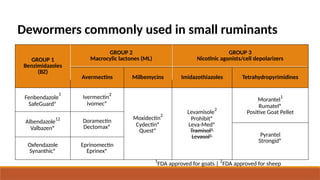
GROUP 1
Benzimidazoles
(BZ)
GROUP 2
Macrocylic lactones (ML)
GROUP 3
Nicotinic agonists/cell depolarizers
Avermectins Milbemycins Imidazothiazoles Tetrahydropyrimidines
Fenbendazole
1
SafeGuard®
Ivermectin
2
Ivomec®
Moxidectin
2
Cydectin®
Quest®
Levamisole
2
Prohibit®
Leva-Med®
Tramisol®
Levasol®
Morantel
1
Rumatel®
Positive Goat Pellet
Albendazole
12
Valbazen®
Doramectin
Dectomax®
Pyrantel
Strongid®
Oxfendazole
Synanthic®
Eprinomectin
Eprinex®
1
FDA approved for goats |
2
FDA approved for sheep
Dewormers commonly used in small ruminants
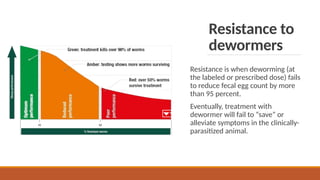
Resistance to
dewormers
Resistance is when deworming (at
the labeled or prescribed dose) fails
to reduce fecal egg count by more
than 95 percent.
Eventually, treatment with
dewormer will fail to “save” or
alleviate symptoms in the clinically-
parasitized animal.

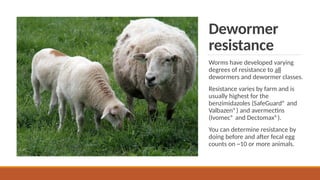
Dewormer
resistance
Worms have developed varying
degrees of resistance to all
dewormers and dewormer classes.
Resistance varies by farm and is
usually highest for the
benzimidazoles (SafeGuard® and
Valbazen®) and avermectins
(Ivomec® and Dectomax®).
You can determine resistance by
doing before and after fecal egg
counts on ~10 or more animals.
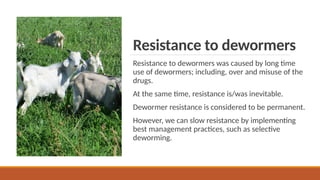
Resistance to dewormers
Resistance to dewormers was caused by long time
use of dewormers; including, over and misuse of the
drugs.
At the same time, resistance is/was inevitable.
Dewormer resistance is considered to be permanent.
However, we can slow resistance by implementing
best management practices, such as selective
deworming.
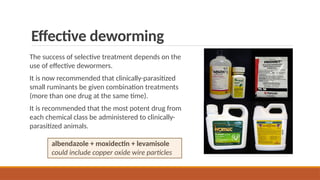
Effective deworming
The success of selective treatment depends on the
use of effective dewormers.
It is now recommended that clinically-parasitized
small ruminants be given combination treatments
(more than one drug at the same time).
It is recommended that the most potent drug from
each chemical class be administered to clinically-
parasitized animals.
albendazole + moxidectin + levamisole
could include copper oxide wire particles
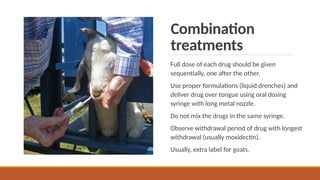
Combination
treatments
Full dose of each drug should be given
sequentially, one after the other.
Use proper formulations (liquid drenches) and
deliver drug over tongue using oral dosing
syringe with long metal nozzle.
Do not mix the drugs in the same syringe.
Observe withdrawal period of drug with longest
withdrawal (usually moxidectin).
Usually, extra label for goats.
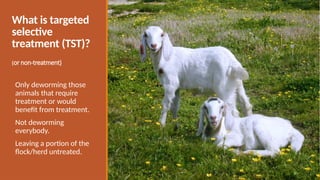
What is targeted
selective
treatment (TST)?
(or non-treatment)
Only deworming those
animals that require
treatment or would
benefit from treatment.
Not deworming
everybody.
Leaving a portion of the
flock/herd untreated.
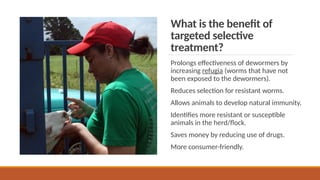
What is the benefit of
targeted selective
treatment?
Prolongs effectiveness of dewormers by
increasing refugia (worms that have not
been exposed to the dewormers).
Reduces selection for resistant worms.
Allows animals to develop natural immunity.
Identifies more resistant or susceptible
animals in the herd/flock.
Saves money by reducing use of drugs.
More consumer-friendly.
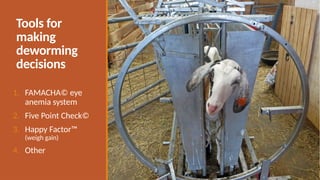
Tools for
making
deworming
decisions
1. FAMACHA© eye
anemia system
2. Five Point Check©
3. Happy Factor™
(weigh gain)
4. Other
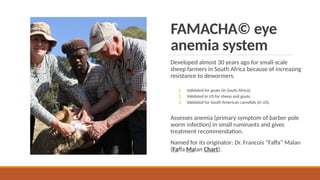
FAMACHA© eye
anemia system
Developed almost 30 years ago for small-scale
sheep farmers in South Africa because of increasing
resistance to dewormers.
1. Validated for goats (in South Africa).
2. Validated in US for sheep and goats.
3. Validated for South American camelids (in US).
Assesses anemia (primary symptom of barber pole
worm infection) in small ruminants and gives
treatment recommendation.
Named for its originator: Dr. Francois “Faffa” Malan
(Faffa Malan Chart).
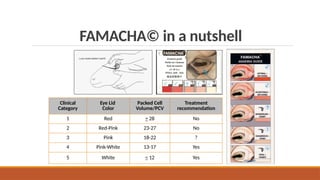
FAMACHA© in a nutshell
Clinical
Category
Eye Lid
Color
Packed Cell
Volume/PCV
Treatment
recommendation
1 Red > 28 No
2 Red-Pink 23-27 No
3 Pink 18-22 ?
4 Pink-White 13-17 Yes
5 White < 12 Yes
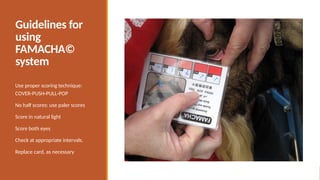
Guidelines for
using
FAMACHA©
system
Use proper scoring technique:
COVER-PUSH-PULL-POP
No half scores: use paler scores
Score in natural light
Score both eyes
Check at appropriate intervals.
Replace card, as necessary
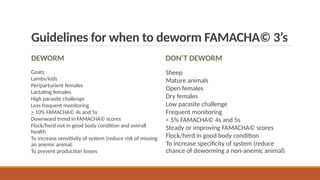
Guidelines for when to deworm FAMACHA© 3’s
DEWORM
Goats
Lambs/kids
Periparturient females
Lactating females
High parasite challenge
Less frequent monitoring
> 10% FAMACHA© 4s and 5s
Downward trend in FAMACHA© scores
Flock/herd not in good body condition and overall
health
To increase sensitivity of system (reduce risk of missing
an anemic animal.
To prevent production losses
DON’T DEWORM
Sheep
Mature animals
Open females
Dry females
Low parasite challenge
Frequent monitoring
< 5% FAMACHA© 4s and 5s
Steady or improving FAMACHA© scores
Flock/herd in good body condition
To increase specificity of system (reduce
chance of deworming a non-anemic animal)
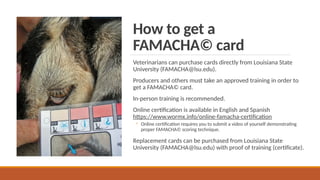
How to get a
FAMACHA© card
Veterinarians can purchase cards directly from Louisiana State
University (FAMACHA@lsu.edu).
Producers and others must take an approved training in order to
get a FAMACHA© card.
In-person training is recommended.
Online certification is available in English and Spanish
https://www.wormx.info/online-famacha-certification
◦ Online certification requires you to submit a video of yourself demonstrating
proper FAMACHA© scoring technique.
Replacement cards can be purchased from Louisiana State
University (FAMACHA@lsu.edu) with proof of training (certificate).
Five Point Check©
Extension of FAMACHA© system developed by
the same South African researchers who
developed the FAMACHA© system.
Adds criteria for evaluating the need for
deworming sheep/goats for other parasites
besides those that cause anemia (blood feeders).
Useful for areas (or times) where/when the
barber pole worm is not the primary parasite.
Also useful for when deciding to deworm
FAMACHA© 3s.
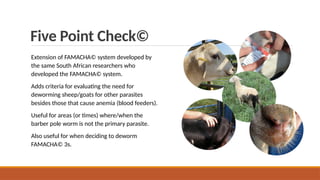
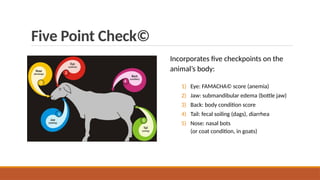
Five Point Check©
Incorporates five checkpoints on the
animal’s body:
1) Eye: FAMACHA© score (anemia)
2) Jaw: submandibular edema (bottle jaw)
3) Back: body condition score
4) Tail: fecal soiling (dags), diarrhea
5) Nose: nasal bots
(or coat condition, in goats)
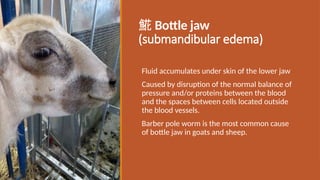
 Bottle jaw
(submandibular edema)
Fluid accumulates under skin of the lower jaw
Caused by disruption of the normal balance of
pressure and/or proteins between the blood
and the spaces between cells located outside
the blood vessels.
Barber pole worm is the most common cause
of bottle jaw in goats and sheep.
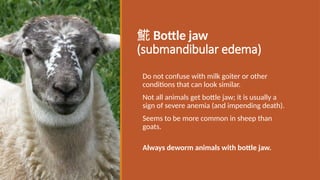
 Bottle jaw
(submandibular edema)
Do not confuse with milk goiter or other
conditions that can look similar.
Not all animals get bottle jaw; it is usually a
sign of severe anemia (and impending death).
Seems to be more common in sheep than
goats.
Always deworm animals with bottle jaw.
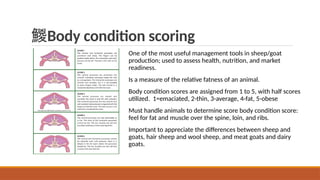
Body condition scoring
One of the most useful management tools in sheep/goat
production; used to assess health, nutrition, and market
readiness.
Is a measure of the relative fatness of an animal.
Body condition scores are assigned from 1 to 5, with half scores
utilized. 1=emaciated, 2-thin, 3-average, 4-fat, 5-obese
Must handle animals to determine score body condition score:
feel for fat and muscle over the spine, loin, and ribs.
Important to appreciate the differences between sheep and
goats, hair sheep and wool sheep, and meat goats and dairy
goats.
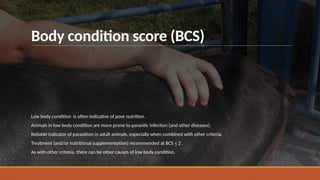
Body condition score (BCS)
Low body condition is often indicative of poor nutrition.
Animals in low body condition are more prone to parasitic infection (and other diseases).
Reliable indicator of parasitism in adult animals, especially when combined with other criteria.
Treatment (and/or nutritional supplementation) recommended at BCS < 2 .
As with other criteria, there can be other causes of low body condition.
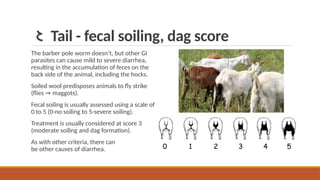
 Tail - fecal soiling, dag score
The barber pole worm doesn’t, but other GI
parasites can cause mild to severe diarrhea,
resulting in the accumulation of feces on the
back side of the animal, including the hocks.
Soiled wool predisposes animals to fly strike
(flies ⇒ maggots).
Fecal soiling is usually assessed using a scale of
0 to 5 (0-no soiling to 5-severe soiling).
Treatment is usually considered at score 3
(moderate soiling and dag formation).
As with other criteria, there can
be other causes of diarrhea.
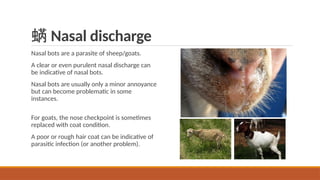
 Nasal discharge
Nasal bots are a parasite of sheep/goats.
A clear or even purulent nasal discharge can
be indicative of nasal bots.
Nasal bots are usually only a minor annoyance
but can become problematic in some
instances.
For goats, the nose checkpoint is sometimes
replaced with coat condition.
A poor or rough hair coat can be indicative of
parasitic infection (or another problem).
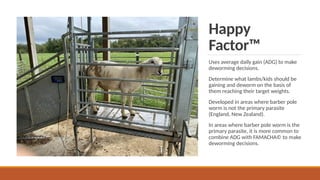
Happy
Factor™
Uses average daily gain (ADG) to make
deworming decisions.
Determine what lambs/kids should be
gaining and deworm on the basis of
them reaching their target weights.
Developed in areas where barber pole
worm is not the primary parasite
(England, New Zealand).
In areas where barber pole worm is the
primary parasite, it is more common to
combine ADG with FAMACHA© to make
deworming decisions.
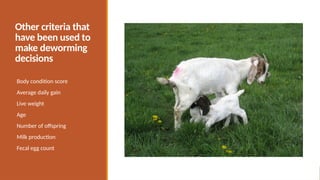
Other criteria that
have been used to
make deworming
decisions
Body condition score
Average daily gain
Live weight
Age
Number of offspring
Milk production
Fecal egg count
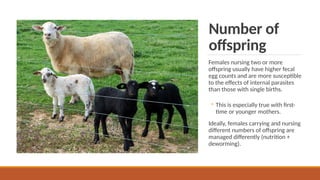
Number of
offspring
Females nursing two or more
offspring usually have higher fecal
egg counts and are more susceptible
to the effects of internal parasites
than those with single births.
◦ This is especially true with first-
time or younger mothers.
Ideally, females carrying and nursing
different numbers of offspring are
managed differently (nutrition +
deworming).
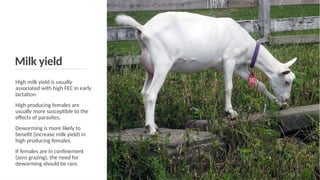
Milk yield
High milk yield is usually
associated with high FEC in early
lactation
High producing females are
usually more susceptible to the
effects of parasites.
Deworming is more likely to
benefit (increase milk yield) in
high producing females.
If females are in confinement
(zero grazing), the need for
deworming should be rare.
What about using fecal egg
counts (FEC, EPG) to make
deworming decisions?
By themselves, FEC should not be used to make deworming
decisions.
There are many limitations to FEC.
FEC is an estimate of worm burden.
FEC is not always highly correlated with other parasite
parameters.
It is better to use fecal egg counts to:
1) Test for dewormer resistance
2) Identify resistant (and susceptible) animals
3) Monitor potential pasture contamination
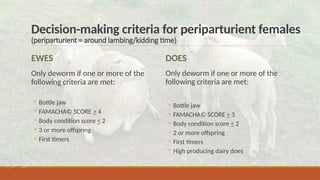
Decision-making criteria for periparturient females
(periparturient = around lambing/kidding time)
EWES
Only deworm if one or more of the
following criteria are met:
◦ Bottle jaw
◦ FAMACHA© SCORE > 4
◦ Body condition score < 2
◦ 3 or more offspring
◦ First timers
DOES
Only deworm if one or more of the
following criteria are met:
◦ Bottle jaw
◦ FAMACHA© SCORE > 3
◦ Body condition score < 2
◦ 2 or more offspring
◦ First timers
◦ High producing dairy does
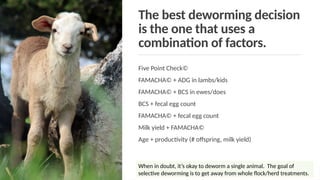
The best deworming decision
is the one that uses a
combination of factors.
Five Point Check©
FAMACHA© + ADG in lambs/kids
FAMACHA© + BCS in ewes/does
BCS + fecal egg count
FAMACHA© + fecal egg count
Milk yield + FAMACHA©
Age + productivity (# offspring, milk yield)
When in doubt, it’s okay to deworm a single animal. The goal of
selective deworming is to get away from whole flock/herd treatments.
Are there times when you should not selectively treat?
In other words, deworm everybody?
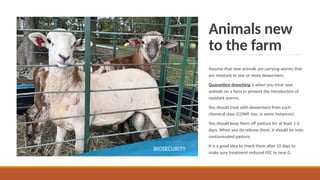
Animals new
to the farm
Assume that new animals are carrying worms that
are resistant to one or more dewormers.
Quarantine drenching is when you treat new
animals on a farm to prevent the introduction of
resistant worms.
You should treat with dewormers from each
chemical class (COWP, too, in some instances).
You should keep them off pasture for at least 1-3
days. When you do release them, it should be onto
contaminated pasture.
It is a good idea to check them after 10 days to
make sure treatment reduced FEC to near 0.
BIOSECURITY
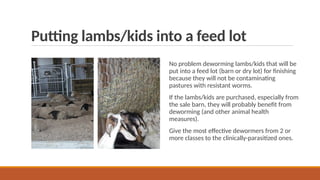
Putting lambs/kids into a feed lot
No problem deworming lambs/kids that will be
put into a feed lot (barn or dry lot) for finishing
because they will not be contaminating
pastures with resistant worms.
If the lambs/kids are purchased, especially from
the sale barn, they will probably benefit from
deworming (and other animal health
measures).
Give the most effective dewormers from 2 or
more classes to the clinically-parasitized ones.
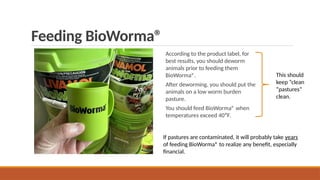
Feeding BioWorma®
According to the product label, for
best results, you should deworm
animals prior to feeding them
BioWorma®.
After deworming, you should put the
animals on a low worm burden
pasture.
You should feed BioWorma® when
temperatures exceed 40°F.
This should
keep “clean
“pastures”
clean.
If pastures are contaminated, it will probably take years
of feeding BioWorma® to realize any benefit, especially
financial.
What if you deworm everyone?
(Example: periparturient ewes/does and lambs/kids at weaning)
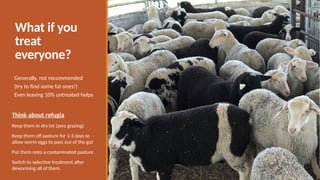
What if you
treat
everyone?
Generally, not recommended
(try to find some fat ones!)
Even leaving 10% untreated helps
Think about refugia
Keep them in dry lot (zero grazing)
Keep them off pasture for 1-3 days to
allow worm eggs to pass out of the gut
Put them onto a contaminated pasture
Switch to selective treatment after
deworming all of them.
Thank you.
Comments?
Questions?
SUSAN SCHOENIAN
Sheep & Goat Specialist Emeritus
University of Maryland Extension
sschoen@umd.edu
* * * * * * * * * * * * * * * * * *
www.sheepandgoat.com
www.sheep101.info
Facebook @ MDSmallRuminant

Selective methods of effective deworming.pptx

  • 1.
    Selective methods of effectivedeworming SUSAN SCHOENIAN SHEEP & GOAT SPECIALIST EMERITUS UNIVERSITY OF MARYLAND EXTENSION SSCHOEN@UMD.EDU
  • 2.
    GROUP 1 Benzimidazoles (BZ) GROUP 2 Macrocyliclactones (ML) GROUP 3 Nicotinic agonists/cell depolarizers Avermectins Milbemycins Imidazothiazoles Tetrahydropyrimidines Fenbendazole 1 SafeGuard® Ivermectin 2 Ivomec® Moxidectin 2 Cydectin® Quest® Levamisole 2 Prohibit® Leva-Med® Tramisol® Levasol® Morantel 1 Rumatel® Positive Goat Pellet Albendazole 12 Valbazen® Doramectin Dectomax® Pyrantel Strongid® Oxfendazole Synanthic® Eprinomectin Eprinex® 1 FDA approved for goats | 2 FDA approved for sheep Dewormers commonly used in small ruminants
  • 3.
    Resistance to dewormers Resistance iswhen deworming (at the labeled or prescribed dose) fails to reduce fecal egg count by more than 95 percent. Eventually, treatment with dewormer will fail to “save” or alleviate symptoms in the clinically- parasitized animal. 
  • 4.
    Dewormer resistance Worms have developedvarying degrees of resistance to all dewormers and dewormer classes. Resistance varies by farm and is usually highest for the benzimidazoles (SafeGuard® and Valbazen®) and avermectins (Ivomec® and Dectomax®). You can determine resistance by doing before and after fecal egg counts on ~10 or more animals.
  • 5.
    Resistance to dewormers Resistanceto dewormers was caused by long time use of dewormers; including, over and misuse of the drugs. At the same time, resistance is/was inevitable. Dewormer resistance is considered to be permanent. However, we can slow resistance by implementing best management practices, such as selective deworming.
  • 6.
    Effective deworming The successof selective treatment depends on the use of effective dewormers. It is now recommended that clinically-parasitized small ruminants be given combination treatments (more than one drug at the same time). It is recommended that the most potent drug from each chemical class be administered to clinically- parasitized animals. albendazole + moxidectin + levamisole could include copper oxide wire particles
  • 7.
    Combination treatments Full dose ofeach drug should be given sequentially, one after the other. Use proper formulations (liquid drenches) and deliver drug over tongue using oral dosing syringe with long metal nozzle. Do not mix the drugs in the same syringe. Observe withdrawal period of drug with longest withdrawal (usually moxidectin). Usually, extra label for goats.
  • 8.
    What is targeted selective treatment(TST)? (or non-treatment) Only deworming those animals that require treatment or would benefit from treatment. Not deworming everybody. Leaving a portion of the flock/herd untreated.
  • 9.
    What is thebenefit of targeted selective treatment? Prolongs effectiveness of dewormers by increasing refugia (worms that have not been exposed to the dewormers). Reduces selection for resistant worms. Allows animals to develop natural immunity. Identifies more resistant or susceptible animals in the herd/flock. Saves money by reducing use of drugs. More consumer-friendly.
  • 10.
    Tools for making deworming decisions 1. FAMACHA©eye anemia system 2. Five Point Check© 3. Happy Factor™ (weigh gain) 4. Other
  • 11.
    FAMACHA© eye anemia system Developedalmost 30 years ago for small-scale sheep farmers in South Africa because of increasing resistance to dewormers. 1. Validated for goats (in South Africa). 2. Validated in US for sheep and goats. 3. Validated for South American camelids (in US). Assesses anemia (primary symptom of barber pole worm infection) in small ruminants and gives treatment recommendation. Named for its originator: Dr. Francois “Faffa” Malan (Faffa Malan Chart).
  • 12.
    FAMACHA© in anutshell Clinical Category Eye Lid Color Packed Cell Volume/PCV Treatment recommendation 1 Red > 28 No 2 Red-Pink 23-27 No 3 Pink 18-22 ? 4 Pink-White 13-17 Yes 5 White < 12 Yes
  • 13.
    Guidelines for using FAMACHA© system Use properscoring technique: COVER-PUSH-PULL-POP No half scores: use paler scores Score in natural light Score both eyes Check at appropriate intervals. Replace card, as necessary
  • 14.
    Guidelines for whento deworm FAMACHA© 3’s DEWORM Goats Lambs/kids Periparturient females Lactating females High parasite challenge Less frequent monitoring > 10% FAMACHA© 4s and 5s Downward trend in FAMACHA© scores Flock/herd not in good body condition and overall health To increase sensitivity of system (reduce risk of missing an anemic animal. To prevent production losses DON’T DEWORM Sheep Mature animals Open females Dry females Low parasite challenge Frequent monitoring < 5% FAMACHA© 4s and 5s Steady or improving FAMACHA© scores Flock/herd in good body condition To increase specificity of system (reduce chance of deworming a non-anemic animal)
  • 15.
    How to geta FAMACHA© card Veterinarians can purchase cards directly from Louisiana State University (FAMACHA@lsu.edu). Producers and others must take an approved training in order to get a FAMACHA© card. In-person training is recommended. Online certification is available in English and Spanish https://www.wormx.info/online-famacha-certification ◦ Online certification requires you to submit a video of yourself demonstrating proper FAMACHA© scoring technique. Replacement cards can be purchased from Louisiana State University (FAMACHA@lsu.edu) with proof of training (certificate).
  • 16.
    Five Point Check© Extensionof FAMACHA© system developed by the same South African researchers who developed the FAMACHA© system. Adds criteria for evaluating the need for deworming sheep/goats for other parasites besides those that cause anemia (blood feeders). Useful for areas (or times) where/when the barber pole worm is not the primary parasite. Also useful for when deciding to deworm FAMACHA© 3s.
  • 17.
    Five Point Check© Incorporatesfive checkpoints on the animal’s body: 1) Eye: FAMACHA© score (anemia) 2) Jaw: submandibular edema (bottle jaw) 3) Back: body condition score 4) Tail: fecal soiling (dags), diarrhea 5) Nose: nasal bots (or coat condition, in goats)
  • 18.
     Bottle jaw (submandibularedema) Fluid accumulates under skin of the lower jaw Caused by disruption of the normal balance of pressure and/or proteins between the blood and the spaces between cells located outside the blood vessels. Barber pole worm is the most common cause of bottle jaw in goats and sheep.
  • 19.
     Bottle jaw (submandibularedema) Do not confuse with milk goiter or other conditions that can look similar. Not all animals get bottle jaw; it is usually a sign of severe anemia (and impending death). Seems to be more common in sheep than goats. Always deworm animals with bottle jaw.
  • 20.
    Body condition scoring Oneof the most useful management tools in sheep/goat production; used to assess health, nutrition, and market readiness. Is a measure of the relative fatness of an animal. Body condition scores are assigned from 1 to 5, with half scores utilized. 1=emaciated, 2-thin, 3-average, 4-fat, 5-obese Must handle animals to determine score body condition score: feel for fat and muscle over the spine, loin, and ribs. Important to appreciate the differences between sheep and goats, hair sheep and wool sheep, and meat goats and dairy goats.
  • 21.
    Body condition score(BCS) Low body condition is often indicative of poor nutrition. Animals in low body condition are more prone to parasitic infection (and other diseases). Reliable indicator of parasitism in adult animals, especially when combined with other criteria. Treatment (and/or nutritional supplementation) recommended at BCS < 2 . As with other criteria, there can be other causes of low body condition.
  • 22.
     Tail -fecal soiling, dag score The barber pole worm doesn’t, but other GI parasites can cause mild to severe diarrhea, resulting in the accumulation of feces on the back side of the animal, including the hocks. Soiled wool predisposes animals to fly strike (flies ⇒ maggots). Fecal soiling is usually assessed using a scale of 0 to 5 (0-no soiling to 5-severe soiling). Treatment is usually considered at score 3 (moderate soiling and dag formation). As with other criteria, there can be other causes of diarrhea.
  • 23.
     Nasal discharge Nasalbots are a parasite of sheep/goats. A clear or even purulent nasal discharge can be indicative of nasal bots. Nasal bots are usually only a minor annoyance but can become problematic in some instances. For goats, the nose checkpoint is sometimes replaced with coat condition. A poor or rough hair coat can be indicative of parasitic infection (or another problem).
  • 24.
    Happy Factor™ Uses average dailygain (ADG) to make deworming decisions. Determine what lambs/kids should be gaining and deworm on the basis of them reaching their target weights. Developed in areas where barber pole worm is not the primary parasite (England, New Zealand). In areas where barber pole worm is the primary parasite, it is more common to combine ADG with FAMACHA© to make deworming decisions.
  • 25.
    Other criteria that havebeen used to make deworming decisions Body condition score Average daily gain Live weight Age Number of offspring Milk production Fecal egg count
  • 26.
    Number of offspring Females nursingtwo or more offspring usually have higher fecal egg counts and are more susceptible to the effects of internal parasites than those with single births. ◦ This is especially true with first- time or younger mothers. Ideally, females carrying and nursing different numbers of offspring are managed differently (nutrition + deworming).
  • 27.
    Milk yield High milkyield is usually associated with high FEC in early lactation High producing females are usually more susceptible to the effects of parasites. Deworming is more likely to benefit (increase milk yield) in high producing females. If females are in confinement (zero grazing), the need for deworming should be rare.
  • 28.
    What about usingfecal egg counts (FEC, EPG) to make deworming decisions? By themselves, FEC should not be used to make deworming decisions. There are many limitations to FEC. FEC is an estimate of worm burden. FEC is not always highly correlated with other parasite parameters. It is better to use fecal egg counts to: 1) Test for dewormer resistance 2) Identify resistant (and susceptible) animals 3) Monitor potential pasture contamination
  • 29.
    Decision-making criteria forperiparturient females (periparturient = around lambing/kidding time) EWES Only deworm if one or more of the following criteria are met: ◦ Bottle jaw ◦ FAMACHA© SCORE > 4 ◦ Body condition score < 2 ◦ 3 or more offspring ◦ First timers DOES Only deworm if one or more of the following criteria are met: ◦ Bottle jaw ◦ FAMACHA© SCORE > 3 ◦ Body condition score < 2 ◦ 2 or more offspring ◦ First timers ◦ High producing dairy does
  • 30.
    The best dewormingdecision is the one that uses a combination of factors. Five Point Check© FAMACHA© + ADG in lambs/kids FAMACHA© + BCS in ewes/does BCS + fecal egg count FAMACHA© + fecal egg count Milk yield + FAMACHA© Age + productivity (# offspring, milk yield) When in doubt, it’s okay to deworm a single animal. The goal of selective deworming is to get away from whole flock/herd treatments.
  • 31.
    Are there timeswhen you should not selectively treat? In other words, deworm everybody?
  • 32.
    Animals new to thefarm Assume that new animals are carrying worms that are resistant to one or more dewormers. Quarantine drenching is when you treat new animals on a farm to prevent the introduction of resistant worms. You should treat with dewormers from each chemical class (COWP, too, in some instances). You should keep them off pasture for at least 1-3 days. When you do release them, it should be onto contaminated pasture. It is a good idea to check them after 10 days to make sure treatment reduced FEC to near 0. BIOSECURITY
  • 33.
    Putting lambs/kids intoa feed lot No problem deworming lambs/kids that will be put into a feed lot (barn or dry lot) for finishing because they will not be contaminating pastures with resistant worms. If the lambs/kids are purchased, especially from the sale barn, they will probably benefit from deworming (and other animal health measures). Give the most effective dewormers from 2 or more classes to the clinically-parasitized ones.
  • 34.
    Feeding BioWorma® According tothe product label, for best results, you should deworm animals prior to feeding them BioWorma®. After deworming, you should put the animals on a low worm burden pasture. You should feed BioWorma® when temperatures exceed 40°F. This should keep “clean “pastures” clean. If pastures are contaminated, it will probably take years of feeding BioWorma® to realize any benefit, especially financial.
  • 35.
    What if youdeworm everyone? (Example: periparturient ewes/does and lambs/kids at weaning)
  • 36.
    What if you treat everyone? Generally,not recommended (try to find some fat ones!) Even leaving 10% untreated helps Think about refugia Keep them in dry lot (zero grazing) Keep them off pasture for 1-3 days to allow worm eggs to pass out of the gut Put them onto a contaminated pasture Switch to selective treatment after deworming all of them.
  • 37.
    Thank you. Comments? Questions? SUSAN SCHOENIAN Sheep& Goat Specialist Emeritus University of Maryland Extension sschoen@umd.edu * * * * * * * * * * * * * * * * * * www.sheepandgoat.com www.sheep101.info Facebook @ MDSmallRuminant