Dr Muhammad Ashiq Toor
DVM , B s c (Zoology)
Islamia University of Bahawal Pur (IUB)
(2010 – 2015)
+92-344-499-7375
+92-300-364-2402
Feeding practices in small ruminants
 During feeding of sheep nutritional requirment
should be met during different physiological
stages like growth , pre - weaning , post
weaning , finishing , pregnancy , lactation and
breeding .
 The practice of providing supplemental feed to
nursing lambs in an area is called creep feeding .
 Lambs start creep feeding 10 - 40 days of age .
 Up to 10 - 12 weeks of age suckling lambs should
be supplemented with creep ration . Its
consumption is affected by palatibility , location
and environment of creep area .
 In 100 kg of creep mixture adequate quantity of
vitamins and oral anti -biotic ( powder ) should be
added .
 Fish meal and meat meal replace by groundnut
cake , soybean cake and linseed cake .
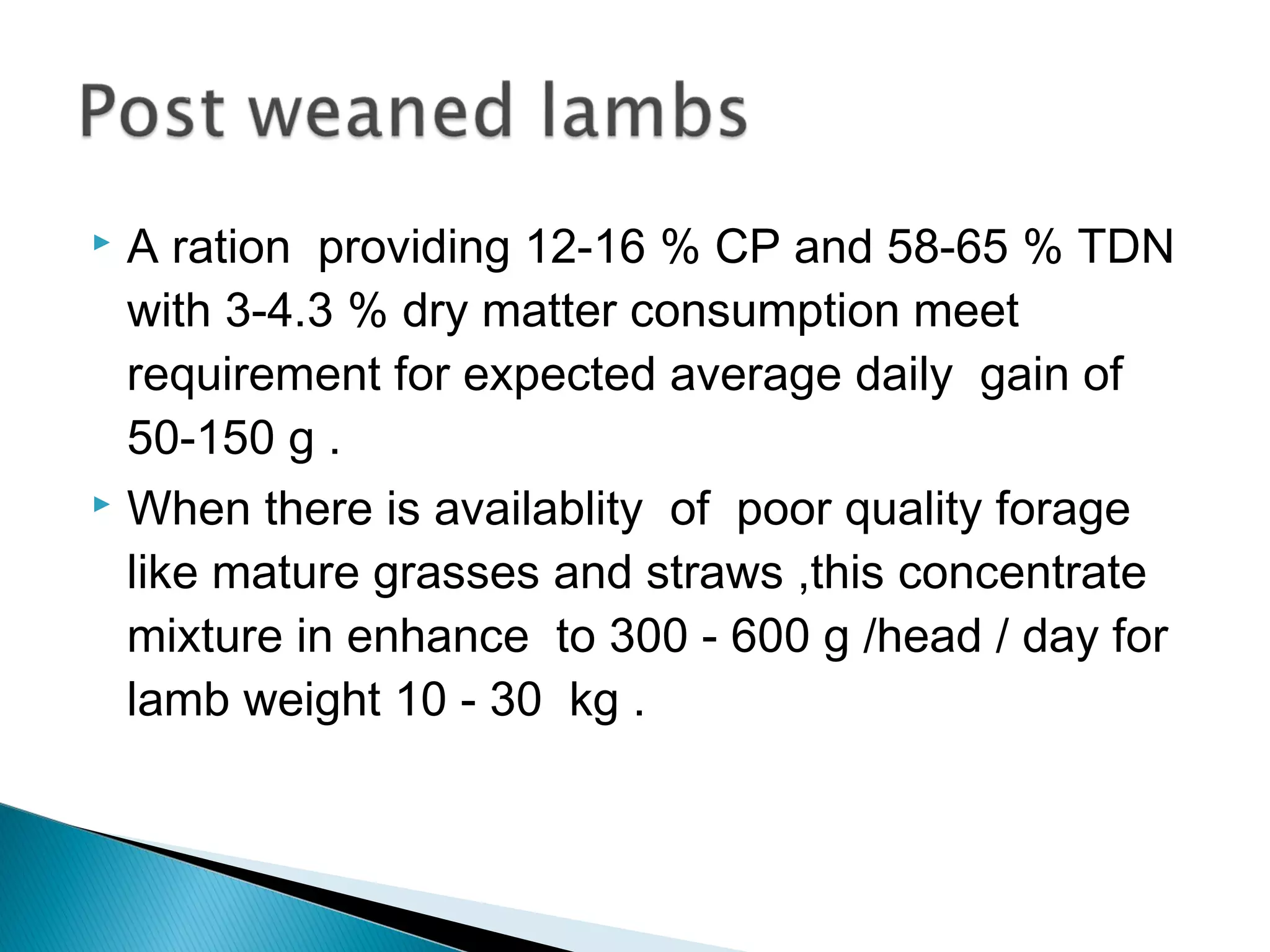
 A ration providing 12-16 % CP and 58-65 % TDN
with 3-4.3 % dry matter consumption meet
requirement for expected average daily gain of
50-150 g .
 When there is availablity of poor quality forage
like mature grasses and straws ,this concentrate
mixture in enhance to 300 - 600 g /head / day for
lamb weight 10 - 30 kg .
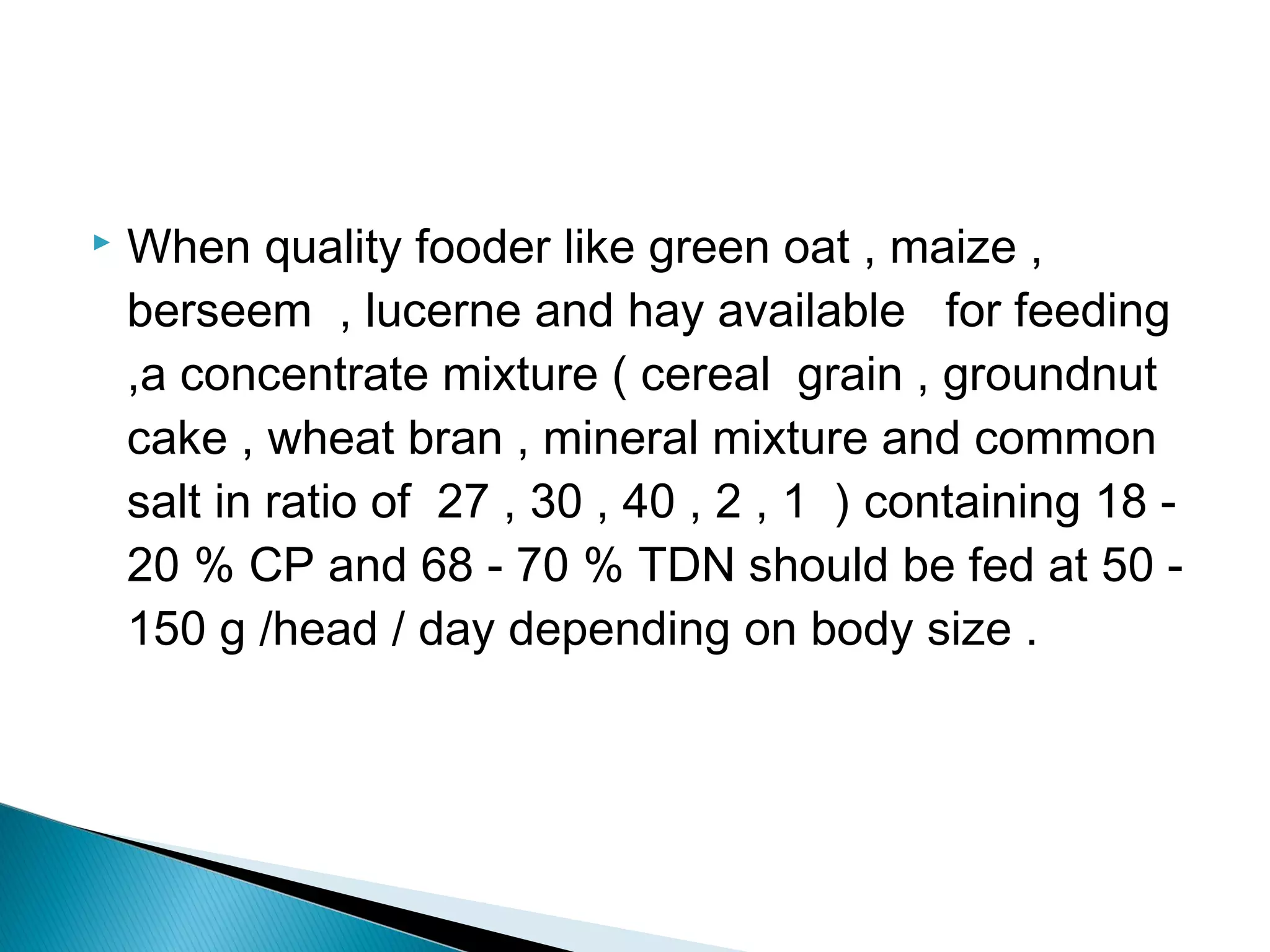
 When quality fooder like green oat , maize ,
berseem , lucerne and hay available for feeding
,a concentrate mixture ( cereal grain , groundnut
cake , wheat bran , mineral mixture and common
salt in ratio of 27 , 30 , 40 , 2 , 1 ) containing 18 -
20 % CP and 68 - 70 % TDN should be fed at 50 -
150 g /head / day depending on body size .
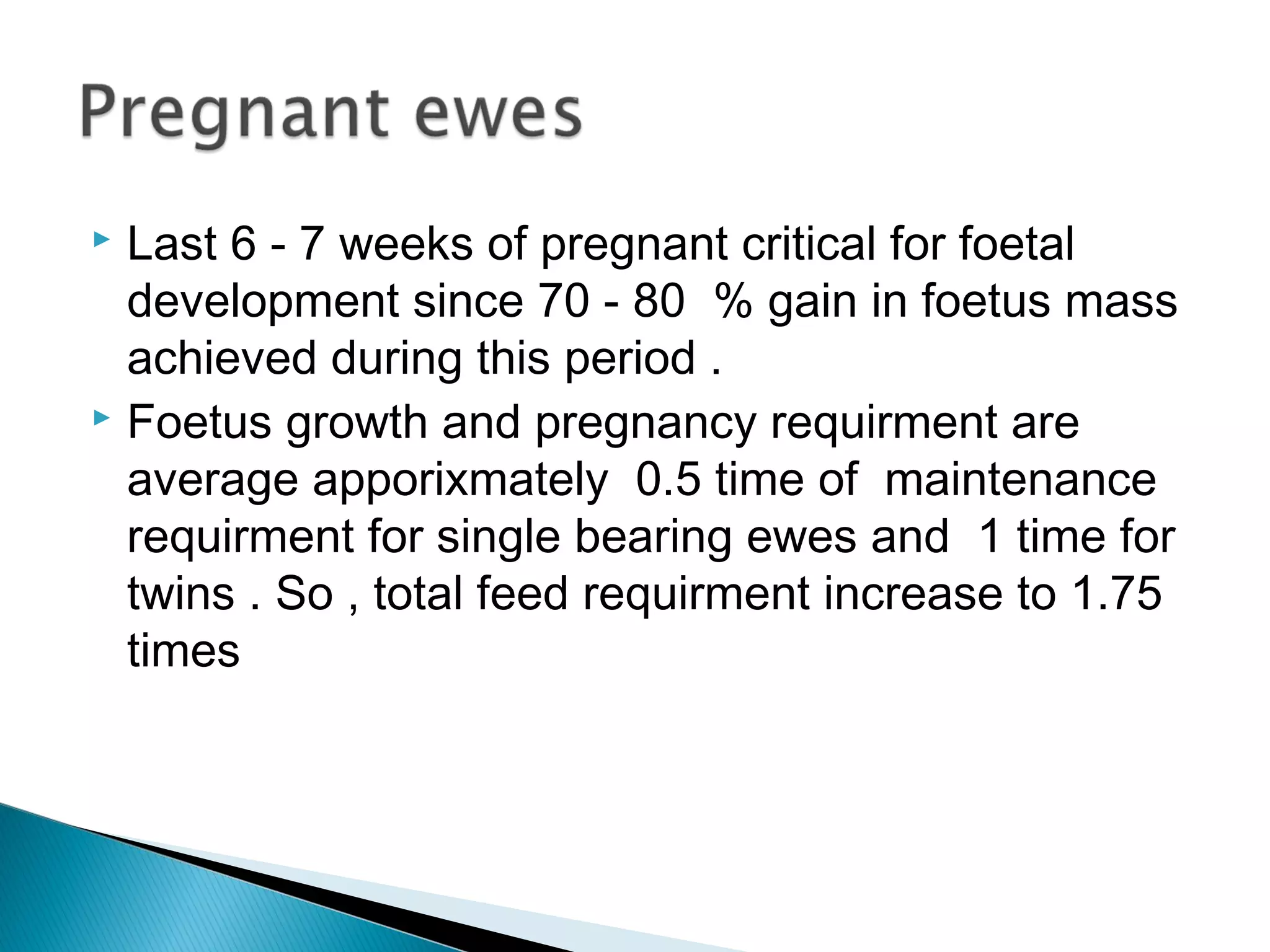
 Last 6 - 7 weeks of pregnant critical for foetal
development since 70 - 80 % gain in foetus mass
achieved during this period .
 Foetus growth and pregnancy requirment are
average apporixmately 0.5 time of maintenance
requirment for single bearing ewes and 1 time for
twins . So , total feed requirment increase to 1.75
times
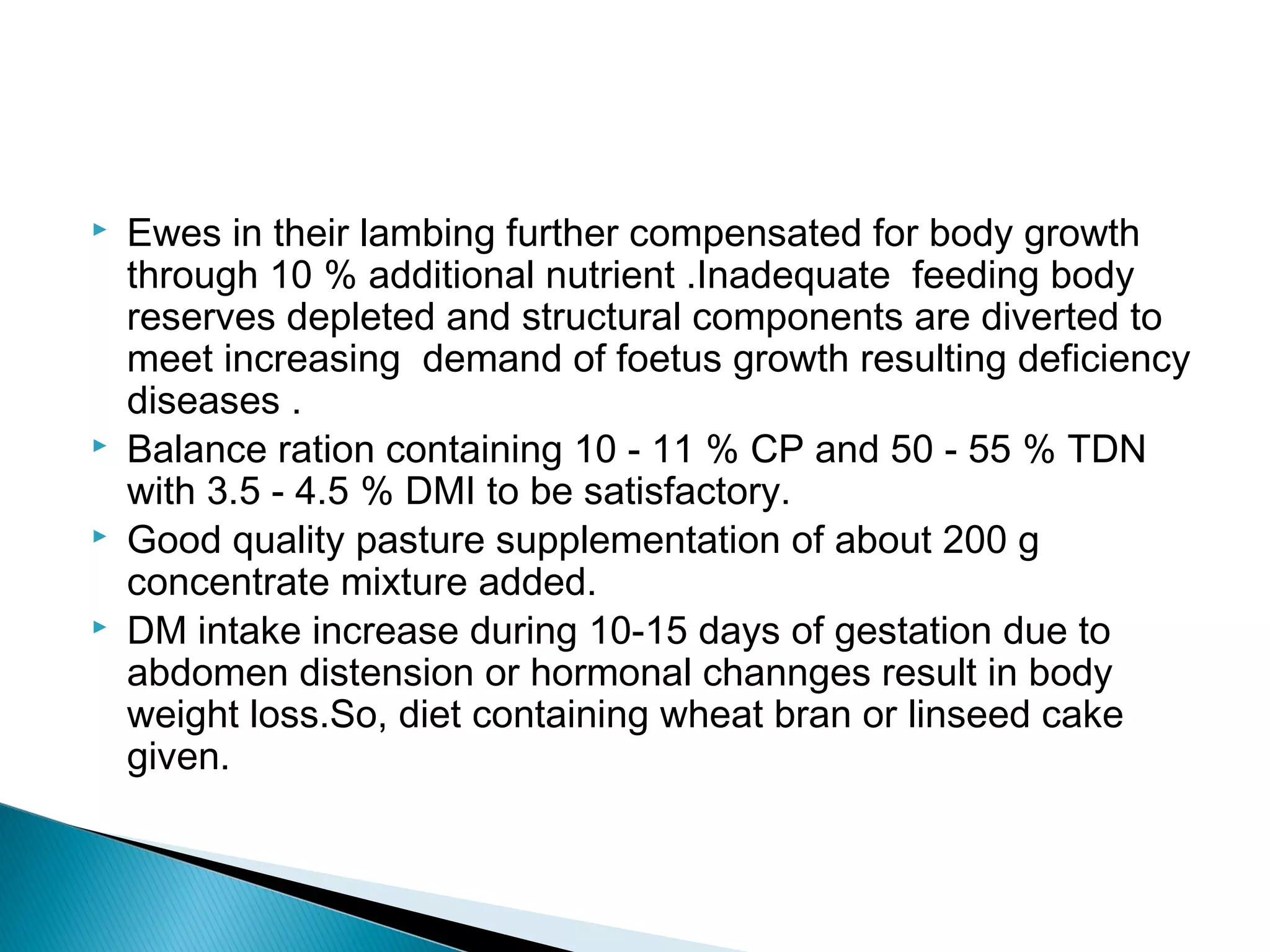
 Ewes in their lambing further compensated for body growth
through 10 % additional nutrient .Inadequate feeding body
reserves depleted and structural components are diverted to
meet increasing demand of foetus growth resulting deficiency
diseases .
 Balance ration containing 10 - 11 % CP and 50 - 55 % TDN
with 3.5 - 4.5 % DMI to be satisfactory.
 Good quality pasture supplementation of about 200 g
concentrate mixture added.
 DM intake increase during 10-15 days of gestation due to
abdomen distension or hormonal channges result in body
weight loss.So, diet containing wheat bran or linseed cake
given.
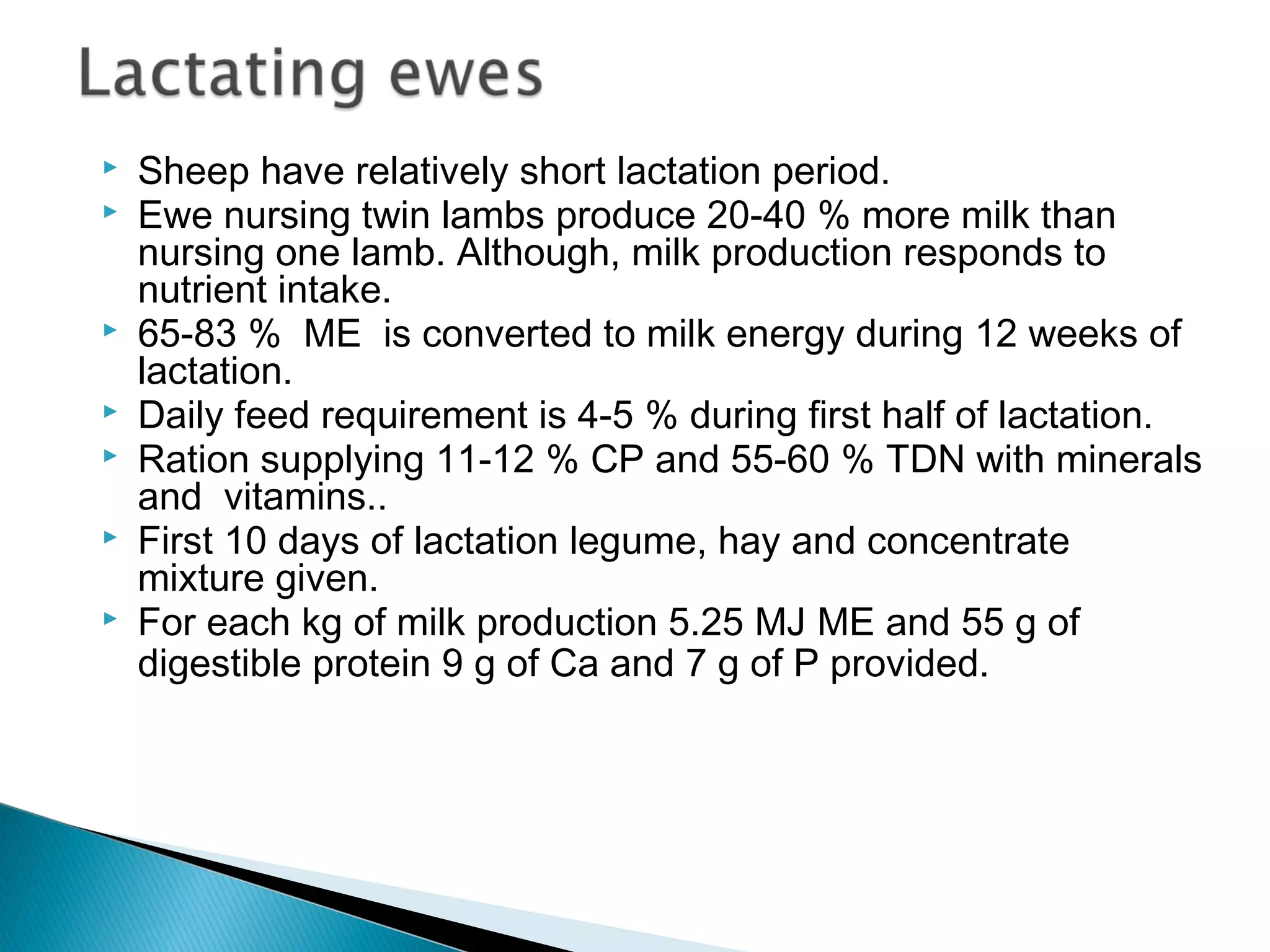
 Sheep have relatively short lactation period.
 Ewe nursing twin lambs produce 20-40 % more milk than
nursing one lamb. Although, milk production responds to
nutrient intake.
 65-83 % ME is converted to milk energy during 12 weeks of
lactation.
 Daily feed requirement is 4-5 % during first half of lactation.
 Ration supplying 11-12 % CP and 55-60 % TDN with minerals
and vitamins..
 First 10 days of lactation legume, hay and concentrate
mixture given.
 For each kg of milk production 5.25 MJ ME and 55 g of
digestible protein 9 g of Ca and 7 g of P provided.
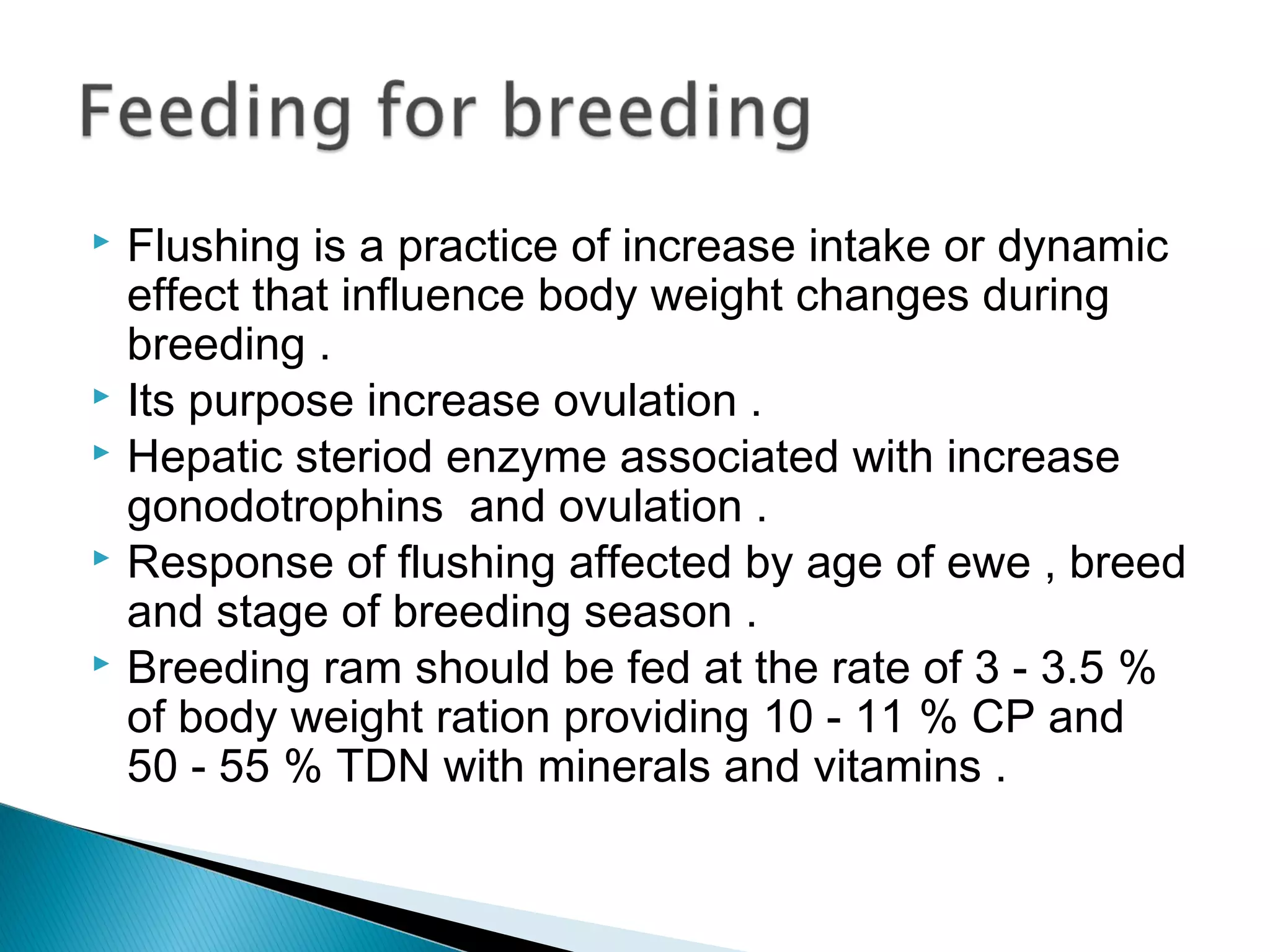
 Flushing is a practice of increase intake or dynamic
effect that influence body weight changes during
breeding .
 Its purpose increase ovulation .
 Hepatic steriod enzyme associated with increase
gonodotrophins and ovulation .
 Response of flushing affected by age of ewe , breed
and stage of breeding season .
 Breeding ram should be fed at the rate of 3 - 3.5 %
of body weight ration providing 10 - 11 % CP and
50 - 55 % TDN with minerals and vitamins .
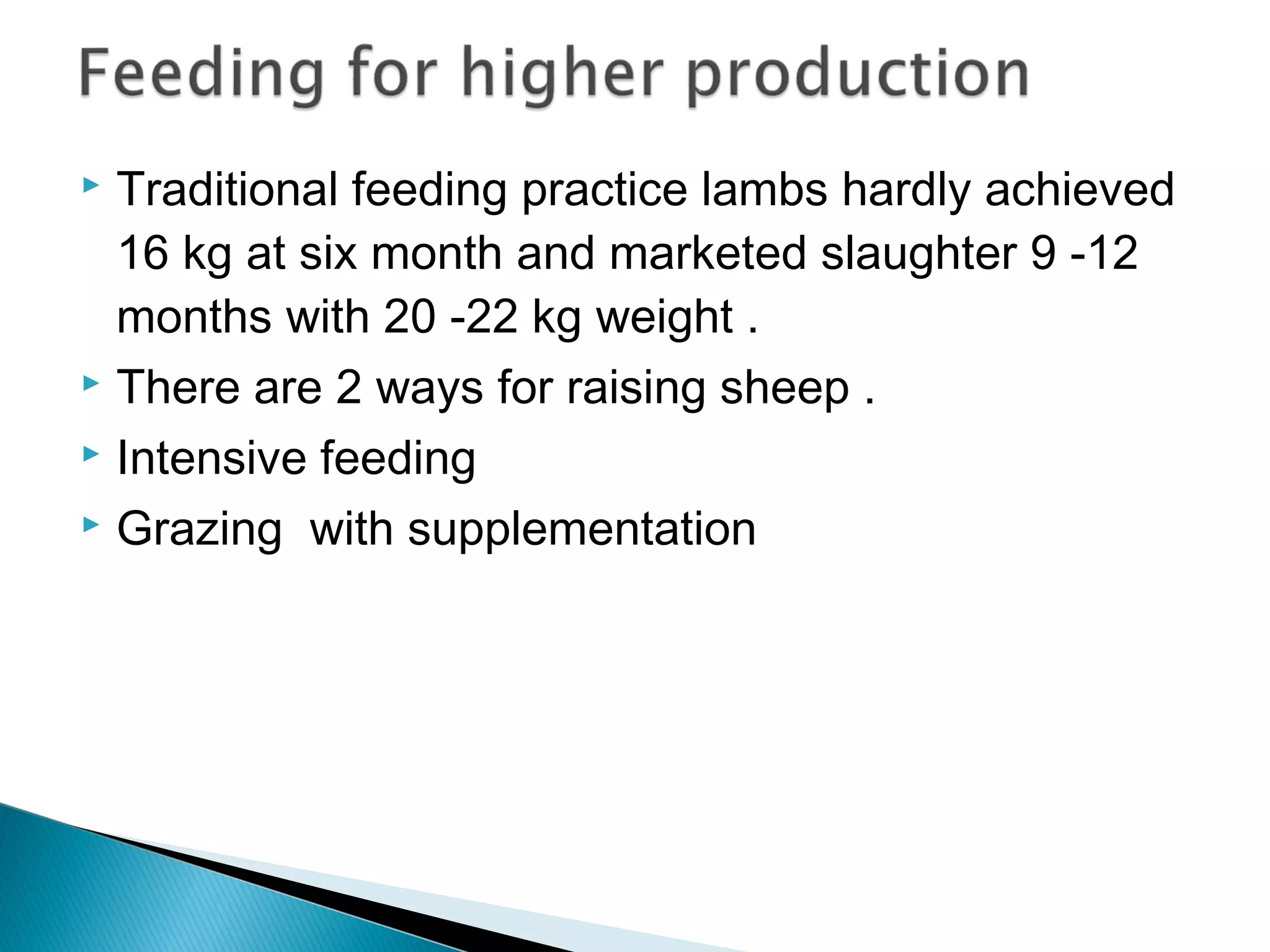
 Traditional feeding practice lambs hardly achieved
16 kg at six month and marketed slaughter 9 -12
months with 20 -22 kg weight .
 There are 2 ways for raising sheep .
 Intensive feeding
 Grazing with supplementation
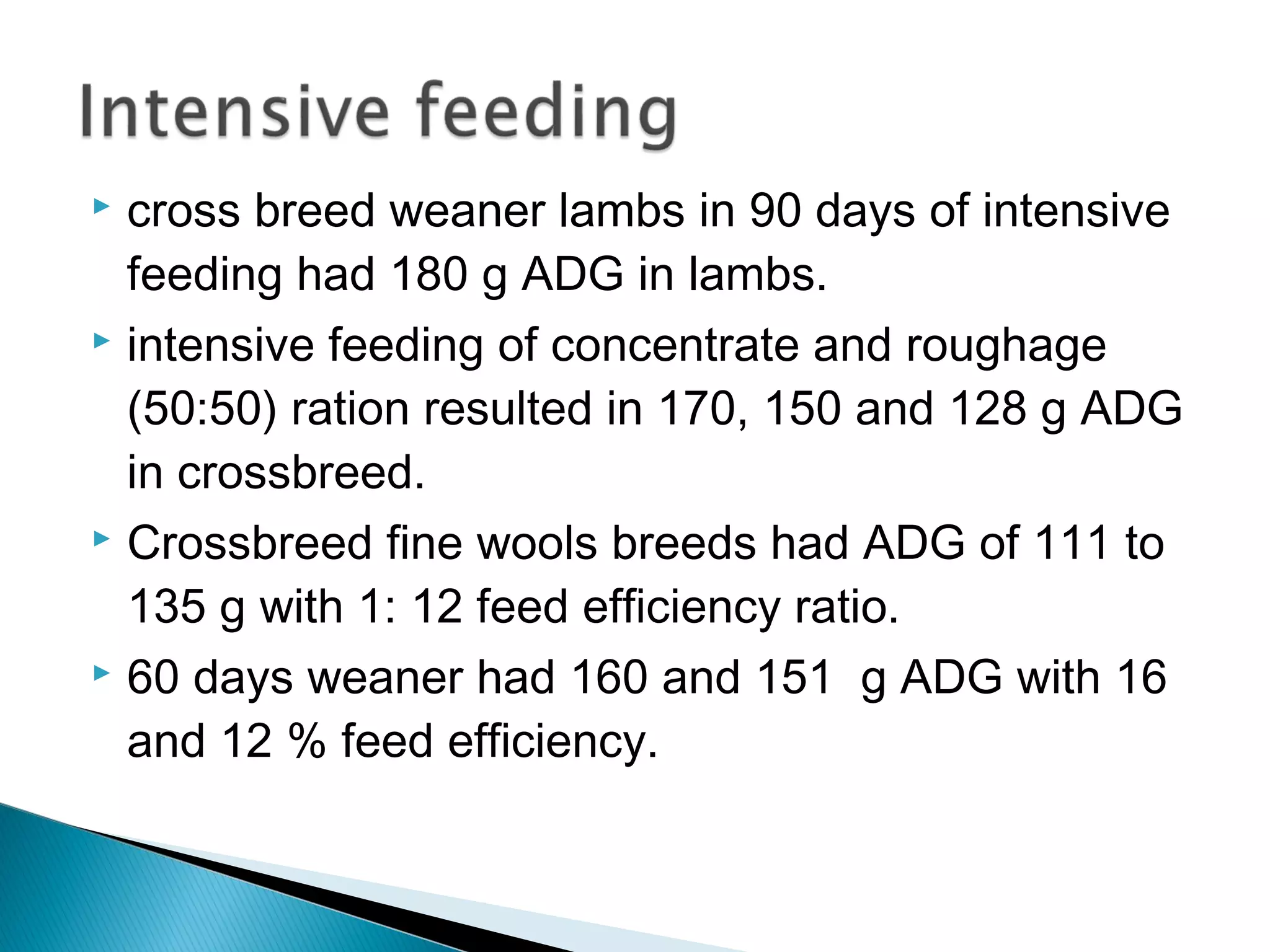
 cross breed weaner lambs in 90 days of intensive
feeding had 180 g ADG in lambs.
 intensive feeding of concentrate and roughage
(50:50) ration resulted in 170, 150 and 128 g ADG
in crossbreed.
 Crossbreed fine wools breeds had ADG of 111 to
135 g with 1: 12 feed efficiency ratio.
 60 days weaner had 160 and 151 g ADG with 16
and 12 % feed efficiency.
 Free grazing on rangeland limited amount of
concentrate at 1.5-2 % of body would provide 25-
30 kg weight at 6-9 months.
 grazzing with supplementation on established
pasture has potential of still higher production.
 supplementation at 1.5 % of body weight provided
27.3 kg weight in lambbs.

 Feeding behaviour of goat is more complex than
other ruminants.
 They frequently to eat as leaves and stem.
 Daily time spent in eating by goats generally
exceed than sheep. They eat round clock.
 During stall feeding refusal is 50 % .
 They choose more leaves than stem. Quantity of
ration is high when poor quality.
 Time spent in ruminating shorter than sheep
during day. Goats ruminate more during night.
 Goats vary to choose feed.
 They refuse badly conserved feeds , rapeseed
meal , urea or high level of minerals . These
problems increase in yielder .
 Specific design are used to minimize spoiling and
wastage of feed .
 Goats prefer browsing then grazing . They pluck
tender leaves of plants .
 They will accept wide range of feed . But what is
acceptable to one goat is not always accepted to
others .
 Appetite of goat for any given concentrate fed in
quantities 0.45 - 0.91 kg / day .
 They distinguish various taste and have higher
tolerance for bitter taste than cattle
 Higher intake of grass are normal when grazing in
improved pasture , while large percentage of
weeds are consumed when browsing over waste
land .
Over 80 % of their feed intake consist of leaves
of shrub and bushes when living in bush country .
 Hay , pasture and concentrate supplements are
required for lactation by milking does .Much skilled
is required for formulating adequate ration .
 Goats are very selective feeder . They choice
carefully , kind of plant vegetation and parts
ingested of each plant , which varies with season .
 Goats discontinue grazing at minor disturbance
like rain or appearnce of unknown man.
 It is impossible to make better utilization of
pasture by maintaining high animal density to
obtain greater competition between animals
 Choice behaviour is disadvantage in intensive
pasture but it is favourable in rangeland .
 Goats move , climb up . down for nutritive plants.
They can stand on hind legs to consume foliage
that unfavourable to sheep.
 Independent of range quality ,goats and other
ruminants prefer vegetative fraction with leaf/stem,
seed/leaf ratio , low fiber and high protein content
.
 Preference of goats for herbaceous strata
especially for grasses becomes evident when
grasses are growing .
 After desiccation of annual species goats go to
low bushes.
 Goats do not prefer woody vegetation but they
accept and consume it more easily than sheep .
 Goats adapt better than sheep and cattle in arid
even desert areas

Feeding practices in small ruminants

  • 1.
    Dr Muhammad AshiqToor DVM , B s c (Zoology) Islamia University of Bahawal Pur (IUB) (2010 – 2015) +92-344-499-7375 +92-300-364-2402 Feeding practices in small ruminants
  • 2.
     During feedingof sheep nutritional requirment should be met during different physiological stages like growth , pre - weaning , post weaning , finishing , pregnancy , lactation and breeding .
  • 3.
     The practiceof providing supplemental feed to nursing lambs in an area is called creep feeding .  Lambs start creep feeding 10 - 40 days of age .  Up to 10 - 12 weeks of age suckling lambs should be supplemented with creep ration . Its consumption is affected by palatibility , location and environment of creep area .
  • 4.
     In 100kg of creep mixture adequate quantity of vitamins and oral anti -biotic ( powder ) should be added .  Fish meal and meat meal replace by groundnut cake , soybean cake and linseed cake .
  • 5.
     A rationproviding 12-16 % CP and 58-65 % TDN with 3-4.3 % dry matter consumption meet requirement for expected average daily gain of 50-150 g .  When there is availablity of poor quality forage like mature grasses and straws ,this concentrate mixture in enhance to 300 - 600 g /head / day for lamb weight 10 - 30 kg .
  • 6.
     When qualityfooder like green oat , maize , berseem , lucerne and hay available for feeding ,a concentrate mixture ( cereal grain , groundnut cake , wheat bran , mineral mixture and common salt in ratio of 27 , 30 , 40 , 2 , 1 ) containing 18 - 20 % CP and 68 - 70 % TDN should be fed at 50 - 150 g /head / day depending on body size .
  • 7.
     Last 6- 7 weeks of pregnant critical for foetal development since 70 - 80 % gain in foetus mass achieved during this period .  Foetus growth and pregnancy requirment are average apporixmately 0.5 time of maintenance requirment for single bearing ewes and 1 time for twins . So , total feed requirment increase to 1.75 times
  • 8.
     Ewes intheir lambing further compensated for body growth through 10 % additional nutrient .Inadequate feeding body reserves depleted and structural components are diverted to meet increasing demand of foetus growth resulting deficiency diseases .  Balance ration containing 10 - 11 % CP and 50 - 55 % TDN with 3.5 - 4.5 % DMI to be satisfactory.  Good quality pasture supplementation of about 200 g concentrate mixture added.  DM intake increase during 10-15 days of gestation due to abdomen distension or hormonal channges result in body weight loss.So, diet containing wheat bran or linseed cake given.
  • 9.
     Sheep haverelatively short lactation period.  Ewe nursing twin lambs produce 20-40 % more milk than nursing one lamb. Although, milk production responds to nutrient intake.  65-83 % ME is converted to milk energy during 12 weeks of lactation.  Daily feed requirement is 4-5 % during first half of lactation.  Ration supplying 11-12 % CP and 55-60 % TDN with minerals and vitamins..  First 10 days of lactation legume, hay and concentrate mixture given.  For each kg of milk production 5.25 MJ ME and 55 g of digestible protein 9 g of Ca and 7 g of P provided.
  • 10.
     Flushing isa practice of increase intake or dynamic effect that influence body weight changes during breeding .  Its purpose increase ovulation .  Hepatic steriod enzyme associated with increase gonodotrophins and ovulation .  Response of flushing affected by age of ewe , breed and stage of breeding season .  Breeding ram should be fed at the rate of 3 - 3.5 % of body weight ration providing 10 - 11 % CP and 50 - 55 % TDN with minerals and vitamins .
  • 11.
     Traditional feedingpractice lambs hardly achieved 16 kg at six month and marketed slaughter 9 -12 months with 20 -22 kg weight .  There are 2 ways for raising sheep .  Intensive feeding  Grazing with supplementation
  • 12.
     cross breedweaner lambs in 90 days of intensive feeding had 180 g ADG in lambs.  intensive feeding of concentrate and roughage (50:50) ration resulted in 170, 150 and 128 g ADG in crossbreed.  Crossbreed fine wools breeds had ADG of 111 to 135 g with 1: 12 feed efficiency ratio.  60 days weaner had 160 and 151 g ADG with 16 and 12 % feed efficiency.
  • 13.
     Free grazingon rangeland limited amount of concentrate at 1.5-2 % of body would provide 25- 30 kg weight at 6-9 months.  grazzing with supplementation on established pasture has potential of still higher production.  supplementation at 1.5 % of body weight provided 27.3 kg weight in lambbs. 
  • 14.
     Feeding behaviourof goat is more complex than other ruminants.  They frequently to eat as leaves and stem.  Daily time spent in eating by goats generally exceed than sheep. They eat round clock.  During stall feeding refusal is 50 % .
  • 15.
     They choosemore leaves than stem. Quantity of ration is high when poor quality.  Time spent in ruminating shorter than sheep during day. Goats ruminate more during night.  Goats vary to choose feed.  They refuse badly conserved feeds , rapeseed meal , urea or high level of minerals . These problems increase in yielder .
  • 16.
     Specific designare used to minimize spoiling and wastage of feed .  Goats prefer browsing then grazing . They pluck tender leaves of plants .  They will accept wide range of feed . But what is acceptable to one goat is not always accepted to others .  Appetite of goat for any given concentrate fed in quantities 0.45 - 0.91 kg / day .
  • 17.
     They distinguishvarious taste and have higher tolerance for bitter taste than cattle  Higher intake of grass are normal when grazing in improved pasture , while large percentage of weeds are consumed when browsing over waste land .
  • 18.
    Over 80 %of their feed intake consist of leaves of shrub and bushes when living in bush country .  Hay , pasture and concentrate supplements are required for lactation by milking does .Much skilled is required for formulating adequate ration .
  • 19.
     Goats arevery selective feeder . They choice carefully , kind of plant vegetation and parts ingested of each plant , which varies with season .  Goats discontinue grazing at minor disturbance like rain or appearnce of unknown man.  It is impossible to make better utilization of pasture by maintaining high animal density to obtain greater competition between animals
  • 20.
     Choice behaviouris disadvantage in intensive pasture but it is favourable in rangeland .  Goats move , climb up . down for nutritive plants. They can stand on hind legs to consume foliage that unfavourable to sheep.  Independent of range quality ,goats and other ruminants prefer vegetative fraction with leaf/stem, seed/leaf ratio , low fiber and high protein content .
  • 21.
     Preference ofgoats for herbaceous strata especially for grasses becomes evident when grasses are growing .  After desiccation of annual species goats go to low bushes.  Goats do not prefer woody vegetation but they accept and consume it more easily than sheep .  Goats adapt better than sheep and cattle in arid even desert areas