DGM:ISU:2016
Maryland M&V
Management
Dr. Dan Morrical
ISU Sheep Specialist
515-294-2904
morrical@iastate.edu
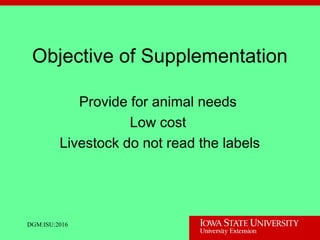
Objective of Supplementation
Provide for animal needs
Low cost
Livestock do not read the labels
DGM:ISU:2016
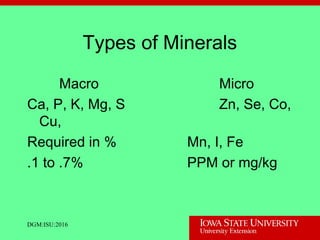
Types of Minerals
Macro Micro
Ca, P, K, Mg, S Zn, Se, Co,
Cu,
Required in % Mn, I, Fe
.1 to .7% PPM or mg/kg
DGM:ISU:2016
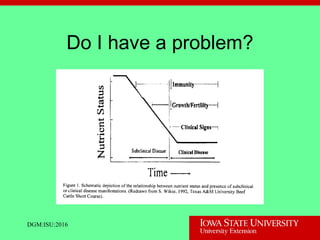
Do I have a problem?
DGM:ISU:2016
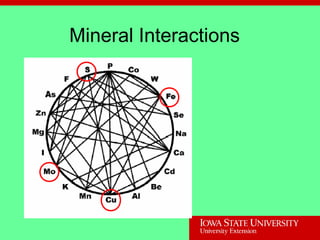
Mineral Interactions
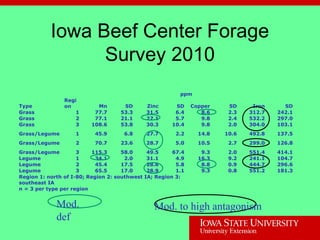
Iowa Beef Center Forage
Survey 2010
ppm
Type
Regi
on Mn SD Zinc SD Copper SD Iron SD
Grass 1 77.7 53.3 31.5 6.4 8.6 2.3 312.7 242.1
Grass 2 77.1 21.1 27.1 5.7 9.8 2.4 532.2 297.0
Grass 3 108.6 53.8 30.3 10.4 9.8 2.0 304.0 103.1
Grass/Legume 1 45.9 6.8 27.7 2.2 14.8 10.6 492.8 137.5
Grass/Legume 2 70.7 23.6 28.7 5.0 10.5 2.7 299.0 126.8
Grass/Legume 3 115.3 58.0 49.5 67.4 9.3 2.0 551.4 414.1
Legume 1 34.1 2.0 31.1 4.9 16.3 9.2 241.1 104.7
Legume 2 45.4 17.5 28.6 5.8 8.8 0.9 444.7 296.6
Legume 3 65.5 17.0 28.9 1.1 9.3 0.8 551.2 181.3
Region 1: north of I-80; Region 2: southwest IA; Region 3:
southeast IA
n = 3 per type per region
Mod.
def
Mod. to high antagonism
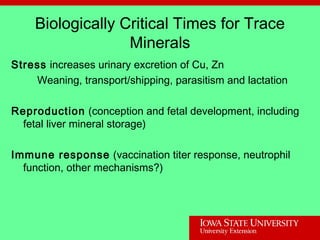
Biologically Critical Times for Trace
Minerals
Stress increases urinary excretion of Cu, Zn
Weaning, transport/shipping, parasitism and lactation
Reproduction (conception and fetal development, including
fetal liver mineral storage)
Immune response (vaccination titer response, neutrophil
function, other mechanisms?)
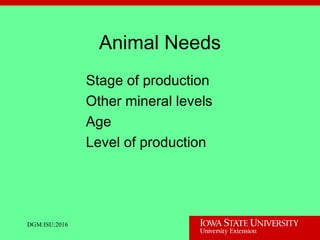
Animal Needs
Stage of production
Other mineral levels
Age
Level of production
DGM:ISU:2016
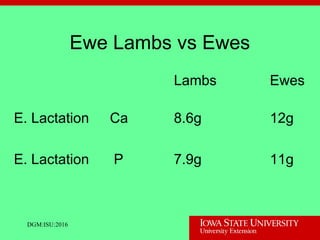
Ewe Lambs vs Ewes
Lambs Ewes
E. Lactation Ca 8.6g 12g
E. Lactation P 7.9g 11g
DGM:ISU:2016
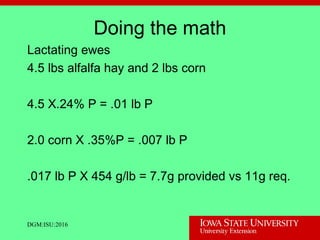
Doing the math
Lactating ewes
4.5 lbs alfalfa hay and 2 lbs corn
4.5 X.24% P = .01 lb P
2.0 corn X .35%P = .007 lb P
.017 lb P X 454 g/lb = 7.7g provided vs 11g req.
DGM:ISU:2016
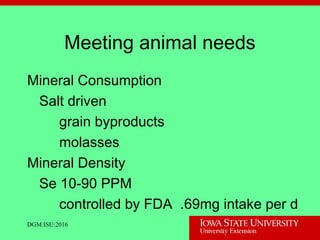
Meeting animal needs
Mineral Consumption
Salt driven
grain byproducts
molasses
Mineral Density
Se 10-90 PPM
controlled by FDA .69mg intake per d
DGM:ISU:2016
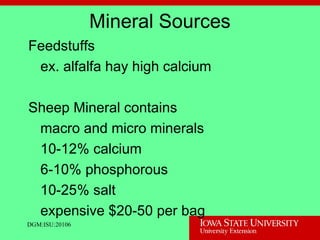
Mineral Sources
Feedstuffs
ex. alfalfa hay high calcium
Sheep Mineral contains
macro and micro minerals
10-12% calcium
6-10% phosphorous
10-25% salt
expensive $20-50 per bag
DGM:ISU:20106
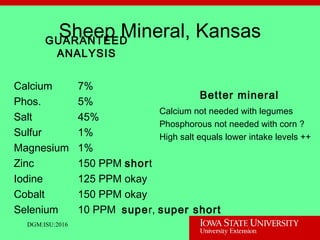
Sheep Mineral, KansasGUARANTEED
ANALYSIS
Calcium 7%
Phos. 5%
Salt 45%
Sulfur 1%
Magnesium 1%
Zinc 150 PPM short
Iodine 125 PPM okay
Cobalt 150 PPM okay
Selenium 10 PPM super, super short
Better mineral
Calcium not needed with legumes
Phosphorous not needed with corn ?
High salt equals lower intake levels ++
DGM:ISU:2016
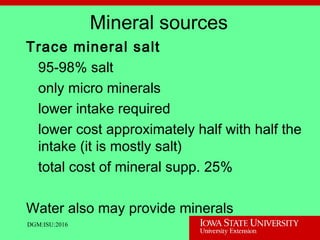
Mineral sources
Trace mineral salt
95-98% salt
only micro minerals
lower intake required
lower cost approximately half with half the
intake (it is mostly salt)
total cost of mineral supp. 25%
Water also may provide minerals
DGM:ISU:2016
DGM:ISU:2016
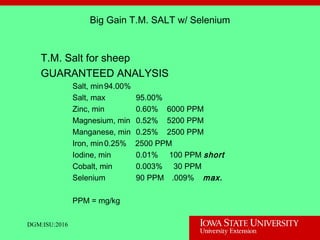
Big Gain T.M. SALT w/ Selenium
T.M. Salt for sheep
GUARANTEED ANALYSIS
Salt, min94.00%
Salt, max 95.00%
Zinc, min 0.60% 6000 PPM
Magnesium, min 0.52% 5200 PPM
Manganese, min 0.25% 2500 PPM
Iron, min0.25% 2500 PPM
Iodine, min 0.01% 100 PPM short
Cobalt, min 0.003% 30 PPM
Selenium 90 PPM .009% max.
PPM = mg/kg
DGM:ISU:20126
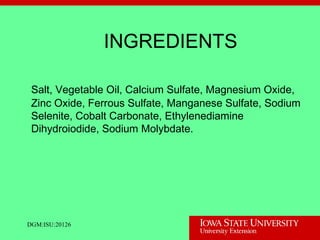
INGREDIENTS
Salt, Vegetable Oil, Calcium Sulfate, Magnesium Oxide,
Zinc Oxide, Ferrous Sulfate, Manganese Sulfate, Sodium
Selenite, Cobalt Carbonate, Ethylenediamine
Dihydroiodide, Sodium Molybdate.
DGM:ISU:2016
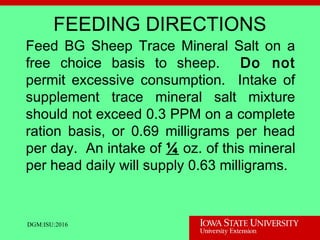
FEEDING DIRECTIONS
Feed BG Sheep Trace Mineral Salt on a
free choice basis to sheep. Do not
permit excessive consumption. Intake of
supplement trace mineral salt mixture
should not exceed 0.3 PPM on a complete
ration basis, or 0.69 milligrams per head
per day. An intake of ¼ oz. of this mineral
per head daily will supply 0.63 milligrams.
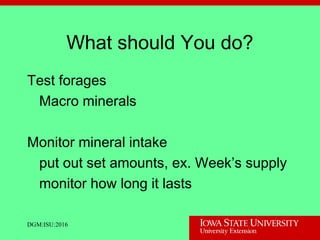
What should You do?
Test forages
Macro minerals
Monitor mineral intake
put out set amounts, ex. Week’s supply
monitor how long it lasts
DGM:ISU:2016
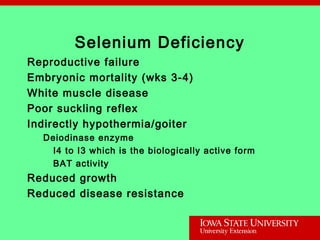
Selenium Deficiency
Reproductive failure
Embryonic mortality (wks 3-4)
White muscle disease
Poor suckling reflex
Indirectly hypothermia/goiter
Deiodinase enzyme
I4 to I3 which is the biologically active form
BAT activity
Reduced growth
Reduced disease resistance
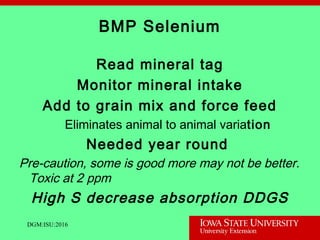
BMP Selenium
Read mineral tag
Monitor mineral intake
Add to grain mix and force feed
Eliminates animal to animal variation
Needed year round
Pre-caution, some is good more may not be better.
Toxic at 2 ppm
High S decrease absorption DDGS
DGM:ISU:2016
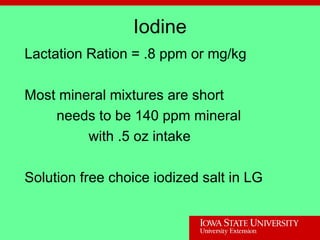
Iodine
Lactation Ration = .8 ppm or mg/kg
Most mineral mixtures are short
needs to be 140 ppm mineral
with .5 oz intake
Solution free choice iodized salt in LG
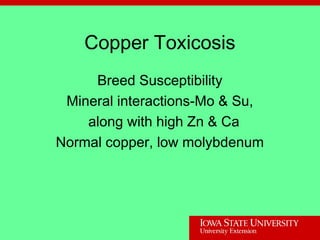
Copper Toxicosis
Breed Susceptibility
Mineral interactions-Mo & Su,
along with high Zn & Ca
Normal copper, low molybdenum
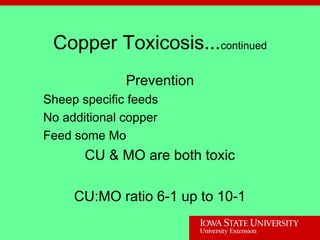
Copper Toxicosis...continued
Prevention
Sheep specific feeds
No additional copper
Feed some Mo
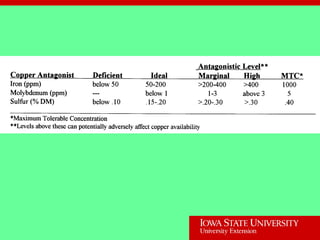
CU & MO are both toxic
CU:MO ratio 6-1 up to 10-1
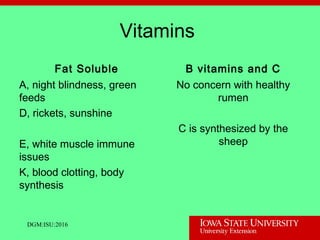
Vitamins
Fat Soluble
A, night blindness, green
feeds
D, rickets, sunshine
E, white muscle immune
issues
K, blood clotting, body
synthesis
B vitamins and C
No concern with healthy
rumen
C is synthesized by the
sheep
DGM:ISU:2016
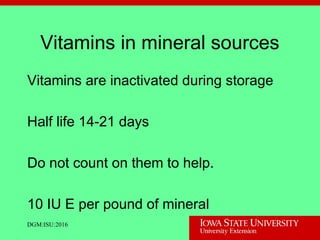
Vitamins in mineral sources
Vitamins are inactivated during storage
Half life 14-21 days
Do not count on them to help.
10 IU E per pound of mineral
DGM:ISU:2016
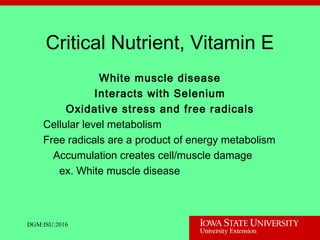
Critical Nutrient, Vitamin E
White muscle disease
Interacts with Selenium
Oxidative stress and free radicals
Cellular level metabolism
Free radicals are a product of energy metabolism
Accumulation creates cell/muscle damage
ex. White muscle disease
DGM:ISU:2016
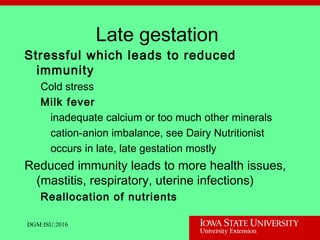
Late gestation
Stressful which leads to reduced
immunity
Cold stress
Milk fever
inadequate calcium or too much other minerals
cation-anion imbalance, see Dairy Nutritionist
occurs in late, late gestation mostly
Reduced immunity leads to more health issues,
(mastitis, respiratory, uterine infections)
Reallocation of nutrients
DGM:ISU:2016
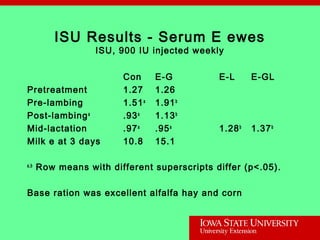
ISU Results - Serum E ewes
ISU, 900 IU injected weekly
Con E-G E-L E-GL
Pretreatment 1.27 1.26
Pre-lambing 1.51a
1.91b
Post-lambinga
.93a
1.13b
Mid-lactation .97a
.95a
1.28b
1.37b
Milk e at 3 days 10.8 15.1
a,b
Row means with different superscripts differ (p<.05).
Base ration was excellent alfalfa hay and corn
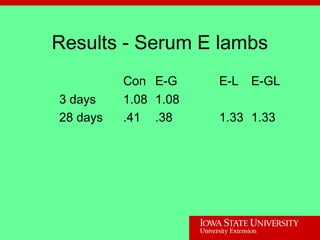
Results - Serum E lambs
Con E-G E-L E-GL
3 days 1.08 1.08
28 days .41 .38 1.33 1.33
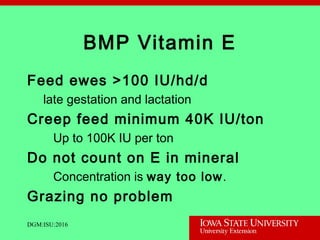
BMP Vitamin E
Feed ewes >100 IU/hd/d
late gestation and lactation
Creep feed minimum 40K IU/ton
Up to 100K IU per ton
Do not count on E in mineral
Concentration is way too low.
Grazing no problem
DGM:ISU:2016
What should You do?
Harvest kidney and liver from deads.
Sample forages
Trace minerals are around $35-50 per sample
Read mineral tags
Monitor mineral intake
Plain salt is not enough
Sheep have zero nutritional wisdom
DGM:ISU:2016
On farm vitamin fortification
50 ewes free choice mineral with .5 ounce
intake
Kent ADE premix 2 million A, .5million D and
4000 E / pound
Vitamin E 20,000 iu/lb
Ewes need 3500 IU A and 150-300 IU E
DGM:ISU:2016
Mineral recipe
.5 oz X 50 head X 7 days / 16oz = 10.9 lbs
add
.7 pounds Kent ADE Premix (storage)
2.5 pounds Vitamin E (20K iu/lb)
Provides ewes 3800 IU A, 960 D and 138 E
Cost per week $3.00 or $3.00 per ewe per
year
DGM:ISU:2016
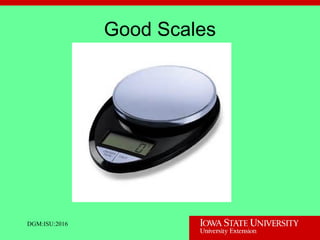
Good Scales
DGM:ISU:2016
Questions?
DGM:ISU:2007

MineralVitaminNutrition

  • 1.
    DGM:ISU:2016 Maryland M&V Management Dr. DanMorrical ISU Sheep Specialist 515-294-2904 morrical@iastate.edu
  • 2.
    Objective of Supplementation Providefor animal needs Low cost Livestock do not read the labels DGM:ISU:2016
  • 3.
    Types of Minerals MacroMicro Ca, P, K, Mg, S Zn, Se, Co, Cu, Required in % Mn, I, Fe .1 to .7% PPM or mg/kg DGM:ISU:2016
  • 4.
    Do I havea problem? DGM:ISU:2016
  • 5.
  • 7.
    Iowa Beef CenterForage Survey 2010 ppm Type Regi on Mn SD Zinc SD Copper SD Iron SD Grass 1 77.7 53.3 31.5 6.4 8.6 2.3 312.7 242.1 Grass 2 77.1 21.1 27.1 5.7 9.8 2.4 532.2 297.0 Grass 3 108.6 53.8 30.3 10.4 9.8 2.0 304.0 103.1 Grass/Legume 1 45.9 6.8 27.7 2.2 14.8 10.6 492.8 137.5 Grass/Legume 2 70.7 23.6 28.7 5.0 10.5 2.7 299.0 126.8 Grass/Legume 3 115.3 58.0 49.5 67.4 9.3 2.0 551.4 414.1 Legume 1 34.1 2.0 31.1 4.9 16.3 9.2 241.1 104.7 Legume 2 45.4 17.5 28.6 5.8 8.8 0.9 444.7 296.6 Legume 3 65.5 17.0 28.9 1.1 9.3 0.8 551.2 181.3 Region 1: north of I-80; Region 2: southwest IA; Region 3: southeast IA n = 3 per type per region Mod. def Mod. to high antagonism
  • 8.
    Biologically Critical Timesfor Trace Minerals Stress increases urinary excretion of Cu, Zn Weaning, transport/shipping, parasitism and lactation Reproduction (conception and fetal development, including fetal liver mineral storage) Immune response (vaccination titer response, neutrophil function, other mechanisms?)
  • 9.
    Animal Needs Stage ofproduction Other mineral levels Age Level of production DGM:ISU:2016
  • 10.
    Ewe Lambs vsEwes Lambs Ewes E. Lactation Ca 8.6g 12g E. Lactation P 7.9g 11g DGM:ISU:2016
  • 11.
    Doing the math Lactatingewes 4.5 lbs alfalfa hay and 2 lbs corn 4.5 X.24% P = .01 lb P 2.0 corn X .35%P = .007 lb P .017 lb P X 454 g/lb = 7.7g provided vs 11g req. DGM:ISU:2016
  • 12.
    Meeting animal needs MineralConsumption Salt driven grain byproducts molasses Mineral Density Se 10-90 PPM controlled by FDA .69mg intake per d DGM:ISU:2016
  • 13.
    Mineral Sources Feedstuffs ex. alfalfahay high calcium Sheep Mineral contains macro and micro minerals 10-12% calcium 6-10% phosphorous 10-25% salt expensive $20-50 per bag DGM:ISU:20106
  • 14.
    Sheep Mineral, KansasGUARANTEED ANALYSIS Calcium7% Phos. 5% Salt 45% Sulfur 1% Magnesium 1% Zinc 150 PPM short Iodine 125 PPM okay Cobalt 150 PPM okay Selenium 10 PPM super, super short Better mineral Calcium not needed with legumes Phosphorous not needed with corn ? High salt equals lower intake levels ++ DGM:ISU:2016
  • 15.
    Mineral sources Trace mineralsalt 95-98% salt only micro minerals lower intake required lower cost approximately half with half the intake (it is mostly salt) total cost of mineral supp. 25% Water also may provide minerals DGM:ISU:2016
  • 16.
    DGM:ISU:2016 Big Gain T.M.SALT w/ Selenium T.M. Salt for sheep GUARANTEED ANALYSIS Salt, min94.00% Salt, max 95.00% Zinc, min 0.60% 6000 PPM Magnesium, min 0.52% 5200 PPM Manganese, min 0.25% 2500 PPM Iron, min0.25% 2500 PPM Iodine, min 0.01% 100 PPM short Cobalt, min 0.003% 30 PPM Selenium 90 PPM .009% max. PPM = mg/kg
  • 17.
    DGM:ISU:20126 INGREDIENTS Salt, Vegetable Oil,Calcium Sulfate, Magnesium Oxide, Zinc Oxide, Ferrous Sulfate, Manganese Sulfate, Sodium Selenite, Cobalt Carbonate, Ethylenediamine Dihydroiodide, Sodium Molybdate.
  • 18.
    DGM:ISU:2016 FEEDING DIRECTIONS Feed BGSheep Trace Mineral Salt on a free choice basis to sheep. Do not permit excessive consumption. Intake of supplement trace mineral salt mixture should not exceed 0.3 PPM on a complete ration basis, or 0.69 milligrams per head per day. An intake of ¼ oz. of this mineral per head daily will supply 0.63 milligrams.
  • 19.
    What should Youdo? Test forages Macro minerals Monitor mineral intake put out set amounts, ex. Week’s supply monitor how long it lasts DGM:ISU:2016
  • 20.
    Selenium Deficiency Reproductive failure Embryonicmortality (wks 3-4) White muscle disease Poor suckling reflex Indirectly hypothermia/goiter Deiodinase enzyme I4 to I3 which is the biologically active form BAT activity Reduced growth Reduced disease resistance
  • 21.
    BMP Selenium Read mineraltag Monitor mineral intake Add to grain mix and force feed Eliminates animal to animal variation Needed year round Pre-caution, some is good more may not be better. Toxic at 2 ppm High S decrease absorption DDGS DGM:ISU:2016
  • 22.
    Iodine Lactation Ration =.8 ppm or mg/kg Most mineral mixtures are short needs to be 140 ppm mineral with .5 oz intake Solution free choice iodized salt in LG
  • 23.
    Copper Toxicosis Breed Susceptibility Mineralinteractions-Mo & Su, along with high Zn & Ca Normal copper, low molybdenum
  • 24.
    Copper Toxicosis...continued Prevention Sheep specificfeeds No additional copper Feed some Mo CU & MO are both toxic CU:MO ratio 6-1 up to 10-1
  • 25.
    Vitamins Fat Soluble A, nightblindness, green feeds D, rickets, sunshine E, white muscle immune issues K, blood clotting, body synthesis B vitamins and C No concern with healthy rumen C is synthesized by the sheep DGM:ISU:2016
  • 26.
    Vitamins in mineralsources Vitamins are inactivated during storage Half life 14-21 days Do not count on them to help. 10 IU E per pound of mineral DGM:ISU:2016
  • 27.
    Critical Nutrient, VitaminE White muscle disease Interacts with Selenium Oxidative stress and free radicals Cellular level metabolism Free radicals are a product of energy metabolism Accumulation creates cell/muscle damage ex. White muscle disease DGM:ISU:2016
  • 28.
    Late gestation Stressful whichleads to reduced immunity Cold stress Milk fever inadequate calcium or too much other minerals cation-anion imbalance, see Dairy Nutritionist occurs in late, late gestation mostly Reduced immunity leads to more health issues, (mastitis, respiratory, uterine infections) Reallocation of nutrients DGM:ISU:2016
  • 29.
    ISU Results -Serum E ewes ISU, 900 IU injected weekly Con E-G E-L E-GL Pretreatment 1.27 1.26 Pre-lambing 1.51a 1.91b Post-lambinga .93a 1.13b Mid-lactation .97a .95a 1.28b 1.37b Milk e at 3 days 10.8 15.1 a,b Row means with different superscripts differ (p<.05). Base ration was excellent alfalfa hay and corn
  • 30.
    Results - SerumE lambs Con E-G E-L E-GL 3 days 1.08 1.08 28 days .41 .38 1.33 1.33
  • 31.
    BMP Vitamin E Feedewes >100 IU/hd/d late gestation and lactation Creep feed minimum 40K IU/ton Up to 100K IU per ton Do not count on E in mineral Concentration is way too low. Grazing no problem DGM:ISU:2016
  • 32.
    What should Youdo? Harvest kidney and liver from deads. Sample forages Trace minerals are around $35-50 per sample Read mineral tags Monitor mineral intake Plain salt is not enough Sheep have zero nutritional wisdom DGM:ISU:2016
  • 33.
    On farm vitaminfortification 50 ewes free choice mineral with .5 ounce intake Kent ADE premix 2 million A, .5million D and 4000 E / pound Vitamin E 20,000 iu/lb Ewes need 3500 IU A and 150-300 IU E DGM:ISU:2016
  • 34.
    Mineral recipe .5 ozX 50 head X 7 days / 16oz = 10.9 lbs add .7 pounds Kent ADE Premix (storage) 2.5 pounds Vitamin E (20K iu/lb) Provides ewes 3800 IU A, 960 D and 138 E Cost per week $3.00 or $3.00 per ewe per year DGM:ISU:2016
  • 35.
  • 36.

Editor's Notes

  • #2 I appreciate this opportunity to update you on ISU Extension. Extension is a very important part of Iowa State University …one that is at the very core of what it means to be a land-grant university …and an area where we are regarded by our peer land-grant universities as being the very best.