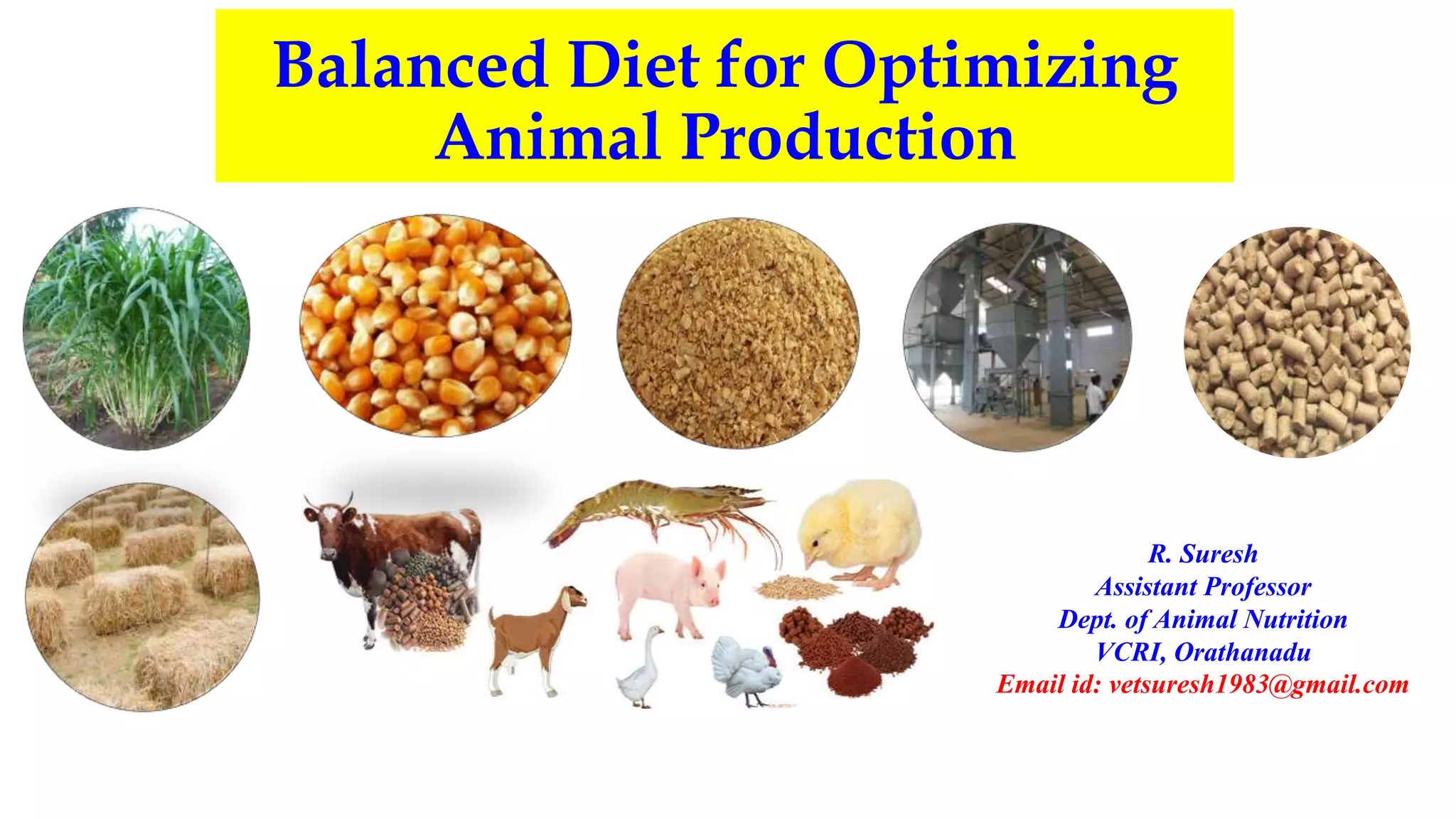
Balanced Diet for Optimizing
Animal Production
R. Suresh
Assistant Professor
Dept. of Animal Nutrition
VCRI, Orathanadu
Email id: vetsuresh1983@gmail.com
Basic Definitions and Terminologies
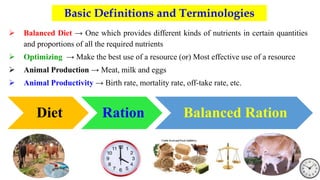
 Balanced Diet → One which provides different kinds of nutrients in certain quantities
and proportions of all the required nutrients
 Optimizing → Make the best use of a resource (or) Most effective use of a resource
 Animal Production → Meat, milk and eggs
 Animal Productivity → Birth rate, mortality rate, off-take rate, etc.
Diet Ration Balanced Ration
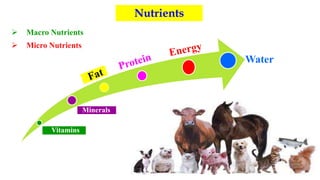
Nutrients
 Macro Nutrients
 Micro Nutrients
Vitamins
Minerals
Water
Importance of Minerals
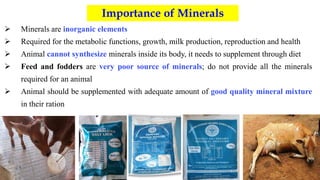
 Minerals are inorganic elements
 Required for the metabolic functions, growth, milk production, reproduction and health
 Animal cannot synthesize minerals inside its body, it needs to supplement through diet
 Feed and fodders are very poor source of minerals; do not provide all the minerals
required for an animal
 Animal should be supplemented with adequate amount of good quality mineral mixture
in their ration
Use of Nutrients
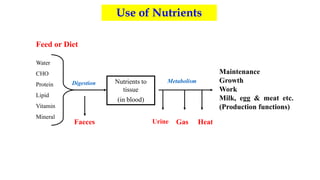
Feed or Diet
Water
CHO
Protein
Lipid
Vitamin
Mineral
Nutrients to
tissue
(in blood)
Maintenance
Growth
Work
Milk, egg & meat etc.
(Production functions)
Digestion
Faeces
Metabolism
Urine Gas Heat
Use of Nutrients
Importance of feed and fodder
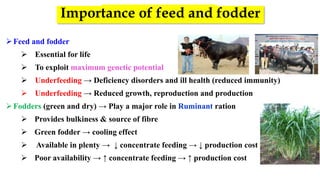
Feed and fodder
 Essential for life
 To exploit maximum genetic potential
 Underfeeding → Deficiency disorders and ill health (reduced immunity)
 Underfeeding → Reduced growth, reproduction and production
Fodders (green and dry) → Play a major role in Ruminant ration
 Provides bulkiness & source of fibre
 Green fodder → cooling effect
 Available in plenty → ↓ concentrate feeding → ↓ production cost
 Poor availability → ↑ concentrate feeding → ↑ production cost
Need of Ration Balancing
 Concentration of nutrient is extremely variable between feed ingredients
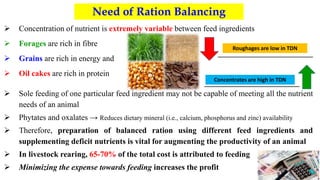
 Forages are rich in fibre
 Grains are rich in energy and
 Oil cakes are rich in protein
 Sole feeding of one particular feed ingredient may not be capable of meeting all the nutrient
needs of an animal
 Phytates and oxalates → Reduces dietary mineral (i.e., calcium, phosphorus and zinc) availability
 Therefore, preparation of balanced ration using different feed ingredients and
supplementing deficit nutrients is vital for augmenting the productivity of an animal
 In livestock rearing, 65-70% of the total cost is attributed to feeding
 Minimizing the expense towards feeding increases the profit
Roughages are low in TDN
Concentrates are high in TDN
Desirable characteristic of a ration
 The Ration should be properly balanced
 The ration must be Palatable
 Variety of Feed in the Ration
 The Ration should contain enough of mineral matter
 The Ration should be fairly Laxative
 The Ration should be fairly bulky
 The ration should contain sufficient green fodder
 Avoid sudden changes in the ration
 Maintain regularity in Feeding
 The Feed must be properly prepared
 A Ration should not be too bulky
 Economy in Labour and Cost
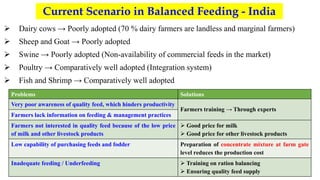
Current Scenario in Balanced Feeding - India
 Dairy cows → Poorly adopted (70 % dairy farmers are landless and marginal farmers)
 Sheep and Goat → Poorly adopted
 Swine → Poorly adopted (Non-availability of commercial feeds in the market)
 Poultry → Comparatively well adopted (Integration system)
 Fish and Shrimp → Comparatively well adopted
Problems Solutions
Very poor awareness of quality feed, which hinders productivity
Farmers training → Through experts
Farmers lack information on feeding & management practices
Farmers not interested in quality feed because of the low price
of milk and other livestock products
 Good price for milk
 Good price for other livestock products
Low capability of purchasing feeds and fodder Preparation of concentrate mixture at farm gate
level reduces the production cost
Inadequate feeding / Underfeeding  Training on ration balancing
 Ensuring quality feed supply
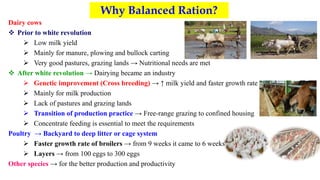
Why Balanced Ration?
Dairy cows
 Prior to white revolution
 Low milk yield
 Mainly for manure, plowing and bullock carting
 Very good pastures, grazing lands → Nutritional needs are met
 After white revolution → Dairying became an industry
 Genetic improvement (Cross breeding) → ↑ milk yield and faster growth rate
 Mainly for milk production
 Lack of pastures and grazing lands
 Transition of production practice → Free-range grazing to confined housing
 Concentrate feeding is essential to meet the requirements
Poultry → Backyard to deep litter or cage system
 Faster growth rate of broilers → from 9 weeks it came to 6 weeks
 Layers → from 100 eggs to 300 eggs
Other species → for the better production and productivity
 To acquire maximum genetic potential → “Nutritionally balanced diet” is indispensable
 Livestock should be fed with balanced ration based on its body weight and production
performance → To acquire maximum genetic potential
 Imbalanced feeding
 Leads to excess feeding of some nutrients whilst others remain deficient
 Affects various physiological functions; including long term animal health, fertility and
productivity
 Feeding a well-balanced ration can lead to greater returns in the long term,
in areas such as immune function, reproduction, growth and maintained
body condition
Why Balanced Ration?
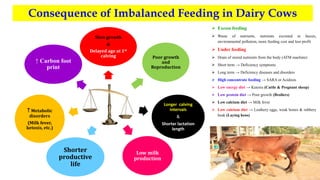
Consequence of Imbalanced Feeding in Dairy Cows
Slow growth
&
Delayed age at 1st
calving Poor growth
and
Reproduction
Longer calving
intervals
&
Shorter lactation
length
Low milk
production
Shorter
productive
life
↑ Metabolic
disorders
(Milk fever,
ketosis, etc.)
↑ Carbon foot
print
 Excess feeding
 Waste of nutrients, nutrients excreted in faeces,
environmental pollution, more feeding cost and less profit
 Under feeding
 Drain of stored nutrients from the body (ATM machine)
 Short term → Deficiency symptoms
 Long term → Deficiency diseases and disorders
 High concentrate feeding → SARA or Acidosis
 Low energy diet → Ketosis (Cattle & Pregnant sheep)
 Low protein diet → Poor growth (Broilers)
 Low calcium diet → Milk fever
 Low calcium diet → Leathery eggs, weak bones & rubbery
beak (Laying hens)
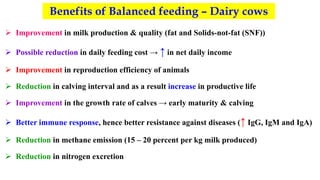
Benefits of Balanced feeding – Dairy cows
 Improvement in milk production & quality (fat and Solids-not-fat (SNF))
 Possible reduction in daily feeding cost → ↑ in net daily income
 Improvement in reproduction efficiency of animals
 Reduction in calving interval and as a result increase in productive life
 Improvement in the growth rate of calves → early maturity & calving
 Better immune response, hence better resistance against diseases (↑ IgG, IgM and IgA)
 Reduction in methane emission (15 – 20 percent per kg milk produced)
 Reduction in nitrogen excretion
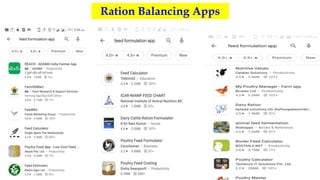
Ration Balancing Apps
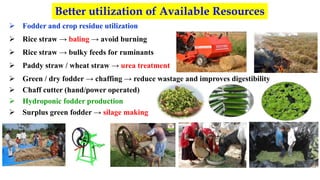
Better utilization of Available Resources
 Fodder and crop residue utilization
 Rice straw → baling → avoid burning
 Rice straw → bulky feeds for ruminants
 Paddy straw / wheat straw → urea treatment
 Green / dry fodder → chaffing → reduce wastage and improves digestibility
 Chaff cutter (hand/power operated)
 Hydroponic fodder production
 Surplus green fodder → silage making
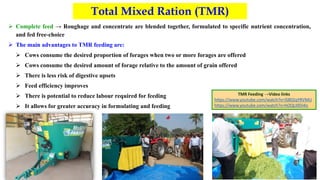
Total Mixed Ration (TMR)
 Complete feed → Roughage and concentrate are blended together, formulated to specific nutrient concentration,
and fed free-choice
 The main advantages to TMR feeding are:
 Cows consume the desired proportion of forages when two or more forages are offered
 Cows consume the desired amount of forage relative to the amount of grain offered
 There is less risk of digestive upsets
 Feed efficiency improves
 There is potential to reduce labour required for feeding
 It allows for greater accuracy in formulating and feeding
TMR Feeding →Video links
https://www.youtube.com/watch?v=lS802qYRVMU
https://www.youtube.com/watch?v=hOQLI0Di4is
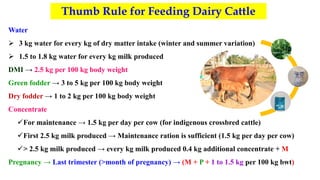
Thumb Rule for Feeding Dairy Cattle
Water
 3 kg water for every kg of dry matter intake (winter and summer variation)
 1.5 to 1.8 kg water for every kg milk produced
DMI → 2.5 kg per 100 kg body weight
Green fodder → 3 to 5 kg per 100 kg body weight
Dry fodder → 1 to 2 kg per 100 kg body weight
Concentrate
For maintenance → 1.5 kg per day per cow (for indigenous crossbred cattle)
First 2.5 kg milk produced → Maintenance ration is sufficient (1.5 kg per day per cow)
> 2.5 kg milk produced → every kg milk produced 0.4 kg additional concentrate + M
Pregnancy → Last trimester (>month of pregnancy) → (M + P + 1 to 1.5 kg per 100 kg bwt)
Summary
 In livestock rearing, 65-70% of the total cost is attributed to feeding
 Minimizing the expense towards feeding increases the profit
 Majority of diseases, reproductive problems and less milk production of the animals are
related with the faulty nutrition of the animals
 Knowledge on newer ration balancing tools, identifying newer raw materials and knowing
their nutritive value is important
 Ration formulation based on lab analyzed values rather than book values
 Feed according to their physiological state with balanced ration
 To achieve maximum genetic potential and optimum productivity → balanced feeding
Take home message
 To optimize productivity in large farms → grouping of animals according to their
production state (2 or more groups) and feeding (2 or more rations) based on production
is very important
 One calf per year
 Balanced nutrition/feeding is the key → profitable livestock production
 Genetics has created the potential, nutrition has failed to deliver that potential,
“irrespective of the type of system practiced”
 Faster dissemination of ration balancing technology is essential
Balanced ration suresh

Balanced ration suresh

  • 1.
    Balanced Diet forOptimizing Animal Production R. Suresh Assistant Professor Dept. of Animal Nutrition VCRI, Orathanadu Email id: vetsuresh1983@gmail.com
  • 2.
    Basic Definitions andTerminologies  Balanced Diet → One which provides different kinds of nutrients in certain quantities and proportions of all the required nutrients  Optimizing → Make the best use of a resource (or) Most effective use of a resource  Animal Production → Meat, milk and eggs  Animal Productivity → Birth rate, mortality rate, off-take rate, etc. Diet Ration Balanced Ration
  • 3.
    Nutrients  Macro Nutrients Micro Nutrients Vitamins Minerals Water
  • 4.
    Importance of Minerals Minerals are inorganic elements  Required for the metabolic functions, growth, milk production, reproduction and health  Animal cannot synthesize minerals inside its body, it needs to supplement through diet  Feed and fodders are very poor source of minerals; do not provide all the minerals required for an animal  Animal should be supplemented with adequate amount of good quality mineral mixture in their ration
  • 5.
    Use of Nutrients Feedor Diet Water CHO Protein Lipid Vitamin Mineral Nutrients to tissue (in blood) Maintenance Growth Work Milk, egg & meat etc. (Production functions) Digestion Faeces Metabolism Urine Gas Heat
  • 6.
    Use of Nutrients Importanceof feed and fodder Feed and fodder  Essential for life  To exploit maximum genetic potential  Underfeeding → Deficiency disorders and ill health (reduced immunity)  Underfeeding → Reduced growth, reproduction and production Fodders (green and dry) → Play a major role in Ruminant ration  Provides bulkiness & source of fibre  Green fodder → cooling effect  Available in plenty → ↓ concentrate feeding → ↓ production cost  Poor availability → ↑ concentrate feeding → ↑ production cost
  • 7.
    Need of RationBalancing  Concentration of nutrient is extremely variable between feed ingredients  Forages are rich in fibre  Grains are rich in energy and  Oil cakes are rich in protein  Sole feeding of one particular feed ingredient may not be capable of meeting all the nutrient needs of an animal  Phytates and oxalates → Reduces dietary mineral (i.e., calcium, phosphorus and zinc) availability  Therefore, preparation of balanced ration using different feed ingredients and supplementing deficit nutrients is vital for augmenting the productivity of an animal  In livestock rearing, 65-70% of the total cost is attributed to feeding  Minimizing the expense towards feeding increases the profit Roughages are low in TDN Concentrates are high in TDN
  • 8.
    Desirable characteristic ofa ration  The Ration should be properly balanced  The ration must be Palatable  Variety of Feed in the Ration  The Ration should contain enough of mineral matter  The Ration should be fairly Laxative  The Ration should be fairly bulky  The ration should contain sufficient green fodder  Avoid sudden changes in the ration  Maintain regularity in Feeding  The Feed must be properly prepared  A Ration should not be too bulky  Economy in Labour and Cost
  • 9.
    Current Scenario inBalanced Feeding - India  Dairy cows → Poorly adopted (70 % dairy farmers are landless and marginal farmers)  Sheep and Goat → Poorly adopted  Swine → Poorly adopted (Non-availability of commercial feeds in the market)  Poultry → Comparatively well adopted (Integration system)  Fish and Shrimp → Comparatively well adopted Problems Solutions Very poor awareness of quality feed, which hinders productivity Farmers training → Through experts Farmers lack information on feeding & management practices Farmers not interested in quality feed because of the low price of milk and other livestock products  Good price for milk  Good price for other livestock products Low capability of purchasing feeds and fodder Preparation of concentrate mixture at farm gate level reduces the production cost Inadequate feeding / Underfeeding  Training on ration balancing  Ensuring quality feed supply
  • 10.
    Why Balanced Ration? Dairycows  Prior to white revolution  Low milk yield  Mainly for manure, plowing and bullock carting  Very good pastures, grazing lands → Nutritional needs are met  After white revolution → Dairying became an industry  Genetic improvement (Cross breeding) → ↑ milk yield and faster growth rate  Mainly for milk production  Lack of pastures and grazing lands  Transition of production practice → Free-range grazing to confined housing  Concentrate feeding is essential to meet the requirements Poultry → Backyard to deep litter or cage system  Faster growth rate of broilers → from 9 weeks it came to 6 weeks  Layers → from 100 eggs to 300 eggs Other species → for the better production and productivity
  • 11.
     To acquiremaximum genetic potential → “Nutritionally balanced diet” is indispensable  Livestock should be fed with balanced ration based on its body weight and production performance → To acquire maximum genetic potential  Imbalanced feeding  Leads to excess feeding of some nutrients whilst others remain deficient  Affects various physiological functions; including long term animal health, fertility and productivity  Feeding a well-balanced ration can lead to greater returns in the long term, in areas such as immune function, reproduction, growth and maintained body condition Why Balanced Ration?
  • 12.
    Consequence of ImbalancedFeeding in Dairy Cows Slow growth & Delayed age at 1st calving Poor growth and Reproduction Longer calving intervals & Shorter lactation length Low milk production Shorter productive life ↑ Metabolic disorders (Milk fever, ketosis, etc.) ↑ Carbon foot print  Excess feeding  Waste of nutrients, nutrients excreted in faeces, environmental pollution, more feeding cost and less profit  Under feeding  Drain of stored nutrients from the body (ATM machine)  Short term → Deficiency symptoms  Long term → Deficiency diseases and disorders  High concentrate feeding → SARA or Acidosis  Low energy diet → Ketosis (Cattle & Pregnant sheep)  Low protein diet → Poor growth (Broilers)  Low calcium diet → Milk fever  Low calcium diet → Leathery eggs, weak bones & rubbery beak (Laying hens)
  • 13.
    Benefits of Balancedfeeding – Dairy cows  Improvement in milk production & quality (fat and Solids-not-fat (SNF))  Possible reduction in daily feeding cost → ↑ in net daily income  Improvement in reproduction efficiency of animals  Reduction in calving interval and as a result increase in productive life  Improvement in the growth rate of calves → early maturity & calving  Better immune response, hence better resistance against diseases (↑ IgG, IgM and IgA)  Reduction in methane emission (15 – 20 percent per kg milk produced)  Reduction in nitrogen excretion
  • 14.
  • 15.
    Better utilization ofAvailable Resources  Fodder and crop residue utilization  Rice straw → baling → avoid burning  Rice straw → bulky feeds for ruminants  Paddy straw / wheat straw → urea treatment  Green / dry fodder → chaffing → reduce wastage and improves digestibility  Chaff cutter (hand/power operated)  Hydroponic fodder production  Surplus green fodder → silage making
  • 16.
    Total Mixed Ration(TMR)  Complete feed → Roughage and concentrate are blended together, formulated to specific nutrient concentration, and fed free-choice  The main advantages to TMR feeding are:  Cows consume the desired proportion of forages when two or more forages are offered  Cows consume the desired amount of forage relative to the amount of grain offered  There is less risk of digestive upsets  Feed efficiency improves  There is potential to reduce labour required for feeding  It allows for greater accuracy in formulating and feeding TMR Feeding →Video links https://www.youtube.com/watch?v=lS802qYRVMU https://www.youtube.com/watch?v=hOQLI0Di4is
  • 17.
    Thumb Rule forFeeding Dairy Cattle Water  3 kg water for every kg of dry matter intake (winter and summer variation)  1.5 to 1.8 kg water for every kg milk produced DMI → 2.5 kg per 100 kg body weight Green fodder → 3 to 5 kg per 100 kg body weight Dry fodder → 1 to 2 kg per 100 kg body weight Concentrate For maintenance → 1.5 kg per day per cow (for indigenous crossbred cattle) First 2.5 kg milk produced → Maintenance ration is sufficient (1.5 kg per day per cow) > 2.5 kg milk produced → every kg milk produced 0.4 kg additional concentrate + M Pregnancy → Last trimester (>month of pregnancy) → (M + P + 1 to 1.5 kg per 100 kg bwt)
  • 18.
    Summary  In livestockrearing, 65-70% of the total cost is attributed to feeding  Minimizing the expense towards feeding increases the profit  Majority of diseases, reproductive problems and less milk production of the animals are related with the faulty nutrition of the animals  Knowledge on newer ration balancing tools, identifying newer raw materials and knowing their nutritive value is important  Ration formulation based on lab analyzed values rather than book values  Feed according to their physiological state with balanced ration  To achieve maximum genetic potential and optimum productivity → balanced feeding
  • 19.
    Take home message To optimize productivity in large farms → grouping of animals according to their production state (2 or more groups) and feeding (2 or more rations) based on production is very important  One calf per year  Balanced nutrition/feeding is the key → profitable livestock production  Genetics has created the potential, nutrition has failed to deliver that potential, “irrespective of the type of system practiced”  Faster dissemination of ration balancing technology is essential