Civil Engineering 
Drawing 
BY SAFIULLAH 13CE07 SCET WAH CANTT 
CONTT;03479164097
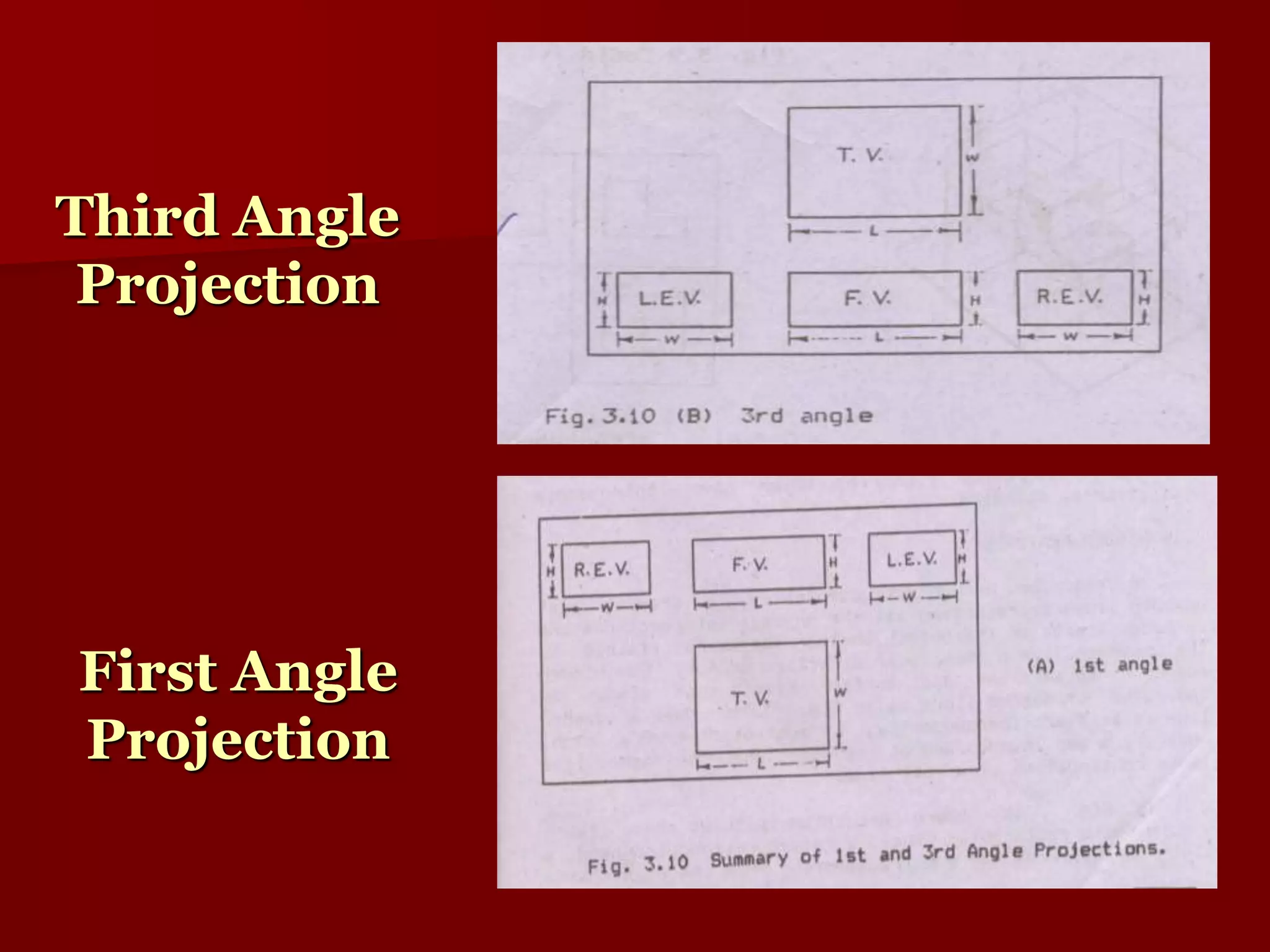
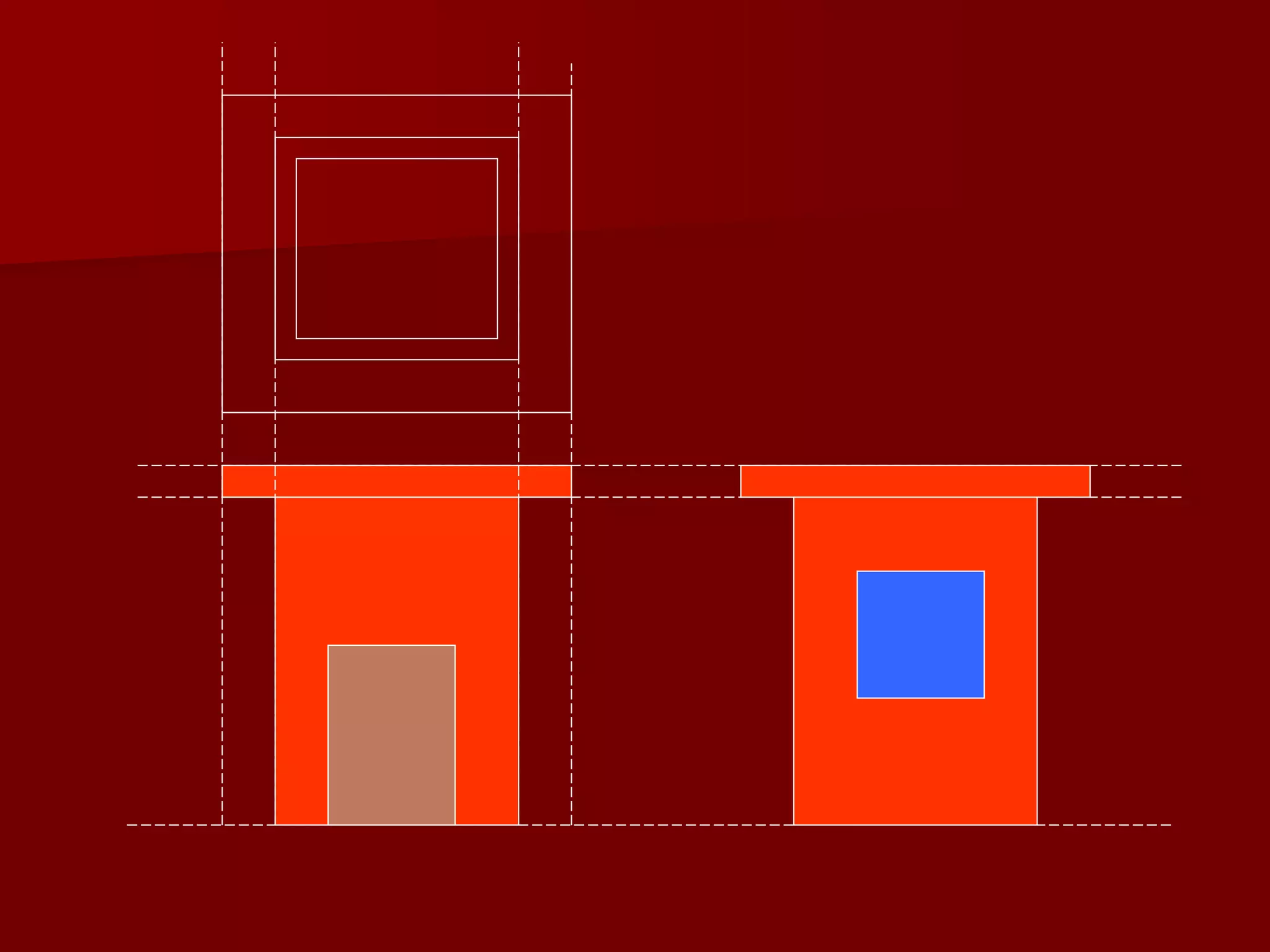
Third Angle Projection 
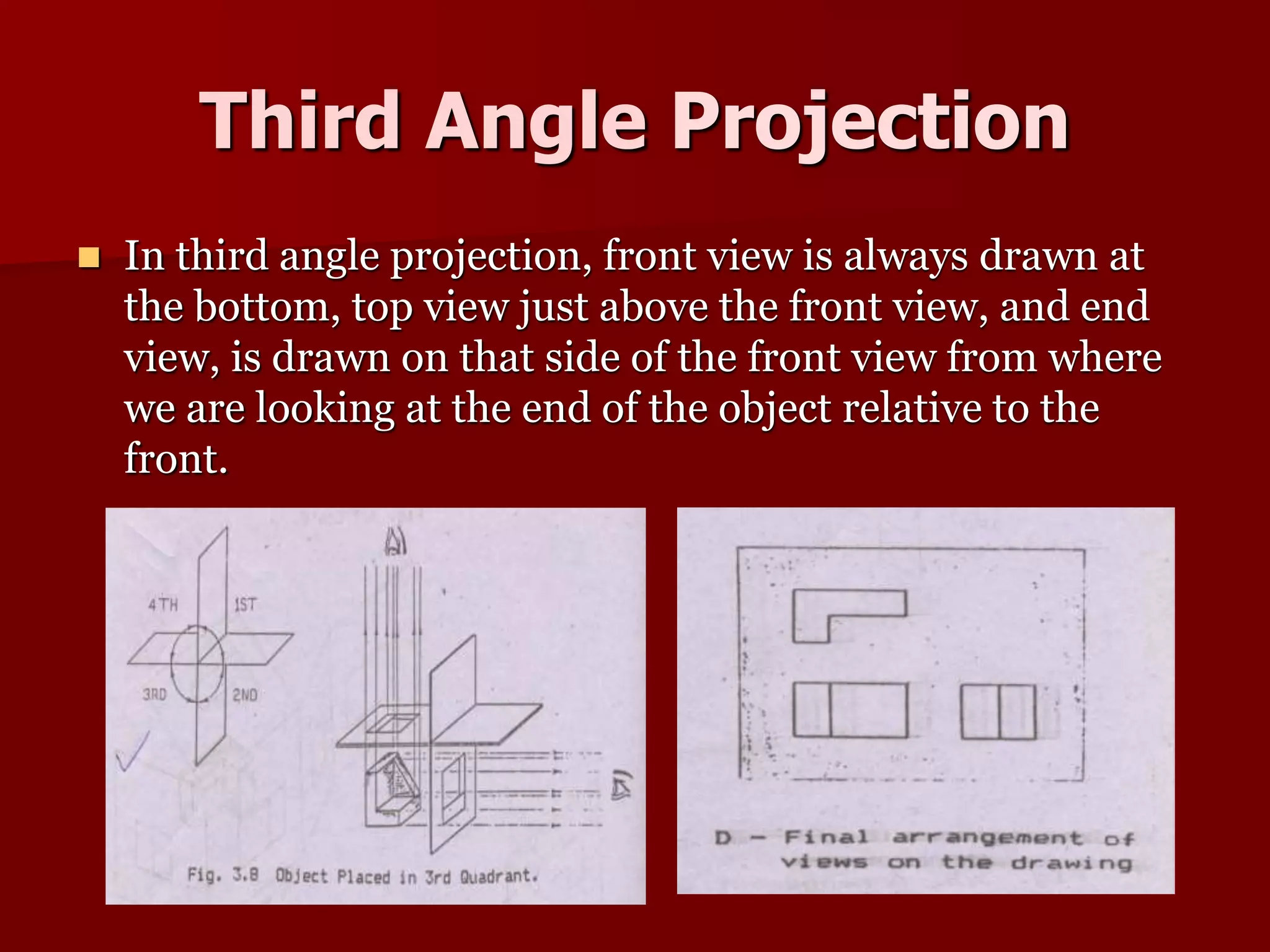
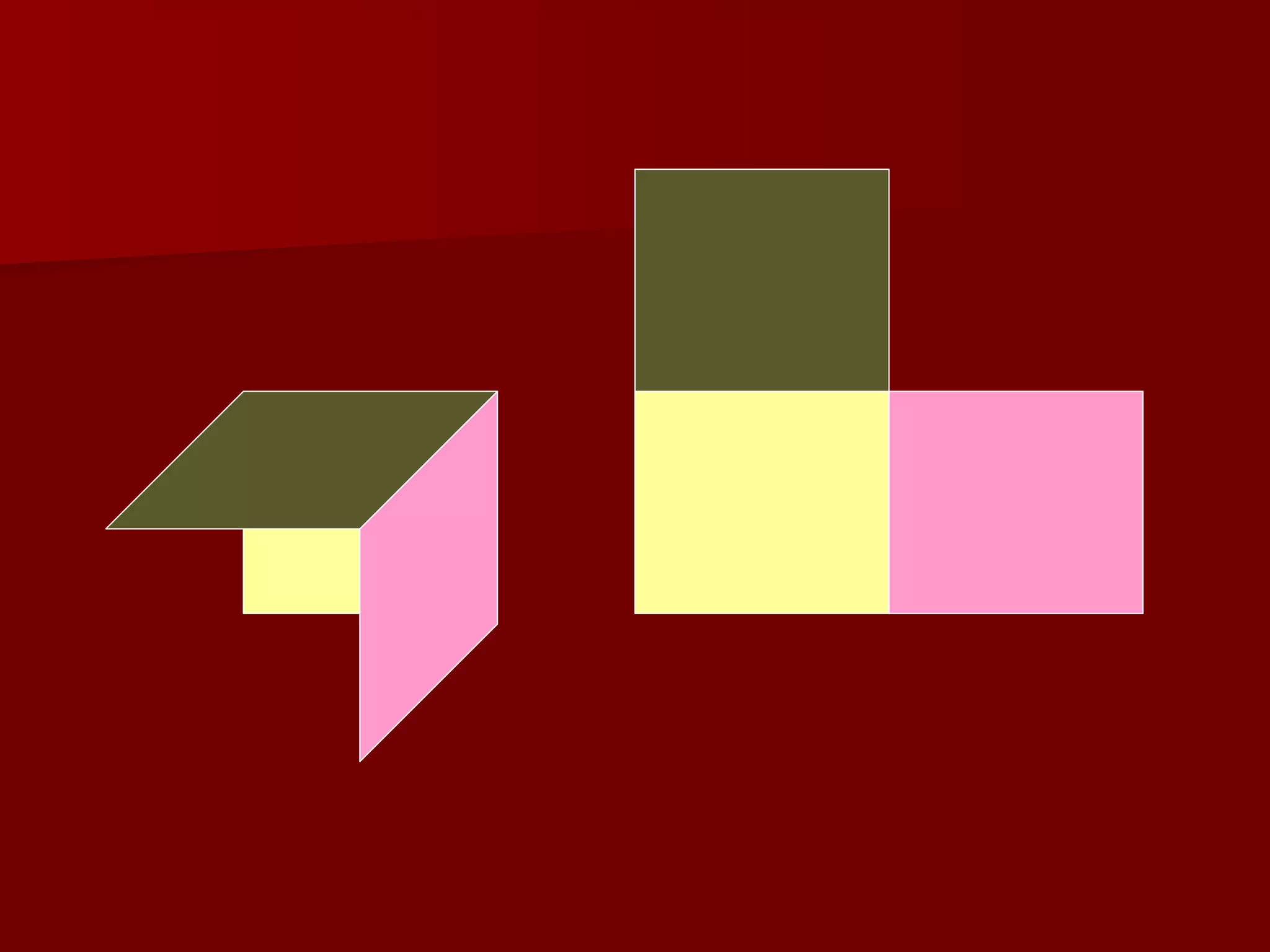
 In third angle projection, front view is always drawn at 
the bottom, top view just above the front view, and end 
view, is drawn on that side of the front view from where 
we are looking at the end of the object relative to the 
front.
Third Angle Projection 
 Left End View should be accommodated on the left 
of the front view. 
 Right End View should be accommodated on the 
right of the front view. 
 However one end view is generally drawn.
First Angle Projection 
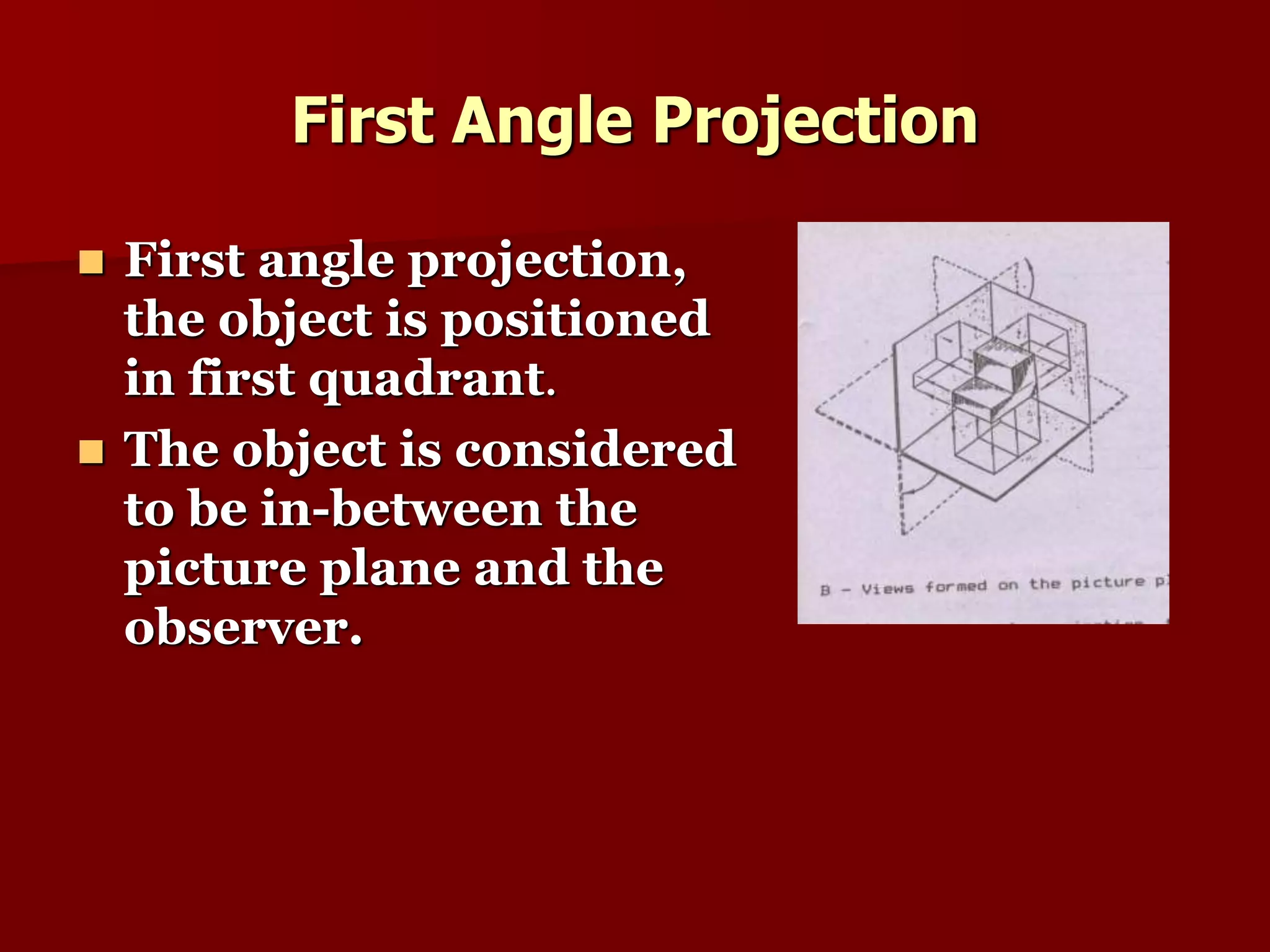
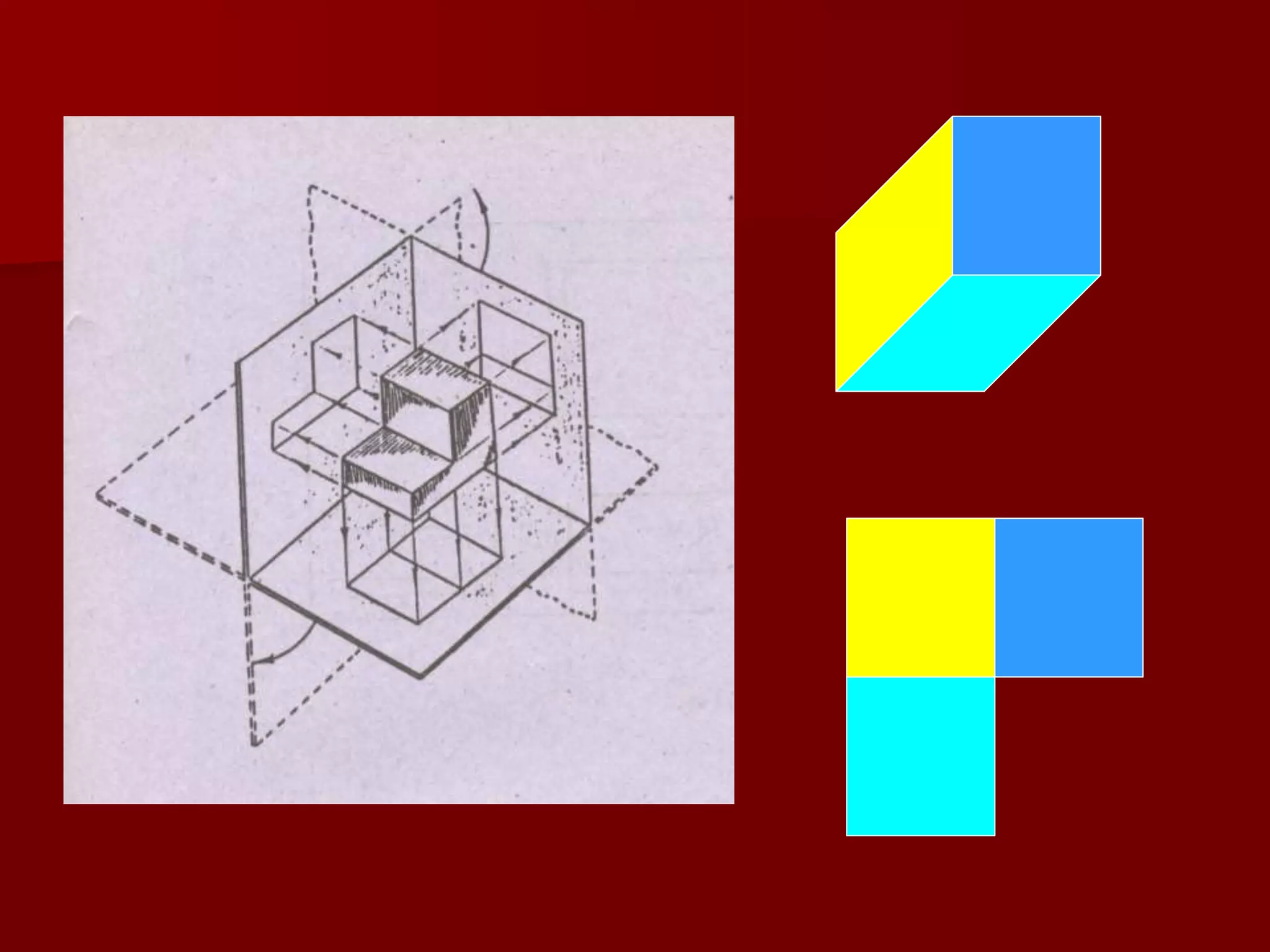
 First angle projection, 
the object is positioned 
in first quadrant. 
 The object is considered 
to be in-between the 
picture plane and the 
observer.
First Angle Projection 
 The top and the end views are rotated through 
90° as before until they come in the frontal 
plane. 
 End view is drawn on that side of the front view 
which is opposite to the side from which we are 
looking at the object relative to the front. 
 First-angle projection was originally used all 
over the world but now in countries like the 
united States and Canada, third-angle projection 
is standard.
First Angle Projection 
 In Pakistan, we use first angle projection for 
building drawing because all of the previous 
drawings for important buildings still lying in 
the offices are according to this method. 
 For machine drawing, more trends is to use 
third-angle projection because of its convenience 
and because most of the machines are imported 
form those countries which have third-angle 
projection as standard.
Third Angle 
Projection 
First Angle 
Projection
Hidden Features 
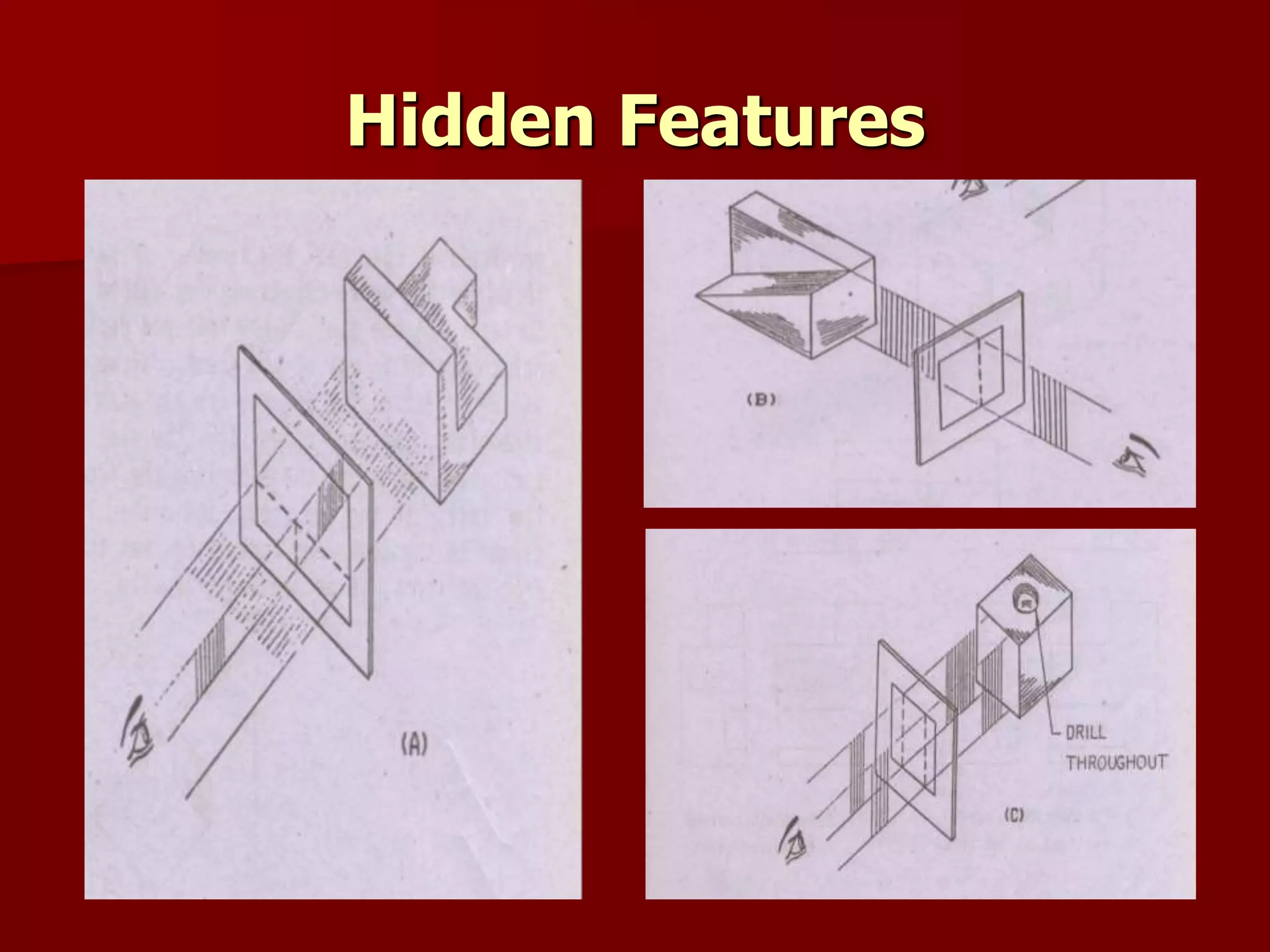
 To describe an object completely, a drawing 
must contain lines representing all the edges, 
intersections and surface limits of the object 
whether these are visible to the observer from a 
particular direction or not. 
 The hidden edges, intersections and surface 
limits must always be indicated by dashed lines. 
 When a dashed line is to start independently, it 
must start form a dash, however, a gap is 
provided at the start when the dashed line is 
continuation of a full line.
Hidden Features
Centre Lines 
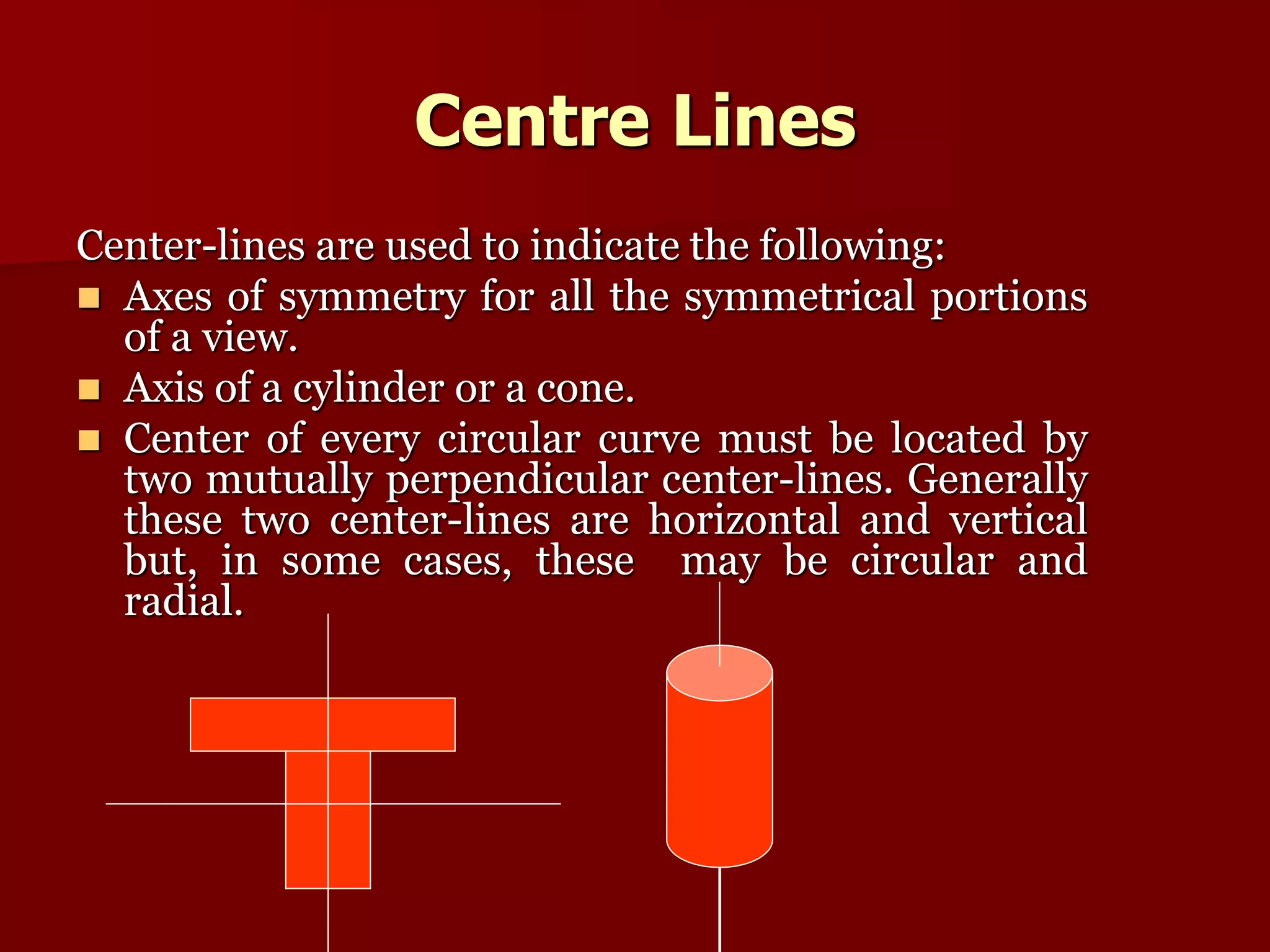
Center-lines are used to indicate the following: 
 Axes of symmetry for all the symmetrical portions 
of a view. 
 Axis of a cylinder or a cone. 
 Center of every circular curve must be located by 
two mutually perpendicular center-lines. Generally 
these two center-lines are horizontal and vertical 
but, in some cases, these may be circular and 
radial.
Precedence Or Order of Lines 
In any view, there are chances of coincidence of different 
types of lines. 
 Hidden portions may coincide with visible portions. 
 center-line may be required where already there is a full 
line. 
 Full lines have the first preference because visible 
features are more prominent . 
 On the second number are the dashed lines because 
these are showing physical features though hidden. 
 Then comes the imaginary lines like cutting plane 
symbol and center-lines. Most commonly cutting plane 
symbol is given more importance. 
 A line having lower order of preference is omitted in the 
portion where the other line with higher order of 
preference is present.
Order of Drawing 
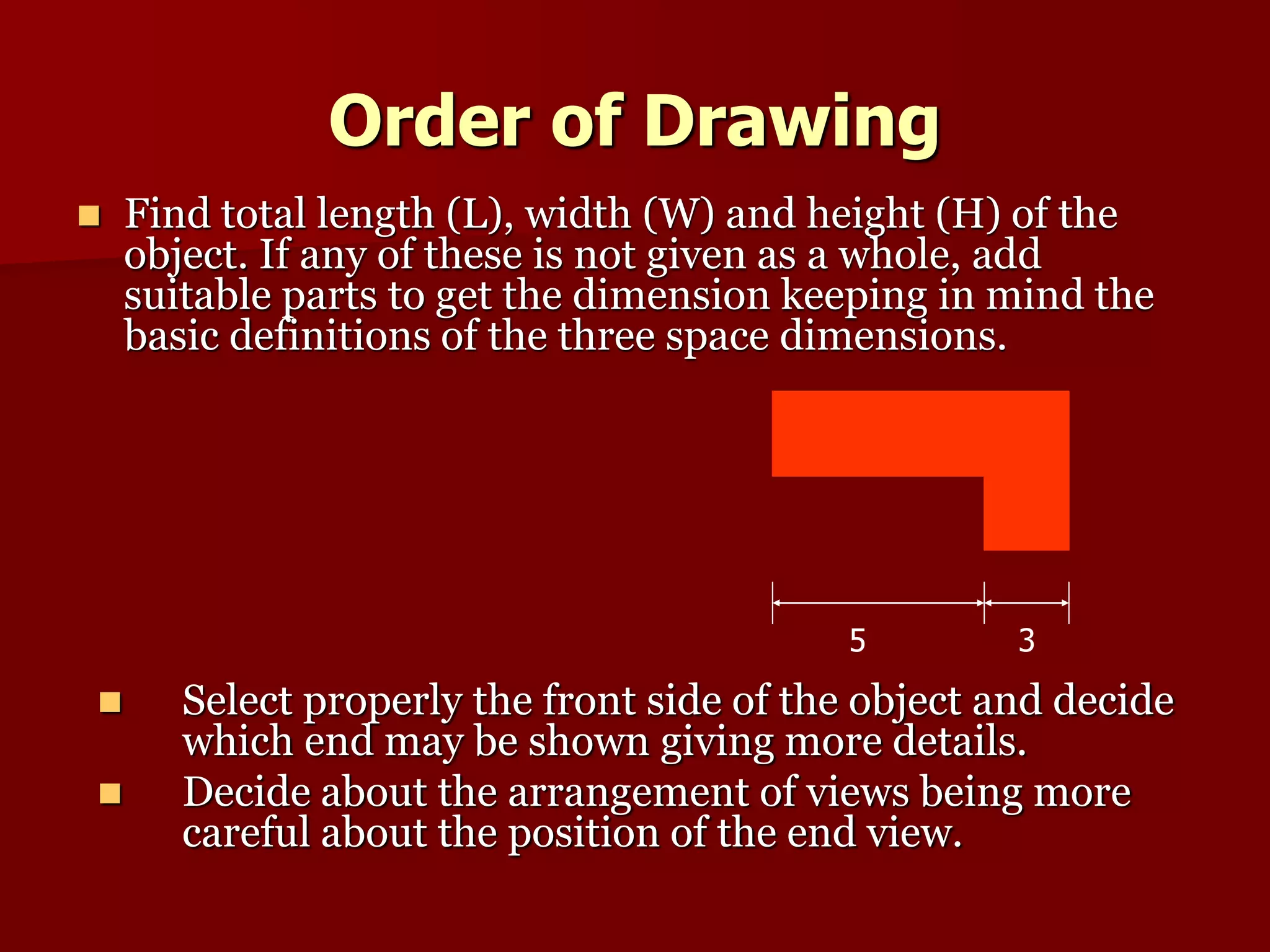
 Find total length (L), width (W) and height (H) of the 
object. If any of these is not given as a whole, add 
suitable parts to get the dimension keeping in mind the 
basic definitions of the three space dimensions. 
5 3 
 Select properly the front side of the object and decide 
which end may be shown giving more details. 
 Decide about the arrangement of views being more 
careful about the position of the end view.
Order of Drawing 
 Decide the scale at which the views may be drawn meaning 
that whether the object should be drawn by actual sizes or 
the dimensions should be considered as reduce/inl arged 
by a certain factor for drawing purposes. Usually a 
minimum space of one inch must be left in between the 
views to make them separate and to write the dimensions. 
 Adjust available space properly and draw lines to show the 
detail of different views. 
 Rub out the extra lines to obtain rectangular blocks for the 
three views. 
 Draw all those center-lines from for which dimensions can 
readily be found out. 
 Start showing the features one by one and carry the 
different views along together as far as possible. 
 Remove extra line, give dimensions and check the views 
before the final presentation.
TRANSFERING DIMENSIONS INBETWEEN 
THE VIEWS 
 During drawing work, avoid duplication of laying down the 
same measurements. 
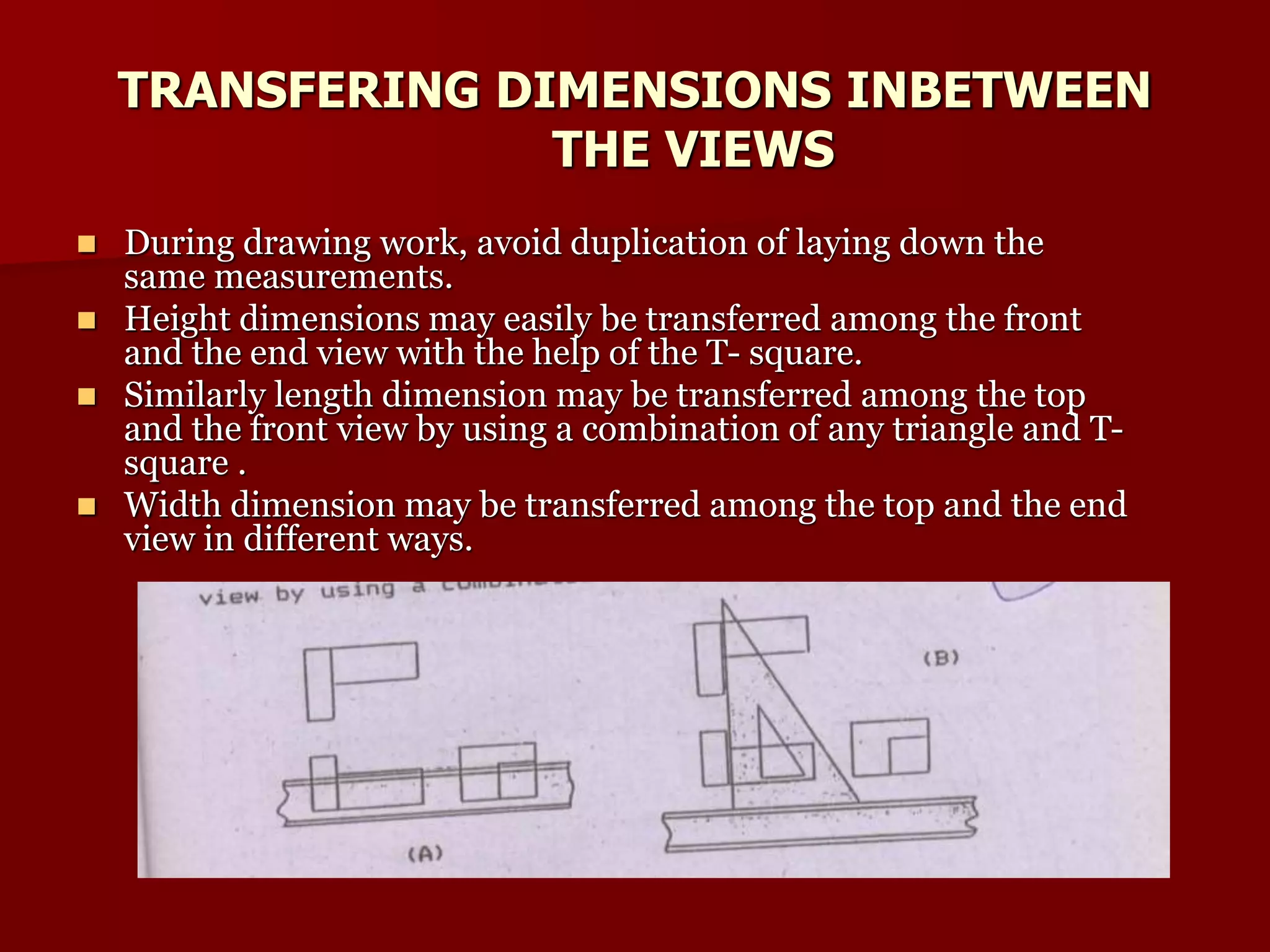
 Height dimensions may easily be transferred among the front 
and the end view with the help of the T- square. 
 Similarly length dimension may be transferred among the top 
and the front view by using a combination of any triangle and T-square 
. 
 Width dimension may be transferred among the top and the end 
view in different ways.
TRANSFERING DIMENSIOANS INBETWEEN 
THE VIEWS 
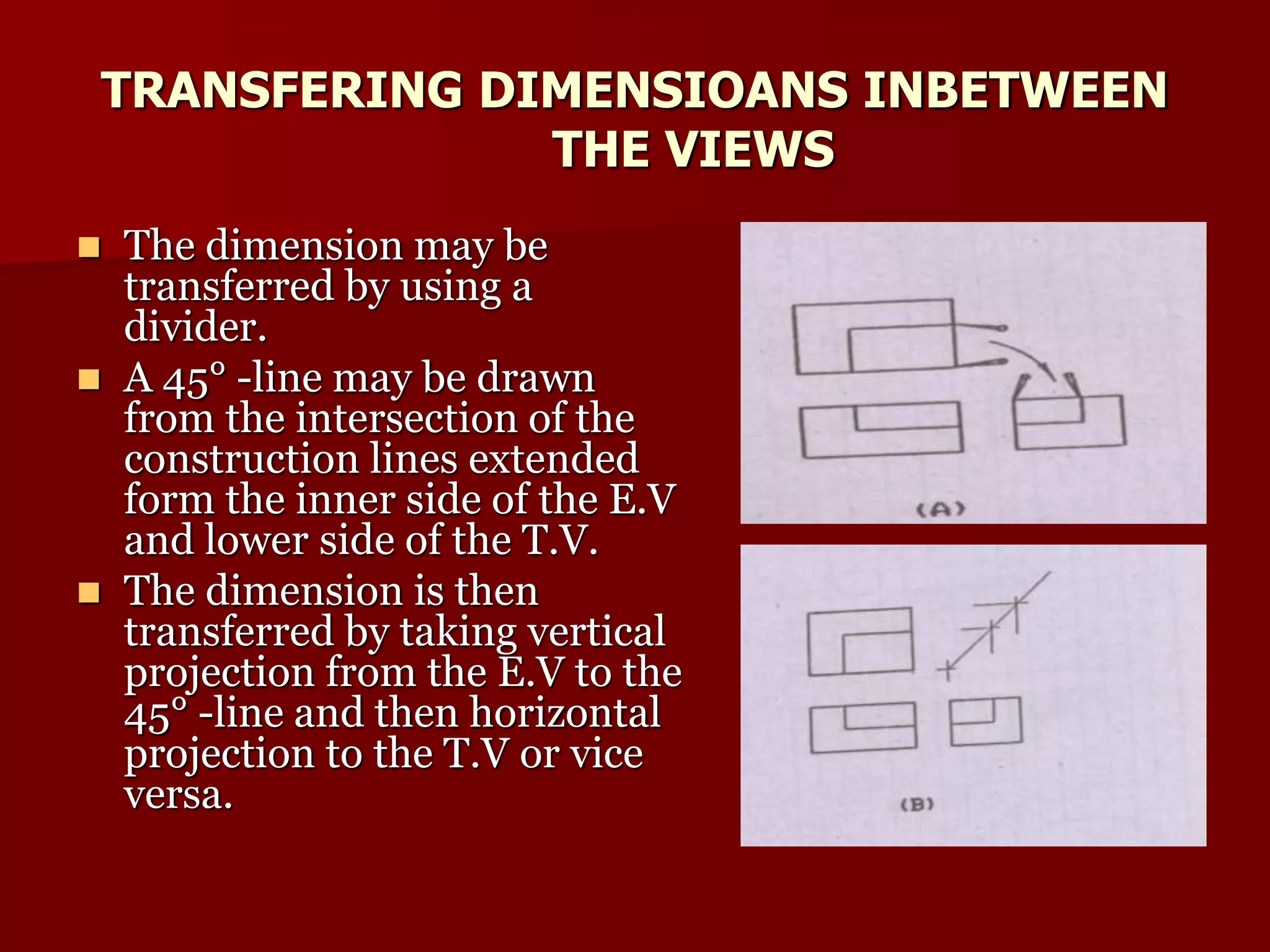
 The dimension may be 
transferred by using a 
divider. 
 A 45° -line may be drawn 
from the intersection of the 
construction lines extended 
form the inner side of the E.V 
and lower side of the T.V. 
 The dimension is then 
transferred by taking vertical 
projection from the E.V to the 
45° -line and then horizontal 
projection to the T.V or vice 
versa.
FREEHAND SKETCHING 
 A freehand sketch is a drawing in which all the 
proportions and measurements are judged by the eye 
and all the lines are drawn without the use of drawing 
instruments; the only tools used are pencil, eraser 
and paper. 
 If drawing of an existing building is to be made, it will 
not be possible to carry all the drawing instruments at 
the site and to make the formal drawings there. 
 Instead the engineer will make a sketch in his note-book 
after taking the measurements, then, later on, at 
a favorable time sitting in his office, he may carry out 
the detailed drawing work. 
 Further an engineer usually draws sketches only and 
it is the job of draftsmen to carry out the drawing 
work. 
 Sketches should be made such that they are easily 
readable by the same person and by the others.
FREEHAND SKETCHING 
 All the dimensions should be in some proportions 
that means bigger dimensions should actually be 
bigger than the smaller ones. 
 Straight lines should be as straight as possible, 
multistroke lines are generally used for the bigger 
lengths. 
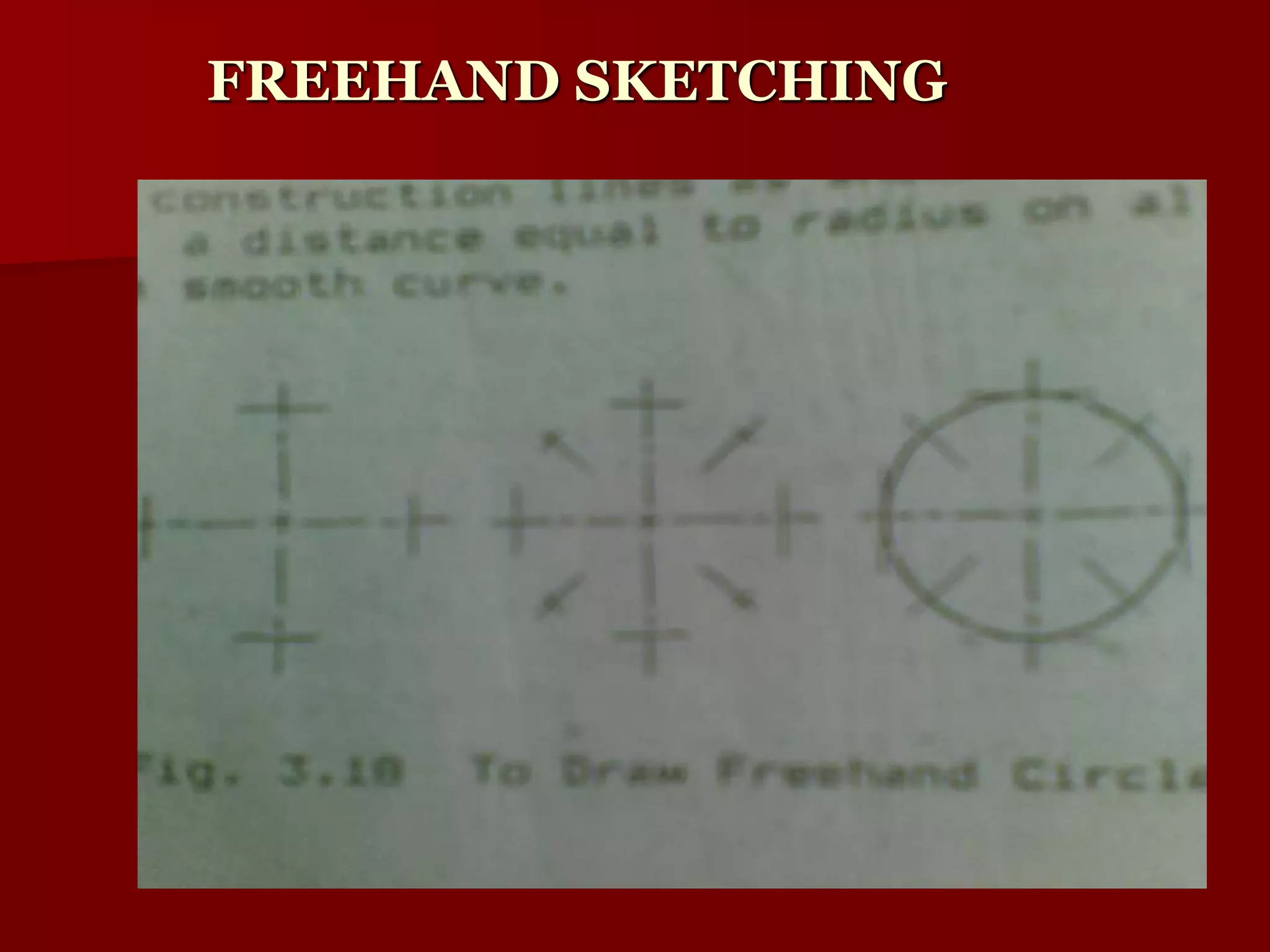
 To draw a circle, first sketch the center-lines, and 
then draw the 45 construction lines . By guess, 
mark a distance equal to radius on all these lines 
and join by a smooth curve.
FREEHAND SKETCHING
Models 
 Models of a simple object may easily be made in 
modeling wax, soap or wood. 
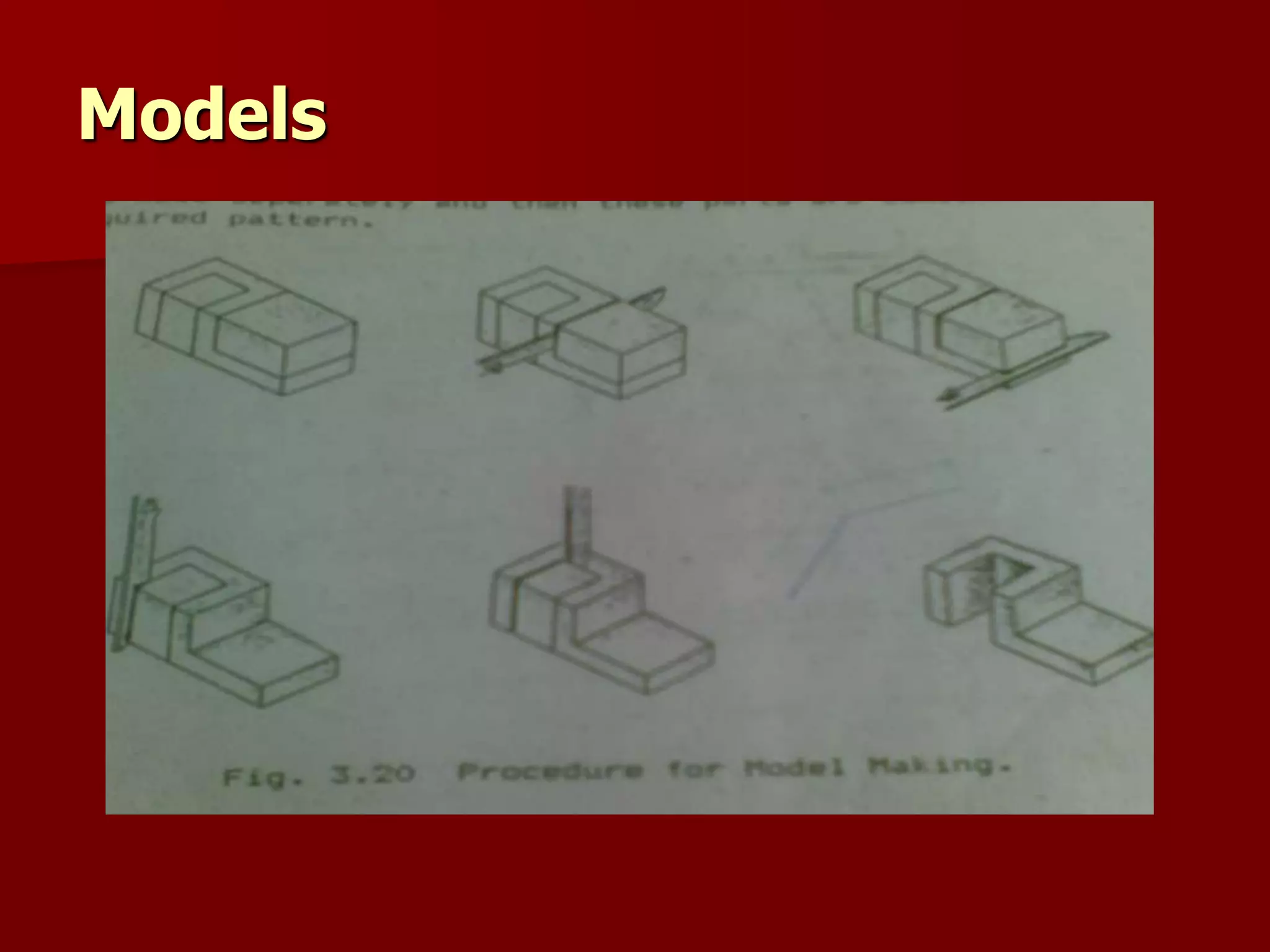
 For soap models, rectangular block of soap having a 
size close to 1.5” x 1” x 1” may be used. First 
proportions of the object are marked lightly with 
the point of the knife according to the given 
pictorial or other graphic views. Cuts are now made 
in a suitable order to obtain the model. 
 Some objects should first be divided into basic 
geometric shapes which are made separately and 
then these parts are combined in the required 
pattern.
Models
Thanks for ur concentration

First and third angle projection

  • 1.
    Civil Engineering Drawing BY SAFIULLAH 13CE07 SCET WAH CANTT CONTT;03479164097
  • 2.
    Third Angle Projection  In third angle projection, front view is always drawn at the bottom, top view just above the front view, and end view, is drawn on that side of the front view from where we are looking at the end of the object relative to the front.
  • 4.
    Third Angle Projection  Left End View should be accommodated on the left of the front view.  Right End View should be accommodated on the right of the front view.  However one end view is generally drawn.
  • 5.
    First Angle Projection  First angle projection, the object is positioned in first quadrant.  The object is considered to be in-between the picture plane and the observer.
  • 7.
    First Angle Projection  The top and the end views are rotated through 90° as before until they come in the frontal plane.  End view is drawn on that side of the front view which is opposite to the side from which we are looking at the object relative to the front.  First-angle projection was originally used all over the world but now in countries like the united States and Canada, third-angle projection is standard.
  • 8.
    First Angle Projection  In Pakistan, we use first angle projection for building drawing because all of the previous drawings for important buildings still lying in the offices are according to this method.  For machine drawing, more trends is to use third-angle projection because of its convenience and because most of the machines are imported form those countries which have third-angle projection as standard.
  • 9.
    Third Angle Projection First Angle Projection
  • 10.
    Hidden Features To describe an object completely, a drawing must contain lines representing all the edges, intersections and surface limits of the object whether these are visible to the observer from a particular direction or not.  The hidden edges, intersections and surface limits must always be indicated by dashed lines.  When a dashed line is to start independently, it must start form a dash, however, a gap is provided at the start when the dashed line is continuation of a full line.
  • 11.
  • 12.
    Centre Lines Center-linesare used to indicate the following:  Axes of symmetry for all the symmetrical portions of a view.  Axis of a cylinder or a cone.  Center of every circular curve must be located by two mutually perpendicular center-lines. Generally these two center-lines are horizontal and vertical but, in some cases, these may be circular and radial.
  • 13.
    Precedence Or Orderof Lines In any view, there are chances of coincidence of different types of lines.  Hidden portions may coincide with visible portions.  center-line may be required where already there is a full line.  Full lines have the first preference because visible features are more prominent .  On the second number are the dashed lines because these are showing physical features though hidden.  Then comes the imaginary lines like cutting plane symbol and center-lines. Most commonly cutting plane symbol is given more importance.  A line having lower order of preference is omitted in the portion where the other line with higher order of preference is present.
  • 14.
    Order of Drawing  Find total length (L), width (W) and height (H) of the object. If any of these is not given as a whole, add suitable parts to get the dimension keeping in mind the basic definitions of the three space dimensions. 5 3  Select properly the front side of the object and decide which end may be shown giving more details.  Decide about the arrangement of views being more careful about the position of the end view.
  • 15.
    Order of Drawing  Decide the scale at which the views may be drawn meaning that whether the object should be drawn by actual sizes or the dimensions should be considered as reduce/inl arged by a certain factor for drawing purposes. Usually a minimum space of one inch must be left in between the views to make them separate and to write the dimensions.  Adjust available space properly and draw lines to show the detail of different views.  Rub out the extra lines to obtain rectangular blocks for the three views.  Draw all those center-lines from for which dimensions can readily be found out.  Start showing the features one by one and carry the different views along together as far as possible.  Remove extra line, give dimensions and check the views before the final presentation.
  • 16.
    TRANSFERING DIMENSIONS INBETWEEN THE VIEWS  During drawing work, avoid duplication of laying down the same measurements.  Height dimensions may easily be transferred among the front and the end view with the help of the T- square.  Similarly length dimension may be transferred among the top and the front view by using a combination of any triangle and T-square .  Width dimension may be transferred among the top and the end view in different ways.
  • 18.
    TRANSFERING DIMENSIOANS INBETWEEN THE VIEWS  The dimension may be transferred by using a divider.  A 45° -line may be drawn from the intersection of the construction lines extended form the inner side of the E.V and lower side of the T.V.  The dimension is then transferred by taking vertical projection from the E.V to the 45° -line and then horizontal projection to the T.V or vice versa.
  • 19.
    FREEHAND SKETCHING A freehand sketch is a drawing in which all the proportions and measurements are judged by the eye and all the lines are drawn without the use of drawing instruments; the only tools used are pencil, eraser and paper.  If drawing of an existing building is to be made, it will not be possible to carry all the drawing instruments at the site and to make the formal drawings there.  Instead the engineer will make a sketch in his note-book after taking the measurements, then, later on, at a favorable time sitting in his office, he may carry out the detailed drawing work.  Further an engineer usually draws sketches only and it is the job of draftsmen to carry out the drawing work.  Sketches should be made such that they are easily readable by the same person and by the others.
  • 20.
    FREEHAND SKETCHING All the dimensions should be in some proportions that means bigger dimensions should actually be bigger than the smaller ones.  Straight lines should be as straight as possible, multistroke lines are generally used for the bigger lengths.  To draw a circle, first sketch the center-lines, and then draw the 45 construction lines . By guess, mark a distance equal to radius on all these lines and join by a smooth curve.
  • 21.
  • 22.
    Models  Modelsof a simple object may easily be made in modeling wax, soap or wood.  For soap models, rectangular block of soap having a size close to 1.5” x 1” x 1” may be used. First proportions of the object are marked lightly with the point of the knife according to the given pictorial or other graphic views. Cuts are now made in a suitable order to obtain the model.  Some objects should first be divided into basic geometric shapes which are made separately and then these parts are combined in the required pattern.
  • 23.
  • 24.
    Thanks for urconcentration