Engineering Drawing
Topics discussed
1. Introduction: Basic Drawing Practice
2. Orthogonal views of simple block
3. Orthogonal views with circular holes
4. Orthogonal views with fillets and rounds
5. Sectional views
6. Sectional views (conventional practices)
7. Auxiliary views
8. Isometric views
9. Isometric views with circular holes
10. Missing Lines and Missing views.
2
Graphics Language
3
1. Try to write a description of
this object.
2. Test your written description
by having someone attempt
to make a sketch from your
description.
Effectiveness of Graphics Language
The world languages are inadequate for describing the
size, shape and features completely as well as
concisely.
You can easily understand that …
4
Graphic language in “engineering application” use
lines to represent the surfaces, edges and contours
of objects.
A drawing can be done using freehand, instruments
or computer methods.
Composition of Graphic Language
The language is known as “drawing” or “drafting” .
5
Freehand drawing
The lines are sketched without using instruments other
than pencils and erasers.
Example
6
Example
7
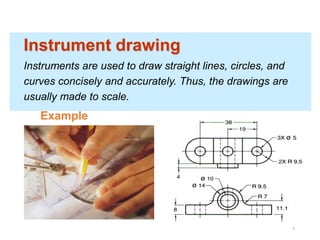
Instrument drawing
Instruments are used to draw straight lines, circles, and
curves concisely and accurately. Thus, the drawings are
usually made to scale.
Computer drawing
The drawings are usually made by commercial software
such as AutoCAD, solid works etc.
Example
8
Engineering Drawing
Introduction
 An engineering drawing is a type of technical drawing, used to fully and
clearly define requirements for engineered items, and is usually created
in accordance with standardized conventions for layout, nomenclature,
interpretation, appearance size, etc.
 Its purpose is to accurately and unambiguously capture all the
geometric features of a product or a component.
 The end goal of an engineering drawing is to convey all the required
information that will allow a manufacturer to produce that component.
10
Purpose of an Engineering Drawing
11
1. An engineering drawing is not an illustration.
2. It is a specification of the size and shape of a part or assembly.
3. The important information on a drawing is the dimension and
tolerance of all of its features.
Elements of Engineering Drawing
Engineering drawing are made up of graphics language
and word language.
Graphics
language
Describe a shape
(mainly).
Word
language
Describe size, location and
specification of the object.
12
Orthographic
Projection
Orthographic projection
• Orthographic" comes from the Greek word for
"straight writing (or drawing)." This projection shows
the object as it looks from the front, right, left, top,
bottom, or back, and are typically positioned relative
to each other according to the rules of either “First
Angle” or “Third Angle” projection.
14
Pictorial
 3-dimensional representations
 One-point
 one vanishing point
 lines that are not vertical
or horizontal converge to
single point in distance
 Two-point or Three-point
 two or three vanishing points
 With two points, vertical or
horizontal lines parallel, but not both
 With three-point, no lines are parallel
 Isometric
 Drawing shows corner of object,
but parallel lines on object are
parallel in drawing
 Shows three dimensions, but no
vanishing point(s)
15
One-point
Two-Point
16
Symbols for Third Angle (right)or First Angle (left).
 First angle projection is the ISO standard and is primarily used in
Europe. The 3D object is projected into 2D "paper" space as if you
were looking at an X-ray of the object: the top view is under the
front view, the right view is at the left of the front view.
 Third angle projection is primarily used in the United States and
Canada, where it is the default projection system according to BS
8888:2006, the left view is placed on the left the top view on the
top.
17
5
Orthographic projection is a parallel projection technique
in which the parallel lines of sight are perpendicular to the
projection plane
MEANING
18
Object views from top
Projection plane
1
2
3
4
5
1 2 3 4
Image of a part represented in First Angle Projection
19
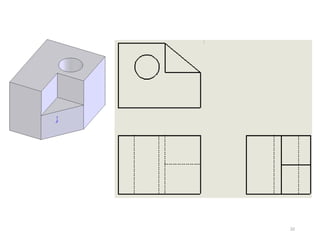
Orthographic / Multiview
• Draw object from two / three perpendicular views
20
/ Orthographic
What it looks
like pictorially
21
22
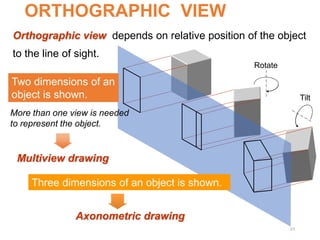
ORTHOGRAPHIC VIEW
23
Orthographic view depends on relative position of the object
to the line of sight.
Two dimensions of an
object is shown.
Three dimensions of an object is shown.
Rotate
Tilt
More than one view is needed
to represent the object.
Multiview drawing
Axonometric drawing
Multiview Drawing
It represents accurate shape and size.
Advantage
Disadvantage Require practice in writing and reading.
Multiviews drawing (2-view drawing)
Example
24
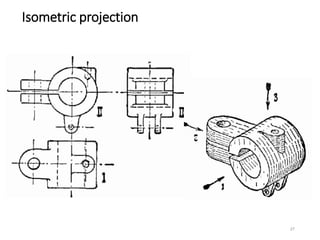
Axonometric (Isometric) Drawing
Easy to understand
Right angle becomes obtuse angle.
Circular hole
becomes ellipse.
Distortions of shape and size in isometric drawing
Advantage
Disadvantage Shape and angle distortion
Example
25
ISOMETRIC PROJECTION
26
Isometric projection
27
Sectional views
28
Auxiliary Views
• Used to show true dimensions of an inclined plane.
29
Auxiliary projection
30
Auxiliary projection
31
Traditional
Drawing Tools
Instruments
 Drawing board/table.
 Drawing sheet/paper.
 Drafting tape.
 Pencils.
 Eraser.
 Sharpener.
 T-square.
 Set-squares/triangles.
 Scales.
 Compass and divider.
33
Drawing board
34
Drawing table
35
Drawing sheet/paper
• 216 X 280 mm
• 280 X 382 mm
• 382 X 560 mm
• 585 X 726 mm
36
Pencils
• Wood pencils: H, 2H, 3H, 4H, 5H,
6H, 7H, 8H, 9H, B, HB, 2B, 3B, 4B,
5B, 6B.
• Semiautomatic Pencils (lead
holder) are more convenient then
ordinary wood pencils.
37
Drafter and T-square
38
39
Circle Template
40
Compass and divider
41
Drawing Standard
Introduction
43
Standards are set of rules that govern how technical
drawings are represented.
Drawing standards are used so that drawings convey
the same meaning to everyone who reads them.
ISO International Standards Organization
Standard Code
ANSI American National Standard Institute
USA
JIS Japanese Industrial Standard
Japan
BS British Standard
UK
AS Australian Standard
Australia
Deutsches Institut für Normung
DIN
Germany
Country Code Full name
44
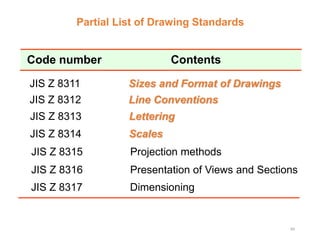
Partial List of Drawing Standards
JIS Z 8311 Sizes and Format of Drawings
JIS Z 8312 Line Conventions
JIS Z 8313 Lettering
JIS Z 8314 Scales
JIS Z 8315 Projection methods
JIS Z 8316 Presentation of Views and Sections
JIS Z 8317 Dimensioning
Code number Contents
45
Drawing Sheet
46
Trimmed paper of
a size A0 ~ A4.
Standard sheet size
(JIS)
A4 210 x 297
A3 297 x 420
A2 420 x 594
A1 594 x 841
A0 841 x 1189
A4
A3
A2
A1
A0
(Dimensions in millimeters)
Drawing space Drawing
space
Title block
d
d
c
c
c
Border
lines
1. Type X (A0~A4) 2. Type Y (A4 only)
Orientation of drawing sheet
Title block
Sheet size c (min) d (min)
A4 10 25
A3 10 25
A2 10 25
A1 20 25
A0 20 25
47
Drawing Scales
Scale is the ratio of the linear dimension of an element
of an object shown in the drawing to the real linear
dimension of the same element of the object.
Size in drawing Actual size
Length, size
:
48
100
10
Drawing Scales
Designation of a scale consists of the word “SCALE”
followed by the indication of its ratio, as follow
SCALE 1:1 for full size
SCALE X:1 for enlargement scales (X > 1)
SCALE 1:X for reduction scales (X > 1)
Dimension numbers shown in the drawing are correspond
to “true size” of the object and they are independent of
the scale used in creating that drawing.
49
Basic Line Types
Types of Lines Appearance
Name according
to application
Continuous thick line Visible line
Continuous thin line Dimension line
Extension line
Leader line
Dash thick line Hidden line
Chain thin line Center line
NOTE : We will learn other types of line in later chapters.
50
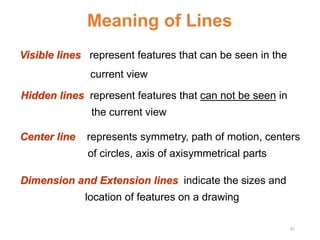
Visible lines represent features that can be seen in the
current view
Meaning of Lines
Hidden lines represent features that can not be seen in
the current view
Center line represents symmetry, path of motion, centers
of circles, axis of axisymmetrical parts
Dimension and Extension lines indicate the sizes and
location of features on a drawing
51
Types of Line
52
Line Conventions
• Visible Lines – solid thick lines that represent visible edges or contours
• Hidden Lines – short evenly spaced dashes that depict hidden features
• Section Lines – solid thin lines that indicate cut surfaces
• Center Lines – alternating long and short dashes
• Dimensioning
• Dimension Lines - solid thin lines showing dimension extent/direction
• Extension Lines - solid thin lines showing point or line to which dimension applies
• Leaders – direct notes, dimensions, symbols, part numbers, etc. to features on
drawing
• Cutting-Plane and Viewing-Plane Lines – indicate location of cutting planes for sectional
views and the viewing position for removed partial views
• Break Lines – indicate only portion of object is drawn. May be random “squiggled” line or
thin dashes joined by zigzags.
• Phantom Lines – long thin dashes separated by pairs of short dashes indicate alternate
positions of moving parts, adjacent position of related parts and repeated detail
• Chain Line – Lines or surfaces with special requirements
53
1
2
3 4
5
6
7
8
9
10
14
13
12 11
Viewing-plane line
Extension
line
Dimension
Line
Center Line
Hidden Line
Break Line
Cutting-plane Line
Visible Line
Center Line (of motion)
Leader
VIEW B-B
SECTION A-A
Section Line
Phantom
Line
ABCDEFGHIJKLMNOPQRS
TUVWXYZABCDEFGHIJKL
MNOPQRSTUVWXYZABCD
ABCDEFGHIJKLMNOPQRS
TUVWXYZABCDEFGHIJKL
MNOPQRSTUVWXYZABCD
EF
Lettering
55
Text on Drawings
56
Text on engineering drawing is used :
To communicate nongraphic information.
As a substitute for graphic information, in those instance
where text can communicate the needed information
more clearly and quickly.
Uniformity - size
- line thickness
Legibility - shape
- space between letters and words
Thus, it must be written with
Example Placement of the text on drawing
Dimension & Notes
Notes Title Block
57
Lettering Standard
58
ANSI Standard
Use a Gothic text style,
either inclined or vertical.
Use all capital letters.
Use 3 mm for most
text height.
Space between lines
of text is at least 1/3
of text height.
Basic Strokes
59
Straight Slanted Curved
Horizontal
1 1 2
3
Examples : Application of basic stroke
“I” letter “A” letter 1
2
3
4 5
6
“B” letter
Suggested Strokes Sequence
Straight line
letters
Curved line
letters
Curved line
letters &
Numerals
Upper-case letters & Numerals
60
The text’ s body height is about 2/3 the height of a capital
letter.
Suggested Strokes Sequence
Lower-case letters
61
Stroke Sequence
62
I L T F
E H
V X W
Stroke Sequence
63
N M K Z
Y A
Stroke Sequence
64
4
O Q C G
Stroke Sequence
65
D U P B
R J
Stroke Sequence
66
1 2
5
Stroke Sequence
67
7
6
8 9
0
Stroke Sequence
68
S 3
Stroke Sequence
l i
69
Stroke Sequence
v w x k
z
70
Stroke Sequence
j y f
r
t
71
Stroke Sequence
c o a b
d p q e
72
Stroke Sequence
g n m h
u s
73
Word Composition
Look at the same word having different spacing between letters.
JIRAPONG
JI G
O
R N
P
A
Which one is easier to read ?
A) Non-uniform spacing
B) Uniform spacing
74
Word Composition
JIRAPONG
 / 
| )( )| (
|
Space between the letters depends on the contour of
the letters at an adjacent side.
Spacing
Contour || ||
General conclusions are:
Good spacing creates approximately equal background
area between letters.
75
GOOD
Not uniform in style.
Not uniform in height.
Not uniformly vertical or inclined.
Not uniform in thickness of stroke.
Area between letters not uniform.
Area between words not uniform.
Example : Good and Poor Lettering
76
Leave the space between words equal to the space
requires for writing a letter “O”.
Example
Sentence Composition
ALL DIMENSIONS ARE IN
MILLIMETERS
O O O
OUNLESS
OTHERWISE SPECIFIED.
O
77
Dimensioning
78
Dimensioning Guidelines
79
The term “feature” refers to surfaces, faces, holes, slots, corners,
bends, arcs and fillets that add up to form an engineering part.
Dimensions define the size of a feature or its location relative to other
features or a frame of reference, called a datum.
The basic rules of dimensioning are:
1. Dimension where the feature contour is shown;
2. Place dimensions between the views;
3. Dimension off the views;
4. Dimension mating features for assembly;
5. Do not dimension to hidden lines;
6. Stagger dimensioning values;
7. Create a logical arrangement of dimensions;
8. Consider fabrication processes and capabilities;
9. Consider inspection processes and capabilities.
80
Important elements of dimensioning
81
Two types of dimensioning:
(1) Size and location dimensions (2) Detail dimensioning
Geometrics
• The science of specifying and tolerancing shapes and locations of
features of on objects
82
Geometrics
• It is important that all persons reading a drawing interpret it exactly
the same way.
• Parts are dimensioned based on two criteria:
• Basic size and locations of the features
• Details of construction for manufacturing
• Standards from ANSI (American National Standards Institute)
83
Scaling vs. Dimensioning
• Drawings can be a different scales, but dimensions are ALWAYS at full
scale.
84
Units of Measure
• Length
• English - Inches, unless otherwise stated
• Up to 72 inches – feet and inches over
• SI – millimeter, mm
• Angle
• degrees, minutes, seconds
85
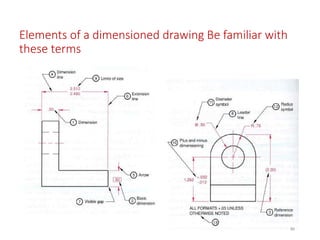
Angle Dimensions
Elements of a dimensioned drawing Be familiar with
these terms
86
Arrangement of Dimensions
87
• Keep dimension off of the part where possible.
• Arrange extension lines so the larger dimensions are outside of the smaller dimensions.
• Stagger the dimension value labels to ensure they are clearly defined.
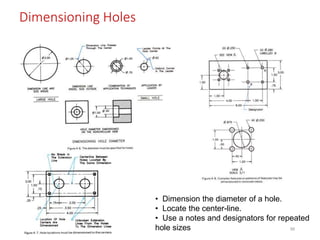
Dimensioning Holes
88
• Dimension the diameter of a hole.
• Locate the center-line.
• Use a notes and designators for repeated
hole sizes
Dimensioning the Radius of an Arc
89
Dimension an arcs by its radius.
Locate the center of the radius or two
tangents to the arc.
Drilled Holes, Counter bores and Countersinks
90
• Use the depth symbol to define the
depth of a drilled hole.
• Use the depth symbol or a section
view to dimension a counter bore.
• Countersinks do not need a section
view.
Angles, Chamfers and Tapers
91
• Dimension the one vertex for an angled face, the other vertex is determined by an
intersection.
• Chamfers are generally 45 with the width of the face specified.
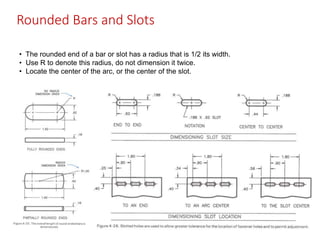
Rounded Bars and Slots
92
• The rounded end of a bar or slot has a radius that is 1/2 its width.
• Use R to denote this radius, do not dimension it twice.
• Locate the center of the arc, or the center of the slot.
Limits of Size
93
• All dimensions have minimum and maximum values
specified by the tolerance block.
• Tolerances accumulate in a chain of dimensions.
• Accumulation can be avoided by using a single baseline.
Fit Between Parts
94
Clearance Fit
Interference Fit Transition Fit
1. Clearance fit: The shaft maximum diameter is smaller than the hole minimum
diameter.
2. Interference fit: The shaft minimum diameter is larger than the hole maximum
diameter.
3. Transition fit: The shaft maximum diameter and hole minimum have an interference
fit, while the shaft minimum diameter and hole maximum diameter have a clearance
fit
Dimensioning standards
P. 95
Dimension text placement
P. 96
Unidirectional or aligned dimensioning?
97
Dual dimensioning
98
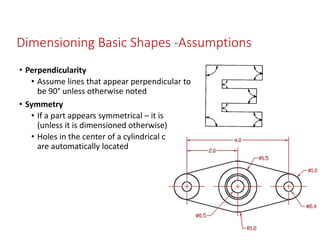
Dimensioning Basic Shapes -Assumptions
• Perpendicularity
• Assume lines that appear perpendicular to
be 90° unless otherwise noted
• Symmetry
• If a part appears symmetrical – it is
(unless it is dimensioned otherwise)
• Holes in the center of a cylindrical object
are automatically located
99
Dimensioning Basic Shapes
• Rectangular Prism
100
Dimensioning Basic Shapes
101
• Cylinders
• Positive
• Negative
Dimensioning Basic Shapes
• Cone Frustum
102
Dimensioning Basic Shapes
• Circle Pattern Center Lines
103
Grouping Dimensions
• Dimensions should always be placed outside the part
104
Yes No
Dimension guidelines
105
Dimensions should be placed in the view that
most clearly describes the feature being
dimensioned (contour (shape) dimensioning)
Dimension guidelines
106
Maintain a minimum
spacing between the
object and the
dimension between
multiple dimensions.
A visible gap shall be
placed between the
ends of extension lines
and the feature to
which they refer.
Dimension guidelines
107
Avoid dimensioning hidden
lines.
Leader lines for diameters
and radii should be radial
lines.
Where and how should we place dimensions
when we have many dimensions?
108
Where and how should we place dimensions
when we have many dimensions? (cont.)
109
Staggering Dimensions
• Put the lesser
dimensions closer to
the part.
• Try to reference
dimensions from
one surface
• This will depend on the
part and how the
tolerances are based.
110
Extension Line Practices
111
Repetitive Features
112
Use the Symbol ‘x’ to
Dimension Repetitive
Features
Symbols for Drilling Operations
113
114
Line weight
115
116
117
118
119

engineering_drawing.ppt

  • 1.
  • 2.
    Topics discussed 1. Introduction:Basic Drawing Practice 2. Orthogonal views of simple block 3. Orthogonal views with circular holes 4. Orthogonal views with fillets and rounds 5. Sectional views 6. Sectional views (conventional practices) 7. Auxiliary views 8. Isometric views 9. Isometric views with circular holes 10. Missing Lines and Missing views. 2
  • 3.
  • 4.
    1. Try towrite a description of this object. 2. Test your written description by having someone attempt to make a sketch from your description. Effectiveness of Graphics Language The world languages are inadequate for describing the size, shape and features completely as well as concisely. You can easily understand that … 4
  • 5.
    Graphic language in“engineering application” use lines to represent the surfaces, edges and contours of objects. A drawing can be done using freehand, instruments or computer methods. Composition of Graphic Language The language is known as “drawing” or “drafting” . 5
  • 6.
    Freehand drawing The linesare sketched without using instruments other than pencils and erasers. Example 6
  • 7.
    Example 7 Instrument drawing Instruments areused to draw straight lines, circles, and curves concisely and accurately. Thus, the drawings are usually made to scale.
  • 8.
    Computer drawing The drawingsare usually made by commercial software such as AutoCAD, solid works etc. Example 8
  • 9.
  • 10.
    Introduction  An engineeringdrawing is a type of technical drawing, used to fully and clearly define requirements for engineered items, and is usually created in accordance with standardized conventions for layout, nomenclature, interpretation, appearance size, etc.  Its purpose is to accurately and unambiguously capture all the geometric features of a product or a component.  The end goal of an engineering drawing is to convey all the required information that will allow a manufacturer to produce that component. 10
  • 11.
    Purpose of anEngineering Drawing 11 1. An engineering drawing is not an illustration. 2. It is a specification of the size and shape of a part or assembly. 3. The important information on a drawing is the dimension and tolerance of all of its features.
  • 12.
    Elements of EngineeringDrawing Engineering drawing are made up of graphics language and word language. Graphics language Describe a shape (mainly). Word language Describe size, location and specification of the object. 12
  • 13.
  • 14.
    Orthographic projection • Orthographic"comes from the Greek word for "straight writing (or drawing)." This projection shows the object as it looks from the front, right, left, top, bottom, or back, and are typically positioned relative to each other according to the rules of either “First Angle” or “Third Angle” projection. 14
  • 15.
    Pictorial  3-dimensional representations One-point  one vanishing point  lines that are not vertical or horizontal converge to single point in distance  Two-point or Three-point  two or three vanishing points  With two points, vertical or horizontal lines parallel, but not both  With three-point, no lines are parallel  Isometric  Drawing shows corner of object, but parallel lines on object are parallel in drawing  Shows three dimensions, but no vanishing point(s) 15
  • 16.
  • 17.
    Symbols for ThirdAngle (right)or First Angle (left).  First angle projection is the ISO standard and is primarily used in Europe. The 3D object is projected into 2D "paper" space as if you were looking at an X-ray of the object: the top view is under the front view, the right view is at the left of the front view.  Third angle projection is primarily used in the United States and Canada, where it is the default projection system according to BS 8888:2006, the left view is placed on the left the top view on the top. 17
  • 18.
    5 Orthographic projection isa parallel projection technique in which the parallel lines of sight are perpendicular to the projection plane MEANING 18 Object views from top Projection plane 1 2 3 4 5 1 2 3 4
  • 19.
    Image of apart represented in First Angle Projection 19
  • 20.
    Orthographic / Multiview •Draw object from two / three perpendicular views 20 / Orthographic What it looks like pictorially
  • 21.
  • 22.
  • 23.
    ORTHOGRAPHIC VIEW 23 Orthographic viewdepends on relative position of the object to the line of sight. Two dimensions of an object is shown. Three dimensions of an object is shown. Rotate Tilt More than one view is needed to represent the object. Multiview drawing Axonometric drawing
  • 24.
    Multiview Drawing It representsaccurate shape and size. Advantage Disadvantage Require practice in writing and reading. Multiviews drawing (2-view drawing) Example 24
  • 25.
    Axonometric (Isometric) Drawing Easyto understand Right angle becomes obtuse angle. Circular hole becomes ellipse. Distortions of shape and size in isometric drawing Advantage Disadvantage Shape and angle distortion Example 25
  • 26.
  • 27.
  • 28.
  • 29.
    Auxiliary Views • Usedto show true dimensions of an inclined plane. 29
  • 30.
  • 31.
  • 32.
  • 33.
    Instruments  Drawing board/table. Drawing sheet/paper.  Drafting tape.  Pencils.  Eraser.  Sharpener.  T-square.  Set-squares/triangles.  Scales.  Compass and divider. 33
  • 34.
  • 35.
  • 36.
    Drawing sheet/paper • 216X 280 mm • 280 X 382 mm • 382 X 560 mm • 585 X 726 mm 36
  • 37.
    Pencils • Wood pencils:H, 2H, 3H, 4H, 5H, 6H, 7H, 8H, 9H, B, HB, 2B, 3B, 4B, 5B, 6B. • Semiautomatic Pencils (lead holder) are more convenient then ordinary wood pencils. 37
  • 38.
  • 39.
  • 40.
  • 41.
  • 42.
  • 43.
    Introduction 43 Standards are setof rules that govern how technical drawings are represented. Drawing standards are used so that drawings convey the same meaning to everyone who reads them.
  • 44.
    ISO International StandardsOrganization Standard Code ANSI American National Standard Institute USA JIS Japanese Industrial Standard Japan BS British Standard UK AS Australian Standard Australia Deutsches Institut für Normung DIN Germany Country Code Full name 44
  • 45.
    Partial List ofDrawing Standards JIS Z 8311 Sizes and Format of Drawings JIS Z 8312 Line Conventions JIS Z 8313 Lettering JIS Z 8314 Scales JIS Z 8315 Projection methods JIS Z 8316 Presentation of Views and Sections JIS Z 8317 Dimensioning Code number Contents 45
  • 46.
    Drawing Sheet 46 Trimmed paperof a size A0 ~ A4. Standard sheet size (JIS) A4 210 x 297 A3 297 x 420 A2 420 x 594 A1 594 x 841 A0 841 x 1189 A4 A3 A2 A1 A0 (Dimensions in millimeters)
  • 47.
    Drawing space Drawing space Titleblock d d c c c Border lines 1. Type X (A0~A4) 2. Type Y (A4 only) Orientation of drawing sheet Title block Sheet size c (min) d (min) A4 10 25 A3 10 25 A2 10 25 A1 20 25 A0 20 25 47
  • 48.
    Drawing Scales Scale isthe ratio of the linear dimension of an element of an object shown in the drawing to the real linear dimension of the same element of the object. Size in drawing Actual size Length, size : 48 100 10
  • 49.
    Drawing Scales Designation ofa scale consists of the word “SCALE” followed by the indication of its ratio, as follow SCALE 1:1 for full size SCALE X:1 for enlargement scales (X > 1) SCALE 1:X for reduction scales (X > 1) Dimension numbers shown in the drawing are correspond to “true size” of the object and they are independent of the scale used in creating that drawing. 49
  • 50.
    Basic Line Types Typesof Lines Appearance Name according to application Continuous thick line Visible line Continuous thin line Dimension line Extension line Leader line Dash thick line Hidden line Chain thin line Center line NOTE : We will learn other types of line in later chapters. 50
  • 51.
    Visible lines representfeatures that can be seen in the current view Meaning of Lines Hidden lines represent features that can not be seen in the current view Center line represents symmetry, path of motion, centers of circles, axis of axisymmetrical parts Dimension and Extension lines indicate the sizes and location of features on a drawing 51
  • 52.
  • 53.
    Line Conventions • VisibleLines – solid thick lines that represent visible edges or contours • Hidden Lines – short evenly spaced dashes that depict hidden features • Section Lines – solid thin lines that indicate cut surfaces • Center Lines – alternating long and short dashes • Dimensioning • Dimension Lines - solid thin lines showing dimension extent/direction • Extension Lines - solid thin lines showing point or line to which dimension applies • Leaders – direct notes, dimensions, symbols, part numbers, etc. to features on drawing • Cutting-Plane and Viewing-Plane Lines – indicate location of cutting planes for sectional views and the viewing position for removed partial views • Break Lines – indicate only portion of object is drawn. May be random “squiggled” line or thin dashes joined by zigzags. • Phantom Lines – long thin dashes separated by pairs of short dashes indicate alternate positions of moving parts, adjacent position of related parts and repeated detail • Chain Line – Lines or surfaces with special requirements 53
  • 54.
    1 2 3 4 5 6 7 8 9 10 14 13 12 11 Viewing-planeline Extension line Dimension Line Center Line Hidden Line Break Line Cutting-plane Line Visible Line Center Line (of motion) Leader VIEW B-B SECTION A-A Section Line Phantom Line
  • 55.
  • 56.
    Text on Drawings 56 Texton engineering drawing is used : To communicate nongraphic information. As a substitute for graphic information, in those instance where text can communicate the needed information more clearly and quickly. Uniformity - size - line thickness Legibility - shape - space between letters and words Thus, it must be written with
  • 57.
    Example Placement ofthe text on drawing Dimension & Notes Notes Title Block 57
  • 58.
    Lettering Standard 58 ANSI Standard Usea Gothic text style, either inclined or vertical. Use all capital letters. Use 3 mm for most text height. Space between lines of text is at least 1/3 of text height.
  • 59.
    Basic Strokes 59 Straight SlantedCurved Horizontal 1 1 2 3 Examples : Application of basic stroke “I” letter “A” letter 1 2 3 4 5 6 “B” letter
  • 60.
    Suggested Strokes Sequence Straightline letters Curved line letters Curved line letters & Numerals Upper-case letters & Numerals 60
  • 61.
    The text’ sbody height is about 2/3 the height of a capital letter. Suggested Strokes Sequence Lower-case letters 61
  • 62.
  • 63.
    V X W StrokeSequence 63
  • 64.
    N M KZ Y A Stroke Sequence 64 4
  • 65.
    O Q CG Stroke Sequence 65
  • 66.
    D U PB R J Stroke Sequence 66 1 2
  • 67.
  • 68.
  • 69.
  • 70.
  • 71.
  • 72.
    Stroke Sequence c oa b d p q e 72
  • 73.
  • 74.
    Word Composition Look atthe same word having different spacing between letters. JIRAPONG JI G O R N P A Which one is easier to read ? A) Non-uniform spacing B) Uniform spacing 74
  • 75.
    Word Composition JIRAPONG / | )( )| ( | Space between the letters depends on the contour of the letters at an adjacent side. Spacing Contour || || General conclusions are: Good spacing creates approximately equal background area between letters. 75
  • 76.
    GOOD Not uniform instyle. Not uniform in height. Not uniformly vertical or inclined. Not uniform in thickness of stroke. Area between letters not uniform. Area between words not uniform. Example : Good and Poor Lettering 76
  • 77.
    Leave the spacebetween words equal to the space requires for writing a letter “O”. Example Sentence Composition ALL DIMENSIONS ARE IN MILLIMETERS O O O OUNLESS OTHERWISE SPECIFIED. O 77
  • 78.
  • 79.
    Dimensioning Guidelines 79 The term“feature” refers to surfaces, faces, holes, slots, corners, bends, arcs and fillets that add up to form an engineering part. Dimensions define the size of a feature or its location relative to other features or a frame of reference, called a datum. The basic rules of dimensioning are: 1. Dimension where the feature contour is shown; 2. Place dimensions between the views; 3. Dimension off the views; 4. Dimension mating features for assembly; 5. Do not dimension to hidden lines; 6. Stagger dimensioning values; 7. Create a logical arrangement of dimensions; 8. Consider fabrication processes and capabilities; 9. Consider inspection processes and capabilities.
  • 80.
  • 81.
    Important elements ofdimensioning 81 Two types of dimensioning: (1) Size and location dimensions (2) Detail dimensioning
  • 82.
    Geometrics • The scienceof specifying and tolerancing shapes and locations of features of on objects 82
  • 83.
    Geometrics • It isimportant that all persons reading a drawing interpret it exactly the same way. • Parts are dimensioned based on two criteria: • Basic size and locations of the features • Details of construction for manufacturing • Standards from ANSI (American National Standards Institute) 83
  • 84.
    Scaling vs. Dimensioning •Drawings can be a different scales, but dimensions are ALWAYS at full scale. 84
  • 85.
    Units of Measure •Length • English - Inches, unless otherwise stated • Up to 72 inches – feet and inches over • SI – millimeter, mm • Angle • degrees, minutes, seconds 85 Angle Dimensions
  • 86.
    Elements of adimensioned drawing Be familiar with these terms 86
  • 87.
    Arrangement of Dimensions 87 •Keep dimension off of the part where possible. • Arrange extension lines so the larger dimensions are outside of the smaller dimensions. • Stagger the dimension value labels to ensure they are clearly defined.
  • 88.
    Dimensioning Holes 88 • Dimensionthe diameter of a hole. • Locate the center-line. • Use a notes and designators for repeated hole sizes
  • 89.
    Dimensioning the Radiusof an Arc 89 Dimension an arcs by its radius. Locate the center of the radius or two tangents to the arc.
  • 90.
    Drilled Holes, Counterbores and Countersinks 90 • Use the depth symbol to define the depth of a drilled hole. • Use the depth symbol or a section view to dimension a counter bore. • Countersinks do not need a section view.
  • 91.
    Angles, Chamfers andTapers 91 • Dimension the one vertex for an angled face, the other vertex is determined by an intersection. • Chamfers are generally 45 with the width of the face specified.
  • 92.
    Rounded Bars andSlots 92 • The rounded end of a bar or slot has a radius that is 1/2 its width. • Use R to denote this radius, do not dimension it twice. • Locate the center of the arc, or the center of the slot.
  • 93.
    Limits of Size 93 •All dimensions have minimum and maximum values specified by the tolerance block. • Tolerances accumulate in a chain of dimensions. • Accumulation can be avoided by using a single baseline.
  • 94.
    Fit Between Parts 94 ClearanceFit Interference Fit Transition Fit 1. Clearance fit: The shaft maximum diameter is smaller than the hole minimum diameter. 2. Interference fit: The shaft minimum diameter is larger than the hole maximum diameter. 3. Transition fit: The shaft maximum diameter and hole minimum have an interference fit, while the shaft minimum diameter and hole maximum diameter have a clearance fit
  • 95.
  • 96.
  • 97.
    Unidirectional or aligneddimensioning? 97
  • 98.
  • 99.
    Dimensioning Basic Shapes-Assumptions • Perpendicularity • Assume lines that appear perpendicular to be 90° unless otherwise noted • Symmetry • If a part appears symmetrical – it is (unless it is dimensioned otherwise) • Holes in the center of a cylindrical object are automatically located 99
  • 100.
    Dimensioning Basic Shapes •Rectangular Prism 100
  • 101.
    Dimensioning Basic Shapes 101 •Cylinders • Positive • Negative
  • 102.
  • 103.
    Dimensioning Basic Shapes •Circle Pattern Center Lines 103
  • 104.
    Grouping Dimensions • Dimensionsshould always be placed outside the part 104 Yes No
  • 105.
    Dimension guidelines 105 Dimensions shouldbe placed in the view that most clearly describes the feature being dimensioned (contour (shape) dimensioning)
  • 106.
    Dimension guidelines 106 Maintain aminimum spacing between the object and the dimension between multiple dimensions. A visible gap shall be placed between the ends of extension lines and the feature to which they refer.
  • 107.
    Dimension guidelines 107 Avoid dimensioninghidden lines. Leader lines for diameters and radii should be radial lines.
  • 108.
    Where and howshould we place dimensions when we have many dimensions? 108
  • 109.
    Where and howshould we place dimensions when we have many dimensions? (cont.) 109
  • 110.
    Staggering Dimensions • Putthe lesser dimensions closer to the part. • Try to reference dimensions from one surface • This will depend on the part and how the tolerances are based. 110
  • 111.
  • 112.
    Repetitive Features 112 Use theSymbol ‘x’ to Dimension Repetitive Features
  • 113.
    Symbols for DrillingOperations 113
  • 114.
  • 115.
  • 116.
  • 117.
  • 118.
  • 119.