Properties of Concrete (CE-203) 
By: 
Engr. Rameez Sohail 
Lecture # 01 
Department of Civil Engineering
Properties of Concrete 
• Credit Hours 3 ( 2+1) 
• Semester Weeks 16/18 
• Evaluation/Grading 
– Home Assignments 
– Quiz test, unannounced 
– Midterm test 
– Attendance 
• Semester Exam 
2
What is Concrete?. 
• Concrete is word of Latin derivation ( con – together ) ( crete 
– to grow ) and its history can be charted from 3000 BC. 
• It is a composite material that consists essentially of a binding 
medium (Cement, Lime) within which are embedded particles 
or fragments of aggregate(Coarse & Fine Aggregates). 
• Concrete is often looked upon as “man made rock”. 
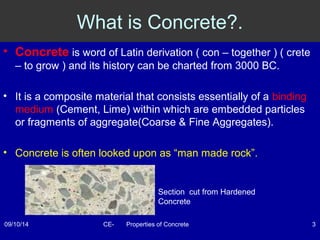
Section cut from Hardened 
Concrete 
09/10/14 CE- Properties of Concrete 3
Concrete Ingredients 
☞Cement /Lime - Binder 
☞Aggregate - sand, gravel, crushed rock 
 Fine aggregate ----- Sand 
 Coarse aggregates ----crushed rock 
☞Water 
☞Admixtures - when necessary 
09/10/14 CE- Properties of Concrete 4
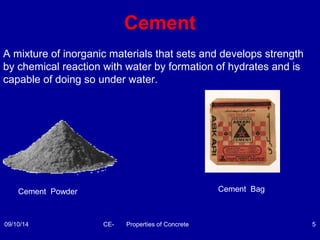
Cement 
A mixture of inorganic materials that sets and develops strength 
by chemical reaction with water by formation of hydrates and is 
capable of doing so under water. 
Cement Powder Cement Bag 
09/10/14 CE- Properties of Concrete 5
Cement 
Binds the aggregates into a solid mass 
Imparts strength to concrete 
Makes concrete impermeable by filling up voids in fine 
concrete 
09/10/14 CE- Properties of Concrete 6
Aggregates 
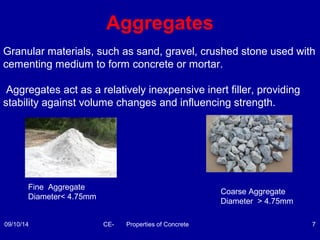
Granular materials, such as sand, gravel, crushed stone used with 
cementing medium to form concrete or mortar. 
Aggregates act as a relatively inexpensive inert filler, providing 
stability against volume changes and influencing strength. 
Fine Aggregate 
Diameter< 4.75mm Coarse Aggregate 
Diameter > 4.75mm 
09/10/14 CE- Properties of Concrete 7
Aggregates 
Sand 
Fills the voids within coarse aggregates 
Assists in hardening of cement by allowing water to seep 
through its voids 
Minimizes shrinking and cracking of concrete 
Economizes concrete by varying its proportion for strength 
Coarse Aggregate 
Acts as main filler, forms the main bulk mass 
Binding material adheres on its surface 
Imparts volumetric stability and durability to concrete 
Increases crushing strength, resistance to wear and tear, and 
water tightness of concrete 
Economizes concrete since it is cheaper than cement 
09/10/14 CE- Properties of Concrete 8
Water 
•It reacts with the cement to form binder that hardens and bonds 
the aggregates together 
•Lubricates the fresh concrete enabling it to be placed into 
position and compacted. 
•Good water is essential for quality concrete. 
•It should be good enough to drink--free of trash, organic matter 
and excessive chemicals and/or minerals. 
•The strength and other properties of concrete are highly 
dependent on the amount of water and the water-cement ratio. 
09/10/14 CE- Properties of Concrete 9
Concrete Ingredients 
Admixtures 
They are chemicals that can be added to the concrete 
immediately before or during mixing and significantly change its 
fresh, early age or hardened state to economic or physical 
advantage 
09/10/14 CE- Properties of Concrete 10
Concrete Ingredients 
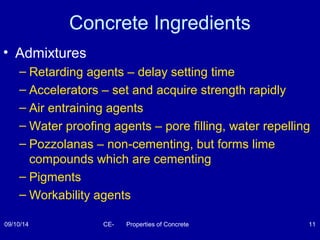
• Admixtures 
– Retarding agents – delay setting time 
– Accelerators – set and acquire strength rapidly 
– Air entraining agents 
– Water proofing agents – pore filling, water repelling 
– Pozzolanas – non-cementing, but forms lime 
compounds which are cementing 
– Pigments 
– Workability agents 
09/10/14 CE- Properties of Concrete 11
Cement Concrete 
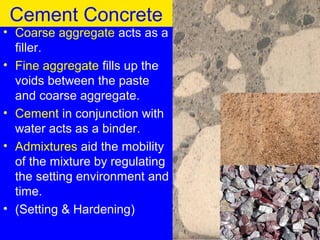
• Coarse aggregate acts as a 
filler. 
• Fine aggregate fills up the 
voids between the paste 
and coarse aggregate. 
• Cement in conjunction with 
water acts as a binder. 
• Admixtures aid the mobility 
of the mixture by regulating 
the setting environment and 
time. 
• (Setting & Hardening) 
09/10/14 CE- Properties of Concrete 12
Advantages of Concrete 
Concrete is the most widely used construction material in the 
world. 
•It has relatively high compressive strength. 
•It has better resistance to fire than steel, wood etc 
•It has long service life with low maintenance cost. 
•In some type of structure such as dams, piers and footing it is 
most economical structural materials. 
•It can be cast to take the shape required making it widely used in 
pre-cast structural components. 
•It yield rigid member with minimum apparent deflection. 
•Concrete can be finished to produce surfaces ranging from glass-smooth 
to coarsely textured, and it can be colored with pigments 
or painted. 
09/10/14 CE- Properties of Concrete 13
Disadvantages of Concrete 
•It needs mixing, casting and curing all of which affect the final 
strength of concrete. 
•The cost of formwork used to cast the concrete is relatively high. 
•It has very low tensile strength. 
•It has low compressive strength as compared to steel which lead to 
large section of structural members. 
•Minor crack develops in concrete due to shrinkage. 
•It requires skill labor and supervision from mixing to finishing. 
09/10/14 CE- Properties of Concrete 14
Qualities of Good Concrete 
Fresh Concrete 
• Workability – easily workable 
• Volume stability 
Hardened Concrete 
• Strength – compressive and tensile 
• Durability – wind, rain, frost, temperature, chemicals and salts 
• Density – 3,000 kg/m³ well compacted 
• Water tightness – avoid corrosion of inside steel and leakage, 
seepage in hydraulic structures 
• Resistance to wear and tear – abrasive action in floors and 
roads 
09/10/14 CE- Properties of Concrete 15
09/10/14 CE- Properties of Concrete 16

Properties of Concrete (CE-203)

  • 1.
    Properties of Concrete(CE-203) By: Engr. Rameez Sohail Lecture # 01 Department of Civil Engineering
  • 2.
    Properties of Concrete • Credit Hours 3 ( 2+1) • Semester Weeks 16/18 • Evaluation/Grading – Home Assignments – Quiz test, unannounced – Midterm test – Attendance • Semester Exam 2
  • 3.
    What is Concrete?. • Concrete is word of Latin derivation ( con – together ) ( crete – to grow ) and its history can be charted from 3000 BC. • It is a composite material that consists essentially of a binding medium (Cement, Lime) within which are embedded particles or fragments of aggregate(Coarse & Fine Aggregates). • Concrete is often looked upon as “man made rock”. Section cut from Hardened Concrete 09/10/14 CE- Properties of Concrete 3
  • 4.
    Concrete Ingredients ☞Cement/Lime - Binder ☞Aggregate - sand, gravel, crushed rock  Fine aggregate ----- Sand  Coarse aggregates ----crushed rock ☞Water ☞Admixtures - when necessary 09/10/14 CE- Properties of Concrete 4
  • 5.
    Cement A mixtureof inorganic materials that sets and develops strength by chemical reaction with water by formation of hydrates and is capable of doing so under water. Cement Powder Cement Bag 09/10/14 CE- Properties of Concrete 5
  • 6.
    Cement Binds theaggregates into a solid mass Imparts strength to concrete Makes concrete impermeable by filling up voids in fine concrete 09/10/14 CE- Properties of Concrete 6
  • 7.
    Aggregates Granular materials,such as sand, gravel, crushed stone used with cementing medium to form concrete or mortar. Aggregates act as a relatively inexpensive inert filler, providing stability against volume changes and influencing strength. Fine Aggregate Diameter< 4.75mm Coarse Aggregate Diameter > 4.75mm 09/10/14 CE- Properties of Concrete 7
  • 8.
    Aggregates Sand Fillsthe voids within coarse aggregates Assists in hardening of cement by allowing water to seep through its voids Minimizes shrinking and cracking of concrete Economizes concrete by varying its proportion for strength Coarse Aggregate Acts as main filler, forms the main bulk mass Binding material adheres on its surface Imparts volumetric stability and durability to concrete Increases crushing strength, resistance to wear and tear, and water tightness of concrete Economizes concrete since it is cheaper than cement 09/10/14 CE- Properties of Concrete 8
  • 9.
    Water •It reactswith the cement to form binder that hardens and bonds the aggregates together •Lubricates the fresh concrete enabling it to be placed into position and compacted. •Good water is essential for quality concrete. •It should be good enough to drink--free of trash, organic matter and excessive chemicals and/or minerals. •The strength and other properties of concrete are highly dependent on the amount of water and the water-cement ratio. 09/10/14 CE- Properties of Concrete 9
  • 10.
    Concrete Ingredients Admixtures They are chemicals that can be added to the concrete immediately before or during mixing and significantly change its fresh, early age or hardened state to economic or physical advantage 09/10/14 CE- Properties of Concrete 10
  • 11.
    Concrete Ingredients •Admixtures – Retarding agents – delay setting time – Accelerators – set and acquire strength rapidly – Air entraining agents – Water proofing agents – pore filling, water repelling – Pozzolanas – non-cementing, but forms lime compounds which are cementing – Pigments – Workability agents 09/10/14 CE- Properties of Concrete 11
  • 12.
    Cement Concrete •Coarse aggregate acts as a filler. • Fine aggregate fills up the voids between the paste and coarse aggregate. • Cement in conjunction with water acts as a binder. • Admixtures aid the mobility of the mixture by regulating the setting environment and time. • (Setting & Hardening) 09/10/14 CE- Properties of Concrete 12
  • 13.
    Advantages of Concrete Concrete is the most widely used construction material in the world. •It has relatively high compressive strength. •It has better resistance to fire than steel, wood etc •It has long service life with low maintenance cost. •In some type of structure such as dams, piers and footing it is most economical structural materials. •It can be cast to take the shape required making it widely used in pre-cast structural components. •It yield rigid member with minimum apparent deflection. •Concrete can be finished to produce surfaces ranging from glass-smooth to coarsely textured, and it can be colored with pigments or painted. 09/10/14 CE- Properties of Concrete 13
  • 14.
    Disadvantages of Concrete •It needs mixing, casting and curing all of which affect the final strength of concrete. •The cost of formwork used to cast the concrete is relatively high. •It has very low tensile strength. •It has low compressive strength as compared to steel which lead to large section of structural members. •Minor crack develops in concrete due to shrinkage. •It requires skill labor and supervision from mixing to finishing. 09/10/14 CE- Properties of Concrete 14
  • 15.
    Qualities of GoodConcrete Fresh Concrete • Workability – easily workable • Volume stability Hardened Concrete • Strength – compressive and tensile • Durability – wind, rain, frost, temperature, chemicals and salts • Density – 3,000 kg/m³ well compacted • Water tightness – avoid corrosion of inside steel and leakage, seepage in hydraulic structures • Resistance to wear and tear – abrasive action in floors and roads 09/10/14 CE- Properties of Concrete 15
  • 16.