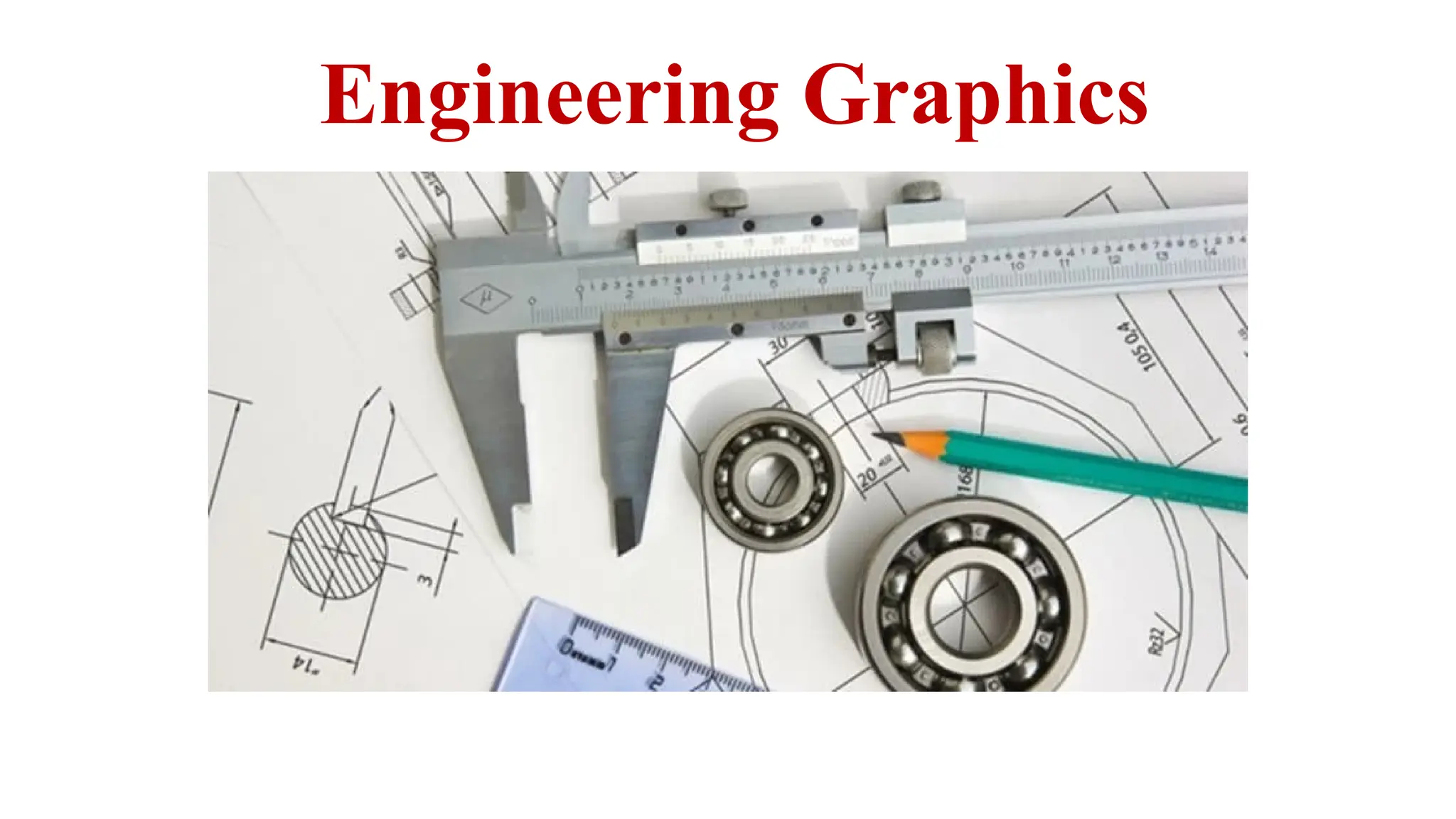
Engineering Graphics
What is Engineering Drawing?
• It is the graphic representation of physical objects and their relationships.
• It is prepared, based on certain basic principles, symbolic representations, standard
conventions, notations, etc.
• It is the only universal means of communication used by engineers.
• It is the graphic language, from which a trained person can visualize the object.
• Engineering drawing is called the universal language of engineers.
What information should be available
on engineering drawing?
• A perfect engineering drawing should have the following information:
• Shape of an object
• Exact Sizes and tolerances of various parts of the object
• The finish of the product
• The details of materials
• The company’s name
• Catalogue no of the product
• Date on which the drawing was made
• The person who made the drawing
What you will learn in this course?
Visualization – the ability to mentally understand visual information.
Graphics theory – geometry and projection techniques used for the preparation of drawings.
Use of standards – set of rules for the preparation of technical drawings.
Use of conventions – commonly accepted practices in technical drawings.
Tools – devices used to create technical drawings and models.
Applications – the various uses for technical drawings.
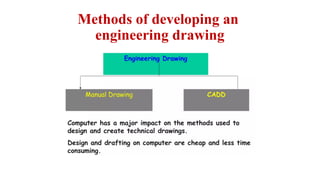
Methods of developing an
engineering drawing
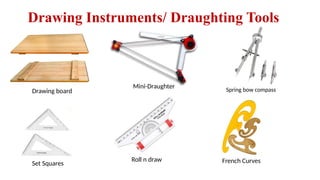
Drawing Instruments/ Draughting Tools
• Drawing board
• Mini-draughter
• Instrument box, containing the following:
• Compass
• Bow-compass
• Spring bow-compass
• Divider
• 45°-45° and 30° -60° set-squares
• Protractor
• Set of scales
• French curves
Drawing Instruments/ Draughting Tools
Drawing board
Mini-Draughter Spring bow compass
Set Squares
Roll n draw French Curves
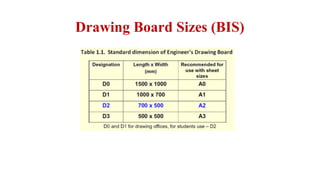
Drawing Board Sizes (BIS)
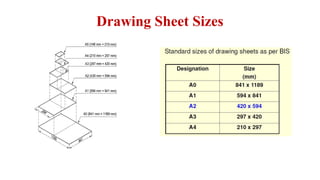
Drawing Sheet Sizes
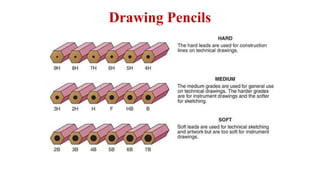
Drawing Pencils
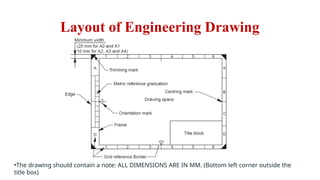
Layout of Engineering Drawing
•The drawing should contain a note: ALL DIMENSIONS ARE IN MM. (Bottom left corner outside the
title box)
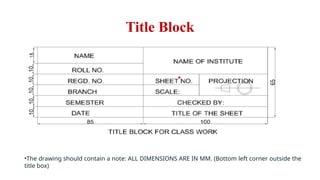
Title Block
•The drawing should contain a note: ALL DIMENSIONS ARE IN MM. (Bottom left corner outside the
title box)
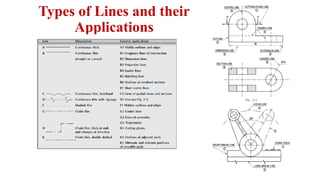
Types of Lines and their
Applications
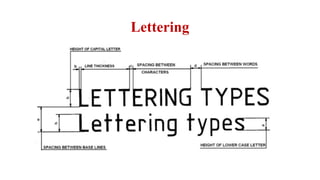
Lettering
• The verbal information, in writing, given in the drawing is known as lettering.
• Lettering forms an important part of the drawing and is used to write letters, dimensions, notes,
and such other necessary information as may be required for the complete execution of the
drawing of an object.
• Lettering is used to write titles, sub-titles, dimensions, scales, and other details on a drawing.
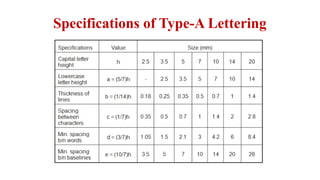
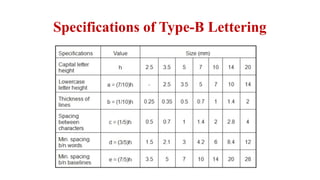
Lettering types generally used for creating a drawing are
• Lettering A – Height of the capital letter is divided into 14 equal parts
• Lettering B – Height of the capital letter is divided into 10 equal parts
• The ratio of height to width varies but in case of most of the letters it is 6 : 5.
• Main titles are generally written in 6 mm to 8 mm size, sub-titles in 3 mm to 6 mm size, while
notes, dimension figures etc. in 3 mm to 5 mm size.
Lettering
Specifications of Type-A Lettering
Specifications of Type-B Lettering
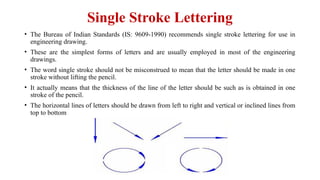
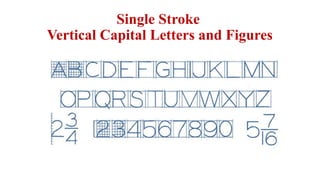
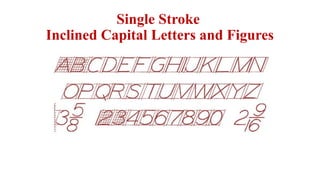
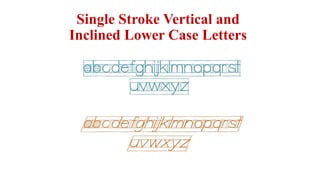
Single Stroke Lettering
• The Bureau of Indian Standards (IS: 9609-1990) recommends single stroke lettering for use in
engineering drawing.
• These are the simplest forms of letters and are usually employed in most of the engineering
drawings.
• The word single stroke should not be misconstrued to mean that the letter should be made in one
stroke without lifting the pencil.
• It actually means that the thickness of the line of the letter should be such as is obtained in one
stroke of the pencil.
• The horizontal lines of letters should be drawn from left to right and vertical or inclined lines from
top to bottom
Single Stroke
Vertical Capital Letters and Figures
Single Stroke
Inclined Capital Letters and Figures
Single Stroke Vertical and
Inclined Lower Case Letters
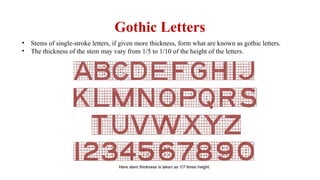
Gothic Letters
• Stems of single-stroke letters, if given more thickness, form what are known as gothic letters.
• The thickness of the stem may vary from 1/5 to 1/10 of the height of the letters.
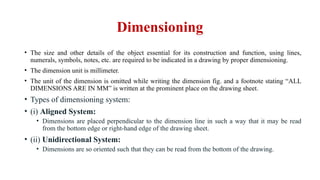
Dimensioning
• The size and other details of the object essential for its construction and function, using lines,
numerals, symbols, notes, etc. are required to be indicated in a drawing by proper dimensioning.
• The dimension unit is millimeter.
• The unit of the dimension is omitted while writing the dimension fig. and a footnote stating “ALL
DIMENSIONS ARE IN MM” is written at the prominent place on the drawing sheet.
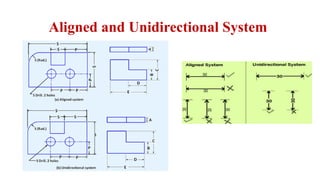
• Types of dimensioning system:
• (i) Aligned System:
• Dimensions are placed perpendicular to the dimension line in such a way that it may be read
from the bottom edge or right-hand edge of the drawing sheet.
• (ii) Unidirectional System:
• Dimensions are so oriented such that they can be read from the bottom of the drawing.
Aligned and Unidirectional System
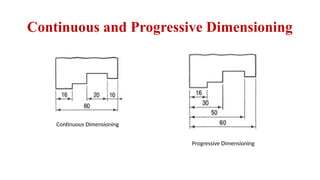
Continuous and Progressive Dimensioning
Continuous Dimensioning
Progressive Dimensioning
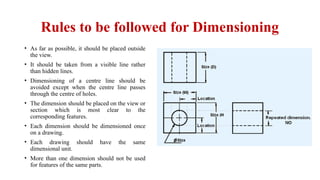
Rules to be followed for Dimensioning
• As far as possible, it should be placed outside
the view.
• It should be taken from a visible line rather
than hidden lines.
• Dimensioning of a centre line should be
avoided except when the centre line passes
through the centre of holes.
• The dimension should be placed on the view or
section which is most clear to the
corresponding features.
• Each dimension should be dimensioned once
on a drawing.
• Each drawing should have the same
dimensional unit.
• More than one dimension should not be used
for features of the same parts.
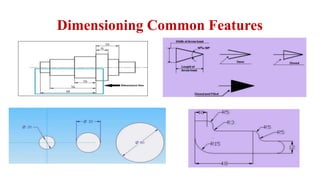
Dimensioning Common Features
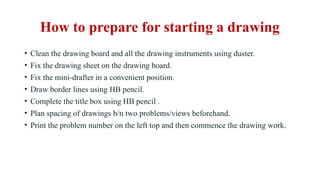
How to prepare for starting a drawing
• Clean the drawing board and all the drawing instruments using duster.
• Fix the drawing sheet on the drawing board.
• Fix the mini-drafter in a convenient position.
• Draw border lines using HB pencil.
• Complete the title box using HB pencil .
• Plan spacing of drawings b/n two problems/views beforehand.
• Print the problem number on the left top and then commence the drawing work.
How to keep your drawing clean
• Never sharpen pencils over drawing.
• Clean pencil point with a soft cloth after sharpening.
• Keep drawing instruments clean.
• Rest hands on drawing instruments as much as possible – to avoid smearing the
graphite on the drawing.
• When darkening lines – try to work from the top of the drawing to the bottom, and
from left to the right across the drawing.
• Use brush to remove eraser particles. Never use hands.
• Always use appropriate drawing pencils.
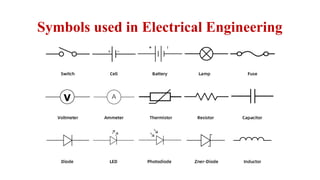
Symbols used in Electrical Engineering
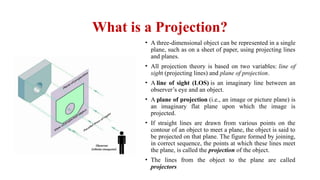
What is a Projection?
• A three-dimensional object can be repre­
sented in a single
plane, such as on a sheet of paper, using projecting lines
and planes.
• All projection theory is based on two variables: line of
sight (projecting lines) and plane of projection.
• A line of sight (LOS) is an imaginary line between an
observer’s eye and an object.
• A plane of projection (i.e., an image or picture plane) is
an imaginary flat plane upon which the image is
projected.
• If straight lines are drawn from various points on the
contour of an object to meet a plane, the object is said to
be projected on that plane. The figure formed by joining,
in correct sequence, the points at which these lines meet
the plane, is called the projection of the object.
• The lines from the object to the plane are called
projectors
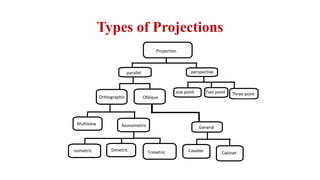
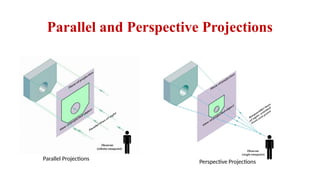
Types of Projections
Parallel and Perspective Projections
Parallel Projections
Perspective Projections
Orthographic Projections
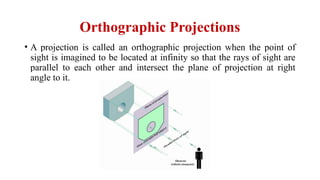
• A projection is called an orthographic projection when the point of
sight is imagined to be located at infinity so that the rays of sight are
parallel to each other and intersect the plane of projection at right
angle to it.
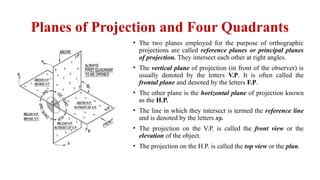
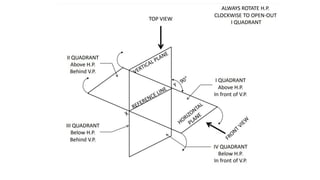
Planes of Projection and Four Quadrants
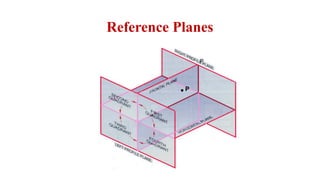
• The two planes employed for the purpose of orthographic
projections are called reference planes or principal planes
of projection. They intersect each other at right angles.
• The vertical plane of projection (in front of the observer) is
usually denoted by the letters V.P. It is often called the
frontal plane and denoted by the letters F.P.
• The other plane is the horizontal plane of projection known
as the H.P.
• The line in which they intersect is termed the reference line
and is denoted by the letters xy.
• The projection on the V.P. is called the front view or the
elevation of the object.
• The projection on the H.P. is called the top view or the plan.
First-Angle Projections
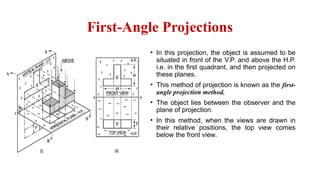
• In this projection, the object is assumed to be
situated in front of the V.P. and above the H.P.
i.e. in the first quadrant, and then projected on
these planes.
• This method of projection is known as the first-
angle projection method.
• The object lies between the observer and the
plane of projection.
• In this method, when the views are drawn in
their relative positions, the top view comes
below the front view.
Third-Angle Projections
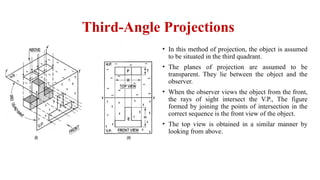
• In this method of projection, the object is assumed
to be situated in the third quadrant.
• The planes of projection are assumed to be
transparent. They lie between the object and the
observer.
• When the observer views the object from the front,
the rays of sight intersect the V.P., The figure
formed by joining the points of intersection in the
correct sequence is the front view of the object.
• The top view is obtained in a similar manner by
looking from above.
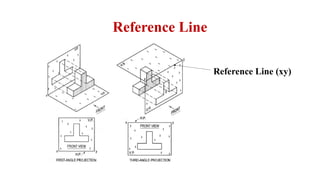
Reference Line
Reference Line (xy)
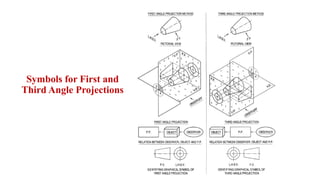
Symbols for First and
Third Angle Projections
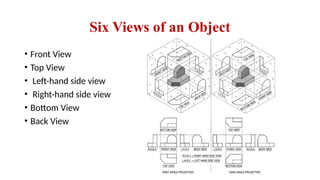
Six Views of an Object
• Front View
• Top View
• Left-hand side view
• Right-hand side view
• Bottom View
• Back View
Reference Planes
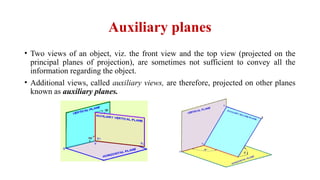
Auxiliary planes
• Two views of an object, viz. the front view and the top view (projected on the
principal planes of projection), are sometimes not sufficient to convey all the
information regarding the object.
• Additional views, called auxiliary views, are therefore, projected on other planes
known as auxiliary planes.
Projection of Points
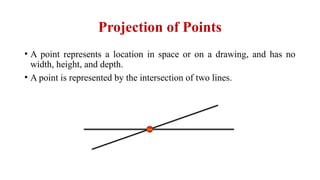
• A point represents a location in space or on a drawing, and has no
width, height, and depth.
• A point is represented by the intersection of two lines.
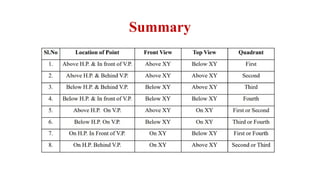
Summary

Computer Aided Engineering Drawing for beginners.pptx

  • 1.
  • 2.
    What is EngineeringDrawing? • It is the graphic representation of physical objects and their relationships. • It is prepared, based on certain basic principles, symbolic representations, standard conventions, notations, etc. • It is the only universal means of communication used by engineers. • It is the graphic language, from which a trained person can visualize the object. • Engineering drawing is called the universal language of engineers.
  • 3.
    What information shouldbe available on engineering drawing? • A perfect engineering drawing should have the following information: • Shape of an object • Exact Sizes and tolerances of various parts of the object • The finish of the product • The details of materials • The company’s name • Catalogue no of the product • Date on which the drawing was made • The person who made the drawing
  • 4.
    What you willlearn in this course? Visualization – the ability to mentally understand visual information. Graphics theory – geometry and projection techniques used for the preparation of drawings. Use of standards – set of rules for the preparation of technical drawings. Use of conventions – commonly accepted practices in technical drawings. Tools – devices used to create technical drawings and models. Applications – the various uses for technical drawings.
  • 5.
    Methods of developingan engineering drawing
  • 7.
    Drawing Instruments/ DraughtingTools • Drawing board • Mini-draughter • Instrument box, containing the following: • Compass • Bow-compass • Spring bow-compass • Divider • 45°-45° and 30° -60° set-squares • Protractor • Set of scales • French curves
  • 8.
    Drawing Instruments/ DraughtingTools Drawing board Mini-Draughter Spring bow compass Set Squares Roll n draw French Curves
  • 9.
  • 10.
  • 11.
  • 12.
    Layout of EngineeringDrawing •The drawing should contain a note: ALL DIMENSIONS ARE IN MM. (Bottom left corner outside the title box)
  • 13.
    Title Block •The drawingshould contain a note: ALL DIMENSIONS ARE IN MM. (Bottom left corner outside the title box)
  • 14.
    Types of Linesand their Applications
  • 15.
    Lettering • The verbalinformation, in writing, given in the drawing is known as lettering. • Lettering forms an important part of the drawing and is used to write letters, dimensions, notes, and such other necessary information as may be required for the complete execution of the drawing of an object. • Lettering is used to write titles, sub-titles, dimensions, scales, and other details on a drawing. Lettering types generally used for creating a drawing are • Lettering A – Height of the capital letter is divided into 14 equal parts • Lettering B – Height of the capital letter is divided into 10 equal parts • The ratio of height to width varies but in case of most of the letters it is 6 : 5. • Main titles are generally written in 6 mm to 8 mm size, sub-titles in 3 mm to 6 mm size, while notes, dimension figures etc. in 3 mm to 5 mm size.
  • 16.
  • 17.
  • 18.
  • 19.
    Single Stroke Lettering •The Bureau of Indian Standards (IS: 9609-1990) recommends single stroke lettering for use in engineering drawing. • These are the simplest forms of letters and are usually employed in most of the engineering drawings. • The word single stroke should not be misconstrued to mean that the letter should be made in one stroke without lifting the pencil. • It actually means that the thickness of the line of the letter should be such as is obtained in one stroke of the pencil. • The horizontal lines of letters should be drawn from left to right and vertical or inclined lines from top to bottom
  • 20.
    Single Stroke Vertical CapitalLetters and Figures
  • 21.
    Single Stroke Inclined CapitalLetters and Figures
  • 22.
    Single Stroke Verticaland Inclined Lower Case Letters
  • 23.
    Gothic Letters • Stemsof single-stroke letters, if given more thickness, form what are known as gothic letters. • The thickness of the stem may vary from 1/5 to 1/10 of the height of the letters.
  • 24.
    Dimensioning • The sizeand other details of the object essential for its construction and function, using lines, numerals, symbols, notes, etc. are required to be indicated in a drawing by proper dimensioning. • The dimension unit is millimeter. • The unit of the dimension is omitted while writing the dimension fig. and a footnote stating “ALL DIMENSIONS ARE IN MM” is written at the prominent place on the drawing sheet. • Types of dimensioning system: • (i) Aligned System: • Dimensions are placed perpendicular to the dimension line in such a way that it may be read from the bottom edge or right-hand edge of the drawing sheet. • (ii) Unidirectional System: • Dimensions are so oriented such that they can be read from the bottom of the drawing.
  • 25.
  • 26.
    Continuous and ProgressiveDimensioning Continuous Dimensioning Progressive Dimensioning
  • 27.
    Rules to befollowed for Dimensioning • As far as possible, it should be placed outside the view. • It should be taken from a visible line rather than hidden lines. • Dimensioning of a centre line should be avoided except when the centre line passes through the centre of holes. • The dimension should be placed on the view or section which is most clear to the corresponding features. • Each dimension should be dimensioned once on a drawing. • Each drawing should have the same dimensional unit. • More than one dimension should not be used for features of the same parts.
  • 28.
  • 29.
    How to preparefor starting a drawing • Clean the drawing board and all the drawing instruments using duster. • Fix the drawing sheet on the drawing board. • Fix the mini-drafter in a convenient position. • Draw border lines using HB pencil. • Complete the title box using HB pencil . • Plan spacing of drawings b/n two problems/views beforehand. • Print the problem number on the left top and then commence the drawing work.
  • 30.
    How to keepyour drawing clean • Never sharpen pencils over drawing. • Clean pencil point with a soft cloth after sharpening. • Keep drawing instruments clean. • Rest hands on drawing instruments as much as possible – to avoid smearing the graphite on the drawing. • When darkening lines – try to work from the top of the drawing to the bottom, and from left to the right across the drawing. • Use brush to remove eraser particles. Never use hands. • Always use appropriate drawing pencils.
  • 31.
    Symbols used inElectrical Engineering
  • 32.
    What is aProjection? • A three-dimensional object can be repre­ sented in a single plane, such as on a sheet of paper, using projecting lines and planes. • All projection theory is based on two variables: line of sight (projecting lines) and plane of projection. • A line of sight (LOS) is an imaginary line between an observer’s eye and an object. • A plane of projection (i.e., an image or picture plane) is an imaginary flat plane upon which the image is projected. • If straight lines are drawn from various points on the contour of an object to meet a plane, the object is said to be projected on that plane. The figure formed by joining, in correct sequence, the points at which these lines meet the plane, is called the projection of the object. • The lines from the object to the plane are called projectors
  • 33.
  • 34.
    Parallel and PerspectiveProjections Parallel Projections Perspective Projections
  • 35.
    Orthographic Projections • Aprojection is called an orthographic projection when the point of sight is imagined to be located at infinity so that the rays of sight are parallel to each other and intersect the plane of projection at right angle to it.
  • 36.
    Planes of Projectionand Four Quadrants • The two planes employed for the purpose of orthographic projections are called reference planes or principal planes of projection. They intersect each other at right angles. • The vertical plane of projection (in front of the observer) is usually denoted by the letters V.P. It is often called the frontal plane and denoted by the letters F.P. • The other plane is the horizontal plane of projection known as the H.P. • The line in which they intersect is termed the reference line and is denoted by the letters xy. • The projection on the V.P. is called the front view or the elevation of the object. • The projection on the H.P. is called the top view or the plan.
  • 37.
    First-Angle Projections • Inthis projection, the object is assumed to be situated in front of the V.P. and above the H.P. i.e. in the first quadrant, and then projected on these planes. • This method of projection is known as the first- angle projection method. • The object lies between the observer and the plane of projection. • In this method, when the views are drawn in their relative positions, the top view comes below the front view.
  • 38.
    Third-Angle Projections • Inthis method of projection, the object is assumed to be situated in the third quadrant. • The planes of projection are assumed to be transparent. They lie between the object and the observer. • When the observer views the object from the front, the rays of sight intersect the V.P., The figure formed by joining the points of intersection in the correct sequence is the front view of the object. • The top view is obtained in a similar manner by looking from above.
  • 39.
  • 40.
    Symbols for Firstand Third Angle Projections
  • 41.
    Six Views ofan Object • Front View • Top View • Left-hand side view • Right-hand side view • Bottom View • Back View
  • 42.
  • 43.
    Auxiliary planes • Twoviews of an object, viz. the front view and the top view (projected on the principal planes of projection), are sometimes not sufficient to convey all the information regarding the object. • Additional views, called auxiliary views, are therefore, projected on other planes known as auxiliary planes.
  • 44.
    Projection of Points •A point represents a location in space or on a drawing, and has no width, height, and depth. • A point is represented by the intersection of two lines.
  • 46.