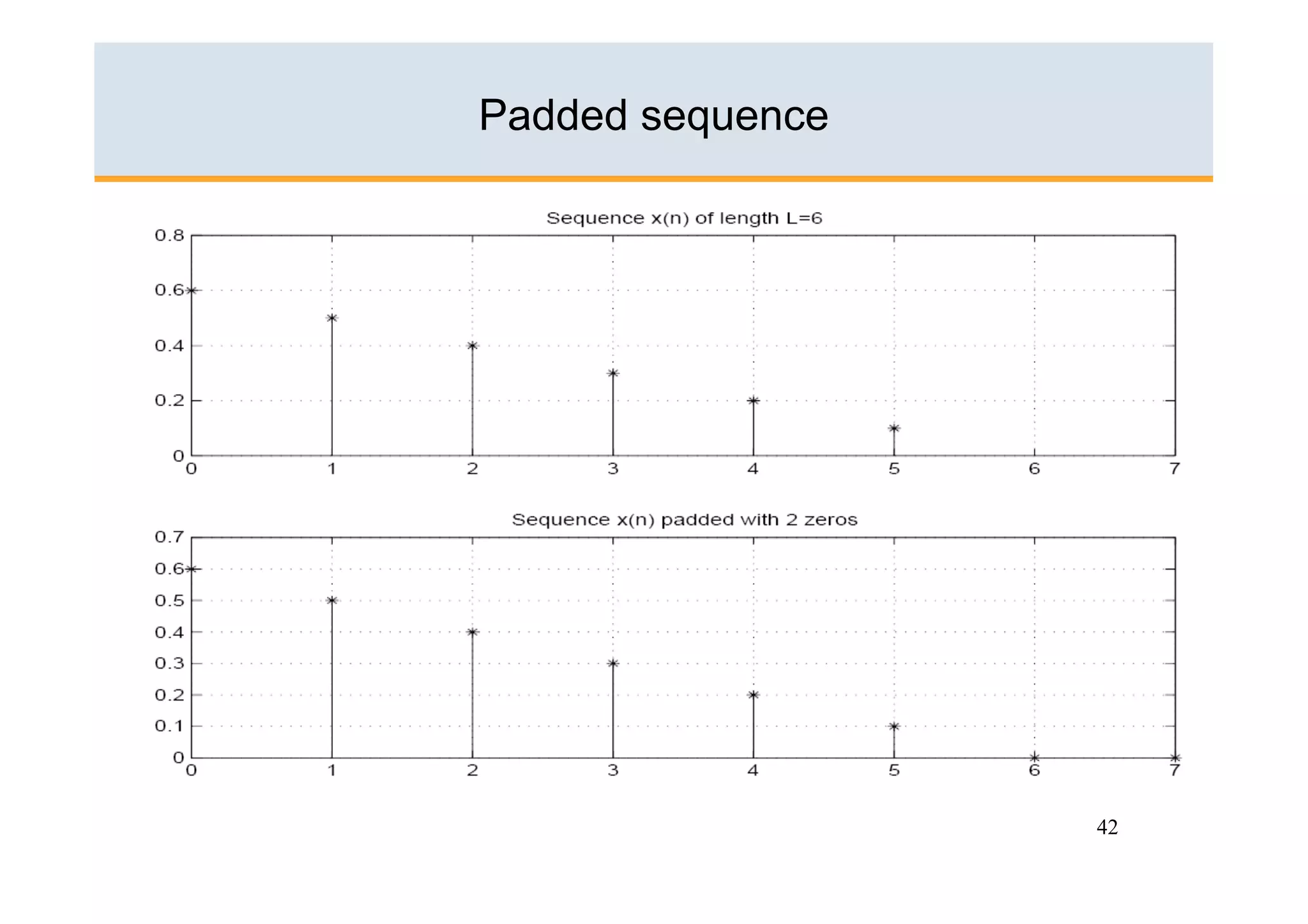
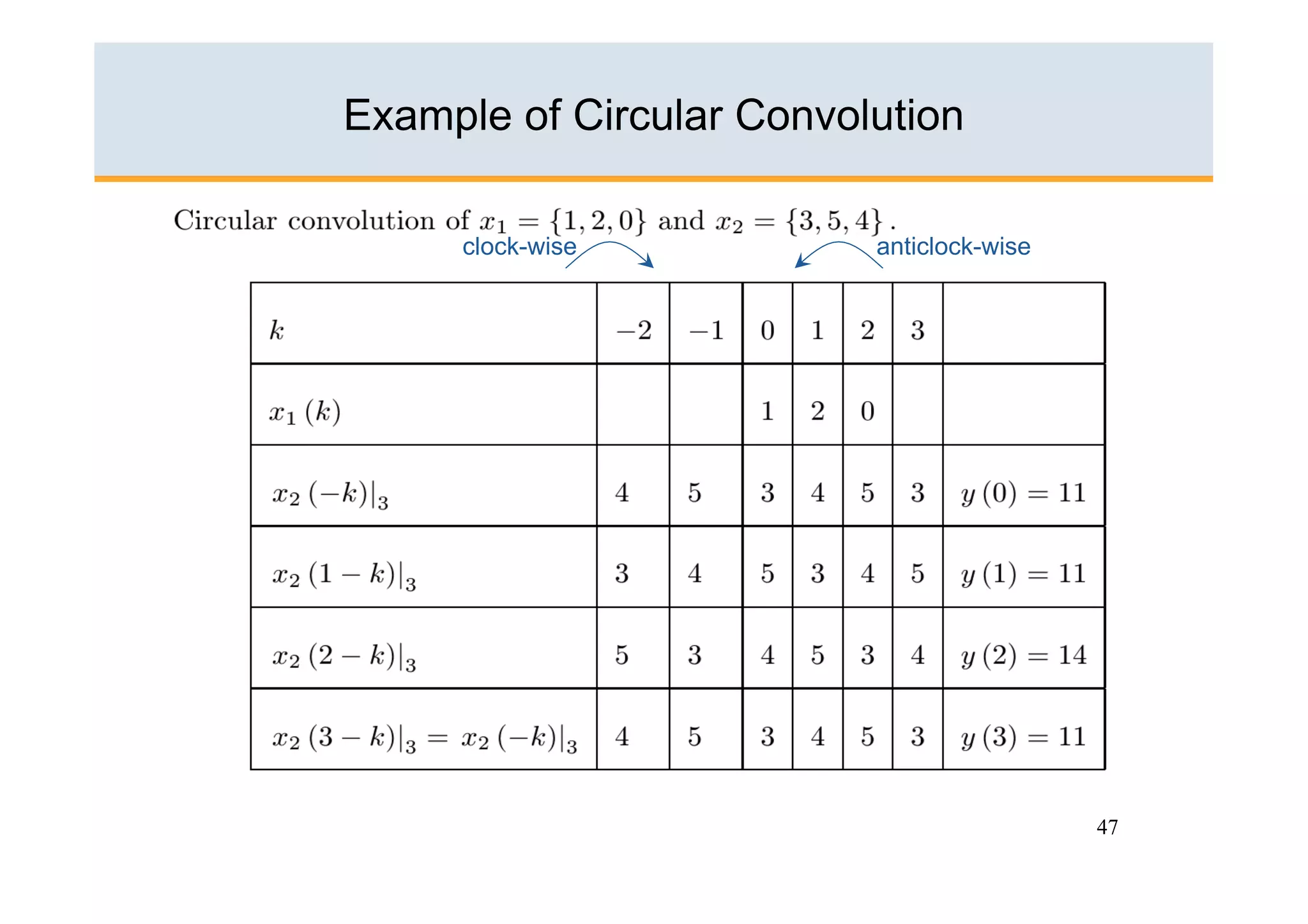
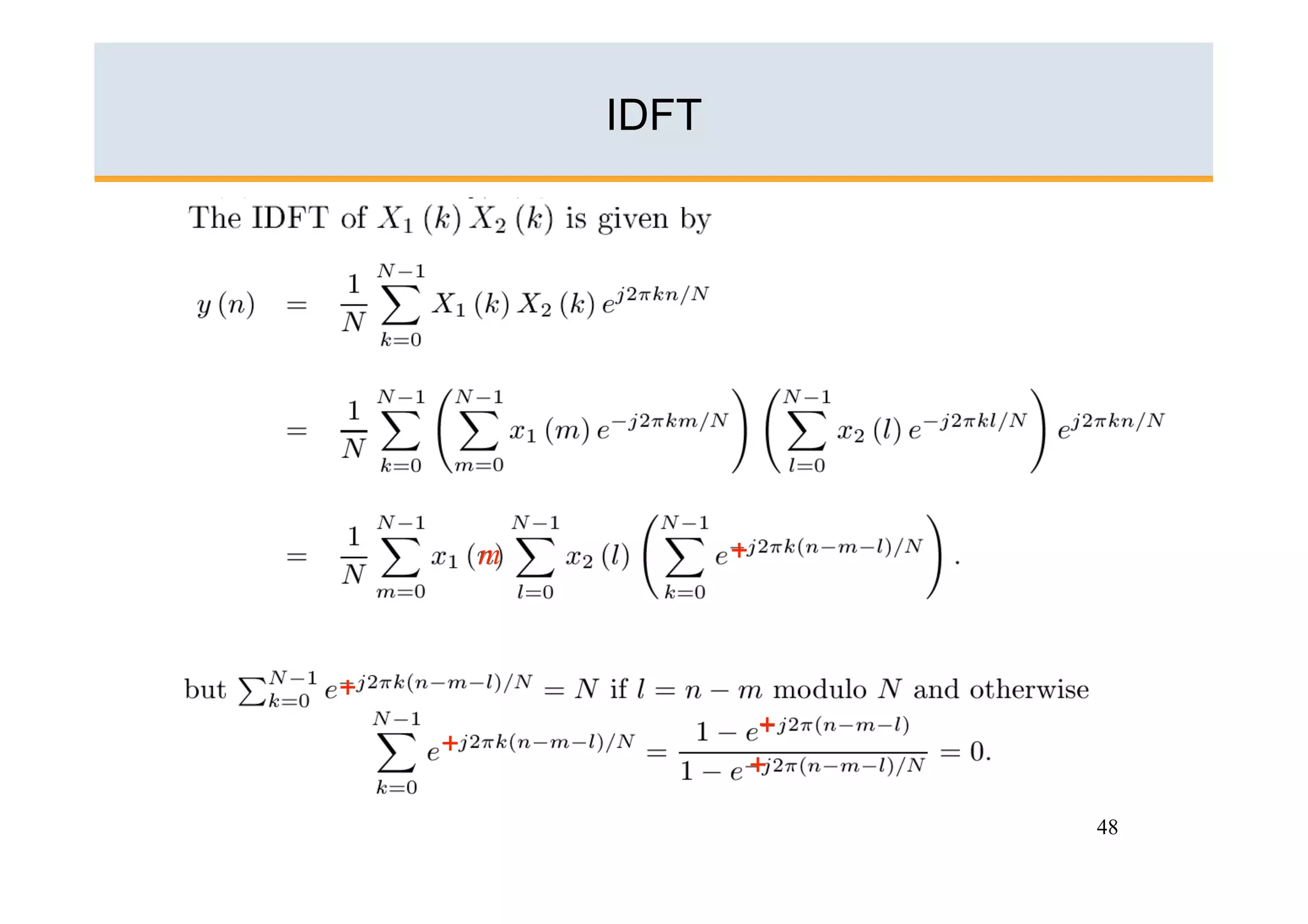
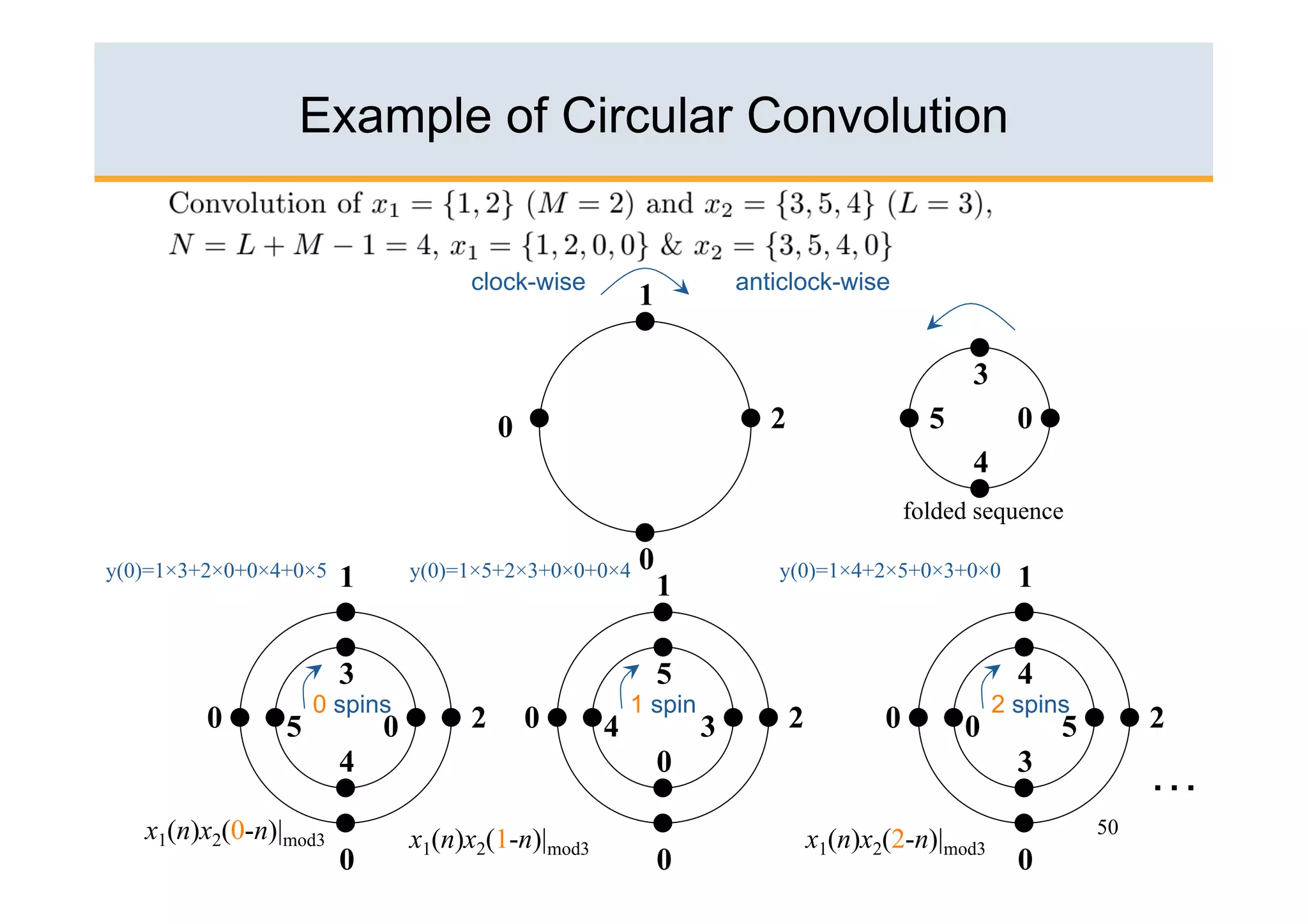
The document discusses concepts related to the Discrete Fourier Transform (DFT) and its applications, focusing on topics like circular convolution, zero-padding, and standard convolution. It explains how DFT can be used for linear filtering by computing standard convolution products. Key points include the transformation of signals into the frequency domain and the numerical equivalent of the Fourier Transform for digital computation.
More on DFT
Elena Punskaya
www-sigproc.eng.cam.ac.uk/~op205
Some material adapted from courses by
Prof. Simon Godsill, Dr. Arnaud Doucet,
Dr. Malcolm Macleod and Prof. Peter Rayner
39
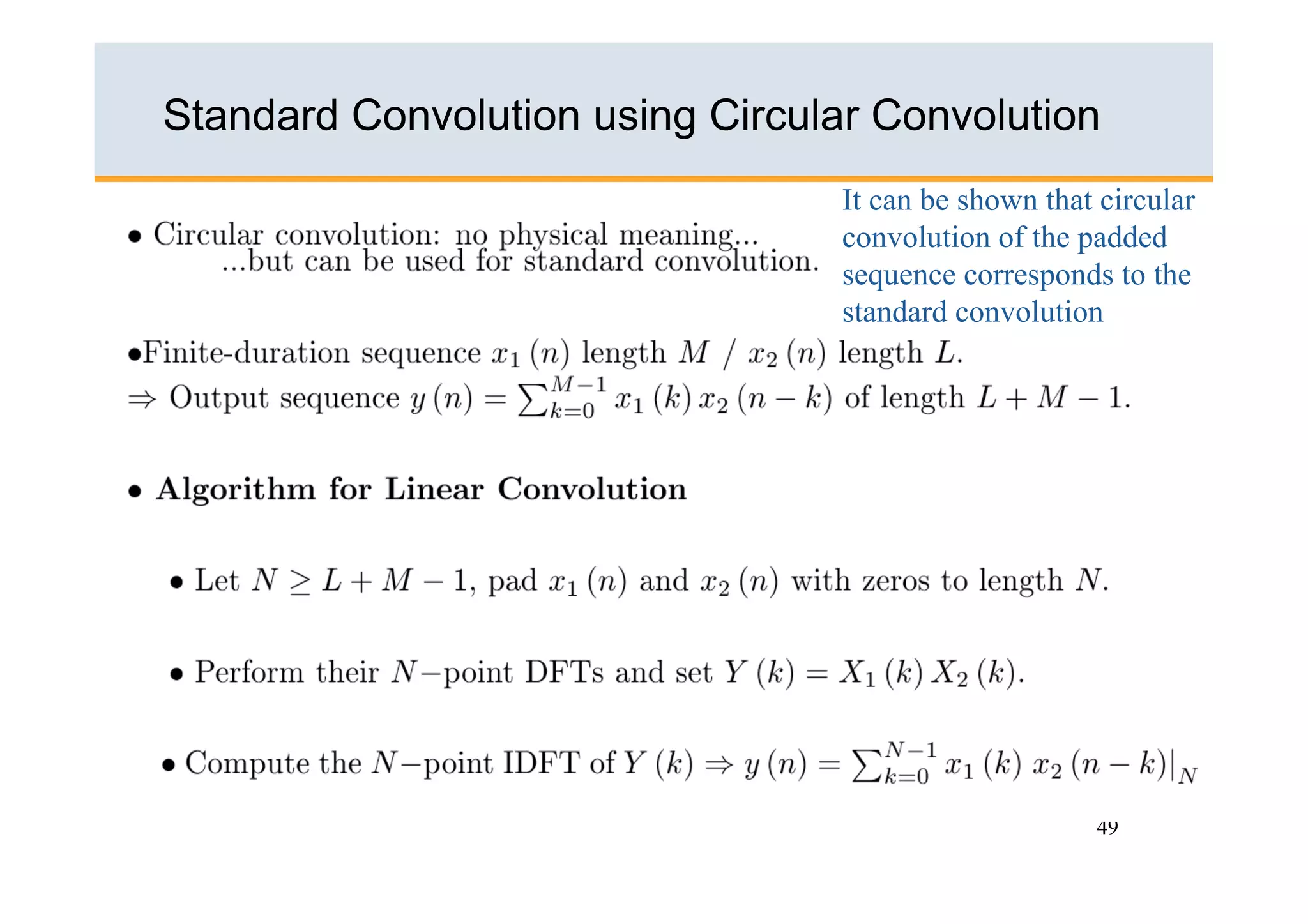
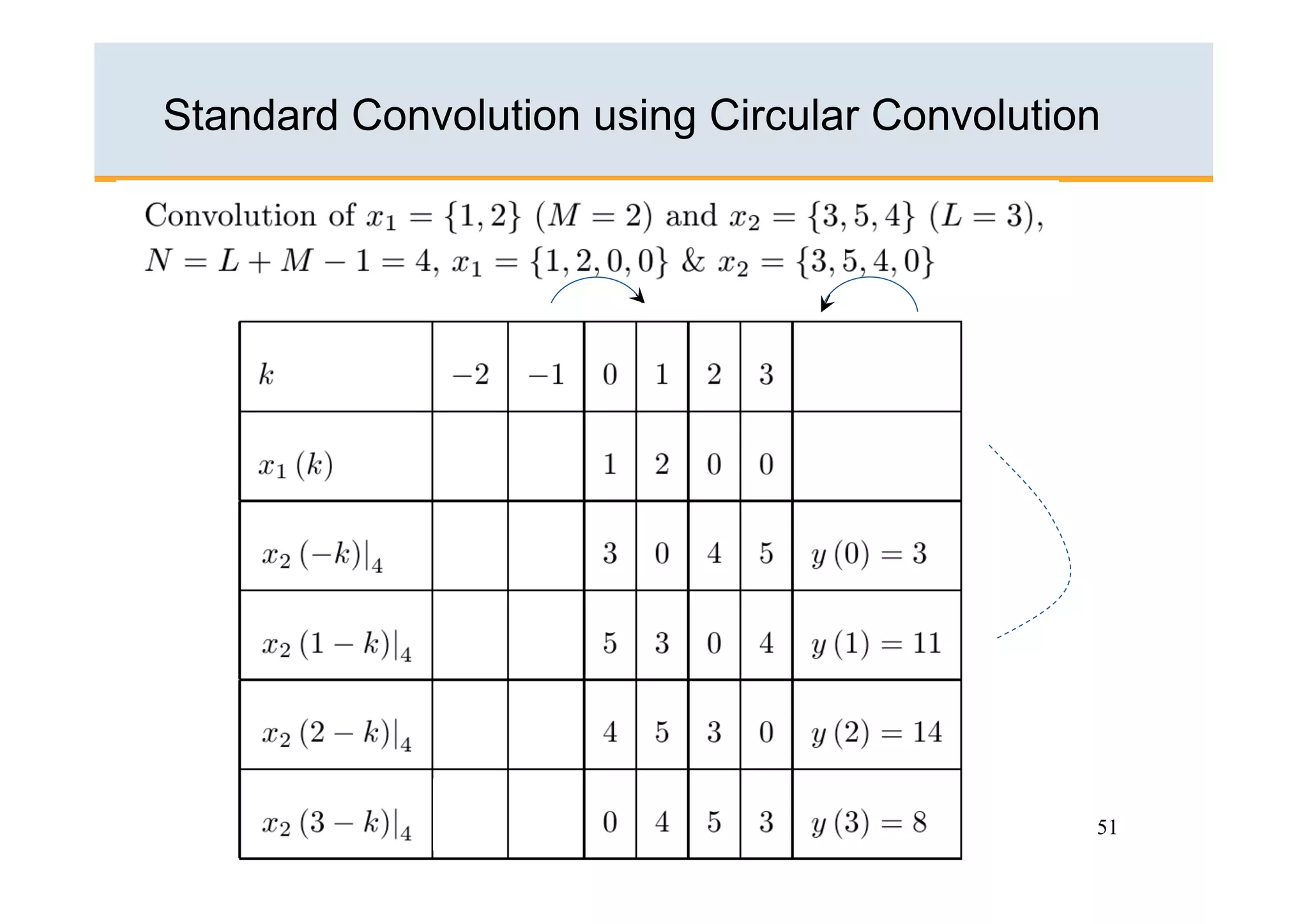
Standard Convolution usingCircular Convolution
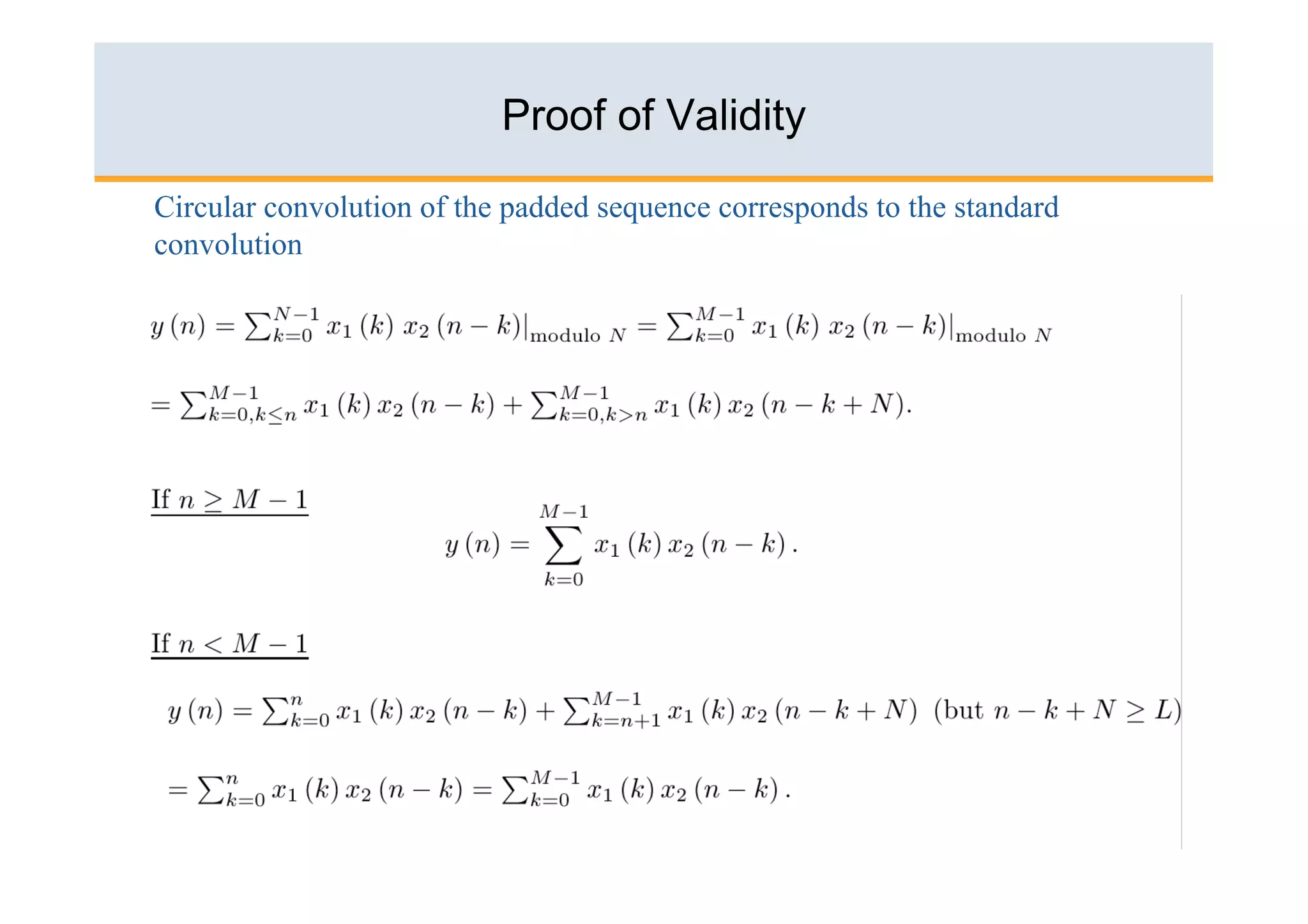
It can be shown that circular
convolution of the padded
sequence corresponds to the
standard convolution
49
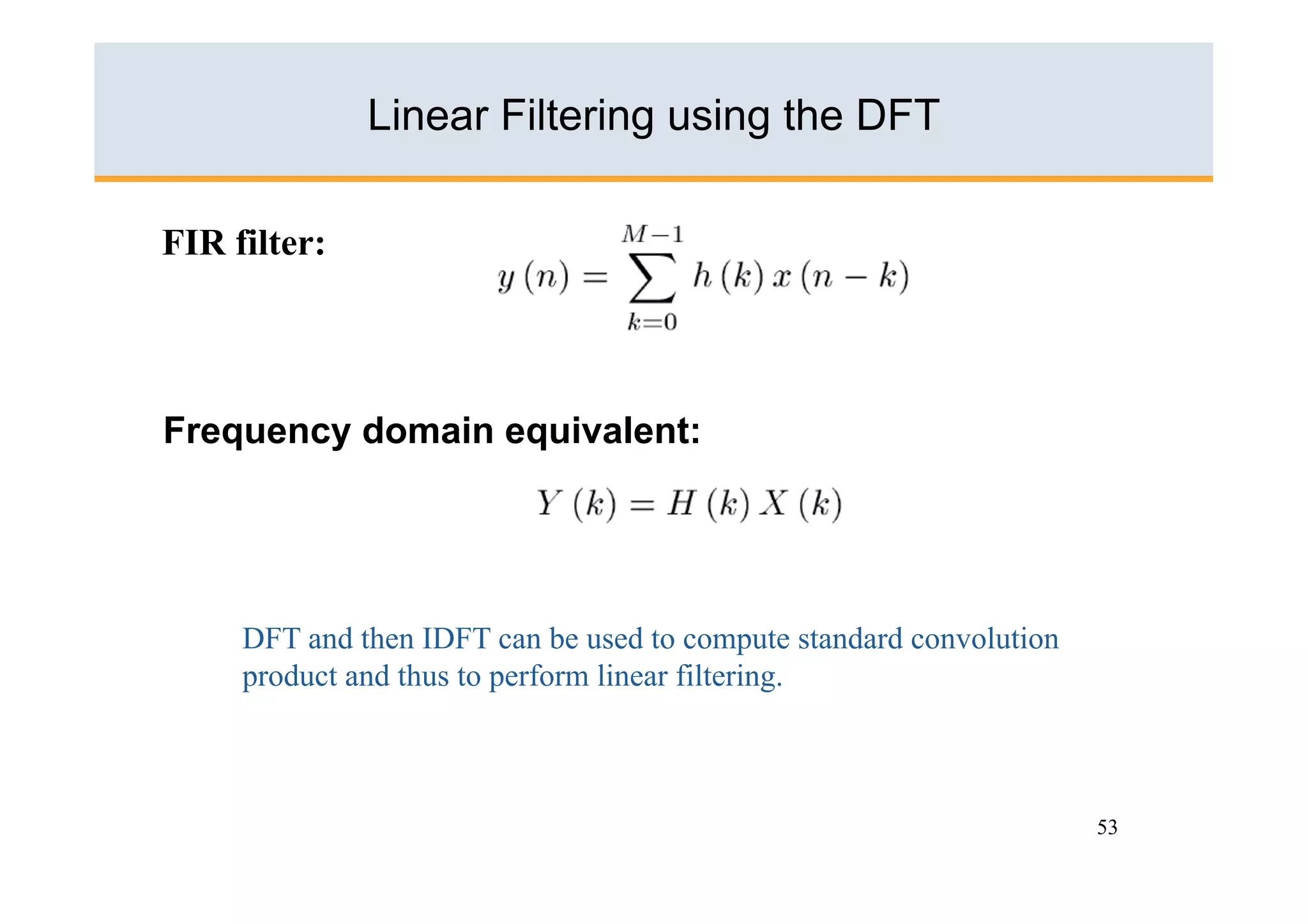
Linear Filtering usingthe DFT
FIR filter:
Frequency domain equivalent:
DFT and then IDFT can be used to compute standard convolution
product and thus to perform linear filtering.
53
16.
Summary So Far
• Fourier analysis for periodic functions focuses on the
study of Fourier series
• The Fourier Transform (FT) is a way of transforming
a continuous signal into the frequency domain
• The Discrete Time Fourier Transform (DTFT) is a
Fourier Transform of a sampled signal
• The Discrete Fourier Transform (DFT) is a discrete
numerical equivalent using sums instead of integrals
that can be computed on a digital computer
• As one of the applications DFT and then Inverse DFT
(IDFT) can be used to compute standard convolution
product and thus to perform linear filtering 54


![RF Module Design - [Chapter 2] Noises](https://cdn.slidesharecdn.com/ss_thumbnails/rfch2-150613070344-lva1-app6892-thumbnail.jpg?width=640&height=640&fit=bounds)


