LOGO


EENG 541 Project:
   180°-Hybrid Coupler


                  Prepared by / Ahmed Mahfouz Marzouk

        Presented to/ Dr. Amr Safwat
Outline:
 INTRODUCTION.
 PROBLEM.
 METHODOLOGY
     Wilkinson-Power-Divider based Design.
     Phase reversal Design using CPW Inverter
     Compact Folded Line
     Artificial Transmission Lines
        Using Left-Handed Materials

 CONCLUSION.
 REFERENCES.
Introduction:
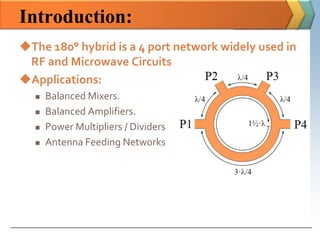
The 180° hybrid is a 4 port network widely used in
 RF and Microwave Circuits
Applications:
     Balanced Mixers.
     Balanced Amplifiers.
     Power Multipliers / Dividers
     Antenna Feeding Networks
Introduction:
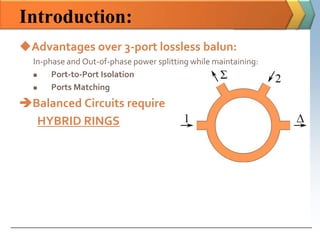
Advantages over 3-port lossless balun:
  In-phase and Out-of-phase power splitting while maintaining:
      Port-to-Port Isolation
      Ports Matching
Balanced Circuits require
  HYBRID RINGS
Introduction:
The 180° hybrid is a 4 port network widely used in
 RF and Microwave Circuits
Applications[2]:
     Balanced Mixers.
     Balanced Amplifiers.
     Antenna Feeding Networks
     Power Multipliers / Dividers
Implementation:
 rat-race hybrid as the most popular way.
PROBLEM:
The 180°-Hybrid Limitations:
     Compactness
     Bandwidth

 THE 270° SECTION
     The resulting 1.5 λ is often
      large especially in MMIC app.
     The 270°-section has the
      largest phase variation versus
      frequency, since the phase variation is proportional to the
      line length (∂ф/ ∂ω α ℓ)
Methodology:[1]
Novel Hybrid derived from WILKINSON Power
 Divider (WPD).
Transmission Line Model of the Novel hybrid:
Methodology:[1]
The resistor replacement with a 4th port of an
 equal characteristic impedance
MAIN ADVANTAGE: Reduced Size compared to
 conventional Rat-Race Hybrid
Methodology[2]:
PHASE REVERSAL Method
     270°-section replacement with a “-90°” section.
     The “-90°”-section realization:
        A 90° Microstrip line.

        A Co-Planar Waveguide phase inverter.
Methodology[3]:
Compact Folded Line Configurations:
     Rat-Race Configuration using folded line geometry:
Methodology[3]:
Compact Folded Line Configurations:
     Rat-Race Configuration using folded line geometry:
     Design Equations: (Using Even-Odd Analysis for single C-
      Section Rat-Race Hybrid) :
Methodology[3]:
Compact Folded Line Configurations:
     Rat-Race Configuration using folded line geomtry:
     Design Equations: (Using Even-Odd Analysis for single C-
      Section Rat-Race Hybrid) :


     Result 
Methodology:
Artificial Transmission Lines (ATLs) [4]:
      270°-section replacement with a “-90°” section.
      The “-90°”-section realization:
         Left-Handed material: realizing an artificial lumped-
          element TL section.
Methodology:
Artificial Transmission Lines (ATLs) [4]:
      270°-section replacement with a “-90°” section.
      The “-90°”-section realization:
         Left-Handed material: realizing an artificial lumped-
          element TL section.
Methodology:
Artificial Transmission Lines (ATLs) [4]:
      270°-section replacement with a “-90°” section.
      The “-90°”-section realization:
         Left-Handed material: realizing an artificial lumped-
          element TL section.
Conclusion:
180° hybrids are still to be optimized
Rat-Race Implementation of a 180 hybrid is a
 challenging in PCB technology.
Problem: BW and Size especially the (3 λ /4)
 section.
Solutions:
     WPD-based Design [1]
     Using CPW Phase Inverter [2]
     ATL Section [4]
     Folded Line Configuration[3][5]
REFERENCES
Thank You
Questions?
LOGO
Paper 1: Affiliation
Ning Yang, Member, IEEE, Christophe Caloz,
  Fellow, IEEE, and Ke Wu, Fellow, IEEE.


 University: The École Poly-technique de
  Montréal; The Polytechnical School of Montreal.
Paper 1


Broadband Compact 180 Hybrid
  Derived From the Wilkinson
            Divider

180 hybrid-coupler

  • 1.
    LOGO EENG 541 Project: 180°-Hybrid Coupler Prepared by / Ahmed Mahfouz Marzouk Presented to/ Dr. Amr Safwat
  • 2.
    Outline:  INTRODUCTION.  PROBLEM. METHODOLOGY  Wilkinson-Power-Divider based Design.  Phase reversal Design using CPW Inverter  Compact Folded Line  Artificial Transmission Lines  Using Left-Handed Materials  CONCLUSION.  REFERENCES.
  • 3.
    Introduction: The 180° hybridis a 4 port network widely used in RF and Microwave Circuits Applications:  Balanced Mixers.  Balanced Amplifiers.  Power Multipliers / Dividers  Antenna Feeding Networks
  • 4.
    Introduction: Advantages over 3-portlossless balun: In-phase and Out-of-phase power splitting while maintaining:  Port-to-Port Isolation  Ports Matching Balanced Circuits require HYBRID RINGS
  • 5.
    Introduction: The 180° hybridis a 4 port network widely used in RF and Microwave Circuits Applications[2]:  Balanced Mixers.  Balanced Amplifiers.  Antenna Feeding Networks  Power Multipliers / Dividers Implementation: rat-race hybrid as the most popular way.
  • 6.
    PROBLEM: The 180°-Hybrid Limitations:  Compactness  Bandwidth  THE 270° SECTION  The resulting 1.5 λ is often large especially in MMIC app.  The 270°-section has the largest phase variation versus frequency, since the phase variation is proportional to the line length (∂ф/ ∂ω α ℓ)
  • 7.
    Methodology:[1] Novel Hybrid derivedfrom WILKINSON Power Divider (WPD). Transmission Line Model of the Novel hybrid:
  • 8.
    Methodology:[1] The resistor replacementwith a 4th port of an equal characteristic impedance MAIN ADVANTAGE: Reduced Size compared to conventional Rat-Race Hybrid
  • 9.
    Methodology[2]: PHASE REVERSAL Method  270°-section replacement with a “-90°” section.  The “-90°”-section realization:  A 90° Microstrip line.  A Co-Planar Waveguide phase inverter.
  • 10.
    Methodology[3]: Compact Folded LineConfigurations:  Rat-Race Configuration using folded line geometry:
  • 11.
    Methodology[3]: Compact Folded LineConfigurations:  Rat-Race Configuration using folded line geometry:  Design Equations: (Using Even-Odd Analysis for single C- Section Rat-Race Hybrid) :
  • 12.
    Methodology[3]: Compact Folded LineConfigurations:  Rat-Race Configuration using folded line geomtry:  Design Equations: (Using Even-Odd Analysis for single C- Section Rat-Race Hybrid) :  Result 
  • 13.
    Methodology: Artificial Transmission Lines(ATLs) [4]:  270°-section replacement with a “-90°” section.  The “-90°”-section realization:  Left-Handed material: realizing an artificial lumped- element TL section.
  • 14.
    Methodology: Artificial Transmission Lines(ATLs) [4]:  270°-section replacement with a “-90°” section.  The “-90°”-section realization:  Left-Handed material: realizing an artificial lumped- element TL section.
  • 15.
    Methodology: Artificial Transmission Lines(ATLs) [4]:  270°-section replacement with a “-90°” section.  The “-90°”-section realization:  Left-Handed material: realizing an artificial lumped- element TL section.
  • 16.
    Conclusion: 180° hybrids arestill to be optimized Rat-Race Implementation of a 180 hybrid is a challenging in PCB technology. Problem: BW and Size especially the (3 λ /4) section. Solutions:  WPD-based Design [1]  Using CPW Phase Inverter [2]  ATL Section [4]  Folded Line Configuration[3][5]
  • 17.
  • 18.
  • 19.
  • 20.
    Paper 1: Affiliation NingYang, Member, IEEE, Christophe Caloz, Fellow, IEEE, and Ke Wu, Fellow, IEEE.  University: The École Poly-technique de Montréal; The Polytechnical School of Montreal.
  • 21.
    Paper 1 Broadband Compact180 Hybrid Derived From the Wilkinson Divider

Editor's Notes

  • #4 Applications: separating the sum and the difference of two input signals
  • #5 While the lossless 3-port balun provides the out-of-phase power splitting, the rat-race ring achieves such splitting while maintaining port-to-port isolations and return losses, in addition to keeping the ports matched. And as a result the rat-race hybrid ring is better than the lossless 3-port network in the balanced circuits.
  • #6 Applications: separating the sum and the difference of two input signals as shown.The 180 hybrid may be implemented in several forms , among which the rat –race hybrid is most popularly used in microwave circuits for its simple design and its planar form.
  • #7  The conventional rat-race is composedof three quarter-wavelength sections and one 3 quarters transmission line sections forming aring. The limiting factor in these hybrids in term of both com-pactness and bandwidth is the270 DEGREE transmission-linesection.
  • #11 As shown this is the proposed rat-race configuration using folded line geometry. Here the TL sections of conventional rat-race hybrid are replaced by folded lines sections connecting through TL sections of small lengths.The folding can be in either edge-coupled (single-level) or broadside-coupled (multilevel) configurations.
  • #12 As shown this is the proposed rat-race configuration using folded line geometry. Here the TL sections of conventional rat-race hybrid are replaced by folded lines sections connecting through TL sections of small lengths.The folding can be in either edge-coupled (single-level) or broadside-coupled (multilevel) configurations.
  • #13 As shown this is the double C-section hybrid in comparison to the conventional design.
  • #14 Equivalent Circuit
  • #15 In-Phase Operation
  • #16 180-out-of-phase operation