Confidential © ams AG 2015
Full Service Foundry
An example transition to
1687-based mixed-signal DFT
Peter Sarson
February 16, 2015
Confidential © ams AG 2015
Page 2
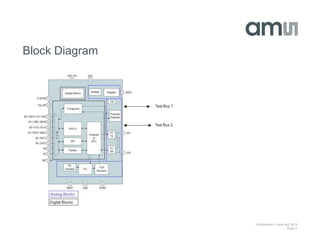
Block Diagram
Confidential © ams AG 2015
Page 3
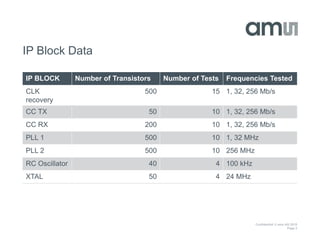
IP Block Data
IP BLOCK Number of Transistors Number of Tests Frequencies Tested
CLK
recovery
500 15 1, 32, 256 Mb/s
CC TX 50 10 1, 32, 256 Mb/s
CC RX 200 10 1, 32, 256 Mb/s
PLL 1 500 10 1, 32 MHz
PLL 2 500 10 256 MHz
RC Oscillator 40 4 100 kHz
XTAL 50 4 24 MHz
Confidential © ams AG 2015
Page 4
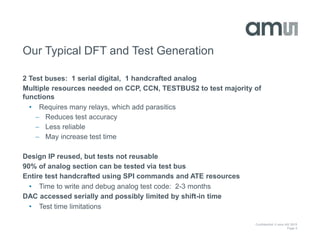
Our Typical DFT and Test Generation
2 Test buses: 1 serial digital, 1 handcrafted analog
Multiple resources needed on CCP, CCN, TESTBUS2 to test majority of
functions
• Requires many relays, which add parasitics
 Reduces test accuracy
 Less reliable
 May increase test time
Design IP reused, but tests not reusable
90% of analog section can be tested via test bus
Entire test handcrafted using SPI commands and ATE resources
• Time to write and debug analog test code: 2-3 months
DAC accessed serially and possibly limited by shift-in time
• Test time limitations
Confidential © ams AG 2015
Page 5
Our Typical Test Coverage
100% of datasheet parameters tested
• Temperature guardbands
• No automated verification of coverage
Defect-based coverage unknown (likely lower)
• Some defects might not affect datasheet specs – reliability?
Confidential © ams AG 2015
Page 6
1687 Modifications and Benefits
TESTBUS1 (digital), TESTBUS2 (analog)
• Control analog bus via scan, instead of via digital bus – less area
 May be able to access additional nodes to increase coverage
DAC test
• Stream data serially from scan – may decrease test time 5%
No handcrafted digital SPI patterns
• All test blocks accessed by scan, generated from WGL files
• Possible 2 week saving in writing/debug of setups
One test pin instead of three
• Hardware more reliable; higher performance due to fewer wires
• May decrease test time 5% test time by avoiding relay switching to high
performance resources
Confidential © ams AG 2015
Page 7
Drawbacks
Specification coverage same as original test plan
• Might increase defect coverage, but not yet proven
Confidential © ams AG 2015
Page 8
Future Benefits
RC Oscillator, PLL, CLK recovery circuit, proximity detection
designed-for-test differently each time
• 1687 ICL and PDL allow generation of reusable hardware and tests
• Allows creation of plug-and-play (and test) library IP blocks
• Will reduce DFT and test development time of future ICs
Any production test escapes will lead to fix to IP block’s test
• Improves quality of future designs using that block
Confidential © ams AG 2015
Page 9
Proof of Concept – Simulation Only
Old flow
• Structural test not possible
• Analog Defect Coverage calculation using Test Benches is xyz %
New flow
• Show where test coverage is missing and how it was increased using 1687
access to abc %
• Real silicon wont be modified at the moment
Confidential © ams AG 2015
Thank you
Please visit our website www.ams.com

An example transition to 1687-based mixed-signal DFT

  • 1.
    Confidential © amsAG 2015 Full Service Foundry An example transition to 1687-based mixed-signal DFT Peter Sarson February 16, 2015
  • 2.
    Confidential © amsAG 2015 Page 2 Block Diagram
  • 3.
    Confidential © amsAG 2015 Page 3 IP Block Data IP BLOCK Number of Transistors Number of Tests Frequencies Tested CLK recovery 500 15 1, 32, 256 Mb/s CC TX 50 10 1, 32, 256 Mb/s CC RX 200 10 1, 32, 256 Mb/s PLL 1 500 10 1, 32 MHz PLL 2 500 10 256 MHz RC Oscillator 40 4 100 kHz XTAL 50 4 24 MHz
  • 4.
    Confidential © amsAG 2015 Page 4 Our Typical DFT and Test Generation 2 Test buses: 1 serial digital, 1 handcrafted analog Multiple resources needed on CCP, CCN, TESTBUS2 to test majority of functions • Requires many relays, which add parasitics  Reduces test accuracy  Less reliable  May increase test time Design IP reused, but tests not reusable 90% of analog section can be tested via test bus Entire test handcrafted using SPI commands and ATE resources • Time to write and debug analog test code: 2-3 months DAC accessed serially and possibly limited by shift-in time • Test time limitations
  • 5.
    Confidential © amsAG 2015 Page 5 Our Typical Test Coverage 100% of datasheet parameters tested • Temperature guardbands • No automated verification of coverage Defect-based coverage unknown (likely lower) • Some defects might not affect datasheet specs – reliability?
  • 6.
    Confidential © amsAG 2015 Page 6 1687 Modifications and Benefits TESTBUS1 (digital), TESTBUS2 (analog) • Control analog bus via scan, instead of via digital bus – less area  May be able to access additional nodes to increase coverage DAC test • Stream data serially from scan – may decrease test time 5% No handcrafted digital SPI patterns • All test blocks accessed by scan, generated from WGL files • Possible 2 week saving in writing/debug of setups One test pin instead of three • Hardware more reliable; higher performance due to fewer wires • May decrease test time 5% test time by avoiding relay switching to high performance resources
  • 7.
    Confidential © amsAG 2015 Page 7 Drawbacks Specification coverage same as original test plan • Might increase defect coverage, but not yet proven
  • 8.
    Confidential © amsAG 2015 Page 8 Future Benefits RC Oscillator, PLL, CLK recovery circuit, proximity detection designed-for-test differently each time • 1687 ICL and PDL allow generation of reusable hardware and tests • Allows creation of plug-and-play (and test) library IP blocks • Will reduce DFT and test development time of future ICs Any production test escapes will lead to fix to IP block’s test • Improves quality of future designs using that block
  • 9.
    Confidential © amsAG 2015 Page 9 Proof of Concept – Simulation Only Old flow • Structural test not possible • Analog Defect Coverage calculation using Test Benches is xyz % New flow • Show where test coverage is missing and how it was increased using 1687 access to abc % • Real silicon wont be modified at the moment
  • 10.
    Confidential © amsAG 2015 Thank you Please visit our website www.ams.com