PRESENTATION ON
CURRENT TRANSFORMERS
Submitted by – Roopal pancholi
B.Tech (Electrical),
III year, V semester
K13072
Submitted To –
Mr. Kamal Arora
Dean of Electrical
Department
CONTENTS
1. Introduction
2. Instrument Transformers
3. Need of Instrument Transformers
4. Applications of instrument Transformers
5. Current Transformers
6. Parts of Current Transformers
7. Working of CT’S
8. Let’s learn more about CT’s
9. Calculation of CT’s
10. Applications of Current Transformers
11. Safety of CT’S
INTRODUCTION
 Transformers is a device-
1. transfers electric power from one circuit to another
2. it does so without change of frequency
3. it accomplishes this by electromagnetic induction and
4. It is divided into core & shell types of transformers
5. for measurement purpose we uses INSTRUMENT
TRANSFORMRS .
INSTRUMENTS TRANSFORMER
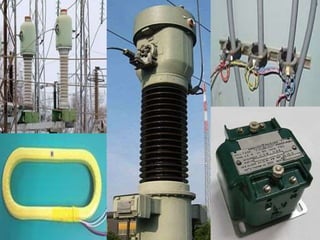
 These are special types of transformers used for the
measurement of voltage , current ,power & energy. As the
name suggests , these transformers are used in conjuction with
the relevant instruments such a ammeters , voltmeters
,wattmeters & energy meters.
NEED OF INSTRUMENT TRANSFORMERS
 For the purpose of measurement of large currents and high
voltage in transformer we uses instrument transformer.
 It also make it possible to measure it with low range voltmeters
and low range ammeters.
 For these purpose ,specially constructed accurate ratio
instrument transformers are employed in conjunction with many
measuring instruments.
 They are basically of two types –
1. Current Transformers
2. Potential Transformers
APPLICATIONS OF INSTRUMENT
TRANSFORMER
• It would not be economical to have a ammeter to measure
600amps in a conductor directly , but we can have an ammeter
range 0-5amps which corresponds to 0-600amps.
• Similarly , for measuring voltage of 14,400volts directly it would
not be economical , so we place 0-120 volts will be corresponds
to 0-14,400volts & economical.
 The degree to which an instrument transformer produces a
current or voltage i. e. proportionate to the one to be monitored
is to it’s accuracy.
CURRENT TRANSFORMER
 They generally used to step
down current in a very
predictable fashion with
respect to current and phase
.
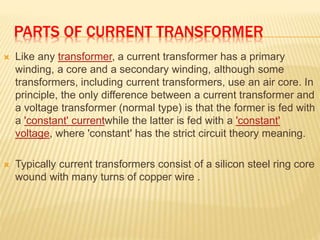
 The current (or series)
transformer has a primary
coil of one or more turns of
thick wire connected in series
with the line whose current is
to be measured.
 The secondary consists of a
large number of turns of fine
wire & is connected across
the ammeter terminals.
PARTS OF CURRENT TRANSFORMER
 Like any transformer, a current transformer has a primary
winding, a core and a secondary winding, although some
transformers, including current transformers, use an air core. In
principle, the only difference between a current transformer and
a voltage transformer (normal type) is that the former is fed with
a 'constant' currentwhile the latter is fed with a 'constant'
voltage, where 'constant' has the strict circuit theory meaning.
 Typically current transformers consist of a silicon steel ring core
wound with many turns of copper wire .
WORKING OF CT’S
 The alternating current in the primary produces an alternating
magnetic field in the core, which then induces an alternating
current in the secondary. The primary circuit is largely
unaffected by the insertion of the CT.
 Accurate current transformers need close coupling between the
primary and secondary to ensure that the secondary current is
proportional to the primary current over a wide current range.
 The current in the secondary is the current in the primary
(assuming a single turn primary) divided by the number of turns
of the secondary.
 The conductor carrying the primary current is then passed
through the ring; the CT's primary therefore consists of a single
'turn'. The primary 'winding' may be a permanent part of the
current transformer, with a heavy copper bar to carry current
through the core.
LET’S LEARN MORE ABOUT CT’S
CALCULATION OF CT’S
 If the current transformer has
primary to secondary current
ratio of 100:5,then it steps up
the voltage 20 times whereas
it steps up the voltage 20
times whereas it steps down
the current to 1/20 of its
actual value.
 Hence , if we know current
ratio (I1/I2) of the transformer
& the reading of the a.c.
ammeter , the line current
can be calculated.
 For eg; 1. A100:5
transformer is used in
conjunction with a 5-amp
ammeter . If the latter reads
3.5A,find the line current.
 Sol: As we know that
I1/I2=100/5 , now primary
on line –current =3.5*(100/5)
=70A
APPLICATIONS OF CURRENT TRANSFORMERS
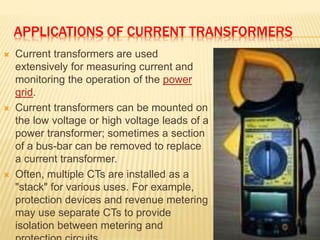
 Current transformers are used
extensively for measuring current and
monitoring the operation of the power
grid.
 Current transformers can be mounted on
the low voltage or high voltage leads of a
power transformer; sometimes a section
of a bus-bar can be removed to replace
a current transformer.
 Often, multiple CTs are installed as a
"stack" for various uses. For example,
protection devices and revenue metering
may use separate CTs to provide
isolation between metering and
SAFETY OF CURRENT TRANSFORMERS
 Regarding safety issues ,it is considered important as the
secondary of a current transformer should not be disconnected
from its burden while current is in the primary, as the secondary
will attempt to continue driving current into an effective
infinite impedance up to its insulation break-down voltage and
thus compromise operator safety.
THANK YOU!
ANY QUERIES!!

Ppt of current transformer

  • 1.
    PRESENTATION ON CURRENT TRANSFORMERS Submittedby – Roopal pancholi B.Tech (Electrical), III year, V semester K13072 Submitted To – Mr. Kamal Arora Dean of Electrical Department
  • 2.
    CONTENTS 1. Introduction 2. InstrumentTransformers 3. Need of Instrument Transformers 4. Applications of instrument Transformers 5. Current Transformers 6. Parts of Current Transformers 7. Working of CT’S 8. Let’s learn more about CT’s 9. Calculation of CT’s 10. Applications of Current Transformers 11. Safety of CT’S
  • 3.
    INTRODUCTION  Transformers isa device- 1. transfers electric power from one circuit to another 2. it does so without change of frequency 3. it accomplishes this by electromagnetic induction and 4. It is divided into core & shell types of transformers 5. for measurement purpose we uses INSTRUMENT TRANSFORMRS .
  • 4.
    INSTRUMENTS TRANSFORMER  Theseare special types of transformers used for the measurement of voltage , current ,power & energy. As the name suggests , these transformers are used in conjuction with the relevant instruments such a ammeters , voltmeters ,wattmeters & energy meters.
  • 6.
    NEED OF INSTRUMENTTRANSFORMERS  For the purpose of measurement of large currents and high voltage in transformer we uses instrument transformer.  It also make it possible to measure it with low range voltmeters and low range ammeters.  For these purpose ,specially constructed accurate ratio instrument transformers are employed in conjunction with many measuring instruments.  They are basically of two types – 1. Current Transformers 2. Potential Transformers
  • 7.
    APPLICATIONS OF INSTRUMENT TRANSFORMER •It would not be economical to have a ammeter to measure 600amps in a conductor directly , but we can have an ammeter range 0-5amps which corresponds to 0-600amps. • Similarly , for measuring voltage of 14,400volts directly it would not be economical , so we place 0-120 volts will be corresponds to 0-14,400volts & economical.  The degree to which an instrument transformer produces a current or voltage i. e. proportionate to the one to be monitored is to it’s accuracy.
  • 8.
    CURRENT TRANSFORMER  Theygenerally used to step down current in a very predictable fashion with respect to current and phase .  The current (or series) transformer has a primary coil of one or more turns of thick wire connected in series with the line whose current is to be measured.  The secondary consists of a large number of turns of fine wire & is connected across the ammeter terminals.
  • 9.
    PARTS OF CURRENTTRANSFORMER  Like any transformer, a current transformer has a primary winding, a core and a secondary winding, although some transformers, including current transformers, use an air core. In principle, the only difference between a current transformer and a voltage transformer (normal type) is that the former is fed with a 'constant' currentwhile the latter is fed with a 'constant' voltage, where 'constant' has the strict circuit theory meaning.  Typically current transformers consist of a silicon steel ring core wound with many turns of copper wire .
  • 10.
    WORKING OF CT’S The alternating current in the primary produces an alternating magnetic field in the core, which then induces an alternating current in the secondary. The primary circuit is largely unaffected by the insertion of the CT.  Accurate current transformers need close coupling between the primary and secondary to ensure that the secondary current is proportional to the primary current over a wide current range.
  • 11.
     The currentin the secondary is the current in the primary (assuming a single turn primary) divided by the number of turns of the secondary.  The conductor carrying the primary current is then passed through the ring; the CT's primary therefore consists of a single 'turn'. The primary 'winding' may be a permanent part of the current transformer, with a heavy copper bar to carry current through the core.
  • 12.
    LET’S LEARN MOREABOUT CT’S
  • 13.
    CALCULATION OF CT’S If the current transformer has primary to secondary current ratio of 100:5,then it steps up the voltage 20 times whereas it steps up the voltage 20 times whereas it steps down the current to 1/20 of its actual value.  Hence , if we know current ratio (I1/I2) of the transformer & the reading of the a.c. ammeter , the line current can be calculated.  For eg; 1. A100:5 transformer is used in conjunction with a 5-amp ammeter . If the latter reads 3.5A,find the line current.  Sol: As we know that I1/I2=100/5 , now primary on line –current =3.5*(100/5) =70A
  • 14.
    APPLICATIONS OF CURRENTTRANSFORMERS  Current transformers are used extensively for measuring current and monitoring the operation of the power grid.  Current transformers can be mounted on the low voltage or high voltage leads of a power transformer; sometimes a section of a bus-bar can be removed to replace a current transformer.  Often, multiple CTs are installed as a "stack" for various uses. For example, protection devices and revenue metering may use separate CTs to provide isolation between metering and
  • 15.
    SAFETY OF CURRENTTRANSFORMERS  Regarding safety issues ,it is considered important as the secondary of a current transformer should not be disconnected from its burden while current is in the primary, as the secondary will attempt to continue driving current into an effective infinite impedance up to its insulation break-down voltage and thus compromise operator safety.
  • 16.