


Chapter 7 Dimensioning
Contents Introduction Dimensioning components & their recommended practices Dimensioning the object’ s features Placement of dimensions. Problem solving steps
Introduction
Definition Dimensioning  is the process of specifying part’ s information by using of  lines, number, symbols   and notes . Notes 1. Lines to be used are  always   thin   continuous  line. 2. Symbol or abbreviation commonly found in a drawing are   - “ diameter ” is represented by a symbol “   ”.   - “ radius ”  is represented by a letter “ R   ”.
Types of an information A  basic   information  (this  course ) 1.  Sizes  and  location  of the object’s features.  (this  chapter )  2. Type of material 3. Number of piece required to assemble into a single unit   of a product (or machine). A  higher-level   information 1. Tolerances : Size and geometric 2. Surface roughness 3. Manufacturing or assemble   process descriptions. Example  : Roughness condition Process Level
Dimensioning components : General topics
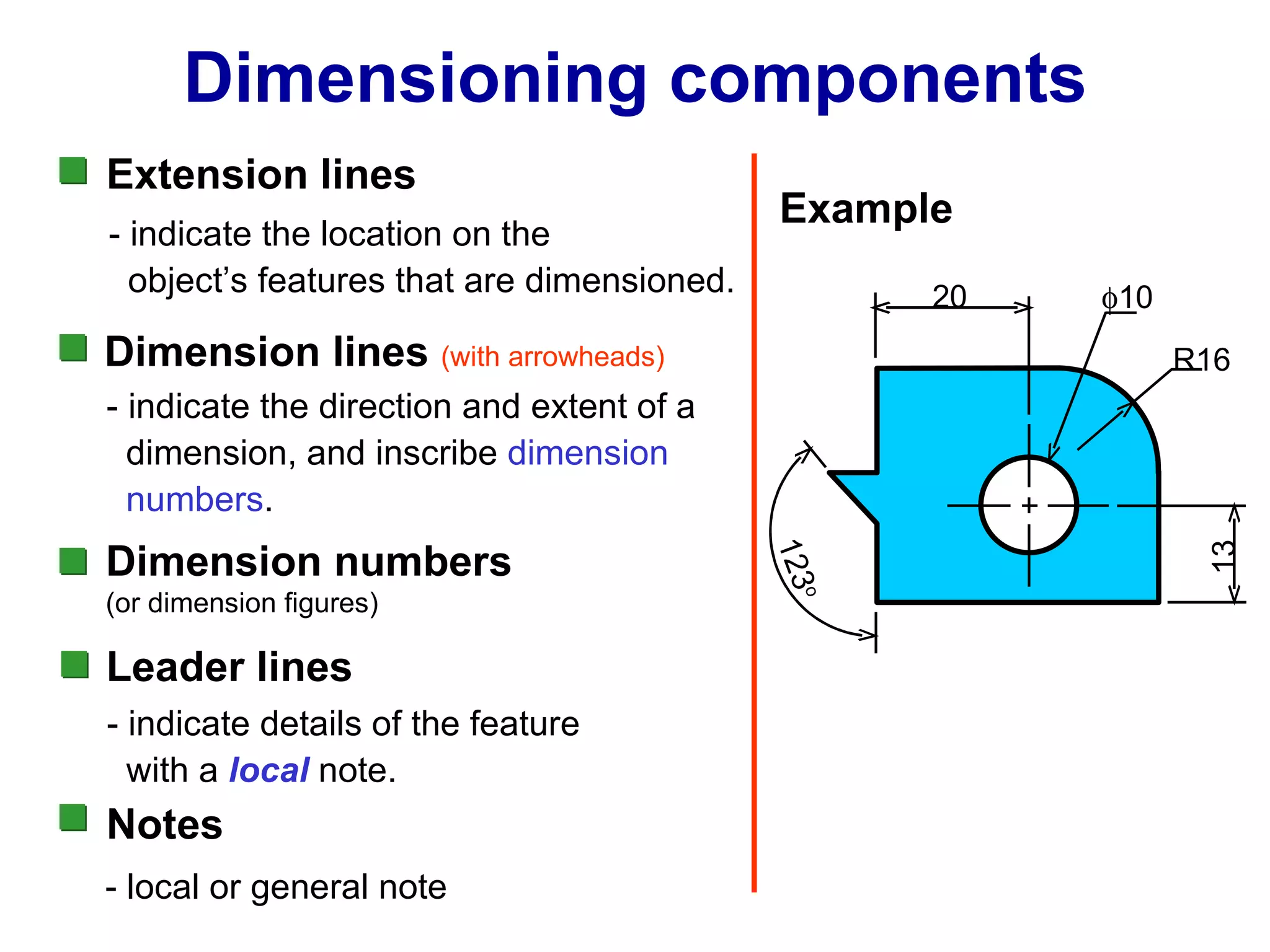
Dimensioning components Extension lines Dimension lines   (with arrowheads) Leader lines Dimension numbers (or dimension figures) Notes 20 13 123 o  10 - indicate the location on the   object’s features that are dimensioned. - indicate the direction and extent of a   dimension, and inscribe  dimension   numbers . - indicate details of the feature with a  local   note. - local or general note R16 Example
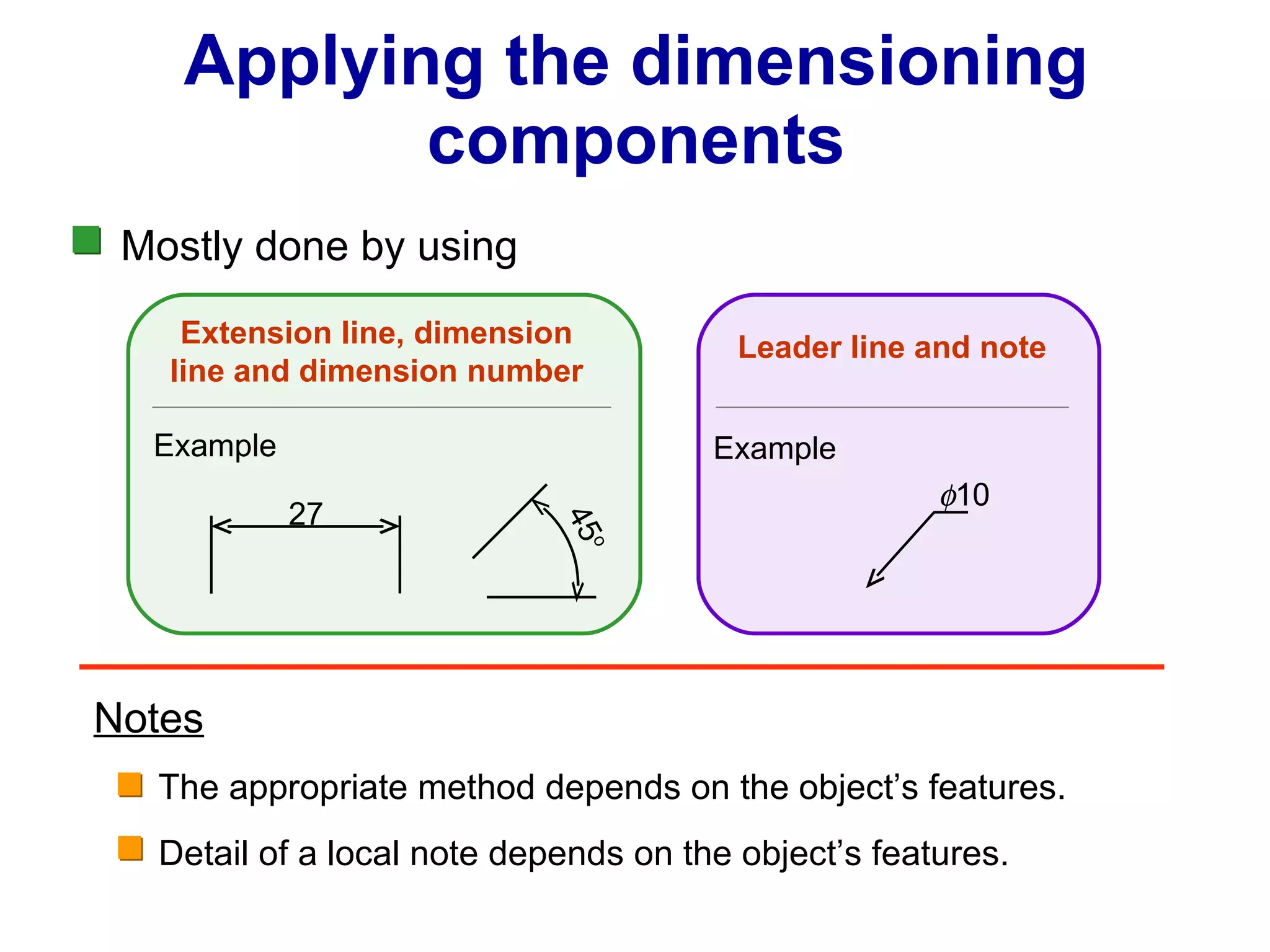
Applying the dimensioning components Extension line, dimension line and dimension number Mostly done by using Leader line and note  The appropriate method depends on the object’s features. 27  10 45 o Notes Detail of a local note depends on the object’s features. Example Example
Dimensioning components : Recommended practice
Extension line Always leave a  visible gap   (≈ 1 mm) from a view or center lines before start drawing a line. Extend the lines  beyond  the (last) dimension line 2-3 mm. Good practice Poor practice 1 2 3 2 4
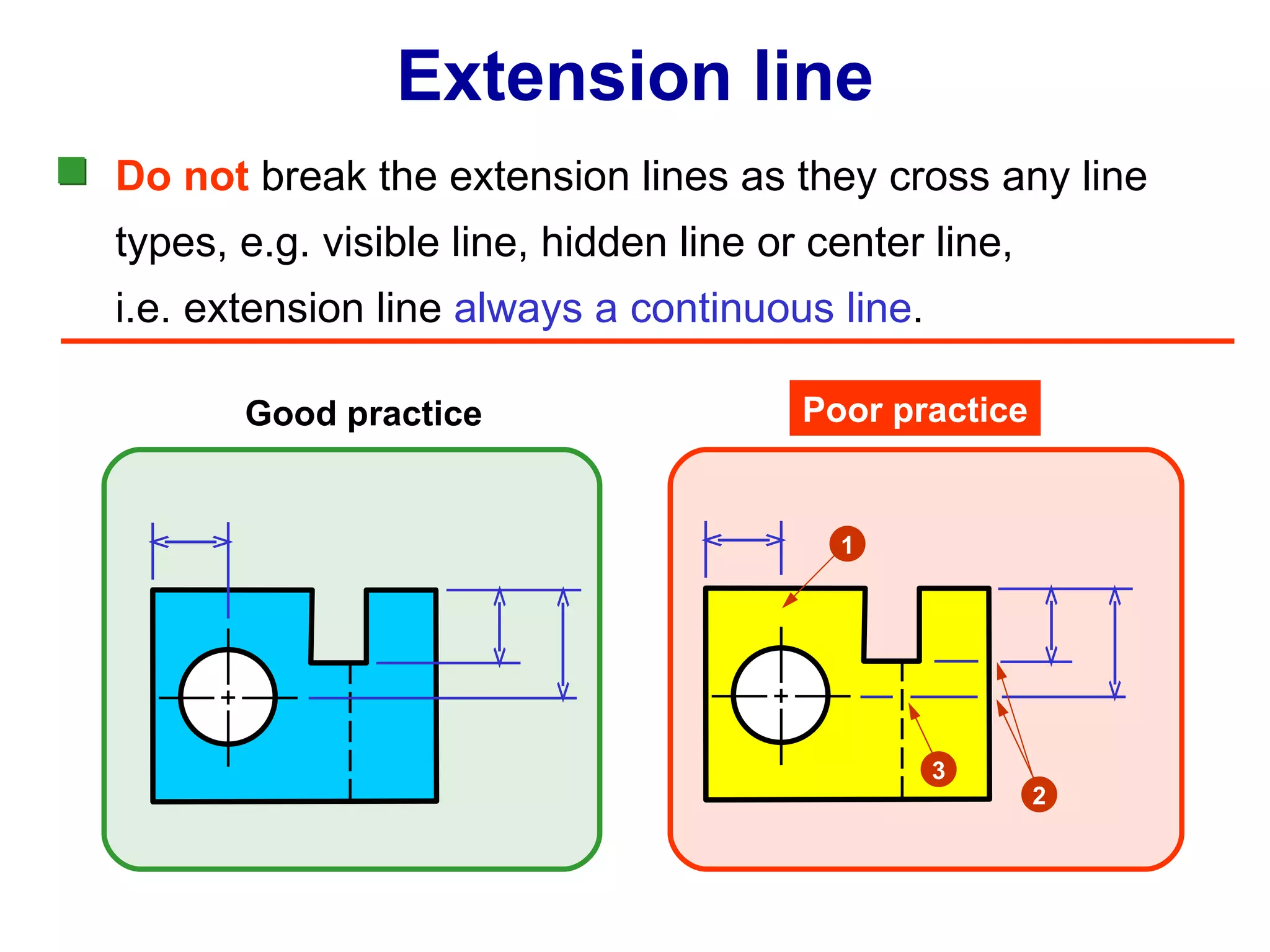
Do not  break the extension lines as they cross any line types, e.g. visible line, hidden line or center line, i.e. extension line  always a continuous line . Good practice Poor practice 1 2 3 Extension line
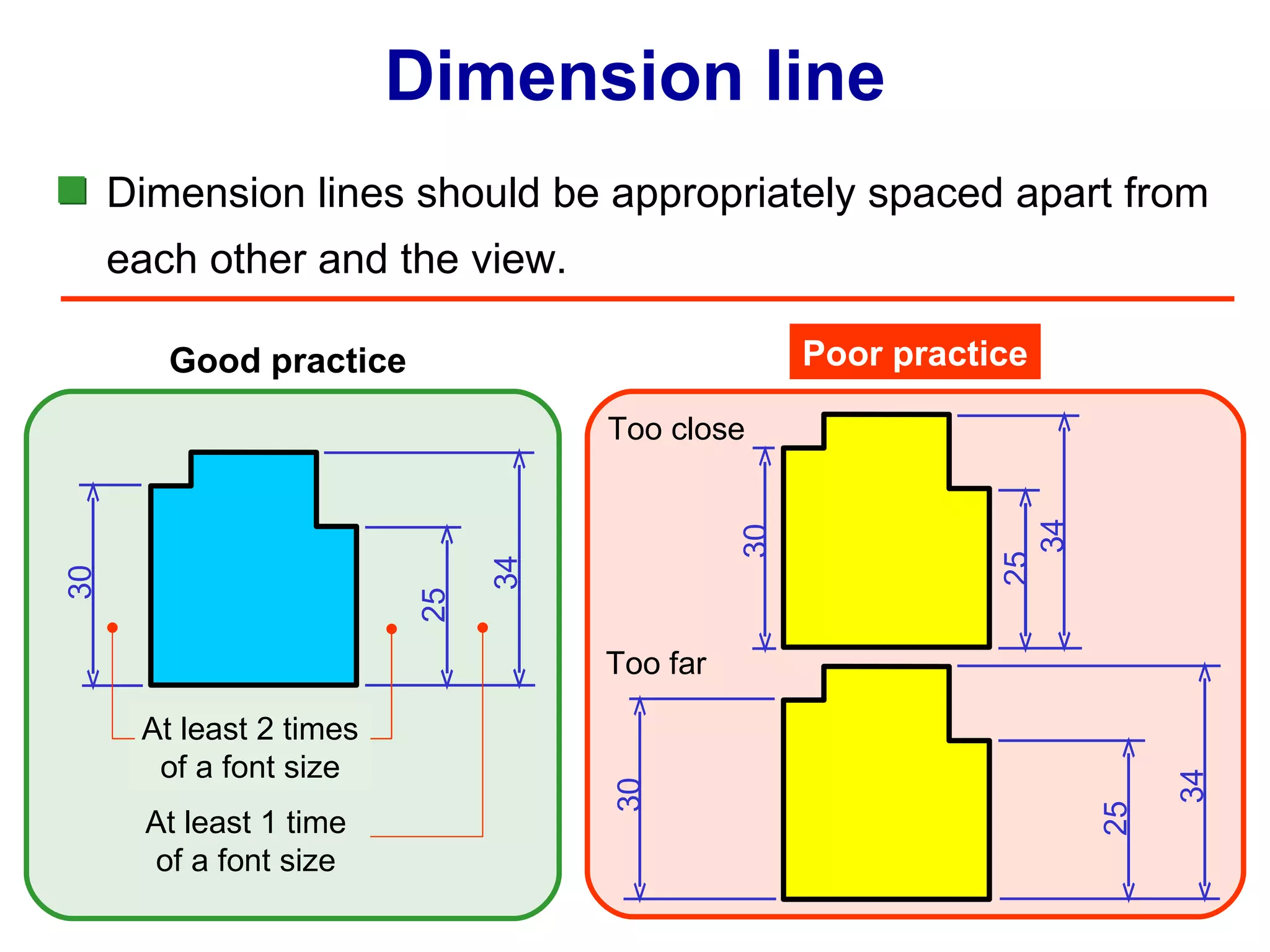
Good practice Poor practice Dimension lines should be appropriately spaced apart from each other and the view. 25 34 At least 2 times of a font size 30 At least 1 time of a font size 25 34 30 25 34 30 Too close Too far Dimension line
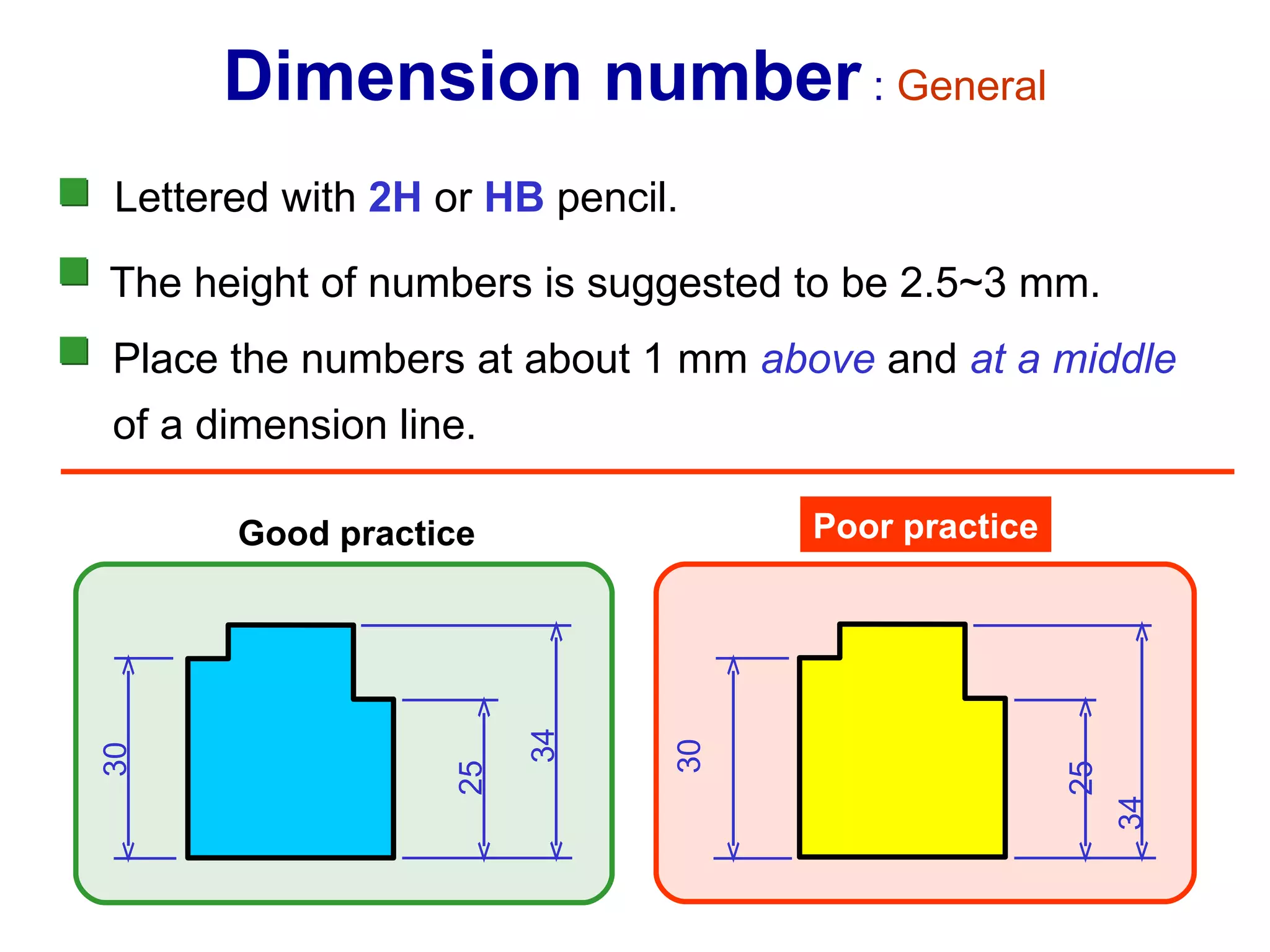
The height of numbers is suggested to be 2.5~3 mm. Place the numbers at about 1 mm  above  and  at a middle  of a   dimension line. Lettered with  2H  or  HB   pencil. Dimension number  :  General Good practice Poor practice 25 34 25 34 30 30
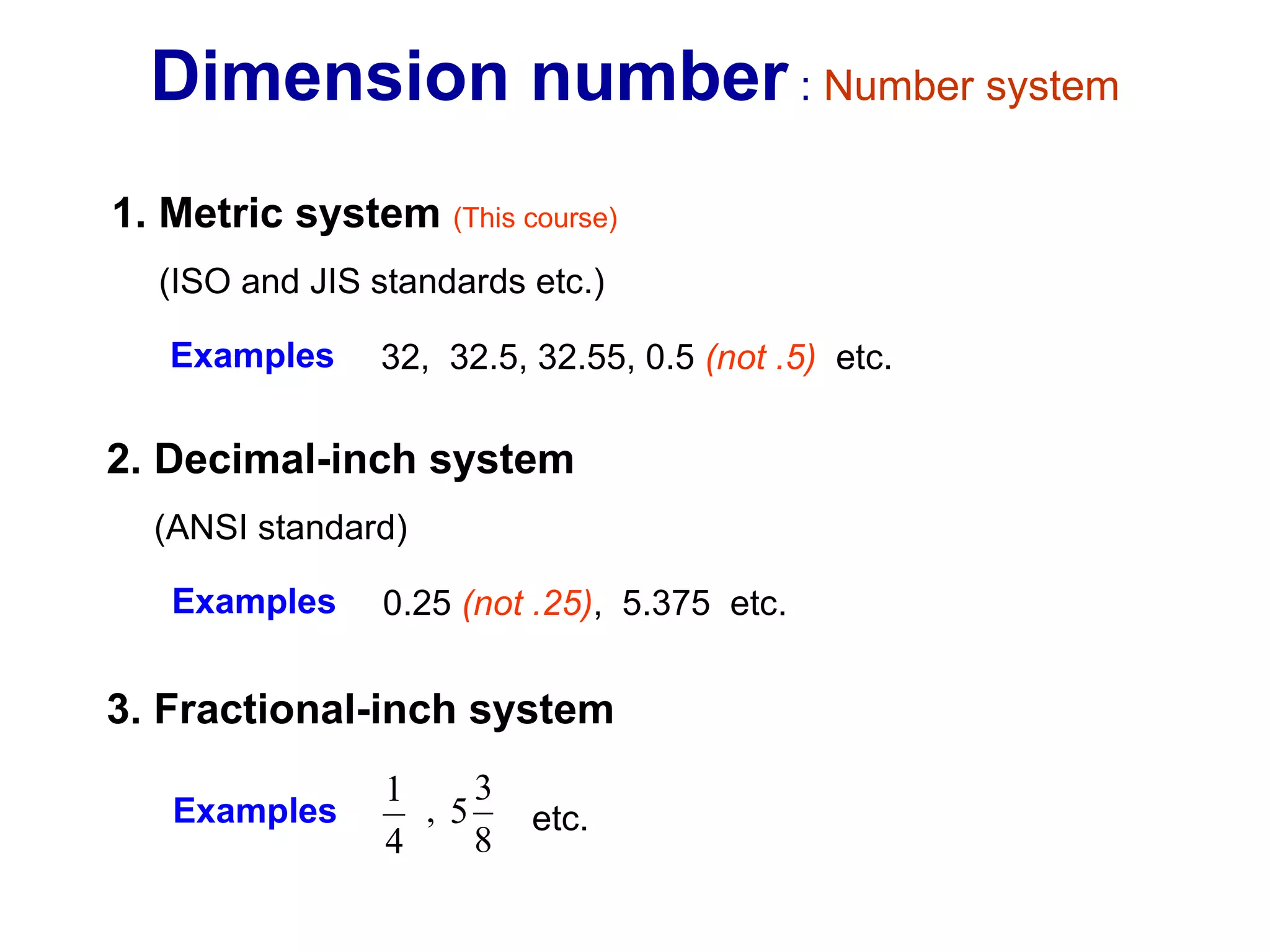
1. Metric system  (This course) (ISO and JIS standards etc.) 2. Decimal-inch system   (ANSI standard) 3. Fractional-inch system , 0.25  (not .25) ,  5.375  etc. Examples Examples 32,  32.5, 32.55, 0.5  (not .5)   etc.  Examples etc. Dimension number  :  Number system
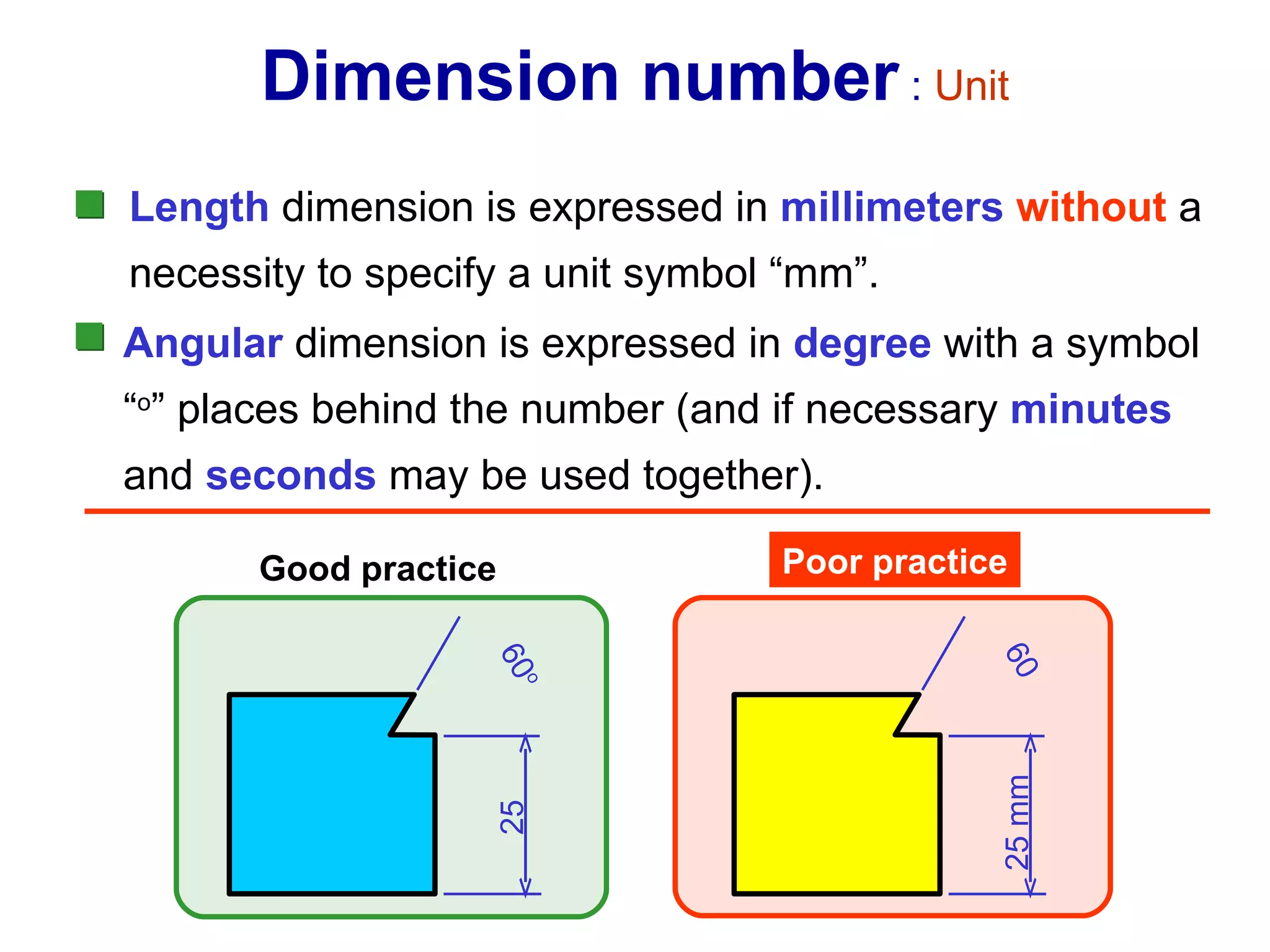
Angular   dimension is expressed in  degree  with a symbol “ o ” places behind the number (and if necessary  minutes  and  seconds  may be used together).  Length   dimension is expressed in  millimeters  without  a necessity to   specify a unit symbol “mm”. 25 Good practice Poor practice 60 o 25 mm 60 Dimension number  :  Unit
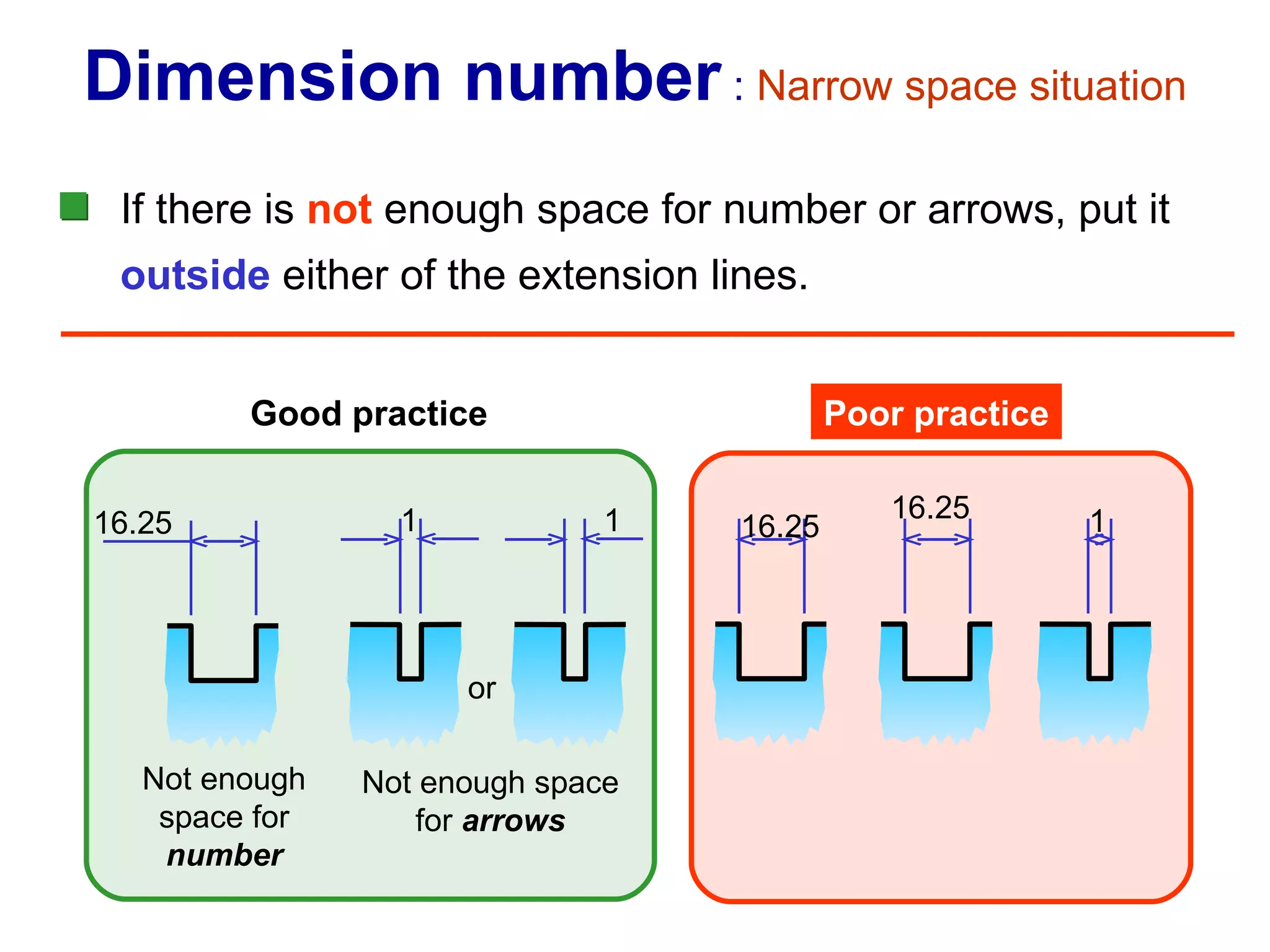
16.25 or If there is  not  enough space for number or arrows, put it  outside  either of the extension lines.  1 Not enough space for number Not enough space for  arrows 1 1 16.25 16.25 Good practice Poor practice Dimension number  :  Narrow space situation
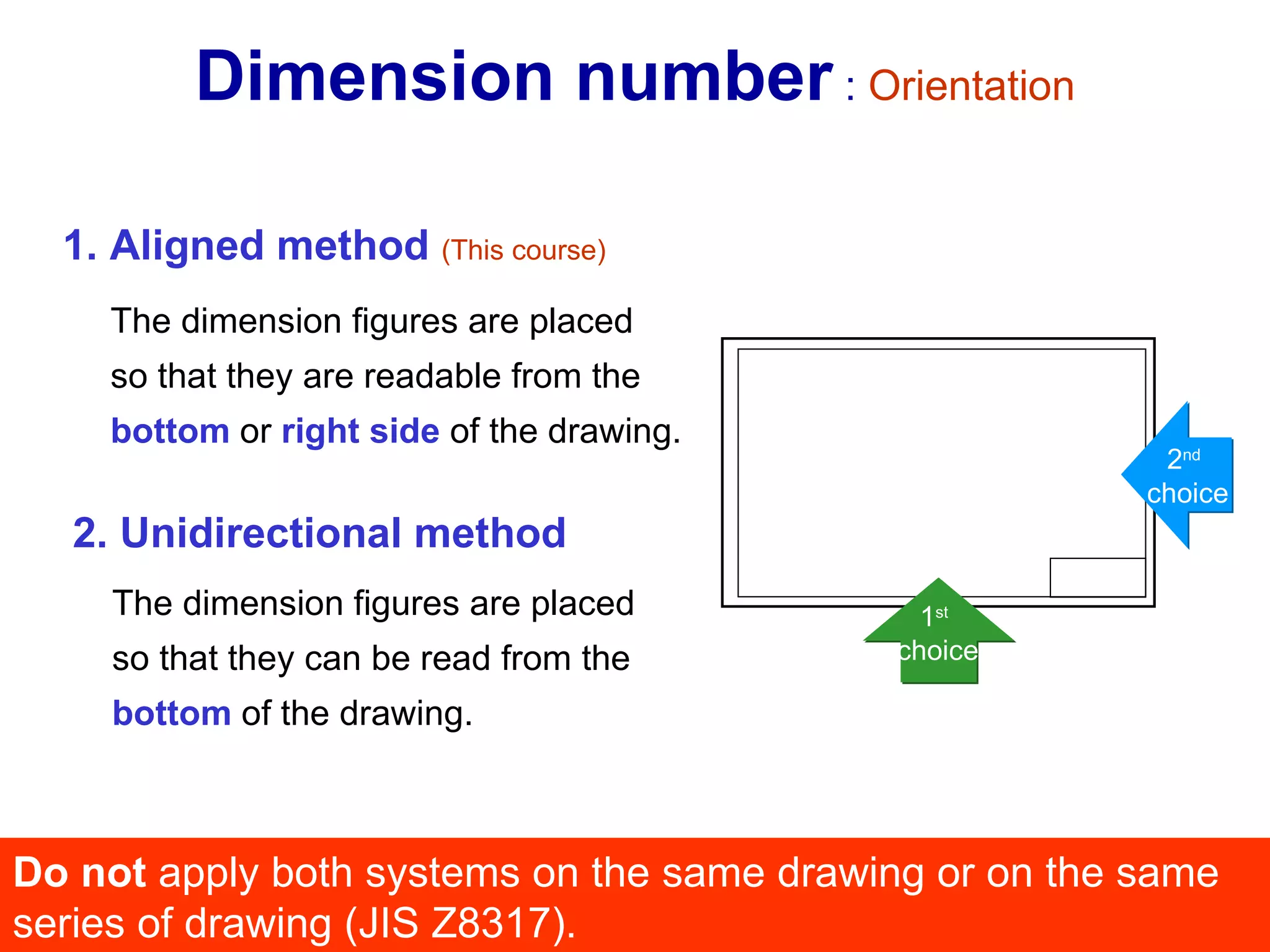
1. Aligned method  (This course) 2. Unidirectional method The dimension figures are placed so that they are readable from the bottom  or  right side   of the drawing. The dimension figures are placed so that they can be read from the bottom  of the drawing. Do not  apply both systems on the same drawing or on the same series of drawing (JIS Z8317). Dimension number  :  Orientation 1 st   choice 2 nd   choice
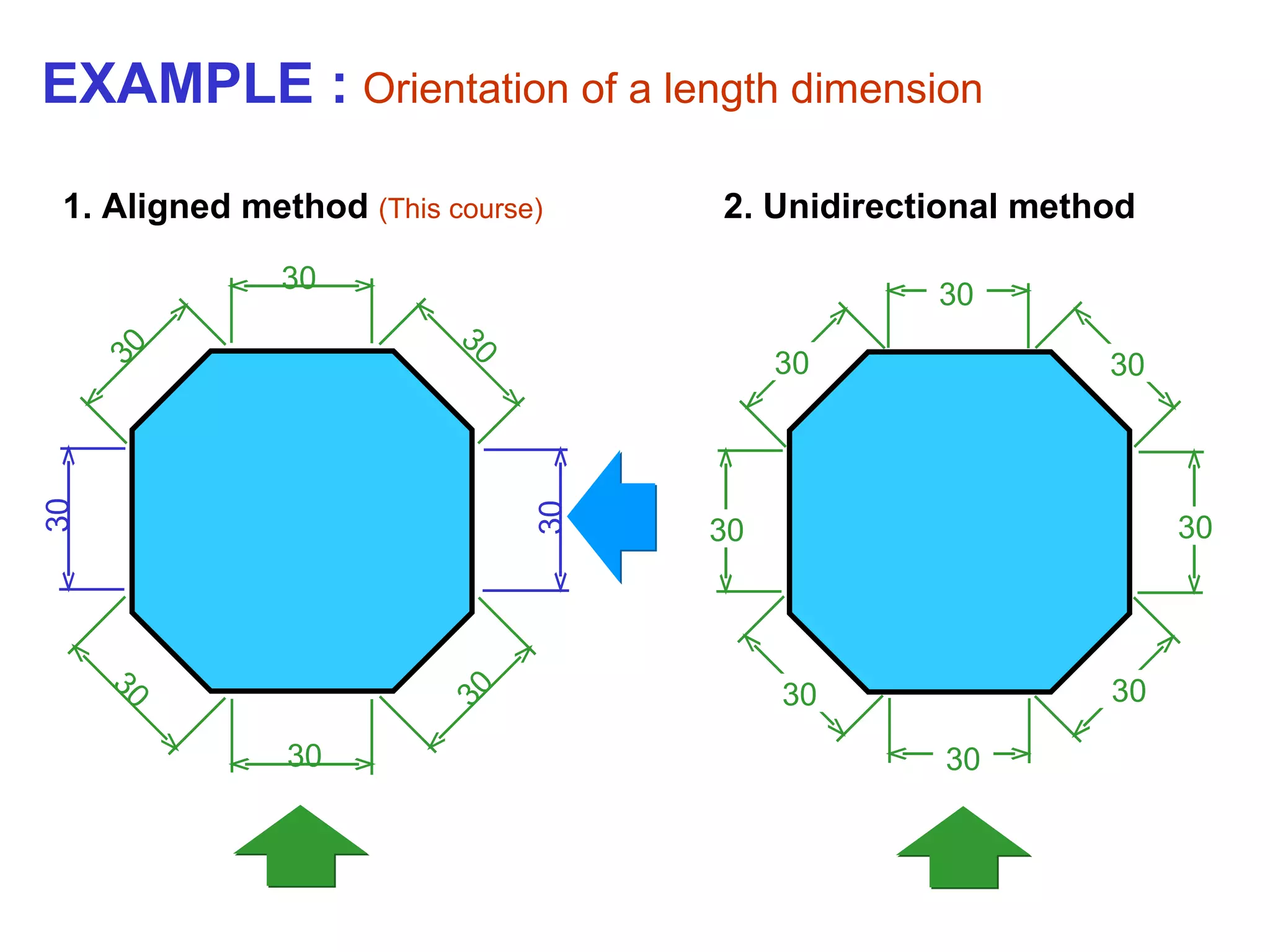
30 30 30 30 30 30 30 30 EXAMPLE :   Orientation of a length dimension 30 30 30 30 30 30 30 30 1. Aligned method  (This course) 2. Unidirectional method
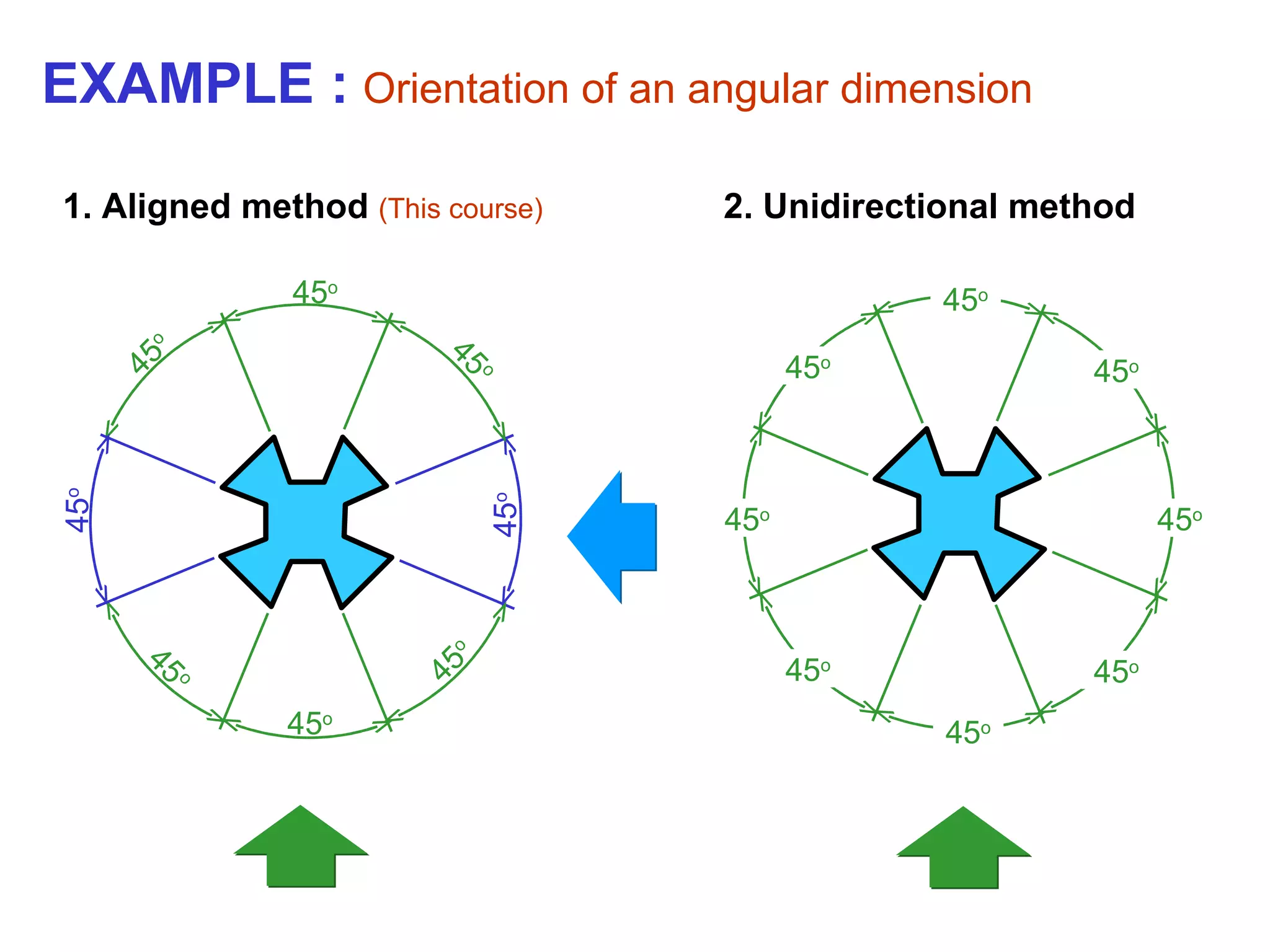
45 o 45 o 45 o 45 o 45 o 45 o 45 o 45 o 45 o 45 o 45 o 45 o 45 o 45 o 45 o 45 o EXAMPLE :   Orientation of an angular dimension 1. Aligned method  (This course) 2. Unidirectional method
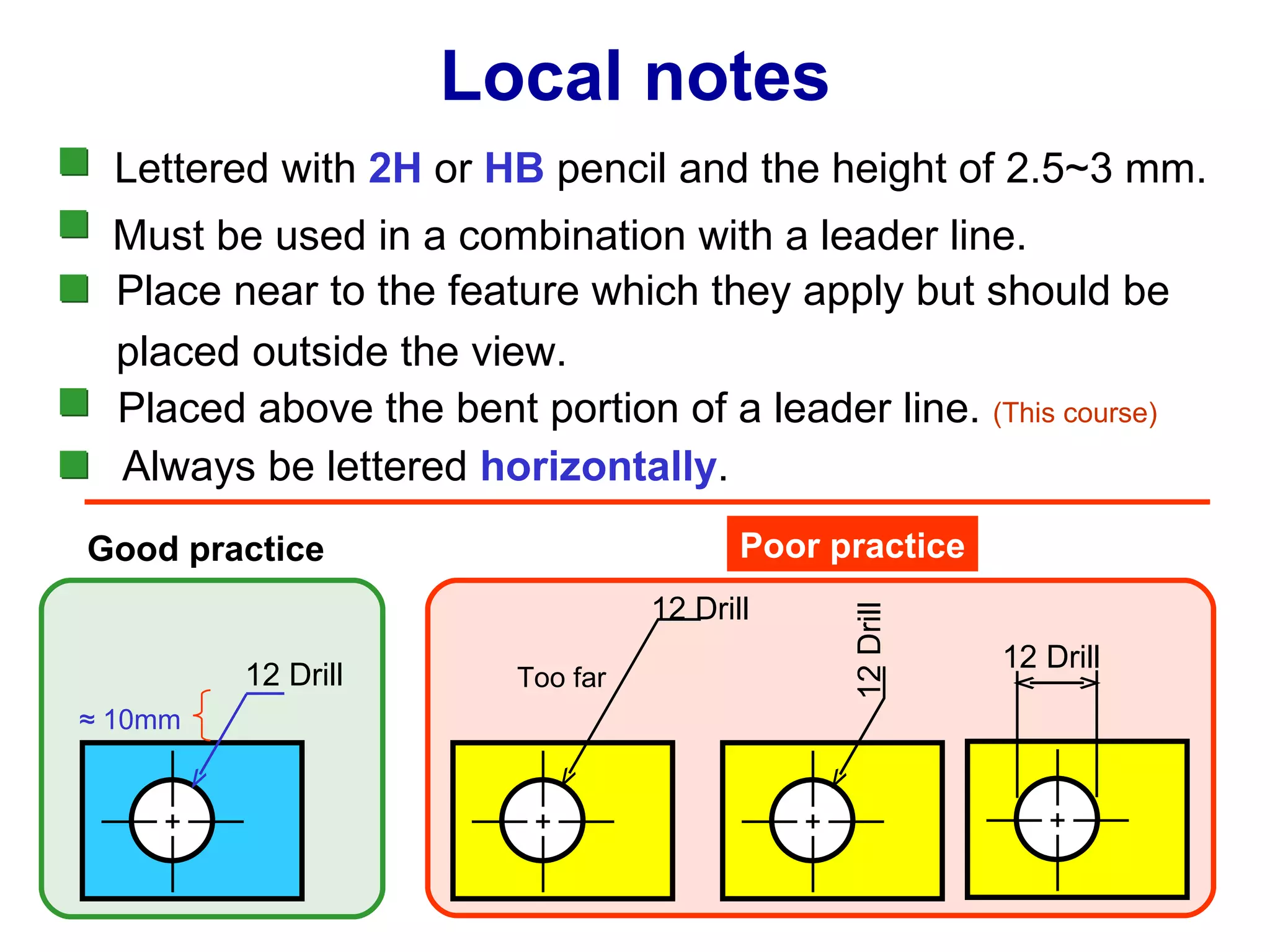
Poor practice Place near to the feature which they apply but should be placed outside the view. Always be lettered  horizontally . 12 Drill 12 Drill ≈   10mm Too far Must be used in a combination with a leader line.  Lettered with  2H  or  HB   pencil and the height of 2.5~3 mm. Good practice 12 Drill Placed above the bent portion of a leader line.  (This course) 12 Drill Local notes
Dimensioning the object’s features
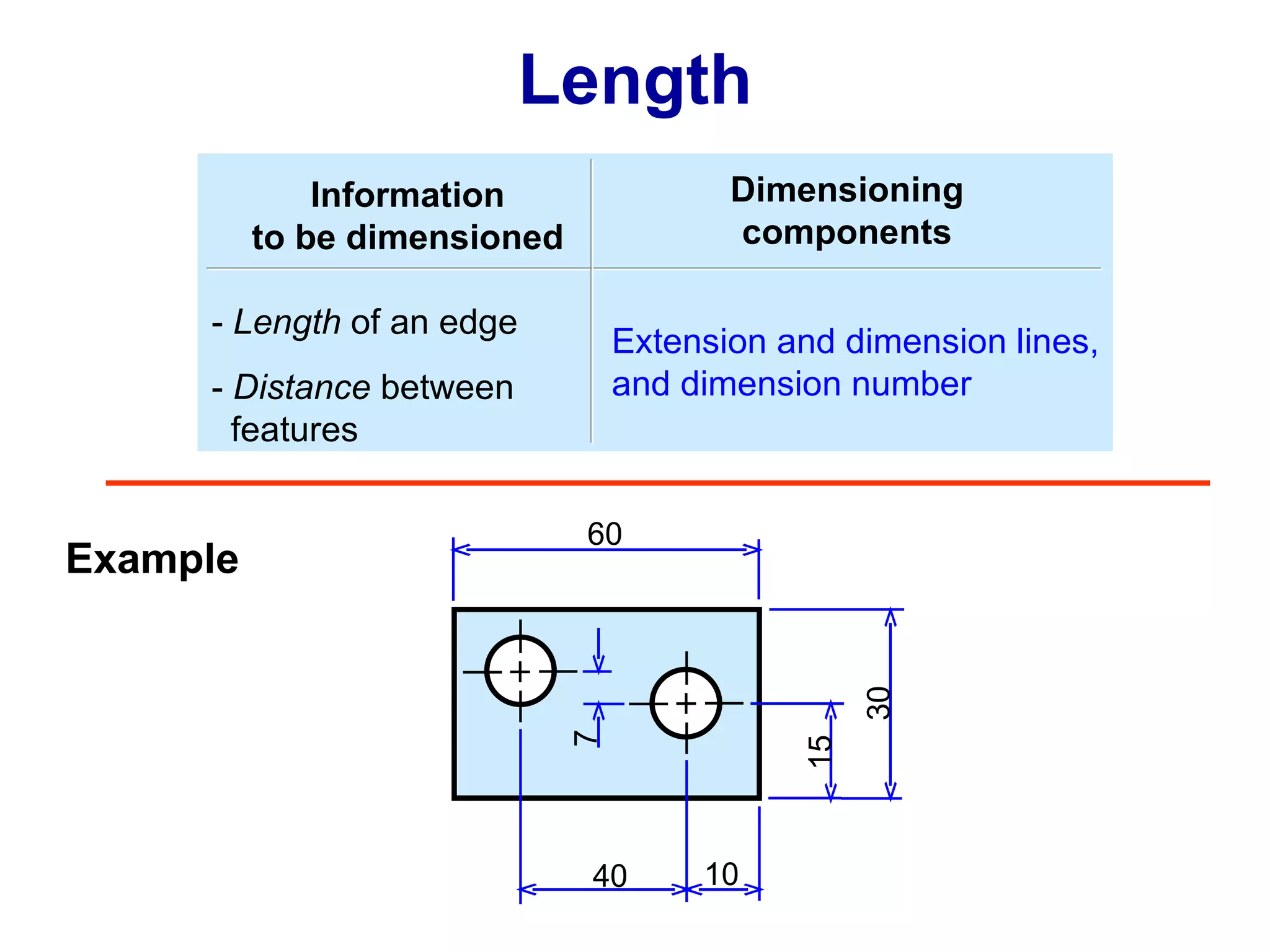
Length Dimensioning components Extension and dimension lines, and dimension number Information to be dimensioned -  Length  of an edge Example -  Distance  between   features  60 40 10 15 30 7
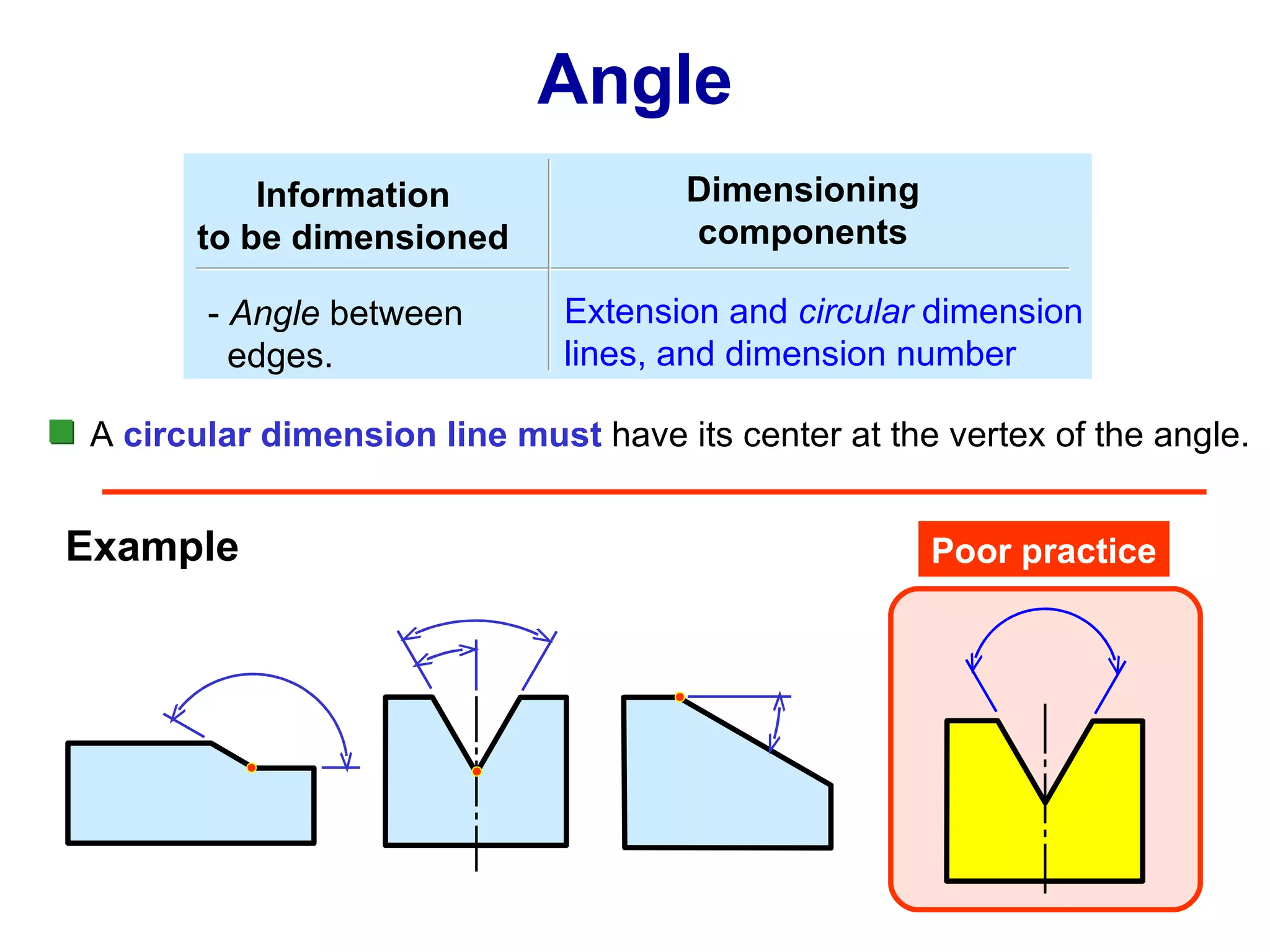
Angle Dimensioning components Information to be dimensioned -  Angle  between edges. A  circular dimension line must  have its center at the vertex of the angle. Poor practice Example Extension and  circular  dimension lines, and dimension number
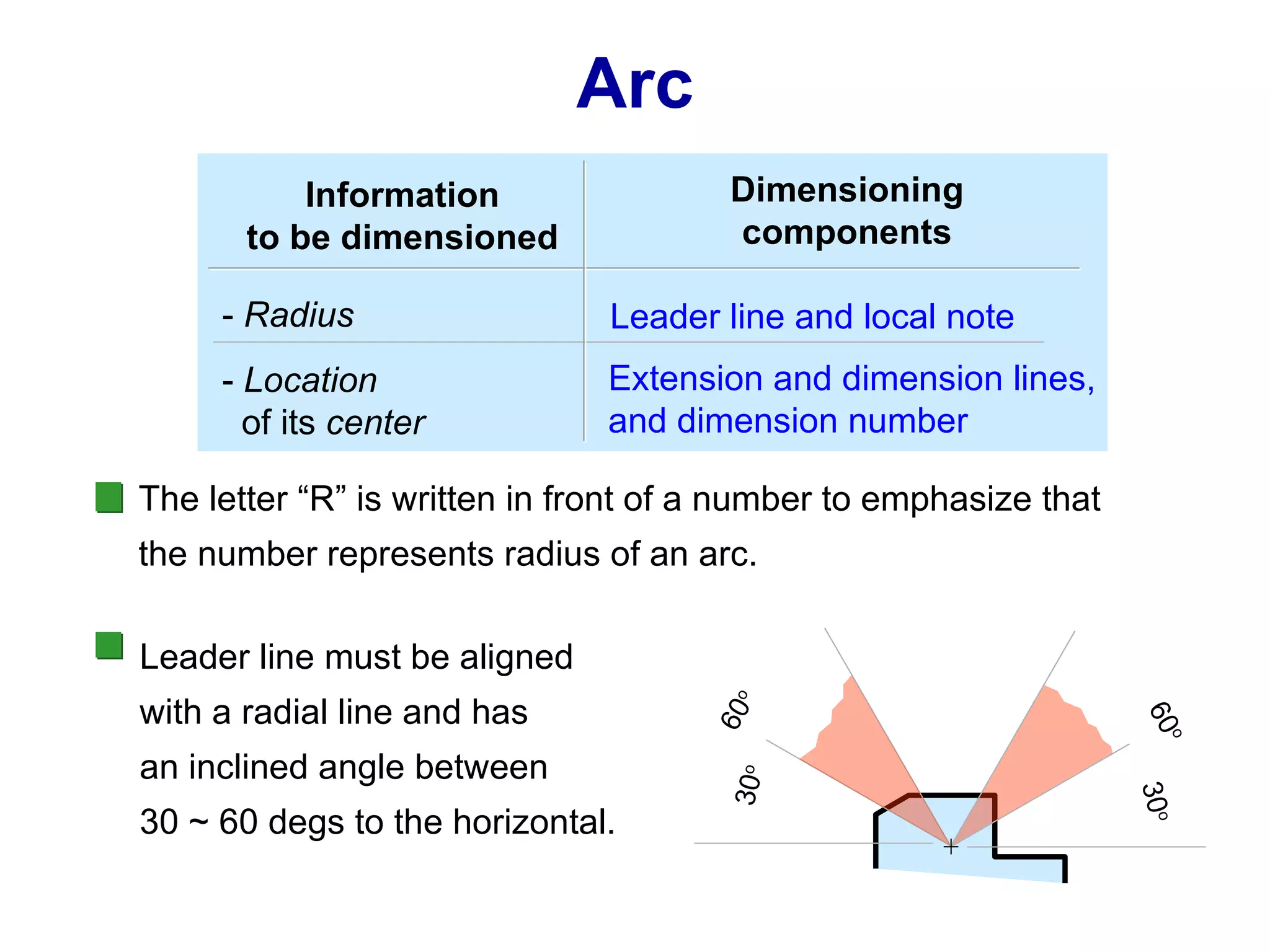
Arc Leader line and local note -  Radius -  Location   of its  center The letter “R” is written in front of a number to emphasize that the number represents radius of an arc. Dimensioning components Information to be dimensioned Extension and dimension lines, and dimension number Leader line must be aligned with a radial line and has an inclined angle between 30 ~ 60 degs to the horizontal. 30 o 60 o 30 o 60 o
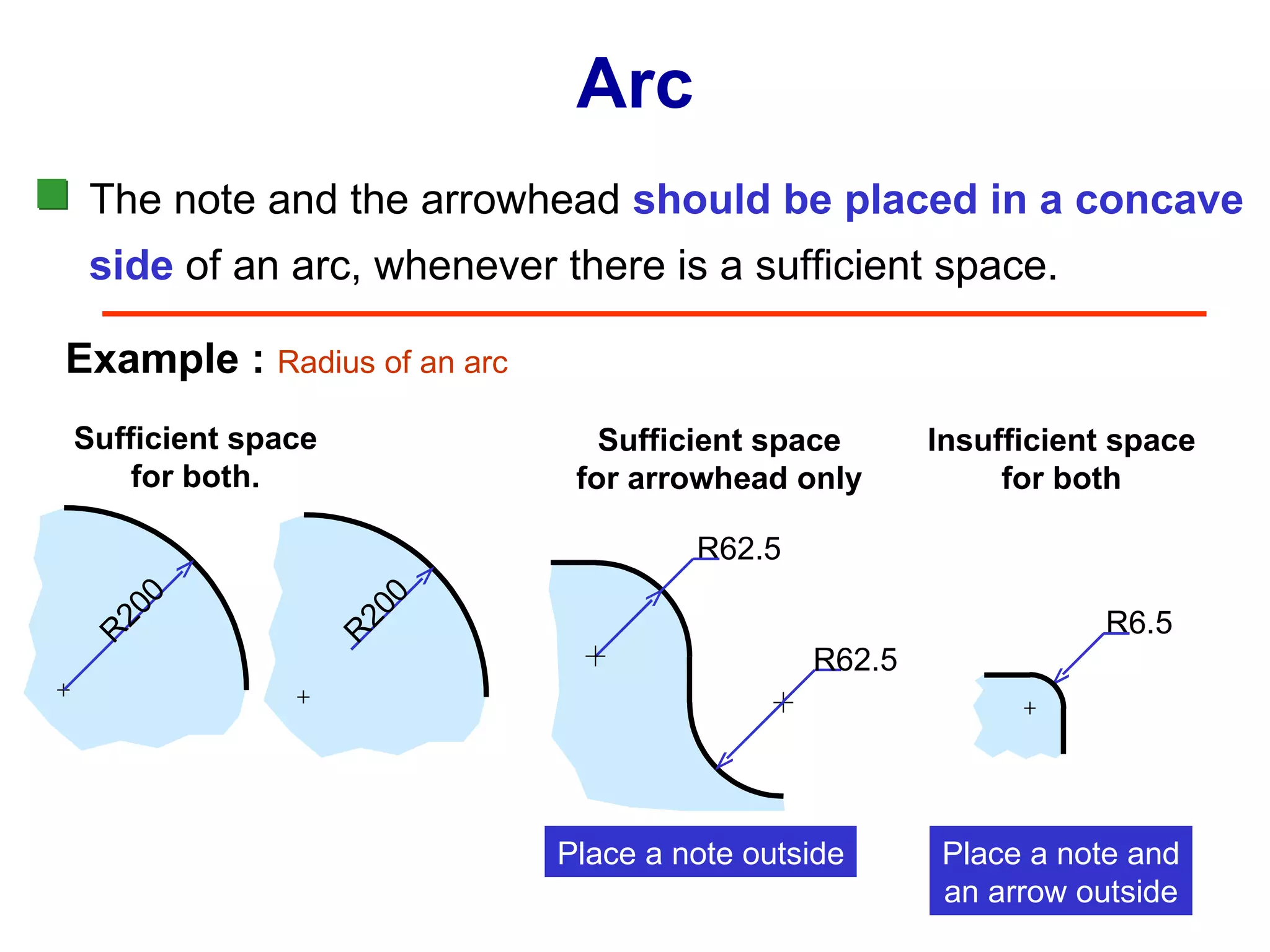
The note and the arrowhead  should be placed in a concave side  of an arc, whenever there is a sufficient space. Arc Example :  Radius of an arc R6.5 Place a note and an arrow outside Insufficient space for both R62.5 Place a note outside Sufficient space for arrowhead only R62.5 R200 Sufficient space for both. R200
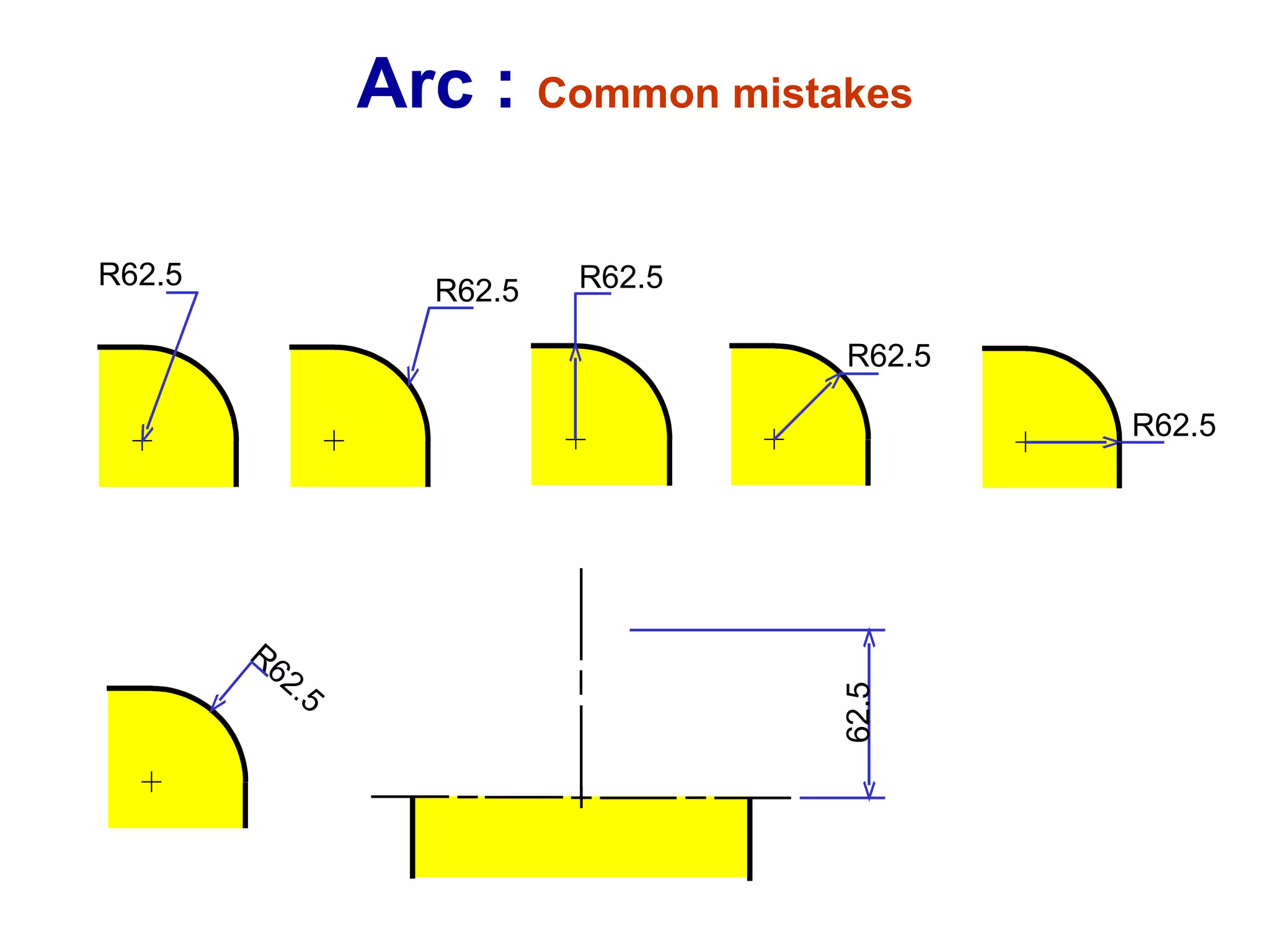
Arc :  Common mistakes R62.5 R62.5 R62.5 R62.5 R62.5 R62.5 62.5
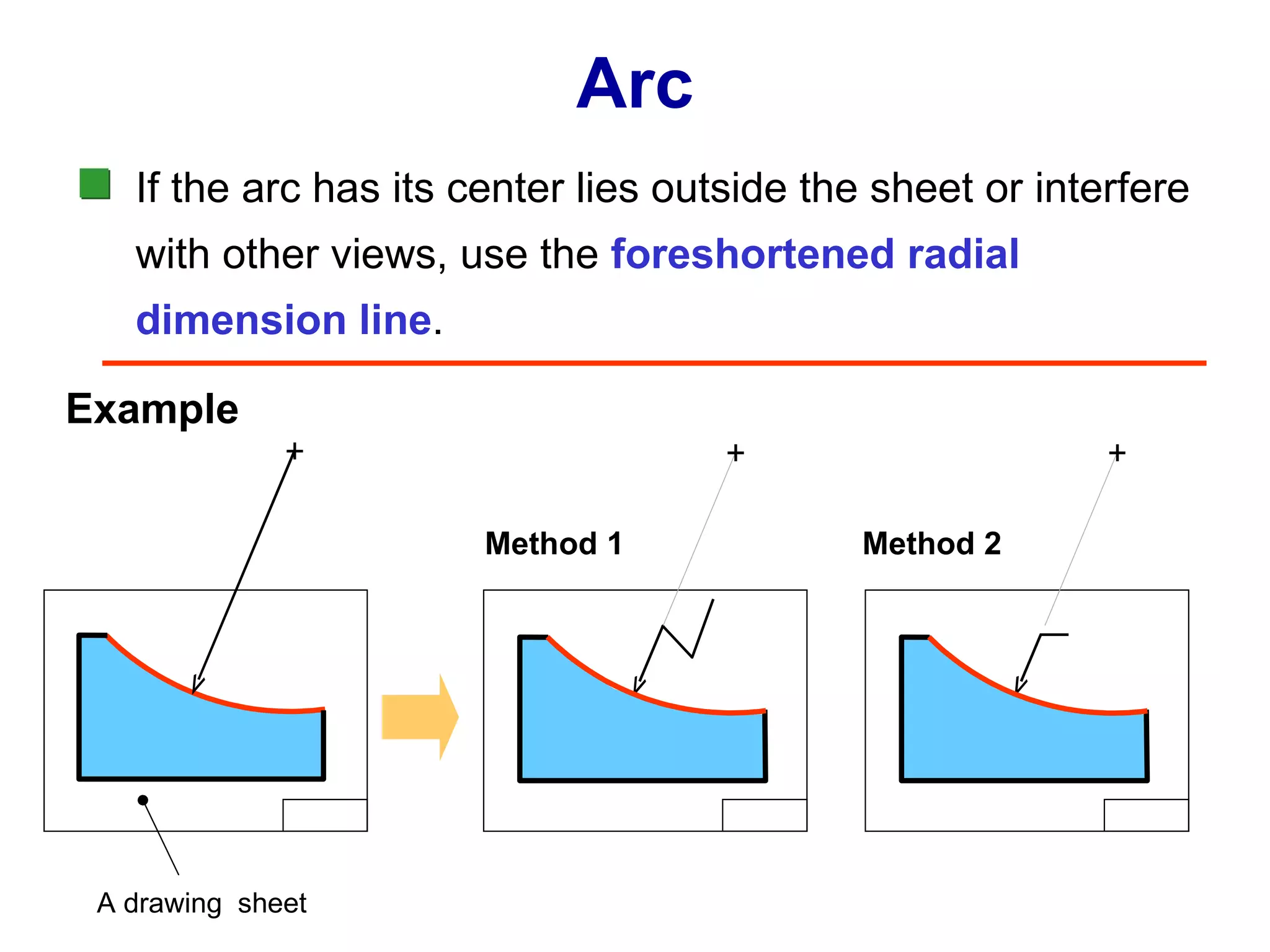
If the arc has its center lies outside the sheet or interfere with other views, use the  foreshortened radial dimension line . Arc Example A drawing  sheet Method 1 Method 2
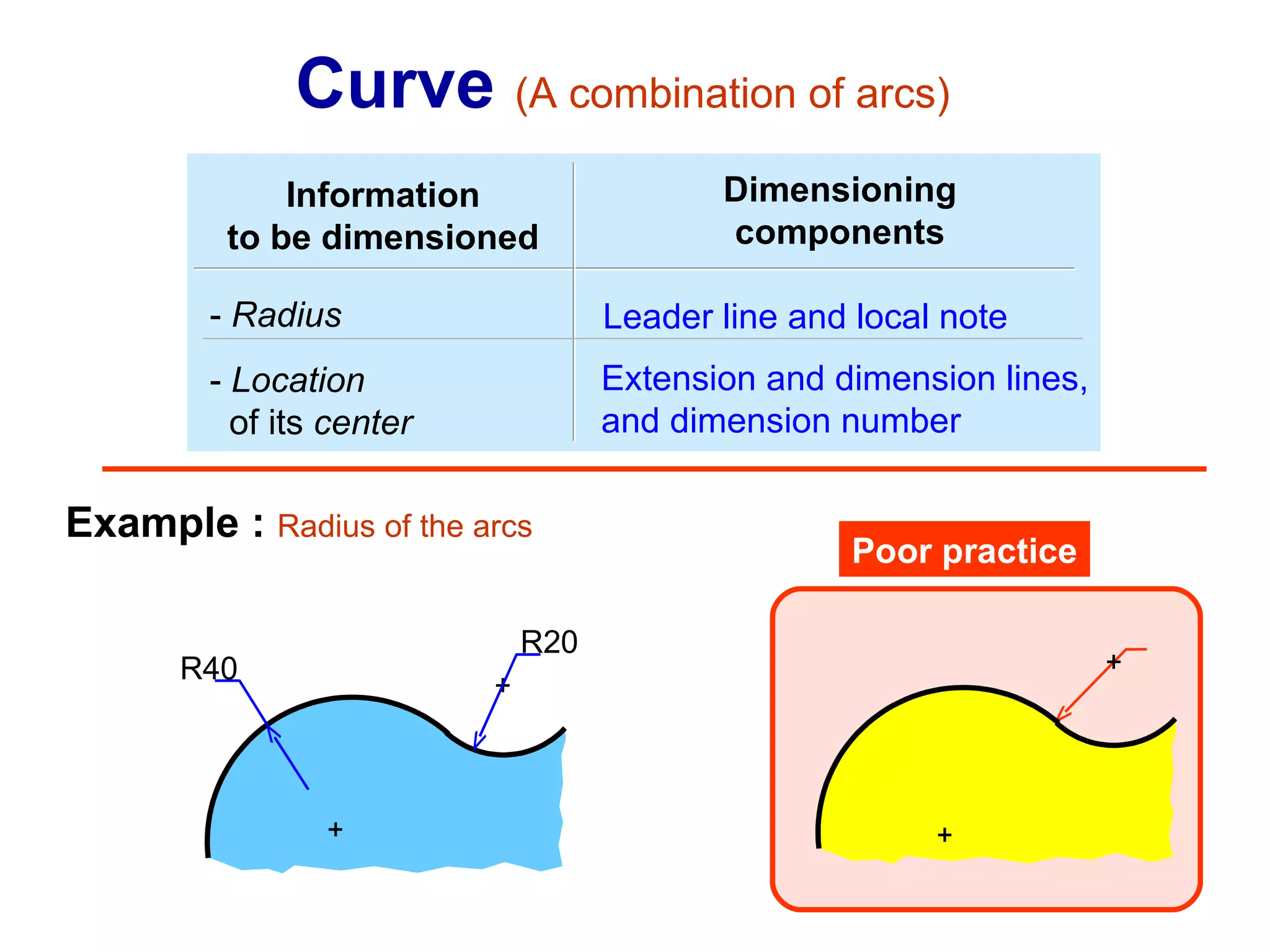
Curve  (A combination of arcs) Leader line and local note -  Radius -  Location   of its  center Dimensioning components Information to be dimensioned Extension and dimension lines, and dimension number Poor practice Example :  Radius of the arcs R20 R40
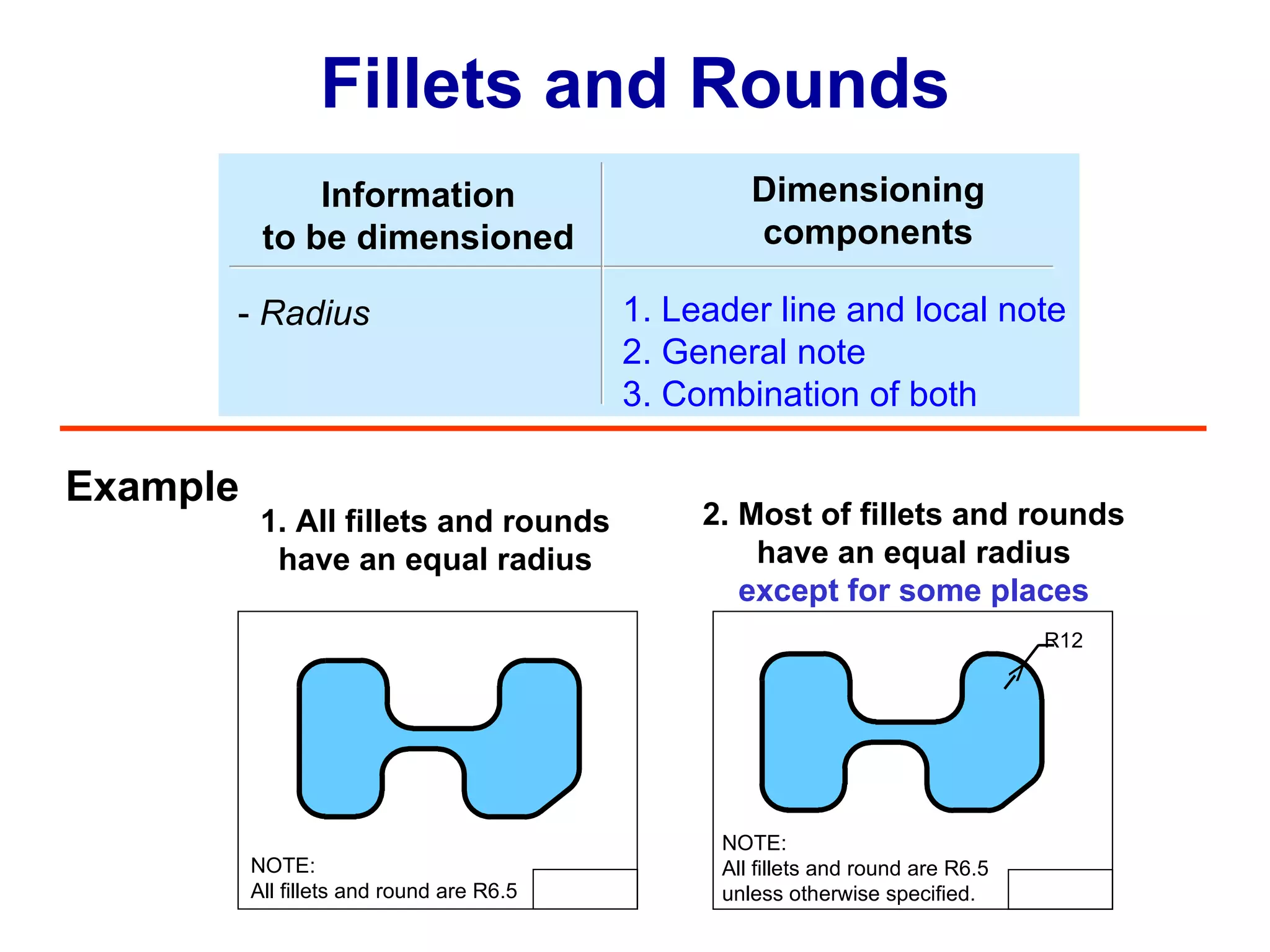
Fillets and Rounds Dimensioning components Information to be dimensioned -  Radius 1. Leader line and local note 2. General note 3. Combination of both Example NOTE: All fillets and round are R6.5 1. All fillets and rounds have an equal radius NOTE: All fillets and round are R6.5 unless otherwise specified. R12 2. Most of fillets and rounds have an equal radius except for some places
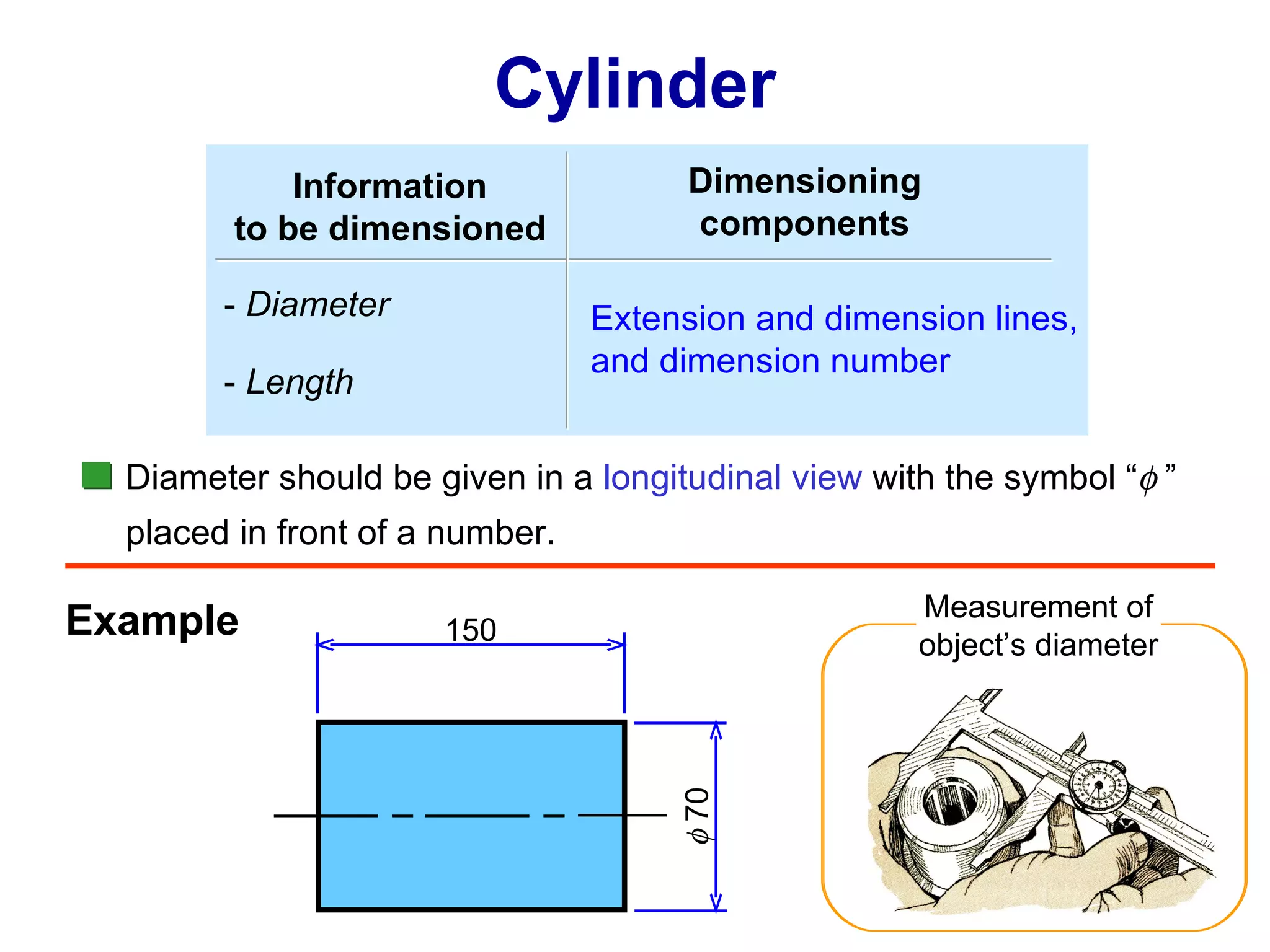
Cylinder Dimensioning components Information to be dimensioned -  Diameter -  Length Extension and dimension lines, and dimension number Diameter should be given in a  longitudinal view  with the symbol “    ” placed in front of a number. Example    70 150 Measurement of object’s diameter
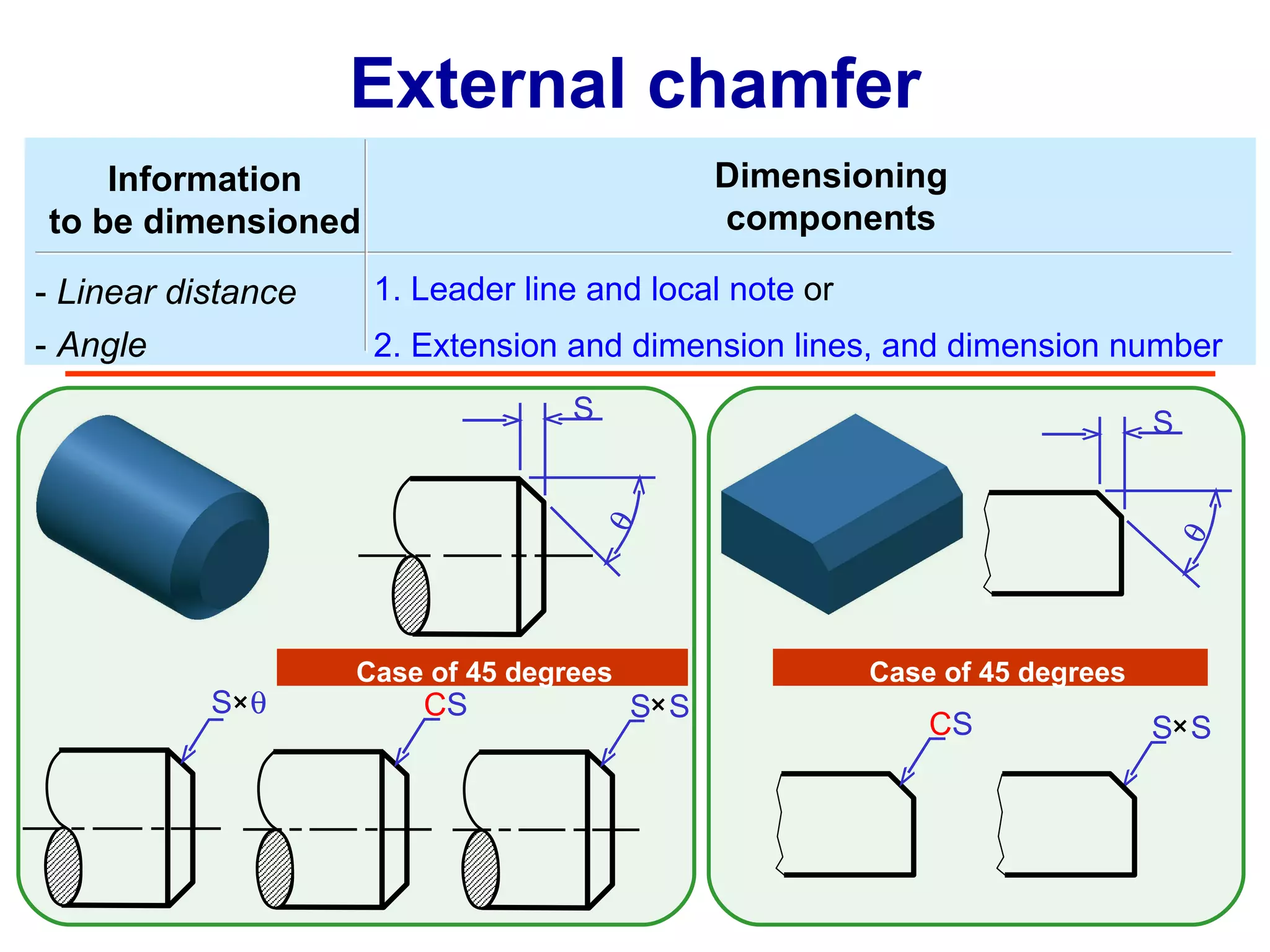
External chamfer Dimensioning components Information to be dimensioned -  Linear distance 1. Leader line and local note  or -  Angle 2. Extension and dimension lines, and dimension number  S   S  S C S S  S Case of 45 degrees Case of 45 degrees C S S  S
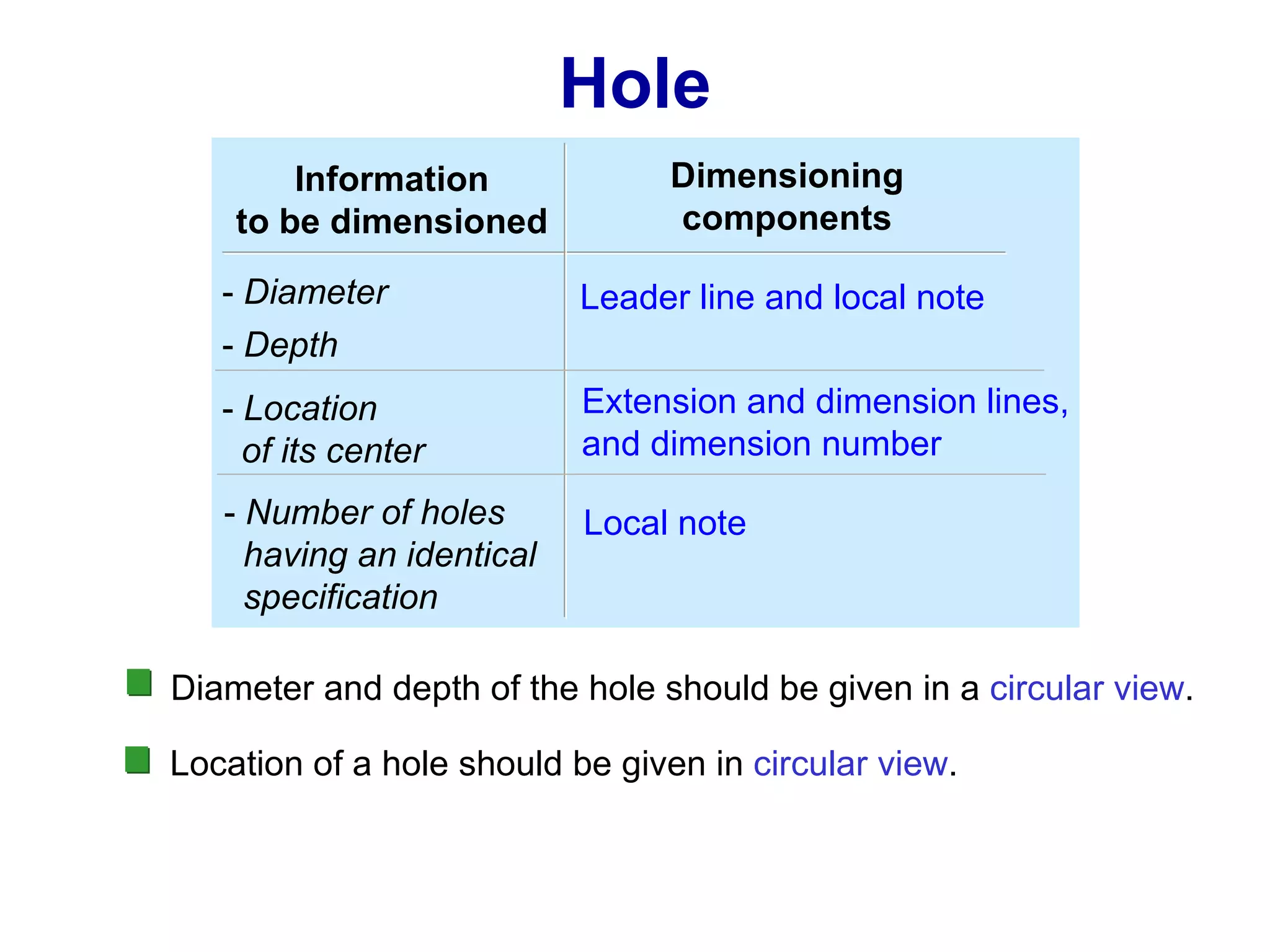
Hole Location of a hole should be given in  circular view . Dimensioning components Information to be dimensioned -  Diameter Leader line and local note -  Depth -  Location   of its center Extension and dimension lines, and dimension number Diameter and depth of the hole should be given in a  circular view . -  Number of holes    having an identical    specification Local note
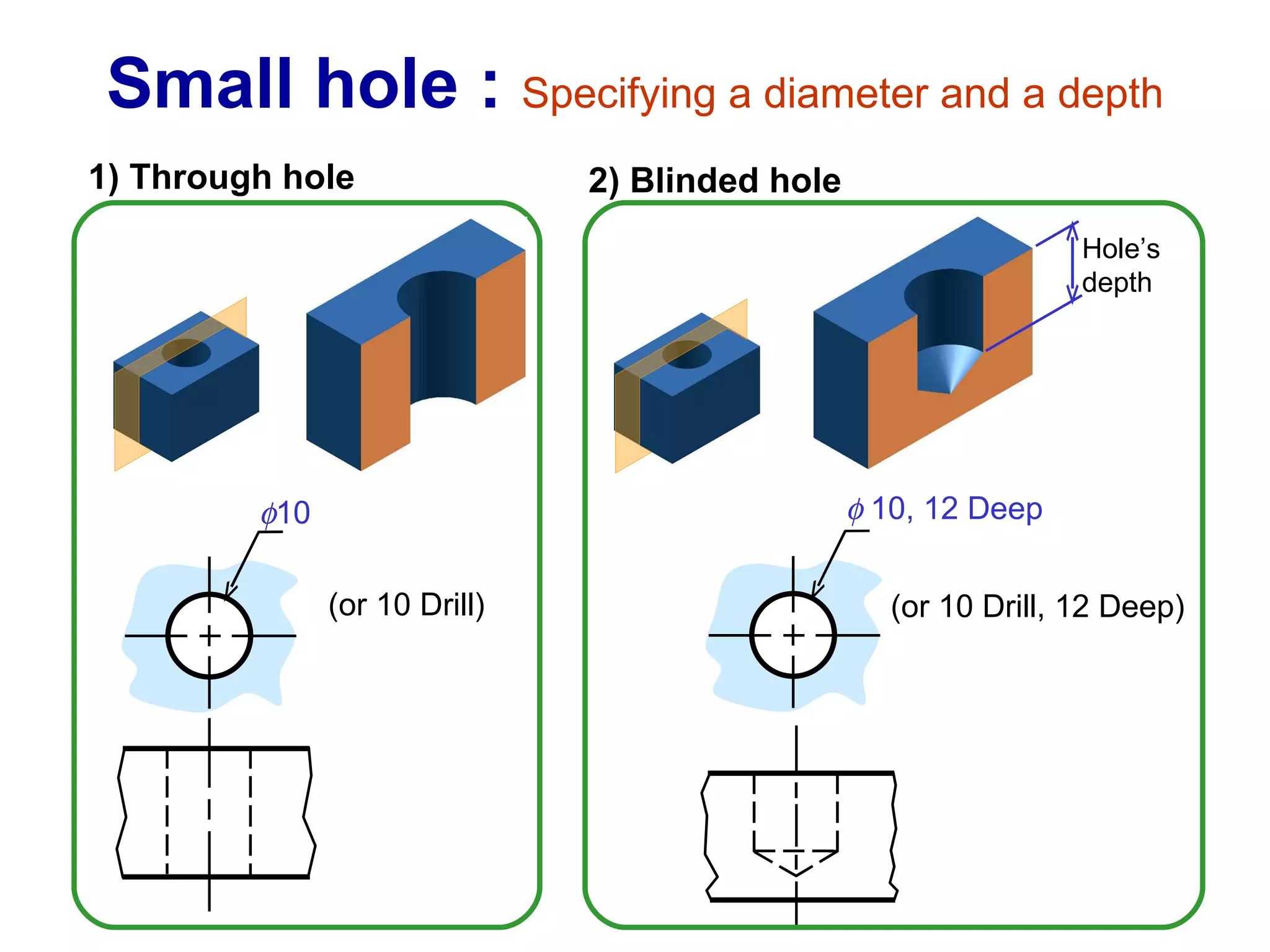
Small hole :  Specifying a diameter and a depth 1) Through hole 2) Blinded hole Hole’s depth (or   10 Drill) (or   10 Drill, 12 Deep)  10  10, 12 Deep
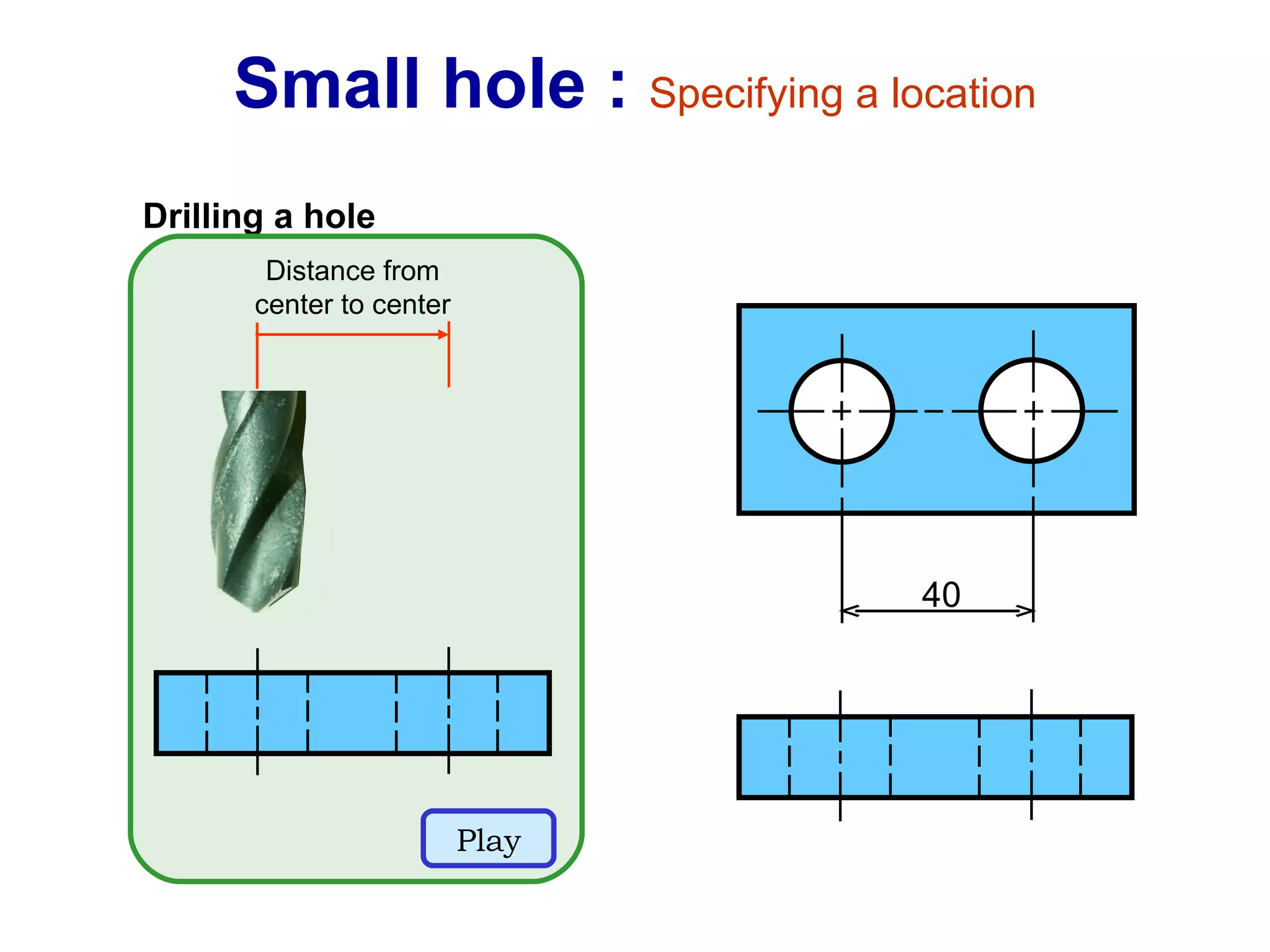
Small hole :  Specifying a location Drilling a hole Distance from center to center Play 40
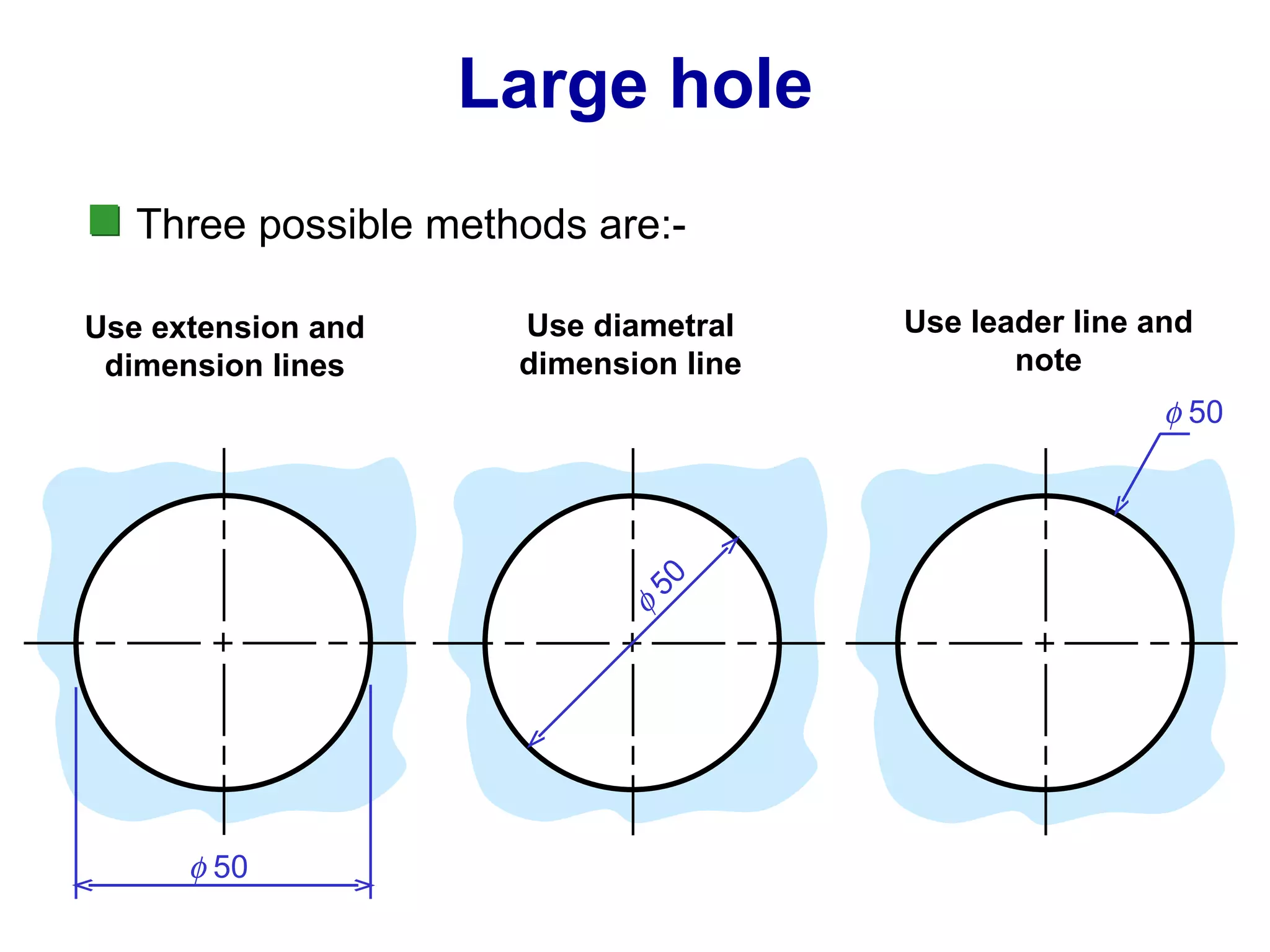
Large hole Three possible methods are:-  50 Use extension and dimension lines Use diametral dimension line  50 Use leader line and note  50
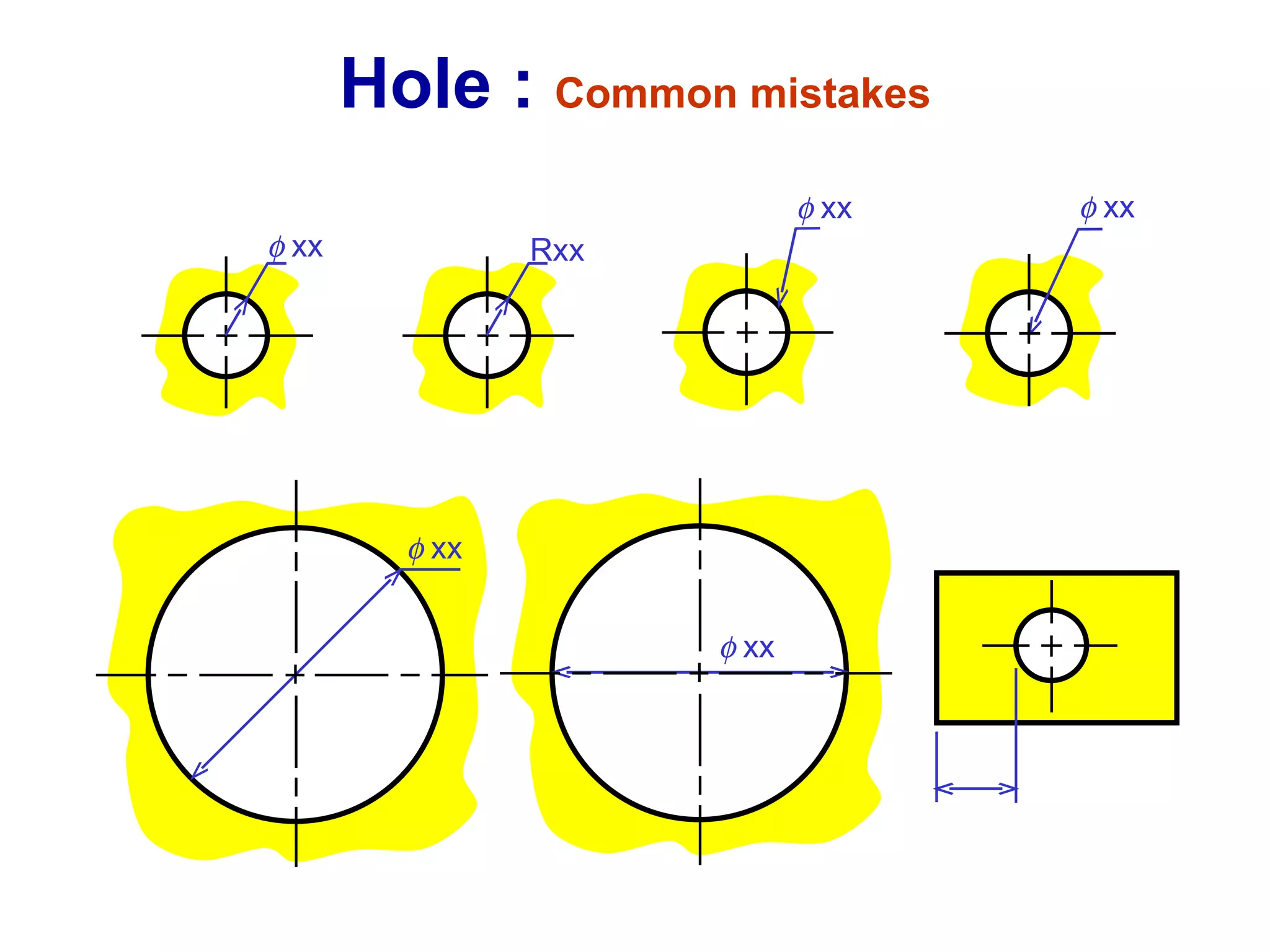
 xx  xx  xx Rxx Hole :  Common mistakes  xx  xx
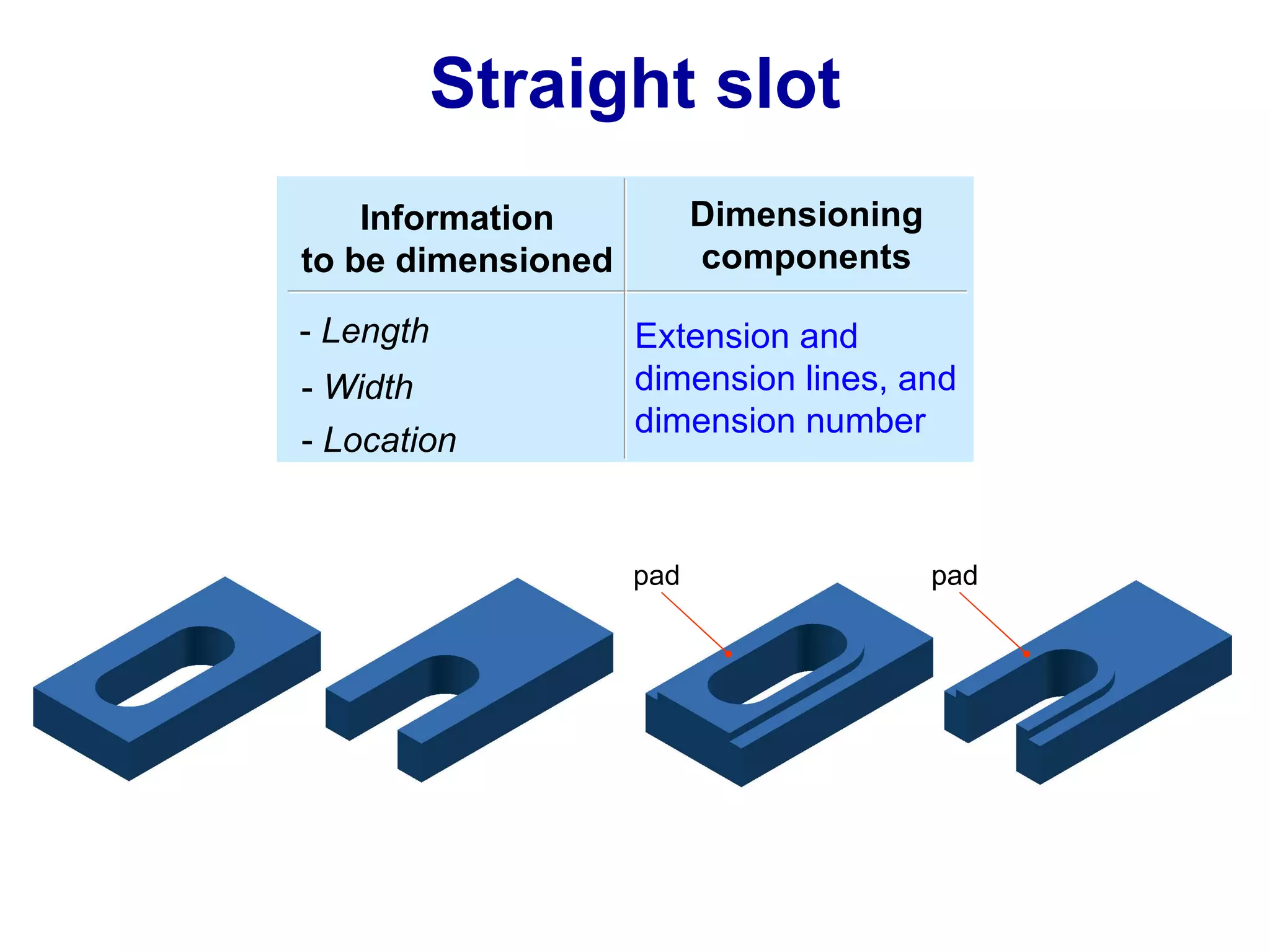
Straight slot Dimensioning components Information to be dimensioned -  Length -  Width Extension and dimension lines, and dimension number -  Location pad pad
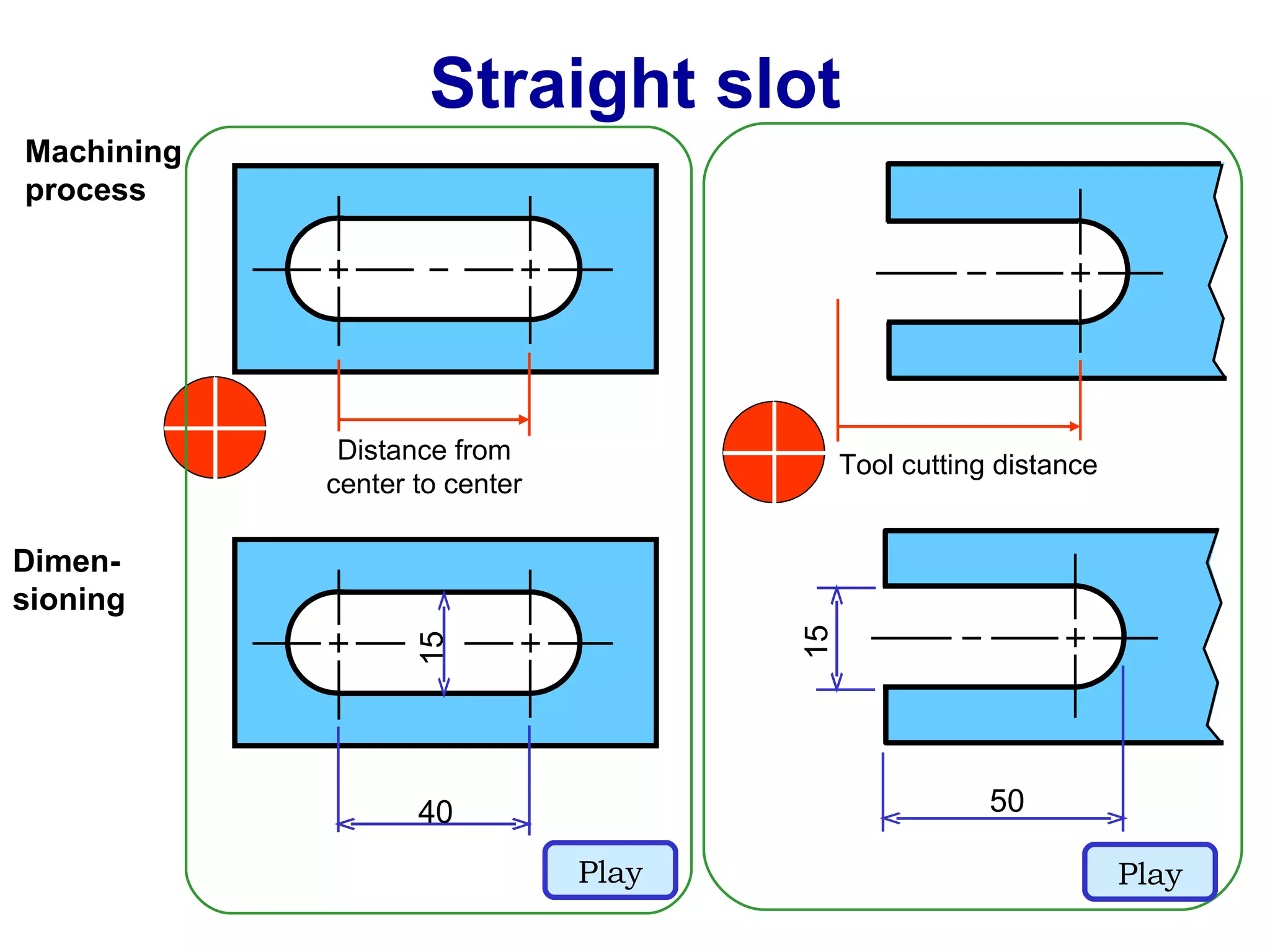
Tool cutting distance Straight slot Machining process Distance from center to center Dimen- sioning Play Play 40 15 15 50
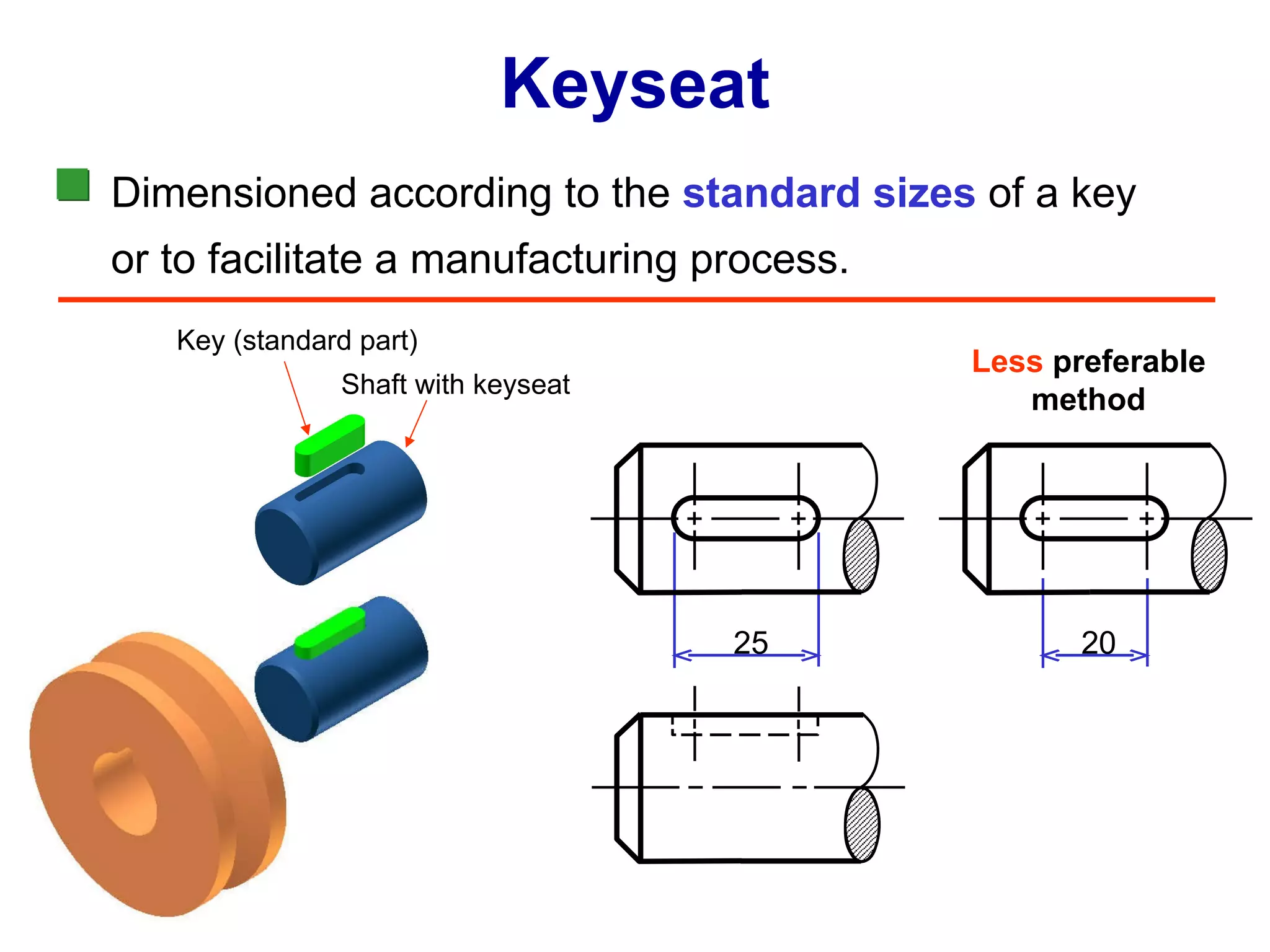
Keyseat Dimensioned according to the  standard sizes  of a key or to facilitate a manufacturing process. Key (standard part) 25 20 Less  preferable method Shaft with keyseat
Placement of dimensions
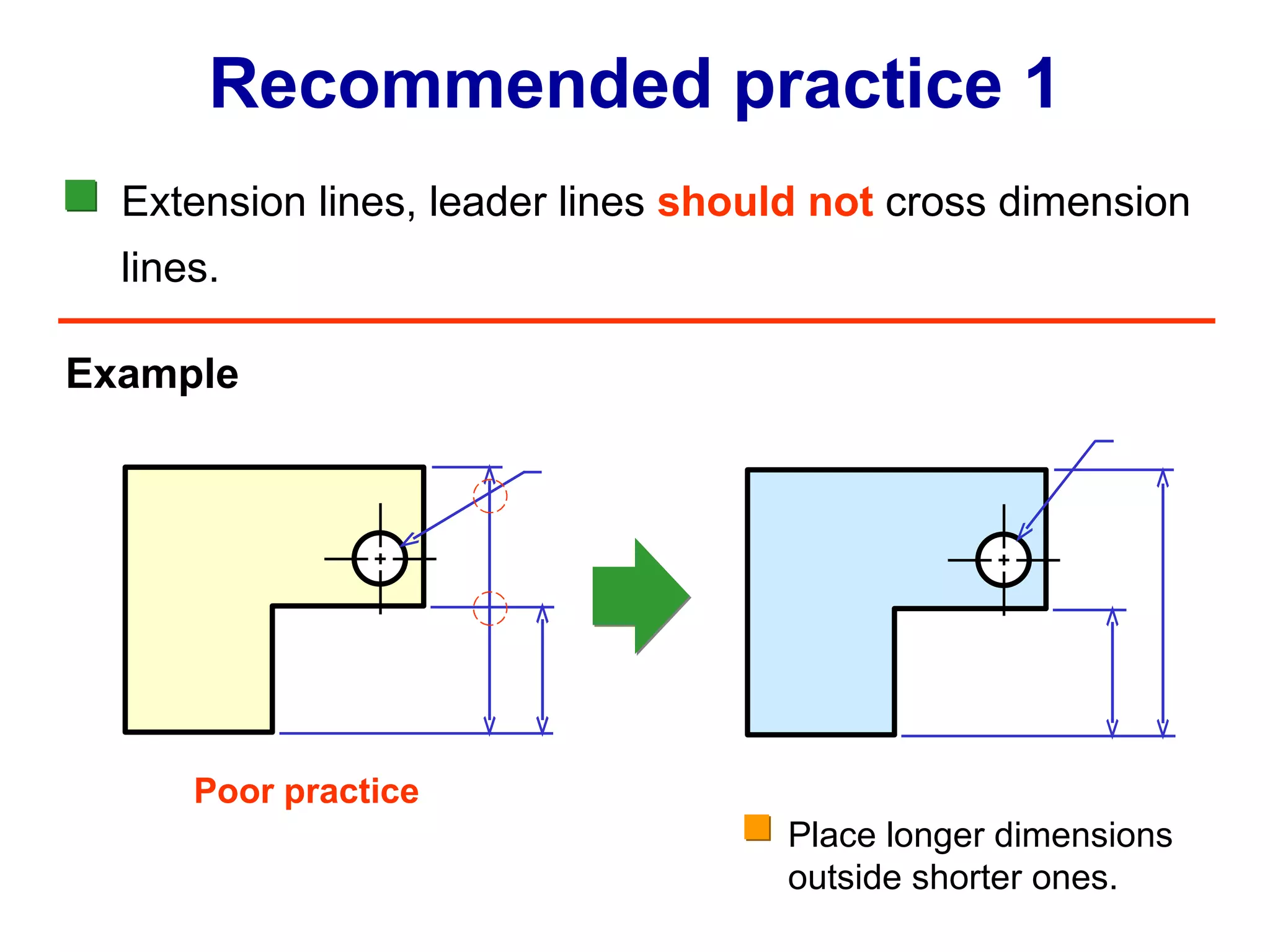
Extension lines, leader lines  should   not   cross dimension  lines. Poor practice Recommended practice 1 Example Place longer dimensions outside shorter ones.
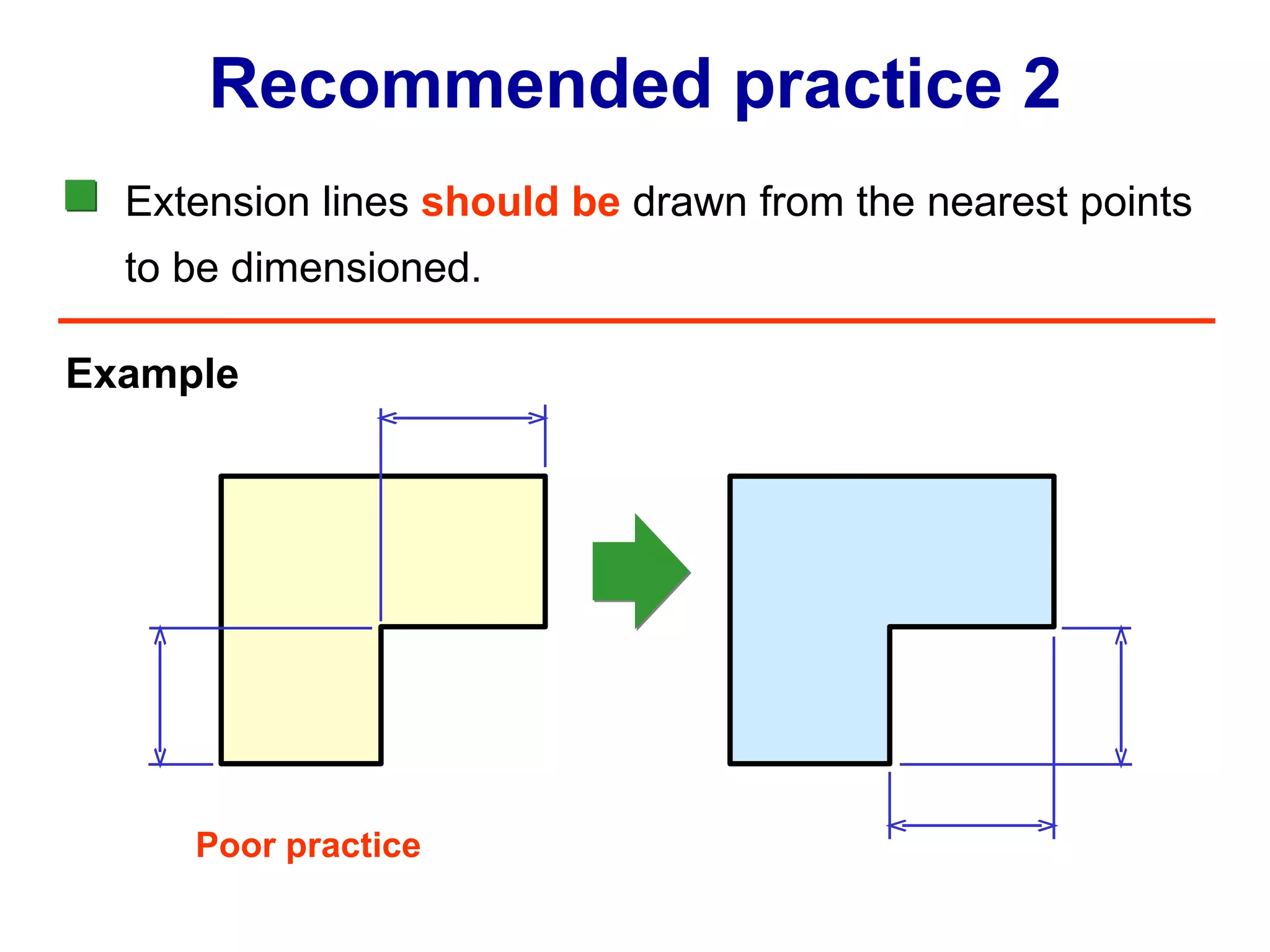
Extension lines  should be   drawn from the nearest points to be dimensioned. Recommended practice 2 Poor practice Example
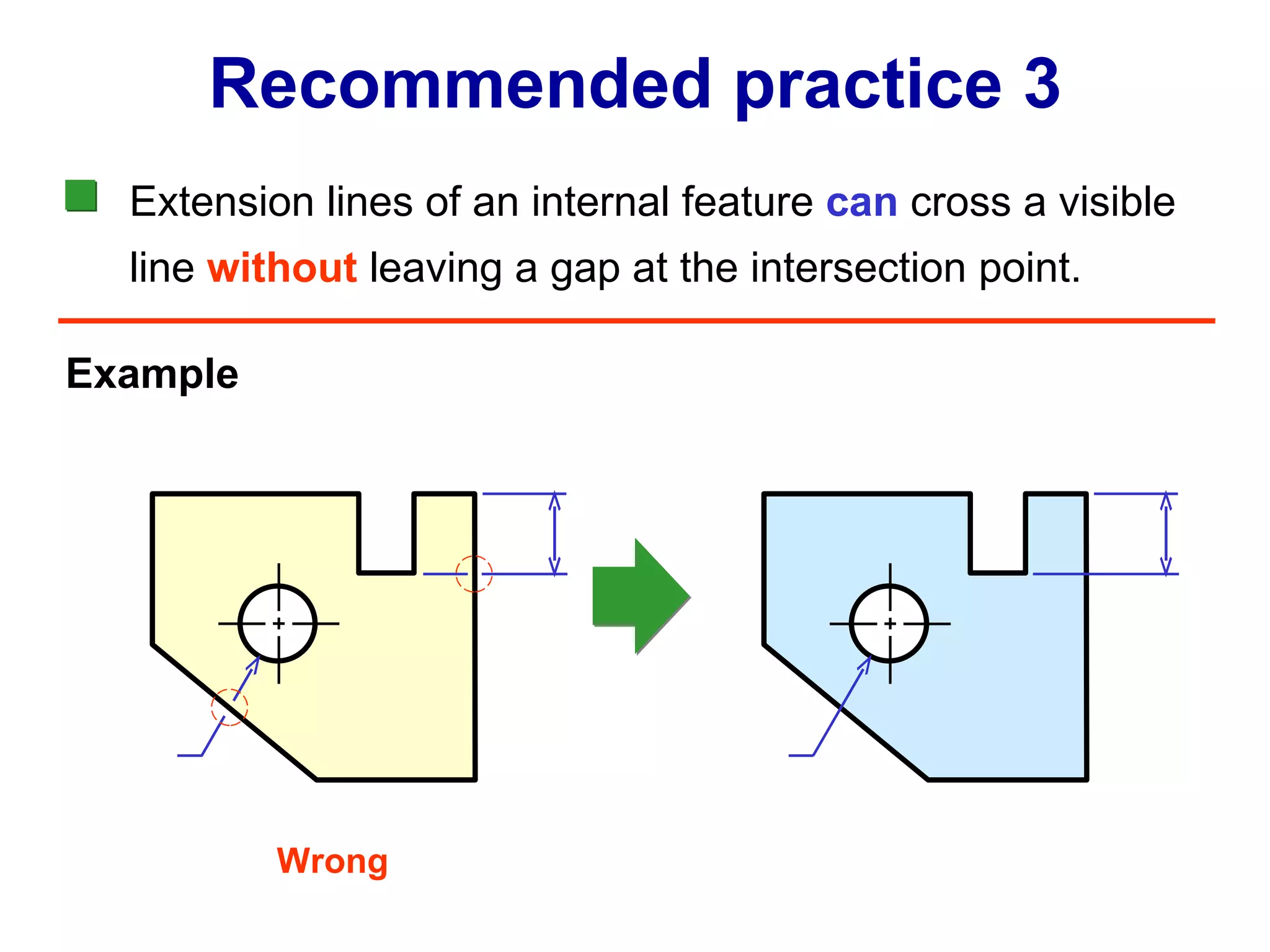
Extension lines of an internal feature  can   cross a visible line  without  leaving a gap at the intersection point. Recommended practice 3 Example Wrong
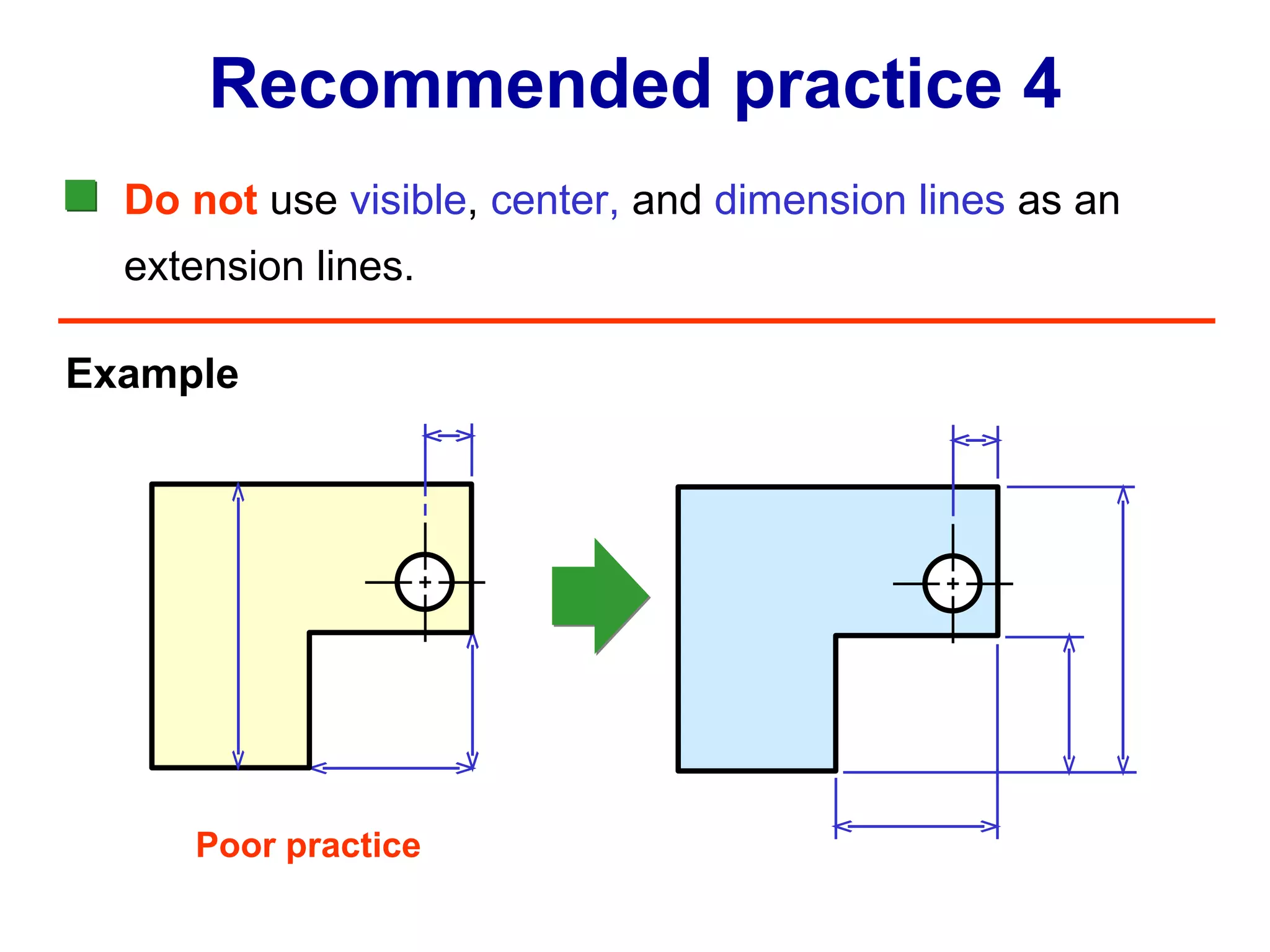
Do not  use  visible ,  center,  and  dimension lines  as an extension lines. Recommended practice 4 Example Poor practice
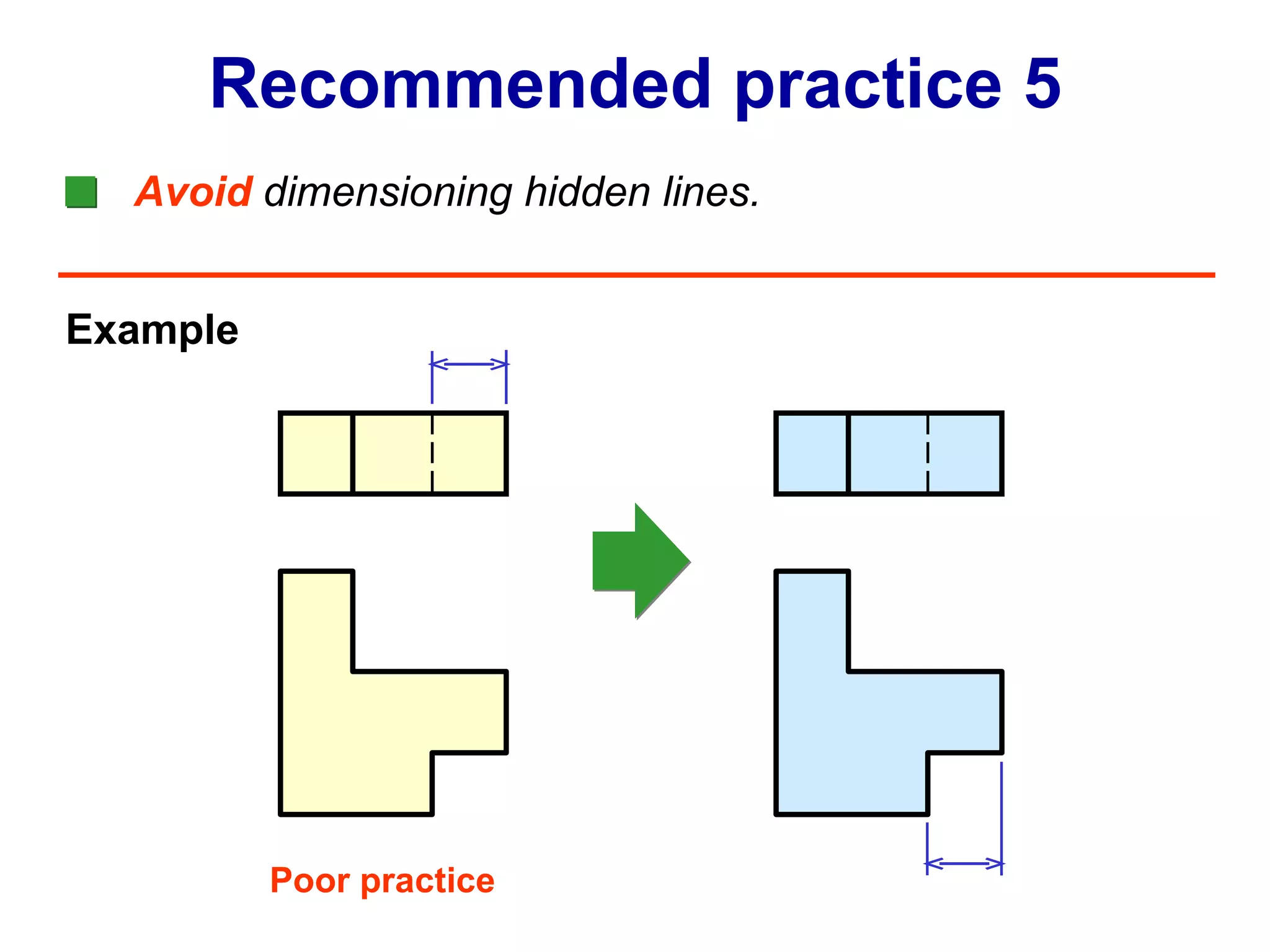
Avoid  dimensioning hidden lines.  Recommended practice 5 Poor practice Example
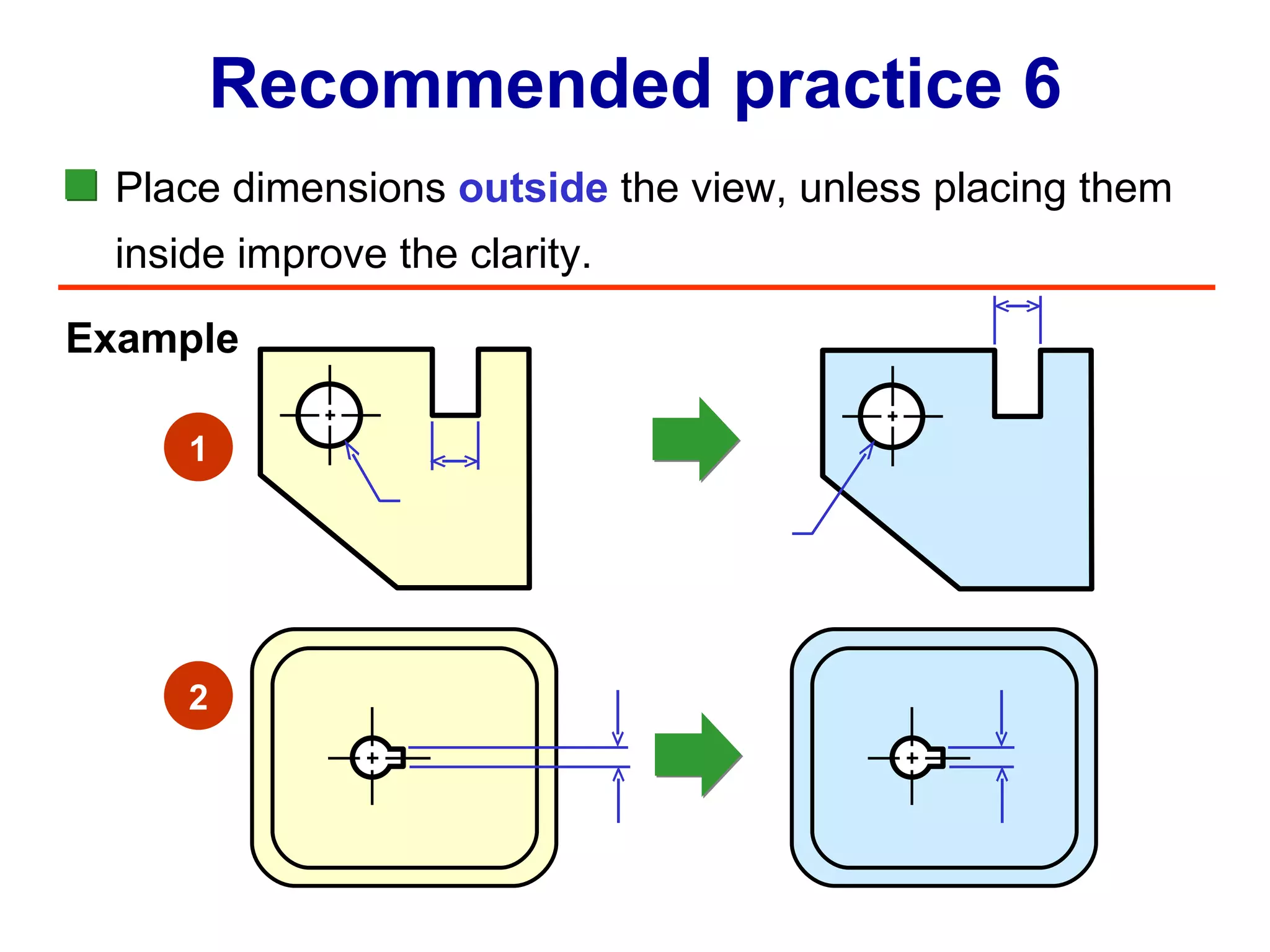
Place dimensions  outside  the view, unless placing them inside improve the clarity.  Recommended practice 6 Example 1 2
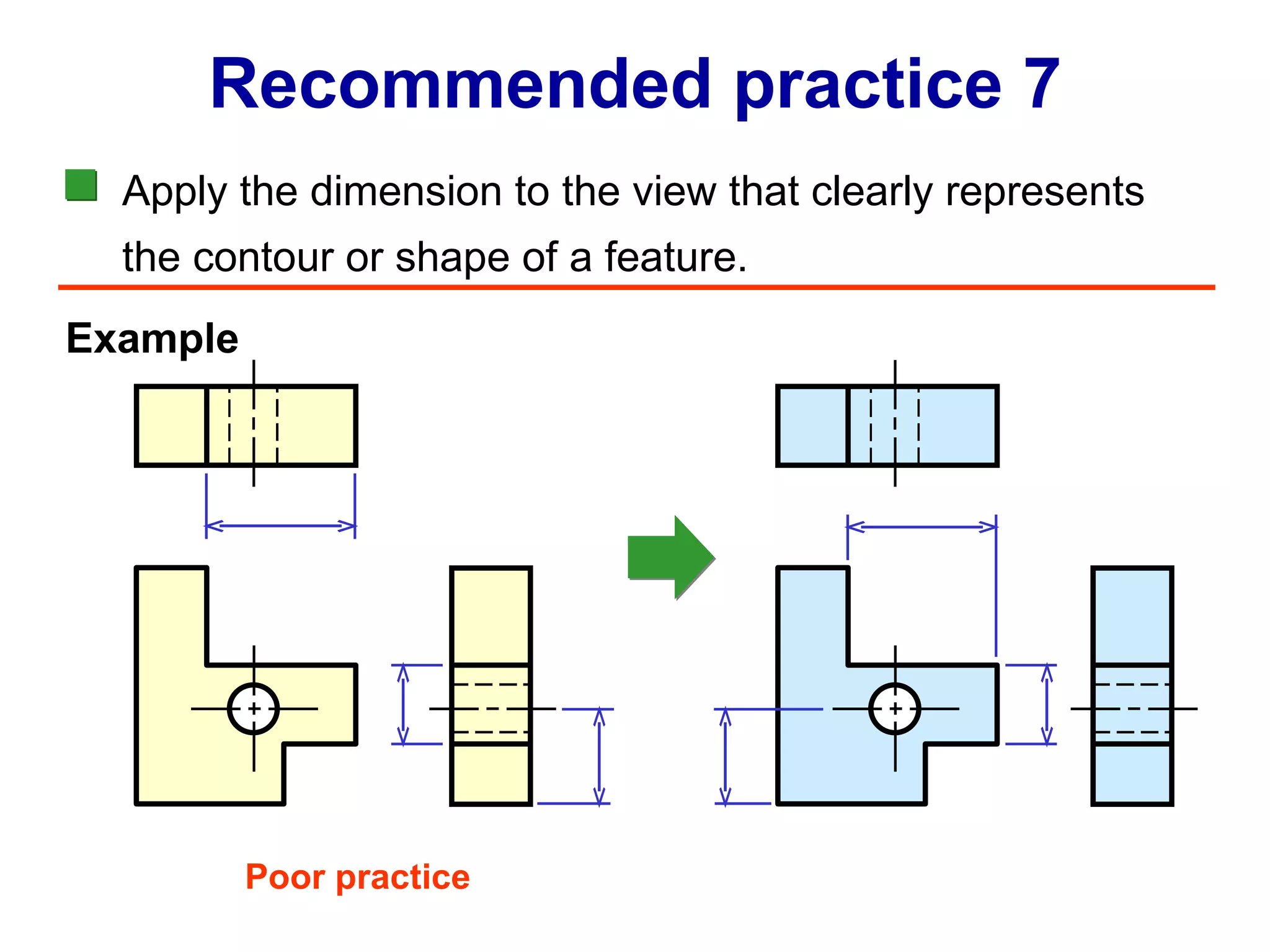
Apply the dimension to the view that clearly represents the contour or shape of a feature. Recommended practice 7 Example Poor practice
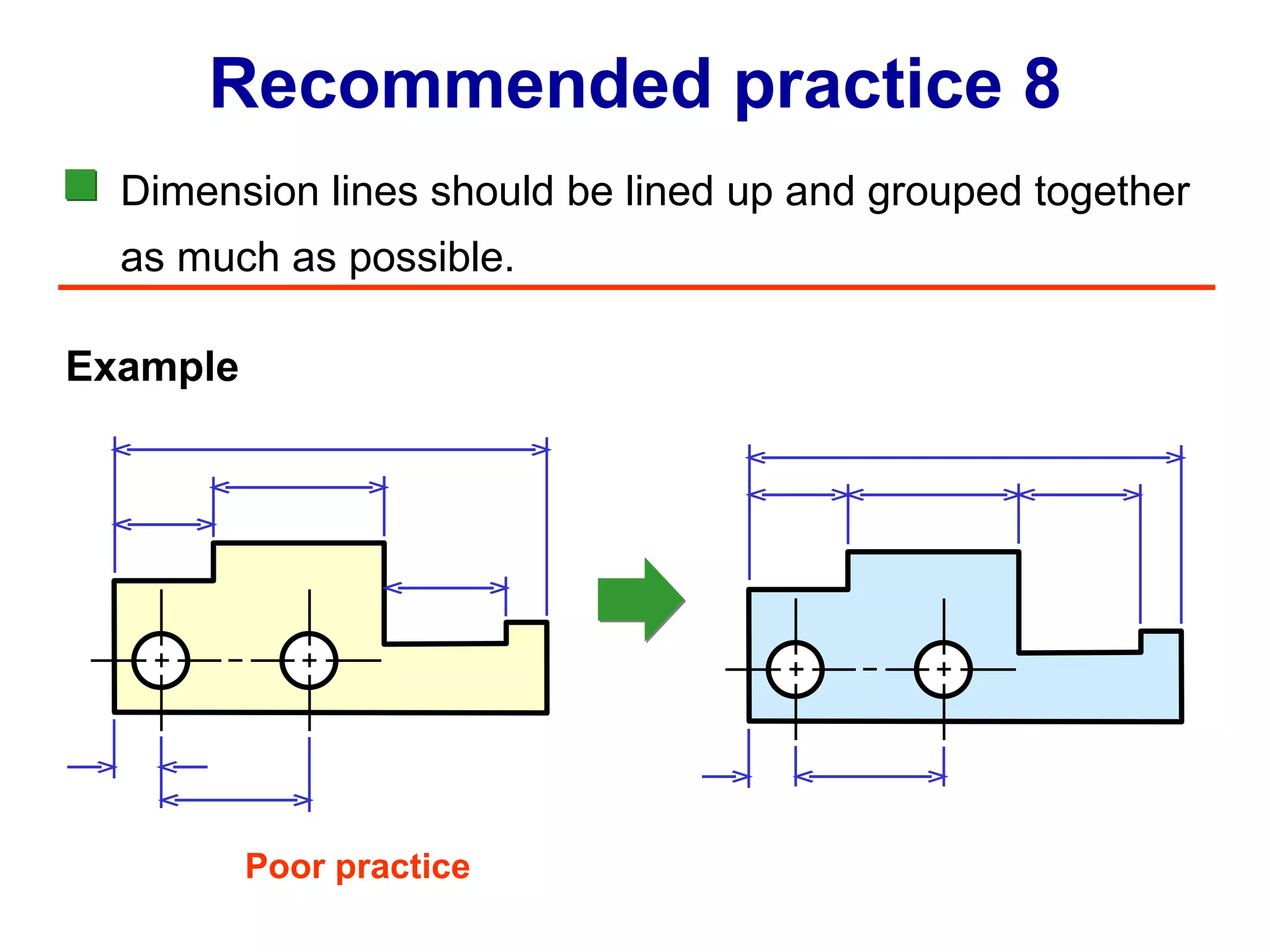
Dimension lines should be lined up and grouped together as much as possible. Recommended practice 8 Example Poor practice
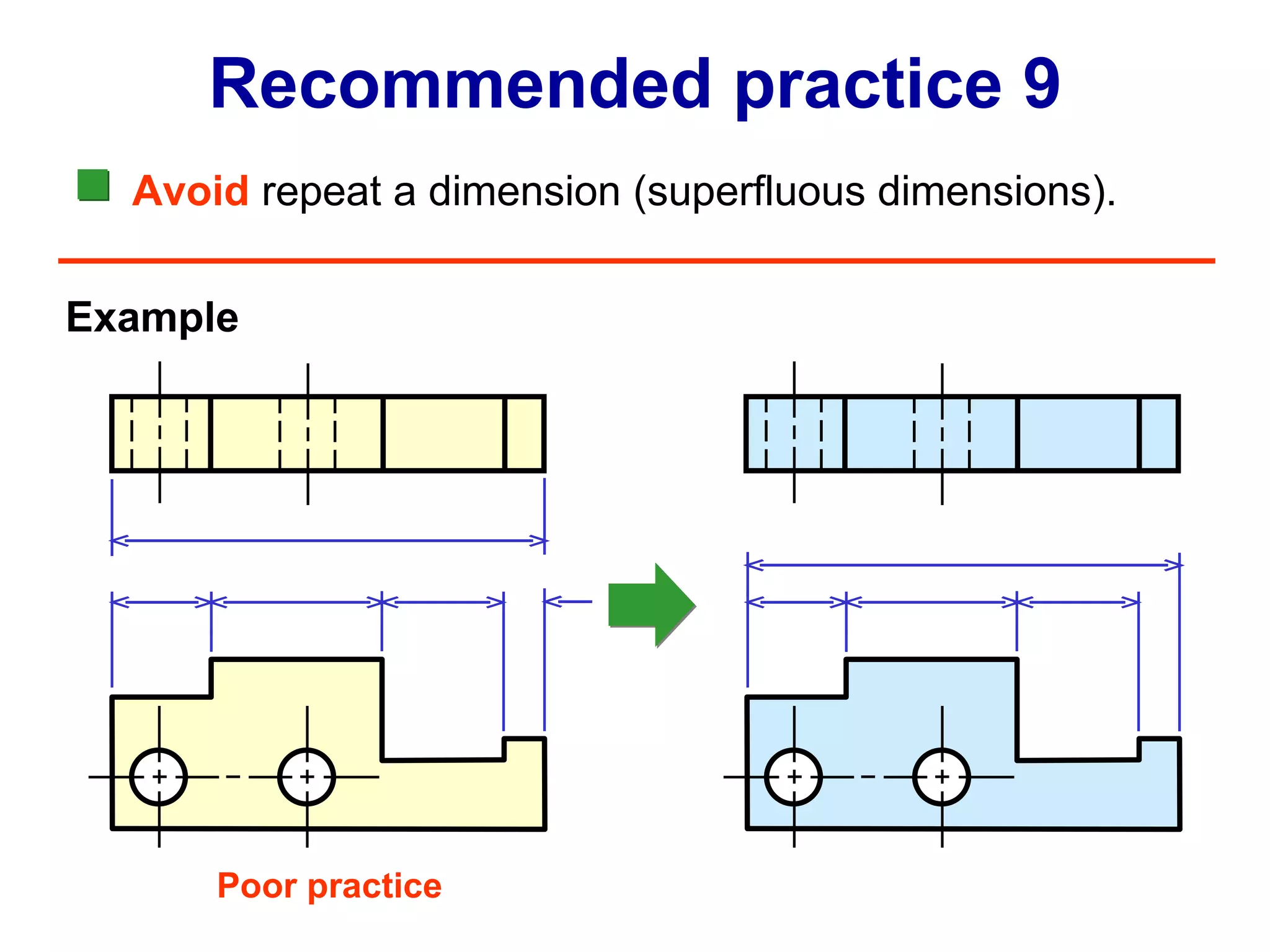
Avoid  repeat a dimension (superfluous dimensions). Recommended practice 9 Example Poor practice
Problem solving steps
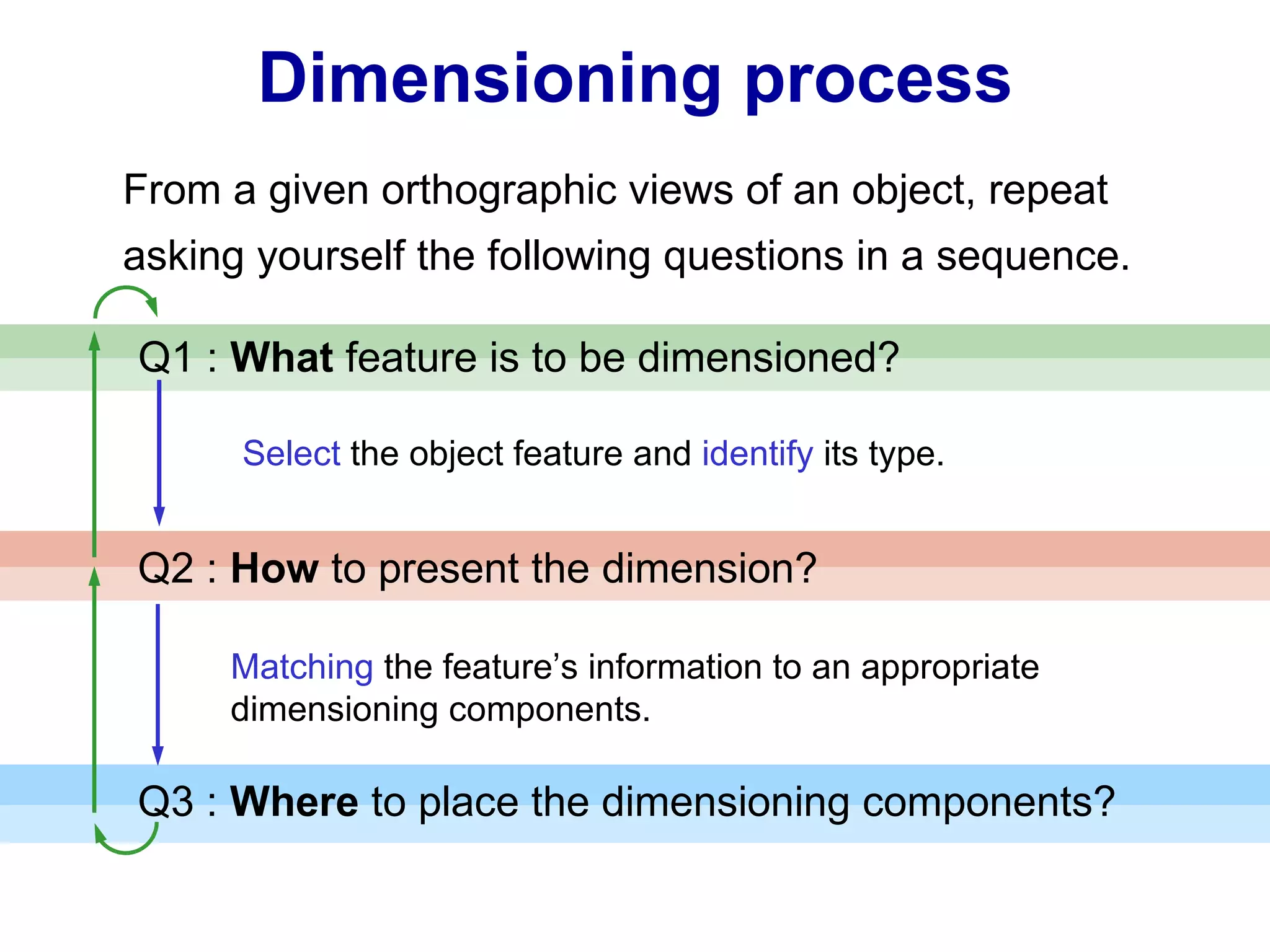
Dimensioning process From a given orthographic views of an object, repeat asking yourself the following questions in a sequence. Q1 :  What  feature is to be dimensioned?   Q2 :  How  to present the dimension?   Q3 :  Where  to place the dimensioning components?   Select  the object feature and  identify  its type. Matching  the feature’s information to an appropriate dimensioning components.
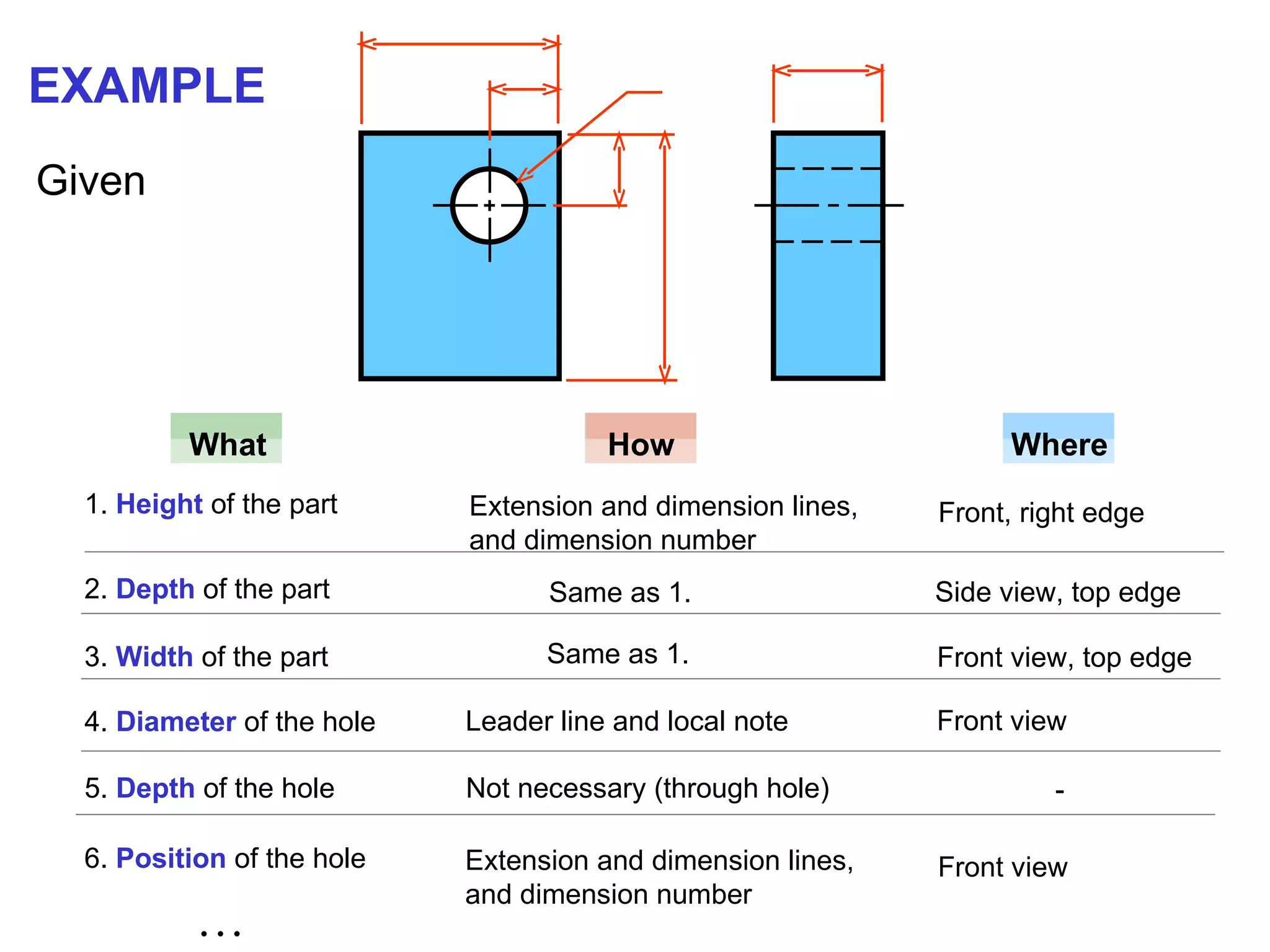
EXAMPLE Given 1.  Height  of the part 4.  Diameter  of the hole 2.  Depth  of the part 3.  Width  of the part 5.  Depth  of the hole Extension and dimension lines, and dimension number Front, right edge Same as 1. Same as 1. Leader line and local note Side view, top edge Front view, top edge Front view Not necessary (through hole) - 6.  Position  of the hole Extension and dimension lines, and dimension number Front view … What How Where
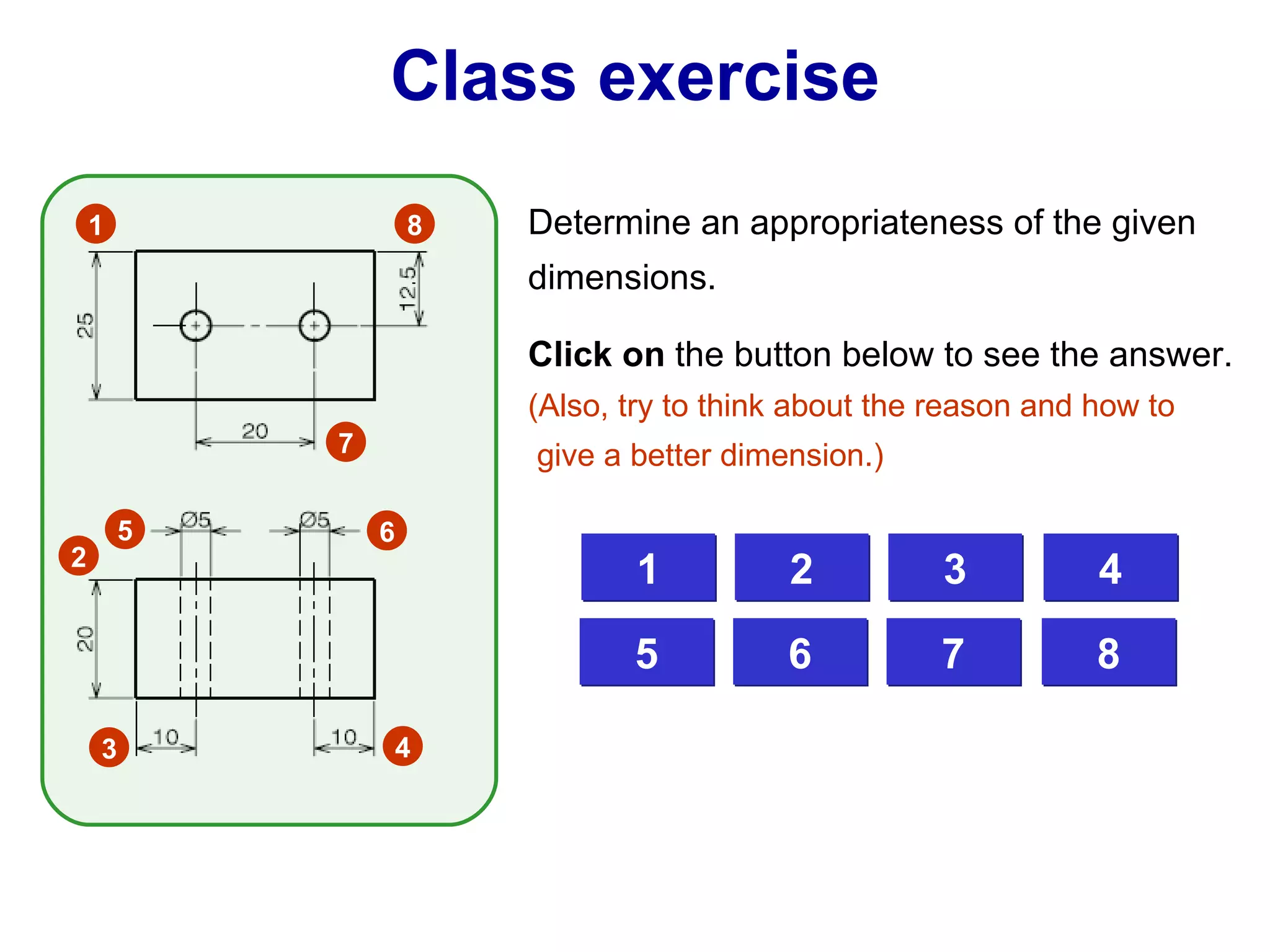
Good Good Poor Poor Poor Poor Good Good Class exercise Determine an appropriateness of the given dimensions. Click on  the button below to see the answer. (Also, try to think about the reason and how to  give a better dimension.) 1 2 3 4 5 6 7 8 1 2 3 4 5 6 7 8
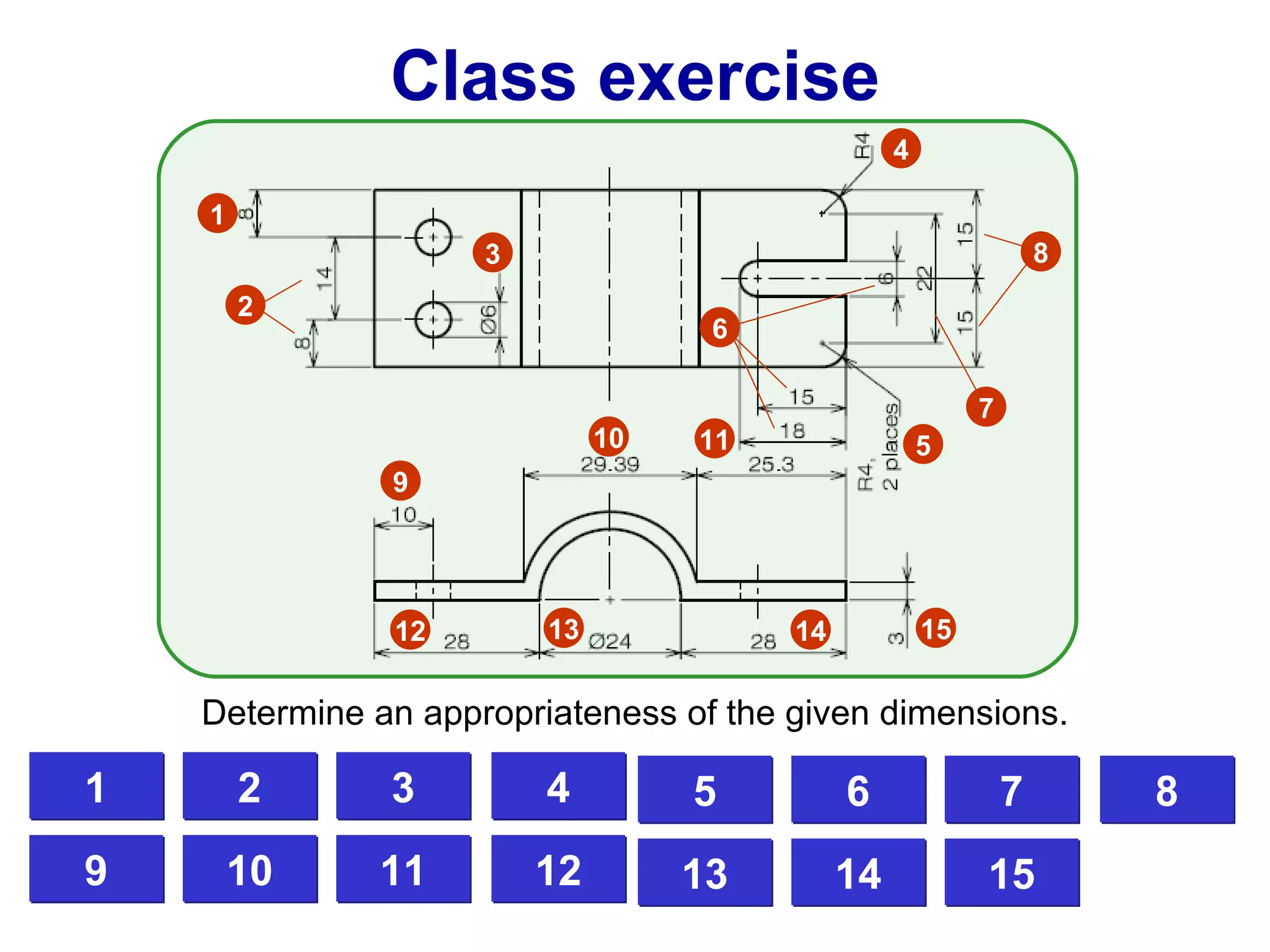
Poor Poor Poor Poor Poor Poor Poor Poor Poor Poor Poor Poor Good Poor Good 1 2 3 4 5 6 7 8 Class exercise Determine an appropriateness of the given dimensions. 1 12 3 4 5 6 7 9 10 11 13 14 15 2 8 9 10 11 12 13 14 15

Engineering Drawing: Chapter 07 dimensioning

  • 1.
  • 2.
    Contents Introduction Dimensioningcomponents & their recommended practices Dimensioning the object’ s features Placement of dimensions. Problem solving steps
  • 3.
  • 4.
    Definition Dimensioning is the process of specifying part’ s information by using of lines, number, symbols and notes . Notes 1. Lines to be used are always thin continuous line. 2. Symbol or abbreviation commonly found in a drawing are - “ diameter ” is represented by a symbol “   ”. - “ radius ” is represented by a letter “ R ”.
  • 5.
    Types of aninformation A basic information (this course ) 1. Sizes and location of the object’s features. (this chapter ) 2. Type of material 3. Number of piece required to assemble into a single unit of a product (or machine). A higher-level information 1. Tolerances : Size and geometric 2. Surface roughness 3. Manufacturing or assemble process descriptions. Example : Roughness condition Process Level
  • 6.
  • 7.
    Dimensioning components Extensionlines Dimension lines (with arrowheads) Leader lines Dimension numbers (or dimension figures) Notes 20 13 123 o  10 - indicate the location on the object’s features that are dimensioned. - indicate the direction and extent of a dimension, and inscribe dimension numbers . - indicate details of the feature with a local note. - local or general note R16 Example
  • 8.
    Applying the dimensioningcomponents Extension line, dimension line and dimension number Mostly done by using Leader line and note The appropriate method depends on the object’s features. 27  10 45 o Notes Detail of a local note depends on the object’s features. Example Example
  • 9.
    Dimensioning components :Recommended practice
  • 10.
    Extension line Alwaysleave a visible gap (≈ 1 mm) from a view or center lines before start drawing a line. Extend the lines beyond the (last) dimension line 2-3 mm. Good practice Poor practice 1 2 3 2 4
  • 11.
    Do not break the extension lines as they cross any line types, e.g. visible line, hidden line or center line, i.e. extension line always a continuous line . Good practice Poor practice 1 2 3 Extension line
  • 12.
    Good practice Poorpractice Dimension lines should be appropriately spaced apart from each other and the view. 25 34 At least 2 times of a font size 30 At least 1 time of a font size 25 34 30 25 34 30 Too close Too far Dimension line
  • 13.
    The height ofnumbers is suggested to be 2.5~3 mm. Place the numbers at about 1 mm above and at a middle of a dimension line. Lettered with 2H or HB pencil. Dimension number : General Good practice Poor practice 25 34 25 34 30 30
  • 14.
    1. Metric system (This course) (ISO and JIS standards etc.) 2. Decimal-inch system (ANSI standard) 3. Fractional-inch system , 0.25 (not .25) , 5.375 etc. Examples Examples 32, 32.5, 32.55, 0.5 (not .5) etc. Examples etc. Dimension number : Number system
  • 15.
    Angular dimension is expressed in degree with a symbol “ o ” places behind the number (and if necessary minutes and seconds may be used together). Length dimension is expressed in millimeters without a necessity to specify a unit symbol “mm”. 25 Good practice Poor practice 60 o 25 mm 60 Dimension number : Unit
  • 16.
    16.25 or Ifthere is not enough space for number or arrows, put it outside either of the extension lines. 1 Not enough space for number Not enough space for arrows 1 1 16.25 16.25 Good practice Poor practice Dimension number : Narrow space situation
  • 17.
    1. Aligned method (This course) 2. Unidirectional method The dimension figures are placed so that they are readable from the bottom or right side of the drawing. The dimension figures are placed so that they can be read from the bottom of the drawing. Do not apply both systems on the same drawing or on the same series of drawing (JIS Z8317). Dimension number : Orientation 1 st choice 2 nd choice
  • 18.
    30 30 3030 30 30 30 30 EXAMPLE : Orientation of a length dimension 30 30 30 30 30 30 30 30 1. Aligned method (This course) 2. Unidirectional method
  • 19.
    45 o 45o 45 o 45 o 45 o 45 o 45 o 45 o 45 o 45 o 45 o 45 o 45 o 45 o 45 o 45 o EXAMPLE : Orientation of an angular dimension 1. Aligned method (This course) 2. Unidirectional method
  • 20.
    Poor practice Placenear to the feature which they apply but should be placed outside the view. Always be lettered horizontally . 12 Drill 12 Drill ≈ 10mm Too far Must be used in a combination with a leader line. Lettered with 2H or HB pencil and the height of 2.5~3 mm. Good practice 12 Drill Placed above the bent portion of a leader line. (This course) 12 Drill Local notes
  • 21.
  • 22.
    Length Dimensioning componentsExtension and dimension lines, and dimension number Information to be dimensioned - Length of an edge Example - Distance between features 60 40 10 15 30 7
  • 23.
    Angle Dimensioning componentsInformation to be dimensioned - Angle between edges. A circular dimension line must have its center at the vertex of the angle. Poor practice Example Extension and circular dimension lines, and dimension number
  • 24.
    Arc Leader lineand local note - Radius - Location of its center The letter “R” is written in front of a number to emphasize that the number represents radius of an arc. Dimensioning components Information to be dimensioned Extension and dimension lines, and dimension number Leader line must be aligned with a radial line and has an inclined angle between 30 ~ 60 degs to the horizontal. 30 o 60 o 30 o 60 o
  • 25.
    The note andthe arrowhead should be placed in a concave side of an arc, whenever there is a sufficient space. Arc Example : Radius of an arc R6.5 Place a note and an arrow outside Insufficient space for both R62.5 Place a note outside Sufficient space for arrowhead only R62.5 R200 Sufficient space for both. R200
  • 26.
    Arc : Common mistakes R62.5 R62.5 R62.5 R62.5 R62.5 R62.5 62.5
  • 27.
    If the archas its center lies outside the sheet or interfere with other views, use the foreshortened radial dimension line . Arc Example A drawing sheet Method 1 Method 2
  • 28.
    Curve (Acombination of arcs) Leader line and local note - Radius - Location of its center Dimensioning components Information to be dimensioned Extension and dimension lines, and dimension number Poor practice Example : Radius of the arcs R20 R40
  • 29.
    Fillets and RoundsDimensioning components Information to be dimensioned - Radius 1. Leader line and local note 2. General note 3. Combination of both Example NOTE: All fillets and round are R6.5 1. All fillets and rounds have an equal radius NOTE: All fillets and round are R6.5 unless otherwise specified. R12 2. Most of fillets and rounds have an equal radius except for some places
  • 30.
    Cylinder Dimensioning componentsInformation to be dimensioned - Diameter - Length Extension and dimension lines, and dimension number Diameter should be given in a longitudinal view with the symbol “  ” placed in front of a number. Example  70 150 Measurement of object’s diameter
  • 31.
    External chamfer Dimensioningcomponents Information to be dimensioned - Linear distance 1. Leader line and local note or - Angle 2. Extension and dimension lines, and dimension number  S  S S C S S  S Case of 45 degrees Case of 45 degrees C S S S
  • 32.
    Hole Location ofa hole should be given in circular view . Dimensioning components Information to be dimensioned - Diameter Leader line and local note - Depth - Location of its center Extension and dimension lines, and dimension number Diameter and depth of the hole should be given in a circular view . - Number of holes having an identical specification Local note
  • 33.
    Small hole : Specifying a diameter and a depth 1) Through hole 2) Blinded hole Hole’s depth (or 10 Drill) (or 10 Drill, 12 Deep)  10  10, 12 Deep
  • 34.
    Small hole : Specifying a location Drilling a hole Distance from center to center Play 40
  • 35.
    Large hole Threepossible methods are:-  50 Use extension and dimension lines Use diametral dimension line  50 Use leader line and note  50
  • 36.
     xx xx  xx Rxx Hole : Common mistakes  xx  xx
  • 37.
    Straight slot Dimensioningcomponents Information to be dimensioned - Length - Width Extension and dimension lines, and dimension number - Location pad pad
  • 38.
    Tool cutting distanceStraight slot Machining process Distance from center to center Dimen- sioning Play Play 40 15 15 50
  • 39.
    Keyseat Dimensioned accordingto the standard sizes of a key or to facilitate a manufacturing process. Key (standard part) 25 20 Less preferable method Shaft with keyseat
  • 40.
  • 41.
    Extension lines, leaderlines should not cross dimension lines. Poor practice Recommended practice 1 Example Place longer dimensions outside shorter ones.
  • 42.
    Extension lines should be drawn from the nearest points to be dimensioned. Recommended practice 2 Poor practice Example
  • 43.
    Extension lines ofan internal feature can cross a visible line without leaving a gap at the intersection point. Recommended practice 3 Example Wrong
  • 44.
    Do not use visible , center, and dimension lines as an extension lines. Recommended practice 4 Example Poor practice
  • 45.
    Avoid dimensioninghidden lines. Recommended practice 5 Poor practice Example
  • 46.
    Place dimensions outside the view, unless placing them inside improve the clarity. Recommended practice 6 Example 1 2
  • 47.
    Apply the dimensionto the view that clearly represents the contour or shape of a feature. Recommended practice 7 Example Poor practice
  • 48.
    Dimension lines shouldbe lined up and grouped together as much as possible. Recommended practice 8 Example Poor practice
  • 49.
    Avoid repeata dimension (superfluous dimensions). Recommended practice 9 Example Poor practice
  • 50.
  • 51.
    Dimensioning process Froma given orthographic views of an object, repeat asking yourself the following questions in a sequence. Q1 : What feature is to be dimensioned? Q2 : How to present the dimension? Q3 : Where to place the dimensioning components? Select the object feature and identify its type. Matching the feature’s information to an appropriate dimensioning components.
  • 52.
    EXAMPLE Given 1. Height of the part 4. Diameter of the hole 2. Depth of the part 3. Width of the part 5. Depth of the hole Extension and dimension lines, and dimension number Front, right edge Same as 1. Same as 1. Leader line and local note Side view, top edge Front view, top edge Front view Not necessary (through hole) - 6. Position of the hole Extension and dimension lines, and dimension number Front view … What How Where
  • 53.
    Good Good PoorPoor Poor Poor Good Good Class exercise Determine an appropriateness of the given dimensions. Click on the button below to see the answer. (Also, try to think about the reason and how to give a better dimension.) 1 2 3 4 5 6 7 8 1 2 3 4 5 6 7 8
  • 54.
    Poor Poor PoorPoor Poor Poor Poor Poor Poor Poor Poor Poor Good Poor Good 1 2 3 4 5 6 7 8 Class exercise Determine an appropriateness of the given dimensions. 1 12 3 4 5 6 7 9 10 11 13 14 15 2 8 9 10 11 12 13 14 15