MEHRAN UNIVERSITY
OF ENGINEERING & TECHNOLOGY, JAMSHORO
B.E MECHANICAL ENGINEERING
BATCH-F16, 1ST
YEAR,1ST
SEMESTER
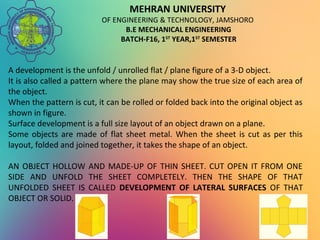
ENGINEERING DRAWING
&
GRAPHICS
SURFACE DEVELOPMENT
MEHRAN UNIVERSITY
OF ENGINEERING & TECHNOLOGY, JAMSHORO
B.E MECHANICAL ENGINEERING
BATCH-F16, 1ST
YEAR,1ST
SEMESTER
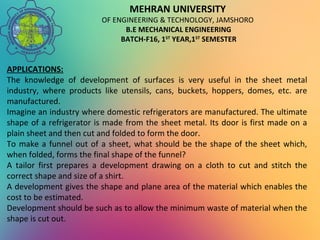
A development is the unfold / unrolled flat / plane figure of a 3-D object.
It is also called a pattern where the plane may show the true size of each area of
the object.
When the pattern is cut, it can be rolled or folded back into the original object as
shown in figure.
Surface development is a full size layout of an object drawn on a plane.
Some objects are made of flat sheet metal. When the sheet is cut as per this
layout, folded and joined together, it takes the shape of an object.
AN OBJECT HOLLOW AND MADE-UP OF THIN SHEET. CUT OPEN IT FROM ONE
SIDE AND UNFOLD THE SHEET COMPLETELY. THEN THE SHAPE OF THAT
UNFOLDED SHEET IS CALLED DEVELOPMENT OF LATERAL SURFACES OF THAT
OBJECT OR SOLID.
MEHRAN UNIVERSITY
OF ENGINEERING & TECHNOLOGY, JAMSHORO
B.E MECHANICAL ENGINEERING
BATCH-F16, 1ST
YEAR,1ST
SEMESTER
APPLICATIONS:
The knowledge of development of surfaces is very useful in the sheet metal
industry, where products like utensils, cans, buckets, hoppers, domes, etc. are
manufactured.
Imagine an industry where domestic refrigerators are manufactured. The ultimate
shape of a refrigerator is made from the sheet metal. Its door is first made on a
plain sheet and then cut and folded to form the door.
To make a funnel out of a sheet, what should be the shape of the sheet which,
when folded, forms the final shape of the funnel?
A tailor first prepares a development drawing on a cloth to cut and stitch the
correct shape and size of a shirt.
A development gives the shape and plane area of the material which enables the
cost to be estimated.
Development should be such as to allow the minimum waste of material when the
shape is cut out.
MEHRAN UNIVERSITY
OF ENGINEERING & TECHNOLOGY, JAMSHORO
B.E MECHANICAL ENGINEERING
BATCH-F16, 1ST
YEAR,1ST
SEMESTER
EXAMPLES:-
Boiler Shells & chimneys, Pressure Vessels, Shovels, Trays,
Boxes & Cartons, Feeding Hoppers, Large Pipe sections,
Body & Parts of automotive, Ships, Aero-planes and many
more.
MEHRAN UNIVERSITY
OF ENGINEERING & TECHNOLOGY, JAMSHORO
B.E MECHANICAL ENGINEERING
BATCH-F16, 1ST
YEAR,1ST
SEMESTER
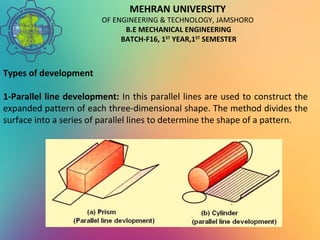
Types of development
1-Parallel line development: In this parallel lines are used to construct the
expanded pattern of each three-dimensional shape. The method divides the
surface into a series of parallel lines to determine the shape of a pattern.
MEHRAN UNIVERSITY
OF ENGINEERING & TECHNOLOGY, JAMSHORO
B.E MECHANICAL ENGINEERING
BATCH-F16, 1ST
YEAR,1ST
SEMESTER
Types of development
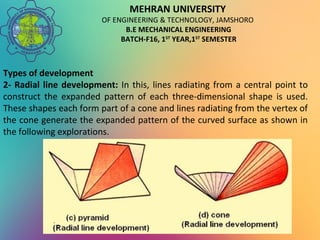
2- Radial line development: In this, lines radiating from a central point to
construct the expanded pattern of each three-dimensional shape is used.
These shapes each form part of a cone and lines radiating from the vertex of
the cone generate the expanded pattern of the curved surface as shown in
the following explorations.
MEHRAN UNIVERSITY
OF ENGINEERING & TECHNOLOGY, JAMSHORO
B.E MECHANICAL ENGINEERING
BATCH-F16, 1ST
YEAR,1ST
SEMESTER
Types of development
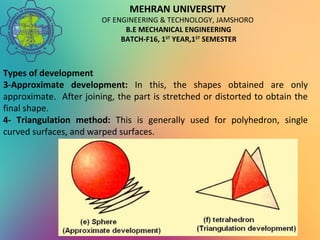
3-Approximate development: In this, the shapes obtained are only
approximate. After joining, the part is stretched or distorted to obtain the
final shape.
4- Triangulation method: This is generally used for polyhedron, single
curved surfaces, and warped surfaces.
MEHRAN UNIVERSITY
OF ENGINEERING & TECHNOLOGY, JAMSHORO
B.E MECHANICAL ENGINEERING
BATCH-F16, 1ST
YEAR,1ST
SEMESTER
Types of development
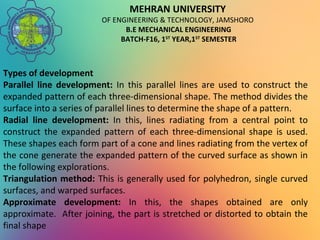
Parallel line development: In this parallel lines are used to construct the
expanded pattern of each three-dimensional shape. The method divides the
surface into a series of parallel lines to determine the shape of a pattern.
Radial line development: In this, lines radiating from a central point to
construct the expanded pattern of each three-dimensional shape is used.
These shapes each form part of a cone and lines radiating from the vertex of
the cone generate the expanded pattern of the curved surface as shown in
the following explorations.
Triangulation method: This is generally used for polyhedron, single curved
surfaces, and warped surfaces.
Approximate development: In this, the shapes obtained are only
approximate. After joining, the part is stretched or distorted to obtain the
final shape
MEHRAN UNIVERSITY
OF ENGINEERING & TECHNOLOGY, JAMSHORO
B.E MECHANICAL ENGINEERING
BATCH-F16, 1ST
YEAR,1ST
SEMESTER
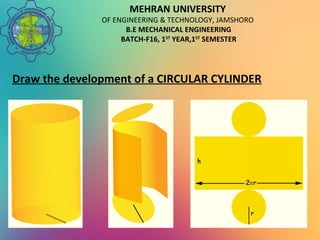
Draw the development of a CIRCULAR CYLINDER
MEHRAN UNIVERSITY
OF ENGINEERING & TECHNOLOGY, JAMSHORO
B.E MECHANICAL ENGINEERING
BATCH-F16, 1ST
YEAR,1ST
SEMESTER
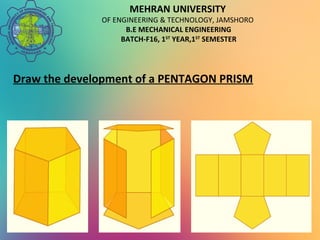
Draw the development of a PENTAGON PRISM
MEHRAN UNIVERSITY
OF ENGINEERING & TECHNOLOGY, JAMSHORO
B.E MECHANICAL ENGINEERING
BATCH-F16, 1ST
YEAR,1ST
SEMESTER
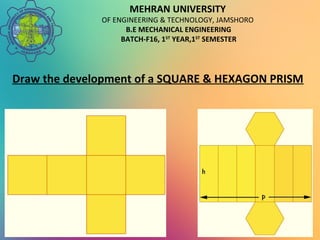
Draw the development of a SQUARE & HEXAGON PRISM
MEHRAN UNIVERSITY
OF ENGINEERING & TECHNOLOGY, JAMSHORO
B.E MECHANICAL ENGINEERING
BATCH-F16, 1ST
YEAR,1ST
SEMESTER
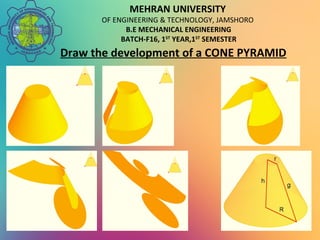
Draw the development of a CONE PYRAMID
MEHRAN UNIVERSITY
OF ENGINEERING & TECHNOLOGY, JAMSHORO
B.E MECHANICAL ENGINEERING
BATCH-F16, 1ST
YEAR,1ST
SEMESTER
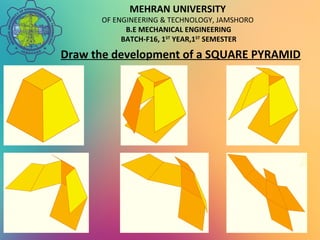
Draw the development of a SQUARE PYRAMID
MEHRAN UNIVERSITY
OF ENGINEERING & TECHNOLOGY, JAMSHORO
B.E MECHANICAL ENGINEERING
BATCH-F16, 1ST
YEAR,1ST
SEMESTER
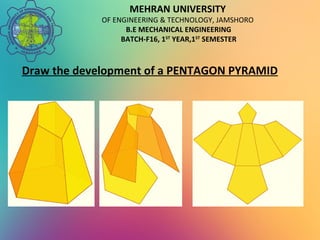
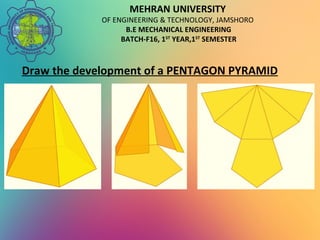
Draw the development of a PENTAGON PYRAMID
MEHRAN UNIVERSITY
OF ENGINEERING & TECHNOLOGY, JAMSHORO
B.E MECHANICAL ENGINEERING
BATCH-F16, 1ST
YEAR,1ST
SEMESTER
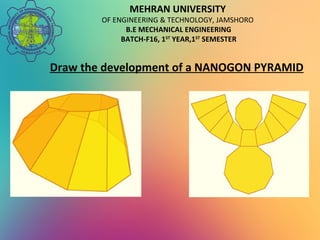
Draw the development of a NANOGON PYRAMID
MEHRAN UNIVERSITY
OF ENGINEERING & TECHNOLOGY, JAMSHORO
B.E MECHANICAL ENGINEERING
BATCH-F16, 1ST
YEAR,1ST
SEMESTER
Draw the development of a PENTAGON PYRAMID
MEHRAN UNIVERSITY
OF ENGINEERING & TECHNOLOGY, JAMSHORO
B.E MECHANICAL ENGINEERING
BATCH-F16, 1ST
YEAR,1ST
SEMESTER
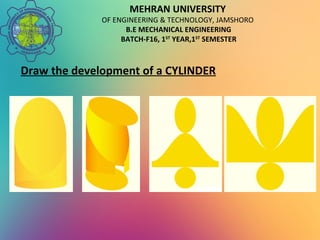
Draw the development of a CYLINDER
MEHRAN UNIVERSITY
OF ENGINEERING & TECHNOLOGY, JAMSHORO
B.E MECHANICAL ENGINEERING
BATCH-F16, 1ST
YEAR,1ST
SEMESTER
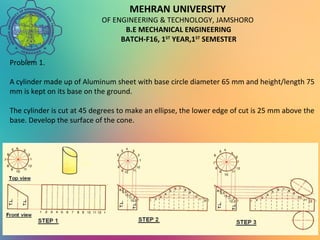
Problem 1.
A cylinder made up of Aluminum sheet with base circle diameter 65 mm and height/length 75
mm is kept on its base on the ground.
The cylinder is cut at 45 degrees to make an ellipse, the lower edge of cut is 25 mm above the
base. Develop the surface of the cone.
MEHRAN UNIVERSITY
OF ENGINEERING & TECHNOLOGY, JAMSHORO
B.E MECHANICAL ENGINEERING
BATCH-F16, 1ST
YEAR,1ST
SEMESTER
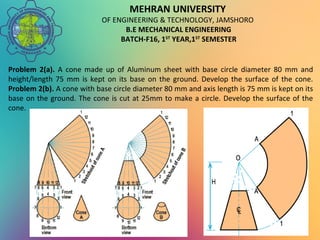
Problem 2(a). A cone made up of Aluminum sheet with base circle diameter 80 mm and
height/length 75 mm is kept on its base on the ground. Develop the surface of the cone.
Problem 2(b). A cone with base circle diameter 80 mm and axis length is 75 mm is kept on its
base on the ground. The cone is cut at 25mm to make a circle. Develop the surface of the
cone.
MEHRAN UNIVERSITY
OF ENGINEERING & TECHNOLOGY, JAMSHORO
B.E MECHANICAL ENGINEERING
BATCH-F16, 1ST
YEAR,1ST
SEMESTER
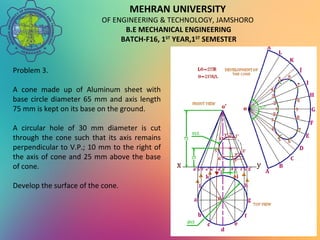
Problem 3.
A cone made up of Aluminum sheet with
base circle diameter 65 mm and axis length
75 mm is kept on its base on the ground.
A circular hole of 30 mm diameter is cut
through the cone such that its axis remains
perpendicular to V.P.; 10 mm to the right of
the axis of cone and 25 mm above the base
of cone.
Develop the surface of the cone.
MEHRAN UNIVERSITY
OF ENGINEERING & TECHNOLOGY, JAMSHORO
B.E MECHANICAL ENGINEERING
BATCH-F16, 1ST
YEAR,1ST
SEMESTER
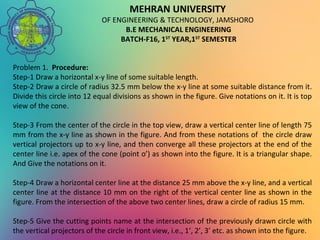
Problem 1. Procedure:
Step-1 Draw a horizontal x-y line of some suitable length.
Step-2 Draw a circle of radius 32.5 mm below the x-y line at some suitable distance from it.
Divide this circle into 12 equal divisions as shown in the figure. Give notations on it. It is top
view of the cone.
Step-3 From the center of the circle in the top view, draw a vertical center line of length 75
mm from the x-y line as shown in the figure. And from these notations of the circle draw
vertical projectors up to x-y line, and then converge all these projectors at the end of the
center line i.e. apex of the cone (point o’) as shown into the figure. It is a triangular shape.
And Give the notations on it.
Step-4 Draw a horizontal center line at the distance 25 mm above the x-y line, and a vertical
center line at the distance 10 mm on the right of the vertical center line as shown in the
figure. From the intersection of the above two center lines, draw a circle of radius 15 mm.
Step-5 Give the cutting points name at the intersection of the previously drawn circle with
the vertical projectors of the circle in front view, i.e., 1’, 2’, 3’ etc. as shown into the figure.
MEHRAN UNIVERSITY
OF ENGINEERING & TECHNOLOGY, JAMSHORO
B.E MECHANICAL ENGINEERING
BATCH-F16, 1ST
YEAR,1ST
SEMESTER
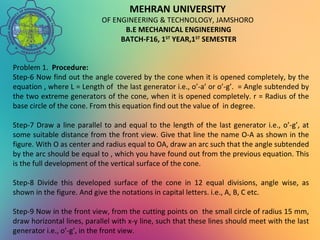
Problem 1. Procedure:
Step-6 Now find out the angle covered by the cone when it is opened completely, by the
equation , where L = Length of the last generator i.e., o’-a’ or o’-g’. = Angle subtended by
the two extreme generators of the cone, when it is opened completely. r = Radius of the
base circle of the cone. From this equation find out the value of in degree.
Step-7 Draw a line parallel to and equal to the length of the last generator i.e., o’-g’, at
some suitable distance from the front view. Give that line the name O-A as shown in the
figure. With O as center and radius equal to OA, draw an arc such that the angle subtended
by the arc should be equal to , which you have found out from the previous equation. This
is the full development of the vertical surface of the cone.
Step-8 Divide this developed surface of the cone in 12 equal divisions, angle wise, as
shown in the figure. And give the notations in capital letters. i.e., A, B, C etc.
Step-9 Now in the front view, from the cutting points on the small circle of radius 15 mm,
draw horizontal lines, parallel with x-y line, such that these lines should meet with the last
generator i.e., o’-g’, in the front view.
MEHRAN UNIVERSITY
OF ENGINEERING & TECHNOLOGY, JAMSHORO
B.E MECHANICAL ENGINEERING
BATCH-F16, 1ST
YEAR,1ST
SEMESTER
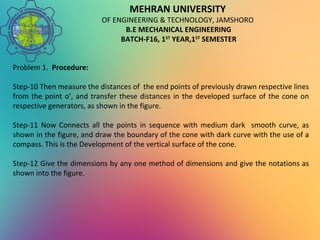
Problem 1. Procedure:
Step-10 Then measure the distances of the end points of previously drawn respective lines
from the point o’, and transfer these distances in the developed surface of the cone on
respective generators, as shown in the figure.
Step-11 Now Connects all the points in sequence with medium dark smooth curve, as
shown in the figure, and draw the boundary of the cone with dark curve with the use of a
compass. This is the Development of the vertical surface of the cone.
Step-12 Give the dimensions by any one method of dimensions and give the notations as
shown into the figure.
MEHRAN UNIVERSITY
OF ENGINEERING & TECHNOLOGY, JAMSHORO
B.E MECHANICAL ENGINEERING
BATCH-F16, 1ST
YEAR,1ST
SEMESTER
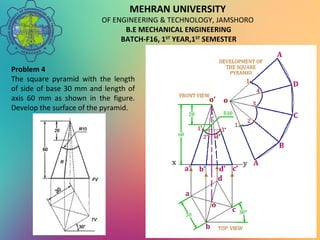
Problem 4
The square pyramid with the length
of side of base 30 mm and length of
axis 60 mm as shown in the figure.
Develop the surface of the pyramid.
MEHRAN UNIVERSITY
OF ENGINEERING & TECHNOLOGY, JAMSHORO
B.E MECHANICAL ENGINEERING
BATCH-F16, 1ST
YEAR,1ST
SEMESTER
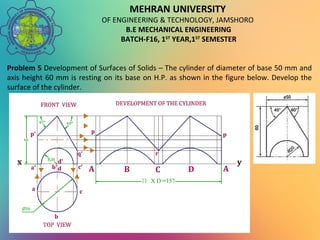
Problem 5 Development of Surfaces of Solids – The cylinder of diameter of base 50 mm and
axis height 60 mm is resting on its base on H.P. as shown in the figure below. Develop the
surface of the cylinder.
MEHRAN UNIVERSITY
OF ENGINEERING & TECHNOLOGY, JAMSHORO
B.E MECHANICAL ENGINEERING
BATCH-F16, 1ST
YEAR,1ST
SEMESTER
SYLLABUS
• Introduction & Basics: Introduction to graphic language, Essential drawing
instruments and their correct use. Line types and lettering. Basic drafting techniques
and standards. Curves used in engineering.
• Orthographic Projections:
• Orthographic multi view projection of some simple and composite solids.
• Sections: Sectioning and projection of auxiliary views.
• Surface Development: Surface development of simple solids such as cylinder, cone,
prism and pyramid, surface development of intersecting solids.
• Isometric Projections: Isometric projection / drawings of piping.
• Freehand/Sketching : Sketching and basic rules of sketching.
• Detail, assembly and Working Drawings: Preparing detail, assembly and working
drawings of various machine and engine parts such as, keys, cotters, foundation bolts,
screws, pulleys, couplings, bearings riveted joints and nut and bolts. Fundamentals of
geometric dimensioning and tolerancing.
• Computer Aided Drawing: Computer aided drafting (CAD). Auto CAD Software

Surface Development

  • 1.
    MEHRAN UNIVERSITY OF ENGINEERING& TECHNOLOGY, JAMSHORO B.E MECHANICAL ENGINEERING BATCH-F16, 1ST YEAR,1ST SEMESTER ENGINEERING DRAWING & GRAPHICS SURFACE DEVELOPMENT
  • 2.
    MEHRAN UNIVERSITY OF ENGINEERING& TECHNOLOGY, JAMSHORO B.E MECHANICAL ENGINEERING BATCH-F16, 1ST YEAR,1ST SEMESTER A development is the unfold / unrolled flat / plane figure of a 3-D object. It is also called a pattern where the plane may show the true size of each area of the object. When the pattern is cut, it can be rolled or folded back into the original object as shown in figure. Surface development is a full size layout of an object drawn on a plane. Some objects are made of flat sheet metal. When the sheet is cut as per this layout, folded and joined together, it takes the shape of an object. AN OBJECT HOLLOW AND MADE-UP OF THIN SHEET. CUT OPEN IT FROM ONE SIDE AND UNFOLD THE SHEET COMPLETELY. THEN THE SHAPE OF THAT UNFOLDED SHEET IS CALLED DEVELOPMENT OF LATERAL SURFACES OF THAT OBJECT OR SOLID.
  • 3.
    MEHRAN UNIVERSITY OF ENGINEERING& TECHNOLOGY, JAMSHORO B.E MECHANICAL ENGINEERING BATCH-F16, 1ST YEAR,1ST SEMESTER APPLICATIONS: The knowledge of development of surfaces is very useful in the sheet metal industry, where products like utensils, cans, buckets, hoppers, domes, etc. are manufactured. Imagine an industry where domestic refrigerators are manufactured. The ultimate shape of a refrigerator is made from the sheet metal. Its door is first made on a plain sheet and then cut and folded to form the door. To make a funnel out of a sheet, what should be the shape of the sheet which, when folded, forms the final shape of the funnel? A tailor first prepares a development drawing on a cloth to cut and stitch the correct shape and size of a shirt. A development gives the shape and plane area of the material which enables the cost to be estimated. Development should be such as to allow the minimum waste of material when the shape is cut out.
  • 4.
    MEHRAN UNIVERSITY OF ENGINEERING& TECHNOLOGY, JAMSHORO B.E MECHANICAL ENGINEERING BATCH-F16, 1ST YEAR,1ST SEMESTER EXAMPLES:- Boiler Shells & chimneys, Pressure Vessels, Shovels, Trays, Boxes & Cartons, Feeding Hoppers, Large Pipe sections, Body & Parts of automotive, Ships, Aero-planes and many more.
  • 5.
    MEHRAN UNIVERSITY OF ENGINEERING& TECHNOLOGY, JAMSHORO B.E MECHANICAL ENGINEERING BATCH-F16, 1ST YEAR,1ST SEMESTER Types of development 1-Parallel line development: In this parallel lines are used to construct the expanded pattern of each three-dimensional shape. The method divides the surface into a series of parallel lines to determine the shape of a pattern.
  • 6.
    MEHRAN UNIVERSITY OF ENGINEERING& TECHNOLOGY, JAMSHORO B.E MECHANICAL ENGINEERING BATCH-F16, 1ST YEAR,1ST SEMESTER Types of development 2- Radial line development: In this, lines radiating from a central point to construct the expanded pattern of each three-dimensional shape is used. These shapes each form part of a cone and lines radiating from the vertex of the cone generate the expanded pattern of the curved surface as shown in the following explorations.
  • 7.
    MEHRAN UNIVERSITY OF ENGINEERING& TECHNOLOGY, JAMSHORO B.E MECHANICAL ENGINEERING BATCH-F16, 1ST YEAR,1ST SEMESTER Types of development 3-Approximate development: In this, the shapes obtained are only approximate. After joining, the part is stretched or distorted to obtain the final shape. 4- Triangulation method: This is generally used for polyhedron, single curved surfaces, and warped surfaces.
  • 8.
    MEHRAN UNIVERSITY OF ENGINEERING& TECHNOLOGY, JAMSHORO B.E MECHANICAL ENGINEERING BATCH-F16, 1ST YEAR,1ST SEMESTER Types of development Parallel line development: In this parallel lines are used to construct the expanded pattern of each three-dimensional shape. The method divides the surface into a series of parallel lines to determine the shape of a pattern. Radial line development: In this, lines radiating from a central point to construct the expanded pattern of each three-dimensional shape is used. These shapes each form part of a cone and lines radiating from the vertex of the cone generate the expanded pattern of the curved surface as shown in the following explorations. Triangulation method: This is generally used for polyhedron, single curved surfaces, and warped surfaces. Approximate development: In this, the shapes obtained are only approximate. After joining, the part is stretched or distorted to obtain the final shape
  • 9.
    MEHRAN UNIVERSITY OF ENGINEERING& TECHNOLOGY, JAMSHORO B.E MECHANICAL ENGINEERING BATCH-F16, 1ST YEAR,1ST SEMESTER Draw the development of a CIRCULAR CYLINDER
  • 10.
    MEHRAN UNIVERSITY OF ENGINEERING& TECHNOLOGY, JAMSHORO B.E MECHANICAL ENGINEERING BATCH-F16, 1ST YEAR,1ST SEMESTER Draw the development of a PENTAGON PRISM
  • 11.
    MEHRAN UNIVERSITY OF ENGINEERING& TECHNOLOGY, JAMSHORO B.E MECHANICAL ENGINEERING BATCH-F16, 1ST YEAR,1ST SEMESTER Draw the development of a SQUARE & HEXAGON PRISM
  • 12.
    MEHRAN UNIVERSITY OF ENGINEERING& TECHNOLOGY, JAMSHORO B.E MECHANICAL ENGINEERING BATCH-F16, 1ST YEAR,1ST SEMESTER Draw the development of a CONE PYRAMID
  • 13.
    MEHRAN UNIVERSITY OF ENGINEERING& TECHNOLOGY, JAMSHORO B.E MECHANICAL ENGINEERING BATCH-F16, 1ST YEAR,1ST SEMESTER Draw the development of a SQUARE PYRAMID
  • 14.
    MEHRAN UNIVERSITY OF ENGINEERING& TECHNOLOGY, JAMSHORO B.E MECHANICAL ENGINEERING BATCH-F16, 1ST YEAR,1ST SEMESTER Draw the development of a PENTAGON PYRAMID
  • 15.
    MEHRAN UNIVERSITY OF ENGINEERING& TECHNOLOGY, JAMSHORO B.E MECHANICAL ENGINEERING BATCH-F16, 1ST YEAR,1ST SEMESTER Draw the development of a NANOGON PYRAMID
  • 16.
    MEHRAN UNIVERSITY OF ENGINEERING& TECHNOLOGY, JAMSHORO B.E MECHANICAL ENGINEERING BATCH-F16, 1ST YEAR,1ST SEMESTER Draw the development of a PENTAGON PYRAMID
  • 17.
    MEHRAN UNIVERSITY OF ENGINEERING& TECHNOLOGY, JAMSHORO B.E MECHANICAL ENGINEERING BATCH-F16, 1ST YEAR,1ST SEMESTER Draw the development of a CYLINDER
  • 18.
    MEHRAN UNIVERSITY OF ENGINEERING& TECHNOLOGY, JAMSHORO B.E MECHANICAL ENGINEERING BATCH-F16, 1ST YEAR,1ST SEMESTER Problem 1. A cylinder made up of Aluminum sheet with base circle diameter 65 mm and height/length 75 mm is kept on its base on the ground. The cylinder is cut at 45 degrees to make an ellipse, the lower edge of cut is 25 mm above the base. Develop the surface of the cone.
  • 19.
    MEHRAN UNIVERSITY OF ENGINEERING& TECHNOLOGY, JAMSHORO B.E MECHANICAL ENGINEERING BATCH-F16, 1ST YEAR,1ST SEMESTER Problem 2(a). A cone made up of Aluminum sheet with base circle diameter 80 mm and height/length 75 mm is kept on its base on the ground. Develop the surface of the cone. Problem 2(b). A cone with base circle diameter 80 mm and axis length is 75 mm is kept on its base on the ground. The cone is cut at 25mm to make a circle. Develop the surface of the cone.
  • 20.
    MEHRAN UNIVERSITY OF ENGINEERING& TECHNOLOGY, JAMSHORO B.E MECHANICAL ENGINEERING BATCH-F16, 1ST YEAR,1ST SEMESTER Problem 3. A cone made up of Aluminum sheet with base circle diameter 65 mm and axis length 75 mm is kept on its base on the ground. A circular hole of 30 mm diameter is cut through the cone such that its axis remains perpendicular to V.P.; 10 mm to the right of the axis of cone and 25 mm above the base of cone. Develop the surface of the cone.
  • 21.
    MEHRAN UNIVERSITY OF ENGINEERING& TECHNOLOGY, JAMSHORO B.E MECHANICAL ENGINEERING BATCH-F16, 1ST YEAR,1ST SEMESTER Problem 1. Procedure: Step-1 Draw a horizontal x-y line of some suitable length. Step-2 Draw a circle of radius 32.5 mm below the x-y line at some suitable distance from it. Divide this circle into 12 equal divisions as shown in the figure. Give notations on it. It is top view of the cone. Step-3 From the center of the circle in the top view, draw a vertical center line of length 75 mm from the x-y line as shown in the figure. And from these notations of the circle draw vertical projectors up to x-y line, and then converge all these projectors at the end of the center line i.e. apex of the cone (point o’) as shown into the figure. It is a triangular shape. And Give the notations on it. Step-4 Draw a horizontal center line at the distance 25 mm above the x-y line, and a vertical center line at the distance 10 mm on the right of the vertical center line as shown in the figure. From the intersection of the above two center lines, draw a circle of radius 15 mm. Step-5 Give the cutting points name at the intersection of the previously drawn circle with the vertical projectors of the circle in front view, i.e., 1’, 2’, 3’ etc. as shown into the figure.
  • 22.
    MEHRAN UNIVERSITY OF ENGINEERING& TECHNOLOGY, JAMSHORO B.E MECHANICAL ENGINEERING BATCH-F16, 1ST YEAR,1ST SEMESTER Problem 1. Procedure: Step-6 Now find out the angle covered by the cone when it is opened completely, by the equation , where L = Length of the last generator i.e., o’-a’ or o’-g’. = Angle subtended by the two extreme generators of the cone, when it is opened completely. r = Radius of the base circle of the cone. From this equation find out the value of in degree. Step-7 Draw a line parallel to and equal to the length of the last generator i.e., o’-g’, at some suitable distance from the front view. Give that line the name O-A as shown in the figure. With O as center and radius equal to OA, draw an arc such that the angle subtended by the arc should be equal to , which you have found out from the previous equation. This is the full development of the vertical surface of the cone. Step-8 Divide this developed surface of the cone in 12 equal divisions, angle wise, as shown in the figure. And give the notations in capital letters. i.e., A, B, C etc. Step-9 Now in the front view, from the cutting points on the small circle of radius 15 mm, draw horizontal lines, parallel with x-y line, such that these lines should meet with the last generator i.e., o’-g’, in the front view.
  • 23.
    MEHRAN UNIVERSITY OF ENGINEERING& TECHNOLOGY, JAMSHORO B.E MECHANICAL ENGINEERING BATCH-F16, 1ST YEAR,1ST SEMESTER Problem 1. Procedure: Step-10 Then measure the distances of the end points of previously drawn respective lines from the point o’, and transfer these distances in the developed surface of the cone on respective generators, as shown in the figure. Step-11 Now Connects all the points in sequence with medium dark smooth curve, as shown in the figure, and draw the boundary of the cone with dark curve with the use of a compass. This is the Development of the vertical surface of the cone. Step-12 Give the dimensions by any one method of dimensions and give the notations as shown into the figure.
  • 24.
    MEHRAN UNIVERSITY OF ENGINEERING& TECHNOLOGY, JAMSHORO B.E MECHANICAL ENGINEERING BATCH-F16, 1ST YEAR,1ST SEMESTER Problem 4 The square pyramid with the length of side of base 30 mm and length of axis 60 mm as shown in the figure. Develop the surface of the pyramid.
  • 25.
    MEHRAN UNIVERSITY OF ENGINEERING& TECHNOLOGY, JAMSHORO B.E MECHANICAL ENGINEERING BATCH-F16, 1ST YEAR,1ST SEMESTER Problem 5 Development of Surfaces of Solids – The cylinder of diameter of base 50 mm and axis height 60 mm is resting on its base on H.P. as shown in the figure below. Develop the surface of the cylinder.
  • 26.
    MEHRAN UNIVERSITY OF ENGINEERING& TECHNOLOGY, JAMSHORO B.E MECHANICAL ENGINEERING BATCH-F16, 1ST YEAR,1ST SEMESTER SYLLABUS • Introduction & Basics: Introduction to graphic language, Essential drawing instruments and their correct use. Line types and lettering. Basic drafting techniques and standards. Curves used in engineering. • Orthographic Projections: • Orthographic multi view projection of some simple and composite solids. • Sections: Sectioning and projection of auxiliary views. • Surface Development: Surface development of simple solids such as cylinder, cone, prism and pyramid, surface development of intersecting solids. • Isometric Projections: Isometric projection / drawings of piping. • Freehand/Sketching : Sketching and basic rules of sketching. • Detail, assembly and Working Drawings: Preparing detail, assembly and working drawings of various machine and engine parts such as, keys, cotters, foundation bolts, screws, pulleys, couplings, bearings riveted joints and nut and bolts. Fundamentals of geometric dimensioning and tolerancing. • Computer Aided Drawing: Computer aided drafting (CAD). Auto CAD Software