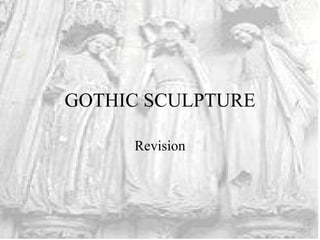
Gothic Sculpture

Loading...

Flash Player 9 (or above) is needed to view presentations.
We have detected that you do not have it on your computer. To install it, go here.

0 comments

Post a comment

    Post a comment
    Embed Video
    Edit your comment Cancel

    Favorites, Groups & Events

    Gothic Sculpture - Presentation Transcript

    1. GOTHIC SCULPTURE Revision
    2. Introduction
      • There is a change in the sculptural conception in the evolution from the Romanesque
      • Images are naturalistic and related to the time they represent in opposition to the lack of temporality and geometric shapes of the former period.
    3. General Characteristics
      • It is inspired in the nature with sensitive forms that can be easily understood
      • Approximation to physical beauty from the spiritual dimension of their iconography
      • New problems:
        • Depiction of the space
        • Volume of the images (anatomy)
        • Relation of light and colour
    4. General Characteristics
      • It is an attempt to present the world as it is. Nature loses idealization.
      • Characters’ gestures and attitudes are human. The character represents emotions and natural features.
    5. General Characteristics
      • Naturalism affected the two main images depicted:
      • The Virgin is not any longer a throne for her son but a mother who plays with him
      • Christ is a human person who suffers in the cross or who is death.
    6. General Characteristics
      • The characters are full of humanism, they abandon verticality, symmetry and hieratic positions to adopt mannered gestures with realistic movement.
      • They tend to depict emotions such as joy or sadness. A good example are the gestures of the Virgin and Saint John in the Calvarias or Pieties.
    7. Evolution 13th century: classicist. They look for an idealised naturalism. 14th century: Mannerism in stylization, longer images and with bends. 15th century: Sculptures of kings, bourgeoises and aristocracy
    8. Façades
      • The most important part is the tympanum where the Pantocrator and the Tetramorph group appear.
      • The Virgin may appear in the centre.
      • Sometimes, in lower positions there is the narration of Christ or the Virgin life.
      • In the archivolts other characters such as saints and kings appear.
    9. Façades
      • In the trumeau it appears the image of Christ or the Virgin. They are friendly images in a door that is considered the access to paradise.
      • The jambs are reserved for the Apostles
      • Other profane characters can appear in secondary places.
    10. Sepulchres
      • It is one of the new locations for sculpture.
      • It can be of two types:
        • Adjacent: below an arch
        • Exempt: a funerary bed
      • The characteristics are:
        • Death person depicted on the bed, laying or praying
        • Symbolic animal images
      • They were commanded by nobility or bourgeoisie
      • They appear in the chapels.
    11. Other locations
      • Other places for sculptures are:
        • Choir chairs
        • Pulpits
        • Altar pieces
    12. Iconography
      • It is mainly religious:
        • Last Judgement
        • Christ in majesty
        • Virgin
        • Saints lives (hagiography)
        • Fantastic animals (gargoyles)
      • They appear in façades, cloisters or in form of exempt images
    13. Iconography
      • Christ may appear as judge or in the images about his life.
      • Other common depiction is that of the Crucifixion, with some new characteristics:
        • Four nails
        • Sufferance elements (blood, injury, crown)
        • Death or almost death
        • Wearing a short piece of clothe
    14. Iconography
      • The Virgin acquired an special
      • status
      • The image changes:
        • She is young
        • Very human
        • She plays with her son
        • She smiles
      • The clothes are elegant
      • The image is stylised
    15. Iconography
      • Hagiographies: there are saints’ lives. Martyrdoms are frequently depicted
      • Fantastic animals are common as gargoyles.
    16. Colour
      • Polychrome effects were used to make the images more realistic
      • Characters communicate to each other.
    17. Naturalism
      • It can be seen in characters in daily activities or in animals and plants
    18. Sluter
      • He is the best representative of the sculpture of the late Gothic
      • His images are realistic, with great volume
      • He created the character of the hooded person
    19.  
    20. Spain
      • Romanesque style lasted for a long time
      • The images made by Mathew master in Santiago’s Glory portal advanced the naturalism.
    21. Spain
      • The development came with the arrival of French masters to work in the cathedrals of Burgos, Leon and Toledo.
      • The best examples are the façades.
    22. Spain
      • Gothic sepulchres are commonly realised
      • The type with an arch appears on the wall
      • The buried person’s portrait lays on the funerary bed
      • Polychrome effects were used.
    23. Spain
      • The sepulchre of funerary bed could be:
        • Double
        • Single
    24. Spain
      • In some cases the person appears in a normal attitude, as is they were alive.

    + mfresnillomfresnillo, 2 years ago

    custom

    2036 views, 0 favs, 1 embeds more stats

    Revision on Gothic Sculpture

    More info about this document

    © All Rights Reserved

    Go to text version

    • Total Views 2036
      • 2035 on SlideShare
      • 1 from embeds
    • Comments 0
    • Favorites 0
    • Downloads 103
    Most viewed embeds
    • 1 views on http://www.classroomsonline.org

    more

    All embeds
    • 1 views on http://www.classroomsonline.org

    less

    Flagged as inappropriate Flag as inappropriate
    Flag as inappropriate

    Select your reason for flagging this presentation as inappropriate. If needed, use the feedback form to let us know more details.

    Cancel
    File a copyright complaint
    Having problems? Go to our helpdesk?

    Categories