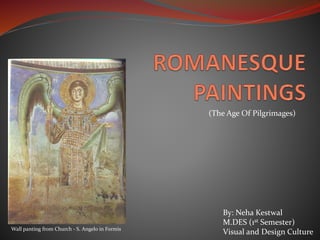
(The Age Of Pilgrimages) 
By: Neha Kestwal 
M.DES (1st Semester) 
Visual and Design Culture Wall panting from Church - S. Angelo in Formis
History 
• Romanesque Era – 11th – 12th Century. 
•Travelled from Holy Empire Rome to 
Italy, France, Germany, Spain and England. 
• Era where Christianity flourished.
Influenced 
Romanesque Painting 
Byzantine Painting 
Roman Sculpture 
Gothic Painting
Characteristics 
Murder of Innocent in Bethlehem 
Author : artist from southern France 
Date :c. 1180 
Technique :Fresco 
Type :religious 
Form :painting 
Location :The Panteón de los Re 'es of San Isidoro in 
Leon 
Source : E- Book “Romanesque – Architecture, 
Sculpture, Painting (Art Book)”, Edited by Rolf 
Toman; pp. 391 
•Wall Painting using technique Frescoes, Secco and 
Tempera. 
•Flat Drawing. 
•Lack Perspective. 
• Elongated Body Parts. 
•Use of Black color to outline figure. 
• Religious, Bring out message of stories of old 
And new Testaments. 
• Hierarchy shown by gradual decrease in sizes. 
•Eyes are wide open. 
•According to areas under Romanesque there is little change 
in paintings. 
•Uses Bright and intense Colors (Red, Yellow, Orange, Blue)
Visual Representation of Image 
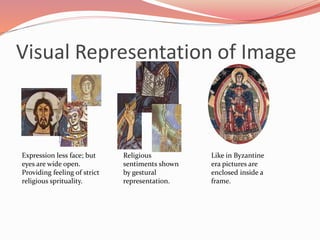
Expression less face; but 
eyes are wide open. 
Providing feeling of strict 
religious sprituality. 
Religious 
sentiments shown 
by gestural 
representation. 
Like in Byzantine 
era pictures are 
enclosed inside a 
frame.
Variation in Romanesque Painting 
Three “Christs in Majesty” provide examples: 
Church- Sant'Angelo in Formis (around 1080), 
Church -San Clemente in Tahull (around 1123), and 
Church -Berze-la-Ville (around 1120).
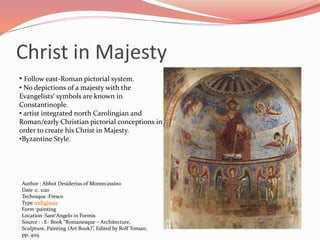
Christ in Majesty 
• Follow east-Roman pictorial system. 
• No depictions of a majesty with the 
Evangelists‘ symbols are known in 
Constantinople. 
• artist integrated north Carolingian and 
Roman/early Christian pictorial conceptions in 
order to create his Christ in Majesty. 
•Byzantine Style. 
Author : Abbot Desiderius of Montecassino 
Date :c. 1120 
Technique :Fresco 
Type :religious 
Form :painting 
Location :Sant'Angelo in Formis 
Source : : E- Book “Romanesque – Architecture, 
Sculpture, Painting (Art Book)”, Edited by Rolf Toman; 
pp. 409
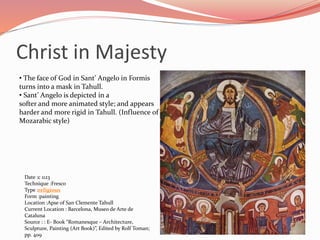
Christ in Majesty 
• The face of God in Sant’ Angelo in Formis 
turns into a mask in Tahull. 
• Sant’ Angelo is depicted in a 
softer and more animated style; and appears 
harder and more rigid in Tahull. (Influence of 
M0zarabic style) 
Date :c 1123 
Technique :Fresco 
Type :religious 
Form :painting 
Location :Apse of San Clemente Tahull 
Current Location : Barcelona, Museo de Arte de 
Cataluna 
Source : : E- Book “Romanesque – Architecture, 
Sculpture, Painting (Art Book)”, Edited by Rolf Toman; 
pp. 409
Christ in Majesty 
• faced with soft, flowing lines 
and a sublime use of color. 
• strict formalism which was derived 
from the Byzantine monumental 
style. 
• Change in Gown, the dense folds of 
which wind Themselves along the 
various parts of the bodies. 
Date :c. 11 Century 
Technique :Fresco 
Type :religious 
Form :painting 
Location :Bern-la-Ville 
Source : : E- Book “Romanesque – Architecture, 
Sculpture, Painting (Art Book)”, Edited by Rolf Toman; 
pp. 409
GROUP COMPOSITION 
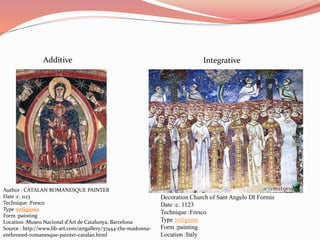
Two basic types can be distinguished, the additive and the integrative principle. 
Additive principle: The figures are placed next to one another without significant 
overlapping. 
Integrative principle: The figures are arranged both side by side and behind one 
another, resulting overlaps are very conspicuous and are supposed to suggest a feeling of 
spatial depth. But such group compositions often appear like a flat piling-up of bodies 
without conveying any spatial connection.
Additive Integrative 
Decoration Church of Sant Angelo DI Formis 
Date :c. 1123 
Technique :Fresco 
Type :religious 
Form :painting 
Location :Italy 
Author : CATALAN ROMANESQUE PAINTER 
Date :c. 1123 
Technique :Fresco 
Type :religious 
Form :painting 
Location :Museu Nacional d'Art de Catalunya, Barcelona 
Source : http://www.lib-art.com/artgallery/37444-the-madonna-enthroned- 
romanesque-painter-catalan.html
Four Apostles 
Date :c. 12th century 
Technique :Fresco 
Type :religious 
Form :painting 
Location : S. Clemente, Rome 
Source :Book- The history of Art Architecture 
Painting Sculpture; Author - Hamlyn
Preservation of Fresco Painting 
Protection and Support Bandage applied 
(cotton gauze and polyvinyl alcohol) 
Difficult Section Removed 
(soft brushes and localized 
vacuuming) 
Easier Section Removed 
(with a paper pulp compress 
saturated with bicarbonate of 
ammonia solutions and 
removed with de-ionized water) 
Removed sections are strengthened with barium hydrate 
cracks and detachments are stopped with lime putty and injected with 
an epoxy resin loaded with micronized silica
References 
E- Book “Romanesque – Architecture, Sculpture, Painting (Art Book)”, Edited by Rolf 
Toman 
www.britannica.com/EBchecked/topic/508431/Romanesque-art 
www.metmuseum.org/toah/hd/rmsq/hd_rmsq.htm 
Book – “A world of Art”; Author – Hugh Honour & John Fleming (7th Edition: 709 
Reference: 8512) 
Book – “The History of Art Architecture Painting Sculpture”; Author – Hamlyn (700.9 
MYE, Reference: 227)
Thank you

Romanesque Paintings

  • 1.
    (The Age OfPilgrimages) By: Neha Kestwal M.DES (1st Semester) Visual and Design Culture Wall panting from Church - S. Angelo in Formis
  • 2.
    History • RomanesqueEra – 11th – 12th Century. •Travelled from Holy Empire Rome to Italy, France, Germany, Spain and England. • Era where Christianity flourished.
  • 3.
    Influenced Romanesque Painting Byzantine Painting Roman Sculpture Gothic Painting
  • 4.
    Characteristics Murder ofInnocent in Bethlehem Author : artist from southern France Date :c. 1180 Technique :Fresco Type :religious Form :painting Location :The Panteón de los Re 'es of San Isidoro in Leon Source : E- Book “Romanesque – Architecture, Sculpture, Painting (Art Book)”, Edited by Rolf Toman; pp. 391 •Wall Painting using technique Frescoes, Secco and Tempera. •Flat Drawing. •Lack Perspective. • Elongated Body Parts. •Use of Black color to outline figure. • Religious, Bring out message of stories of old And new Testaments. • Hierarchy shown by gradual decrease in sizes. •Eyes are wide open. •According to areas under Romanesque there is little change in paintings. •Uses Bright and intense Colors (Red, Yellow, Orange, Blue)
  • 5.
    Visual Representation ofImage Expression less face; but eyes are wide open. Providing feeling of strict religious sprituality. Religious sentiments shown by gestural representation. Like in Byzantine era pictures are enclosed inside a frame.
  • 6.
    Variation in RomanesquePainting Three “Christs in Majesty” provide examples: Church- Sant'Angelo in Formis (around 1080), Church -San Clemente in Tahull (around 1123), and Church -Berze-la-Ville (around 1120).
  • 7.
    Christ in Majesty • Follow east-Roman pictorial system. • No depictions of a majesty with the Evangelists‘ symbols are known in Constantinople. • artist integrated north Carolingian and Roman/early Christian pictorial conceptions in order to create his Christ in Majesty. •Byzantine Style. Author : Abbot Desiderius of Montecassino Date :c. 1120 Technique :Fresco Type :religious Form :painting Location :Sant'Angelo in Formis Source : : E- Book “Romanesque – Architecture, Sculpture, Painting (Art Book)”, Edited by Rolf Toman; pp. 409
  • 8.
    Christ in Majesty • The face of God in Sant’ Angelo in Formis turns into a mask in Tahull. • Sant’ Angelo is depicted in a softer and more animated style; and appears harder and more rigid in Tahull. (Influence of M0zarabic style) Date :c 1123 Technique :Fresco Type :religious Form :painting Location :Apse of San Clemente Tahull Current Location : Barcelona, Museo de Arte de Cataluna Source : : E- Book “Romanesque – Architecture, Sculpture, Painting (Art Book)”, Edited by Rolf Toman; pp. 409
  • 9.
    Christ in Majesty • faced with soft, flowing lines and a sublime use of color. • strict formalism which was derived from the Byzantine monumental style. • Change in Gown, the dense folds of which wind Themselves along the various parts of the bodies. Date :c. 11 Century Technique :Fresco Type :religious Form :painting Location :Bern-la-Ville Source : : E- Book “Romanesque – Architecture, Sculpture, Painting (Art Book)”, Edited by Rolf Toman; pp. 409
  • 10.
    GROUP COMPOSITION Twobasic types can be distinguished, the additive and the integrative principle. Additive principle: The figures are placed next to one another without significant overlapping. Integrative principle: The figures are arranged both side by side and behind one another, resulting overlaps are very conspicuous and are supposed to suggest a feeling of spatial depth. But such group compositions often appear like a flat piling-up of bodies without conveying any spatial connection.
  • 11.
    Additive Integrative DecorationChurch of Sant Angelo DI Formis Date :c. 1123 Technique :Fresco Type :religious Form :painting Location :Italy Author : CATALAN ROMANESQUE PAINTER Date :c. 1123 Technique :Fresco Type :religious Form :painting Location :Museu Nacional d'Art de Catalunya, Barcelona Source : http://www.lib-art.com/artgallery/37444-the-madonna-enthroned- romanesque-painter-catalan.html
  • 12.
    Four Apostles Date:c. 12th century Technique :Fresco Type :religious Form :painting Location : S. Clemente, Rome Source :Book- The history of Art Architecture Painting Sculpture; Author - Hamlyn
  • 13.
    Preservation of FrescoPainting Protection and Support Bandage applied (cotton gauze and polyvinyl alcohol) Difficult Section Removed (soft brushes and localized vacuuming) Easier Section Removed (with a paper pulp compress saturated with bicarbonate of ammonia solutions and removed with de-ionized water) Removed sections are strengthened with barium hydrate cracks and detachments are stopped with lime putty and injected with an epoxy resin loaded with micronized silica
  • 14.
    References E- Book“Romanesque – Architecture, Sculpture, Painting (Art Book)”, Edited by Rolf Toman www.britannica.com/EBchecked/topic/508431/Romanesque-art www.metmuseum.org/toah/hd/rmsq/hd_rmsq.htm Book – “A world of Art”; Author – Hugh Honour & John Fleming (7th Edition: 709 Reference: 8512) Book – “The History of Art Architecture Painting Sculpture”; Author – Hamlyn (700.9 MYE, Reference: 227)
  • 15.