Art and Its History Why Study the Subject?
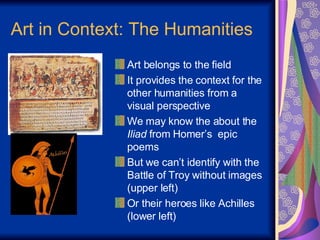
Art in Context: The Humanities Art belongs to the field It provides the context for the other humanities from a visual perspective We may know the about the  Iliad  from Homer’s  epic poems But we can’t identify with the Battle of Troy without images (upper left) Or their heroes like Achilles (lower left)
Humanities The Study of the Human Condition What is the human condition? We remember the past We imagine the future We have emotions We can reason We know we will die
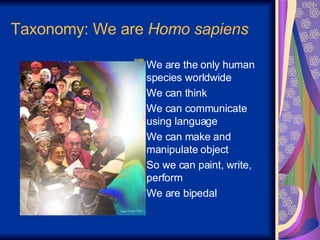
Taxonomy: We are  Homo sapiens We are the only human species worldwide We can think We can communicate using language We can make and manipulate object So we can paint, write, perform We are bipedal
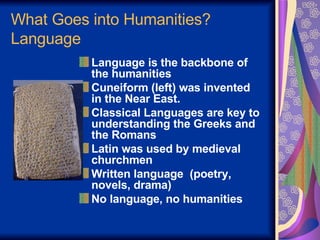
What Goes into Humanities? Language Language is the backbone of the humanities Cuneiform (left) was invented  in the Near East.  Classical Languages are key to understanding the Greeks and the Romans Latin was used by medieval churchmen Written language  (poetry, novels, drama) No language, no humanities
What Goes Into Humanities: History Humanities appeals to the past Traditionally, scholars have to know their classical history Systematic study of the families, societies and the great men (sometimes women) Today, history is more of a social science with a dimension of time Santayana: “Who ignores the past is doomed to repeat it.” Faulkner: “The past is never dead: it isn’t even past.”
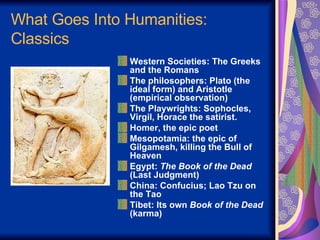
What Goes Into Humanities: Classics Western Societies: The Greeks and the Romans The philosophers: Plato (the ideal form) and Aristotle (empirical observation) The Playwrights: Sophocles, Virgil, Horace the satirist. Homer, the epic poet Mesopotamia: the epic of Gilgamesh, killing the Bull of Heaven Egypt:  The Book of the Dead  (Last Judgment) China: Confucius; Lao Tzu on the Tao Tibet: Its own  Book of the Dead  (karma)
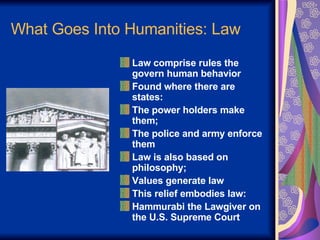
What Goes Into Humanities: Law Law comprise rules the govern human behavior Found where there are states: The power holders make them;  The police and army enforce them Law is also based on philosophy; Values generate law This relief embodies law: Hammurabi the Lawgiver on the U.S. Supreme Court
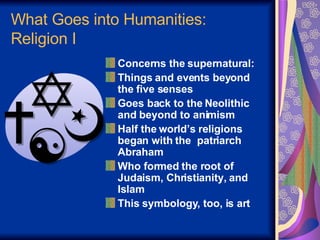
What Goes into Humanities: Religion I Concerns the supernatural:  Things and events beyond  the five senses  Goes back to the Neolithic and beyond to animism Half the world’s religions began with the  patriarch Abraham Who formed the root of Judaism, Christianity, and Islam This symbology, too, is art
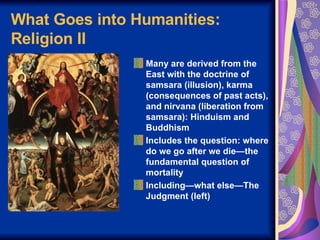
What Goes into Humanities: Religion II Many are derived from the East with the doctrine of samsara (illusion), karma (consequences of past acts), and nirvana (liberation from samsara): Hinduism and Buddhism Includes the question: where do we go after we die—the fundamental question of mortality Including—what else—The Judgment (left)
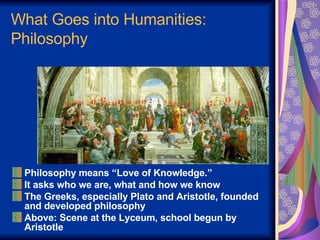
What Goes into Humanities: Philosophy Philosophy means “Love of Knowledge.” It asks who we are, what and how we know The Greeks, especially Plato and Aristotle, founded and developed philosophy Above: Scene at the Lyceum, school begun by Aristotle
What goes into Humanities: The Visual Arts Sculpture Greek and Roman sculpture of the human form Drawings, from sketches to hatching to use of pastels (upper left, Escher’s  Drawing Hands ) Paintings, involving the application of  a pigment within a medium and binder (glue)  on a surface: (lower left Mona Lisa by Da Vinci)
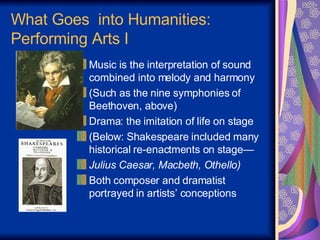
Music is the interpretation of sound combined into melody and harmony  (Such as the nine symphonies of Beethoven, above) Drama: the imitation of life on stage (Below: Shakespeare included many historical re-enactments on stage— Julius Caesar, Macbeth, Othello) Both composer and dramatist portrayed in artists’ conceptions What Goes  into Humanities: Performing Arts I
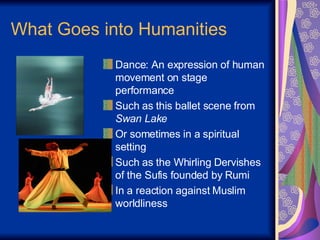
What Goes into Humanities Dance: An expression of human movement on stage performance Such as this ballet scene from  Swan Lake Or sometimes in a spiritual setting  Such as the Whirling Dervishes of the Sufis founded by Rumi  In a reaction against Muslim worldliness
What is Art For? We have seen ways that art fits into the humanities But is there arts for art’s sake The answer: it depends Sometimes art can be very useful for that which is not art
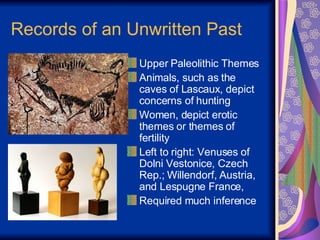
Records of an Unwritten Past Upper Paleolithic Themes Animals, such as the caves of Lascaux, depict concerns of hunting Women, depict erotic themes or themes of fertility  Left to right: Venuses of Dolni Vestonice, Czech Rep.; Willendorf, Austria, and Lespugne France,  Required much inference
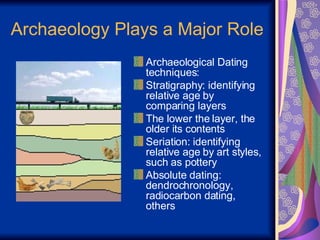
Archaeology Plays a Major Role Archaeological Dating techniques: Stratigraphy: identifying relative age by comparing layers The lower the layer, the older its contents Seriation: identifying relative age by art styles, such as pottery Absolute dating: dendrochronology, radiocarbon dating, others
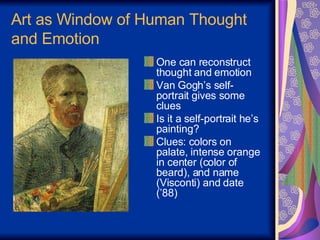
Art as Window of Human Thought and Emotion One can reconstruct thought and emotion Van Gogh’s self-portrait gives some clues Is it a self-portrait he’s painting? Clues: colors on palate, intense orange in center (color of beard), and name (Visconti) and date (’88)
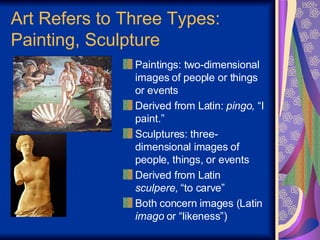
Art Refers to Three Types: Painting, Sculpture Paintings: two-dimensional images of people or things or events Derived from Latin:  pingo,  “I paint.” Sculptures: three-dimensional images of people, things, or events Derived from Latin  sculpere,  “to carve” Both concern images (Latin  imago  or “likeness”)
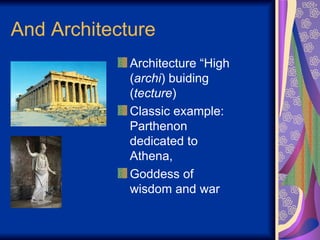
And Architecture Architecture “High ( archi ) buiding ( tecture ) Classic example: Parthenon dedicated to Athena,  Goddess of wisdom and war
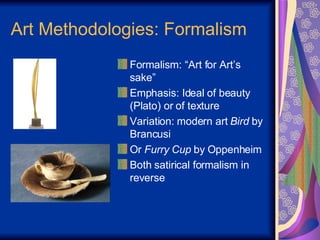
Art Methodologies: Formalism Formalism: “Art for Art’s sake” Emphasis: Ideal of beauty (Plato) or of texture Variation: modern art  Bird  by Brancusi Or  Furry Cup  by Oppenheim Both satirical formalism in reverse
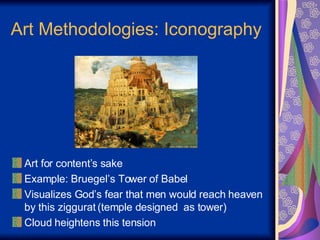
Art Methodologies: Iconography Art for content’s sake Example: Bruegel’s Tower of Babel Visualizes God’s fear that men would reach heaven by this ziggurat (temple designed  as tower) Cloud heightens this tension
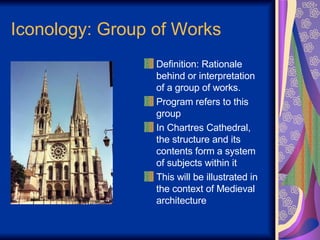
Iconology: Group of Works Definition: Rationale behind or interpretation of a group of works.  Program refers to this group In Chartres Cathedral, the structure and its contents form a system of subjects within it This will be illustrated in the context of Medieval architecture
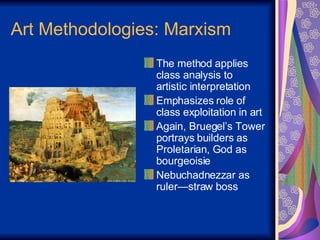
Art Methodologies: Marxism The method applies class analysis to artistic interpretation Emphasizes role of class exploitation in art Again, Bruegel’s Tower portrays builders as Proletarian, God as bourgeoisie Nebuchadnezzar as ruler—straw boss
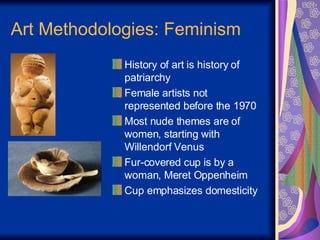
Art Methodologies: Feminism History of art is history of patriarchy Female artists not represented before the 1970 Most nude themes are of women, starting with Willendorf Venus Fur-covered cup is by a woman, Meret Oppenheim Cup emphasizes domesticity
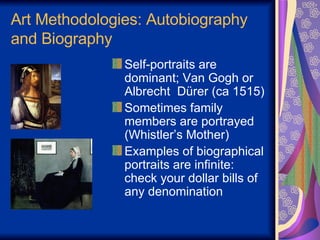
Art Methodologies: Autobiography and Biography Self-portraits are dominant; Van Gogh or Albrecht  D ü rer (ca 1515) Sometimes family members are portrayed (Whistler’s Mother) Examples of biographical portraits are infinite: check your dollar bills of any denomination
Other Methodologies Semiology: The study of signs Structuralism: Binary opposites based on linguistics (Levi-Strauss) Deconstruction: Reconstruction of meaning from symbols (text) Psychoanalysis: Especially derived from Freud and the Oedipus complex
Techniques of Art: Composition Overall plan or structure of art Relationship between the component parts is emphasized. Emphasizes the arrangement of the formal elements Composition is distinct from content, theme, or subject matter It comprises plane, balance, line, shape, color, and texture Refer to pp. 18-24 of Adams text for illustrations of these principles
Plane Plane: a flat surface direction in space Picture plane: all paintings are on a flat surface: stone wall to canvas Plane of relief: surface of a relief sculpture in which an image is raised from a flat surface—stone or masonry
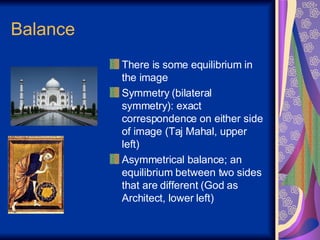
Balance There is some equilibrium in the image Symmetry (bilateral symmetry): exact correspondence on either side of image (Taj Mahal, upper left) Asymmetrical balance; an equilibrium between two sides that are different (God as Architect, lower left)
Lines: Straight Lines Shortest distance between two points Vertical: “Stands at attention” Horizontal: Lies down Diagonal: Falling over Zigzag: Aggressive quality Wavy and cured line; more like a human body
Line: Interpretations Parallel lines are harmonious Perpendicular,  converging, and intersecting lines: sense of force and counterforce Thick lines: aggressive, forceful Thin lines: delicate, even weak Undulating lines: calmness, as a calm sea Irregular wave imply choppiness, unsteadiness
Lines: Expressive Qualities Straight line: implied a sense of purpose—but also rigidity Circle and curves imply facial expression: upward curves signal happiness, downward implies sadness Calder’s Cat combines lines with image
Shape Regular shapes are geometric and have names Examples: square, circle, rectangle, oval, triangle, trapezoid, polygon  Irregular shapes are biomorphic, or shaped like life itself Associations: square implied solidity, reliability—and overconservatism Circle is considered a divine shape
Open versus Closed Shape Open shape implies openness to new ideas or new content Closed shape implies shutting off new influences or ideas Navajo: Sand paintings never close a circle and always includes an imperfection: only the divine is perfect
Shape and Dimensionality Portraying three dimensions on a flat surface Example: hatching or cross-hatching create an illusion of mass or volume Shading: gradual transition from light to dark
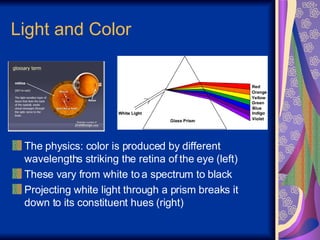
Light and Color The physics: color is produced by different wavelengths striking the retina of the eye (left) These vary from white to a spectrum to black Projecting white light through a prism breaks it down to its constituent hues (right)
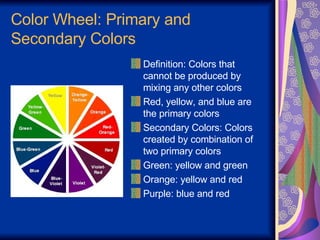
Color Wheel: Primary and Secondary Colors Definition: Colors that cannot be produced by mixing any other colors Red, yellow, and blue are the primary colors Secondary Colors: Colors created by combination of two primary colors Green: yellow and green Orange: yellow and red Purple: blue and red
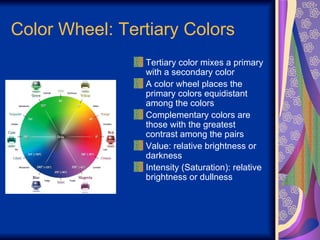
Color Wheel: Tertiary Colors Tertiary color mixes a primary with a secondary color A color wheel places the primary colors equidistant among the colors Complementary colors are those with the greatest contrast among the pairs Value: relative brightness or darkness Intensity (Saturation): relative brightness or dullness
Expressive Qualities of Color Bright or warm colors convey feelings of gaiety or happiness: these are red, orange, and yellow Cool colors: blue, green-blue, green, since they convey the quality of water or sky They often convey sadness or pessimism Symbolic significance:  Red: danger, extravagant welcome, exciting event Green: envy; yellow: cowardice; purple: rage
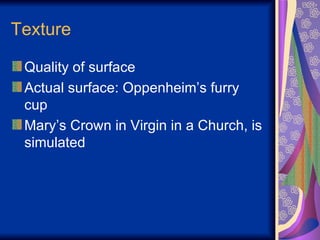
Texture Quality of surface Actual surface: Oppenheim’s furry cup Mary’s Crown in Virgin in a Church, is simulated
Conclusion There are three media of art: visual media, sculpture, and architecture Art may be regarded as a quality in itself It may also represent a content, a person, or a theme that is not art in and of itself Methods vary in analyzing art Techniques serve to evoke a particular emotion or value

Introduction to Art History

  • 1.
    Art and ItsHistory Why Study the Subject?
  • 2.
    Art in Context:The Humanities Art belongs to the field It provides the context for the other humanities from a visual perspective We may know the about the Iliad from Homer’s epic poems But we can’t identify with the Battle of Troy without images (upper left) Or their heroes like Achilles (lower left)
  • 3.
    Humanities The Studyof the Human Condition What is the human condition? We remember the past We imagine the future We have emotions We can reason We know we will die
  • 4.
    Taxonomy: We are Homo sapiens We are the only human species worldwide We can think We can communicate using language We can make and manipulate object So we can paint, write, perform We are bipedal
  • 5.
    What Goes intoHumanities? Language Language is the backbone of the humanities Cuneiform (left) was invented in the Near East. Classical Languages are key to understanding the Greeks and the Romans Latin was used by medieval churchmen Written language (poetry, novels, drama) No language, no humanities
  • 6.
    What Goes IntoHumanities: History Humanities appeals to the past Traditionally, scholars have to know their classical history Systematic study of the families, societies and the great men (sometimes women) Today, history is more of a social science with a dimension of time Santayana: “Who ignores the past is doomed to repeat it.” Faulkner: “The past is never dead: it isn’t even past.”
  • 7.
    What Goes IntoHumanities: Classics Western Societies: The Greeks and the Romans The philosophers: Plato (the ideal form) and Aristotle (empirical observation) The Playwrights: Sophocles, Virgil, Horace the satirist. Homer, the epic poet Mesopotamia: the epic of Gilgamesh, killing the Bull of Heaven Egypt: The Book of the Dead (Last Judgment) China: Confucius; Lao Tzu on the Tao Tibet: Its own Book of the Dead (karma)
  • 8.
    What Goes IntoHumanities: Law Law comprise rules the govern human behavior Found where there are states: The power holders make them; The police and army enforce them Law is also based on philosophy; Values generate law This relief embodies law: Hammurabi the Lawgiver on the U.S. Supreme Court
  • 9.
    What Goes intoHumanities: Religion I Concerns the supernatural: Things and events beyond the five senses Goes back to the Neolithic and beyond to animism Half the world’s religions began with the patriarch Abraham Who formed the root of Judaism, Christianity, and Islam This symbology, too, is art
  • 10.
    What Goes intoHumanities: Religion II Many are derived from the East with the doctrine of samsara (illusion), karma (consequences of past acts), and nirvana (liberation from samsara): Hinduism and Buddhism Includes the question: where do we go after we die—the fundamental question of mortality Including—what else—The Judgment (left)
  • 11.
    What Goes intoHumanities: Philosophy Philosophy means “Love of Knowledge.” It asks who we are, what and how we know The Greeks, especially Plato and Aristotle, founded and developed philosophy Above: Scene at the Lyceum, school begun by Aristotle
  • 12.
    What goes intoHumanities: The Visual Arts Sculpture Greek and Roman sculpture of the human form Drawings, from sketches to hatching to use of pastels (upper left, Escher’s Drawing Hands ) Paintings, involving the application of a pigment within a medium and binder (glue) on a surface: (lower left Mona Lisa by Da Vinci)
  • 13.
    Music is theinterpretation of sound combined into melody and harmony (Such as the nine symphonies of Beethoven, above) Drama: the imitation of life on stage (Below: Shakespeare included many historical re-enactments on stage— Julius Caesar, Macbeth, Othello) Both composer and dramatist portrayed in artists’ conceptions What Goes into Humanities: Performing Arts I
  • 14.
    What Goes intoHumanities Dance: An expression of human movement on stage performance Such as this ballet scene from Swan Lake Or sometimes in a spiritual setting Such as the Whirling Dervishes of the Sufis founded by Rumi In a reaction against Muslim worldliness
  • 15.
    What is ArtFor? We have seen ways that art fits into the humanities But is there arts for art’s sake The answer: it depends Sometimes art can be very useful for that which is not art
  • 16.
    Records of anUnwritten Past Upper Paleolithic Themes Animals, such as the caves of Lascaux, depict concerns of hunting Women, depict erotic themes or themes of fertility Left to right: Venuses of Dolni Vestonice, Czech Rep.; Willendorf, Austria, and Lespugne France, Required much inference
  • 17.
    Archaeology Plays aMajor Role Archaeological Dating techniques: Stratigraphy: identifying relative age by comparing layers The lower the layer, the older its contents Seriation: identifying relative age by art styles, such as pottery Absolute dating: dendrochronology, radiocarbon dating, others
  • 18.
    Art as Windowof Human Thought and Emotion One can reconstruct thought and emotion Van Gogh’s self-portrait gives some clues Is it a self-portrait he’s painting? Clues: colors on palate, intense orange in center (color of beard), and name (Visconti) and date (’88)
  • 19.
    Art Refers toThree Types: Painting, Sculpture Paintings: two-dimensional images of people or things or events Derived from Latin: pingo, “I paint.” Sculptures: three-dimensional images of people, things, or events Derived from Latin sculpere, “to carve” Both concern images (Latin imago or “likeness”)
  • 20.
    And Architecture Architecture“High ( archi ) buiding ( tecture ) Classic example: Parthenon dedicated to Athena, Goddess of wisdom and war
  • 21.
    Art Methodologies: FormalismFormalism: “Art for Art’s sake” Emphasis: Ideal of beauty (Plato) or of texture Variation: modern art Bird by Brancusi Or Furry Cup by Oppenheim Both satirical formalism in reverse
  • 22.
    Art Methodologies: IconographyArt for content’s sake Example: Bruegel’s Tower of Babel Visualizes God’s fear that men would reach heaven by this ziggurat (temple designed as tower) Cloud heightens this tension
  • 23.
    Iconology: Group ofWorks Definition: Rationale behind or interpretation of a group of works. Program refers to this group In Chartres Cathedral, the structure and its contents form a system of subjects within it This will be illustrated in the context of Medieval architecture
  • 24.
    Art Methodologies: MarxismThe method applies class analysis to artistic interpretation Emphasizes role of class exploitation in art Again, Bruegel’s Tower portrays builders as Proletarian, God as bourgeoisie Nebuchadnezzar as ruler—straw boss
  • 25.
    Art Methodologies: FeminismHistory of art is history of patriarchy Female artists not represented before the 1970 Most nude themes are of women, starting with Willendorf Venus Fur-covered cup is by a woman, Meret Oppenheim Cup emphasizes domesticity
  • 26.
    Art Methodologies: Autobiographyand Biography Self-portraits are dominant; Van Gogh or Albrecht D ü rer (ca 1515) Sometimes family members are portrayed (Whistler’s Mother) Examples of biographical portraits are infinite: check your dollar bills of any denomination
  • 27.
    Other Methodologies Semiology:The study of signs Structuralism: Binary opposites based on linguistics (Levi-Strauss) Deconstruction: Reconstruction of meaning from symbols (text) Psychoanalysis: Especially derived from Freud and the Oedipus complex
  • 28.
    Techniques of Art:Composition Overall plan or structure of art Relationship between the component parts is emphasized. Emphasizes the arrangement of the formal elements Composition is distinct from content, theme, or subject matter It comprises plane, balance, line, shape, color, and texture Refer to pp. 18-24 of Adams text for illustrations of these principles
  • 29.
    Plane Plane: aflat surface direction in space Picture plane: all paintings are on a flat surface: stone wall to canvas Plane of relief: surface of a relief sculpture in which an image is raised from a flat surface—stone or masonry
  • 30.
    Balance There issome equilibrium in the image Symmetry (bilateral symmetry): exact correspondence on either side of image (Taj Mahal, upper left) Asymmetrical balance; an equilibrium between two sides that are different (God as Architect, lower left)
  • 31.
    Lines: Straight LinesShortest distance between two points Vertical: “Stands at attention” Horizontal: Lies down Diagonal: Falling over Zigzag: Aggressive quality Wavy and cured line; more like a human body
  • 32.
    Line: Interpretations Parallellines are harmonious Perpendicular, converging, and intersecting lines: sense of force and counterforce Thick lines: aggressive, forceful Thin lines: delicate, even weak Undulating lines: calmness, as a calm sea Irregular wave imply choppiness, unsteadiness
  • 33.
    Lines: Expressive QualitiesStraight line: implied a sense of purpose—but also rigidity Circle and curves imply facial expression: upward curves signal happiness, downward implies sadness Calder’s Cat combines lines with image
  • 34.
    Shape Regular shapesare geometric and have names Examples: square, circle, rectangle, oval, triangle, trapezoid, polygon Irregular shapes are biomorphic, or shaped like life itself Associations: square implied solidity, reliability—and overconservatism Circle is considered a divine shape
  • 35.
    Open versus ClosedShape Open shape implies openness to new ideas or new content Closed shape implies shutting off new influences or ideas Navajo: Sand paintings never close a circle and always includes an imperfection: only the divine is perfect
  • 36.
    Shape and DimensionalityPortraying three dimensions on a flat surface Example: hatching or cross-hatching create an illusion of mass or volume Shading: gradual transition from light to dark
  • 37.
    Light and ColorThe physics: color is produced by different wavelengths striking the retina of the eye (left) These vary from white to a spectrum to black Projecting white light through a prism breaks it down to its constituent hues (right)
  • 38.
    Color Wheel: Primaryand Secondary Colors Definition: Colors that cannot be produced by mixing any other colors Red, yellow, and blue are the primary colors Secondary Colors: Colors created by combination of two primary colors Green: yellow and green Orange: yellow and red Purple: blue and red
  • 39.
    Color Wheel: TertiaryColors Tertiary color mixes a primary with a secondary color A color wheel places the primary colors equidistant among the colors Complementary colors are those with the greatest contrast among the pairs Value: relative brightness or darkness Intensity (Saturation): relative brightness or dullness
  • 40.
    Expressive Qualities ofColor Bright or warm colors convey feelings of gaiety or happiness: these are red, orange, and yellow Cool colors: blue, green-blue, green, since they convey the quality of water or sky They often convey sadness or pessimism Symbolic significance: Red: danger, extravagant welcome, exciting event Green: envy; yellow: cowardice; purple: rage
  • 41.
    Texture Quality ofsurface Actual surface: Oppenheim’s furry cup Mary’s Crown in Virgin in a Church, is simulated
  • 42.
    Conclusion There arethree media of art: visual media, sculpture, and architecture Art may be regarded as a quality in itself It may also represent a content, a person, or a theme that is not art in and of itself Methods vary in analyzing art Techniques serve to evoke a particular emotion or value