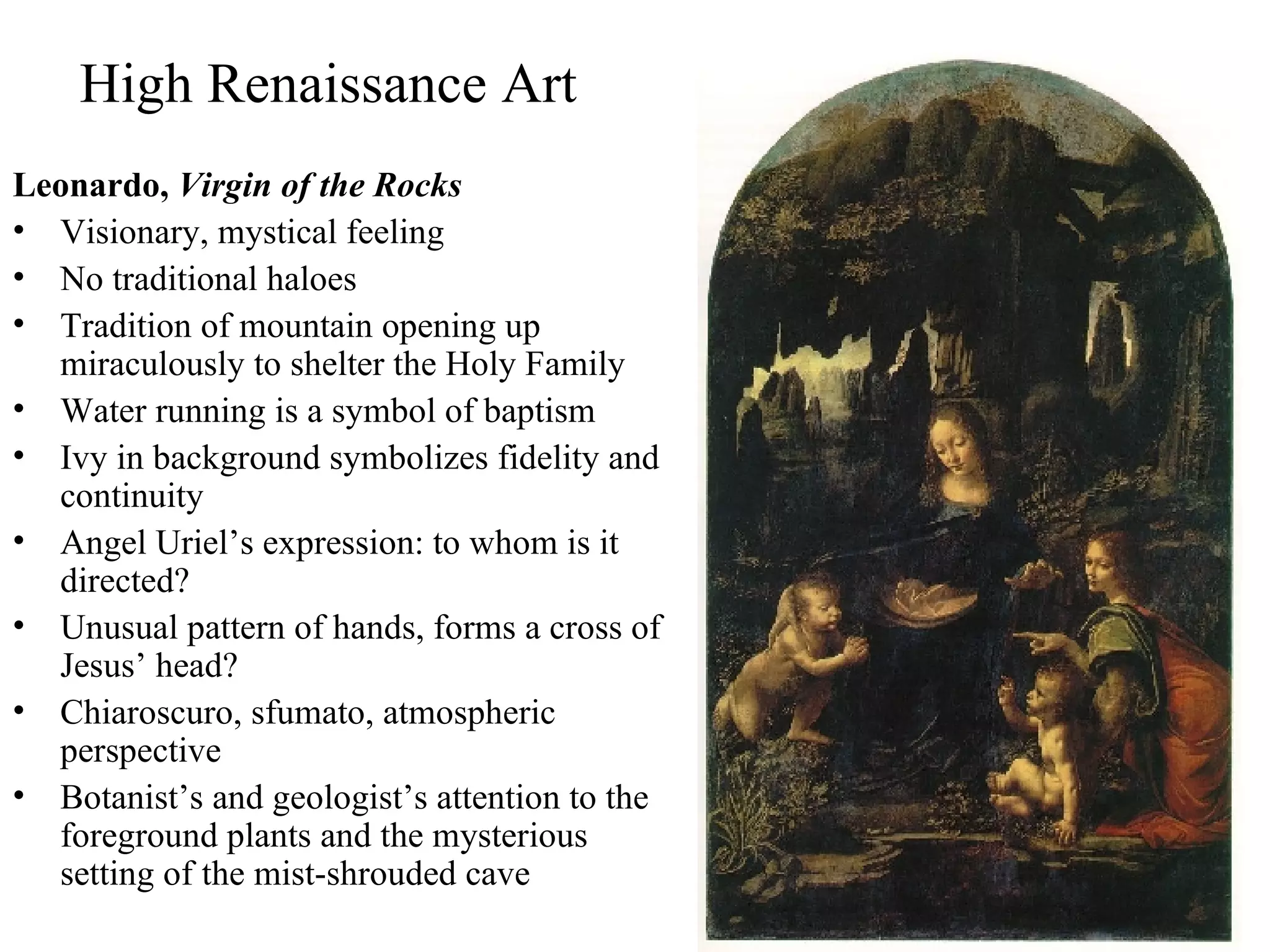
High Renaissance Art Leonardo,  Virgin of the Rocks Visionary, mystical feeling No traditional haloes Tradition of mountain opening up miraculously to shelter the Holy Family Water running is a symbol of baptism Ivy in background symbolizes fidelity and continuity Angel Uriel’s expression: to whom is it directed? Unusual pattern of hands, forms a cross of Jesus’ head? Chiaroscuro, sfumato, atmospheric perspective Botanist’s and geologist’s attention to the foreground plants and the mysterious setting of the mist-shrouded cave
High Renaissance Art Leonardo,  Last Supper Only remaining work in situ, painted on a wall of the monks’ dining room Oil, tempera, fresco technique on a damp wall made the fresco flake Captures the moment when Christ says, “One of you will betray me” Christ appears calm amid the storm of animated gestures Various psychological portraits in the reactions of the apostles: surprise, anger, fear, denial, etc. Rhythmic groupings of three, Christ at center in open-armed pose of serene acceptance Perspective beams of the ceiling, floor and tapestries on walls point to Christ Fictional space advances real space of room Pyramidical shape of Christ’s body, a favorite High Renaissance form Subtle halo of the rounded pediment above his head Three windows symbolize the Trinity Judas obscured by darkness falls back, clutching his bag of coins
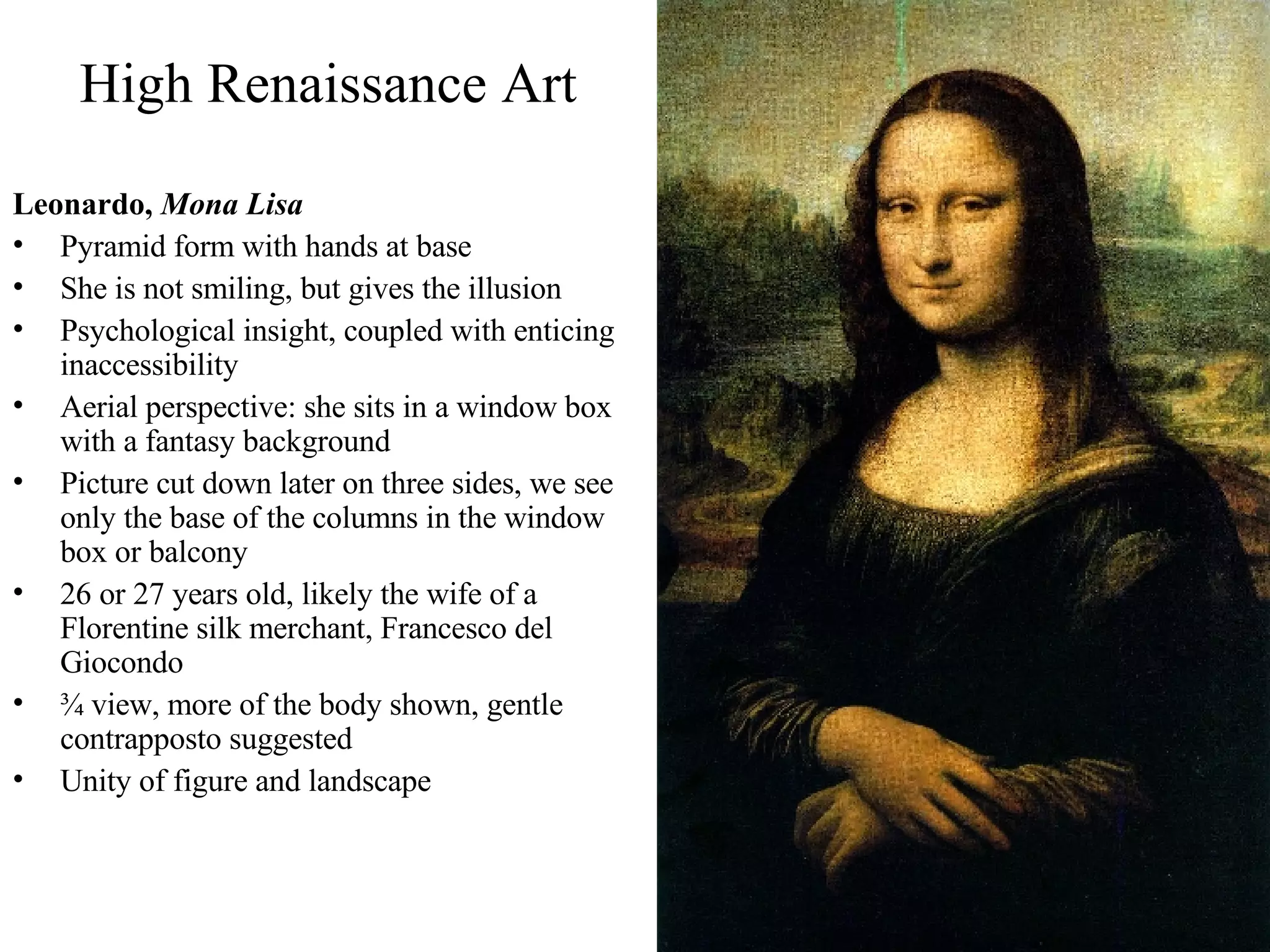
High Renaissance Art Leonardo,  Mona Lisa Pyramid form with hands at base She is not smiling, but gives the illusion Psychological insight, coupled with enticing inaccessibility Aerial perspective: she sits in a window box with a fantasy background Picture cut down later on three sides, we see only the base of the columns in the window box or balcony 26 or 27 years old, likely the wife of a Florentine silk merchant, Francesco del Giocondo ¾ view, more of the body shown, gentle contrapposto suggested Unity of figure and landscape
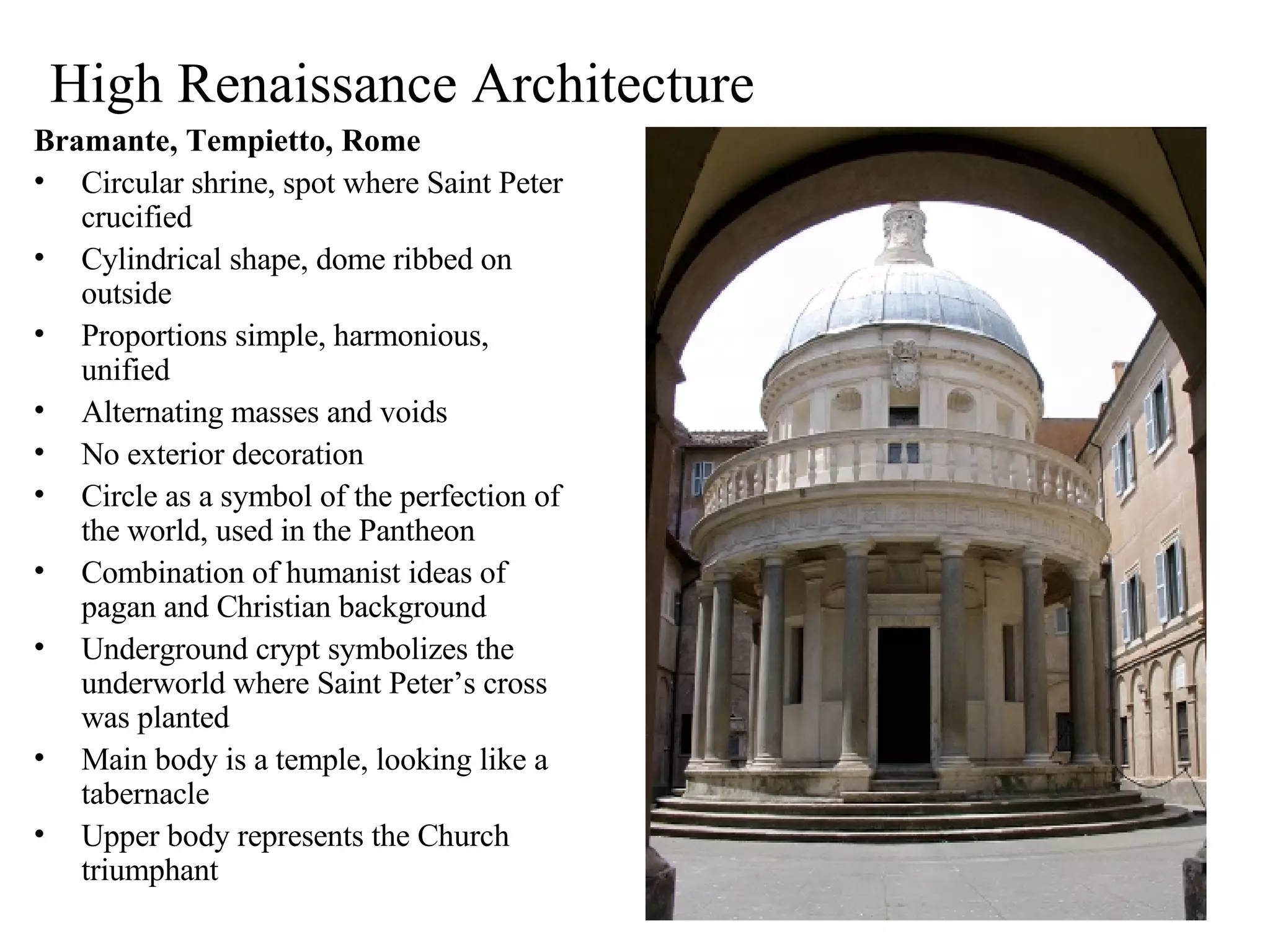
High Renaissance Architecture Bramante, Tempietto, Rome Circular shrine, spot where Saint Peter crucified Cylindrical shape, dome ribbed on outside Proportions simple, harmonious, unified Alternating masses and voids No exterior decoration Circle as a symbol of the perfection of the world, used in the Pantheon Combination of humanist ideas of pagan and Christian background Underground crypt symbolizes the underworld where Saint Peter’s cross was planted Main body is a temple, looking like a tabernacle Upper body represents the Church triumphant
Bramante, Saint Peter’s, Rome Greek cross, four sides equal Exact hemisphere of a dome, planned like the Pantheon Bell towers frame main dome; drum added for height Interior: coupled pilasters, one giant story as in Sant’Andrea Never finished according to Bramante’s plan Smaller domes accent main dome
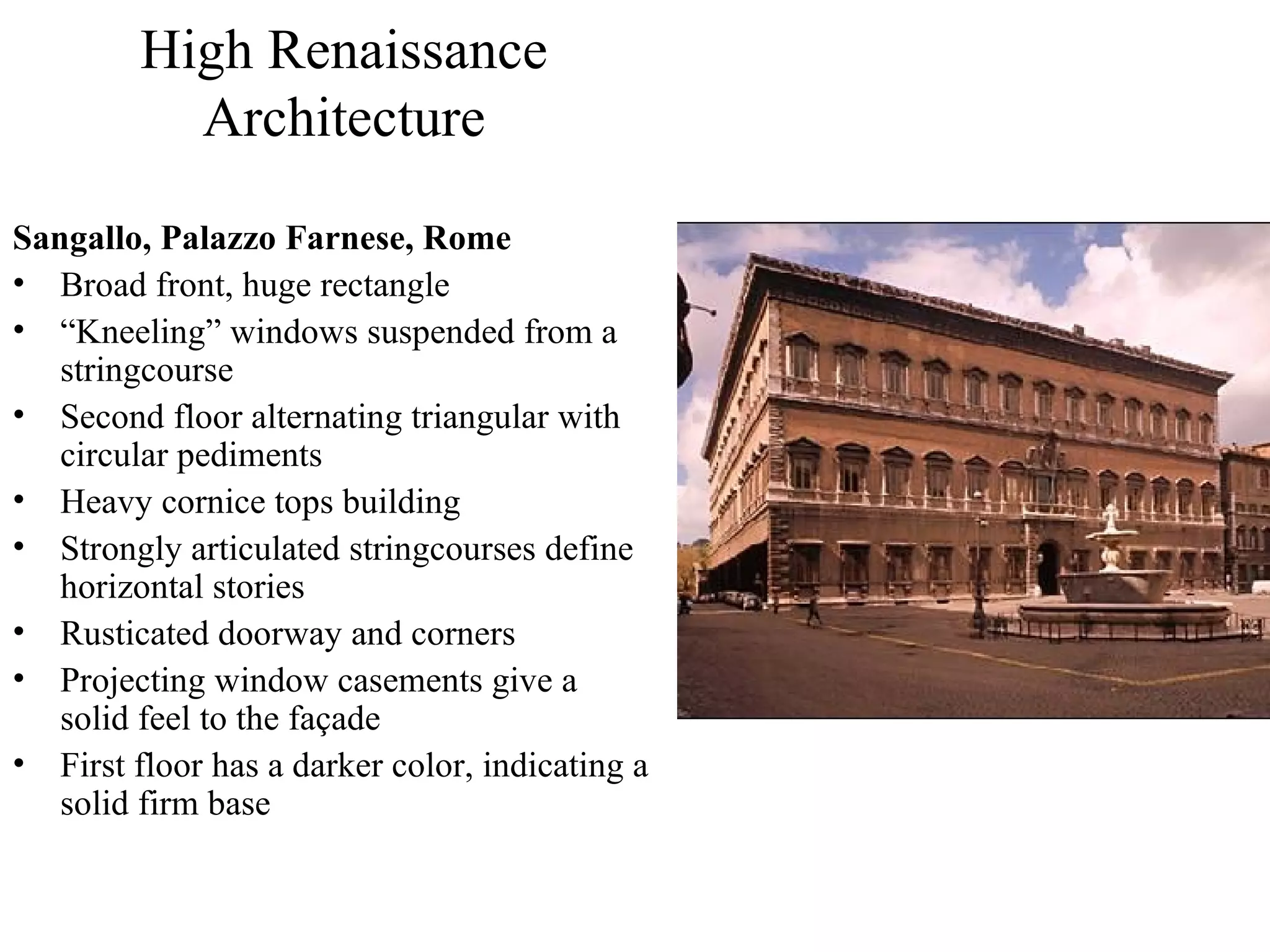
High Renaissance Architecture Sangallo, Palazzo Farnese, Rome Broad front, huge rectangle “ Kneeling” windows suspended from a stringcourse Second floor alternating triangular with circular pediments Heavy cornice tops building Strongly articulated stringcourses define horizontal stories Rusticated doorway and corners Projecting window casements give a solid feel to the façade First floor has a darker color, indicating a solid firm base
High Renaissance Art Michelangelo,  David Terribilità First colossal nude since the ancient world Challenging figure: calm, tense, concentrating on the enemy Optimum vantage point is from the front and below, not meant to be seen from the back Slight contrapposto Monumentality, simplicity Undercutting of brow, piercing eyes Sense of alertness, awareness Holds slingshot over shoulder, rock in hand Placed in front of city hall of Florence Came to symbolize victorious Florence against larger enemies
Michelangelo, Sistine Ceiling, Rome 4 years to paint, 300 figures, no two of which are in the same pose; 70 feet from floor Nine main episodes from the book of Genesis, opening book of the Bible Done at the behest of Pope Julius II
Michelangelo,  Creation of Adam Fourth scene on the vault of the Sistine Ceiling Monumental forms, solid figures God creates Adam in “his image and likeness” Center: two hands do not touch, there is a distance between them God the Father is awesome in his power of love, his kindness to create Adam modeled on an ancient Roman river god Two great forms: Adam as earth and God as sky Essentially separate units
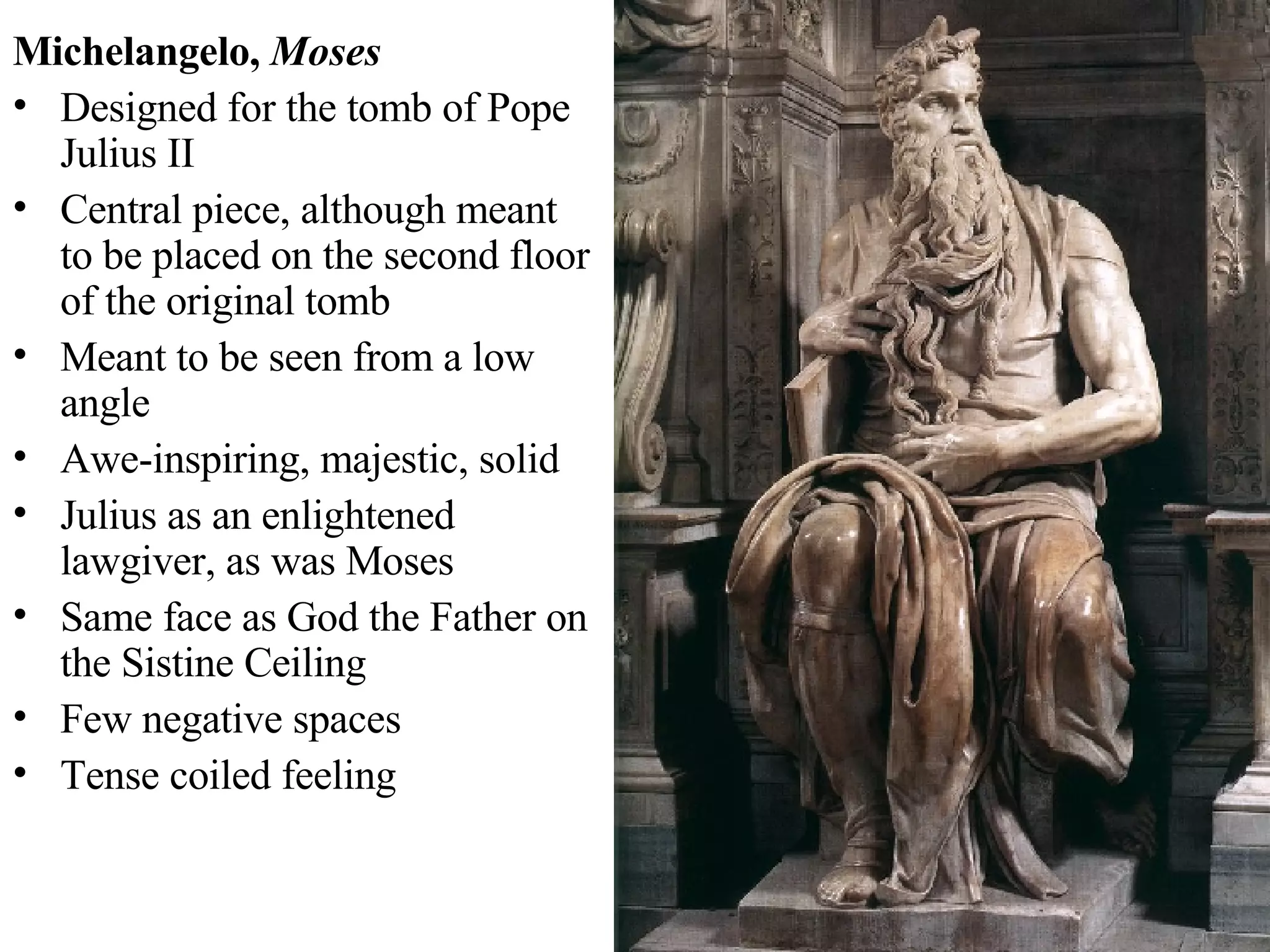
Michelangelo,  Moses Designed for the tomb of Pope Julius II Central piece, although meant to be placed on the second floor of the original tomb Meant to be seen from a low angle  Awe-inspiring, majestic, solid Julius as an enlightened lawgiver, as was Moses Same face as God the Father on the Sistine Ceiling Few negative spaces Tense coiled feeling
High Renaissance Art Raphael,  Madonna in the Meadow Triangular composition echoing Leonardo Atmospheric perspective, sun-drenched landscape Clear, ordered and deceptively simple composition, but poses complex Tenderness and love expressed Graceful, tender expressions Strong diagonals control composition
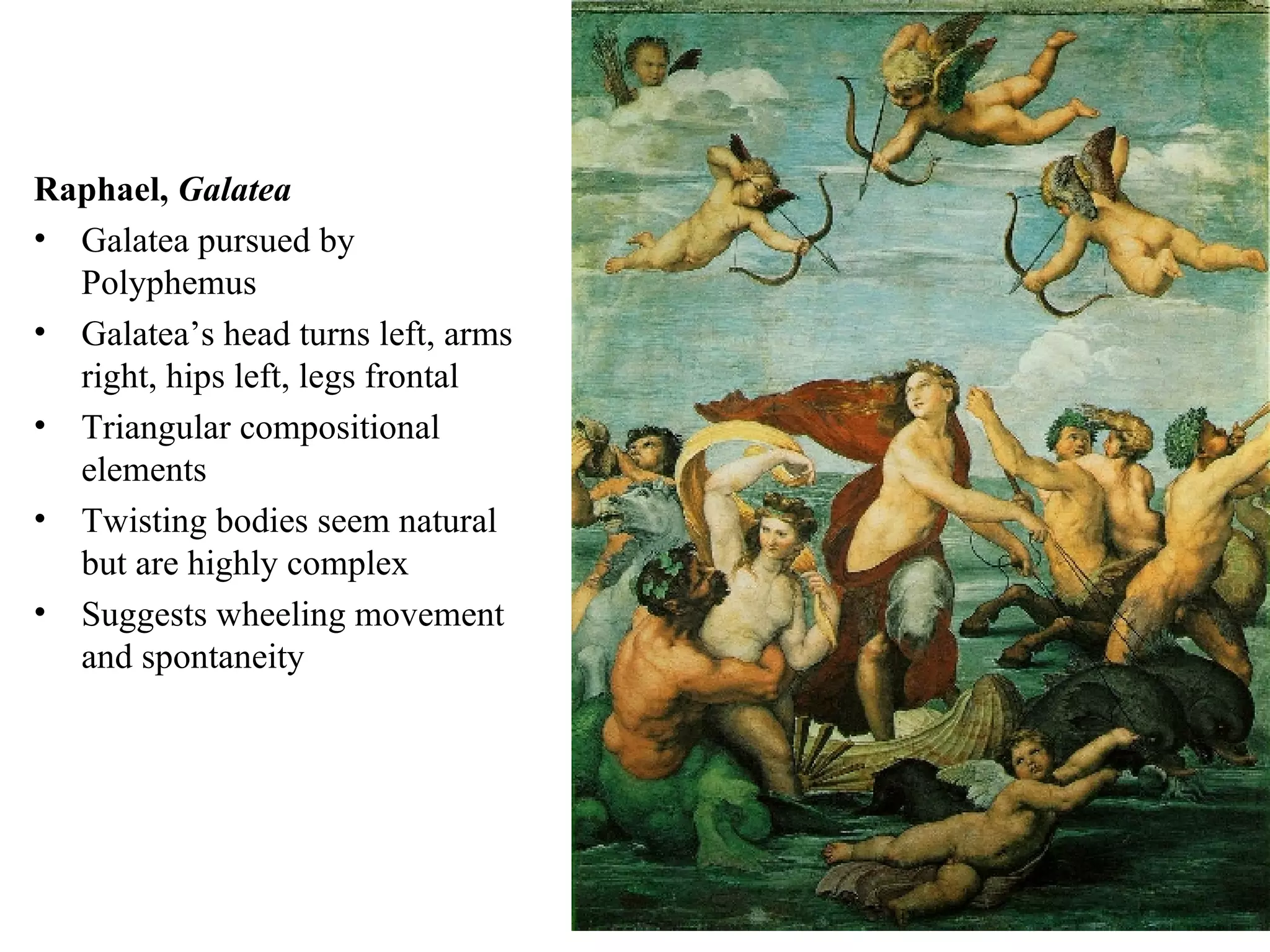
Raphael,  Galatea  Galatea pursued by Polyphemus Galatea’s head turns left, arms right, hips left, legs frontal Triangular compositional elements Twisting bodies seem natural but are highly complex Suggests wheeling movement and spontaneity
High Renaissance Art Raphael,  School of Athens Painted for Pope Julius II’s library/study Greek philosophers of ancient world in muted conversation No dominant colors, weaving of various hues Clear, open piazza-like structure Perspective points to two central figures under a barrel vault that resembles Saint Peter’s by Bramante Plato and Aristotle in center as greatest of philosophers Plato has Leonardo’s features Plato points up revealing his philosophy of another ideal world Aristotle points outward to indicate that this material world is the only world Bramante as Euclid, balding, in lower right Raphael second from the far right, among the scientists, mathematicians and astronomers Michelangelo, as Heraclitus, composing a sonnet in the front foreground painted in his own style
 
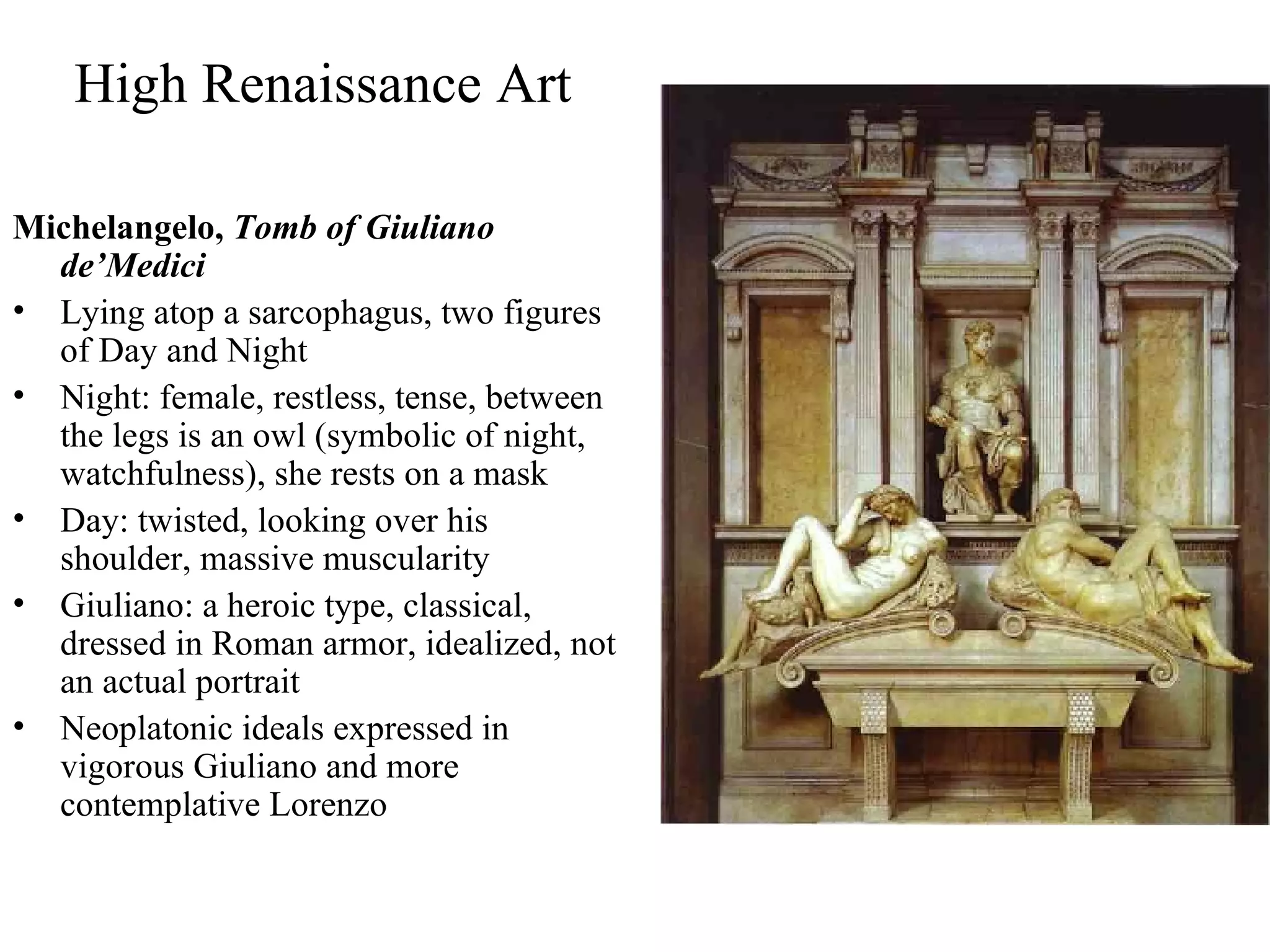
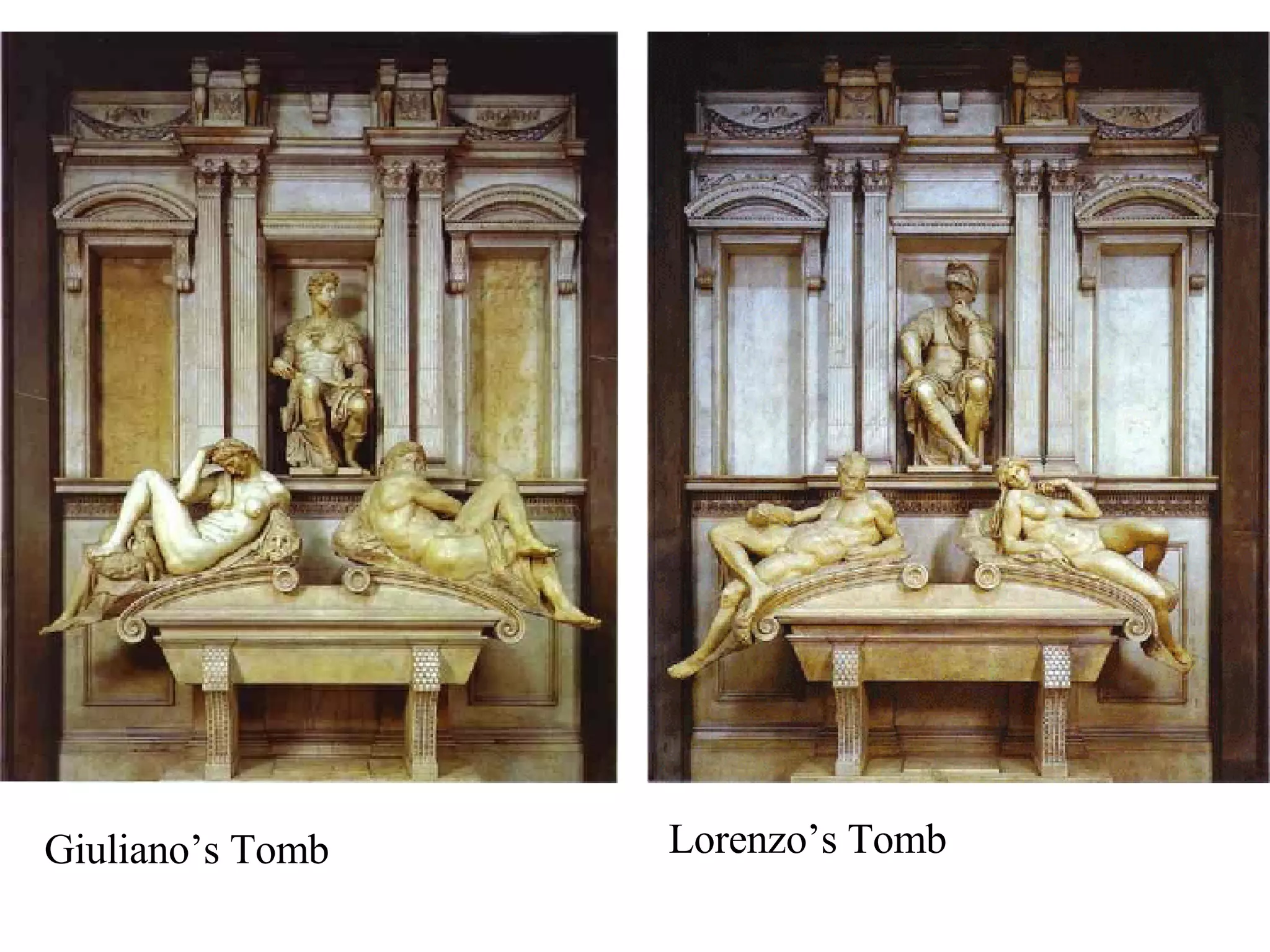
High Renaissance Art Michelangelo,  Tomb of Giuliano de’Medici Lying atop a sarcophagus, two figures of Day and Night  Night: female, restless, tense, between the legs is an owl (symbolic of night, watchfulness), she rests on a mask Day: twisted, looking over his shoulder, massive muscularity Giuliano: a heroic type, classical, dressed in Roman armor, idealized, not an actual portrait Neoplatonic ideals expressed in vigorous Giuliano and more contemplative Lorenzo
Giuliano’s Tomb Lorenzo’s Tomb
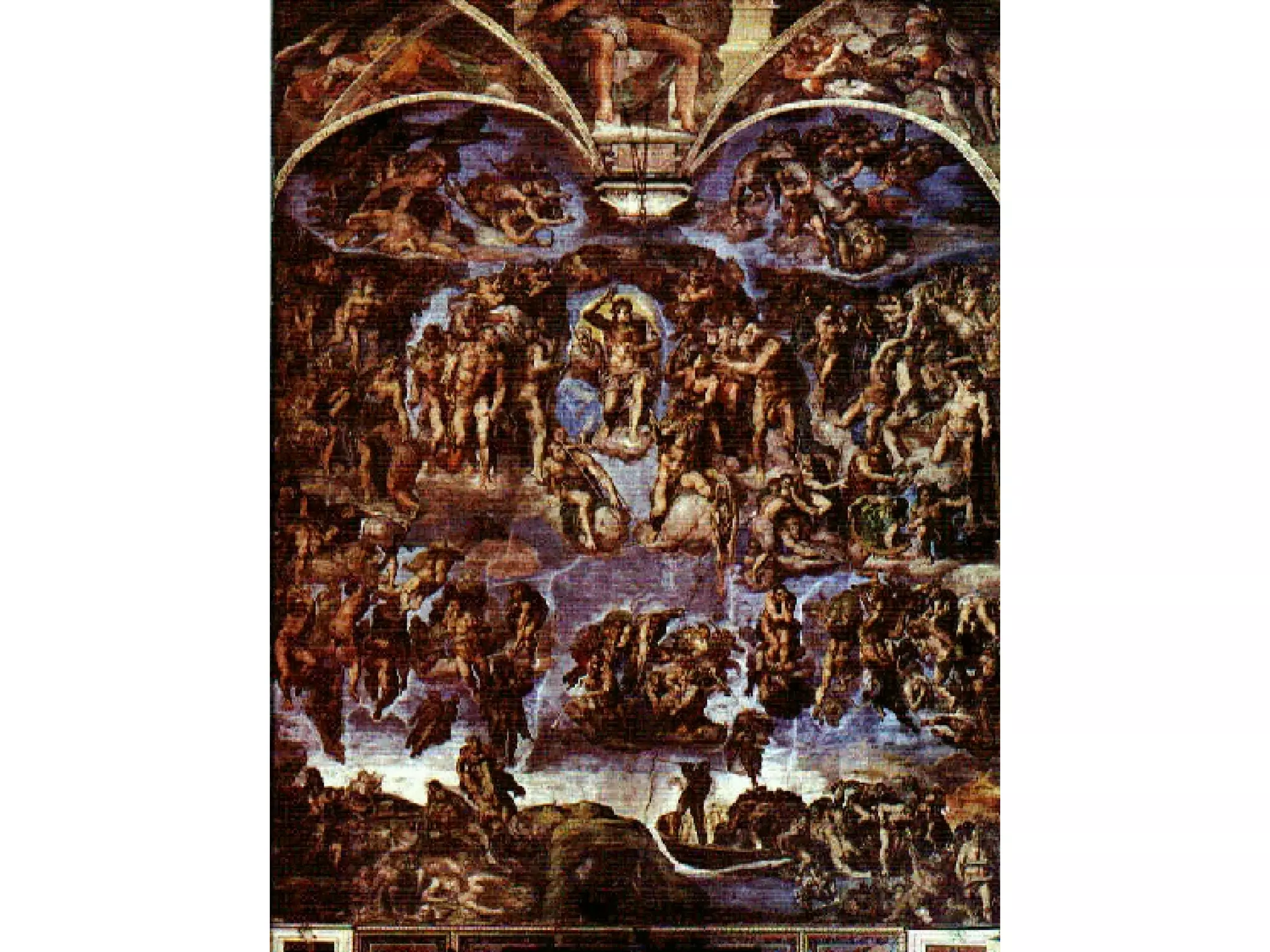
High Renaissance Art Michelangelo,  Last Judgment Beginnings of Mannerism seen here: distortion of the figures, elongation Apollo-like Christ comes to bring the saved to heaven and condemn the lost to Hell No weighing of souls, he passes judgment with a movement of his hands Christ defiantly swings away the evil souls, gently lifts the blessed He is surrounded by the martyrs and saints of the church On the skin held by Saint Bartholomew is a self-portrait of Michelangelo Charon ferries the damned into Hell at bottom right A serpent wrapped around his torso, Minos awaits to place the damned Twisting, complex, and convoluted composition Composition organized in horizontal layers
 
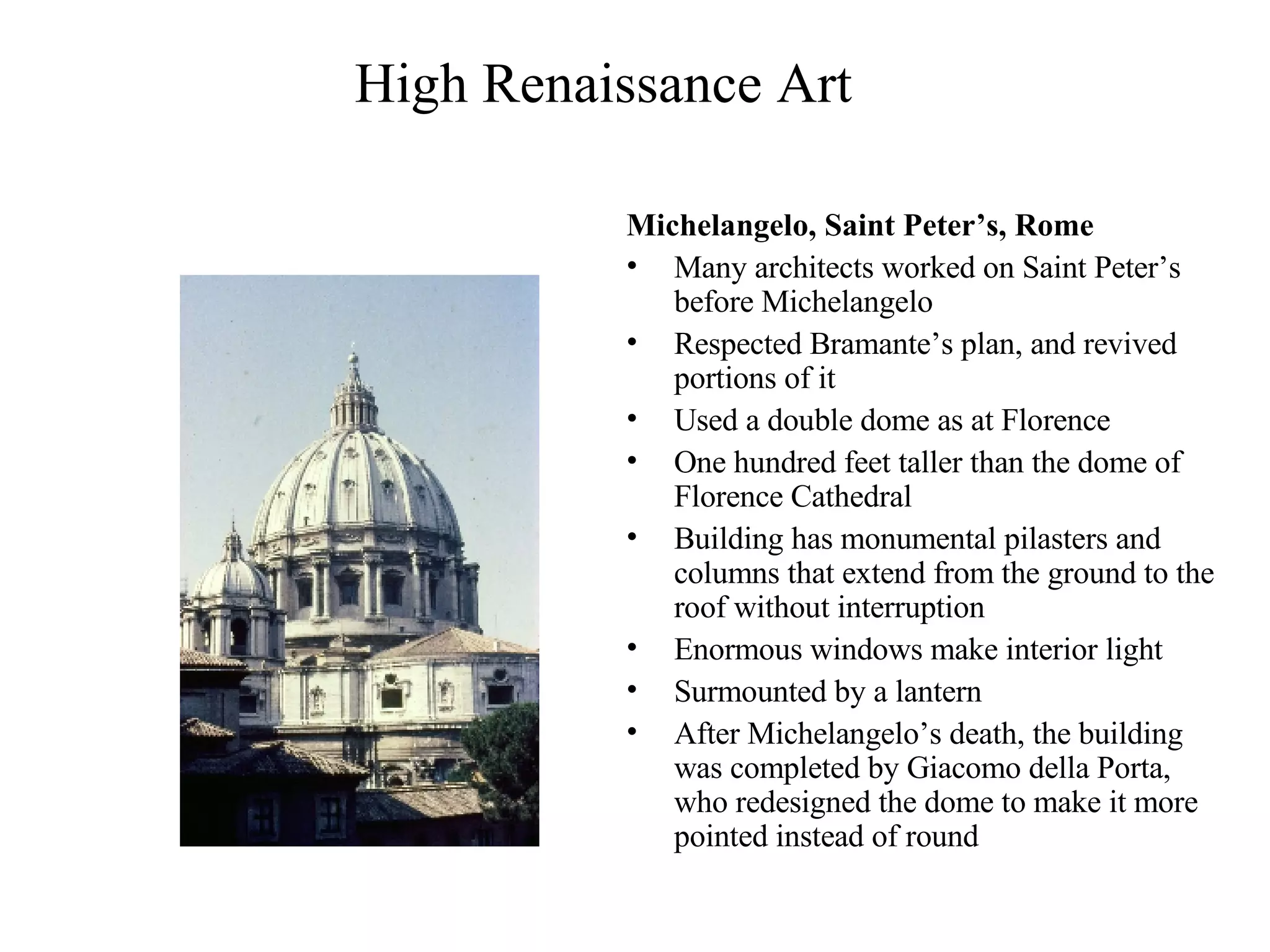
High Renaissance Art Michelangelo, Saint Peter’s, Rome   Many architects worked on Saint Peter’s before Michelangelo Respected Bramante’s plan, and revived portions of it Used a double dome as at Florence One hundred feet taller than the dome of Florence Cathedral Building has monumental pilasters and columns that extend from the ground to the roof without interruption Enormous windows make interior light Surmounted by a lantern After Michelangelo’s death, the building was completed by Giacomo della Porta, who redesigned the dome to make it more pointed instead of round

High Renaissance Post

  • 1.
    High Renaissance ArtLeonardo, Virgin of the Rocks Visionary, mystical feeling No traditional haloes Tradition of mountain opening up miraculously to shelter the Holy Family Water running is a symbol of baptism Ivy in background symbolizes fidelity and continuity Angel Uriel’s expression: to whom is it directed? Unusual pattern of hands, forms a cross of Jesus’ head? Chiaroscuro, sfumato, atmospheric perspective Botanist’s and geologist’s attention to the foreground plants and the mysterious setting of the mist-shrouded cave
  • 2.
    High Renaissance ArtLeonardo, Last Supper Only remaining work in situ, painted on a wall of the monks’ dining room Oil, tempera, fresco technique on a damp wall made the fresco flake Captures the moment when Christ says, “One of you will betray me” Christ appears calm amid the storm of animated gestures Various psychological portraits in the reactions of the apostles: surprise, anger, fear, denial, etc. Rhythmic groupings of three, Christ at center in open-armed pose of serene acceptance Perspective beams of the ceiling, floor and tapestries on walls point to Christ Fictional space advances real space of room Pyramidical shape of Christ’s body, a favorite High Renaissance form Subtle halo of the rounded pediment above his head Three windows symbolize the Trinity Judas obscured by darkness falls back, clutching his bag of coins
  • 3.
    High Renaissance ArtLeonardo, Mona Lisa Pyramid form with hands at base She is not smiling, but gives the illusion Psychological insight, coupled with enticing inaccessibility Aerial perspective: she sits in a window box with a fantasy background Picture cut down later on three sides, we see only the base of the columns in the window box or balcony 26 or 27 years old, likely the wife of a Florentine silk merchant, Francesco del Giocondo ¾ view, more of the body shown, gentle contrapposto suggested Unity of figure and landscape
  • 4.
    High Renaissance ArchitectureBramante, Tempietto, Rome Circular shrine, spot where Saint Peter crucified Cylindrical shape, dome ribbed on outside Proportions simple, harmonious, unified Alternating masses and voids No exterior decoration Circle as a symbol of the perfection of the world, used in the Pantheon Combination of humanist ideas of pagan and Christian background Underground crypt symbolizes the underworld where Saint Peter’s cross was planted Main body is a temple, looking like a tabernacle Upper body represents the Church triumphant
  • 5.
    Bramante, Saint Peter’s,Rome Greek cross, four sides equal Exact hemisphere of a dome, planned like the Pantheon Bell towers frame main dome; drum added for height Interior: coupled pilasters, one giant story as in Sant’Andrea Never finished according to Bramante’s plan Smaller domes accent main dome
  • 6.
    High Renaissance ArchitectureSangallo, Palazzo Farnese, Rome Broad front, huge rectangle “ Kneeling” windows suspended from a stringcourse Second floor alternating triangular with circular pediments Heavy cornice tops building Strongly articulated stringcourses define horizontal stories Rusticated doorway and corners Projecting window casements give a solid feel to the façade First floor has a darker color, indicating a solid firm base
  • 7.
    High Renaissance ArtMichelangelo, David Terribilità First colossal nude since the ancient world Challenging figure: calm, tense, concentrating on the enemy Optimum vantage point is from the front and below, not meant to be seen from the back Slight contrapposto Monumentality, simplicity Undercutting of brow, piercing eyes Sense of alertness, awareness Holds slingshot over shoulder, rock in hand Placed in front of city hall of Florence Came to symbolize victorious Florence against larger enemies
  • 8.
    Michelangelo, Sistine Ceiling,Rome 4 years to paint, 300 figures, no two of which are in the same pose; 70 feet from floor Nine main episodes from the book of Genesis, opening book of the Bible Done at the behest of Pope Julius II
  • 9.
    Michelangelo, Creationof Adam Fourth scene on the vault of the Sistine Ceiling Monumental forms, solid figures God creates Adam in “his image and likeness” Center: two hands do not touch, there is a distance between them God the Father is awesome in his power of love, his kindness to create Adam modeled on an ancient Roman river god Two great forms: Adam as earth and God as sky Essentially separate units
  • 10.
    Michelangelo, MosesDesigned for the tomb of Pope Julius II Central piece, although meant to be placed on the second floor of the original tomb Meant to be seen from a low angle Awe-inspiring, majestic, solid Julius as an enlightened lawgiver, as was Moses Same face as God the Father on the Sistine Ceiling Few negative spaces Tense coiled feeling
  • 11.
    High Renaissance ArtRaphael, Madonna in the Meadow Triangular composition echoing Leonardo Atmospheric perspective, sun-drenched landscape Clear, ordered and deceptively simple composition, but poses complex Tenderness and love expressed Graceful, tender expressions Strong diagonals control composition
  • 12.
    Raphael, Galatea Galatea pursued by Polyphemus Galatea’s head turns left, arms right, hips left, legs frontal Triangular compositional elements Twisting bodies seem natural but are highly complex Suggests wheeling movement and spontaneity
  • 13.
    High Renaissance ArtRaphael, School of Athens Painted for Pope Julius II’s library/study Greek philosophers of ancient world in muted conversation No dominant colors, weaving of various hues Clear, open piazza-like structure Perspective points to two central figures under a barrel vault that resembles Saint Peter’s by Bramante Plato and Aristotle in center as greatest of philosophers Plato has Leonardo’s features Plato points up revealing his philosophy of another ideal world Aristotle points outward to indicate that this material world is the only world Bramante as Euclid, balding, in lower right Raphael second from the far right, among the scientists, mathematicians and astronomers Michelangelo, as Heraclitus, composing a sonnet in the front foreground painted in his own style
  • 14.
  • 15.
    High Renaissance ArtMichelangelo, Tomb of Giuliano de’Medici Lying atop a sarcophagus, two figures of Day and Night Night: female, restless, tense, between the legs is an owl (symbolic of night, watchfulness), she rests on a mask Day: twisted, looking over his shoulder, massive muscularity Giuliano: a heroic type, classical, dressed in Roman armor, idealized, not an actual portrait Neoplatonic ideals expressed in vigorous Giuliano and more contemplative Lorenzo
  • 16.
  • 17.
    High Renaissance ArtMichelangelo, Last Judgment Beginnings of Mannerism seen here: distortion of the figures, elongation Apollo-like Christ comes to bring the saved to heaven and condemn the lost to Hell No weighing of souls, he passes judgment with a movement of his hands Christ defiantly swings away the evil souls, gently lifts the blessed He is surrounded by the martyrs and saints of the church On the skin held by Saint Bartholomew is a self-portrait of Michelangelo Charon ferries the damned into Hell at bottom right A serpent wrapped around his torso, Minos awaits to place the damned Twisting, complex, and convoluted composition Composition organized in horizontal layers
  • 18.
  • 19.
    High Renaissance ArtMichelangelo, Saint Peter’s, Rome Many architects worked on Saint Peter’s before Michelangelo Respected Bramante’s plan, and revived portions of it Used a double dome as at Florence One hundred feet taller than the dome of Florence Cathedral Building has monumental pilasters and columns that extend from the ground to the roof without interruption Enormous windows make interior light Surmounted by a lantern After Michelangelo’s death, the building was completed by Giacomo della Porta, who redesigned the dome to make it more pointed instead of round