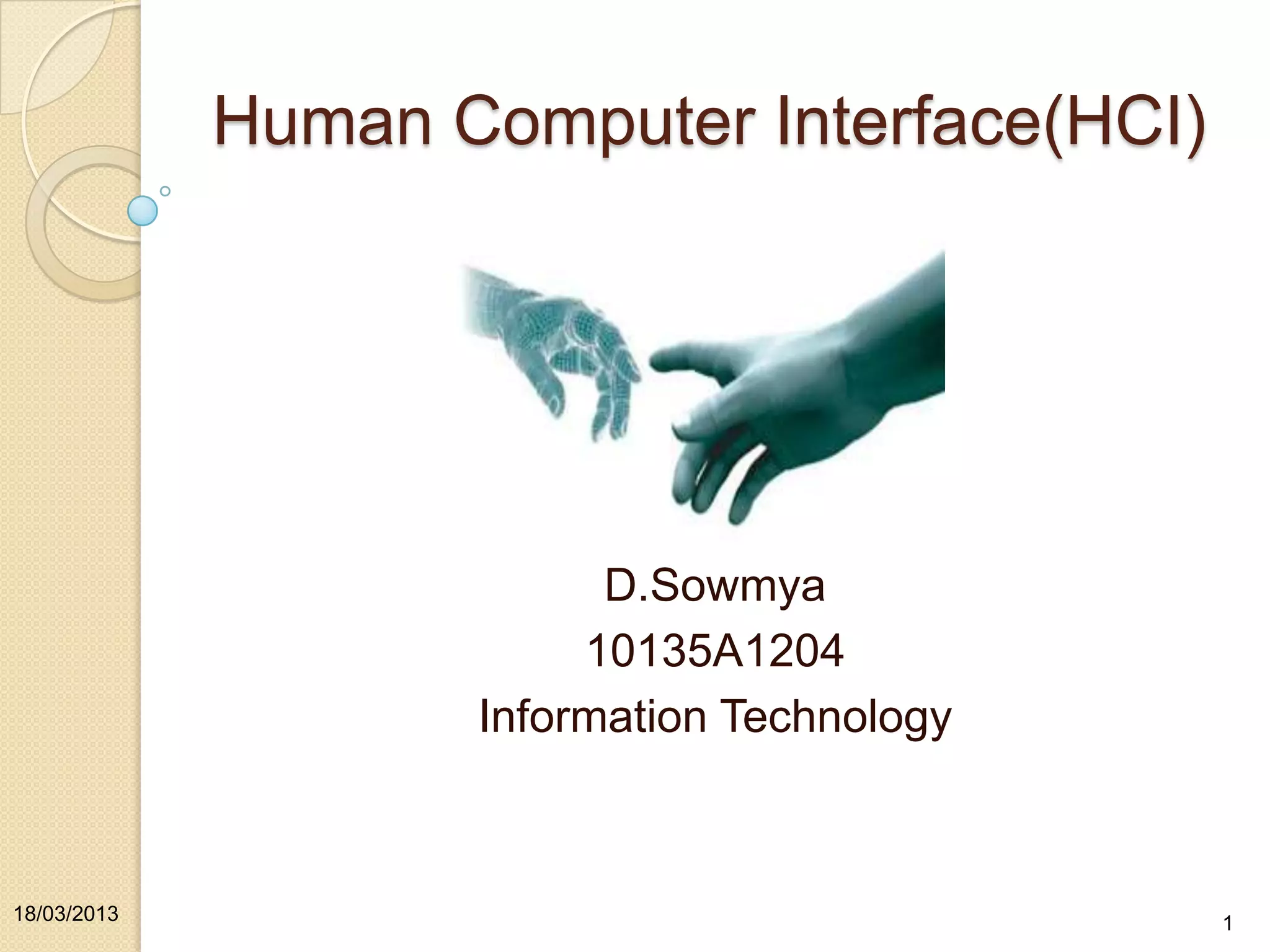
Human Computer Interface(HCI)
D.Sowmya
10135A1204
Information Technology
18/03/2013 1
Outline
 Introduction
 What is HCI?
 Types of interfaces
 Existing technologies
 Advances in HCI
 Architecture
 Applications
 Advantages and Disadvantages
 Conclusion
 References
18/03/2013 2
Introduction
Human
• The end-user
• The members of an organization
Computer
• Hardware
• Software
Interface
• A point where two objects meet.
• A point where the human can tell the computer what to do.
• A point where the computer displays the requested information.
18/03/2013 3
What is HCI?
• A process of information transfer
 User to Machine
 Machine to User
• HCI is also referred to as Man Machine Interaction.
• HCI is what the user sees and includes:
 The physical controls
 What the system looks like?
 How the system accepts input from the user?
 How the system responds to user input?
 How the system outputs the results of processing?
18/03/2013 4
Types of Interfaces
• Command Line Interface (CLI)
A CLI displays a prompt, the user types a command on the
keyboard, the computer executes the command and provides
textual output.
• Menu Driven Interface
The user has a list of items to choose from, and can make
selections by highlighting one.
 Graphical User Interface (GUI)
Uses windows, icons, menus and pointers (WIMP) which
can be manipulated by a mouse (and often to an extent by a
keyboard as well).
 Natural Language Interface
Can range from simple command systems to voice activated
text processing. Commands are spoken in “normal” language.
18/03/2013
5
Existing Technologies
• The existing interfaces differ in the degree of complexity both
because of degree of functionality or usability.
• The user activity has three different levels:
 Physical
 Cognitive
 Affective
 The existing physical technologies for HCI basically can be
categorized by human senses.
• These devices are basically relying on three human senses: vision,
audio, and touch.
18/03/2013 6
Advances in HCI
• The new advances in HCI can be categorized in 3 sections:
wearable devices, wireless devices, and virtual devices
• Examples:
 GPS Navigation Systems
 Military super-soldier enhancing devices
 PDA
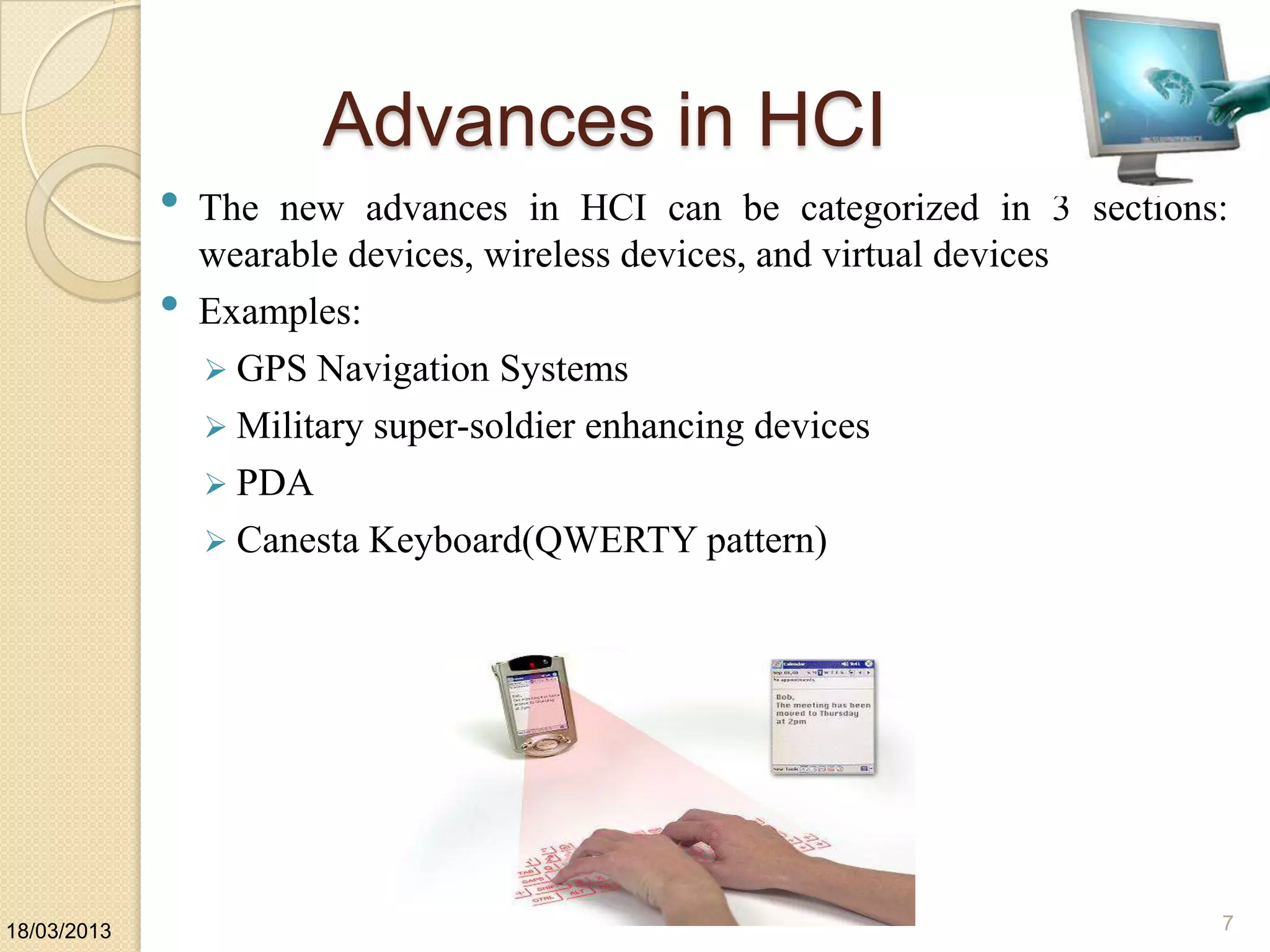
 Canesta Keyboard(QWERTY pattern)
18/03/2013 7
Contd..
• Recent advances of research in HCI are in these areas:
 Intelligent and Adaptive interfaces
 Ubiquitous computing(UbiComp)
• These interfaces involve different levels of user activity:
physical, cognitive, and affective.
• Intelligent and Adaptive Interface:
 Intelligent HCI designs are interfaces that incorporate at least
some kind of intelligence in perception from and/or response to
users.
Ex: Speech enabled interfaces that use natural language to
interact with users and devices
18/03/2013 8
Contd..
 Adaptive HCI designs, on the other hand, may not use
intelligence in the creation of interface but use it to interact
with users.
Ex: A website using regular GUI for selling various products
 Intelligent and adaptive interfaces are active interfaces
 Non-Intelligent interfaces are passive in nature
 Tablet PC is an example that uses both intelligent and adaptive
interfaces and it has handwriting recognition ability.
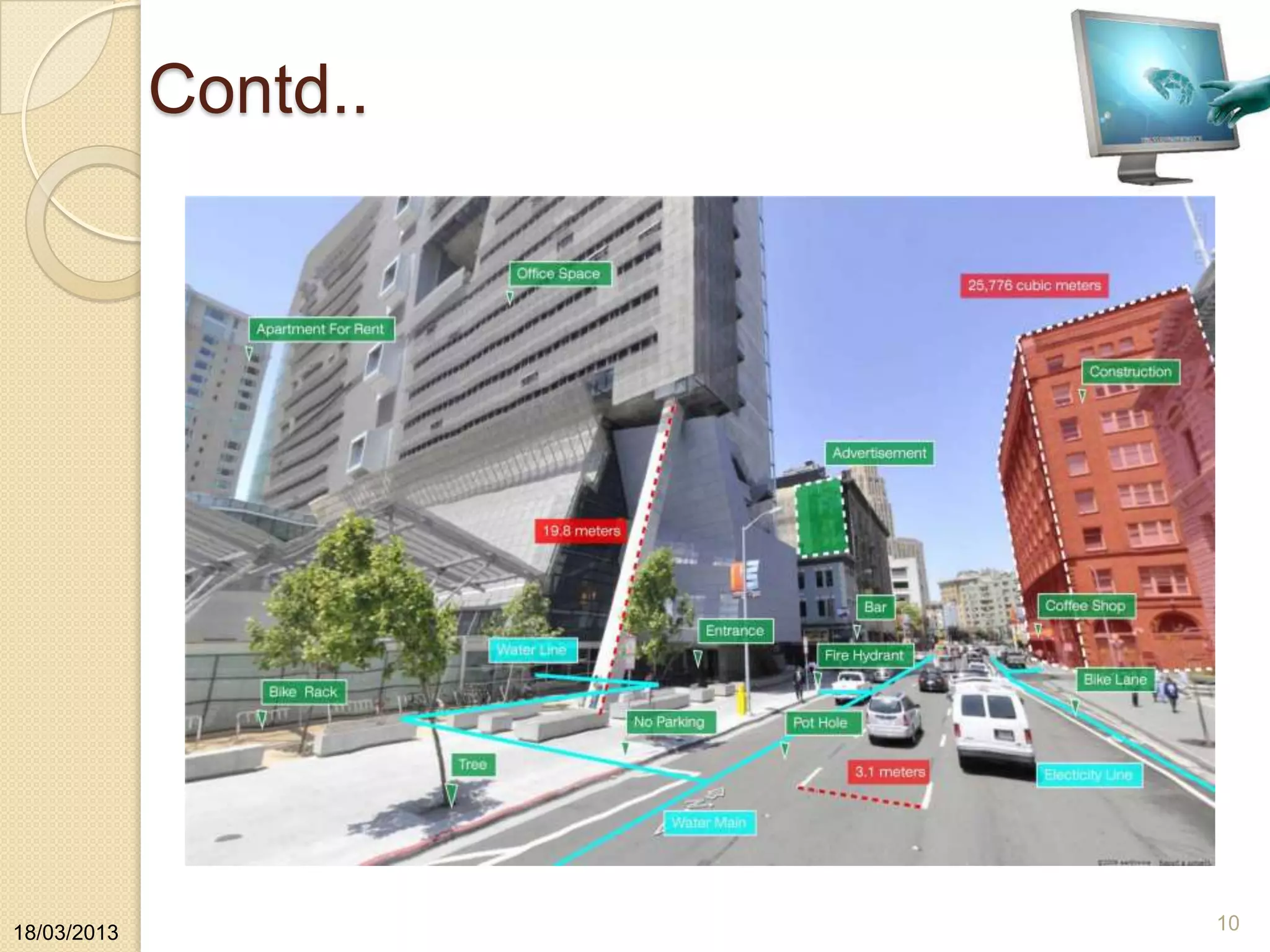
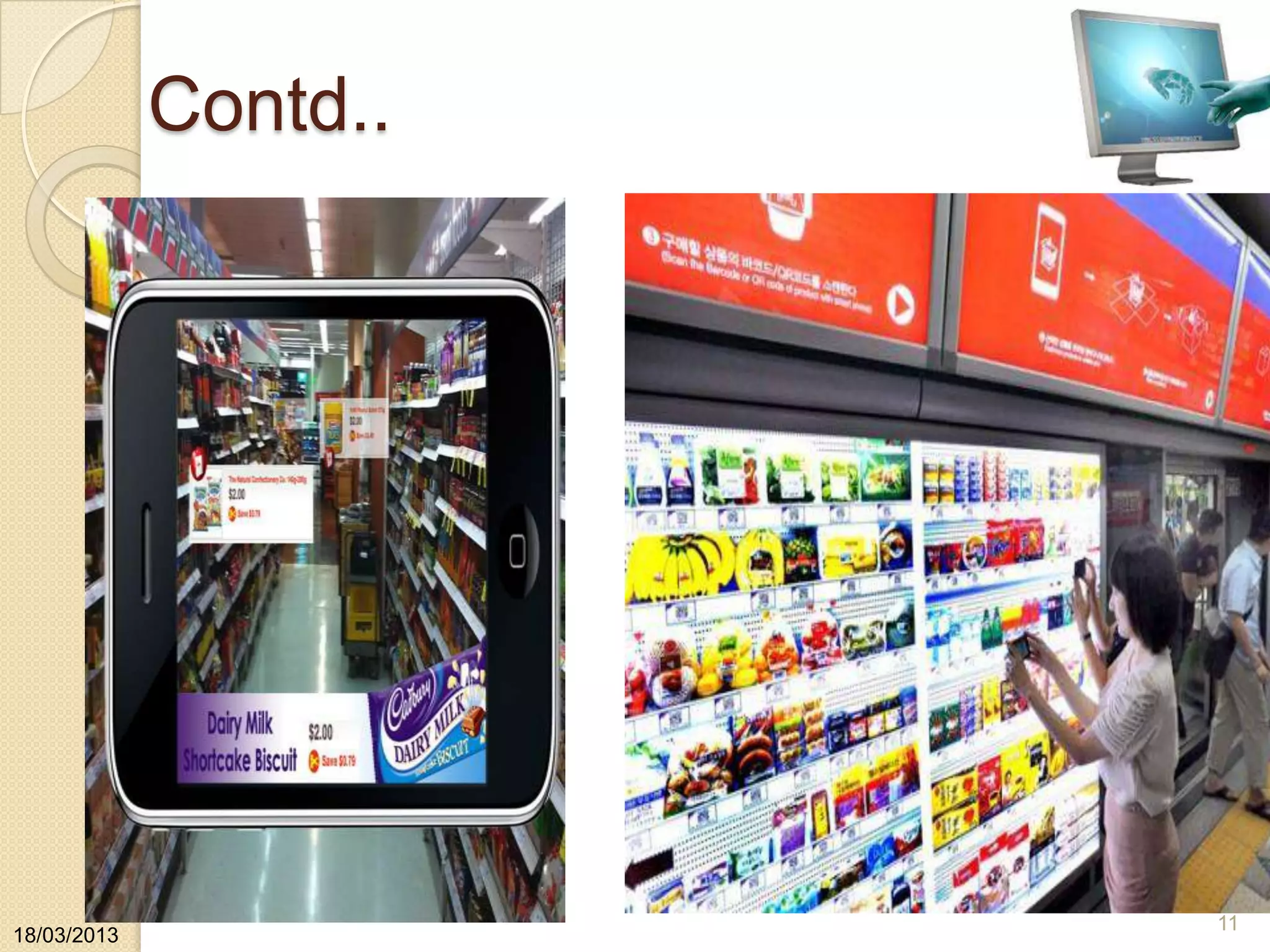
• Ubiquitous Computing:
 The idea of ubiquitous computing was to embed computers
everywhere in the environment and everyday objects so that
people could interact with many computers
18/03/2013 9
Contd..
18/03/2013 10
Contd..
18/03/2013
11
Architecture
• Architecture of any HCI systems is identified by:
 Number of inputs and outputs in the system
 Diversity of inputs and outputs in terms of modality
 Workings of these diverse input and output for interaction
purpose
• Based on different configuration and design of interface, HCI
systems can be divided into:
 Unimodal HCI system
 Multimodal HCI system
18/03/2013
12
Unimodal HCI System
• An interface mainly relies on number and diversity of its inputs
and outputs which are communication channels that enable users
to interact with computer via this interface.
• A system that is based on only one modality is called unimodal.
• Based on the nature of different modalities, they can be divided
into three categories:
 Audio-Based
 Sensor-Based
 Visual-Based
18/03/2013 13
Audio Based HCI
 It deals with information acquired by different audio signals.
 The information gathered from audio signals can be more
trustable, helpful and in some cases unique providers of
information.
 Key components:
 Microphone
 ASR(automated speech recognition) and NLU(natural language
understanding) software
 The main research areas of Audio based HCI are divided into:
 Speech Recognition
 Speaker Recognition
 Auditory Emotion Analysis
 Human-Made Noise/Sign Detections
 Musical Interaction18/03/2013
14
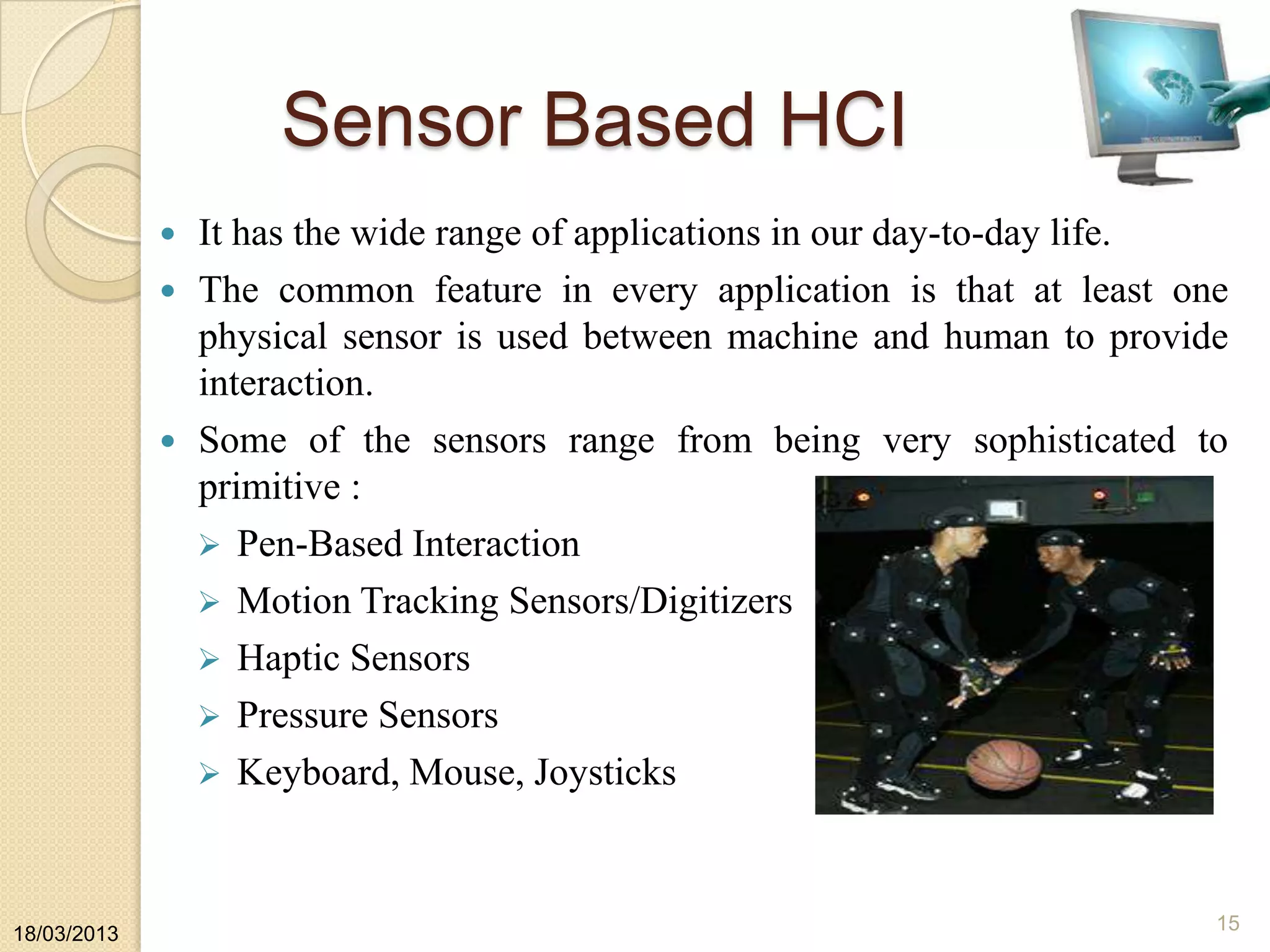
Sensor Based HCI
 It has the wide range of applications in our day-to-day life.
 The common feature in every application is that at least one
physical sensor is used between machine and human to provide
interaction.
 Some of the sensors range from being very sophisticated to
primitive :
 Pen-Based Interaction
 Motion Tracking Sensors/Digitizers
 Haptic Sensors
 Pressure Sensors
 Keyboard, Mouse, Joysticks
18/03/2013
15
Visual Based HCI
 It is also called as machine vision which is the observation of an
environment using cameras.
 In this, different aspects of human responses can be recognised
visual signals.
 Detection, identification and tracking of a real life entity and its
translation into meaningful machine/computer input.
 The main research areas of visual based HCI are:
 Facial Expression Analysis
 Body Movement tracking and Gesture recognition
 Gaze Detection
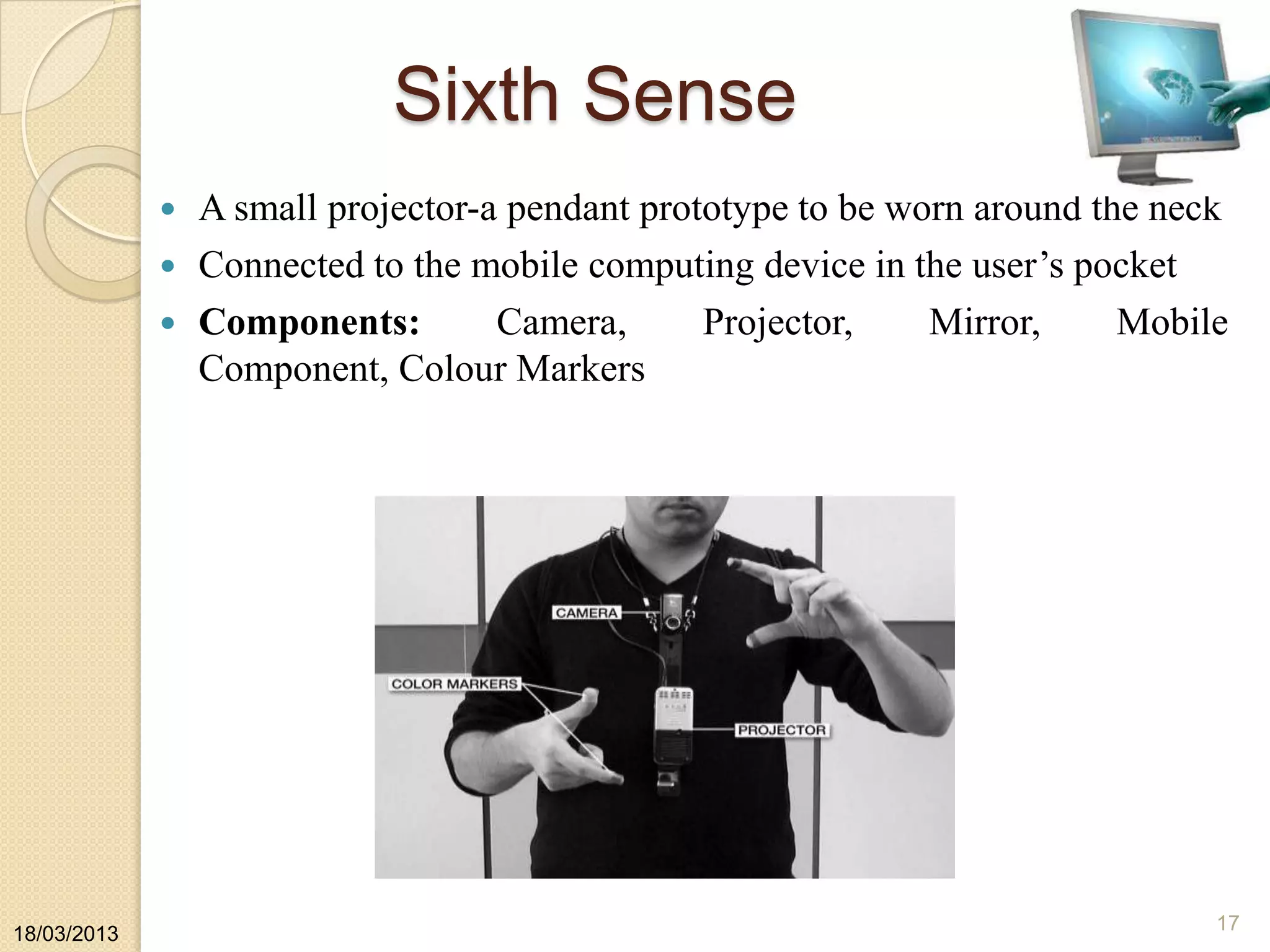
 Sixth Sense is one of the Visual based HCI technologies which is
a wearable “Gesture Based” device.
18/03/2013 16
Sixth Sense
 A small projector-a pendant prototype to be worn around the neck
 Connected to the mobile computing device in the user‟s pocket
 Components: Camera, Projector, Mirror, Mobile
Component, Colour Markers
18/03/2013
17
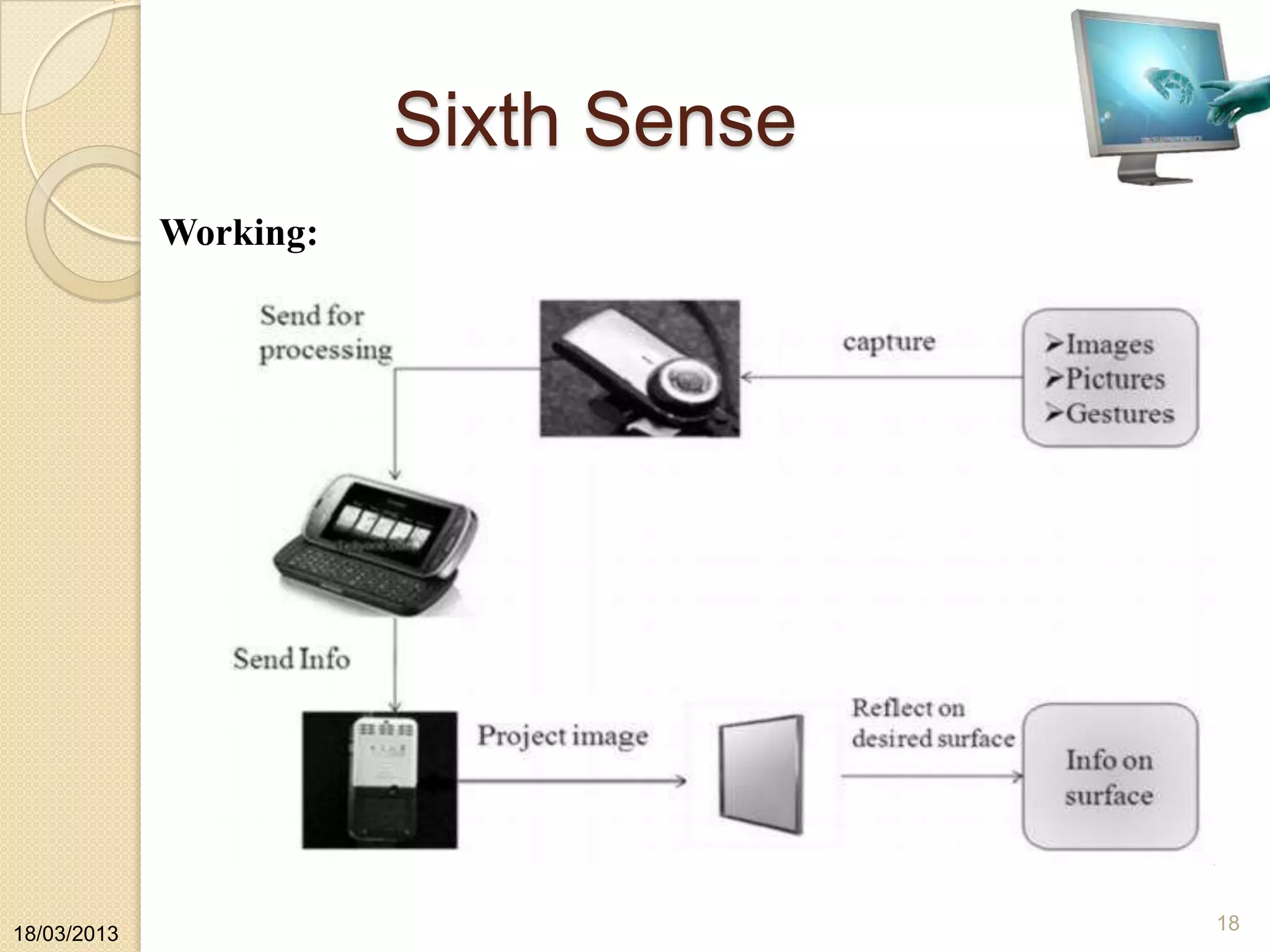
Sixth Sense
Working:
18/03/2013
18
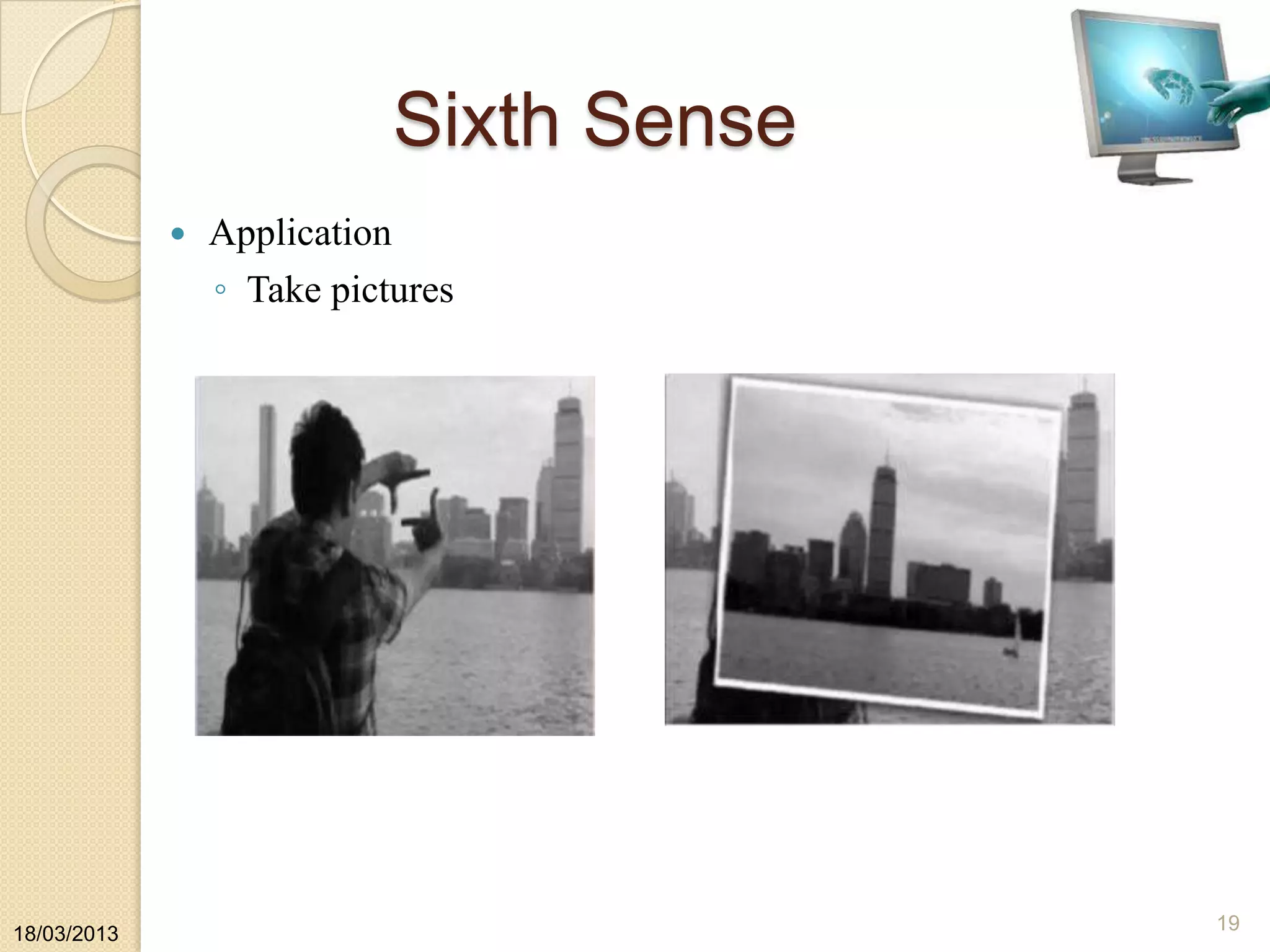
Sixth Sense
18/03/2013
19
 Application
◦ Take pictures
Limitations of Unimodal
HCI
• Not a natural way of human interaction
• Usually designed for the „average‟ user
• Fails to cater to the needs of a diverse category of people
• Difficult to use by disabled, illiterate and untrained people
• Cannot provide universal interface
18/03/2013 20
Multimodal HCI System
 Combination of multiple modalities, or usage of more than one
independent channel signals for the interaction between a user
and a machine is termed as multimodal human computer
interaction system (MMHCI).
 A multimodal interface acts as a facilitator of human-computer
interaction via two or more modes of input.
 It is easy to use by disabled, illiterate people.
 A classic example of a multimodal system is the “Put That There”
demonstration system.
18/03/2013
21
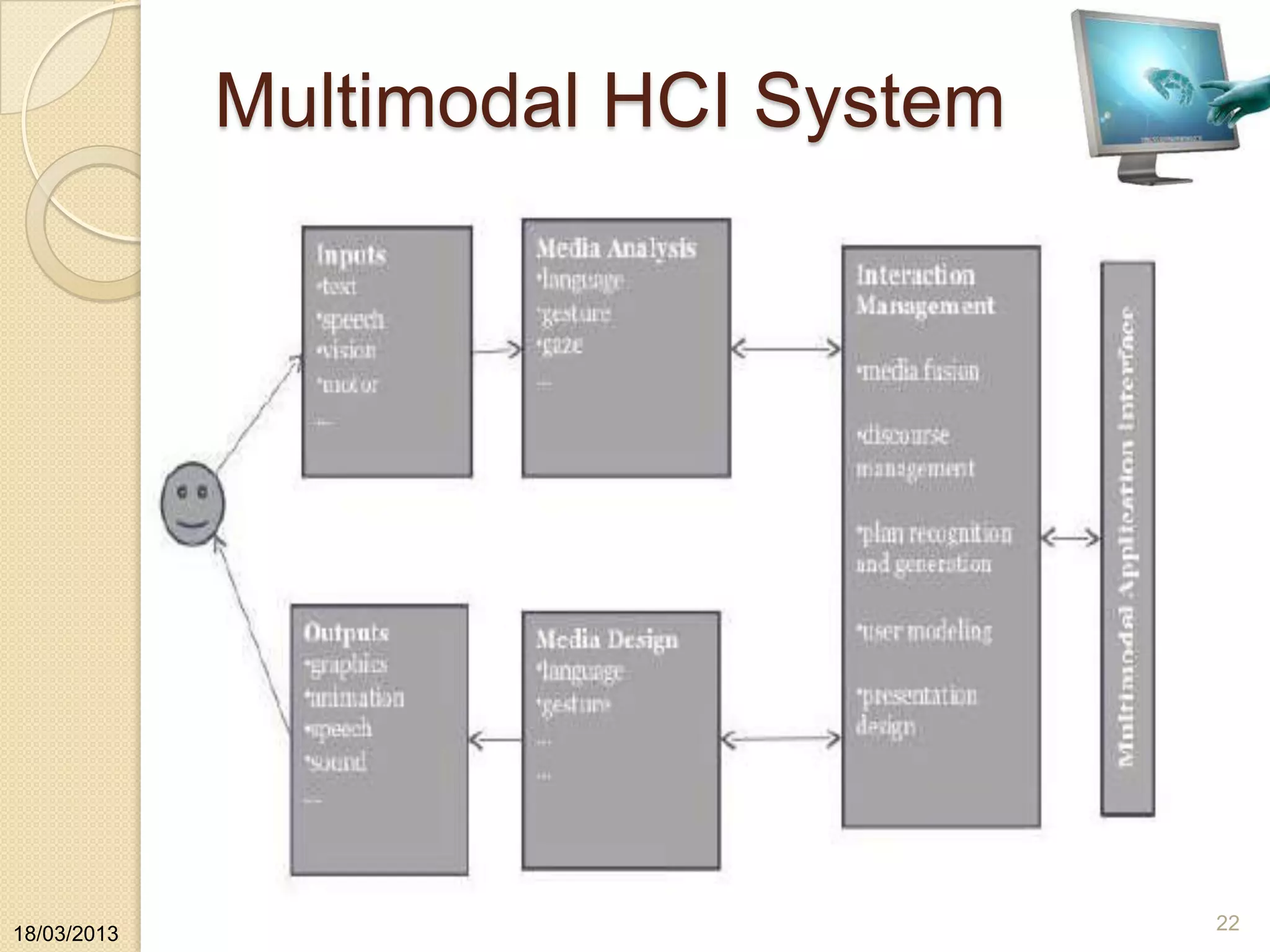
Multimodal HCI System
18/03/2013
22
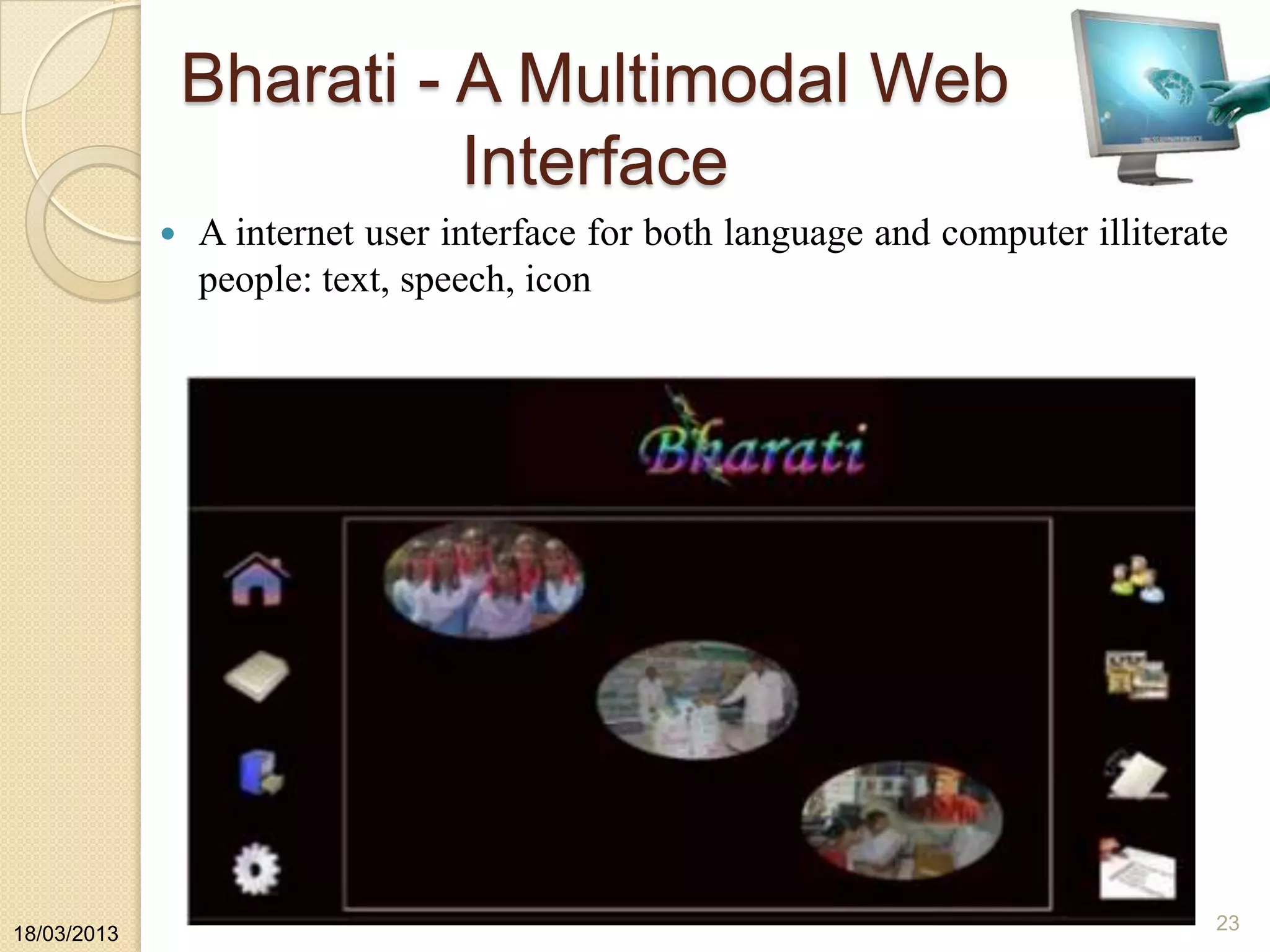
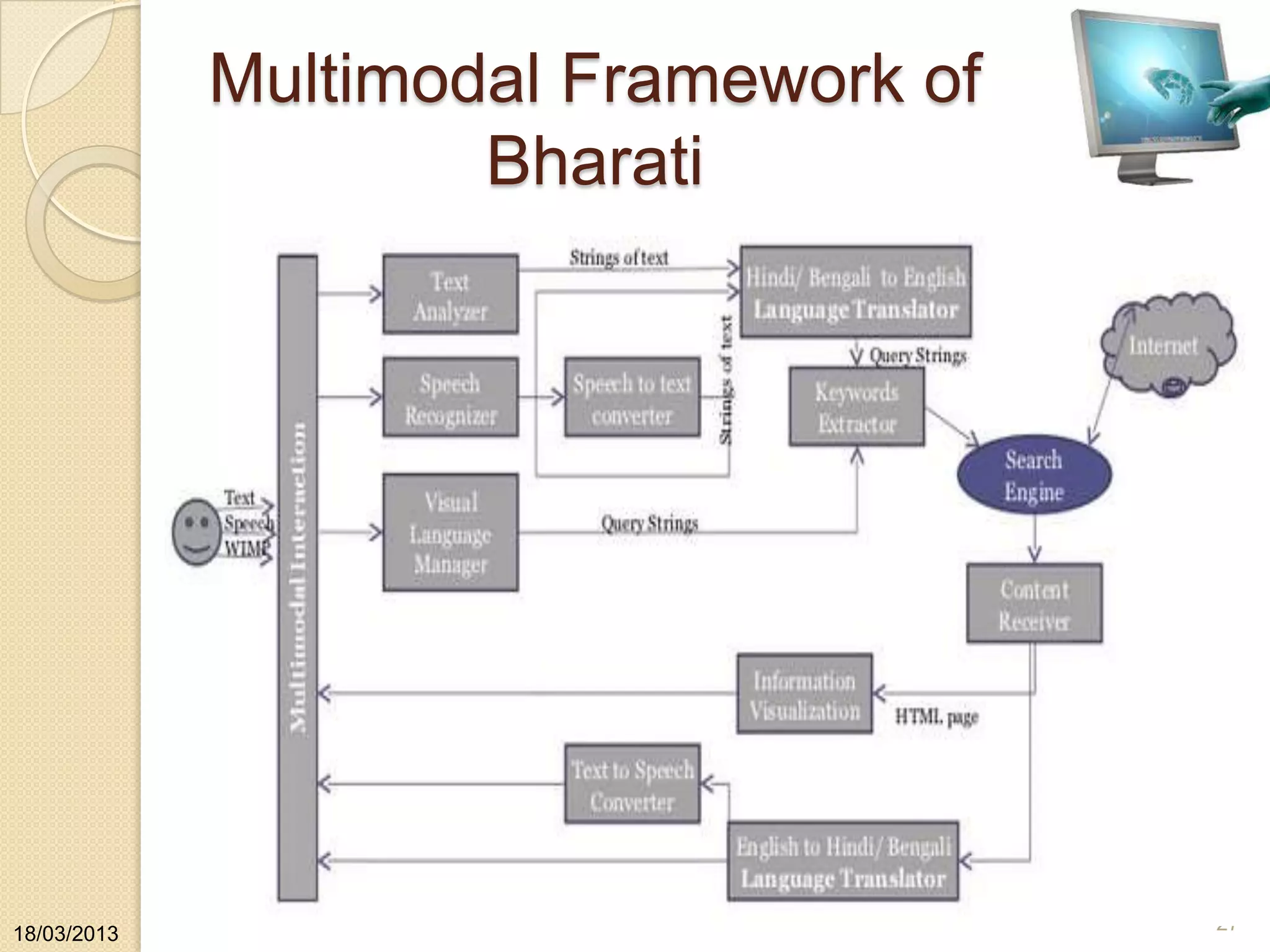
Bharati - A Multimodal Web
Interface
18/03/2013
23
 A internet user interface for both language and computer illiterate
people: text, speech, icon
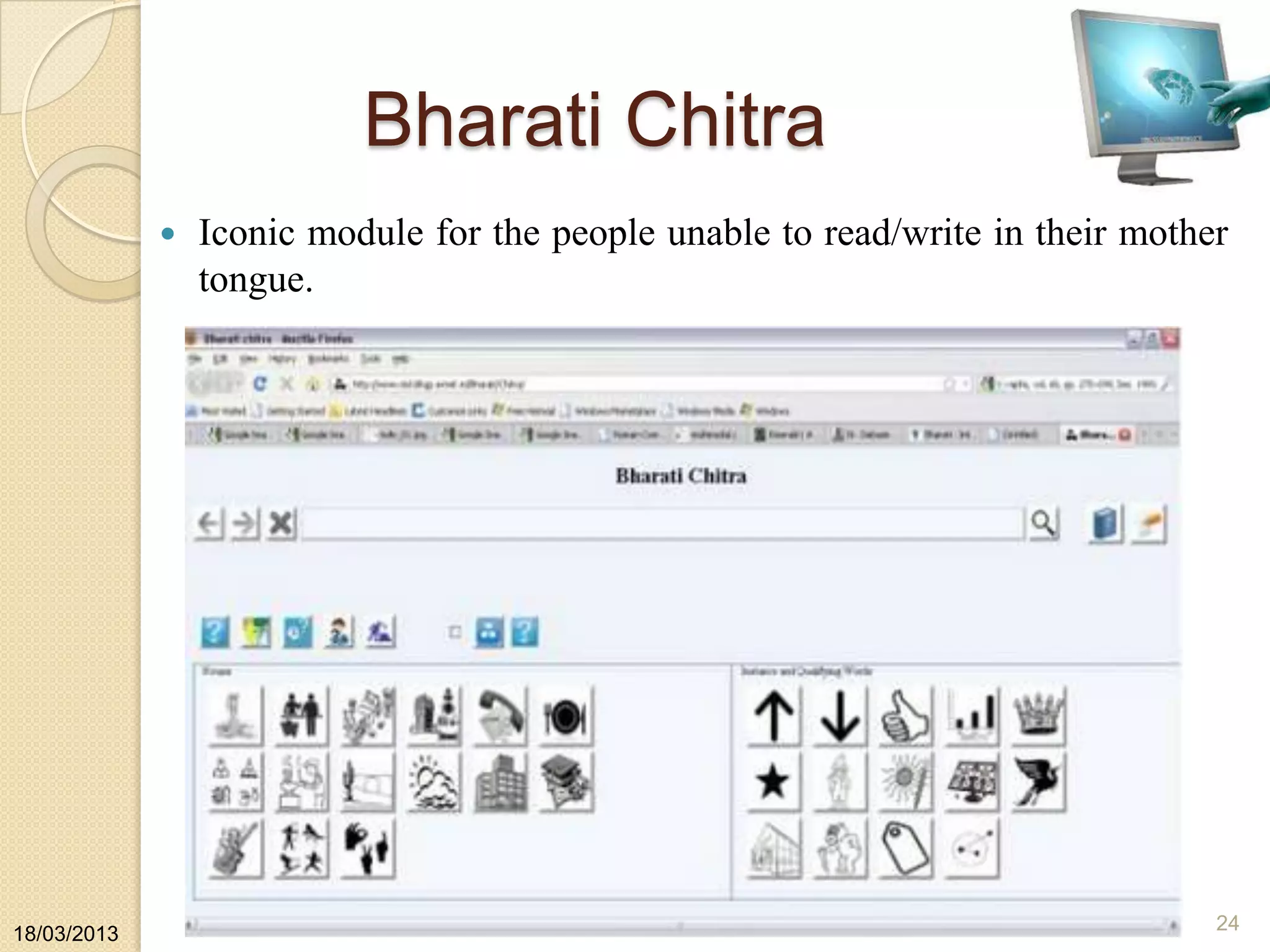
Bharati Chitra
 Iconic module for the people unable to read/write in their mother
tongue.
18/03/2013
24
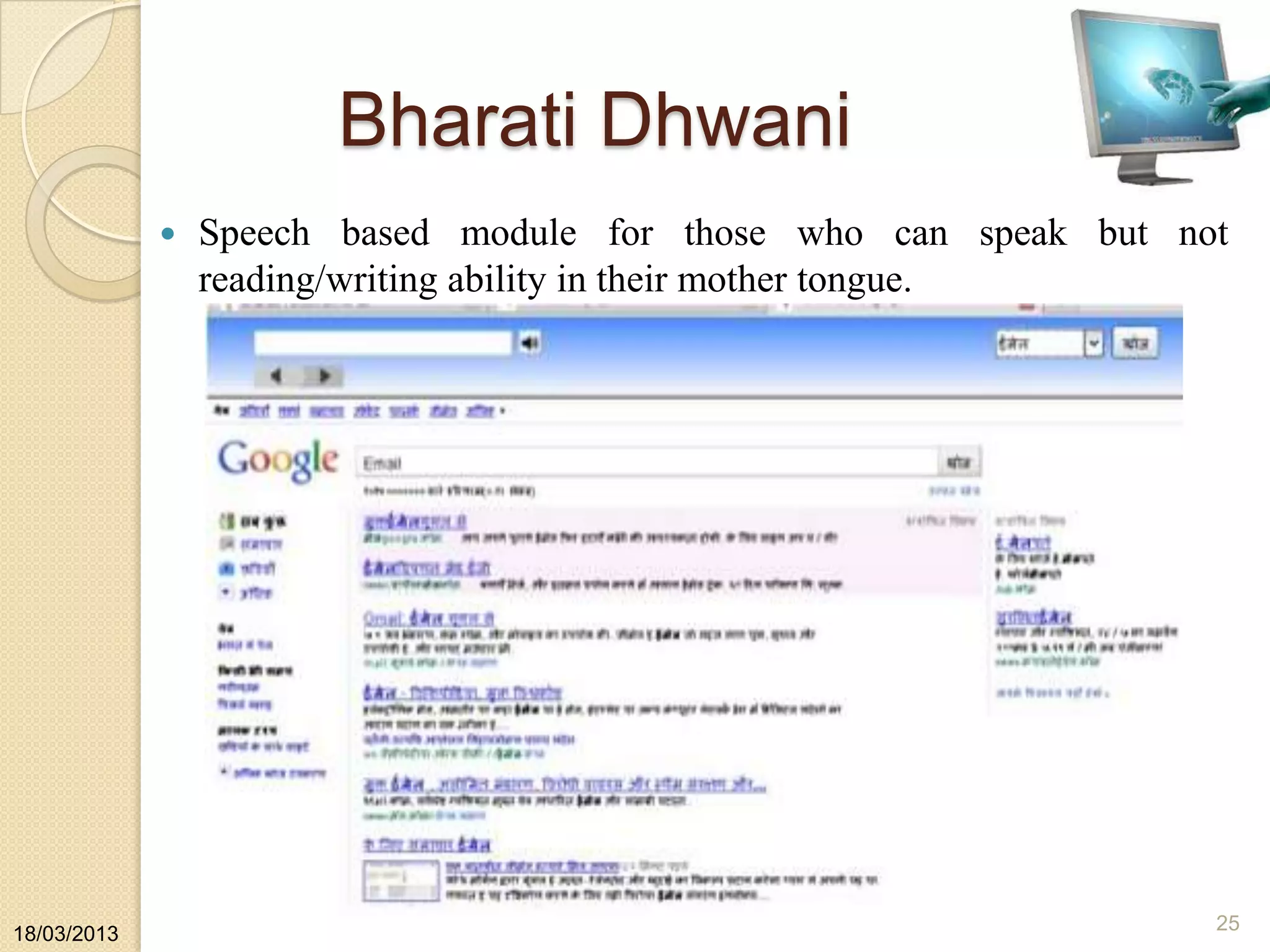
Bharati Dhwani
 Speech based module for those who can speak but not
reading/writing ability in their mother tongue.
18/03/2013
25
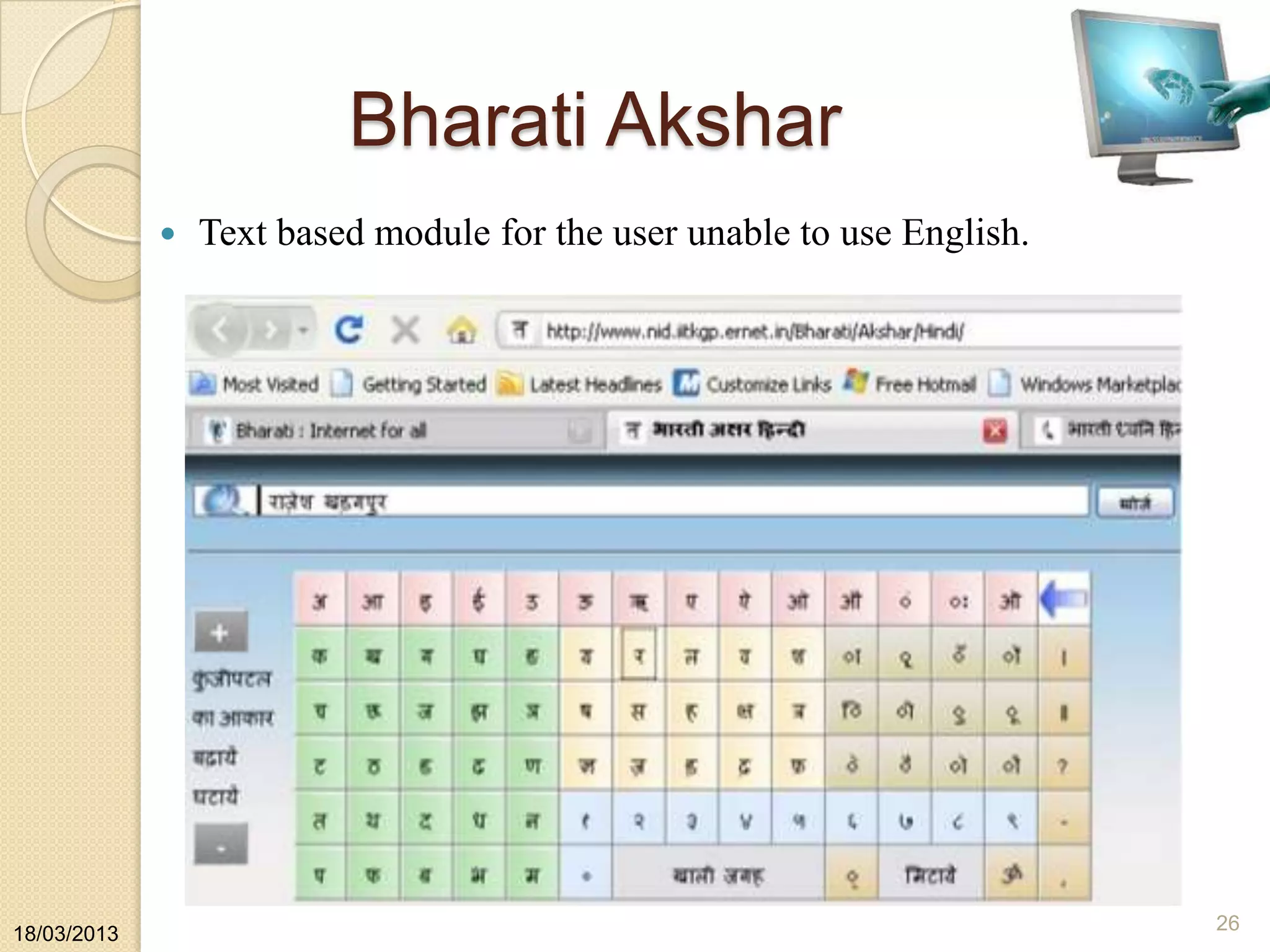
Bharati Akshar
 Text based module for the user unable to use English.
18/03/2013
26
Multimodal Framework of
Bharati
18/03/2013
27
Applications
 Intelligent Homes/Offices
 Driver Monitoring
 Intelligent Games

 E-Commerce
 Helping People with Disabilities
18/03/2013
28
Helping People with
Disabilities
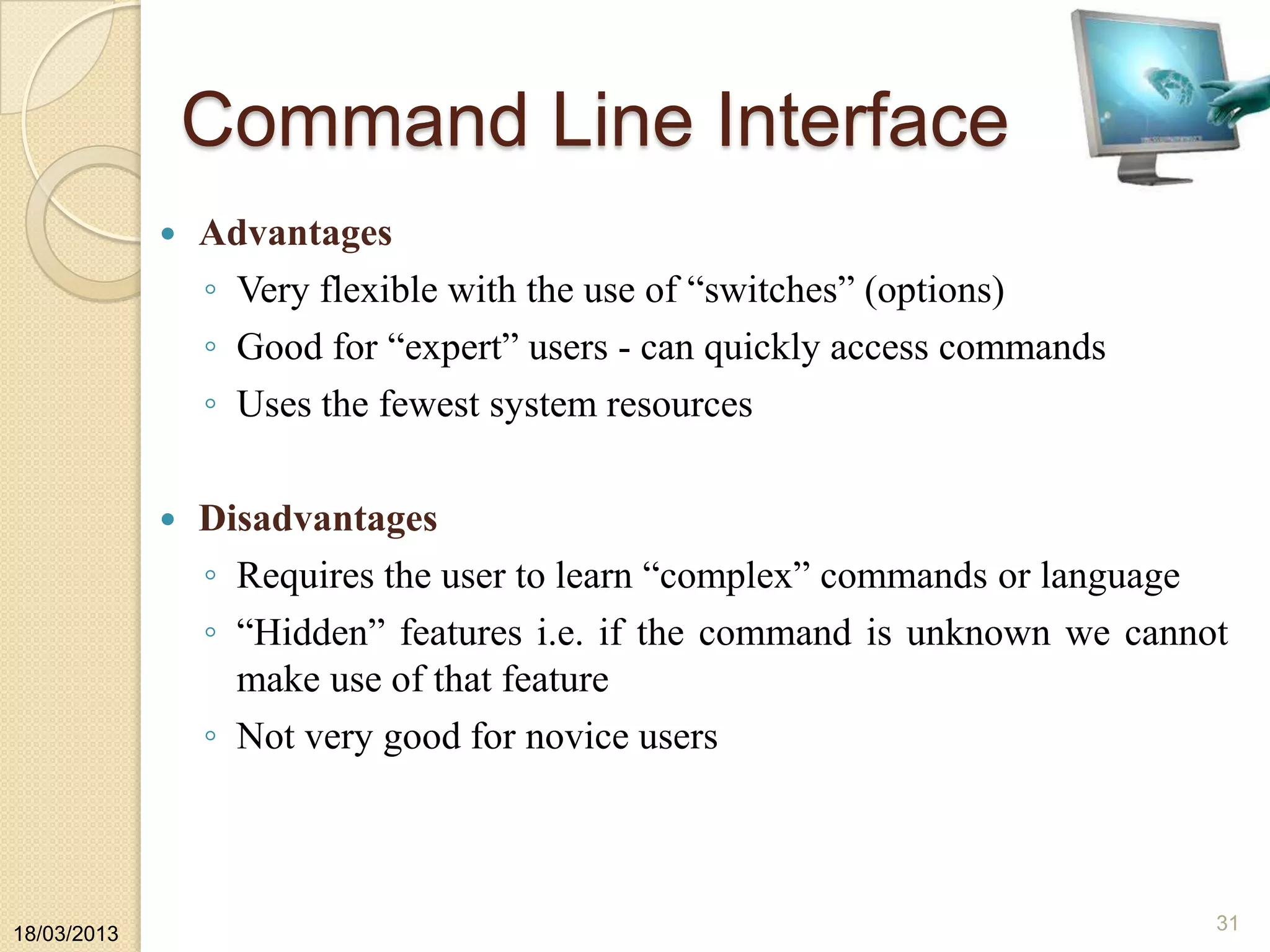
• A good application of multimodal systems is to address and assist
disabled people.
• In this system users can interact with machine using voice and
head movements.
• Two modalities are used and both are active continuously: speech
and head movements.
• Speech provides the needed information about the meaning of the
action that must be performed with an object selected by the
cursor.
• The head position indicates the coordinates of the cursor on the
screen at the current moment.
18/03/2013
29
Contd..
18/03/2013
30
Command Line Interface
 Advantages
◦ Very flexible with the use of “switches” (options)
◦ Good for “expert” users - can quickly access commands
◦ Uses the fewest system resources
 Disadvantages
◦ Requires the user to learn “complex” commands or language
◦ “Hidden” features i.e. if the command is unknown we cannot
make use of that feature
◦ Not very good for novice users
18/03/2013
31
Menu Driven Interface
 Advantages
◦ No need to learn complex commands/language
◦ Easier for a novice to learn/use
◦ Ideal when there are a limited number of options (efficient)
 Disadvantages
◦ Can be frustrating for experienced users i.e. the command they
want to use is buried 5 levels deep.
◦ User interface may be limited by screen space and number of
options available.
18/03/2013
32
Graphical User Interface
 Advantages
◦ Most suitable interface for inexperienced or novice users
◦ Many generic packages for a GUI will share common features
 Disadvantages
◦ GUIs use more system resources than other types of interface
18/03/2013
33
Natural Language
Interface
 Advantages
◦ No training required
◦ Can be quicker than keyboard entry
◦ Hands-free
◦ Can be used by the disabled
 Disadvantages
◦ Emerging technology – still contains “bugs”
◦ Difficulty in dealing with homonyms
◦ Difficult to recognise all the different ways of saying things
(and regional dialects)
◦ Artificial languages are often more precise
18/03/2013
34
Conclusion
 Quality of system depends on how it is represented and used by
user
 Therefore, enormous amount of attention has been paid to better
designs of HCI.
 Virtual reality can be the common interface in future
 UbiComp is trying to embed the technology in the environment
and make it invisible at the same time.
 Natural and Neural Interfaces are the future of Human-Computer
input interfaces
18/03/2013
35
References
 http://en.wikipedia.org/wiki/Human_Computer_Interface
 http://hci.stanford.edu/courses/cs547/
 A. Chapanis, Man Machine Engineering, Wadsworth, Belmont
 http://ijcsms.com/journals/Volume%2011,%20Issue%2002,%20A
ug%202011_Paper25.pdf
 D. Te‟eni, “Designs that fit: an overview of fit conceptualization
in HCI”, in P. Zhang and D. Galletta (eds), Human-Computer
Interaction and Management Information Systems:
Foundations, M.E. Sharpe, Armonk
18/03/2013
36
THANK YOU!!!
18/03/2013 37

human computer interface

  • 1.
  • 2.
    Outline  Introduction  Whatis HCI?  Types of interfaces  Existing technologies  Advances in HCI  Architecture  Applications  Advantages and Disadvantages  Conclusion  References 18/03/2013 2
  • 3.
    Introduction Human • The end-user •The members of an organization Computer • Hardware • Software Interface • A point where two objects meet. • A point where the human can tell the computer what to do. • A point where the computer displays the requested information. 18/03/2013 3
  • 4.
    What is HCI? •A process of information transfer  User to Machine  Machine to User • HCI is also referred to as Man Machine Interaction. • HCI is what the user sees and includes:  The physical controls  What the system looks like?  How the system accepts input from the user?  How the system responds to user input?  How the system outputs the results of processing? 18/03/2013 4
  • 5.
    Types of Interfaces •Command Line Interface (CLI) A CLI displays a prompt, the user types a command on the keyboard, the computer executes the command and provides textual output. • Menu Driven Interface The user has a list of items to choose from, and can make selections by highlighting one.  Graphical User Interface (GUI) Uses windows, icons, menus and pointers (WIMP) which can be manipulated by a mouse (and often to an extent by a keyboard as well).  Natural Language Interface Can range from simple command systems to voice activated text processing. Commands are spoken in “normal” language. 18/03/2013 5
  • 6.
    Existing Technologies • Theexisting interfaces differ in the degree of complexity both because of degree of functionality or usability. • The user activity has three different levels:  Physical  Cognitive  Affective  The existing physical technologies for HCI basically can be categorized by human senses. • These devices are basically relying on three human senses: vision, audio, and touch. 18/03/2013 6
  • 7.
    Advances in HCI •The new advances in HCI can be categorized in 3 sections: wearable devices, wireless devices, and virtual devices • Examples:  GPS Navigation Systems  Military super-soldier enhancing devices  PDA  Canesta Keyboard(QWERTY pattern) 18/03/2013 7
  • 8.
    Contd.. • Recent advancesof research in HCI are in these areas:  Intelligent and Adaptive interfaces  Ubiquitous computing(UbiComp) • These interfaces involve different levels of user activity: physical, cognitive, and affective. • Intelligent and Adaptive Interface:  Intelligent HCI designs are interfaces that incorporate at least some kind of intelligence in perception from and/or response to users. Ex: Speech enabled interfaces that use natural language to interact with users and devices 18/03/2013 8
  • 9.
    Contd..  Adaptive HCIdesigns, on the other hand, may not use intelligence in the creation of interface but use it to interact with users. Ex: A website using regular GUI for selling various products  Intelligent and adaptive interfaces are active interfaces  Non-Intelligent interfaces are passive in nature  Tablet PC is an example that uses both intelligent and adaptive interfaces and it has handwriting recognition ability. • Ubiquitous Computing:  The idea of ubiquitous computing was to embed computers everywhere in the environment and everyday objects so that people could interact with many computers 18/03/2013 9
  • 10.
  • 11.
  • 12.
    Architecture • Architecture ofany HCI systems is identified by:  Number of inputs and outputs in the system  Diversity of inputs and outputs in terms of modality  Workings of these diverse input and output for interaction purpose • Based on different configuration and design of interface, HCI systems can be divided into:  Unimodal HCI system  Multimodal HCI system 18/03/2013 12
  • 13.
    Unimodal HCI System •An interface mainly relies on number and diversity of its inputs and outputs which are communication channels that enable users to interact with computer via this interface. • A system that is based on only one modality is called unimodal. • Based on the nature of different modalities, they can be divided into three categories:  Audio-Based  Sensor-Based  Visual-Based 18/03/2013 13
  • 14.
    Audio Based HCI It deals with information acquired by different audio signals.  The information gathered from audio signals can be more trustable, helpful and in some cases unique providers of information.  Key components:  Microphone  ASR(automated speech recognition) and NLU(natural language understanding) software  The main research areas of Audio based HCI are divided into:  Speech Recognition  Speaker Recognition  Auditory Emotion Analysis  Human-Made Noise/Sign Detections  Musical Interaction18/03/2013 14
  • 15.
    Sensor Based HCI It has the wide range of applications in our day-to-day life.  The common feature in every application is that at least one physical sensor is used between machine and human to provide interaction.  Some of the sensors range from being very sophisticated to primitive :  Pen-Based Interaction  Motion Tracking Sensors/Digitizers  Haptic Sensors  Pressure Sensors  Keyboard, Mouse, Joysticks 18/03/2013 15
  • 16.
    Visual Based HCI It is also called as machine vision which is the observation of an environment using cameras.  In this, different aspects of human responses can be recognised visual signals.  Detection, identification and tracking of a real life entity and its translation into meaningful machine/computer input.  The main research areas of visual based HCI are:  Facial Expression Analysis  Body Movement tracking and Gesture recognition  Gaze Detection  Sixth Sense is one of the Visual based HCI technologies which is a wearable “Gesture Based” device. 18/03/2013 16
  • 17.
    Sixth Sense  Asmall projector-a pendant prototype to be worn around the neck  Connected to the mobile computing device in the user‟s pocket  Components: Camera, Projector, Mirror, Mobile Component, Colour Markers 18/03/2013 17
  • 18.
  • 19.
  • 20.
    Limitations of Unimodal HCI •Not a natural way of human interaction • Usually designed for the „average‟ user • Fails to cater to the needs of a diverse category of people • Difficult to use by disabled, illiterate and untrained people • Cannot provide universal interface 18/03/2013 20
  • 21.
    Multimodal HCI System Combination of multiple modalities, or usage of more than one independent channel signals for the interaction between a user and a machine is termed as multimodal human computer interaction system (MMHCI).  A multimodal interface acts as a facilitator of human-computer interaction via two or more modes of input.  It is easy to use by disabled, illiterate people.  A classic example of a multimodal system is the “Put That There” demonstration system. 18/03/2013 21
  • 22.
  • 23.
    Bharati - AMultimodal Web Interface 18/03/2013 23  A internet user interface for both language and computer illiterate people: text, speech, icon
  • 24.
    Bharati Chitra  Iconicmodule for the people unable to read/write in their mother tongue. 18/03/2013 24
  • 25.
    Bharati Dhwani  Speechbased module for those who can speak but not reading/writing ability in their mother tongue. 18/03/2013 25
  • 26.
    Bharati Akshar  Textbased module for the user unable to use English. 18/03/2013 26
  • 27.
  • 28.
    Applications  Intelligent Homes/Offices Driver Monitoring  Intelligent Games  E-Commerce  Helping People with Disabilities 18/03/2013 28
  • 29.
    Helping People with Disabilities •A good application of multimodal systems is to address and assist disabled people. • In this system users can interact with machine using voice and head movements. • Two modalities are used and both are active continuously: speech and head movements. • Speech provides the needed information about the meaning of the action that must be performed with an object selected by the cursor. • The head position indicates the coordinates of the cursor on the screen at the current moment. 18/03/2013 29
  • 30.
  • 31.
    Command Line Interface Advantages ◦ Very flexible with the use of “switches” (options) ◦ Good for “expert” users - can quickly access commands ◦ Uses the fewest system resources  Disadvantages ◦ Requires the user to learn “complex” commands or language ◦ “Hidden” features i.e. if the command is unknown we cannot make use of that feature ◦ Not very good for novice users 18/03/2013 31
  • 32.
    Menu Driven Interface Advantages ◦ No need to learn complex commands/language ◦ Easier for a novice to learn/use ◦ Ideal when there are a limited number of options (efficient)  Disadvantages ◦ Can be frustrating for experienced users i.e. the command they want to use is buried 5 levels deep. ◦ User interface may be limited by screen space and number of options available. 18/03/2013 32
  • 33.
    Graphical User Interface Advantages ◦ Most suitable interface for inexperienced or novice users ◦ Many generic packages for a GUI will share common features  Disadvantages ◦ GUIs use more system resources than other types of interface 18/03/2013 33
  • 34.
    Natural Language Interface  Advantages ◦No training required ◦ Can be quicker than keyboard entry ◦ Hands-free ◦ Can be used by the disabled  Disadvantages ◦ Emerging technology – still contains “bugs” ◦ Difficulty in dealing with homonyms ◦ Difficult to recognise all the different ways of saying things (and regional dialects) ◦ Artificial languages are often more precise 18/03/2013 34
  • 35.
    Conclusion  Quality ofsystem depends on how it is represented and used by user  Therefore, enormous amount of attention has been paid to better designs of HCI.  Virtual reality can be the common interface in future  UbiComp is trying to embed the technology in the environment and make it invisible at the same time.  Natural and Neural Interfaces are the future of Human-Computer input interfaces 18/03/2013 35
  • 36.
    References  http://en.wikipedia.org/wiki/Human_Computer_Interface  http://hci.stanford.edu/courses/cs547/ A. Chapanis, Man Machine Engineering, Wadsworth, Belmont  http://ijcsms.com/journals/Volume%2011,%20Issue%2002,%20A ug%202011_Paper25.pdf  D. Te‟eni, “Designs that fit: an overview of fit conceptualization in HCI”, in P. Zhang and D. Galletta (eds), Human-Computer Interaction and Management Information Systems: Foundations, M.E. Sharpe, Armonk 18/03/2013 36
  • 37.