BLACK HAT
HACKERS
Rajitha.B
09131A1276
Information Technology
14-03-2013
1
OUTLINE
• Introduction
• History
• Famous Hackers
• Types of Hackers
• Black Hat Hackers
• Pre-Hacking stage
• Domains affected by Hacking
• Types of attacks
• Detection and counter measures
• SQL Injection
• Pros and cons
• Conclusion
• References
14-03-2013 2
Introduction
Hacking refers to an array of activities which
are done to intrude someone else‟s personal
information space so as to use it for
malicious, unwanted purposes.
Hacking is a term used for activities aimed at
exploiting security flaws to obtain critical
information for gaining access to secured
networks.
14-03-2013 3
History
 1980s
- Cyberspace coined
-414 arrested
-Two hacker groups formed
-2600 published
 1990s
-National Crackdown on hackers
-Kevin Mitnick arrested
14-03-2013 4
Cont.…
 2001
– In one of the biggest denial-of-service
attack, hackers launched attacks against
eBay, Yahoo!, CNN.com., Amazon and
others.
 2007
– Bank hit by “biggest ever” hack. Swedish
Bank, Nordea recorded nearly $1 Million has
been stolen in three months from 250
customer account.
14-03-2013 5
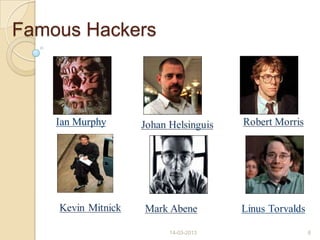
Famous Hackers
14-03-2013 6
Types of hackers
 White hat hacker(The term "white hat" in
Internet slang refers to an ethical computer
hacker, or a computer security expert.)
 Black hat hacker(illegal or bad )
 Grey hat hacker(A grey hat in the hacking
community refers to a skilled hacker whose
activities fall somewhere between white and
black hat hackers)
14-03-2013 7
Black Hat Hackers
 A "black hat hacker” is a hacker who violates
computer security for little reason beyond
maliciousness or for personal gain.
 Black hat hackers break into secure networks to
destroy data or make the network unusable for
those who are authorized to use the network.
14-03-2013 8
Pre-hacking stage
Part 1: Targeting
The hacker determines what network to break into
during this phase. The target may be of particular
interest to the hacker, either politically or
personally, or it may be picked at random.
Part 2: Research and Information Gathering
It is in this stage that the hacker will visit or contact
the target in some way in hopes of finding out vital
information that will help them to access the
system.
14-03-2013 9
Cont.…
Part 3: Finishing The Attack
This is the stage when the hacker will invade the
primary target that he/she was planning to attack
or steal from.
14-03-2013 10
Domains affected by hacking
 Mobile hacking
 Email hacking
 Data stealing
 Injecting virus and Trojans
 Man -in-middle attacks
 Internet applications
14-03-2013 11
TYPES OF ATTACKS
 Denial of Services attacks
 Threat from Sniffing and Key
Logging
 Trojan Attacks
14-03-2013 12
Denial of Services (DOS)
Attacks
DOS Attacks are aimed at denying
valid, legitimate Internet and Network users
access to the services offered by the target
system.
In other words, a DOS attack is one in which
clogging up so much memory on the target
system that it cannot serve legitimate users.
14-03-2013 13
DOS Attacks: Ping of Death
Attack
The maximum packet size allowed to be
transmitted by TCPIP on a network is 65 536 bytes.
In the Ping of Death Attack, a packet having a size
greater than this maximum size allowed by
TCPIP, is sent to the target system.
As soon as the target system receives a packet
exceeding the allowable size, then it
crashes, reboots or hangs.
14-03-2013 14
sniffers and Key
loggers
Sniffers: capture all data packets being sent
across the network. Commonly Used for:
Traffic Monitoring
Network Trouble shooting
Gathering Information on Attacker.
For stealing company Secrets and
sensitive data.
Commonly Available Sniffers
• tcpdump
• DSniff
14-03-2013 15
Threats from key loggers
Key loggers: Records all keystrokes made on that
system and store them in a log file, which can later
automatically be emailed to the attacker.
Countermeasures
 Periodic Detection practices should be made
mandatory.
A Typical Key Logger automatically loads itself
into the memory, each time the computer boots.
 Thus, the start up script of the Key Logger
should be removed.
14-03-2013 16
Trojan Attacks
Trojans: act as a RAT or Remote Administration
Tool, which allow remote control and remote access to
the attacker.
Working:
1.The Server Part of the Trojan is installed on the
target system through trickery or disguise.
2.This server part listens on a predefined port for
connections.
3.The attacker connects to this Server Part using
the Client part of the Trojan on the predefined port
number.
4.Once this is done, the attacker has complete
control over the target system.
14-03-2013 17
Trojan Attacks : Detection and
counter measures
Detection & Countermeasures
Scan your own system regularly.
If you find a irregular port open, on which you
usually do not have a service running, then your
system might have a Trojan installed.
One can remove a Trojan using any normal
Anti-Virus Software
14-03-2013 18
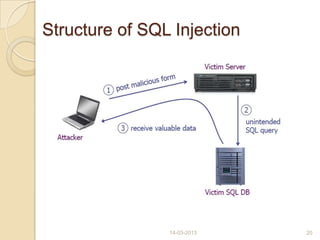
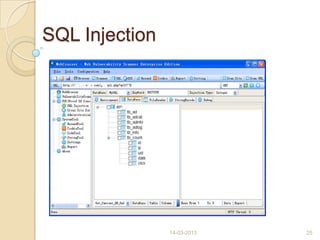
SQL injection
 SQL injection is a technique often used to attack
data driven applications.
 This is done by including portions of SQL
statements in an entry field in an attempt to get
the website to pass a newly formed SQL
command to the database.
 string literal escape characters embedded in SQL
statements like („ or * ) etc.
 SQL injection is mostly known as an attack vector
for websites but can be used to attack any type of
SQL database.
14-03-2013 19
Structure of SQL Injection
14-03-2013 20
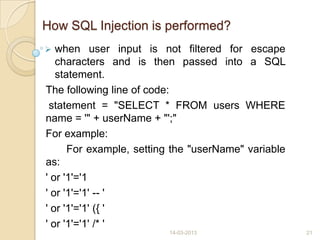
How SQL Injection is performed?
 when user input is not filtered for escape
characters and is then passed into a SQL
statement.
The following line of code:
statement = "SELECT * FROM users WHERE
name = '" + userName + "';"
For example:
For example, setting the "userName" variable
as:
' or '1'='1
' or '1'='1' -- '
' or '1'='1' ({ '
' or '1'='1' /* '
14-03-2013 21
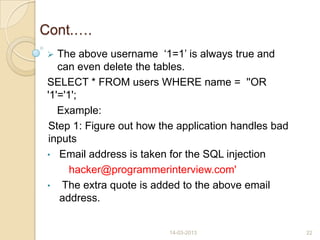
Cont.….
 The above username „1=1‟ is always true and
can even delete the tables.
SELECT * FROM users WHERE name = ''OR
'1'='1';
Example:
Step 1: Figure out how the application handles bad
inputs
• Email address is taken for the SQL injection
hacker@programmerinterview.com'
• The extra quote is added to the above email
address.
14-03-2013 22
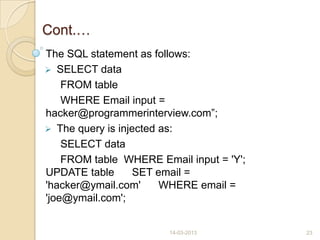
Cont.…
The SQL statement as follows:
 SELECT data
FROM table
WHERE Email input =
hacker@programmerinterview.com”;
 The query is injected as:
SELECT data
FROM table WHERE Email input = 'Y';
UPDATE table SET email =
'hacker@ymail.com' WHERE email =
'joe@ymail.com';
14-03-2013 23
Cont.…
 The hacker enters into the database and
drops the tables .
 Insertion of any other data in table can be
done.
14-03-2013 24
SQL Injection
14-03-2013 25
SQL Injection Prevention
 Encrypt sensitive data.
 Access the database using an
account with the least privileges
necessary.
 Install the database using an
account with the least privileges
necessary.
 Ensure that data is valid.
14-03-2013 26
Pros and cons
Pros
• Increases computer security –when a
hacker is hired he can be given a specific
job or way to hack into the system. This
can give company insight of possible back
doors or openings into the company‟s
security.
Cons
• The hacker can break into the system and
steal information.
• If the hacker is inexperience he can leave
harmful programs and delete the
information.
14-03-2013 27
Conclusion
 Hacking may be defined as legal
or illegal, ethical or unethical but
useful for finding out possible back
doors or openings into the
computer security.
14-03-2013 28
References
http://www.blackhatlibrary.net/Main_Page
http://prezi.com/sxnobhzvsenq/hacking-
and-cracking-pros-and-cons
http://www.cybercure.in/hacking/
http://en.wikipedia.org/wiki/Hacker_(compu
ter_security)
http://en.wikipedia.org/wiki/The_Hacker_Cr
ackdown
Cyber cure customized e-book
http://www.blackhat.com/presentations/bh-
usa-04/bh-us-04-hotchkies/bh-us-04-
hotchkies.pdf
http://crypto.stanford.edu/cs142/lectures/1
6-sql-inj.pdf 14-03-2013 29
Thank you
14-03-2013 30

Black hat hackers

  • 1.
  • 2.
    OUTLINE • Introduction • History •Famous Hackers • Types of Hackers • Black Hat Hackers • Pre-Hacking stage • Domains affected by Hacking • Types of attacks • Detection and counter measures • SQL Injection • Pros and cons • Conclusion • References 14-03-2013 2
  • 3.
    Introduction Hacking refers toan array of activities which are done to intrude someone else‟s personal information space so as to use it for malicious, unwanted purposes. Hacking is a term used for activities aimed at exploiting security flaws to obtain critical information for gaining access to secured networks. 14-03-2013 3
  • 4.
    History  1980s - Cyberspacecoined -414 arrested -Two hacker groups formed -2600 published  1990s -National Crackdown on hackers -Kevin Mitnick arrested 14-03-2013 4
  • 5.
    Cont.…  2001 – Inone of the biggest denial-of-service attack, hackers launched attacks against eBay, Yahoo!, CNN.com., Amazon and others.  2007 – Bank hit by “biggest ever” hack. Swedish Bank, Nordea recorded nearly $1 Million has been stolen in three months from 250 customer account. 14-03-2013 5
  • 6.
  • 7.
    Types of hackers White hat hacker(The term "white hat" in Internet slang refers to an ethical computer hacker, or a computer security expert.)  Black hat hacker(illegal or bad )  Grey hat hacker(A grey hat in the hacking community refers to a skilled hacker whose activities fall somewhere between white and black hat hackers) 14-03-2013 7
  • 8.
    Black Hat Hackers A "black hat hacker” is a hacker who violates computer security for little reason beyond maliciousness or for personal gain.  Black hat hackers break into secure networks to destroy data or make the network unusable for those who are authorized to use the network. 14-03-2013 8
  • 9.
    Pre-hacking stage Part 1:Targeting The hacker determines what network to break into during this phase. The target may be of particular interest to the hacker, either politically or personally, or it may be picked at random. Part 2: Research and Information Gathering It is in this stage that the hacker will visit or contact the target in some way in hopes of finding out vital information that will help them to access the system. 14-03-2013 9
  • 10.
    Cont.… Part 3: FinishingThe Attack This is the stage when the hacker will invade the primary target that he/she was planning to attack or steal from. 14-03-2013 10
  • 11.
    Domains affected byhacking  Mobile hacking  Email hacking  Data stealing  Injecting virus and Trojans  Man -in-middle attacks  Internet applications 14-03-2013 11
  • 12.
    TYPES OF ATTACKS Denial of Services attacks  Threat from Sniffing and Key Logging  Trojan Attacks 14-03-2013 12
  • 13.
    Denial of Services(DOS) Attacks DOS Attacks are aimed at denying valid, legitimate Internet and Network users access to the services offered by the target system. In other words, a DOS attack is one in which clogging up so much memory on the target system that it cannot serve legitimate users. 14-03-2013 13
  • 14.
    DOS Attacks: Pingof Death Attack The maximum packet size allowed to be transmitted by TCPIP on a network is 65 536 bytes. In the Ping of Death Attack, a packet having a size greater than this maximum size allowed by TCPIP, is sent to the target system. As soon as the target system receives a packet exceeding the allowable size, then it crashes, reboots or hangs. 14-03-2013 14
  • 15.
    sniffers and Key loggers Sniffers:capture all data packets being sent across the network. Commonly Used for: Traffic Monitoring Network Trouble shooting Gathering Information on Attacker. For stealing company Secrets and sensitive data. Commonly Available Sniffers • tcpdump • DSniff 14-03-2013 15
  • 16.
    Threats from keyloggers Key loggers: Records all keystrokes made on that system and store them in a log file, which can later automatically be emailed to the attacker. Countermeasures  Periodic Detection practices should be made mandatory. A Typical Key Logger automatically loads itself into the memory, each time the computer boots.  Thus, the start up script of the Key Logger should be removed. 14-03-2013 16
  • 17.
    Trojan Attacks Trojans: actas a RAT or Remote Administration Tool, which allow remote control and remote access to the attacker. Working: 1.The Server Part of the Trojan is installed on the target system through trickery or disguise. 2.This server part listens on a predefined port for connections. 3.The attacker connects to this Server Part using the Client part of the Trojan on the predefined port number. 4.Once this is done, the attacker has complete control over the target system. 14-03-2013 17
  • 18.
    Trojan Attacks :Detection and counter measures Detection & Countermeasures Scan your own system regularly. If you find a irregular port open, on which you usually do not have a service running, then your system might have a Trojan installed. One can remove a Trojan using any normal Anti-Virus Software 14-03-2013 18
  • 19.
    SQL injection  SQLinjection is a technique often used to attack data driven applications.  This is done by including portions of SQL statements in an entry field in an attempt to get the website to pass a newly formed SQL command to the database.  string literal escape characters embedded in SQL statements like („ or * ) etc.  SQL injection is mostly known as an attack vector for websites but can be used to attack any type of SQL database. 14-03-2013 19
  • 20.
    Structure of SQLInjection 14-03-2013 20
  • 21.
    How SQL Injectionis performed?  when user input is not filtered for escape characters and is then passed into a SQL statement. The following line of code: statement = "SELECT * FROM users WHERE name = '" + userName + "';" For example: For example, setting the "userName" variable as: ' or '1'='1 ' or '1'='1' -- ' ' or '1'='1' ({ ' ' or '1'='1' /* ' 14-03-2013 21
  • 22.
    Cont.….  The aboveusername „1=1‟ is always true and can even delete the tables. SELECT * FROM users WHERE name = ''OR '1'='1'; Example: Step 1: Figure out how the application handles bad inputs • Email address is taken for the SQL injection hacker@programmerinterview.com' • The extra quote is added to the above email address. 14-03-2013 22
  • 23.
    Cont.… The SQL statementas follows:  SELECT data FROM table WHERE Email input = hacker@programmerinterview.com”;  The query is injected as: SELECT data FROM table WHERE Email input = 'Y'; UPDATE table SET email = 'hacker@ymail.com' WHERE email = 'joe@ymail.com'; 14-03-2013 23
  • 24.
    Cont.…  The hackerenters into the database and drops the tables .  Insertion of any other data in table can be done. 14-03-2013 24
  • 25.
  • 26.
    SQL Injection Prevention Encrypt sensitive data.  Access the database using an account with the least privileges necessary.  Install the database using an account with the least privileges necessary.  Ensure that data is valid. 14-03-2013 26
  • 27.
    Pros and cons Pros •Increases computer security –when a hacker is hired he can be given a specific job or way to hack into the system. This can give company insight of possible back doors or openings into the company‟s security. Cons • The hacker can break into the system and steal information. • If the hacker is inexperience he can leave harmful programs and delete the information. 14-03-2013 27
  • 28.
    Conclusion  Hacking maybe defined as legal or illegal, ethical or unethical but useful for finding out possible back doors or openings into the computer security. 14-03-2013 28
  • 29.
  • 30.