E-Commerce in Mobile
          Computing


                    Presented by
                     V.Chaitanya
                    09131A1266
1   GVPCE(A)               Tuesday, March 12, 2013
Outline
     Introduction
     History
     Overview
     Services and Applications
     Advantages
     Disadvantages
     Conclusion
     References


2    GVPCE(A)                     Tuesday, March 12, 2013
Introduction
     What is Commerce
     Commerce is a division of trade or production which

     deals with the exchange of goods and services from
     producer to final consumer.

     It comprises the trading of economic value such as

     goods, services, information, or money between two or
     more entities.


3     GVPCE(A)                             Tuesday, March 12, 2013
Contd..
    What is E-Commerce
     Commonly known as Electronic Marketing.

     It consist of buying and selling goods and services
     over an electronic system such as the internet .
     E-Commerce     is   the    purchasing,      selling         and
     exchanging goods and services over computer
     networks (internet) through which transaction or terms
     of sale are performed Electronically.

4     GVPCE(A)                                 Tuesday, March 12, 2013
Contd..
    Mobile Commerce:
 Mobile Commerce is also known as M-Commerce.

 M-Commerce is the buying and selling of goods and

    services through wireless handheld devices.

 M-Commerce is the process of paying for services using a

    mobile phone or personal organizer


5      GVPCE(A)                              Tuesday, March 12, 2013
History
     Mobile Commerce Services were first delivered in

     1997, when the first two mobile-phone enabled Coca
     Cola vending machines were installed in the Helsinki
     area in Finland.

     The M-Commerce server developed in late 1997 by

     Kevin Duffey at Logica.

     Since the launch of the iPhone, mobile Commerce has

     moved away from SMS systems and into actual
6    applications.
      GVPCE(A)                             Tuesday, March 12, 2013
Overview
 M-Commerce is the ability to conduct Commerce using a

     mobile device such as:

    1. Mobile Phone

    2. Personal Digital Assistant(PDA)

    3. Smart Phone


7      GVPCE(A)                          Tuesday, March 12, 2013
Contd..
    Mobile Commerce from the Customer‘ s point of view
     The customer wants to access information, goods and

     services any time and in any place on his mobile device.

     He can use his mobile device to purchase tickets for

     events or public transport, pay for parking, download
     content and even order books and CDs.

     He should be offered appropriate payment methods.


8      GVPCE(A)                              Tuesday, March 12, 2013
Contd..
Mobile Commerce from the Provider`s point of view
 The future development of the mobile telecommunication

    sector is heading more and more towards value-added
    services. Analysts forecast that soon half of mobile
    operators‘ revenue will be earned through mobile
    Commerce.

 Innovative service scenarios will be needed that meet the

    customer‘s expectations and business models that satisfy

9
    all GVPCE(A) involved.
        partners                            Tuesday, March 12, 2013
Services and Applications
      Mobile ticketing

      Mobile Money Transfer

      Content purchase and delivery

      Information services

      Mobile banking

      Mobile Browsing

      Mobile Purchase

      Mobile marketing and advertising
10    GVPCE(A)                            Tuesday, March 12, 2013
Mobile Ticketing
      Mobile Ticketing is the process where the customers

      can order, pay for, obtain and validate tickets from
      any location and at any time using Mobile phones .

      Tickets can be booked and cancelled on the mobile

      device with the help of simple application downloads.

      Delivery of tickets to mobile phones can be done in

      the form of a SMS or by a MMS.

11     GVPCE(A)                             Tuesday, March 12, 2013
Contd..
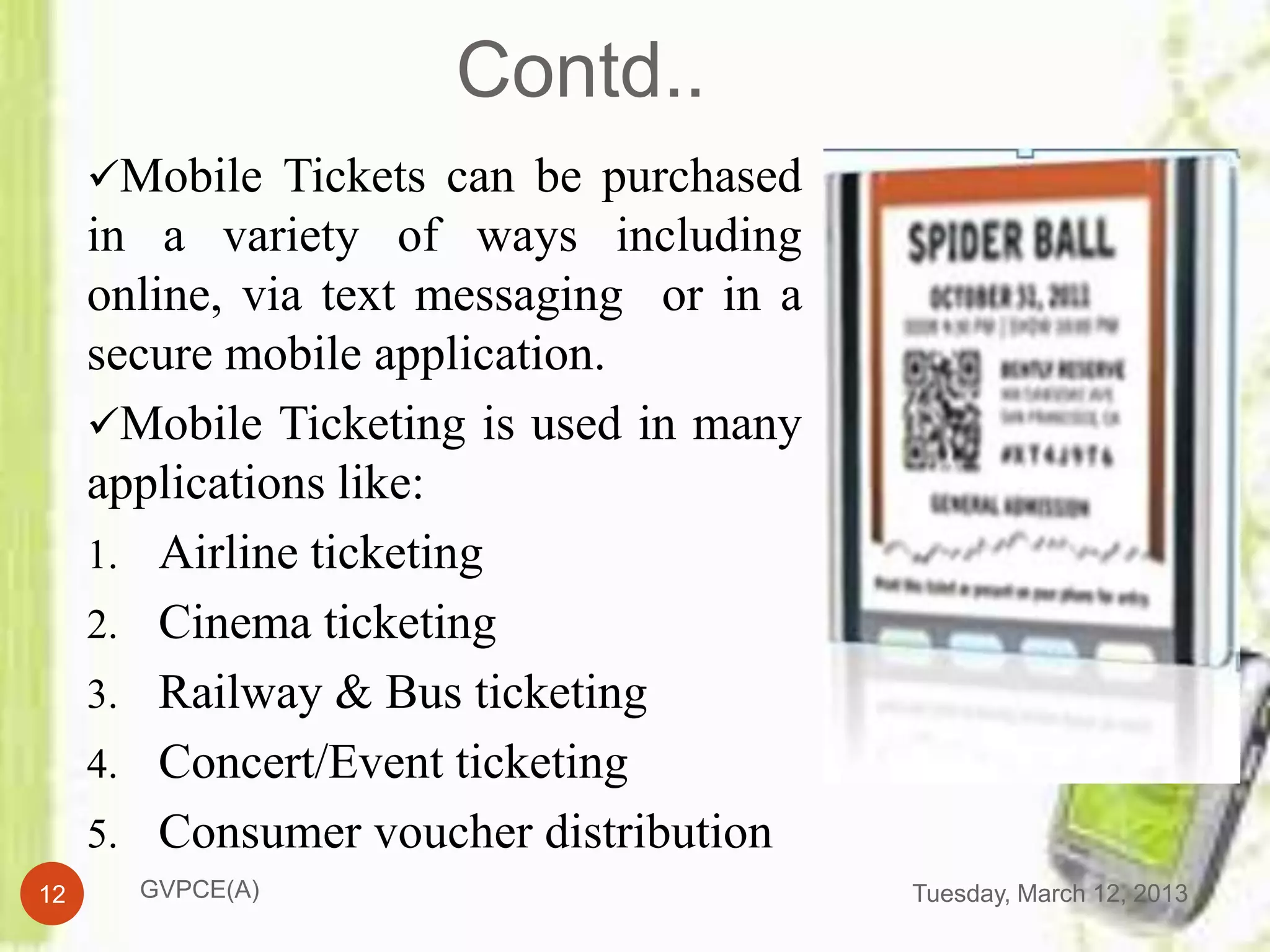
     Mobile Tickets can be purchased
     in a variety of ways including
     online, via text messaging or in a
     secure mobile application.
     Mobile Ticketing is used in many
     applications like:
     1. Airline ticketing
     2. Cinema ticketing
     3. Railway & Bus ticketing
     4. Concert/Event ticketing
     5. Consumer voucher distribution
12     GVPCE(A)                           Tuesday, March 12, 2013
Benefits to the ticket buyer

      Instant delivery of mobile tickets at the time of

      purchase.

      Individual mobile tickets can be forwarded to a friend.

      Quicker entry with no waiting in lines.

                  Benefits to the Event organizer

      Reduced will call lines and staffing.

      Guaranteed security, only one entry per barcode.
13     GVPCE(A)                                  Tuesday, March 12, 2013
      Event is 'greener' with reduced paper waste.
Mobile Money Transfer
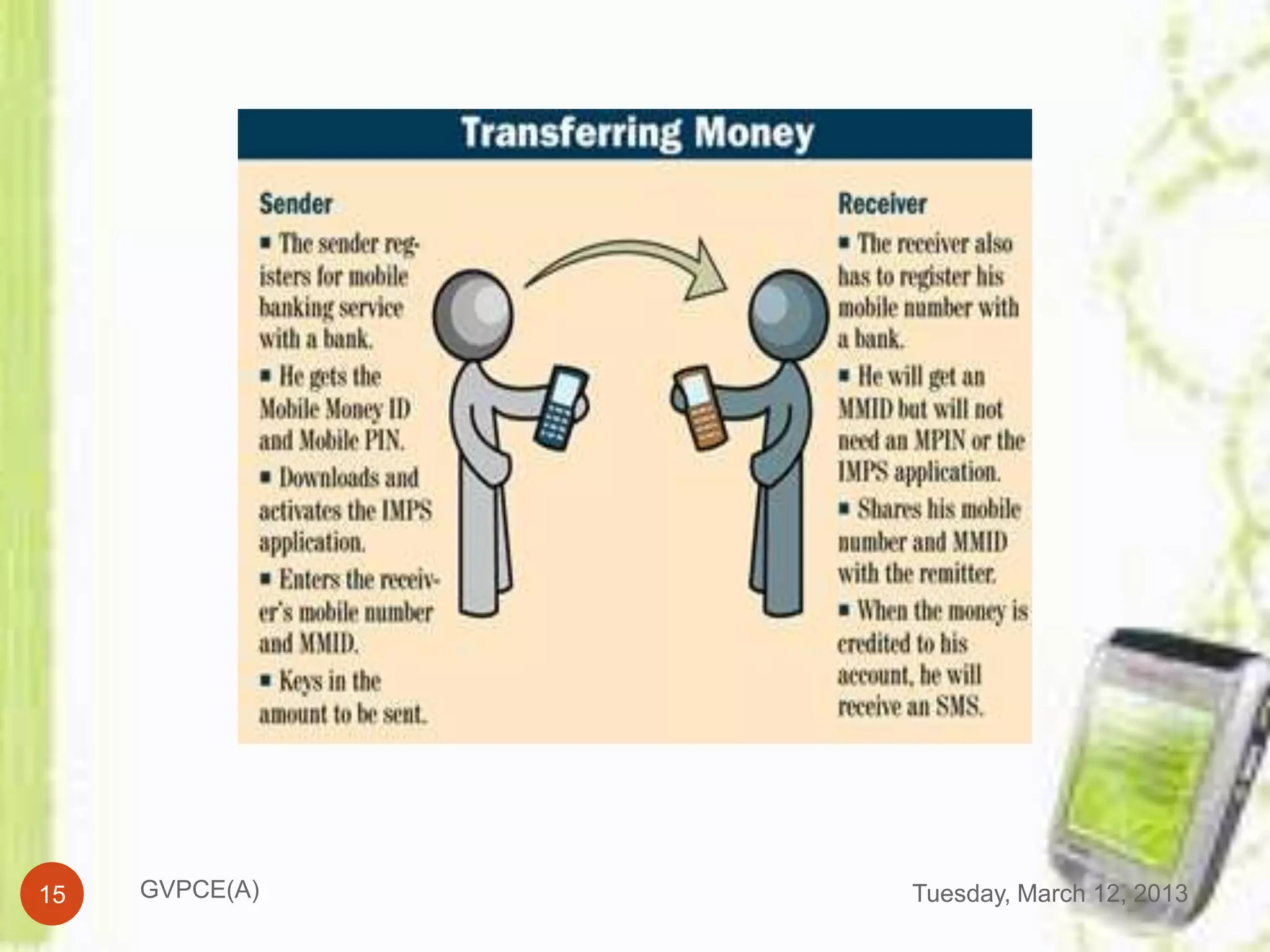
  Mobile Money Transfer refers to payment services

      which are performed by using a mobile phone.

  By using this service we can transfer money from one

      person to other by using a mobile phone.

     Ex: ICICI bank has started IMPS - Interbank Mobile
     Payment Service. It is an interbank electronic instant
     mobile money transfer service through mobile phones.
14      GVPCE(A)                                 Tuesday, March 12, 2013
15   GVPCE(A)   Tuesday, March 12, 2013
Content purchase and delivery

      Mobile content purchase and delivery mainly
       consists of the sale of ring-tones, wallpapers, and
       games for mobile phones.
      The convergence of mobile phones, portable audio
       players, and video players into a single device is
       increasing the purchase and delivery of full-length
       music tracks and video.


16    GVPCE(A)                              Tuesday, March 12, 2013
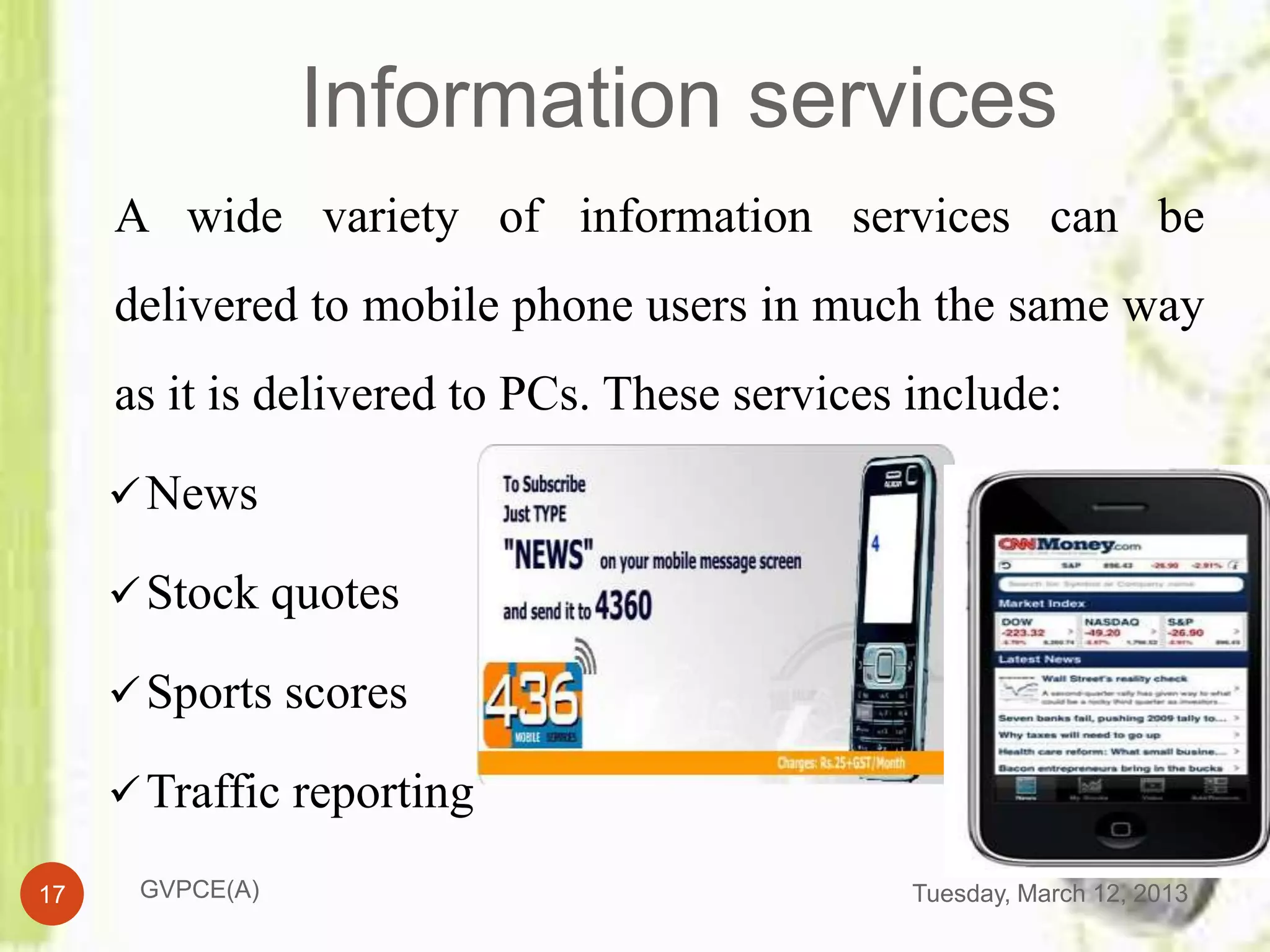
Information services
     A wide variety of information services can be
     delivered to mobile phone users in much the same way
     as it is delivered to PCs. These services include:

      News

      Stock quotes

      Sports scores

      Traffic reporting

17    GVPCE(A)                                 Tuesday, March 12, 2013
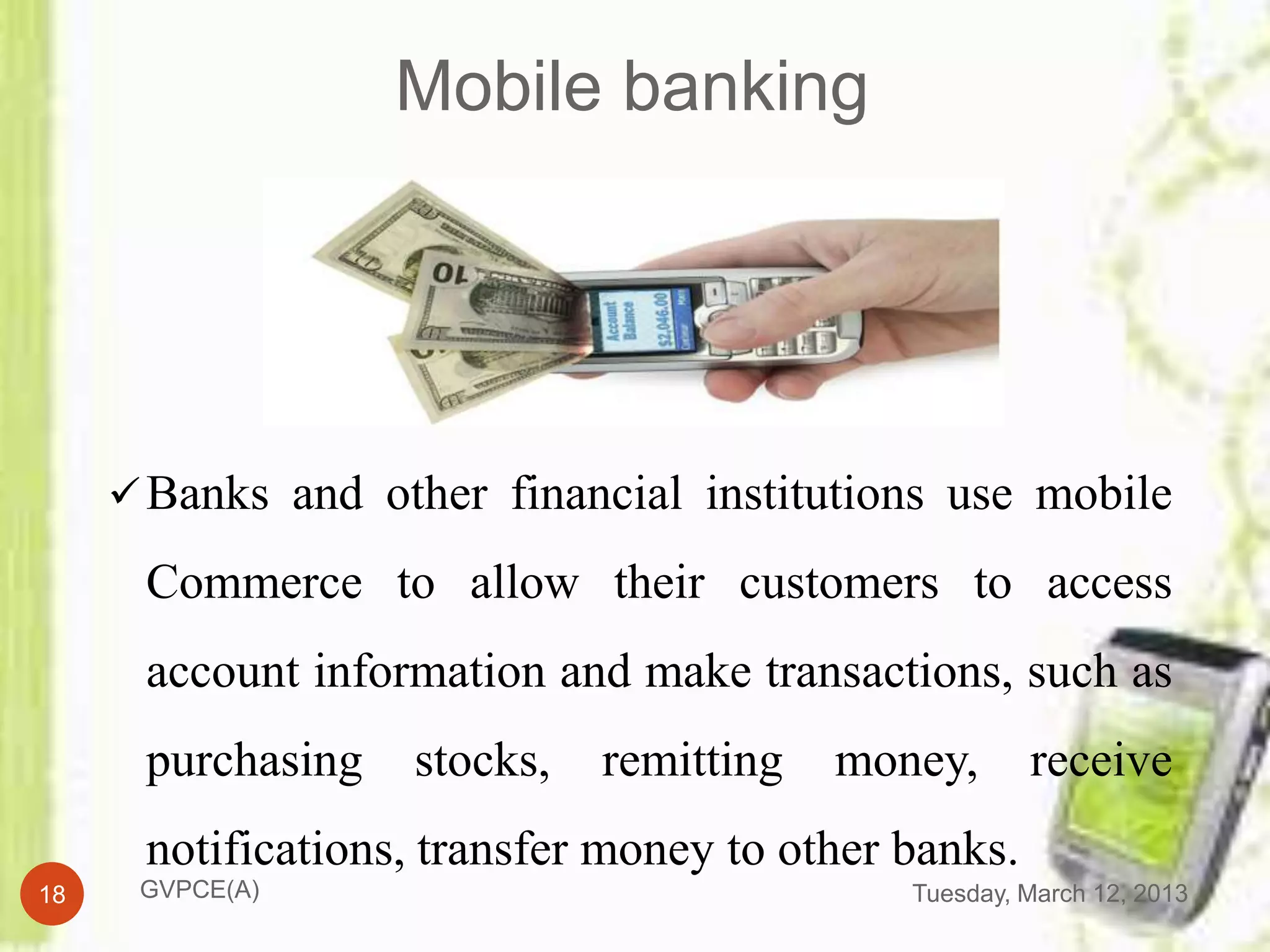
Mobile banking


      Banks and other financial institutions use mobile

      Commerce to allow their customers to access
      account information and make transactions, such as
      purchasing   stocks,   remitting   money,       receive
      notifications, transfer money to other banks.
18    GVPCE(A)                               Tuesday, March 12, 2013
Contd..
 Mobile Banking Services are:

     1. Mini-statements and checking of account history

     2. Checking the balance

     3. Recent transactions

     4. PIN provision, Change of PIN and reminder over

        the Internet

     5. Cash-in, cash-out transactions on an ATM

19      GVPCE(A)                             Tuesday, March 12, 2013
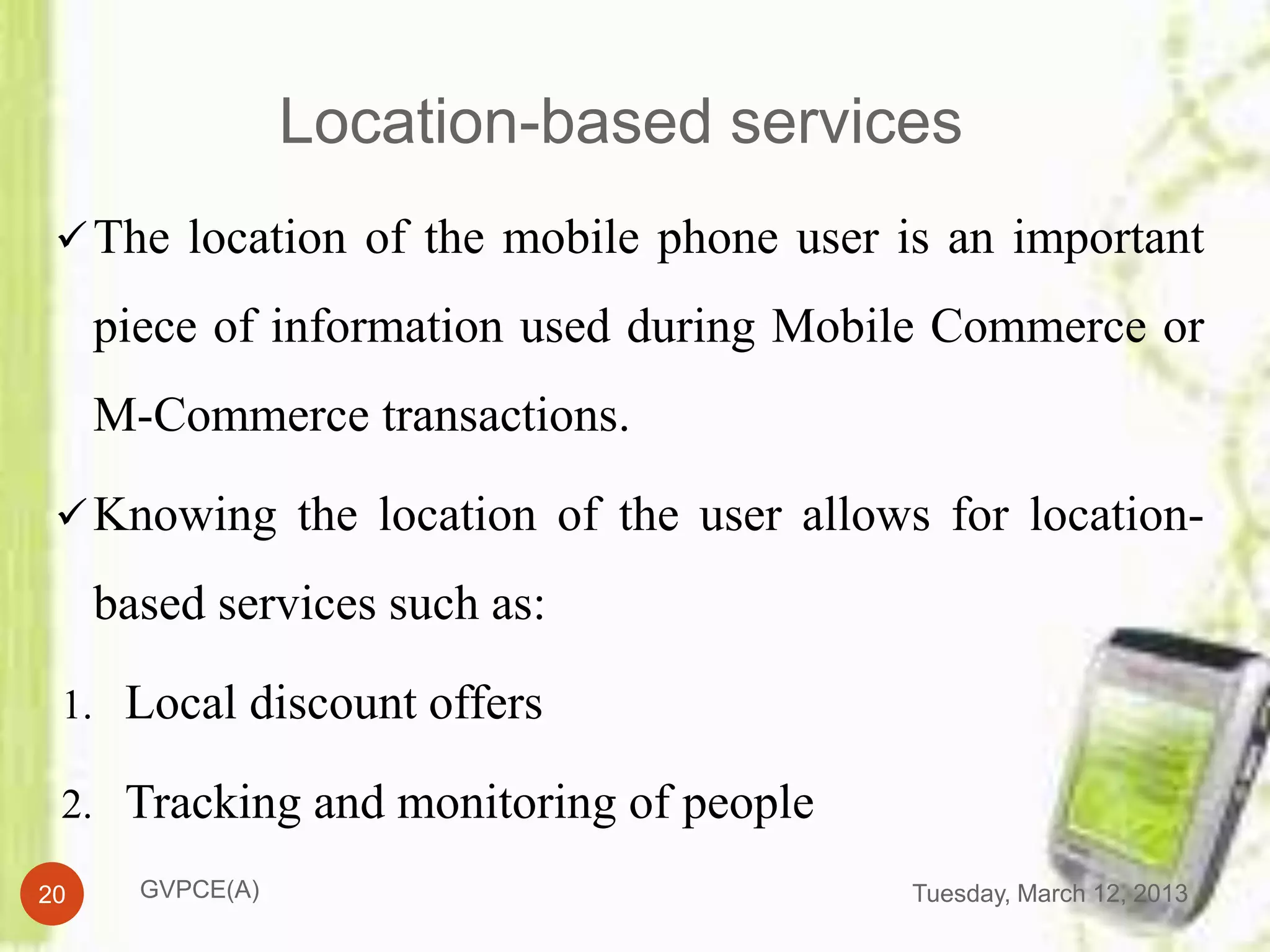
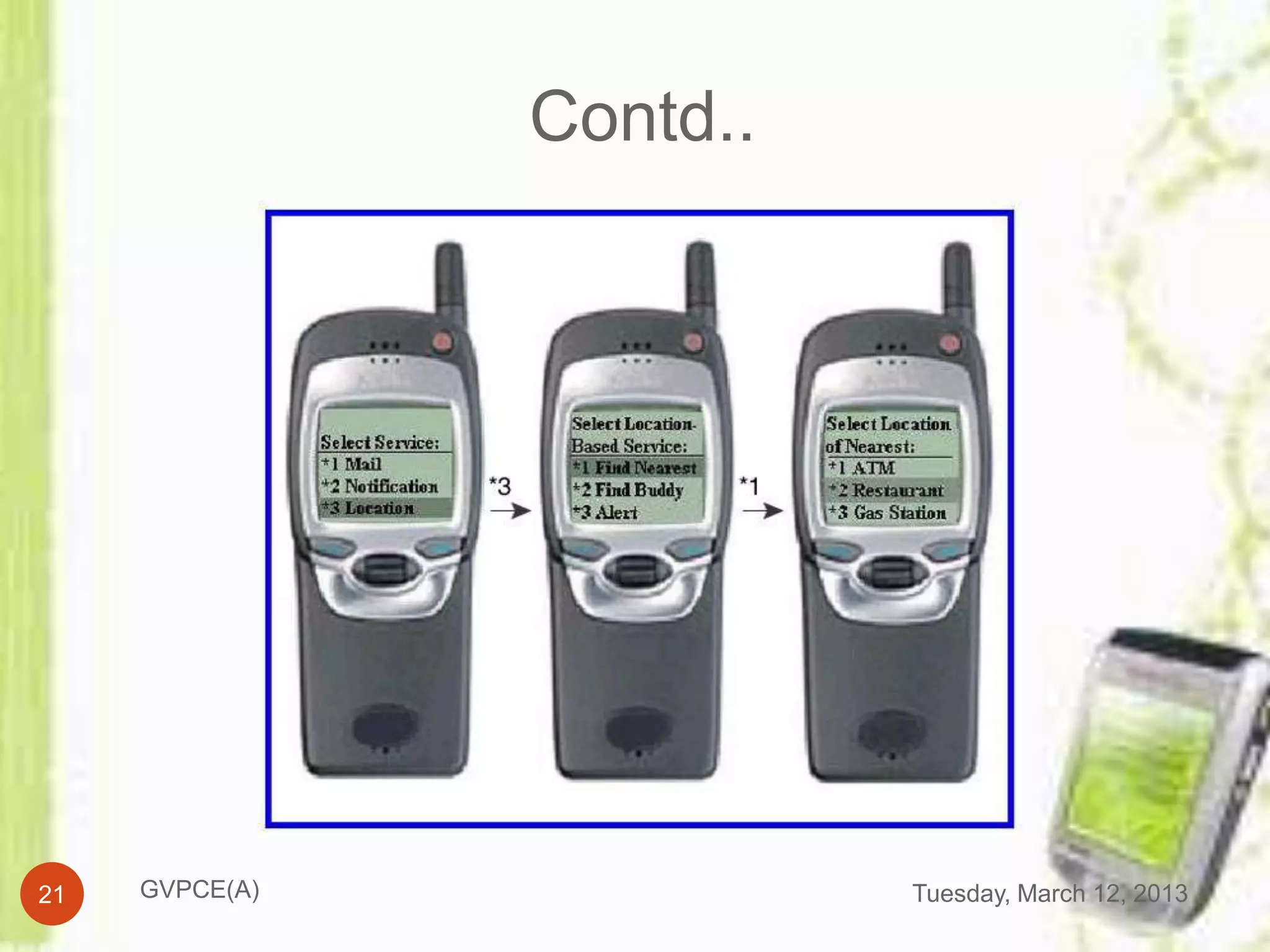
Location-based services
  The location of the mobile phone user is an important

     piece of information used during Mobile Commerce or
     M-Commerce transactions.

  Knowing the location of the user allows for location-

     based services such as:

 1. Local discount offers

 2. Tracking and monitoring of people

20     GVPCE(A)                           Tuesday, March 12, 2013
Contd..


21   GVPCE(A)             Tuesday, March 12, 2013
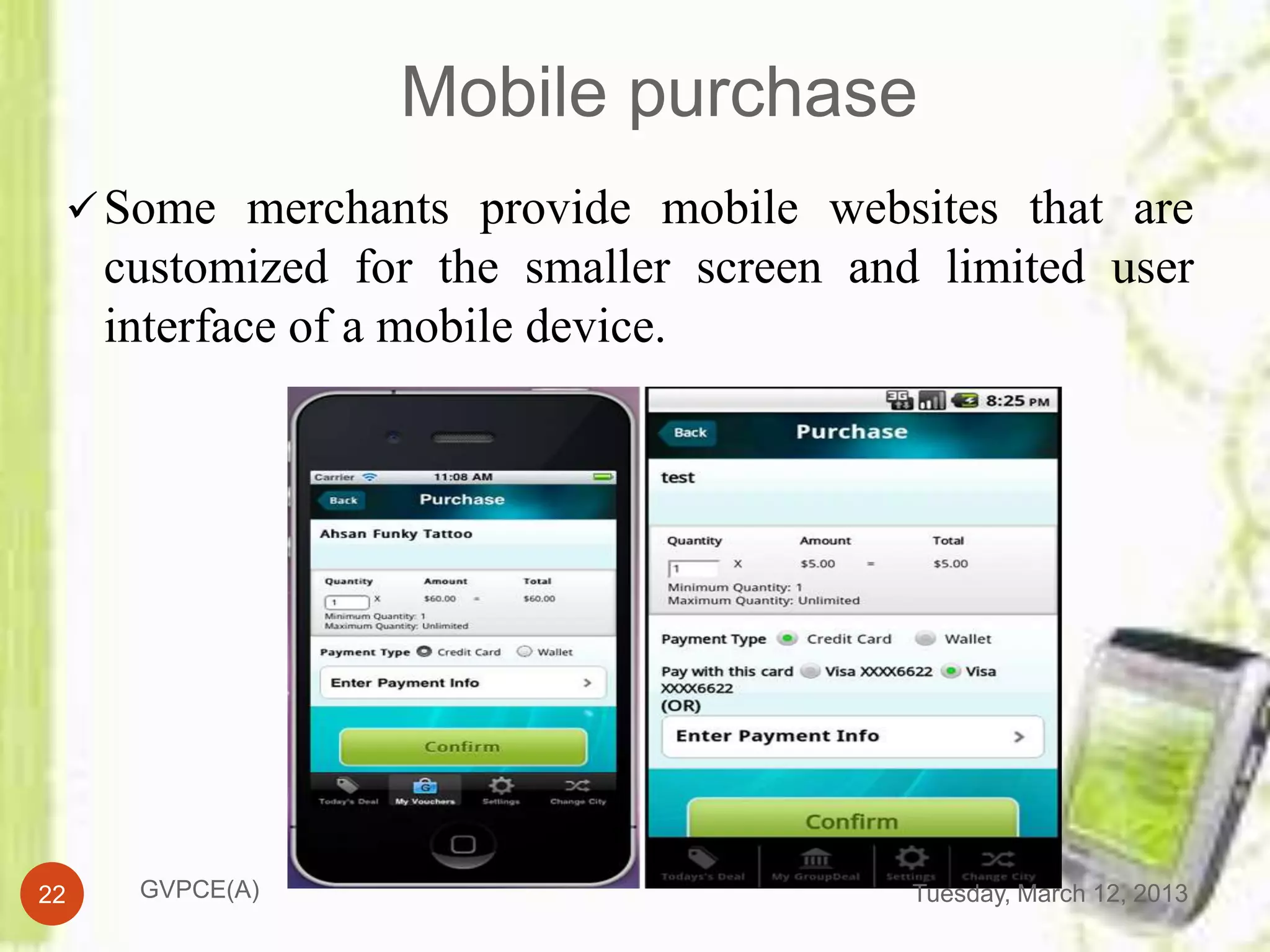
Mobile purchase
  Some merchants provide mobile websites that are
     customized for the smaller screen and limited user
     interface of a mobile device.


22    GVPCE(A)                            Tuesday, March 12, 2013
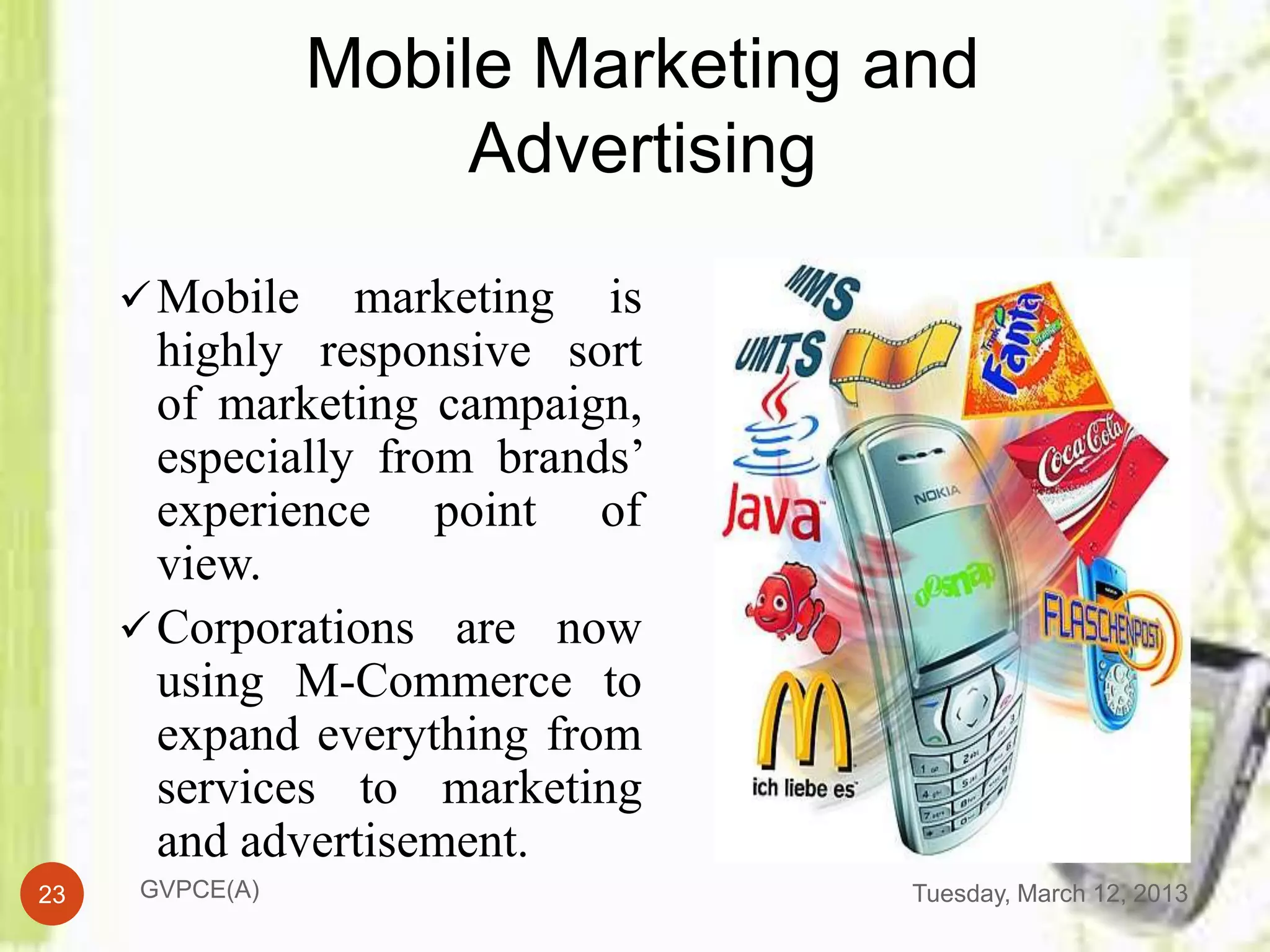
Mobile Marketing and
                      Advertising
      Mobile    marketing is
       highly responsive sort
       of marketing campaign,
       especially from brands’
       experience point of
       view.
      Corporations are now
       using M-Commerce to
       expand everything from
       services to marketing
       and advertisement.
23    GVPCE(A)                    Tuesday, March 12, 2013
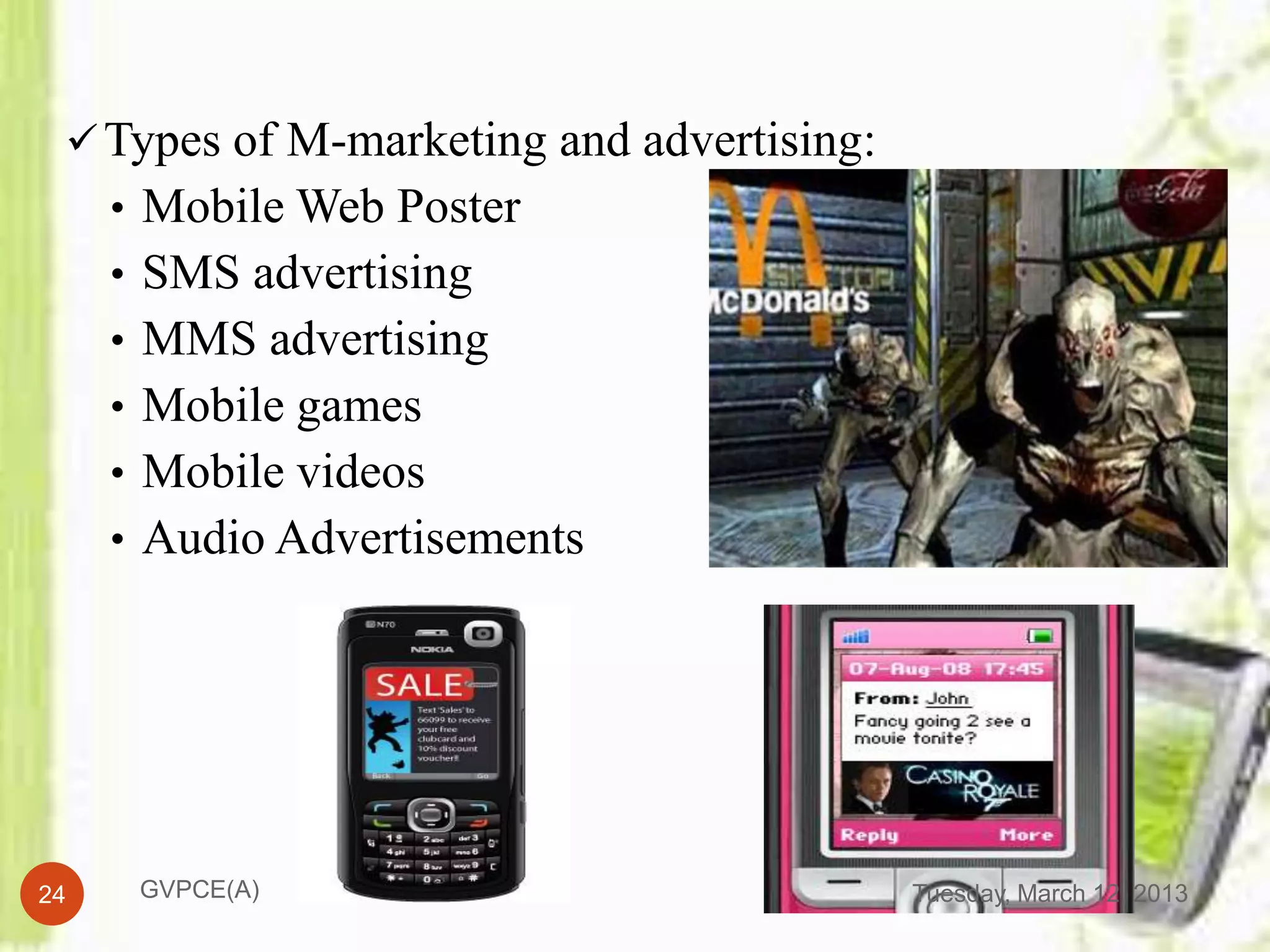
 Types of M-marketing and advertising:
     • Mobile Web Poster
     • SMS advertising
     • MMS advertising
     • Mobile games
     • Mobile videos
     • Audio Advertisements


24    GVPCE(A)                             Tuesday, March 12, 2013
Mobile vouchers, coupons and
                     loyalty cards
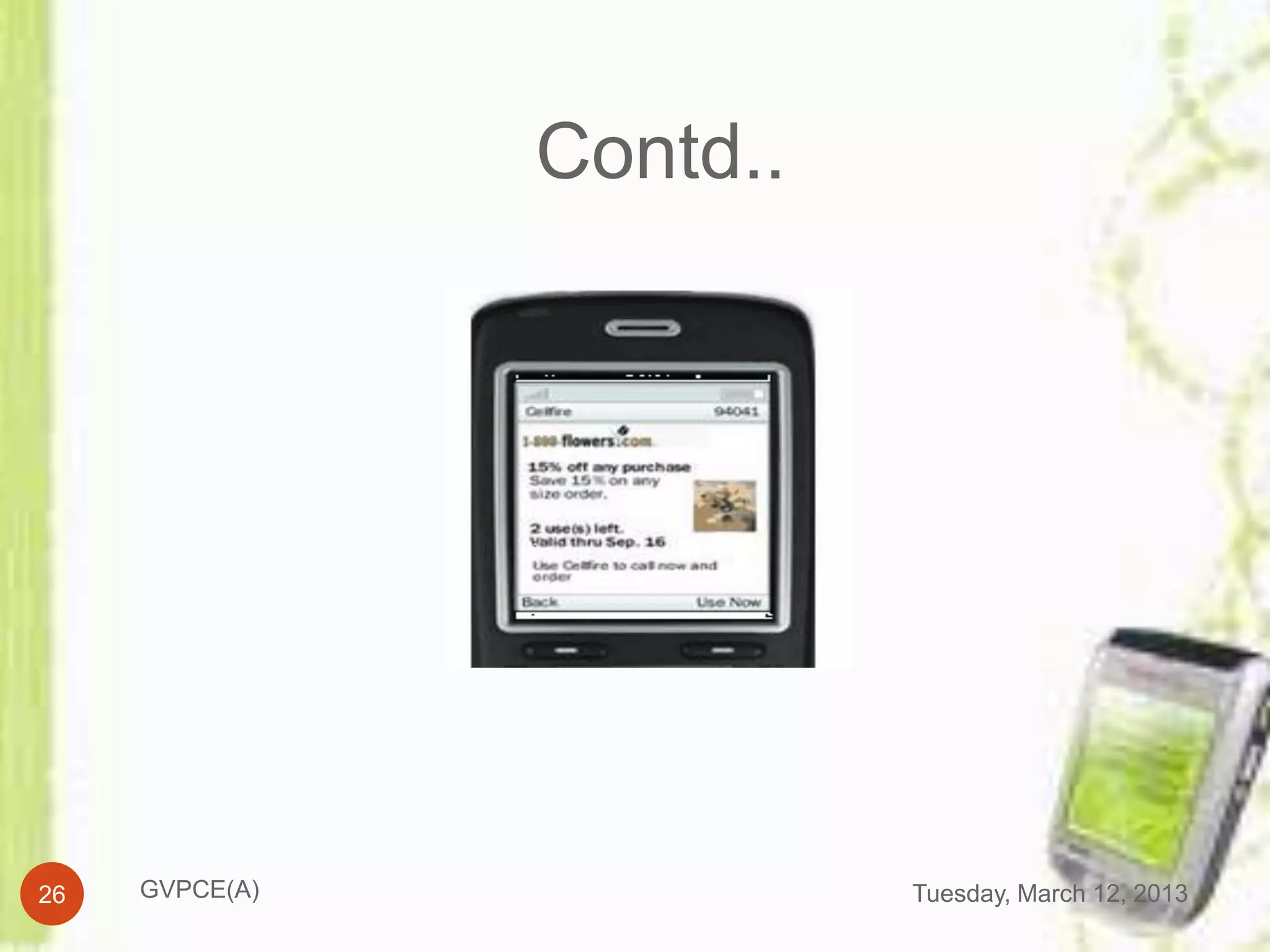
      The voucher, coupon, or loyalty card is represented by

      a virtual token that is sent to the mobile phone.
      Presenting a mobile phone with one of these tokens at
      the point of sale allows the customer to receive the
      same benefits as another customer who has a loyalty
      card or other paper coupon/voucher.


25      GVPCE(A)                              Tuesday, March 12, 2013
Contd..


26   GVPCE(A)             Tuesday, March 12, 2013
Payment Methods
      Consumers can use many forms of payment in

      mobile Commerce. They are:

     1. Premium Rate Telephone Numbers

     2. Direct Mobile Billing

     3. Macro payment and Micro payment Services

     4. Mobile Wallet


27     GVPCE(A)                          Tuesday, March 12, 2013
Premium Rate Telephone
                   Numbers
  Premium-rate       telephone   numbers   are      telephone
     numbers for telephone calls during which certain
     services are provided, and for which prices higher than
     normal are charged.

  Unlike a normal call, part of the call charge is paid to

     the service provider, thus enabling businesses to be
     funded via the calls.

  These telephone numbers are easily distinguished with
28    GVPCE(A)                               Tuesday, March 12, 2013
     other numbers.
Contd..
      The services that use Premium Rate Numbers are:

     • Directory Enquiries

     • Weather Forecasts

     • Competition and Voting


29   GVPCE(A)                             Tuesday, March 12, 2013
Direct Mobile Billing
     Direct mobile billing, also called direct to bill, is a

     method of paying for merchandise by charging the
     purchase to a mobile phone account.

     At the time of checkout, the customer selects the

     mobile billing option on a smart phone and follows a
     two-factor authentication procedure.


30    GVPCE(A)                                   Tuesday, March 12, 2013
Contd..
      After the authentication, which usually involves
       a PIN(personal identification number) and one-
       time password, the consumer's mobile account is
       charged for the amount of the purchase, plus
       applicable taxes and, in some cases, a processing fee.
      Direct mobile billing does not require any previous
       registration, and it does not involve any other sources
       of funding such as credit cards or bank accounts.


31   GVPCE(A)                                  Tuesday, March 12, 2013
Macro and Micro Payment
                     Services
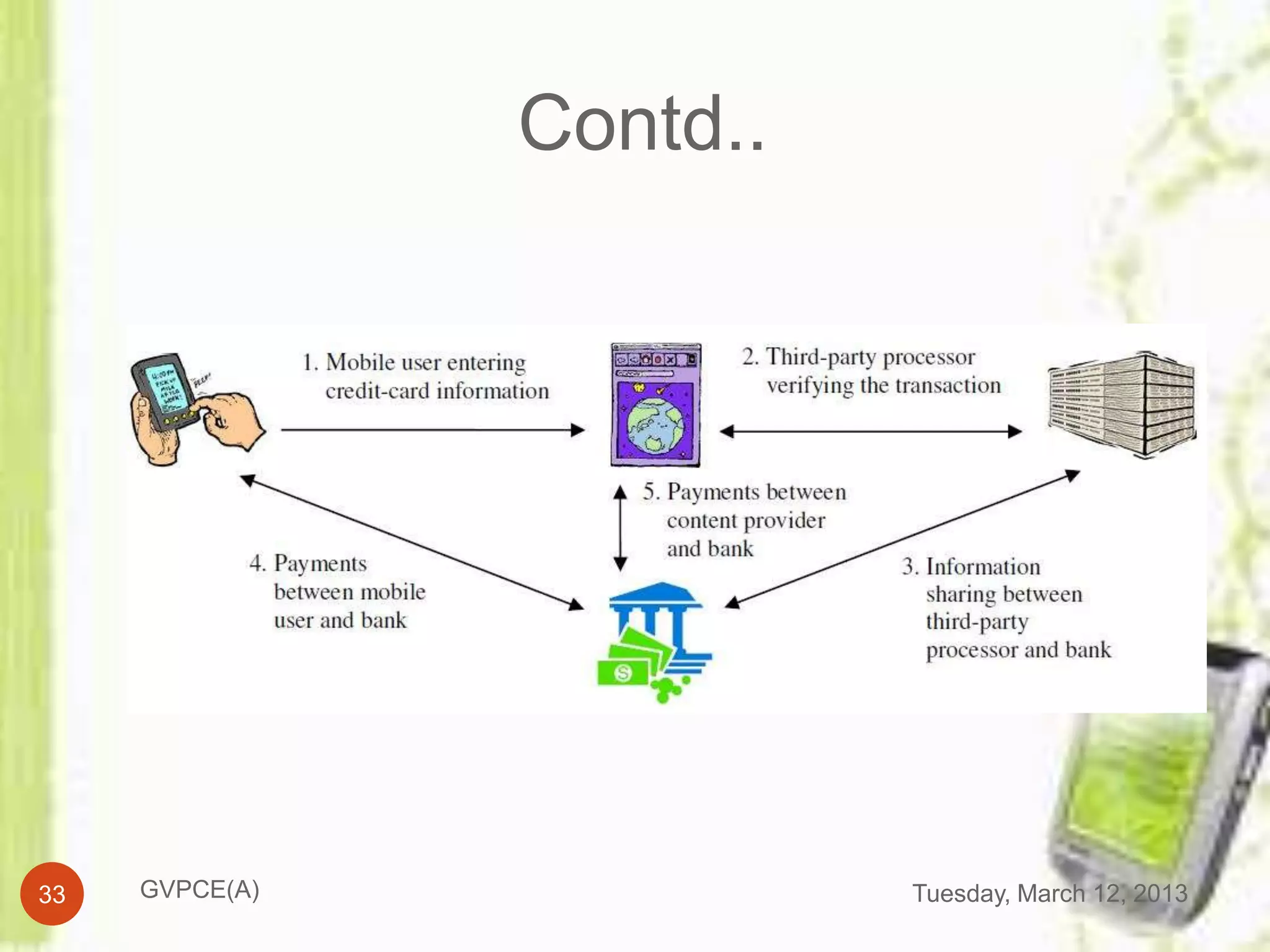
                       Macro payments:
  This kind of payments is used by traditional electronic

     Commerce and they usually involve amounts more
     than US $10.00.

  Payments by credit cards are the most common

     method for Macro payments.


32    GVPCE(A)                             Tuesday, March 12, 2013
Contd..


33   GVPCE(A)             Tuesday, March 12, 2013
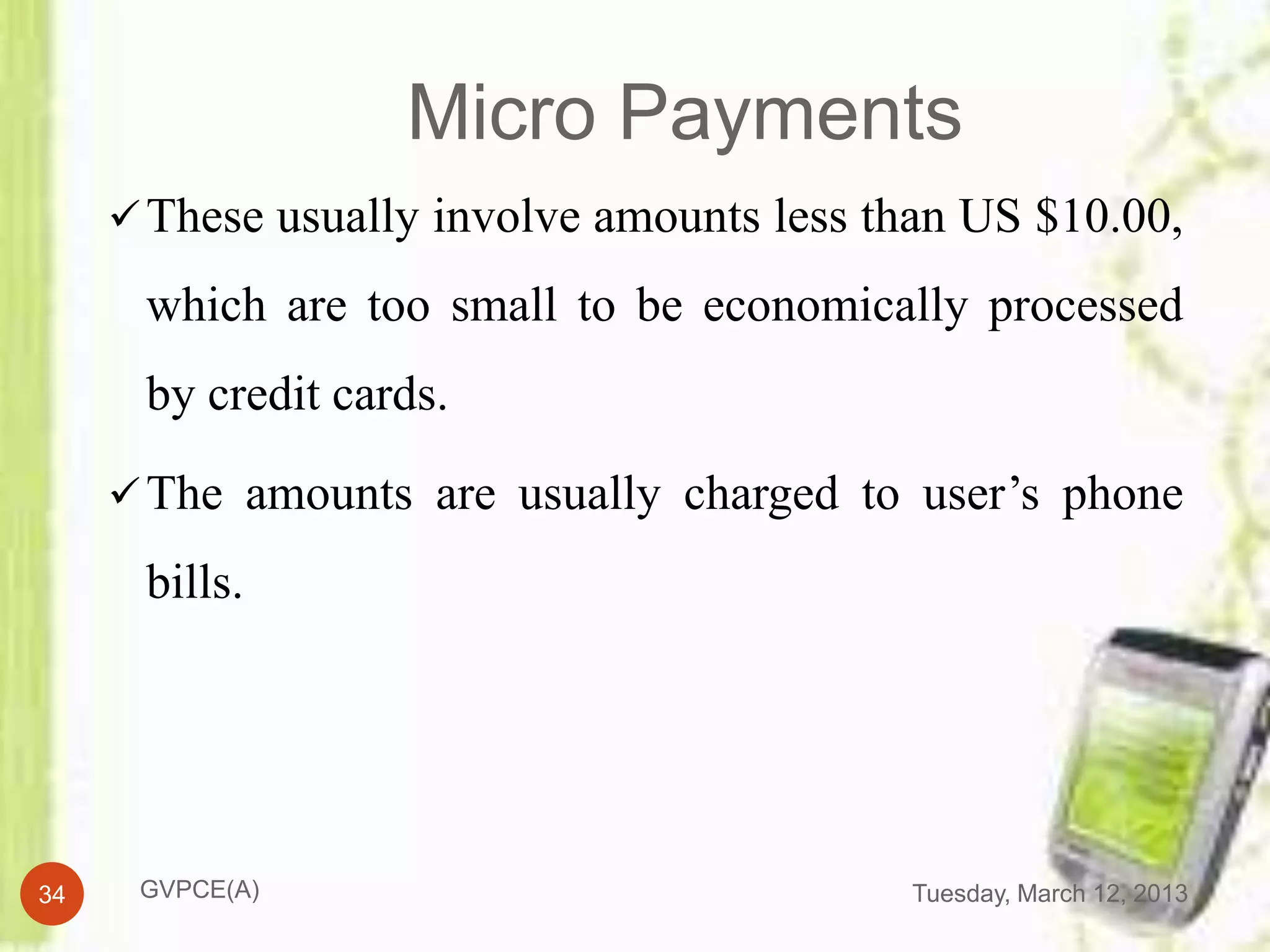
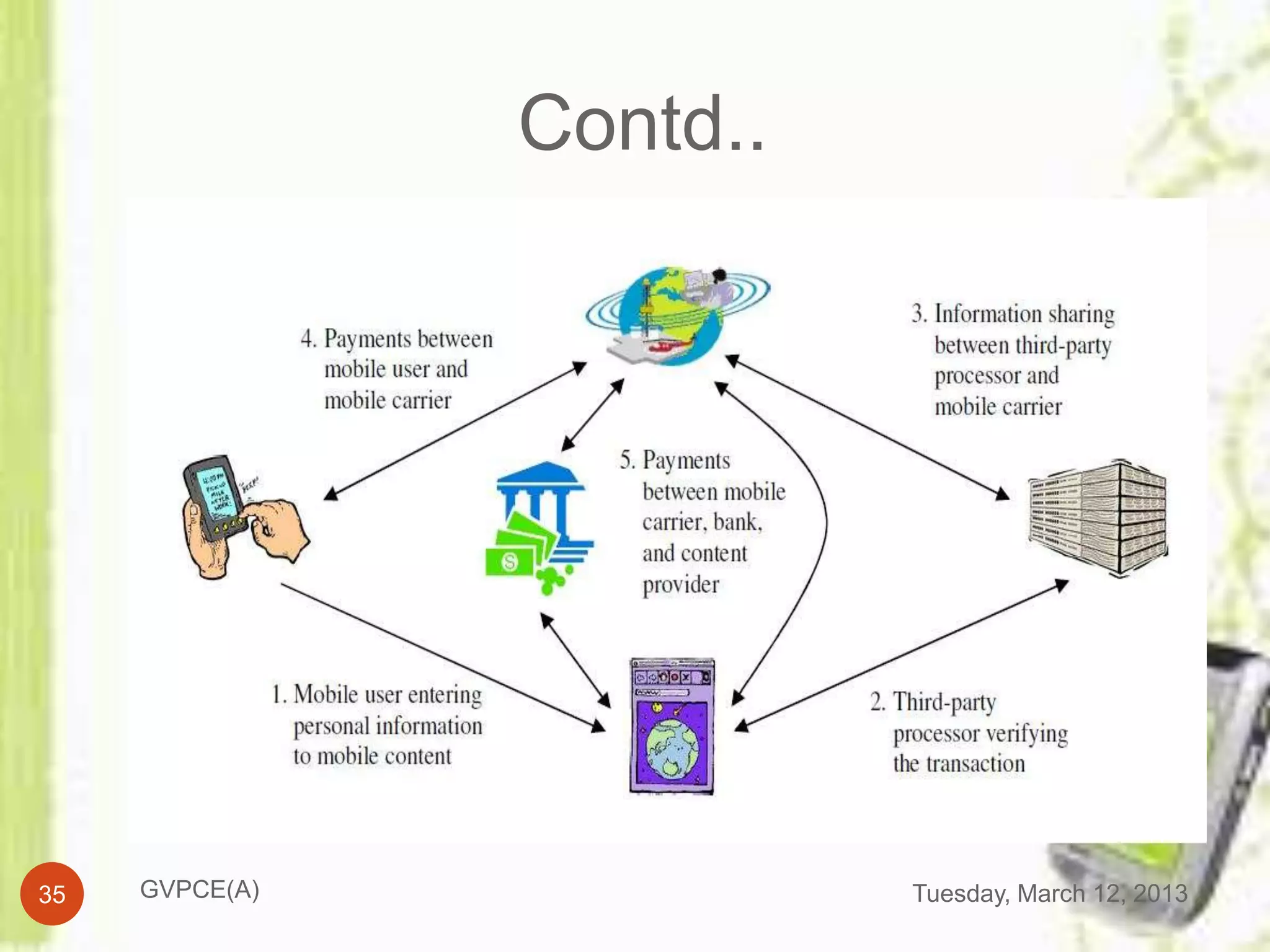
Micro Payments
      These usually involve amounts less than US $10.00,

      which are too small to be economically processed
      by credit cards.

      The amounts are usually charged to user’s phone

      bills.


34    GVPCE(A)                             Tuesday, March 12, 2013
Contd..


35   GVPCE(A)             Tuesday, March 12, 2013
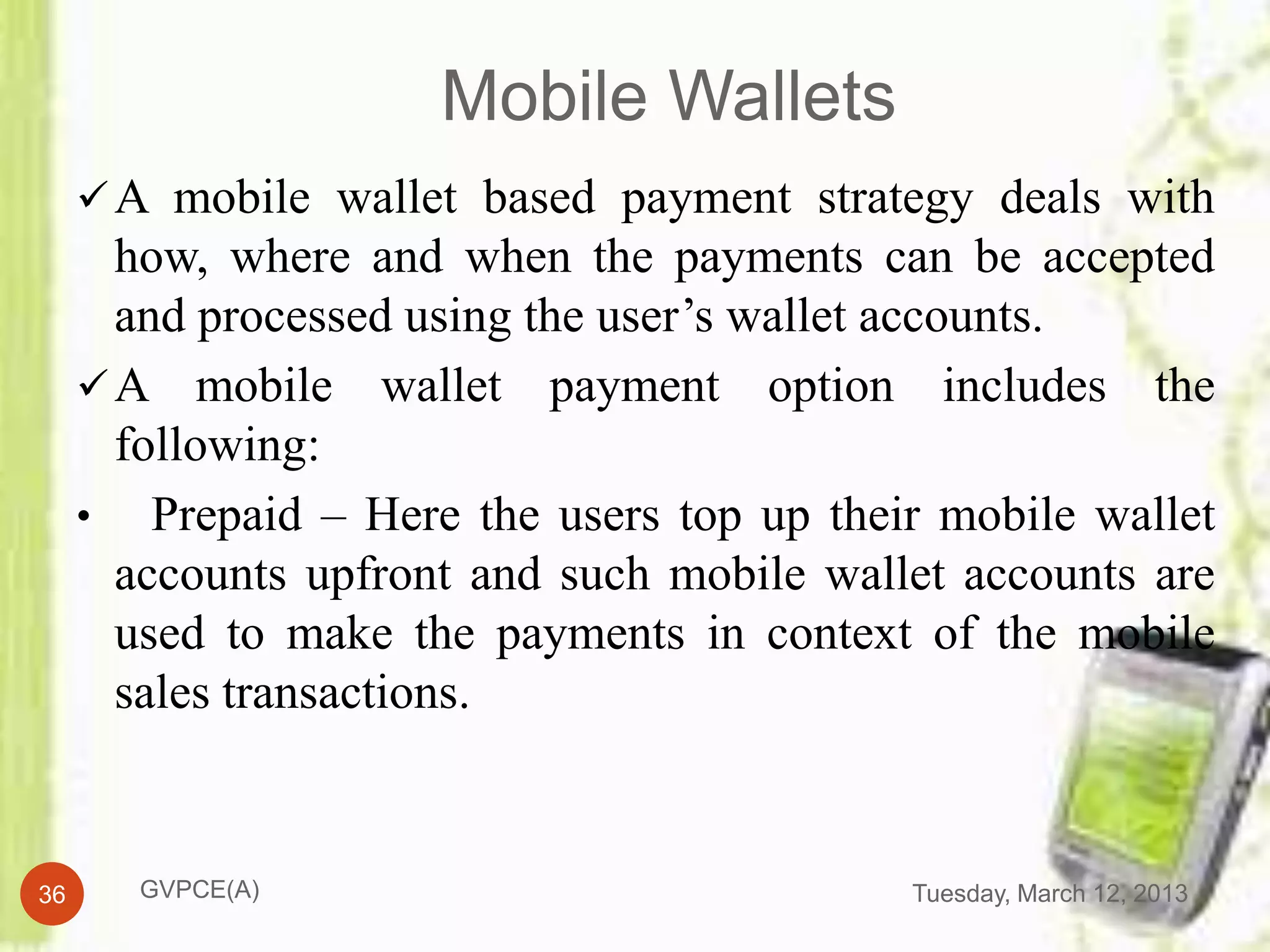
Mobile Wallets
      A mobile wallet based payment strategy deals with
       how, where and when the payments can be accepted
       and processed using the user’s wallet accounts.
      A mobile wallet payment option includes the
       following:
     • Prepaid – Here the users top up their mobile wallet
       accounts upfront and such mobile wallet accounts are
       used to make the payments in context of the mobile
       sales transactions.


36      GVPCE(A)                            Tuesday, March 12, 2013
Contd..
     •   Post-paid – In this case, a user’s mobile wallet
       account is linked to his or her carrier billing
       account. The mobile sales transactions are paid
       with the user’s mobile wallet account, which in
       turn is charged to the associated mobile billing
       account that is usually paid on a monthly or
       quarterly basis.
     • Card linked mobile wallets – In this mobile wallet
       strategy, the mobile wallet accounts are linked to
       user’s debit or credit cards. In a mobile sales
       transaction, with card linked mobile wallet
       payment, the final payment is made from the
       wallet account that is linked to user’s cards.
37   GVPCE(A)                              Tuesday, March 12, 2013
Advantages
      Advantages of M-Commerce are:
           •     Portability
           •     Instant connectivity
           •     Mobility
           •     Personalization
           •     Localization


38    GVPCE(A)                          Tuesday, March 12, 2013
Disadvantages
      Small screens of most devices still limit types of file

      and data transfer (i.e. streaming videos, etc.)

      Use of graphics limited

      User interface is often difficult to learn how to use

      Speed

      Limited storage capacity of devices


39    GVPCE(A)                                 Tuesday, March 12, 2013
Conclusion
     The core of M-Commerce is the use of a

     terminal(telephone, PDA, PC device) and public
     mobile network to access information and conduct
     transactions that result in the transfer of value in
     exchange of information, services or goods. Mobile
     commerce refers to any transaction with monetary
     value that is conducted via a mobile communications
     network.
40    GVPCE(A)                              Tuesday, March 12, 2013
References
      http://en.wikipedia.org/wiki/Mobile_Commerce

      http://en.wikipedia.org/wiki/Mobile_web

      http://en.wikipedia.org/wiki/Mobile_payment

      http://en.wikipedia.org/wiki/Micropayment

      http://en.wikipedia.org/wiki/Mobile_Commerce


41      GVPCE(A)                             Tuesday, March 12, 2013
Thank You So Much


42   GVPCE(A)                Tuesday, March 12, 2013

M commerce ppt

  • 1.
    E-Commerce in Mobile Computing Presented by V.Chaitanya 09131A1266 1 GVPCE(A) Tuesday, March 12, 2013
  • 2.
    Outline  Introduction  History  Overview  Services and Applications  Advantages  Disadvantages  Conclusion  References 2 GVPCE(A) Tuesday, March 12, 2013
  • 3.
    Introduction What is Commerce  Commerce is a division of trade or production which deals with the exchange of goods and services from producer to final consumer.  It comprises the trading of economic value such as goods, services, information, or money between two or more entities. 3 GVPCE(A) Tuesday, March 12, 2013
  • 4.
    Contd.. What is E-Commerce  Commonly known as Electronic Marketing.  It consist of buying and selling goods and services over an electronic system such as the internet .  E-Commerce is the purchasing, selling and exchanging goods and services over computer networks (internet) through which transaction or terms of sale are performed Electronically. 4 GVPCE(A) Tuesday, March 12, 2013
  • 5.
    Contd.. Mobile Commerce:  Mobile Commerce is also known as M-Commerce.  M-Commerce is the buying and selling of goods and services through wireless handheld devices.  M-Commerce is the process of paying for services using a mobile phone or personal organizer 5 GVPCE(A) Tuesday, March 12, 2013
  • 6.
    History  Mobile Commerce Services were first delivered in 1997, when the first two mobile-phone enabled Coca Cola vending machines were installed in the Helsinki area in Finland.  The M-Commerce server developed in late 1997 by Kevin Duffey at Logica.  Since the launch of the iPhone, mobile Commerce has moved away from SMS systems and into actual 6 applications. GVPCE(A) Tuesday, March 12, 2013
  • 7.
    Overview  M-Commerce isthe ability to conduct Commerce using a mobile device such as: 1. Mobile Phone 2. Personal Digital Assistant(PDA) 3. Smart Phone 7 GVPCE(A) Tuesday, March 12, 2013
  • 8.
    Contd.. Mobile Commerce from the Customer‘ s point of view  The customer wants to access information, goods and services any time and in any place on his mobile device.  He can use his mobile device to purchase tickets for events or public transport, pay for parking, download content and even order books and CDs.  He should be offered appropriate payment methods. 8 GVPCE(A) Tuesday, March 12, 2013
  • 9.
    Contd.. Mobile Commerce fromthe Provider`s point of view  The future development of the mobile telecommunication sector is heading more and more towards value-added services. Analysts forecast that soon half of mobile operators‘ revenue will be earned through mobile Commerce.  Innovative service scenarios will be needed that meet the customer‘s expectations and business models that satisfy 9 all GVPCE(A) involved. partners Tuesday, March 12, 2013
  • 10.
    Services and Applications  Mobile ticketing  Mobile Money Transfer  Content purchase and delivery  Information services  Mobile banking  Mobile Browsing  Mobile Purchase  Mobile marketing and advertising 10 GVPCE(A) Tuesday, March 12, 2013
  • 11.
    Mobile Ticketing  Mobile Ticketing is the process where the customers can order, pay for, obtain and validate tickets from any location and at any time using Mobile phones .  Tickets can be booked and cancelled on the mobile device with the help of simple application downloads.  Delivery of tickets to mobile phones can be done in the form of a SMS or by a MMS. 11 GVPCE(A) Tuesday, March 12, 2013
  • 12.
    Contd.. Mobile Tickets can be purchased in a variety of ways including online, via text messaging or in a secure mobile application. Mobile Ticketing is used in many applications like: 1. Airline ticketing 2. Cinema ticketing 3. Railway & Bus ticketing 4. Concert/Event ticketing 5. Consumer voucher distribution 12 GVPCE(A) Tuesday, March 12, 2013
  • 13.
    Benefits to theticket buyer  Instant delivery of mobile tickets at the time of purchase.  Individual mobile tickets can be forwarded to a friend.  Quicker entry with no waiting in lines. Benefits to the Event organizer  Reduced will call lines and staffing.  Guaranteed security, only one entry per barcode. 13 GVPCE(A) Tuesday, March 12, 2013  Event is 'greener' with reduced paper waste.
  • 14.
    Mobile Money Transfer  Mobile Money Transfer refers to payment services which are performed by using a mobile phone.  By using this service we can transfer money from one person to other by using a mobile phone. Ex: ICICI bank has started IMPS - Interbank Mobile Payment Service. It is an interbank electronic instant mobile money transfer service through mobile phones. 14 GVPCE(A) Tuesday, March 12, 2013
  • 15.
    15 GVPCE(A) Tuesday, March 12, 2013
  • 16.
    Content purchase anddelivery  Mobile content purchase and delivery mainly consists of the sale of ring-tones, wallpapers, and games for mobile phones.  The convergence of mobile phones, portable audio players, and video players into a single device is increasing the purchase and delivery of full-length music tracks and video. 16 GVPCE(A) Tuesday, March 12, 2013
  • 17.
    Information services A wide variety of information services can be delivered to mobile phone users in much the same way as it is delivered to PCs. These services include:  News  Stock quotes  Sports scores  Traffic reporting 17 GVPCE(A) Tuesday, March 12, 2013
  • 18.
    Mobile banking  Banks and other financial institutions use mobile Commerce to allow their customers to access account information and make transactions, such as purchasing stocks, remitting money, receive notifications, transfer money to other banks. 18 GVPCE(A) Tuesday, March 12, 2013
  • 19.
    Contd.. Mobile BankingServices are: 1. Mini-statements and checking of account history 2. Checking the balance 3. Recent transactions 4. PIN provision, Change of PIN and reminder over the Internet 5. Cash-in, cash-out transactions on an ATM 19 GVPCE(A) Tuesday, March 12, 2013
  • 20.
    Location-based services The location of the mobile phone user is an important piece of information used during Mobile Commerce or M-Commerce transactions.  Knowing the location of the user allows for location- based services such as: 1. Local discount offers 2. Tracking and monitoring of people 20 GVPCE(A) Tuesday, March 12, 2013
  • 21.
    Contd.. 21 GVPCE(A) Tuesday, March 12, 2013
  • 22.
    Mobile purchase Some merchants provide mobile websites that are customized for the smaller screen and limited user interface of a mobile device. 22 GVPCE(A) Tuesday, March 12, 2013
  • 23.
    Mobile Marketing and Advertising  Mobile marketing is highly responsive sort of marketing campaign, especially from brands’ experience point of view.  Corporations are now using M-Commerce to expand everything from services to marketing and advertisement. 23 GVPCE(A) Tuesday, March 12, 2013
  • 24.
     Types ofM-marketing and advertising: • Mobile Web Poster • SMS advertising • MMS advertising • Mobile games • Mobile videos • Audio Advertisements 24 GVPCE(A) Tuesday, March 12, 2013
  • 25.
    Mobile vouchers, couponsand loyalty cards  The voucher, coupon, or loyalty card is represented by a virtual token that is sent to the mobile phone. Presenting a mobile phone with one of these tokens at the point of sale allows the customer to receive the same benefits as another customer who has a loyalty card or other paper coupon/voucher. 25 GVPCE(A) Tuesday, March 12, 2013
  • 26.
    Contd.. 26 GVPCE(A) Tuesday, March 12, 2013
  • 27.
    Payment Methods  Consumers can use many forms of payment in mobile Commerce. They are: 1. Premium Rate Telephone Numbers 2. Direct Mobile Billing 3. Macro payment and Micro payment Services 4. Mobile Wallet 27 GVPCE(A) Tuesday, March 12, 2013
  • 28.
    Premium Rate Telephone Numbers  Premium-rate telephone numbers are telephone numbers for telephone calls during which certain services are provided, and for which prices higher than normal are charged.  Unlike a normal call, part of the call charge is paid to the service provider, thus enabling businesses to be funded via the calls.  These telephone numbers are easily distinguished with 28 GVPCE(A) Tuesday, March 12, 2013 other numbers.
  • 29.
    Contd..  The services that use Premium Rate Numbers are: • Directory Enquiries • Weather Forecasts • Competition and Voting 29 GVPCE(A) Tuesday, March 12, 2013
  • 30.
    Direct Mobile Billing Direct mobile billing, also called direct to bill, is a method of paying for merchandise by charging the purchase to a mobile phone account. At the time of checkout, the customer selects the mobile billing option on a smart phone and follows a two-factor authentication procedure. 30 GVPCE(A) Tuesday, March 12, 2013
  • 31.
    Contd..  After the authentication, which usually involves a PIN(personal identification number) and one- time password, the consumer's mobile account is charged for the amount of the purchase, plus applicable taxes and, in some cases, a processing fee.  Direct mobile billing does not require any previous registration, and it does not involve any other sources of funding such as credit cards or bank accounts. 31 GVPCE(A) Tuesday, March 12, 2013
  • 32.
    Macro and MicroPayment Services Macro payments:  This kind of payments is used by traditional electronic Commerce and they usually involve amounts more than US $10.00.  Payments by credit cards are the most common method for Macro payments. 32 GVPCE(A) Tuesday, March 12, 2013
  • 33.
    Contd.. 33 GVPCE(A) Tuesday, March 12, 2013
  • 34.
    Micro Payments  These usually involve amounts less than US $10.00, which are too small to be economically processed by credit cards.  The amounts are usually charged to user’s phone bills. 34 GVPCE(A) Tuesday, March 12, 2013
  • 35.
    Contd.. 35 GVPCE(A) Tuesday, March 12, 2013
  • 36.
    Mobile Wallets  A mobile wallet based payment strategy deals with how, where and when the payments can be accepted and processed using the user’s wallet accounts.  A mobile wallet payment option includes the following: • Prepaid – Here the users top up their mobile wallet accounts upfront and such mobile wallet accounts are used to make the payments in context of the mobile sales transactions. 36 GVPCE(A) Tuesday, March 12, 2013
  • 37.
    Contd.. • Post-paid – In this case, a user’s mobile wallet account is linked to his or her carrier billing account. The mobile sales transactions are paid with the user’s mobile wallet account, which in turn is charged to the associated mobile billing account that is usually paid on a monthly or quarterly basis. • Card linked mobile wallets – In this mobile wallet strategy, the mobile wallet accounts are linked to user’s debit or credit cards. In a mobile sales transaction, with card linked mobile wallet payment, the final payment is made from the wallet account that is linked to user’s cards. 37 GVPCE(A) Tuesday, March 12, 2013
  • 38.
    Advantages  Advantages of M-Commerce are: • Portability • Instant connectivity • Mobility • Personalization • Localization 38 GVPCE(A) Tuesday, March 12, 2013
  • 39.
    Disadvantages  Small screens of most devices still limit types of file and data transfer (i.e. streaming videos, etc.)  Use of graphics limited  User interface is often difficult to learn how to use  Speed  Limited storage capacity of devices 39 GVPCE(A) Tuesday, March 12, 2013
  • 40.
    Conclusion The core of M-Commerce is the use of a terminal(telephone, PDA, PC device) and public mobile network to access information and conduct transactions that result in the transfer of value in exchange of information, services or goods. Mobile commerce refers to any transaction with monetary value that is conducted via a mobile communications network. 40 GVPCE(A) Tuesday, March 12, 2013
  • 41.
    References  http://en.wikipedia.org/wiki/Mobile_Commerce  http://en.wikipedia.org/wiki/Mobile_web  http://en.wikipedia.org/wiki/Mobile_payment  http://en.wikipedia.org/wiki/Micropayment  http://en.wikipedia.org/wiki/Mobile_Commerce 41 GVPCE(A) Tuesday, March 12, 2013
  • 42.
    Thank You SoMuch 42 GVPCE(A) Tuesday, March 12, 2013