HUMAN COMPUTER
INTERACTION
BY : MUHAMMAD FAHIM RANA
HCI
 OPEN YOUR EYES
 OPEN YOUR MIND
 CHANGE THE WAY YOU THINK ABOUT HUMAN AND COMPUTER
 HOW THEY INTERACT WITH EACH OTHER
HCI (FORMAL DEFINITION)
 Human-Computer Interaction is a discipline concerned with the
design, evaluation and implementation of interactive computing
systems for human use and with the study of major phenomena
surrounding them” -ACM/IEEE
Be careful…
 You will never look at computers the same way again
 Computers are everywhere, and penetrating our lives slowly slowly,
 Computer become powerful day by day
 Computer perform many task which were earlier performed by humans
What is the result ??
Pros of Computer Technology
 Enable new discoveries
 Lead to efficiencies
 Make on life easy and convenient
Cons of Computer Technology
 Annoy us
 Infuriate us
 Even kill us
But…
We cant live without them because we cannot
kill computers
Riddles for the Information Age
 Computer + Alarm Clock
 Computer + Camera
 Computer + Car
 Computer + Warship
 Computer + Airplane
Alarm Clock
 1st Generation, simple clock whose alarm can be set with the help of a button
easily
 2nd Generation, clock have LCD, sophisticated and digital, but if you want to
set alarm its difficult as compared to first generation
 3rd Generation,
 A computer! I just purchased an expensive new clock-radio for my bedroom, a JVC
FS2000. It has a very sophisticated computer brain, and offers high fidelity, digital
sound, and lots of features. It wakes me up at a preset time by playing a compact
disc, and it has the delicacy and intelligence to slowly fade up the volume when it
begins to play at six o’clock in the morning. This feature is really pleasant and
quite unique, and it compensates for the fact that I want to hurl the infuriating
machine out the window.
 It’s very hard to tell when the alarm is armed, so it occasionally fails to wake me up on a
Monday and rousts me out of bed early on a Saturday. Sure, it has an indicator to show the
alarm is set, but that doesn’t mean it’s useful. The clock has a sophisticated alphanumeric
liquid crystal display (LCD) that displays all of its many functions. The presence of a small
symbol in the upper left corner of the LCD indicates the alarm is armed, but in a dimly lit
bedroom the clock symbol visible, but the backlight comes on when the CD or radio is
explicitly turned on. There’s a gotcha, however, as the alarm simply won’t ever sound while
the CD is explicitly left on, regardless of the setting of the alarm. It is this paradoxical
operation that frequently catches me unaware.
 It is simple to disarm the alarm: Simply press the “Alarm” button once, and the clock symbol
disappears from the display. However to arm it, I must press the “Alarm” button exactly five
times. The first time I press it, the display shows me the time of the alarm. On press tow, it
shows the time when it will turn the sound off. On press three, it shows me whether it will
play the radio or the CD. On press four, it shows me the preset volume. On press five, it
returns to the normal view, but with the alarm now armed. But with just one additional
press, it disarms the alarm. Sleepy, in a dark bedroom, it is quite difficult to perform this
little digital ballet correctly. The alarm clock may still wake me up, but it behaves like a
computer.
 By contrast, my old non-computerized alarm clock woke me up with a sudden,
unholy buzzing. When it was armed, a single red light glowed. When it was
not armed, the red light was dark. I didn’t like this old alarm clock for many
reasons, but at least I could tell when it was going to wake me up
Feature Shock
 Every digital device has more features than its manual counterpart,
but manual devices easier to use. Hi-tech companies add more
features to improve product. Product becomes complicated
Bad process can’t improve product
Computer + Bank
 A computer! Whenever I withdraw cash from an automatic teller machine
(ATM), I encounter the same sullen and difficult behavior so universal with
computers. If I make the slightest mistake, it rejects the entire transaction
and kicks me out of the process. I have to pull my card out, reinsert it,
reenter my PIN code, and then re-assert my request. Typically, it wasn’t my
mistake, either, but the ATM computer finesses me into a misstep. It always
asks me whether I want to withdraw money from my checking, saving, or
money market account, even though I have only checking account.
Subsequently, I always forget which type it is, and the question confuses me.
About once a month I inadvertently select “savings”, and the infernal
machine summarily boots me out of the entire transaction to start over the
beginning. To reject “savings”, the machine has to know that I don’t have a
saving account, yet it still offers it to me as a choice. The only difference
between me selecting “saving” and the pilot of Flight 965 selecting “ROMEO”
is the magnitude of the penalty.
Computer + Bank
 The ATM has rules that must be followed, and I am quite willing to follow
them, but it is unreasonably computer-like to fail to inform me of them,
giving me contradictory indications, and then summarily punish me for
innocently transgressing them. This behavior---so typical of computers---is not
intrinsic to them. Actually nothing is intrinsic to computers: they merely act
on behalf of their software, the program. And programs are as malleable as
human speech. A person can speak rudely of politely, helpfully or sullenly. It is
as simple for a computer to behave with respect and courtesy as it is for a
human to speak that way. All it takes is for someone to describe how.
Unfortunately, programmers aren’t very good at teaching that to computers.
 In order to solve some of these problems, here comes the relatively new and
emerging field of Human Computer Interaction (HCI).[1
Human verses Computer
Human species
 Human beings are the most interesting and fascinating specie on planet.
 They are the most complex living being on the earth.
 It has very much diversity in its nature.
 It is intelligent in its deeds.
 Human beings think and decide according to their own will.
 Yes, they are free in nature.
 They like freedom.
Human species
 They think on a problem dynamically and they can find many solutions that
may not exist before.
 They can invent.
 They are not only rational but they also have emotions.
 They also think emotionally.
 They act emotionally.
 And fortunately or unfortunately they make mistakes. They make mistakes
which some time become fatal for them and some time they become blessing
for them
Computer species
 On contrast, computers are the invention of human being.
 They are also complex
 they are also pretty dumb
 It can also think but it can’t think on its own will
 it thinks how it has been directed to think
 No doubt its speed is marvelous
 It does not tire
Computer species
 It is emotionless
 It has no feelings
 It has no desires
 It works how it has been commanded to work
 And they do not make mistakes
Computer vs Human
 Before penetration of computers in our daily life, human beings were
performing their tasks at their on responsibility
 In a business domain human beings were dealing and interacting with each
other’s
 For example a store manager was dealing with all the workers performing
their different duties in the store. Some one was registering the new arrivals
of products, some one was numbering the products and many more…and store
manager has to interact with all these human beings. If some one was a
salesperson, he used to interact with different clients and used to deal with
them according to their mood and desire. He could judge their mood with
their tone, their attitude and with their body language. He could provide
answers relevant to their questions.
Computer Vs Humans
 But now in this age of information technology we are expecting computers to
mimic human behavior e.g. ECommerce systems, now there is no need for a
salesperson. Web sites are behaving as a salesperson or as a shopping mal.
That is now; a dumb, unintelligent and inanimate object will perform the
complex task which was performed by some human being.
Software Engineering and HCI
 There is a basic fundamental difference between the approaches taken by
software engineers and human-computer interaction specialists. Human-
computer interface specialists are user-centered and software engineers are
system-centered.
 Software engineering methodologies are good at modeling certain aspects of
the problem domain. Formal methods have been developed to represent
data, architectural, and procedural aspects of a software system. Software
engineering approaches deal with managerial and financial issues well.
Software engineering methodologies are useful for specifying and building the
functional aspects of a software system.
Software Engineering and HCI
 Human-computer interfaces emphasize developing a deep understanding of
user characteristics and a clear awareness of the tasks a user must perform.
 HCI specialists test design ideas on real users and use formal evaluation
techniques to replace intuition in guiding design. This constant reality check
improves the final product
Here are some facts and figures:
 Users can only find information 42% of the time – Jared Spool
 62% of web shoppers give up looking for the item they want to buy online –
Zona Research
 50% of the potential sales from a site are lost because people cannot find the
item they are looking for – Forrester Research
 40% of the users who do not return to a site do so because their first visit
resulted in a negative experience – Forrester Research
 80% of software lifecycle costs occur after the product is released, in the
maintenance phase - of that work, 80 % is due to unmet or unforeseen user
requirements; only 20 % is due to bugs or reliability problems- IEEE Software
Here are some facts and figures:
 Around 63% of software projects exceed their cost estimates. The top four
reasons for this are: – Frequent requests for changes from users – Overlooked
tasks – Users' lack of understanding of their own requirements – Insufficient
user-analyst communication and understanding
 Poor commercial web sites will kill 80% of Fortune 500 companies within a
decade - Jakob Nielsen
 So all above given facts reveals that the product with the bad user experience
deserve to die!
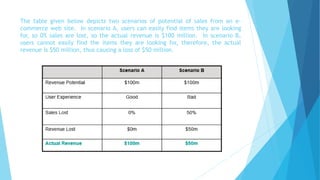
The table given below depicts two scenarios of potential of sales from an e-
commerce web site. In scenario A, users can easily find items they are looking
for, so 0% sales are lost, so the actual revenue is $100 million. In scenario B,
users cannot easily find the items they are looking for, therefore, the actual
revenue is $50 million, thus causing a loss of $50 million.
Computer + Information
WHAT DO YOU GET WHEN YOU CROSS A COMPUTER WITH
INFORMATION?
Computer + Information
 In 2000, the Olympic Games were held in Sydney. Before the Olympic games
could begin, a lawsuit was filed against the Olympic Committee. The case
was called Bruce Lindsay Maguire vs Sydney Organizing Committee for the
Olympics Games (SOCOG). On 7 June 1999 the complainant, who is blind,
complained to the Commission that he was unlawfully discriminated against
by the respondent in three respects:
 The failure to provide Braille copies of the information required to place
orders for Olympic Games tickets;
 The failure to provide Braille copies of the Olympic Games souvenir
programmed; and
 The failure to provide a web site which was accessible to the complainant.
Computer + Information
 It was alleged that the SOCOG was in breach the Disability Discrimination Act
1992 by failing to make accessible to him key parts of its web site
 According to the law of many European and western countries, organizations
with a web site must ensure that their web site is (within certain limits)
accessible by disabled persons. However, this was not the case in the matter
of the official Olympic Games web site.
 Could this have been avoided? Certainly: by applying a few very simple
techniques, the developers of the web site could have made it accessible to
people with vision impairment. But as is usually the case, this was not done.
Result
 The complainant won the case and was awarded a sum of money in damages.
This was very embarrassing for both the SOCOG and also the company that
developed the web site
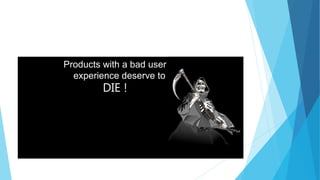
Products with a bad user
experience deserve to
DIE !
Goals of HCI
 The term Human Computer Interaction (HCI) was adopted in the mid-1980s as
a means of describing this new field of study.
 This term acknowledged that the focus of interest was broader than just the
design of the interface and was concerned with all those aspects that relate
to the interaction between users and computers.
 The goals of HCI are to produce usable and safe systems, as well as functional
systems.
 These goals can be summarized as ‘to develop or improve the safety, utility,
effectiveness, efficiency and usability of systems that include computers.
 it refers not just to the hardware and software but to the entire environment
Goals of HCI
 be it organization of people at work at, home or engaged in leisure pursuits---
that uses or is affected by the computer technology in question
 Improving effectiveness and efficiency are self-evident and ubiquitous
objectives.
 The promotion of safety in relation to computer systems is of top importance
in the design of safety-critical systems.
 Usability, a key concept in HCI, is concerned with making systems easy to
learn and easy to use.
 Poorly designed computer system can be extremely annoying to users, as you
can understand from above described incidents
Goals of HCI
 Part of the process of understanding user’s needs, with respect to designing
an interactive system to support them, is to be clear about your primary
objective.
 Is it to design a very efficient system that will allow users to be highly
productive to their work, or is to design a system that will be challenging and
motivating so that it supports effective learning, or is it some thing else?
 We call these talk-level concerns usability goals and user experience goals.
 Usability goals are concerned with meeting specific usability criteria (e.g.,
efficiency)
 User experience goals are largely concern with explicating the quality of the
user experience.
Usability goals
 Usability in generally regarded as ensuring that interactive products are easy to
learn, effective to use, and enjoyable from user perspective.
 It involves optimizing the interactions people have with interactive product to
enable them to carry out their activities at work, school, and in their everyday
life. More specifically, usability is broken down into the following goals:
 Effective to use (effectiveness)
 Efficient to use (efficiency)
 Safe to use(safety)
 Have good utility (utility)
 Easy to learn (learnability)
 Easy to remember how to use (memorability)
Effective to use (effectiveness)
 It is a very general goal and refers to how good a system at doing what it is
suppose to do

Human computer interaction

  • 1.
  • 2.
    HCI  OPEN YOUREYES  OPEN YOUR MIND  CHANGE THE WAY YOU THINK ABOUT HUMAN AND COMPUTER  HOW THEY INTERACT WITH EACH OTHER
  • 3.
    HCI (FORMAL DEFINITION) Human-Computer Interaction is a discipline concerned with the design, evaluation and implementation of interactive computing systems for human use and with the study of major phenomena surrounding them” -ACM/IEEE
  • 4.
    Be careful…  Youwill never look at computers the same way again  Computers are everywhere, and penetrating our lives slowly slowly,  Computer become powerful day by day  Computer perform many task which were earlier performed by humans What is the result ??
  • 5.
    Pros of ComputerTechnology  Enable new discoveries  Lead to efficiencies  Make on life easy and convenient
  • 6.
    Cons of ComputerTechnology  Annoy us  Infuriate us  Even kill us
  • 7.
    But… We cant livewithout them because we cannot kill computers
  • 8.
    Riddles for theInformation Age  Computer + Alarm Clock  Computer + Camera  Computer + Car  Computer + Warship  Computer + Airplane
  • 9.
    Alarm Clock  1stGeneration, simple clock whose alarm can be set with the help of a button easily  2nd Generation, clock have LCD, sophisticated and digital, but if you want to set alarm its difficult as compared to first generation  3rd Generation,  A computer! I just purchased an expensive new clock-radio for my bedroom, a JVC FS2000. It has a very sophisticated computer brain, and offers high fidelity, digital sound, and lots of features. It wakes me up at a preset time by playing a compact disc, and it has the delicacy and intelligence to slowly fade up the volume when it begins to play at six o’clock in the morning. This feature is really pleasant and quite unique, and it compensates for the fact that I want to hurl the infuriating machine out the window.
  • 10.
     It’s veryhard to tell when the alarm is armed, so it occasionally fails to wake me up on a Monday and rousts me out of bed early on a Saturday. Sure, it has an indicator to show the alarm is set, but that doesn’t mean it’s useful. The clock has a sophisticated alphanumeric liquid crystal display (LCD) that displays all of its many functions. The presence of a small symbol in the upper left corner of the LCD indicates the alarm is armed, but in a dimly lit bedroom the clock symbol visible, but the backlight comes on when the CD or radio is explicitly turned on. There’s a gotcha, however, as the alarm simply won’t ever sound while the CD is explicitly left on, regardless of the setting of the alarm. It is this paradoxical operation that frequently catches me unaware.  It is simple to disarm the alarm: Simply press the “Alarm” button once, and the clock symbol disappears from the display. However to arm it, I must press the “Alarm” button exactly five times. The first time I press it, the display shows me the time of the alarm. On press tow, it shows the time when it will turn the sound off. On press three, it shows me whether it will play the radio or the CD. On press four, it shows me the preset volume. On press five, it returns to the normal view, but with the alarm now armed. But with just one additional press, it disarms the alarm. Sleepy, in a dark bedroom, it is quite difficult to perform this little digital ballet correctly. The alarm clock may still wake me up, but it behaves like a computer.
  • 11.
     By contrast,my old non-computerized alarm clock woke me up with a sudden, unholy buzzing. When it was armed, a single red light glowed. When it was not armed, the red light was dark. I didn’t like this old alarm clock for many reasons, but at least I could tell when it was going to wake me up
  • 12.
    Feature Shock  Everydigital device has more features than its manual counterpart, but manual devices easier to use. Hi-tech companies add more features to improve product. Product becomes complicated Bad process can’t improve product
  • 13.
    Computer + Bank A computer! Whenever I withdraw cash from an automatic teller machine (ATM), I encounter the same sullen and difficult behavior so universal with computers. If I make the slightest mistake, it rejects the entire transaction and kicks me out of the process. I have to pull my card out, reinsert it, reenter my PIN code, and then re-assert my request. Typically, it wasn’t my mistake, either, but the ATM computer finesses me into a misstep. It always asks me whether I want to withdraw money from my checking, saving, or money market account, even though I have only checking account. Subsequently, I always forget which type it is, and the question confuses me. About once a month I inadvertently select “savings”, and the infernal machine summarily boots me out of the entire transaction to start over the beginning. To reject “savings”, the machine has to know that I don’t have a saving account, yet it still offers it to me as a choice. The only difference between me selecting “saving” and the pilot of Flight 965 selecting “ROMEO” is the magnitude of the penalty.
  • 14.
    Computer + Bank The ATM has rules that must be followed, and I am quite willing to follow them, but it is unreasonably computer-like to fail to inform me of them, giving me contradictory indications, and then summarily punish me for innocently transgressing them. This behavior---so typical of computers---is not intrinsic to them. Actually nothing is intrinsic to computers: they merely act on behalf of their software, the program. And programs are as malleable as human speech. A person can speak rudely of politely, helpfully or sullenly. It is as simple for a computer to behave with respect and courtesy as it is for a human to speak that way. All it takes is for someone to describe how. Unfortunately, programmers aren’t very good at teaching that to computers.  In order to solve some of these problems, here comes the relatively new and emerging field of Human Computer Interaction (HCI).[1
  • 15.
  • 16.
    Human species  Humanbeings are the most interesting and fascinating specie on planet.  They are the most complex living being on the earth.  It has very much diversity in its nature.  It is intelligent in its deeds.  Human beings think and decide according to their own will.  Yes, they are free in nature.  They like freedom.
  • 17.
    Human species  Theythink on a problem dynamically and they can find many solutions that may not exist before.  They can invent.  They are not only rational but they also have emotions.  They also think emotionally.  They act emotionally.  And fortunately or unfortunately they make mistakes. They make mistakes which some time become fatal for them and some time they become blessing for them
  • 18.
    Computer species  Oncontrast, computers are the invention of human being.  They are also complex  they are also pretty dumb  It can also think but it can’t think on its own will  it thinks how it has been directed to think  No doubt its speed is marvelous  It does not tire
  • 19.
    Computer species  Itis emotionless  It has no feelings  It has no desires  It works how it has been commanded to work  And they do not make mistakes
  • 20.
    Computer vs Human Before penetration of computers in our daily life, human beings were performing their tasks at their on responsibility  In a business domain human beings were dealing and interacting with each other’s  For example a store manager was dealing with all the workers performing their different duties in the store. Some one was registering the new arrivals of products, some one was numbering the products and many more…and store manager has to interact with all these human beings. If some one was a salesperson, he used to interact with different clients and used to deal with them according to their mood and desire. He could judge their mood with their tone, their attitude and with their body language. He could provide answers relevant to their questions.
  • 21.
    Computer Vs Humans But now in this age of information technology we are expecting computers to mimic human behavior e.g. ECommerce systems, now there is no need for a salesperson. Web sites are behaving as a salesperson or as a shopping mal. That is now; a dumb, unintelligent and inanimate object will perform the complex task which was performed by some human being.
  • 22.
    Software Engineering andHCI  There is a basic fundamental difference between the approaches taken by software engineers and human-computer interaction specialists. Human- computer interface specialists are user-centered and software engineers are system-centered.  Software engineering methodologies are good at modeling certain aspects of the problem domain. Formal methods have been developed to represent data, architectural, and procedural aspects of a software system. Software engineering approaches deal with managerial and financial issues well. Software engineering methodologies are useful for specifying and building the functional aspects of a software system.
  • 23.
    Software Engineering andHCI  Human-computer interfaces emphasize developing a deep understanding of user characteristics and a clear awareness of the tasks a user must perform.  HCI specialists test design ideas on real users and use formal evaluation techniques to replace intuition in guiding design. This constant reality check improves the final product
  • 24.
    Here are somefacts and figures:  Users can only find information 42% of the time – Jared Spool  62% of web shoppers give up looking for the item they want to buy online – Zona Research  50% of the potential sales from a site are lost because people cannot find the item they are looking for – Forrester Research  40% of the users who do not return to a site do so because their first visit resulted in a negative experience – Forrester Research  80% of software lifecycle costs occur after the product is released, in the maintenance phase - of that work, 80 % is due to unmet or unforeseen user requirements; only 20 % is due to bugs or reliability problems- IEEE Software
  • 25.
    Here are somefacts and figures:  Around 63% of software projects exceed their cost estimates. The top four reasons for this are: – Frequent requests for changes from users – Overlooked tasks – Users' lack of understanding of their own requirements – Insufficient user-analyst communication and understanding  Poor commercial web sites will kill 80% of Fortune 500 companies within a decade - Jakob Nielsen  So all above given facts reveals that the product with the bad user experience deserve to die!
  • 26.
    The table givenbelow depicts two scenarios of potential of sales from an e- commerce web site. In scenario A, users can easily find items they are looking for, so 0% sales are lost, so the actual revenue is $100 million. In scenario B, users cannot easily find the items they are looking for, therefore, the actual revenue is $50 million, thus causing a loss of $50 million.
  • 27.
    Computer + Information WHATDO YOU GET WHEN YOU CROSS A COMPUTER WITH INFORMATION?
  • 28.
    Computer + Information In 2000, the Olympic Games were held in Sydney. Before the Olympic games could begin, a lawsuit was filed against the Olympic Committee. The case was called Bruce Lindsay Maguire vs Sydney Organizing Committee for the Olympics Games (SOCOG). On 7 June 1999 the complainant, who is blind, complained to the Commission that he was unlawfully discriminated against by the respondent in three respects:  The failure to provide Braille copies of the information required to place orders for Olympic Games tickets;  The failure to provide Braille copies of the Olympic Games souvenir programmed; and  The failure to provide a web site which was accessible to the complainant.
  • 29.
    Computer + Information It was alleged that the SOCOG was in breach the Disability Discrimination Act 1992 by failing to make accessible to him key parts of its web site  According to the law of many European and western countries, organizations with a web site must ensure that their web site is (within certain limits) accessible by disabled persons. However, this was not the case in the matter of the official Olympic Games web site.  Could this have been avoided? Certainly: by applying a few very simple techniques, the developers of the web site could have made it accessible to people with vision impairment. But as is usually the case, this was not done.
  • 30.
    Result  The complainantwon the case and was awarded a sum of money in damages. This was very embarrassing for both the SOCOG and also the company that developed the web site
  • 31.
    Products with abad user experience deserve to DIE !
  • 32.
    Goals of HCI The term Human Computer Interaction (HCI) was adopted in the mid-1980s as a means of describing this new field of study.  This term acknowledged that the focus of interest was broader than just the design of the interface and was concerned with all those aspects that relate to the interaction between users and computers.  The goals of HCI are to produce usable and safe systems, as well as functional systems.  These goals can be summarized as ‘to develop or improve the safety, utility, effectiveness, efficiency and usability of systems that include computers.  it refers not just to the hardware and software but to the entire environment
  • 33.
    Goals of HCI be it organization of people at work at, home or engaged in leisure pursuits--- that uses or is affected by the computer technology in question  Improving effectiveness and efficiency are self-evident and ubiquitous objectives.  The promotion of safety in relation to computer systems is of top importance in the design of safety-critical systems.  Usability, a key concept in HCI, is concerned with making systems easy to learn and easy to use.  Poorly designed computer system can be extremely annoying to users, as you can understand from above described incidents
  • 34.
    Goals of HCI Part of the process of understanding user’s needs, with respect to designing an interactive system to support them, is to be clear about your primary objective.  Is it to design a very efficient system that will allow users to be highly productive to their work, or is to design a system that will be challenging and motivating so that it supports effective learning, or is it some thing else?  We call these talk-level concerns usability goals and user experience goals.  Usability goals are concerned with meeting specific usability criteria (e.g., efficiency)  User experience goals are largely concern with explicating the quality of the user experience.
  • 35.
    Usability goals  Usabilityin generally regarded as ensuring that interactive products are easy to learn, effective to use, and enjoyable from user perspective.  It involves optimizing the interactions people have with interactive product to enable them to carry out their activities at work, school, and in their everyday life. More specifically, usability is broken down into the following goals:  Effective to use (effectiveness)  Efficient to use (efficiency)  Safe to use(safety)  Have good utility (utility)  Easy to learn (learnability)  Easy to remember how to use (memorability)
  • 36.
    Effective to use(effectiveness)  It is a very general goal and refers to how good a system at doing what it is suppose to do