INTERNET OF THINGS

PRESENTED BY:

Prahlad Kumar
CONTENTS OF INTRODUCTION
 What’s

Internet of Things
 Why Internet of Things
 Technologies used
 Applications
 Future Focuses
WHAT’S INTERNET OF THINGS
The Internet of things refers to a wireless network
between objects.
 The term Internet of Things was proposed by Kevin
Ashton in 1999.
 Internet of Things first became popular through
the Auto-ID Center at MIT.
 Today the number of things connected on internet is
more than the people living on Earth.

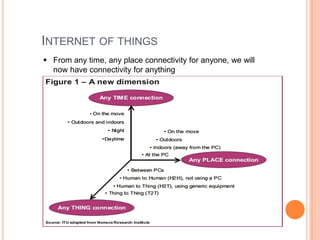
INTERNET OF THINGS
 From any time, any place connectivity for anyone, we will
now have connectivity for anything
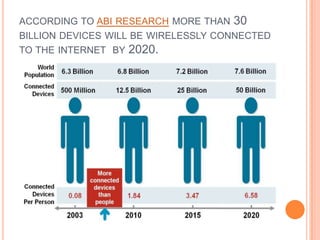
ACCORDING TO ABI RESEARCH MORE THAN

30

BILLION DEVICES WILL BE WIRELESSLY CONNECTED
TO THE INTERNET BY 2020.
WHY INTERNET OF THINGS ??
 Better

Relationship Between Human and
Nature.
 Universal transport & internetworking.
 Improve

 Dynamic

the resource utilization ratio.

control of industry and daily life.
 IoT is recognized as one of the most
important areas of the future Internet.
TECHNOLOGIES



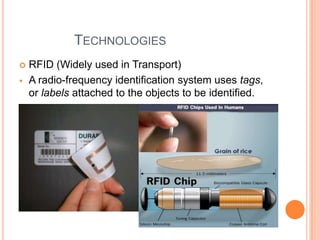
RFID (Widely used in Transport)
A radio-frequency identification system uses tags,
or labels attached to the objects to be identified.
RFID APPLICATIONS
 Widely

used in Transport and
Logistics.
 Tracking of persons and animals.
 Tracking of goods.
 RFID inserted in passports.
 RFID can help detect and retrieve
stolen cars.
TECHNOLOGIES










WiFi IEEE 802.11
Connect to the internet wirelessly using radio waves)
Widely used for both indoor and outdoor environment.
Very common
General Purpose
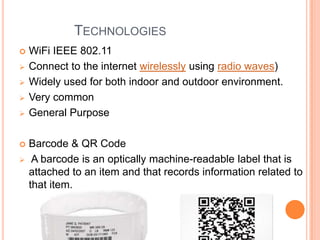
Barcode & QR Code
A barcode is an optically machine-readable label that is
attached to an item and that records information related to
that item.
TECHNOLOGIES
 Sensors









and Smartphones.

Sensors are used in everyday objects such as touchsensitive elevator buttons.
In the near future almost everybody will probably
have a Smartphone.

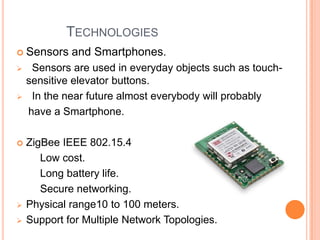
ZigBee IEEE 802.15.4
Low cost.
Long battery life.
Secure networking.
Physical range10 to 100 meters.
Support for Multiple Network Topologies.
APPLICATIONS


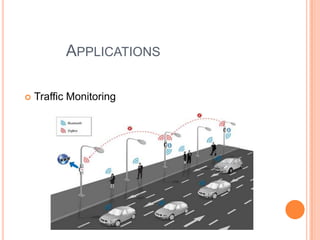
Traffic Monitoring
APPLICATIONS


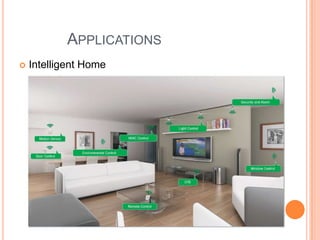
Intelligent Home
APPLICATIONS
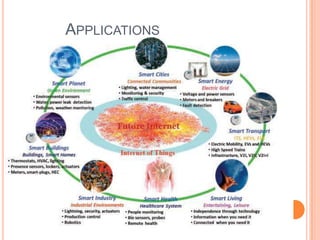
APPLICATIONS
Smart Parking
Monitoring of parking spaces availability in the city.
 Green Houses
Control micro-climate conditions to maximize the
production of fruits and vegetables and its quality.
 Indoor Air Quality
Monitoring of toxic gas and oxygen levels inside chemical
plants to ensure workers and goods safety.
 Water Leakages
Detection of liquid presence outside tanks and pressure
variations along pipes.
 Animal Tracking
Location and identification of animals grazing in open
pastures or location in big stables.

IOT FUTURE FOCUSES
So far important focus on sensors
and architectures.
 Standardization.


 New




considerations on :

Identification
Privacy and Security
Users Interface
INTERNATIONAL COOPERATION
 Joint

IoT activities are encouraged ( eg
China, Japan, Taiwan, S Korea)

 IEEE

International Conference on Internet of
Things was held in Beijing, China during
August 20-23, 2013.

 IEEE

World Forum on Internet of Things
2014 will be held in Seoul, South Korea in
March 2014.
CONCLUSION
The Internet of Things is closer to being
implemented than the average person would think.
 Most of the necessary technological advances
needed for it have already been made, and some
manufacturers and agencies have already begun
implementing a small-scale version of it.

REFERENCES
K. Ashton, That ―Internet of Things‖ Thing, RFiD
Journal. (2009).
 Coroama, V.: The Smart Tachograph – Individual
Accounting of Traffic Costs and its Implications.
 Cisco Connections Counter:" dynamic, online
widget displays the number of connections being
made at any one moment in
time. http://newsroom.cisco.com/featurecontent?type=webcontent&articleId=1208342
 http://en.wikipedia.org/wiki/Internet_of_Things.

THANK YOU

Internet of Things

  • 1.
  • 2.
    CONTENTS OF INTRODUCTION What’s Internet of Things  Why Internet of Things  Technologies used  Applications  Future Focuses
  • 3.
    WHAT’S INTERNET OFTHINGS The Internet of things refers to a wireless network between objects.  The term Internet of Things was proposed by Kevin Ashton in 1999.  Internet of Things first became popular through the Auto-ID Center at MIT.  Today the number of things connected on internet is more than the people living on Earth. 
  • 4.
    INTERNET OF THINGS From any time, any place connectivity for anyone, we will now have connectivity for anything
  • 5.
    ACCORDING TO ABIRESEARCH MORE THAN 30 BILLION DEVICES WILL BE WIRELESSLY CONNECTED TO THE INTERNET BY 2020.
  • 6.
    WHY INTERNET OFTHINGS ??  Better Relationship Between Human and Nature.  Universal transport & internetworking.  Improve  Dynamic the resource utilization ratio. control of industry and daily life.  IoT is recognized as one of the most important areas of the future Internet.
  • 7.
    TECHNOLOGIES   RFID (Widely usedin Transport) A radio-frequency identification system uses tags, or labels attached to the objects to be identified.
  • 8.
    RFID APPLICATIONS  Widely usedin Transport and Logistics.  Tracking of persons and animals.  Tracking of goods.  RFID inserted in passports.  RFID can help detect and retrieve stolen cars.
  • 9.
    TECHNOLOGIES        WiFi IEEE 802.11 Connectto the internet wirelessly using radio waves) Widely used for both indoor and outdoor environment. Very common General Purpose Barcode & QR Code A barcode is an optically machine-readable label that is attached to an item and that records information related to that item.
  • 10.
    TECHNOLOGIES  Sensors      and Smartphones. Sensorsare used in everyday objects such as touchsensitive elevator buttons. In the near future almost everybody will probably have a Smartphone. ZigBee IEEE 802.15.4 Low cost. Long battery life. Secure networking. Physical range10 to 100 meters. Support for Multiple Network Topologies.
  • 11.
  • 12.
  • 13.
  • 14.
    APPLICATIONS Smart Parking Monitoring ofparking spaces availability in the city.  Green Houses Control micro-climate conditions to maximize the production of fruits and vegetables and its quality.  Indoor Air Quality Monitoring of toxic gas and oxygen levels inside chemical plants to ensure workers and goods safety.  Water Leakages Detection of liquid presence outside tanks and pressure variations along pipes.  Animal Tracking Location and identification of animals grazing in open pastures or location in big stables. 
  • 15.
    IOT FUTURE FOCUSES Sofar important focus on sensors and architectures.  Standardization.   New    considerations on : Identification Privacy and Security Users Interface
  • 16.
    INTERNATIONAL COOPERATION  Joint IoTactivities are encouraged ( eg China, Japan, Taiwan, S Korea)  IEEE International Conference on Internet of Things was held in Beijing, China during August 20-23, 2013.  IEEE World Forum on Internet of Things 2014 will be held in Seoul, South Korea in March 2014.
  • 17.
    CONCLUSION The Internet ofThings is closer to being implemented than the average person would think.  Most of the necessary technological advances needed for it have already been made, and some manufacturers and agencies have already begun implementing a small-scale version of it. 
  • 18.
    REFERENCES K. Ashton, That―Internet of Things‖ Thing, RFiD Journal. (2009).  Coroama, V.: The Smart Tachograph – Individual Accounting of Traffic Costs and its Implications.  Cisco Connections Counter:" dynamic, online widget displays the number of connections being made at any one moment in time. http://newsroom.cisco.com/featurecontent?type=webcontent&articleId=1208342  http://en.wikipedia.org/wiki/Internet_of_Things. 
  • 19.