presented by
P.CHAITANYA
09131A1275
IT
MOTION
SENSING
TECHNOLOGY
5/22/2013
1
Overview
o What is a sensor?
o Motion sensor
o Types of motion sensors
o Motion Detection
o Types of Motion Sensing
o Dual sense technology
o Motion Sensor in mobile
o Motion sensor in Games
o Conclusion
o References
5/22/2013
2
Sensor
o A sensor is a device which receives and
responds to a signal.
o A sensor (also called detector) is a converter
that measures a physical quantity and converts
it into a signal which can be read by an
observer or by an (today mostly electronic)
instrument.
5/22/2013
3
Specifications of Sensor
 Accuracy: error between the result of a
measurement and the true value being measured.
 Resolution: the smallest increment of measure that
a device can make.
 Sensitivity: the ratio between the change in the
output signal to a small change in input physical
signal.
 Repeatability/Precision: the ability of the sensor to
output the same value for the same input over a
number of trials.
5/22/2013
4
Types of sensors
 There are many versions of each type which may
use a different sensing principle or may be
designed to operate within different ranges.
 The sensors are used to measure and/or detect a
huge variety of conditions including: temperature,
pressure, level, humidity, speed, motion, distance,
light or the presence/absence of an object and
many other types.
5/22/2013
5
Motion sensors
 The term ‘Motion sensors’ can be used to refer to any
kind of sensing system which is used to detect motion;
motion of any object or motion of human beings.
 Motion sensor is also called as motion detector.
 Motion sensors are commonly used in security systems
as triggers for automatic lights or remote alarms and
similar applications.
5/22/2013
6
Types of Motion sensors
 The way in which a motion sensor works
typically depends on the type of sensor being
used, which often depends on the device that
uses the sensor.
There are two basic types of motion sensors:
 Active Sensors
 Passive Sensors
5/22/2013
7
Active sensors
 Active sensors emit a signal, typically an burst
of (light, microwaves or sound) waves which is
reflected by the surroundings.
 The reflected signal is received by the sensor
and takes necessary action.
 When something moves within the area of an
active motion sensor, the change in signal
that is reflected to the sensor activates the
system.
5/22/2013
8
 The active sensor is one of the most common and
reliable sensors used in a security system.
 For example, when an automatic faucet senses
hands underneath it, a device is signaled to run
water in the sink.
5/22/2013
9
Contd...
Passive sensor
 Passive sensors are a type of motion
sensor that do not emit a signal, but
instead detect infrared radiation around
the sensor.
 As this sensor detects temperature
differences, it is well suited to detecting
the motion of people by their body
temperature.
5/22/2013
10
5/22/2013
11
Use as a human detection sensor to
automatically
turn lights on when a person is present in a room
and to turn them off when nobody is there.
When a person or
animal moves through
the area, heat from the
movement is detected
by the sensor, which then
activates the system to
which it is connected
Contd...
Motion sensing is used in number of
applications
• Automated lighting system
• Security systems
• Smart Floodlights
• Burglar Alarm
• Radar Guns
5/22/2013
12 TYPICAL APPLICATIONS
Advantages of Motion
sensor
 Saves time
 Security
 Easy to install
 Saves energy
 Powerful transmission
5/22/2013
13
Motion detection
Motion detection is the process of detecting a
change in position of an object relative to its
surroundings or the change in the surroundings
relative to an object.
Motion can be detected by:
 Infrared (Passive and active sensors)
 Optics (video and camera systems)
 Radio Frequency Energy (radar, microwave motion
detection)
 Sound (microphones and acoustic sensors)
 Vibration (seismic sensors) 5/22/2013
14
TYPES OF MOTION SENSING
 Local Motion Sensing
 Ultrasonic Motion Sensing
 Microwave Motion Sensing
5/22/2013
15
Local motion sensing
 Infrared light is a spectrum of non-visible — for
humans at least — light that is emitted by
objects when they produce heat.
 Infrared motion sensor systems are one of the
cheapest and most reliable systems available.
 An infrared motion detector uses infrared
sensing to detect motion in a given area.
5/22/2013
16
 The use of infrared technology usually allows such a
detector to only pick up on heat.
 Infrared sensors are characterized by high
sensitivity, low cost and are widely used.
 An infrared motion detector can also be set to only
pick up on certain levels of heat, making it possible
to ignore small animals.
 This type of detector is often used as part of a
larger security system. 5/22/2013
17
Contd...
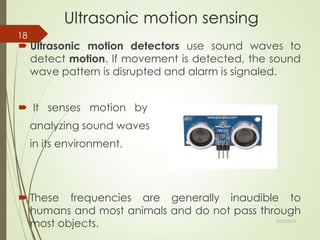
Ultrasonic motion sensing
 Ultrasonic motion detectors use sound waves to
detect motion. If movement is detected, the sound
wave pattern is disrupted and alarm is signaled.
 It senses motion by
analyzing sound waves
in its environment.
 These frequencies are generally inaudible to
humans and most animals and do not pass through
most objects. 5/22/2013
18
 Active motion sensors generate sound
waves in the ultrasonic frequency range,
typically around 30 to 50 kilohertz (kHz).
 When no objects are moving in the area,
the pattern of sound and the time it takes to
bounce back remain the same.
 If something moves, the detector senses
that the level or phase of the returning
sound waves has shifted slightly.
5/22/2013
19
Contd...
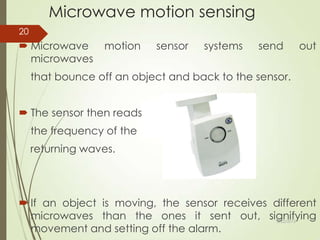
Microwave motion sensing
 Microwave motion sensor systems send out
microwaves
that bounce off an object and back to the sensor.
 The sensor then reads
the frequency of the
returning waves.
 If an object is moving, the sensor receives different
microwaves than the ones it sent out, signifying
movement and setting off the alarm.
5/22/2013
20
 These types of motion sensor systems cover a
larger area than infrared sensors, they are
capable of penetrating walls.
 They are more reliable over longer distances.
 Their radiation is unhealthy for living organisms.
 Despite this, they are the least popular motion
sensor system on the market because of their
their cost.
5/22/2013
21
Contd...
Dual sense technology
 Dual technology systems use a combination of
infrared and microwave motion sensor systems to
provide the most complete coverage available.
 Using both forms of technology allows dual motion
sensor systems to reduce the occurrence of false
alarms by combining the microwave technology’s
coverage range and the infrared technology’s use of
heat sensing.
 The dual technology system is rapidly gaining
popularity among homeowners and businesses alike.
5/22/2013
22
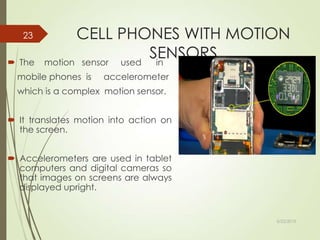
CELL PHONES WITH MOTION
SENSORS The motion sensor used in
mobile phones is accelerometer
which is a complex motion sensor.
 It translates motion into action on
the screen.
 Accelerometers are used in tablet
computers and digital cameras so
that images on screens are always
displayed upright.
5/22/2013
23
Motion sensing in Games
 Motion sensing technology
is an emerging technology
in Gaming.
 Our focus technology will be Microsoft’s Xbox360 Kinect
peripheral, which is the first demonstrator of touch free motion
sensing.
 The primary innovation of Kinect (and the most secretive) is the
device that enables advanced posture, gesture, facial, and
voice recognition.
5/22/2013
24
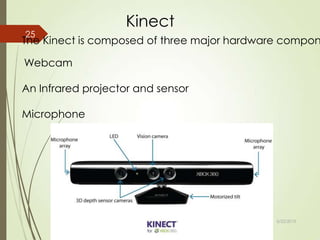
The Kinect is composed of three major hardware compon
Webcam
An Infrared projector and sensor
Microphone
Kinect
5/22/2013
25
Challenges faced
 Limited Camera And Sensor Capability
 Better Audio Sensing Capability
 Limited Body Recognition
5/22/2013
26
Conclusion
Motion sensing, though important in gaming, will
ultimately make its biggest impact in non-gaming
applications
5/22/2013
27
References
 http://developer.android.com/guide/to
pics/sensors/sensors_motion.html
 www.wikianswers.com/sensing
 www.wikipedia/motionsensing
 www.wisegeeks.com
 www.howstufffworks.com
5/22/2013
28
Thank you
5/22/2013
29

motion sensing technology

  • 1.
  • 2.
    Overview o What isa sensor? o Motion sensor o Types of motion sensors o Motion Detection o Types of Motion Sensing o Dual sense technology o Motion Sensor in mobile o Motion sensor in Games o Conclusion o References 5/22/2013 2
  • 3.
    Sensor o A sensoris a device which receives and responds to a signal. o A sensor (also called detector) is a converter that measures a physical quantity and converts it into a signal which can be read by an observer or by an (today mostly electronic) instrument. 5/22/2013 3
  • 4.
    Specifications of Sensor Accuracy: error between the result of a measurement and the true value being measured.  Resolution: the smallest increment of measure that a device can make.  Sensitivity: the ratio between the change in the output signal to a small change in input physical signal.  Repeatability/Precision: the ability of the sensor to output the same value for the same input over a number of trials. 5/22/2013 4
  • 5.
    Types of sensors There are many versions of each type which may use a different sensing principle or may be designed to operate within different ranges.  The sensors are used to measure and/or detect a huge variety of conditions including: temperature, pressure, level, humidity, speed, motion, distance, light or the presence/absence of an object and many other types. 5/22/2013 5
  • 6.
    Motion sensors  Theterm ‘Motion sensors’ can be used to refer to any kind of sensing system which is used to detect motion; motion of any object or motion of human beings.  Motion sensor is also called as motion detector.  Motion sensors are commonly used in security systems as triggers for automatic lights or remote alarms and similar applications. 5/22/2013 6
  • 7.
    Types of Motionsensors  The way in which a motion sensor works typically depends on the type of sensor being used, which often depends on the device that uses the sensor. There are two basic types of motion sensors:  Active Sensors  Passive Sensors 5/22/2013 7
  • 8.
    Active sensors  Activesensors emit a signal, typically an burst of (light, microwaves or sound) waves which is reflected by the surroundings.  The reflected signal is received by the sensor and takes necessary action.  When something moves within the area of an active motion sensor, the change in signal that is reflected to the sensor activates the system. 5/22/2013 8
  • 9.
     The activesensor is one of the most common and reliable sensors used in a security system.  For example, when an automatic faucet senses hands underneath it, a device is signaled to run water in the sink. 5/22/2013 9 Contd...
  • 10.
    Passive sensor  Passivesensors are a type of motion sensor that do not emit a signal, but instead detect infrared radiation around the sensor.  As this sensor detects temperature differences, it is well suited to detecting the motion of people by their body temperature. 5/22/2013 10
  • 11.
    5/22/2013 11 Use as ahuman detection sensor to automatically turn lights on when a person is present in a room and to turn them off when nobody is there. When a person or animal moves through the area, heat from the movement is detected by the sensor, which then activates the system to which it is connected Contd...
  • 12.
    Motion sensing isused in number of applications • Automated lighting system • Security systems • Smart Floodlights • Burglar Alarm • Radar Guns 5/22/2013 12 TYPICAL APPLICATIONS
  • 13.
    Advantages of Motion sensor Saves time  Security  Easy to install  Saves energy  Powerful transmission 5/22/2013 13
  • 14.
    Motion detection Motion detectionis the process of detecting a change in position of an object relative to its surroundings or the change in the surroundings relative to an object. Motion can be detected by:  Infrared (Passive and active sensors)  Optics (video and camera systems)  Radio Frequency Energy (radar, microwave motion detection)  Sound (microphones and acoustic sensors)  Vibration (seismic sensors) 5/22/2013 14
  • 15.
    TYPES OF MOTIONSENSING  Local Motion Sensing  Ultrasonic Motion Sensing  Microwave Motion Sensing 5/22/2013 15
  • 16.
    Local motion sensing Infrared light is a spectrum of non-visible — for humans at least — light that is emitted by objects when they produce heat.  Infrared motion sensor systems are one of the cheapest and most reliable systems available.  An infrared motion detector uses infrared sensing to detect motion in a given area. 5/22/2013 16
  • 17.
     The useof infrared technology usually allows such a detector to only pick up on heat.  Infrared sensors are characterized by high sensitivity, low cost and are widely used.  An infrared motion detector can also be set to only pick up on certain levels of heat, making it possible to ignore small animals.  This type of detector is often used as part of a larger security system. 5/22/2013 17 Contd...
  • 18.
    Ultrasonic motion sensing Ultrasonic motion detectors use sound waves to detect motion. If movement is detected, the sound wave pattern is disrupted and alarm is signaled.  It senses motion by analyzing sound waves in its environment.  These frequencies are generally inaudible to humans and most animals and do not pass through most objects. 5/22/2013 18
  • 19.
     Active motionsensors generate sound waves in the ultrasonic frequency range, typically around 30 to 50 kilohertz (kHz).  When no objects are moving in the area, the pattern of sound and the time it takes to bounce back remain the same.  If something moves, the detector senses that the level or phase of the returning sound waves has shifted slightly. 5/22/2013 19 Contd...
  • 20.
    Microwave motion sensing Microwave motion sensor systems send out microwaves that bounce off an object and back to the sensor.  The sensor then reads the frequency of the returning waves.  If an object is moving, the sensor receives different microwaves than the ones it sent out, signifying movement and setting off the alarm. 5/22/2013 20
  • 21.
     These typesof motion sensor systems cover a larger area than infrared sensors, they are capable of penetrating walls.  They are more reliable over longer distances.  Their radiation is unhealthy for living organisms.  Despite this, they are the least popular motion sensor system on the market because of their their cost. 5/22/2013 21 Contd...
  • 22.
    Dual sense technology Dual technology systems use a combination of infrared and microwave motion sensor systems to provide the most complete coverage available.  Using both forms of technology allows dual motion sensor systems to reduce the occurrence of false alarms by combining the microwave technology’s coverage range and the infrared technology’s use of heat sensing.  The dual technology system is rapidly gaining popularity among homeowners and businesses alike. 5/22/2013 22
  • 23.
    CELL PHONES WITHMOTION SENSORS The motion sensor used in mobile phones is accelerometer which is a complex motion sensor.  It translates motion into action on the screen.  Accelerometers are used in tablet computers and digital cameras so that images on screens are always displayed upright. 5/22/2013 23
  • 24.
    Motion sensing inGames  Motion sensing technology is an emerging technology in Gaming.  Our focus technology will be Microsoft’s Xbox360 Kinect peripheral, which is the first demonstrator of touch free motion sensing.  The primary innovation of Kinect (and the most secretive) is the device that enables advanced posture, gesture, facial, and voice recognition. 5/22/2013 24
  • 25.
    The Kinect iscomposed of three major hardware compon Webcam An Infrared projector and sensor Microphone Kinect 5/22/2013 25
  • 26.
    Challenges faced  LimitedCamera And Sensor Capability  Better Audio Sensing Capability  Limited Body Recognition 5/22/2013 26
  • 27.
    Conclusion Motion sensing, thoughimportant in gaming, will ultimately make its biggest impact in non-gaming applications 5/22/2013 27
  • 28.
    References  http://developer.android.com/guide/to pics/sensors/sensors_motion.html  www.wikianswers.com/sensing www.wikipedia/motionsensing  www.wisegeeks.com  www.howstufffworks.com 5/22/2013 28
  • 29.