Human Computer
Interaction (HCI)
A G A L Danushka | SEU-IS-14-PS-101
Content
Introduction01
Disciplines, Activities02
Principles03
HCI in software engineering04
What is HCI?
* HCI is the study and the practice of usability.
It is about understanding and creating software and other technology that
people will want to use, will be able to use, and will find effective when
used.
* HCI is the study of how people use computer systems to perform
HCI tries to provide us with all understanding of the computer and the
person using it, so as to make the interaction between them more
effective and more enjoyable.
certain tasks.
3
What is HCI?
HCI concerns:
process: design, evaluation and implementation
on: interactive computing systems for human use
plus: the study of major phenomena surrounding them
4
Why HCI?
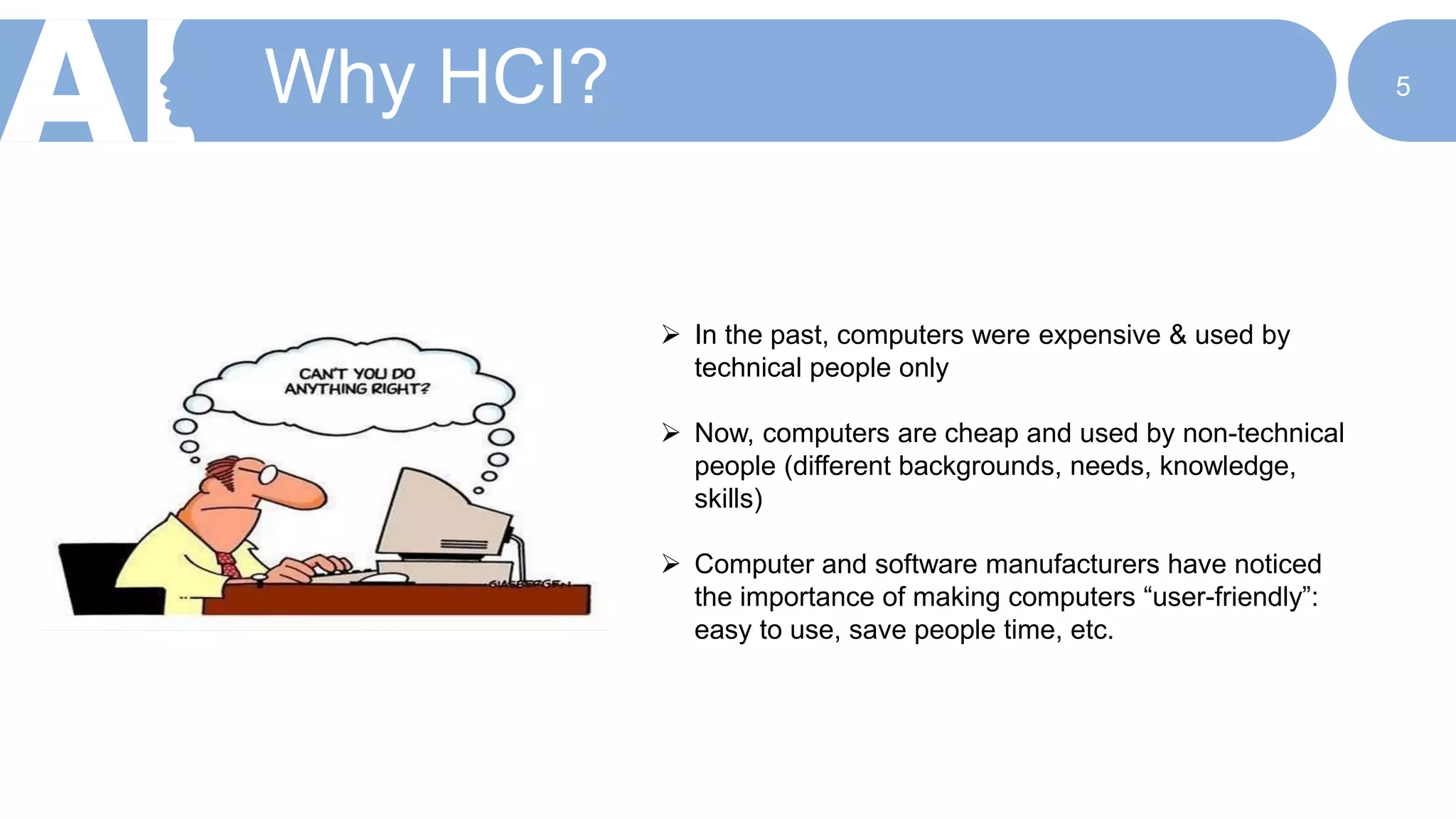
 In the past, computers were expensive & used by
technical people only
 Now, computers are cheap and used by non-technical
people (different backgrounds, needs, knowledge,
skills)
 Computer and software manufacturers have noticed
the importance of making computers “user-friendly”:
easy to use, save people time, etc.
5
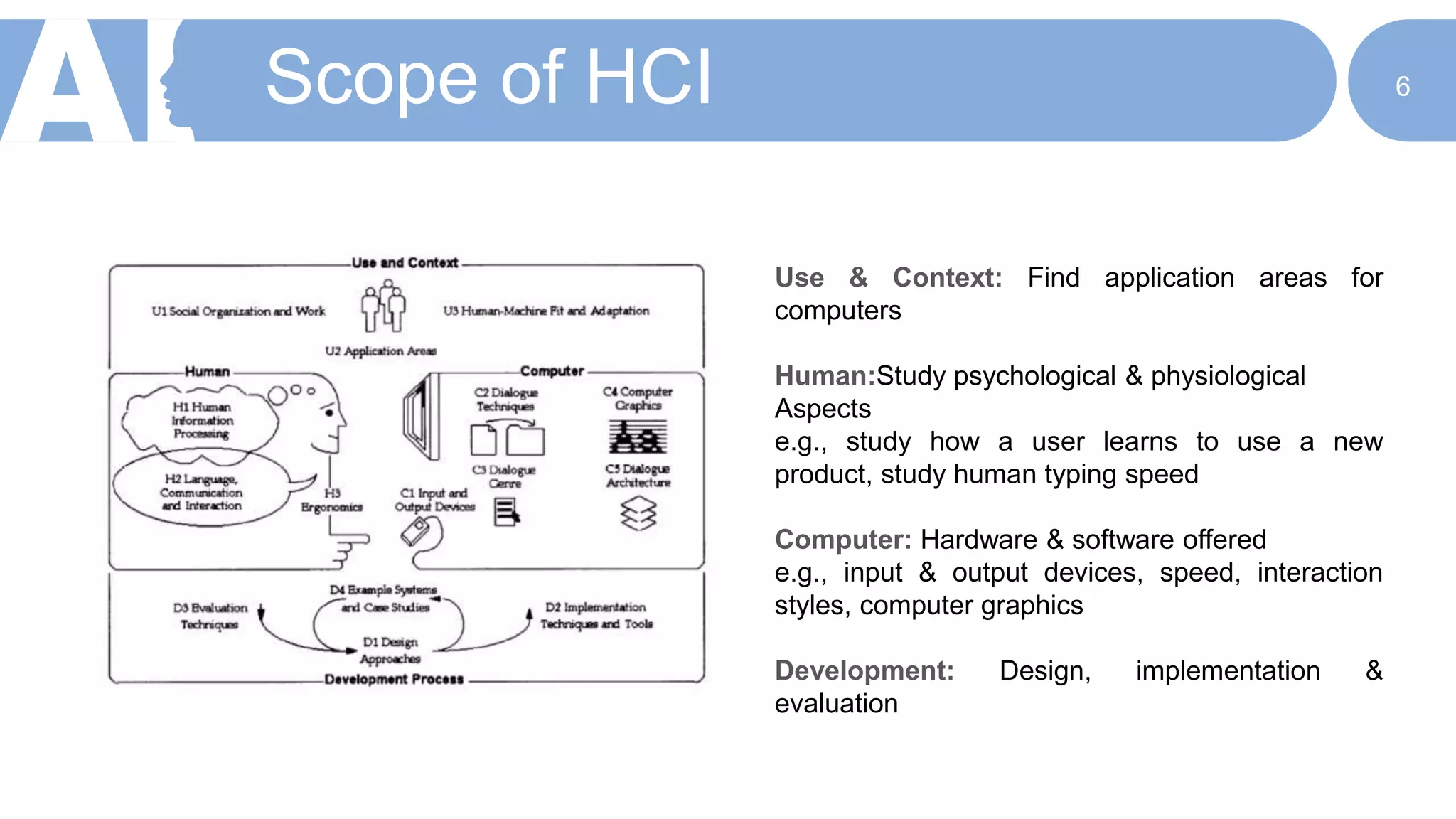
Scope of HCI
Use & Context: Find application areas for
computers
Human:Study psychological & physiological
Aspects
e.g., study how a user learns to use a new
product, study human typing speed
Computer: Hardware & software offered
e.g., input & output devices, speed, interaction
styles, computer graphics
Development: Design, implementation &
evaluation
6
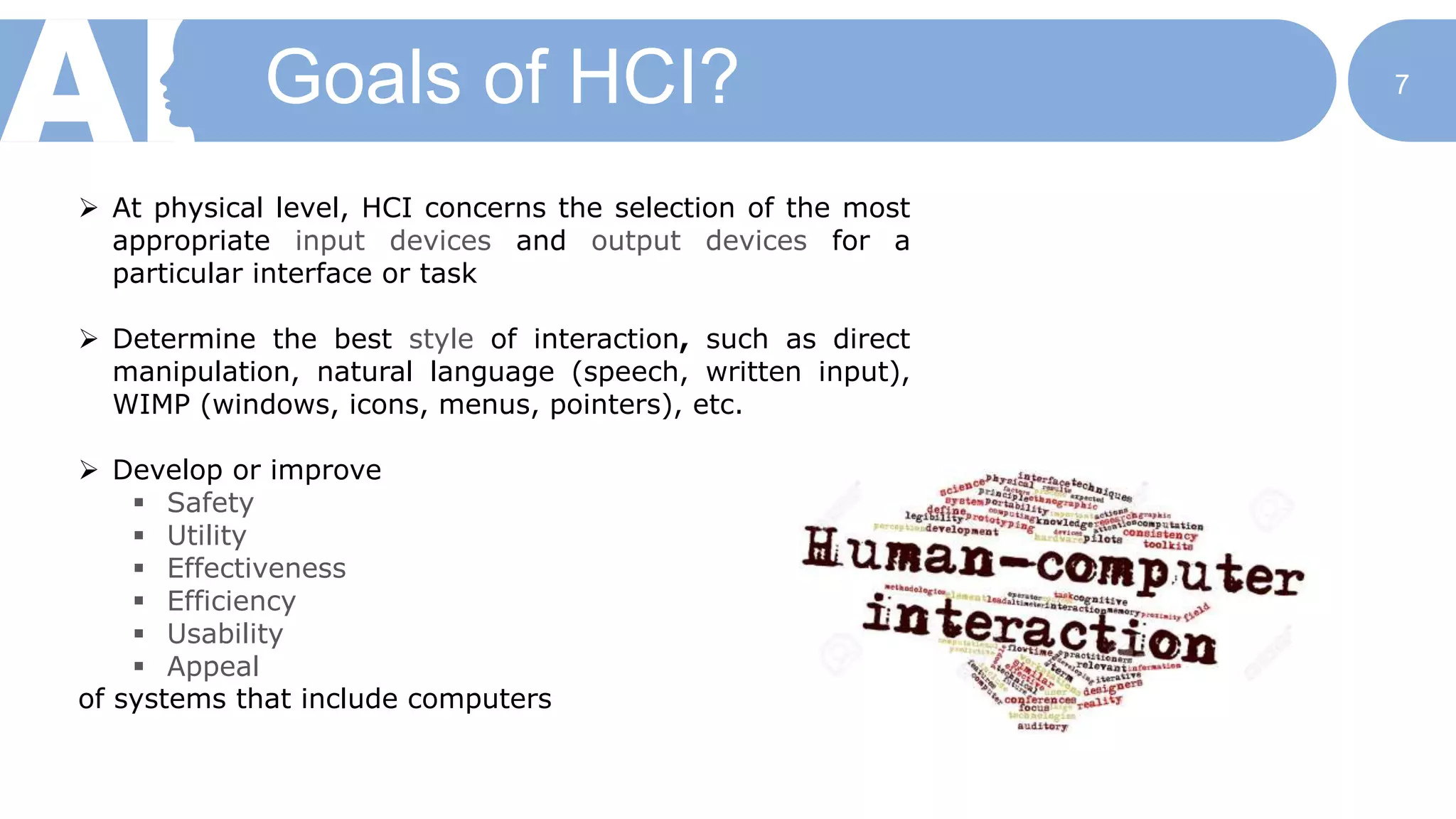
Goals of HCI?
 At physical level, HCI concerns the selection of the most
appropriate input devices and output devices for a
particular interface or task
 Determine the best style of interaction, such as direct
manipulation, natural language (speech, written input),
WIMP (windows, icons, menus, pointers), etc.
 Develop or improve
 Safety
 Utility
 Effectiveness
 Efficiency
 Usability
 Appeal
of systems that include computers
7
Goals of HCI?
Safety
protecting the user from dangerous conditions and
undesirable situations
Utility
extent of providing the right kind of functionality so that users
can do what they need or want to do
Efficiency
a measure of how quickly users can accomplish their goals or
finish their work using the system
Usability
ease of learning and ease of use
Appeal
how well the user likes the system
8
HCI Benefits
Gaining market share
People intend to buy/use products with higher usability
e.g., Google’s search engine has the largest market share because it is easy to use with higher efficiency
Improving productivity
Employees in a company perform their jobs in a faster manner
e.g., Workers in a mainland company needed to press a lengthy sequence of buttons in performing a task
Lowering support costs
If the product is not usable, calls to customer support can be enormous
e.g., If a washing machine is difficult to use even after reading the instruction manual, many users will call
the customer service and the cost per call can be over $100
Reducing development cost
Avoid implementing features users don’t want and creating features that are annoying or inefficient
e.g., If there are too many unnecessary confirmation dialog boxes in using a word processor, it is likely
this product needs to be redeveloped
9
Good and Bad Designs
Which elevator control is good?
10
Good and Bad Designs
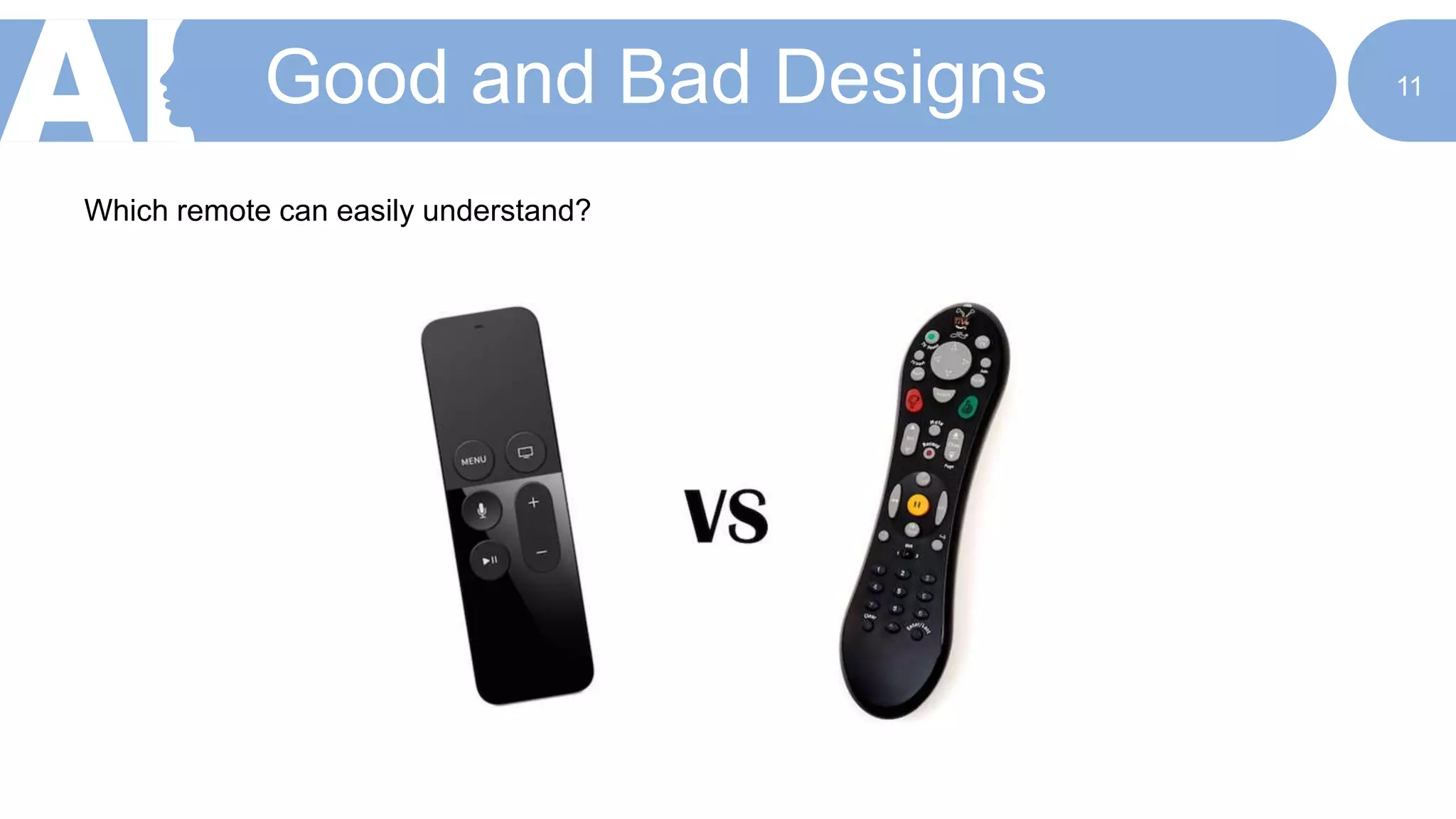
Which remote can easily understand?
11
Good and Bad Designs
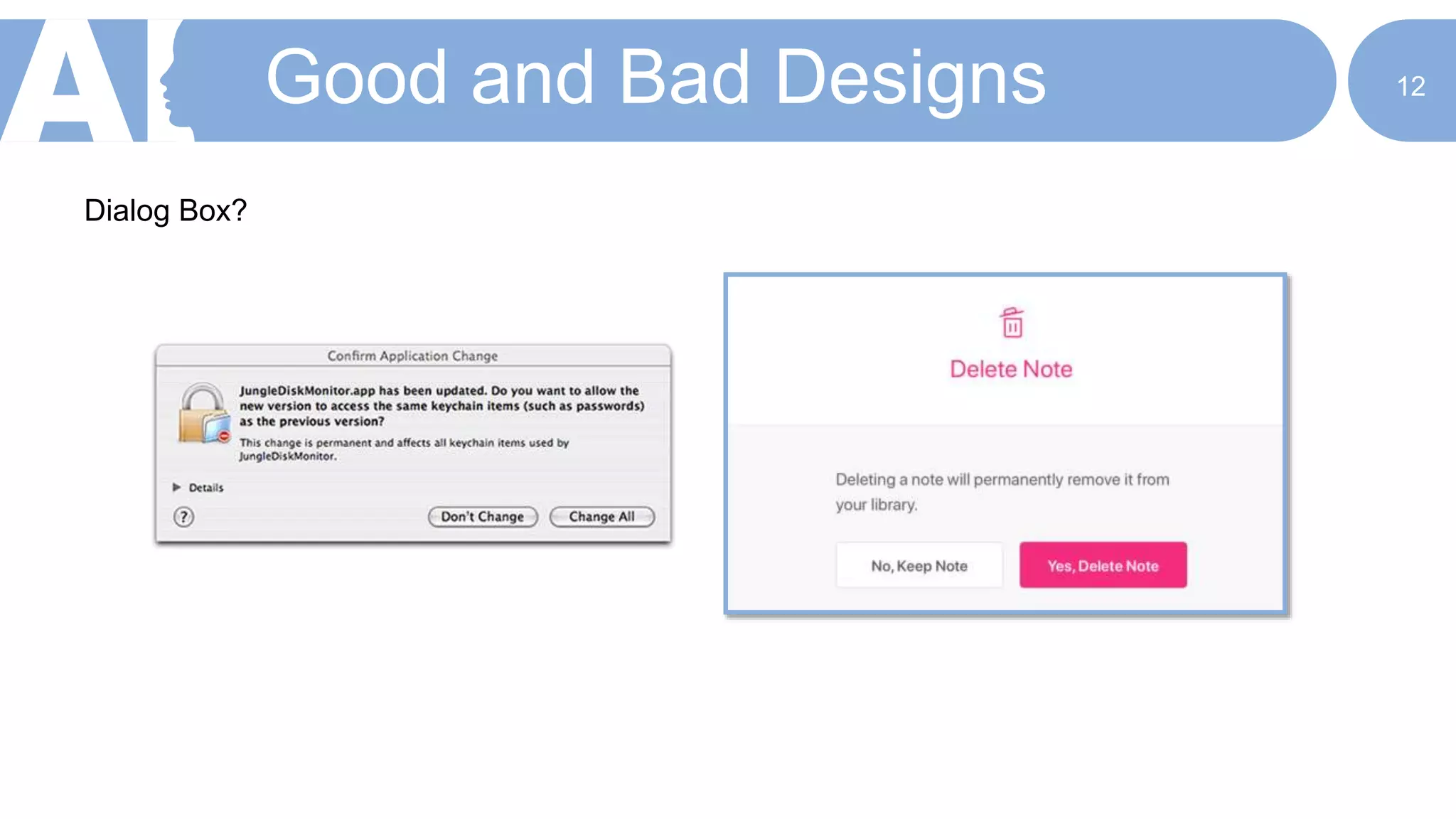
Dialog Box?
12
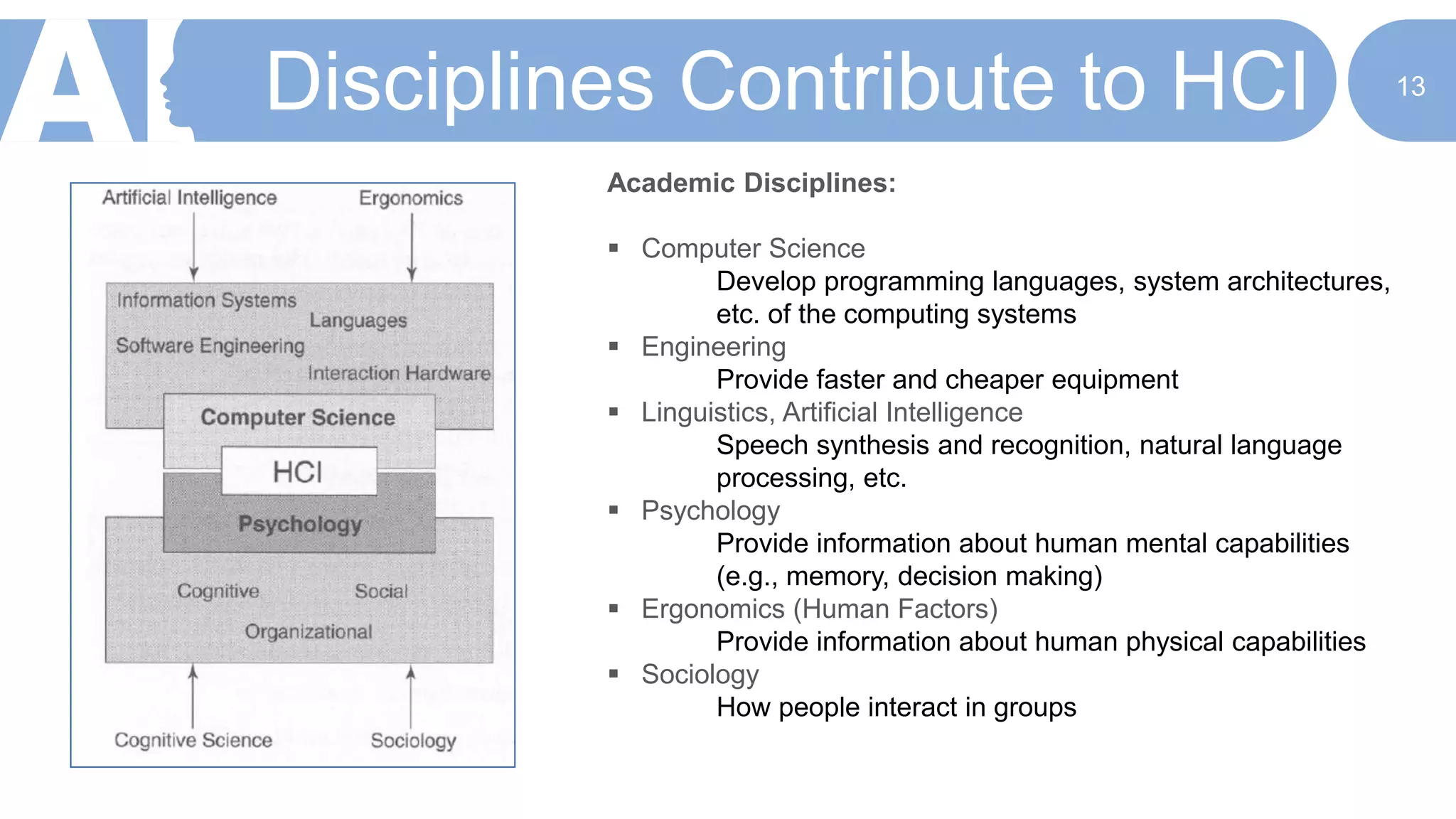
Disciplines Contribute to HCI
Academic Disciplines:
 Computer Science
Develop programming languages, system architectures,
etc. of the computing systems
 Engineering
Provide faster and cheaper equipment
 Linguistics, Artificial Intelligence
Speech synthesis and recognition, natural language
processing, etc.
 Psychology
Provide information about human mental capabilities
(e.g., memory, decision making)
 Ergonomics (Human Factors)
Provide information about human physical capabilities
 Sociology
How people interact in groups
13
Disciplines Contribute to HCI
Design Practices:
 Graphic Design
Art of combining text and graphics and
communicating an effective message in design of
posters, brochures, signs, logos & other type of visual
communications
 Product Design
Process of planning the product's specification
 Industrial Design
Applied H artH whereby aesthetics and usability of
HproductsH may be improved. Aspects include overall
shape of the object, HcolorsH, textures, HsoundsH &
product Hergonomics
14
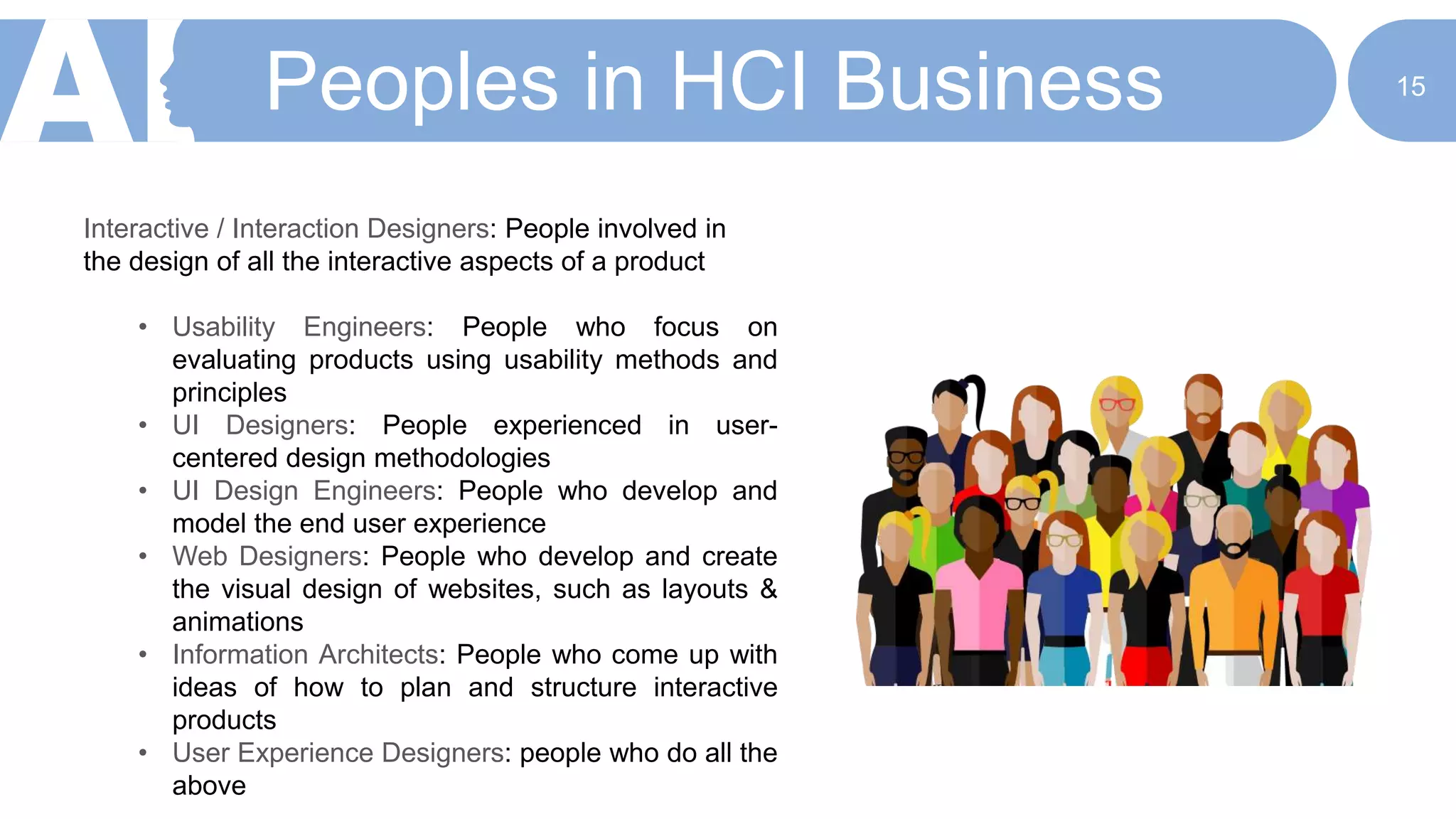
Peoples in HCI Business
Interactive / Interaction Designers: People involved in
the design of all the interactive aspects of a product
• Usability Engineers: People who focus on
evaluating products using usability methods and
principles
• UI Designers: People experienced in user-
centered design methodologies
• UI Design Engineers: People who develop and
model the end user experience
• Web Designers: People who develop and create
the visual design of websites, such as layouts &
animations
• Information Architects: People who come up with
ideas of how to plan and structure interactive
products
• User Experience Designers: people who do all the
above
15
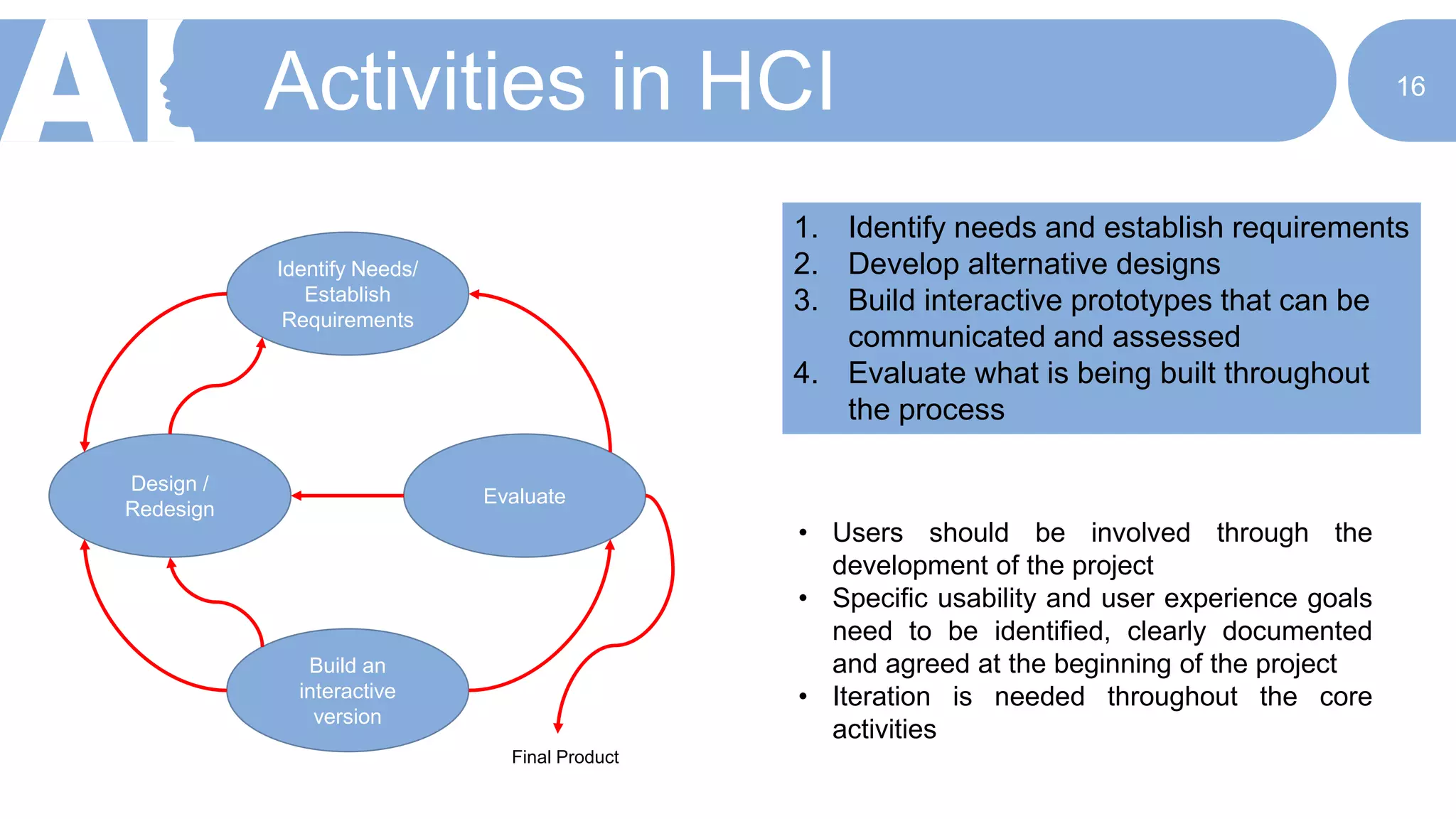
Activities in HCI
1. Identify needs and establish requirements
2. Develop alternative designs
3. Build interactive prototypes that can be
communicated and assessed
4. Evaluate what is being built throughout
the process
• Users should be involved through the
development of the project
• Specific usability and user experience goals
need to be identified, clearly documented
and agreed at the beginning of the project
• Iteration is needed throughout the core
activities
Identify Needs/
Establish
Requirements
Design /
Redesign
Evaluate
Build an
interactive
version
Final Product
16
General Principles of HCI Design
Compatibility
Ease of Learning
Memorability
Predictability
Simplicity
Flexibility
Responsiveness
Protection
Invisible Technology
Control
WYSIWYG
17
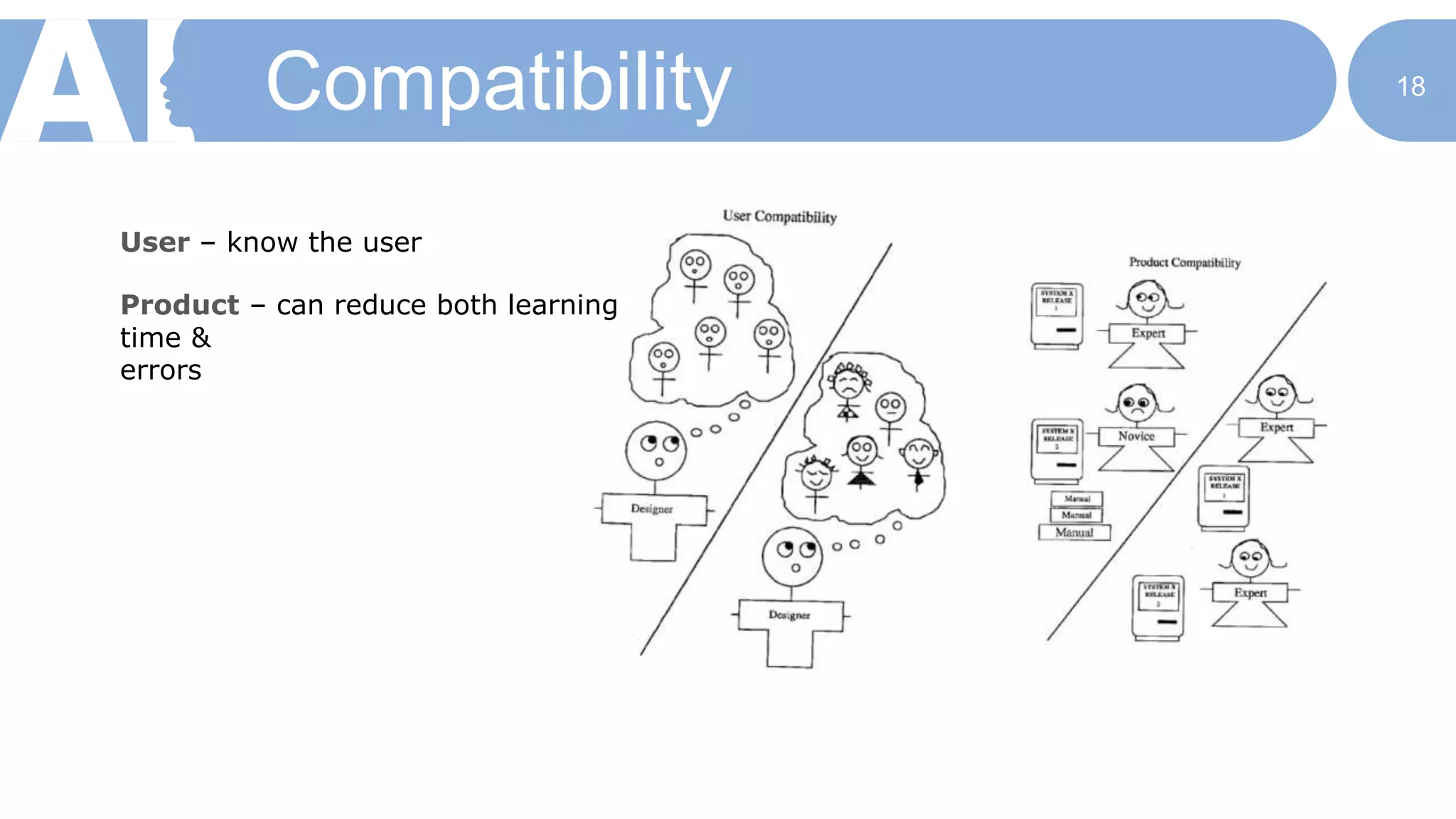
Compatibility
Product – can reduce both learning
time &
errors
User – know the user
18
Ease of Learning
Ease of learning – the system should be easy to
learn so that the user can rapidly start getting
some work done with the system
19
Memorability
Interfaces that have high memorability will be easier to learn and use. Factors
which affect memorability include
Location: It will be easier to remember if a particular object is placed in a
consistent location, e.g., always putting the search box in the upper right-hand
corner of a Web page
Logical grouping: It will be easier to remember if things are grouped logically,
e.g., putting related options together in a menu
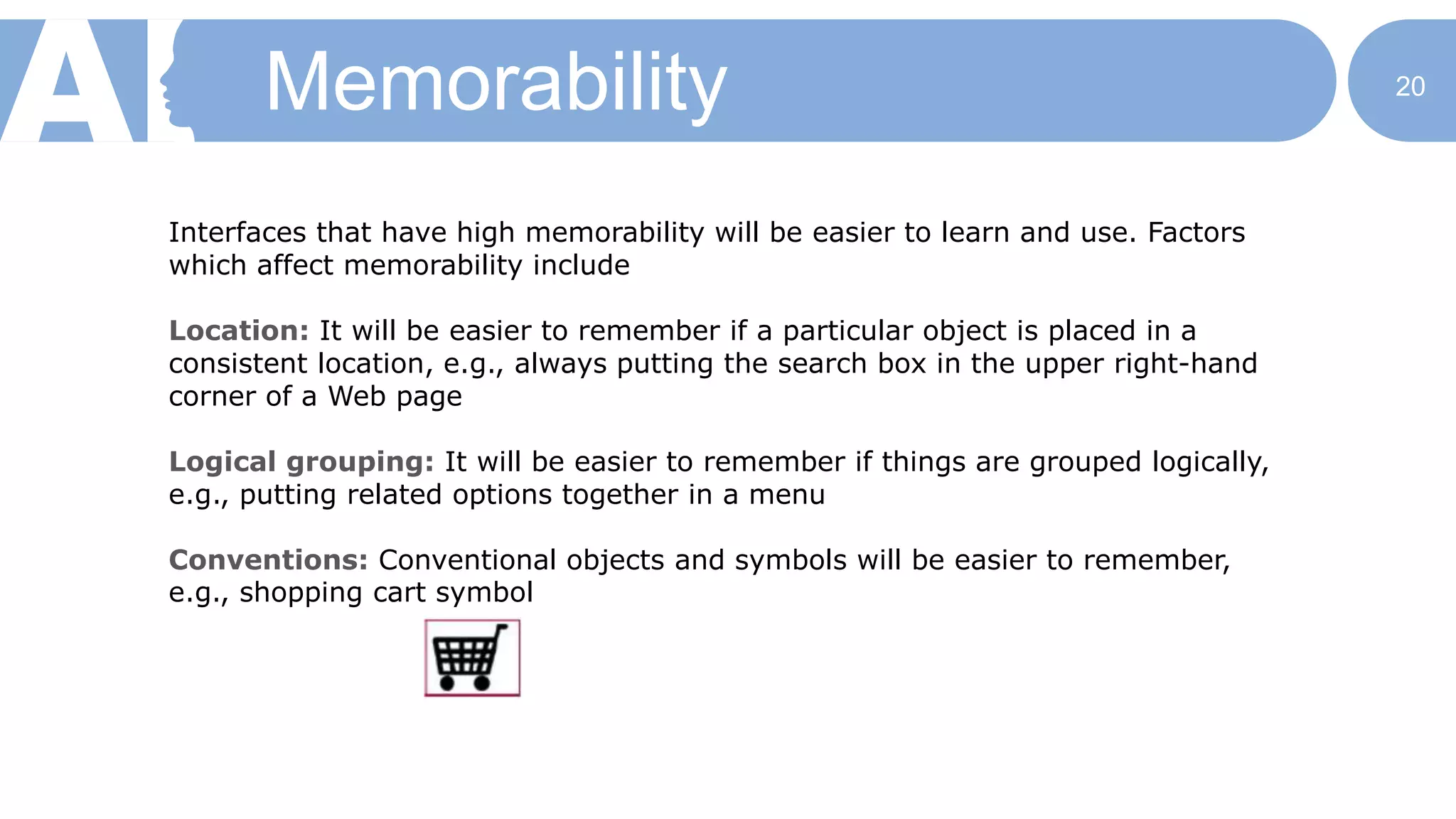
Conventions: Conventional objects and symbols will be easier to remember,
e.g., shopping cart symbol
20
Predictability
Predictability involves a person’s expectations and his/her ability to determine the
results of actions ahead of time. It includes:
Consistency – reinforce our associations and therefore increase our ability to
remember and predict outcomes and processes
Generalizabilty – Help us use the knowledge we gathered from previous
experience and apply it to similar Situations
Familiarity – e.g., familiar menu names and options help users locate objects and
functions more easily
Conventions – Allow us to use our intuitions which are based on previous
experience and logic; if something is consistently done in a particular way, it will
eventually
become the conventional way of doing it
21
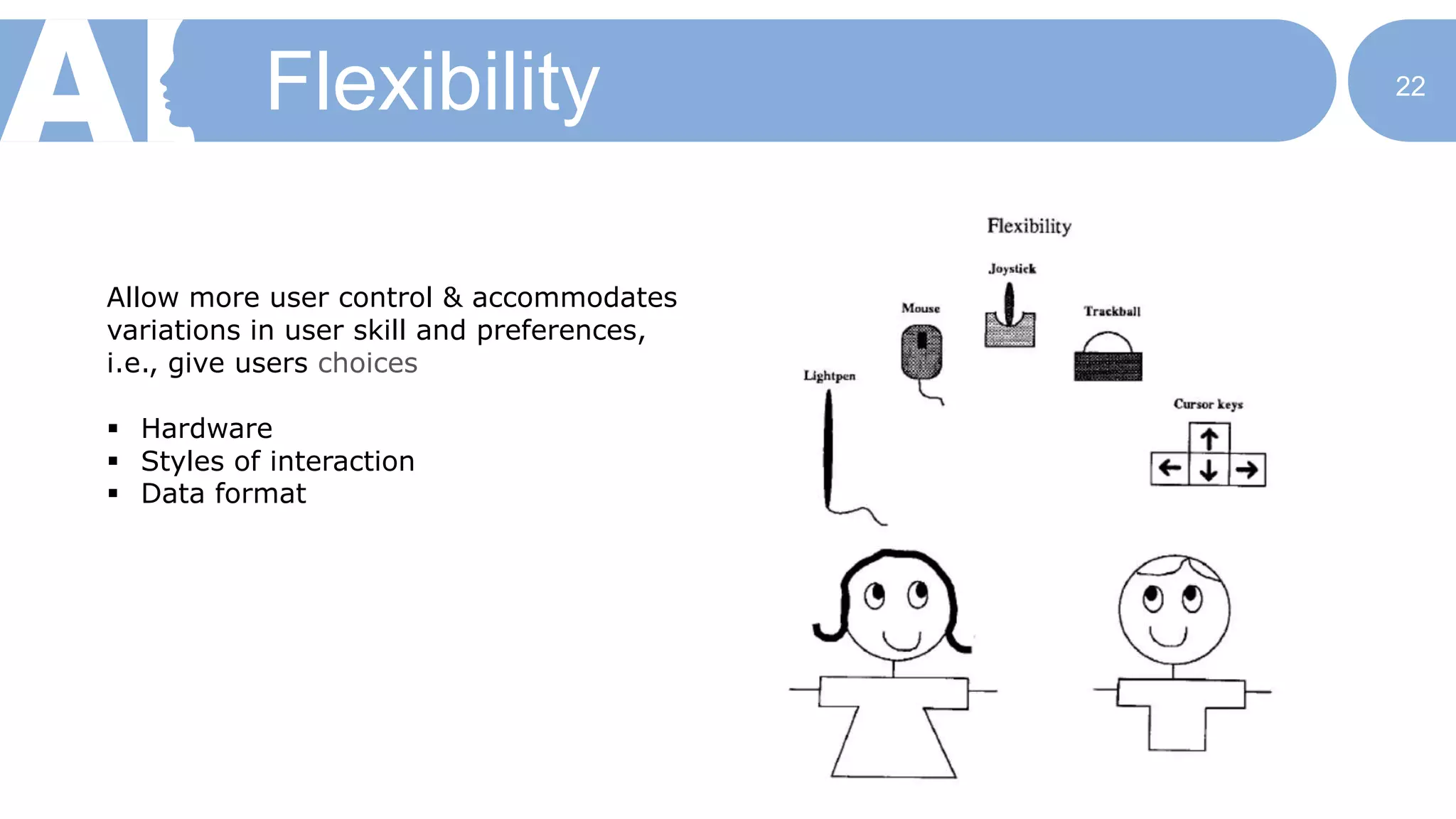
Flexibility
Allow more user control & accommodates
variations in user skill and preferences,
i.e., give users choices
 Hardware
 Styles of interaction
 Data format
22
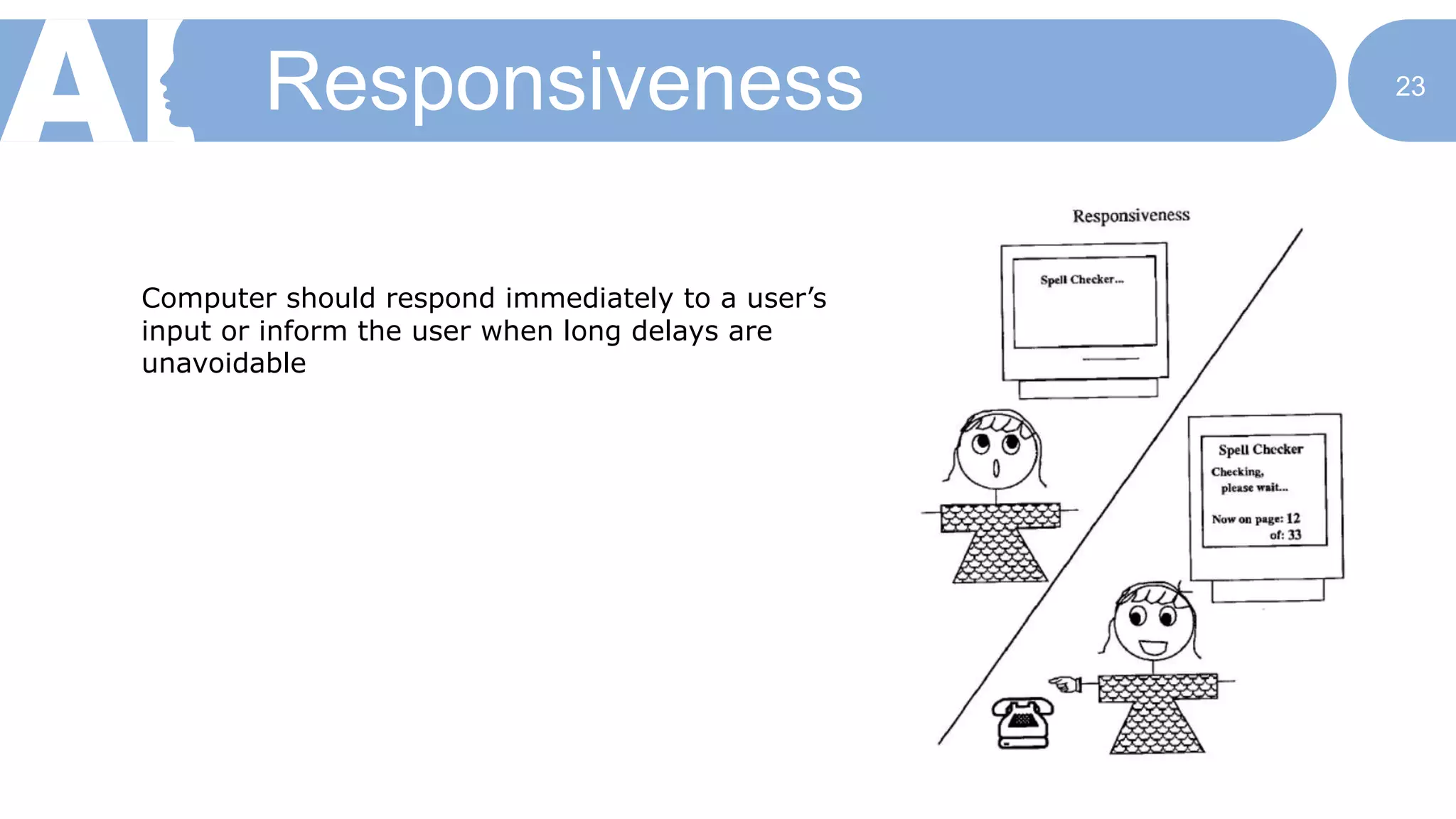
Responsiveness
Computer should respond immediately to a user’s
input or inform the user when long delays are
unavoidable
23
Protection
Protect users against disastrous results of
common human error
24
Invisible Technology
• No need to know the technical details
• A way to think about invisible technologies is that
they are the set of infrastructure, tools and tech that
have become indistinguishable from your daily life. So
ingrained with our day-to-day that we don't even reflect
that we're using them.
25
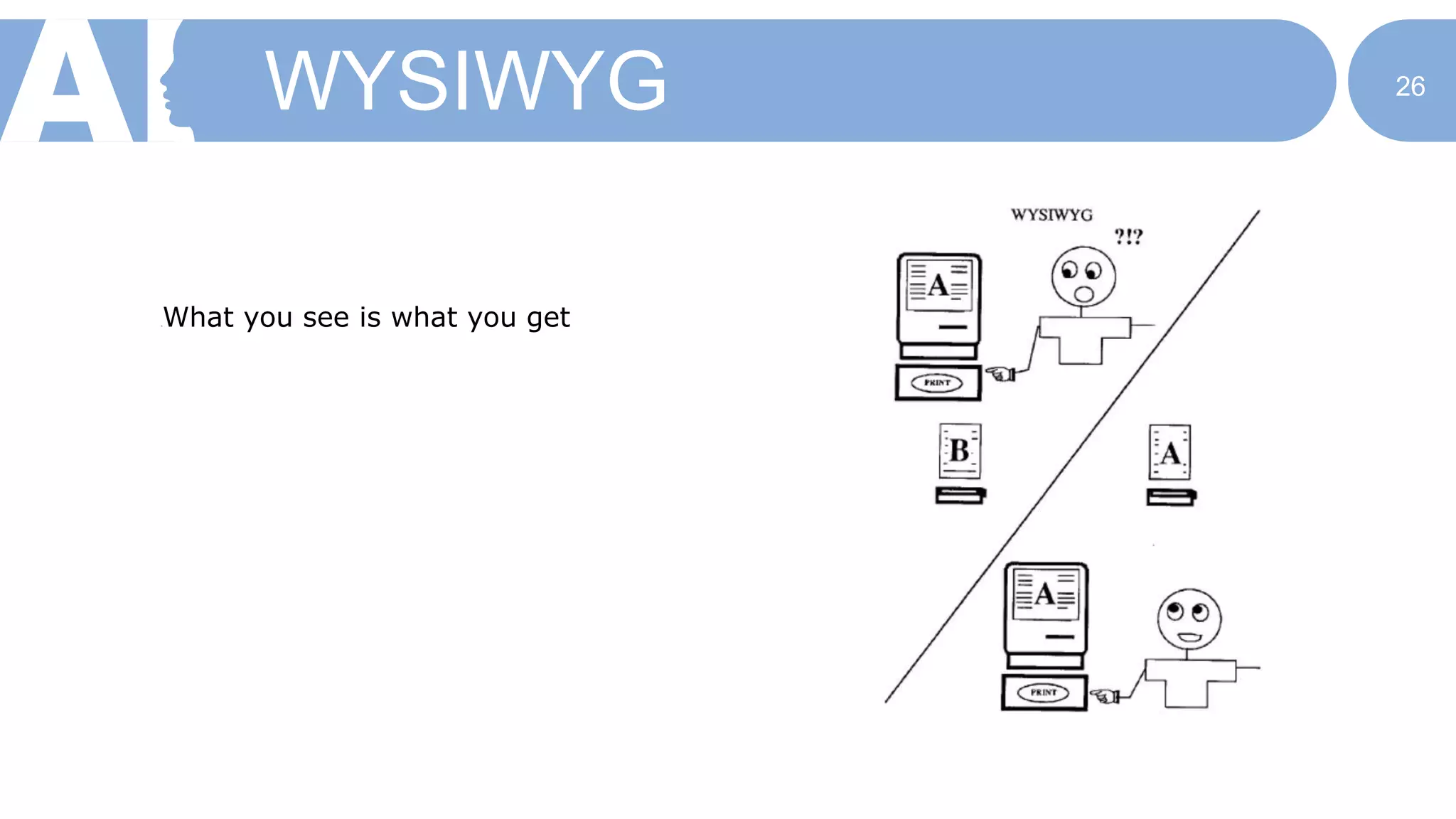
WYSIWYG
1BWhat you see is what you get
26
Norman's
Principles of
Usability
Norman’s Seven Principles
To assess the interaction between human and computers, Donald Norman in 1988 proposed
seven principles. He proposed the seven stages that can be used to transform difficult tasks.
Following are the seven principles of Norman −
 Use both knowledge in world & knowledge in the head.
 Simplify task structures.
 Make things visible.
 Get the mapping right (User mental model = Conceptual model = Designed model).
 Convert constrains into advantages (Physical constraints, Cultural constraints,
Technological constraints).
 Design for Error.
 When all else fails − Standardize.
28
HCI and
Software
Engineering
HCI and Software Engineering
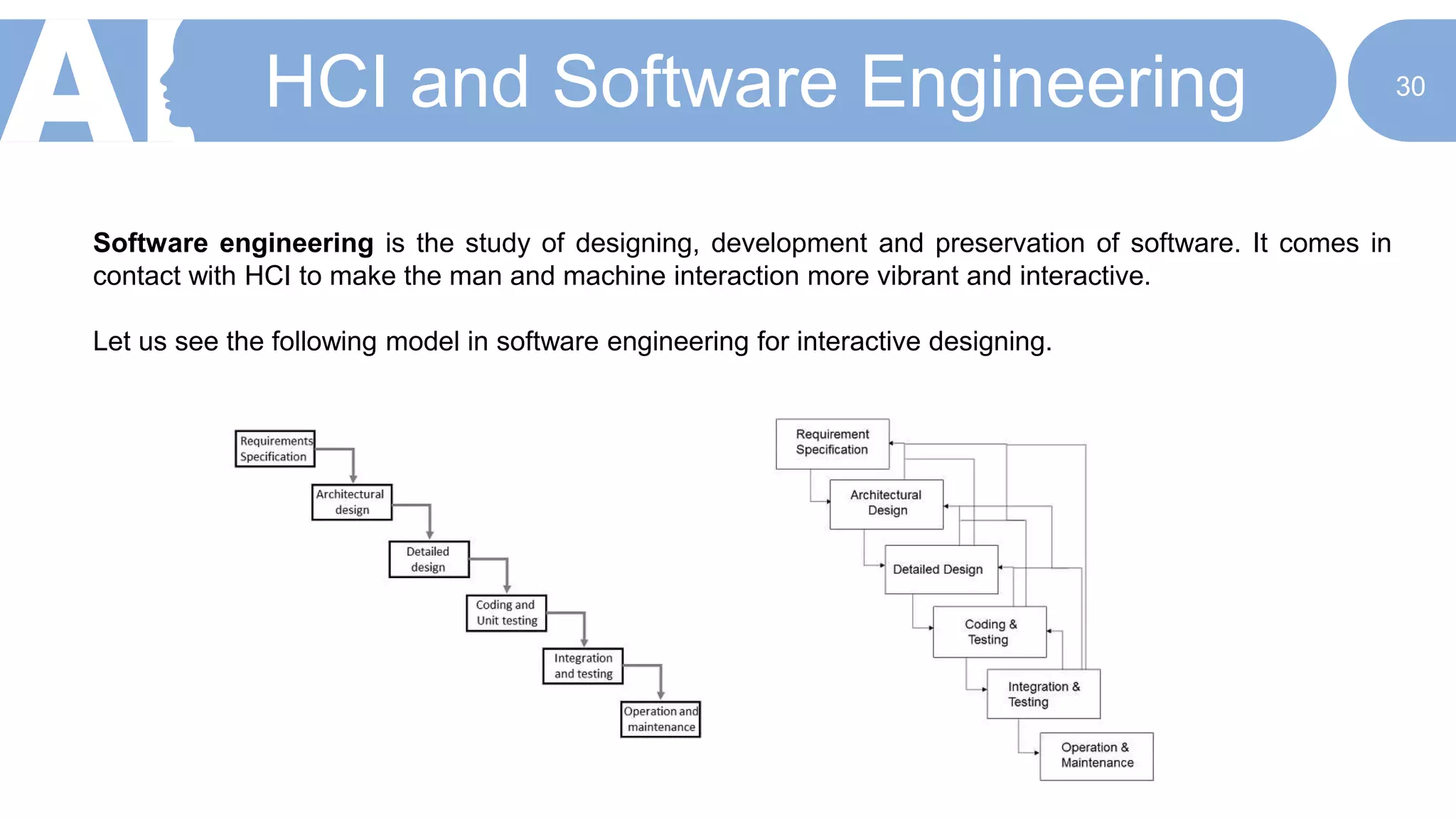
Software engineering is the study of designing, development and preservation of software. It comes in
contact with HCI to make the man and machine interaction more vibrant and interactive.
Let us see the following model in software engineering for interactive designing.
30
HCI
Analogy
HCI Analogy
Let us take a known analogy that can be understood by everyone. A film director is a person who with
his/her experience can work on script writing, acting, editing, and cinematography. He/She can be
considered as the only person accountable for all the creative phases of the film.
Similarly, HCI can be considered as the film director whose job is part creative and part technical. An HCI
designer have substantial understanding of all areas of designing. The following diagram depicts the
analogy
32
Summary
We hope to see the birth of new professions in
HCI designing in the future that would take help
from the current designing practices. The HCI
designer of tomorrow would definitely adopt
many skills that are the domain of specialists
today. And for the current practice of specialists,
we wish them to evolve, as others have done in
the past.
In the future, we hope to reinvent the software
development tools, making programming useful
to people’s work and hobbies. We also hope to
understand the software development as a
collaborative work and study the impact of
software on society.
33

Human Computer Interaction (HCI)

  • 1.
    Human Computer Interaction (HCI) AG A L Danushka | SEU-IS-14-PS-101
  • 2.
  • 3.
    What is HCI? *HCI is the study and the practice of usability. It is about understanding and creating software and other technology that people will want to use, will be able to use, and will find effective when used. * HCI is the study of how people use computer systems to perform HCI tries to provide us with all understanding of the computer and the person using it, so as to make the interaction between them more effective and more enjoyable. certain tasks. 3
  • 4.
    What is HCI? HCIconcerns: process: design, evaluation and implementation on: interactive computing systems for human use plus: the study of major phenomena surrounding them 4
  • 5.
    Why HCI?  Inthe past, computers were expensive & used by technical people only  Now, computers are cheap and used by non-technical people (different backgrounds, needs, knowledge, skills)  Computer and software manufacturers have noticed the importance of making computers “user-friendly”: easy to use, save people time, etc. 5
  • 6.
    Scope of HCI Use& Context: Find application areas for computers Human:Study psychological & physiological Aspects e.g., study how a user learns to use a new product, study human typing speed Computer: Hardware & software offered e.g., input & output devices, speed, interaction styles, computer graphics Development: Design, implementation & evaluation 6
  • 7.
    Goals of HCI? At physical level, HCI concerns the selection of the most appropriate input devices and output devices for a particular interface or task  Determine the best style of interaction, such as direct manipulation, natural language (speech, written input), WIMP (windows, icons, menus, pointers), etc.  Develop or improve  Safety  Utility  Effectiveness  Efficiency  Usability  Appeal of systems that include computers 7
  • 8.
    Goals of HCI? Safety protectingthe user from dangerous conditions and undesirable situations Utility extent of providing the right kind of functionality so that users can do what they need or want to do Efficiency a measure of how quickly users can accomplish their goals or finish their work using the system Usability ease of learning and ease of use Appeal how well the user likes the system 8
  • 9.
    HCI Benefits Gaining marketshare People intend to buy/use products with higher usability e.g., Google’s search engine has the largest market share because it is easy to use with higher efficiency Improving productivity Employees in a company perform their jobs in a faster manner e.g., Workers in a mainland company needed to press a lengthy sequence of buttons in performing a task Lowering support costs If the product is not usable, calls to customer support can be enormous e.g., If a washing machine is difficult to use even after reading the instruction manual, many users will call the customer service and the cost per call can be over $100 Reducing development cost Avoid implementing features users don’t want and creating features that are annoying or inefficient e.g., If there are too many unnecessary confirmation dialog boxes in using a word processor, it is likely this product needs to be redeveloped 9
  • 10.
    Good and BadDesigns Which elevator control is good? 10
  • 11.
    Good and BadDesigns Which remote can easily understand? 11
  • 12.
    Good and BadDesigns Dialog Box? 12
  • 13.
    Disciplines Contribute toHCI Academic Disciplines:  Computer Science Develop programming languages, system architectures, etc. of the computing systems  Engineering Provide faster and cheaper equipment  Linguistics, Artificial Intelligence Speech synthesis and recognition, natural language processing, etc.  Psychology Provide information about human mental capabilities (e.g., memory, decision making)  Ergonomics (Human Factors) Provide information about human physical capabilities  Sociology How people interact in groups 13
  • 14.
    Disciplines Contribute toHCI Design Practices:  Graphic Design Art of combining text and graphics and communicating an effective message in design of posters, brochures, signs, logos & other type of visual communications  Product Design Process of planning the product's specification  Industrial Design Applied H artH whereby aesthetics and usability of HproductsH may be improved. Aspects include overall shape of the object, HcolorsH, textures, HsoundsH & product Hergonomics 14
  • 15.
    Peoples in HCIBusiness Interactive / Interaction Designers: People involved in the design of all the interactive aspects of a product • Usability Engineers: People who focus on evaluating products using usability methods and principles • UI Designers: People experienced in user- centered design methodologies • UI Design Engineers: People who develop and model the end user experience • Web Designers: People who develop and create the visual design of websites, such as layouts & animations • Information Architects: People who come up with ideas of how to plan and structure interactive products • User Experience Designers: people who do all the above 15
  • 16.
    Activities in HCI 1.Identify needs and establish requirements 2. Develop alternative designs 3. Build interactive prototypes that can be communicated and assessed 4. Evaluate what is being built throughout the process • Users should be involved through the development of the project • Specific usability and user experience goals need to be identified, clearly documented and agreed at the beginning of the project • Iteration is needed throughout the core activities Identify Needs/ Establish Requirements Design / Redesign Evaluate Build an interactive version Final Product 16
  • 17.
    General Principles ofHCI Design Compatibility Ease of Learning Memorability Predictability Simplicity Flexibility Responsiveness Protection Invisible Technology Control WYSIWYG 17
  • 18.
    Compatibility Product – canreduce both learning time & errors User – know the user 18
  • 19.
    Ease of Learning Easeof learning – the system should be easy to learn so that the user can rapidly start getting some work done with the system 19
  • 20.
    Memorability Interfaces that havehigh memorability will be easier to learn and use. Factors which affect memorability include Location: It will be easier to remember if a particular object is placed in a consistent location, e.g., always putting the search box in the upper right-hand corner of a Web page Logical grouping: It will be easier to remember if things are grouped logically, e.g., putting related options together in a menu Conventions: Conventional objects and symbols will be easier to remember, e.g., shopping cart symbol 20
  • 21.
    Predictability Predictability involves aperson’s expectations and his/her ability to determine the results of actions ahead of time. It includes: Consistency – reinforce our associations and therefore increase our ability to remember and predict outcomes and processes Generalizabilty – Help us use the knowledge we gathered from previous experience and apply it to similar Situations Familiarity – e.g., familiar menu names and options help users locate objects and functions more easily Conventions – Allow us to use our intuitions which are based on previous experience and logic; if something is consistently done in a particular way, it will eventually become the conventional way of doing it 21
  • 22.
    Flexibility Allow more usercontrol & accommodates variations in user skill and preferences, i.e., give users choices  Hardware  Styles of interaction  Data format 22
  • 23.
    Responsiveness Computer should respondimmediately to a user’s input or inform the user when long delays are unavoidable 23
  • 24.
    Protection Protect users againstdisastrous results of common human error 24
  • 25.
    Invisible Technology • Noneed to know the technical details • A way to think about invisible technologies is that they are the set of infrastructure, tools and tech that have become indistinguishable from your daily life. So ingrained with our day-to-day that we don't even reflect that we're using them. 25
  • 26.
    WYSIWYG 1BWhat you seeis what you get 26
  • 27.
  • 28.
    Norman’s Seven Principles Toassess the interaction between human and computers, Donald Norman in 1988 proposed seven principles. He proposed the seven stages that can be used to transform difficult tasks. Following are the seven principles of Norman −  Use both knowledge in world & knowledge in the head.  Simplify task structures.  Make things visible.  Get the mapping right (User mental model = Conceptual model = Designed model).  Convert constrains into advantages (Physical constraints, Cultural constraints, Technological constraints).  Design for Error.  When all else fails − Standardize. 28
  • 29.
  • 30.
    HCI and SoftwareEngineering Software engineering is the study of designing, development and preservation of software. It comes in contact with HCI to make the man and machine interaction more vibrant and interactive. Let us see the following model in software engineering for interactive designing. 30
  • 31.
  • 32.
    HCI Analogy Let ustake a known analogy that can be understood by everyone. A film director is a person who with his/her experience can work on script writing, acting, editing, and cinematography. He/She can be considered as the only person accountable for all the creative phases of the film. Similarly, HCI can be considered as the film director whose job is part creative and part technical. An HCI designer have substantial understanding of all areas of designing. The following diagram depicts the analogy 32
  • 33.
    Summary We hope tosee the birth of new professions in HCI designing in the future that would take help from the current designing practices. The HCI designer of tomorrow would definitely adopt many skills that are the domain of specialists today. And for the current practice of specialists, we wish them to evolve, as others have done in the past. In the future, we hope to reinvent the software development tools, making programming useful to people’s work and hobbies. We also hope to understand the software development as a collaborative work and study the impact of software on society. 33