EVMS

Basics of Earned Value
Management
Part I
Eleanor Haupt
Earned Value Associates LLC
ehaupt@earnedvalue.biz
937-572-2586
1
EVMS

What is EVM?

EVM is the primary project
management tool...
that integrates the
technical, schedule, and cost
parameters of the contract.

All work is planned, scheduled, and budgeted in timephased ''planned value'' increments. As work is
performed, it is measured and controlled against the
baseline.
2
EVM Defined

EVMS

• EVM is:
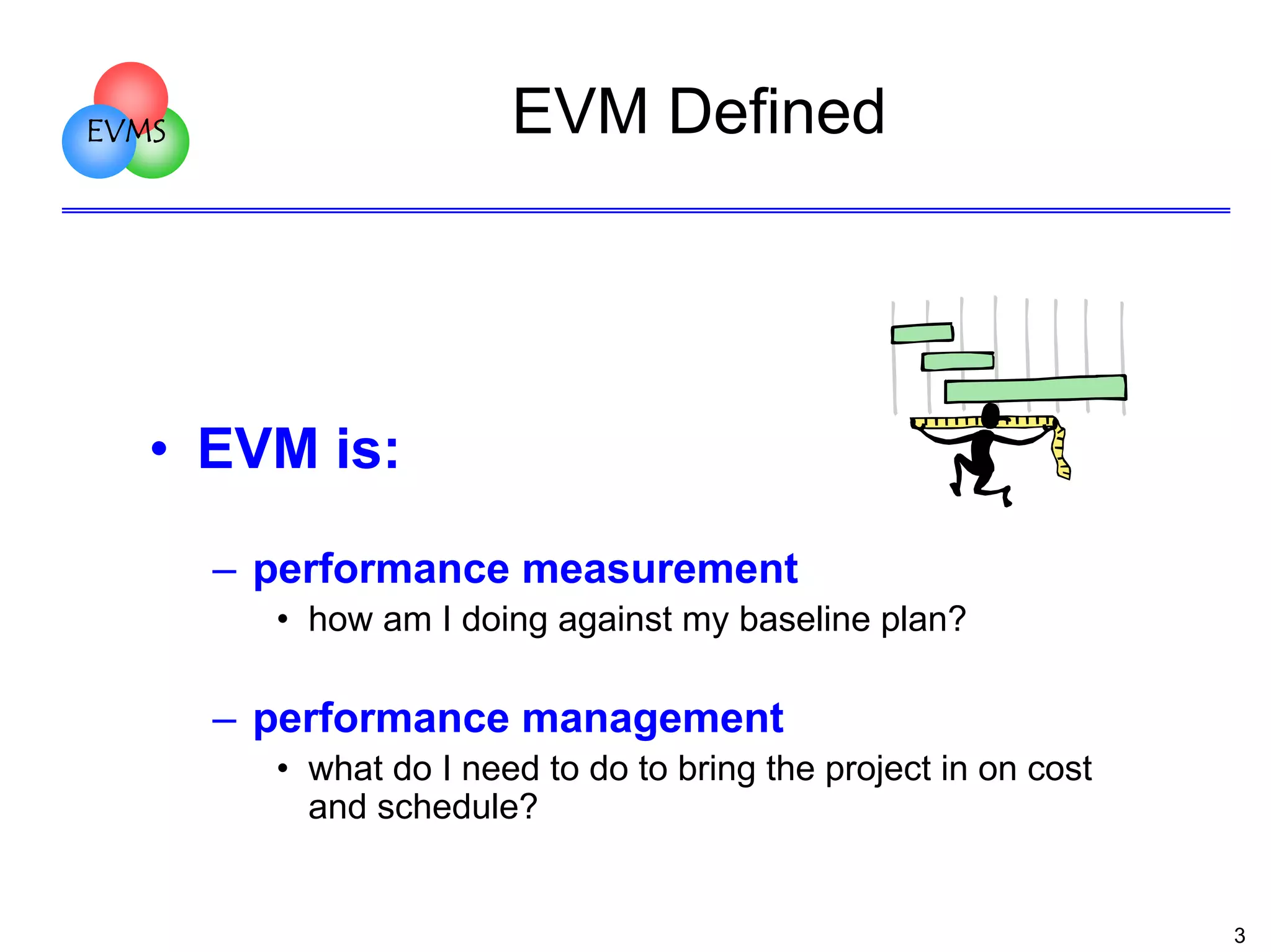
– performance measurement
• how am I doing against my baseline plan?

– performance management
• what do I need to do to bring the project in on cost
and schedule?

3
EVMS

Where can EVM be Applied?

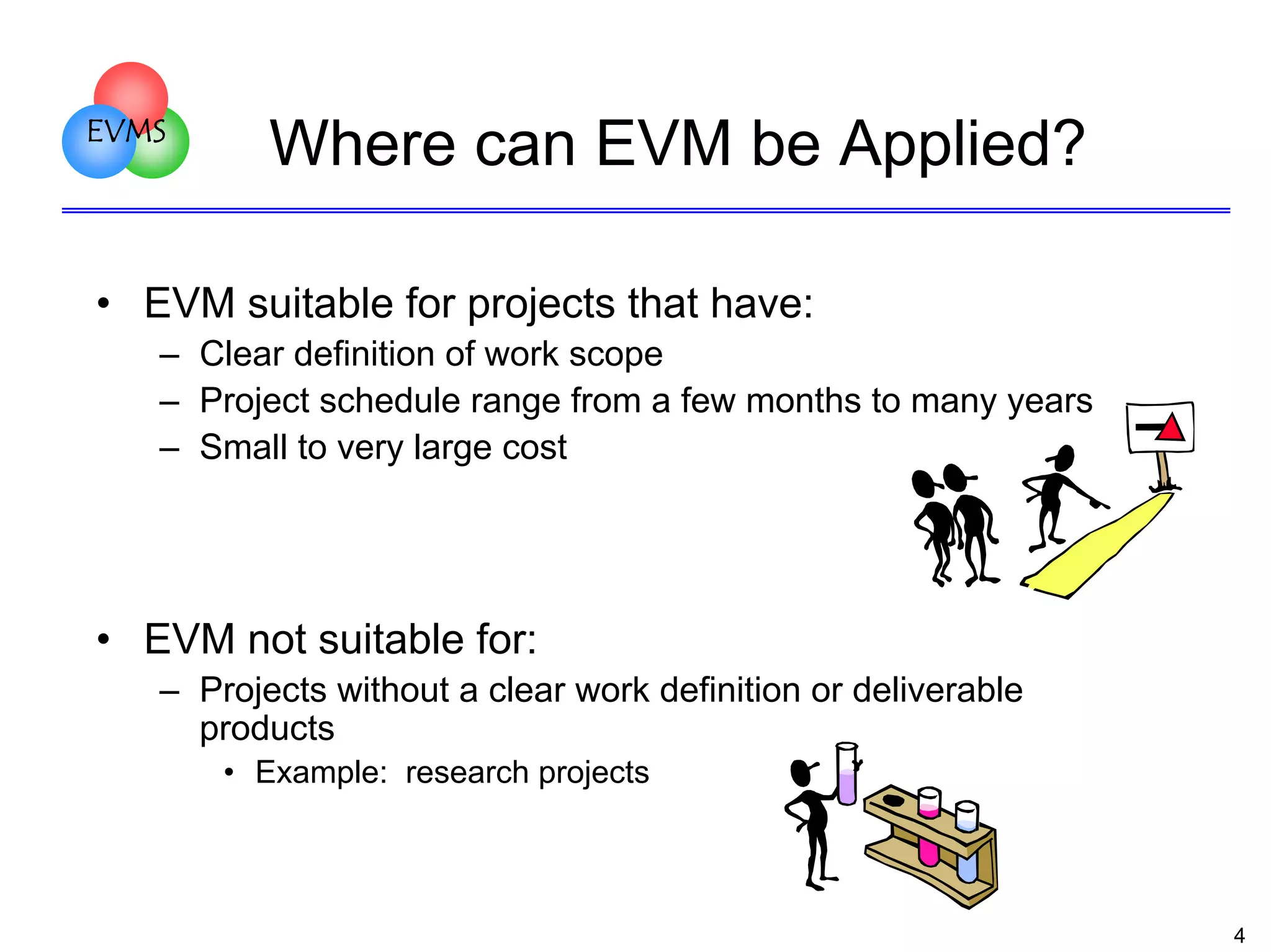
• EVM suitable for projects that have:
– Clear definition of work scope
– Project schedule range from a few months to many years
– Small to very large cost

• EVM not suitable for:
– Projects without a clear work definition or deliverable
products
• Example: research projects

4
EVMS

EVM Guidelines

• EVM has a recognized set of guidelines
– A company’s business planning system should meet these
guidelines = Earned Value Management System
• Most are existing project management practices
• Relatively few practices unique to EVMS
– Guidelines do not specify a particular process or business
system, but only set an expectation

• Some countries have national standards
– U.S., Australia, Canada, U.K.
– Guidelines may be mandatory in some cases

• Can be tailored or scaled for smaller projects

5
EVMS

•

Primary Steps in Performance
Management

Plan all project work
– Create an integrated performance management baseline

•

Objectively assess work progress at the level of performance
– Compare to the plan and to actual costs

•
•
•
•
•

Analyze significant deviations from the plan
Forecast impacts to cost and schedule
Take corrective actions as needed
Summarize data for progressively higher levels of
management
Maintain performance management baseline
– Update for contract changes (work scope)
– Maintain realistic baseline for remaining work

6
Why use EVM?

EVMS

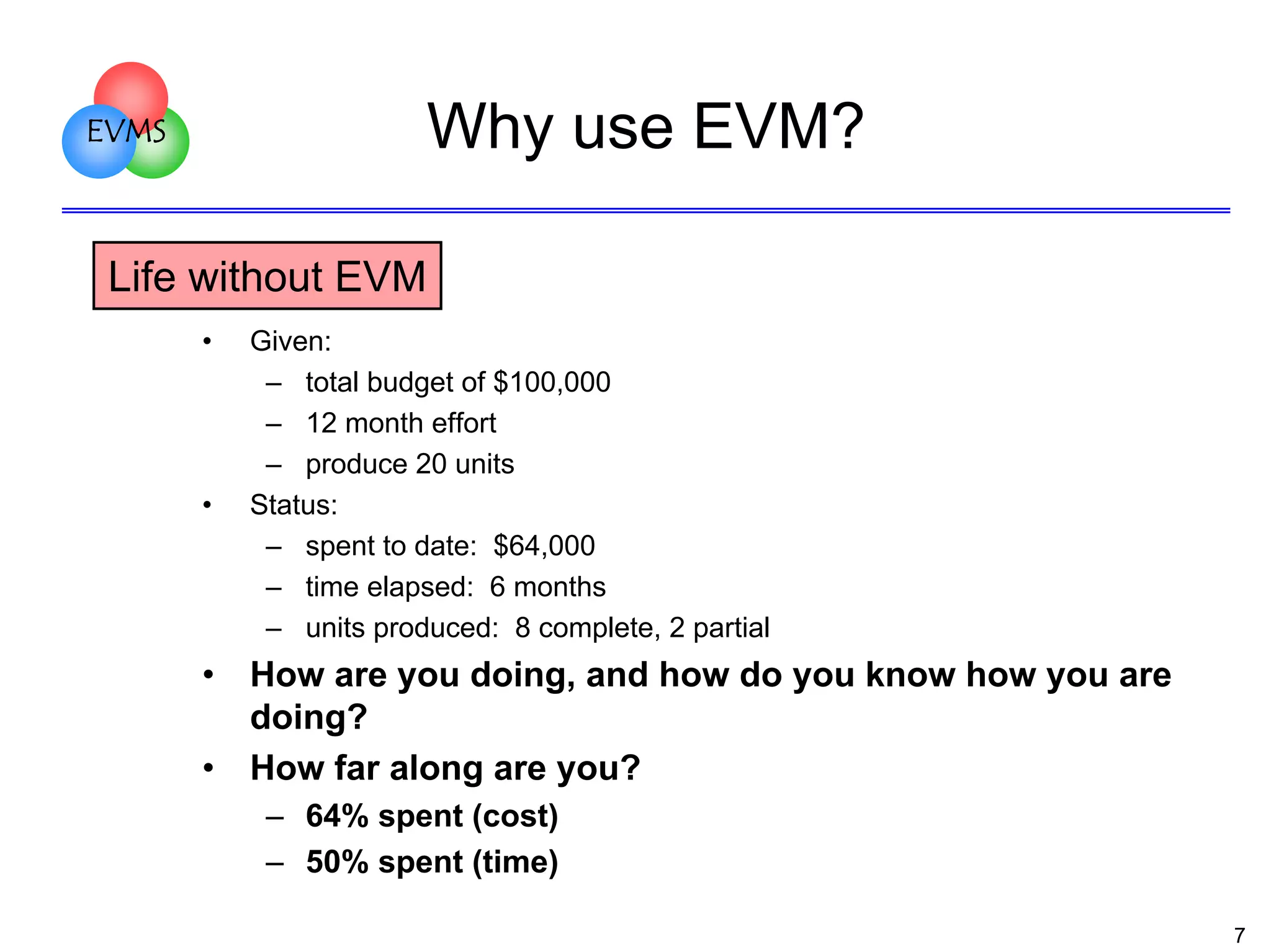
Life without EVM
•

•

•
•

Given:
– total budget of $100,000
– 12 month effort
– produce 20 units
Status:
– spent to date: $64,000
– time elapsed: 6 months
– units produced: 8 complete, 2 partial

How are you doing, and how do you know how you are
doing?
How far along are you?
– 64% spent (cost)
– 50% spent (time)
7
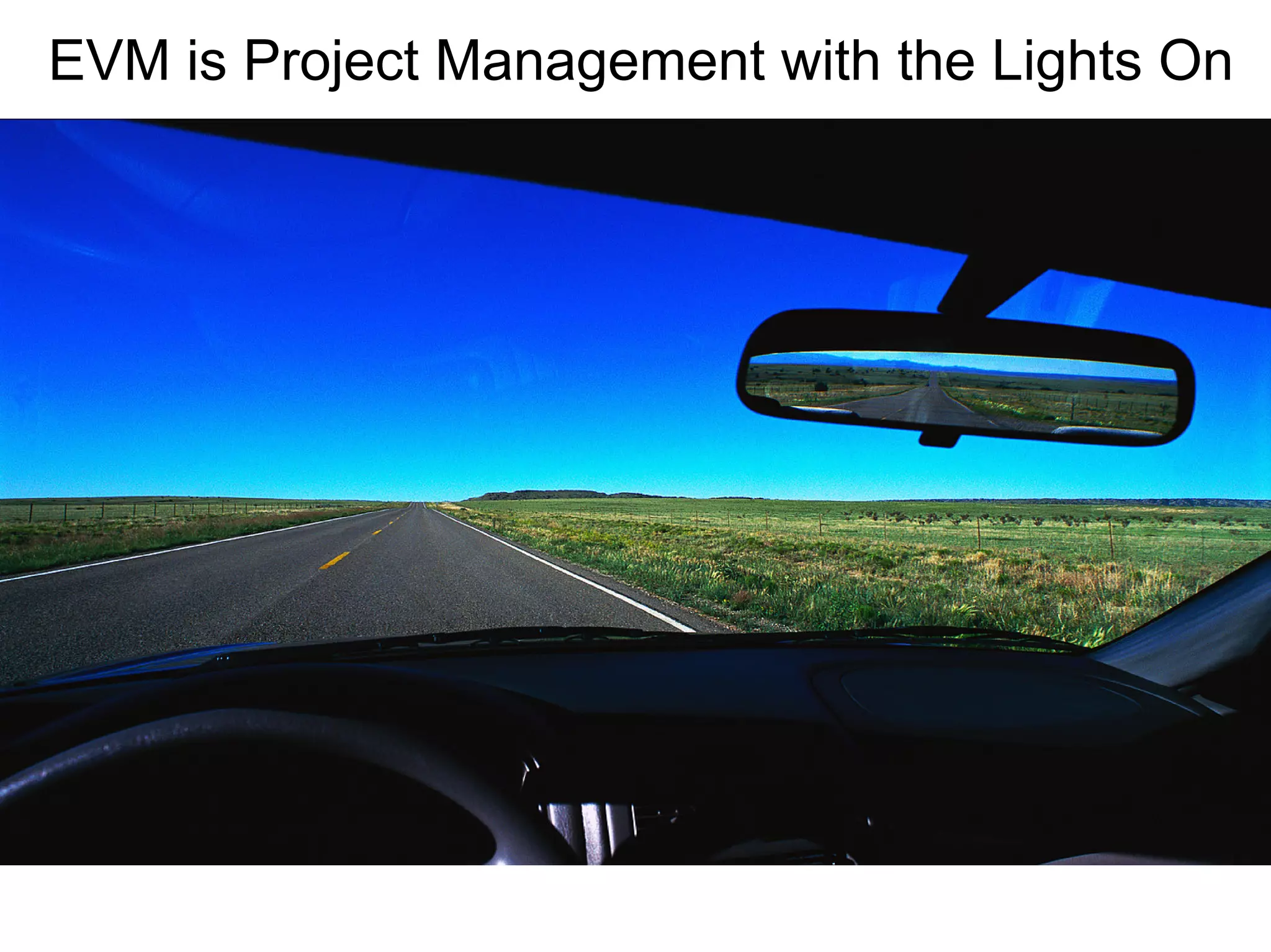
EVM is Project Management with the Lights On
Why use EVM?

EVMS

Life with EVM
•

•

•

Given:
– total budget of $100,000
– 12 month effort
– produce 20 units
Status:
– spent to date: $64,000
– time elapsed: 6 months
– units produced: 8 complete, 2 partial

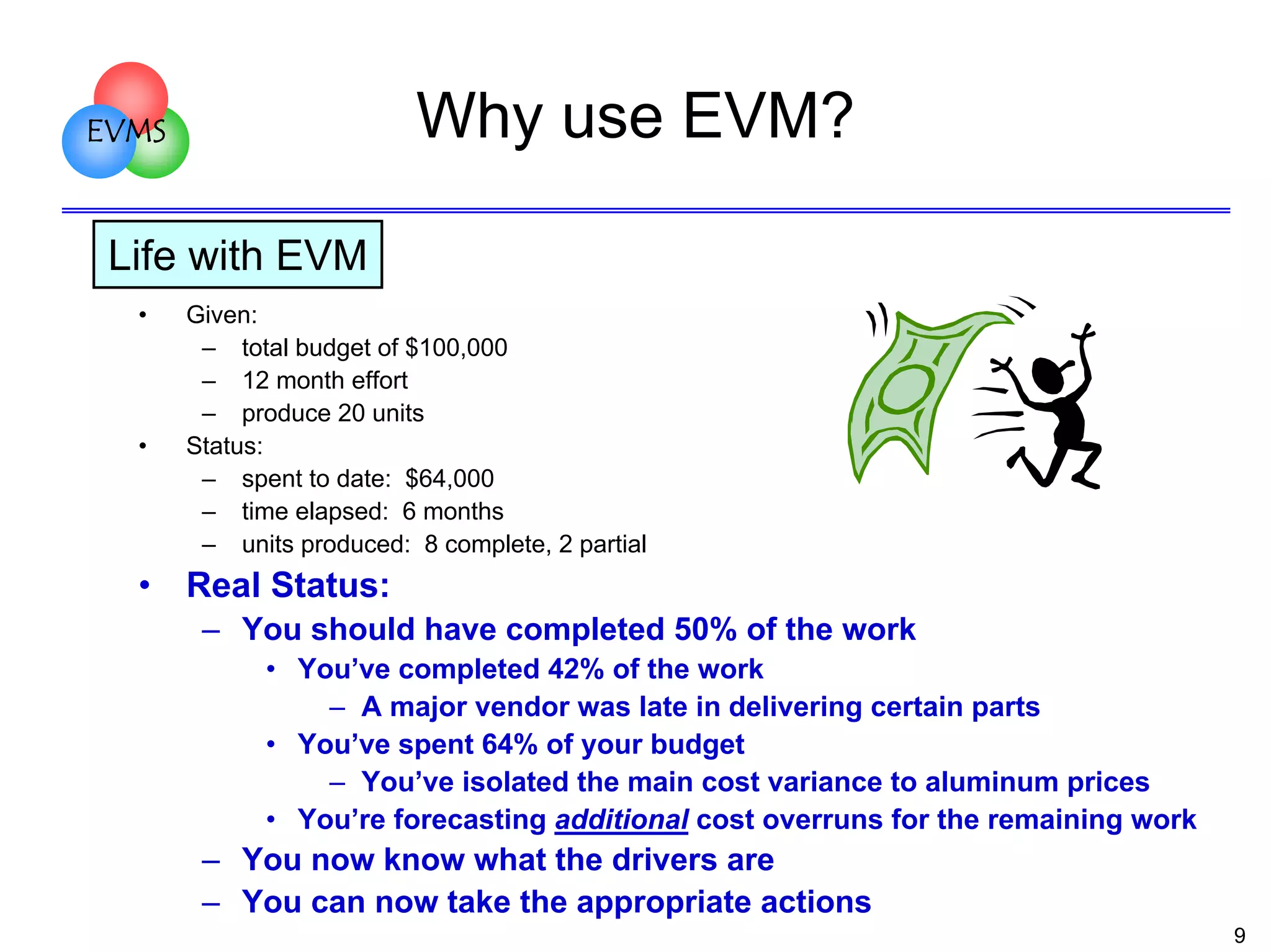
Real Status:
– You should have completed 50% of the work
• You’ve completed 42% of the work
– A major vendor was late in delivering certain parts
• You’ve spent 64% of your budget
– You’ve isolated the main cost variance to aluminum prices
• You’re forecasting additional cost overruns for the remaining work

– You now know what the drivers are
– You can now take the appropriate actions
9
EVMS

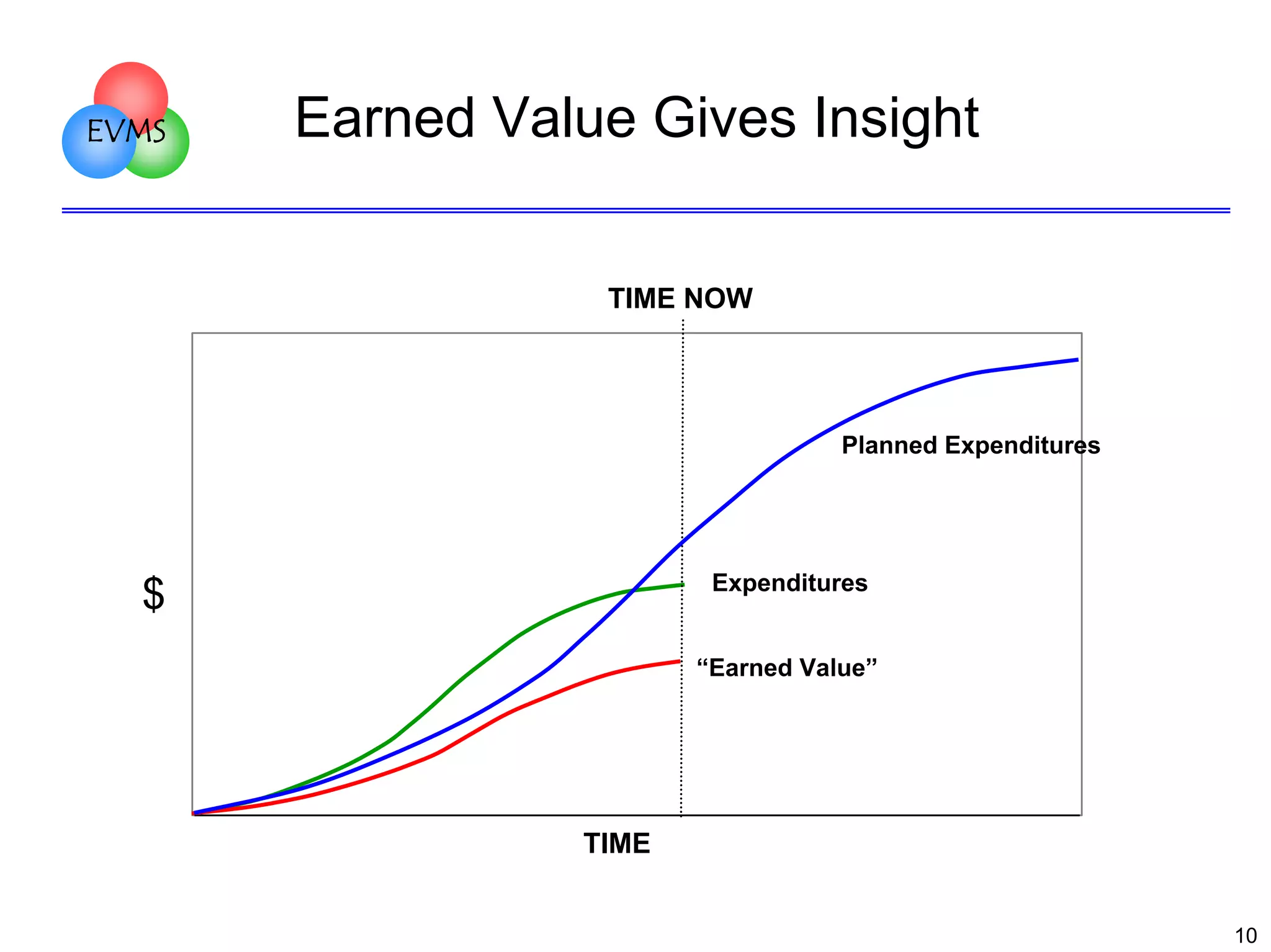
Earned Value Gives Insight
TIME NOW

Planned Expenditures

Expenditures

$

“Earned Value”

TIME
10
EVMS

Benefits of EVM

• Requires development of integrated baseline
– Results in better project definition and planning

• Early identification of trends and problems
• Accurate picture of project status
– Cost, schedule, and technical
– Segregation of schedule and cost variances

• Projection of final costs
• Project control by the team
– Enables project manager to make informed decisions based on facts

• Results in successful projects
– On time, on cost

11
EVMS

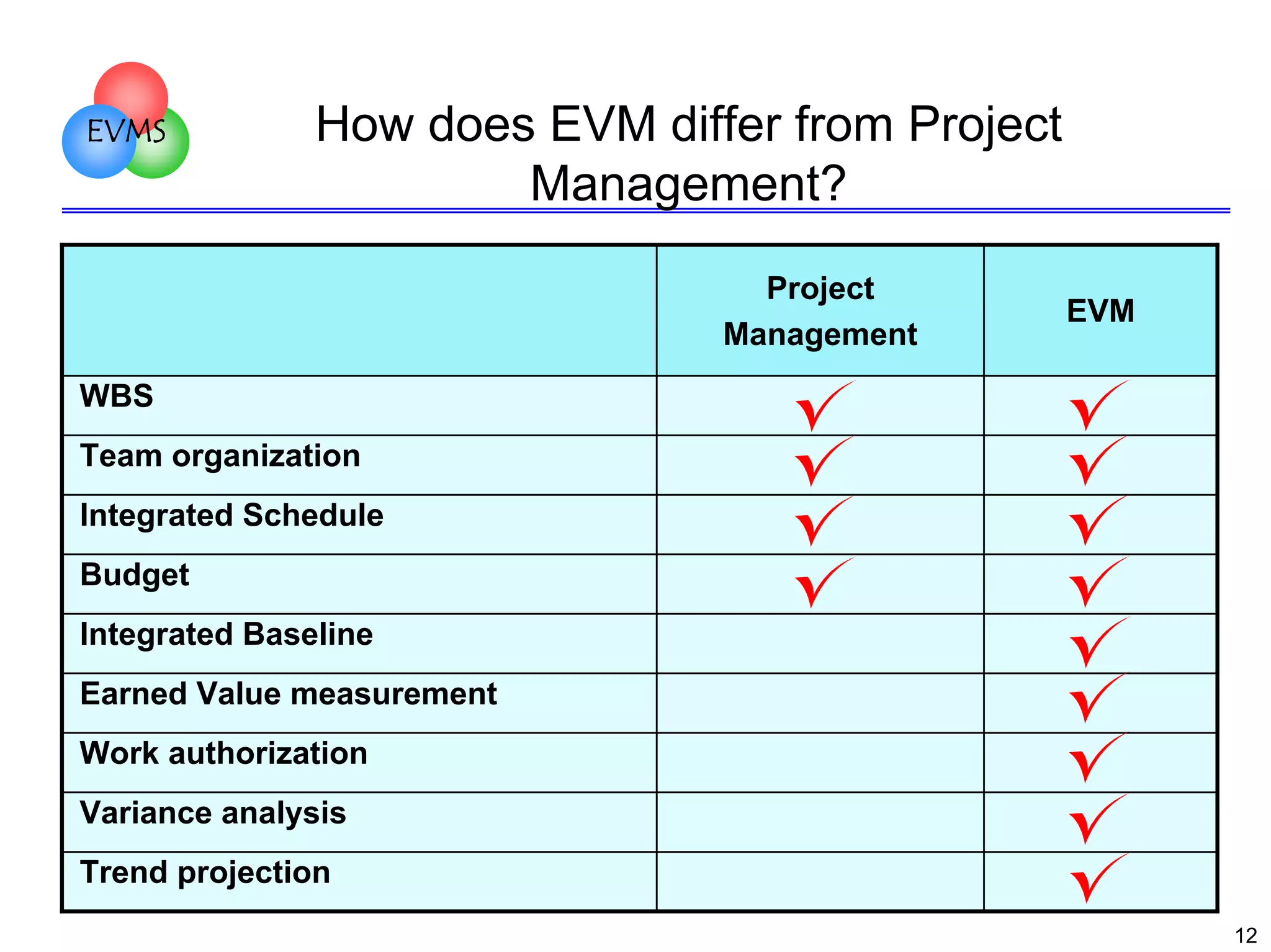
How does EVM differ from Project
Management?
Project
Management

EVM

WBS
Team organization
Integrated Schedule
Budget
Integrated Baseline
Earned Value measurement
Work authorization
Variance analysis
Trend projection
12
EVMS

Basic EVMS Terms

13
EVMS

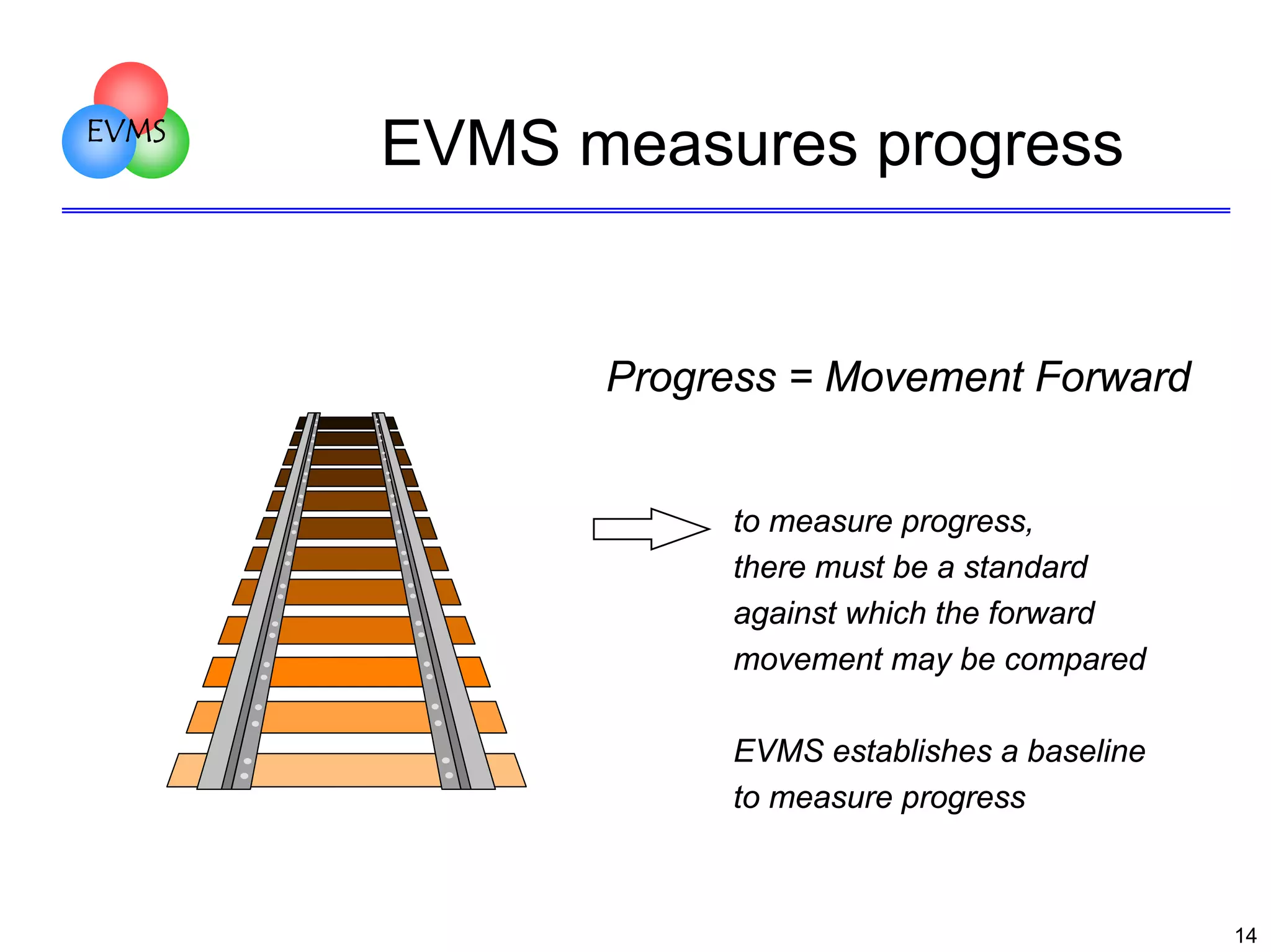
EVMS measures progress

Progress = Movement Forward

to measure progress,
there must be a standard
against which the forward
movement may be compared
EVMS establishes a baseline
to measure progress

14
EVMS

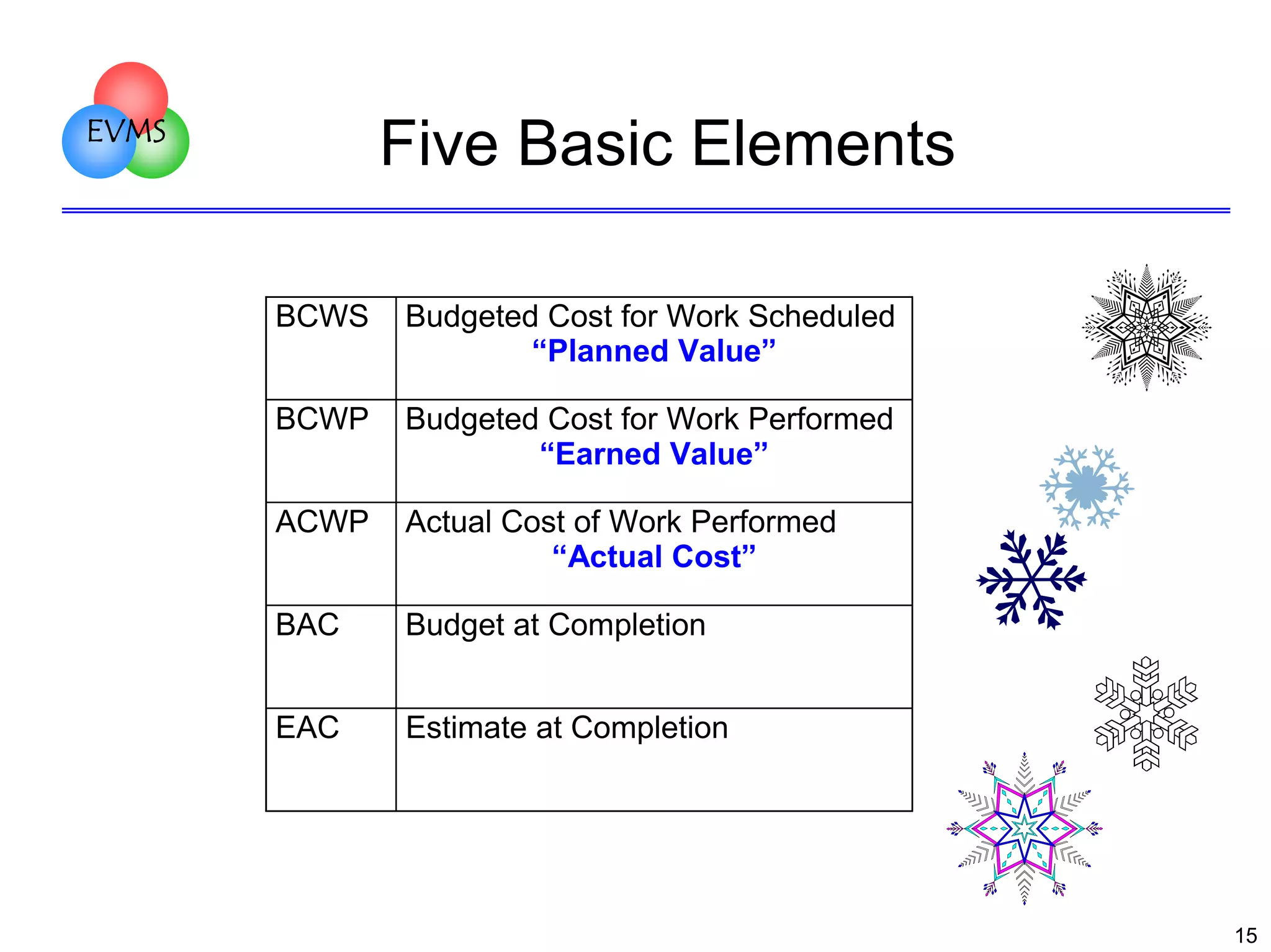
Five Basic Elements
BCWS

Budgeted Cost for Work Scheduled
“Planned Value”

BCWP

Budgeted Cost for Work Performed
“Earned Value”

ACWP

Actual Cost of Work Performed
“Actual Cost”

BAC

Budget at Completion

EAC

Estimate at Completion

15
EVMS

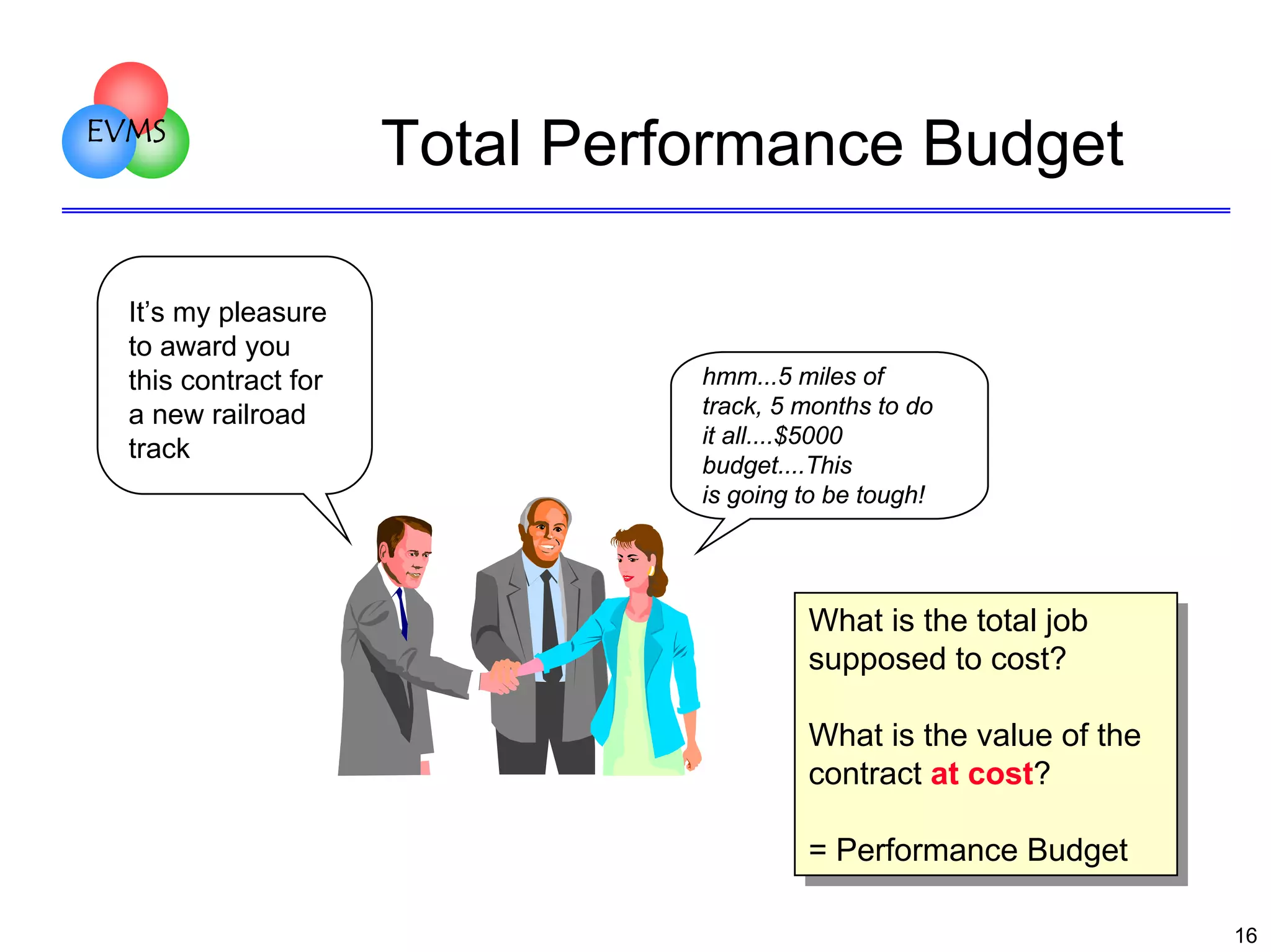
It’s my pleasure
to award you
this contract for
a new railroad
track

Total Performance Budget

hmm...5 miles of
track, 5 months to do
it all....$5000
budget....This
is going to be tough!

What is the total job
supposed to cost?
supposed to cost?
What is the value of the
contract at cost?
contract at cost?
= Performance Budget
16
EVMS

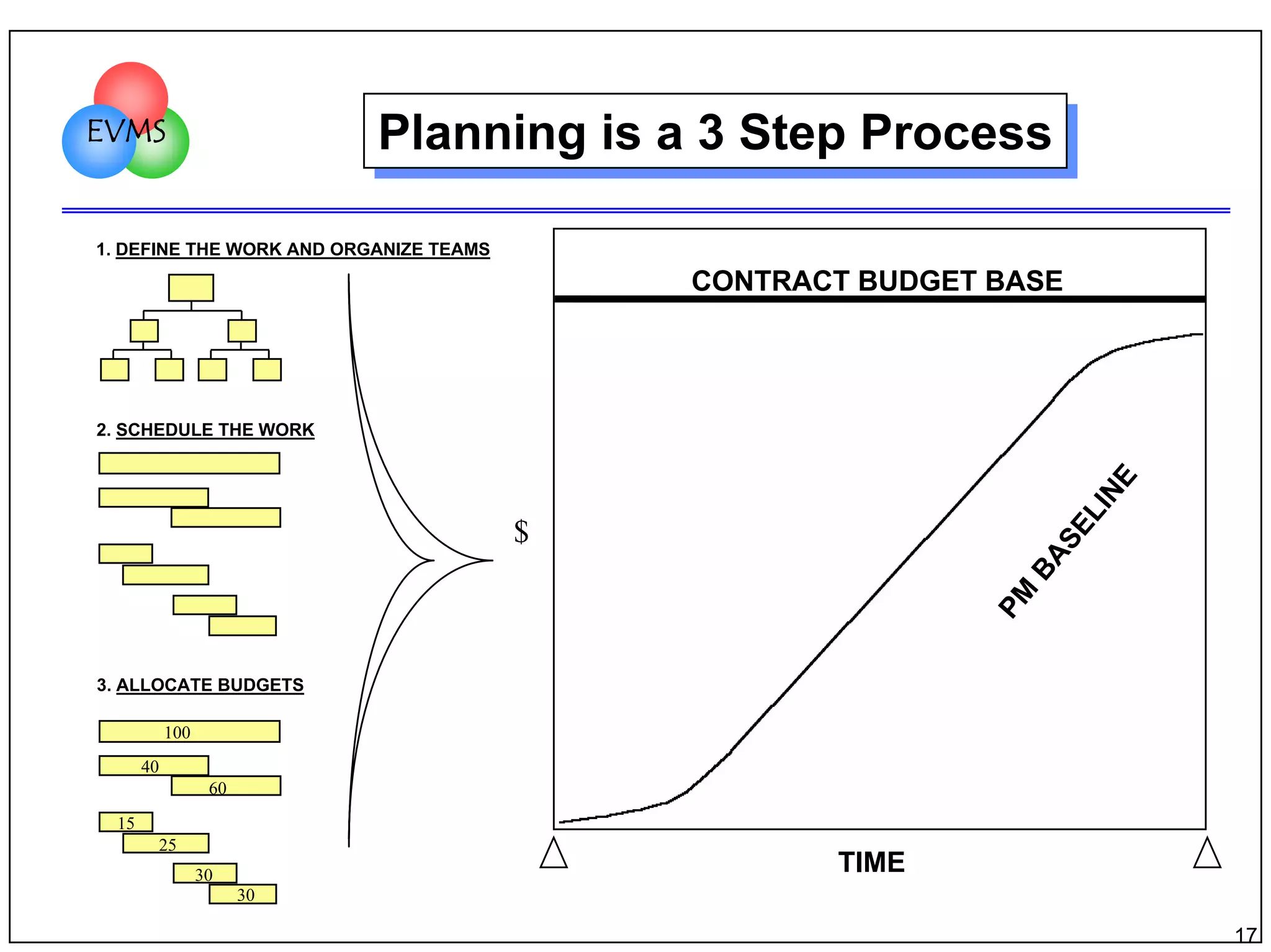
Planning is a 3 Step Process

1. DEFINE THE WORK AND ORGANIZE TEAMS

CONTRACT BUDGET BASE

BA
SE
LI
NE

2. SCHEDULE THE WORK

PM

$

3. ALLOCATE BUDGETS
100
40
60
15
25

TIME

30
30

17
EVMS

•
•
•

•

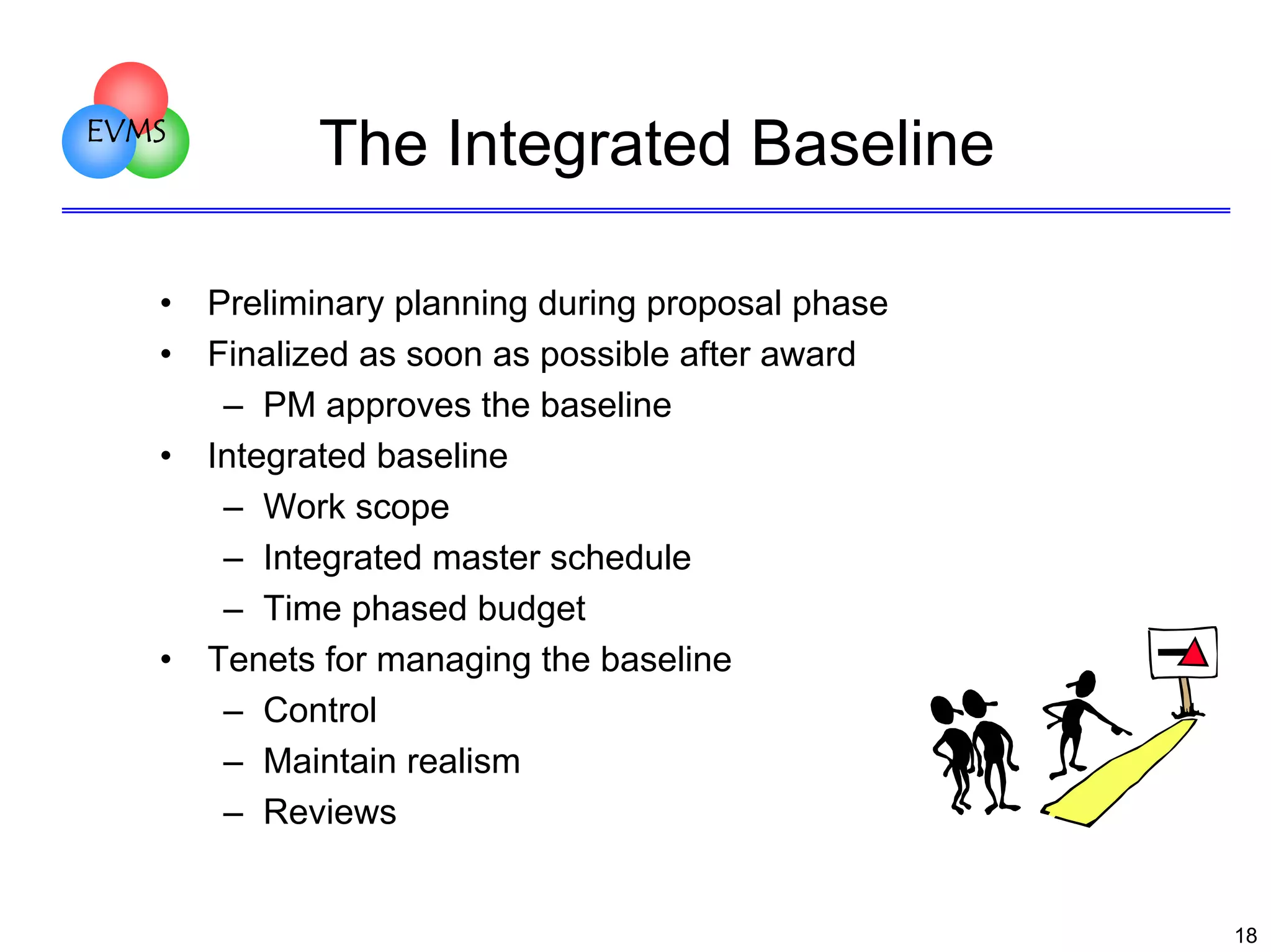
The Integrated Baseline
Preliminary planning during proposal phase
Finalized as soon as possible after award
– PM approves the baseline
Integrated baseline
– Work scope
– Integrated master schedule
– Time phased budget
Tenets for managing the baseline
– Control
– Maintain realism
– Reviews

18
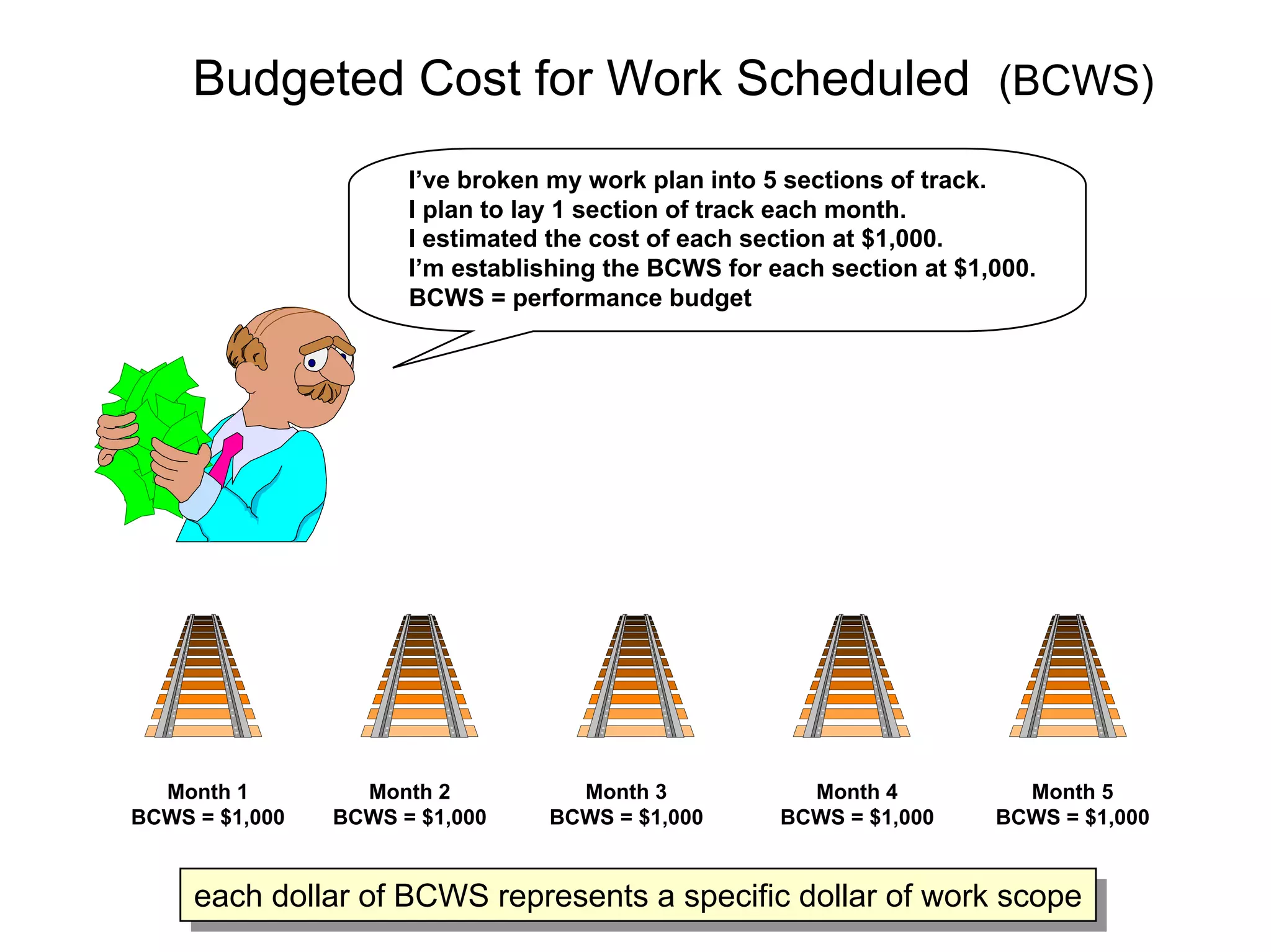
Budgeted Cost for Work Scheduled (BCWS)
I’ve broken my work plan into 5 sections of track.
I plan to lay 1 section of track each month.
I estimated the cost of each section at $1,000.
I’m establishing the BCWS for each section at $1,000.
BCWS = performance budget

Month 1
BCWS = $1,000

Month 2
BCWS = $1,000

Month 3
BCWS = $1,000

Month 4
BCWS = $1,000

Month 5
BCWS = $1,000

each dollar of BCWS represents a specific dollar of work scope
EVMS

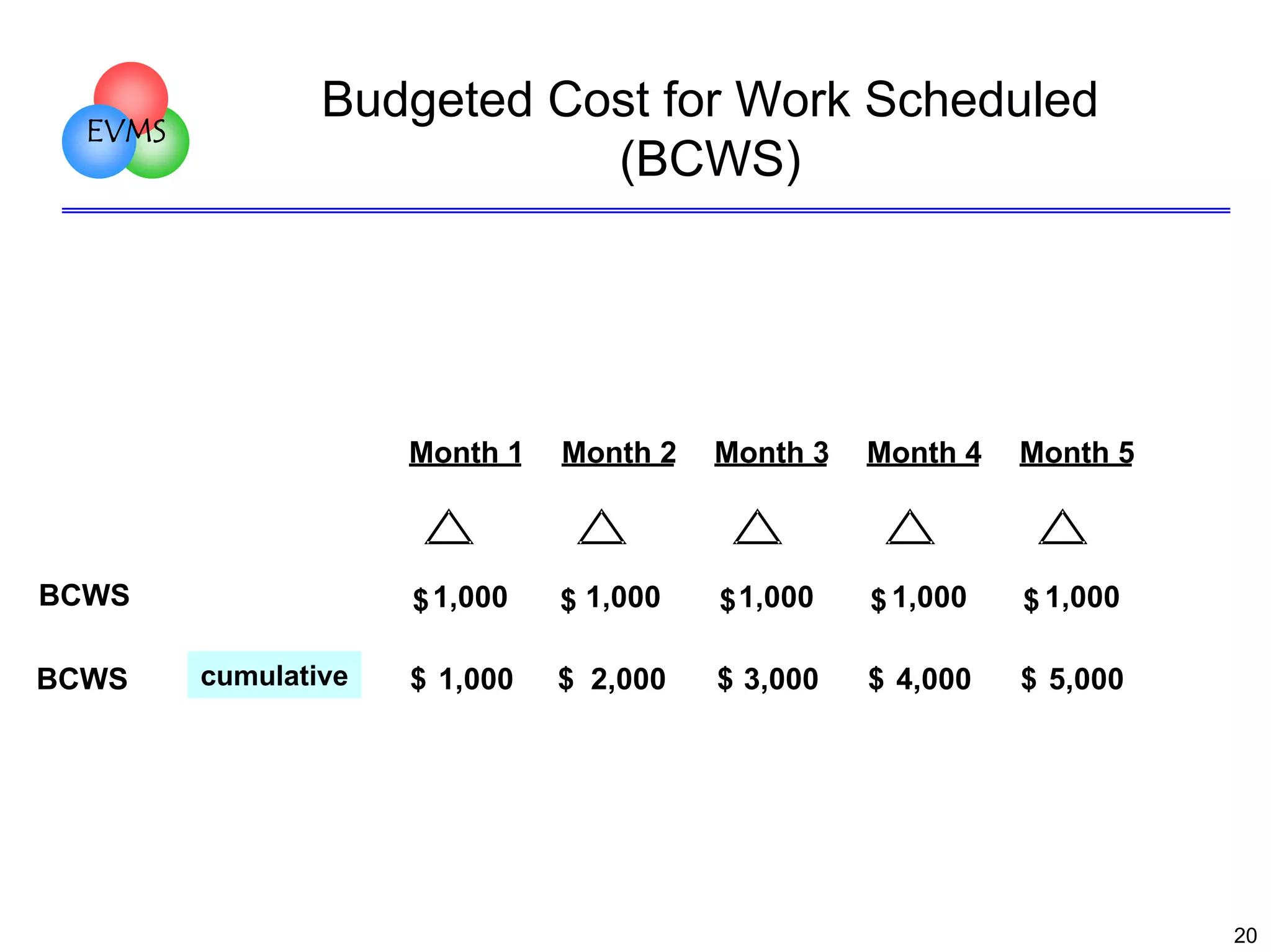
Budgeted Cost for Work Scheduled
(BCWS)

Month 1

BCWS

cumulative

Month 3

Month 4

Month 5

$ 1,000

BCWS

Month 2

$ 1,000

$ 1,000

$ 1,000

$ 1,000

$ 1,000

$ 2,000

$ 3,000

4
$ 4,000

$ 5,000

20
EVMS

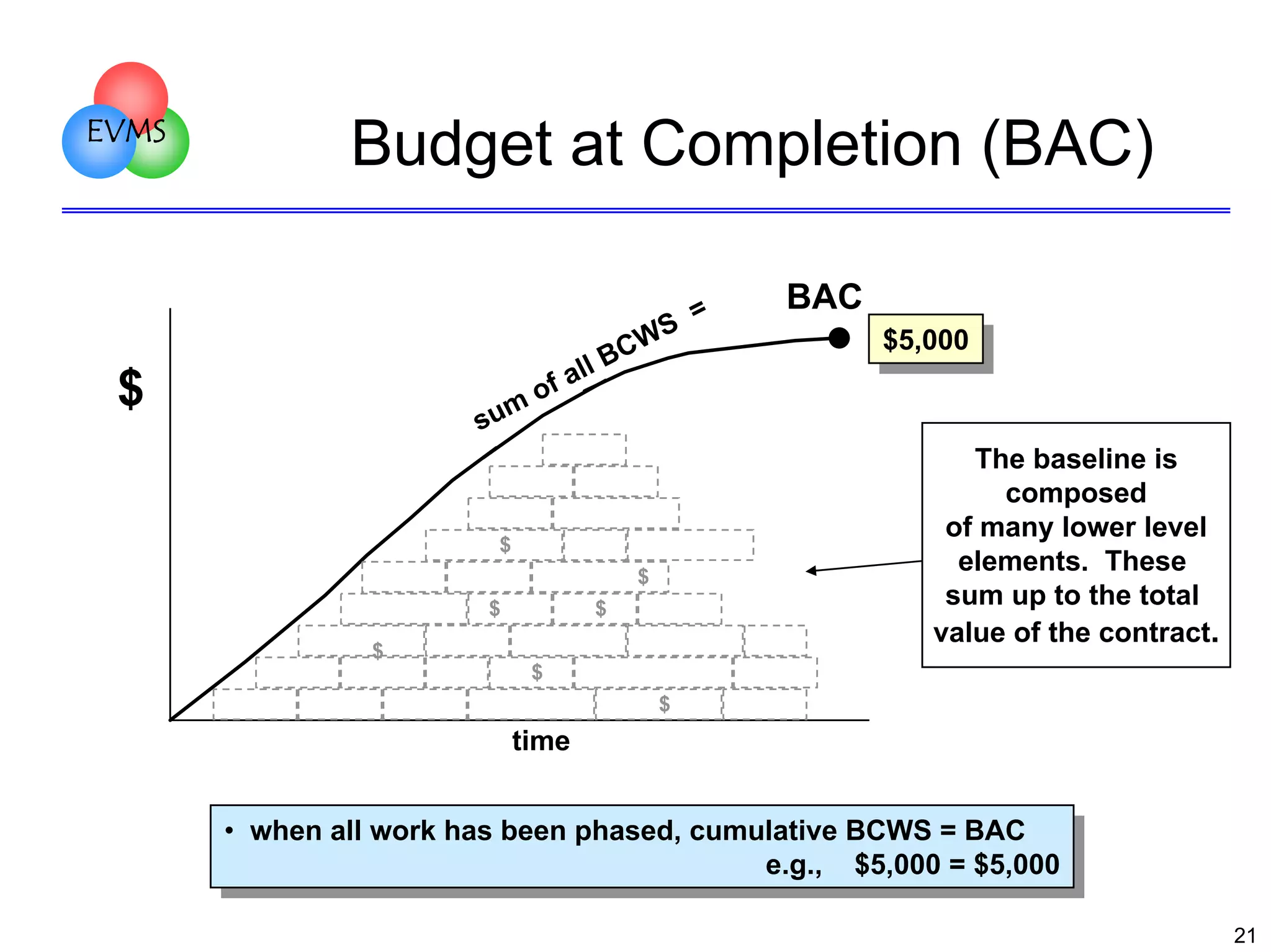
Budget at Completion (BAC)

$

m
su

S
CW
ll B
fa
o

BAC
$5,000
$5,000

The baseline is
composed
of many lower level
elements. These
sum up to the total
value of the contract.

$
$
$

=

$

$
$
$

time
•• when all work has been phased, cumulative BCWS = BAC
when all work has been phased, cumulative BCWS = BAC
e.g., $5,000 = $5,000
21
EVMS

Budgeted Cost for Work Performed
(BCWP)
the EARNED

VALUE concept

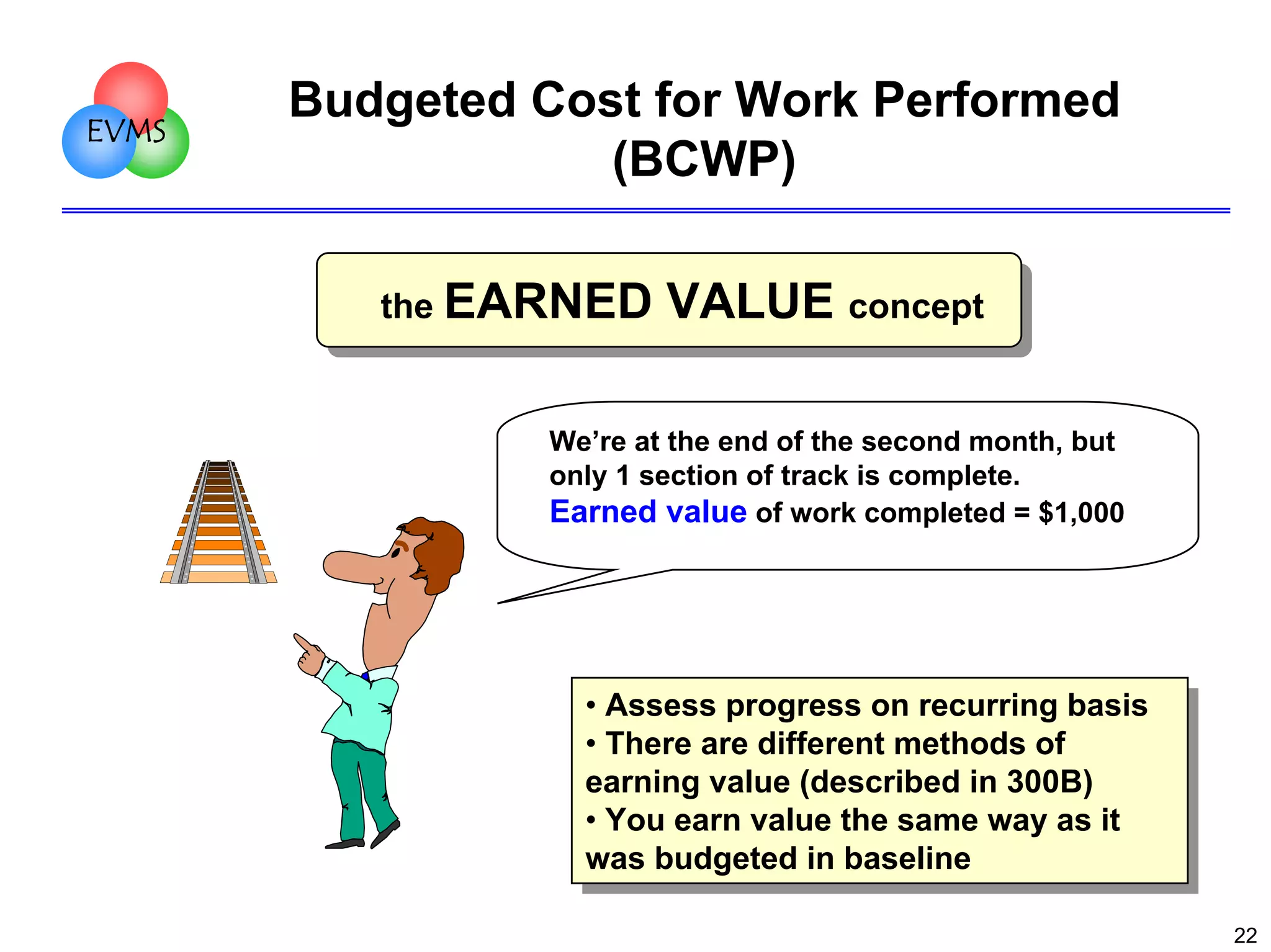
We’re at the end of the second month, but
only 1 section of track is complete.
Earned value of work completed = $1,000

••Assess progress on recurring basis
Assess progress on recurring basis
••There are different methods of
There are different methods of
earning value (described in 300B)
••You earn value the same way as it
You earn value the same way as it
was budgeted in baseline
22
EVMS

•

Measuring Performance
BCWP

General Principles
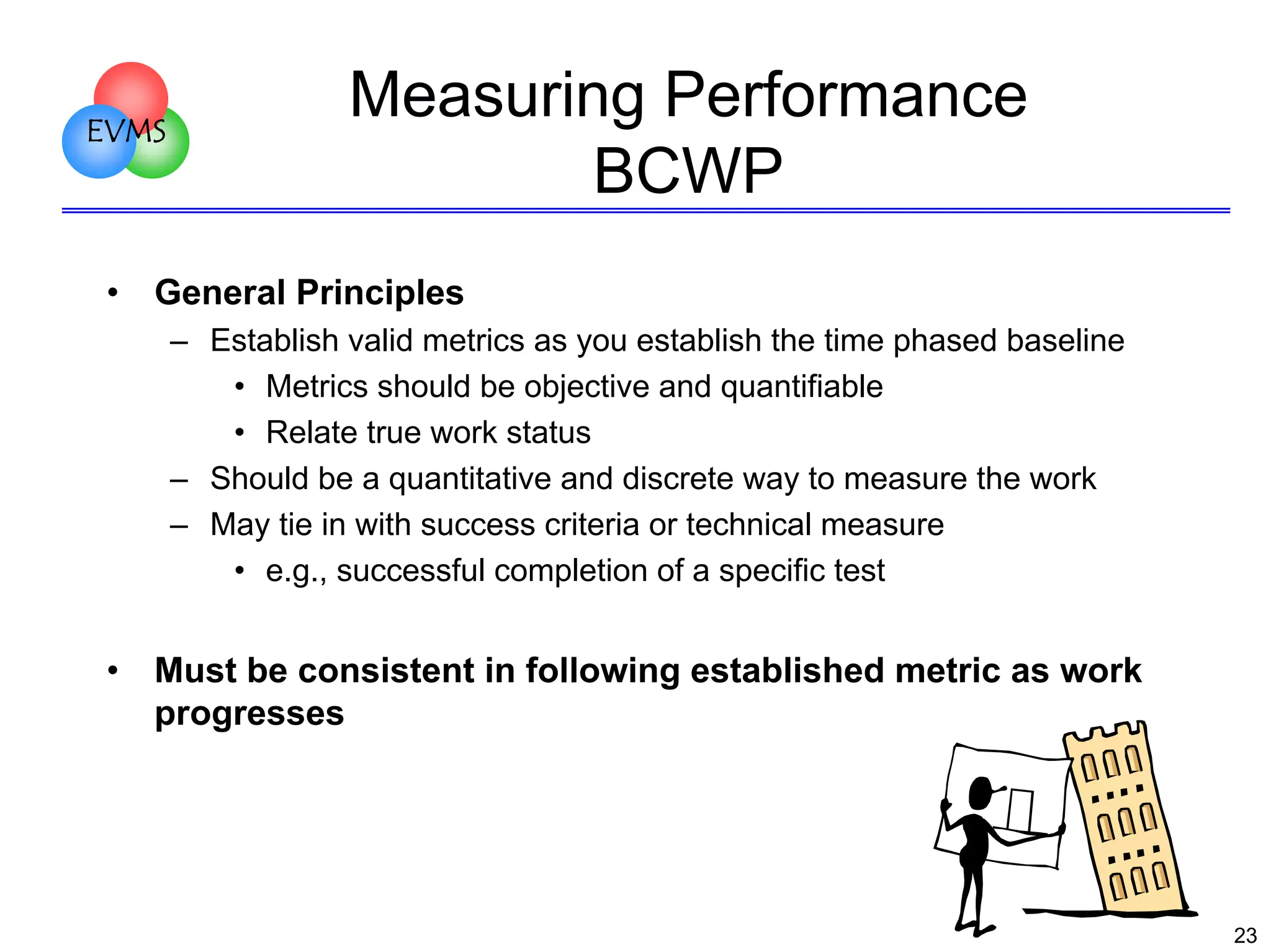
– Establish valid metrics as you establish the time phased baseline
• Metrics should be objective and quantifiable
• Relate true work status
– Should be a quantitative and discrete way to measure the work
– May tie in with success criteria or technical measure
• e.g., successful completion of a specific test

•

Must be consistent in following established metric as work
progresses

23
Budgeted Cost for Work Performed
(BCWP)

EVMS

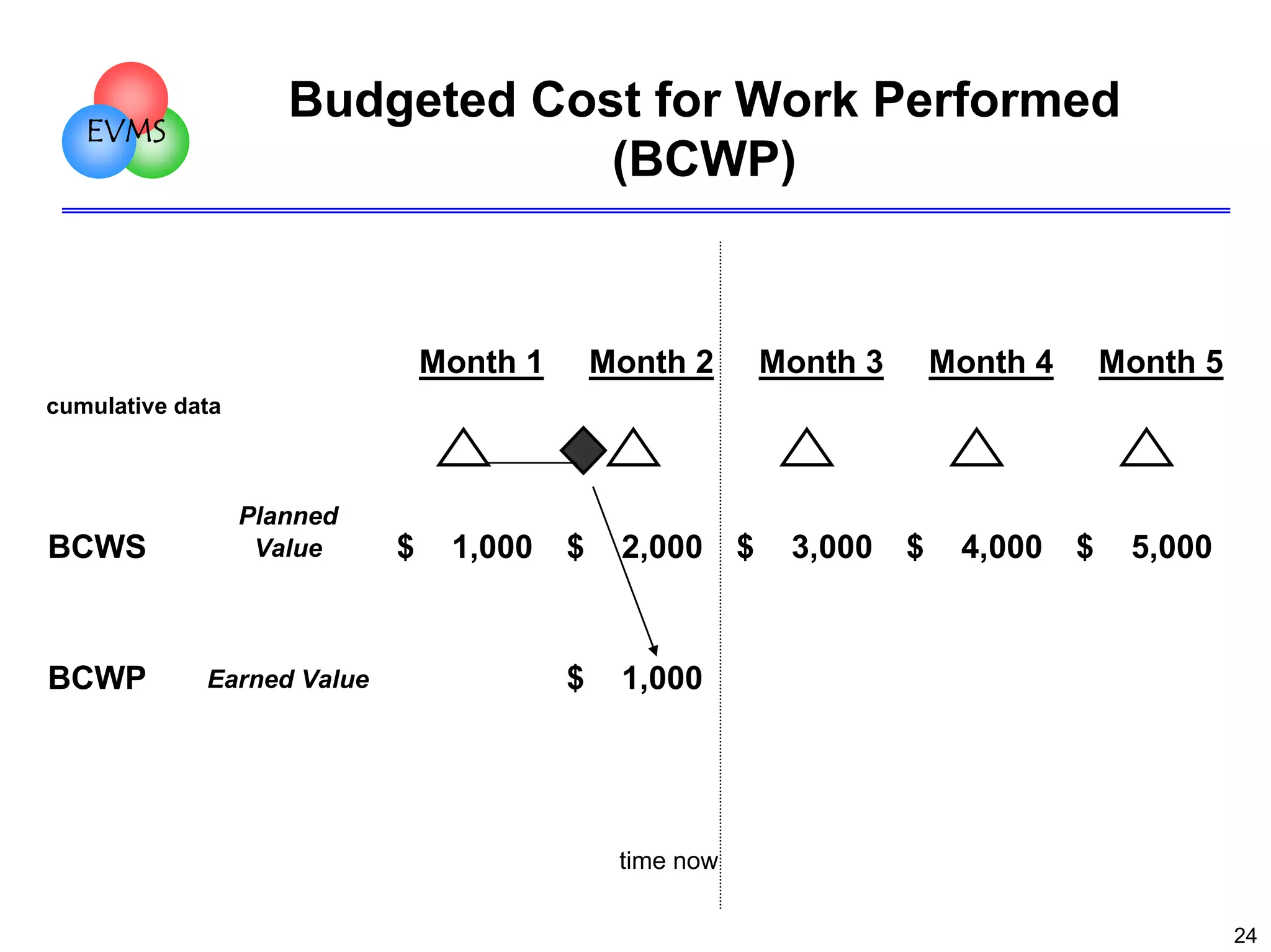
Month 1

Month 2

Month 3

Month 4

Month 5

cumulative data

BCWS

Planned
Value

BCWP

Earned Value

$

1,000

$

2,000

$

$

3,000

$

4,000

$

5,000

1,000

time now
24
BUDGET BASED

EVMS

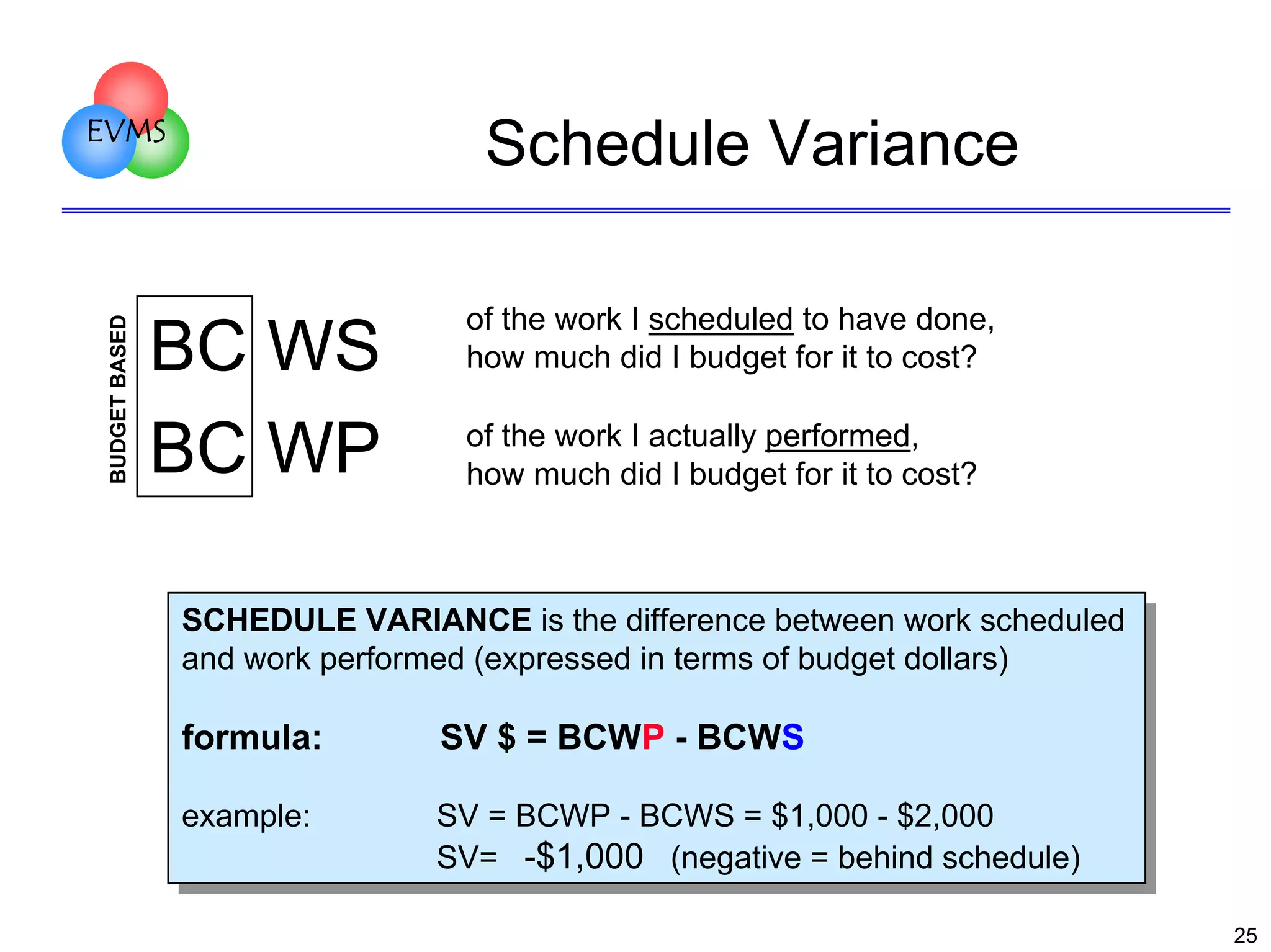
Schedule Variance

BC WS
BC WP

of the work I scheduled to have done,
how much did I budget for it to cost?
of the work I actually performed,
how much did I budget for it to cost?

SCHEDULE VARIANCE is the difference between work scheduled
and work performed (expressed in terms of budget dollars)

formula:
formula:

SV $ = BCWP --BCWS
SV $ = BCWP BCWS

example:
example:

SV = BCWP --BCWS = $1,000 --$2,000
SV = BCWP BCWS = $1,000 $2,000
SV= -$1,000 (negative = behind schedule)
25
EVMS

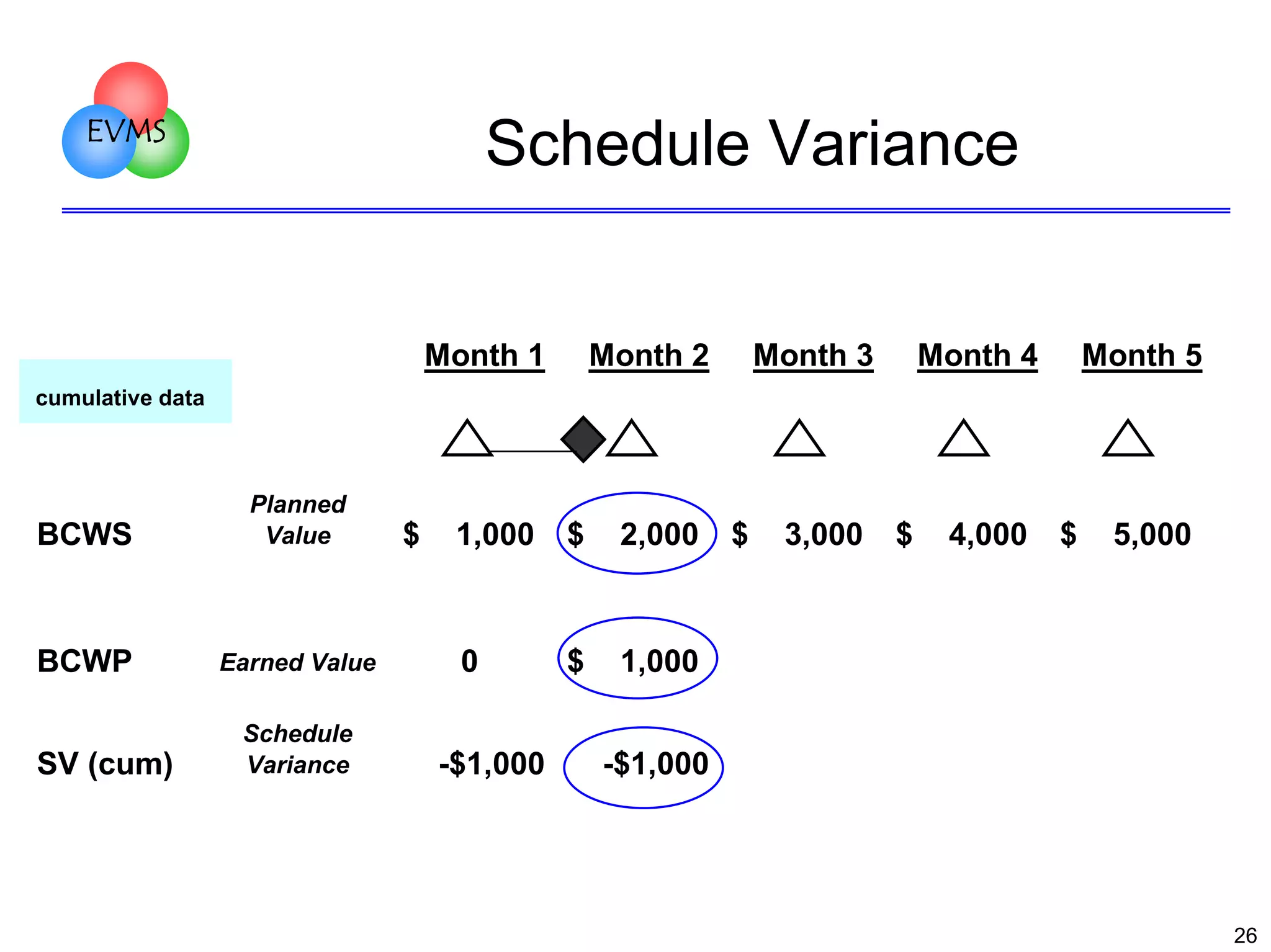
Schedule Variance

Month 1

Month 2

Month 3

Month 4

Month 5

cumulative data

BCWS

Planned
Value

BCWP

Earned Value

SV (cum)

Schedule
Variance

$

1,000

$

2,000

0

$

1,000

-$1,000

$

3,000

$

4,000

$

5,000

-$1,000

26
EVMS

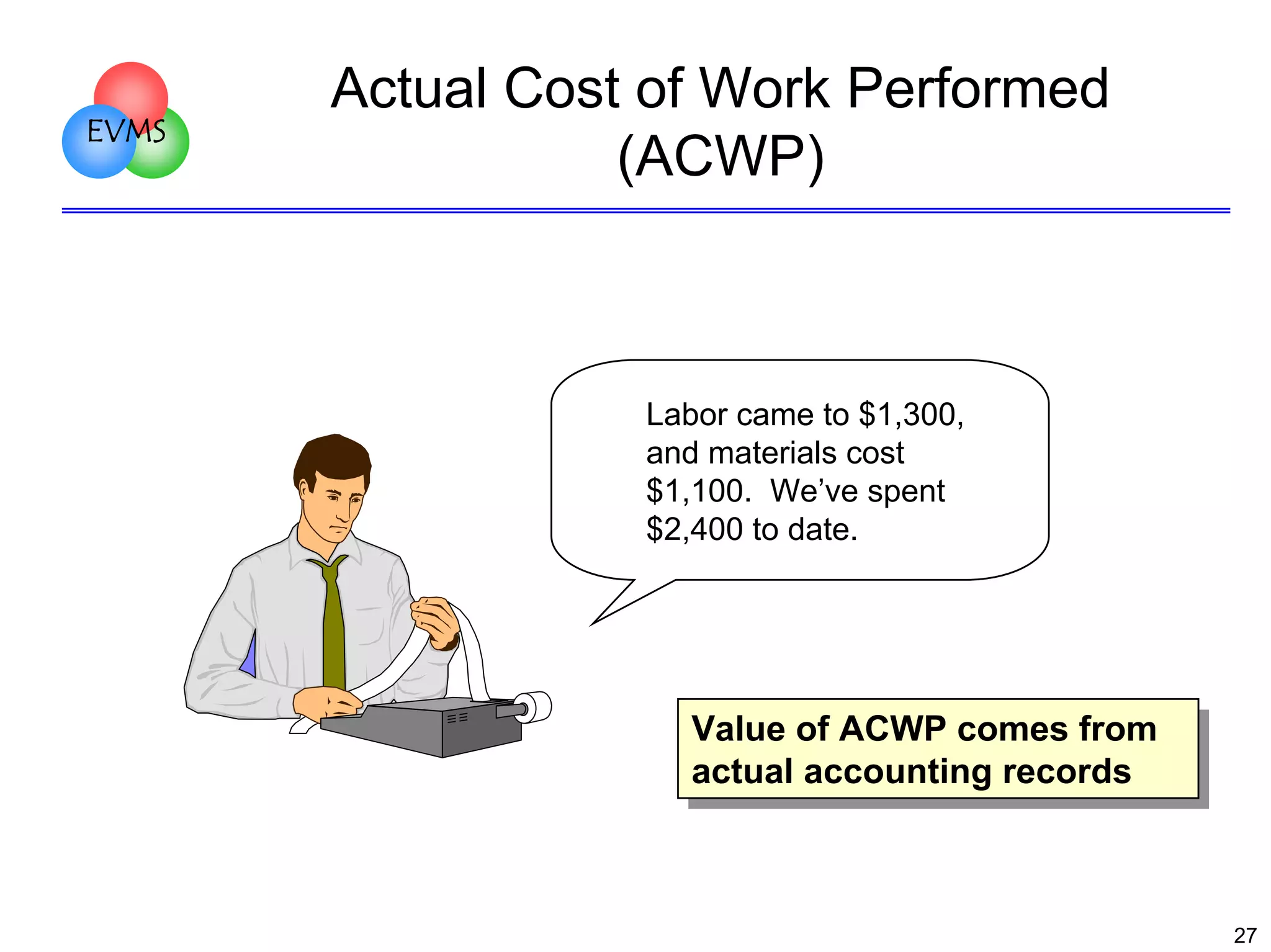
Actual Cost of Work Performed
(ACWP)

Labor came to $1,300,
and materials cost
$1,100. We’ve spent
$2,400 to date.

Value of ACWP comes from
actual accounting records

27
EVMS

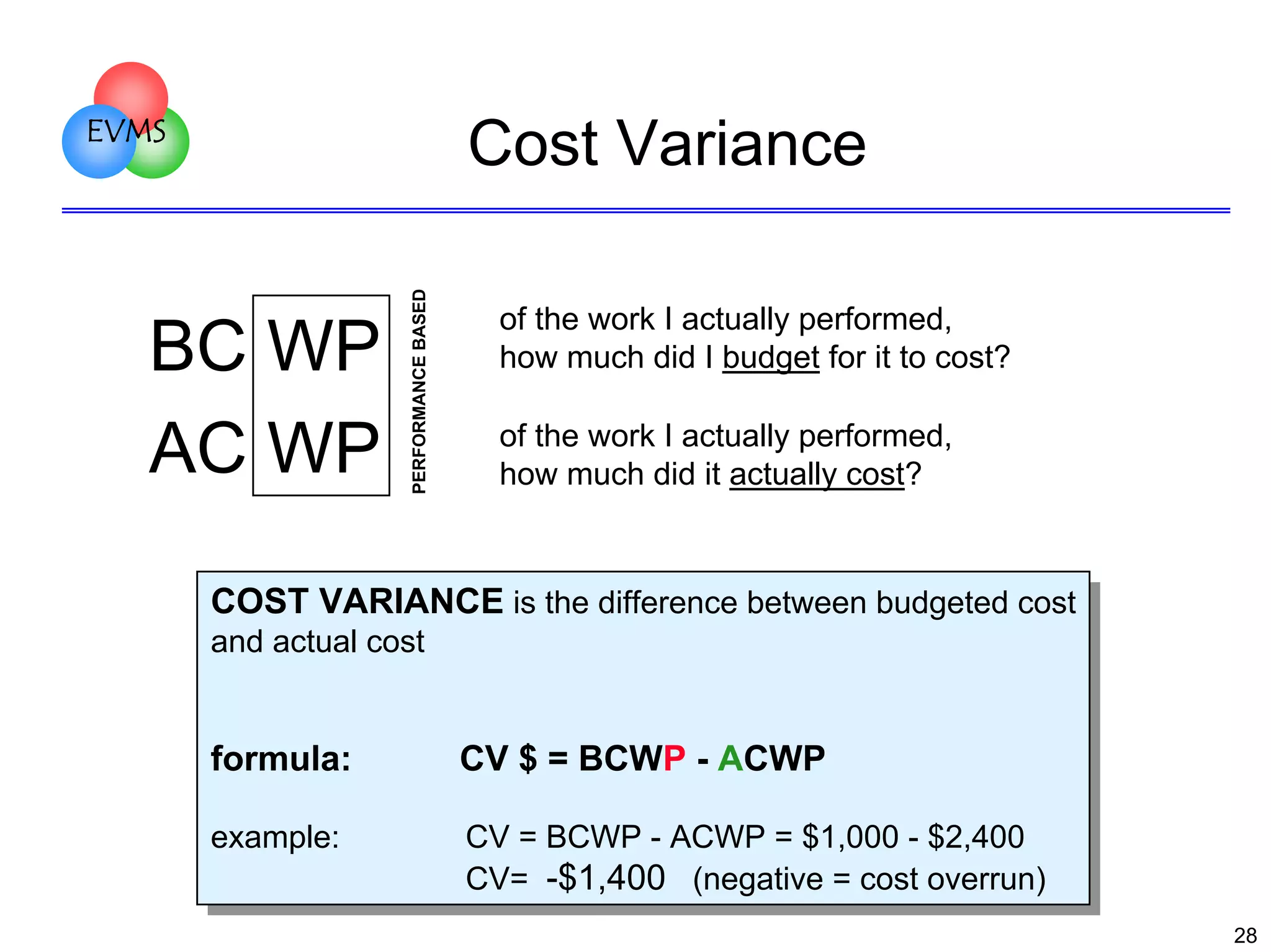
BC WP
AC WP

PERFORMANCE BASED

Cost Variance
of the work I actually performed,
how much did I budget for it to cost?
of the work I actually performed,
how much did it actually cost?

COST VARIANCE is the difference between budgeted cost

and actual cost
and actual cost

formula:
formula:

CV $ = BCWP --ACWP
CV $ = BCWP ACWP

example:
example:

CV = BCWP --ACWP = $1,000 --$2,400
CV = BCWP ACWP = $1,000 $2,400
CV= -$1,400 (negative = cost overrun)
28
EVMS

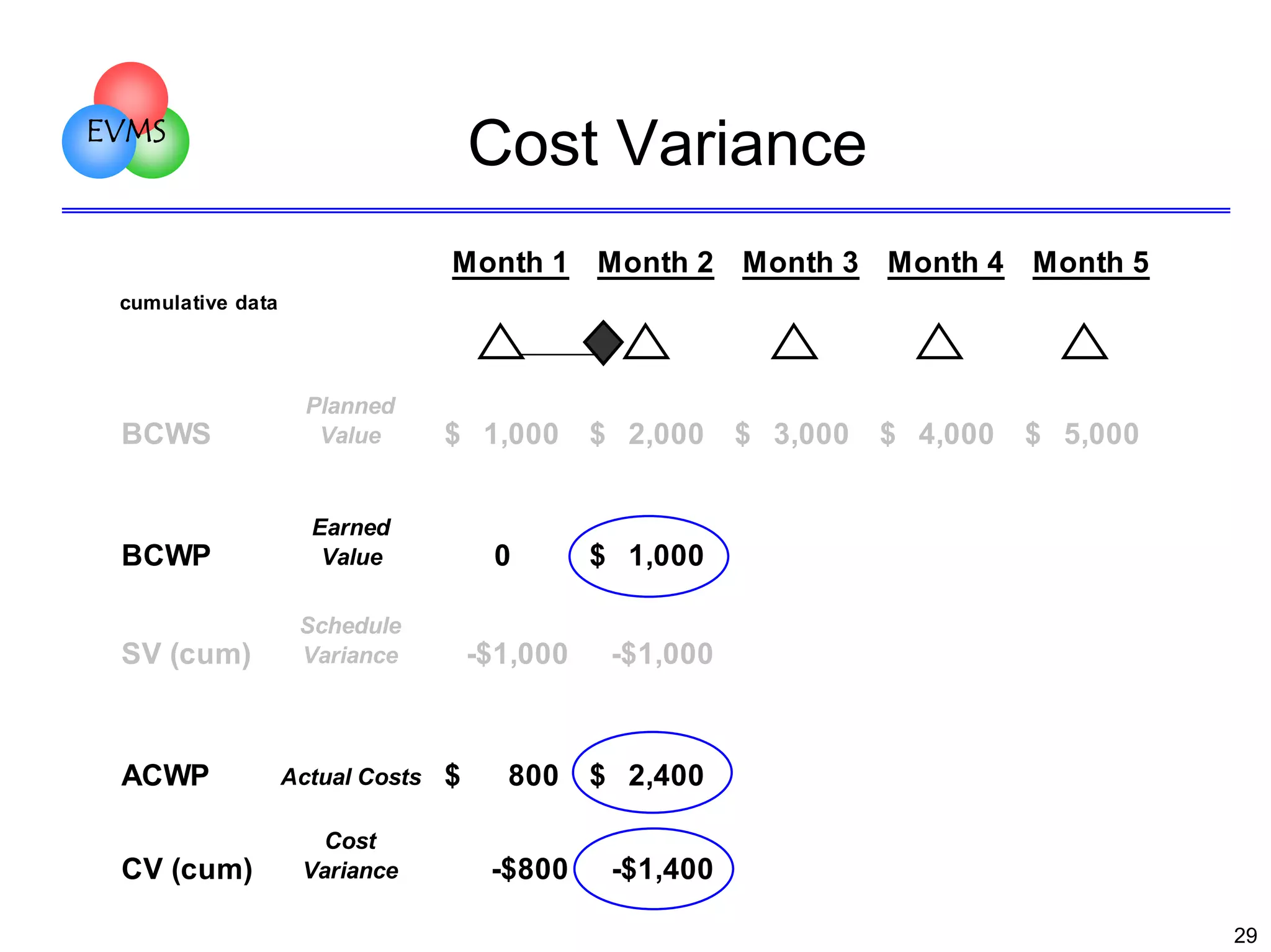
Cost Variance
Month 1 Month 2 Month 3 Month 4 Month 5

cumulative data

BCWS

Planned
Value

$ 1,000

$ 2,000

BCWP

Earned
Value

0

$ 1,000

SV (cum)

ACWP
CV (cum)

Schedule
Variance

Actual Costs
Cost
Variance

-$1,000

$

800
-$800

$ 3,000

$ 4,000

$ 5,000

-$1,000

$ 2,400
-$1,400
29
EVMS

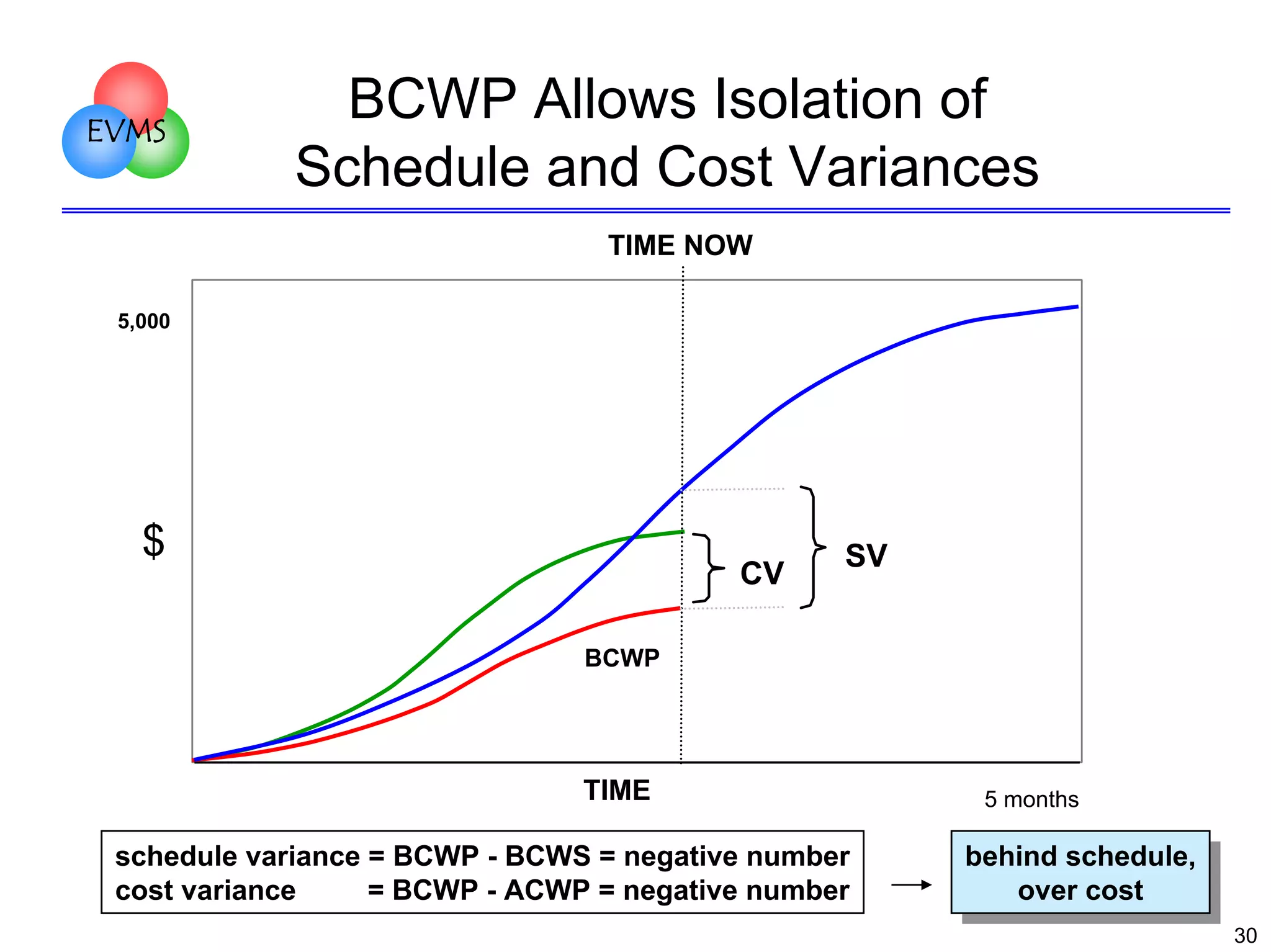
BCWP Allows Isolation of
Schedule and Cost Variances
TIME NOW

5,000

$

CV

SV

BCWP

TIME
schedule variance = BCWP - BCWS = negative number
cost variance
= BCWP - ACWP = negative number

5 months

behind schedule,
behind schedule,
over cost
over cost
30
EVMS

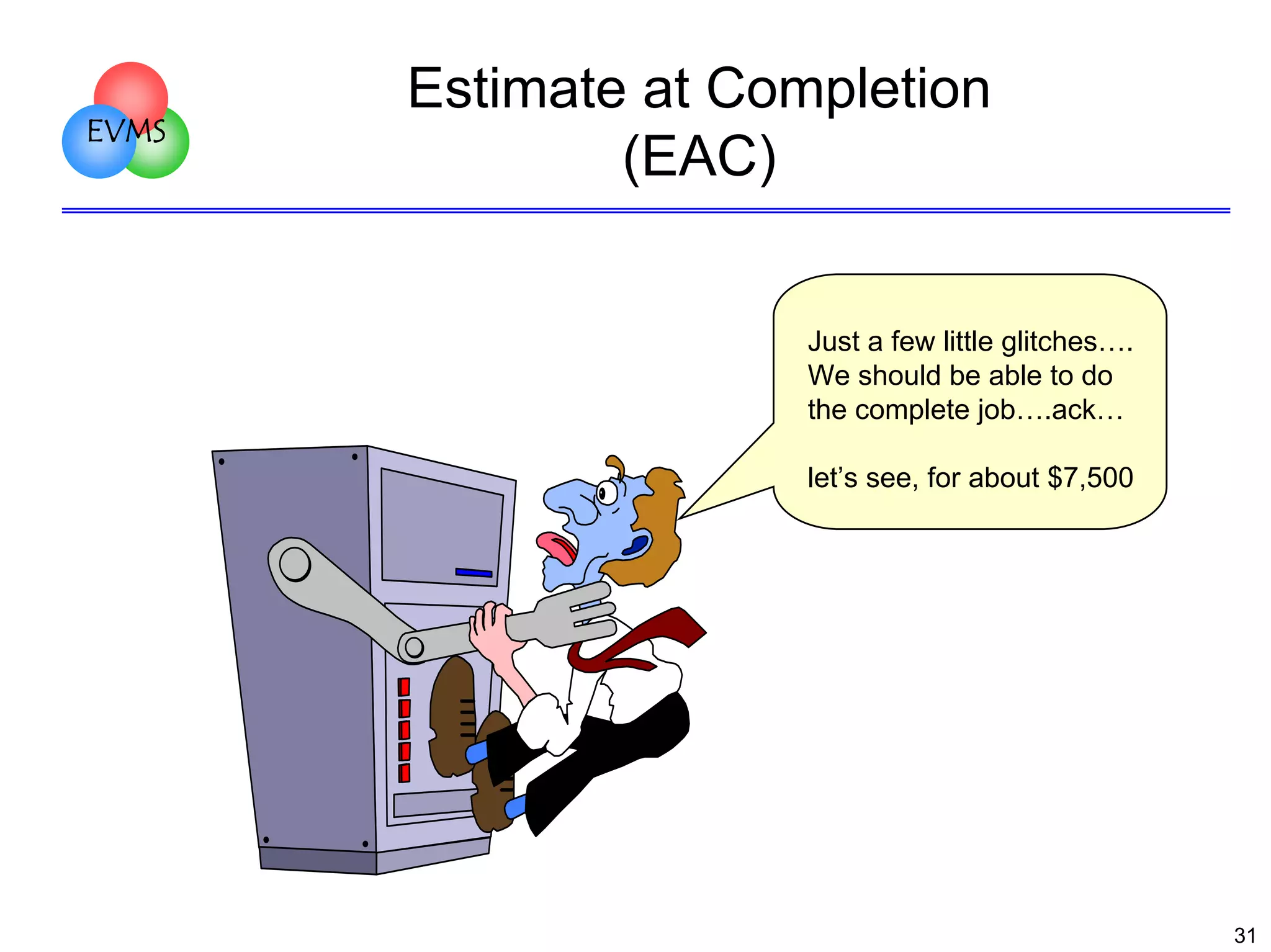
Estimate at Completion
(EAC)

Just a few little glitches….
We should be able to do
the complete job….ack…
let’s see, for about $7,500

31
EVMS

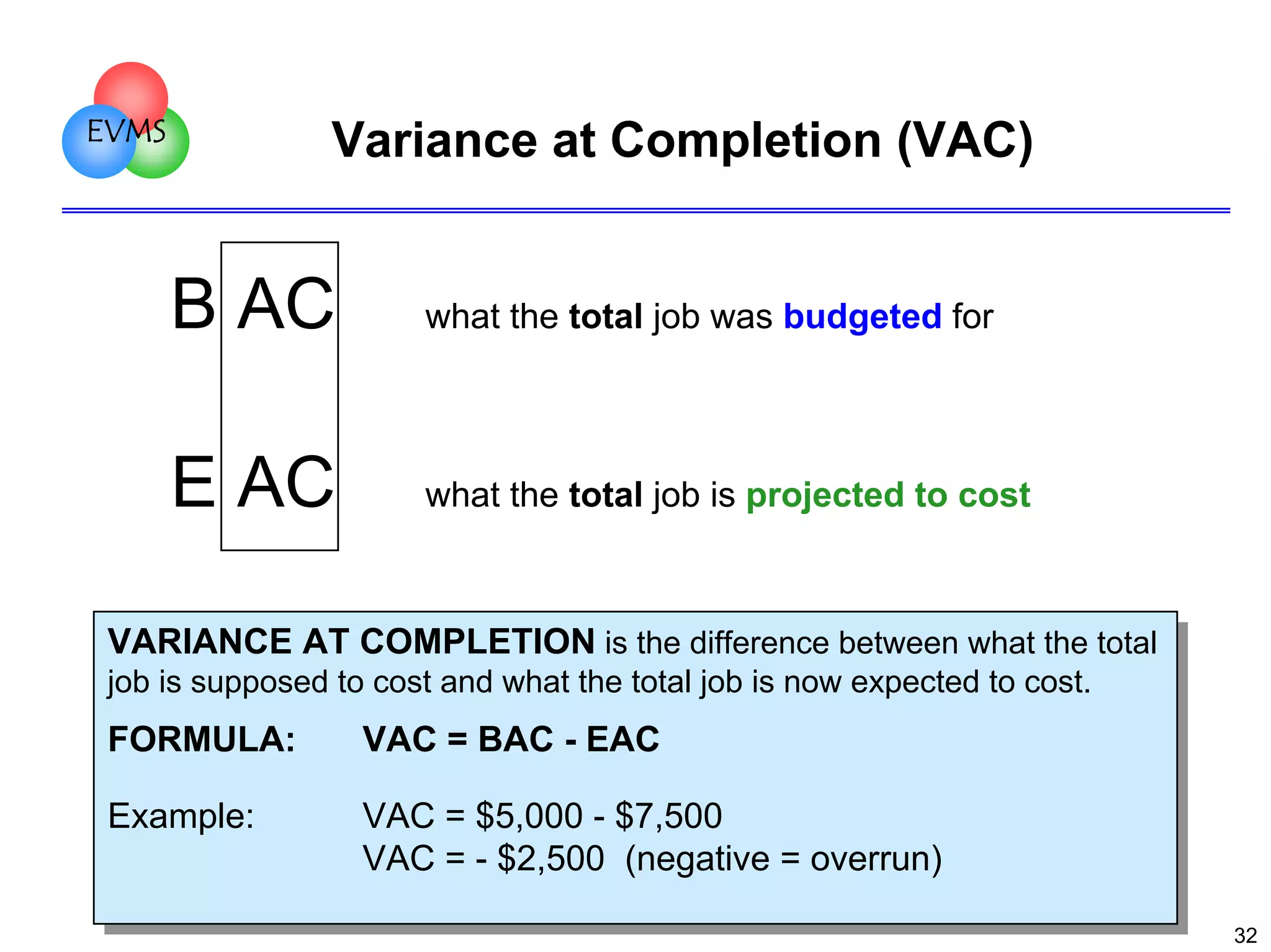
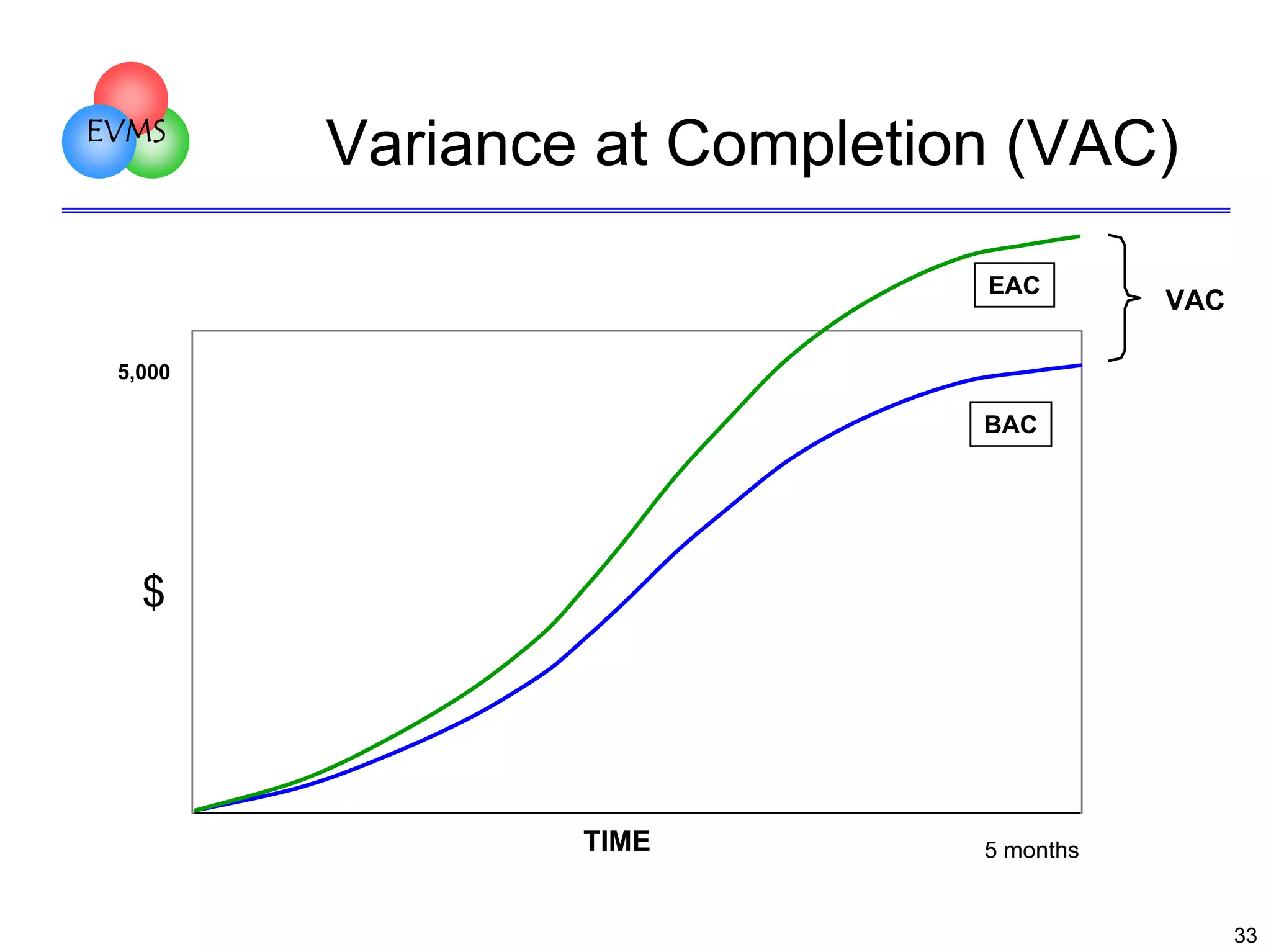
Variance at Completion (VAC)

B AC

what the total job was budgeted for

E AC

what the total job is projected to cost

VARIANCE AT COMPLETION is the difference between what the total

job is supposed to cost and what the total job is now expected to cost.

FORMULA:
FORMULA:

VAC = BAC --EAC
VAC = BAC EAC

Example:
Example:

VAC = $5,000 --$7,500
VAC = $5,000 $7,500
VAC = --$2,500 (negative = overrun)
VAC = $2,500 (negative = overrun)
32
EVMS

Variance at Completion (VAC)
EAC

VAC

5,000

BAC

$

TIME

5 months

33
EVMS

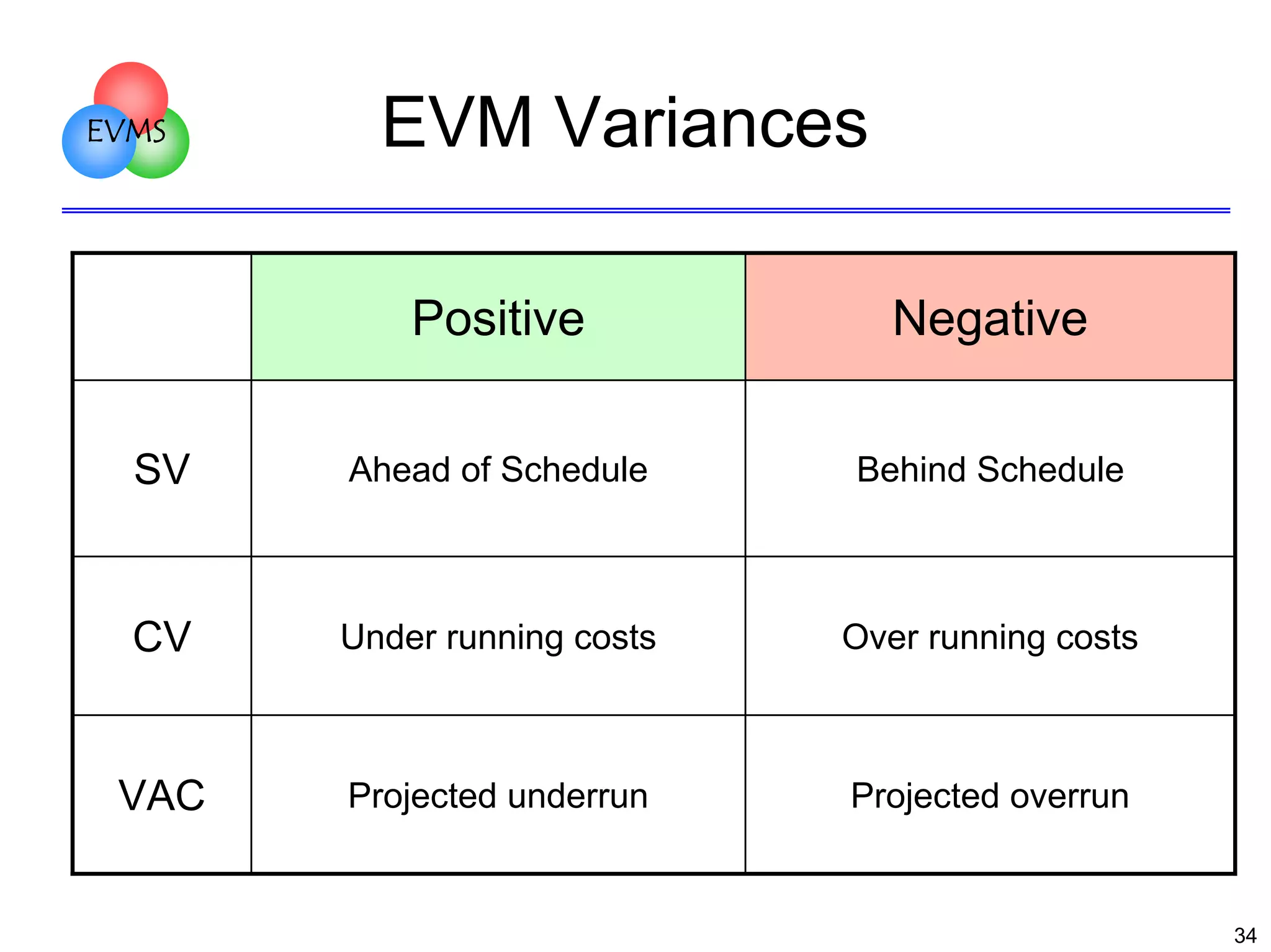
EVM Variances
Positive

Negative

SV

Ahead of Schedule

Behind Schedule

CV

Under running costs

Over running costs

VAC

Projected underrun

Projected overrun

34
EVMS

Planning

35
EVMS

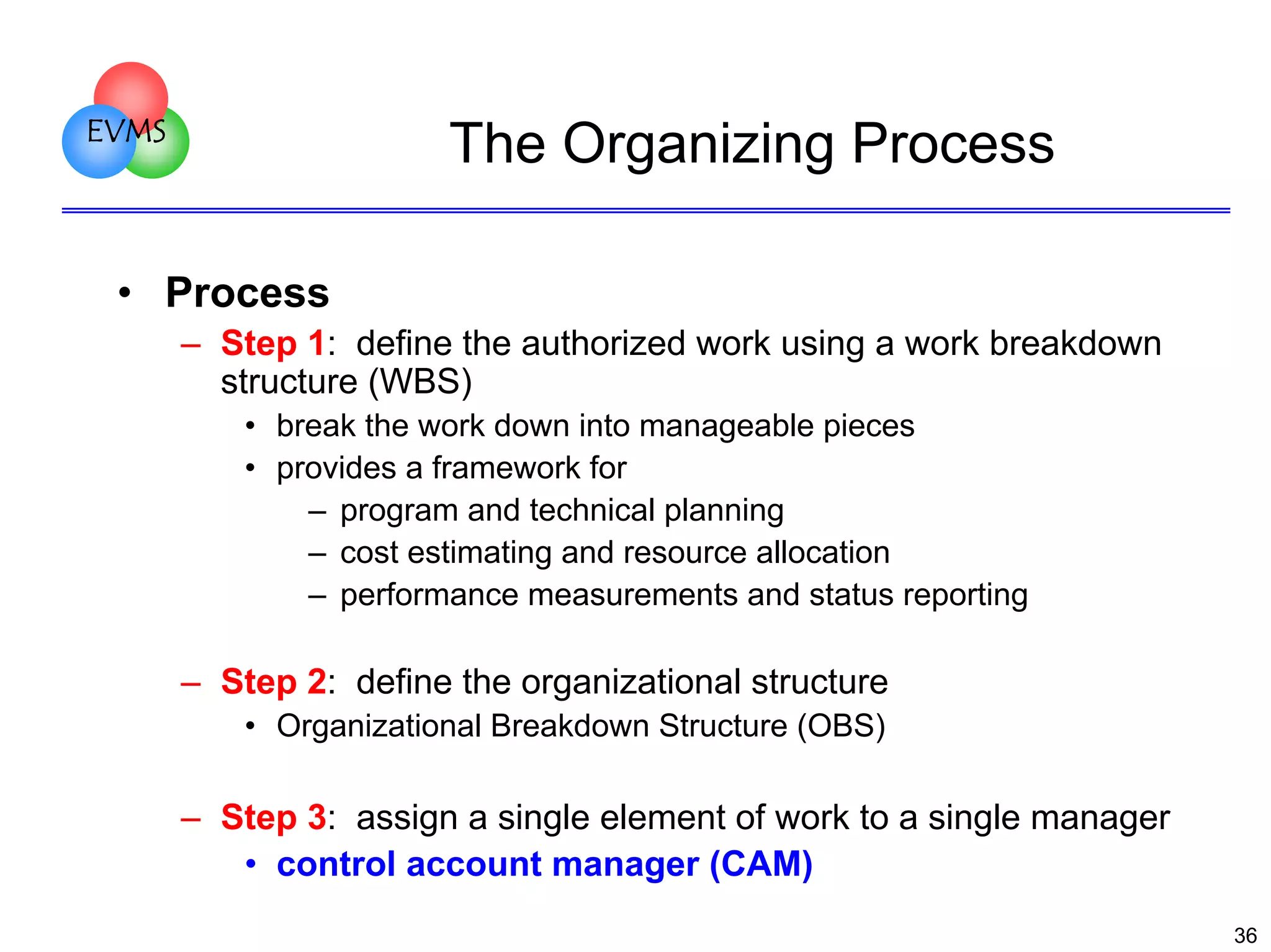
The Organizing Process

• Process
– Step 1: define the authorized work using a work breakdown
structure (WBS)
• break the work down into manageable pieces
• provides a framework for
– program and technical planning
– cost estimating and resource allocation
– performance measurements and status reporting

– Step 2: define the organizational structure
• Organizational Breakdown Structure (OBS)

– Step 3: assign a single element of work to a single manager
• control account manager (CAM)
36
EVMS

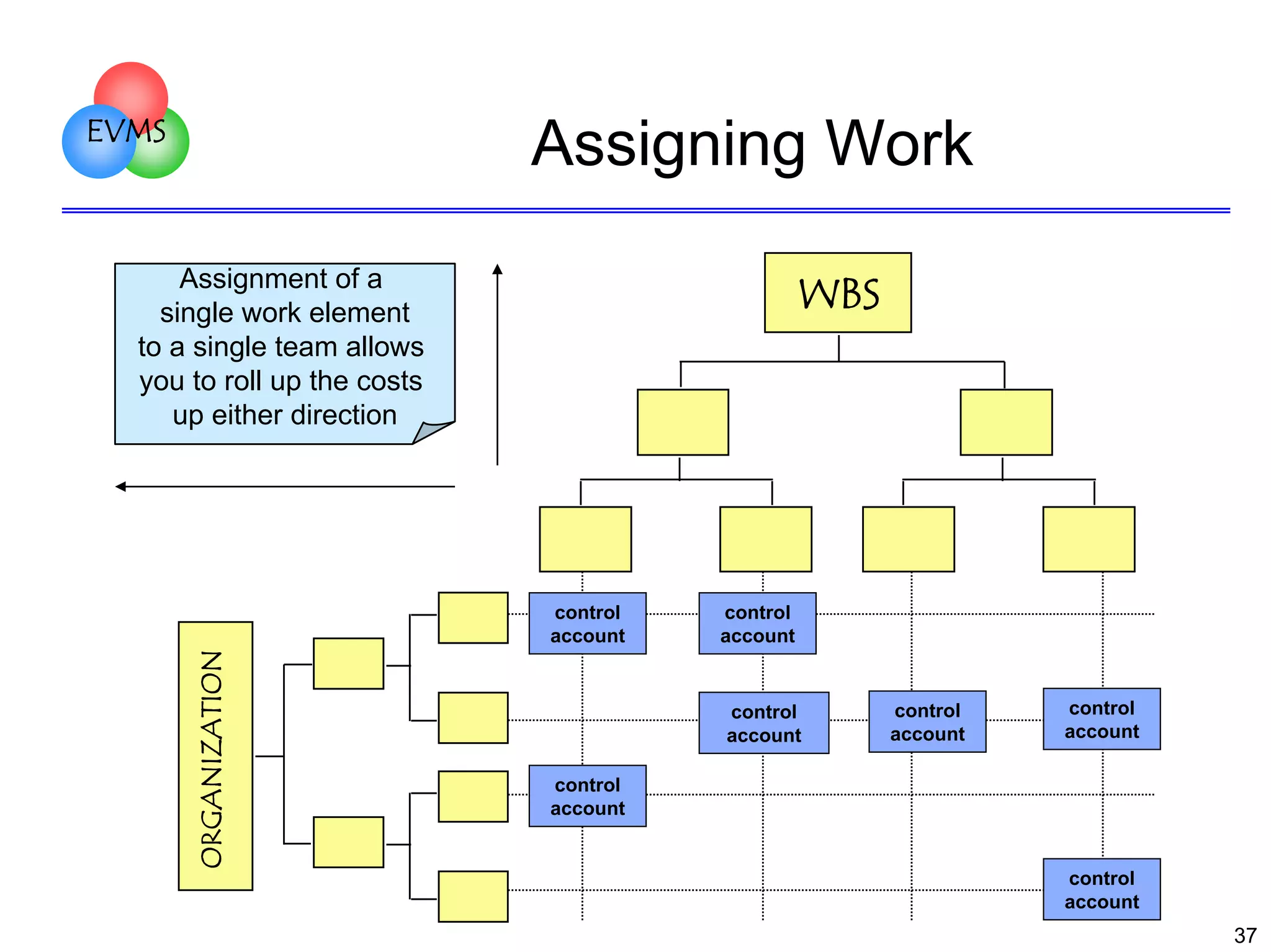
Assigning Work
WBS

Assignment of a
single work element
to a single team allows
you to roll up the costs
up either direction

ORGANIZATION

control
account

control
account

control
account

control
account

control
account

control
account

control
account

37
EVMS

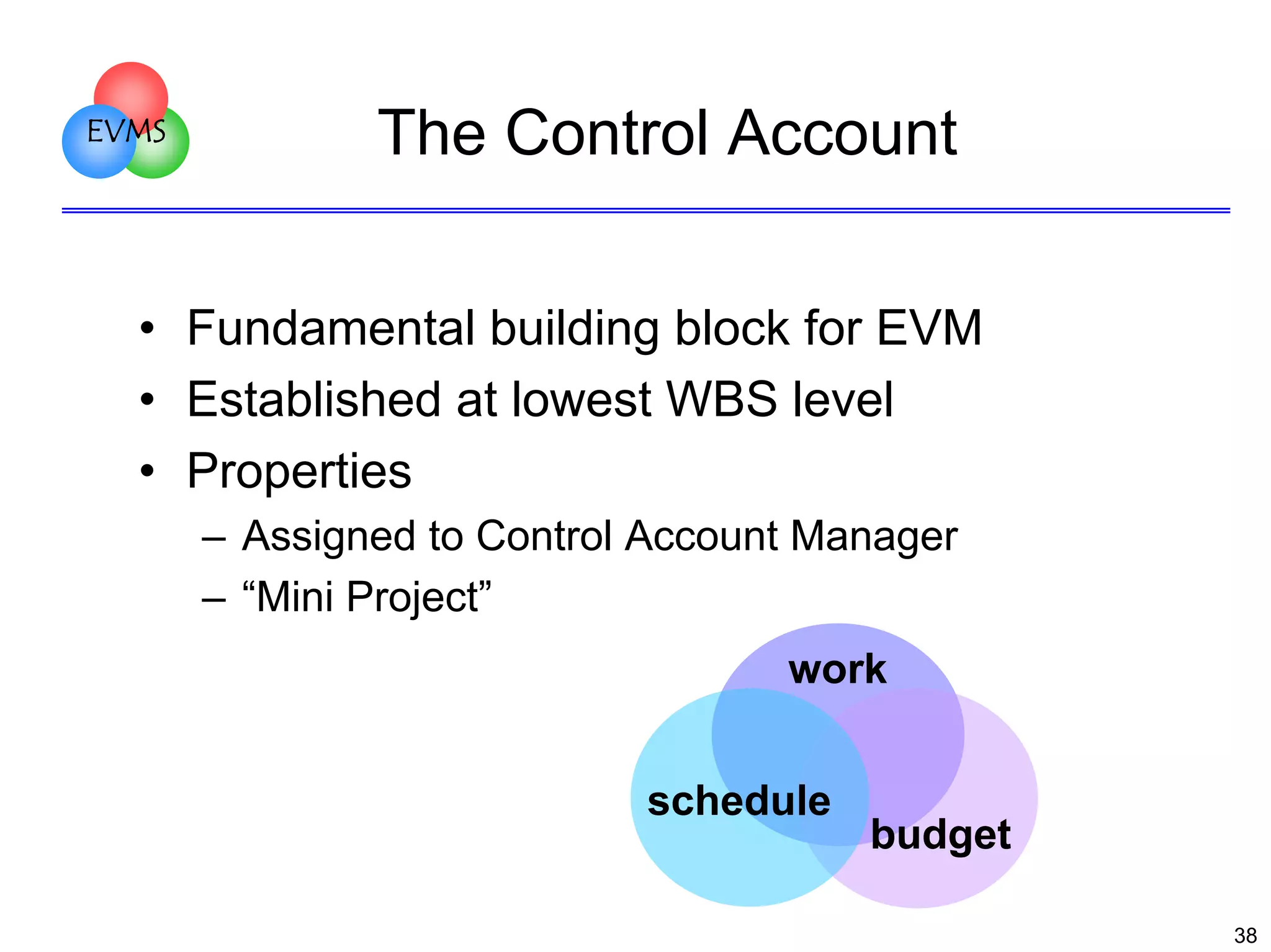
The Control Account

• Fundamental building block for EVM
• Established at lowest WBS level
• Properties
– Assigned to Control Account Manager
– “Mini Project”
work
schedule

budget
38
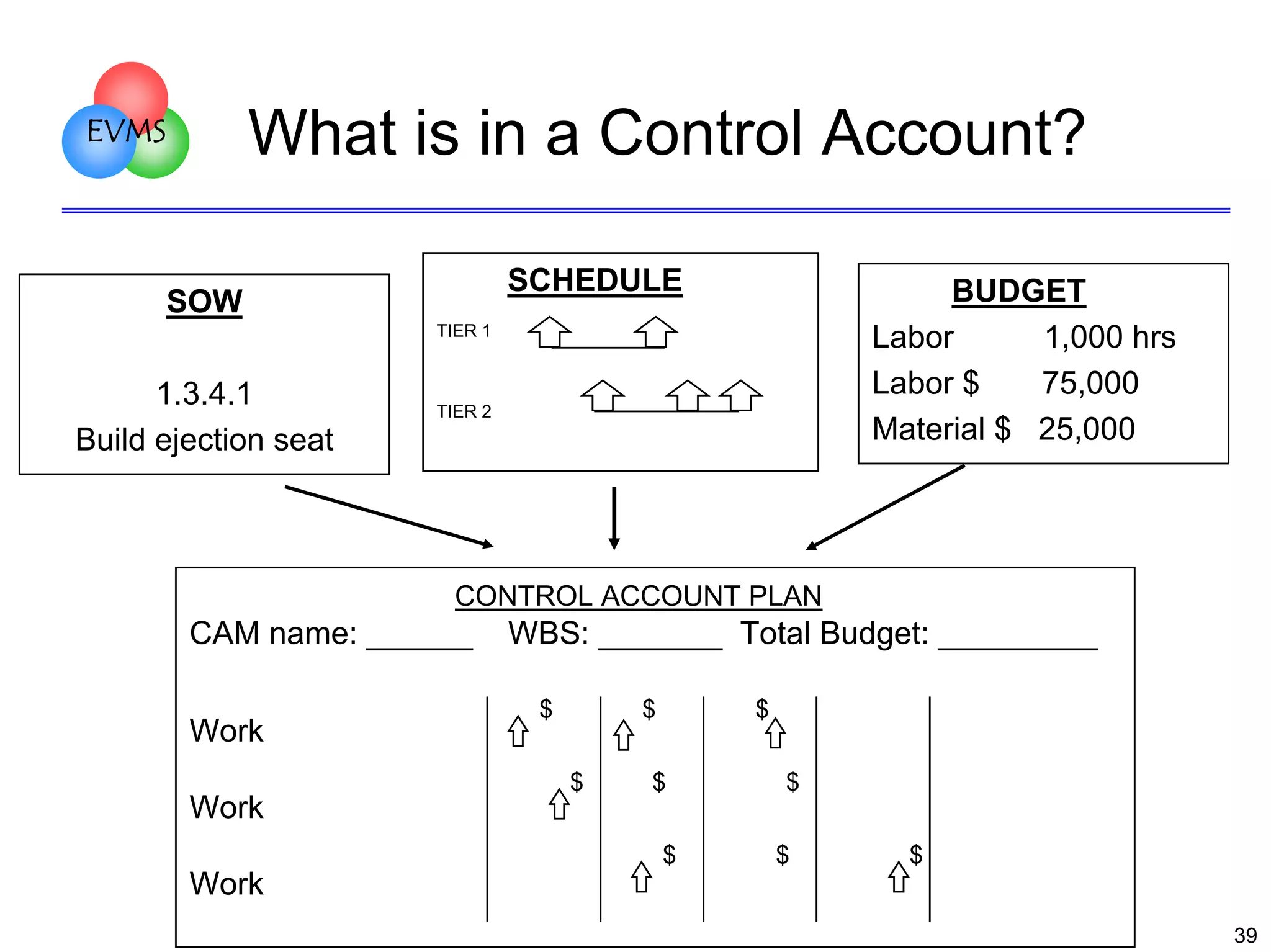
What is in a Control Account?

EVMS

SCHEDULE

SOW

BUDGET
Labor
1,000 hrs
Labor $
75,000
Material $ 25,000

TIER 1

1.3.4.1
Build ejection seat

TIER 2

CONTROL ACCOUNT PLAN

CAM name: ______
Work
Work

WBS: _______ Total Budget: _________
$

$
$

$

$
$

$
$

$

Work
39
EVMS

•

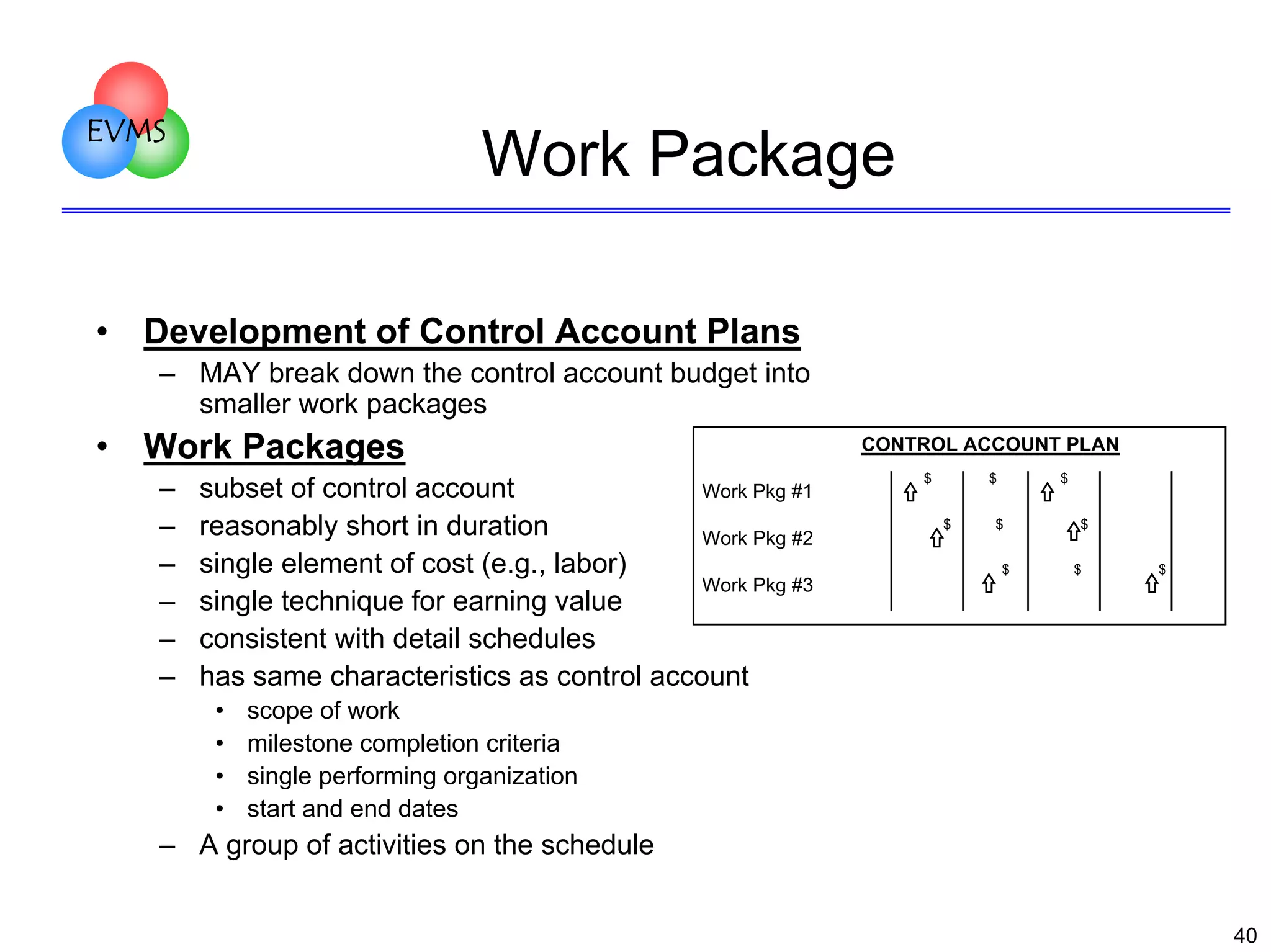
Work Package

Development of Control Account Plans
– MAY break down the control account budget into
smaller work packages

•

Work Packages
–
–
–
–
–
–

subset of control account
Work Pkg #1
reasonably short in duration
Work Pkg #2
single element of cost (e.g., labor)
Work Pkg #3
single technique for earning value
consistent with detail schedules
has same characteristics as control account
•
•
•
•

CONTROL ACCOUNT PLAN
$

$
$

$

$
$

$
$

$

scope of work
milestone completion criteria
single performing organization
start and end dates

– A group of activities on the schedule
40
EVMS

A Fun Example…

41
EVMS

•
•

Contract Award
You are the program manager, I. M. Taz
You just won a contract to eliminate varmints within the state of Arizona
– birds (tweetie and road runner types)
– small animals

•

You have an organization of highly trained specialists
–
–
–
–

•

L. M. Fudd
Sil Vester the cat
Wile E. Coyote
Daffie Duck (your deputy and the CAM for management)

You have allocated the following budgets from your $50,000 contract
award
–
–
–
–
–

wascally rabbits ($5,000)
squirrels ($5,000)
tweetie birds ($20,000)
road runners ($10,000)
program management ($10,000)
42
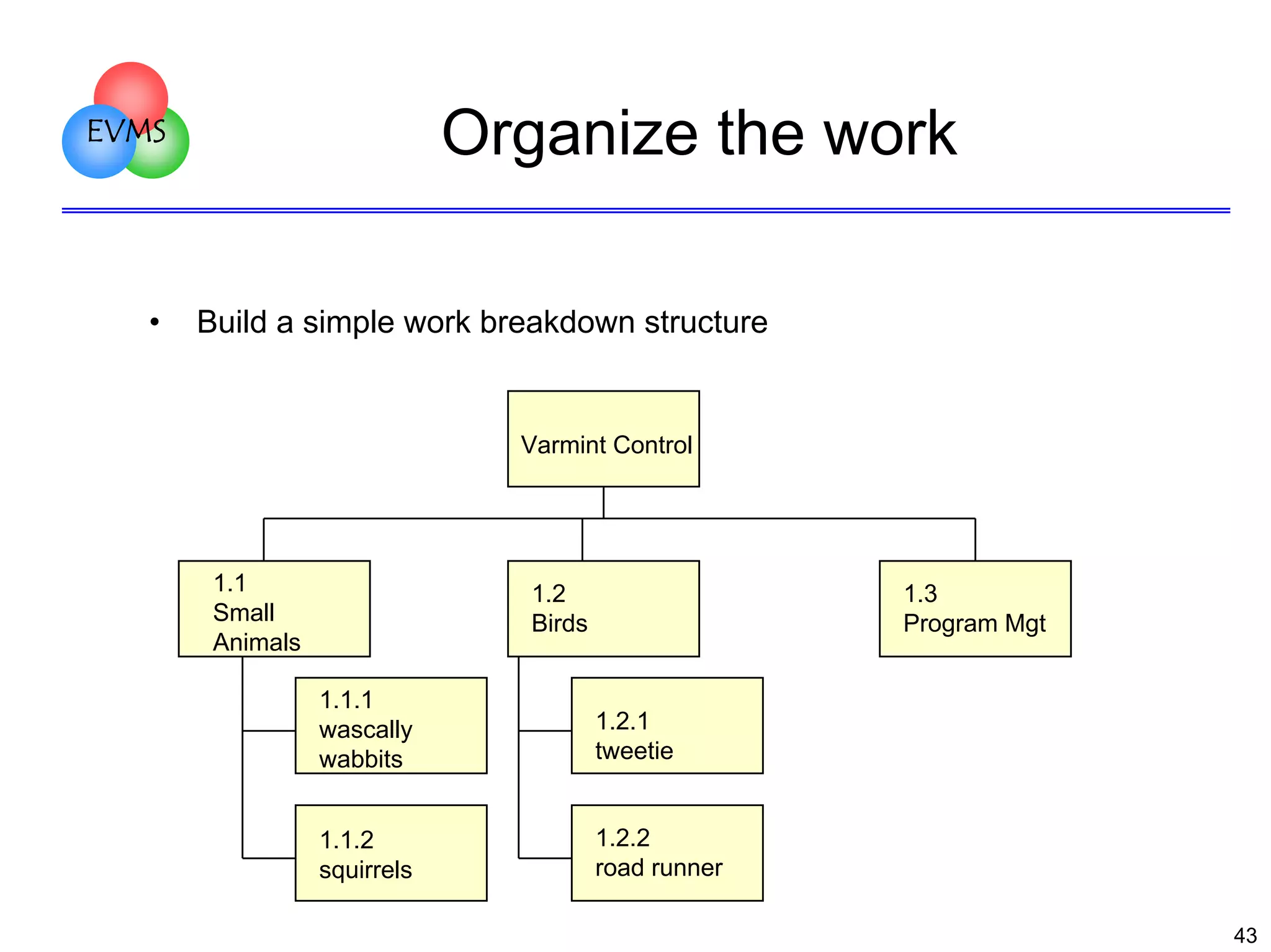
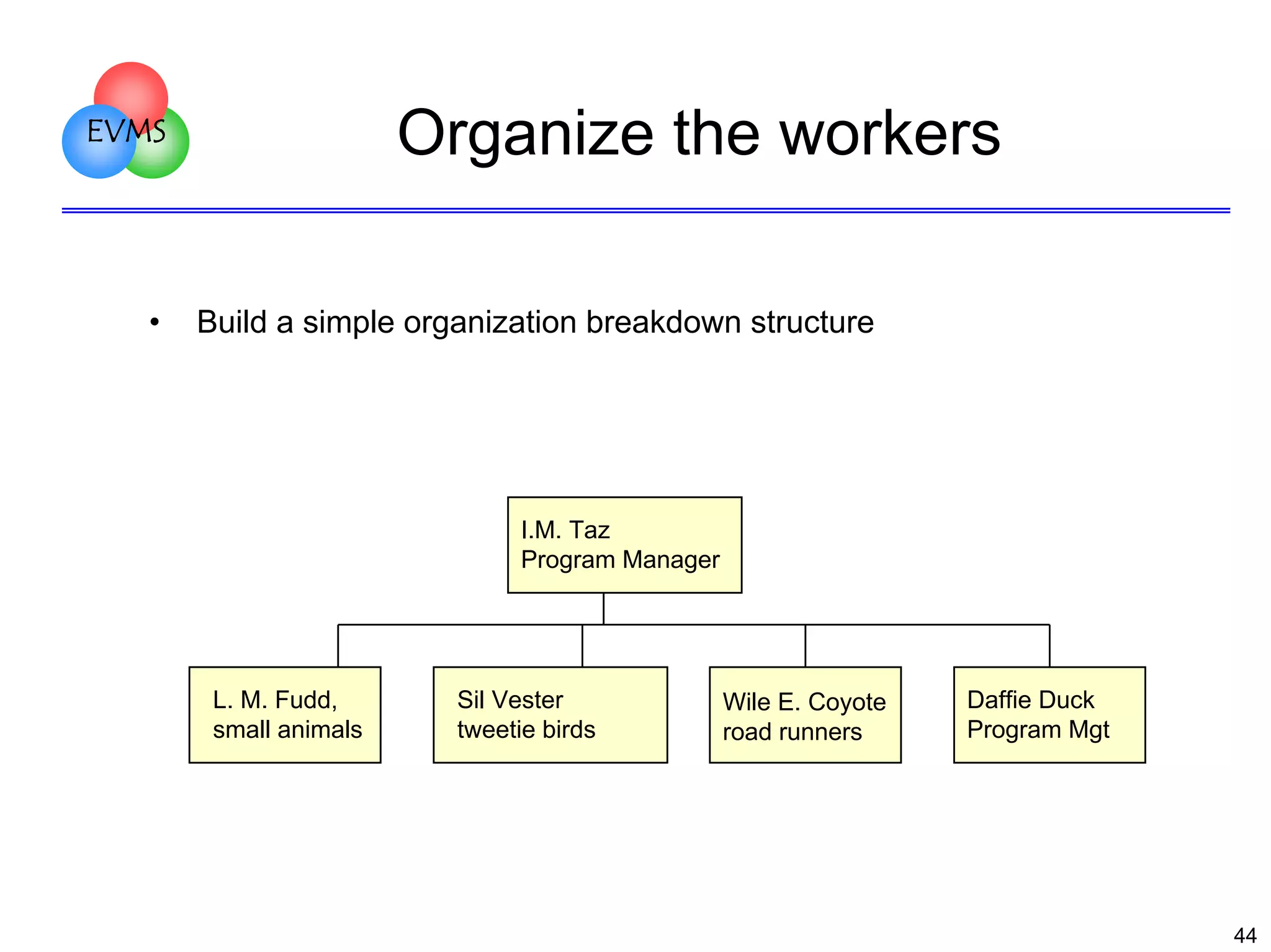
Organize the work

EVMS

•

Build a simple work breakdown structure

Varmint Control

1.1
Small
Animals

1.3
Program Mgt

1.2
Birds
1.1.1
wascally
wabbits

1.2.1
tweetie

1.1.1
1.1.2
wascally
squirrels
wabbits

1.2.2
road runner
43
Organize the workers

EVMS

•

Build a simple organization breakdown structure

I.M. Taz
Program Manager

L. M. Fudd,
small animals

Sil Vester
tweetie birds

Wile E. Coyote
road runners

Daffie Duck
Program Mgt

44
EVMS

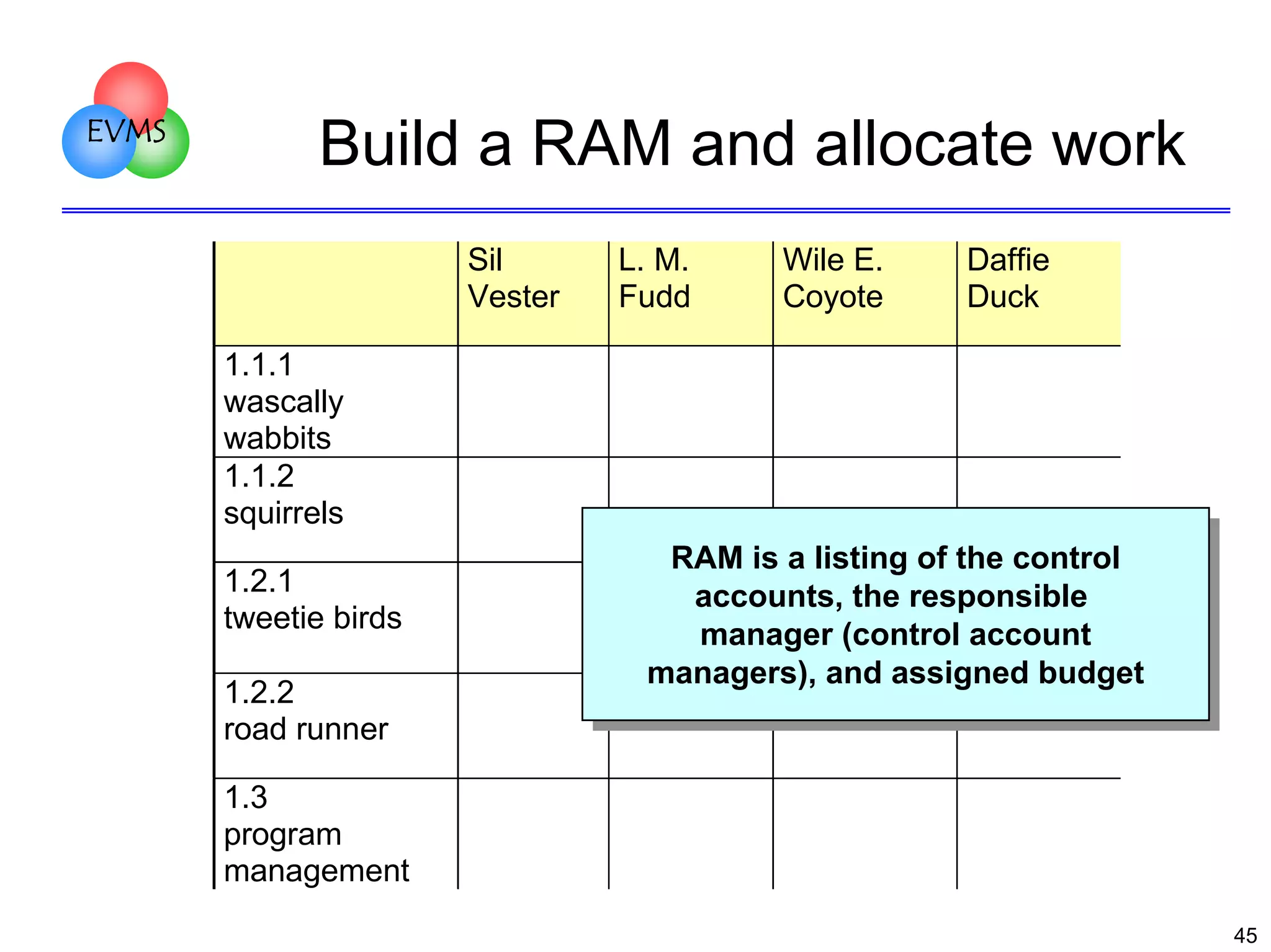
Build a RAM and allocate work
Sil
Vester

L. M.
Fudd

Wile E.
Coyote

Daffie
Duck

1.1.1
wascally
wabbits
1.1.2
squirrels
1.2.1
tweetie birds
1.2.2
road runner

RAM is a listing of the control
accounts, the responsible
manager (control account
managers), and assigned budget

1.3
program
management
45
EVMS

Build a RAM and allocate work
Sil
Vester
1.1.1
wascally
wabbits
1.1.2
squirrels
1.2.1
tweetie birds
1.2.2
road runner
1.3
program
management

L. M.
Fudd

Wile E.
Coyote

Daffie
Duck

$5,000

$5,000
$20,000

control
account
$10,000
$10,000
46
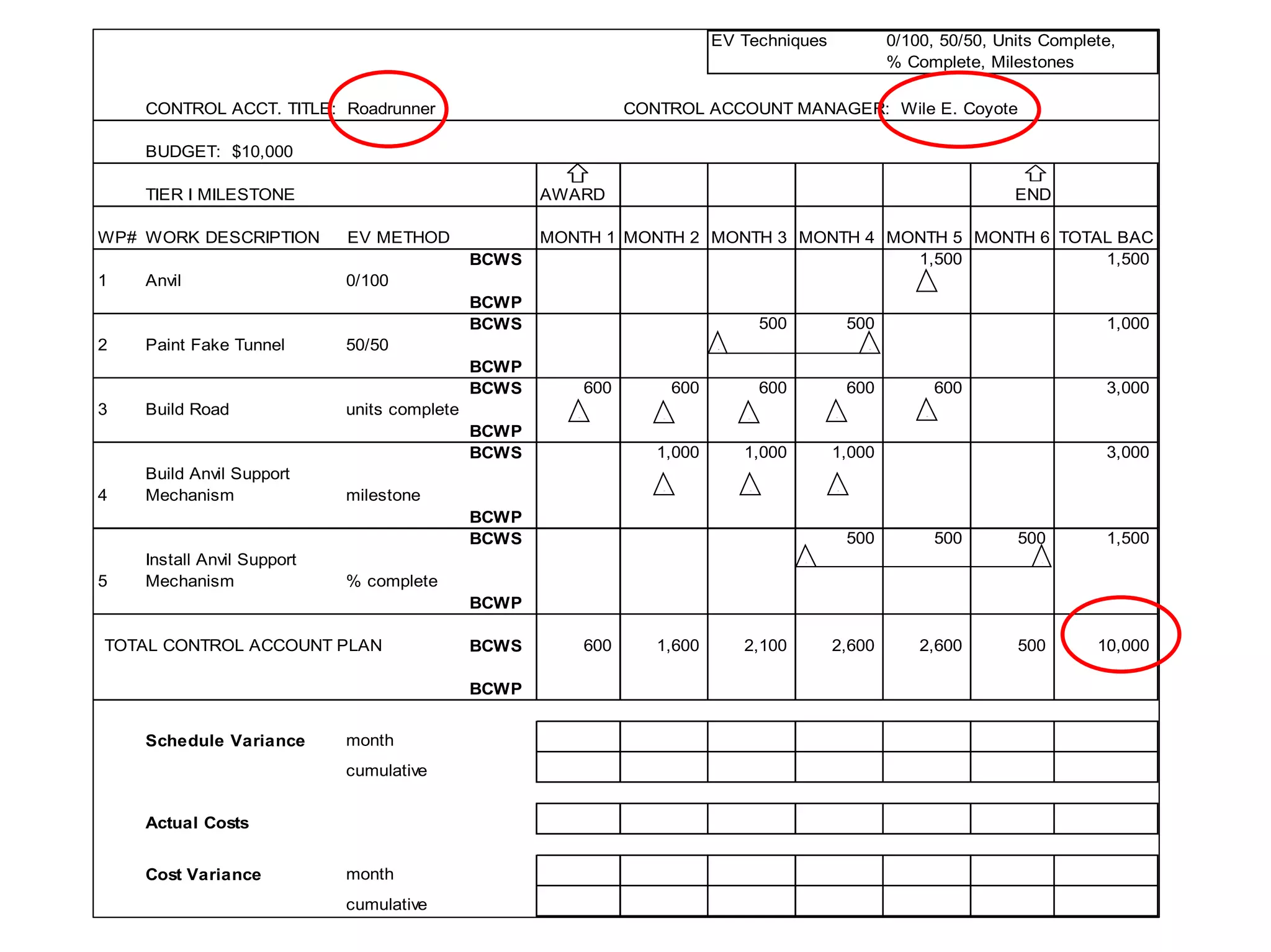
EV Techniques

CONTROL ACCT. TITLE: Roadrunner

0/100, 50/50, Units Complete,
% Complete, Milestones

CONTROL ACCOUNT MANAGER: Wile E. Coyote

BUDGET: $10,000
TIER I MILESTONE
WP# WORK DESCRIPTION

AWARD
EV METHOD
BCWS

1

Anvil

END

MONTH 1 MONTH 2 MONTH 3 MONTH 4 MONTH 5 MONTH 6 TOTAL BAC
1,500
1,500

0/100

v

BCWP
BCWS
2

Paint Fake Tunnel

BCWP
BCWS
3

Build Road

units complete
BCWP
BCWS

4

Build Anvil Support
Mechanism

500

50/50

500

v

600
v

1,000
v

milestone

v

600
v

600

600

5

600

3,000

v

v

v

1,000

1,000

v

3,000

v

BCWP
BCWS
Install Anvil Support
Mechanism

1,000

500

500

v

500

1,500

v

% complete
BCWP

TOTAL CONTROL ACCOUNT PLAN

BCWS
BCWP

Schedule Variance

month
cumulative

Actual Costs
Cost Variance

month
cumulative

600

1,600

2,100

2,600

2,600

500

10,000
EVMS

Summary

• Should now understand
– Basic EVM terms
– Basic concepts of an integrated baseline
• Work, phased over time, with time phased budget

– Basics of planning
– Control account concepts and example

Please stay tuned for Part 2!!
48

EVM of Project Management...

  • 1.
    EVMS Basics of EarnedValue Management Part I Eleanor Haupt Earned Value Associates LLC ehaupt@earnedvalue.biz 937-572-2586 1
  • 2.
    EVMS What is EVM? EVMis the primary project management tool... that integrates the technical, schedule, and cost parameters of the contract. All work is planned, scheduled, and budgeted in timephased ''planned value'' increments. As work is performed, it is measured and controlled against the baseline. 2
  • 3.
    EVM Defined EVMS • EVMis: – performance measurement • how am I doing against my baseline plan? – performance management • what do I need to do to bring the project in on cost and schedule? 3
  • 4.
    EVMS Where can EVMbe Applied? • EVM suitable for projects that have: – Clear definition of work scope – Project schedule range from a few months to many years – Small to very large cost • EVM not suitable for: – Projects without a clear work definition or deliverable products • Example: research projects 4
  • 5.
    EVMS EVM Guidelines • EVMhas a recognized set of guidelines – A company’s business planning system should meet these guidelines = Earned Value Management System • Most are existing project management practices • Relatively few practices unique to EVMS – Guidelines do not specify a particular process or business system, but only set an expectation • Some countries have national standards – U.S., Australia, Canada, U.K. – Guidelines may be mandatory in some cases • Can be tailored or scaled for smaller projects 5
  • 6.
    EVMS • Primary Steps inPerformance Management Plan all project work – Create an integrated performance management baseline • Objectively assess work progress at the level of performance – Compare to the plan and to actual costs • • • • • Analyze significant deviations from the plan Forecast impacts to cost and schedule Take corrective actions as needed Summarize data for progressively higher levels of management Maintain performance management baseline – Update for contract changes (work scope) – Maintain realistic baseline for remaining work 6
  • 7.
    Why use EVM? EVMS Lifewithout EVM • • • • Given: – total budget of $100,000 – 12 month effort – produce 20 units Status: – spent to date: $64,000 – time elapsed: 6 months – units produced: 8 complete, 2 partial How are you doing, and how do you know how you are doing? How far along are you? – 64% spent (cost) – 50% spent (time) 7
  • 8.
    EVM is ProjectManagement with the Lights On
  • 9.
    Why use EVM? EVMS Lifewith EVM • • • Given: – total budget of $100,000 – 12 month effort – produce 20 units Status: – spent to date: $64,000 – time elapsed: 6 months – units produced: 8 complete, 2 partial Real Status: – You should have completed 50% of the work • You’ve completed 42% of the work – A major vendor was late in delivering certain parts • You’ve spent 64% of your budget – You’ve isolated the main cost variance to aluminum prices • You’re forecasting additional cost overruns for the remaining work – You now know what the drivers are – You can now take the appropriate actions 9
  • 10.
    EVMS Earned Value GivesInsight TIME NOW Planned Expenditures Expenditures $ “Earned Value” TIME 10
  • 11.
    EVMS Benefits of EVM •Requires development of integrated baseline – Results in better project definition and planning • Early identification of trends and problems • Accurate picture of project status – Cost, schedule, and technical – Segregation of schedule and cost variances • Projection of final costs • Project control by the team – Enables project manager to make informed decisions based on facts • Results in successful projects – On time, on cost 11
  • 12.
    EVMS How does EVMdiffer from Project Management? Project Management EVM WBS Team organization Integrated Schedule Budget Integrated Baseline Earned Value measurement Work authorization Variance analysis Trend projection 12
  • 13.
  • 14.
    EVMS EVMS measures progress Progress= Movement Forward to measure progress, there must be a standard against which the forward movement may be compared EVMS establishes a baseline to measure progress 14
  • 15.
    EVMS Five Basic Elements BCWS BudgetedCost for Work Scheduled “Planned Value” BCWP Budgeted Cost for Work Performed “Earned Value” ACWP Actual Cost of Work Performed “Actual Cost” BAC Budget at Completion EAC Estimate at Completion 15
  • 16.
    EVMS It’s my pleasure toaward you this contract for a new railroad track Total Performance Budget hmm...5 miles of track, 5 months to do it all....$5000 budget....This is going to be tough! What is the total job What is the total job supposed to cost? supposed to cost? What is the value of the What is the value of the contract at cost? contract at cost? = Performance Budget = Performance Budget 16
  • 17.
    EVMS Planning is a3 Step Process Planning is a 3 Step Process 1. DEFINE THE WORK AND ORGANIZE TEAMS CONTRACT BUDGET BASE BA SE LI NE 2. SCHEDULE THE WORK PM $ 3. ALLOCATE BUDGETS 100 40 60 15 25 TIME 30 30 17
  • 18.
    EVMS • • • • The Integrated Baseline Preliminaryplanning during proposal phase Finalized as soon as possible after award – PM approves the baseline Integrated baseline – Work scope – Integrated master schedule – Time phased budget Tenets for managing the baseline – Control – Maintain realism – Reviews 18
  • 19.
    Budgeted Cost forWork Scheduled (BCWS) I’ve broken my work plan into 5 sections of track. I plan to lay 1 section of track each month. I estimated the cost of each section at $1,000. I’m establishing the BCWS for each section at $1,000. BCWS = performance budget Month 1 BCWS = $1,000 Month 2 BCWS = $1,000 Month 3 BCWS = $1,000 Month 4 BCWS = $1,000 Month 5 BCWS = $1,000 each dollar of BCWS represents a specific dollar of work scope each dollar of BCWS represents a specific dollar of work scope
  • 20.
    EVMS Budgeted Cost forWork Scheduled (BCWS) Month 1 BCWS cumulative Month 3 Month 4 Month 5 $ 1,000 BCWS Month 2 $ 1,000 $ 1,000 $ 1,000 $ 1,000 $ 1,000 $ 2,000 $ 3,000 4 $ 4,000 $ 5,000 20
  • 21.
    EVMS Budget at Completion(BAC) $ m su S CW ll B fa o BAC $5,000 $5,000 The baseline is composed of many lower level elements. These sum up to the total value of the contract. $ $ $ = $ $ $ $ time •• when all work has been phased, cumulative BCWS = BAC when all work has been phased, cumulative BCWS = BAC e.g., $5,000 = $5,000 e.g., $5,000 = $5,000 21
  • 22.
    EVMS Budgeted Cost forWork Performed (BCWP) the EARNED VALUE concept We’re at the end of the second month, but only 1 section of track is complete. Earned value of work completed = $1,000 ••Assess progress on recurring basis Assess progress on recurring basis ••There are different methods of There are different methods of earning value (described in 300B) earning value (described in 300B) ••You earn value the same way as it You earn value the same way as it was budgeted in baseline was budgeted in baseline 22
  • 23.
    EVMS • Measuring Performance BCWP General Principles –Establish valid metrics as you establish the time phased baseline • Metrics should be objective and quantifiable • Relate true work status – Should be a quantitative and discrete way to measure the work – May tie in with success criteria or technical measure • e.g., successful completion of a specific test • Must be consistent in following established metric as work progresses 23
  • 24.
    Budgeted Cost forWork Performed (BCWP) EVMS Month 1 Month 2 Month 3 Month 4 Month 5 cumulative data BCWS Planned Value BCWP Earned Value $ 1,000 $ 2,000 $ $ 3,000 $ 4,000 $ 5,000 1,000 time now 24
  • 25.
    BUDGET BASED EVMS Schedule Variance BCWS BC WP of the work I scheduled to have done, how much did I budget for it to cost? of the work I actually performed, how much did I budget for it to cost? SCHEDULE VARIANCE is the difference between work scheduled SCHEDULE VARIANCE is the difference between work scheduled and work performed (expressed in terms of budget dollars) and work performed (expressed in terms of budget dollars) formula: formula: SV $ = BCWP --BCWS SV $ = BCWP BCWS example: example: SV = BCWP --BCWS = $1,000 --$2,000 SV = BCWP BCWS = $1,000 $2,000 SV= -$1,000 (negative = behind schedule) SV= -$1,000 (negative = behind schedule) 25
  • 26.
    EVMS Schedule Variance Month 1 Month2 Month 3 Month 4 Month 5 cumulative data BCWS Planned Value BCWP Earned Value SV (cum) Schedule Variance $ 1,000 $ 2,000 0 $ 1,000 -$1,000 $ 3,000 $ 4,000 $ 5,000 -$1,000 26
  • 27.
    EVMS Actual Cost ofWork Performed (ACWP) Labor came to $1,300, and materials cost $1,100. We’ve spent $2,400 to date. Value of ACWP comes from Value of ACWP comes from actual accounting records actual accounting records 27
  • 28.
    EVMS BC WP AC WP PERFORMANCEBASED Cost Variance of the work I actually performed, how much did I budget for it to cost? of the work I actually performed, how much did it actually cost? COST VARIANCE is the difference between budgeted cost COST VARIANCE is the difference between budgeted cost and actual cost and actual cost formula: formula: CV $ = BCWP --ACWP CV $ = BCWP ACWP example: example: CV = BCWP --ACWP = $1,000 --$2,400 CV = BCWP ACWP = $1,000 $2,400 CV= -$1,400 (negative = cost overrun) CV= -$1,400 (negative = cost overrun) 28
  • 29.
    EVMS Cost Variance Month 1Month 2 Month 3 Month 4 Month 5 cumulative data BCWS Planned Value $ 1,000 $ 2,000 BCWP Earned Value 0 $ 1,000 SV (cum) ACWP CV (cum) Schedule Variance Actual Costs Cost Variance -$1,000 $ 800 -$800 $ 3,000 $ 4,000 $ 5,000 -$1,000 $ 2,400 -$1,400 29
  • 30.
    EVMS BCWP Allows Isolationof Schedule and Cost Variances TIME NOW 5,000 $ CV SV BCWP TIME schedule variance = BCWP - BCWS = negative number cost variance = BCWP - ACWP = negative number 5 months behind schedule, behind schedule, over cost over cost 30
  • 31.
    EVMS Estimate at Completion (EAC) Justa few little glitches…. We should be able to do the complete job….ack… let’s see, for about $7,500 31
  • 32.
    EVMS Variance at Completion(VAC) B AC what the total job was budgeted for E AC what the total job is projected to cost VARIANCE AT COMPLETION is the difference between what the total VARIANCE AT COMPLETION is the difference between what the total job is supposed to cost and what the total job is now expected to cost. job is supposed to cost and what the total job is now expected to cost. FORMULA: FORMULA: VAC = BAC --EAC VAC = BAC EAC Example: Example: VAC = $5,000 --$7,500 VAC = $5,000 $7,500 VAC = --$2,500 (negative = overrun) VAC = $2,500 (negative = overrun) 32
  • 33.
    EVMS Variance at Completion(VAC) EAC VAC 5,000 BAC $ TIME 5 months 33
  • 34.
    EVMS EVM Variances Positive Negative SV Ahead ofSchedule Behind Schedule CV Under running costs Over running costs VAC Projected underrun Projected overrun 34
  • 35.
  • 36.
    EVMS The Organizing Process •Process – Step 1: define the authorized work using a work breakdown structure (WBS) • break the work down into manageable pieces • provides a framework for – program and technical planning – cost estimating and resource allocation – performance measurements and status reporting – Step 2: define the organizational structure • Organizational Breakdown Structure (OBS) – Step 3: assign a single element of work to a single manager • control account manager (CAM) 36
  • 37.
    EVMS Assigning Work WBS Assignment ofa single work element to a single team allows you to roll up the costs up either direction ORGANIZATION control account control account control account control account control account control account control account 37
  • 38.
    EVMS The Control Account •Fundamental building block for EVM • Established at lowest WBS level • Properties – Assigned to Control Account Manager – “Mini Project” work schedule budget 38
  • 39.
    What is ina Control Account? EVMS SCHEDULE SOW BUDGET Labor 1,000 hrs Labor $ 75,000 Material $ 25,000 TIER 1 1.3.4.1 Build ejection seat TIER 2 CONTROL ACCOUNT PLAN CAM name: ______ Work Work WBS: _______ Total Budget: _________ $ $ $ $ $ $ $ $ $ Work 39
  • 40.
    EVMS • Work Package Development ofControl Account Plans – MAY break down the control account budget into smaller work packages • Work Packages – – – – – – subset of control account Work Pkg #1 reasonably short in duration Work Pkg #2 single element of cost (e.g., labor) Work Pkg #3 single technique for earning value consistent with detail schedules has same characteristics as control account • • • • CONTROL ACCOUNT PLAN $ $ $ $ $ $ $ $ $ scope of work milestone completion criteria single performing organization start and end dates – A group of activities on the schedule 40
  • 41.
  • 42.
    EVMS • • Contract Award You arethe program manager, I. M. Taz You just won a contract to eliminate varmints within the state of Arizona – birds (tweetie and road runner types) – small animals • You have an organization of highly trained specialists – – – – • L. M. Fudd Sil Vester the cat Wile E. Coyote Daffie Duck (your deputy and the CAM for management) You have allocated the following budgets from your $50,000 contract award – – – – – wascally rabbits ($5,000) squirrels ($5,000) tweetie birds ($20,000) road runners ($10,000) program management ($10,000) 42
  • 43.
    Organize the work EVMS • Builda simple work breakdown structure Varmint Control 1.1 Small Animals 1.3 Program Mgt 1.2 Birds 1.1.1 wascally wabbits 1.2.1 tweetie 1.1.1 1.1.2 wascally squirrels wabbits 1.2.2 road runner 43
  • 44.
    Organize the workers EVMS • Builda simple organization breakdown structure I.M. Taz Program Manager L. M. Fudd, small animals Sil Vester tweetie birds Wile E. Coyote road runners Daffie Duck Program Mgt 44
  • 45.
    EVMS Build a RAMand allocate work Sil Vester L. M. Fudd Wile E. Coyote Daffie Duck 1.1.1 wascally wabbits 1.1.2 squirrels 1.2.1 tweetie birds 1.2.2 road runner RAM is a listing of the control RAM is a listing of the control accounts, the responsible accounts, the responsible manager (control account manager (control account managers), and assigned budget managers), and assigned budget 1.3 program management 45
  • 46.
    EVMS Build a RAMand allocate work Sil Vester 1.1.1 wascally wabbits 1.1.2 squirrels 1.2.1 tweetie birds 1.2.2 road runner 1.3 program management L. M. Fudd Wile E. Coyote Daffie Duck $5,000 $5,000 $20,000 control account $10,000 $10,000 46
  • 47.
    EV Techniques CONTROL ACCT.TITLE: Roadrunner 0/100, 50/50, Units Complete, % Complete, Milestones CONTROL ACCOUNT MANAGER: Wile E. Coyote BUDGET: $10,000 TIER I MILESTONE WP# WORK DESCRIPTION AWARD EV METHOD BCWS 1 Anvil END MONTH 1 MONTH 2 MONTH 3 MONTH 4 MONTH 5 MONTH 6 TOTAL BAC 1,500 1,500 0/100 v BCWP BCWS 2 Paint Fake Tunnel BCWP BCWS 3 Build Road units complete BCWP BCWS 4 Build Anvil Support Mechanism 500 50/50 500 v 600 v 1,000 v milestone v 600 v 600 600 5 600 3,000 v v v 1,000 1,000 v 3,000 v BCWP BCWS Install Anvil Support Mechanism 1,000 500 500 v 500 1,500 v % complete BCWP TOTAL CONTROL ACCOUNT PLAN BCWS BCWP Schedule Variance month cumulative Actual Costs Cost Variance month cumulative 600 1,600 2,100 2,600 2,600 500 10,000
  • 48.
    EVMS Summary • Should nowunderstand – Basic EVM terms – Basic concepts of an integrated baseline • Work, phased over time, with time phased budget – Basics of planning – Control account concepts and example Please stay tuned for Part 2!! 48