

Improving the Project
Management
Processes in Project
M.Rehman Siddique
530
MELMS (Part II)
Project
 A project is
 A planned or proposed
undertaking.
 A collaborative enterprise,
frequency involving research
or design that is carefully
planned to achieve define a
particular aim.
 To achieve defined objective
and goal.
Project Management
 Project management is
the application of
knowledge ,skills ,tools
and techniques to
project activities to meet
project requirements.
This application of
knowledge requires the
effective management
of appropriate
processes.
Process
 A process is a set of
interrelated actions and
activities performed to
achieve a pre-specified
product ,result or
services .Each process is
characterized by its
inputs ,the tool and
techniques that can be
applied and the resulting
output.
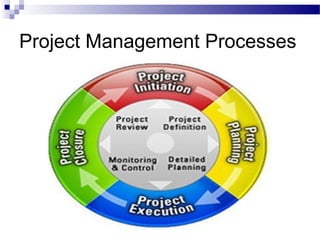
Project Management Processes
 The nine project management processes are:
 1. Scope Management
 2. Schedule Management
 3. Budget Management
 4. Quality Management
 5. Team Management
 6. Stakeholder Management
 7. Information Management
 8. Risk management
 9. Contract Management
Contd…
 These processes have divided into two groups:
 1- Enabling processes
 2- Facilitating processes
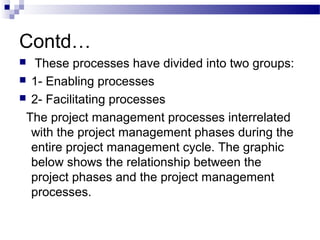
The project management processes interrelated
with the project management phases during the
entire project management cycle. The graphic
below shows the relationship between the
project phases and the project management
processes.
Project Management Processes
and Phases
Contd…
Process improvement
 Understanding existing processes and
introducing process changes to improve product
quality, reduce costs or accelerate schedules.
 Most process improvement work so far has
focused on defect reduction. This reflects the
increasing attention paid by industry to quality.
 However, other process attributes can also be
the focus of improvement
Contd…
 Dr .W. Edward Deming used to say that there
are two kinds of organization…those that are
getting better and those that are dying. If you’re
standing still , you’re dying; you don’t know. Your
competition isn’t standing still. He used this point
to argue for continuous improvement in the
organization.
 Marvin Weisbord say that “Processes issue will
always affect task performance”.
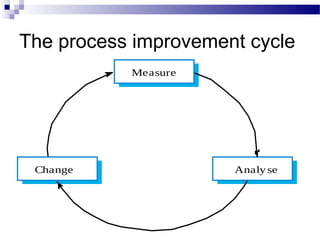
The process improvement cycle
Analy se
Measure
Change
Process improvement stages
 Process measurement
 Attributes of the current process are measured.
These are a baseline for assessing improvements.
 Process analysis
 The current process is assessed and bottlenecks and
weaknesses are identified.
 Process change
 Changes to the process that have been identified
during the analysis are introduced.
Time-Cost Tradeoff Curve for a
Project
0
100
200
300
400
500
600
700
800
900
1000
1 2 3 4 5 6 7 8 9 10
Series1
Time Units
Cost
Process issue
 “You pain now or pain later". Good project
planning causes a lot of pain at the
beginning, but the pain diminishes as the
project progress . With no planning . There
is not much pain at the beginning, but it
grows significantly as the project goes
ahead.
Pain Curve in Project Management
0
1
2
3
4
5
6
7
8
1 2 3 4 5 6 7 8 9
Series1
Series2
No planning
Good planning
Time Scale
Pain level
Some of the processes of project
management
 Communicating
 Decision Making
 Leadership
 Problem Solving
 Creative Thinking
 Scheduling
 Planning
 The Work Itself
 Monitoring Status
 Change Control
 Meetings
 Team Building
 Conflict Resolution
 Administrative
Some Principles of Process
Improvement
 If we know how to improve processes in one
area, we should be able to apply the in other
area.
 Some principle are….
 Improve process quality.
 Implement concurrent processes.
 Add value as rapidly as possible at each
process step.
 Improve quality and timeliness of incoming
materials.
Contd…
 The right information at the right time.
 Streamline the flow of materials.
 Eliminate bottlenecks.
 Improve Process Quality
Anything that you can do to reduce errors that
lead to rework will improve overall process
performance, especially speed. Improvements
in planning generally reduce errors due to false
starts. Time spent planning must be balanced.
It is not productive if the team goes into
analysis because they are afraid to make any
planning errors.
Implement concurrent processes.
 If we can do as many things as possible in
parallel rather than in series, we can speed up
project work. Care must be taken to balance risk
with gains in speed. When interdependent tasks
are performed concurrently, you definitely
increase the risk that costs will be incurred
because the work done in one step negates that
done in the next step.
Add value as rapidly as possible at
each process step.
 Every step in the project should increase
the value of the final product that will be
delivered to the customer. Related to this
idea, perhaps as a the point about
eliminating any step that adds no value.
Improve quality and timeliness of
incoming materials.
 A manufacturer who receives raw
materials can hardly produce quality
products .Considerable time and money
were once spent on incoming inspection
of materials. Selection of good partnership
arrangements can greatly improve the
quality of incoming goods and reduce later
incurred cost of poor-quality of product.
DFA=Director Financial Accounting.
DMG=Director Material Group.
The right information at the right
time.
 If the information arrives
too late ,it will be no
beneficial to the current
job. If it arrives too early,
it may not be recognition
as relevant, through if an
error is to be made, then
it help to resolve the
issues.
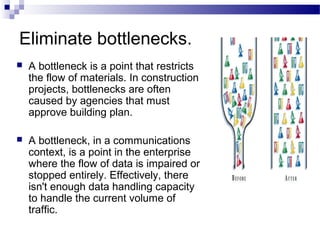
Eliminate bottlenecks.
 A bottleneck is a point that restricts
the flow of materials. In construction
projects, bottlenecks are often
caused by agencies that must
approve building plan.
 A bottleneck, in a communications
context, is a point in the enterprise
where the flow of data is impaired or
stopped entirely. Effectively, there
isn't enough data handling capacity
to handle the current volume of
traffic.
Project Management and Process

Project Management and Process

  • 2.
    Improving the Project Management Processesin Project M.Rehman Siddique 530 MELMS (Part II)
  • 3.
    Project  A projectis  A planned or proposed undertaking.  A collaborative enterprise, frequency involving research or design that is carefully planned to achieve define a particular aim.  To achieve defined objective and goal.
  • 4.
    Project Management  Projectmanagement is the application of knowledge ,skills ,tools and techniques to project activities to meet project requirements. This application of knowledge requires the effective management of appropriate processes.
  • 5.
    Process  A processis a set of interrelated actions and activities performed to achieve a pre-specified product ,result or services .Each process is characterized by its inputs ,the tool and techniques that can be applied and the resulting output.
  • 6.
  • 7.
    Project Management Processes The nine project management processes are:  1. Scope Management  2. Schedule Management  3. Budget Management  4. Quality Management  5. Team Management  6. Stakeholder Management  7. Information Management  8. Risk management  9. Contract Management
  • 8.
    Contd…  These processeshave divided into two groups:  1- Enabling processes  2- Facilitating processes The project management processes interrelated with the project management phases during the entire project management cycle. The graphic below shows the relationship between the project phases and the project management processes.
  • 9.
  • 10.
  • 12.
    Process improvement  Understandingexisting processes and introducing process changes to improve product quality, reduce costs or accelerate schedules.  Most process improvement work so far has focused on defect reduction. This reflects the increasing attention paid by industry to quality.  However, other process attributes can also be the focus of improvement
  • 13.
    Contd…  Dr .W.Edward Deming used to say that there are two kinds of organization…those that are getting better and those that are dying. If you’re standing still , you’re dying; you don’t know. Your competition isn’t standing still. He used this point to argue for continuous improvement in the organization.  Marvin Weisbord say that “Processes issue will always affect task performance”.
  • 14.
    The process improvementcycle Analy se Measure Change
  • 15.
    Process improvement stages Process measurement  Attributes of the current process are measured. These are a baseline for assessing improvements.  Process analysis  The current process is assessed and bottlenecks and weaknesses are identified.  Process change  Changes to the process that have been identified during the analysis are introduced.
  • 16.
    Time-Cost Tradeoff Curvefor a Project 0 100 200 300 400 500 600 700 800 900 1000 1 2 3 4 5 6 7 8 9 10 Series1 Time Units Cost
  • 17.
    Process issue  “Youpain now or pain later". Good project planning causes a lot of pain at the beginning, but the pain diminishes as the project progress . With no planning . There is not much pain at the beginning, but it grows significantly as the project goes ahead.
  • 18.
    Pain Curve inProject Management 0 1 2 3 4 5 6 7 8 1 2 3 4 5 6 7 8 9 Series1 Series2 No planning Good planning Time Scale Pain level
  • 19.
    Some of theprocesses of project management  Communicating  Decision Making  Leadership  Problem Solving  Creative Thinking  Scheduling  Planning  The Work Itself  Monitoring Status  Change Control  Meetings  Team Building  Conflict Resolution  Administrative
  • 20.
    Some Principles ofProcess Improvement  If we know how to improve processes in one area, we should be able to apply the in other area.  Some principle are….  Improve process quality.  Implement concurrent processes.  Add value as rapidly as possible at each process step.  Improve quality and timeliness of incoming materials.
  • 21.
    Contd…  The rightinformation at the right time.  Streamline the flow of materials.  Eliminate bottlenecks.  Improve Process Quality Anything that you can do to reduce errors that lead to rework will improve overall process performance, especially speed. Improvements in planning generally reduce errors due to false starts. Time spent planning must be balanced. It is not productive if the team goes into analysis because they are afraid to make any planning errors.
  • 23.
    Implement concurrent processes. If we can do as many things as possible in parallel rather than in series, we can speed up project work. Care must be taken to balance risk with gains in speed. When interdependent tasks are performed concurrently, you definitely increase the risk that costs will be incurred because the work done in one step negates that done in the next step.
  • 24.
    Add value asrapidly as possible at each process step.  Every step in the project should increase the value of the final product that will be delivered to the customer. Related to this idea, perhaps as a the point about eliminating any step that adds no value.
  • 25.
    Improve quality andtimeliness of incoming materials.  A manufacturer who receives raw materials can hardly produce quality products .Considerable time and money were once spent on incoming inspection of materials. Selection of good partnership arrangements can greatly improve the quality of incoming goods and reduce later incurred cost of poor-quality of product.
  • 26.
  • 27.
    The right informationat the right time.  If the information arrives too late ,it will be no beneficial to the current job. If it arrives too early, it may not be recognition as relevant, through if an error is to be made, then it help to resolve the issues.
  • 28.
    Eliminate bottlenecks.  Abottleneck is a point that restricts the flow of materials. In construction projects, bottlenecks are often caused by agencies that must approve building plan.  A bottleneck, in a communications context, is a point in the enterprise where the flow of data is impaired or stopped entirely. Effectively, there isn't enough data handling capacity to handle the current volume of traffic.