+
Earned Value Management Essentials
Earned Value Management is more than people, processes, and tools.
It is an integrated service that provides actionable information to the
decision makers
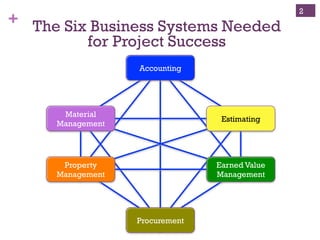
+ The Six Business Systems Needed
for Project Success
2
Accounting
Material
Management
Estimating
Property
Management
Earned Value
Management
Procurement
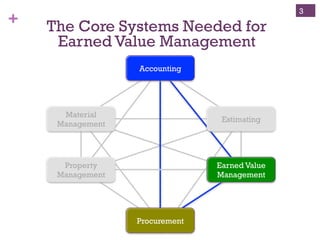
+ The Core Systems Needed for
Earned Value Management
3
Accounting
Material
Management
Estimating
Property
Management
Earned Value
Management
Procurement
+
Z
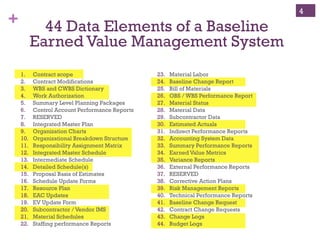
44 Data Elements of a Baseline
Earned Value Management System
1.  Contract scope
2.  Contract Modifications
3.  WBS and CWBS Dictionary
4.  Work Authorization
5.  Summary Level Planning Packages
6.  Control Account Performance Reports
7.  RESERVED
8.  Integrated Master Plan
9.  Organization Charts
10.  Organizational Breakdown Structure
11.  Responsibility Assignment Matrix
12.  Integrated Master Schedule
13.  Intermediate Schedule
14.  Detailed Schedule(s)
15.  Proposal Basis of Estimates
16.  Schedule Update Forms
17.  Resource Plan
18.  EAC Updates
19.  EV Update Form
20.  Subcontractor / Vendor IMS
21.  Material Schedules
22.  Staffing performance Reports
23.  Material Labor
24.  Baseline Change Report
25.  Bill of Materials
26.  OBS / WBS Performance Report
27.  Material Status
28.  Material Data
29.  Subcontractor Data
30.  Estimated Actuals
31.  Indirect Performance Reports
32.  Accounting System Data
33.  Summary Performance Reports
34.  Earned Value Metrics
35.  Variance Reports
36.  External Performance Reports
37.  RESERVED
38.  Corrective Action Plans
39.  Risk Management Reports
40.  Technical Performance Reports
41.  Baseline Change Request
42.  Contract Change Requests
43.  Change Logs
44.  Budget Logs
4
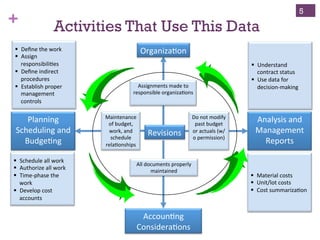
+ Activities That Use This Data
5
§  Define	
  the	
  work	
  
§  Assign	
  
responsibili3es	
  
§  Define	
  indirect	
  
procedures	
  
§  Establish	
  proper	
  
management	
  
controls	
  	
  
§  Schedule	
  all	
  work	
  
§  Authorize	
  all	
  work	
  
§  Time-­‐phase	
  the	
  
work	
  
§  Develop	
  cost	
  
accounts	
  
§  Material	
  costs	
  
§  Unit/lot	
  costs	
  
§  Cost	
  summariza3on	
  
§  Understand	
  
contract	
  status	
  
§  Use	
  data	
  for	
  
decision-­‐making	
  Assignments	
  made	
  to	
  
responsible	
  organiza3ons	
  
Maintenance	
  
of	
  budget,	
  
work,	
  and	
  
schedule	
  
rela3onships	
  
Do	
  not	
  modify	
  
past	
  budget	
  
or	
  actuals	
  (w/
o	
  permission)	
  
All	
  documents	
  properly	
  
maintained	
  
Planning	
  
Scheduling	
  and	
  
Budge3ng	
  
Organiza3on	
  
Analysis	
  and	
  
Management	
  
Reports	
  
Accoun3ng	
  
Considera3ons	
  
Revisions	
  
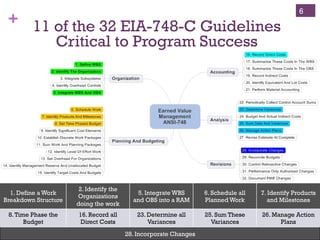
+ 11 of the 32 EIA-748-C Guidelines
Critical to Program Success
6
1. Define a Work
Breakdown Structure
2. Identify the
Organizations
doing the work
5. Integrate WBS
and OBS into a RAM
6. Schedule all
Planned Work
7. Identify Products
and Milestones
8.Time Phase the
Budget
16. Record all
Direct Costs
23. Determine all
Variances
25. Sum These
Variances
26. Manage Action
Plans
28. Incorporate Changes
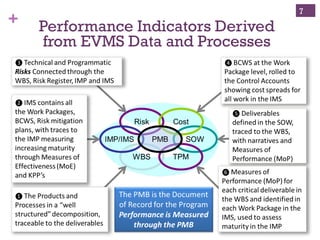
+ Performance Indicators Derived
from EVMS Data and Processes
7
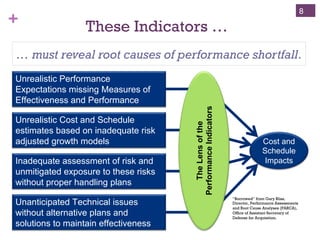
+ These Indicators …
… must reveal root causes of performance shortfall.
8
Unrealistic Performance
Expectations missing Measures of
Effectiveness and Performance
Unrealistic Cost and Schedule
estimates based on inadequate risk
adjusted growth models
Inadequate assessment of risk and
unmitigated exposure to these risks
without proper handling plans
Unanticipated Technical issues
without alternative plans and
solutions to maintain effectiveness
Cost and
Schedule
Impacts
TheLensofthe
PerformanceIndicators
“Borrowed” from Gary Bliss,
Director, Performance Assessments
and Root Cause Analyses (PARCA),
Office of Assistant Secretary of
Defense for Acquisition.
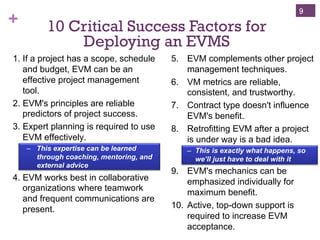
+ 10 Critical Success Factors for
Deploying an EVMS
9
1. If a project has a scope, schedule
and budget, EVM can be an
effective project management
tool.
2. EVM's principles are reliable
predictors of project success.
3. Expert planning is required to use
EVM effectively.
–  This expertise can be learned
through coaching, mentoring, and
external advice
4. EVM works best in collaborative
organizations where teamwork
and frequent communications are
present.
5.  EVM complements other project
management techniques.
6.  VM metrics are reliable,
consistent, and trustworthy.
7.  Contract type doesn't influence
EVM's benefit.
8.  Retrofitting EVM after a project
is under way is a bad idea.
–  This is exactly what happens, so
we’ll just have to deal with it
9.  EVM's mechanics can be
emphasized individually for
maximum benefit.
10.  Active, top-down support is
required to increase EVM
acceptance.
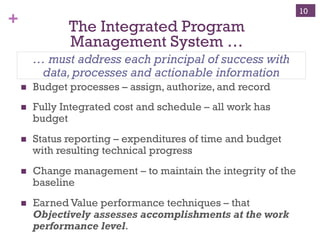
+ The Integrated Program
Management System …
n  Budget processes – assign, authorize, and record
n  Fully Integrated cost and schedule – all work has
budget
n  Status reporting – expenditures of time and budget
with resulting technical progress
n  Change management – to maintain the integrity of the
baseline
n  Earned Value performance techniques – that
Objectively assesses accomplishments at the work
performance level.
… must address each principal of success with
data,processes and actionable information
10
+
Connecting the Dots
Between Cost, Schedule and
Objective Assessment of
Technical Performance
The role of the Earned Value Management System (EVMS) is to
connect the dots between budget (BCWS), performance (BCWP) –
informed by technical performance, schedule, risk reduction
activities, and estimates to complete
11
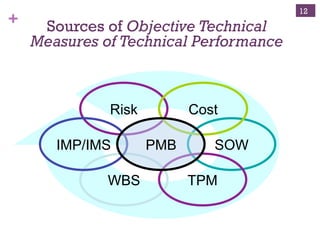
+ Sources of Objective Technical
Measures of Technical Performance
Risk
SOW
Cost
WBS
IMP/IMS
TPM
PMB
GA
12
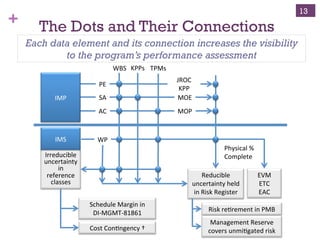
+ The Dots and Their Connections
Each data element and its connection increases the visibility
to the program’s performance assessment
13
WBS	
   TPMs	
  
EVM	
  
ETC	
  
EAC	
  
Irreducible	
  
uncertainty	
  
in	
  
reference	
  
classes	
  
Reducible	
  
uncertainty	
  held	
  
in	
  Risk	
  Register	
  
Schedule	
  Margin	
  in	
  	
  
DI-­‐MGMT-­‐81861	
  
Cost	
  Con3ngency	
  †	
  
Risk	
  re3rement	
  in	
  PMB	
  
Management	
  Reserve	
  
covers	
  unmi3gated	
  risk	
  
MOE	
  
MOP	
  
Physical	
  %	
  
Complete	
  
PE	
  
SA	
  
AC	
  
JROC	
  
KPP	
  
IMP	
  
IMS	
   WP	


KPPs	
  
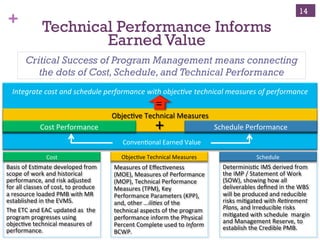
+ Technical Performance Informs
Earned Value
Critical Success of Program Management means connecting
the dots of Cost,Schedule,and Technical Performance
Integrate	
  cost	
  and	
  schedule	
  performance	
  with	
  objec7ve	
  technical	
  measures	
  of	
  performance	
  
Objec3ve	
  Technical	
  Measures	
  
Cost	
  Performance	
   Schedule	
  Performance	
  
Conven3onal	
  Earned	
  Value	
  
+	
  
=	
  
Basis	
  of	
  Es3mate	
  developed	
  from	
  
scope	
  of	
  work	
  and	
  historical	
  
performance,	
  and	
  risk	
  adjusted	
  
for	
  all	
  classes	
  of	
  cost,	
  to	
  produce	
  
a	
  resource	
  loaded	
  PMB	
  with	
  MR	
  
established	
  in	
  the	
  EVMS.	
  
The	
  ETC	
  and	
  EAC	
  updated	
  as	
  	
  the	
  
program	
  progresses	
  using	
  	
  
objec3ve	
  technical	
  measures	
  of	
  
performance.	
  
Cost	
  
Measures	
  of	
  Effec3veness	
  
(MOE),	
  Measures	
  of	
  Performance	
  
(MOP),	
  Technical	
  Performance	
  
Measures	
  (TPM),	
  Key	
  
Performance	
  Parameters	
  (KPP),	
  
and,	
  other	
  …ili7es	
  of	
  the	
  
technical	
  aspects	
  of	
  the	
  program	
  
performance	
  inform	
  the	
  Physical	
  
Percent	
  Complete	
  used	
  to	
  Inform	
  
BCWP.	
  
Objec3ve	
  Technical	
  Measures	
  
Determinis3c	
  IMS	
  derived	
  from	
  
the	
  IMP	
  /	
  Statement	
  of	
  Work	
  
(SOW),	
  showing	
  how	
  all	
  
deliverables	
  defined	
  in	
  the	
  WBS	
  
will	
  be	
  produced	
  and	
  reducible	
  
risks	
  mi3gated	
  with	
  Re7rement	
  
Plans,	
  and	
  Irreducible	
  risks	
  
mi3gated	
  with	
  schedule	
  	
  margin	
  
and	
  Management	
  Reserve,	
  to	
  
establish	
  the	
  Credible	
  PMB.	
  
Schedule	
  
GA
14
+Assembly the moving parts
into a successful EVMS
People, processes, and tools are the start. For real
sustainable success more is needed
15
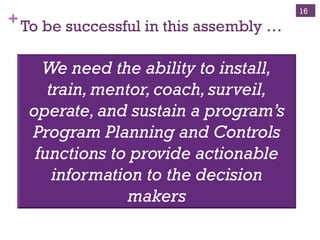
+To be successful in this assembly …
16
We need the ability to install,
train,mentor,coach,surveil,
operate,and sustain a program’s
Program Planning and Controls
functions to provide actionable
information to the decision
makers
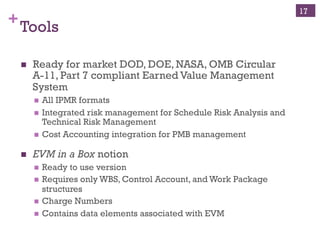
+Tools
n  Ready for market DOD, DOE, NASA, OMB Circular
A-11, Part 7 compliant Earned Value Management
System
n  All IPMR formats
n  Integrated risk management for Schedule Risk Analysis and
Technical Risk Management
n  Cost Accounting integration for PMB management
n  EVM in a Box notion
n  Ready to use version
n  Requires only WBS, Control Account, and Work Package
structures
n  Charge Numbers
n  Contains data elements associated with EVM
17
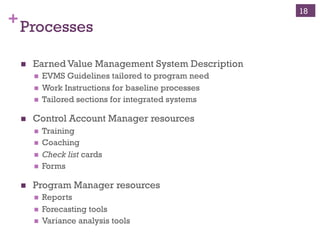
+Processes
n  Earned Value Management System Description
n  EVMS Guidelines tailored to program need
n  Work Instructions for baseline processes
n  Tailored sections for integrated systems
n  Control Account Manager resources
n  Training
n  Coaching
n  Check list cards
n  Forms
n  Program Manager resources
n  Reports
n  Forecasting tools
n  Variance analysis tools
18
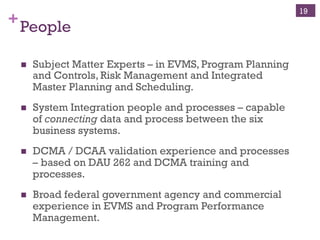
+People
n  Subject Matter Experts – in EVMS, Program Planning
and Controls, Risk Management and Integrated
Master Planning and Scheduling.
n  System Integration people and processes – capable
of connecting data and process between the six
business systems.
n  DCMA / DCAA validation experience and processes
– based on DAU 262 and DCMA training and
processes.
n  Broad federal government agency and commercial
experience in EVMS and Program Performance
Management.
19
20

Earned Value Managed Services

  • 1.
    + Earned Value ManagementEssentials Earned Value Management is more than people, processes, and tools. It is an integrated service that provides actionable information to the decision makers
  • 2.
    + The SixBusiness Systems Needed for Project Success 2 Accounting Material Management Estimating Property Management Earned Value Management Procurement
  • 3.
    + The CoreSystems Needed for Earned Value Management 3 Accounting Material Management Estimating Property Management Earned Value Management Procurement
  • 4.
    + Z 44 Data Elementsof a Baseline Earned Value Management System 1.  Contract scope 2.  Contract Modifications 3.  WBS and CWBS Dictionary 4.  Work Authorization 5.  Summary Level Planning Packages 6.  Control Account Performance Reports 7.  RESERVED 8.  Integrated Master Plan 9.  Organization Charts 10.  Organizational Breakdown Structure 11.  Responsibility Assignment Matrix 12.  Integrated Master Schedule 13.  Intermediate Schedule 14.  Detailed Schedule(s) 15.  Proposal Basis of Estimates 16.  Schedule Update Forms 17.  Resource Plan 18.  EAC Updates 19.  EV Update Form 20.  Subcontractor / Vendor IMS 21.  Material Schedules 22.  Staffing performance Reports 23.  Material Labor 24.  Baseline Change Report 25.  Bill of Materials 26.  OBS / WBS Performance Report 27.  Material Status 28.  Material Data 29.  Subcontractor Data 30.  Estimated Actuals 31.  Indirect Performance Reports 32.  Accounting System Data 33.  Summary Performance Reports 34.  Earned Value Metrics 35.  Variance Reports 36.  External Performance Reports 37.  RESERVED 38.  Corrective Action Plans 39.  Risk Management Reports 40.  Technical Performance Reports 41.  Baseline Change Request 42.  Contract Change Requests 43.  Change Logs 44.  Budget Logs 4
  • 5.
    + Activities ThatUse This Data 5 §  Define  the  work   §  Assign   responsibili3es   §  Define  indirect   procedures   §  Establish  proper   management   controls     §  Schedule  all  work   §  Authorize  all  work   §  Time-­‐phase  the   work   §  Develop  cost   accounts   §  Material  costs   §  Unit/lot  costs   §  Cost  summariza3on   §  Understand   contract  status   §  Use  data  for   decision-­‐making  Assignments  made  to   responsible  organiza3ons   Maintenance   of  budget,   work,  and   schedule   rela3onships   Do  not  modify   past  budget   or  actuals  (w/ o  permission)   All  documents  properly   maintained   Planning   Scheduling  and   Budge3ng   Organiza3on   Analysis  and   Management   Reports   Accoun3ng   Considera3ons   Revisions  
  • 6.
    + 11 ofthe 32 EIA-748-C Guidelines Critical to Program Success 6 1. Define a Work Breakdown Structure 2. Identify the Organizations doing the work 5. Integrate WBS and OBS into a RAM 6. Schedule all Planned Work 7. Identify Products and Milestones 8.Time Phase the Budget 16. Record all Direct Costs 23. Determine all Variances 25. Sum These Variances 26. Manage Action Plans 28. Incorporate Changes
  • 7.
    + Performance IndicatorsDerived from EVMS Data and Processes 7
  • 8.
    + These Indicators… … must reveal root causes of performance shortfall. 8 Unrealistic Performance Expectations missing Measures of Effectiveness and Performance Unrealistic Cost and Schedule estimates based on inadequate risk adjusted growth models Inadequate assessment of risk and unmitigated exposure to these risks without proper handling plans Unanticipated Technical issues without alternative plans and solutions to maintain effectiveness Cost and Schedule Impacts TheLensofthe PerformanceIndicators “Borrowed” from Gary Bliss, Director, Performance Assessments and Root Cause Analyses (PARCA), Office of Assistant Secretary of Defense for Acquisition.
  • 9.
    + 10 CriticalSuccess Factors for Deploying an EVMS 9 1. If a project has a scope, schedule and budget, EVM can be an effective project management tool. 2. EVM's principles are reliable predictors of project success. 3. Expert planning is required to use EVM effectively. –  This expertise can be learned through coaching, mentoring, and external advice 4. EVM works best in collaborative organizations where teamwork and frequent communications are present. 5.  EVM complements other project management techniques. 6.  VM metrics are reliable, consistent, and trustworthy. 7.  Contract type doesn't influence EVM's benefit. 8.  Retrofitting EVM after a project is under way is a bad idea. –  This is exactly what happens, so we’ll just have to deal with it 9.  EVM's mechanics can be emphasized individually for maximum benefit. 10.  Active, top-down support is required to increase EVM acceptance.
  • 10.
    + The IntegratedProgram Management System … n  Budget processes – assign, authorize, and record n  Fully Integrated cost and schedule – all work has budget n  Status reporting – expenditures of time and budget with resulting technical progress n  Change management – to maintain the integrity of the baseline n  Earned Value performance techniques – that Objectively assesses accomplishments at the work performance level. … must address each principal of success with data,processes and actionable information 10
  • 11.
    + Connecting the Dots BetweenCost, Schedule and Objective Assessment of Technical Performance The role of the Earned Value Management System (EVMS) is to connect the dots between budget (BCWS), performance (BCWP) – informed by technical performance, schedule, risk reduction activities, and estimates to complete 11
  • 12.
    + Sources ofObjective Technical Measures of Technical Performance Risk SOW Cost WBS IMP/IMS TPM PMB GA 12
  • 13.
    + The Dotsand Their Connections Each data element and its connection increases the visibility to the program’s performance assessment 13 WBS   TPMs   EVM   ETC   EAC   Irreducible   uncertainty   in   reference   classes   Reducible   uncertainty  held   in  Risk  Register   Schedule  Margin  in     DI-­‐MGMT-­‐81861   Cost  Con3ngency  †   Risk  re3rement  in  PMB   Management  Reserve   covers  unmi3gated  risk   MOE   MOP   Physical  %   Complete   PE   SA   AC   JROC   KPP   IMP   IMS   WP     KPPs  
  • 14.
    + Technical PerformanceInforms Earned Value Critical Success of Program Management means connecting the dots of Cost,Schedule,and Technical Performance Integrate  cost  and  schedule  performance  with  objec7ve  technical  measures  of  performance   Objec3ve  Technical  Measures   Cost  Performance   Schedule  Performance   Conven3onal  Earned  Value   +   =   Basis  of  Es3mate  developed  from   scope  of  work  and  historical   performance,  and  risk  adjusted   for  all  classes  of  cost,  to  produce   a  resource  loaded  PMB  with  MR   established  in  the  EVMS.   The  ETC  and  EAC  updated  as    the   program  progresses  using     objec3ve  technical  measures  of   performance.   Cost   Measures  of  Effec3veness   (MOE),  Measures  of  Performance   (MOP),  Technical  Performance   Measures  (TPM),  Key   Performance  Parameters  (KPP),   and,  other  …ili7es  of  the   technical  aspects  of  the  program   performance  inform  the  Physical   Percent  Complete  used  to  Inform   BCWP.   Objec3ve  Technical  Measures   Determinis3c  IMS  derived  from   the  IMP  /  Statement  of  Work   (SOW),  showing  how  all   deliverables  defined  in  the  WBS   will  be  produced  and  reducible   risks  mi3gated  with  Re7rement   Plans,  and  Irreducible  risks   mi3gated  with  schedule    margin   and  Management  Reserve,  to   establish  the  Credible  PMB.   Schedule   GA 14
  • 15.
    +Assembly the movingparts into a successful EVMS People, processes, and tools are the start. For real sustainable success more is needed 15
  • 16.
    +To be successfulin this assembly … 16 We need the ability to install, train,mentor,coach,surveil, operate,and sustain a program’s Program Planning and Controls functions to provide actionable information to the decision makers
  • 17.
    +Tools n  Ready formarket DOD, DOE, NASA, OMB Circular A-11, Part 7 compliant Earned Value Management System n  All IPMR formats n  Integrated risk management for Schedule Risk Analysis and Technical Risk Management n  Cost Accounting integration for PMB management n  EVM in a Box notion n  Ready to use version n  Requires only WBS, Control Account, and Work Package structures n  Charge Numbers n  Contains data elements associated with EVM 17
  • 18.
    +Processes n  Earned ValueManagement System Description n  EVMS Guidelines tailored to program need n  Work Instructions for baseline processes n  Tailored sections for integrated systems n  Control Account Manager resources n  Training n  Coaching n  Check list cards n  Forms n  Program Manager resources n  Reports n  Forecasting tools n  Variance analysis tools 18
  • 19.
    +People n  Subject MatterExperts – in EVMS, Program Planning and Controls, Risk Management and Integrated Master Planning and Scheduling. n  System Integration people and processes – capable of connecting data and process between the six business systems. n  DCMA / DCAA validation experience and processes – based on DAU 262 and DCMA training and processes. n  Broad federal government agency and commercial experience in EVMS and Program Performance Management. 19
  • 20.