Solutions
Properties of Solutions
Enthalpy of Solution
Solutions
Solutions
How does a solid dissolve
into a liquid?
What ‘drives’ the
dissolution process?
What are the energetics of
dissolution?
Solutions
How Does a Solution Form?
1. Solvent molecules attracted to surface ions.
2. Each ion is surrounded by solvent molecules.
3. Enthalpy (∆H) changes with each interaction broken or
formed.
Ionic solid dissolving in water
Solutions
How Does a Solution Form?
1. Solvent molecules attracted to surface ions.
2. Each ion is surrounded by solvent molecules.
3. Enthalpy (∆H) changes with each interaction broken or
formed.
Solutions
How Does a Solution Form
The ions are solvated
(surrounded by
solvent).
If the solvent is water,
the ions are
hydrated.
The intermolecular
force here is ion-
dipole.
Solutions
What is enthalpy
• a thermodynamic quantity equivalent to
the total heat content of a system. It is
equal to the internal energy of the system
plus the product of pressure and volume
Solutions
Energy Changes in Solution
To determine the enthalpy
change, we divide the
process into 3 steps.
1. Separation of solute
particles.
2. Separation of solvent
particles to make
‘holes’.
3. Formation of new
interactions between
solute and solvent.
Solutions
Enthalpy Changes in Solution
The enthalpy
change of the
overall process
depends on ∆H for
each of these steps.
Start
End
EndStart
Solutions
Enthalpy changes during dissolution
The enthalpy of
solution, ∆Hsoln, can
be either positive or
negative.
∆Hsoln = ∆H1 + ∆H2 + ∆H3
∆Hsoln (MgSO4)= -91.2 kJ/mol --> exothermic
∆Hsoln (NH4NO3)= 26.4 kJ/mol --> endothermic
Solutions
Why do endothermic processes
sometimes occur spontaneously?
Some processes,
like the dissolution
of NH4NO3 in water,
are spontaneous at
room temperature
even though heat is
absorbed, not
released.
Solutions
Enthalpy Is Only Part of the Picture
Entropy is a measure of:
• Dispersal of energy in
the system.
• Number of microstates
(arrangements) in the
system.
b. has greater entropy,
∴ is the favored state
(more on this in chap 19)
Solutions
Entropy changes during dissolution
Each step also involves a
change in entropy.
1. Separation of solute
particles.
2. Separation of solvent
particles to make
‘holes’.
3. Formation of new
interactions between
solute and solvent.
Solutions
SAMPLE EXERCISE: Assessing Entropy Change
In the process illustrated below, water vapor reacts with excess solid sodium
sulfate to form the hydrated form of the salt. The chemical reaction is
Does the entropy of the system increase or decrease?
Solutions
Factors Affecting Solubility
The stronger the
intermolecular
attractions between
solute and solvent,
the more likely the
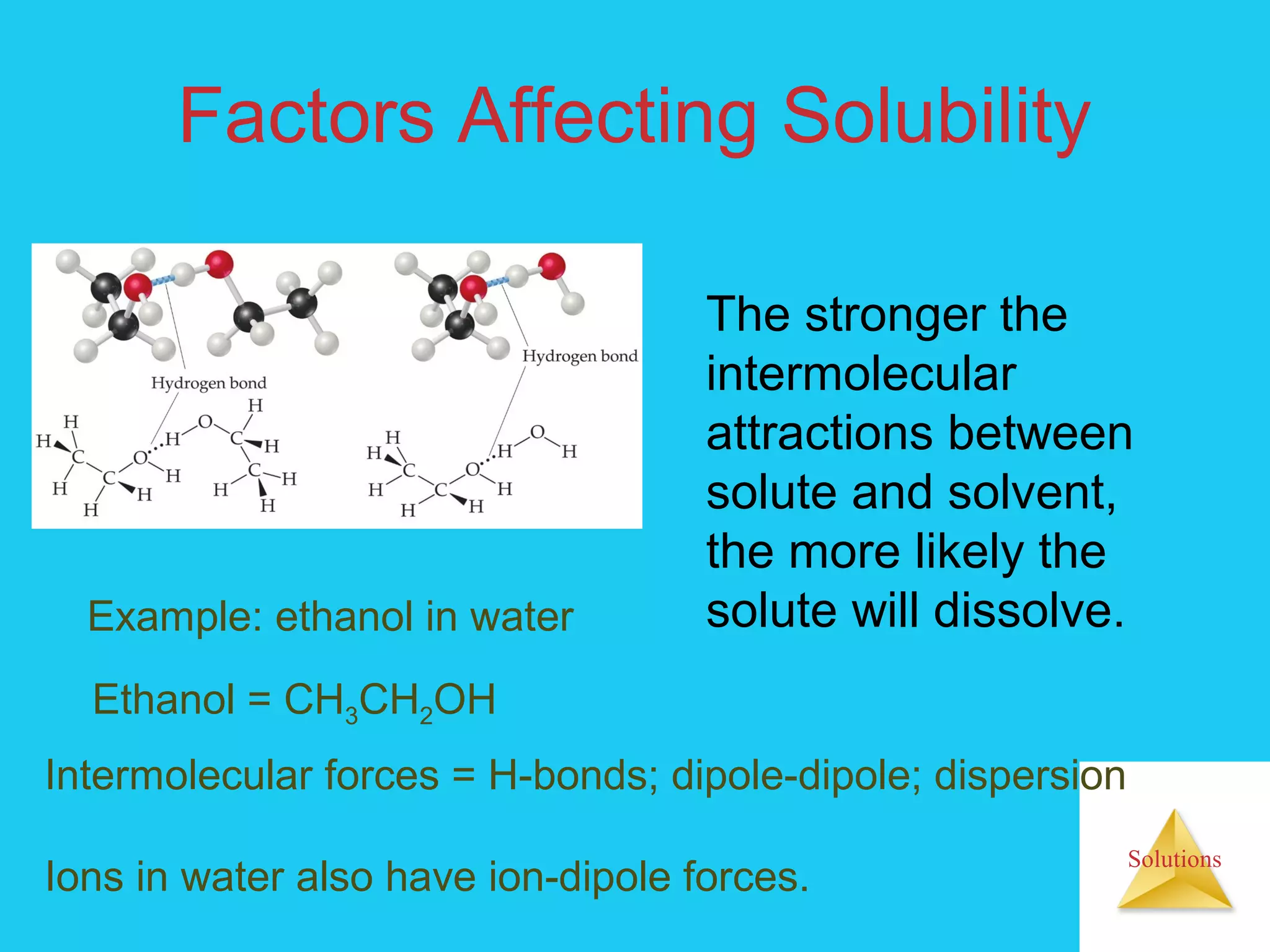
solute will dissolve.Example: ethanol in water
Ethanol = CH3CH2OH
Intermolecular forces = H-bonds; dipole-dipole; dispersion
Ions in water also have ion-dipole forces.
Solutions
Factors Affecting Solubility
Glucose (which has
hydrogen bonding)
is very soluble in
water.
Cyclohexane (which
only has dispersion
forces) is not water-
soluble.
Solutions
Factors Affecting Solubility
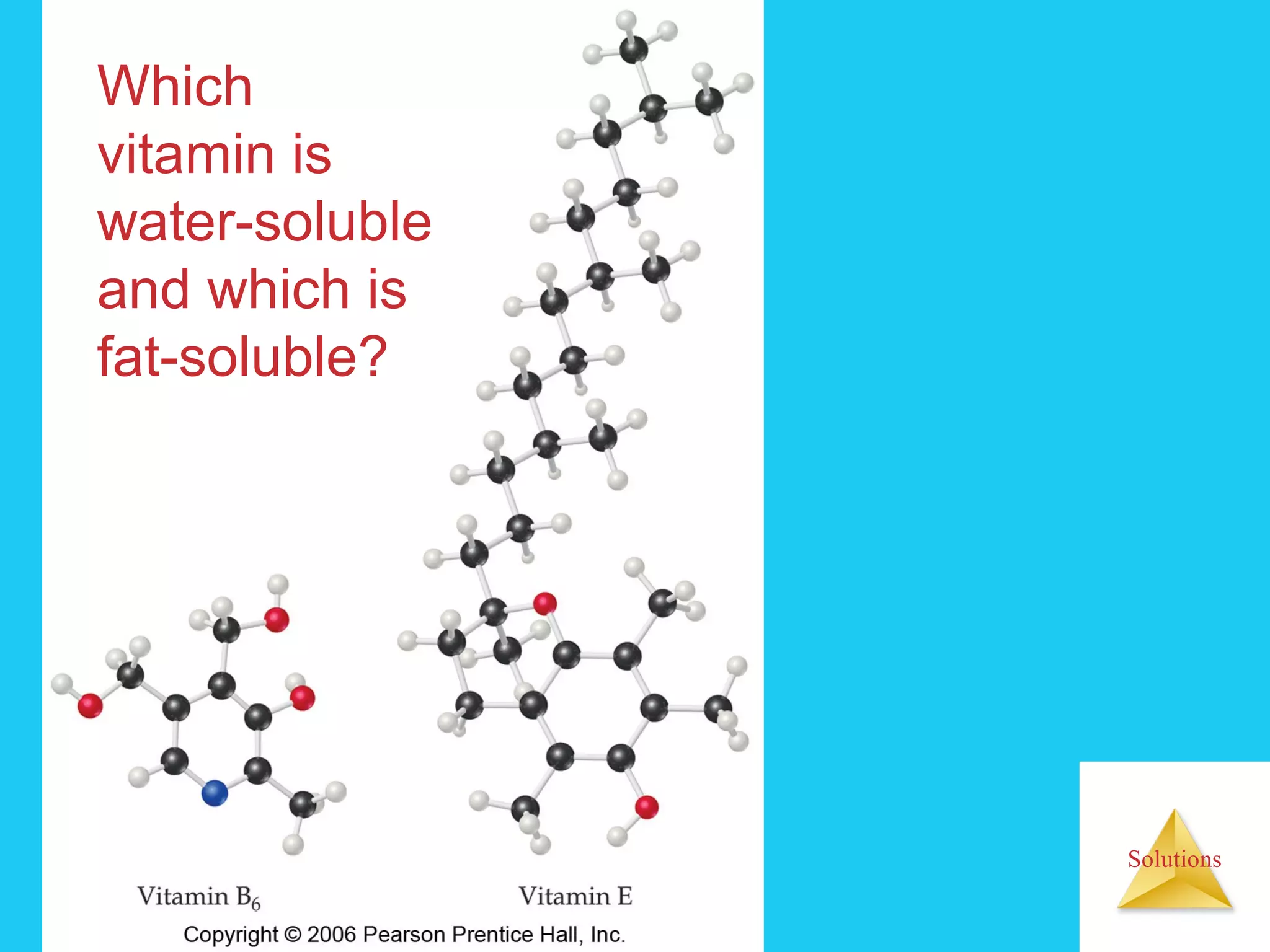
• Vitamin A is soluble in nonpolar compounds
(like fats).
• Vitamin C is soluble in water.
Solutions
Which
vitamin is
water-soluble
and which is
fat-soluble?
Solutions
Gases in Solution
• In general, the
solubility of gases in
water increases with
increasing mass.
Why?
• Larger molecules
have stronger
dispersion forces.
Solutions
Gases in Solution
• The solubility of
liquids and solids
does not change
appreciably with
pressure.
• But, the solubility of
a gas in a liquid is
directly proportional
to its pressure.
Increasing
pressure
above
solution
forces
more gas
to dissolve.
Solutions
Henry’s Law
Sg = kPg
where
• Sg is the solubility of the
gas;
• k is the Henry’s law
constant for that gas in
that solvent;
• Pg is the partial
pressure of the gas
above the liquid.
Solutions
Ways of ExpressingWays of Expressing
Concentrations ofConcentrations of
SolutionsSolutions
Solutions
Mass Percentage
Mass % of A =
mass of A in solution
total mass of solution
× 100
Solutions
Parts per Million and
Parts per Billion
ppm =
mass of A in solution
total mass of solution
× 106
Parts per Million (ppm)
Parts per Billion (ppb)
ppb =
mass of A in solution
total mass of solution
× 109
Solutions
Mass/Mass
Moles/Moles
M
oles/M
ass
Moles/L
Solutions
Boiling Point Elevation and
Freezing Point Depression
Solute-solvent
interactions also
cause solutions to
have higher boiling
points and lower
freezing points than
the pure solvent.
Solutions
Colligative Properties of
Electrolytes
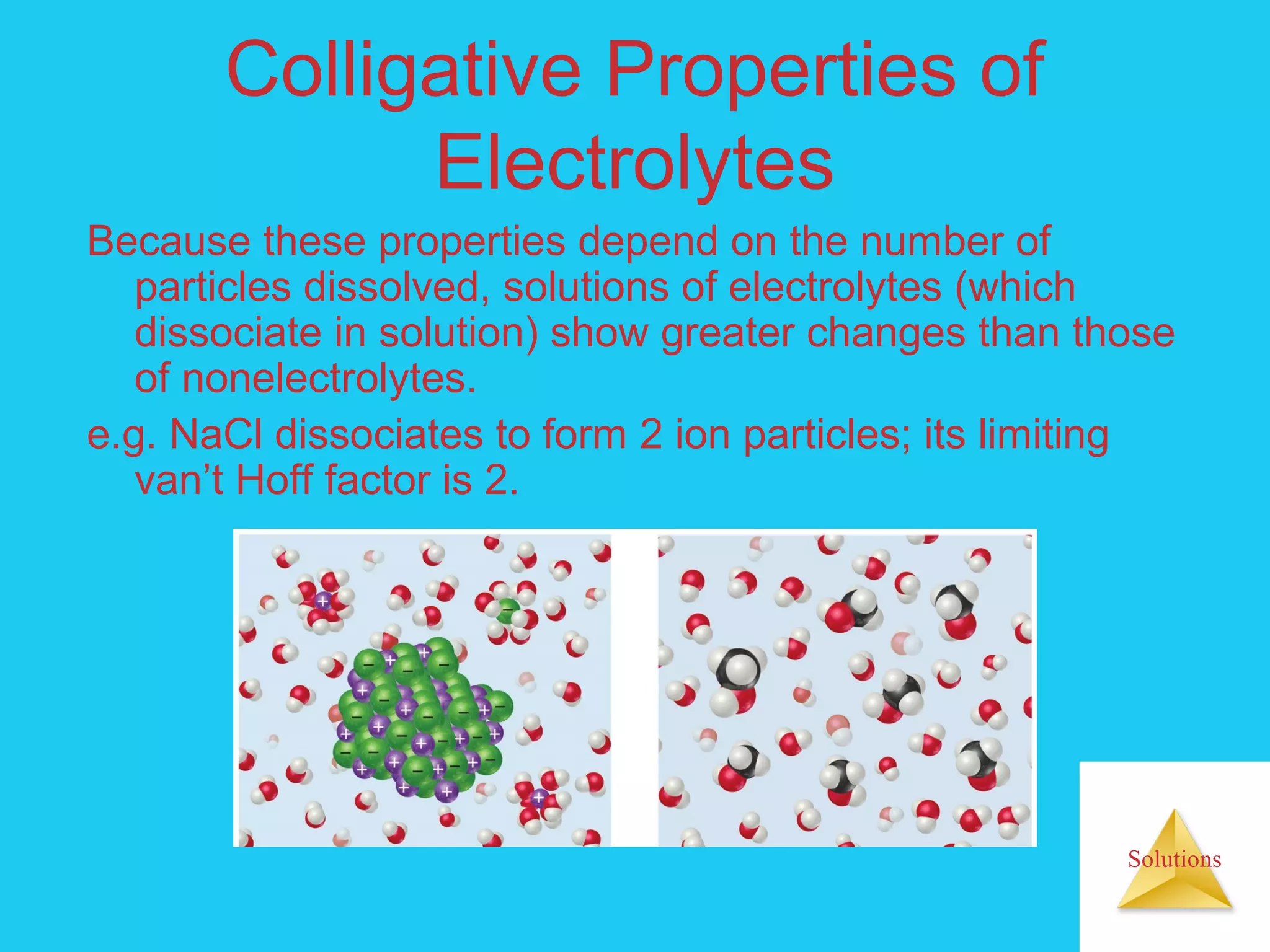
Because these properties depend on the number of
particles dissolved, solutions of electrolytes (which
dissociate in solution) show greater changes than those
of nonelectrolytes.
e.g. NaCl dissociates to form 2 ion particles; its limiting
van’t Hoff factor is 2.
Solutions
Colligative Properties of
Electrolytes
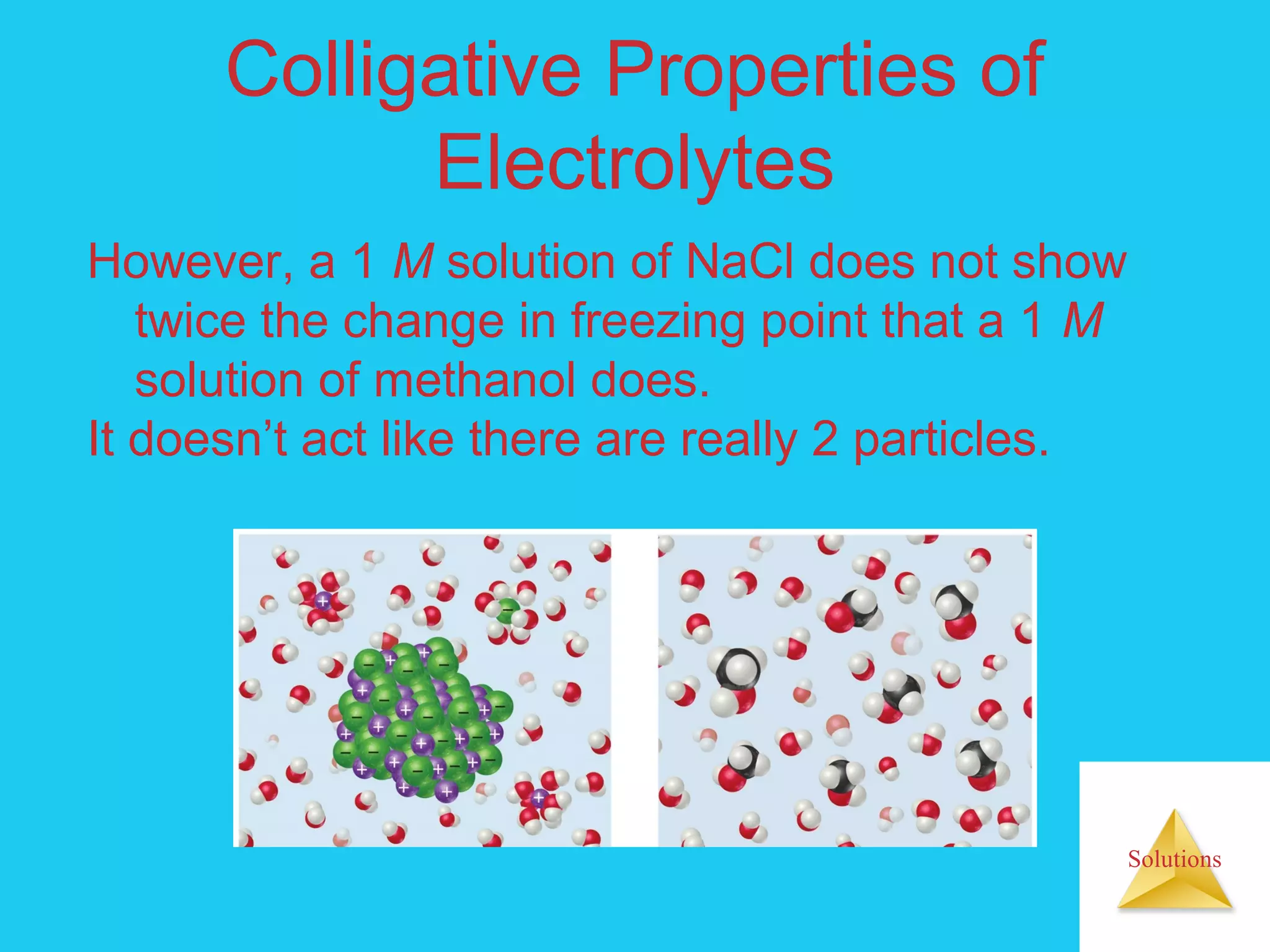
However, a 1 M solution of NaCl does not show
twice the change in freezing point that a 1 M
solution of methanol does.
It doesn’t act like there are really 2 particles.
Solutions
van’t Hoff Factor
One mole of NaCl in
water does not really
give rise to two
moles of ions.
Solutions
van’t Hoff Factor
Some Na+
and Cl−
reassociate as
hydrated ion pairs,
so the true
concentration of
particles is
somewhat less than
two times the
concentration of
NaCl.
Solutions
The van’t Hoff Factor
• Reassociation is
more likely at higher
concentration.
• Therefore, the
number of particles
present is
concentration
dependent.
Solutions
The van’t Hoff Factor
We modify the
previous equations
by multiplying by the
van’t Hoff factor, i
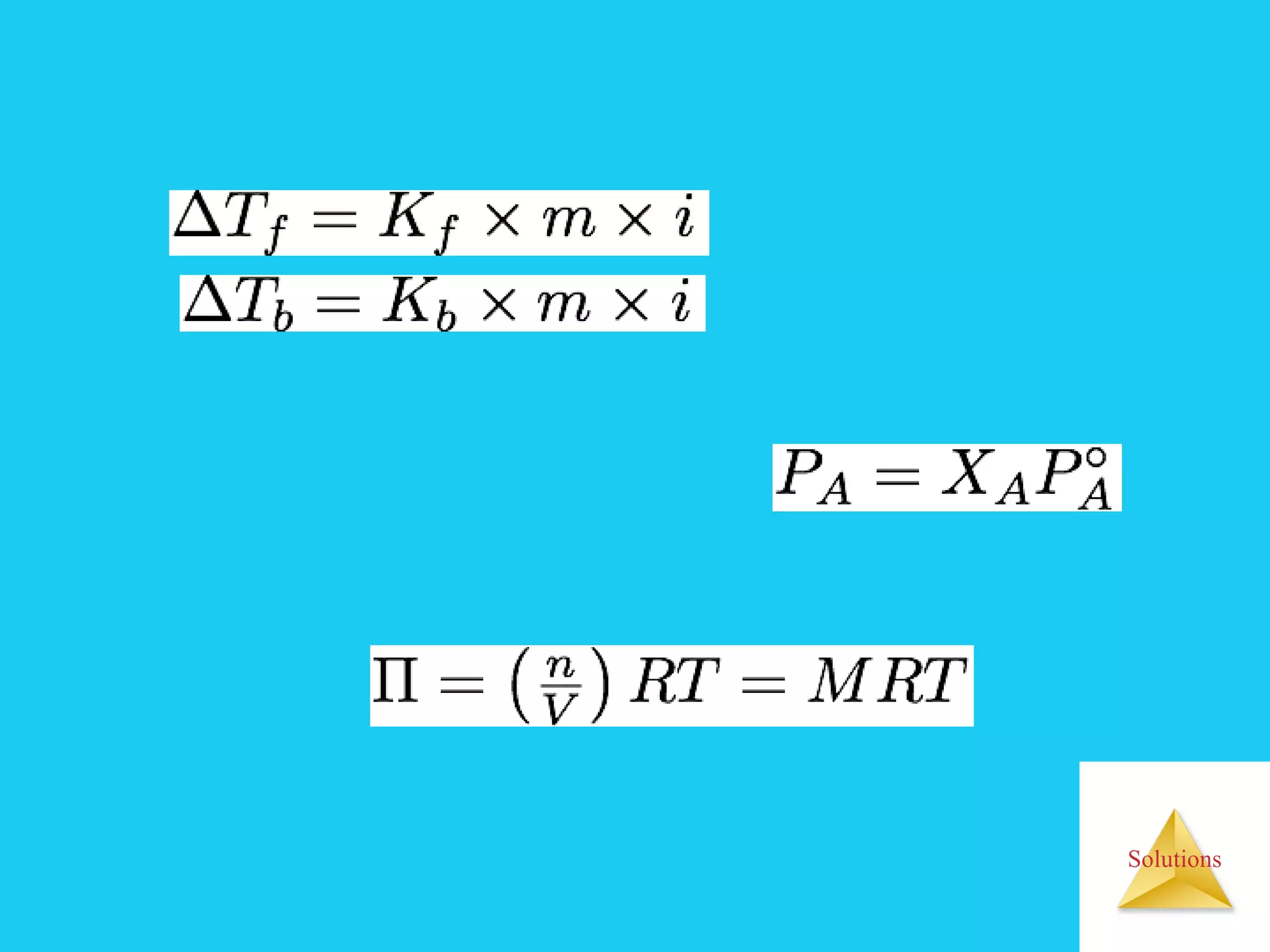
∆Tf = Kf  m  i
i = 1 for non-elecrtolytes
Solutions
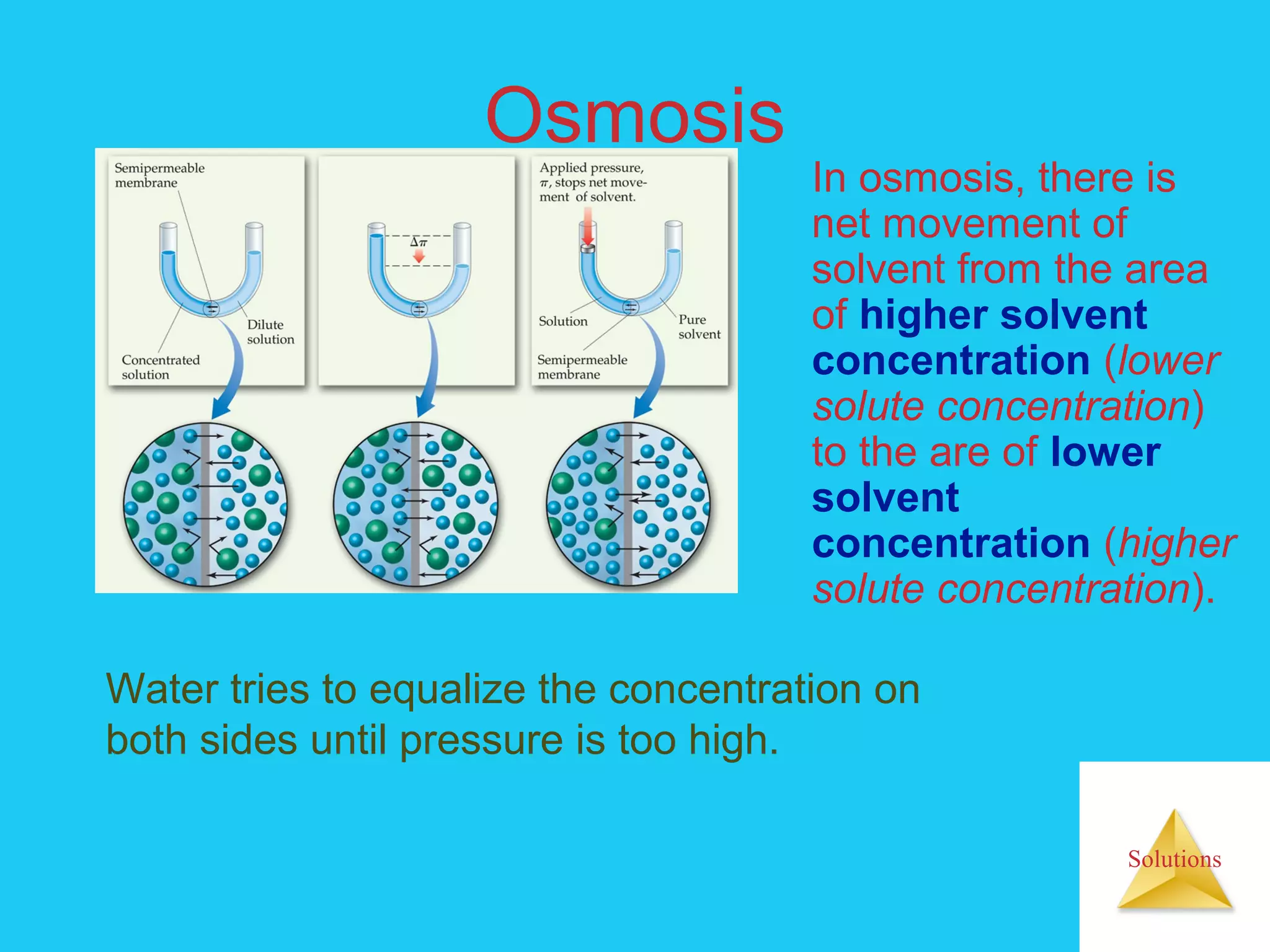
Osmosis
• Semipermeable membranes allow
some particles to pass through while
blocking others.
• In biological systems, most
semipermeable membranes (such as
cell walls) allow water to pass through,
but block solutes.
Solutions
Osmosis
In osmosis, there is
net movement of
solvent from the area
of higher solvent
concentration (lower
solute concentration)
to the are of lower
solvent
concentration (higher
solute concentration).
Water tries to equalize the concentration on
both sides until pressure is too high.
Solutions
Osmotic Pressure
• The pressure required to stop osmosis,
known as osmotic pressure, π, is
n
V
π = ( )RT = MRT
where M is the molarity of the solution
If the osmotic pressure is the same on both sides
of a membrane (i.e., the concentrations are the
same), the solutions are isotonic.
Solutions
Osmosis in Blood Cells
• If the solute
concentration outside
the cell is greater than
that inside the cell, the
solution is hypertonic.
• Water will flow out of
the cell, and crenation
results.
Solutions
Osmosis in Cells
• If the solute
concentration outside
the cell is less than
that inside the cell, the
solution is hypotonic.
• Water will flow into the
cell, and hemolysis
results.
Solutions
Solutions
Tyndall Effect
• Colloidal suspensions
can scatter rays of light.
• This phenomenon is
known as the Tyndall
effect.

Solution chemistry enthalpy

  • 1.
  • 2.
    Solutions Solutions How does asolid dissolve into a liquid? What ‘drives’ the dissolution process? What are the energetics of dissolution?
  • 3.
    Solutions How Does aSolution Form? 1. Solvent molecules attracted to surface ions. 2. Each ion is surrounded by solvent molecules. 3. Enthalpy (∆H) changes with each interaction broken or formed. Ionic solid dissolving in water
  • 4.
    Solutions How Does aSolution Form? 1. Solvent molecules attracted to surface ions. 2. Each ion is surrounded by solvent molecules. 3. Enthalpy (∆H) changes with each interaction broken or formed.
  • 5.
    Solutions How Does aSolution Form The ions are solvated (surrounded by solvent). If the solvent is water, the ions are hydrated. The intermolecular force here is ion- dipole.
  • 6.
    Solutions What is enthalpy •a thermodynamic quantity equivalent to the total heat content of a system. It is equal to the internal energy of the system plus the product of pressure and volume
  • 7.
    Solutions Energy Changes inSolution To determine the enthalpy change, we divide the process into 3 steps. 1. Separation of solute particles. 2. Separation of solvent particles to make ‘holes’. 3. Formation of new interactions between solute and solvent.
  • 8.
    Solutions Enthalpy Changes inSolution The enthalpy change of the overall process depends on ∆H for each of these steps. Start End EndStart
  • 9.
    Solutions Enthalpy changes duringdissolution The enthalpy of solution, ∆Hsoln, can be either positive or negative. ∆Hsoln = ∆H1 + ∆H2 + ∆H3 ∆Hsoln (MgSO4)= -91.2 kJ/mol --> exothermic ∆Hsoln (NH4NO3)= 26.4 kJ/mol --> endothermic
  • 10.
    Solutions Why do endothermicprocesses sometimes occur spontaneously? Some processes, like the dissolution of NH4NO3 in water, are spontaneous at room temperature even though heat is absorbed, not released.
  • 11.
    Solutions Enthalpy Is OnlyPart of the Picture Entropy is a measure of: • Dispersal of energy in the system. • Number of microstates (arrangements) in the system. b. has greater entropy, ∴ is the favored state (more on this in chap 19)
  • 12.
    Solutions Entropy changes duringdissolution Each step also involves a change in entropy. 1. Separation of solute particles. 2. Separation of solvent particles to make ‘holes’. 3. Formation of new interactions between solute and solvent.
  • 13.
    Solutions SAMPLE EXERCISE: AssessingEntropy Change In the process illustrated below, water vapor reacts with excess solid sodium sulfate to form the hydrated form of the salt. The chemical reaction is Does the entropy of the system increase or decrease?
  • 14.
    Solutions Factors Affecting Solubility Thestronger the intermolecular attractions between solute and solvent, the more likely the solute will dissolve.Example: ethanol in water Ethanol = CH3CH2OH Intermolecular forces = H-bonds; dipole-dipole; dispersion Ions in water also have ion-dipole forces.
  • 15.
    Solutions Factors Affecting Solubility Glucose(which has hydrogen bonding) is very soluble in water. Cyclohexane (which only has dispersion forces) is not water- soluble.
  • 16.
    Solutions Factors Affecting Solubility •Vitamin A is soluble in nonpolar compounds (like fats). • Vitamin C is soluble in water.
  • 17.
  • 18.
    Solutions Gases in Solution •In general, the solubility of gases in water increases with increasing mass. Why? • Larger molecules have stronger dispersion forces.
  • 19.
    Solutions Gases in Solution •The solubility of liquids and solids does not change appreciably with pressure. • But, the solubility of a gas in a liquid is directly proportional to its pressure. Increasing pressure above solution forces more gas to dissolve.
  • 20.
    Solutions Henry’s Law Sg =kPg where • Sg is the solubility of the gas; • k is the Henry’s law constant for that gas in that solvent; • Pg is the partial pressure of the gas above the liquid.
  • 21.
    Solutions Ways of ExpressingWaysof Expressing Concentrations ofConcentrations of SolutionsSolutions
  • 22.
    Solutions Mass Percentage Mass %of A = mass of A in solution total mass of solution × 100
  • 23.
    Solutions Parts per Millionand Parts per Billion ppm = mass of A in solution total mass of solution × 106 Parts per Million (ppm) Parts per Billion (ppb) ppb = mass of A in solution total mass of solution × 109
  • 24.
  • 25.
    Solutions Boiling Point Elevationand Freezing Point Depression Solute-solvent interactions also cause solutions to have higher boiling points and lower freezing points than the pure solvent.
  • 26.
    Solutions Colligative Properties of Electrolytes Becausethese properties depend on the number of particles dissolved, solutions of electrolytes (which dissociate in solution) show greater changes than those of nonelectrolytes. e.g. NaCl dissociates to form 2 ion particles; its limiting van’t Hoff factor is 2.
  • 27.
    Solutions Colligative Properties of Electrolytes However,a 1 M solution of NaCl does not show twice the change in freezing point that a 1 M solution of methanol does. It doesn’t act like there are really 2 particles.
  • 28.
    Solutions van’t Hoff Factor Onemole of NaCl in water does not really give rise to two moles of ions.
  • 29.
    Solutions van’t Hoff Factor SomeNa+ and Cl− reassociate as hydrated ion pairs, so the true concentration of particles is somewhat less than two times the concentration of NaCl.
  • 30.
    Solutions The van’t HoffFactor • Reassociation is more likely at higher concentration. • Therefore, the number of particles present is concentration dependent.
  • 31.
    Solutions The van’t HoffFactor We modify the previous equations by multiplying by the van’t Hoff factor, i ∆Tf = Kf  m  i i = 1 for non-elecrtolytes
  • 32.
    Solutions Osmosis • Semipermeable membranesallow some particles to pass through while blocking others. • In biological systems, most semipermeable membranes (such as cell walls) allow water to pass through, but block solutes.
  • 33.
    Solutions Osmosis In osmosis, thereis net movement of solvent from the area of higher solvent concentration (lower solute concentration) to the are of lower solvent concentration (higher solute concentration). Water tries to equalize the concentration on both sides until pressure is too high.
  • 34.
    Solutions Osmotic Pressure • Thepressure required to stop osmosis, known as osmotic pressure, π, is n V π = ( )RT = MRT where M is the molarity of the solution If the osmotic pressure is the same on both sides of a membrane (i.e., the concentrations are the same), the solutions are isotonic.
  • 35.
    Solutions Osmosis in BloodCells • If the solute concentration outside the cell is greater than that inside the cell, the solution is hypertonic. • Water will flow out of the cell, and crenation results.
  • 36.
    Solutions Osmosis in Cells •If the solute concentration outside the cell is less than that inside the cell, the solution is hypotonic. • Water will flow into the cell, and hemolysis results.
  • 37.
  • 38.
    Solutions Tyndall Effect • Colloidalsuspensions can scatter rays of light. • This phenomenon is known as the Tyndall effect.

Editor's Notes

  • #18 Figure: 13-32-03UNE13.06 Title: Exercise 13.6 Caption: Vitamins E and B6.