1
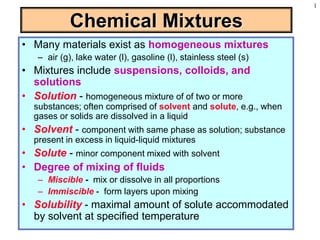
Chemical Mixtures
• Many materials exist as homogeneous mixtures
– air (g), lake water (l), gasoline (l), stainless steel (s)
• Mixtures include suspensions, colloids, and
solutions
• Solution - homogeneous mixture of of two or more
substances; often comprised of solvent and solute, e.g., when
gases or solids are dissolved in a liquid
• Solvent - component with same phase as solution; substance
present in excess in liquid-liquid mixtures
• Solute - minor component mixed with solvent
• Degree of mixing of fluids
– Miscible - mix or dissolve in all proportions
– Immiscible - form layers upon mixing
• Solubility - maximal amount of solute accommodated
by solvent at specified temperature
2
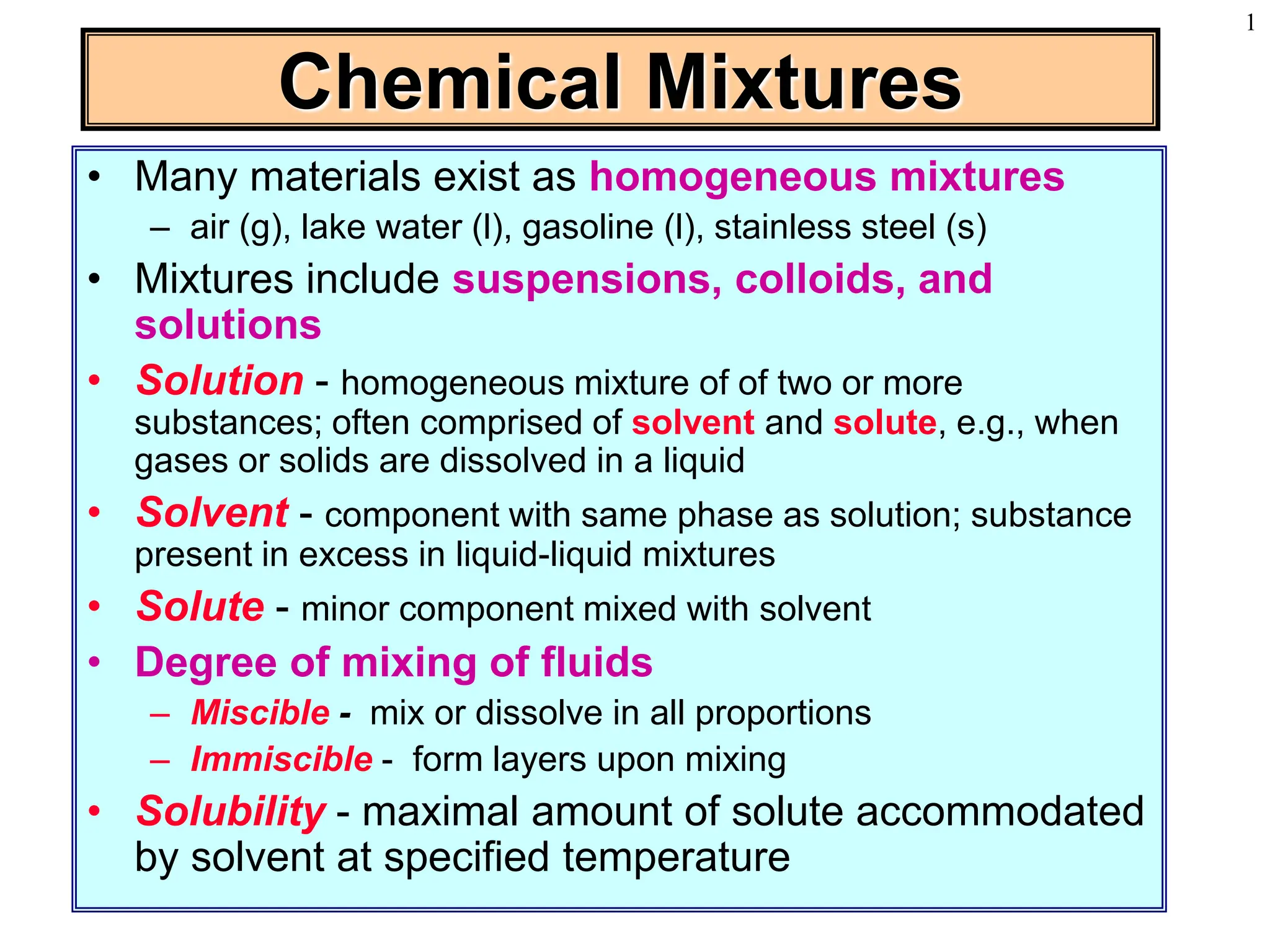
Molecular Forces
• All condensed matter has intermolecular attractive
forces (IAFs) between particles (formula units, ions,
molecules)
• Predominant attractive forces
• Coulombic - attraction of oppositely charged
particles
• van der Waals forces: a. dispersion (London);
b. dipole-dipole; c. ion-dipole
• Hydrogen-bonding
• Solutions form when it is energetically favorable
• Solutions form when substances with similar IAFs are
mixed: “like dissolves like,” compounds of like polarity
are most compatible
3
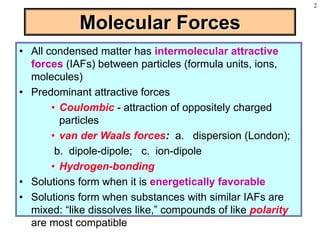
Lattice and Hydration Energies
• Lattice Energy – energy of attraction between
counter ions in an ionic solid (Coulombic forces)
– Lattice bonds must be broken to separate ions in
solid
– IAF must be broken to separate solvent (water)
molecules; this involves breaking hydrogen bond
network between water molecules
• Hydration Energy – New IAF formed between
ions and water molecules; involves forming ion-
dipole bonds
– Water orients around released ions according to
polarity
4
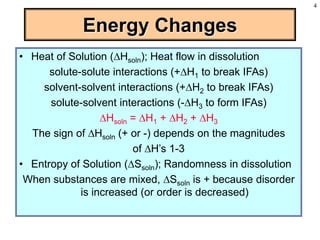
Energy Changes
• Heat of Solution (Hsoln); Heat flow in dissolution
solute-solute interactions (+H1 to break IFAs)
solvent-solvent interactions (+H2 to break IFAs)
solute-solvent interactions (-H3 to form IFAs)
Hsoln = H1 + H2 + H3
The sign of Hsoln (+ or -) depends on the magnitudes
of H’s 1-3
• Entropy of Solution (Ssoln); Randomness in dissolution
When substances are mixed, Ssoln is + because disorder
is increased (or order is decreased)
5
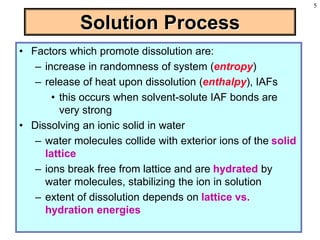
Solution Process
• Factors which promote dissolution are:
– increase in randomness of system (entropy)
– release of heat upon dissolution (enthalpy), IAFs
• this occurs when solvent-solute IAF bonds are
very strong
• Dissolving an ionic solid in water
– water molecules collide with exterior ions of the solid
lattice
– ions break free from lattice and are hydrated by
water molecules, stabilizing the ion in solution
– extent of dissolution depends on lattice vs.
hydration energies
6
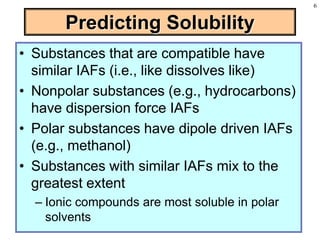
Predicting Solubility
• Substances that are compatible have
similar IAFs (i.e., like dissolves like)
• Nonpolar substances (e.g., hydrocarbons)
have dispersion force IAFs
• Polar substances have dipole driven IAFs
(e.g., methanol)
• Substances with similar IAFs mix to the
greatest extent
– Ionic compounds are most soluble in polar
solvents
7
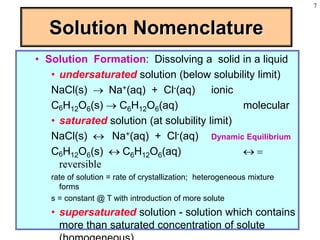
Solution Nomenclature
• Solution Formation: Dissolving a solid in a liquid
• undersaturated solution (below solubility limit)
NaCl(s) Na+(aq) + Cl-(aq) ionic
C6H12O6(s)  C6H12O6(aq) molecular
• saturated solution (at solubility limit)
NaCl(s)  Na+(aq) + Cl-(aq) Dynamic Equilibrium
C6H12O6(s)  C6H12O6(aq)  =
reversible
rate of solution = rate of crystallization; heterogeneous mixture
forms
s = constant @ T with introduction of more solute
• supersaturated solution - solution which contains
more than saturated concentration of solute
8
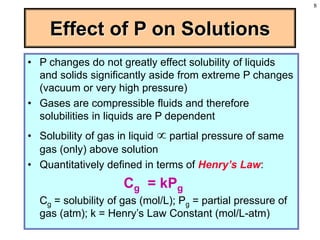
Effect of P on Solutions
• P changes do not greatly effect solubility of liquids
and solids significantly aside from extreme P changes
(vacuum or very high pressure)
• Gases are compressible fluids and therefore
solubilities in liquids are P dependent
• Solubility of gas in liquid  partial pressure of same
gas (only) above solution
• Quantitatively defined in terms of Henry’s Law:
Cg = kPg
Cg = solubility of gas (mol/L); Pg = partial pressure of
gas (atm); k = Henry’s Law Constant (mol/L-atm)
9
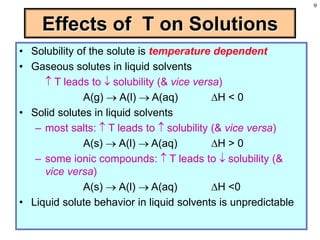
Effects of T on Solutions
• Solubility of the solute is temperature dependent
• Gaseous solutes in liquid solvents
 T leads to solubility (& vice versa)
A(g) A(l)  A(aq) H < 0
• Solid solutes in liquid solvents
– most salts:  T leads to solubility (& vice versa)
A(s) A(l)  A(aq) H > 0
– some ionic compounds:  T leads to solubility (&
vice versa)
A(s) A(l)  A(aq) H <0
• Liquid solute behavior in liquid solvents is unpredictable
10
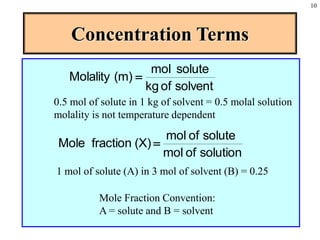
Concentration Terms
solvent
of
kg
solute
mol
(m)
Molality =
0.5 mol of solute in 1 kg of solvent = 0.5 molal solution
molality is not temperature dependent
solution
of
mol
solute
of
mol
(X)
fraction
Mole =
1 mol of solute (A) in 3 mol of solvent (B) = 0.25
Mole Fraction Convention:
A = solute and B = solvent
11
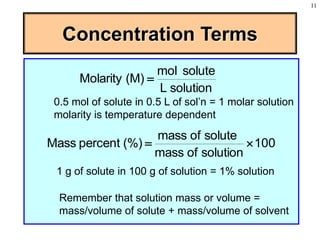
Concentration Terms
solution
L
solute
mol
(M)
Molarity =
0.5 mol of solute in 0.5 L of sol’n = 1 molar solution
molarity is temperature dependent
100
solution
of
mass
solute
of
mass
(%)
percent
Mass 
=
1 g of solute in 100 g of solution = 1% solution
Remember that solution mass or volume =
mass/volume of solute + mass/volume of solvent
12
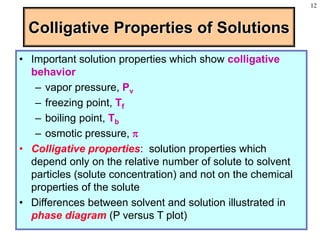
Colligative Properties of Solutions
• Important solution properties which show colligative
behavior
– vapor pressure, Pv
– freezing point, Tf
– boiling point, Tb
– osmotic pressure, 
• Colligative properties: solution properties which
depend only on the relative number of solute to solvent
particles (solute concentration) and not on the chemical
properties of the solute
• Differences between solvent and solution illustrated in
phase diagram (P versus T plot)
13
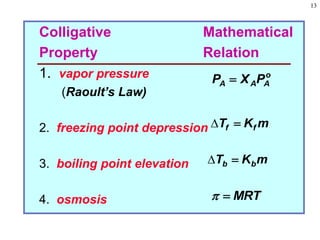
Colligative Mathematical
Property Relation
1. vapor pressure
(Raoult’s Law)
2. freezing point depression
3. boiling point elevation
4. osmosis
o
A
A
A P
X
P =
m
K
T f
f =

m
K
T b
b =

MRT
=

14
Vapor Pressure, Pv, and Vapor
Pressure Lowering, Pv
• Vapor pressure: partial pressure of vapor above
liquid
• Solution vapor pressure
– Examples include volatile solvent with non-volatile
solute and volatile solute and volatile solvent
– In example of non-volatile solute, vapor pressure
of solution proportional to concentration of solvent
Pv,A  [solvent A] = XAPo
A
As solvent concentration decreases, Pv decreases
– In example of volatile solute (B) and solvent (A)
PT = PA + PB = XAPo
A + XBPo
B
15
14
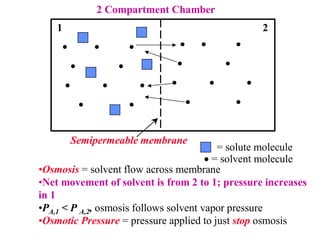
Semipermeable membrane
  
 
  
 
  
 
  
 
= solute molecule
 = solvent molecule
1 2
•Osmosis = solvent flow across membrane
•Net movement of solvent is from 2 to 1; pressure increases
in 1
•PA,1 < P A,2, osmosis follows solvent vapor pressure
•Osmotic Pressure = pressure applied to just stop osmosis
2 Compartment Chamber

1_Solution Chemistry.ppt

  • 1.
    1 Chemical Mixtures • Manymaterials exist as homogeneous mixtures – air (g), lake water (l), gasoline (l), stainless steel (s) • Mixtures include suspensions, colloids, and solutions • Solution - homogeneous mixture of of two or more substances; often comprised of solvent and solute, e.g., when gases or solids are dissolved in a liquid • Solvent - component with same phase as solution; substance present in excess in liquid-liquid mixtures • Solute - minor component mixed with solvent • Degree of mixing of fluids – Miscible - mix or dissolve in all proportions – Immiscible - form layers upon mixing • Solubility - maximal amount of solute accommodated by solvent at specified temperature
  • 2.
    2 Molecular Forces • Allcondensed matter has intermolecular attractive forces (IAFs) between particles (formula units, ions, molecules) • Predominant attractive forces • Coulombic - attraction of oppositely charged particles • van der Waals forces: a. dispersion (London); b. dipole-dipole; c. ion-dipole • Hydrogen-bonding • Solutions form when it is energetically favorable • Solutions form when substances with similar IAFs are mixed: “like dissolves like,” compounds of like polarity are most compatible
  • 3.
    3 Lattice and HydrationEnergies • Lattice Energy – energy of attraction between counter ions in an ionic solid (Coulombic forces) – Lattice bonds must be broken to separate ions in solid – IAF must be broken to separate solvent (water) molecules; this involves breaking hydrogen bond network between water molecules • Hydration Energy – New IAF formed between ions and water molecules; involves forming ion- dipole bonds – Water orients around released ions according to polarity
  • 4.
    4 Energy Changes • Heatof Solution (Hsoln); Heat flow in dissolution solute-solute interactions (+H1 to break IFAs) solvent-solvent interactions (+H2 to break IFAs) solute-solvent interactions (-H3 to form IFAs) Hsoln = H1 + H2 + H3 The sign of Hsoln (+ or -) depends on the magnitudes of H’s 1-3 • Entropy of Solution (Ssoln); Randomness in dissolution When substances are mixed, Ssoln is + because disorder is increased (or order is decreased)
  • 5.
    5 Solution Process • Factorswhich promote dissolution are: – increase in randomness of system (entropy) – release of heat upon dissolution (enthalpy), IAFs • this occurs when solvent-solute IAF bonds are very strong • Dissolving an ionic solid in water – water molecules collide with exterior ions of the solid lattice – ions break free from lattice and are hydrated by water molecules, stabilizing the ion in solution – extent of dissolution depends on lattice vs. hydration energies
  • 6.
    6 Predicting Solubility • Substancesthat are compatible have similar IAFs (i.e., like dissolves like) • Nonpolar substances (e.g., hydrocarbons) have dispersion force IAFs • Polar substances have dipole driven IAFs (e.g., methanol) • Substances with similar IAFs mix to the greatest extent – Ionic compounds are most soluble in polar solvents
  • 7.
    7 Solution Nomenclature • SolutionFormation: Dissolving a solid in a liquid • undersaturated solution (below solubility limit) NaCl(s) Na+(aq) + Cl-(aq) ionic C6H12O6(s)  C6H12O6(aq) molecular • saturated solution (at solubility limit) NaCl(s)  Na+(aq) + Cl-(aq) Dynamic Equilibrium C6H12O6(s)  C6H12O6(aq)  = reversible rate of solution = rate of crystallization; heterogeneous mixture forms s = constant @ T with introduction of more solute • supersaturated solution - solution which contains more than saturated concentration of solute
  • 8.
    8 Effect of Pon Solutions • P changes do not greatly effect solubility of liquids and solids significantly aside from extreme P changes (vacuum or very high pressure) • Gases are compressible fluids and therefore solubilities in liquids are P dependent • Solubility of gas in liquid  partial pressure of same gas (only) above solution • Quantitatively defined in terms of Henry’s Law: Cg = kPg Cg = solubility of gas (mol/L); Pg = partial pressure of gas (atm); k = Henry’s Law Constant (mol/L-atm)
  • 9.
    9 Effects of Ton Solutions • Solubility of the solute is temperature dependent • Gaseous solutes in liquid solvents  T leads to solubility (& vice versa) A(g) A(l)  A(aq) H < 0 • Solid solutes in liquid solvents – most salts:  T leads to solubility (& vice versa) A(s) A(l)  A(aq) H > 0 – some ionic compounds:  T leads to solubility (& vice versa) A(s) A(l)  A(aq) H <0 • Liquid solute behavior in liquid solvents is unpredictable
  • 10.
    10 Concentration Terms solvent of kg solute mol (m) Molality = 0.5mol of solute in 1 kg of solvent = 0.5 molal solution molality is not temperature dependent solution of mol solute of mol (X) fraction Mole = 1 mol of solute (A) in 3 mol of solvent (B) = 0.25 Mole Fraction Convention: A = solute and B = solvent
  • 11.
    11 Concentration Terms solution L solute mol (M) Molarity = 0.5mol of solute in 0.5 L of sol’n = 1 molar solution molarity is temperature dependent 100 solution of mass solute of mass (%) percent Mass  = 1 g of solute in 100 g of solution = 1% solution Remember that solution mass or volume = mass/volume of solute + mass/volume of solvent
  • 12.
    12 Colligative Properties ofSolutions • Important solution properties which show colligative behavior – vapor pressure, Pv – freezing point, Tf – boiling point, Tb – osmotic pressure,  • Colligative properties: solution properties which depend only on the relative number of solute to solvent particles (solute concentration) and not on the chemical properties of the solute • Differences between solvent and solution illustrated in phase diagram (P versus T plot)
  • 13.
    13 Colligative Mathematical Property Relation 1.vapor pressure (Raoult’s Law) 2. freezing point depression 3. boiling point elevation 4. osmosis o A A A P X P = m K T f f =  m K T b b =  MRT = 
  • 14.
    14 Vapor Pressure, Pv,and Vapor Pressure Lowering, Pv • Vapor pressure: partial pressure of vapor above liquid • Solution vapor pressure – Examples include volatile solvent with non-volatile solute and volatile solute and volatile solvent – In example of non-volatile solute, vapor pressure of solution proportional to concentration of solvent Pv,A  [solvent A] = XAPo A As solvent concentration decreases, Pv decreases – In example of volatile solute (B) and solvent (A) PT = PA + PB = XAPo A + XBPo B
  • 15.
    15 14 Semipermeable membrane                    = solute molecule  = solvent molecule 1 2 •Osmosis = solvent flow across membrane •Net movement of solvent is from 2 to 1; pressure increases in 1 •PA,1 < P A,2, osmosis follows solvent vapor pressure •Osmotic Pressure = pressure applied to just stop osmosis 2 Compartment Chamber