

Chemical Change
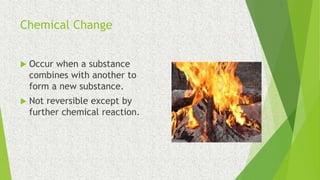
 Occur when a substance
combines with another to
form a new substance.
 Not reversible except by
further chemical reaction.
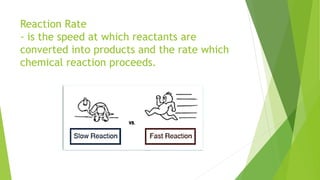
Reaction Rate
- is the speed at which reactants are
converted into products and the rate which
chemical reaction proceeds.
Collision Theory
 Is based on the assumption that for a
reaction to occur it is necessary for the
reacting species (atoms or molecules) to
come together or collide with one another.
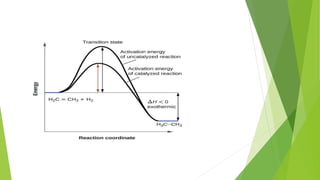
Activation energy, 𝐸𝑎
Serves as an energy barrier that
reactant molecules must overcome to
be converted to the products.
The lower the energy barrier, the
easier it is to form the products.
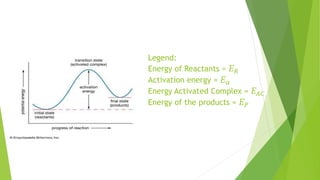
Legend:
Energy of Reactants = 𝐸𝑅
Activation energy = 𝐸𝑎
Energy Activated Complex = 𝐸𝐴𝐶
Energy of the products = 𝐸𝑃
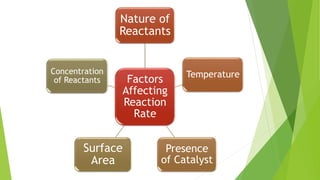
Factors
Affecting
Reaction
Rate
Nature of
Reactants
Temperature
Presence
of Catalyst
Surface
Area
Concentration
of Reactants
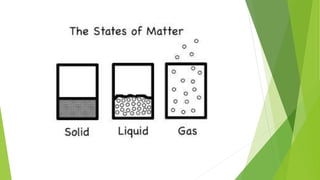
Nature of Reactants
 Individual properties also affect
reaction rates.
Reactants in Liquid and Gas phase
reacts faster than the reactants of
Solid.
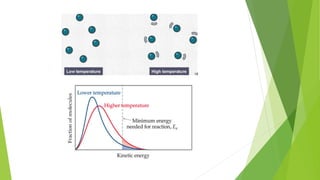
Effect of Temperature
 According to Kinetic Molecular Theory “as the
temperature increases, the average kinetic
energy of molecules also increases.
 It also increases the frequency of collisions.
 If the temperature of the reacting system is
increased, the reaction also increases.
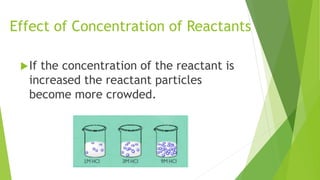
Effect of Concentration of Reactants
If the concentration of the reactant is
increased the reactant particles
become more crowded.
Surface Area
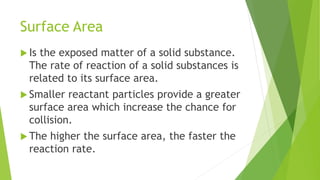
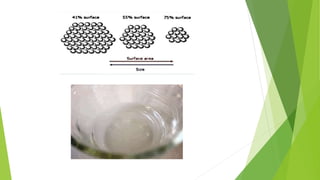
 Is the exposed matter of a solid substance.
The rate of reaction of a solid substances is
related to its surface area.
 Smaller reactant particles provide a greater
surface area which increase the chance for
collision.
 The higher the surface area, the faster the
reaction rate.
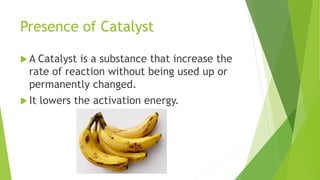
Presence of Catalyst
 A Catalyst is a substance that increase the
rate of reaction without being used up or
permanently changed.
 It lowers the activation energy.
Factors that affect Reaction Rates

Factors that affect Reaction Rates

  • 2.
    Chemical Change  Occurwhen a substance combines with another to form a new substance.  Not reversible except by further chemical reaction.
  • 3.
    Reaction Rate - isthe speed at which reactants are converted into products and the rate which chemical reaction proceeds.
  • 4.
    Collision Theory  Isbased on the assumption that for a reaction to occur it is necessary for the reacting species (atoms or molecules) to come together or collide with one another.
  • 5.
    Activation energy, 𝐸𝑎 Servesas an energy barrier that reactant molecules must overcome to be converted to the products. The lower the energy barrier, the easier it is to form the products.
  • 7.
    Legend: Energy of Reactants= 𝐸𝑅 Activation energy = 𝐸𝑎 Energy Activated Complex = 𝐸𝐴𝐶 Energy of the products = 𝐸𝑃
  • 8.
  • 9.
    Nature of Reactants Individual properties also affect reaction rates. Reactants in Liquid and Gas phase reacts faster than the reactants of Solid.
  • 11.
    Effect of Temperature According to Kinetic Molecular Theory “as the temperature increases, the average kinetic energy of molecules also increases.  It also increases the frequency of collisions.  If the temperature of the reacting system is increased, the reaction also increases.
  • 13.
    Effect of Concentrationof Reactants If the concentration of the reactant is increased the reactant particles become more crowded.
  • 15.
    Surface Area  Isthe exposed matter of a solid substance. The rate of reaction of a solid substances is related to its surface area.  Smaller reactant particles provide a greater surface area which increase the chance for collision.  The higher the surface area, the faster the reaction rate.
  • 17.
    Presence of Catalyst A Catalyst is a substance that increase the rate of reaction without being used up or permanently changed.  It lowers the activation energy.