COGNITIVE GRAMMAR
PEDAGOGY: THE CASE OF “FIND”


         NOORLINDA ALANG
              MEd TESL
         University of Malaya
This paper is presented in partial fulfillment
     of the requirements for the course
        General Linguistics for TESL
             Faculty of Education
             University of Malaya


   Dr. Jessie Grace U. Rubrico, Facilitator
   PBGS 6304, Semester 2, AY 2009-2010
                 April 2010
Linguistics

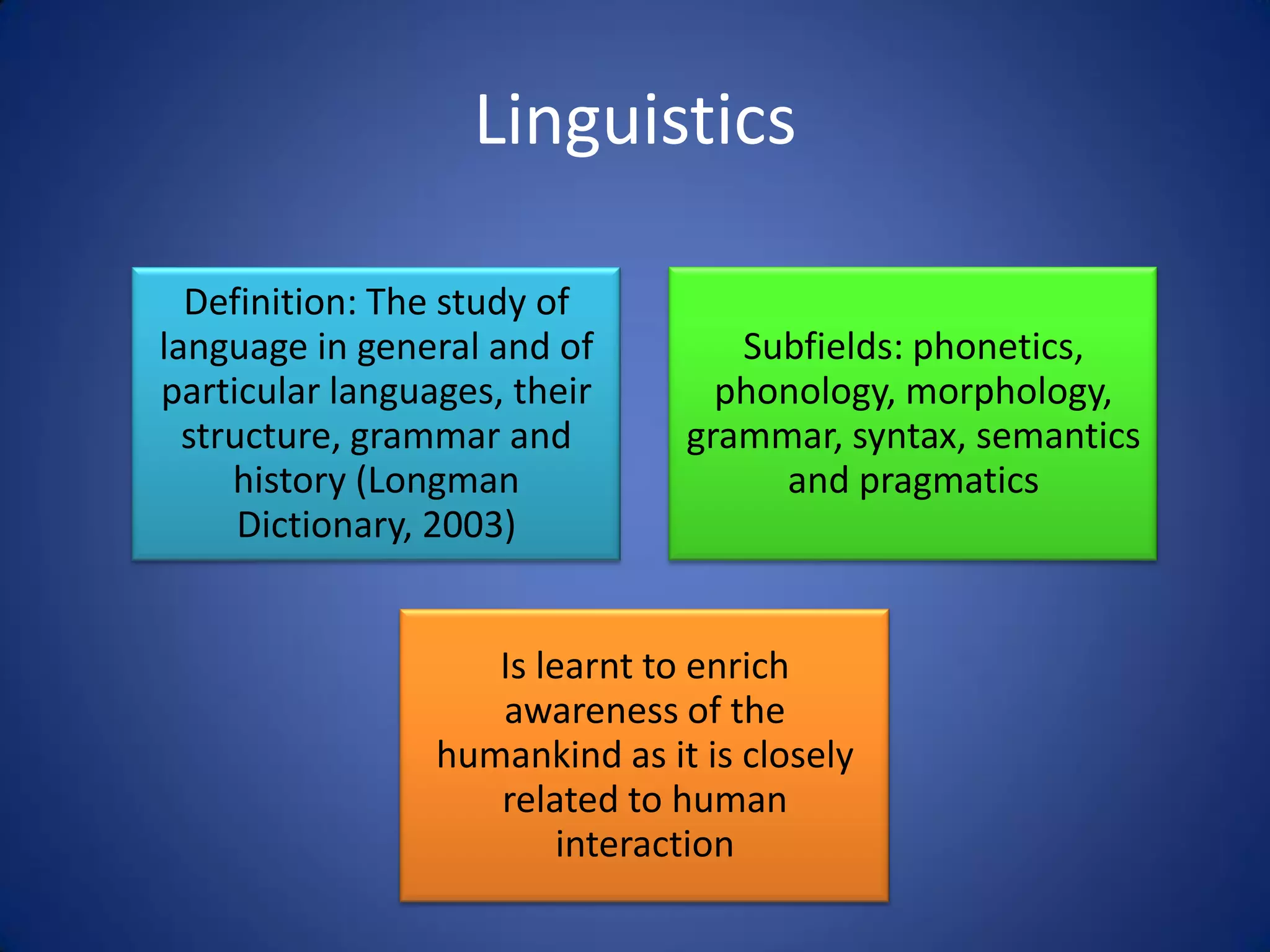
  Definition: The study of
language in general and of         Subfields: phonetics,
particular languages, their       phonology, morphology,
  structure, grammar and        grammar, syntax, semantics
     history (Longman                and pragmatics
      Dictionary, 2003)


                    Is learnt to enrich
                    awareness of the
                 humankind as it is closely
                    related to human
                         interaction
Cognitive Linguistics
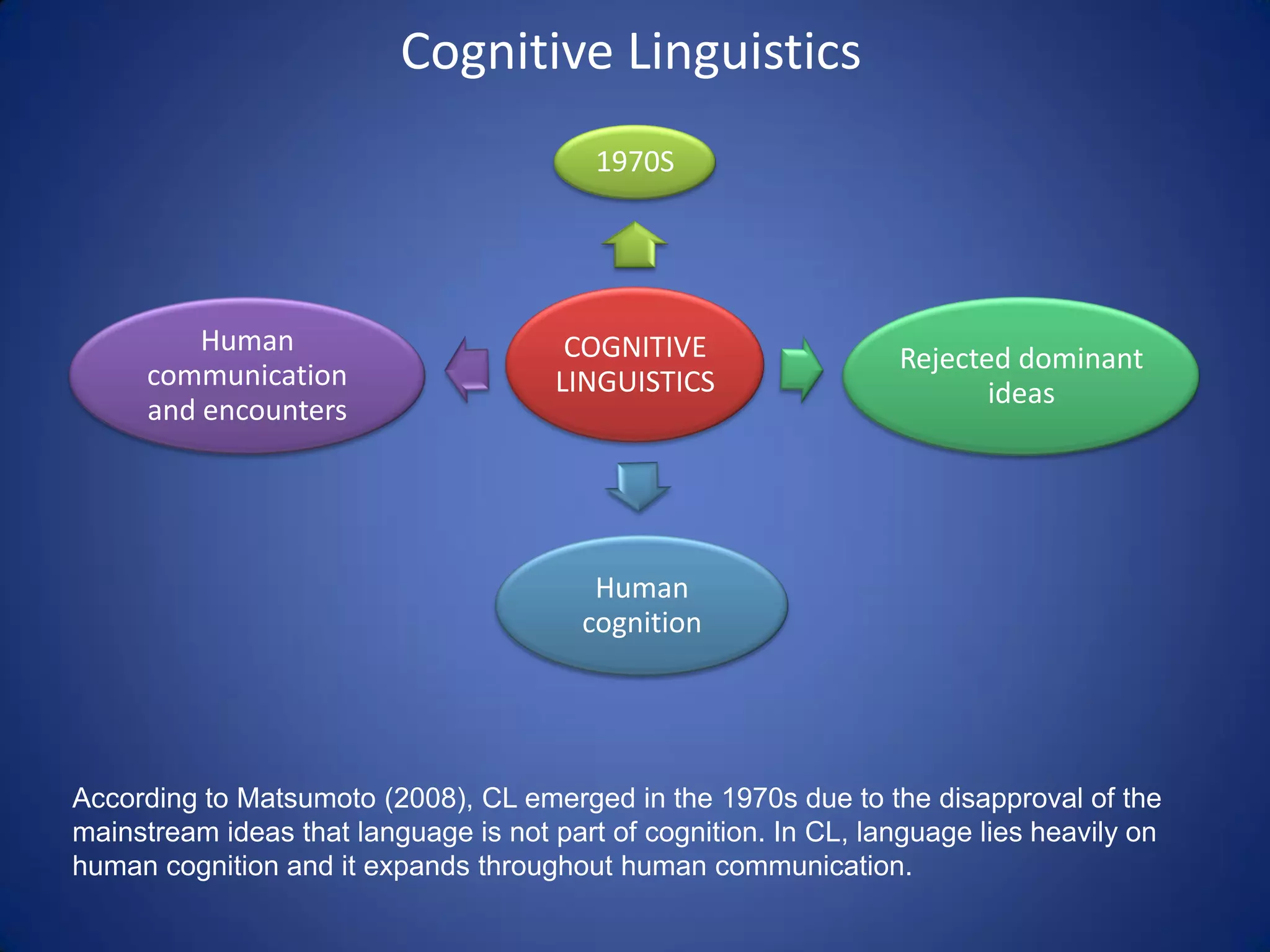
                                          1970S


          Human                         COGNITIVE                 Rejected dominant
      communication                    LINGUISTICS                       ideas
      and encounters


                                          Human
                                         cognition


According to Matsumoto (2008), CL emerged in the 1970s due to the disapproval of the
mainstream ideas that language is not part of cognition. In CL, language lies heavily on
human cognition and it expands throughout human communication.
Cognitive Linguistics: Concepts
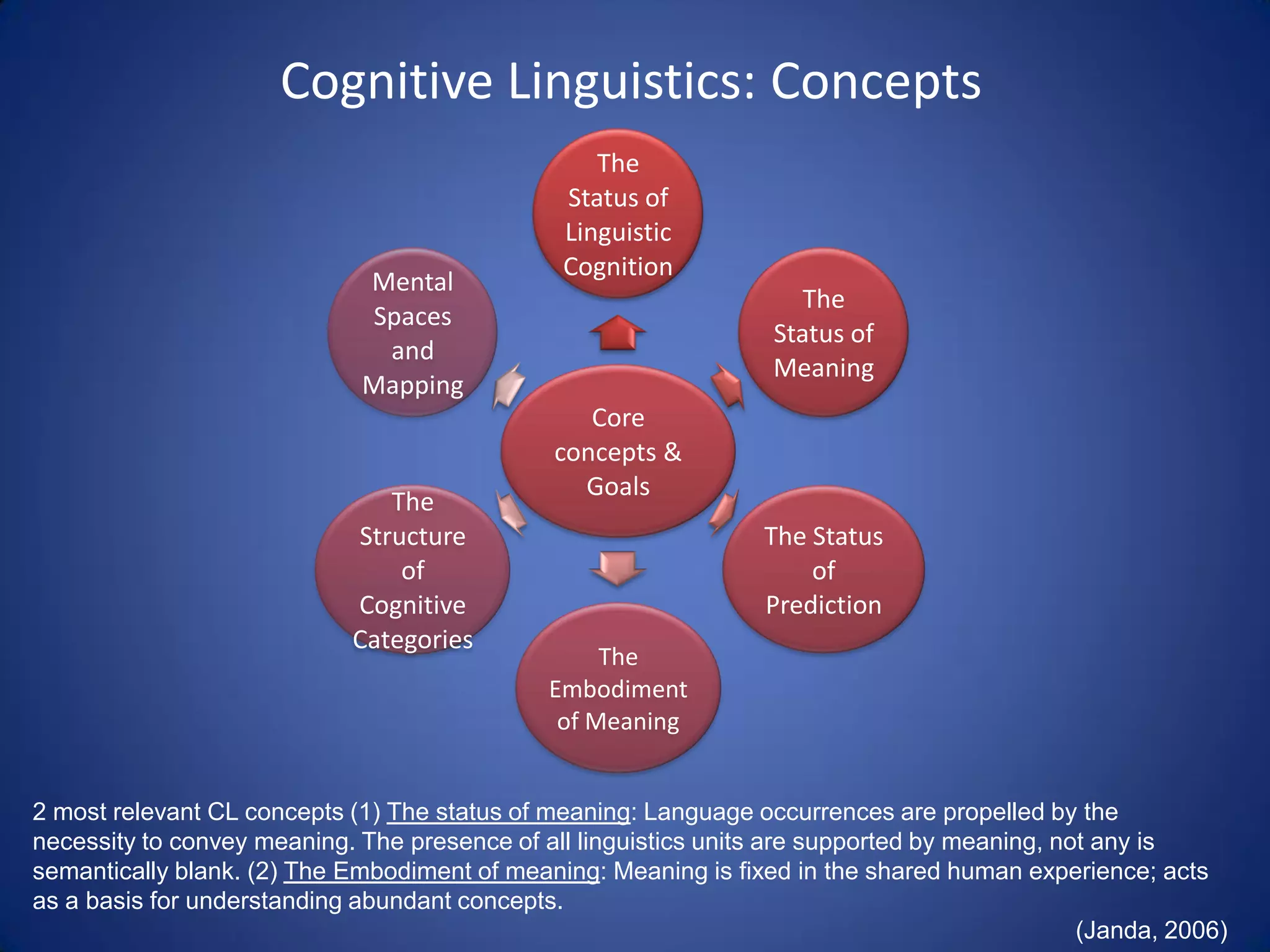
                                                  The
                                               Status of
                                               Linguistic
                                               Cognition
                             Mental
                                                                     The
                             Spaces
                                                                  Status of
                              and
                                                                  Meaning
                             Mapping
                                                  Core
                                               concepts &
                                                 Goals
                               The
                            Structure                             The Status
                                of                                    of
                            Cognitive                             Prediction
                            Categories
                                                   The
                                              Embodiment
                                               of Meaning


2 most relevant CL concepts (1) The status of meaning: Language occurrences are propelled by the
necessity to convey meaning. The presence of all linguistics units are supported by meaning, not any is
semantically blank. (2) The Embodiment of meaning: Meaning is fixed in the shared human experience; acts
as a basis for understanding abundant concepts.
                                                                                               (Janda, 2006)
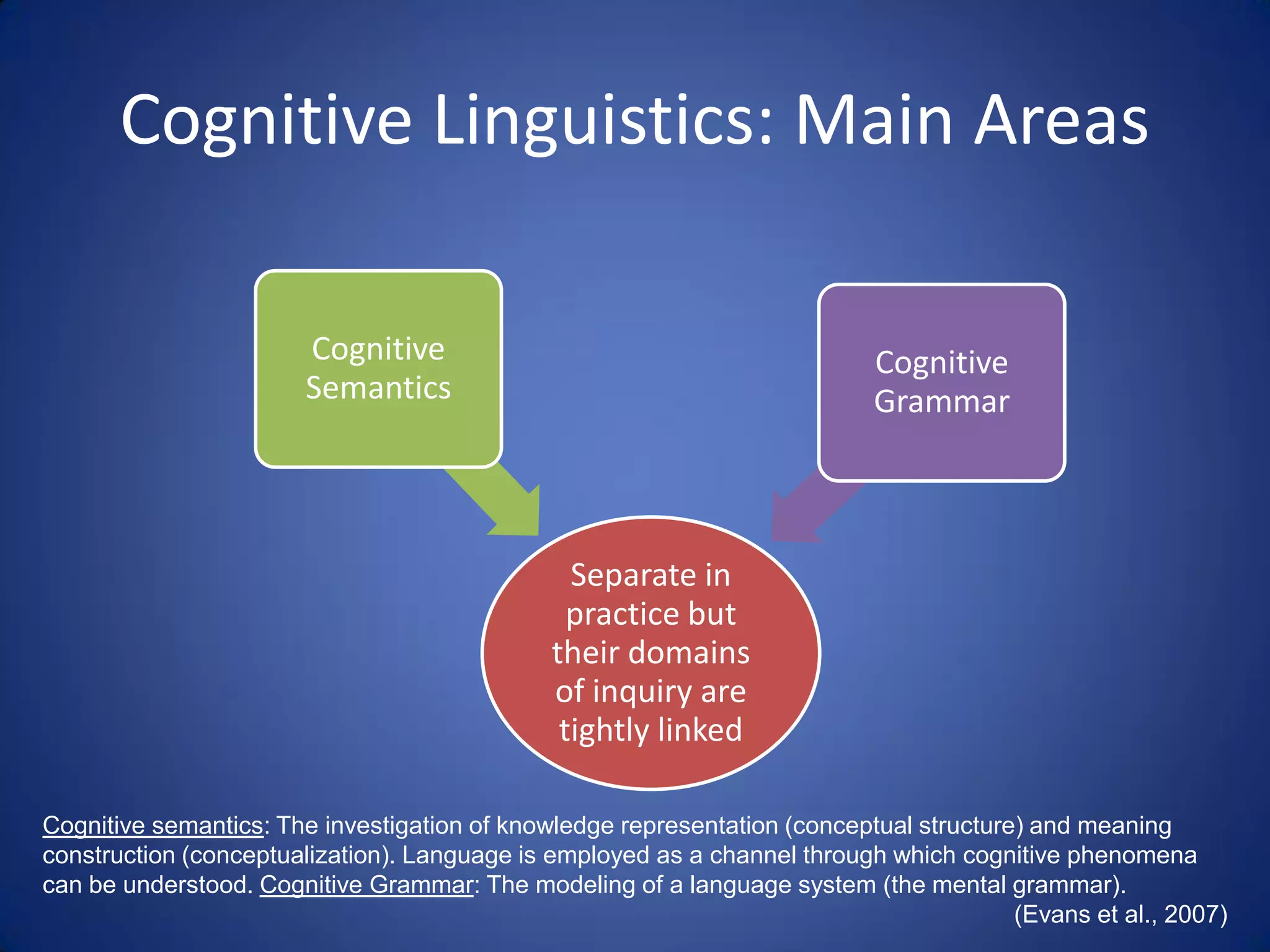
Cognitive Linguistics: Main Areas

                       Cognitive                                           Cognitive
                       Semantics                                           Grammar


                                                Separate in
                                                practice but
                                              their domains
                                              of inquiry are
                                               tightly linked

Cognitive semantics: The investigation of knowledge representation (conceptual structure) and meaning
construction (conceptualization). Language is employed as a channel through which cognitive phenomena
can be understood. Cognitive Grammar: The modeling of a language system (the mental grammar).
                                                                                        (Evans et al., 2007)
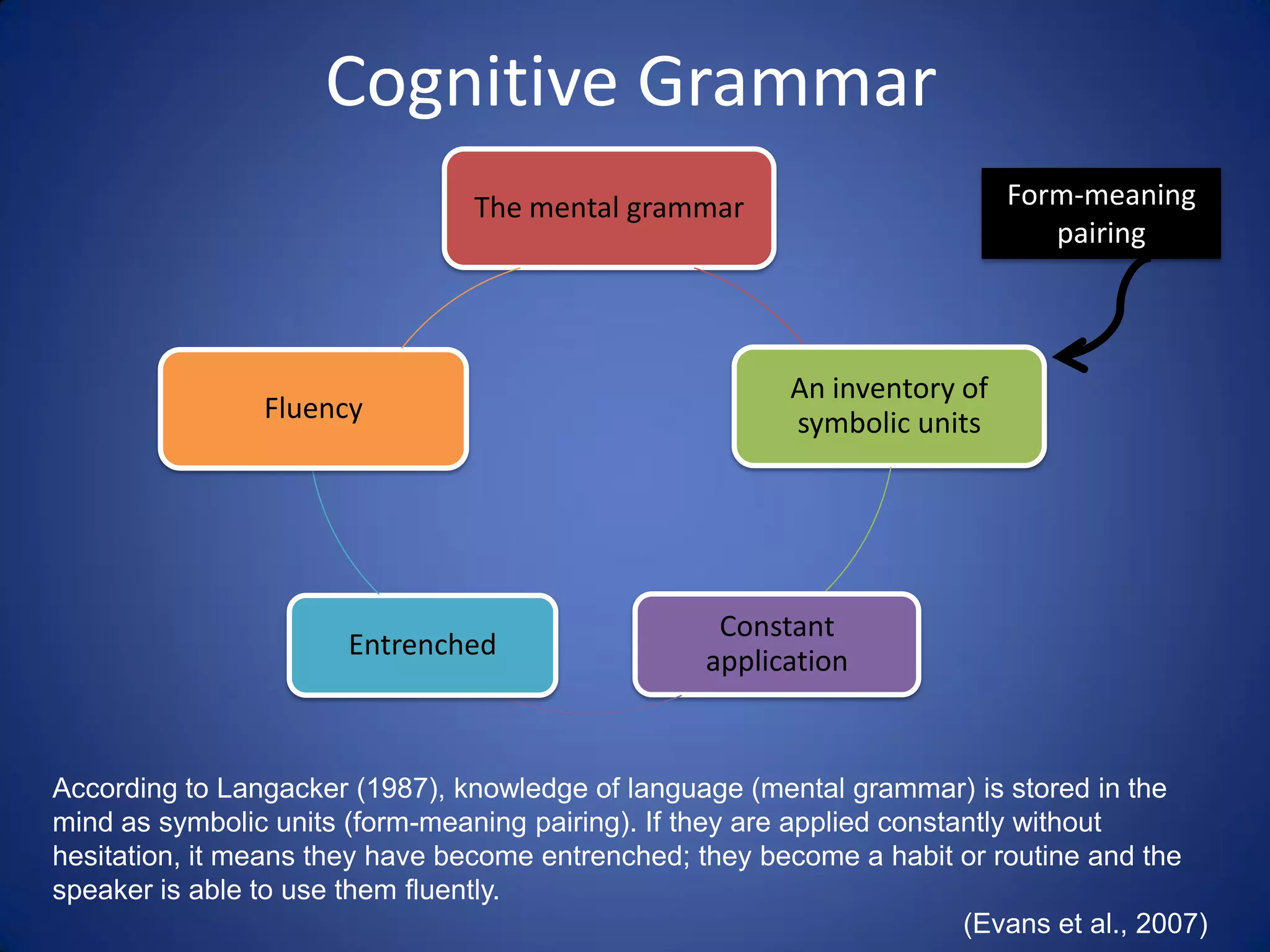
Cognitive Grammar
                                 The mental grammar                          Form-meaning
                                                                                pairing


                                                           An inventory of
                 Fluency                                   symbolic units


                                                     Constant
                       Entrenched
                                                    application


According to Langacker (1987), knowledge of language (mental grammar) is stored in the
mind as symbolic units (form-meaning pairing). If they are applied constantly without
hesitation, it means they have become entrenched; they become a habit or routine and the
speaker is able to use them fluently.
                                                                         (Evans et al., 2007)
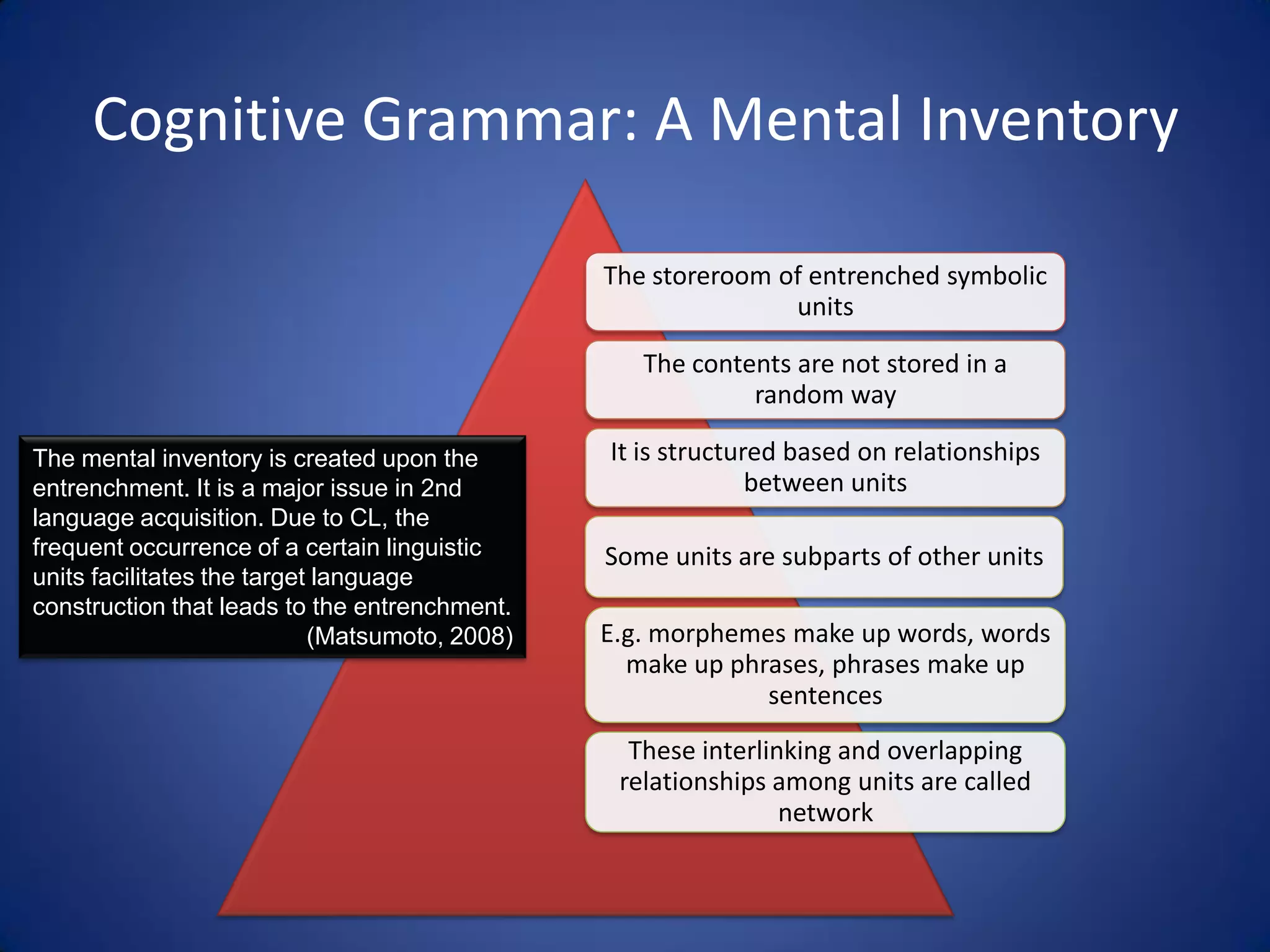
Cognitive Grammar: A Mental Inventory

                                                The storeroom of entrenched symbolic
                                                               units

                                                   The contents are not stored in a
                                                            random way

The mental inventory is created upon the        It is structured based on relationships
entrenchment. It is a major issue in 2nd                      between units
language acquisition. Due to CL, the
frequent occurrence of a certain linguistic     Some units are subparts of other units
units facilitates the target language
construction that leads to the entrenchment.
                            (Matsumoto, 2008)   E.g. morphemes make up words, words
                                                  make up phrases, phrases make up
                                                             sentences
                                                  These interlinking and overlapping
                                                 relationships among units are called
                                                                network
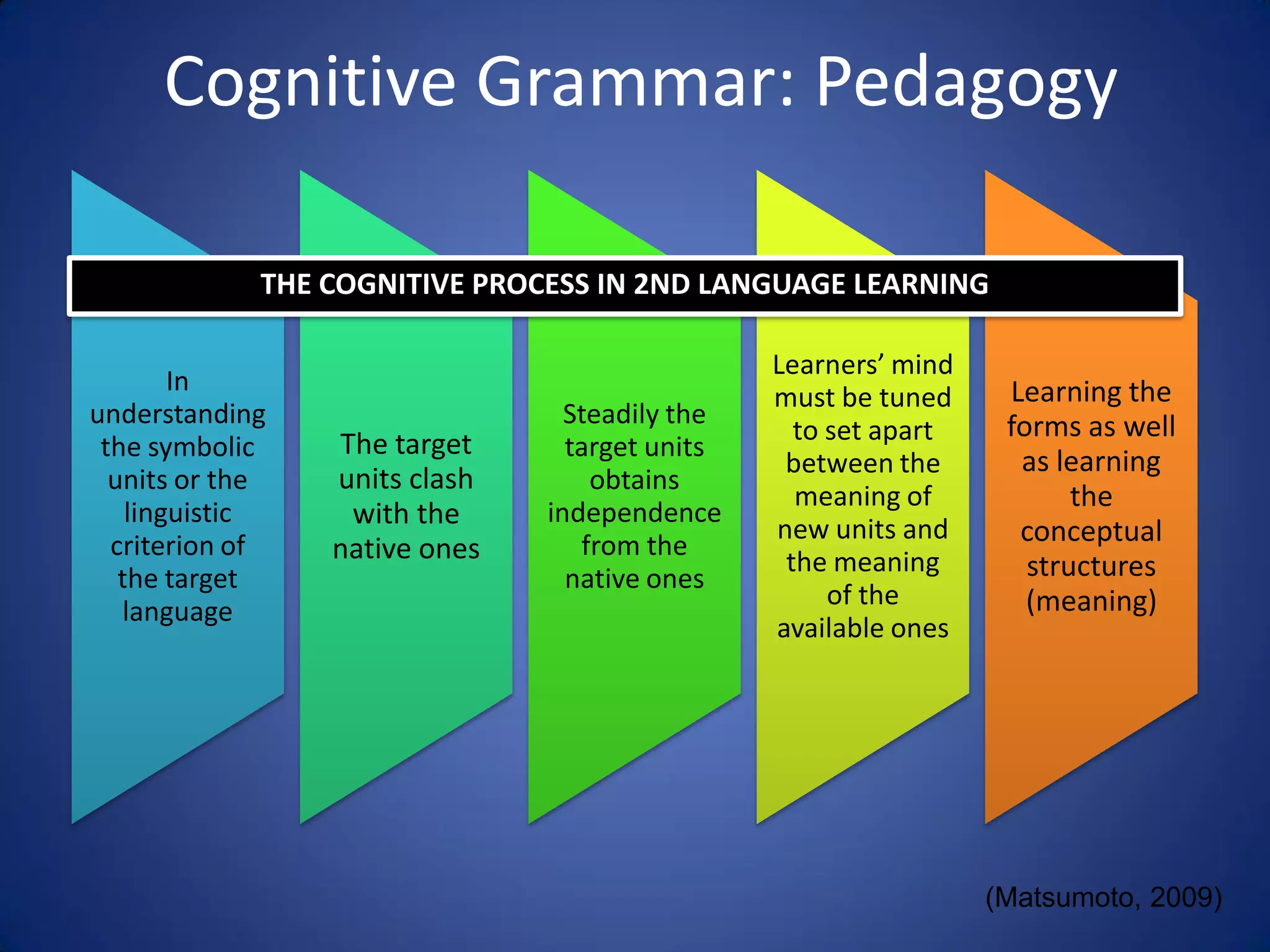
Cognitive Grammar: Pedagogy

             THE COGNITIVE PROCESS IN 2ND LANGUAGE LEARNING

                                                Learners’ mind
        In                                                        Learning the
                                                must be tuned
understanding                    Steadily the                     forms as well
                 The target                       to set apart
 the symbolic                    target units                      as learning
                                                 between the
  units or the   units clash       obtains
                                                  meaning of            the
    linguistic    with the     independence
                                                new units and      conceptual
  criterion of   native ones      from the
                                                 the meaning        structures
   the target                    native ones
                                                     of the         (meaning)
   language
                                                available ones


                                                                 (Matsumoto, 2009)
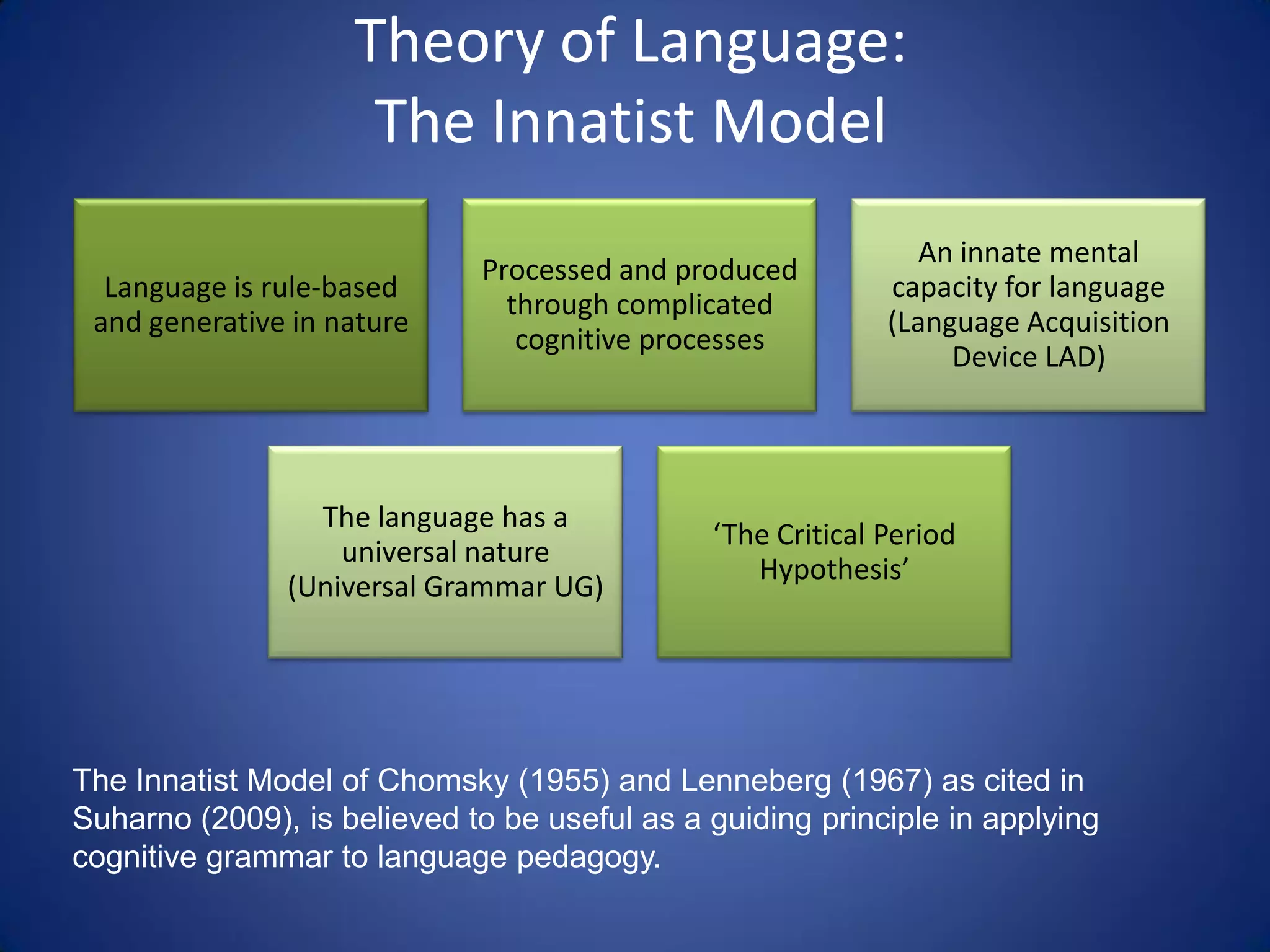
Theory of Language:
                     The Innatist Model
                                                              An innate mental
                             Processed and produced
  Language is rule-based                                    capacity for language
                               through complicated
 and generative in nature                                   (Language Acquisition
                                cognitive processes
                                                                 Device LAD)


                 The language has a
                                              ‘The Critical Period
                   universal nature
                                                 Hypothesis’
               (Universal Grammar UG)


The Innatist Model of Chomsky (1955) and Lenneberg (1967) as cited in
Suharno (2009), is believed to be useful as a guiding principle in applying
cognitive grammar to language pedagogy.
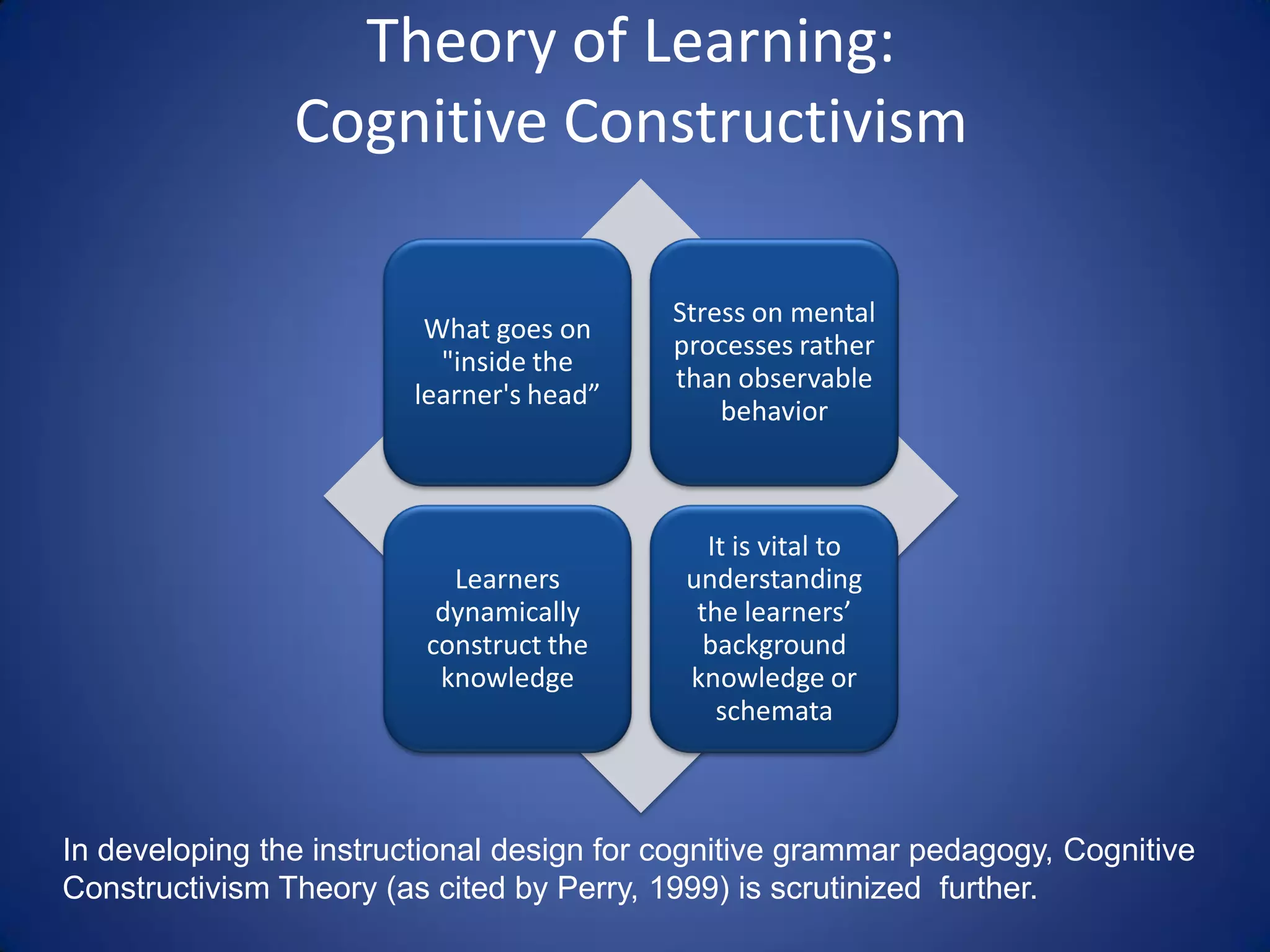
Theory of Learning:
                Cognitive Constructivism

                                           Stress on mental
                         What goes on
                                           processes rather
                          "inside the
                                           than observable
                        learner's head”
                                               behavior


                                              It is vital to
                           Learners         understanding
                          dynamically        the learners’
                         construct the        background
                          knowledge         knowledge or
                                               schemata


In developing the instructional design for cognitive grammar pedagogy, Cognitive
Constructivism Theory (as cited by Perry, 1999) is scrutinized further.
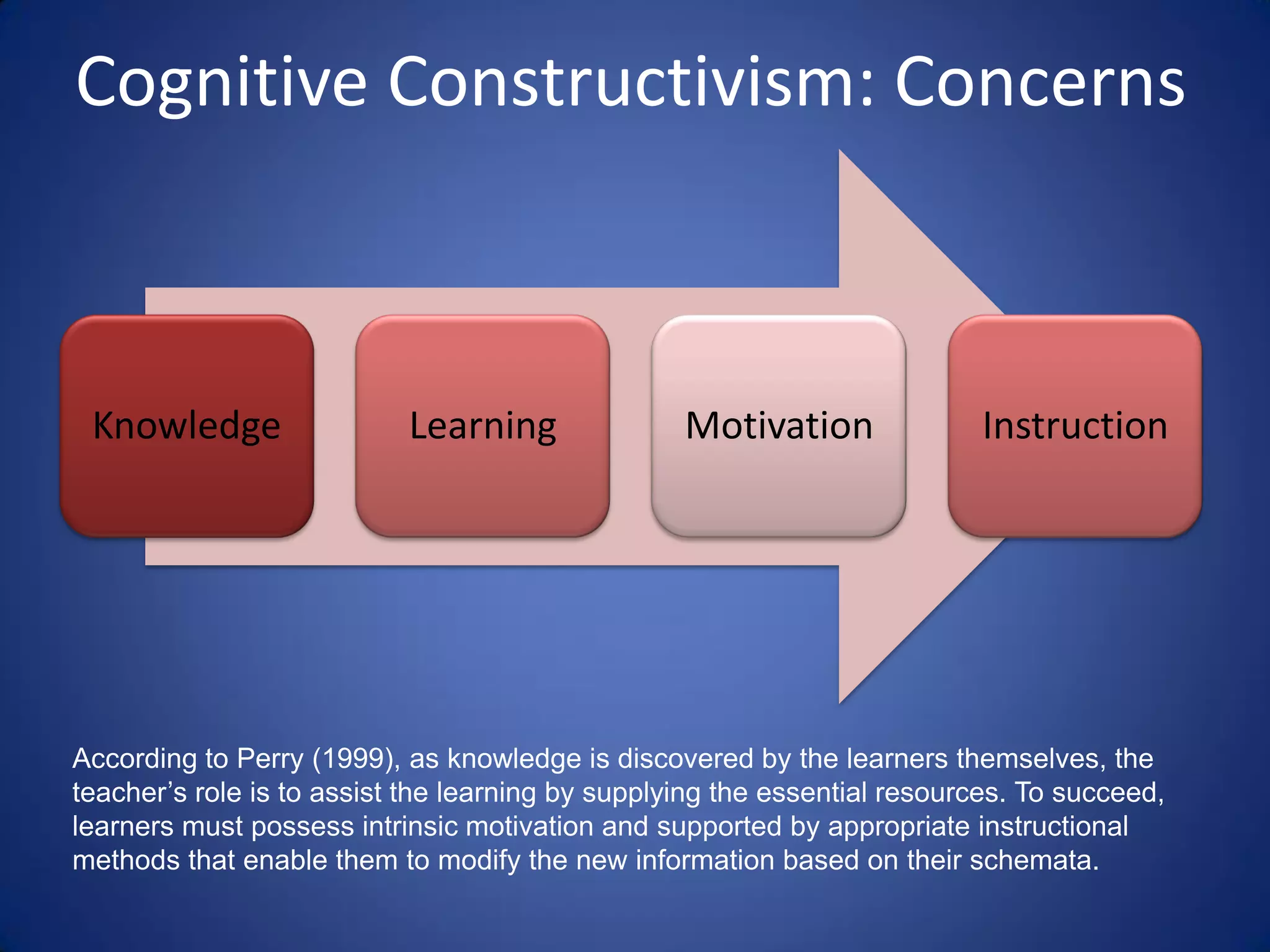
Cognitive Constructivism: Concerns


 Knowledge                 Learning               Motivation              Instruction


According to Perry (1999), as knowledge is discovered by the learners themselves, the
teacher’s role is to assist the learning by supplying the essential resources. To succeed,
learners must possess intrinsic motivation and supported by appropriate instructional
methods that enable them to modify the new information based on their schemata.
Cognitive Grammar:
  The Application
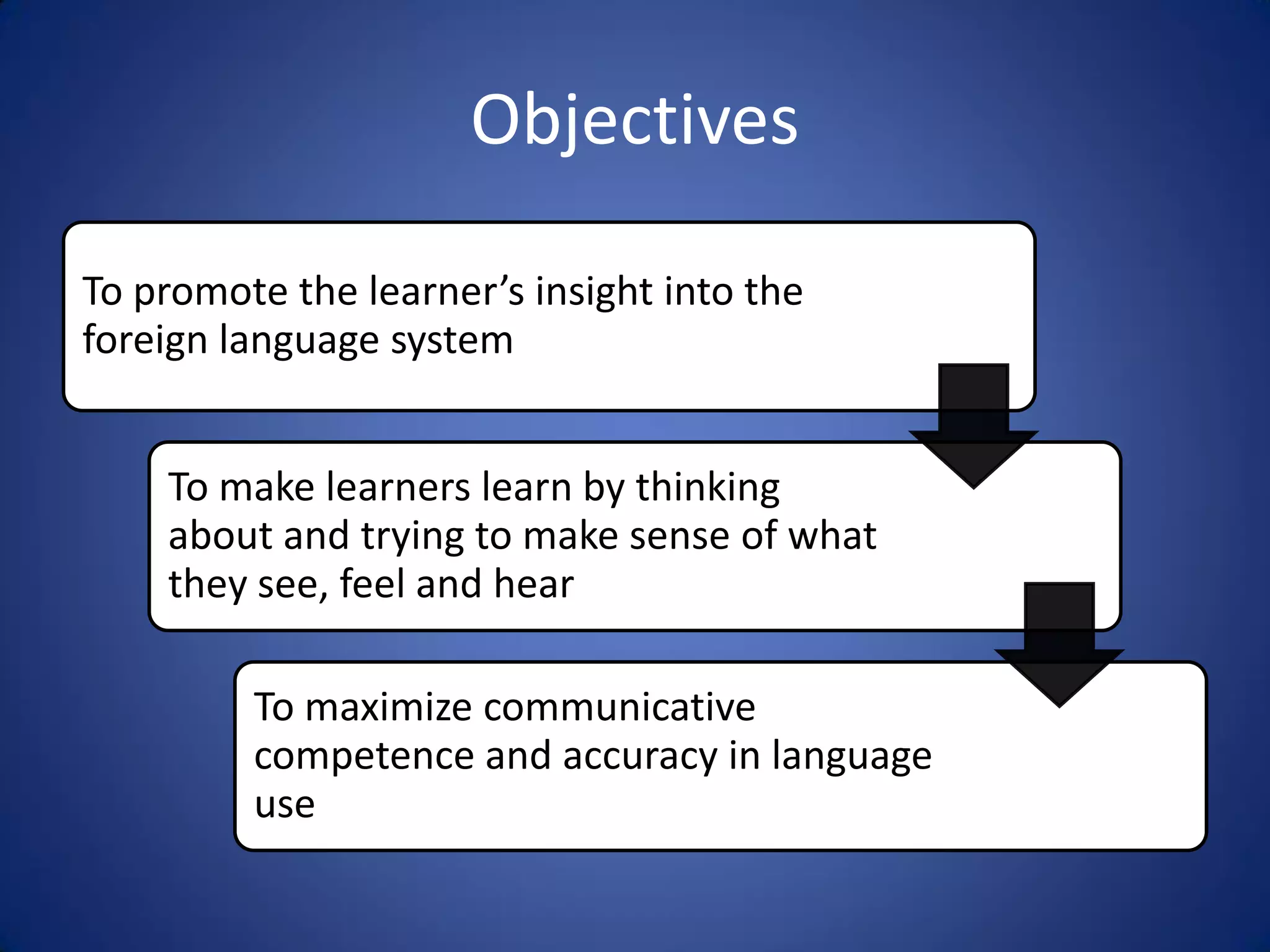
Objectives

To promote the learner’s insight into the
foreign language system


    To make learners learn by thinking
    about and trying to make sense of what
    they see, feel and hear

         To maximize communicative
         competence and accuracy in language
         use
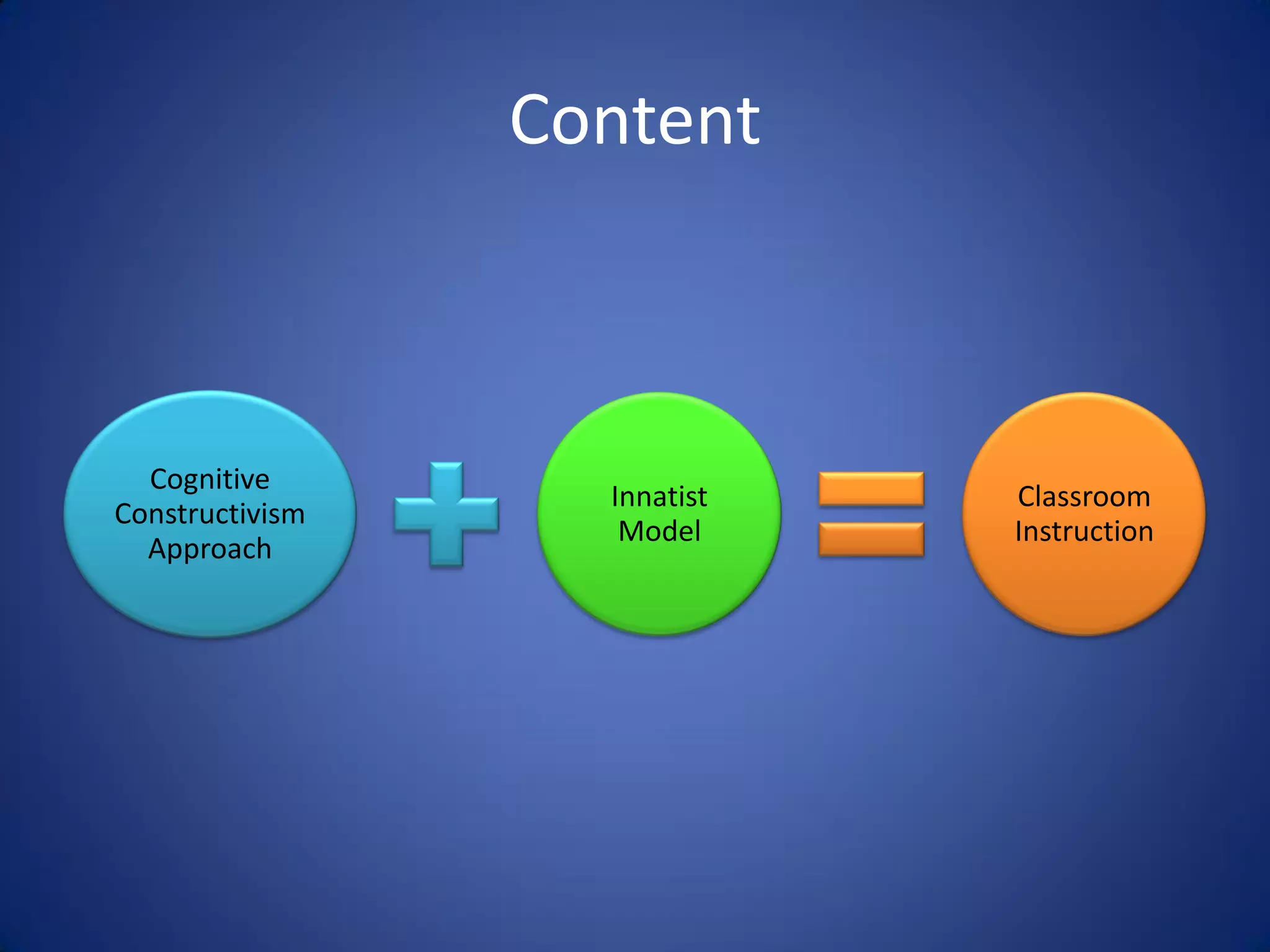
Content


  Cognitive
                   Innatist   Classroom
Constructivism
                    Model     Instruction
  Approach
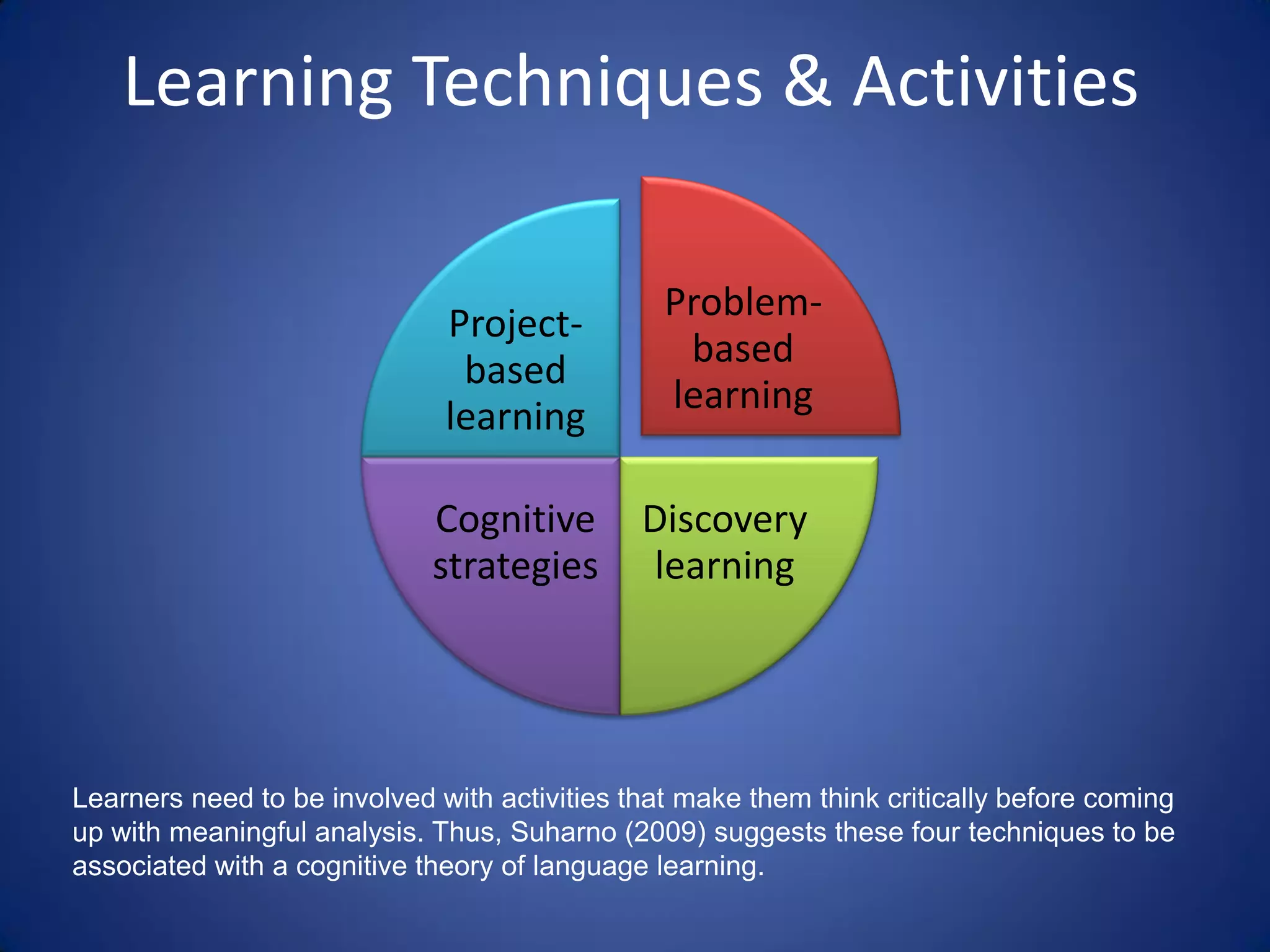
Learning Techniques & Activities

                                                Problem-
                              Project-
                                                 based
                               based
                                                learning
                              learning

                             Cognitive        Discovery
                             strategies       learning


Learners need to be involved with activities that make them think critically before coming
up with meaningful analysis. Thus, Suharno (2009) suggests these four techniques to be
associated with a cognitive theory of language learning.
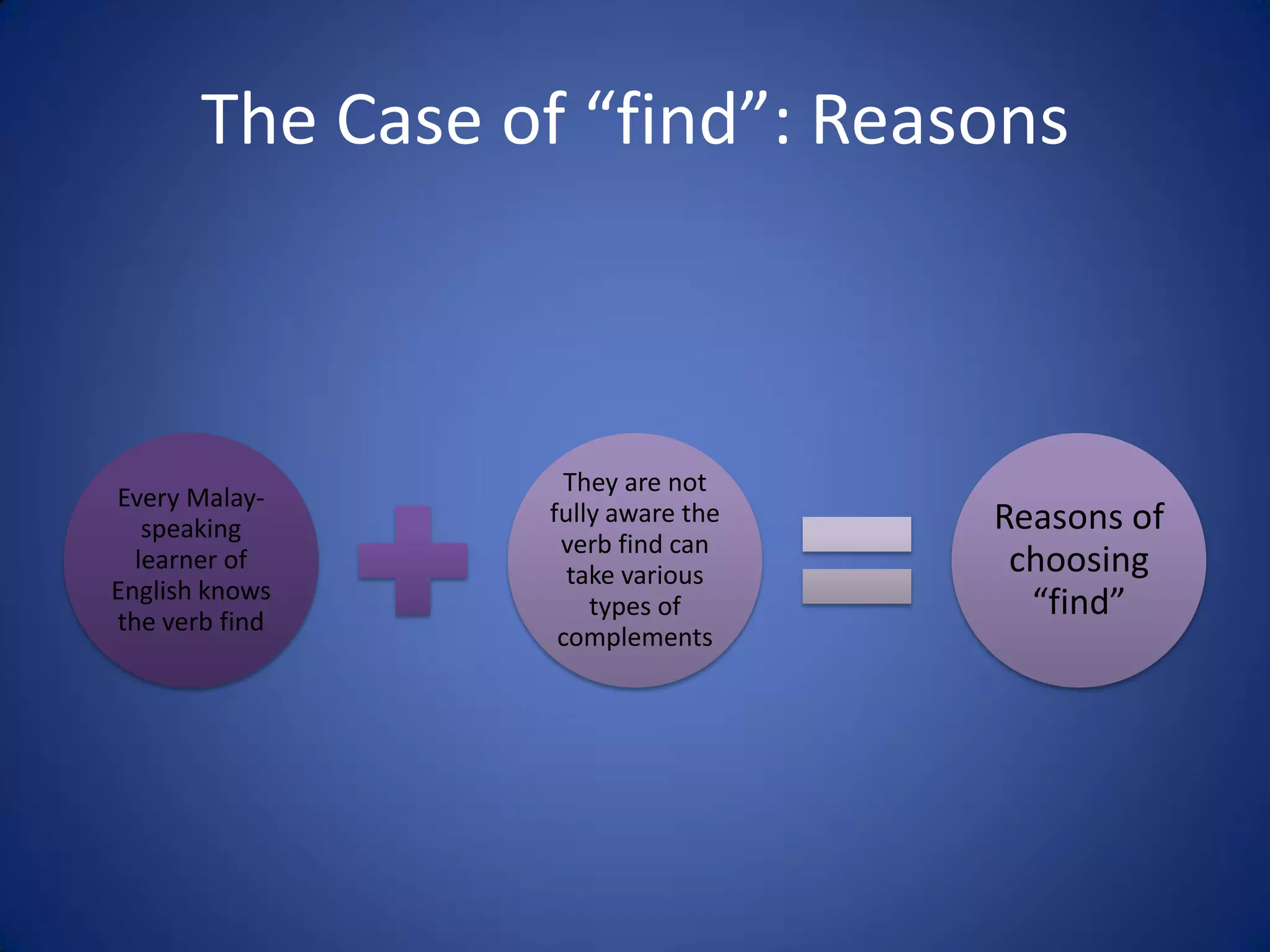
The Case of “find”: Reasons


                   They are not
Every Malay-
   speaking
                 fully aware the   Reasons of
                  verb find can
  learner of
                   take various     choosing
English knows
the verb find
                     types of        “find”
                  complements
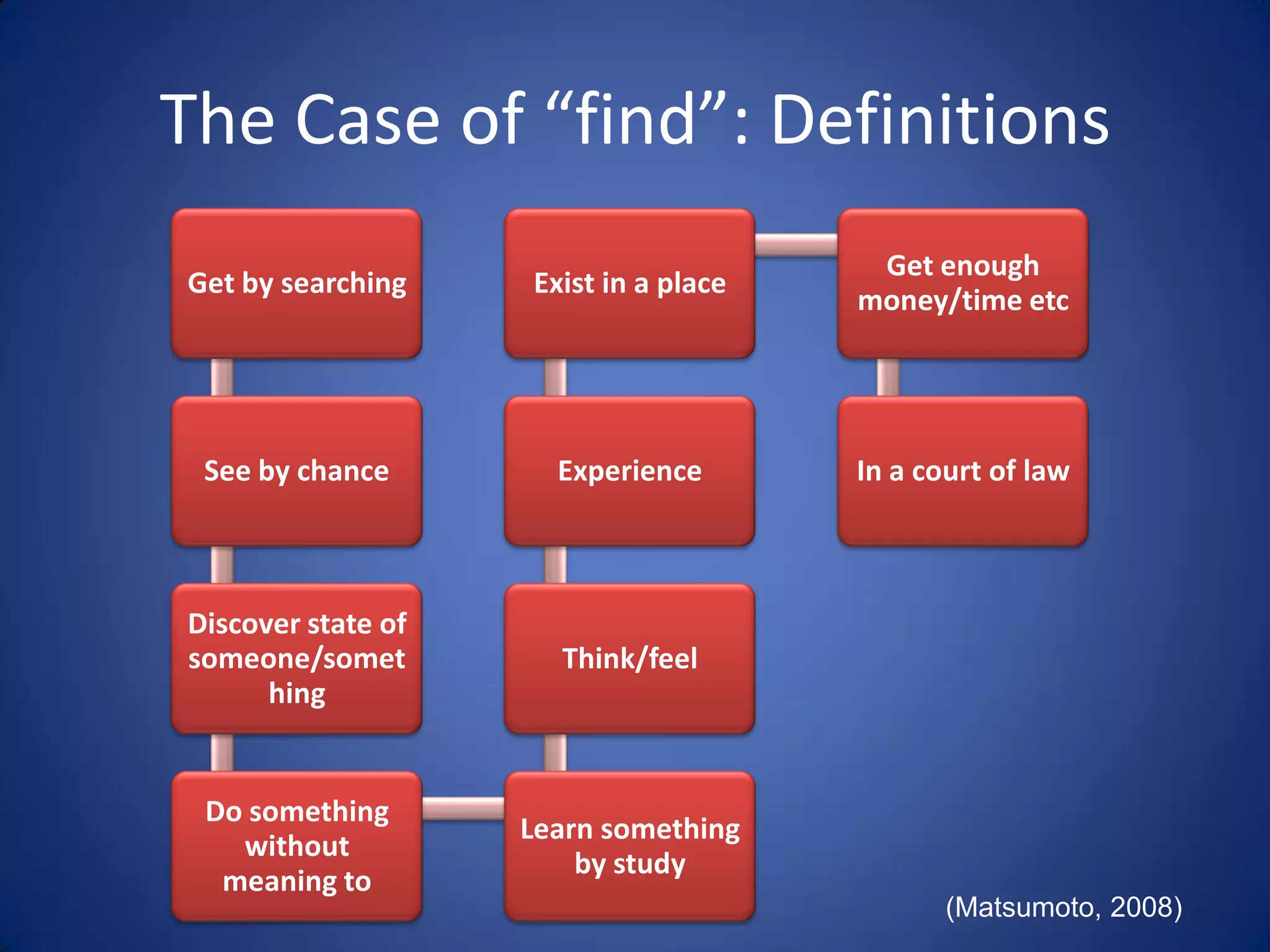
The Case of “find”: Definitions
                                        Get enough
Get by searching    Exist in a place
                                       money/time etc


 See by chance        Experience       In a court of law


Discover state of
someone/somet         Think/feel
      hing


 Do something
                    Learn something
   without
                        by study
  meaning to
                                              (Matsumoto, 2008)
Get by searching
• I can’t find the car keys.
• Can you find me my bag?
• The child was eventually found safe and well.
See by chance
• Look what I’ve found!


• I didn’t expect to come home and find this
  gift.
Discover state of something /
                someone
• He tried the door and found it unlocked.


• She looked at her glass and was amazed to
  find it was empty.
Do something without meaning to
• She woke up and found herself in a hospital
  bed.


• He found he was shaking.
Learn something by study
• I managed to find a solution to the problem.


• His study found that married men and women
  had similar spending patterns.
Think / feel
• Will Gary and Gail find happiness together?


• She finds it a strain to meet new people.
Experience
• We found the beds very comfortable.


• I found the people to be charming and very
  friendly.
Exist in a place
• You’ll find this style of architecture all over the
  town.
Get enough money / time etc
• He’s struggling to find the time, the support,
  and the resource to do all this.
In a court of law (to make official
                decision)
• The jury found him guilty of manslaughter.
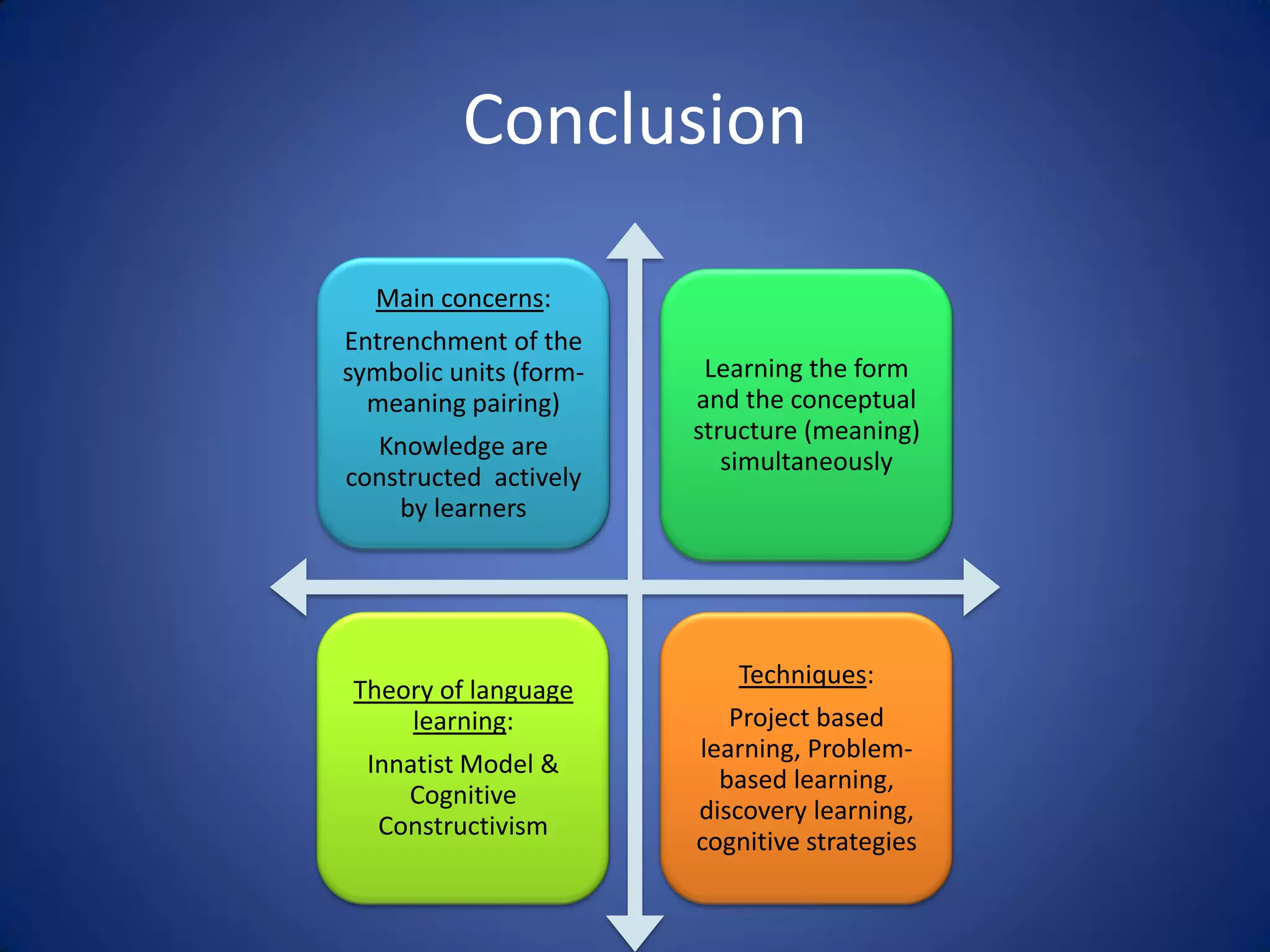
Conclusion

  Main concerns:
Entrenchment of the
symbolic units (form-    Learning the form
  meaning pairing)      and the conceptual
                        structure (meaning)
  Knowledge are
                           simultaneously
constructed actively
    by learners


                           Techniques:
Theory of language
    learning:              Project based
                        learning, Problem-
  Innatist Model &
                          based learning,
     Cognitive
                        discovery learning,
   Constructivism
                        cognitive strategies
REFERENCES
Azar, B. (2007). Grammar-Based Teaching: A Practitioner's Perspective. TESL E-
   Journal. Volume 11, Number 22. Retrieved from: http://tesl-
   ej.org/ej42/a1.pdf

Canton, R. L. (2001). Theories in Language Learning: Vast Divides or
   Traversable Straits? Literature Review/Concept Paper, 1-13.
  Retrieved from:
    http://www.coedu.usf.edu/itphdsem/eme7938/2001/cantonr.pdf

Evans, V. et. Al (2007). The cognitive linguistics enterprise: an overview.
   Retrieved from: http://www.vyvevans.net/CLoverview.pdf

Janda, L. A. (2006). Cognitive Linguistics. Glossos (2).
   Retrieved from: http://www.seelrc.org/glossos/issues/8/janda.pdf

Kristiansen, G. et al. (2006). Introduction to Cognitive Linguistics: Current
    applications and future perspectives. Retrieved from:
    http://www.degruyter.de/files/pdf/9783110189513Introduction.pdf
Longman (2003). Longman Dictionary of Contemporary English (New Edition). Pearson
   ESL.

Moore, B. J. (1998). Situated Cognition versus Traditional Cognitive Theories of
  Learning. Education. Retrieved from:
  http://www.questia.com/googleScholar.qst;jsessionid.

Noriko Matsumoto (2008). Bridges between Cognitive Linguistics and Second
   Language Pedagogy: The Case of Corpora and Their Potential. SKY Journal of
   Linguistics 21, 125–153. Retrieved from:
     http://www.ling.helsinki.fi/sky/julkaisut/SKY2008/Matsumoto_NETTIVERSIO.pdf

Perry, W. G. (1999). Forms of Ethical and Intellectual Development in the College Years.
   San Francisco: Jossey-Bass Publishers.

Turewicz, K. (2005). Understanding Prepositions through Cognitive Grammar:
   A Case of In. Retrieved from: http://cogprints.org/4384/3/turewicz.pdf

Tyler, A. & Evans, V. (2003). Applying Cognitive Linguistics to Pedagogical Grammar:
    The Case of Over. Retrieved from: http://www.vyvevans.net/pedgrmr.over.pdf

Suharno (2009). Cognitivism and Its Implication in the Second Language Learning.
   Retrieved from: http://staff.undip.ac.id/sastra/suharno/2009/07/21/cognitivism-
    and-its-implication-in-the-second-language-learning/

Cognitive Linguistics: The Case Of Find

  • 1.
    COGNITIVE GRAMMAR PEDAGOGY: THECASE OF “FIND” NOORLINDA ALANG MEd TESL University of Malaya
  • 2.
    This paper ispresented in partial fulfillment of the requirements for the course General Linguistics for TESL Faculty of Education University of Malaya Dr. Jessie Grace U. Rubrico, Facilitator PBGS 6304, Semester 2, AY 2009-2010 April 2010
  • 3.
    Linguistics Definition:The study of language in general and of Subfields: phonetics, particular languages, their phonology, morphology, structure, grammar and grammar, syntax, semantics history (Longman and pragmatics Dictionary, 2003) Is learnt to enrich awareness of the humankind as it is closely related to human interaction
  • 4.
    Cognitive Linguistics 1970S Human COGNITIVE Rejected dominant communication LINGUISTICS ideas and encounters Human cognition According to Matsumoto (2008), CL emerged in the 1970s due to the disapproval of the mainstream ideas that language is not part of cognition. In CL, language lies heavily on human cognition and it expands throughout human communication.
  • 5.
    Cognitive Linguistics: Concepts The Status of Linguistic Cognition Mental The Spaces Status of and Meaning Mapping Core concepts & Goals The Structure The Status of of Cognitive Prediction Categories The Embodiment of Meaning 2 most relevant CL concepts (1) The status of meaning: Language occurrences are propelled by the necessity to convey meaning. The presence of all linguistics units are supported by meaning, not any is semantically blank. (2) The Embodiment of meaning: Meaning is fixed in the shared human experience; acts as a basis for understanding abundant concepts. (Janda, 2006)
  • 6.
    Cognitive Linguistics: MainAreas Cognitive Cognitive Semantics Grammar Separate in practice but their domains of inquiry are tightly linked Cognitive semantics: The investigation of knowledge representation (conceptual structure) and meaning construction (conceptualization). Language is employed as a channel through which cognitive phenomena can be understood. Cognitive Grammar: The modeling of a language system (the mental grammar). (Evans et al., 2007)
  • 7.
    Cognitive Grammar The mental grammar Form-meaning pairing An inventory of Fluency symbolic units Constant Entrenched application According to Langacker (1987), knowledge of language (mental grammar) is stored in the mind as symbolic units (form-meaning pairing). If they are applied constantly without hesitation, it means they have become entrenched; they become a habit or routine and the speaker is able to use them fluently. (Evans et al., 2007)
  • 8.
    Cognitive Grammar: AMental Inventory The storeroom of entrenched symbolic units The contents are not stored in a random way The mental inventory is created upon the It is structured based on relationships entrenchment. It is a major issue in 2nd between units language acquisition. Due to CL, the frequent occurrence of a certain linguistic Some units are subparts of other units units facilitates the target language construction that leads to the entrenchment. (Matsumoto, 2008) E.g. morphemes make up words, words make up phrases, phrases make up sentences These interlinking and overlapping relationships among units are called network
  • 9.
    Cognitive Grammar: Pedagogy THE COGNITIVE PROCESS IN 2ND LANGUAGE LEARNING Learners’ mind In Learning the must be tuned understanding Steadily the forms as well The target to set apart the symbolic target units as learning between the units or the units clash obtains meaning of the linguistic with the independence new units and conceptual criterion of native ones from the the meaning structures the target native ones of the (meaning) language available ones (Matsumoto, 2009)
  • 10.
    Theory of Language: The Innatist Model An innate mental Processed and produced Language is rule-based capacity for language through complicated and generative in nature (Language Acquisition cognitive processes Device LAD) The language has a ‘The Critical Period universal nature Hypothesis’ (Universal Grammar UG) The Innatist Model of Chomsky (1955) and Lenneberg (1967) as cited in Suharno (2009), is believed to be useful as a guiding principle in applying cognitive grammar to language pedagogy.
  • 11.
    Theory of Learning: Cognitive Constructivism Stress on mental What goes on processes rather "inside the than observable learner's head” behavior It is vital to Learners understanding dynamically the learners’ construct the background knowledge knowledge or schemata In developing the instructional design for cognitive grammar pedagogy, Cognitive Constructivism Theory (as cited by Perry, 1999) is scrutinized further.
  • 12.
    Cognitive Constructivism: Concerns Knowledge Learning Motivation Instruction According to Perry (1999), as knowledge is discovered by the learners themselves, the teacher’s role is to assist the learning by supplying the essential resources. To succeed, learners must possess intrinsic motivation and supported by appropriate instructional methods that enable them to modify the new information based on their schemata.
  • 13.
    Cognitive Grammar: The Application
  • 14.
    Objectives To promote thelearner’s insight into the foreign language system To make learners learn by thinking about and trying to make sense of what they see, feel and hear To maximize communicative competence and accuracy in language use
  • 15.
    Content Cognitive Innatist Classroom Constructivism Model Instruction Approach
  • 16.
    Learning Techniques &Activities Problem- Project- based based learning learning Cognitive Discovery strategies learning Learners need to be involved with activities that make them think critically before coming up with meaningful analysis. Thus, Suharno (2009) suggests these four techniques to be associated with a cognitive theory of language learning.
  • 17.
    The Case of“find”: Reasons They are not Every Malay- speaking fully aware the Reasons of verb find can learner of take various choosing English knows the verb find types of “find” complements
  • 18.
    The Case of“find”: Definitions Get enough Get by searching Exist in a place money/time etc See by chance Experience In a court of law Discover state of someone/somet Think/feel hing Do something Learn something without by study meaning to (Matsumoto, 2008)
  • 19.
    Get by searching •I can’t find the car keys. • Can you find me my bag? • The child was eventually found safe and well.
  • 20.
    See by chance •Look what I’ve found! • I didn’t expect to come home and find this gift.
  • 21.
    Discover state ofsomething / someone • He tried the door and found it unlocked. • She looked at her glass and was amazed to find it was empty.
  • 22.
    Do something withoutmeaning to • She woke up and found herself in a hospital bed. • He found he was shaking.
  • 23.
    Learn something bystudy • I managed to find a solution to the problem. • His study found that married men and women had similar spending patterns.
  • 24.
    Think / feel •Will Gary and Gail find happiness together? • She finds it a strain to meet new people.
  • 25.
    Experience • We foundthe beds very comfortable. • I found the people to be charming and very friendly.
  • 26.
    Exist in aplace • You’ll find this style of architecture all over the town.
  • 27.
    Get enough money/ time etc • He’s struggling to find the time, the support, and the resource to do all this.
  • 28.
    In a courtof law (to make official decision) • The jury found him guilty of manslaughter.
  • 29.
    Conclusion Mainconcerns: Entrenchment of the symbolic units (form- Learning the form meaning pairing) and the conceptual structure (meaning) Knowledge are simultaneously constructed actively by learners Techniques: Theory of language learning: Project based learning, Problem- Innatist Model & based learning, Cognitive discovery learning, Constructivism cognitive strategies
  • 30.
    REFERENCES Azar, B. (2007).Grammar-Based Teaching: A Practitioner's Perspective. TESL E- Journal. Volume 11, Number 22. Retrieved from: http://tesl- ej.org/ej42/a1.pdf Canton, R. L. (2001). Theories in Language Learning: Vast Divides or Traversable Straits? Literature Review/Concept Paper, 1-13. Retrieved from: http://www.coedu.usf.edu/itphdsem/eme7938/2001/cantonr.pdf Evans, V. et. Al (2007). The cognitive linguistics enterprise: an overview. Retrieved from: http://www.vyvevans.net/CLoverview.pdf Janda, L. A. (2006). Cognitive Linguistics. Glossos (2). Retrieved from: http://www.seelrc.org/glossos/issues/8/janda.pdf Kristiansen, G. et al. (2006). Introduction to Cognitive Linguistics: Current applications and future perspectives. Retrieved from: http://www.degruyter.de/files/pdf/9783110189513Introduction.pdf
  • 31.
    Longman (2003). LongmanDictionary of Contemporary English (New Edition). Pearson ESL. Moore, B. J. (1998). Situated Cognition versus Traditional Cognitive Theories of Learning. Education. Retrieved from: http://www.questia.com/googleScholar.qst;jsessionid. Noriko Matsumoto (2008). Bridges between Cognitive Linguistics and Second Language Pedagogy: The Case of Corpora and Their Potential. SKY Journal of Linguistics 21, 125–153. Retrieved from: http://www.ling.helsinki.fi/sky/julkaisut/SKY2008/Matsumoto_NETTIVERSIO.pdf Perry, W. G. (1999). Forms of Ethical and Intellectual Development in the College Years. San Francisco: Jossey-Bass Publishers. Turewicz, K. (2005). Understanding Prepositions through Cognitive Grammar: A Case of In. Retrieved from: http://cogprints.org/4384/3/turewicz.pdf Tyler, A. & Evans, V. (2003). Applying Cognitive Linguistics to Pedagogical Grammar: The Case of Over. Retrieved from: http://www.vyvevans.net/pedgrmr.over.pdf Suharno (2009). Cognitivism and Its Implication in the Second Language Learning. Retrieved from: http://staff.undip.ac.id/sastra/suharno/2009/07/21/cognitivism- and-its-implication-in-the-second-language-learning/