Altaf Ahmad Khan
Pidgin


A variety of language
- created for very practical and
immediate purpose to communicate
between people who otherwise would
have no common language whatsoever,
- learned by one person from another
within the communities concerned as
the accepted way of communicating with
members of other community.
In short


Pidgin is a mixture of two or more
existing varieties, created jointly for
some special purpose, and different
from both varieties in terms of lexicon,
syntax and morphology.
Why Pidgin is created?
1.

Trade:
Pidgin is created where two (or more)
communities with languages
incomprehensible to each other start
trade and business.
Here, the need to communicate with members of other
community arise, resulting in a PIDGIN- mixture of two
different languages of both trading communities.
BUT


Not all pidgins are restricted to being
used as trade languages, only.



Nor all trade languages are PIDGINS.
e.g. English and French are widely used
as trade languages in many parts of
Africa.
Why Pidgin is created?
2. General Communication:
Pidgin may be created specially for the
purpose of communicating with some
other group, and not used by any
community for communication among
themselves.
e.g. There are a large number of pidgins
spread all over the world- where migrants
have developed pidgin varieties based on
national languages for example in Germany.
Characteristics of Pidgin Variety


Each pidgin is specially constructed to
suit the needs of its users.
i.e. The terminology and constructions
developed are according to the kind of
contact among the communities.
e.g. if the contact is restricted to the
dealing of cattle only, then only linguistic
items to do with this are needed and there
will be no way of talking about vegetables,
emotions etc.
Characteristics of Pidgin Variety


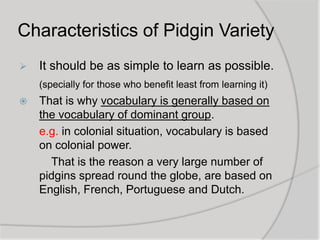
It should be as simple to learn as possible.
(specially for those who benefit least from learning it)



That is why vocabulary is generally based on
the vocabulary of dominant group.
e.g. in colonial situation, vocabulary is based
on colonial power.
That is the reason a very large number of
pidgins spread round the globe, are based on
English, French, Portuguese and Dutch.
Characteristics of Pidgin Variety


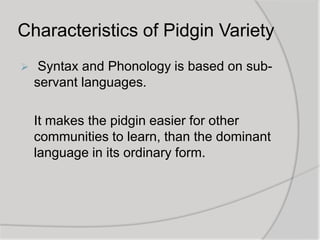
Syntax and Phonology is based on subservant languages.
It makes the pidgin easier for other
communities to learn, than the dominant
language in its ordinary form.
Characteristics of Pidgin Variety




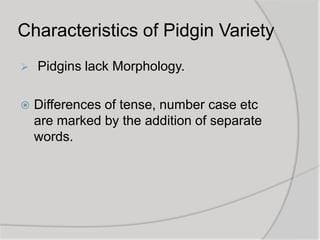
Pidgins lack Morphology.
Differences of tense, number case etc
are marked by the addition of separate
words.
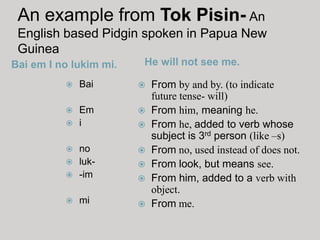
An example from Tok Pisin- An
English based Pidgin spoken in Papua New
Guinea
Bai em I no lukim mi.

He will not see me.

Bai



Em
 i



no
 luk -im










mi







From by and by. (to indicate
future tense- will)
From him, meaning he.
From he, added to verb whose
subject is 3rd person (like –s)
From no, used instead of does not.
From look, but means see.
From him, added to a verb with
object.
From me.
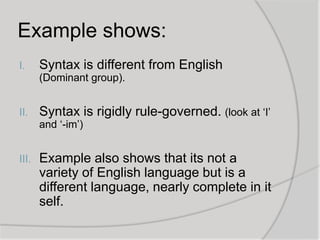
Example shows:
I.

Syntax is different from English
(Dominant group).

II.

Syntax is rigidly rule-governed. (look at ‘I’
and ‘-im’)

III.

Example also shows that its not a
variety of English language but is a
different language, nearly complete in it
self.
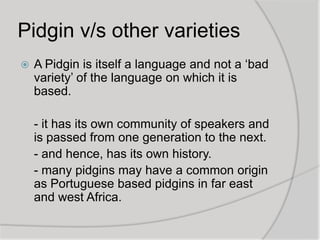
Pidgin v/s other varieties


A Pidgin is itself a language and not a ‘bad
variety’ of the language on which it is
based.
- it has its own community of speakers and
is passed from one generation to the next.
- and hence, has its own history.
- many pidgins may have a common origin
as Portuguese based pidgins in far east
and west Africa.
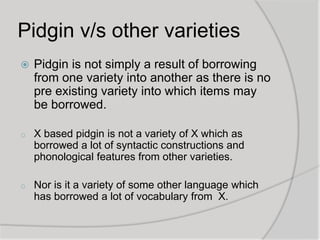
Pidgin v/s other varieties


Pidgin is not simply a result of borrowing
from one variety into another as there is no
pre existing variety into which items may
be borrowed.

o

X based pidgin is not a variety of X which as
borrowed a lot of syntactic constructions and
phonological features from other varieties.

o

Nor is it a variety of some other language which
has borrowed a lot of vocabulary from X.
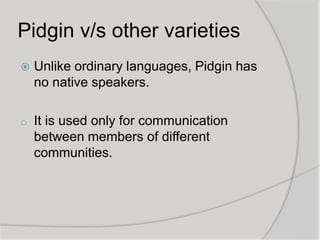
Pidgin v/s other varieties


Unlike ordinary languages, Pidgin has
no native speakers.

o

It is used only for communication
between members of different
communities.

Pidgins

  • 1.
  • 2.
    Pidgin  A variety oflanguage - created for very practical and immediate purpose to communicate between people who otherwise would have no common language whatsoever, - learned by one person from another within the communities concerned as the accepted way of communicating with members of other community.
  • 3.
    In short  Pidgin isa mixture of two or more existing varieties, created jointly for some special purpose, and different from both varieties in terms of lexicon, syntax and morphology.
  • 4.
    Why Pidgin iscreated? 1. Trade: Pidgin is created where two (or more) communities with languages incomprehensible to each other start trade and business. Here, the need to communicate with members of other community arise, resulting in a PIDGIN- mixture of two different languages of both trading communities.
  • 5.
    BUT  Not all pidginsare restricted to being used as trade languages, only.  Nor all trade languages are PIDGINS. e.g. English and French are widely used as trade languages in many parts of Africa.
  • 6.
    Why Pidgin iscreated? 2. General Communication: Pidgin may be created specially for the purpose of communicating with some other group, and not used by any community for communication among themselves. e.g. There are a large number of pidgins spread all over the world- where migrants have developed pidgin varieties based on national languages for example in Germany.
  • 7.
    Characteristics of PidginVariety  Each pidgin is specially constructed to suit the needs of its users. i.e. The terminology and constructions developed are according to the kind of contact among the communities. e.g. if the contact is restricted to the dealing of cattle only, then only linguistic items to do with this are needed and there will be no way of talking about vegetables, emotions etc.
  • 8.
    Characteristics of PidginVariety  It should be as simple to learn as possible. (specially for those who benefit least from learning it)  That is why vocabulary is generally based on the vocabulary of dominant group. e.g. in colonial situation, vocabulary is based on colonial power. That is the reason a very large number of pidgins spread round the globe, are based on English, French, Portuguese and Dutch.
  • 9.
    Characteristics of PidginVariety  Syntax and Phonology is based on subservant languages. It makes the pidgin easier for other communities to learn, than the dominant language in its ordinary form.
  • 10.
    Characteristics of PidginVariety   Pidgins lack Morphology. Differences of tense, number case etc are marked by the addition of separate words.
  • 11.
    An example fromTok Pisin- An English based Pidgin spoken in Papua New Guinea Bai em I no lukim mi. He will not see me. Bai  Em  i  no  luk -im      mi     From by and by. (to indicate future tense- will) From him, meaning he. From he, added to verb whose subject is 3rd person (like –s) From no, used instead of does not. From look, but means see. From him, added to a verb with object. From me.
  • 12.
    Example shows: I. Syntax isdifferent from English (Dominant group). II. Syntax is rigidly rule-governed. (look at ‘I’ and ‘-im’) III. Example also shows that its not a variety of English language but is a different language, nearly complete in it self.
  • 13.
    Pidgin v/s othervarieties  A Pidgin is itself a language and not a ‘bad variety’ of the language on which it is based. - it has its own community of speakers and is passed from one generation to the next. - and hence, has its own history. - many pidgins may have a common origin as Portuguese based pidgins in far east and west Africa.
  • 14.
    Pidgin v/s othervarieties  Pidgin is not simply a result of borrowing from one variety into another as there is no pre existing variety into which items may be borrowed. o X based pidgin is not a variety of X which as borrowed a lot of syntactic constructions and phonological features from other varieties. o Nor is it a variety of some other language which has borrowed a lot of vocabulary from X.
  • 15.
    Pidgin v/s othervarieties  Unlike ordinary languages, Pidgin has no native speakers. o It is used only for communication between members of different communities.

Editor's Notes

  • #8 Page 60, para 2.