Dr.VMS
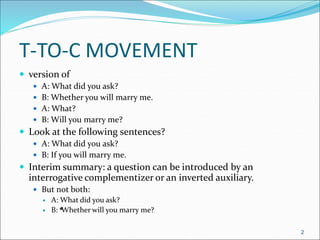
T-TO-C MOVEMENT
 version of
 A: What did you ask?
 B: Whether you will marry me.
 A: What?
 B: Will you marry me?
 Look at the following sentences?
 A: What did you ask?
 B: If you will marry me.
 Interim summary: a question can be introduced by an
interrogative complementizer or an inverted auxiliary.
 But not both:
 A: What did you ask?
 B: Whether will you marry me?
2
*
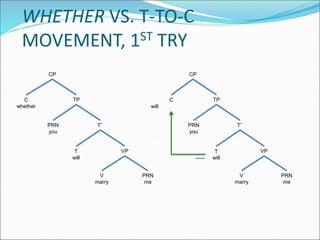
WHETHER VS. T-TO-C
MOVEMENT, 1ST TRY
TP
T’PRN
you
VPT
will
V
marry
PRN
me
CP
C
whether
C TP
T’PRN
you
VPT
will
V
marry
PRN
me
CP
-----
will
WHY MOVE?
 Head position strength and attractiveness
 An interrogative C is strong and so must be filled by an
overt word, either a complementizer (subordinating
conjunction) or an auxiliary verb.
 A null complementizer attracts an auxiliary verb to a
strong C.
 Perhaps C carries a tense feature [TNS ø] which must be
realized on a tensed verb, which is to say that [TNS ø] is
an affix.
 So the tensed auxiliary verb moves up and adjoins to C,
causing the deletion of itself in T and the merger and
deletion of [TNS ø] in C – see the following slide.
T-TO-C MOVEMENT AS
ADJUNCTION OF T TO TENSE IN C
TP
T’PRN
you
VPT
will
V
marry
PRN
me
CP
C
[TNS]
ø
PRN
me
C TP
T’PRN
you
VPT
will
V
marry
CP
T
will
C
[TNS]
ø
A SIMPLIFICATION OF THE
ADJUNCTION TO SHOW ITS
MORPHOLOGICAL RESULT
PRN
me
TP
T’PRN
you
VPT
will
V
marry
CP
C
will+ø
PRN
me
C TP
T’PRN
you
VPT
will
V
marry
CP
T
will
C
[TNS]
ø
Verb Movement
VMS
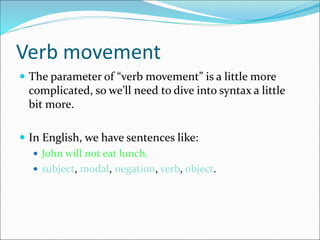
Verb movement
 The parameter of “verb movement” is a little more
complicated, so we’ll need to dive into syntax a little
bit more.
 In English, we have sentences like:
 John will not eat lunch.
 subject, modal, negation, verb, object.
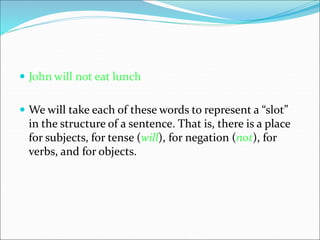
 John will not eat lunch
 We will take each of these words to represent a “slot”
in the structure of a sentence. That is, there is a place
for subjects, for tense (will), for negation (not), for
verbs, and for objects.
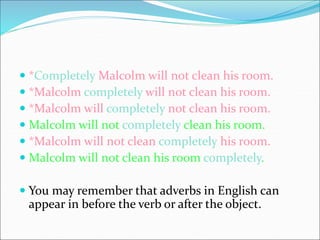
 *Completely Malcolm will not clean his room.
 *Malcolm completely will not clean his room.
 *Malcolm will completely not clean his room.
 Malcolm will not completely clean his room.
 *Malcolm will not clean completely his room.
 Malcolm will not clean his room completely.
 You may remember that adverbs in English can
appear in before the verb or after the object.
 The reason for this is that the verb and object form a
unit (VP) which the adverbs must be “attached to”:
 Malcolm will not [VP clean his room ].
 So, these kind of adverbs can, in a sense, serve as
“landmarks”. Similarly, not and tense and the subject are
assumed to be in the same structural position all the
time.
Auxiliary verbs
 But some verbs (in particular, have and be, the “auxiliary
verbs”) act different.
 Malcolm will not
^ [VP have ^ [VP cleaned his room ]] ^.
 So we know that have is a real verb here…
 Malcolm has not ^ [VP cleaned his room ] ^.
 But if there isn’t something “filling up” the tense slot, have
shows up in the tense slot (to the left of not and adverbs).
Auxiliary verbs
 Same goes for be:
 The meat will not ^ [VP be ^ [VP eaten ]] ^.
 The meat was not ^ [VP eaten ] ^.
 What appears to be happening to have and be is
that they are placed in the tense slot (unless it’s
otherwise filled) instead of in the VP. Another way
to look at it is that the auxiliary verb has moved to
the tense slot.
Auxiliary verbs
 That is, we might start out with:
 Malcolm [PAST] not [have [cleaned his room]]
 In which case, we have this:
 Malcolm have+[PAST] not [—[cleaned his room]]
 That is…
 Malcolm had not cleaned his room.
 But if start with:
 Malcolm will not [have [cleaned his room]]
 We just get:
 Malcolm will not have cleaned his room.
Verb movement
 Turns out this kind of verb movement happens in a lot of
languages, sometimes for all verbs…
Verb movement
 And we in fact see this:
 In English, you can never have an adverb between the
verb and its object.
 *John [eats often chocolate].
 John often [eats chocolate].

Head Movement and verb movement

  • 1.
  • 2.
    T-TO-C MOVEMENT  versionof  A: What did you ask?  B: Whether you will marry me.  A: What?  B: Will you marry me?  Look at the following sentences?  A: What did you ask?  B: If you will marry me.  Interim summary: a question can be introduced by an interrogative complementizer or an inverted auxiliary.  But not both:  A: What did you ask?  B: Whether will you marry me? 2 *
  • 3.
    WHETHER VS. T-TO-C MOVEMENT,1ST TRY TP T’PRN you VPT will V marry PRN me CP C whether C TP T’PRN you VPT will V marry PRN me CP ----- will
  • 4.
    WHY MOVE?  Headposition strength and attractiveness  An interrogative C is strong and so must be filled by an overt word, either a complementizer (subordinating conjunction) or an auxiliary verb.  A null complementizer attracts an auxiliary verb to a strong C.  Perhaps C carries a tense feature [TNS ø] which must be realized on a tensed verb, which is to say that [TNS ø] is an affix.  So the tensed auxiliary verb moves up and adjoins to C, causing the deletion of itself in T and the merger and deletion of [TNS ø] in C – see the following slide.
  • 5.
    T-TO-C MOVEMENT AS ADJUNCTIONOF T TO TENSE IN C TP T’PRN you VPT will V marry PRN me CP C [TNS] ø PRN me C TP T’PRN you VPT will V marry CP T will C [TNS] ø
  • 6.
    A SIMPLIFICATION OFTHE ADJUNCTION TO SHOW ITS MORPHOLOGICAL RESULT PRN me TP T’PRN you VPT will V marry CP C will+ø PRN me C TP T’PRN you VPT will V marry CP T will C [TNS] ø
  • 7.
  • 8.
    Verb movement  Theparameter of “verb movement” is a little more complicated, so we’ll need to dive into syntax a little bit more.  In English, we have sentences like:  John will not eat lunch.  subject, modal, negation, verb, object.
  • 9.
     John willnot eat lunch  We will take each of these words to represent a “slot” in the structure of a sentence. That is, there is a place for subjects, for tense (will), for negation (not), for verbs, and for objects.
  • 10.
     *Completely Malcolmwill not clean his room.  *Malcolm completely will not clean his room.  *Malcolm will completely not clean his room.  Malcolm will not completely clean his room.  *Malcolm will not clean completely his room.  Malcolm will not clean his room completely.  You may remember that adverbs in English can appear in before the verb or after the object.
  • 11.
     The reasonfor this is that the verb and object form a unit (VP) which the adverbs must be “attached to”:  Malcolm will not [VP clean his room ].  So, these kind of adverbs can, in a sense, serve as “landmarks”. Similarly, not and tense and the subject are assumed to be in the same structural position all the time.
  • 12.
    Auxiliary verbs  Butsome verbs (in particular, have and be, the “auxiliary verbs”) act different.  Malcolm will not ^ [VP have ^ [VP cleaned his room ]] ^.  So we know that have is a real verb here…  Malcolm has not ^ [VP cleaned his room ] ^.  But if there isn’t something “filling up” the tense slot, have shows up in the tense slot (to the left of not and adverbs).
  • 13.
    Auxiliary verbs  Samegoes for be:  The meat will not ^ [VP be ^ [VP eaten ]] ^.  The meat was not ^ [VP eaten ] ^.  What appears to be happening to have and be is that they are placed in the tense slot (unless it’s otherwise filled) instead of in the VP. Another way to look at it is that the auxiliary verb has moved to the tense slot.
  • 14.
    Auxiliary verbs  Thatis, we might start out with:  Malcolm [PAST] not [have [cleaned his room]]  In which case, we have this:  Malcolm have+[PAST] not [—[cleaned his room]]  That is…  Malcolm had not cleaned his room.  But if start with:  Malcolm will not [have [cleaned his room]]  We just get:  Malcolm will not have cleaned his room.
  • 15.
    Verb movement  Turnsout this kind of verb movement happens in a lot of languages, sometimes for all verbs…
  • 16.
    Verb movement  Andwe in fact see this:  In English, you can never have an adverb between the verb and its object.  *John [eats often chocolate].  John often [eats chocolate].