Topic 2-1 Transverse Wave Motion
1
UEEP1033 Oscillations and Waves
Topic 4
Transverse Wave Motion
Topic 2-1 Transverse Wave Motion
2
UEEP1033 Oscillations and Waves
Contents
• Revision of 1-D wave equation, waves on a stretched
string, polarization
• Wave impedance
• Reflection and transmission
• Impedance matching
• Compression waves in a fluid
• Waves in 2- and 3-D
• Standing waves in a box
• Wave groups, group velocity
• Dispersion
• Waveguides: Cut-off and dispersion in a confined
membrane
Topic 2-1 Transverse Wave Motion
3
UEEP1033 Oscillations and Waves
Definition of Waves
• A wave is a disturbance that moves through a medium
without giving the medium, as a whole, any permanent
displacement.
• The general name for these waves is progressive wave.
• If the disturbance takes place perpendicular to the
direction of propagation of the wave, the wave is called
transverse.
• If the disturbance is along the direction of propagation of
the wave, it is called longitudinal.
Topic 2-1 Transverse Wave Motion
4
UEEP1033 Oscillations and Waves
Characteristics of Waves
• At any point, the disturbance is a function of time and at
any instant, the disturbance is a function of the position of
the point.
• In a sound wave, the disturbance is pressure-variation in a
medium.
• In the transmission of light in a medium or vacuum, the
disturbance is the variation of the strengths of the electric
and magnetic fields.
• In a progressive wave motion, it is the disturbance that
moves and not the particles of the medium.
Topic 2-1 Transverse Wave Motion
5
UEEP1033 Oscillations and Waves
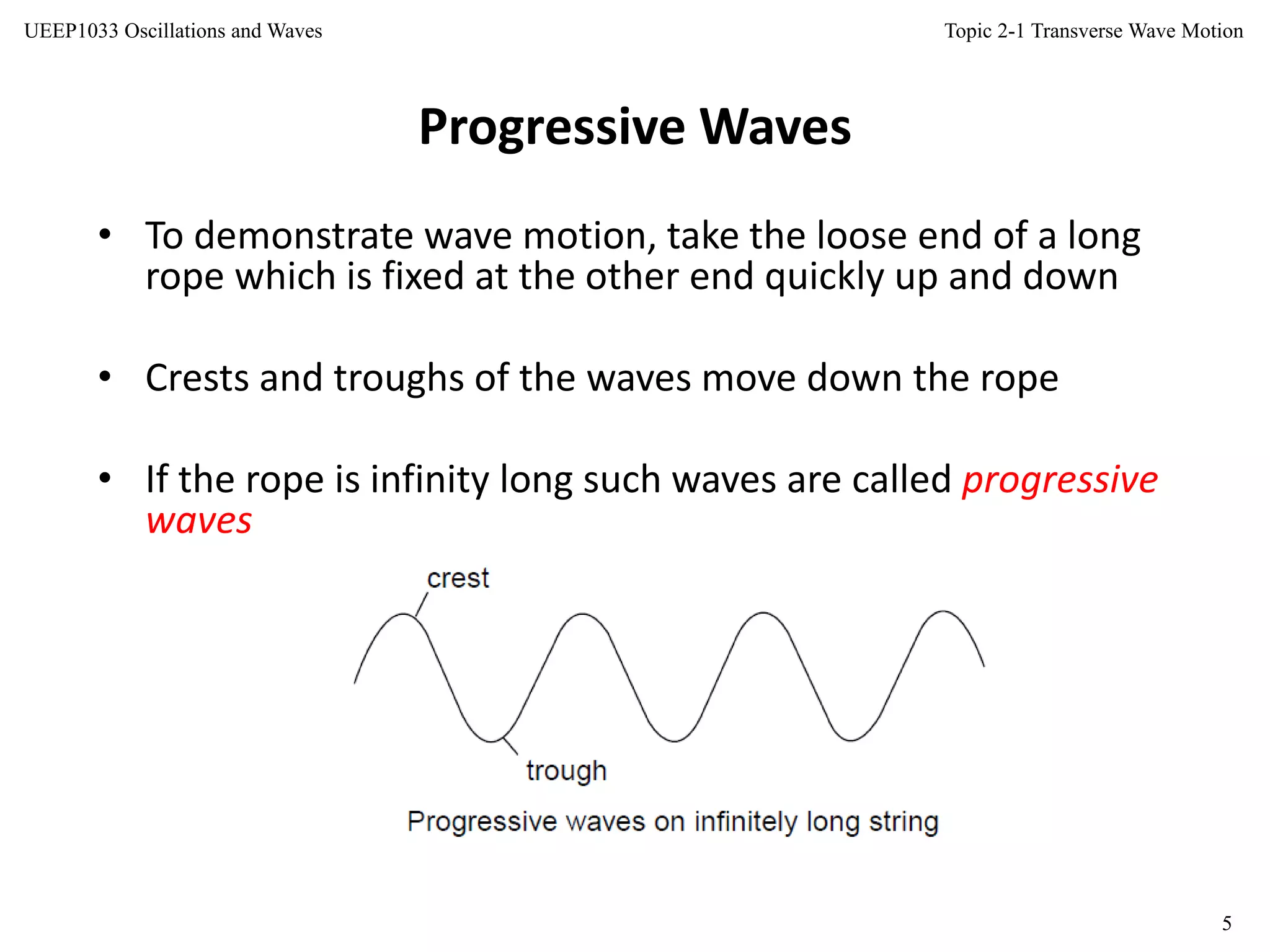
• To demonstrate wave motion, take the loose end of a long
rope which is fixed at the other end quickly up and down
• Crests and troughs of the waves move down the rope
• If the rope is infinity long such waves are called progressive
waves
Progressive Waves
Topic 2-1 Transverse Wave Motion
6
UEEP1033 Oscillations and Waves
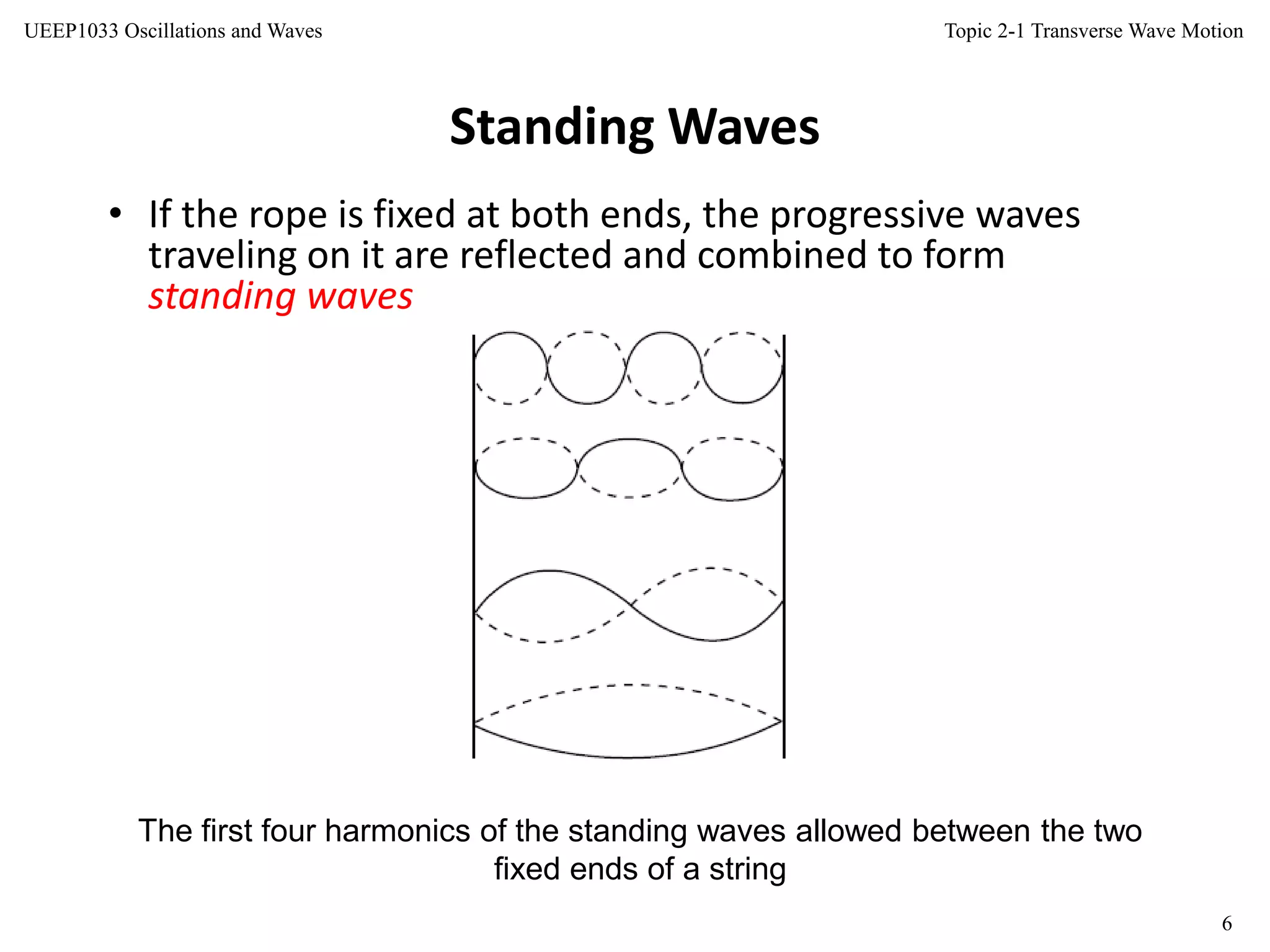
• If the rope is fixed at both ends, the progressive waves
traveling on it are reflected and combined to form
standing waves
Standing Waves
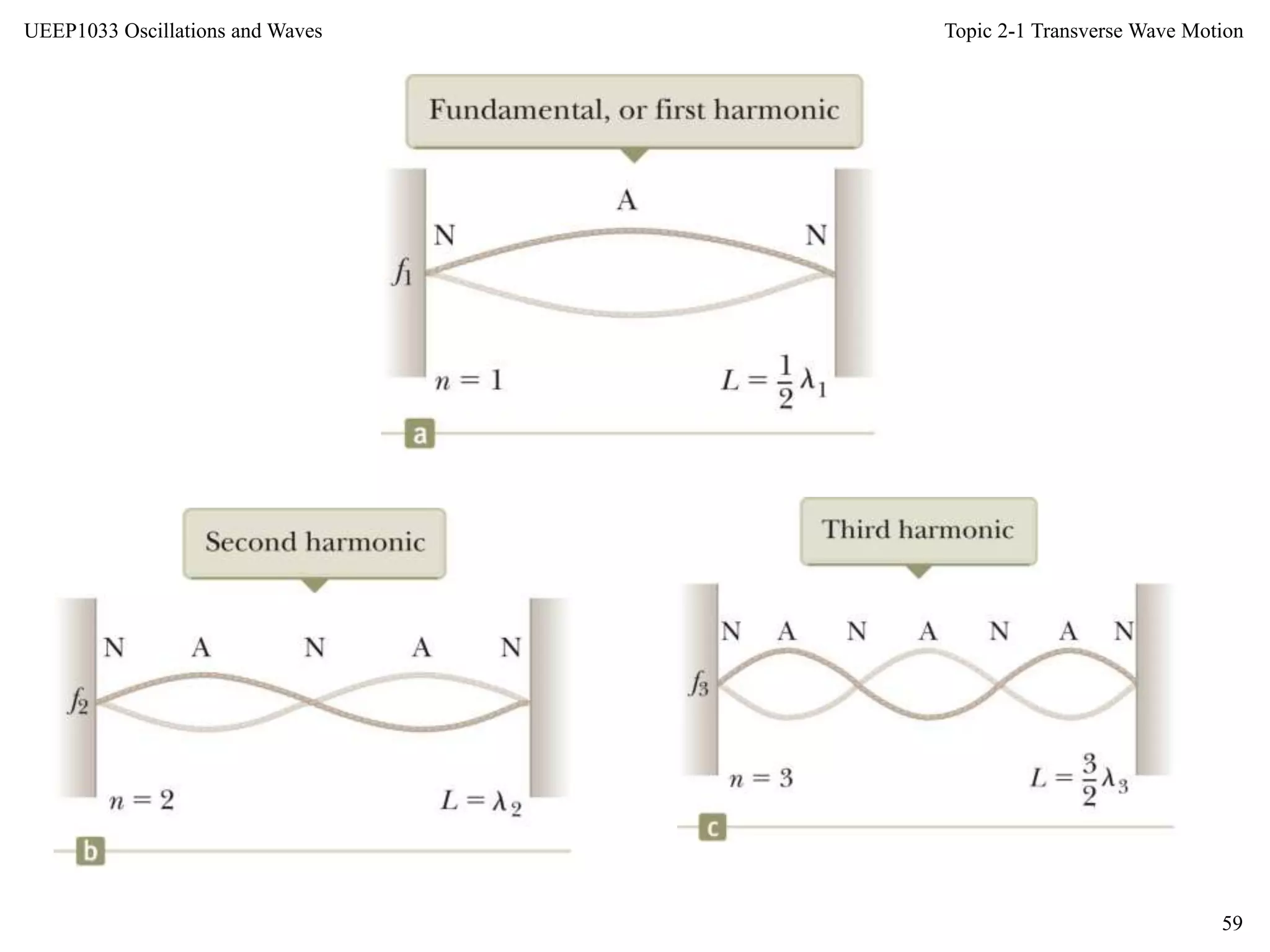
The first four harmonics of the standing waves allowed between the two
fixed ends of a string
Topic 2-1 Transverse Wave Motion
7
UEEP1033 Oscillations and Waves
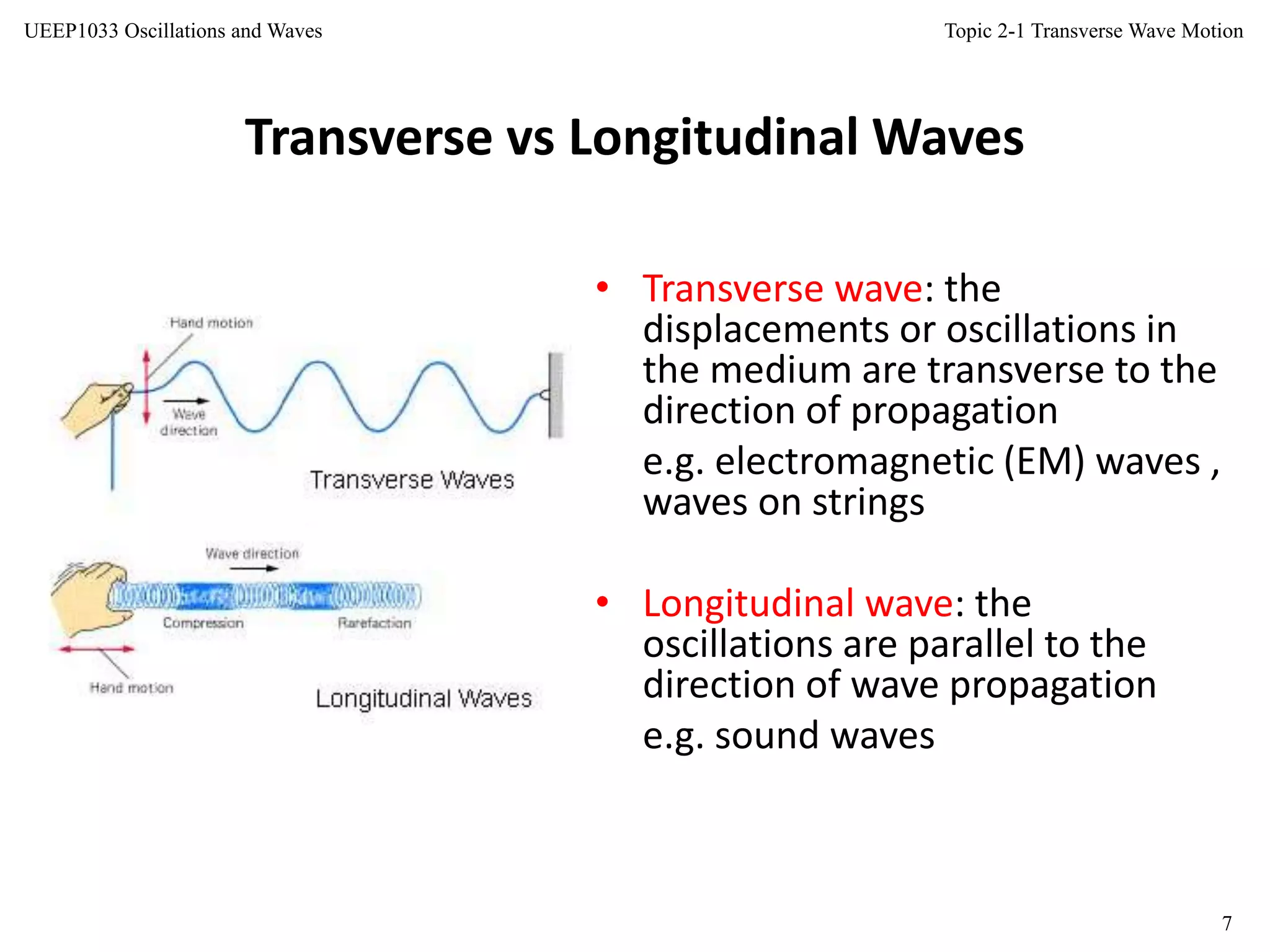
Transverse vs Longitudinal Waves
• Transverse wave: the
displacements or oscillations in
the medium are transverse to the
direction of propagation
e.g. electromagnetic (EM) waves ,
waves on strings
• Longitudinal wave: the
oscillations are parallel to the
direction of wave propagation
e.g. sound waves
Topic 2-1 Transverse Wave Motion
8
UEEP1033 Oscillations and Waves
Plane Waves
• Take a plane perpendicular to the direction of wave
propagation and all oscillators lying within that plane have a
common phase
• Over such a plane, all parameters describing the wave
motion remain constant
• The crests and troughs are planes of maximum amplitude of
oscillation, which are  rad out of phase
• Crest = a plane of maximum positive amplitude
• Trough = a plane of maximum negative amplitude
Topic 2-1 Transverse Wave Motion
9
UEEP1033 Oscillations and Waves
The Wave Equation
2
2
22
2
1
t
y
cx
y






T
c 2
+d
T
T
(x +dx, y +dy)
(x , y )
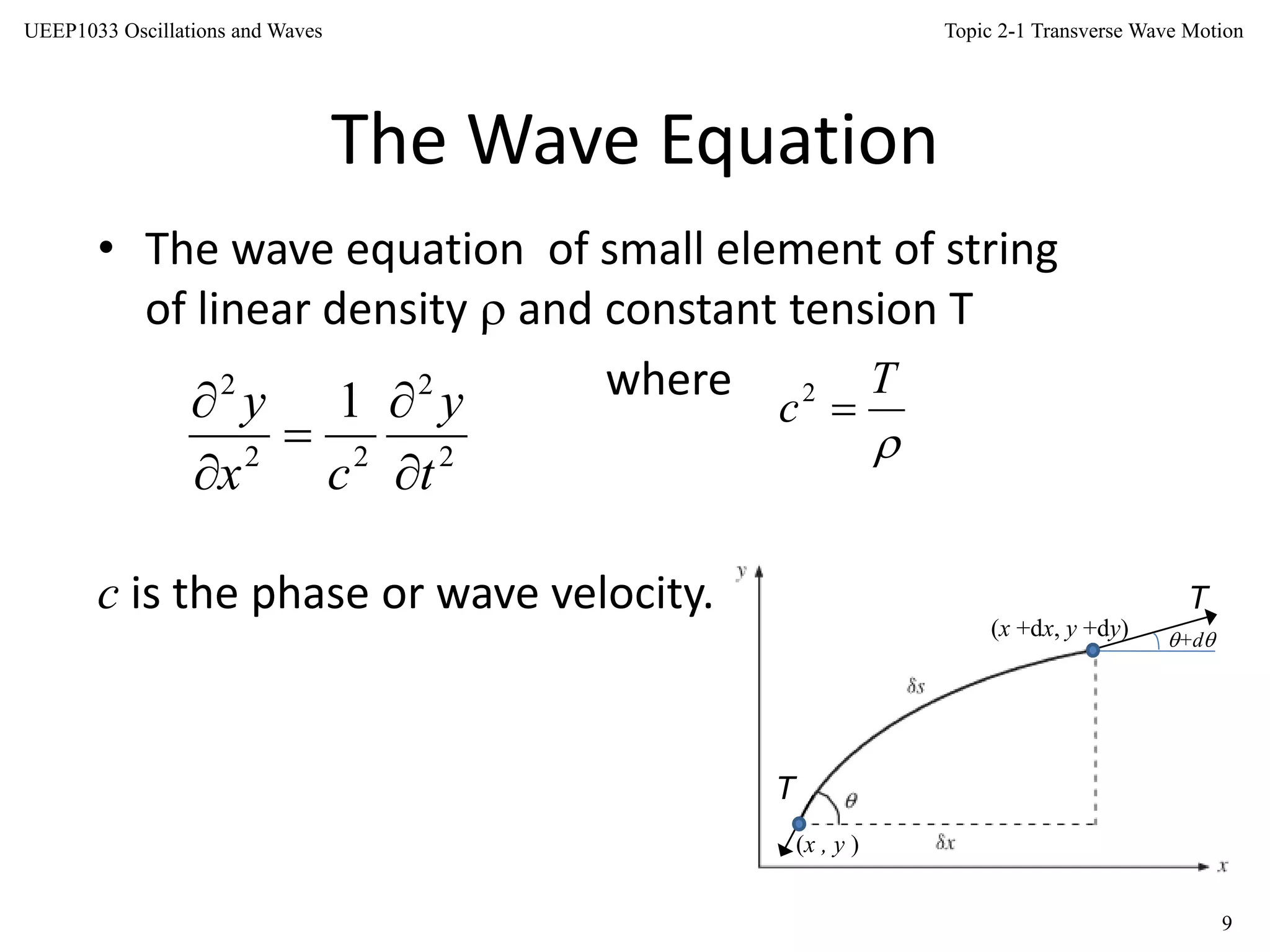
• The wave equation of small element of string
of linear density  and constant tension T
where
c is the phase or wave velocity.
Topic 2-1 Transverse Wave Motion
10
UEEP1033 Oscillations and Waves
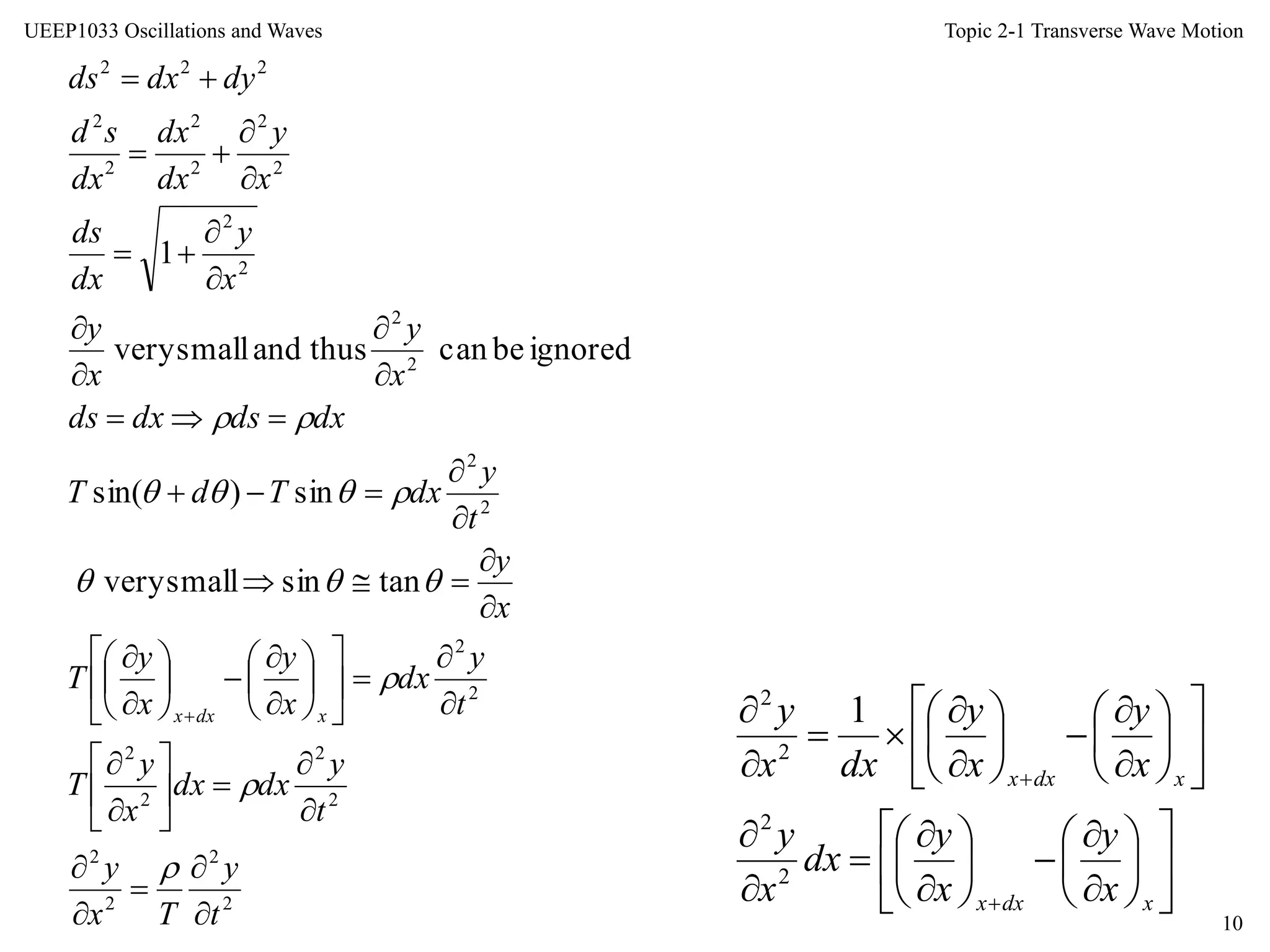
2
2
2
2
2
2
2
2
2
2
2
2
2
2
2
2
2
2
2
2
2
2
222
tansinsmallvery
sin)sin(
ignoredbecanthusandsmallvery
1
t
y
Tx
y
t
y
dxdx
x
y
T
t
y
dx
x
y
x
y
T
x
y
t
y
dxTdT
dxdsdxds
x
y
x
y
x
y
dx
ds
x
y
dx
dx
dx
sd
dydxds
xdxx




















































































































xdxx
xdxx
x
y
x
y
dx
x
y
x
y
x
y
dxx
y
2
2
2
2
1
Topic 2-1 Transverse Wave Motion
11
UEEP1033 Oscillations and Waves
Waves in One Dimension
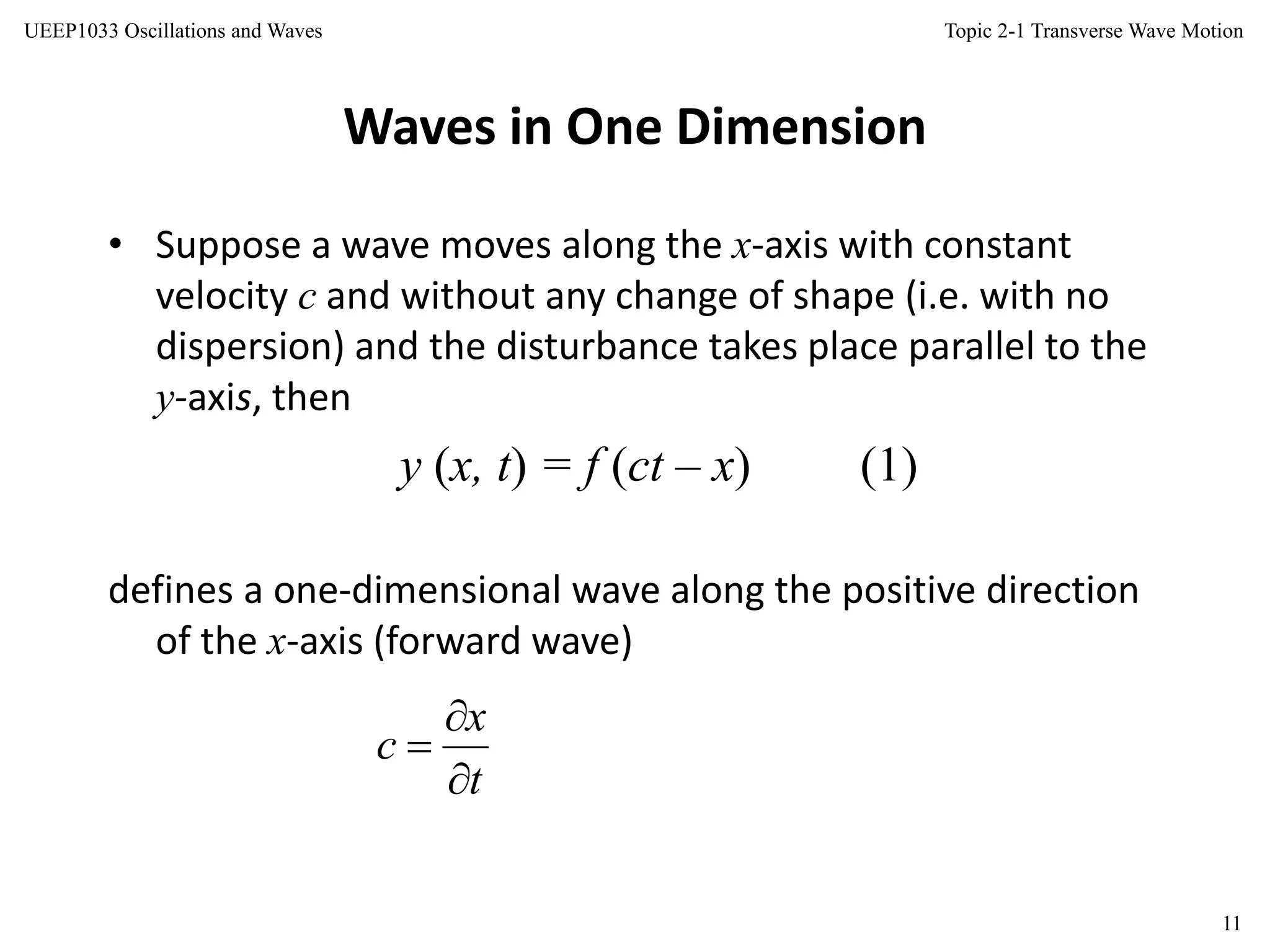
• Suppose a wave moves along the x-axis with constant
velocity c and without any change of shape (i.e. with no
dispersion) and the disturbance takes place parallel to the
y-axis, then
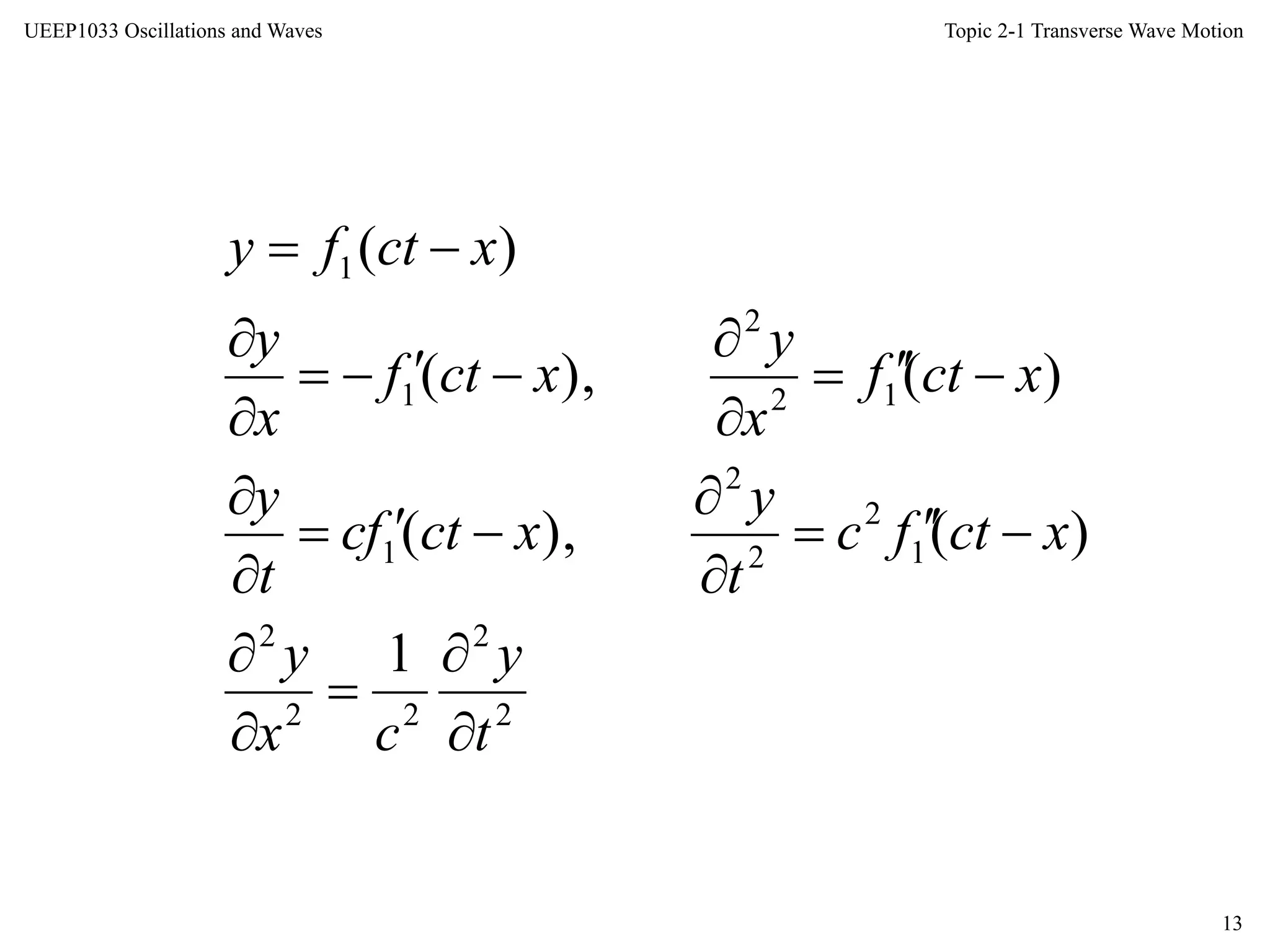
y (x, t) = f (ct – x) (1)
defines a one-dimensional wave along the positive direction
of the x-axis (forward wave)
t
x
c



Topic 2-1 Transverse Wave Motion
12
UEEP1033 Oscillations and Waves
Waves in One Dimension
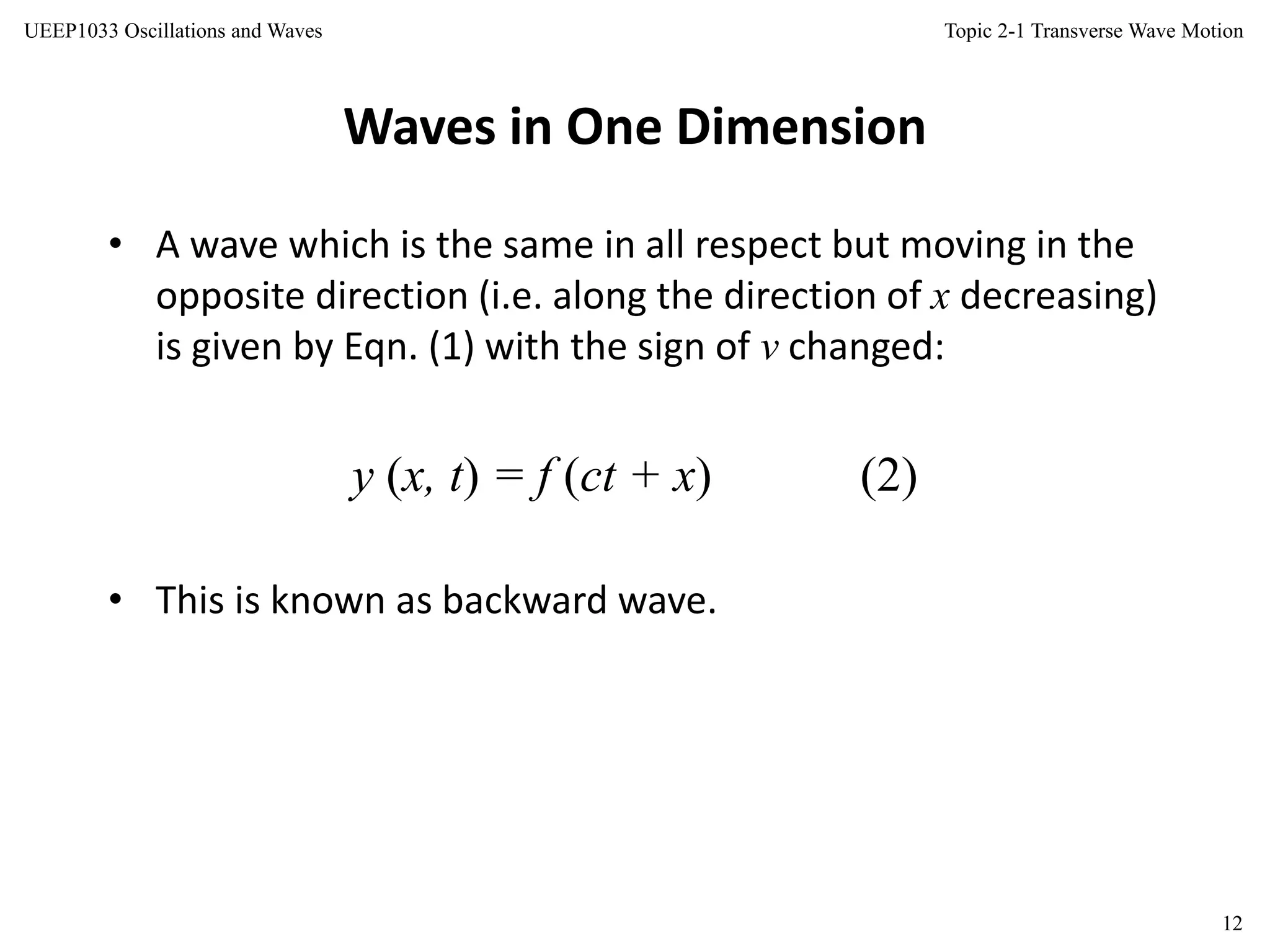
• A wave which is the same in all respect but moving in the
opposite direction (i.e. along the direction of x decreasing)
is given by Eqn. (1) with the sign of v changed:
y (x, t) = f (ct + x) (2)
• This is known as backward wave.
Topic 2-1 Transverse Wave Motion
13
UEEP1033 Oscillations and Waves
2
2
22
2
1
2
2
2
1
12
2
1
1
1
)(),(
)(),(
)(
t
y
cx
y
xctfc
t
y
xctfc
t
y
xctf
x
y
xctf
x
y
xctfy


















Topic 2-1 Transverse Wave Motion
14
UEEP1033 Oscillations and Waves
Waves in One Dimension
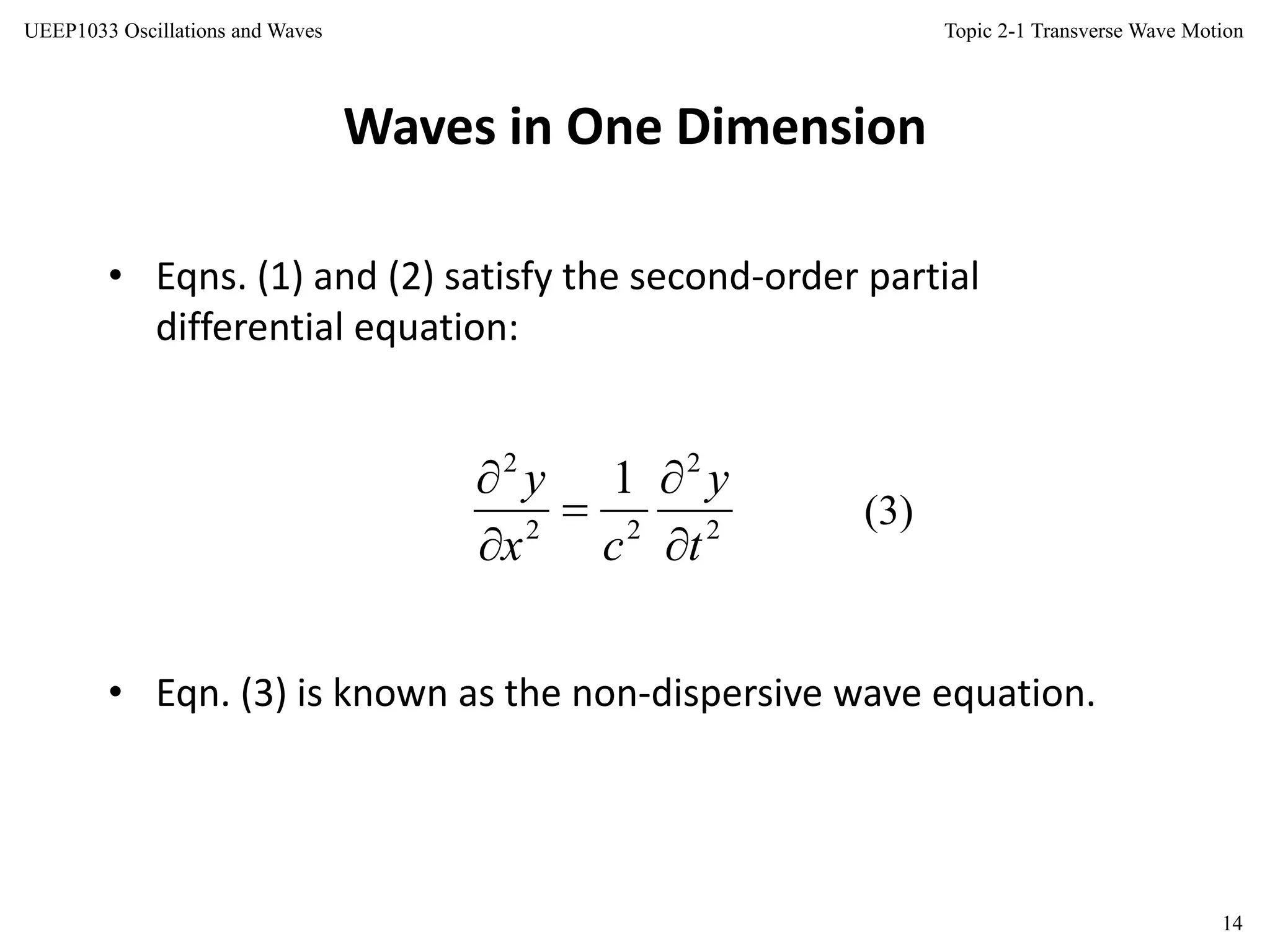
• Eqns. (1) and (2) satisfy the second-order partial
differential equation:
(3)
• Eqn. (3) is known as the non-dispersive wave equation.
2
2
22
2
1
t
y
cx
y





Topic 2-1 Transverse Wave Motion
15
UEEP1033 Oscillations and Waves
Locus of oscillator displacements

x
Displacementy
a
-a
Topic 2-1 Transverse Wave Motion
16
UEEP1033 Oscillations and Waves
Solution of Wave equation
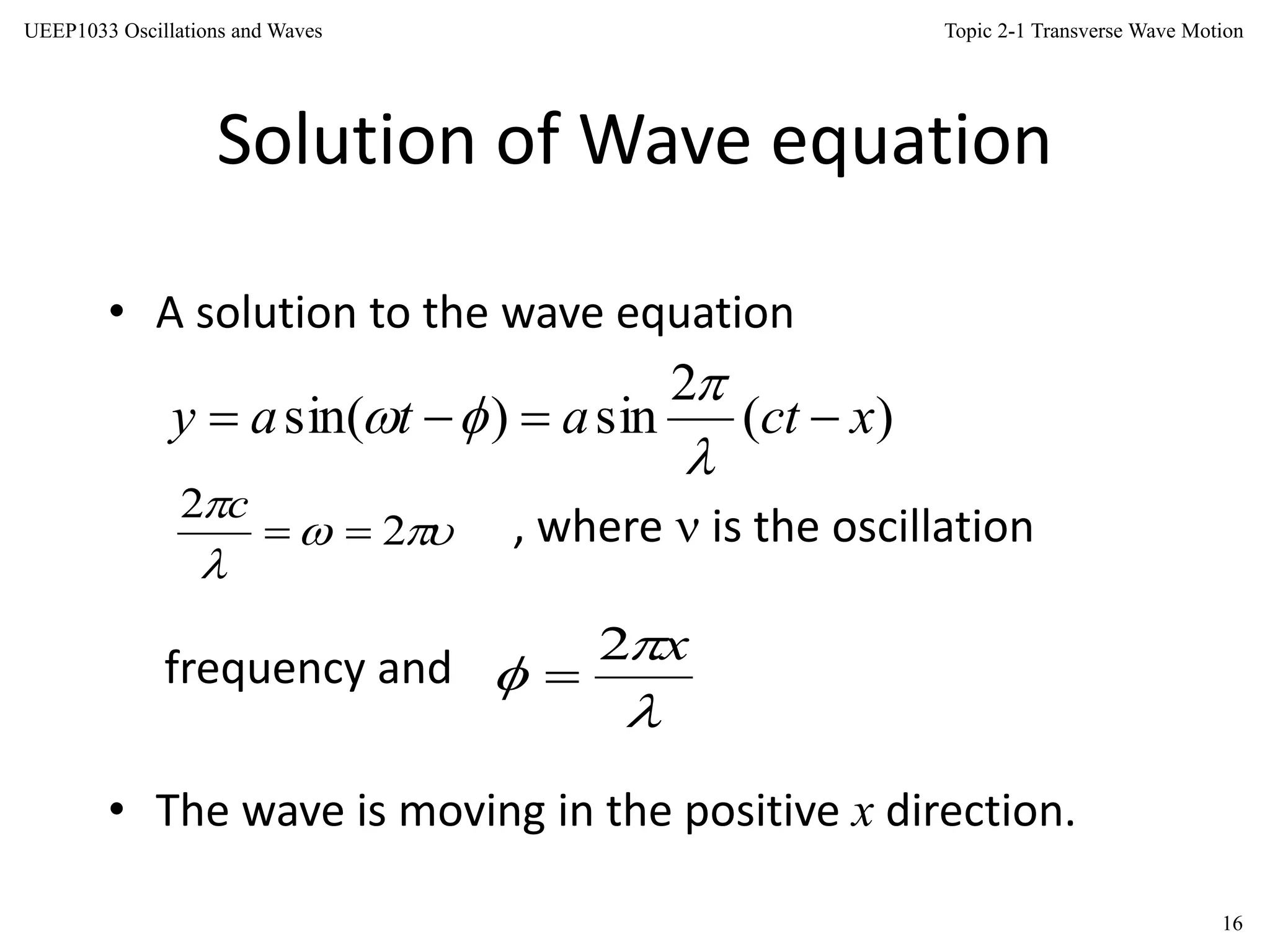
• A solution to the wave equation
, where  is the oscillation
frequency and
• The wave is moving in the positive x direction.
)(
2
sin)sin( xctatay 






x2




2
2

c
Topic 2-1 Transverse Wave Motion
17
UEEP1033 Oscillations and Waves
The Wave Equation
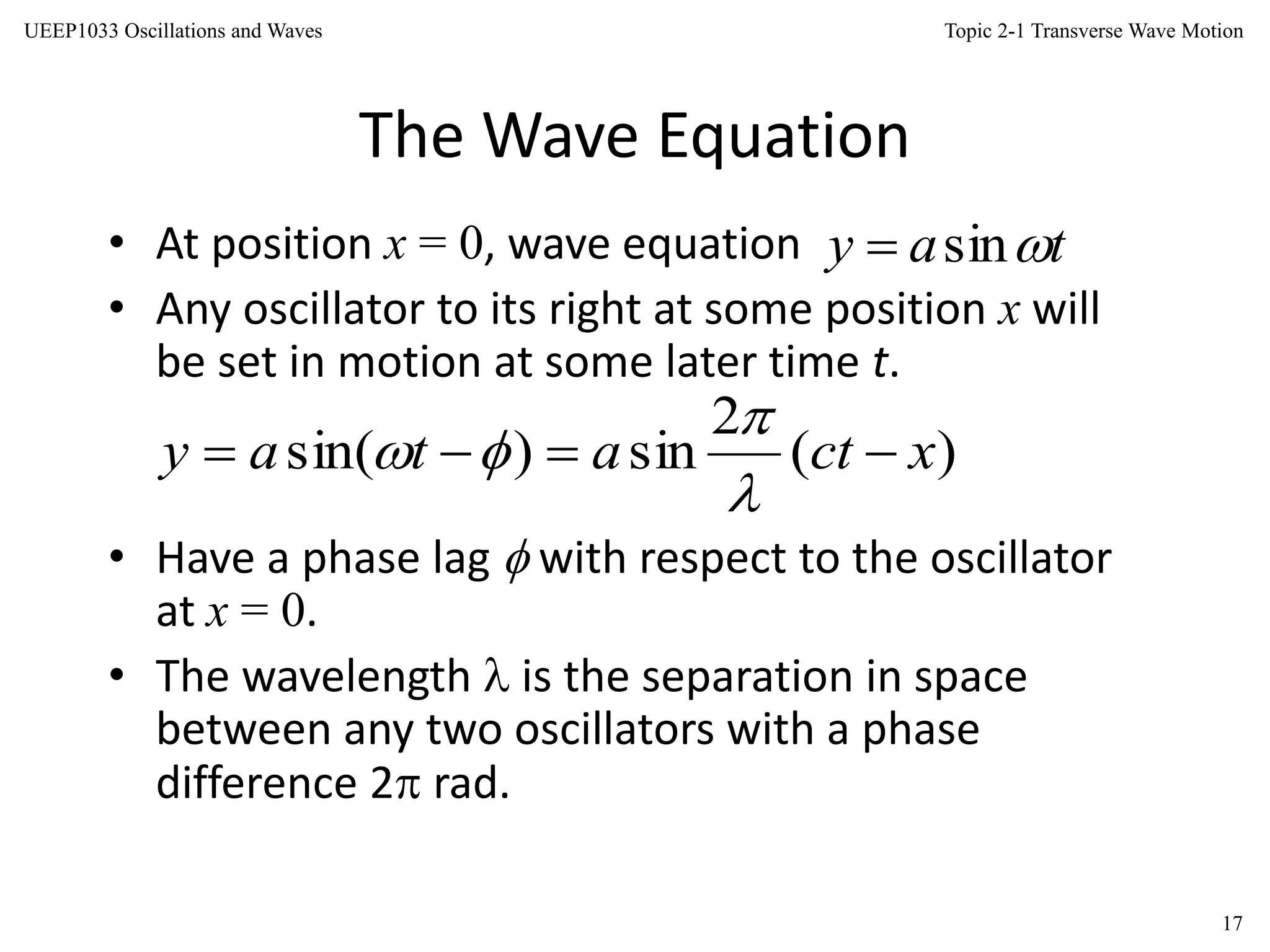
• At position x = 0, wave equation
• Any oscillator to its right at some position x will
be set in motion at some later time t.
• Have a phase lag  with respect to the oscillator
at x = 0.
• The wavelength  is the separation in space
between any two oscillators with a phase
difference 2 rad.
tay sin
)(
2
sin)sin( xctatay 



Topic 2-1 Transverse Wave Motion
18
UEEP1033 Oscillations and Waves
The Wave Equation
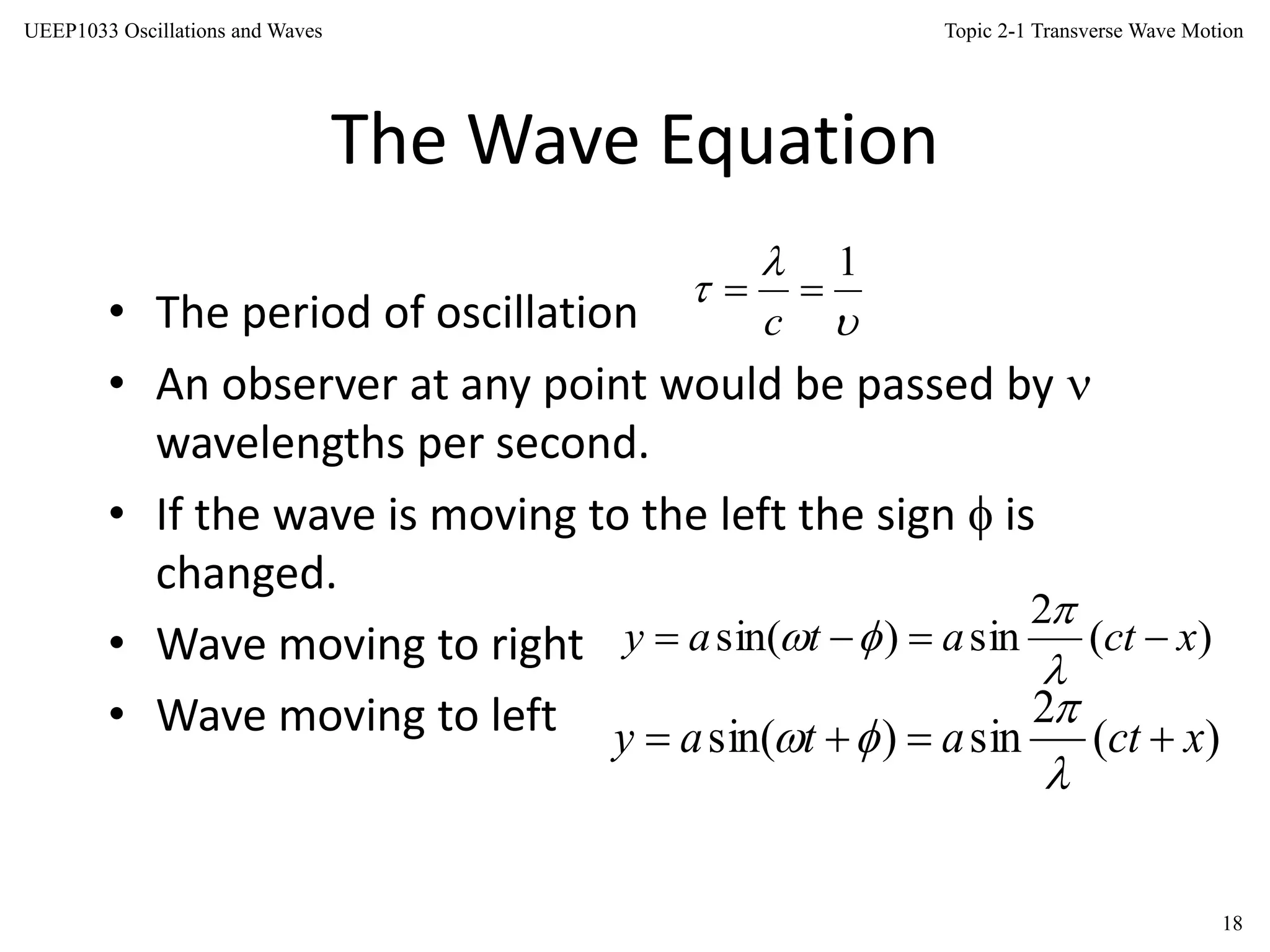
• The period of oscillation
• An observer at any point would be passed by 
wavelengths per second.
• If the wave is moving to the left the sign  is
changed.
• Wave moving to right
• Wave moving to left



1

c
)(
2
sin)sin( xctatay 



)(
2
sin)sin( xctatay 



Topic 2-1 Transverse Wave Motion
19
UEEP1033 Oscillations and Waves
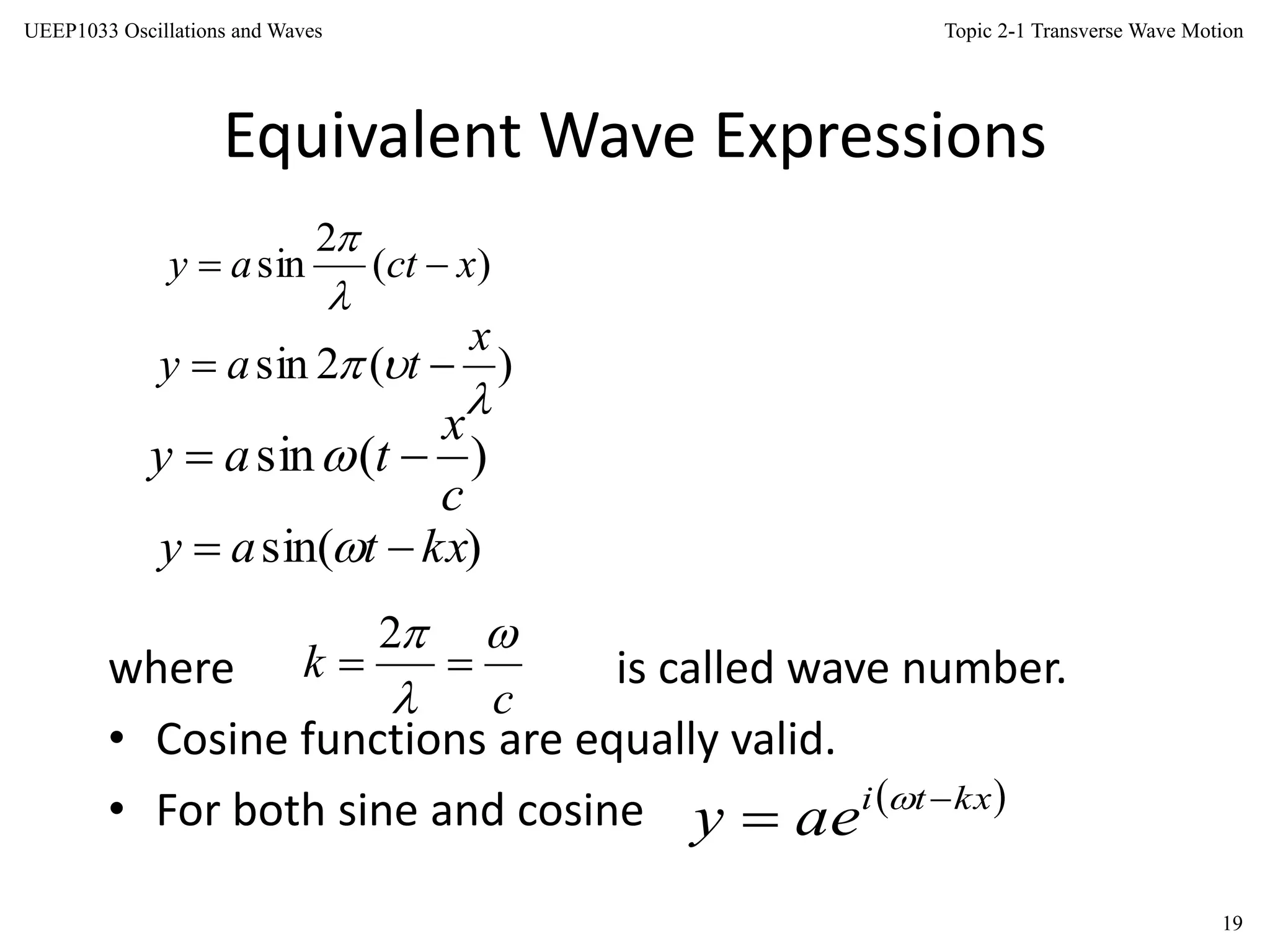
Equivalent Wave Expressions
where is called wave number.
• Cosine functions are equally valid.
• For both sine and cosine
)(
2
sin xctay 


)(2sin


x
tay 
)(sin
c
x
tay  
)sin( kxtay  
c
k




2
 kxti
aey 
 
Topic 2-1 Transverse Wave Motion
20
UEEP1033 Oscillations and Waves
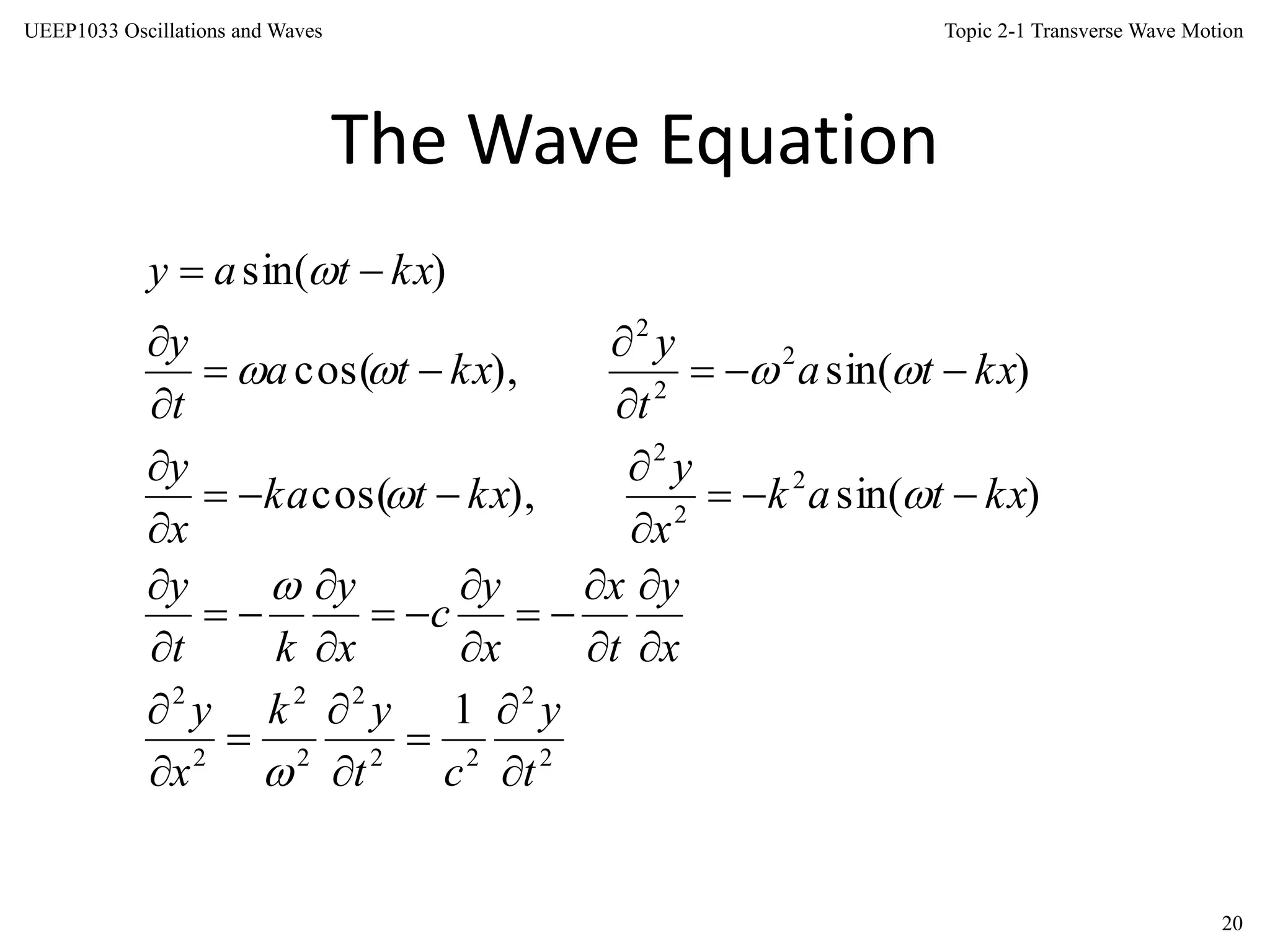
The Wave Equation
2
2
22
2
2
2
2
2
2
2
2
2
2
2
1
)sin(),cos(
)sin(),cos(
)sin(
t
y
ct
yk
x
y
x
y
t
x
x
y
c
x
y
kt
y
kxtak
x
y
kxtka
x
y
kxta
t
y
kxta
t
y
kxtay







































Topic 2-1 Transverse Wave Motion
21
UEEP1033 Oscillations and Waves
Wave or Phase velocity
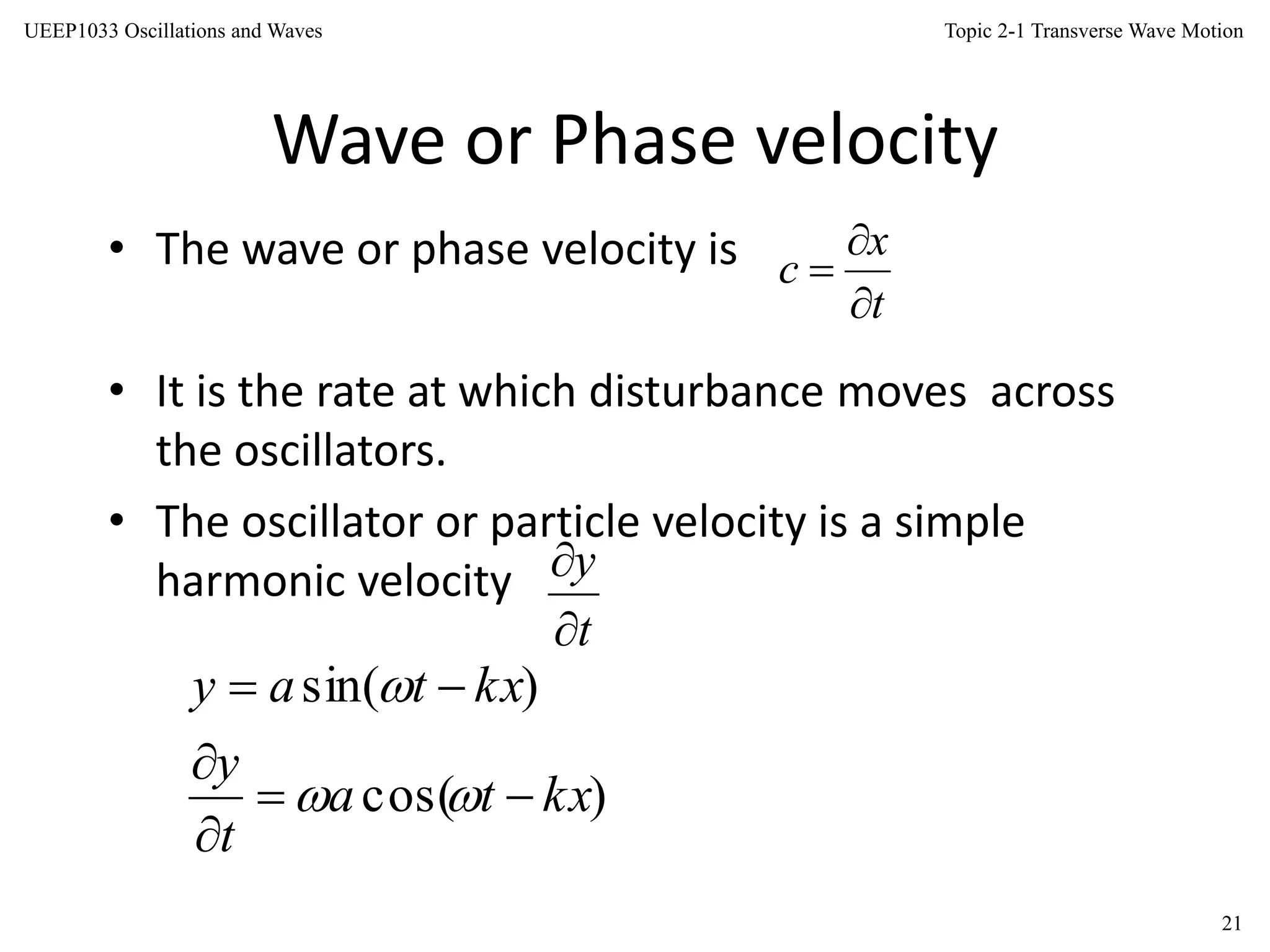
• The wave or phase velocity is
• It is the rate at which disturbance moves across
the oscillators.
• The oscillator or particle velocity is a simple
harmonic velocity
t
x
c



t
y


)cos(
)sin(
kxta
t
y
kxtay






Topic 2-1 Transverse Wave Motion
22
UEEP1033 Oscillations and Waves
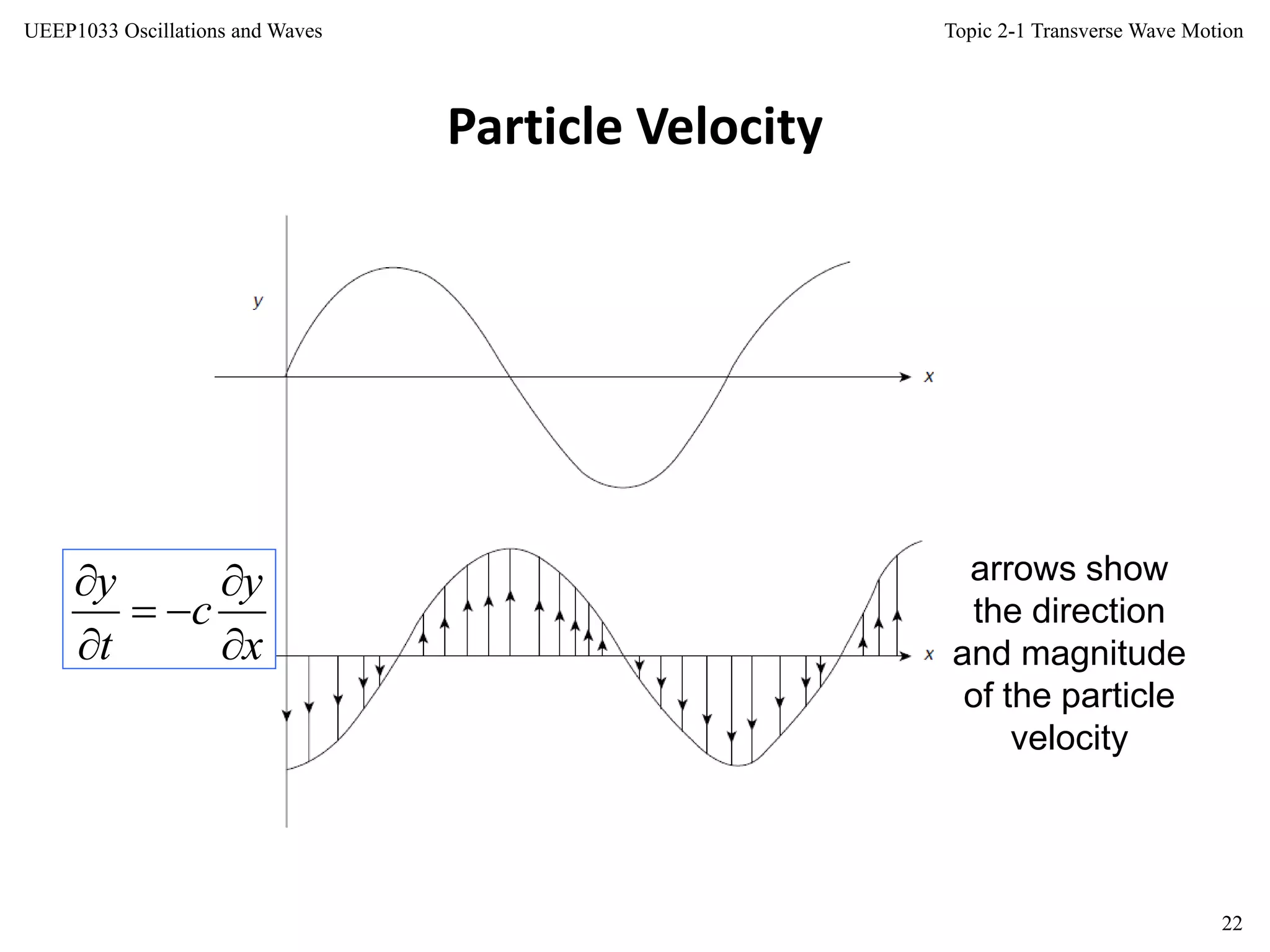
Particle Velocity
arrows show
the direction
and magnitude
of the particle
velocity
x
y
c
t
y





Topic 2-1 Transverse Wave Motion
23
UEEP1033 Oscillations and Waves
Waves in One Dimension
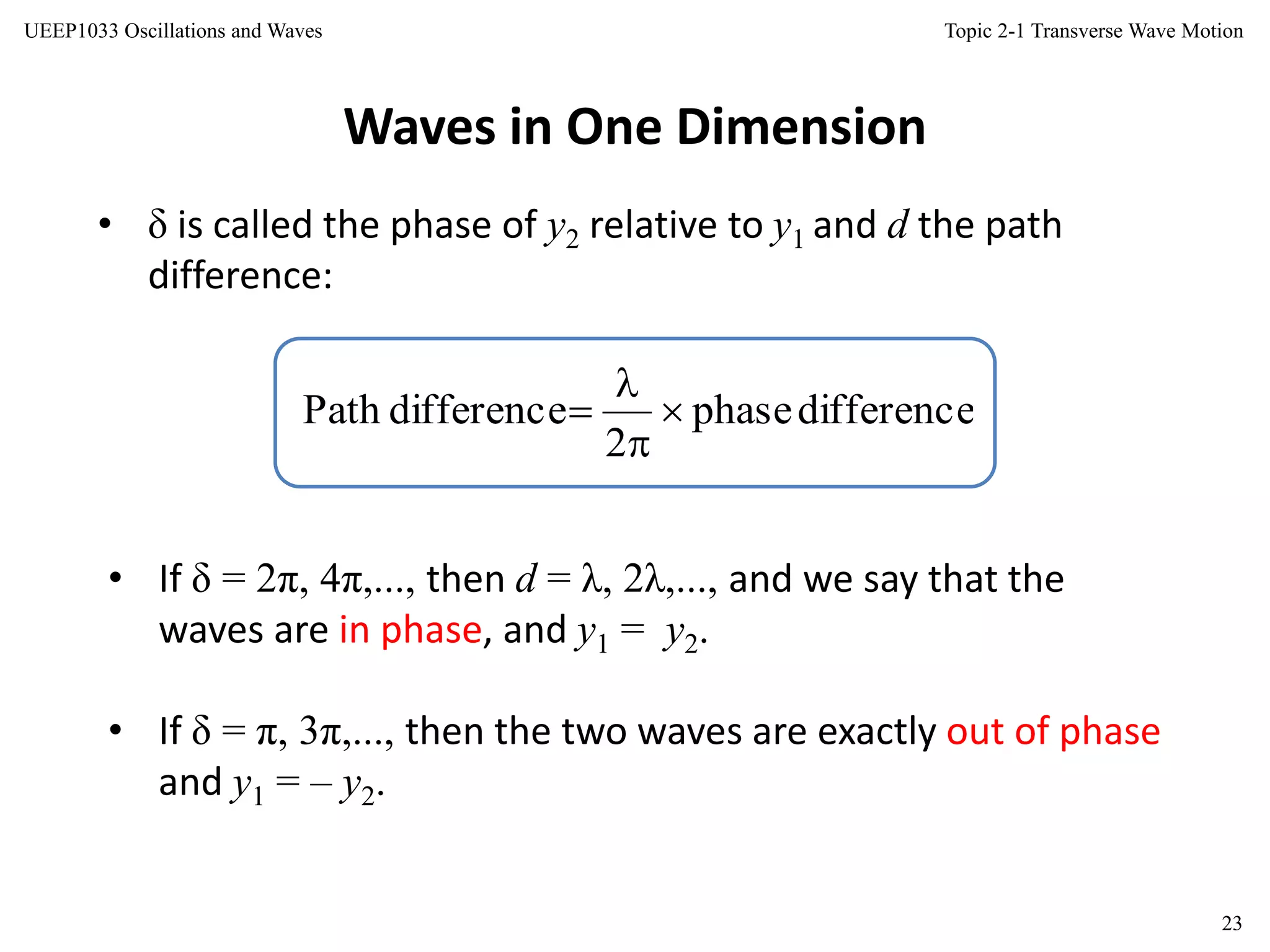
• δ is called the phase of y2 relative to y1 and d the path
difference:
differencephase
2
differencePath 



• If δ = 2π, 4π,..., then d = λ, 2λ,..., and we say that the
waves are in phase, and y1 = y2.
• If δ = π, 3π,..., then the two waves are exactly out of phase
and y1 = – y2.
Topic 2-1 Transverse Wave Motion
24
UEEP1033 Oscillations and Waves
Three Velocities in Wave Motion
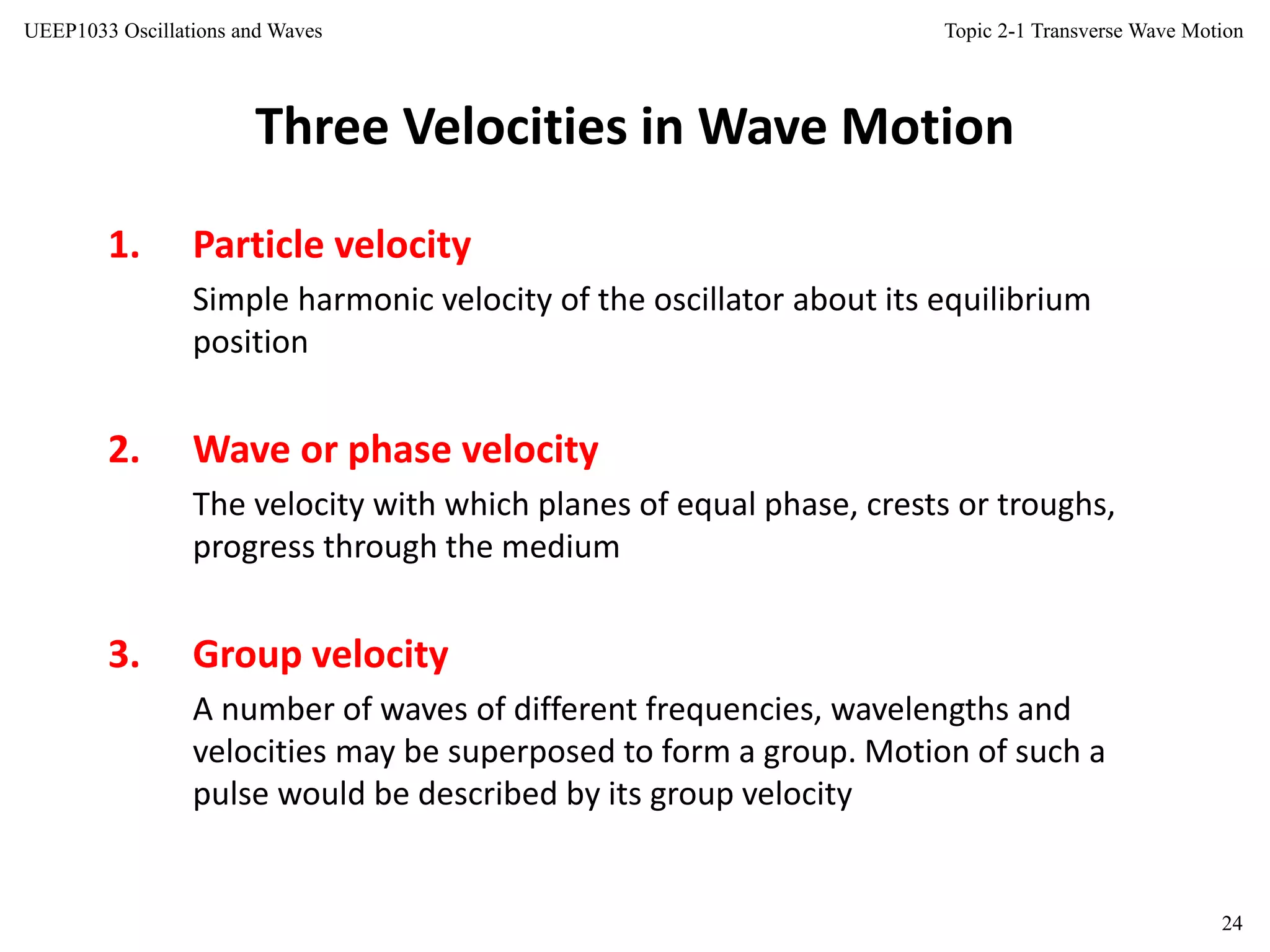
1. Particle velocity
Simple harmonic velocity of the oscillator about its equilibrium
position
2. Wave or phase velocity
The velocity with which planes of equal phase, crests or troughs,
progress through the medium
3. Group velocity
A number of waves of different frequencies, wavelengths and
velocities may be superposed to form a group. Motion of such a
pulse would be described by its group velocity
Topic 2-1 Transverse Wave Motion
25
UEEP1033 Oscillations and Waves
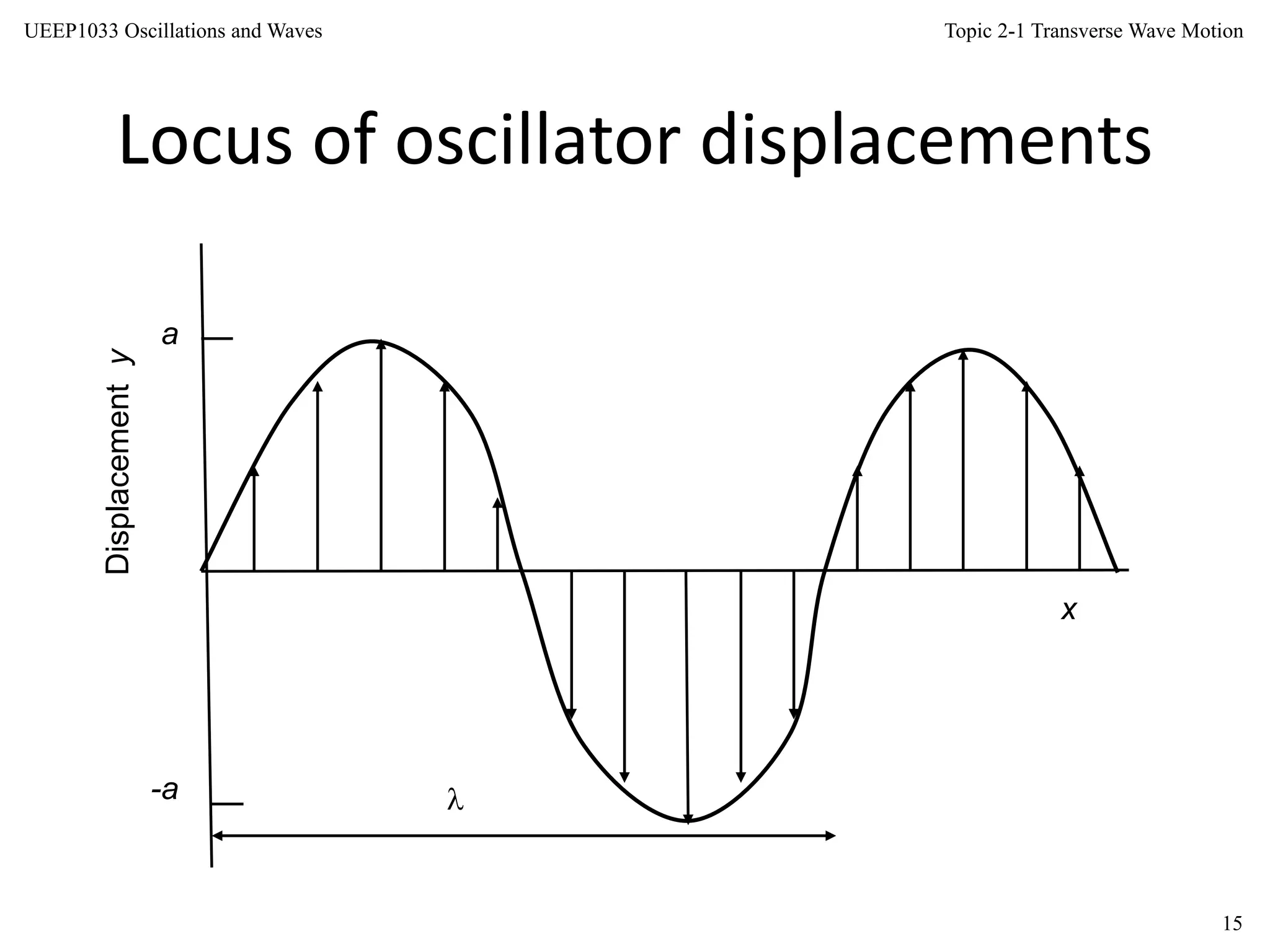
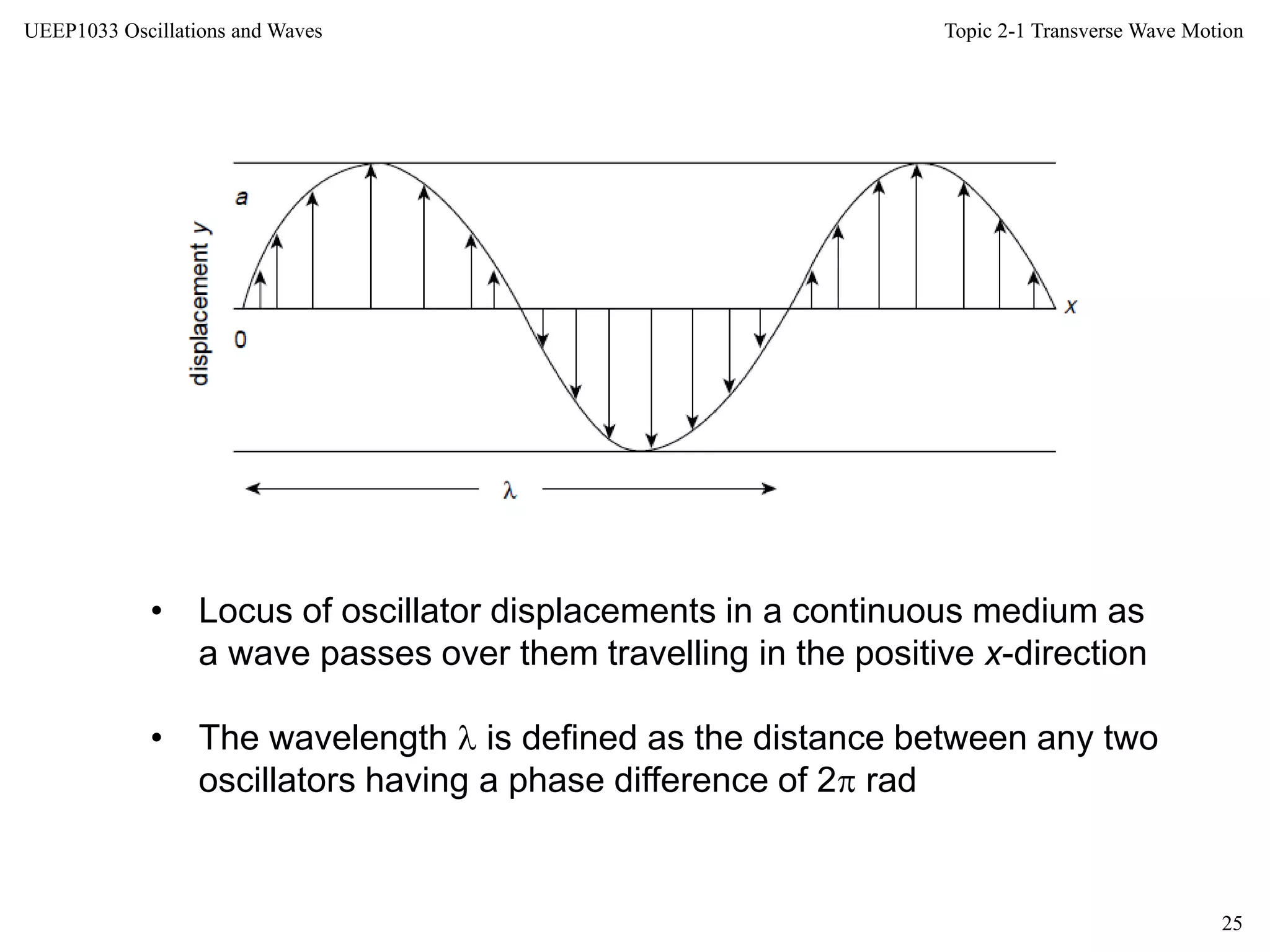
• Locus of oscillator displacements in a continuous medium as
a wave passes over them travelling in the positive x-direction
• The wavelength  is defined as the distance between any two
oscillators having a phase difference of 2 rad
Topic 2-1 Transverse Wave Motion
26
UEEP1033 Oscillations and Waves
Wave or Phase Velocity
Wave or Phase Velocity = the rate at which disturbance moves
across the oscillators
Wave or Phase Velocity =
t
x


Oscillator or Particle Velocity is a simple harmonic velocity
Oscillator or Particle Velocity =
t
y


Topic 2-1 Transverse Wave Motion
27
UEEP1033 Oscillations and Waves
Characteristic Impedance of a String
• Any medium through which waves propagate will present
an impedance to those waves
• If the medium is lossless, and possesses no resistive or
dissipation mechanism, for a string the impedance is
determined by inertia and elasticity
• The presence of a loss mechanism will introduce a
complex term into the impedance
(the string as a forced oscillator)
Topic 2-1 Transverse Wave Motion
28
UEEP1033 Oscillations and Waves
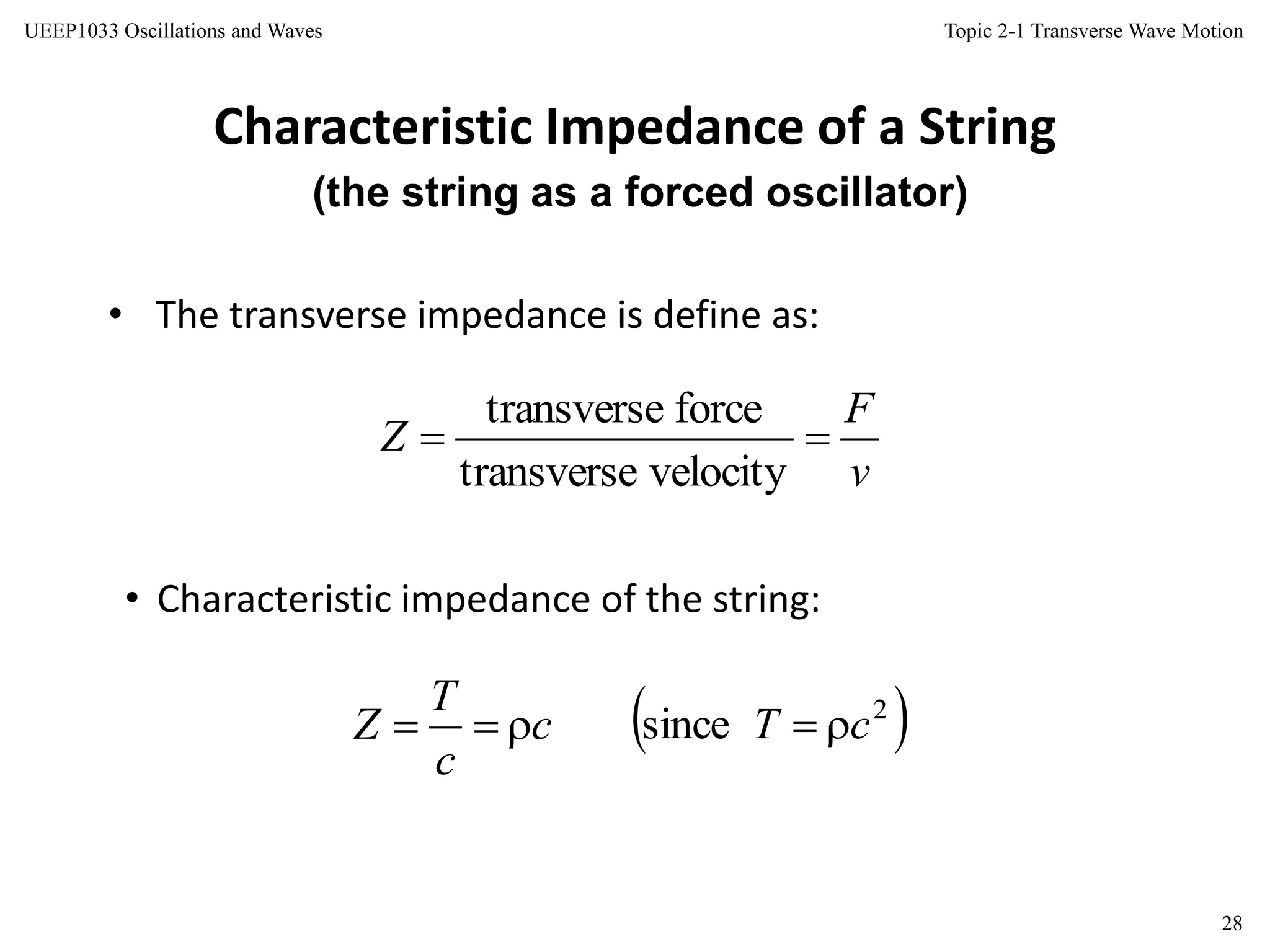
• The transverse impedance is define as:
Characteristic Impedance of a String
• Characteristic impedance of the string:
(the string as a forced oscillator)
v
F
Z 
velocitytransverse
forcetransverse
c
c
T
Z   2
since cT 
Topic 2-1 Transverse Wave Motion
29
UEEP1033 Oscillations and Waves
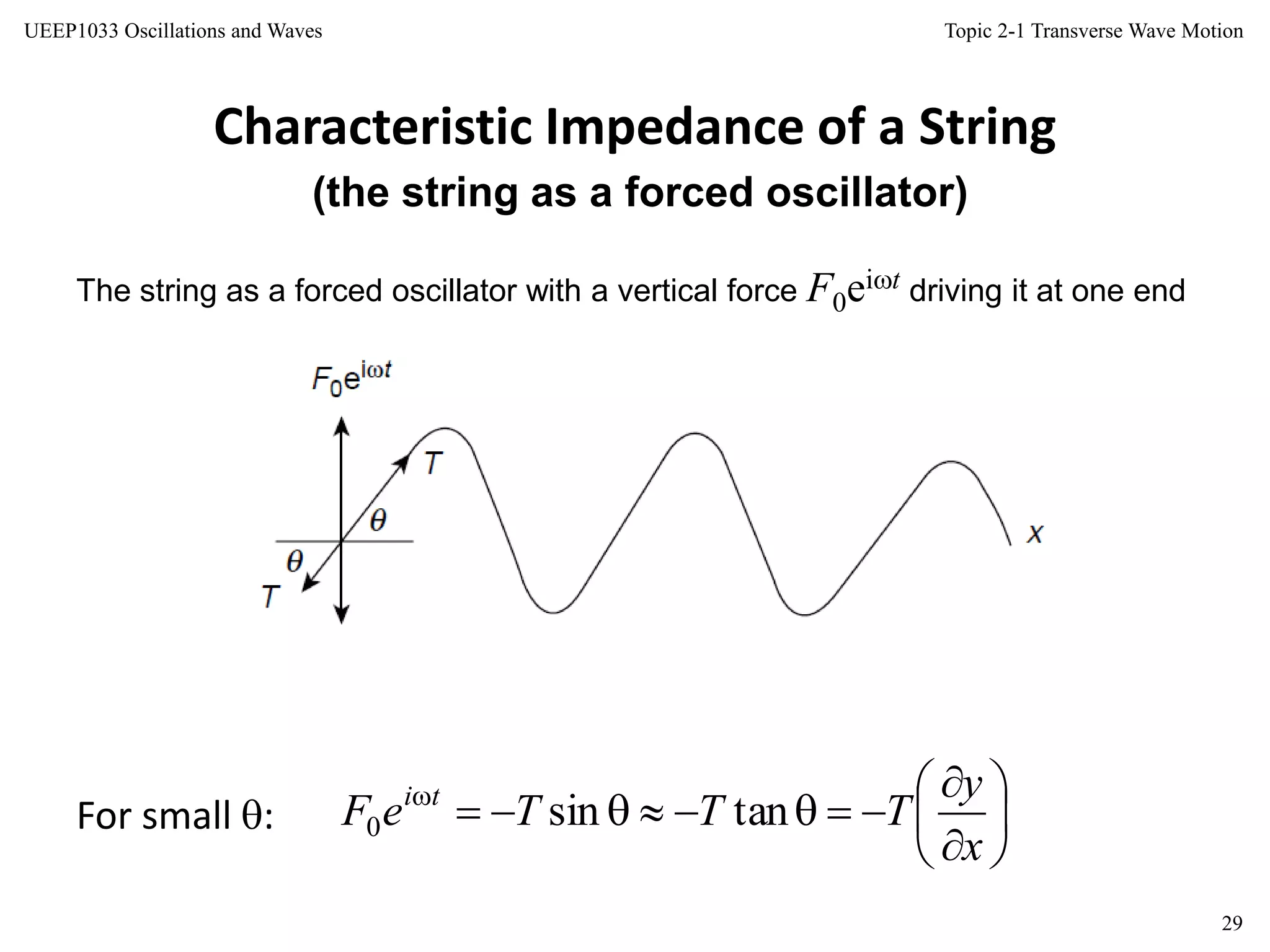
Characteristic Impedance of a String
(the string as a forced oscillator)
The string as a forced oscillator with a vertical force F0eit driving it at one end
For small : 








x
y
TTTeF ti
tansin0
Topic 2-1 Transverse Wave Motion
30
UEEP1033 Oscillations and Waves
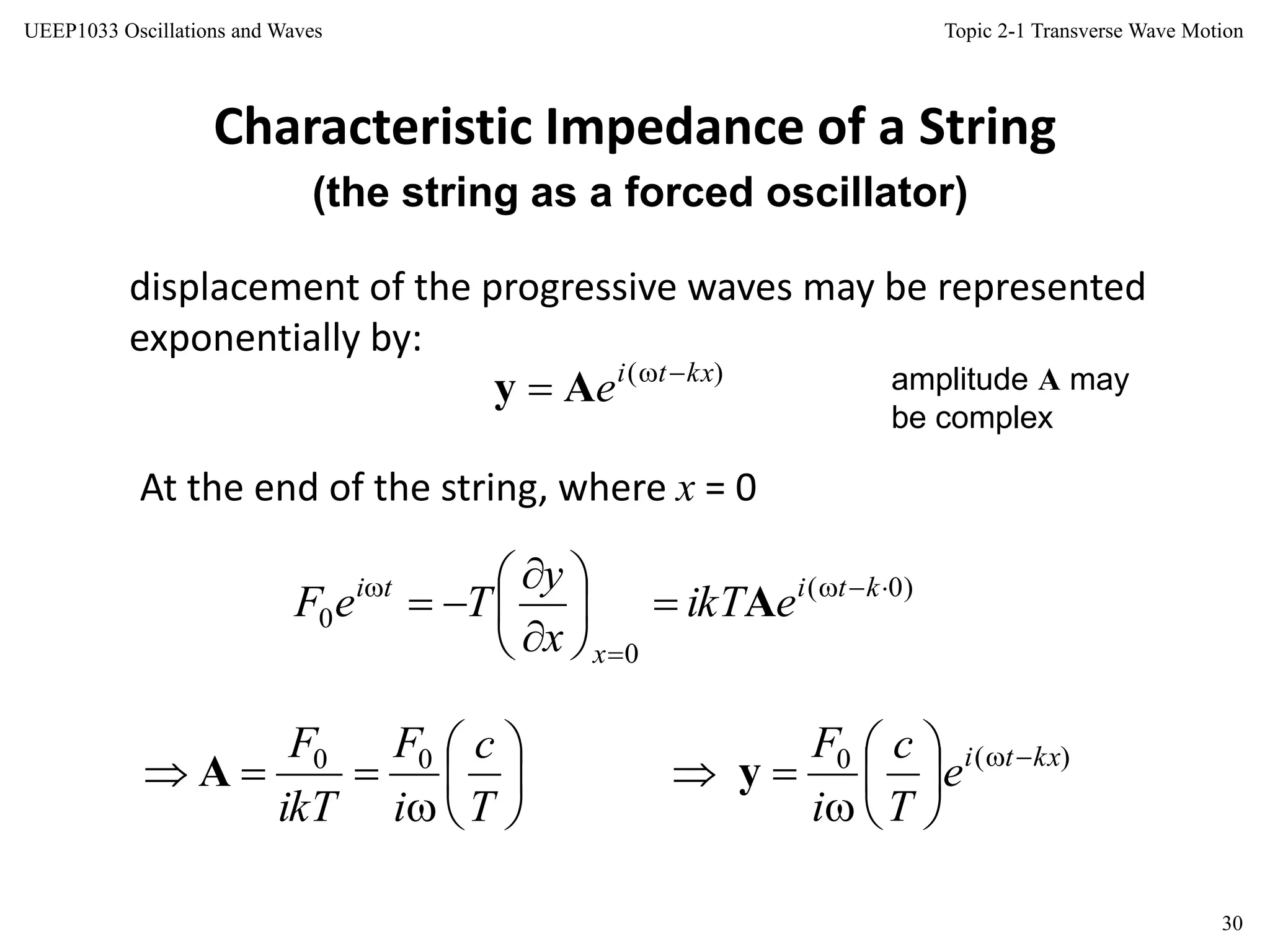
Characteristic Impedance of a String
(the string as a forced oscillator)
displacement of the progressive waves may be represented
exponentially by:
amplitude A may
be complex
At the end of the string, where x = 0
)( kxti
e 
 Ay
)0(
0
0











 kti
x
ti
eikT
x
y
TeF A








T
c
i
F
ikT
F 00
A )(0 kxti
e
T
c
i
F 







 y
Topic 2-1 Transverse Wave Motion
31
UEEP1033 Oscillations and Waves
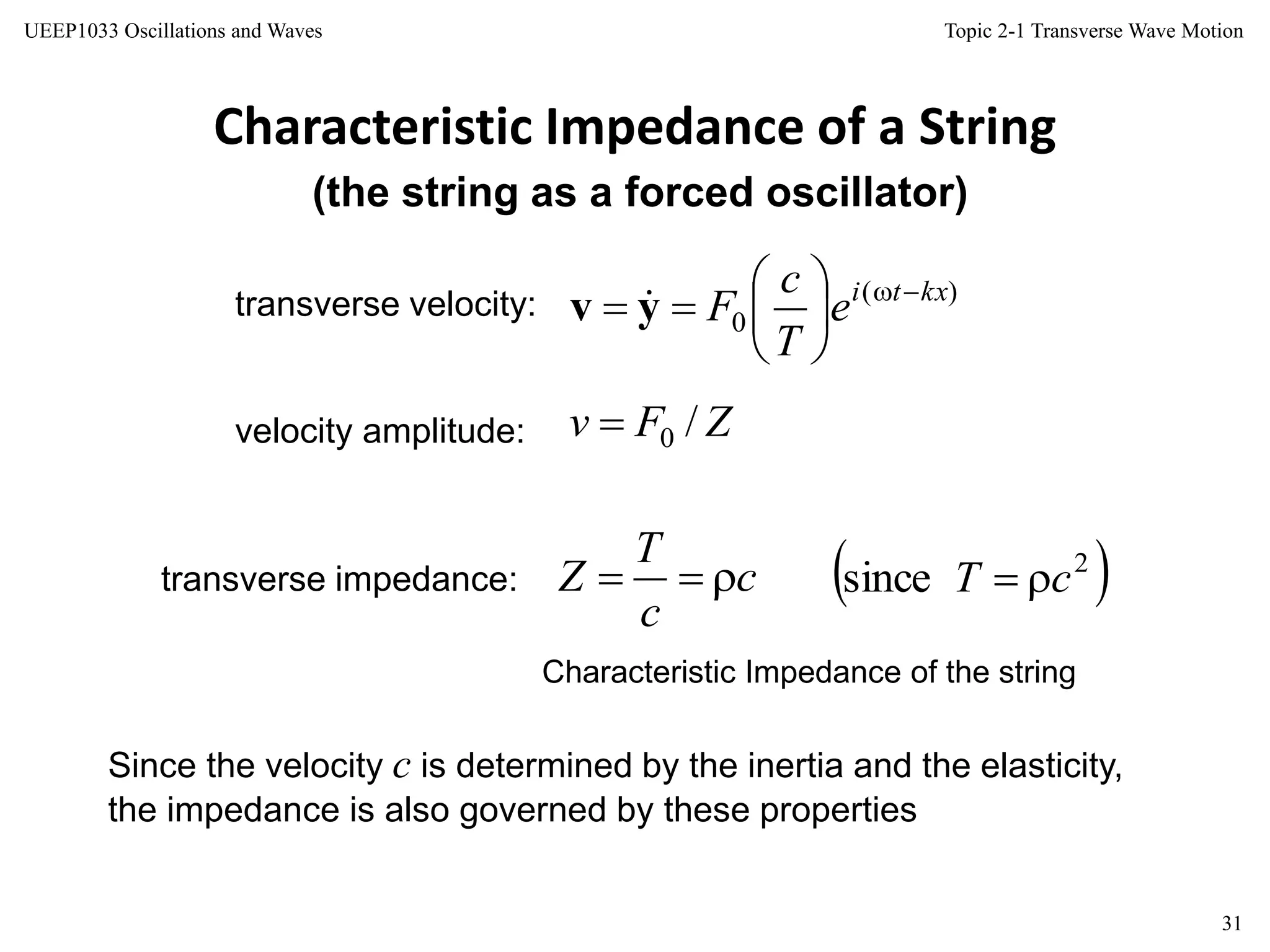
Characteristic Impedance of a String
(the string as a forced oscillator)
transverse velocity:
velocity amplitude:
transverse impedance:
Characteristic Impedance of the string
Since the velocity c is determined by the inertia and the elasticity,
the impedance is also governed by these properties
)(
0
kxti
e
T
c
F 






 yv 
ZFv /0
c
c
T
Z   2
since cT 
Topic 2-1 Transverse Wave Motion
32
UEEP1033 Oscillations and Waves
Reflection and Transmission
Topic 2-1 Transverse Wave Motion
33
UEEP1033 Oscillations and Waves
Z1 = 1c1
Z2 = 2c2
Reflection and Transmission
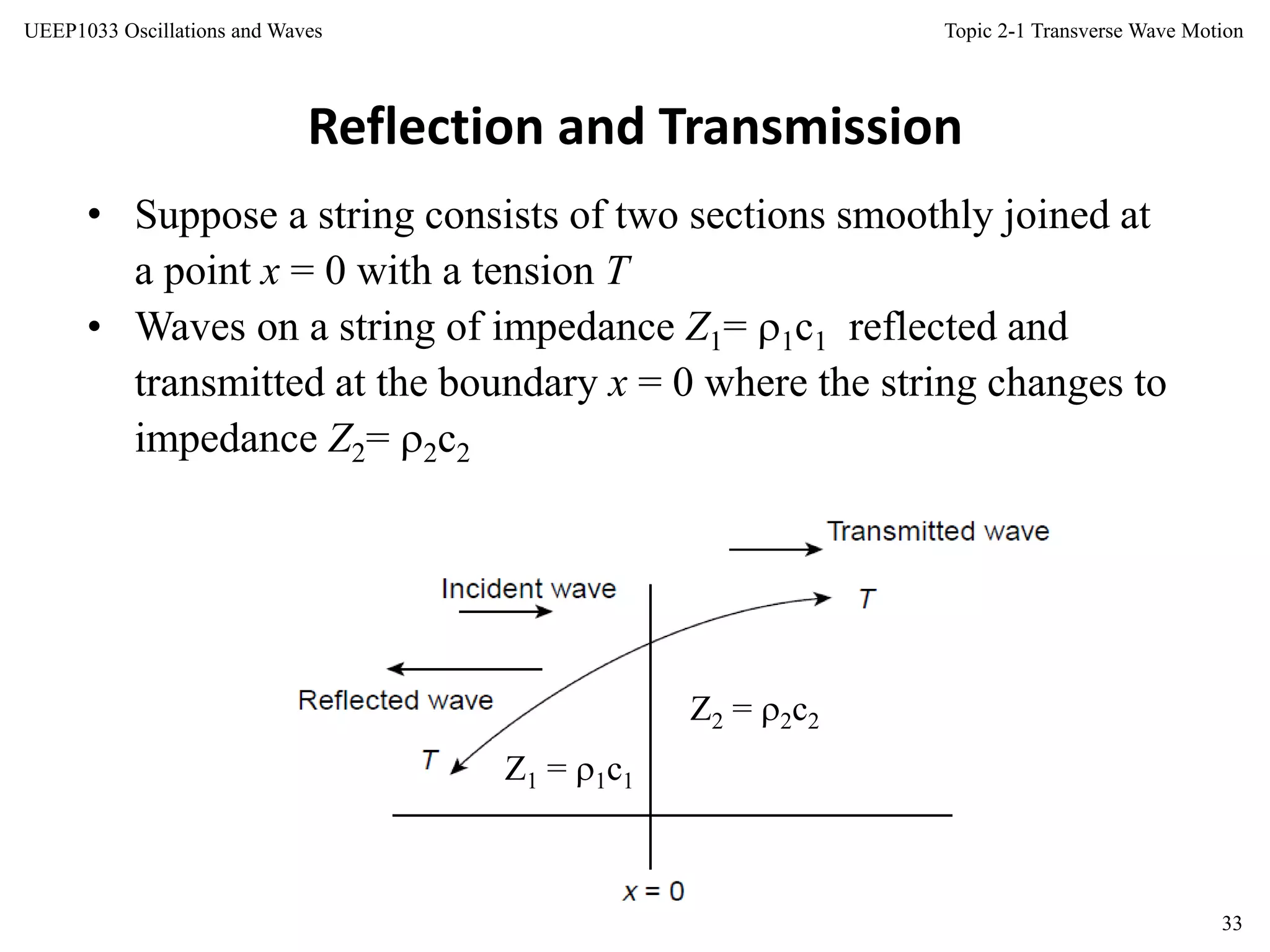
• Suppose a string consists of two sections smoothly joined at
a point x = 0 with a tension T
• Waves on a string of impedance Z1= 1c1 reflected and
transmitted at the boundary x = 0 where the string changes to
impedance Z2= 2c2
Topic 2-1 Transverse Wave Motion
34
UEEP1033 Oscillations and Waves
Reflection and Transmission
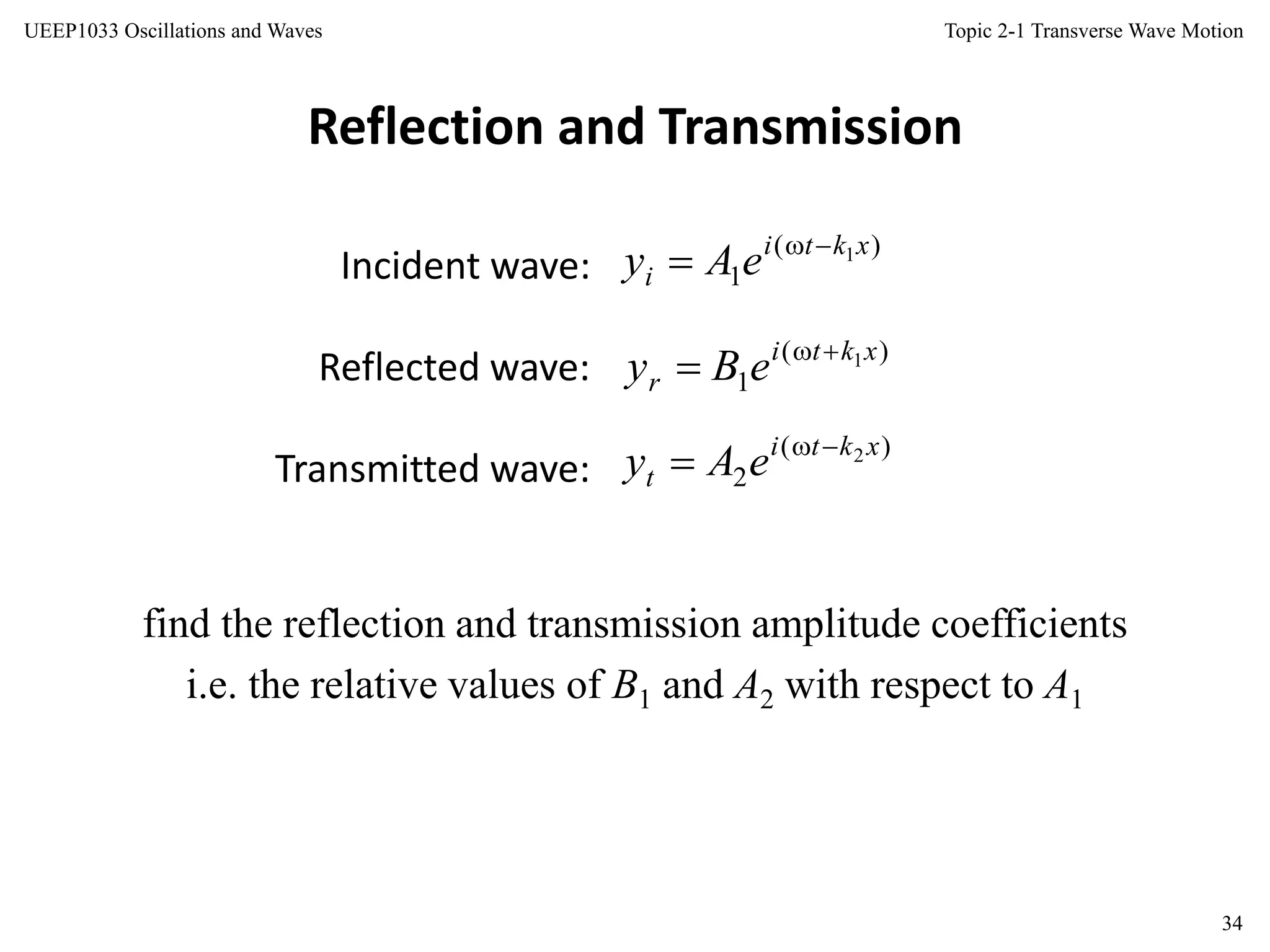
Incident wave:
Reflected wave:
Transmitted wave:
find the reflection and transmission amplitude coefficients
i.e. the relative values of B1 and A2 with respect to A1
)(
1
1xkti
i eAy 

)(
1
1xkti
r eBy 

)(
2
2xkti
t eAy 

Topic 2-1 Transverse Wave Motion
35
UEEP1033 Oscillations and Waves
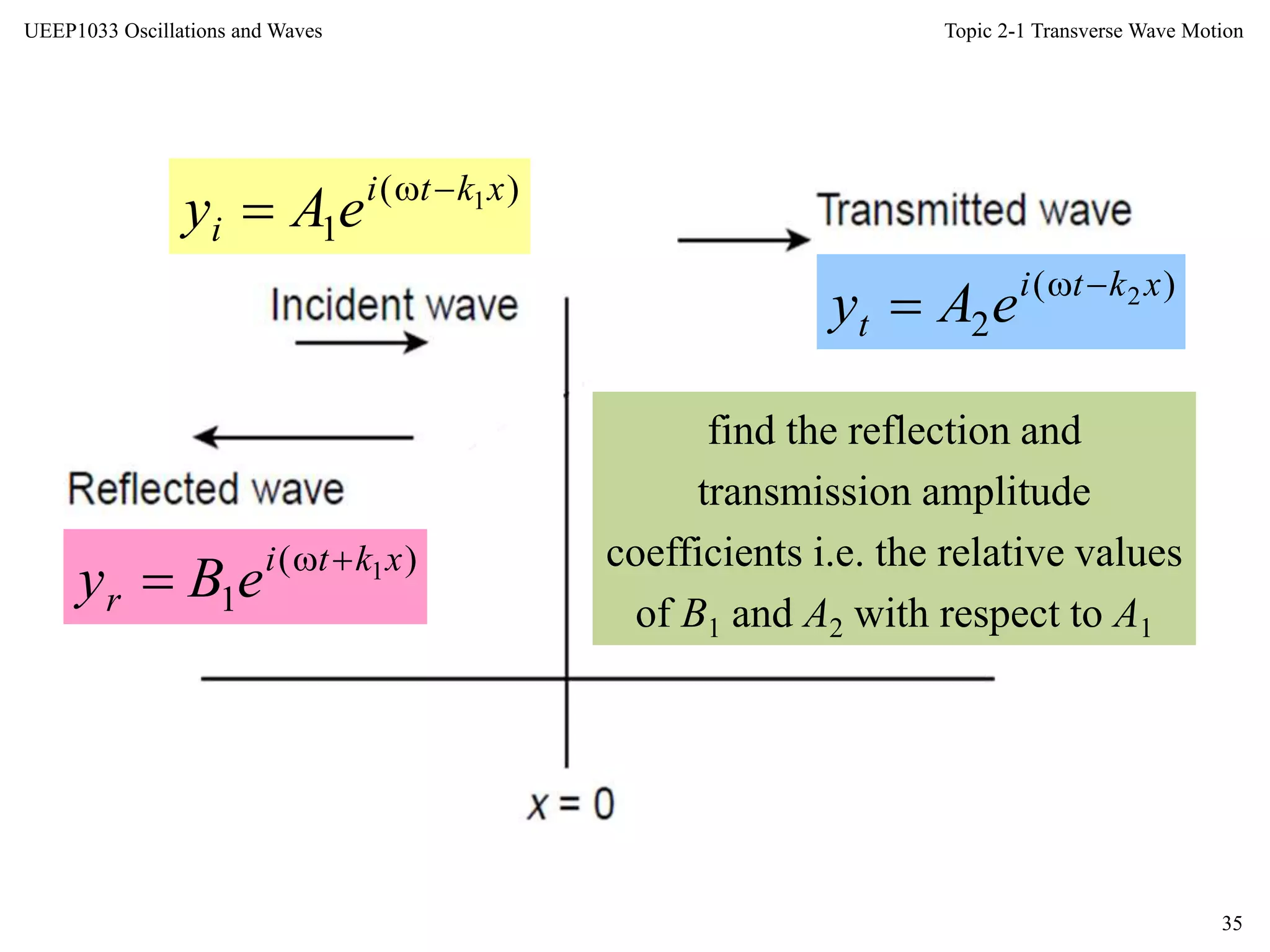
)(
1
1xkti
i eAy 

)(
1
1xkti
r eBy 

)(
2
2xkti
t eAy 

find the reflection and
transmission amplitude
coefficients i.e. the relative values
of B1 and A2 with respect to A1
Topic 2-1 Transverse Wave Motion
36
UEEP1033 Oscillations and Waves
Boundary condition No. 1 at the impedance discontinuity at x = 0
Reflection and Transmission
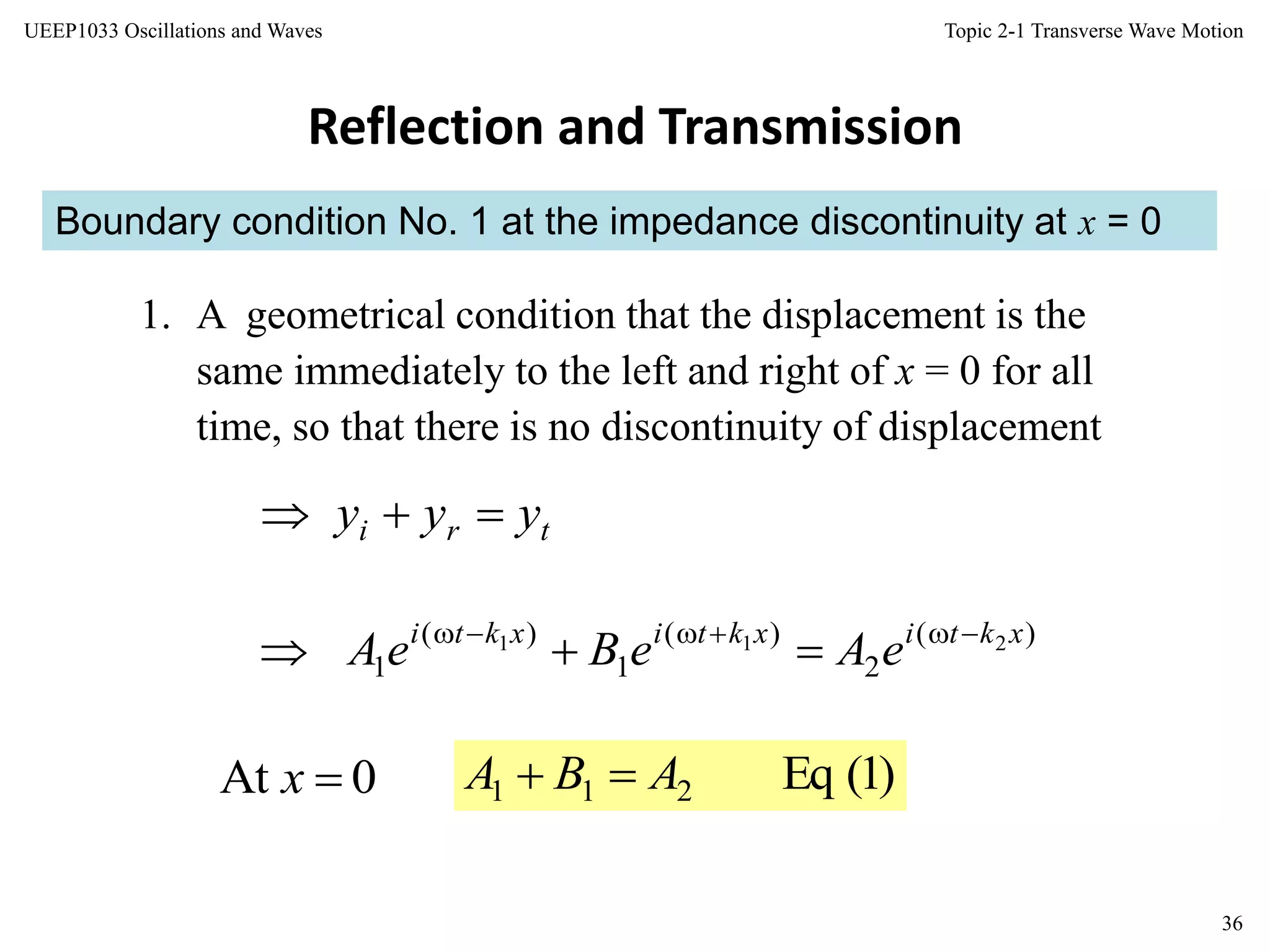
1. A geometrical condition that the displacement is the
same immediately to the left and right of x = 0 for all
time, so that there is no discontinuity of displacement
tri yyy 
)(
2
)(
1
)(
1
211 xktixktixkti
eAeBeA 

0At x )1(Eq211 ABA 
Topic 2-1 Transverse Wave Motion
37
UEEP1033 Oscillations and Waves
Boundary condition No. 2 at the impedance discontinuity at x = 0
Reflection and Transmission
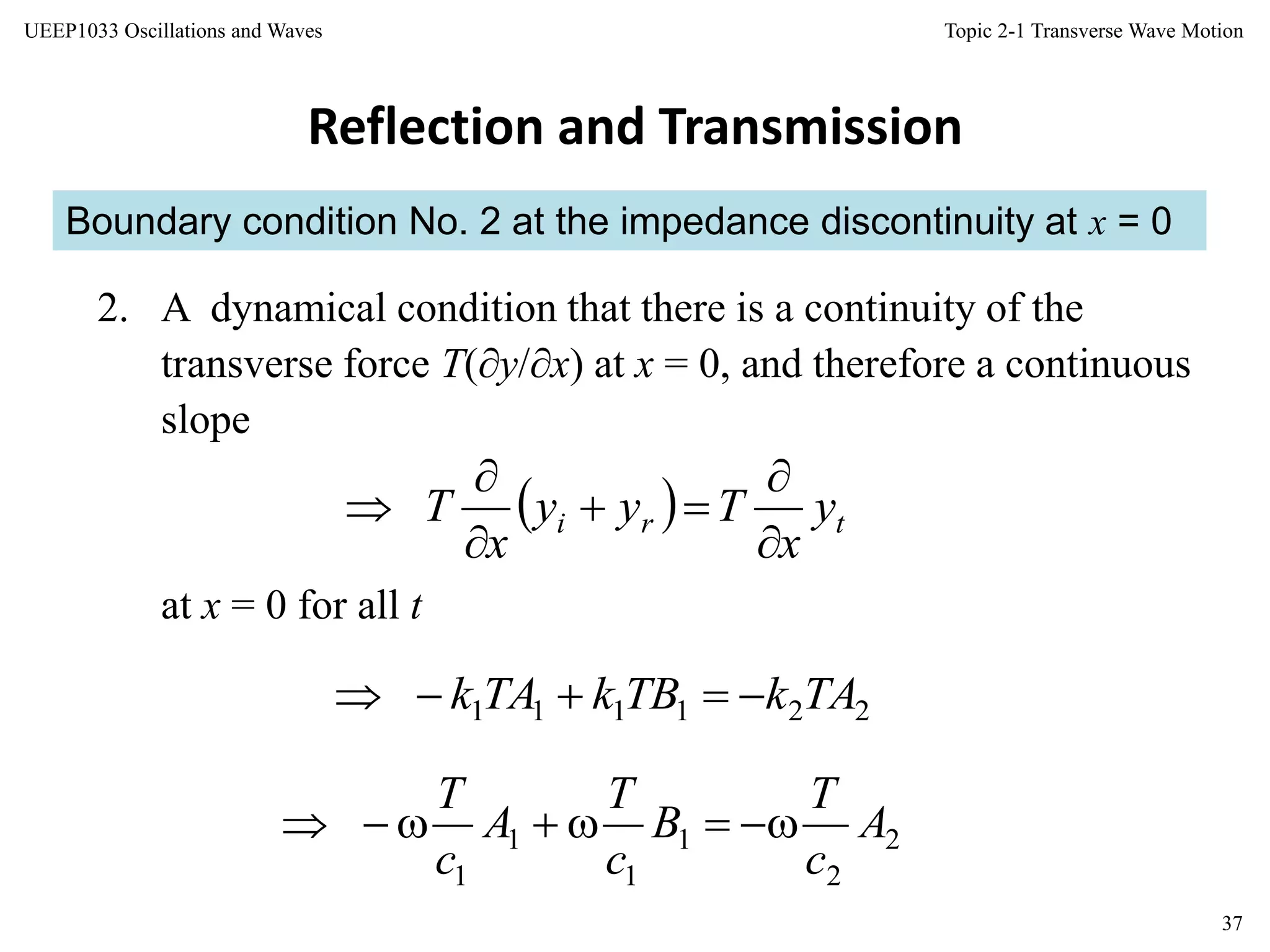
2. A dynamical condition that there is a continuity of the
transverse force T(y/x) at x = 0, and therefore a continuous
slope
  tri y
x
Tyy
x
T






at x = 0 for all t
221111 TAkTBkTAk 
2
2
1
1
1
1
A
c
T
B
c
T
A
c
T

Topic 2-1 Transverse Wave Motion
38
UEEP1033 Oscillations and Waves
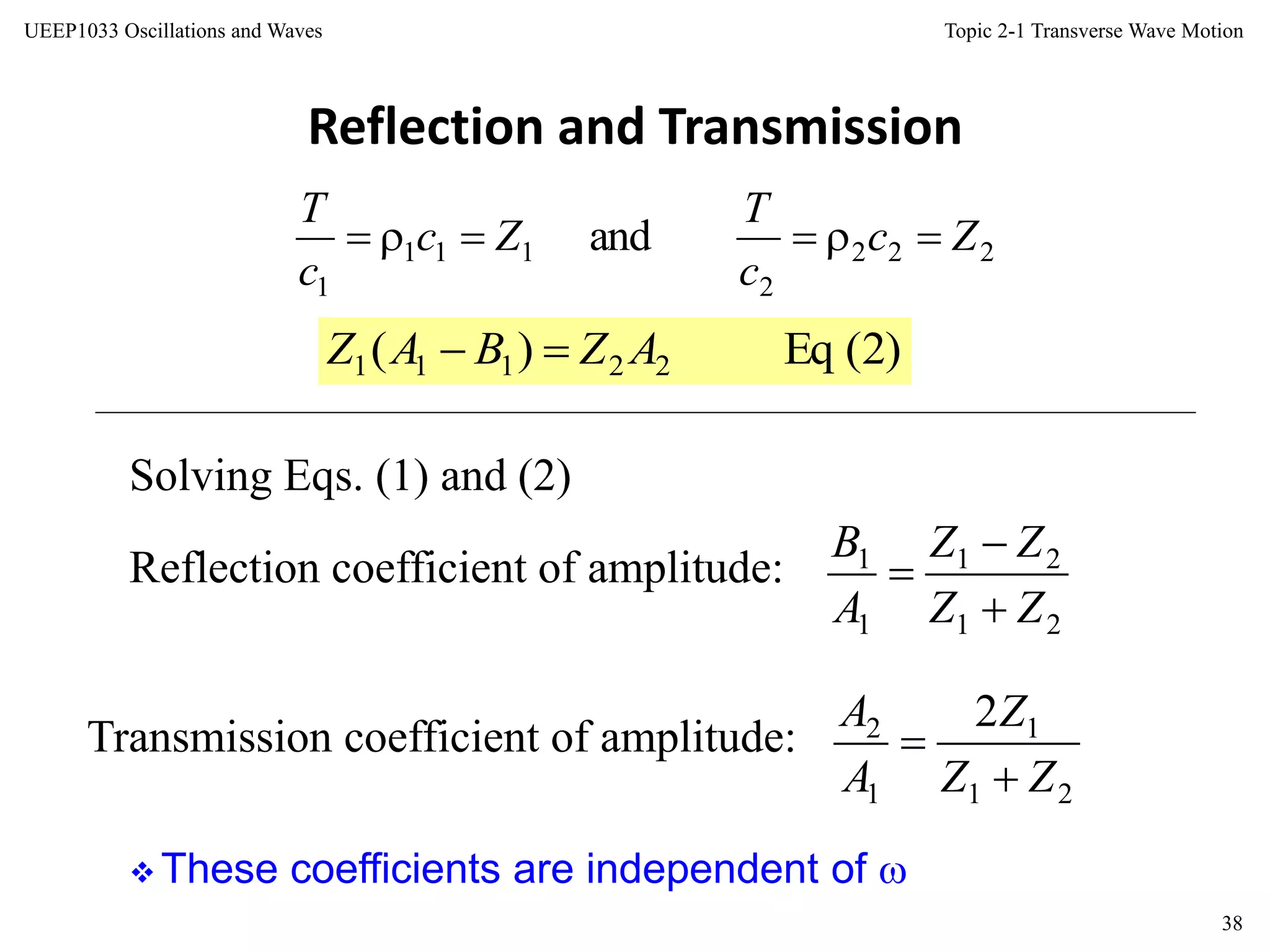
Reflection and Transmission
 These coefficients are independent of 
222
2
111
1
and Zc
c
T
Zc
c
T

)2(Eq)( 22111 AZBAZ 
Reflection coefficient of amplitude:
21
21
1
1
ZZ
ZZ
A
B



Transmission coefficient of amplitude:
21
1
1
2 2
ZZ
Z
A
A

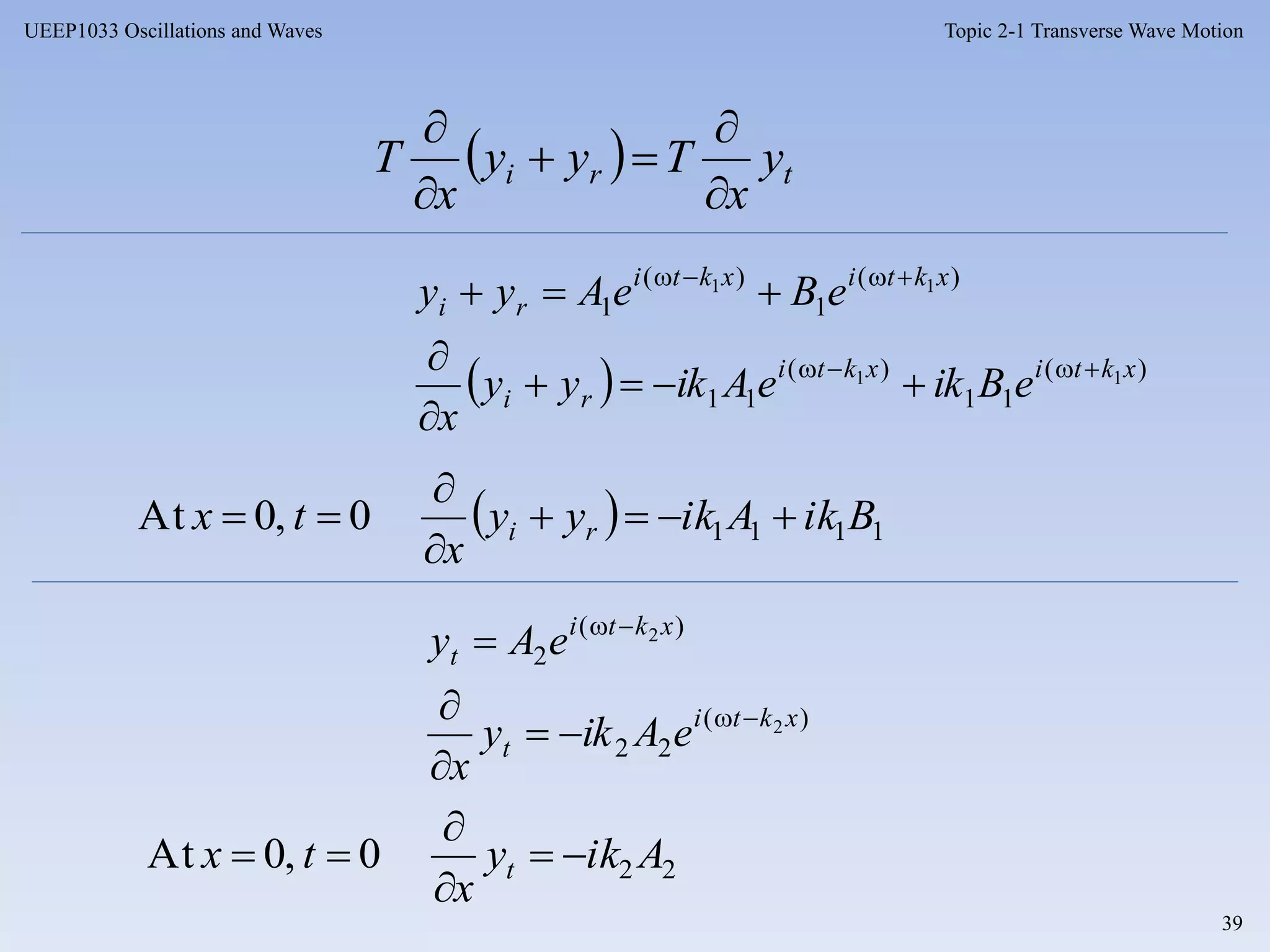

Solving Eqs. (1) and (2)
Topic 2-1 Transverse Wave Motion
39
UEEP1033 Oscillations and Waves
  )(
11
)(
11
)(
1
)(
1
11
11
xktixkti
ri
xktixkti
ri
eBikeAikyy
x
eBeAyy






  tri y
x
Tyy
x
T





)(
22
)(
2
2
2
xkti
t
xkti
t
eAiky
x
eAy






  11110,0At BikAikyy
x
tx ri 



220,0At Aiky
x
tx t 



Topic 2-1 Transverse Wave Motion
40
UEEP1033 Oscillations and Waves
  tri y
x
Tyy
x
T
tx





 0,0At
221111 AikBikAik 
2
2
1
1
1
1
A
c
T
B
c
T
A
c
T

221111 AkBkAk 
22111 )( AZBAZ 
222
2
111
1
Zc
c
T
Zc
c
T


Topic 2-1 Transverse Wave Motion
41
UEEP1033 Oscillations and Waves
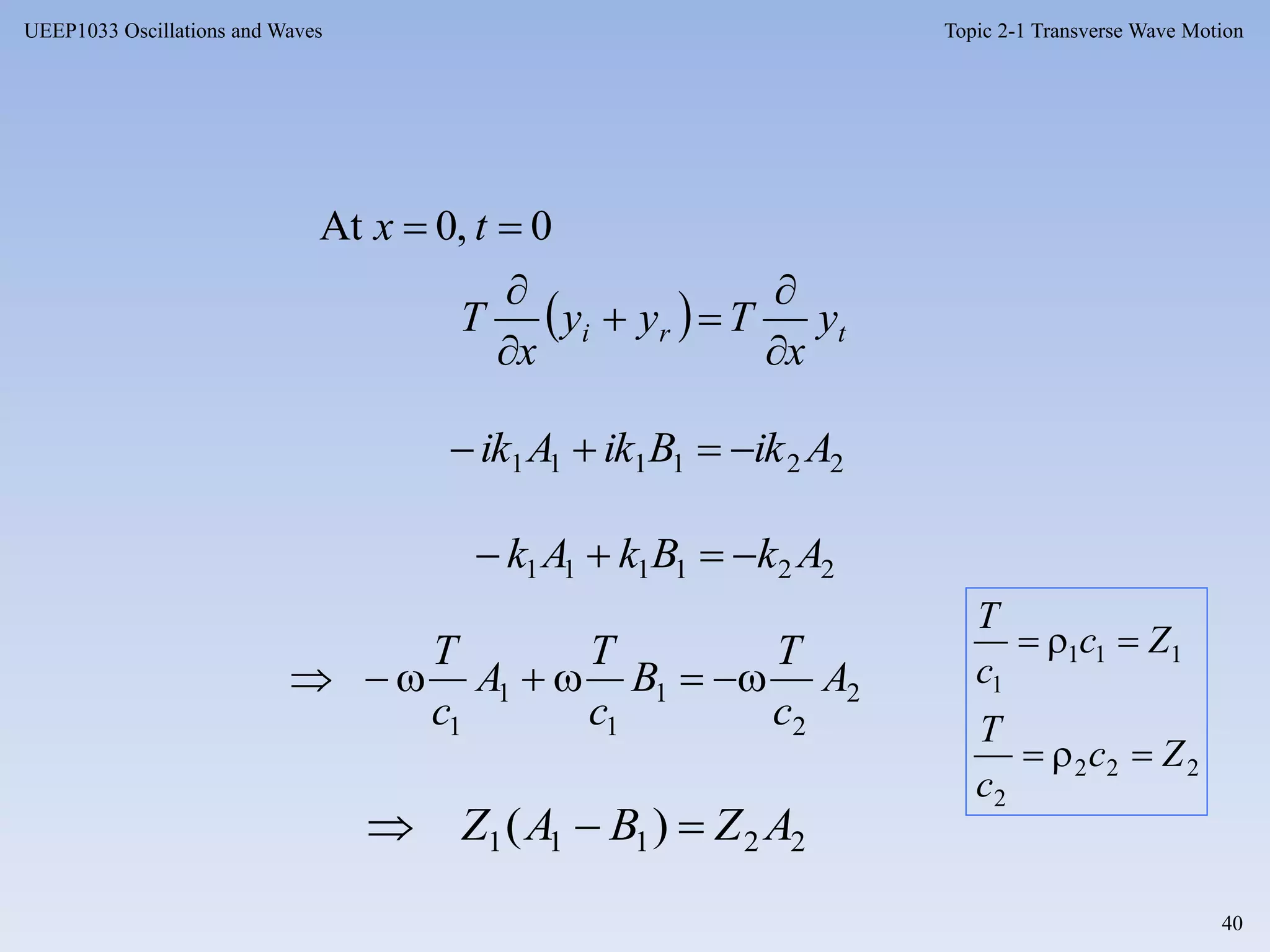
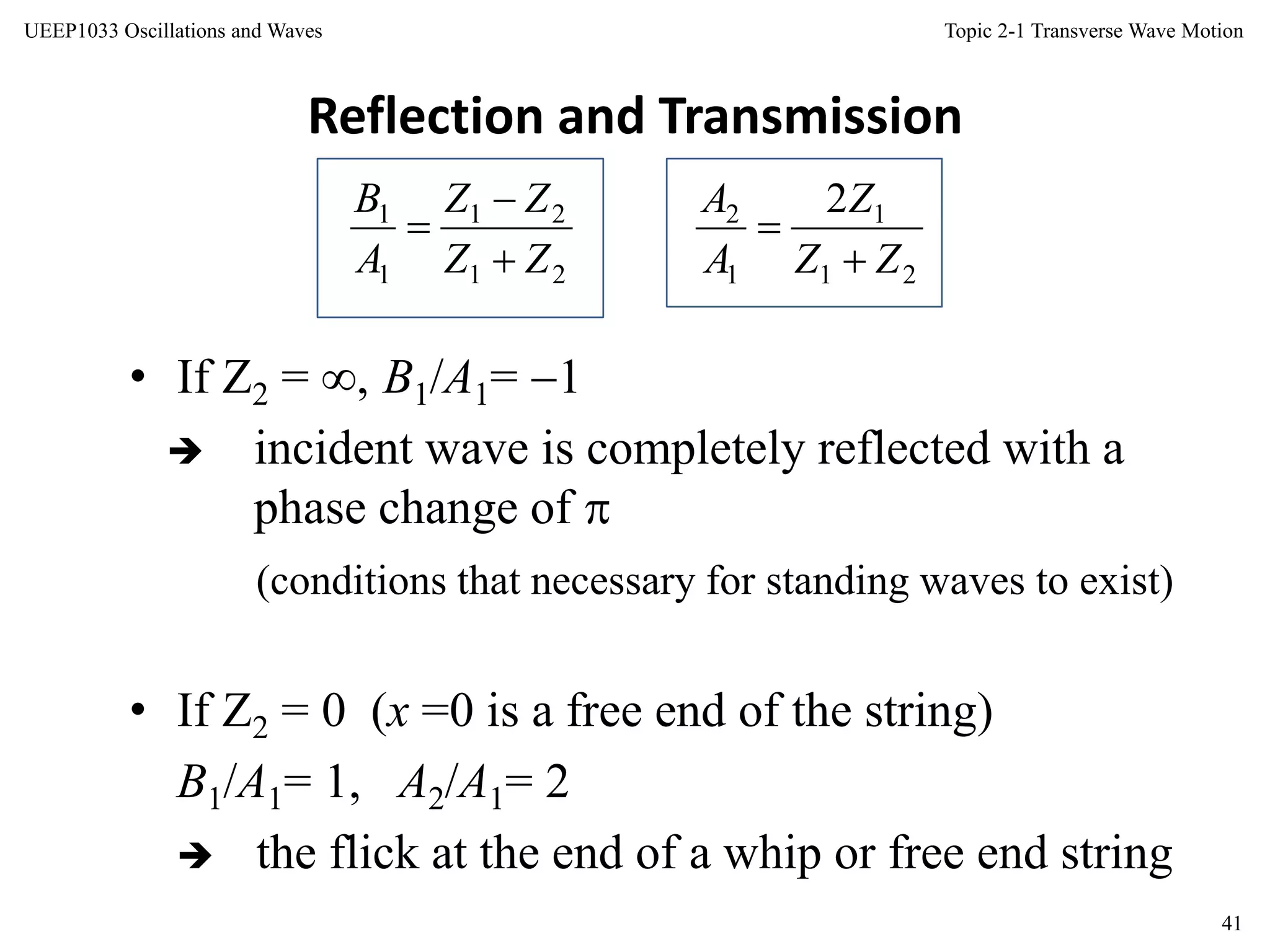
• If Z2 = , B1/A1= 1
 incident wave is completely reflected with a
phase change of 
(conditions that necessary for standing waves to exist)
• If Z2 = 0 (x =0 is a free end of the string)
B1/A1= 1, A2/A1= 2
 the flick at the end of a whip or free end string
Reflection and Transmission
21
21
1
1
ZZ
ZZ
A
B



21
1
1
2 2
ZZ
Z
A
A


Topic 2-1 Transverse Wave Motion
42
UEEP1033 Oscillations and Waves
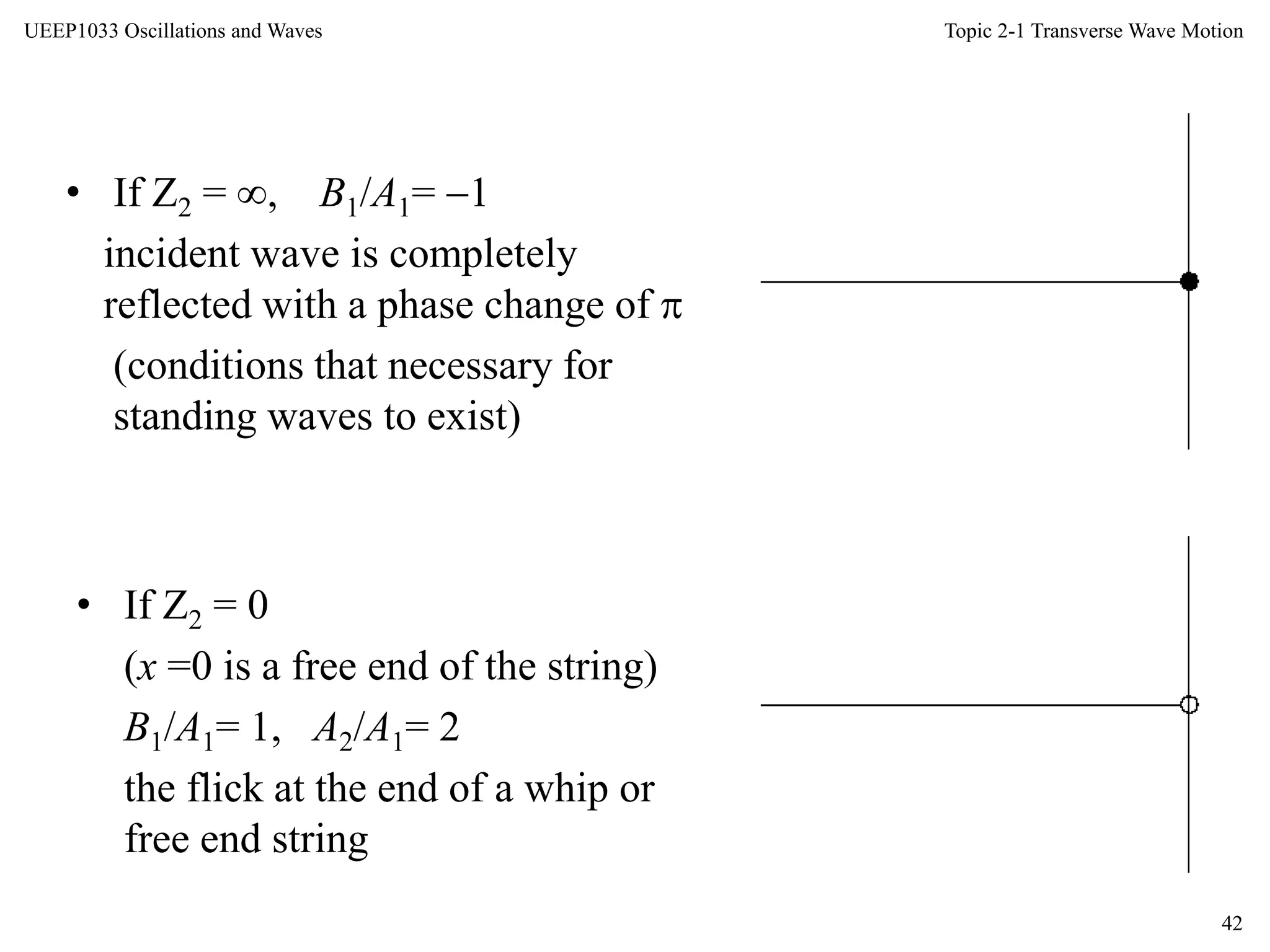
• If Z2 = , B1/A1= 1
incident wave is completely
reflected with a phase change of 
(conditions that necessary for
standing waves to exist)
• If Z2 = 0
(x =0 is a free end of the string)
B1/A1= 1, A2/A1= 2
the flick at the end of a whip or
free end string
Topic 2-1 Transverse Wave Motion
43
UEEP1033 Oscillations and Waves
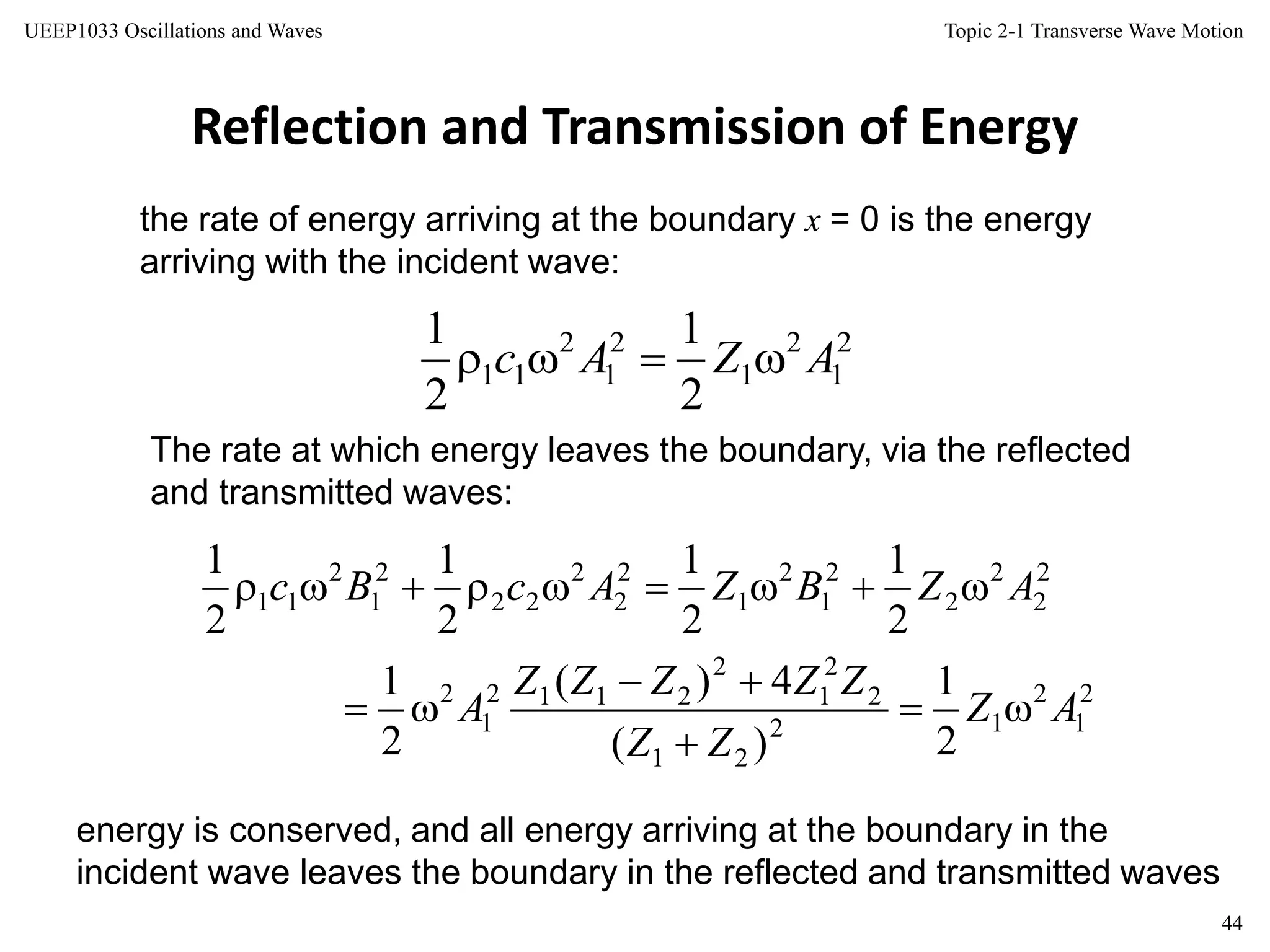
Reflection and Transmission of Energy
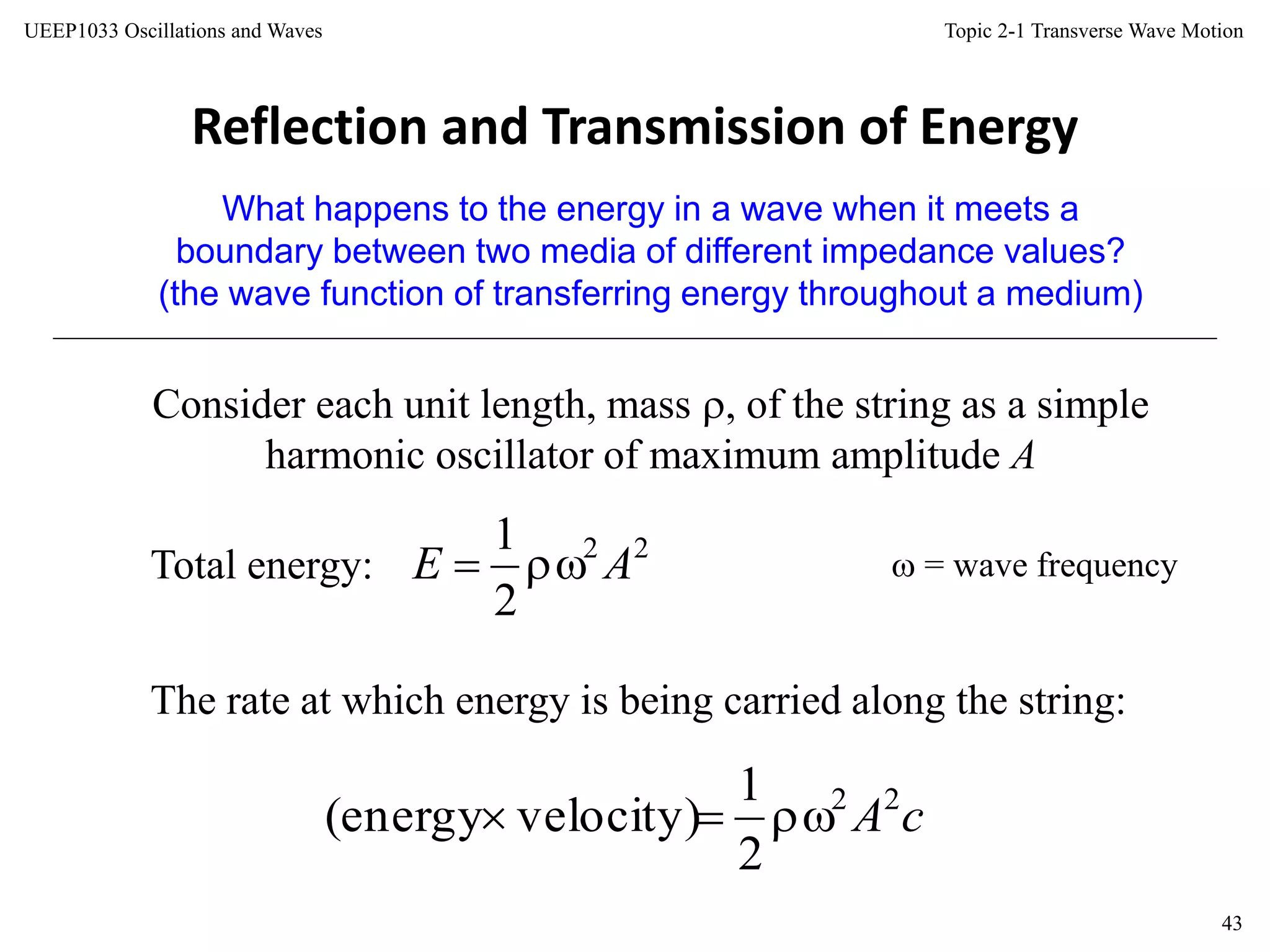
What happens to the energy in a wave when it meets a
boundary between two media of different impedance values?
(the wave function of transferring energy throughout a medium)
Consider each unit length, mass , of the string as a simple
harmonic oscillator of maximum amplitude A
Total energy:  = wave frequency
The rate at which energy is being carried along the string:
22
2
1
AE 
cA22
2
1
velocity)(energy 
Topic 2-1 Transverse Wave Motion
44
UEEP1033 Oscillations and Waves
Reflection and Transmission of Energy
The rate at which energy leaves the boundary, via the reflected
and transmitted waves:
the rate of energy arriving at the boundary x = 0 is the energy
arriving with the incident wave:
energy is conserved, and all energy arriving at the boundary in the
incident wave leaves the boundary in the reflected and transmitted waves
2
1
2
1
2
1
2
11
2
1
2
1
AZAc 
2
1
2
12
21
2
2
1
2
2112
1
2
2
2
2
2
2
1
2
1
2
2
2
22
2
1
2
11
2
1
)(
4)(
2
1
2
1
2
1
2
1
2
1
AZ
ZZ
ZZZZZ
A
AZBZAcBc





Topic 2-1 Transverse Wave Motion
45
UEEP1033 Oscillations and Waves
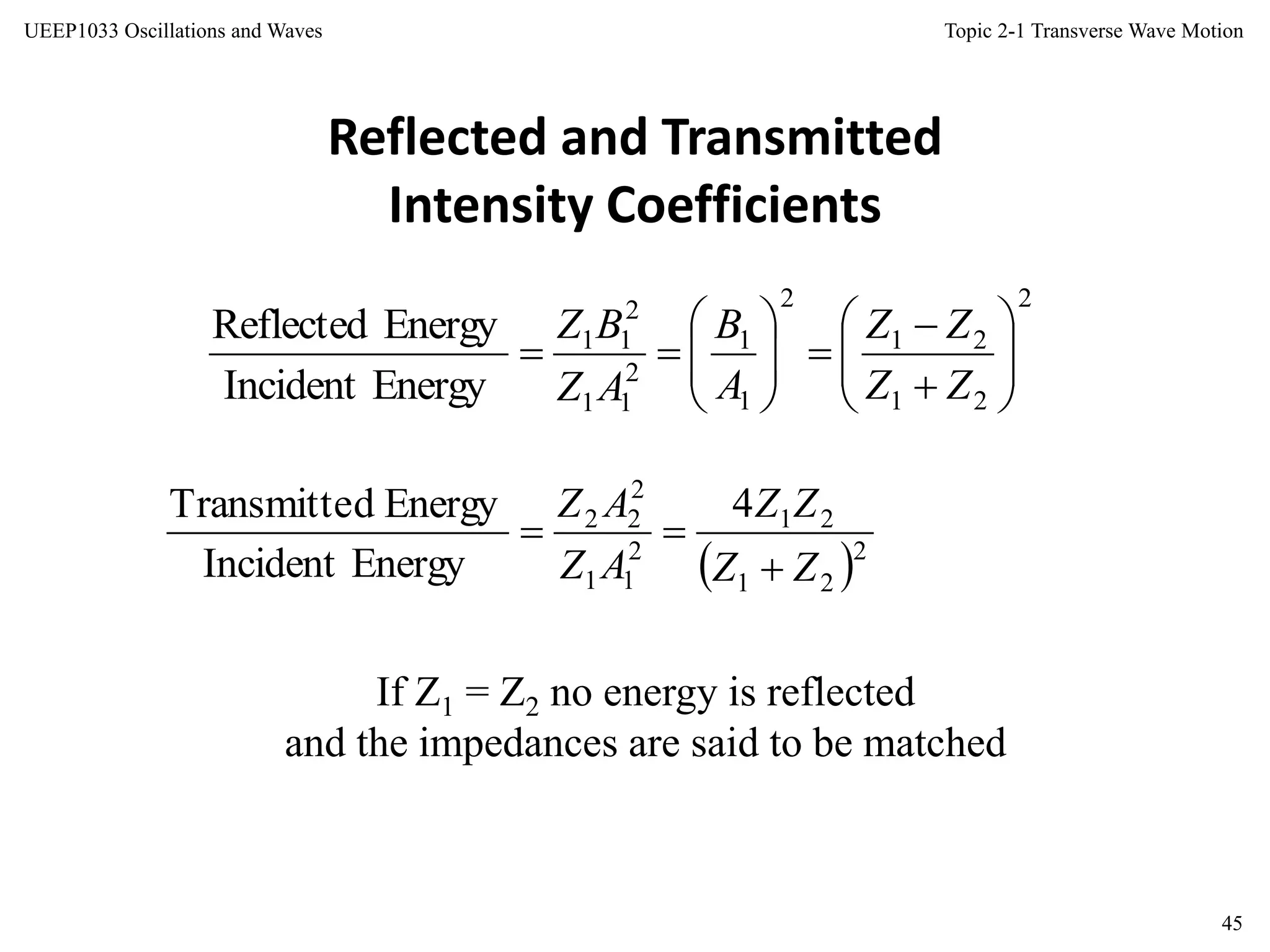
Reflected and Transmitted
Intensity Coefficients
If Z1 = Z2 no energy is reflected
and the impedances are said to be matched
2
21
21
2
1
1
2
11
2
11
EnergyIncident
EnergyReflected















ZZ
ZZ
A
B
AZ
BZ
 2
21
21
2
11
2
22 4
EnergyIncident
EnergydTransmitte
ZZ
ZZ
AZ
AZ


Topic 2-1 Transverse Wave Motion
46
UEEP1033 Oscillations and Waves
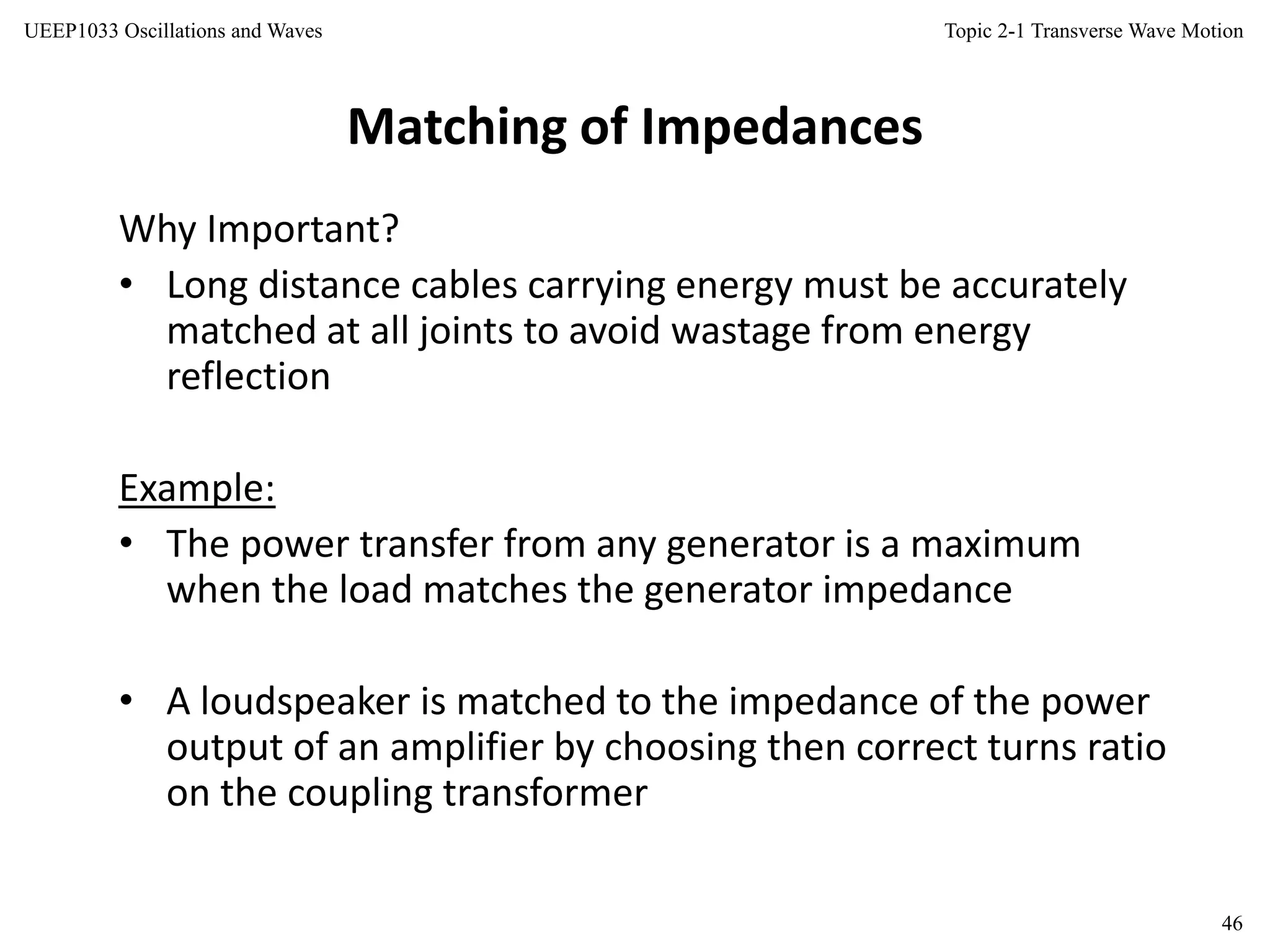
Matching of Impedances
Why Important?
• Long distance cables carrying energy must be accurately
matched at all joints to avoid wastage from energy
reflection
Example:
• The power transfer from any generator is a maximum
when the load matches the generator impedance
• A loudspeaker is matched to the impedance of the power
output of an amplifier by choosing then correct turns ratio
on the coupling transformer
Topic 2-1 Transverse Wave Motion
47
UEEP1033 Oscillations and Waves
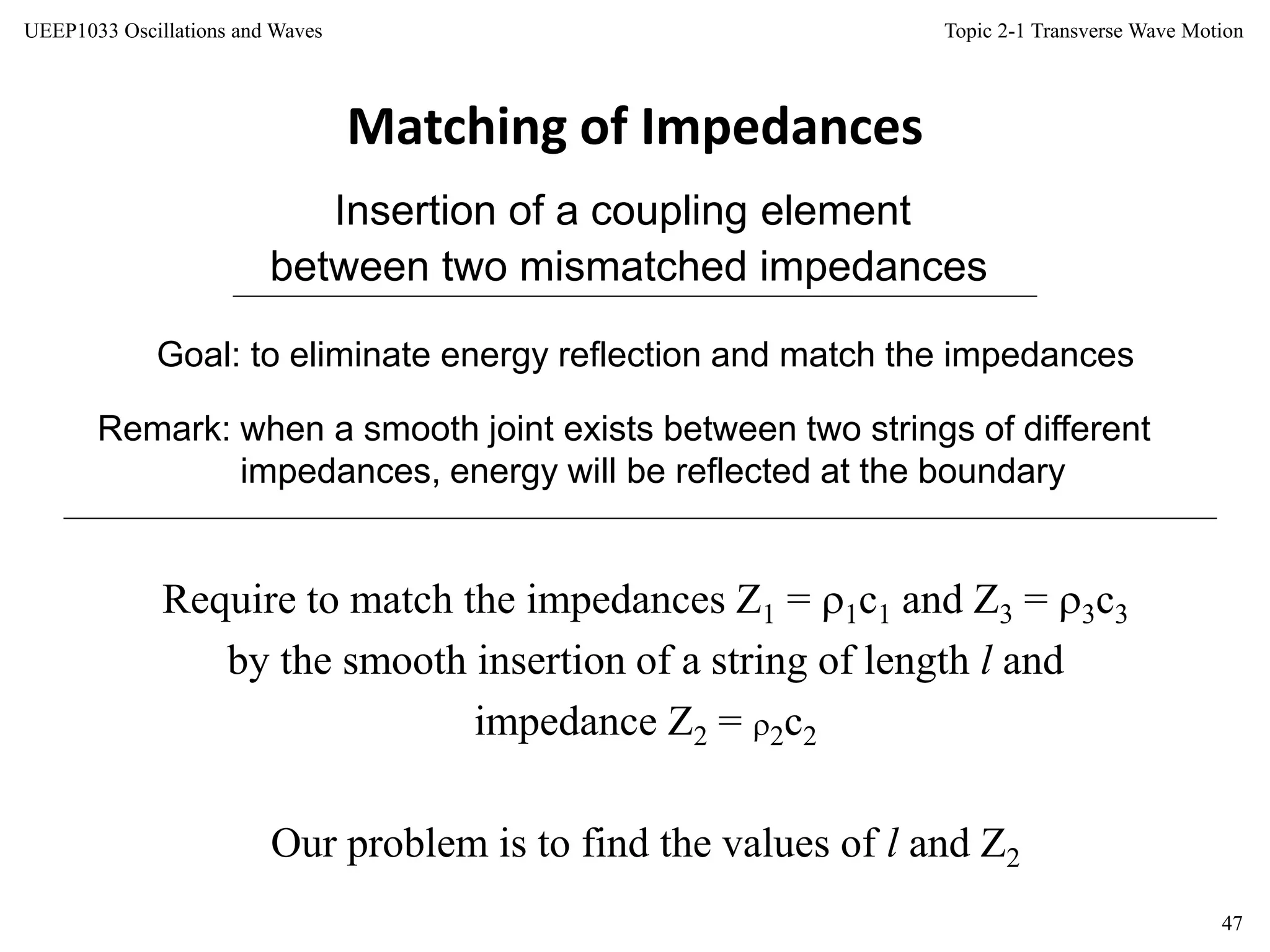
Matching of Impedances
Insertion of a coupling element
between two mismatched impedances
Remark: when a smooth joint exists between two strings of different
impedances, energy will be reflected at the boundary
Goal: to eliminate energy reflection and match the impedances
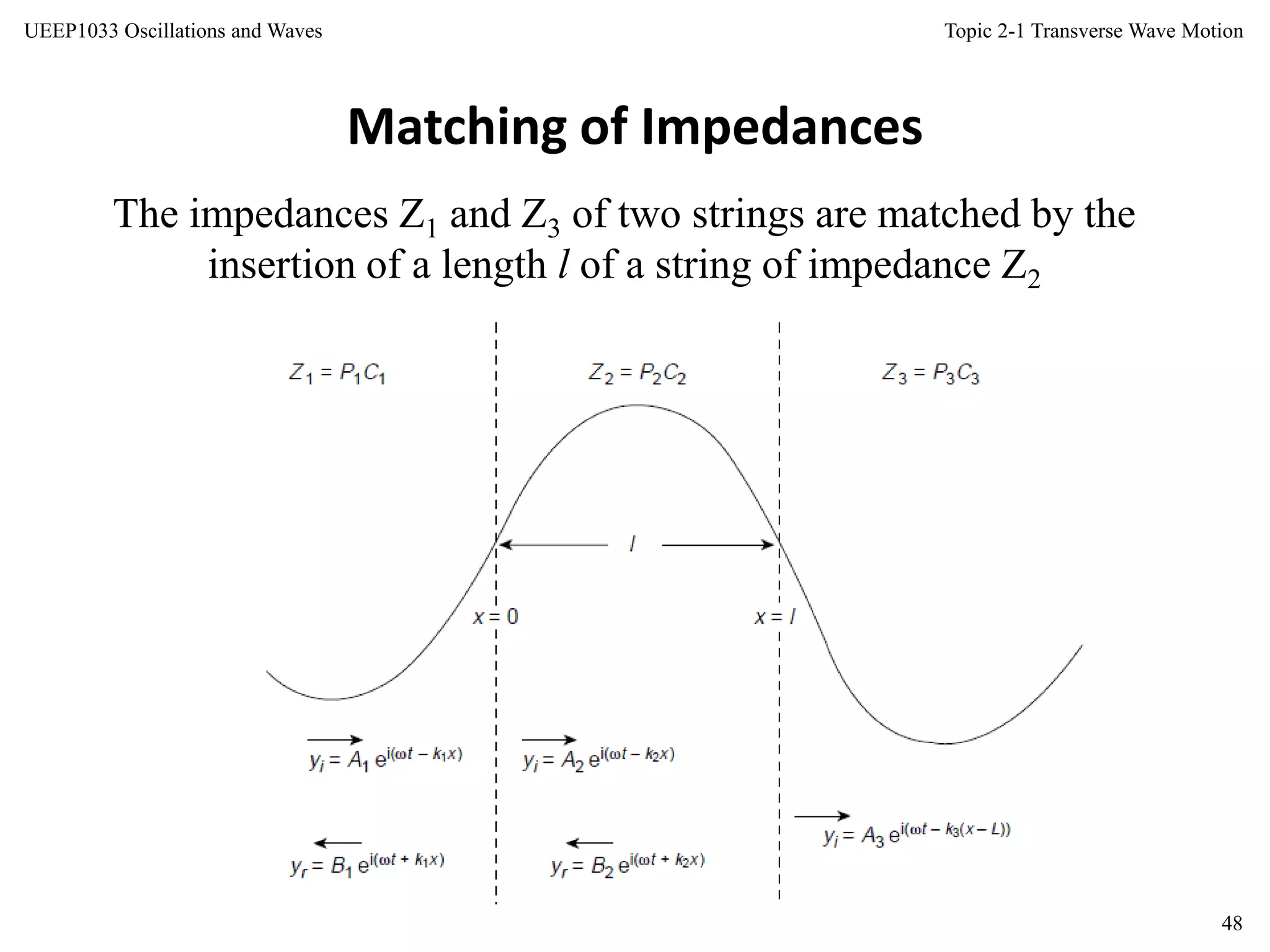
Require to match the impedances Z1 = 1c1 and Z3 = 3c3
by the smooth insertion of a string of length l and
impedance Z2 = 2c2
Our problem is to find the values of l and Z2
Topic 2-1 Transverse Wave Motion
48
UEEP1033 Oscillations and Waves
Matching of Impedances
The impedances Z1 and Z3 of two strings are matched by the
insertion of a length l of a string of impedance Z2
Topic 2-1 Transverse Wave Motion
49
UEEP1033 Oscillations and Waves
Matching of Impedances
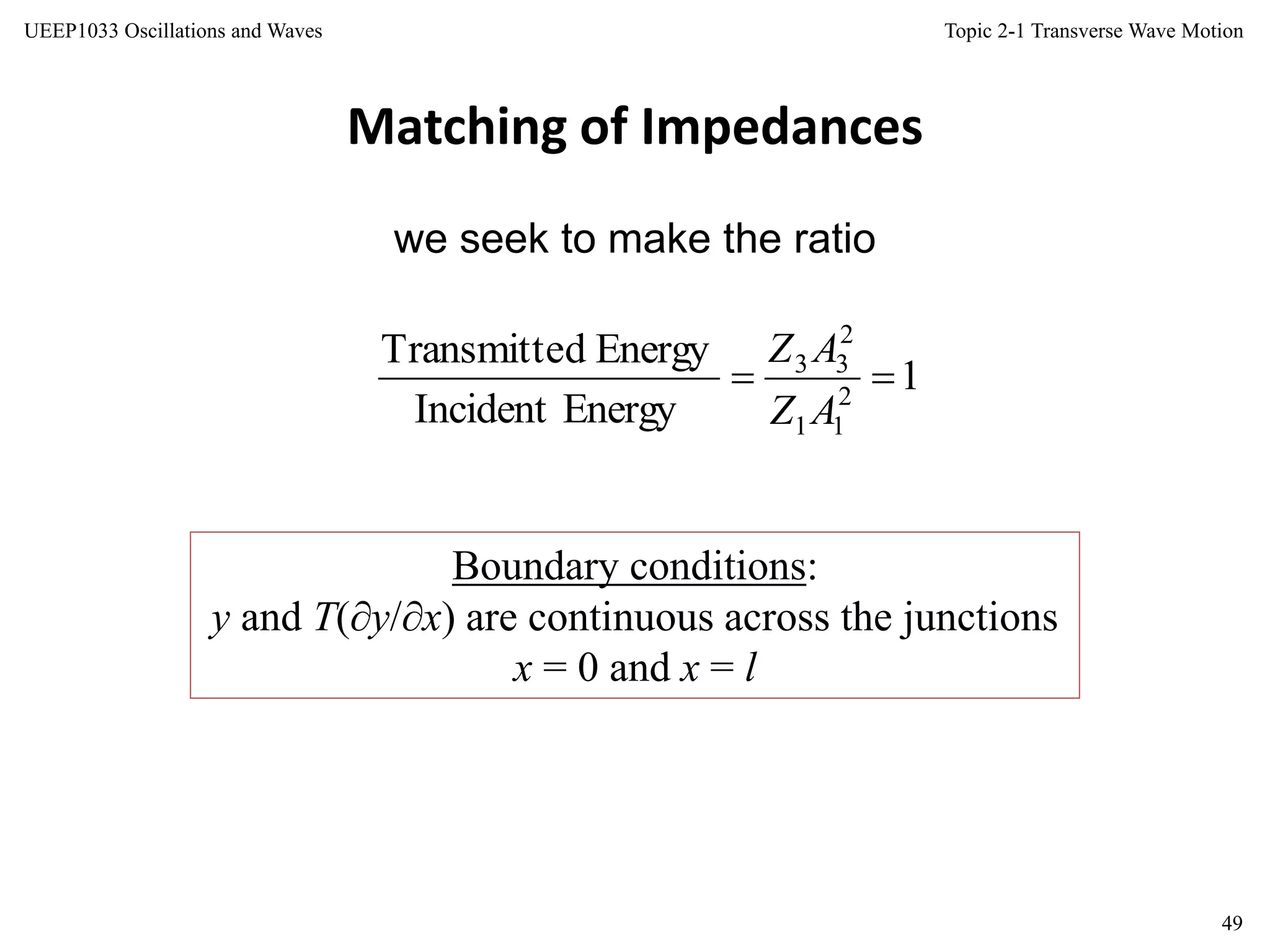
we seek to make the ratio
Boundary conditions:
y and T(y/x) are continuous across the junctions
x = 0 and x = l
1
EnergyIncident
EnergydTransmitte
2
11
2
33

AZ
AZ
Topic 2-1 Transverse Wave Motion
50
UEEP1033 Oscillations and Waves
Matching of Impedances
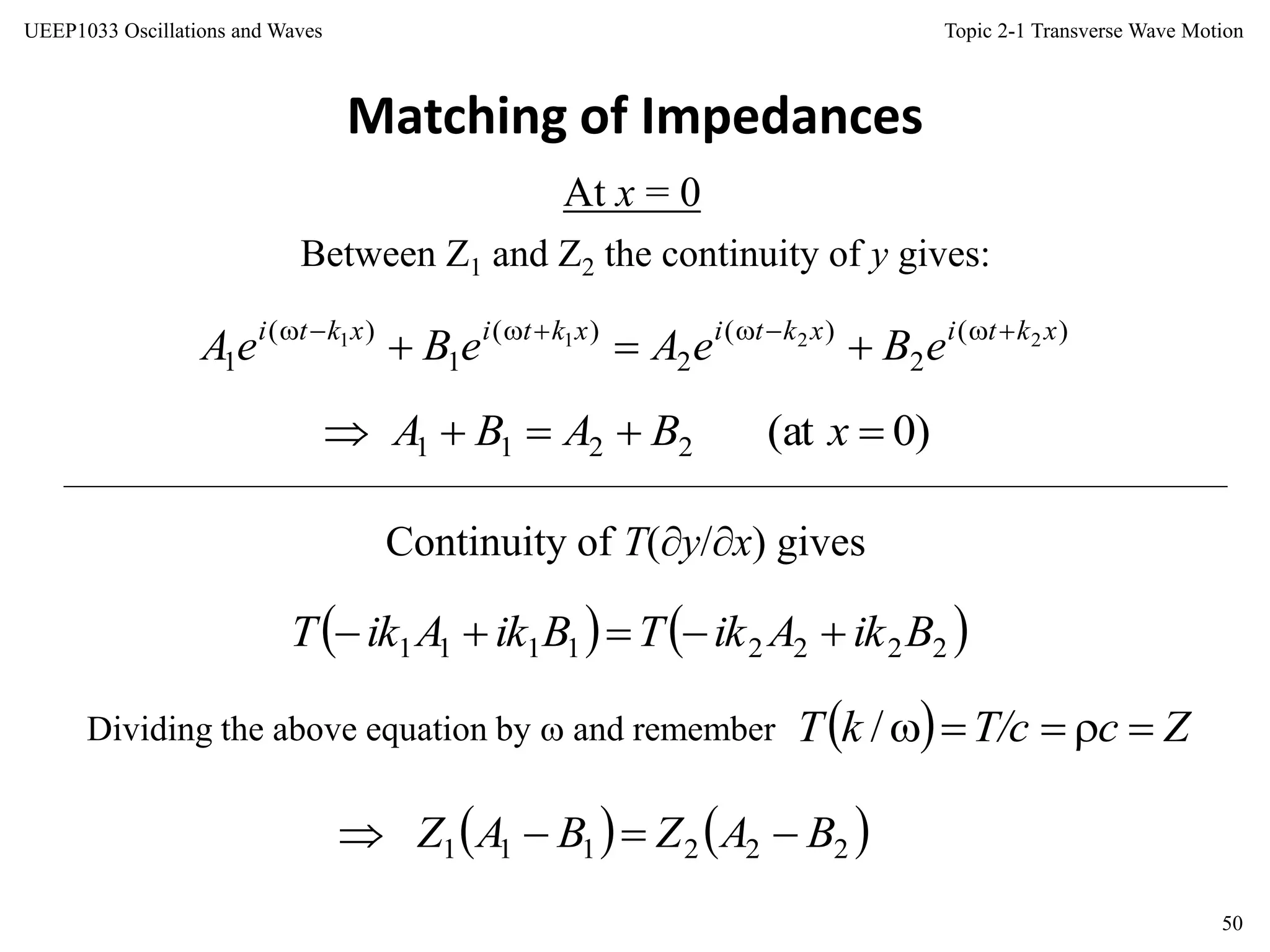
Between Z1 and Z2 the continuity of y gives:
Continuity of T(y/x) gives
Dividing the above equation by  and remember
At x = 0
)(
2
)(
2
)(
1
)(
1
2211 xktixktixktixkti
eBeAeBeA 

)0at(2211  xBABA
   22221111 BikAikTBikAikT 
  ZcT/ckT /
   222111 BAZBAZ 
Topic 2-1 Transverse Wave Motion
51
UEEP1033 Oscillations and Waves
Matching of Impedances
At x = l
Continuity of T(y/x) gives:
Continuity of y gives:
From the four boundary equations, solve for the ratio A3/A1
Refer to the H.J. Pain, “The Physics of Vibrations and Waves”,6th Edition, pg 122-123 for detail derivation
322
22
AeBeA liklik

  33222
22
AZeBeAZ liklik

    lkrrlkr
r
A
A
2
22
23122
22
13
2
13
2
1
3
sincos1
4







Topic 2-1 Transverse Wave Motion
52
UEEP1033 Oscillations and Waves
Matching of Impedances
2
1
2
3
13
2
11
2
33 1
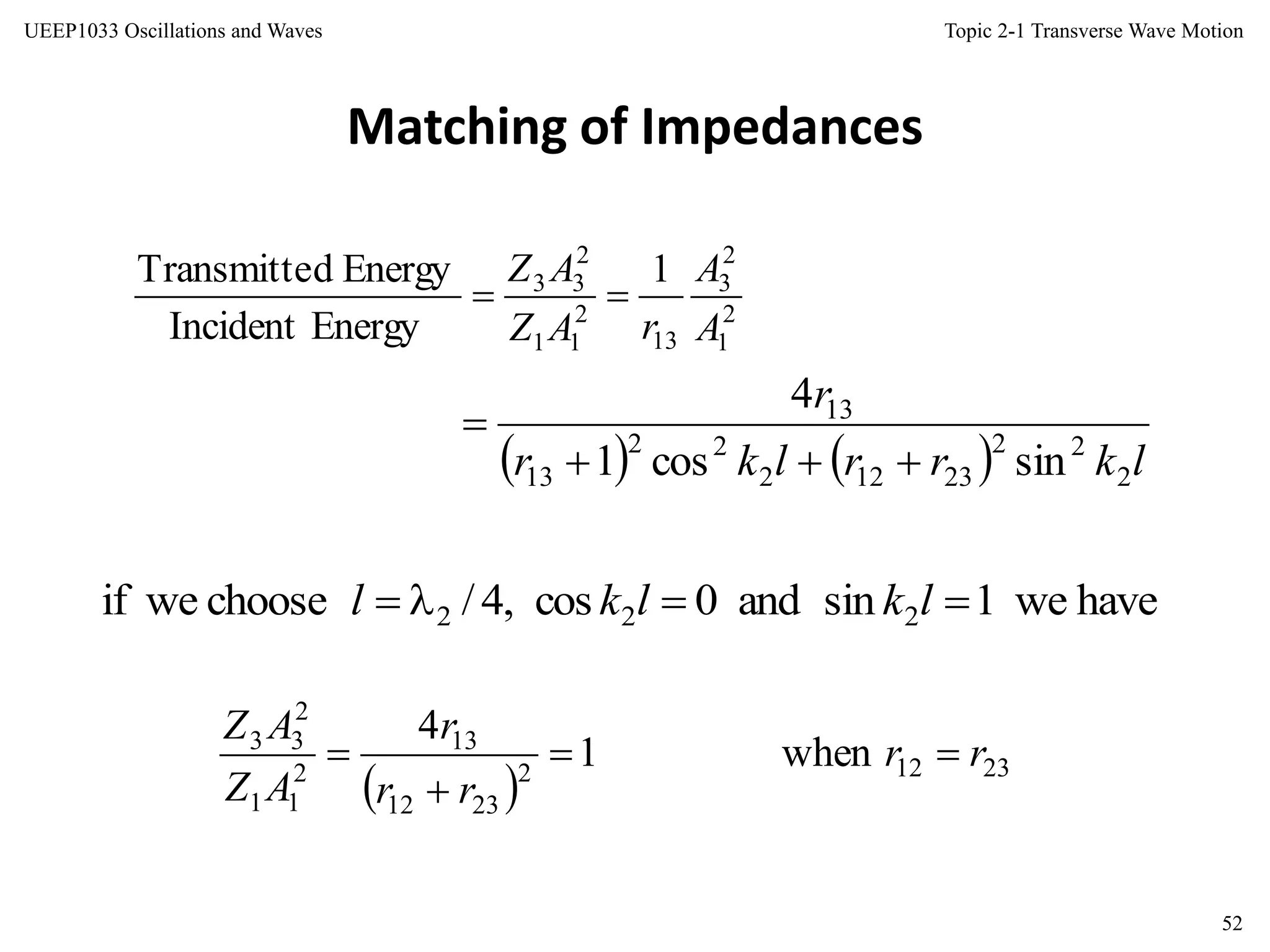
EnergyIncident
EnergydTransmitte
A
A
rAZ
AZ

    lkrrlkr
r
2
22
23122
22
13
13
sincos1
4


havewe1sinand0cos,4/chooseweif 222  lklkl
  23122
2312
13
2
11
2
33
when1
4
rr
rr
r
AZ
AZ



Topic 2-1 Transverse Wave Motion
53
UEEP1033 Oscillations and Waves
Standing Waves
on a String of Fixed Length
Topic 2-1 Transverse Wave Motion
54
UEEP1033 Oscillations and Waves
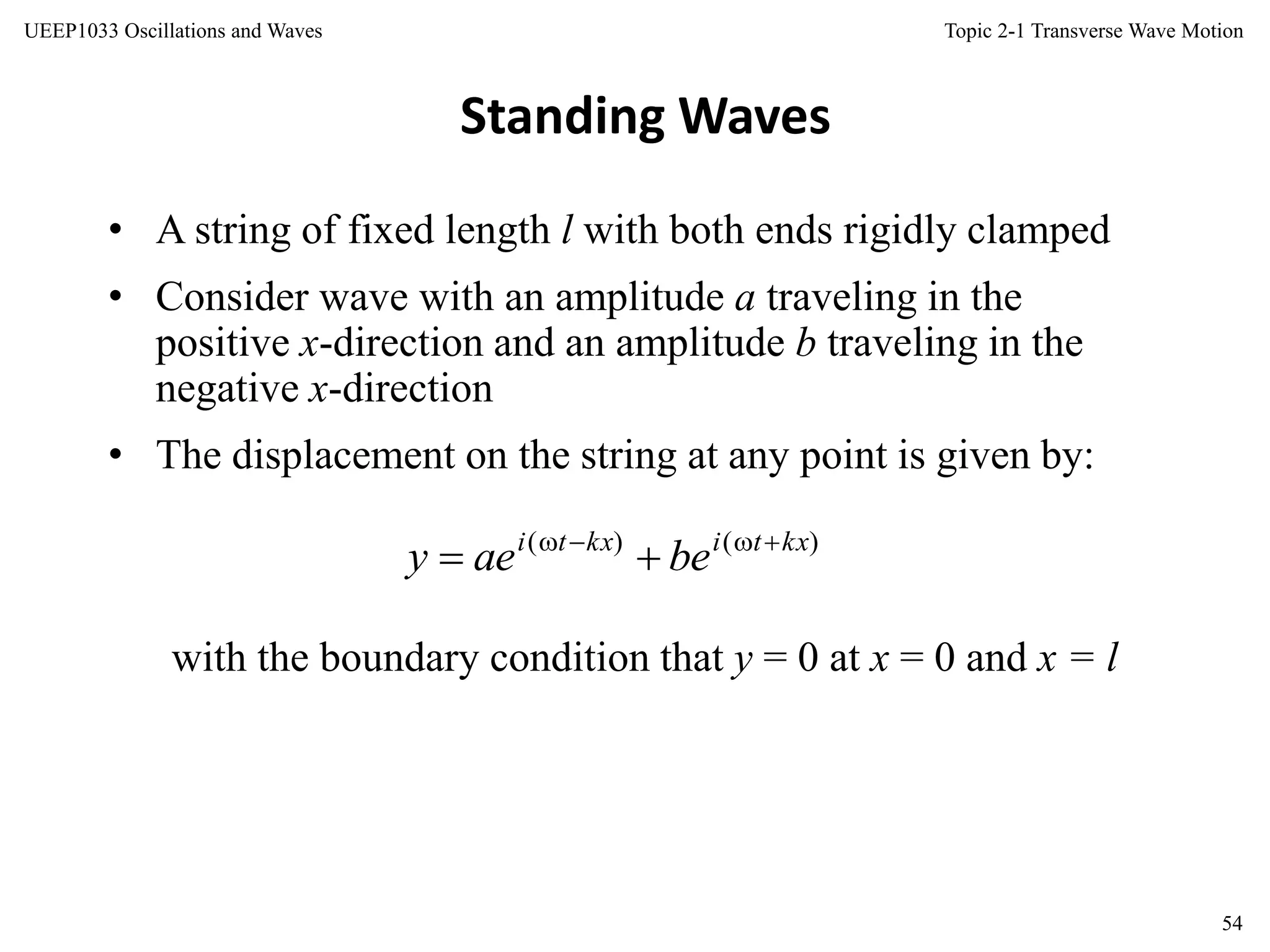
• A string of fixed length l with both ends rigidly clamped
• Consider wave with an amplitude a traveling in the
positive x-direction and an amplitude b traveling in the
negative x-direction
• The displacement on the string at any point is given by:
Standing Waves
with the boundary condition that y = 0 at x = 0 and x = l
)()( kxtikxti
beaey 

Topic 2-1 Transverse Wave Motion
55
UEEP1033 Oscillations and Waves
Topic 2-1 Transverse Wave Motion
56
UEEP1033 Oscillations and Waves
Standing Waves
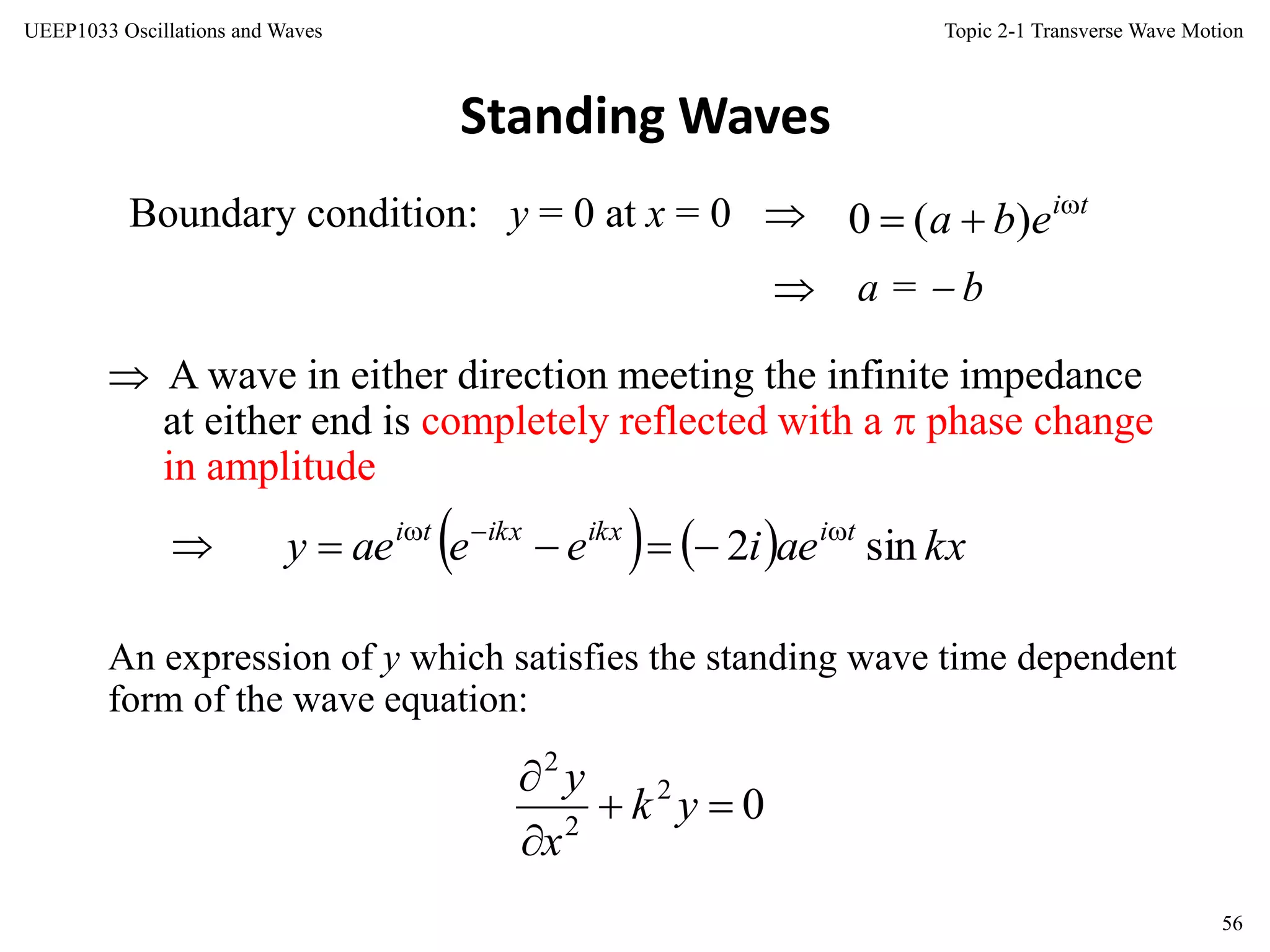
Boundary condition: y = 0 at x = 0 
 A wave in either direction meeting the infinite impedance
at either end is completely reflected with a  phase change
in amplitude
 a =  b

An expression of y which satisfies the standing wave time dependent
form of the wave equation:
    kxaeieeaey tiikxikxti
sin2 

02
2
2



yk
x
y
ti
eba 
 )(0
Topic 2-1 Transverse Wave Motion
57
UEEP1033 Oscillations and Waves
Standing Waves
Boundary condition: y = 0 at x = l
Limiting the value of allowed frequencies to:
22
n
n
n
n
l
c
l
nc
f








 n
c
l
c
l
kl 0sinsin
l
cn
n


 
 kliae
eeae
beae
ti
ikliklti
kltiklti
sin20
0
0 )()(






Topic 2-1 Transverse Wave Motion
58
UEEP1033 Oscillations and Waves
Standing Waves
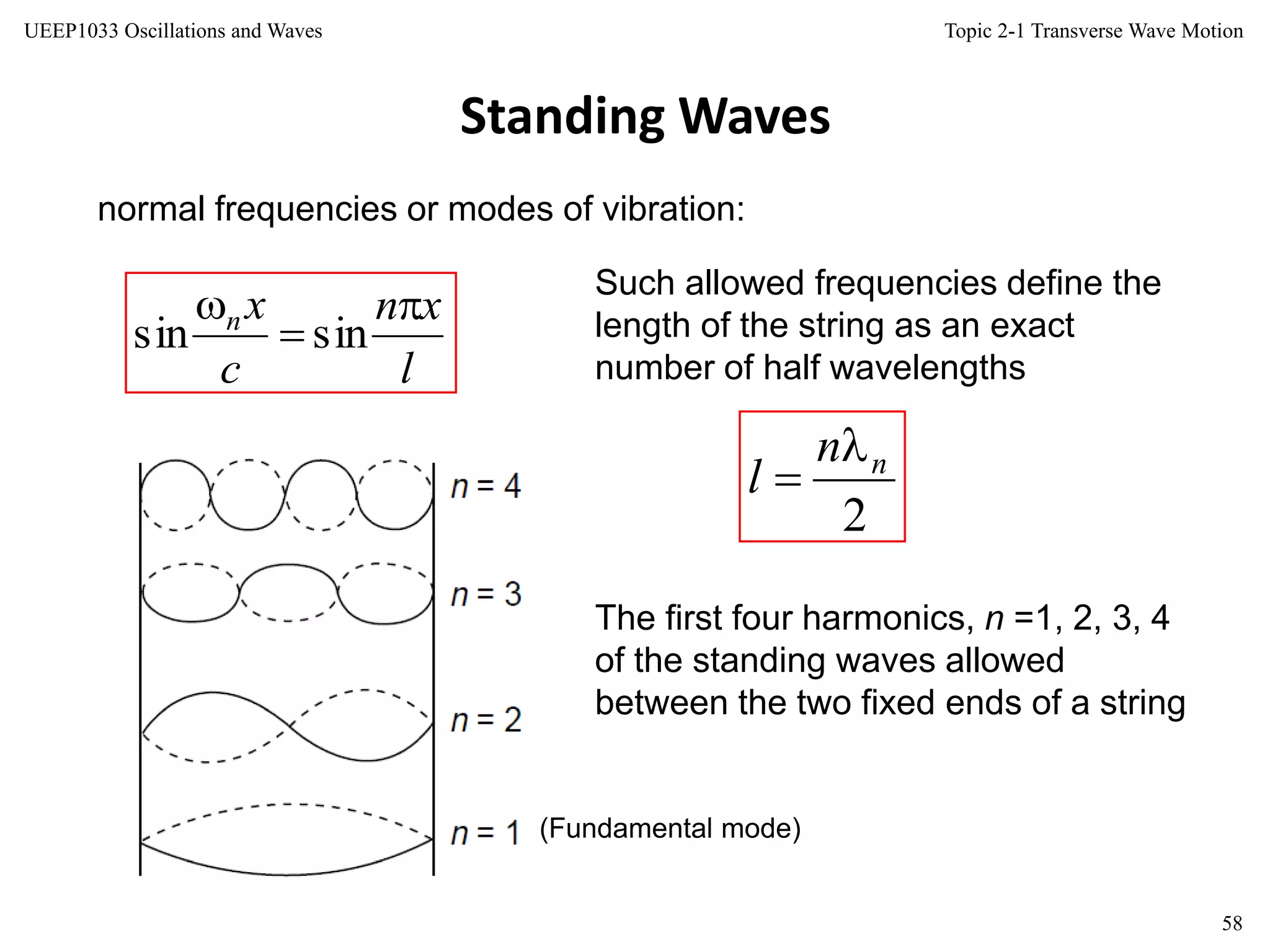
normal frequencies or modes of vibration:
Such allowed frequencies define the
length of the string as an exact
number of half wavelengths
(Fundamental mode)
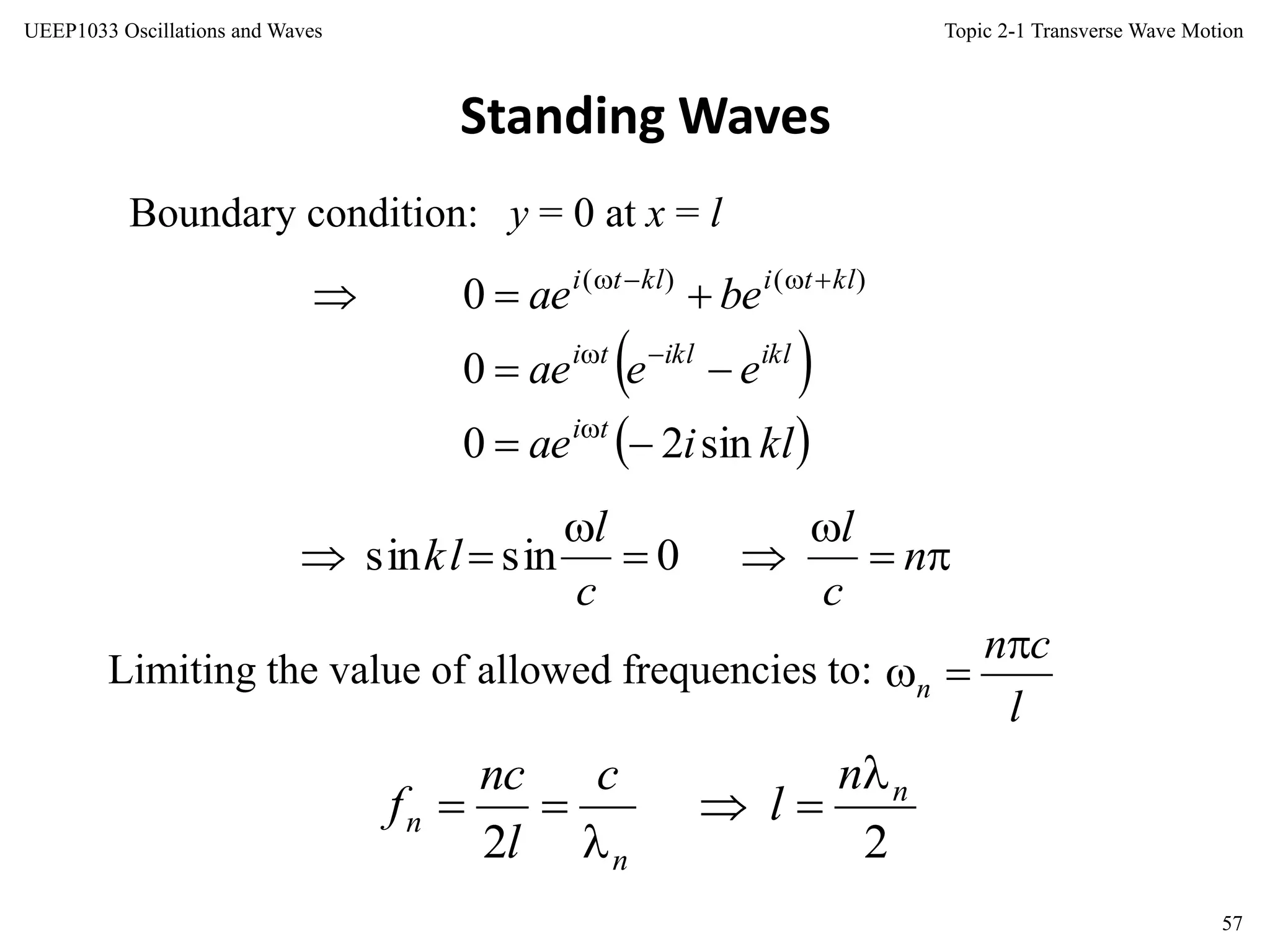
The first four harmonics, n =1, 2, 3, 4
of the standing waves allowed
between the two fixed ends of a string
l
xn
c
xn 


sinsin
2
nn
l


Topic 2-1 Transverse Wave Motion
59
UEEP1033 Oscillations and Waves
Topic 2-1 Transverse Wave Motion
60
UEEP1033 Oscillations and Waves
Standing Waves
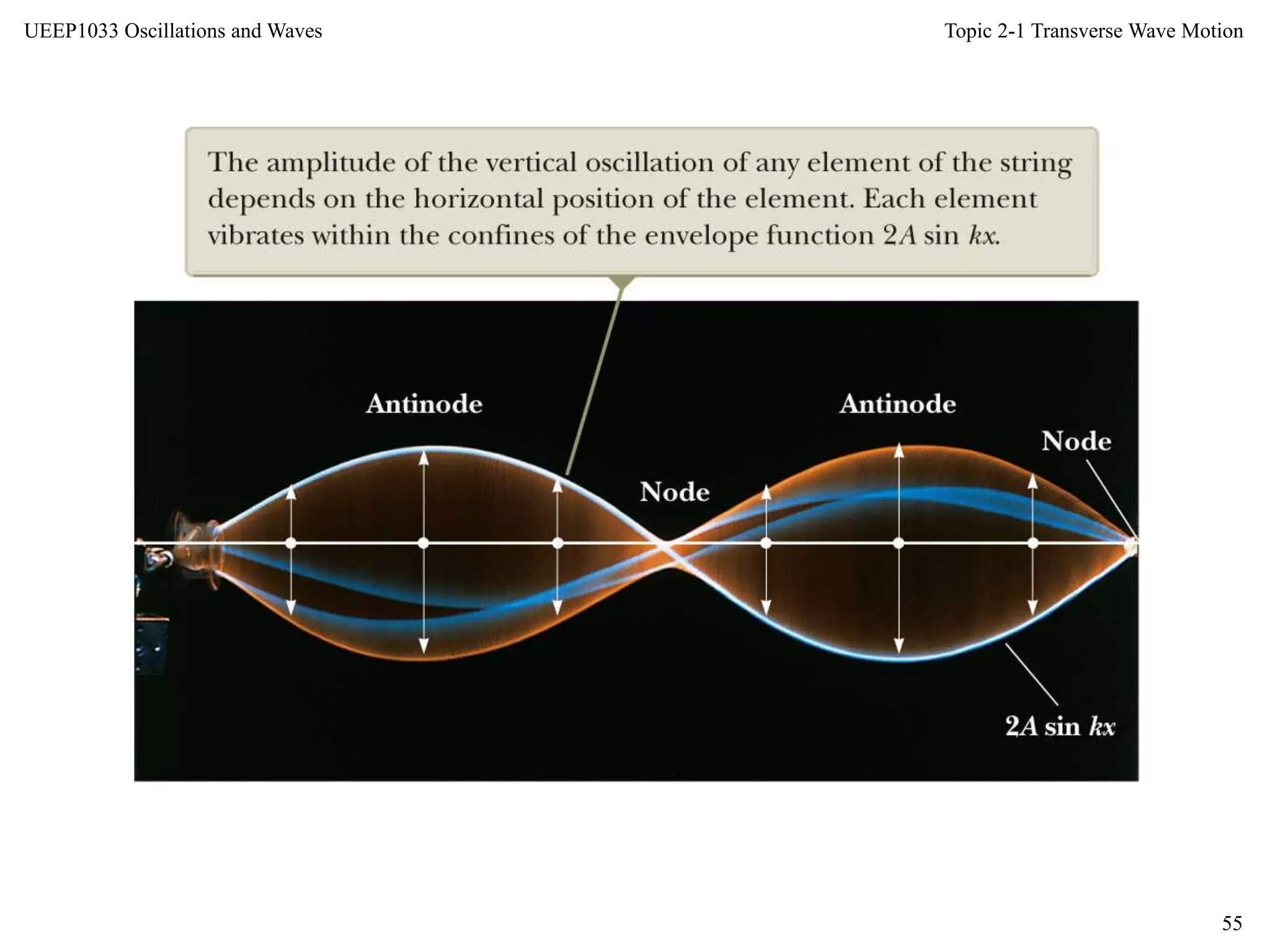
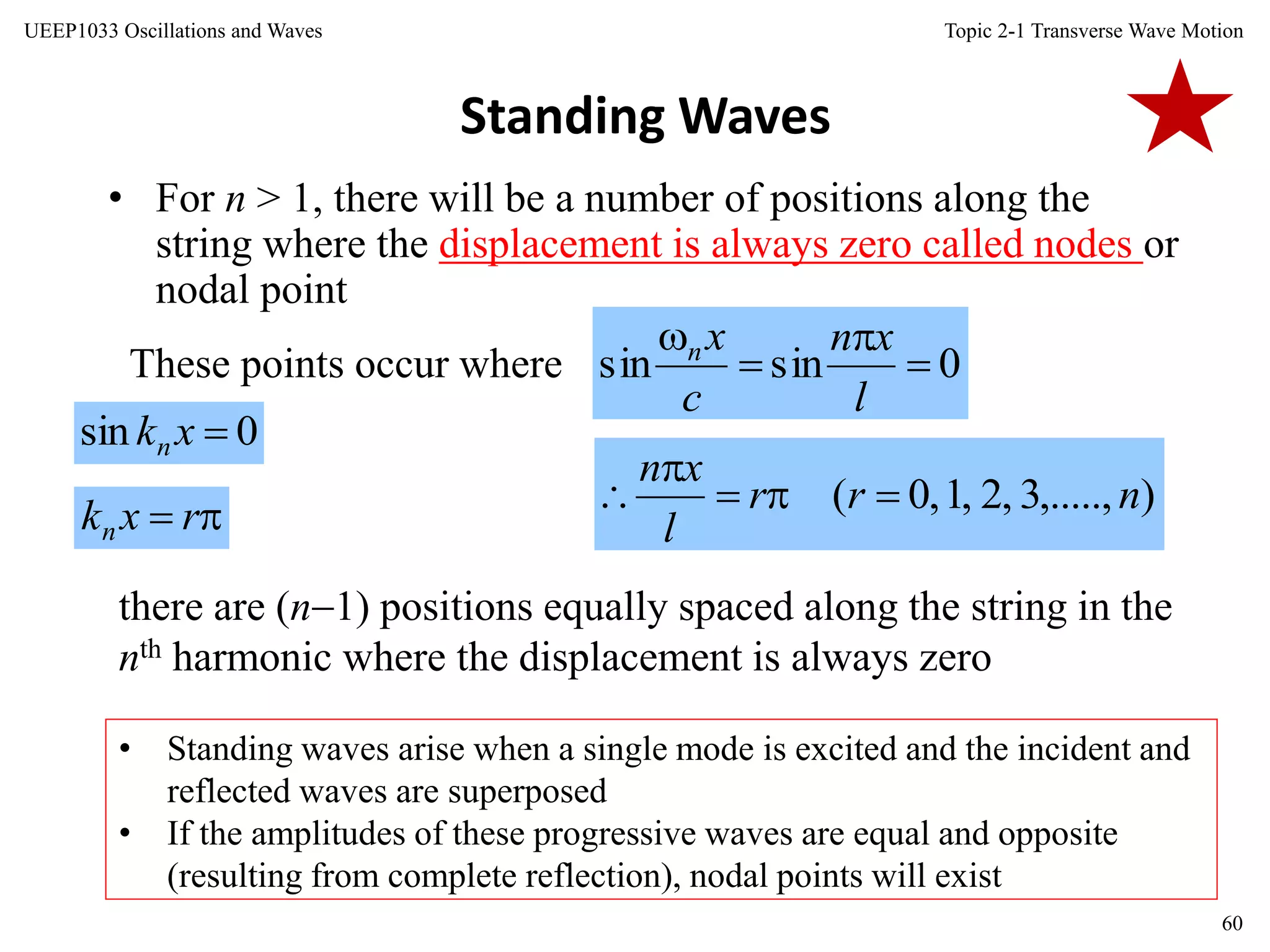
• For n > 1, there will be a number of positions along the
string where the displacement is always zero called nodes or
nodal point
These points occur where
there are (n1) positions equally spaced along the string in the
nth harmonic where the displacement is always zero
• Standing waves arise when a single mode is excited and the incident and
reflected waves are superposed
• If the amplitudes of these progressive waves are equal and opposite
(resulting from complete reflection), nodal points will exist
0sinsin 



l
xn
c
xn
),.....,3,2,1,0( nrr
l
xn



0sin xkn
 rxkn
Topic 2-1 Transverse Wave Motion
61
UEEP1033 Oscillations and Waves
Standing Waves
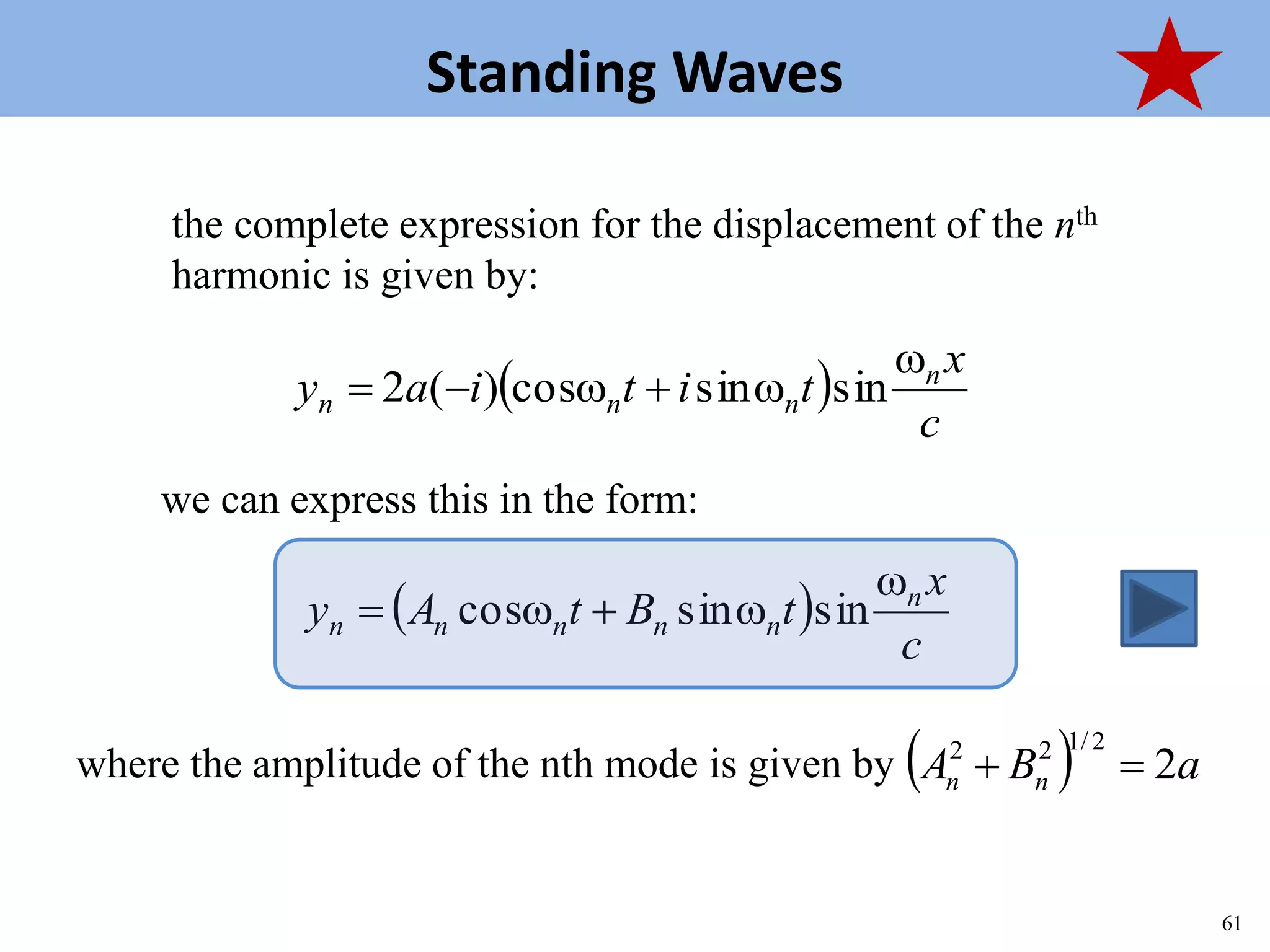
the complete expression for the displacement of the nth
harmonic is given by:
 
c
x
tBtAy n
nnnnn

 sinsincos
 
c
x
titiay n
nnn

 sinsincos)(2
where the amplitude of the nth mode is given by   aBA nn 2
2/122

we can express this in the form:
Topic 2-1 Transverse Wave Motion
62
UEEP1033 Oscillations and Waves
Standing Wave Ratio
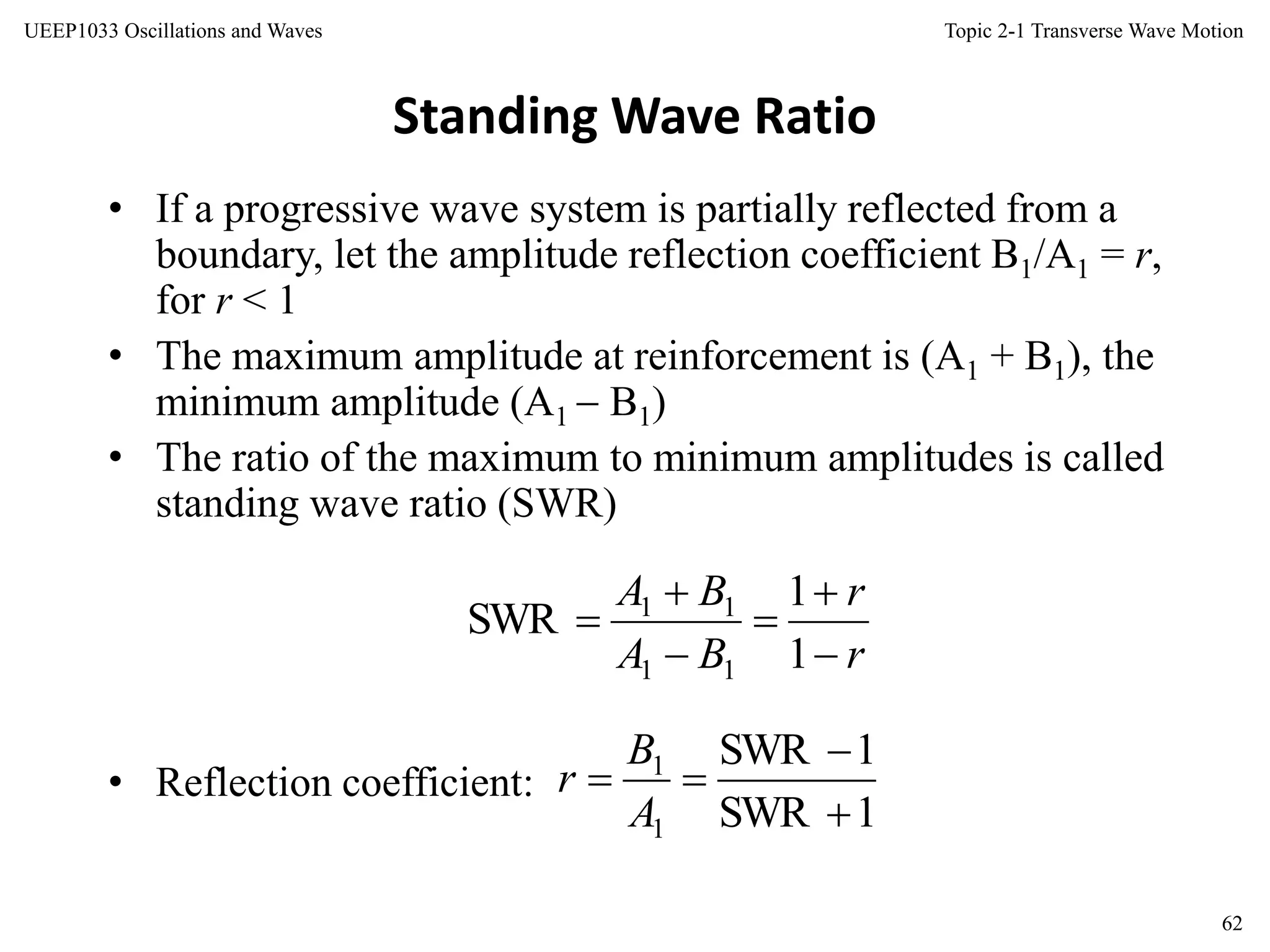
• If a progressive wave system is partially reflected from a
boundary, let the amplitude reflection coefficient B1/A1 = r,
for r < 1
• The maximum amplitude at reinforcement is (A1 + B1), the
minimum amplitude (A1  B1)
• The ratio of the maximum to minimum amplitudes is called
standing wave ratio (SWR)
• Reflection coefficient:
r
r
BA
BA






1
1
SWR
11
11
1SWR
1SWR
1
1



A
B
r
Topic 2-1 Transverse Wave Motion
63
UEEP1033 Oscillations and Waves
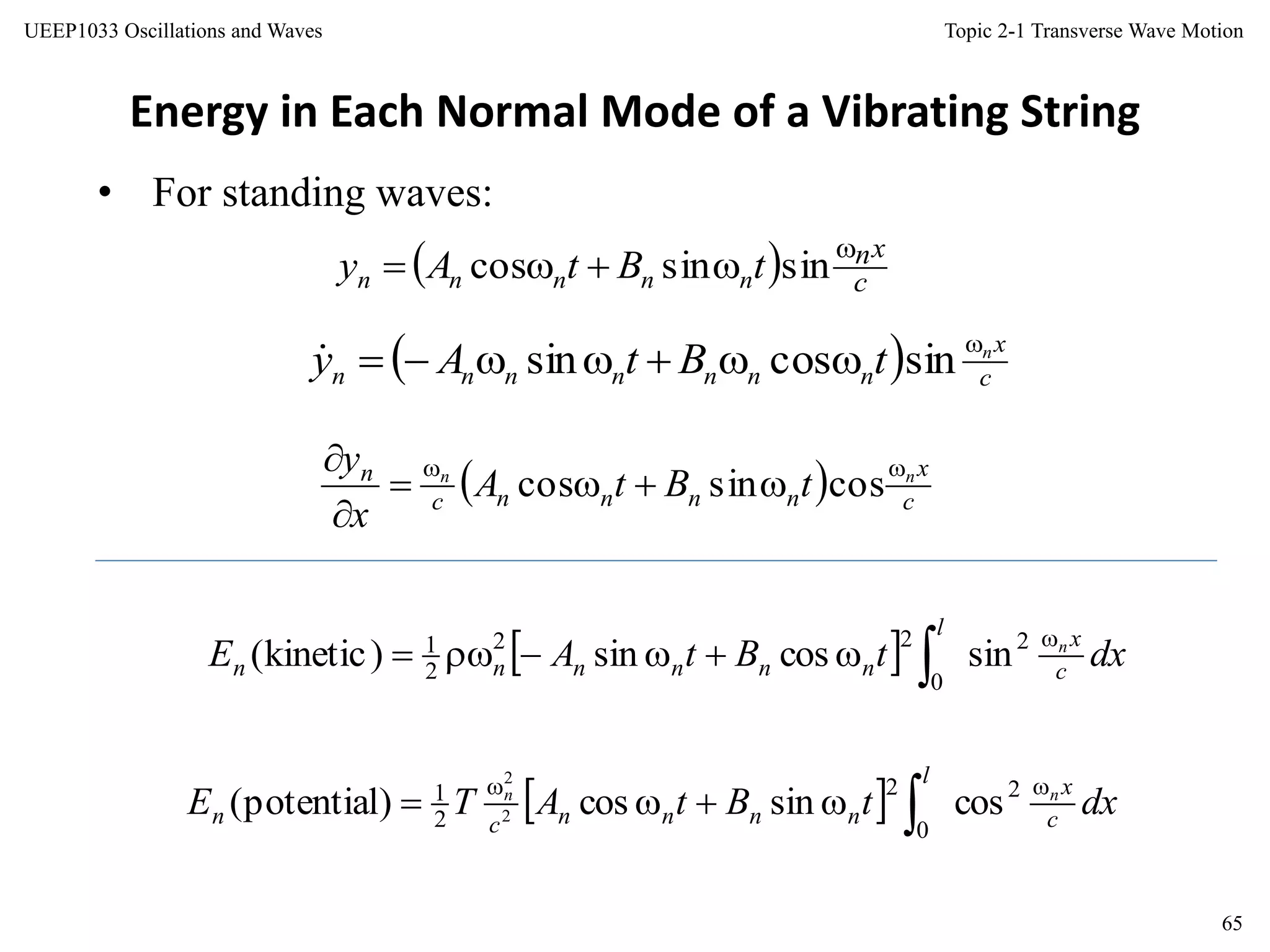
Energy in Each Normal Mode of a Vibrating String
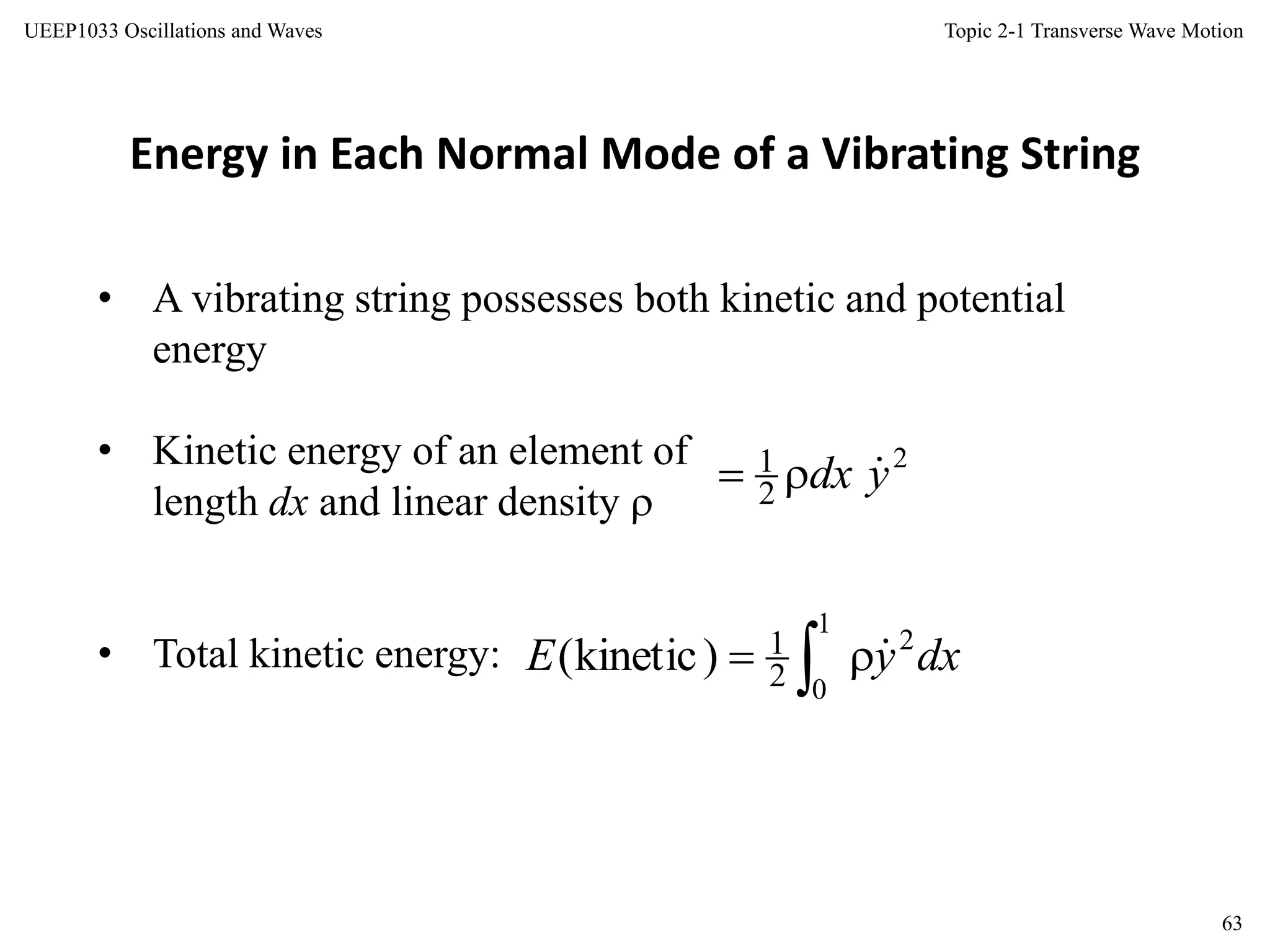
• A vibrating string possesses both kinetic and potential
energy
• Kinetic energy of an element of
length dx and linear density 
• Total kinetic energy:
2
2
1 ydx 
dxyE 2
1
02
1)kinetic(  
Topic 2-1 Transverse Wave Motion
64
UEEP1033 Oscillations and Waves
Energy in Each Normal Mode of a Vibrating String
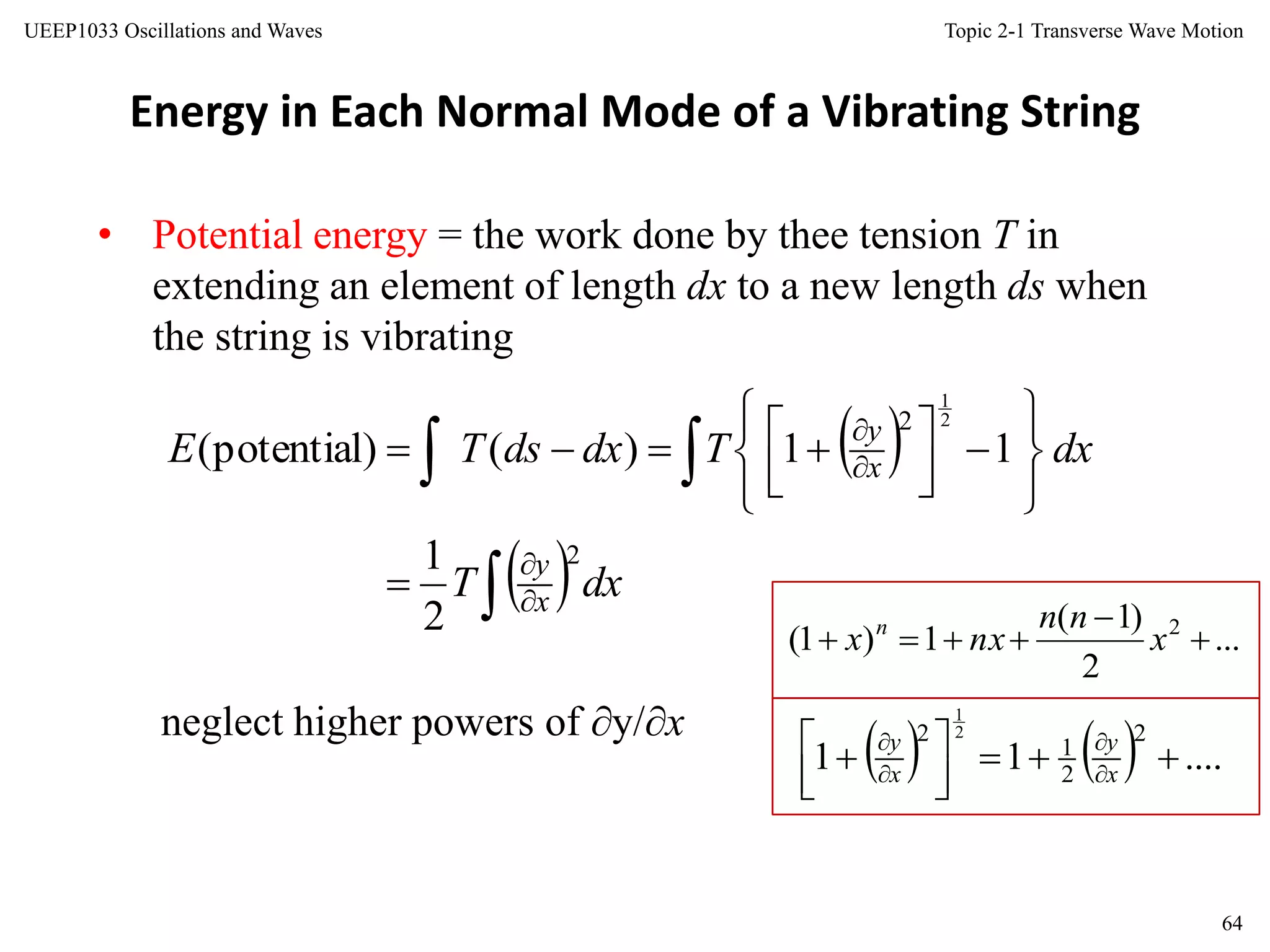
• Potential energy = the work done by thee tension T in
extending an element of length dx to a new length ds when
the string is vibrating
neglect higher powers of y/x
 
  dxT
dxTdxdsTE
x
y
x
y



















 
2
2
2
1
11)()potential(
2
1
    ....11
2
2
1
2 2
1




  



x
y
x
y
...
2
)1(
1)1( 2


 x
nn
nxx n
Topic 2-1 Transverse Wave Motion
65
UEEP1033 Oscillations and Waves
Energy in Each Normal Mode of a Vibrating String
• For standing waves:
  c
xn
tBtAy nnnnn

 sinsincos
  c
x
nnnnnnn
n
tBtAy 
 sincossin
  c
x
nnnnc
n nn
tBtA
x
y 



cossincos
  dxtBtAE c
xl
nnnnnn
n
 2
0
22
2
1
sincossin)kinetic(
  dxtBtATE c
xl
nnnncn
nn 
 2
0
2
2
1
cossincos)potential( 2
2
Topic 2-1 Transverse Wave Motion
66
UEEP1033 Oscillations and Waves
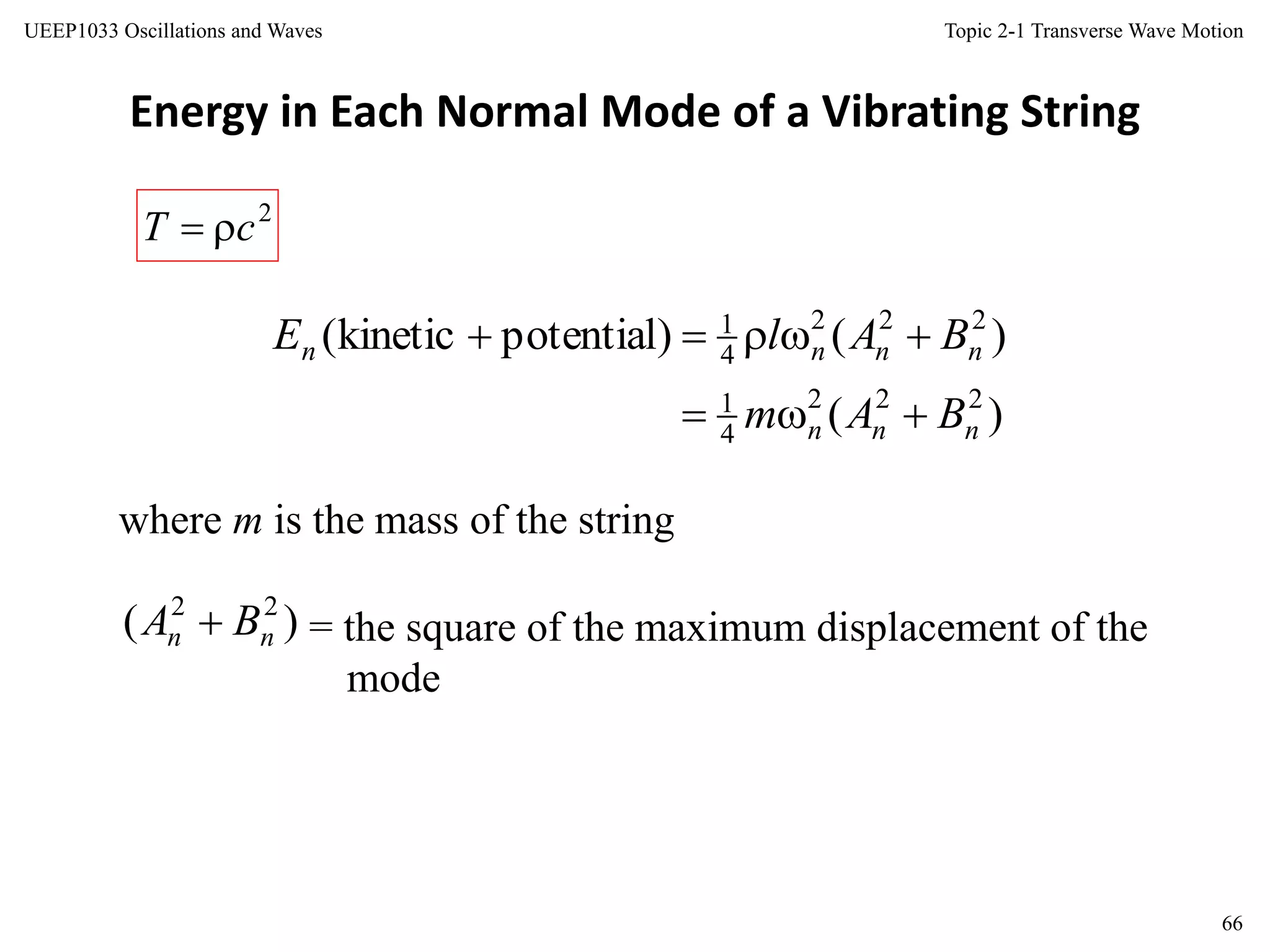
Energy in Each Normal Mode of a Vibrating String
where m is the mass of the string
= the square of the maximum displacement of the
mode
2
cT 
)(
)()potentialkinetic(
222
4
1
222
4
1
nnn
nnnn
BAm
BAlE


)( 22
nn BA 
Topic 2-1 Transverse Wave Motion
67
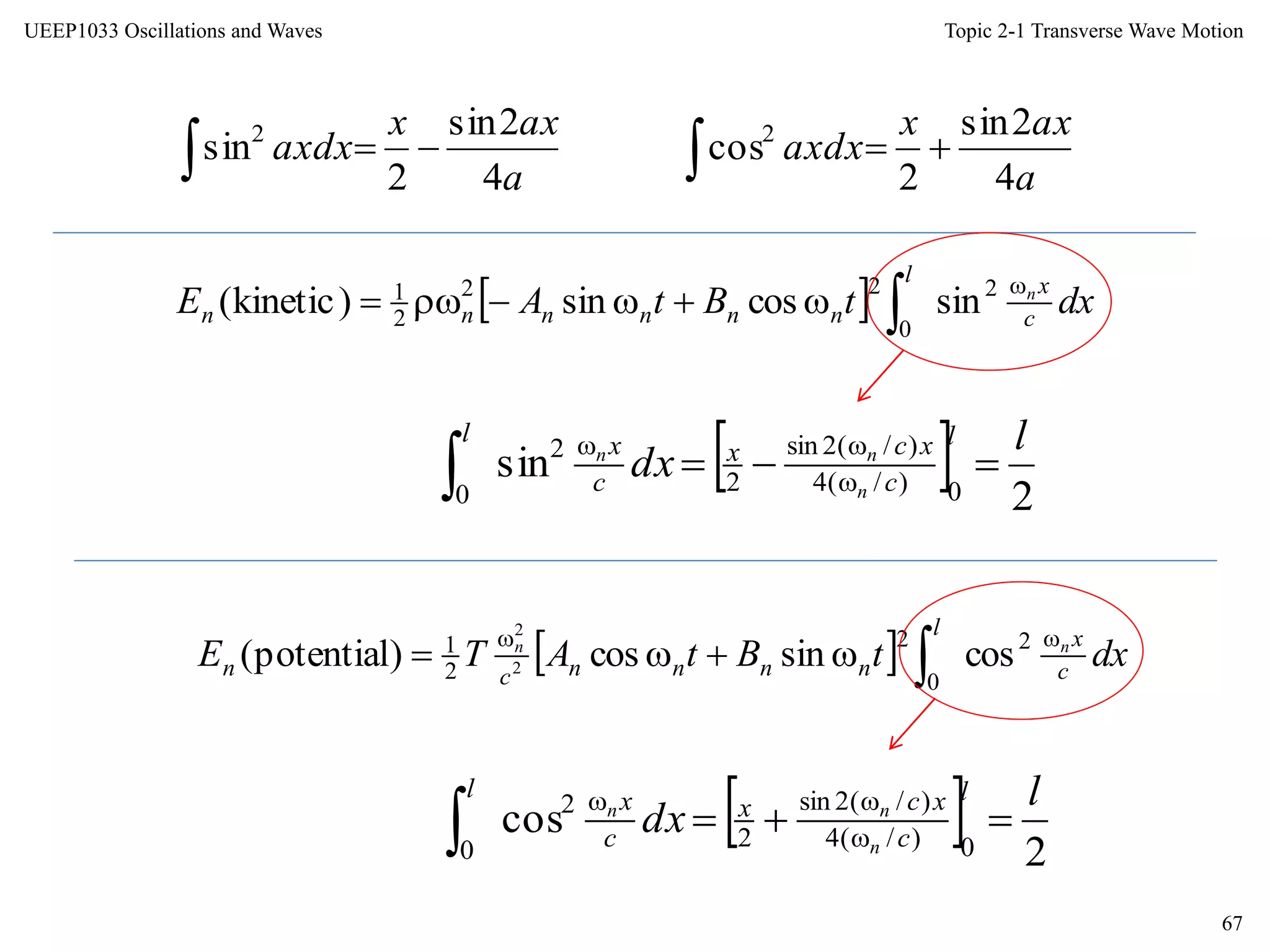
UEEP1033 Oscillations and Waves
a
axx
axdx
4
2sin
2
sin2
 a
axx
axdx
4
2sin
2
cos2

  2
sin
0)/(4
)/(2sin
2
2
0
l
dx
l
c
xcx
c
xl
n
nn
 


  2
cos
0)/(4
)/(2sin
2
2
0
l
dx
l
c
xcx
c
xl
n
nn
 


  dxtBtAE c
xl
nnnnnn
n
 2
0
22
2
1
sincossin)kinetic(
  dxtBtATE c
xl
nnnncn
nn 
 2
0
2
2
1
cossincos)potential( 2
2
Topic 2-1 Transverse Wave Motion
68
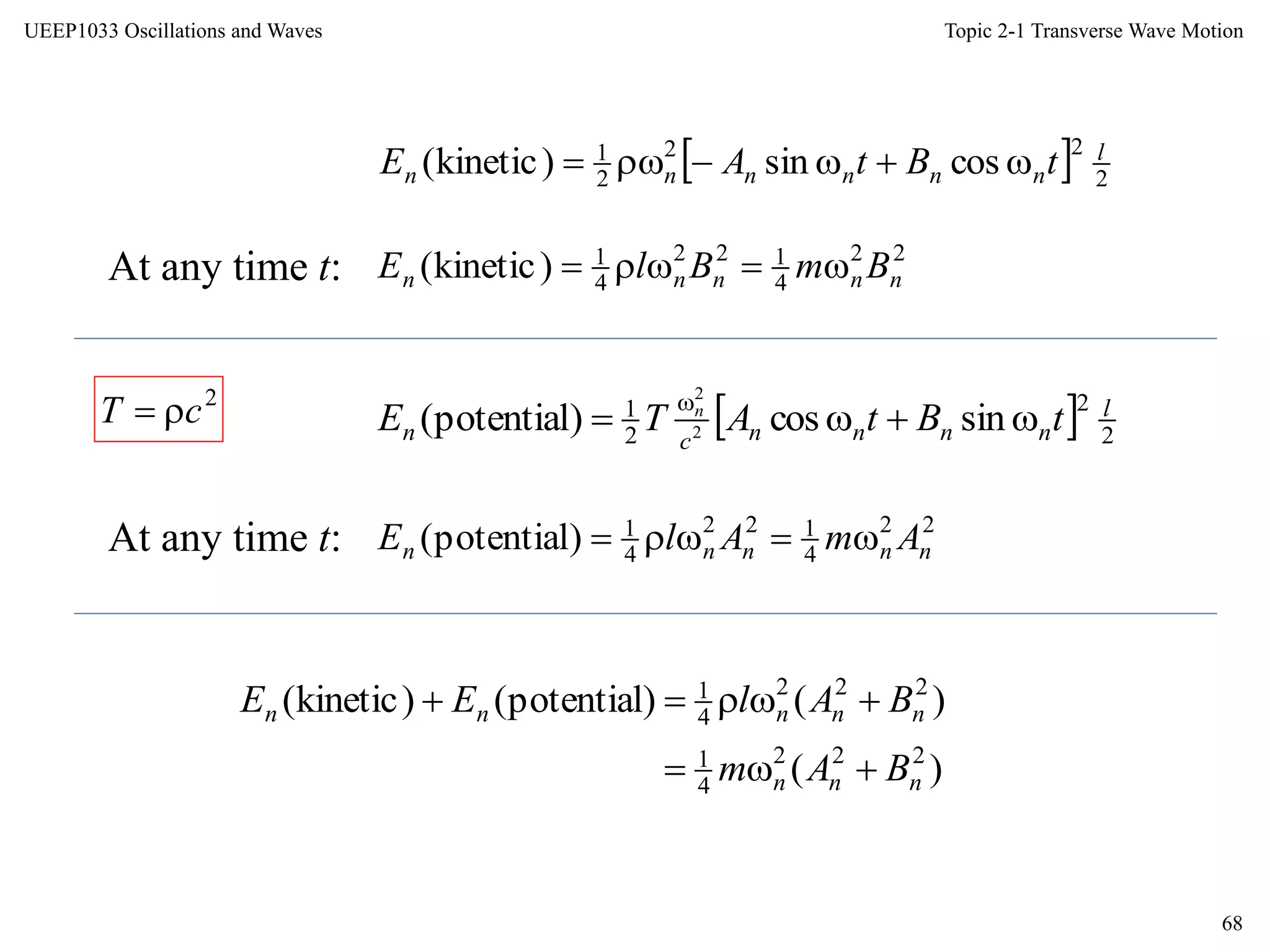
UEEP1033 Oscillations and Waves
  2
22
2
1
cossin)kinetic( l
nnnnnn tBtAE 
22
4
122
4
1
)kinetic( nnnnn BmBlE At any time t:
  2
2
2
1
sincos)potential( 2
2
l
nnnncn tBtATE n


At any time t: 22
4
122
4
1
)potential( nnnnn AmAlE 
2
cT 
)(
)()potential()kinetic(
222
4
1
222
4
1
nnn
nnnnn
BAm
BAlEE


Topic 2-1 Transverse Wave Motion
69
UEEP1033 Oscillations and Waves
Wave Groups and Group Velocity
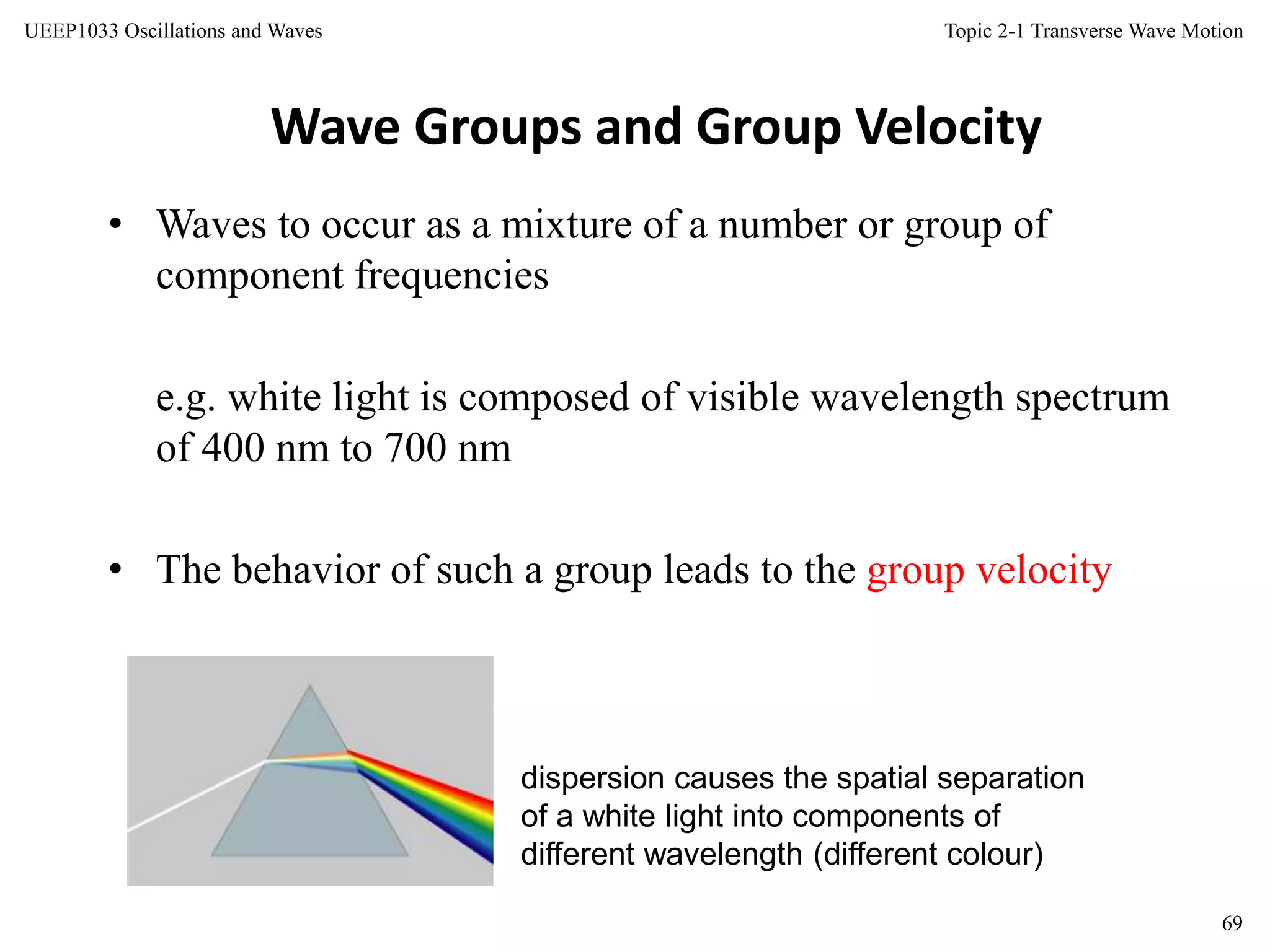
• Waves to occur as a mixture of a number or group of
component frequencies
e.g. white light is composed of visible wavelength spectrum
of 400 nm to 700 nm
• The behavior of such a group leads to the group velocity
dispersion causes the spatial separation
of a white light into components of
different wavelength (different colour)
Topic 2-1 Transverse Wave Motion
70
UEEP1033 Oscillations and Waves
Superposition of two waves of almost equal frequencies
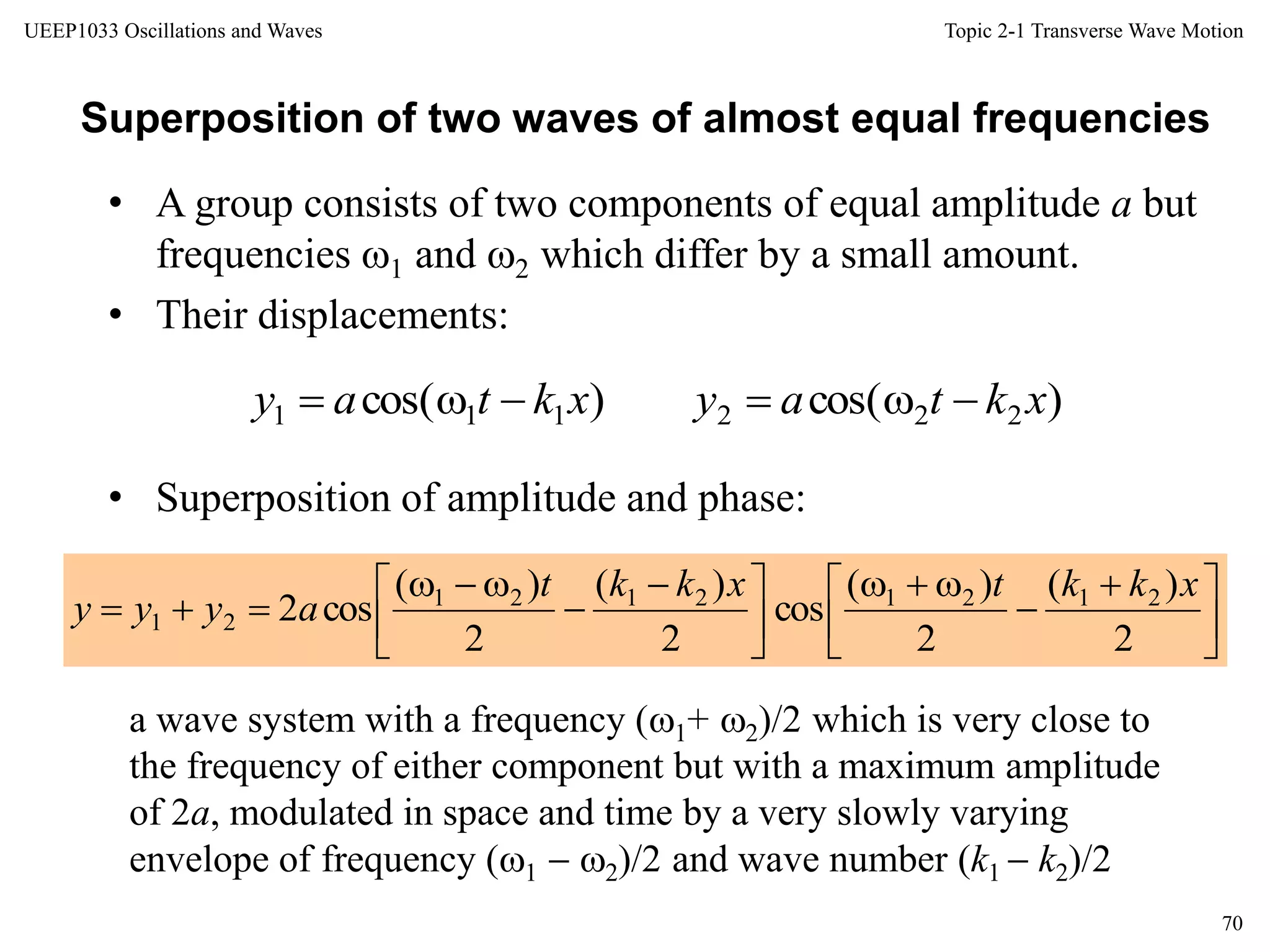
• A group consists of two components of equal amplitude a but
frequencies 1 and 2 which differ by a small amount.
• Their displacements:
• Superposition of amplitude and phase:
)cos()cos( 222111 xktayxktay 





 







 



2
)(
2
)(
cos
2
)(
2
)(
cos2 21212121
21
xkktxkkt
ayyy
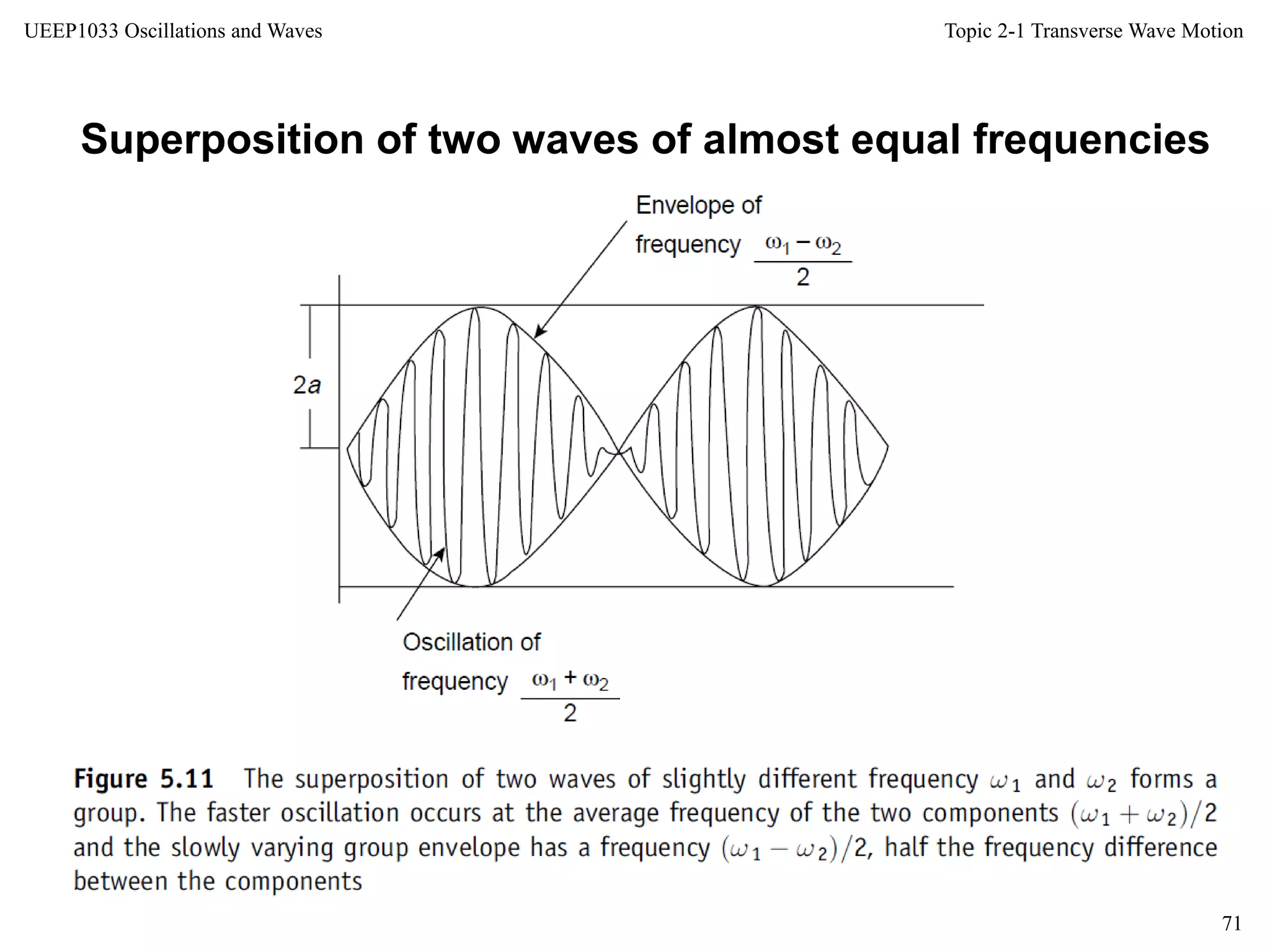
a wave system with a frequency (1+ 2)/2 which is very close to
the frequency of either component but with a maximum amplitude
of 2a, modulated in space and time by a very slowly varying
envelope of frequency (1  2)/2 and wave number (k1  k2)/2
Topic 2-1 Transverse Wave Motion
71
UEEP1033 Oscillations and Waves
Superposition of two waves of almost equal frequencies
Topic 2-1 Transverse Wave Motion
72
UEEP1033 Oscillations and Waves
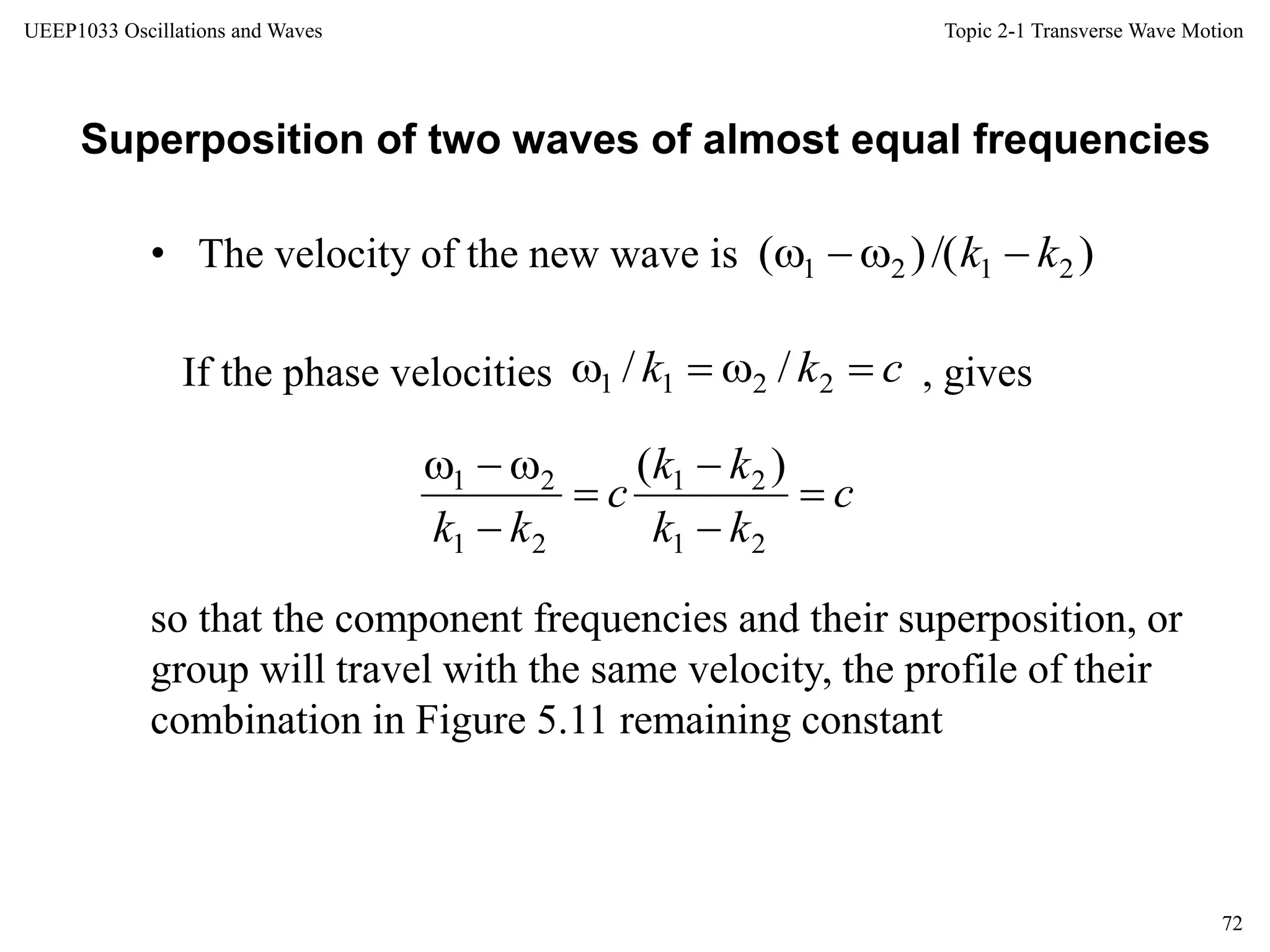
• The velocity of the new wave is
Superposition of two waves of almost equal frequencies
so that the component frequencies and their superposition, or
group will travel with the same velocity, the profile of their
combination in Figure 5.11 remaining constant
)/()( 2121 kk 
ckk  2211 //If the phase velocities , gives
c
kk
kk
c
kk






21
21
21
21 )(
Topic 2-1 Transverse Wave Motion
73
UEEP1033 Oscillations and Waves
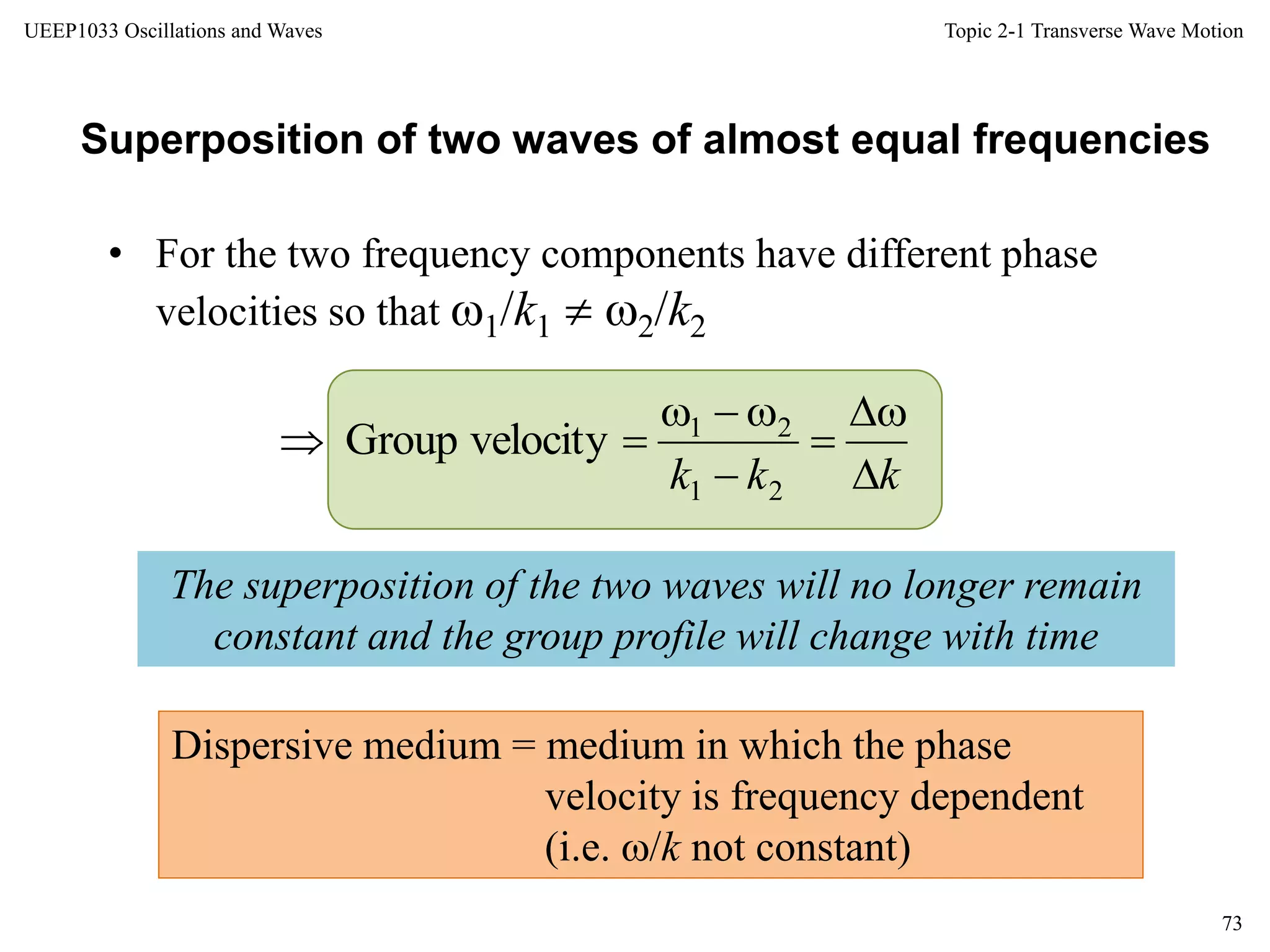
• For the two frequency components have different phase
velocities so that 1/k1  2/k2
Superposition of two waves of almost equal frequencies
The superposition of the two waves will no longer remain
constant and the group profile will change with time
Dispersive medium = medium in which the phase
velocity is frequency dependent
(i.e. /k not constant)
kkk 





21
21
velocityGroup
Topic 2-1 Transverse Wave Motion
74
UEEP1033 Oscillations and Waves
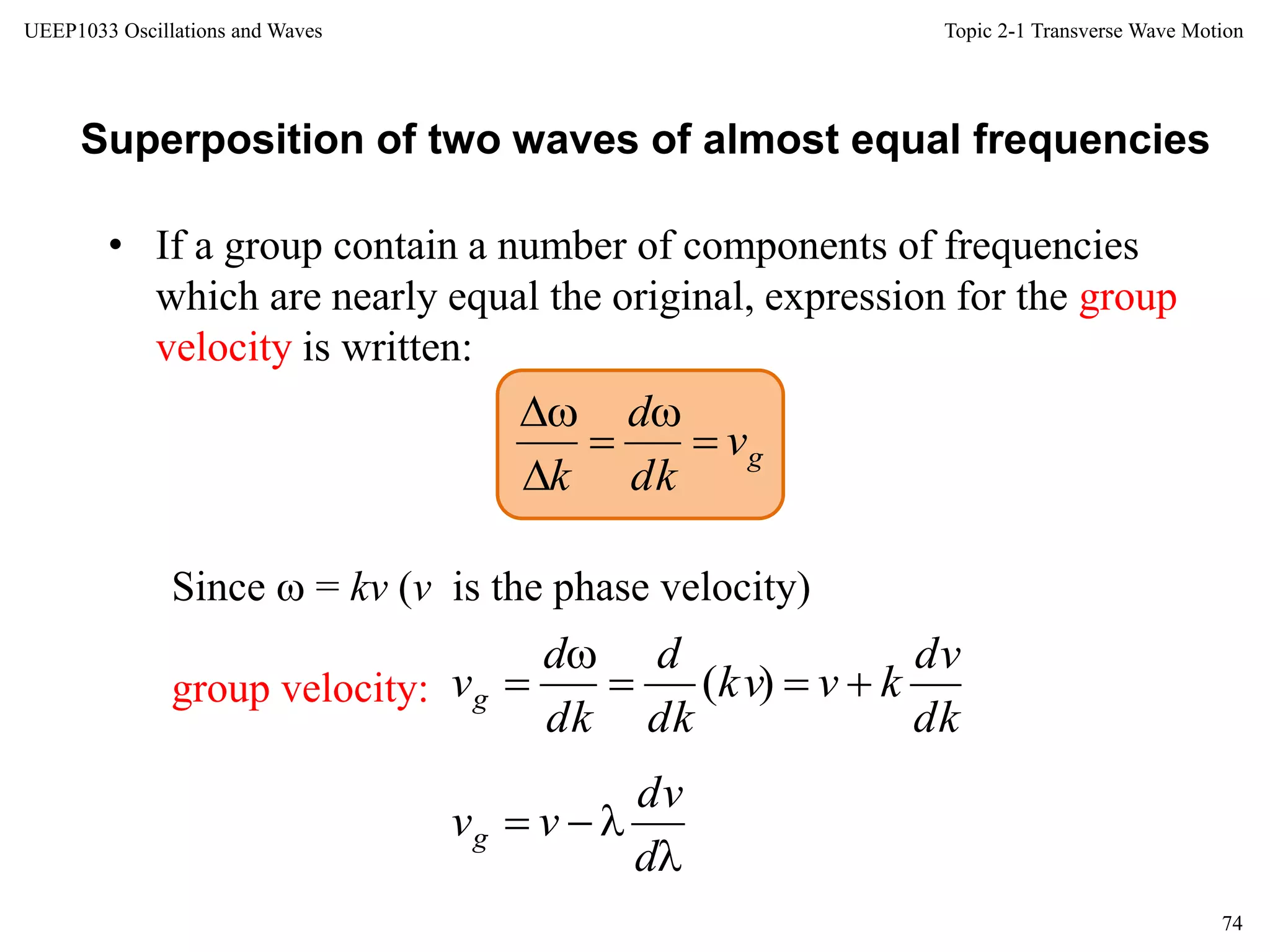
• If a group contain a number of components of frequencies
which are nearly equal the original, expression for the group
velocity is written:
Superposition of two waves of almost equal frequencies
Since  = kv (v is the phase velocity)
group velocity:
gv
dk
d
k





dk
dv
kvkv
dk
d
dk
d
vg 

 )(


d
dv
vvg
Topic 2-1 Transverse Wave Motion
75
UEEP1033 Oscillations and Waves
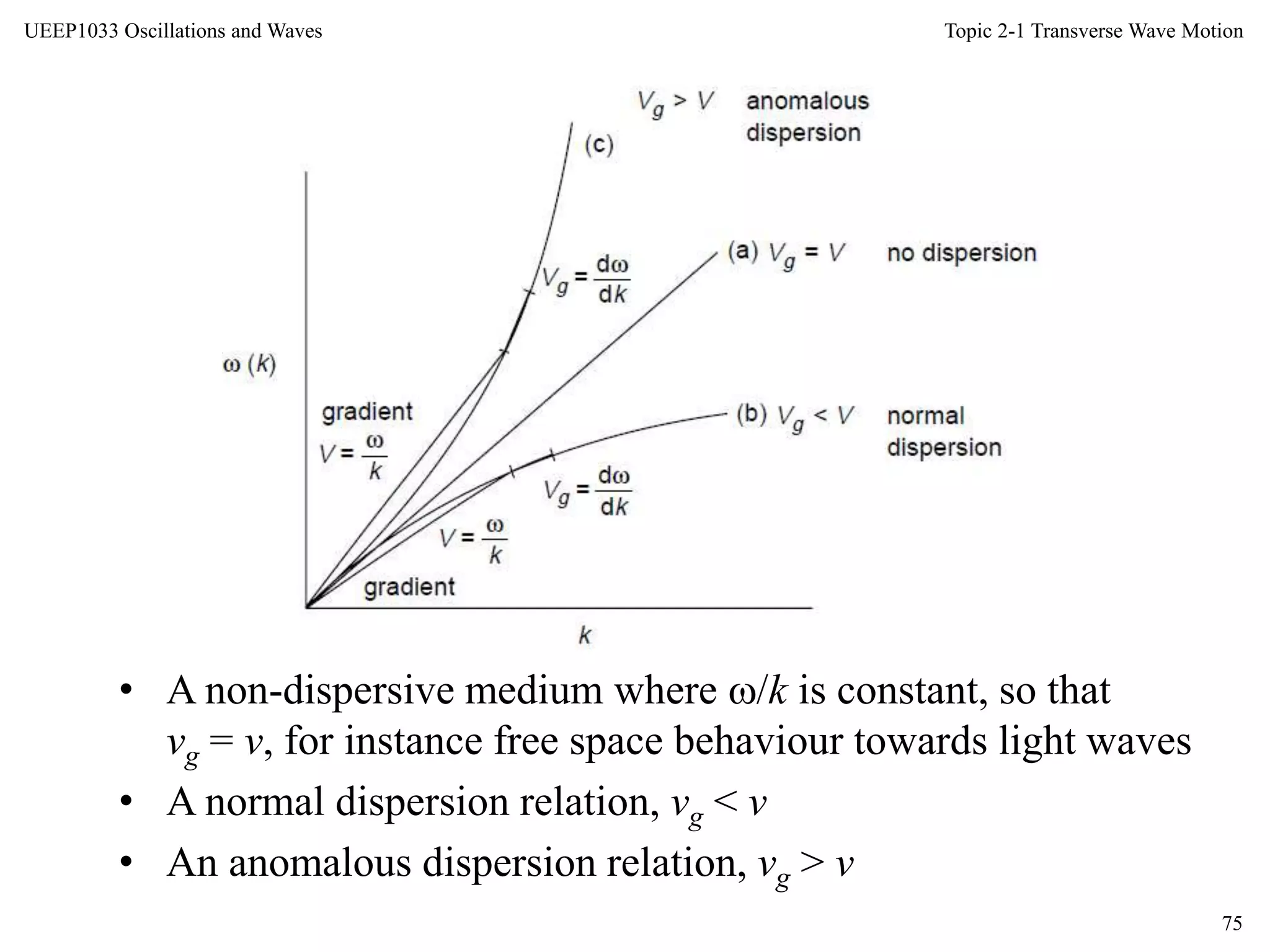
• A non-dispersive medium where /k is constant, so that
vg = v, for instance free space behaviour towards light waves
• A normal dispersion relation, vg < v
• An anomalous dispersion relation, vg > v
Topic 2-1 Transverse Wave Motion
76
UEEP1033 Oscillations and Waves
Standing Waves
as Normal Modes of Vibrating String
Topic 2-1 Transverse Wave Motion
77
UEEP1033 Oscillations and Waves
Characteristic of a Normal Mode
• all the masses move in SHM at the same frequency
• normal modes are completely independent of each other
• general motion of the system is a superposition of the
normal modes
• All of these properties of normal modes are shared by
standing waves on a vibrating string
• all the particles of the string perform SHM with the same
frequency
• the standing waves are the normal modes of the vibrating
string
Standing Waves as Normal Modes
Topic 2-1 Transverse Wave Motion
78
UEEP1033 Oscillations and Waves
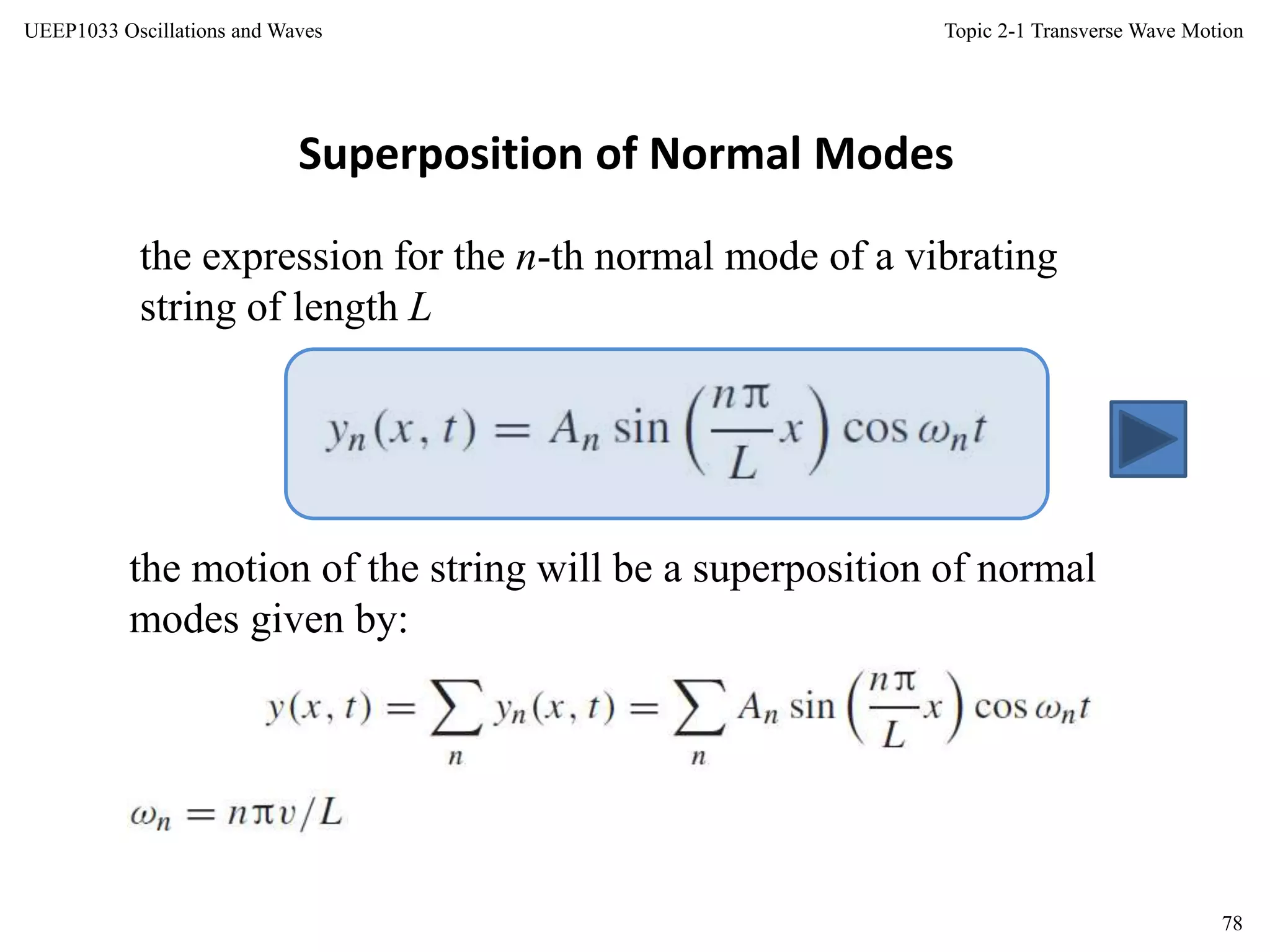
Superposition of Normal Modes
the expression for the n-th normal mode of a vibrating
string of length L
the motion of the string will be a superposition of normal
modes given by:
Topic 2-1 Transverse Wave Motion
79
UEEP1033 Oscillations and Waves
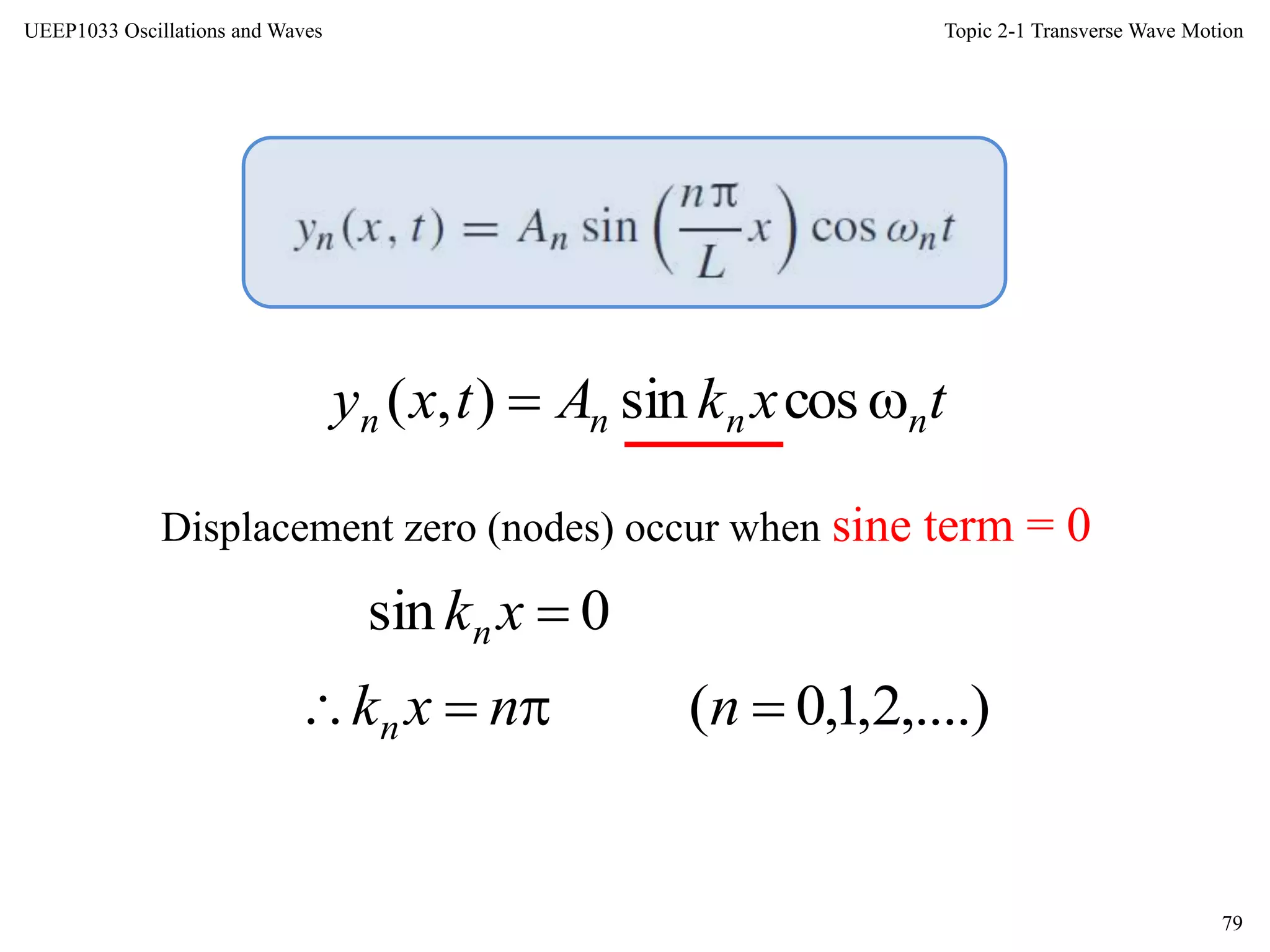
txkAtxy nnnn  cossin),(
0sin xkn
Displacement zero (nodes) occur when sine term = 0
,....)2,1,0(  nnxkn
Topic 2-1 Transverse Wave Motion
80
UEEP1033 Oscillations and Waves
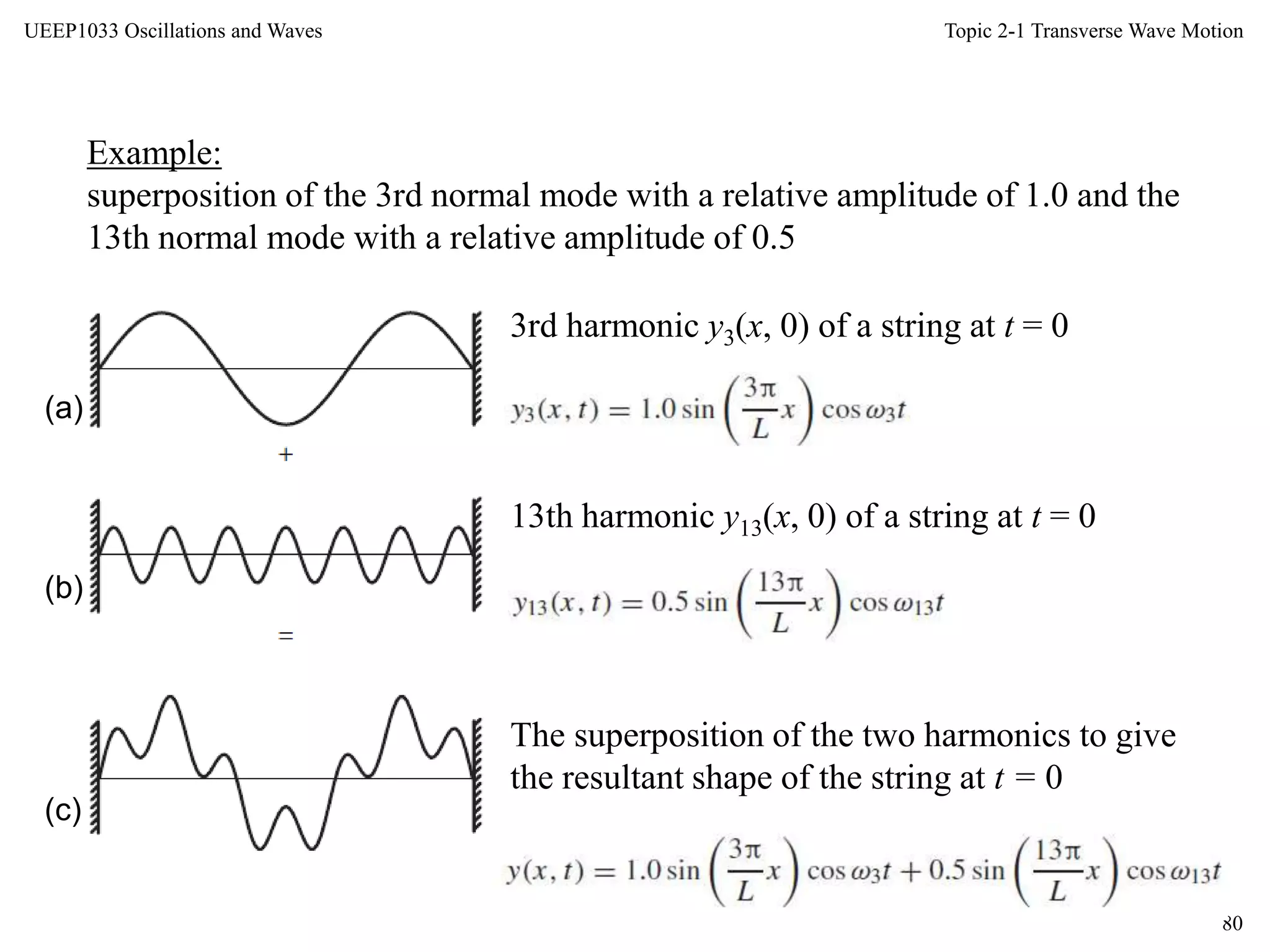
Example:
superposition of the 3rd normal mode with a relative amplitude of 1.0 and the
13th normal mode with a relative amplitude of 0.5
3rd harmonic y3(x, 0) of a string at t = 0
13th harmonic y13(x, 0) of a string at t = 0
The superposition of the two harmonics to give
the resultant shape of the string at t = 0
(a)
(b)
(c)
Topic 2-1 Transverse Wave Motion
81
UEEP1033 Oscillations and Waves
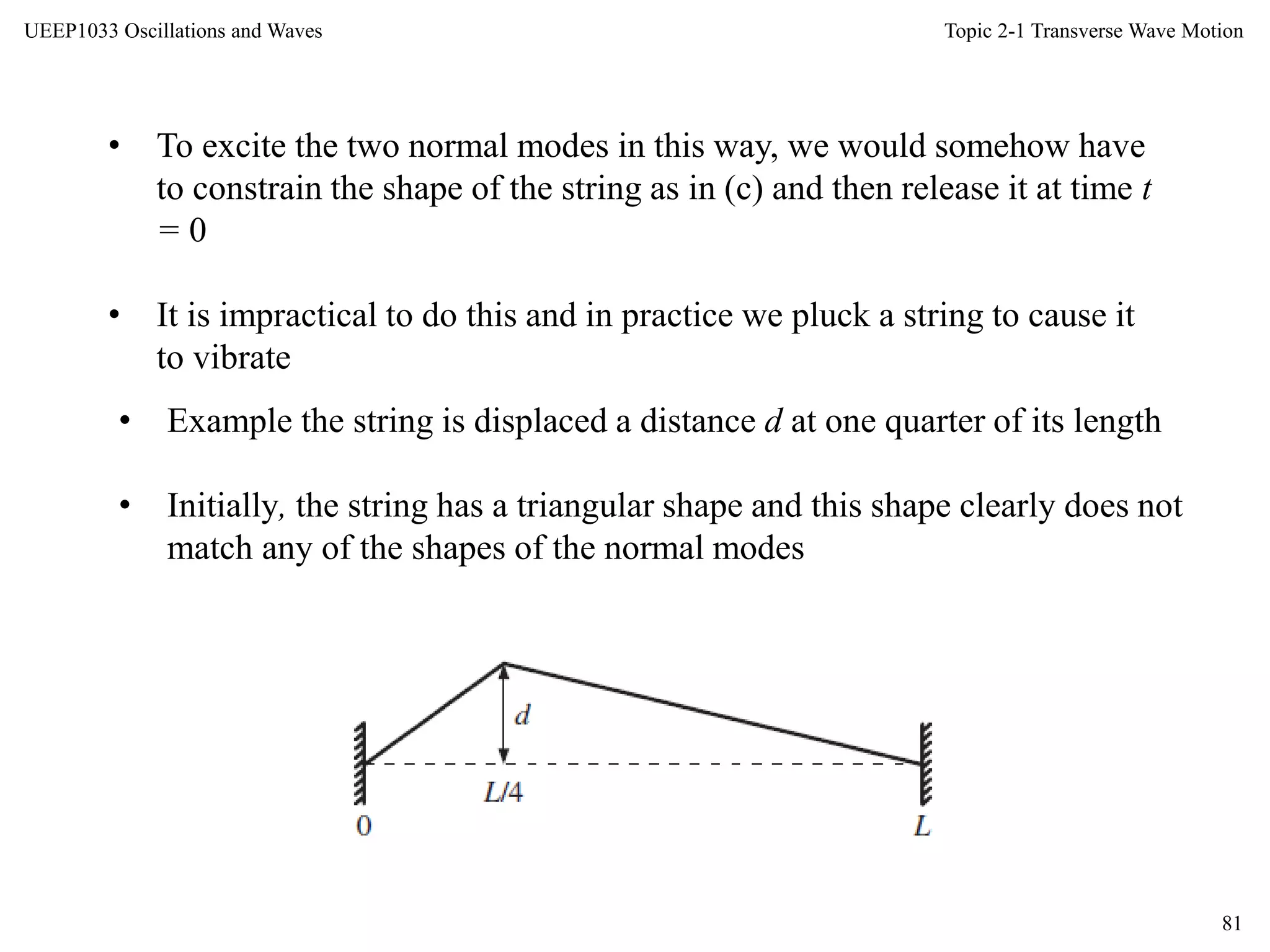
• To excite the two normal modes in this way, we would somehow have
to constrain the shape of the string as in (c) and then release it at time t
= 0
• It is impractical to do this and in practice we pluck a string to cause it
to vibrate
• Example the string is displaced a distance d at one quarter of its length
• Initially, the string has a triangular shape and this shape clearly does not
match any of the shapes of the normal modes
Topic 2-1 Transverse Wave Motion
82
UEEP1033 Oscillations and Waves
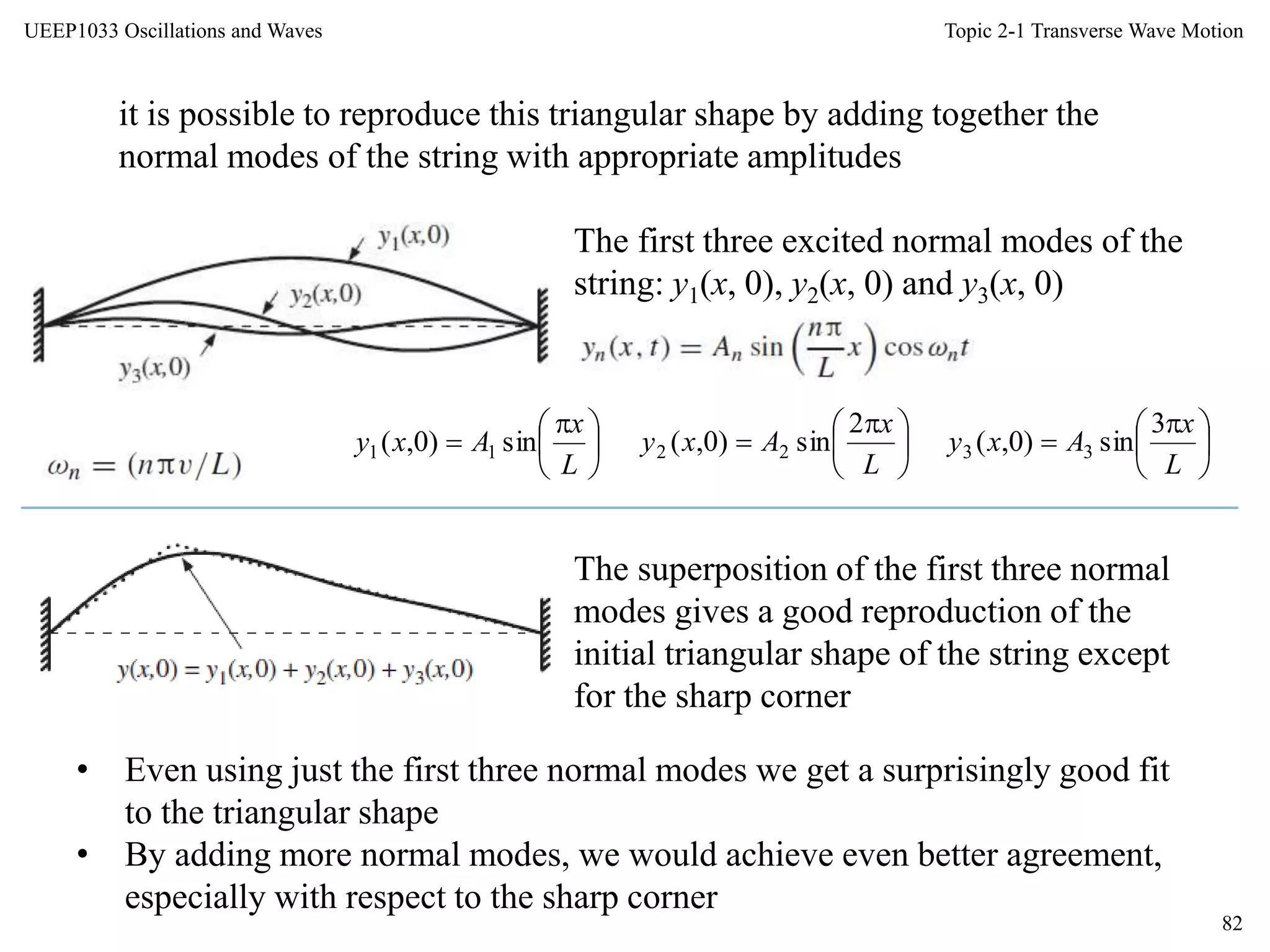
it is possible to reproduce this triangular shape by adding together the
normal modes of the string with appropriate amplitudes
The first three excited normal modes of the
string: y1(x, 0), y2(x, 0) and y3(x, 0)





 

L
x
Axy sin)0,( 11 




 

L
x
Axy
2
sin)0,( 22 




 

L
x
Axy
3
sin)0,( 33
• Even using just the first three normal modes we get a surprisingly good fit
to the triangular shape
• By adding more normal modes, we would achieve even better agreement,
especially with respect to the sharp corner
The superposition of the first three normal
modes gives a good reproduction of the
initial triangular shape of the string except
for the sharp corner
Topic 2-1 Transverse Wave Motion
83
UEEP1033 Oscillations and Waves
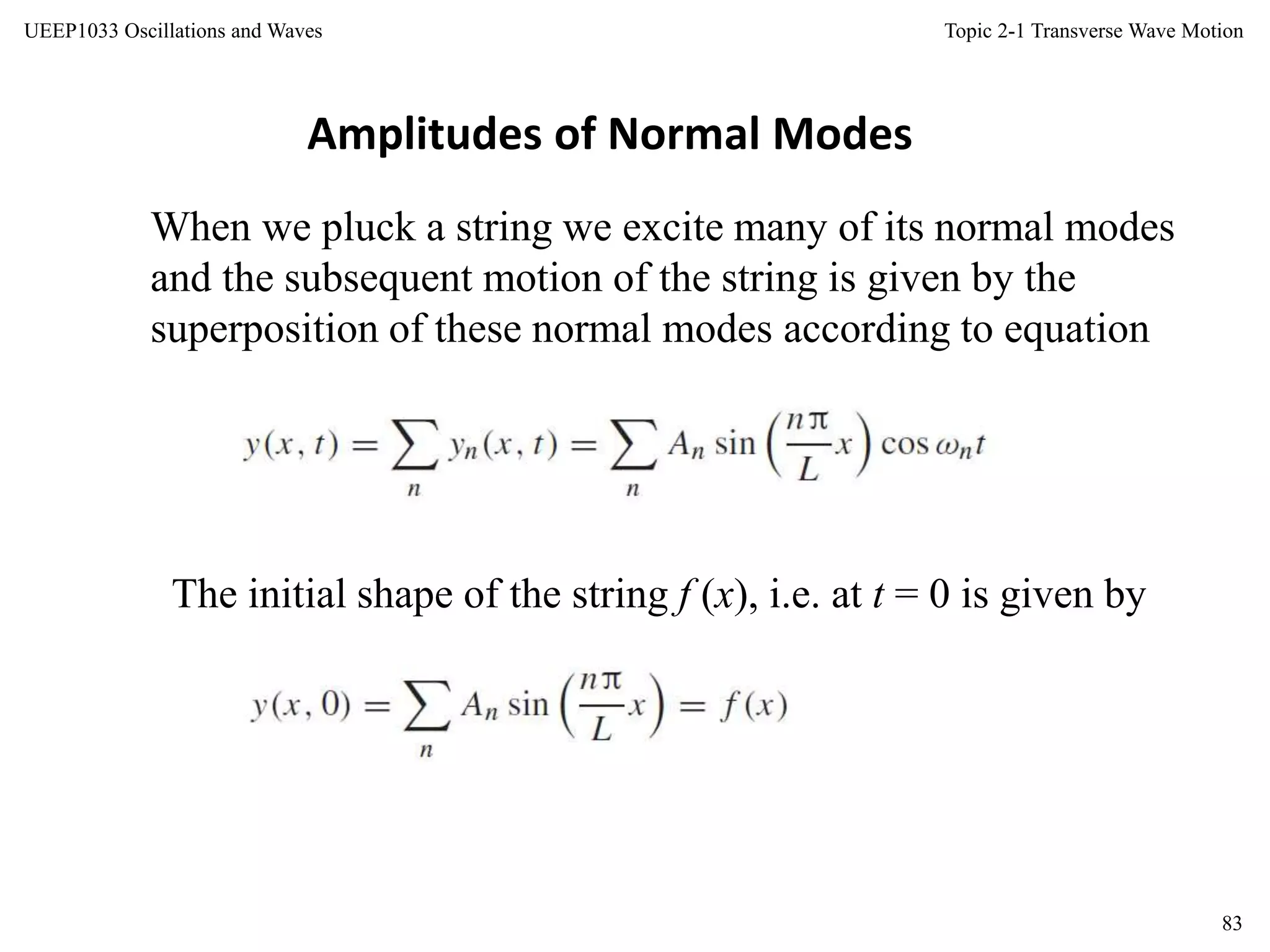
When we pluck a string we excite many of its normal modes
and the subsequent motion of the string is given by the
superposition of these normal modes according to equation
Amplitudes of Normal Modes
The initial shape of the string f (x), i.e. at t = 0 is given by
Topic 2-1 Transverse Wave Motion
84
UEEP1033 Oscillations and Waves
The expansion of the above equation is known as a Fourier
series and the amplitudes A1, A2, . . . as Fourier coefficients or
Fourier amplitude
Any shape f (x) of the string with fixed end points [f (0) = f
(L) = 0] can be written as a superposition of these sine
functions with appropriate values for the coefficients A1, A2, .
. . , i.e. in the form
Amplitudes of Normal Modes
Fourier series
Topic 2-1 Transverse Wave Motion
85
UEEP1033 Oscillations and Waves
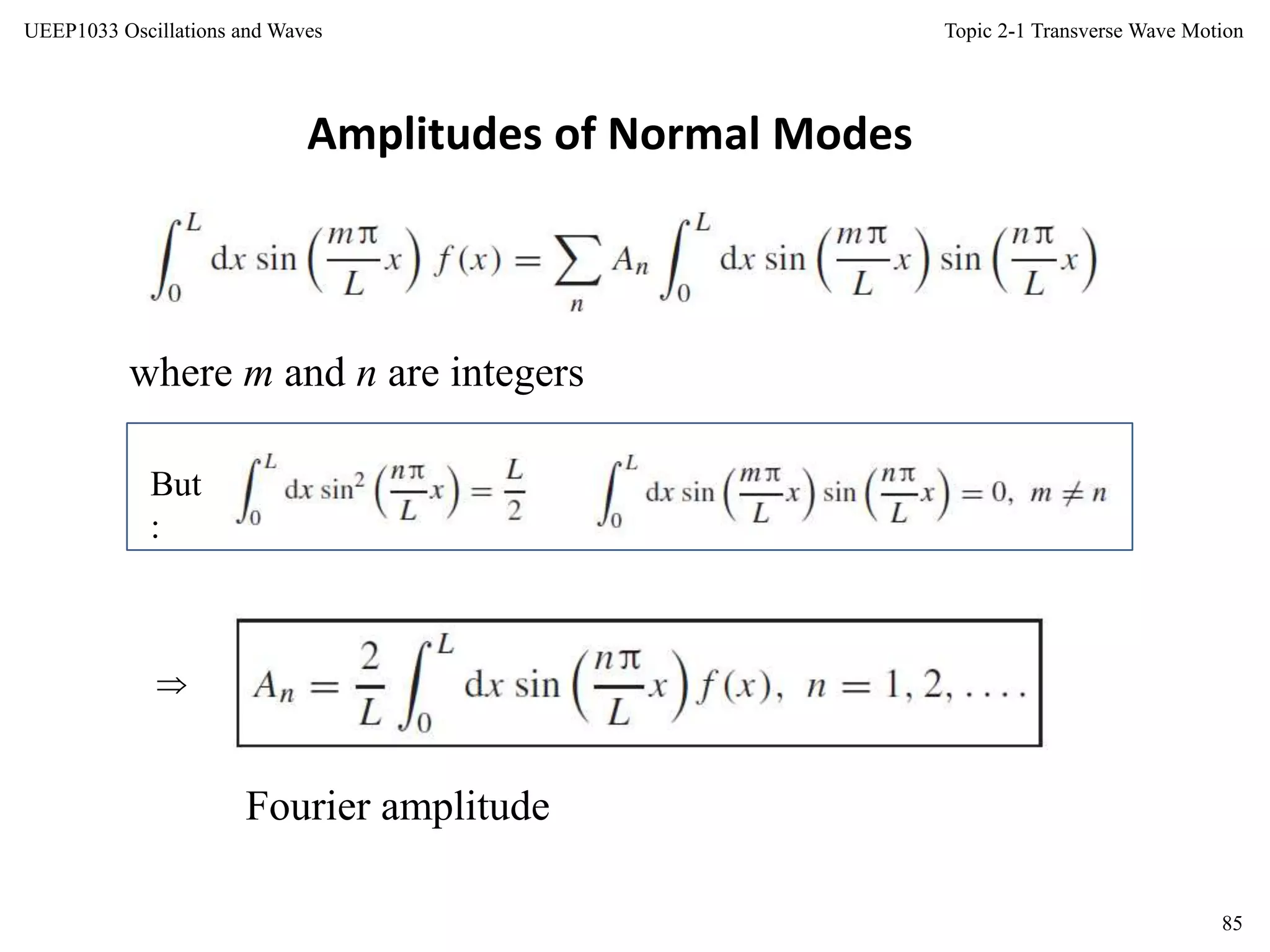
Amplitudes of Normal Modes
where m and n are integers
But
:

Fourier amplitude
Topic 2-1 Transverse Wave Motion
86
UEEP1033 Oscillations and Waves
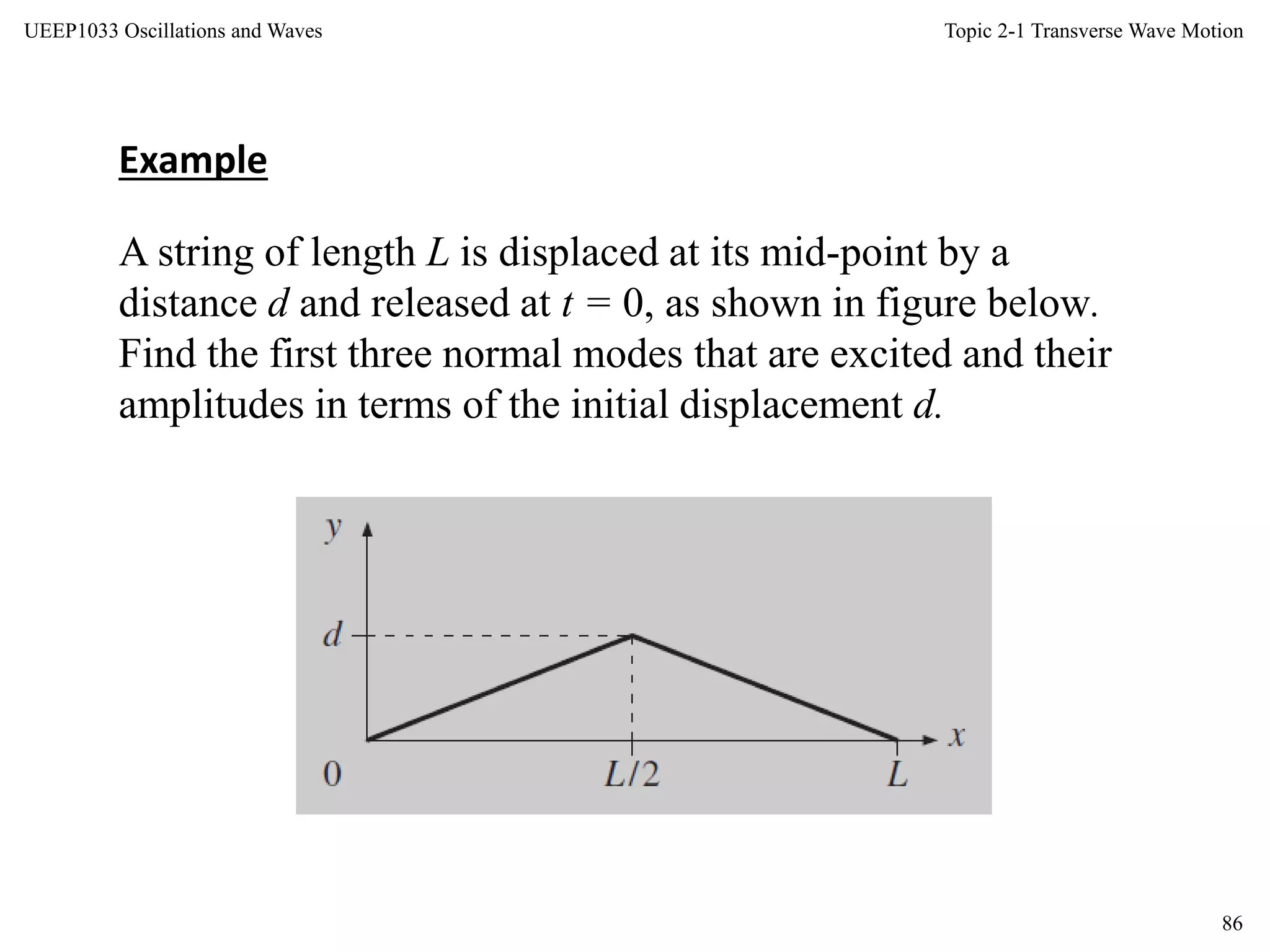
Example
A string of length L is displaced at its mid-point by a
distance d and released at t = 0, as shown in figure below.
Find the first three normal modes that are excited and their
amplitudes in terms of the initial displacement d.
Topic 2-1 Transverse Wave Motion
87
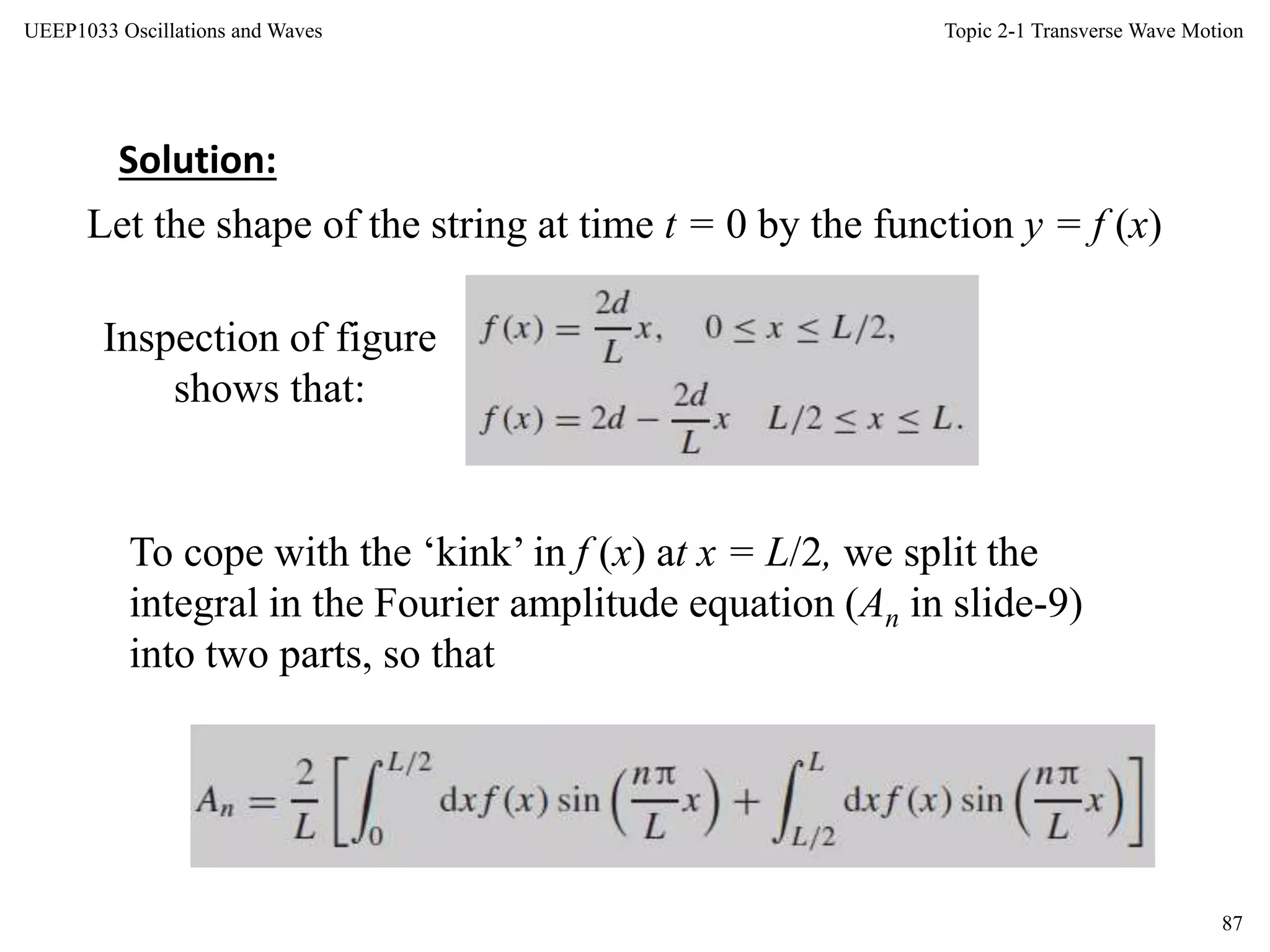
UEEP1033 Oscillations and Waves
Let the shape of the string at time t = 0 by the function y = f (x)
Solution:
Inspection of figure
shows that:
To cope with the ‘kink’ in f (x) at x = L/2, we split the
integral in the Fourier amplitude equation (An in slide-9)
into two parts, so that
Topic 2-1 Transverse Wave Motion
88
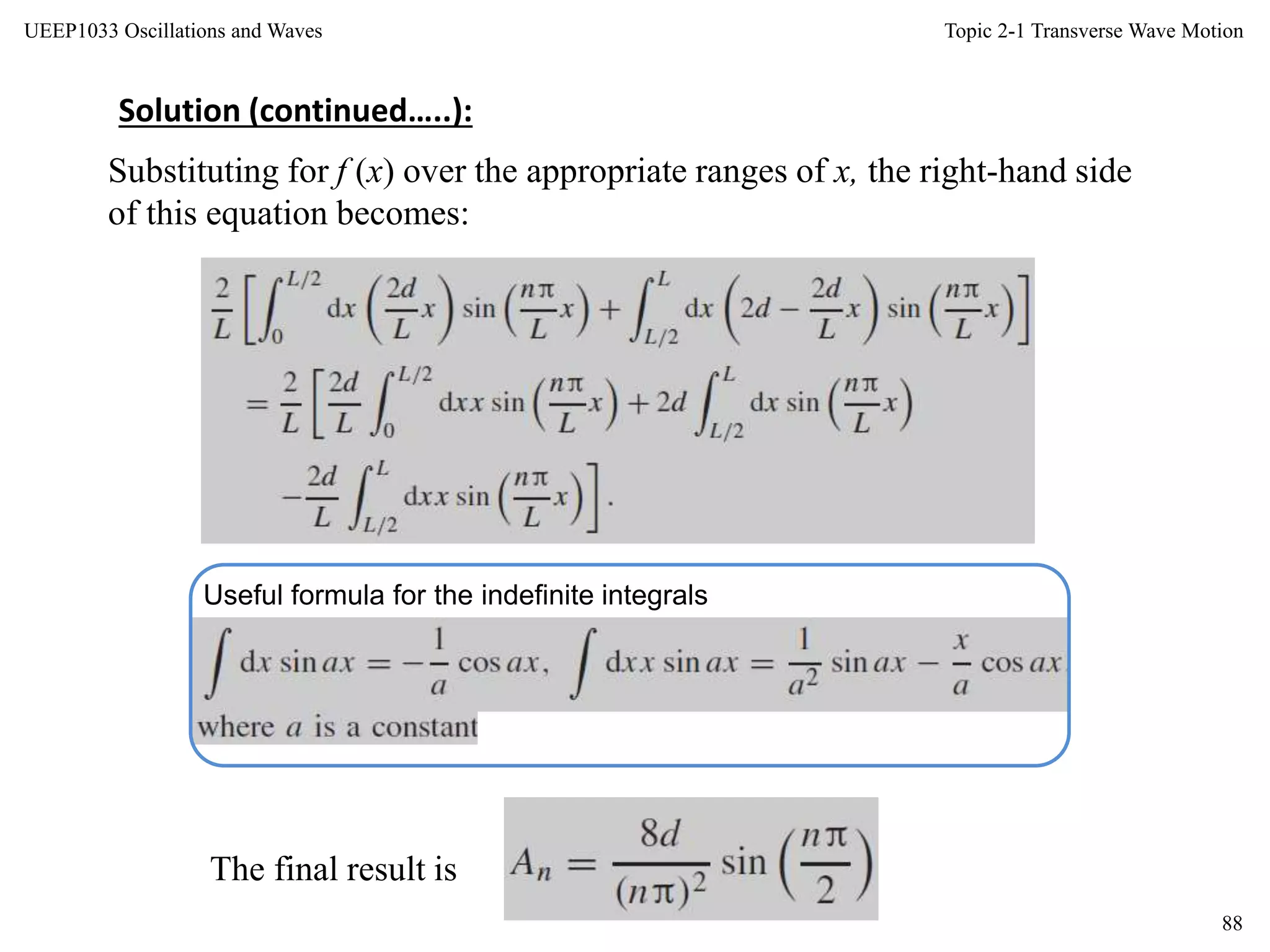
UEEP1033 Oscillations and Waves
Substituting for f (x) over the appropriate ranges of x, the right-hand side
of this equation becomes:
Useful formula for the indefinite integrals
The final result is
Solution (continued…..):
Topic 2-1 Transverse Wave Motion
89
UEEP1033 Oscillations and Waves
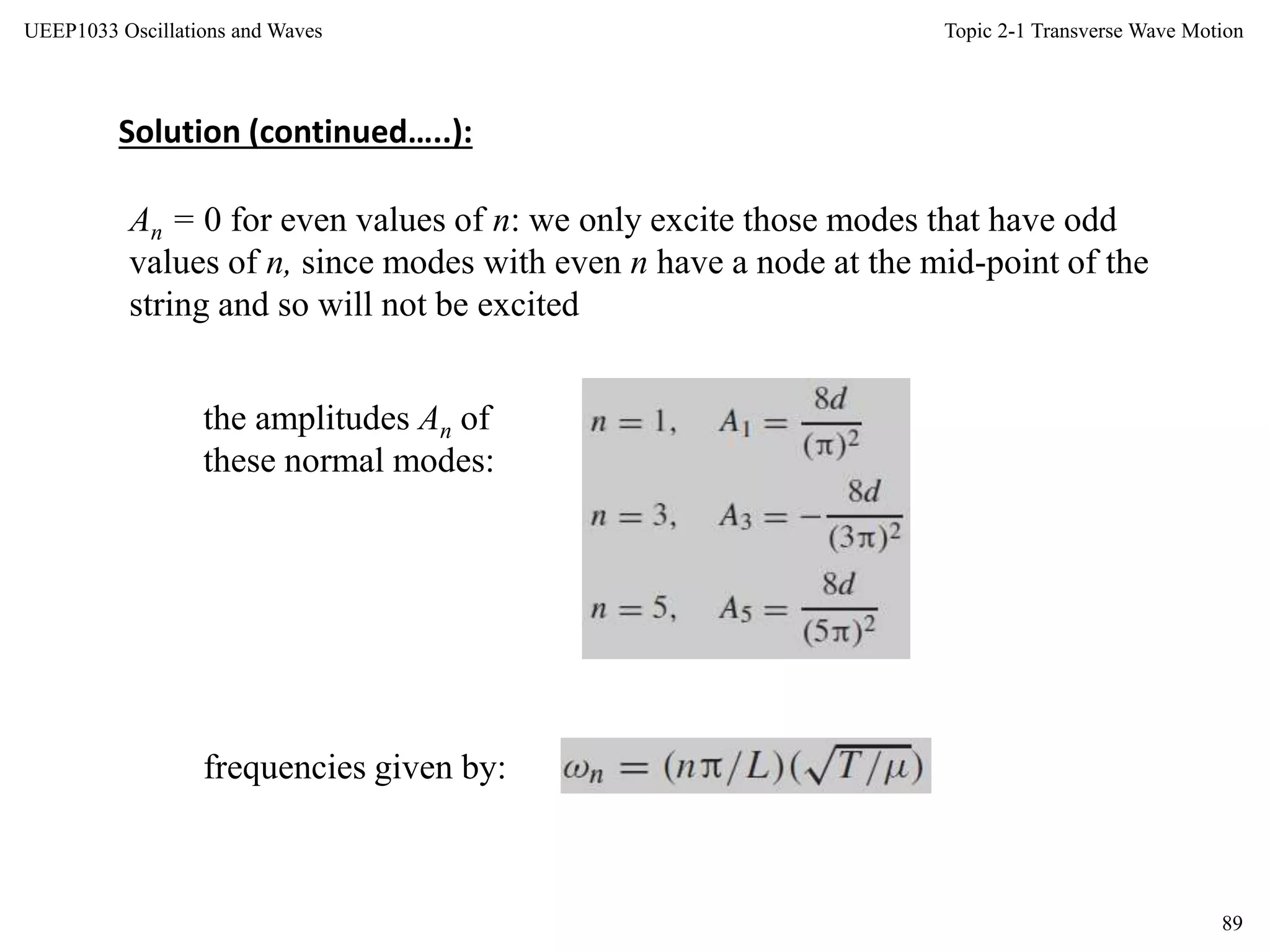
An = 0 for even values of n: we only excite those modes that have odd
values of n, since modes with even n have a node at the mid-point of the
string and so will not be excited
the amplitudes An of
these normal modes:
frequencies given by:
Solution (continued…..):

Topic 4 transverse wave

  • 1.
    Topic 2-1 TransverseWave Motion 1 UEEP1033 Oscillations and Waves Topic 4 Transverse Wave Motion
  • 2.
    Topic 2-1 TransverseWave Motion 2 UEEP1033 Oscillations and Waves Contents • Revision of 1-D wave equation, waves on a stretched string, polarization • Wave impedance • Reflection and transmission • Impedance matching • Compression waves in a fluid • Waves in 2- and 3-D • Standing waves in a box • Wave groups, group velocity • Dispersion • Waveguides: Cut-off and dispersion in a confined membrane
  • 3.
    Topic 2-1 TransverseWave Motion 3 UEEP1033 Oscillations and Waves Definition of Waves • A wave is a disturbance that moves through a medium without giving the medium, as a whole, any permanent displacement. • The general name for these waves is progressive wave. • If the disturbance takes place perpendicular to the direction of propagation of the wave, the wave is called transverse. • If the disturbance is along the direction of propagation of the wave, it is called longitudinal.
  • 4.
    Topic 2-1 TransverseWave Motion 4 UEEP1033 Oscillations and Waves Characteristics of Waves • At any point, the disturbance is a function of time and at any instant, the disturbance is a function of the position of the point. • In a sound wave, the disturbance is pressure-variation in a medium. • In the transmission of light in a medium or vacuum, the disturbance is the variation of the strengths of the electric and magnetic fields. • In a progressive wave motion, it is the disturbance that moves and not the particles of the medium.
  • 5.
    Topic 2-1 TransverseWave Motion 5 UEEP1033 Oscillations and Waves • To demonstrate wave motion, take the loose end of a long rope which is fixed at the other end quickly up and down • Crests and troughs of the waves move down the rope • If the rope is infinity long such waves are called progressive waves Progressive Waves
  • 6.
    Topic 2-1 TransverseWave Motion 6 UEEP1033 Oscillations and Waves • If the rope is fixed at both ends, the progressive waves traveling on it are reflected and combined to form standing waves Standing Waves The first four harmonics of the standing waves allowed between the two fixed ends of a string
  • 7.
    Topic 2-1 TransverseWave Motion 7 UEEP1033 Oscillations and Waves Transverse vs Longitudinal Waves • Transverse wave: the displacements or oscillations in the medium are transverse to the direction of propagation e.g. electromagnetic (EM) waves , waves on strings • Longitudinal wave: the oscillations are parallel to the direction of wave propagation e.g. sound waves
  • 8.
    Topic 2-1 TransverseWave Motion 8 UEEP1033 Oscillations and Waves Plane Waves • Take a plane perpendicular to the direction of wave propagation and all oscillators lying within that plane have a common phase • Over such a plane, all parameters describing the wave motion remain constant • The crests and troughs are planes of maximum amplitude of oscillation, which are  rad out of phase • Crest = a plane of maximum positive amplitude • Trough = a plane of maximum negative amplitude
  • 9.
    Topic 2-1 TransverseWave Motion 9 UEEP1033 Oscillations and Waves The Wave Equation 2 2 22 2 1 t y cx y       T c 2 +d T T (x +dx, y +dy) (x , y ) • The wave equation of small element of string of linear density  and constant tension T where c is the phase or wave velocity.
  • 10.
    Topic 2-1 TransverseWave Motion 10 UEEP1033 Oscillations and Waves 2 2 2 2 2 2 2 2 2 2 2 2 2 2 2 2 2 2 2 2 2 2 222 tansinsmallvery sin)sin( ignoredbecanthusandsmallvery 1 t y Tx y t y dxdx x y T t y dx x y x y T x y t y dxTdT dxdsdxds x y x y x y dx ds x y dx dx dx sd dydxds xdxx                                                                                                                     xdxx xdxx x y x y dx x y x y x y dxx y 2 2 2 2 1
  • 11.
    Topic 2-1 TransverseWave Motion 11 UEEP1033 Oscillations and Waves Waves in One Dimension • Suppose a wave moves along the x-axis with constant velocity c and without any change of shape (i.e. with no dispersion) and the disturbance takes place parallel to the y-axis, then y (x, t) = f (ct – x) (1) defines a one-dimensional wave along the positive direction of the x-axis (forward wave) t x c   
  • 12.
    Topic 2-1 TransverseWave Motion 12 UEEP1033 Oscillations and Waves Waves in One Dimension • A wave which is the same in all respect but moving in the opposite direction (i.e. along the direction of x decreasing) is given by Eqn. (1) with the sign of v changed: y (x, t) = f (ct + x) (2) • This is known as backward wave.
  • 13.
    Topic 2-1 TransverseWave Motion 13 UEEP1033 Oscillations and Waves 2 2 22 2 1 2 2 2 1 12 2 1 1 1 )(),( )(),( )( t y cx y xctfc t y xctfc t y xctf x y xctf x y xctfy                  
  • 14.
    Topic 2-1 TransverseWave Motion 14 UEEP1033 Oscillations and Waves Waves in One Dimension • Eqns. (1) and (2) satisfy the second-order partial differential equation: (3) • Eqn. (3) is known as the non-dispersive wave equation. 2 2 22 2 1 t y cx y     
  • 15.
    Topic 2-1 TransverseWave Motion 15 UEEP1033 Oscillations and Waves Locus of oscillator displacements  x Displacementy a -a
  • 16.
    Topic 2-1 TransverseWave Motion 16 UEEP1033 Oscillations and Waves Solution of Wave equation • A solution to the wave equation , where  is the oscillation frequency and • The wave is moving in the positive x direction. )( 2 sin)sin( xctatay        x2     2 2  c
  • 17.
    Topic 2-1 TransverseWave Motion 17 UEEP1033 Oscillations and Waves The Wave Equation • At position x = 0, wave equation • Any oscillator to its right at some position x will be set in motion at some later time t. • Have a phase lag  with respect to the oscillator at x = 0. • The wavelength  is the separation in space between any two oscillators with a phase difference 2 rad. tay sin )( 2 sin)sin( xctatay    
  • 18.
    Topic 2-1 TransverseWave Motion 18 UEEP1033 Oscillations and Waves The Wave Equation • The period of oscillation • An observer at any point would be passed by  wavelengths per second. • If the wave is moving to the left the sign  is changed. • Wave moving to right • Wave moving to left    1  c )( 2 sin)sin( xctatay     )( 2 sin)sin( xctatay    
  • 19.
    Topic 2-1 TransverseWave Motion 19 UEEP1033 Oscillations and Waves Equivalent Wave Expressions where is called wave number. • Cosine functions are equally valid. • For both sine and cosine )( 2 sin xctay    )(2sin   x tay  )(sin c x tay   )sin( kxtay   c k     2  kxti aey   
  • 20.
    Topic 2-1 TransverseWave Motion 20 UEEP1033 Oscillations and Waves The Wave Equation 2 2 22 2 2 2 2 2 2 2 2 2 2 2 1 )sin(),cos( )sin(),cos( )sin( t y ct yk x y x y t x x y c x y kt y kxtak x y kxtka x y kxta t y kxta t y kxtay                                       
  • 21.
    Topic 2-1 TransverseWave Motion 21 UEEP1033 Oscillations and Waves Wave or Phase velocity • The wave or phase velocity is • It is the rate at which disturbance moves across the oscillators. • The oscillator or particle velocity is a simple harmonic velocity t x c    t y   )cos( )sin( kxta t y kxtay      
  • 22.
    Topic 2-1 TransverseWave Motion 22 UEEP1033 Oscillations and Waves Particle Velocity arrows show the direction and magnitude of the particle velocity x y c t y     
  • 23.
    Topic 2-1 TransverseWave Motion 23 UEEP1033 Oscillations and Waves Waves in One Dimension • δ is called the phase of y2 relative to y1 and d the path difference: differencephase 2 differencePath     • If δ = 2π, 4π,..., then d = λ, 2λ,..., and we say that the waves are in phase, and y1 = y2. • If δ = π, 3π,..., then the two waves are exactly out of phase and y1 = – y2.
  • 24.
    Topic 2-1 TransverseWave Motion 24 UEEP1033 Oscillations and Waves Three Velocities in Wave Motion 1. Particle velocity Simple harmonic velocity of the oscillator about its equilibrium position 2. Wave or phase velocity The velocity with which planes of equal phase, crests or troughs, progress through the medium 3. Group velocity A number of waves of different frequencies, wavelengths and velocities may be superposed to form a group. Motion of such a pulse would be described by its group velocity
  • 25.
    Topic 2-1 TransverseWave Motion 25 UEEP1033 Oscillations and Waves • Locus of oscillator displacements in a continuous medium as a wave passes over them travelling in the positive x-direction • The wavelength  is defined as the distance between any two oscillators having a phase difference of 2 rad
  • 26.
    Topic 2-1 TransverseWave Motion 26 UEEP1033 Oscillations and Waves Wave or Phase Velocity Wave or Phase Velocity = the rate at which disturbance moves across the oscillators Wave or Phase Velocity = t x   Oscillator or Particle Velocity is a simple harmonic velocity Oscillator or Particle Velocity = t y  
  • 27.
    Topic 2-1 TransverseWave Motion 27 UEEP1033 Oscillations and Waves Characteristic Impedance of a String • Any medium through which waves propagate will present an impedance to those waves • If the medium is lossless, and possesses no resistive or dissipation mechanism, for a string the impedance is determined by inertia and elasticity • The presence of a loss mechanism will introduce a complex term into the impedance (the string as a forced oscillator)
  • 28.
    Topic 2-1 TransverseWave Motion 28 UEEP1033 Oscillations and Waves • The transverse impedance is define as: Characteristic Impedance of a String • Characteristic impedance of the string: (the string as a forced oscillator) v F Z  velocitytransverse forcetransverse c c T Z   2 since cT 
  • 29.
    Topic 2-1 TransverseWave Motion 29 UEEP1033 Oscillations and Waves Characteristic Impedance of a String (the string as a forced oscillator) The string as a forced oscillator with a vertical force F0eit driving it at one end For small :          x y TTTeF ti tansin0
  • 30.
    Topic 2-1 TransverseWave Motion 30 UEEP1033 Oscillations and Waves Characteristic Impedance of a String (the string as a forced oscillator) displacement of the progressive waves may be represented exponentially by: amplitude A may be complex At the end of the string, where x = 0 )( kxti e   Ay )0( 0 0             kti x ti eikT x y TeF A         T c i F ikT F 00 A )(0 kxti e T c i F          y
  • 31.
    Topic 2-1 TransverseWave Motion 31 UEEP1033 Oscillations and Waves Characteristic Impedance of a String (the string as a forced oscillator) transverse velocity: velocity amplitude: transverse impedance: Characteristic Impedance of the string Since the velocity c is determined by the inertia and the elasticity, the impedance is also governed by these properties )( 0 kxti e T c F         yv  ZFv /0 c c T Z   2 since cT 
  • 32.
    Topic 2-1 TransverseWave Motion 32 UEEP1033 Oscillations and Waves Reflection and Transmission
  • 33.
    Topic 2-1 TransverseWave Motion 33 UEEP1033 Oscillations and Waves Z1 = 1c1 Z2 = 2c2 Reflection and Transmission • Suppose a string consists of two sections smoothly joined at a point x = 0 with a tension T • Waves on a string of impedance Z1= 1c1 reflected and transmitted at the boundary x = 0 where the string changes to impedance Z2= 2c2
  • 34.
    Topic 2-1 TransverseWave Motion 34 UEEP1033 Oscillations and Waves Reflection and Transmission Incident wave: Reflected wave: Transmitted wave: find the reflection and transmission amplitude coefficients i.e. the relative values of B1 and A2 with respect to A1 )( 1 1xkti i eAy   )( 1 1xkti r eBy   )( 2 2xkti t eAy  
  • 35.
    Topic 2-1 TransverseWave Motion 35 UEEP1033 Oscillations and Waves )( 1 1xkti i eAy   )( 1 1xkti r eBy   )( 2 2xkti t eAy   find the reflection and transmission amplitude coefficients i.e. the relative values of B1 and A2 with respect to A1
  • 36.
    Topic 2-1 TransverseWave Motion 36 UEEP1033 Oscillations and Waves Boundary condition No. 1 at the impedance discontinuity at x = 0 Reflection and Transmission 1. A geometrical condition that the displacement is the same immediately to the left and right of x = 0 for all time, so that there is no discontinuity of displacement tri yyy  )( 2 )( 1 )( 1 211 xktixktixkti eAeBeA   0At x )1(Eq211 ABA 
  • 37.
    Topic 2-1 TransverseWave Motion 37 UEEP1033 Oscillations and Waves Boundary condition No. 2 at the impedance discontinuity at x = 0 Reflection and Transmission 2. A dynamical condition that there is a continuity of the transverse force T(y/x) at x = 0, and therefore a continuous slope   tri y x Tyy x T       at x = 0 for all t 221111 TAkTBkTAk  2 2 1 1 1 1 A c T B c T A c T 
  • 38.
    Topic 2-1 TransverseWave Motion 38 UEEP1033 Oscillations and Waves Reflection and Transmission  These coefficients are independent of  222 2 111 1 and Zc c T Zc c T  )2(Eq)( 22111 AZBAZ  Reflection coefficient of amplitude: 21 21 1 1 ZZ ZZ A B    Transmission coefficient of amplitude: 21 1 1 2 2 ZZ Z A A   Solving Eqs. (1) and (2)
  • 39.
    Topic 2-1 TransverseWave Motion 39 UEEP1033 Oscillations and Waves   )( 11 )( 11 )( 1 )( 1 11 11 xktixkti ri xktixkti ri eBikeAikyy x eBeAyy         tri y x Tyy x T      )( 22 )( 2 2 2 xkti t xkti t eAiky x eAy         11110,0At BikAikyy x tx ri     220,0At Aiky x tx t    
  • 40.
    Topic 2-1 TransverseWave Motion 40 UEEP1033 Oscillations and Waves   tri y x Tyy x T tx       0,0At 221111 AikBikAik  2 2 1 1 1 1 A c T B c T A c T  221111 AkBkAk  22111 )( AZBAZ  222 2 111 1 Zc c T Zc c T  
  • 41.
    Topic 2-1 TransverseWave Motion 41 UEEP1033 Oscillations and Waves • If Z2 = , B1/A1= 1  incident wave is completely reflected with a phase change of  (conditions that necessary for standing waves to exist) • If Z2 = 0 (x =0 is a free end of the string) B1/A1= 1, A2/A1= 2  the flick at the end of a whip or free end string Reflection and Transmission 21 21 1 1 ZZ ZZ A B    21 1 1 2 2 ZZ Z A A  
  • 42.
    Topic 2-1 TransverseWave Motion 42 UEEP1033 Oscillations and Waves • If Z2 = , B1/A1= 1 incident wave is completely reflected with a phase change of  (conditions that necessary for standing waves to exist) • If Z2 = 0 (x =0 is a free end of the string) B1/A1= 1, A2/A1= 2 the flick at the end of a whip or free end string
  • 43.
    Topic 2-1 TransverseWave Motion 43 UEEP1033 Oscillations and Waves Reflection and Transmission of Energy What happens to the energy in a wave when it meets a boundary between two media of different impedance values? (the wave function of transferring energy throughout a medium) Consider each unit length, mass , of the string as a simple harmonic oscillator of maximum amplitude A Total energy:  = wave frequency The rate at which energy is being carried along the string: 22 2 1 AE  cA22 2 1 velocity)(energy 
  • 44.
    Topic 2-1 TransverseWave Motion 44 UEEP1033 Oscillations and Waves Reflection and Transmission of Energy The rate at which energy leaves the boundary, via the reflected and transmitted waves: the rate of energy arriving at the boundary x = 0 is the energy arriving with the incident wave: energy is conserved, and all energy arriving at the boundary in the incident wave leaves the boundary in the reflected and transmitted waves 2 1 2 1 2 1 2 11 2 1 2 1 AZAc  2 1 2 12 21 2 2 1 2 2112 1 2 2 2 2 2 2 1 2 1 2 2 2 22 2 1 2 11 2 1 )( 4)( 2 1 2 1 2 1 2 1 2 1 AZ ZZ ZZZZZ A AZBZAcBc     
  • 45.
    Topic 2-1 TransverseWave Motion 45 UEEP1033 Oscillations and Waves Reflected and Transmitted Intensity Coefficients If Z1 = Z2 no energy is reflected and the impedances are said to be matched 2 21 21 2 1 1 2 11 2 11 EnergyIncident EnergyReflected                ZZ ZZ A B AZ BZ  2 21 21 2 11 2 22 4 EnergyIncident EnergydTransmitte ZZ ZZ AZ AZ  
  • 46.
    Topic 2-1 TransverseWave Motion 46 UEEP1033 Oscillations and Waves Matching of Impedances Why Important? • Long distance cables carrying energy must be accurately matched at all joints to avoid wastage from energy reflection Example: • The power transfer from any generator is a maximum when the load matches the generator impedance • A loudspeaker is matched to the impedance of the power output of an amplifier by choosing then correct turns ratio on the coupling transformer
  • 47.
    Topic 2-1 TransverseWave Motion 47 UEEP1033 Oscillations and Waves Matching of Impedances Insertion of a coupling element between two mismatched impedances Remark: when a smooth joint exists between two strings of different impedances, energy will be reflected at the boundary Goal: to eliminate energy reflection and match the impedances Require to match the impedances Z1 = 1c1 and Z3 = 3c3 by the smooth insertion of a string of length l and impedance Z2 = 2c2 Our problem is to find the values of l and Z2
  • 48.
    Topic 2-1 TransverseWave Motion 48 UEEP1033 Oscillations and Waves Matching of Impedances The impedances Z1 and Z3 of two strings are matched by the insertion of a length l of a string of impedance Z2
  • 49.
    Topic 2-1 TransverseWave Motion 49 UEEP1033 Oscillations and Waves Matching of Impedances we seek to make the ratio Boundary conditions: y and T(y/x) are continuous across the junctions x = 0 and x = l 1 EnergyIncident EnergydTransmitte 2 11 2 33  AZ AZ
  • 50.
    Topic 2-1 TransverseWave Motion 50 UEEP1033 Oscillations and Waves Matching of Impedances Between Z1 and Z2 the continuity of y gives: Continuity of T(y/x) gives Dividing the above equation by  and remember At x = 0 )( 2 )( 2 )( 1 )( 1 2211 xktixktixktixkti eBeAeBeA   )0at(2211  xBABA    22221111 BikAikTBikAikT    ZcT/ckT /    222111 BAZBAZ 
  • 51.
    Topic 2-1 TransverseWave Motion 51 UEEP1033 Oscillations and Waves Matching of Impedances At x = l Continuity of T(y/x) gives: Continuity of y gives: From the four boundary equations, solve for the ratio A3/A1 Refer to the H.J. Pain, “The Physics of Vibrations and Waves”,6th Edition, pg 122-123 for detail derivation 322 22 AeBeA liklik    33222 22 AZeBeAZ liklik      lkrrlkr r A A 2 22 23122 22 13 2 13 2 1 3 sincos1 4       
  • 52.
    Topic 2-1 TransverseWave Motion 52 UEEP1033 Oscillations and Waves Matching of Impedances 2 1 2 3 13 2 11 2 33 1 EnergyIncident EnergydTransmitte A A rAZ AZ      lkrrlkr r 2 22 23122 22 13 13 sincos1 4   havewe1sinand0cos,4/chooseweif 222  lklkl   23122 2312 13 2 11 2 33 when1 4 rr rr r AZ AZ   
  • 53.
    Topic 2-1 TransverseWave Motion 53 UEEP1033 Oscillations and Waves Standing Waves on a String of Fixed Length
  • 54.
    Topic 2-1 TransverseWave Motion 54 UEEP1033 Oscillations and Waves • A string of fixed length l with both ends rigidly clamped • Consider wave with an amplitude a traveling in the positive x-direction and an amplitude b traveling in the negative x-direction • The displacement on the string at any point is given by: Standing Waves with the boundary condition that y = 0 at x = 0 and x = l )()( kxtikxti beaey  
  • 55.
    Topic 2-1 TransverseWave Motion 55 UEEP1033 Oscillations and Waves
  • 56.
    Topic 2-1 TransverseWave Motion 56 UEEP1033 Oscillations and Waves Standing Waves Boundary condition: y = 0 at x = 0   A wave in either direction meeting the infinite impedance at either end is completely reflected with a  phase change in amplitude  a =  b  An expression of y which satisfies the standing wave time dependent form of the wave equation:     kxaeieeaey tiikxikxti sin2   02 2 2    yk x y ti eba   )(0
  • 57.
    Topic 2-1 TransverseWave Motion 57 UEEP1033 Oscillations and Waves Standing Waves Boundary condition: y = 0 at x = l Limiting the value of allowed frequencies to: 22 n n n n l c l nc f          n c l c l kl 0sinsin l cn n      kliae eeae beae ti ikliklti kltiklti sin20 0 0 )()(      
  • 58.
    Topic 2-1 TransverseWave Motion 58 UEEP1033 Oscillations and Waves Standing Waves normal frequencies or modes of vibration: Such allowed frequencies define the length of the string as an exact number of half wavelengths (Fundamental mode) The first four harmonics, n =1, 2, 3, 4 of the standing waves allowed between the two fixed ends of a string l xn c xn    sinsin 2 nn l  
  • 59.
    Topic 2-1 TransverseWave Motion 59 UEEP1033 Oscillations and Waves
  • 60.
    Topic 2-1 TransverseWave Motion 60 UEEP1033 Oscillations and Waves Standing Waves • For n > 1, there will be a number of positions along the string where the displacement is always zero called nodes or nodal point These points occur where there are (n1) positions equally spaced along the string in the nth harmonic where the displacement is always zero • Standing waves arise when a single mode is excited and the incident and reflected waves are superposed • If the amplitudes of these progressive waves are equal and opposite (resulting from complete reflection), nodal points will exist 0sinsin     l xn c xn ),.....,3,2,1,0( nrr l xn    0sin xkn  rxkn
  • 61.
    Topic 2-1 TransverseWave Motion 61 UEEP1033 Oscillations and Waves Standing Waves the complete expression for the displacement of the nth harmonic is given by:   c x tBtAy n nnnnn   sinsincos   c x titiay n nnn   sinsincos)(2 where the amplitude of the nth mode is given by   aBA nn 2 2/122  we can express this in the form:
  • 62.
    Topic 2-1 TransverseWave Motion 62 UEEP1033 Oscillations and Waves Standing Wave Ratio • If a progressive wave system is partially reflected from a boundary, let the amplitude reflection coefficient B1/A1 = r, for r < 1 • The maximum amplitude at reinforcement is (A1 + B1), the minimum amplitude (A1  B1) • The ratio of the maximum to minimum amplitudes is called standing wave ratio (SWR) • Reflection coefficient: r r BA BA       1 1 SWR 11 11 1SWR 1SWR 1 1    A B r
  • 63.
    Topic 2-1 TransverseWave Motion 63 UEEP1033 Oscillations and Waves Energy in Each Normal Mode of a Vibrating String • A vibrating string possesses both kinetic and potential energy • Kinetic energy of an element of length dx and linear density  • Total kinetic energy: 2 2 1 ydx  dxyE 2 1 02 1)kinetic(  
  • 64.
    Topic 2-1 TransverseWave Motion 64 UEEP1033 Oscillations and Waves Energy in Each Normal Mode of a Vibrating String • Potential energy = the work done by thee tension T in extending an element of length dx to a new length ds when the string is vibrating neglect higher powers of y/x     dxT dxTdxdsTE x y x y                      2 2 2 1 11)()potential( 2 1     ....11 2 2 1 2 2 1           x y x y ... 2 )1( 1)1( 2    x nn nxx n
  • 65.
    Topic 2-1 TransverseWave Motion 65 UEEP1033 Oscillations and Waves Energy in Each Normal Mode of a Vibrating String • For standing waves:   c xn tBtAy nnnnn   sinsincos   c x nnnnnnn n tBtAy   sincossin   c x nnnnc n nn tBtA x y     cossincos   dxtBtAE c xl nnnnnn n  2 0 22 2 1 sincossin)kinetic(   dxtBtATE c xl nnnncn nn   2 0 2 2 1 cossincos)potential( 2 2
  • 66.
    Topic 2-1 TransverseWave Motion 66 UEEP1033 Oscillations and Waves Energy in Each Normal Mode of a Vibrating String where m is the mass of the string = the square of the maximum displacement of the mode 2 cT  )( )()potentialkinetic( 222 4 1 222 4 1 nnn nnnn BAm BAlE   )( 22 nn BA 
  • 67.
    Topic 2-1 TransverseWave Motion 67 UEEP1033 Oscillations and Waves a axx axdx 4 2sin 2 sin2  a axx axdx 4 2sin 2 cos2    2 sin 0)/(4 )/(2sin 2 2 0 l dx l c xcx c xl n nn       2 cos 0)/(4 )/(2sin 2 2 0 l dx l c xcx c xl n nn       dxtBtAE c xl nnnnnn n  2 0 22 2 1 sincossin)kinetic(   dxtBtATE c xl nnnncn nn   2 0 2 2 1 cossincos)potential( 2 2
  • 68.
    Topic 2-1 TransverseWave Motion 68 UEEP1033 Oscillations and Waves   2 22 2 1 cossin)kinetic( l nnnnnn tBtAE  22 4 122 4 1 )kinetic( nnnnn BmBlE At any time t:   2 2 2 1 sincos)potential( 2 2 l nnnncn tBtATE n   At any time t: 22 4 122 4 1 )potential( nnnnn AmAlE  2 cT  )( )()potential()kinetic( 222 4 1 222 4 1 nnn nnnnn BAm BAlEE  
  • 69.
    Topic 2-1 TransverseWave Motion 69 UEEP1033 Oscillations and Waves Wave Groups and Group Velocity • Waves to occur as a mixture of a number or group of component frequencies e.g. white light is composed of visible wavelength spectrum of 400 nm to 700 nm • The behavior of such a group leads to the group velocity dispersion causes the spatial separation of a white light into components of different wavelength (different colour)
  • 70.
    Topic 2-1 TransverseWave Motion 70 UEEP1033 Oscillations and Waves Superposition of two waves of almost equal frequencies • A group consists of two components of equal amplitude a but frequencies 1 and 2 which differ by a small amount. • Their displacements: • Superposition of amplitude and phase: )cos()cos( 222111 xktayxktay                     2 )( 2 )( cos 2 )( 2 )( cos2 21212121 21 xkktxkkt ayyy a wave system with a frequency (1+ 2)/2 which is very close to the frequency of either component but with a maximum amplitude of 2a, modulated in space and time by a very slowly varying envelope of frequency (1  2)/2 and wave number (k1  k2)/2
  • 71.
    Topic 2-1 TransverseWave Motion 71 UEEP1033 Oscillations and Waves Superposition of two waves of almost equal frequencies
  • 72.
    Topic 2-1 TransverseWave Motion 72 UEEP1033 Oscillations and Waves • The velocity of the new wave is Superposition of two waves of almost equal frequencies so that the component frequencies and their superposition, or group will travel with the same velocity, the profile of their combination in Figure 5.11 remaining constant )/()( 2121 kk  ckk  2211 //If the phase velocities , gives c kk kk c kk       21 21 21 21 )(
  • 73.
    Topic 2-1 TransverseWave Motion 73 UEEP1033 Oscillations and Waves • For the two frequency components have different phase velocities so that 1/k1  2/k2 Superposition of two waves of almost equal frequencies The superposition of the two waves will no longer remain constant and the group profile will change with time Dispersive medium = medium in which the phase velocity is frequency dependent (i.e. /k not constant) kkk       21 21 velocityGroup
  • 74.
    Topic 2-1 TransverseWave Motion 74 UEEP1033 Oscillations and Waves • If a group contain a number of components of frequencies which are nearly equal the original, expression for the group velocity is written: Superposition of two waves of almost equal frequencies Since  = kv (v is the phase velocity) group velocity: gv dk d k      dk dv kvkv dk d dk d vg    )(   d dv vvg
  • 75.
    Topic 2-1 TransverseWave Motion 75 UEEP1033 Oscillations and Waves • A non-dispersive medium where /k is constant, so that vg = v, for instance free space behaviour towards light waves • A normal dispersion relation, vg < v • An anomalous dispersion relation, vg > v
  • 76.
    Topic 2-1 TransverseWave Motion 76 UEEP1033 Oscillations and Waves Standing Waves as Normal Modes of Vibrating String
  • 77.
    Topic 2-1 TransverseWave Motion 77 UEEP1033 Oscillations and Waves Characteristic of a Normal Mode • all the masses move in SHM at the same frequency • normal modes are completely independent of each other • general motion of the system is a superposition of the normal modes • All of these properties of normal modes are shared by standing waves on a vibrating string • all the particles of the string perform SHM with the same frequency • the standing waves are the normal modes of the vibrating string Standing Waves as Normal Modes
  • 78.
    Topic 2-1 TransverseWave Motion 78 UEEP1033 Oscillations and Waves Superposition of Normal Modes the expression for the n-th normal mode of a vibrating string of length L the motion of the string will be a superposition of normal modes given by:
  • 79.
    Topic 2-1 TransverseWave Motion 79 UEEP1033 Oscillations and Waves txkAtxy nnnn  cossin),( 0sin xkn Displacement zero (nodes) occur when sine term = 0 ,....)2,1,0(  nnxkn
  • 80.
    Topic 2-1 TransverseWave Motion 80 UEEP1033 Oscillations and Waves Example: superposition of the 3rd normal mode with a relative amplitude of 1.0 and the 13th normal mode with a relative amplitude of 0.5 3rd harmonic y3(x, 0) of a string at t = 0 13th harmonic y13(x, 0) of a string at t = 0 The superposition of the two harmonics to give the resultant shape of the string at t = 0 (a) (b) (c)
  • 81.
    Topic 2-1 TransverseWave Motion 81 UEEP1033 Oscillations and Waves • To excite the two normal modes in this way, we would somehow have to constrain the shape of the string as in (c) and then release it at time t = 0 • It is impractical to do this and in practice we pluck a string to cause it to vibrate • Example the string is displaced a distance d at one quarter of its length • Initially, the string has a triangular shape and this shape clearly does not match any of the shapes of the normal modes
  • 82.
    Topic 2-1 TransverseWave Motion 82 UEEP1033 Oscillations and Waves it is possible to reproduce this triangular shape by adding together the normal modes of the string with appropriate amplitudes The first three excited normal modes of the string: y1(x, 0), y2(x, 0) and y3(x, 0)         L x Axy sin)0,( 11         L x Axy 2 sin)0,( 22         L x Axy 3 sin)0,( 33 • Even using just the first three normal modes we get a surprisingly good fit to the triangular shape • By adding more normal modes, we would achieve even better agreement, especially with respect to the sharp corner The superposition of the first three normal modes gives a good reproduction of the initial triangular shape of the string except for the sharp corner
  • 83.
    Topic 2-1 TransverseWave Motion 83 UEEP1033 Oscillations and Waves When we pluck a string we excite many of its normal modes and the subsequent motion of the string is given by the superposition of these normal modes according to equation Amplitudes of Normal Modes The initial shape of the string f (x), i.e. at t = 0 is given by
  • 84.
    Topic 2-1 TransverseWave Motion 84 UEEP1033 Oscillations and Waves The expansion of the above equation is known as a Fourier series and the amplitudes A1, A2, . . . as Fourier coefficients or Fourier amplitude Any shape f (x) of the string with fixed end points [f (0) = f (L) = 0] can be written as a superposition of these sine functions with appropriate values for the coefficients A1, A2, . . . , i.e. in the form Amplitudes of Normal Modes Fourier series
  • 85.
    Topic 2-1 TransverseWave Motion 85 UEEP1033 Oscillations and Waves Amplitudes of Normal Modes where m and n are integers But :  Fourier amplitude
  • 86.
    Topic 2-1 TransverseWave Motion 86 UEEP1033 Oscillations and Waves Example A string of length L is displaced at its mid-point by a distance d and released at t = 0, as shown in figure below. Find the first three normal modes that are excited and their amplitudes in terms of the initial displacement d.
  • 87.
    Topic 2-1 TransverseWave Motion 87 UEEP1033 Oscillations and Waves Let the shape of the string at time t = 0 by the function y = f (x) Solution: Inspection of figure shows that: To cope with the ‘kink’ in f (x) at x = L/2, we split the integral in the Fourier amplitude equation (An in slide-9) into two parts, so that
  • 88.
    Topic 2-1 TransverseWave Motion 88 UEEP1033 Oscillations and Waves Substituting for f (x) over the appropriate ranges of x, the right-hand side of this equation becomes: Useful formula for the indefinite integrals The final result is Solution (continued…..):
  • 89.
    Topic 2-1 TransverseWave Motion 89 UEEP1033 Oscillations and Waves An = 0 for even values of n: we only excite those modes that have odd values of n, since modes with even n have a node at the mid-point of the string and so will not be excited the amplitudes An of these normal modes: frequencies given by: Solution (continued…..):