FUNDAMENTAL TYPES
WAVE MOTION
Waveis a disturbance that travels through space and matter, transferring energy from one place to
another. The key idea is that wave motion transfers energy, not matter. Imagine a cork floating on
water. As a wave passes, the cork moves up and down, but it returns to its original position. As a wave
passes, the cork moves up and down, but it returns to its original position. The wave (the energy) moves
across the water, but the water itself (the matter) only oscillates locally.
Definition Types
3.
Definition Types
FUNDAMENTAL TYPES
Atransverse wave is a wave in which each particle of the medium moves perpendicular to the direction
the wave travels. On a string, the wave moves along the string while the string elements move up–
down; that’s transverse motion.
Transverse Wave
4.
FUNDAMENTAL TYPES
A longitudinalwave is a wave in which particles of the medium oscillate parallel to the direction the
wave travels. You can make one in a Slinky by repeatedly compressing and expanding one end:
compressions and rarefactions move along the spring. Sound in air is a prime example.
Longitudinal Wave
Definition Types
5.
DISPLACEMENT EQUATION
A standardtraveling sinusoidal wave can be written as:
𝑦 =± 𝐴 sin (𝜔 𝑡 ±𝑘𝑥 +𝜙0 )
Where,
• : Displacement from equilibrium
• : Position along the direction the wave travels
• : Time
• : Amplitude
• : Angular wavenumber
• : Angular frequency
• : Phase constant
Note:
• Negative (-) sign in front of , then the wave
propagates to the right (+x).
• Positive (+) sign in front of , then the wave
propagates to the left (-x).
• Positive (+) sign in front of A, then the particle starts
moving upward.
• Negative (-) sign in front of A, then the particle starts
moving downward.
7.
Wavelenght ()
Distance overwhich the wave pattern
repeats in space (crest to next crest).
Phase ()
How rapidly the phase changes with x
Angular Wavenumber ()
How rapidly the phase changes with time. Unit:
rad/s
Angular Frequency ()
Wave Speed ()
Wave speed is the speed at which the shape or
disturbance of a wave travels through a
medium.
Measure of the stage
Phase Angle ()
measure of the stage of the cycle
8.
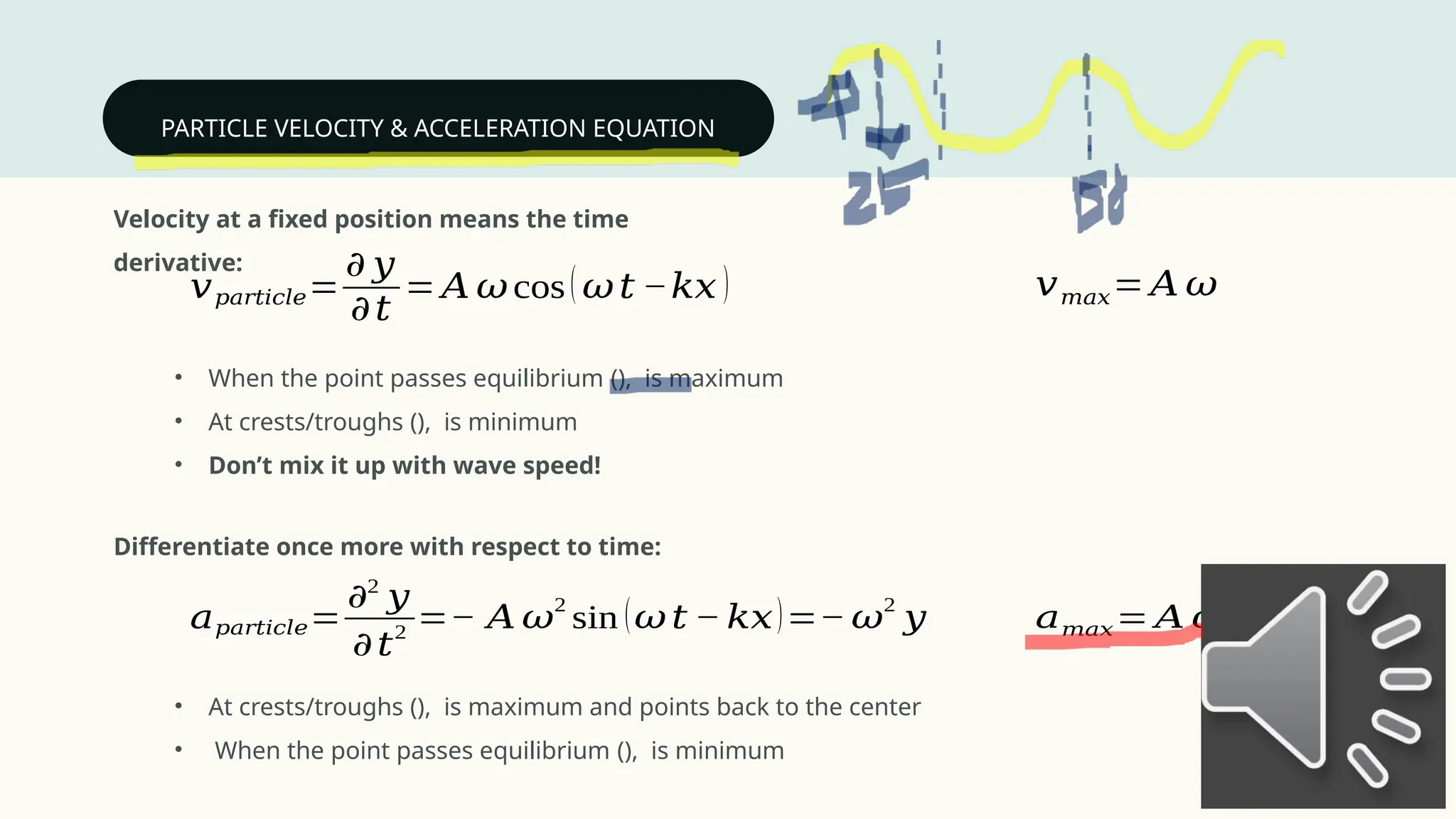
Velocity at afixed position means the time
derivative:
Differentiate once more with respect to time:
𝑎𝑝𝑎𝑟𝑡𝑖𝑐𝑙𝑒=
𝜕2
𝑦
𝜕𝑡
2
=− 𝐴 𝜔
2
sin (𝜔𝑡 − 𝑘𝑥)=− 𝜔
2
𝑦
𝑣𝑝𝑎𝑟𝑡𝑖𝑐𝑙𝑒=
𝜕 𝑦
𝜕𝑡
= 𝐴 𝜔cos( 𝜔𝑡 −𝑘𝑥 ) 𝑣𝑚𝑎𝑥= 𝐴 𝜔
• When the point passes equilibrium (), is maximum
• At crests/troughs (), is minimum
• Don’t mix it up with wave speed!
𝑎𝑚𝑎𝑥= 𝐴 𝜔2
PARTICLE VELOCITY & ACCELERATION EQUATION
• At crests/troughs (), is maximum and points back to the center
• When the point passes equilibrium (), is minimum
9.
EXERCISE
Two boats, separatedby 40 m, bob up and down with ocean waves. When one boat is at a
crest, the other is at a trough, and two additional crests lie between them. Each boat
completes 10 full up-and-down oscillations in 12 s. Determine:
a) Period and frequency
b) Wavelegth
c) Wave speed
11.
EXERCISE
A wave isdescribed by:
1. Where y is in meters, t in seconds, and x in meters. Determine:
a) Amplitude, frequency, period, wavelength, and the direction of propagation
b) Wave speed
𝑦 =0,4 sin (0.5 𝜋 𝑡 − 4 𝜋 𝑥)
2. Points P and Q are located 1.0 m and 2.125 m from the wave source (at x = 0),
respectively. At t = 20 s, determine:
a) Phase angle (in radians), phase (in cycles), and displacement at point P;
b) Phase angle, phase, displacement at point Q
c) Phase difference between Q and P
12.
EXERCISE
A wave isdescribed by:
3. Point P is 1.0 m from the source. At t = 5 s, find the particle velocity and particle
acceleration at P.
𝑦 =0,4 sin (0.5 𝜋 𝑡 − 4 𝜋 𝑥)
13.
WAVE PROPERTIES
When awave meets a boundary, part of its energy can reflect (go back) and part can transmit (go through).
Frequency does not change at a boundary. The speed and wavelength may change if the wave enters a new
medium, because .
Reflection
Reflection Interferences
On a rope or string
Fixed end (clamped end)
The reflected wave is inverted
(a crest returns as a trough).
That is a phase flip of π (half a
cycle).
14.
WAVE PROPERTIES
When awave meets a boundary, part of its energy can reflect (go back) and part can transmit (go through).
Frequency does not change at a boundary. The speed and wavelength may change if the wave enters a new
medium, because .
Reflection
Reflection Interferences
On a rope or string
Free end (loose ring)
The reflected wave is not
inverted (crest returns as crest)
15.
WAVE PROPERTIES
Interferences
Reflection Interferences
Whentwo or more waves overlap at the
same place and time, the actual
displacement is the sum of the individual
displacements:
If the sources have the same frequency (are
coherent), the pattern is steady.
STANDING WAVE (STATIONARYWAVES)
• A standing wave is a vibration pattern that does not travel along the medium. Some points are always
still (nodes), while others vibrate the most (antinodes)
• Standing waves form when two waves with the same frequency and amplitude move in opposite
directions and interfere with each other—most often because a traveling wave reflects from a
boundary.
How it forms?
• Start with two opposite-direction waves on a string:
• Add them:
19.
STANDING WAVE (STATIONARYWAVES)
Antinodes & Nodes
From
• Antinode: maximum amplitude , when
• Nodes: Always zero when
Distances
• Between adjacent nodes = Between adjacent antinodes: :
• Between a node and its nearest antinode:
EXERCISE
A 116-cm stringis stretched horizontally. One end is fixed, and the other end is driven
sinusoidally with frequency 1/6 Hz and amplitude 10 cm. A traveling wave on the string has a
speed of 8 cm/s. Determine:
a) Equation of the standing wave that forms
23.
EXERCISE
Sebuah tali denganpanjang 150 cm direntangkan secara
horizontal. Salah satu ujungnya dipasang tetap, sedangkan
ujung lainnya diberi getaran sinusoidal dengan frekuensi 2 Hz
dan amplitudo 5 cm. Gelombang berjalan pada tali tersebut
memiliki kecepatan 3 m/s. Tentukan: Persamaan gelombang
berdiri/stasioner yang terbentuk.
Editor's Notes
#1 Tuhan yang Maha Kuasa dan Pencipta alam semesta,
Kami bersyukur atas hari yang baru ini dan kesempatan untuk belajar. Terima kasih atas anugerah akal budi yang Engkau berikan, sehingga kami dapat memahami karya-Mu melalui ilmu pengetahuan.
Saat ini kami akan mempelajari tentang gelombang—salah satu cara Engkau menyatakan keindahan dan keteraturan ciptaan-Mu. Kiranya melalui pelajaran ini, kami semakin kagum akan kebesaran-Mu dan semakin bijak dalam menggunakan pengetahuan untuk kebaikan.
Berikanlah kami hati yang tekun, pikiran yang terbuka, dan semangat yang rendah hati dalam belajar. Berkati guru kami dalam menyampaikan materi, dan berkati kami semua agar dapat memahami dan menerapkannya dengan bijak.
Dalam nama Tuhan Yesus Kristus kami berdoa.
Amin.
#2 “Anak-anak, hari ini kita belajar tentang gelombang.
Gelombang adalah getaran atau gangguan yang merambat melalui suatu medium (atau ruang) untuk memindahkan energi dari satu tempat ke tempat lain.
Hal penting yang perlu kalian ingat:
🔑 Gelombang memindahkan energi, bukan benda.
Contohnya, bayangkan sebuah gabus yang mengapung di atas air. Kalau ada ombak lewat, gabus itu akan naik turun di tempat, tetapi tidak terbawa jauh. Energi gelombanglah yang merambat, bukan air atau gabusnya.”
#3 “Gelombang ada dua jenis utama:
Gelombang Transversal
Partikel medium bergerak tegak lurus arah rambat gelombang.
Contoh: gelombang di tali, gelombang cahaya.
Kalau tali digetarkan ke atas-bawah, gelombangnya merambat ke samping.
#4 Gelombang Longitudinal
Partikel medium bergerak sejajar arah rambat gelombang.
Contoh: suara di udara.
Kalau kita mainkan pegas (slinky) dan kita dorong-tarik, terbentuk daerah rapatan dan renggangan yang merambat.”
#7 “Sekarang kita bahas istilah-istilah penting dalam gelombang. Semua istilah ini sering muncul di persamaan gelombang, jadi harus dipahami pelan-pelan.”
1. Wave Speed (v) – Kecepatan Gelombang
Pengertian:
Kecepatan gelombang adalah seberapa cepat bentuk gelombang merambat di suatu medium.
Rumus:
Artinya, kecepatan gelombang bisa dicari dari frekuensi dan panjang gelombang.
2. Wavelength (λ) – Panjang Gelombang
Pengertian:
Jarak satu siklus gelombang, dari puncak ke puncak berikutnya atau lembah ke lembah.
Penting karena menentukan pola node–antinode atau jarak gelombang di medium.
3. Angular Wavenumber (k) – Bilangan Gelombang
Pengertian:
Mengukur seberapa cepat fase gelombang berubah terhadap posisi.
Rumus:
Jadi kkk makin besar kalau gelombang lebih rapat (λ kecil).
4. Angular Frequency (ω) – Frekuensi Sudut
Pengertian:
Mengukur seberapa cepat fase gelombang berubah terhadap waktu.
Rumus:\
Artinya, kalau frekuensi makin besar, gelombang makin cepat berosilasi.
5. Phase Angle (Θ) – Sudut Fase
Pengertian:
Sudut fase menunjukkan posisi titik tertentu dalam satu siklus gelombang.
Rumus umum:
Jadi lebih mudah dipahami, misalnya fase = 0,25 berarti seperempat siklus.
#8 Berikut adalah terjemahan ke dalam Bahasa Indonesia dari isi gambar tersebut:
PERSAMAAN KECEPATAN & PERCEPATAN PARTIKEL
Kecepatan pada posisi tetap berarti turunan terhadap waktu
(rumus)
Ketika titik melewati posisi setimbang (y = 0), kecepatan (v) maksimum
Pada puncak/lembah (y = ±A), kecepatan (v) minimum
Jangan keliru dengan kecepatan gelombang!
Turunkan sekali lagi terhadap waktu
(rumus)
Pada puncak/lembah (y = ±A), percepatan (a) maksimum dan mengarah kembali ke pusat
Ketika titik melewati posisi setimbang (y = 0), percepatan (a) minimum
#13 “Anak-anak, sekarang kita belajar tentang refleksi gelombang.
Ketika gelombang bertemu ujung atau batas medium, sebagian energi bisa terpantul kembali.
Ada dua kondisi:
Ujung tetap (fixed end)
Gelombang terpantul dengan pembalikan fase (puncak jadi lembah).
Seperti memantulkan tali ke tembok yang diikat kuat.
#14 Ujung bebas (free end)
Gelombang terpantul tanpa pembalikan fase (puncak tetap puncak).
Seperti memantulkan tali ke cincin yang bebas bergerak di ujung.”
#15 “Kalau ada dua gelombang yang bertemu di satu medium, mereka akan tumpang tindih. Proses ini disebut interferensi.
#16 Ada dua jenis utama:
Interferensi konstruktif
Dua gelombang bertemu puncak dengan puncak → menghasilkan puncak lebih tinggi (amplitudo maksimum).
Interferensi destruktif
Puncak bertemu lembah → saling meniadakan (amplitudo mengecil atau nol).
Setelah bertemu, gelombang akan terus merambat seperti semula, tidak berubah bentuk.
Ini mirip kalau kita lempar dua batu ke air, gelombangnya bisa saling memperkuat atau melemahkan.”
#18 “Kalau gelombang dipantulkan dan dua gelombang yang identik (frekuensi & amplitudo sama) bergerak berlawanan arah, bisa terbentuk gelombang berdiri.
Pada gelombang berdiri:
Ada node: titik yang selalu diam (tidak bergerak).
Ada antinode: titik yang bergetar paling besar.
Pola ini tidak merambat, tapi hanya berosilasi di tempat.
“Anak-anak, kita sudah tahu tentang gelombang berdiri. Nah, sekarang kita lihat bagaimana pola ini terbentuk.
Gelombang berdiri muncul jika dua gelombang identik (frekuensi dan amplitudo sama) merambat berlawanan arah.
Biasanya terjadi karena gelombang dipantulkan di ujung medium.
Akibatnya, ada titik-titik tertentu di medium yang selalu diam (node) dan titik lain yang selalu maksimum getarannya (antinode).
Contoh nyata: senar gitar, alat musik petik, atau gelombang di pipa orgel.”
#19 “Dalam pola gelombang berdiri:
Node (N): titik yang tidak bergerak.
Antinode (A): titik yang bergetar paling besar.
Jaraknya teratur:
Jarak antara dua node berurutan = λ/2
Jarak antara node dan antinode terdekat = λ/4
Bayangkan seperti pola naik-turun yang tetap di tempat.”