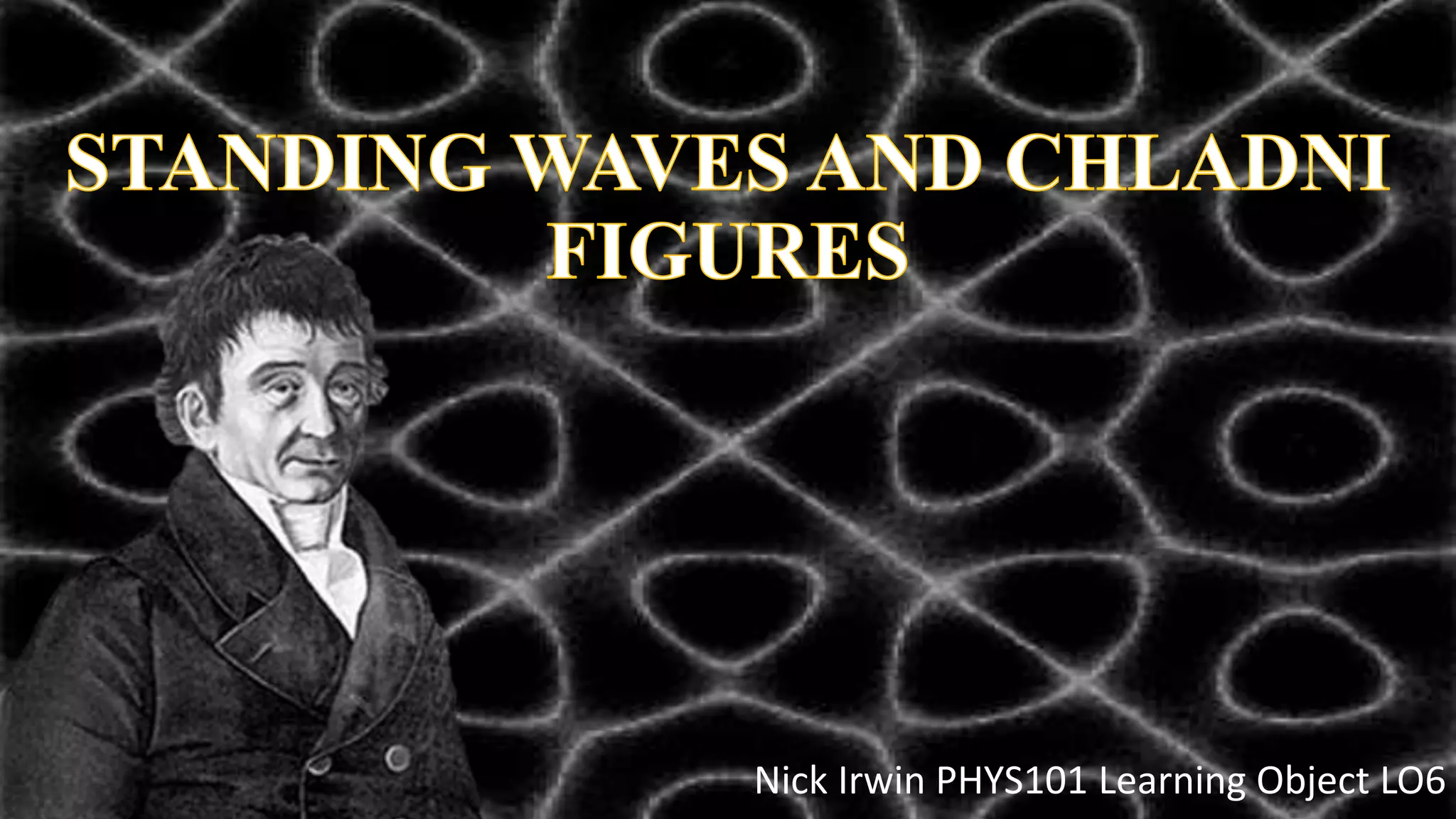
Nick Irwin PHYS101 Learning Object LO6
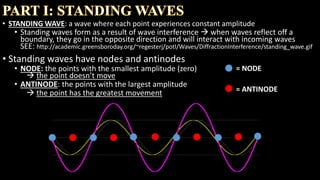
• STANDING WAVE: a wave where each point experiences constant amplitude
• Standing waves form as a result of wave interference  when waves reflect off a
boundary, they go in the opposite direction and will interact with incoming waves
SEE: http://academic.greensboroday.org/~regesterj/potl/Waves/DiffractionInterference/standing_wave.gif
• Standing waves have nodes and antinodes
• NODE: the points with the smallest amplitude (zero)
 the point doesn’t move
• ANTINODE: the points with the largest amplitude
 the point has the greatest movement
= NODE
= ANTINODE
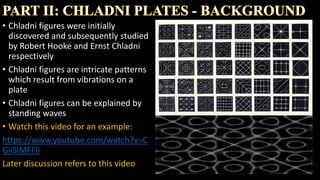
• Chladni figures were initially
discovered and subsequently studied
by Robert Hooke and Ernst Chladni
respectively
• Chladni figures are intricate patterns
which result from vibrations on a
plate
• Chladni figures can be explained by
standing waves
• Watch the video on the next slide for
an example
• Later discussion refers to this video
www.thescienceofcreativity.com
www.mat.ucsb.edu
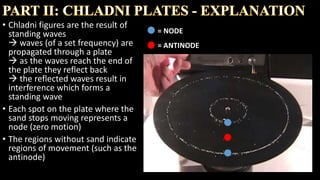
• Chladni figures are the result of
standing waves
 waves (of a set frequency) are
propagated through a plate
 as the waves reach the end of
the plate they reflect back
 the reflected waves result in
interference which forms a
standing wave
• Each spot on the plate where the
sand stops moving represents a
node (zero motion)
• The regions without sand indicate
regions of movement (such as the
antinode)
= NODE
= ANTINODE
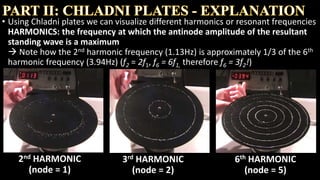
• Using Chladni plates we can visualize different harmonics or resonant frequencies
HARMONICS: the frequency at which the antinode amplitude of the resultant
standing wave is a maximum
2nd HARMONIC
(node = 1)
3rd HARMONIC
(node = 2)
6th HARMONIC
(node = 5)
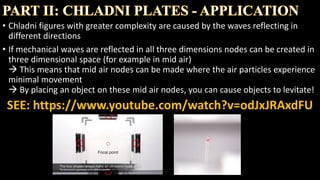
• Chladni figures with greater complexity are caused by the waves reflecting in
different directions
• If mechanical waves are reflected in all three dimensions nodes can be created in
three dimensional space (for example in mid air)
 This means that mid air nodes can be made where the air particles experience
minimal movement
 By placing an object on these mid air nodes, you can cause objects to levitate!
SEE THE NEXT SLIDE FOR A VIDEO

Standing Waves and Chladni Plates

  • 1.
    Nick Irwin PHYS101Learning Object LO6
  • 2.
    • STANDING WAVE:a wave where each point experiences constant amplitude • Standing waves form as a result of wave interference  when waves reflect off a boundary, they go in the opposite direction and will interact with incoming waves SEE: http://academic.greensboroday.org/~regesterj/potl/Waves/DiffractionInterference/standing_wave.gif • Standing waves have nodes and antinodes • NODE: the points with the smallest amplitude (zero)  the point doesn’t move • ANTINODE: the points with the largest amplitude  the point has the greatest movement = NODE = ANTINODE
  • 3.
    • Chladni figureswere initially discovered and subsequently studied by Robert Hooke and Ernst Chladni respectively • Chladni figures are intricate patterns which result from vibrations on a plate • Chladni figures can be explained by standing waves • Watch the video on the next slide for an example • Later discussion refers to this video www.thescienceofcreativity.com www.mat.ucsb.edu
  • 4.
    • Chladni figuresare the result of standing waves  waves (of a set frequency) are propagated through a plate  as the waves reach the end of the plate they reflect back  the reflected waves result in interference which forms a standing wave • Each spot on the plate where the sand stops moving represents a node (zero motion) • The regions without sand indicate regions of movement (such as the antinode) = NODE = ANTINODE
  • 5.
    • Using Chladniplates we can visualize different harmonics or resonant frequencies HARMONICS: the frequency at which the antinode amplitude of the resultant standing wave is a maximum 2nd HARMONIC (node = 1) 3rd HARMONIC (node = 2) 6th HARMONIC (node = 5)
  • 6.
    • Chladni figureswith greater complexity are caused by the waves reflecting in different directions • If mechanical waves are reflected in all three dimensions nodes can be created in three dimensional space (for example in mid air)  This means that mid air nodes can be made where the air particles experience minimal movement  By placing an object on these mid air nodes, you can cause objects to levitate! SEE THE NEXT SLIDE FOR A VIDEO