






Presented By
Mainul Hossan
Roll: 2450
Department of Physics,
Jahangirnagar university.
Course Name: OPTICS
Course Code: PH-202
Course Instructor: Asst. Prof. Shariful Islam
WELCOME TO MY PRESENTATION
OUTLINE OF THE PRESENTATION
1)Huygen’s principle.
2)Superposition & Interference of waves
3)Young’s experiments.
Huygen’s principle
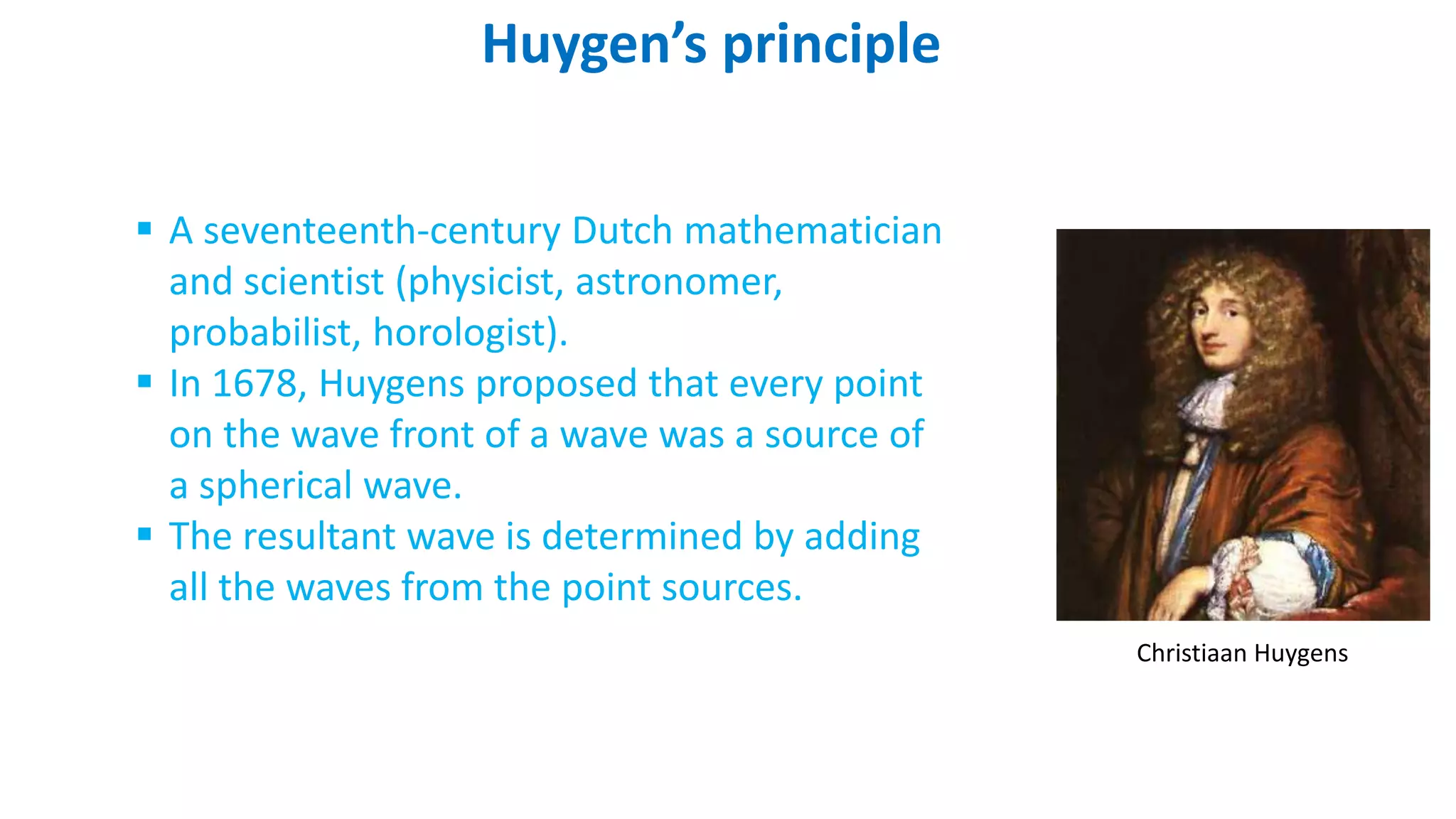
Christiaan Huygens
 A seventeenth-century Dutch mathematician
and scientist (physicist, astronomer,
probabilist, horologist).
 In 1678, Huygens proposed that every point
on the wave front of a wave was a source of
a spherical wave.
 The resultant wave is determined by adding
all the waves from the point sources.
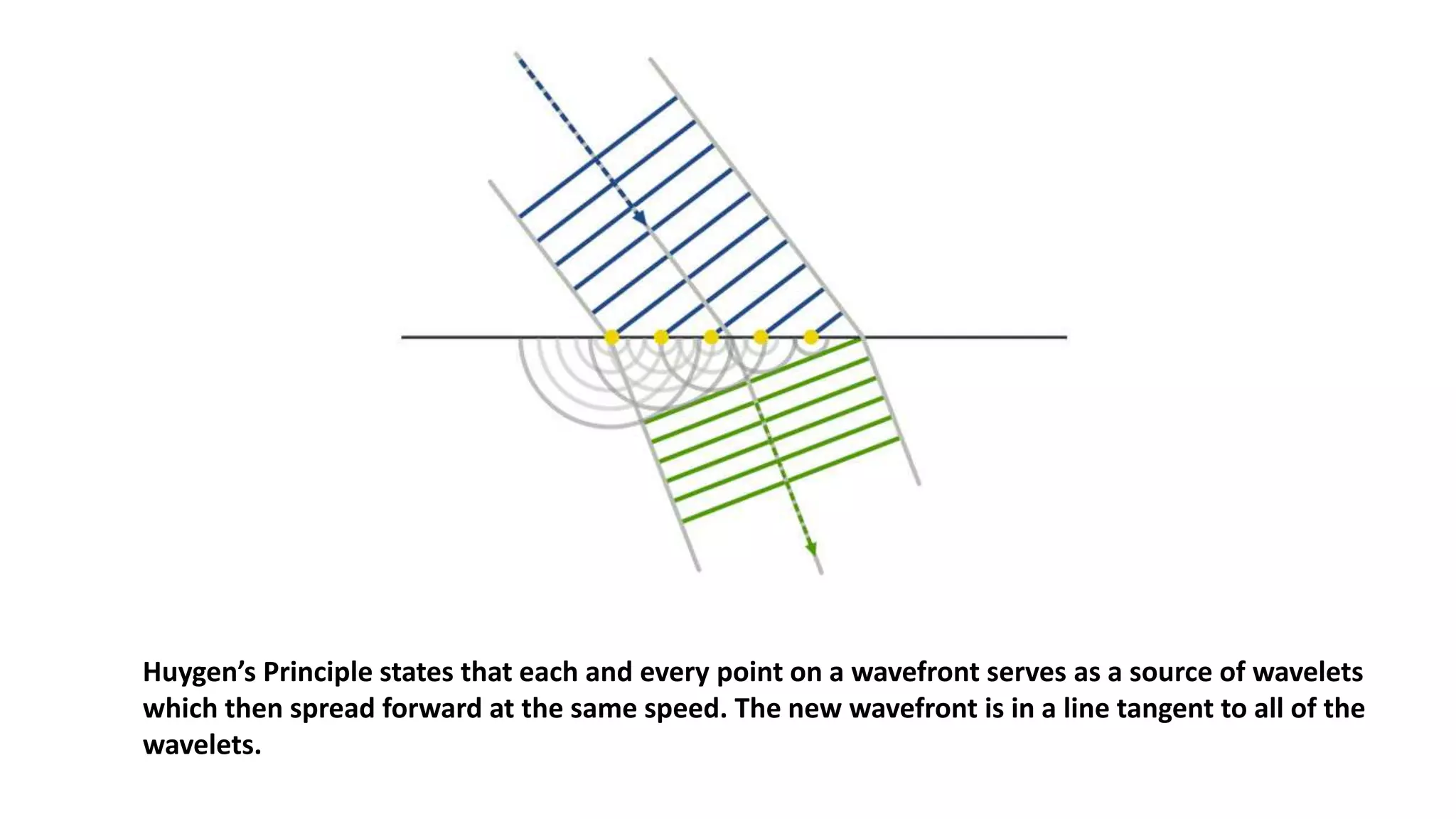
Huygen’s Principle states that each and every point on a wavefront serves as a source of wavelets
which then spread forward at the same speed. The new wavefront is in a line tangent to all of the
wavelets.
USES OF HUYGEN’S PRINCIPLE
1. It can be used to explain the phenomenon of refraction
and interference.
2. It helps in explaining the linear and spherical wave
propagation.
LIMITATIONS OF HUYGEN’S PRINCIPLE
1. It is a consequence of the homogeneity of space (the space is said
to be uniform in all the locations).
2. It was noticed by Jacques Hadamard in 1900, that Huygen’s
principle could not be applied when the number of spatial
dimensions was equal
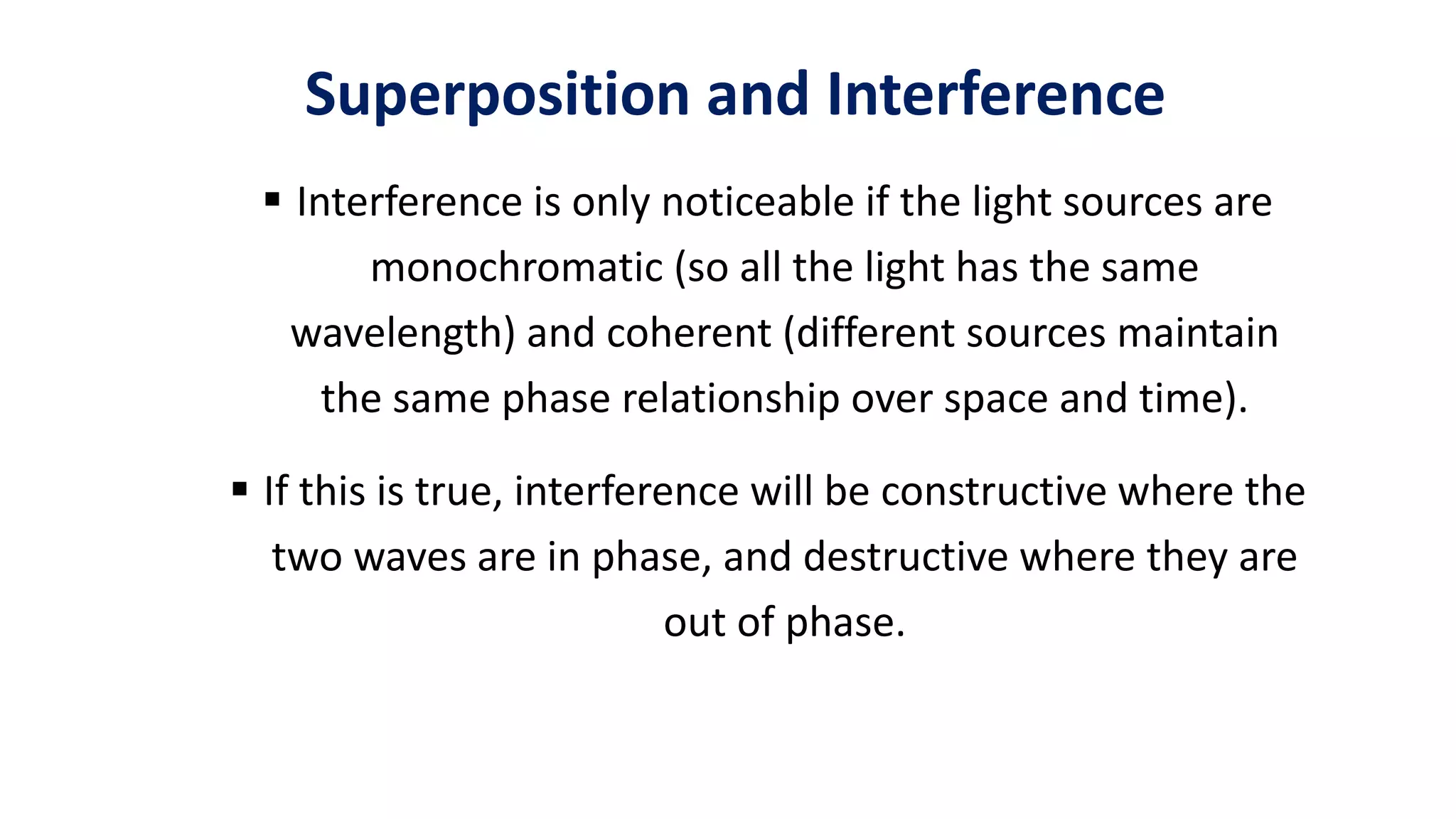
Superposition and Interference
If two waves occupy the same space, their amplitudes add at each
point. They may interfere either constructively or destructively.
Superposition and Interference
 Interference is only noticeable if the light sources are
monochromatic (so all the light has the same
wavelength) and coherent (different sources maintain
the same phase relationship over space and time).
 If this is true, interference will be constructive where the
two waves are in phase, and destructive where they are
out of phase.
Superposition and Interference
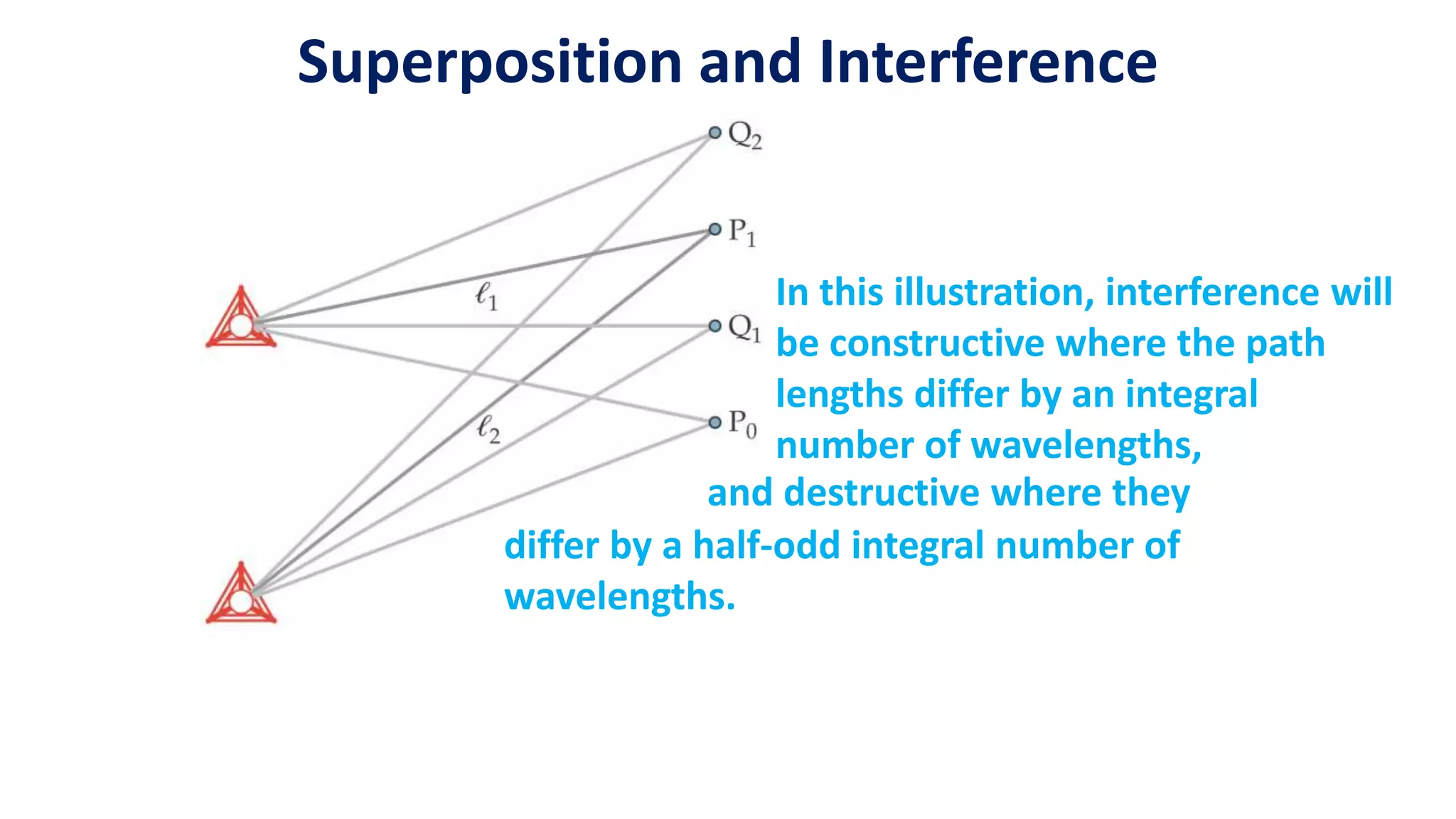
In this illustration, interference will
be constructive where the path
lengths differ by an integral
number of wavelengths,
and destructive where they
differ by a half-odd integral number of
wavelengths.
Superposition and Interference
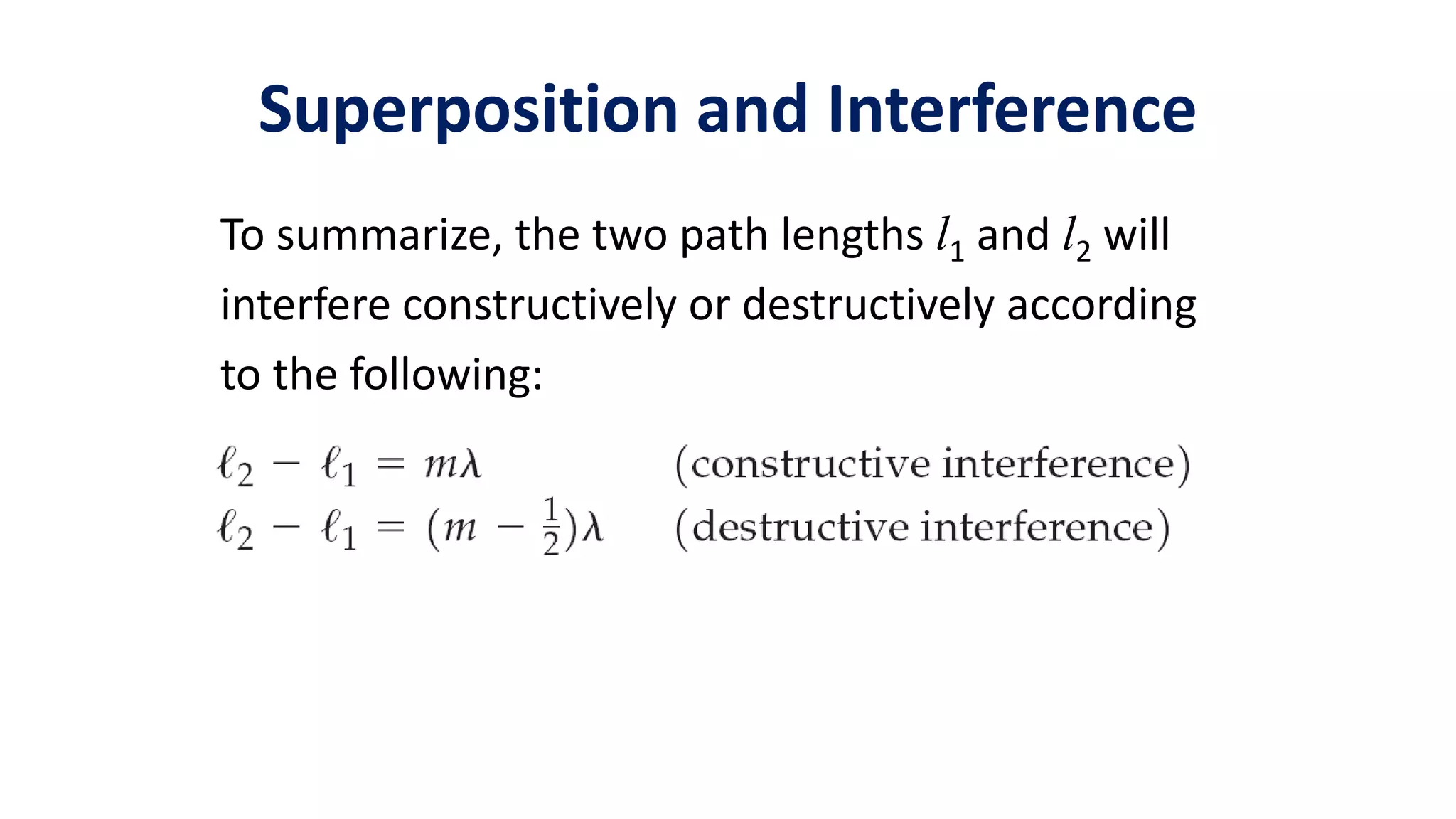
To summarize, the two path lengths l1 and l2 will
interfere constructively or destructively according
to the following:
Young’s Two-Slit
Experiment
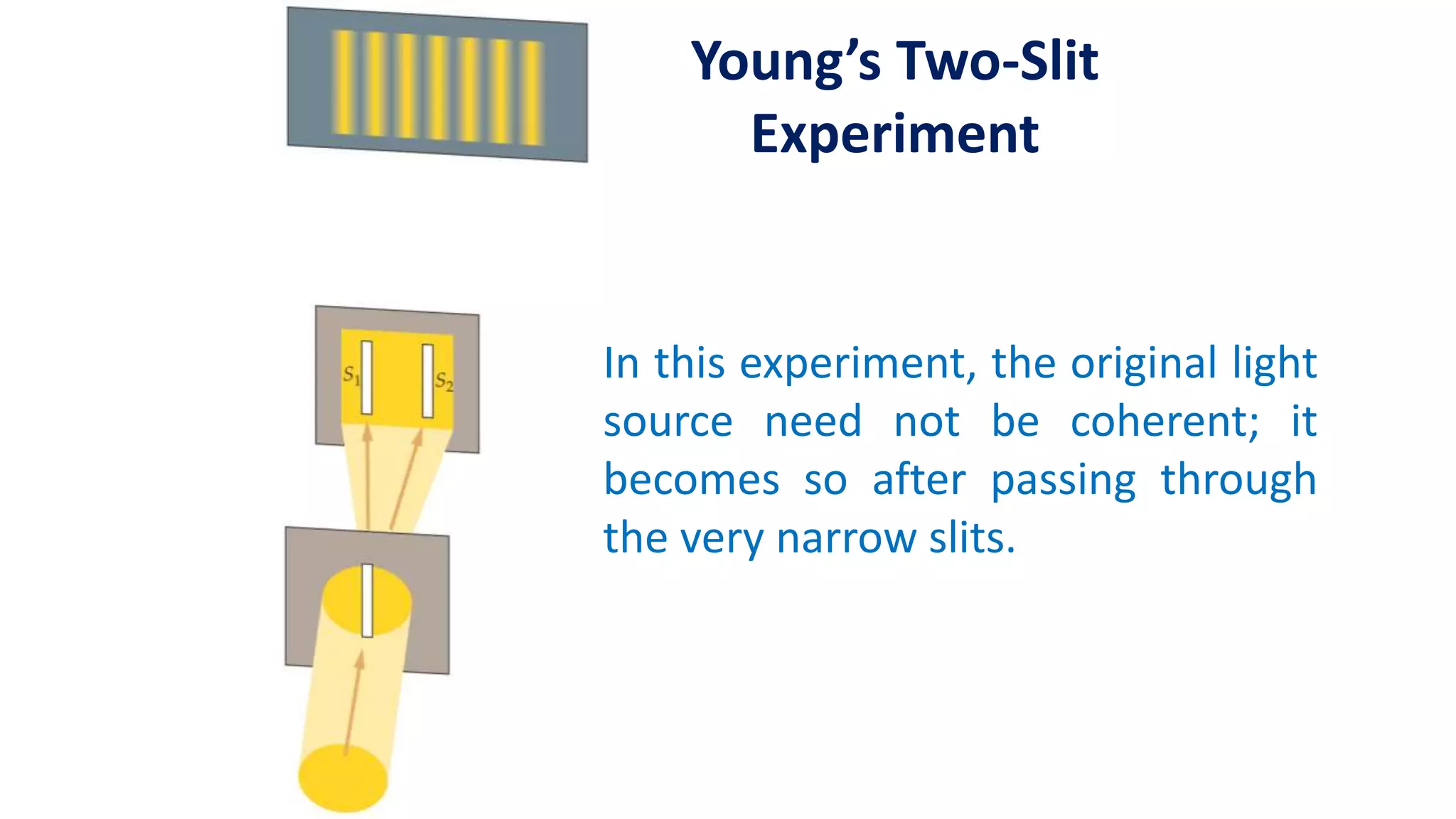
In this experiment, the original light
source need not be coherent; it
becomes so after passing through
the very narrow slits.
Young’s Two-Slit Experiment
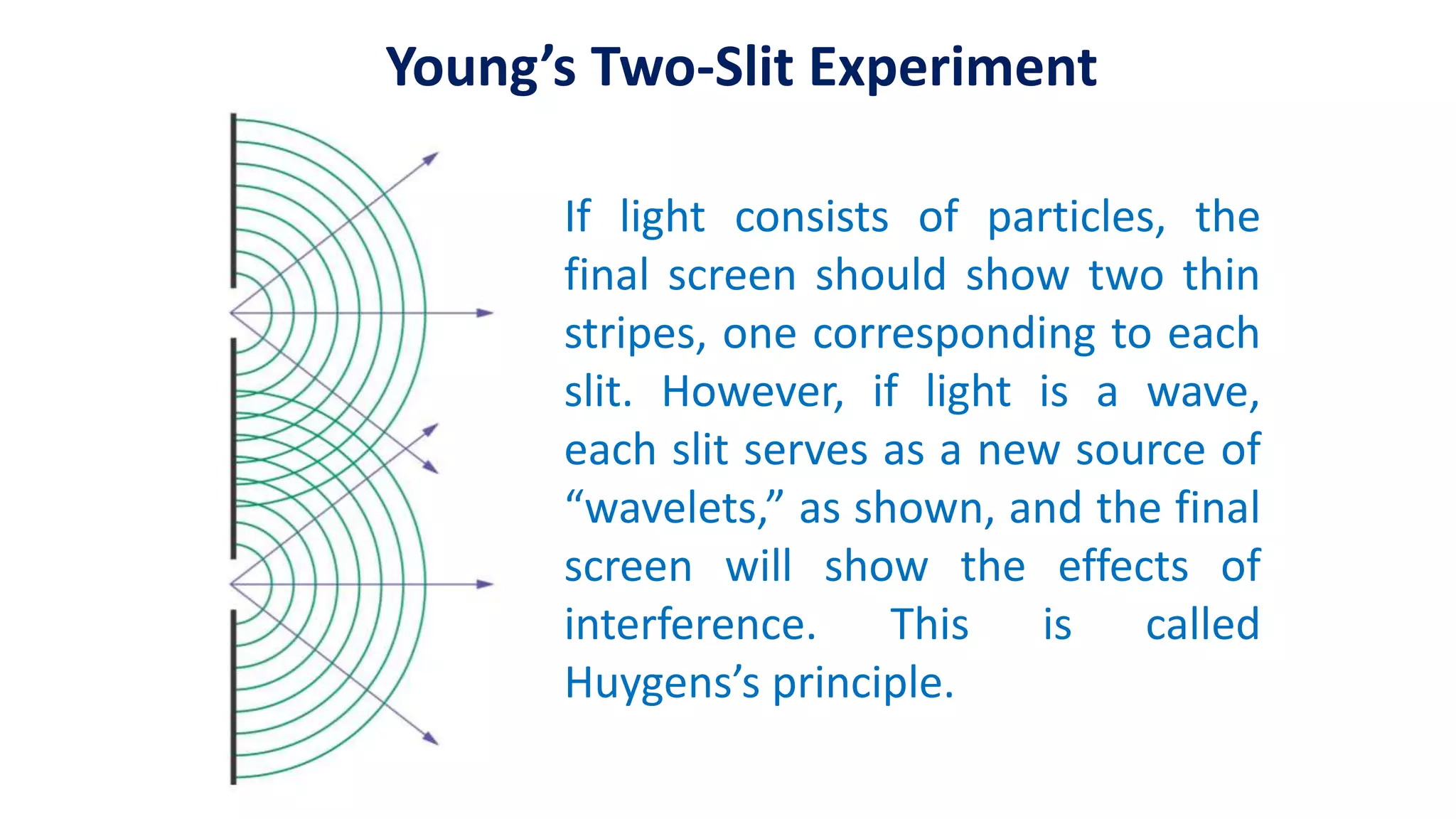
If light consists of particles, the
final screen should show two thin
stripes, one corresponding to each
slit. However, if light is a wave,
each slit serves as a new source of
“wavelets,” as shown, and the final
screen will show the effects of
interference. This is called
Huygens’s principle.
Young’s Two-Slit Experiment
As the pattern on the screen shows, the light on the screen has alternating
light and dark fringes, corresponding to constructive and destructive
interference.
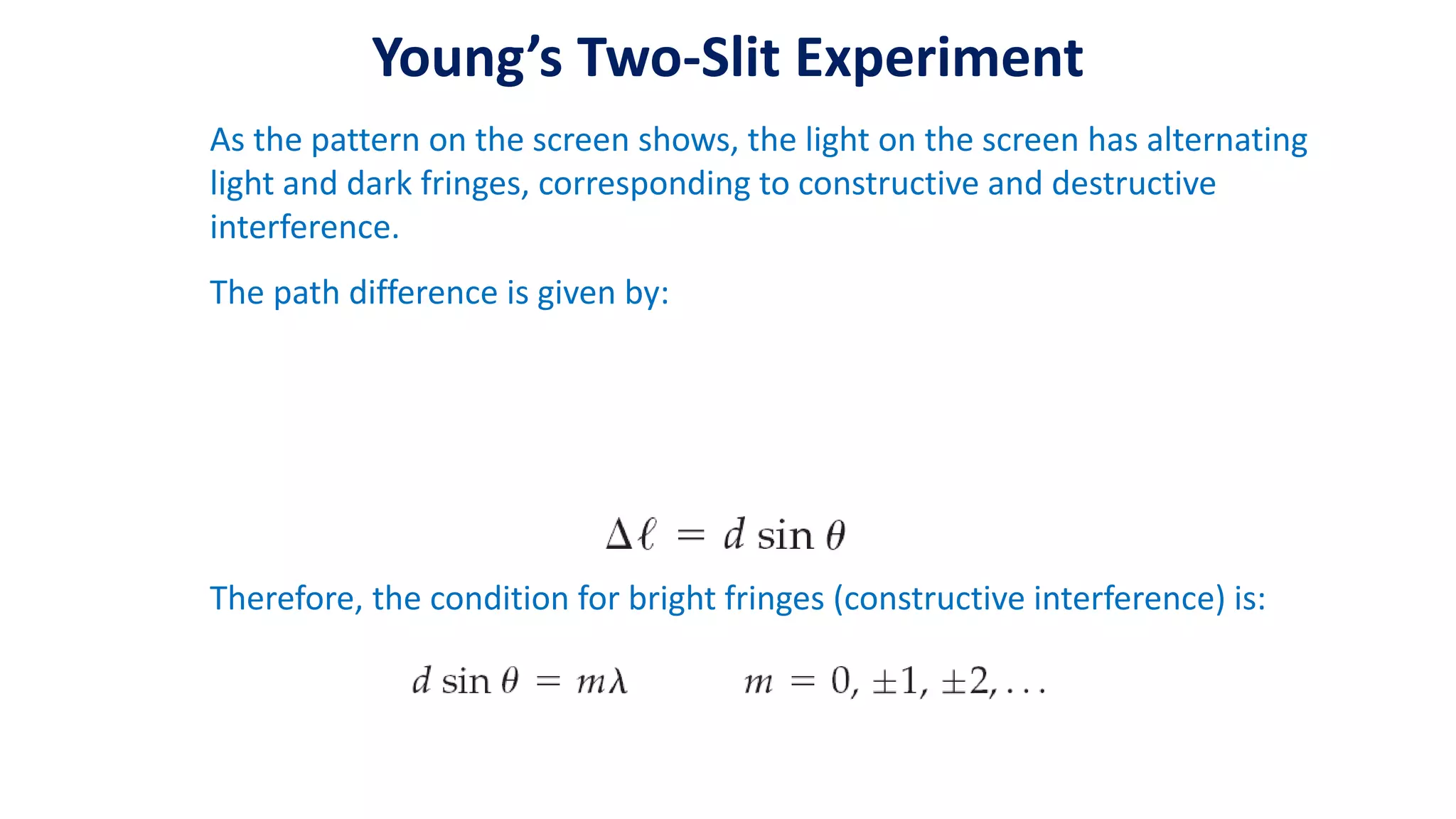
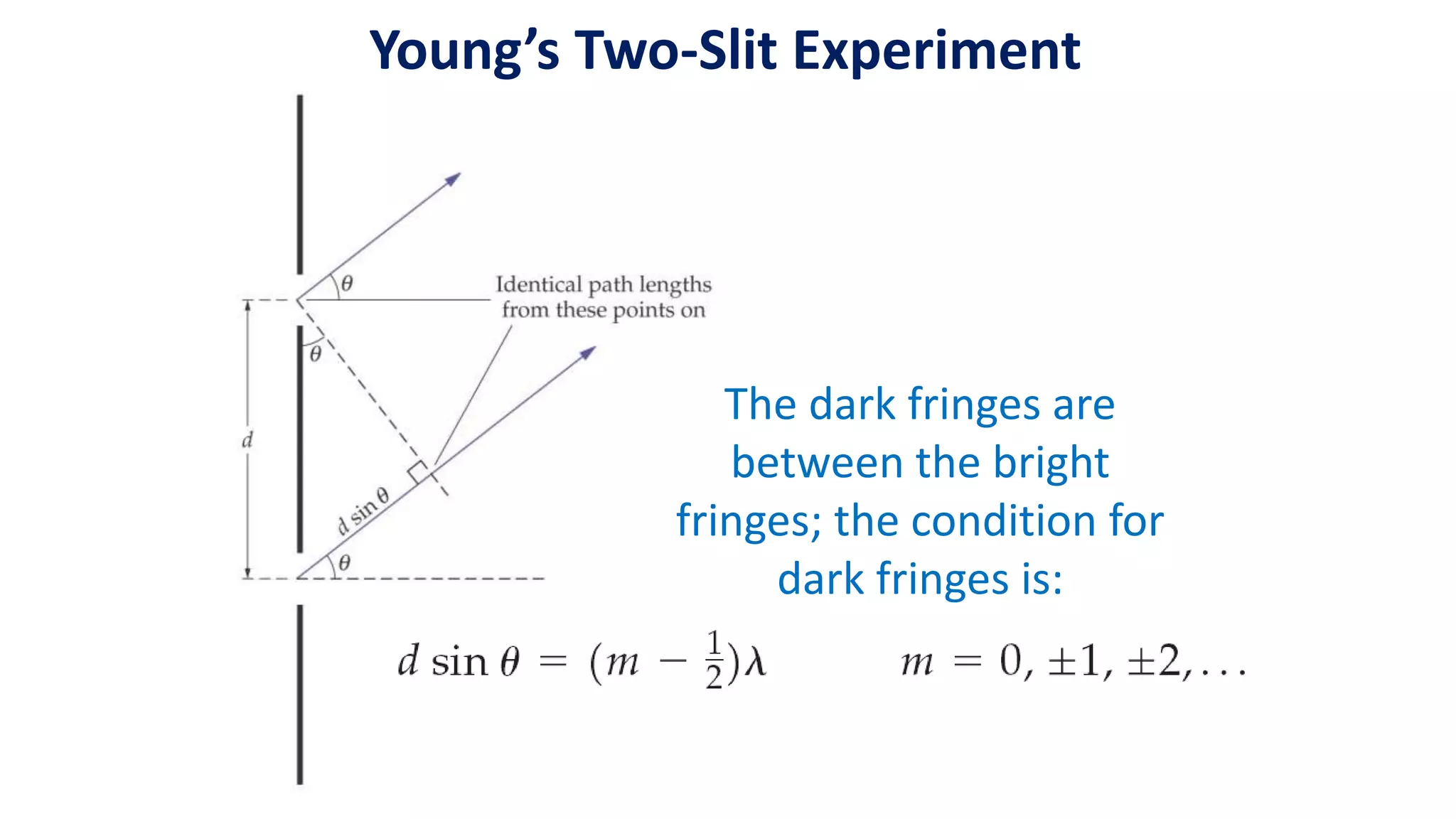
The path difference is given by:
Therefore, the condition for bright fringes (constructive interference) is:
Young’s Two-Slit Experiment
The dark fringes are
between the bright
fringes; the condition for
dark fringes is:
Young’s Two-Slit Experiment
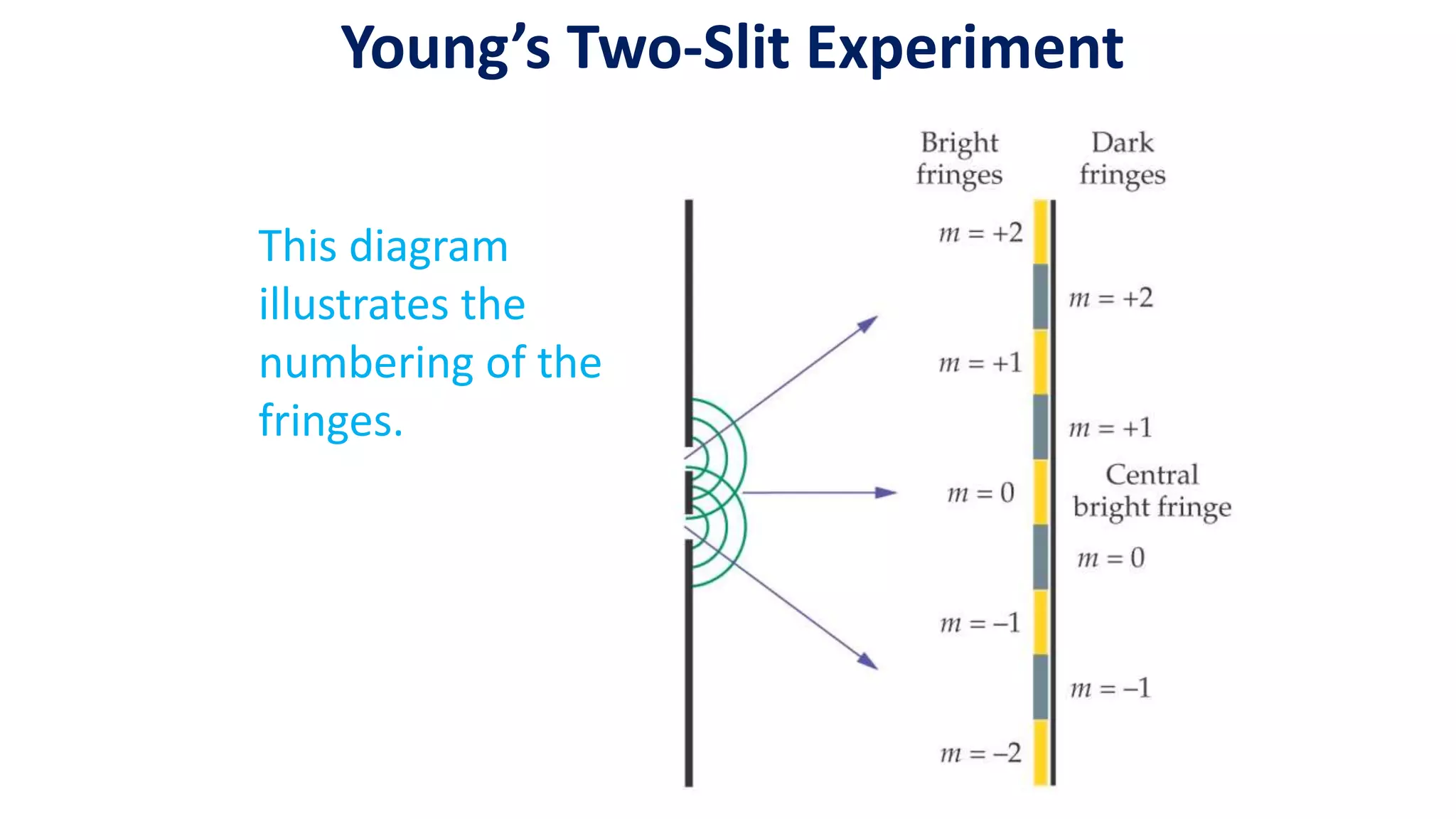
This diagram
illustrates the
numbering of the
fringes.
Any query?
Huygen’s principle, Superposition & Interference of waves, and Young’s experiments.

Huygen’s principle, Superposition & Interference of waves, and Young’s experiments.

  • 1.
    Presented By Mainul Hossan Roll:2450 Department of Physics, Jahangirnagar university. Course Name: OPTICS Course Code: PH-202 Course Instructor: Asst. Prof. Shariful Islam WELCOME TO MY PRESENTATION
  • 2.
    OUTLINE OF THEPRESENTATION 1)Huygen’s principle. 2)Superposition & Interference of waves 3)Young’s experiments.
  • 3.
    Huygen’s principle Christiaan Huygens A seventeenth-century Dutch mathematician and scientist (physicist, astronomer, probabilist, horologist).  In 1678, Huygens proposed that every point on the wave front of a wave was a source of a spherical wave.  The resultant wave is determined by adding all the waves from the point sources.
  • 4.
    Huygen’s Principle statesthat each and every point on a wavefront serves as a source of wavelets which then spread forward at the same speed. The new wavefront is in a line tangent to all of the wavelets.
  • 5.
    USES OF HUYGEN’SPRINCIPLE 1. It can be used to explain the phenomenon of refraction and interference. 2. It helps in explaining the linear and spherical wave propagation. LIMITATIONS OF HUYGEN’S PRINCIPLE 1. It is a consequence of the homogeneity of space (the space is said to be uniform in all the locations). 2. It was noticed by Jacques Hadamard in 1900, that Huygen’s principle could not be applied when the number of spatial dimensions was equal
  • 6.
    Superposition and Interference Iftwo waves occupy the same space, their amplitudes add at each point. They may interfere either constructively or destructively.
  • 7.
    Superposition and Interference Interference is only noticeable if the light sources are monochromatic (so all the light has the same wavelength) and coherent (different sources maintain the same phase relationship over space and time).  If this is true, interference will be constructive where the two waves are in phase, and destructive where they are out of phase.
  • 8.
    Superposition and Interference Inthis illustration, interference will be constructive where the path lengths differ by an integral number of wavelengths, and destructive where they differ by a half-odd integral number of wavelengths.
  • 9.
    Superposition and Interference Tosummarize, the two path lengths l1 and l2 will interfere constructively or destructively according to the following:
  • 10.
    Young’s Two-Slit Experiment In thisexperiment, the original light source need not be coherent; it becomes so after passing through the very narrow slits.
  • 11.
    Young’s Two-Slit Experiment Iflight consists of particles, the final screen should show two thin stripes, one corresponding to each slit. However, if light is a wave, each slit serves as a new source of “wavelets,” as shown, and the final screen will show the effects of interference. This is called Huygens’s principle.
  • 12.
    Young’s Two-Slit Experiment Asthe pattern on the screen shows, the light on the screen has alternating light and dark fringes, corresponding to constructive and destructive interference. The path difference is given by: Therefore, the condition for bright fringes (constructive interference) is:
  • 13.
    Young’s Two-Slit Experiment Thedark fringes are between the bright fringes; the condition for dark fringes is:
  • 14.
    Young’s Two-Slit Experiment Thisdiagram illustrates the numbering of the fringes.
  • 15.