Mechanical waves
Muhammad Rizwan
Contents
• Types of Mechanical Waves
• Periodic Waves
• Mathematical Description of a Wave
• Standing Waves on a String
• Sound Waves
• Speed of Sound Waves
• Doppler Effect and Sonic Boom
Mechanical Waves
• A mechanical wave is a disturbance that travels
through some material or substance called the
medium for the wave
• As the wave travels through the medium, the
particles that make up the medium undergo
displacements of various kinds, depending on the
nature of the wave
Types of Mechanical Waves
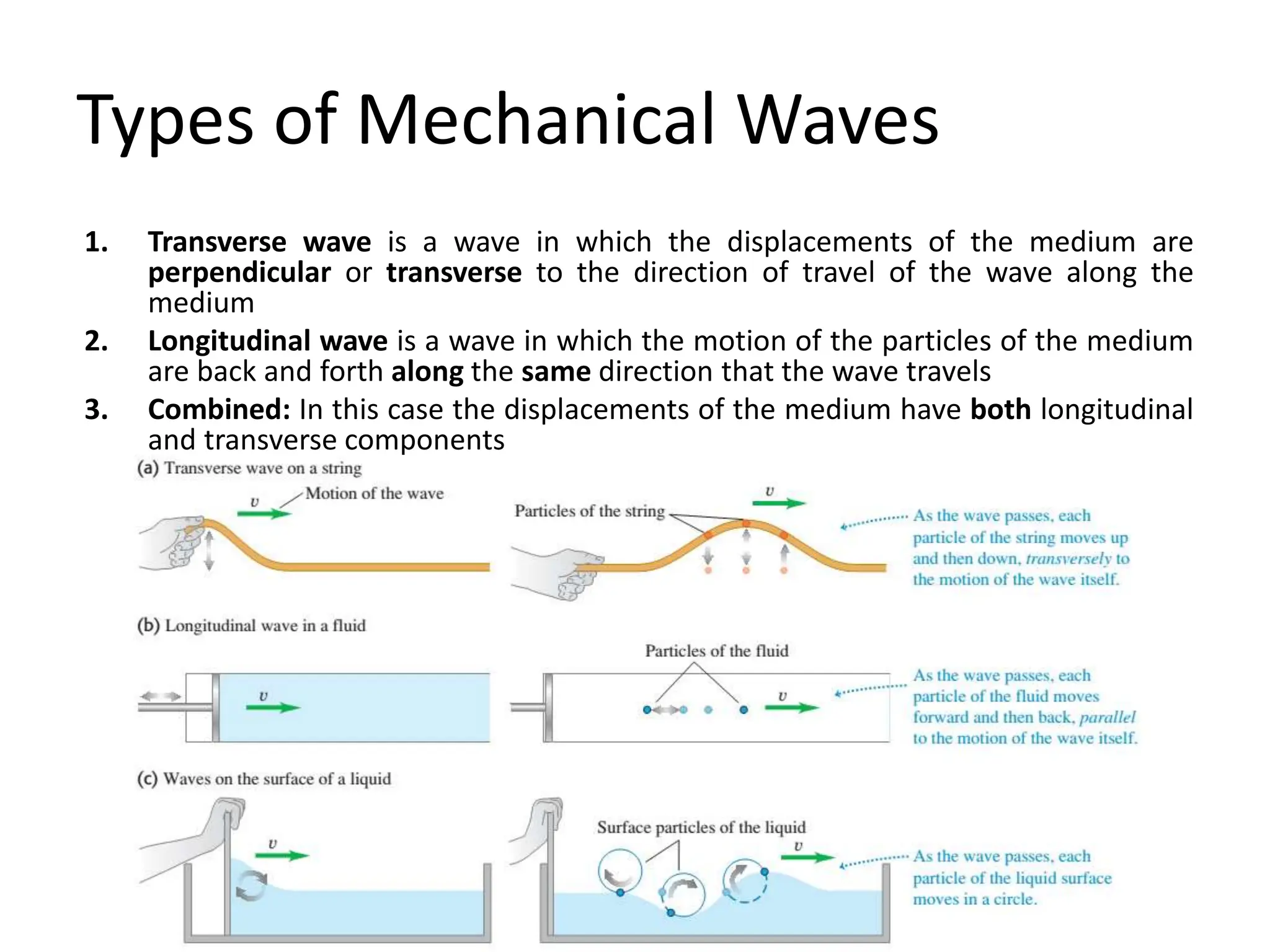
1. Transverse wave is a wave in which the displacements of the medium are
perpendicular or transverse to the direction of travel of the wave along the
medium
2. Longitudinal wave is a wave in which the motion of the particles of the medium
are back and forth along the same direction that the wave travels
3. Combined: In this case the displacements of the medium have both longitudinal
and transverse components
Some Important Facts of MW
• Wave Speed: It is the propagation speed of the
disturbance through a medium
– The wave speed is not the same as the speed with which particles
move when they are disturbed by the wave
– The wave speed depends upon the material of the medium
– Second, the medium itself does not travel through space; its individual
particles undergo back-and-forth or up-and-down motions around
their equilibrium positions. The overall pattern of the wave
disturbance is what travels
– Third, to set any of these systems into motion, we have to put in
energy by doing mechanical work on the system. The wave motion
transports this energy from one region of the medium to another.
Waves transport energy, but not matter, from one region to another
Periodic Waves
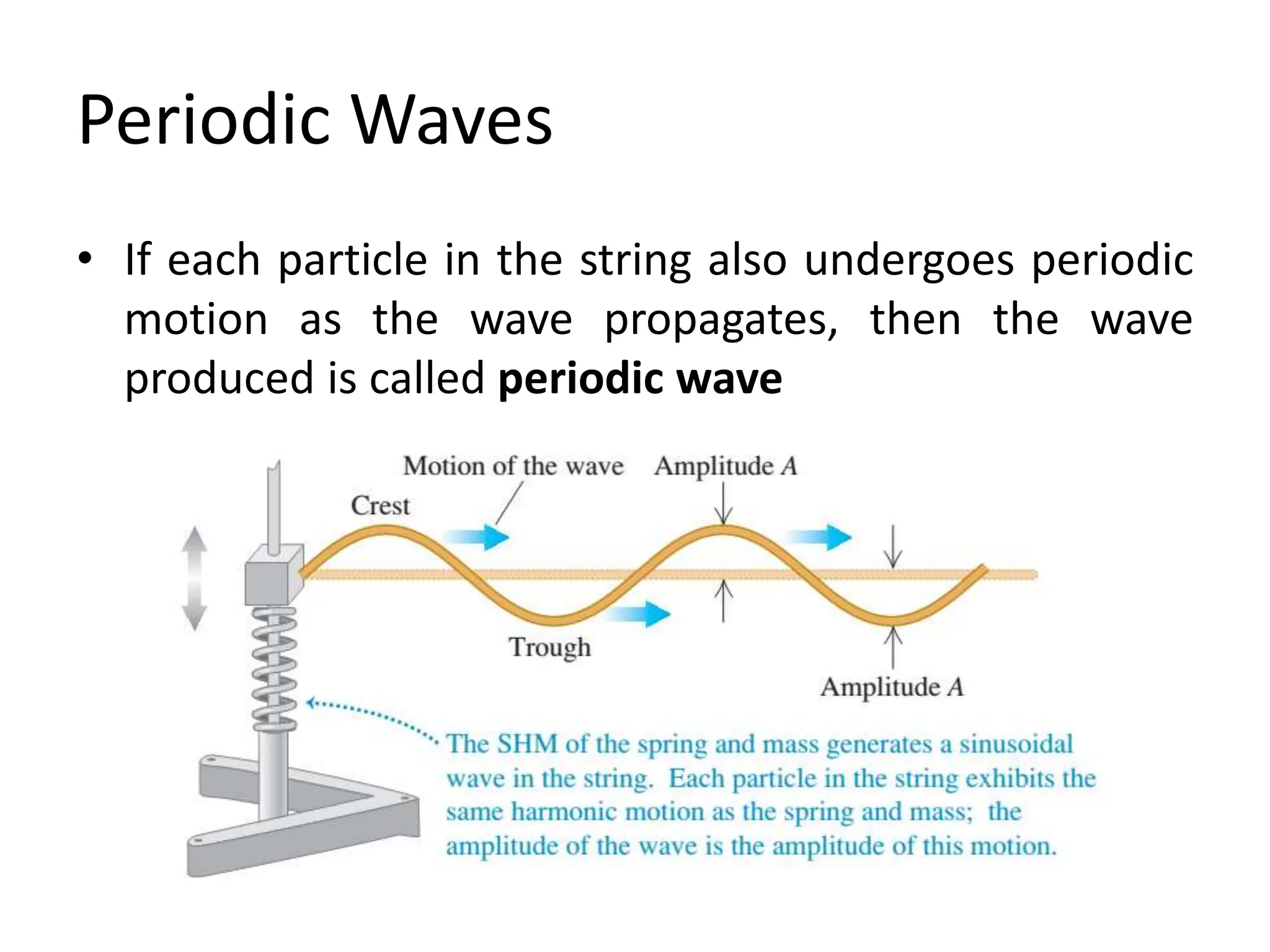
• If each particle in the string also undergoes periodic
motion as the wave propagates, then the wave
produced is called periodic wave
Periodic Waves
• Periodic waves are the waves in which each particle of the medium
also undergoes periodic motion as the wave propagates,
• For a periodic wave;
• Periodic waves with simple harmonic motion are
particularly easy to analyze; we call them sinusoidal waves.
• It also turns out that any periodic wave can be represented
as a combination of sinusoidal waves.
• So this particular kind of wave motion is worth special
attention.
 Amplitude ‘A’
 Frequency ‘f= ω/2π’
 Time Period ‘T = 1/f = 2π/ω’
 Wave speed ‘v=λf’
 Wave number ‘k= 2π/λ’
 A. Frequency ‘ω= vk’
Periodic Transverse Waves
• In figure the wave that advances along the
string is a continuous succession of
transverse sinusoidal disturbances. The wave
shape advances steadily toward the right, as
indicated by the highlighted area. As the
wave moves, any point on the string (any of
the red dots, for example) oscillates up and
down about its equilibrium position with
simple harmonic motion. When a sinusoidal
wave passes through a medium, every
particle in the medium undergoes simple
harmonic motion with the same frequency.
Periodic Longitudinal Waves
• The pattern of compressions and
rarefactions moves steadily to the right,
just like the pattern of crests and
troughs in a sinusoidal transverse wave.
Each particle in the fluid oscillates in
SHM parallel to the direction of wave
propagation (that is, left and right) with
the same amplitude ‘A’ and period ‘T’
as the piston. The particles shown by
the two red dots in figure are one
wavelength apart, and so oscillate in
phase with each other.`
Mathematical Description
• When we need a more detailed description of
the positions and motions of individual
particles of the medium at particular times
during wave propagation, we may make use of
mathematical relationship among wave
speed, amplitude, period, frequency, and
wavelength.
Mathematical Description
• As a specific example, let’s look at waves on a
stretched string. If we ignore the sag of the string
due to gravity, the equilibrium position of the
string is along a straight line.
• We take this to be the x-axis of a coordinate
system.
• Waves on a string are transverse; during wave
motion a particle with equilibrium position ‘x’ is
displaced some distance ‘y’ in the direction
perpendicular to the x-axis.
Mathematical Description
• The value of ‘y’ depends on which particle we are
talking about (that is, y depends on ‘x’) and also on the
time ‘t’ when we look at it.
• Thus ‘y’ is a function of both ‘x’ and ‘t’; y = f(x,t). We
call the wave function that describes the wave.
• If we know this function for a particular wave motion,
we can use it to find the displacement (from
equilibrium) of any particle at any time. From this we
can find the velocity and acceleration of any particle,
the shape of the string, and anything else we want to
know about the behavior of the string at any time.
For Sinusoidal Wave
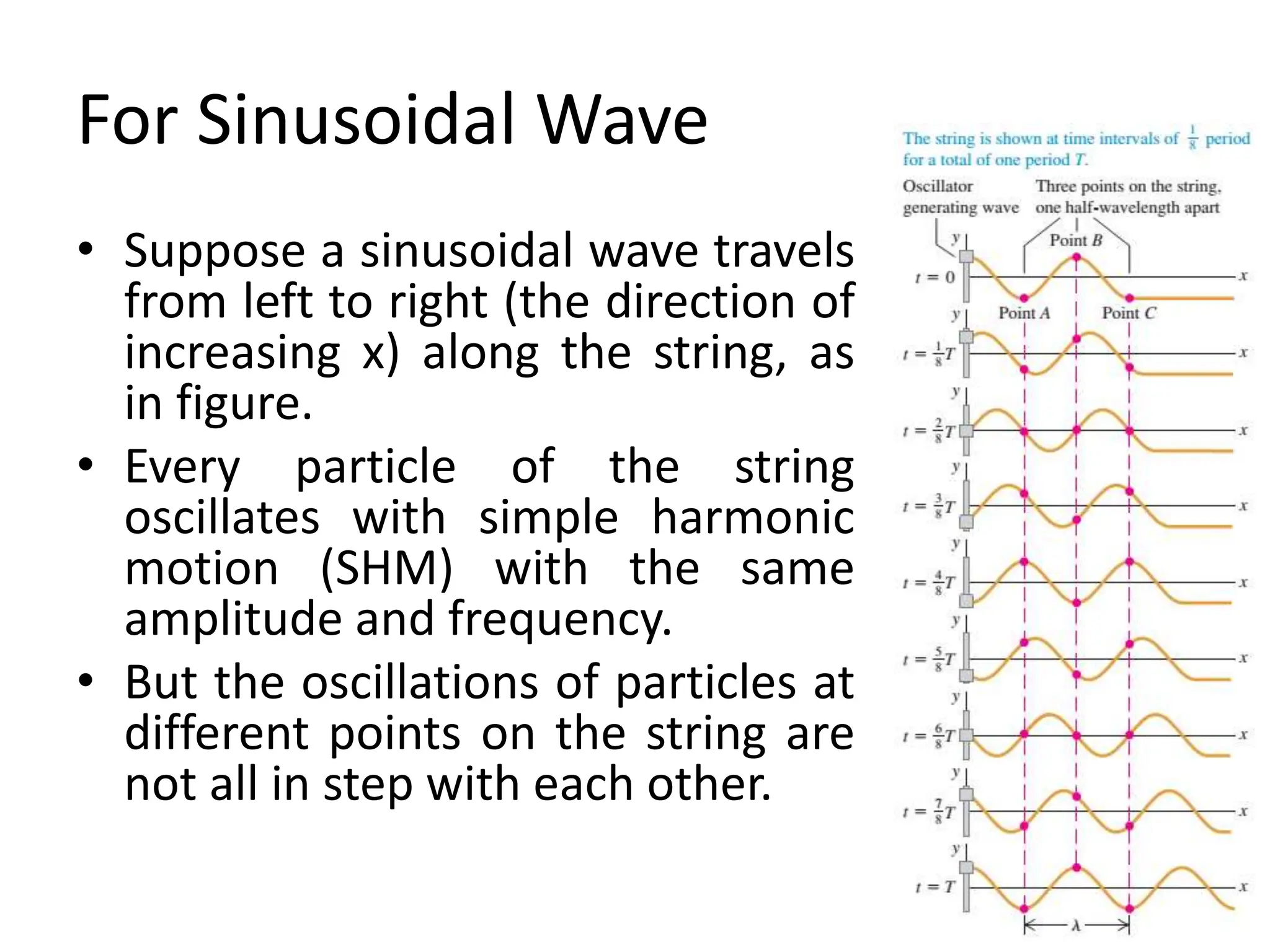
• Suppose a sinusoidal wave travels
from left to right (the direction of
increasing x) along the string, as
in figure.
• Every particle of the string
oscillates with simple harmonic
motion (SHM) with the same
amplitude and frequency.
• But the oscillations of particles at
different points on the string are
not all in step with each other.
For Sinusoidal Wave
• For any two particles of the string (the medium),
the motion of the particle on the right lags behind
the motion of the particle on the left by an
amount proportional to the distance between the
particles.
• Hence the cyclic motions of various points on the
string are out of step with each other by various
fractions of a cycle.
• We call these differences phase differences, and
we say that the phase of the motion is different for
different points
• For example, if one point has its maximum positive
displacement at the same time that another has
its maximum negative displacement, the two are a
half cycle out of phase.
Mathematical Description
• Suppose that the displacement of a particle at
the left end of the string (x = 0) where the
wave originates, is given by
𝑦 𝑥, 𝑡 = 𝐴 cos 𝜔𝑡 = 𝐴𝑐𝑜𝑠 2𝜋𝑓𝑡
(𝜔 = 2𝜋/𝑇 & 𝑓 = 1/𝑇 so 𝜔 = 2𝜋𝑓)
• That is, the particle oscillates in simple
harmonic motion with amplitude ′𝐴′ ,
frequency ′𝑓′ and angular frequency ′𝜔′
Mathematical Description
• The wave disturbance travels from (𝑥 = 0) to some
point ′𝑥′ to the right of the origin in an amount of time
given by ′𝑥/𝑣′ where ′𝑣′ is the wave speed. So the
motion of point ′𝑥′ at time ′𝑡′ is the same as the
motion of point at the earlier time 𝑡 − 𝑥/𝑣. Hence we
can find the displacement of point ′𝑥′ at time ′𝑡′ by
simply modifying the above equation; i.e.
𝑦 𝑥, 𝑡 = 𝐴 cos 𝜔 𝑡 −
𝑥
𝑣
= 𝐴 cos 𝜔
𝑥
𝑣
− 𝑡
• The displacement 𝑦(𝑥, 𝑡) is a function of both the
location ′𝑥′ of the point and the time ′𝑡′.
Mathematical Description
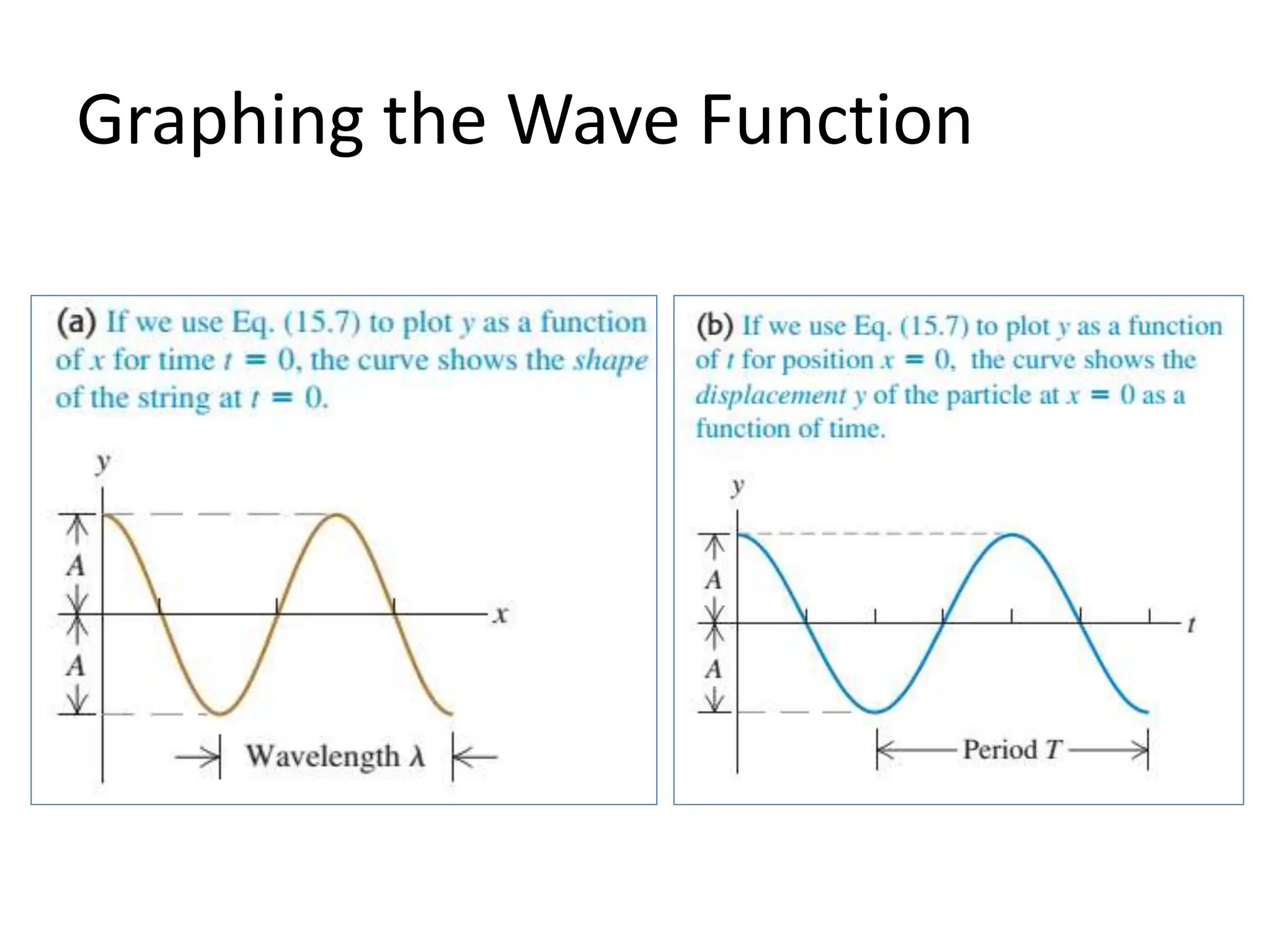
• We can rewrite the wave function in several different but useful
forms. We can express it in terms of the period 𝑇 = 1/𝑓 and the
wavelength 𝜆 = 𝑣/𝑓:
𝑦 𝑥, 𝑡 = 𝐴 cos 𝜔
𝑥
𝑣
− 𝑡 = 𝐴 cos 2𝜋
𝑥
𝜆
−
𝑡
𝑇
• It’s convenient to define a quantity 𝑘, called the wave number:
𝑘 = 2𝜋/𝜆
• The wavenumber (also wave number) is the spatial frequency of
a wave, either in cycles per unit distance or radians per unit
distance. It can be envisaged as the number of waves that exist over
a specified distance.
• We can rewrite the wave function as;
𝑦 𝑥, 𝑡 = 𝐴 cos(𝑘𝑥 − 𝜔𝑡)
Graphing the Wave Function
More on the Wave Function
• The above equation is specific for the motion in +ive x-
axis. But the same equation (with different sign) can be
used for the wave travelling in –ive x-axis. So,
generalizing,
𝑦 𝑥, 𝑡 = 𝐴𝑐𝑜𝑠(𝑘𝑥 ± 𝜔𝑡)
• The quantity (𝑘𝑥 ± 𝜔𝑡) is called the phase. It is an
angular quantity measured in radians.
• For any particular point (e.g. crest, trough, or any
other) of a given phase this quantity remains constant,
i.e. 𝑘𝑥 − 𝜔𝑡 = 𝑐𝑜𝑛𝑠𝑡𝑎𝑛𝑡 →
𝑑𝑥
𝑑𝑡
= 𝑣 =
𝜔
𝑘
• Because of this relationship, 𝒗 is sometimes called the
phase speed of the wave
Particle Velocity in a Sinusoidal Wave
• From the wave function we can get an expression for the transverse
velocity of any particle in a transverse wave.
• We call this 𝑣𝑦 to distinguish it from the wave propagation speed 𝑣.
• To find the transverse velocity at a particular point 𝑥, we take the
derivative of the wave function 𝑦(𝑥, 𝑡) with respect to 𝑡, keeping 𝑥
constant.
• If the wave function is
𝑦 𝑥, 𝑡 = 𝐴 cos(𝑘𝑥 − 𝜔𝑡)
• Then
𝑣𝑦 𝑥, 𝑡 =
𝜕𝑦(𝑥, 𝑡)
𝜕𝑡
= 𝜔𝐴 𝑠𝑖𝑛(𝑘𝑥 − 𝜔𝑡)
• Equation shows that the transverse velocity of a particle varies with time,
as we expect for simple harmonic motion. The maximum particle speed is
𝜔𝐴; this can be greater than, less than, or equal to the wave speed 𝑣
depending on the amplitude and frequency of the wave.
Particle Acceleration
• The acceleration of any particle is the second
partial derivative of wave function 𝑦(𝑥, 𝑡) with
respect to 𝑡:
𝑎𝑦 𝑥, 𝑡 =
𝜕2
𝑦(𝑥, 𝑡)
𝜕𝑡
= −𝜔2
𝐴 cos 𝑘𝑥 − 𝜔𝑡 = −𝜔2
𝑦(𝑥, 𝑡)
• The acceleration of a particle equals −𝜔2
times its displacement, which is the case for
simple harmonic motion
Wave Equation
• We can also compute partial derivatives of wave function
𝑦(𝑥, 𝑡)with respect to 𝑥, holding 𝑡 constant.
• The first derivative
𝜕𝑦 (𝑥,𝑡)
𝜕𝑥
is the slope of the string at point 𝑥 and at
time 𝑡. The second partial derivative with respect to 𝑥 is the
curvature of the string:
𝜕2
𝑦
𝜕𝑥2
= −𝑘2𝐴 cos 𝑘𝑥 − 𝜔𝑡 = −𝑘2𝑦 𝑥, 𝑡
• From equation of particle’s acceleration and the equation above,
we have
𝜕2𝑦(𝑥, 𝑡) 𝜕𝑡2
𝜕2𝑦(𝑥, 𝑡) 𝜕𝑥2
=
𝜔2
𝑘2
= 𝑣2
𝜕2𝑦(𝑥, 𝑡)
𝜕𝑥2
=
1
𝑣2
𝜕2𝑦 𝑥, 𝑡
𝜕𝑡2
(𝑾𝒂𝒗𝒆 𝒆𝒒𝒖𝒂𝒕𝒊𝒐𝒏)
Wave Equation
• The above equation which is called the wave equation, is one of the
most important equations in all of physics.
• Whenever it occurs, we know that a disturbance can propagate as a
wave along the x-axis with wave speed 𝑣.
• The disturbance need not be a sinusoidal wave; any wave on a
string obeys this equation, whether the wave is periodic or not.
• In Chapter 32 we will find that electric and magnetic fields satisfy
the wave equation; the wave speed will turn out to be the speed of
light, which will lead us to the conclusion that light is an
electromagnetic wave.
• The concept of wave function is equally useful with longitudinal
waves. The quantity 𝑦 still measures the displacement of a particle
of the medium from its equilibrium position; the difference is that
for a longitudinal wave, this displacement is parallel to the x-axis
instead of perpendicular to it.
At last but not the least
Wave Interference
• When a wave strikes the
boundaries of its medium, all or
part of the wave is reflected.
• The initial and reflected waves
overlap in the same region of the
medium. This overlapping of waves
is called interference. In general,
the term “interference” refers to
what happens when two or more
waves pass through the same
region at the same time.
Boundary Conditions
• The conditions at
the end of the
string, such as a
rigid support or
the complete
absence of
transverse force,
are called
boundary
conditions.
Superposition and Principle of SP
• As the pulses overlap and pass each other, the
total displacement of the string is the
algebraic sum of the displacements at that
point in the individual pulses.
• Combining the displacements of the separate
pulses at each point to obtain the actual
displacement is an example of the principle of
superposition.
Principle of Superposition (SP)
• When two waves overlap, the actual displacement of any point on
the string at any time is obtained by adding the displacement the
point would have if only the first wave were present and the
displacement it would have if only the second wave were present.
• In other words, the wave function that describes the resulting
motion in this situation is obtained by adding the two wave
functions for the two separate waves:
𝑦 𝑥, 𝑡 = 𝑦1 𝑥, 𝑡 + 𝑦2 𝑥, 𝑡
• Because this principle depends on the linearity of the wave
equation and the corresponding linear-combination property of its
solutions, it is also called the principle of linear superposition.
• For some physical systems, such as a medium that does not obey
Hooke’s law, the wave equation is not linear; this principle does not
hold for such systems
Standing Waves on a String
• A wave that does move along the string is called a traveling
wave
• The wave pattern doesn’t appear to be moving in either
direction along the string, it is called a standing wave
• There are particular points called nodes (labeled N) that
never move at all.
– At a node the displacements of the two waves in red and blue
are always equal and opposite and cancel each other out. This
cancellation is called destructive interference.
• Midway between the nodes are points called antinodes
(labeled A) where the amplitude of motion is greatest.
– At the antinodes the displacements of the two waves in red and
blue are always identical, giving a large resultant displacement;
this phenomenon is called constructive interference.
Standing Waves on a String
• We can derive a wave function for the standing wave, adding
the wave functions for two waves with equal amplitude,
period, and wavelength traveling in opposite directions.
𝑦1 𝑥, 𝑡 = −𝐴 cos 𝑘𝑥 + 𝜔𝑡
𝑦2 𝑥, 𝑡 = +𝐴 cos 𝑘𝑥 − 𝜔𝑡
• The wave function for the standing wave is the sum of the
individual wave functions
𝑦 𝑥, 𝑡 = 𝑦1 𝑥, 𝑡 + 𝑦2 𝑥, 𝑡 = 𝐴 [−cos 𝑘𝑥 + 𝜔𝑡 + cos 𝑘𝑥 − 𝜔𝑡 ]
• By using the identities for the cosine
𝑦 𝑥, 𝑡 = 𝑦1 𝑥, 𝑡 + 𝑦2 𝑥, 𝑡 = 2𝐴 𝑠𝑖𝑛𝑘𝑥 sin 𝜔𝑡
𝑦 𝑥, 𝑡 = 𝐴𝑠𝑤 𝑠𝑖𝑛𝑘𝑥 sin 𝜔𝑡
Incident wave traveling to the left
Reflected wave traveling to the Right
Standing Waves on a String
• A standing wave, unlike a traveling wave, does
not transfer energy from one end to the other.
• The two waves that form it would individually
carry equal amounts of power in opposite
directions.
• There is a local flow of energy from each node to
the adjacent antinodes and back, but the average
rate of energy transfer is zero at every point.
• If you evaluate the wave power given by Eq.
(15.21) using the wave function of Eq. (15.28),
you will find that the average power is zero.

Mechanical waves.pptx

  • 1.
  • 2.
    Contents • Types ofMechanical Waves • Periodic Waves • Mathematical Description of a Wave • Standing Waves on a String • Sound Waves • Speed of Sound Waves • Doppler Effect and Sonic Boom
  • 3.
    Mechanical Waves • Amechanical wave is a disturbance that travels through some material or substance called the medium for the wave • As the wave travels through the medium, the particles that make up the medium undergo displacements of various kinds, depending on the nature of the wave
  • 4.
    Types of MechanicalWaves 1. Transverse wave is a wave in which the displacements of the medium are perpendicular or transverse to the direction of travel of the wave along the medium 2. Longitudinal wave is a wave in which the motion of the particles of the medium are back and forth along the same direction that the wave travels 3. Combined: In this case the displacements of the medium have both longitudinal and transverse components
  • 5.
    Some Important Factsof MW • Wave Speed: It is the propagation speed of the disturbance through a medium – The wave speed is not the same as the speed with which particles move when they are disturbed by the wave – The wave speed depends upon the material of the medium – Second, the medium itself does not travel through space; its individual particles undergo back-and-forth or up-and-down motions around their equilibrium positions. The overall pattern of the wave disturbance is what travels – Third, to set any of these systems into motion, we have to put in energy by doing mechanical work on the system. The wave motion transports this energy from one region of the medium to another. Waves transport energy, but not matter, from one region to another
  • 6.
    Periodic Waves • Ifeach particle in the string also undergoes periodic motion as the wave propagates, then the wave produced is called periodic wave
  • 7.
    Periodic Waves • Periodicwaves are the waves in which each particle of the medium also undergoes periodic motion as the wave propagates, • For a periodic wave; • Periodic waves with simple harmonic motion are particularly easy to analyze; we call them sinusoidal waves. • It also turns out that any periodic wave can be represented as a combination of sinusoidal waves. • So this particular kind of wave motion is worth special attention.  Amplitude ‘A’  Frequency ‘f= ω/2π’  Time Period ‘T = 1/f = 2π/ω’  Wave speed ‘v=λf’  Wave number ‘k= 2π/λ’  A. Frequency ‘ω= vk’
  • 8.
    Periodic Transverse Waves •In figure the wave that advances along the string is a continuous succession of transverse sinusoidal disturbances. The wave shape advances steadily toward the right, as indicated by the highlighted area. As the wave moves, any point on the string (any of the red dots, for example) oscillates up and down about its equilibrium position with simple harmonic motion. When a sinusoidal wave passes through a medium, every particle in the medium undergoes simple harmonic motion with the same frequency.
  • 9.
    Periodic Longitudinal Waves •The pattern of compressions and rarefactions moves steadily to the right, just like the pattern of crests and troughs in a sinusoidal transverse wave. Each particle in the fluid oscillates in SHM parallel to the direction of wave propagation (that is, left and right) with the same amplitude ‘A’ and period ‘T’ as the piston. The particles shown by the two red dots in figure are one wavelength apart, and so oscillate in phase with each other.`
  • 10.
    Mathematical Description • Whenwe need a more detailed description of the positions and motions of individual particles of the medium at particular times during wave propagation, we may make use of mathematical relationship among wave speed, amplitude, period, frequency, and wavelength.
  • 11.
    Mathematical Description • Asa specific example, let’s look at waves on a stretched string. If we ignore the sag of the string due to gravity, the equilibrium position of the string is along a straight line. • We take this to be the x-axis of a coordinate system. • Waves on a string are transverse; during wave motion a particle with equilibrium position ‘x’ is displaced some distance ‘y’ in the direction perpendicular to the x-axis.
  • 12.
    Mathematical Description • Thevalue of ‘y’ depends on which particle we are talking about (that is, y depends on ‘x’) and also on the time ‘t’ when we look at it. • Thus ‘y’ is a function of both ‘x’ and ‘t’; y = f(x,t). We call the wave function that describes the wave. • If we know this function for a particular wave motion, we can use it to find the displacement (from equilibrium) of any particle at any time. From this we can find the velocity and acceleration of any particle, the shape of the string, and anything else we want to know about the behavior of the string at any time.
  • 13.
    For Sinusoidal Wave •Suppose a sinusoidal wave travels from left to right (the direction of increasing x) along the string, as in figure. • Every particle of the string oscillates with simple harmonic motion (SHM) with the same amplitude and frequency. • But the oscillations of particles at different points on the string are not all in step with each other.
  • 14.
    For Sinusoidal Wave •For any two particles of the string (the medium), the motion of the particle on the right lags behind the motion of the particle on the left by an amount proportional to the distance between the particles. • Hence the cyclic motions of various points on the string are out of step with each other by various fractions of a cycle. • We call these differences phase differences, and we say that the phase of the motion is different for different points • For example, if one point has its maximum positive displacement at the same time that another has its maximum negative displacement, the two are a half cycle out of phase.
  • 15.
    Mathematical Description • Supposethat the displacement of a particle at the left end of the string (x = 0) where the wave originates, is given by 𝑦 𝑥, 𝑡 = 𝐴 cos 𝜔𝑡 = 𝐴𝑐𝑜𝑠 2𝜋𝑓𝑡 (𝜔 = 2𝜋/𝑇 & 𝑓 = 1/𝑇 so 𝜔 = 2𝜋𝑓) • That is, the particle oscillates in simple harmonic motion with amplitude ′𝐴′ , frequency ′𝑓′ and angular frequency ′𝜔′
  • 16.
    Mathematical Description • Thewave disturbance travels from (𝑥 = 0) to some point ′𝑥′ to the right of the origin in an amount of time given by ′𝑥/𝑣′ where ′𝑣′ is the wave speed. So the motion of point ′𝑥′ at time ′𝑡′ is the same as the motion of point at the earlier time 𝑡 − 𝑥/𝑣. Hence we can find the displacement of point ′𝑥′ at time ′𝑡′ by simply modifying the above equation; i.e. 𝑦 𝑥, 𝑡 = 𝐴 cos 𝜔 𝑡 − 𝑥 𝑣 = 𝐴 cos 𝜔 𝑥 𝑣 − 𝑡 • The displacement 𝑦(𝑥, 𝑡) is a function of both the location ′𝑥′ of the point and the time ′𝑡′.
  • 17.
    Mathematical Description • Wecan rewrite the wave function in several different but useful forms. We can express it in terms of the period 𝑇 = 1/𝑓 and the wavelength 𝜆 = 𝑣/𝑓: 𝑦 𝑥, 𝑡 = 𝐴 cos 𝜔 𝑥 𝑣 − 𝑡 = 𝐴 cos 2𝜋 𝑥 𝜆 − 𝑡 𝑇 • It’s convenient to define a quantity 𝑘, called the wave number: 𝑘 = 2𝜋/𝜆 • The wavenumber (also wave number) is the spatial frequency of a wave, either in cycles per unit distance or radians per unit distance. It can be envisaged as the number of waves that exist over a specified distance. • We can rewrite the wave function as; 𝑦 𝑥, 𝑡 = 𝐴 cos(𝑘𝑥 − 𝜔𝑡)
  • 18.
  • 19.
    More on theWave Function • The above equation is specific for the motion in +ive x- axis. But the same equation (with different sign) can be used for the wave travelling in –ive x-axis. So, generalizing, 𝑦 𝑥, 𝑡 = 𝐴𝑐𝑜𝑠(𝑘𝑥 ± 𝜔𝑡) • The quantity (𝑘𝑥 ± 𝜔𝑡) is called the phase. It is an angular quantity measured in radians. • For any particular point (e.g. crest, trough, or any other) of a given phase this quantity remains constant, i.e. 𝑘𝑥 − 𝜔𝑡 = 𝑐𝑜𝑛𝑠𝑡𝑎𝑛𝑡 → 𝑑𝑥 𝑑𝑡 = 𝑣 = 𝜔 𝑘 • Because of this relationship, 𝒗 is sometimes called the phase speed of the wave
  • 20.
    Particle Velocity ina Sinusoidal Wave • From the wave function we can get an expression for the transverse velocity of any particle in a transverse wave. • We call this 𝑣𝑦 to distinguish it from the wave propagation speed 𝑣. • To find the transverse velocity at a particular point 𝑥, we take the derivative of the wave function 𝑦(𝑥, 𝑡) with respect to 𝑡, keeping 𝑥 constant. • If the wave function is 𝑦 𝑥, 𝑡 = 𝐴 cos(𝑘𝑥 − 𝜔𝑡) • Then 𝑣𝑦 𝑥, 𝑡 = 𝜕𝑦(𝑥, 𝑡) 𝜕𝑡 = 𝜔𝐴 𝑠𝑖𝑛(𝑘𝑥 − 𝜔𝑡) • Equation shows that the transverse velocity of a particle varies with time, as we expect for simple harmonic motion. The maximum particle speed is 𝜔𝐴; this can be greater than, less than, or equal to the wave speed 𝑣 depending on the amplitude and frequency of the wave.
  • 21.
    Particle Acceleration • Theacceleration of any particle is the second partial derivative of wave function 𝑦(𝑥, 𝑡) with respect to 𝑡: 𝑎𝑦 𝑥, 𝑡 = 𝜕2 𝑦(𝑥, 𝑡) 𝜕𝑡 = −𝜔2 𝐴 cos 𝑘𝑥 − 𝜔𝑡 = −𝜔2 𝑦(𝑥, 𝑡) • The acceleration of a particle equals −𝜔2 times its displacement, which is the case for simple harmonic motion
  • 22.
    Wave Equation • Wecan also compute partial derivatives of wave function 𝑦(𝑥, 𝑡)with respect to 𝑥, holding 𝑡 constant. • The first derivative 𝜕𝑦 (𝑥,𝑡) 𝜕𝑥 is the slope of the string at point 𝑥 and at time 𝑡. The second partial derivative with respect to 𝑥 is the curvature of the string: 𝜕2 𝑦 𝜕𝑥2 = −𝑘2𝐴 cos 𝑘𝑥 − 𝜔𝑡 = −𝑘2𝑦 𝑥, 𝑡 • From equation of particle’s acceleration and the equation above, we have 𝜕2𝑦(𝑥, 𝑡) 𝜕𝑡2 𝜕2𝑦(𝑥, 𝑡) 𝜕𝑥2 = 𝜔2 𝑘2 = 𝑣2 𝜕2𝑦(𝑥, 𝑡) 𝜕𝑥2 = 1 𝑣2 𝜕2𝑦 𝑥, 𝑡 𝜕𝑡2 (𝑾𝒂𝒗𝒆 𝒆𝒒𝒖𝒂𝒕𝒊𝒐𝒏)
  • 23.
    Wave Equation • Theabove equation which is called the wave equation, is one of the most important equations in all of physics. • Whenever it occurs, we know that a disturbance can propagate as a wave along the x-axis with wave speed 𝑣. • The disturbance need not be a sinusoidal wave; any wave on a string obeys this equation, whether the wave is periodic or not. • In Chapter 32 we will find that electric and magnetic fields satisfy the wave equation; the wave speed will turn out to be the speed of light, which will lead us to the conclusion that light is an electromagnetic wave. • The concept of wave function is equally useful with longitudinal waves. The quantity 𝑦 still measures the displacement of a particle of the medium from its equilibrium position; the difference is that for a longitudinal wave, this displacement is parallel to the x-axis instead of perpendicular to it.
  • 24.
    At last butnot the least
  • 25.
    Wave Interference • Whena wave strikes the boundaries of its medium, all or part of the wave is reflected. • The initial and reflected waves overlap in the same region of the medium. This overlapping of waves is called interference. In general, the term “interference” refers to what happens when two or more waves pass through the same region at the same time.
  • 26.
    Boundary Conditions • Theconditions at the end of the string, such as a rigid support or the complete absence of transverse force, are called boundary conditions.
  • 27.
    Superposition and Principleof SP • As the pulses overlap and pass each other, the total displacement of the string is the algebraic sum of the displacements at that point in the individual pulses. • Combining the displacements of the separate pulses at each point to obtain the actual displacement is an example of the principle of superposition.
  • 28.
    Principle of Superposition(SP) • When two waves overlap, the actual displacement of any point on the string at any time is obtained by adding the displacement the point would have if only the first wave were present and the displacement it would have if only the second wave were present. • In other words, the wave function that describes the resulting motion in this situation is obtained by adding the two wave functions for the two separate waves: 𝑦 𝑥, 𝑡 = 𝑦1 𝑥, 𝑡 + 𝑦2 𝑥, 𝑡 • Because this principle depends on the linearity of the wave equation and the corresponding linear-combination property of its solutions, it is also called the principle of linear superposition. • For some physical systems, such as a medium that does not obey Hooke’s law, the wave equation is not linear; this principle does not hold for such systems
  • 29.
  • 30.
    Standing Waves ona String • A wave that does move along the string is called a traveling wave • The wave pattern doesn’t appear to be moving in either direction along the string, it is called a standing wave • There are particular points called nodes (labeled N) that never move at all. – At a node the displacements of the two waves in red and blue are always equal and opposite and cancel each other out. This cancellation is called destructive interference. • Midway between the nodes are points called antinodes (labeled A) where the amplitude of motion is greatest. – At the antinodes the displacements of the two waves in red and blue are always identical, giving a large resultant displacement; this phenomenon is called constructive interference.
  • 32.
    Standing Waves ona String • We can derive a wave function for the standing wave, adding the wave functions for two waves with equal amplitude, period, and wavelength traveling in opposite directions. 𝑦1 𝑥, 𝑡 = −𝐴 cos 𝑘𝑥 + 𝜔𝑡 𝑦2 𝑥, 𝑡 = +𝐴 cos 𝑘𝑥 − 𝜔𝑡 • The wave function for the standing wave is the sum of the individual wave functions 𝑦 𝑥, 𝑡 = 𝑦1 𝑥, 𝑡 + 𝑦2 𝑥, 𝑡 = 𝐴 [−cos 𝑘𝑥 + 𝜔𝑡 + cos 𝑘𝑥 − 𝜔𝑡 ] • By using the identities for the cosine 𝑦 𝑥, 𝑡 = 𝑦1 𝑥, 𝑡 + 𝑦2 𝑥, 𝑡 = 2𝐴 𝑠𝑖𝑛𝑘𝑥 sin 𝜔𝑡 𝑦 𝑥, 𝑡 = 𝐴𝑠𝑤 𝑠𝑖𝑛𝑘𝑥 sin 𝜔𝑡 Incident wave traveling to the left Reflected wave traveling to the Right
  • 33.
    Standing Waves ona String • A standing wave, unlike a traveling wave, does not transfer energy from one end to the other. • The two waves that form it would individually carry equal amounts of power in opposite directions. • There is a local flow of energy from each node to the adjacent antinodes and back, but the average rate of energy transfer is zero at every point. • If you evaluate the wave power given by Eq. (15.21) using the wave function of Eq. (15.28), you will find that the average power is zero.

Editor's Notes

  • #18 It can be defined as either 𝑣 =1/𝜆, the number of wavelengths per unit distance (equivalently, the number of cycles per wavelength), where λ is the wavelength, sometimes termed the spectroscopic wavenumber, or 𝑘=2𝜋/𝜆,the number of radians per unit distance, sometimes termed the angular wavenumber or circular wavenumber, but more often simply wavenumber.