Chapter Summary
Waves
 INTRODUCTION
 TRANSVERSE AND LONGITUDINAL WAVES
 DISPLACEMENT RELATION IN A PROGRESSIVE
WAVE
 SPEED OF A TRAVELLING WAVE
 THE PRINCIPLE OF SUPERPOSITION OF WAVES
 REFLECTION OF WAVES
 BEATS
 DOPPLER EFFECT
CONTENTS
INTRODUCTION
The transportation of energy from its source to the receiving
end can be done in two ways:
 By actually moving the matter carrying kinetic energy and
delivering it to the other end.
 By the vibration of the particles of a medium and thus,
transferring energy from one particle to another.
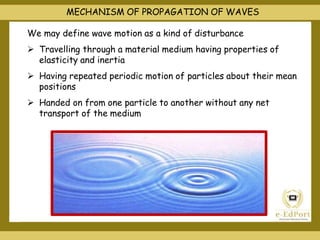
MECHANISM OF PROPAGATION OF WAVES
We may define wave motion as a kind of disturbance
 Travelling through a material medium having properties of
elasticity and inertia
 Having repeated periodic motion of particles about their mean
positions
 Handed on from one particle to another without any net
transport of the medium
TYPES OF WAVES
We usually come across three types of waves. They are:
 Mechanical Waves
 Electromagnetic Waves
 Matter waves
Mechanical waves are of two types:
 Transverse wave motion
 Longitudinal wave motion
TYPES OF MECHANICAL WAVE MOTION
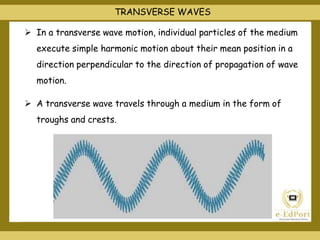
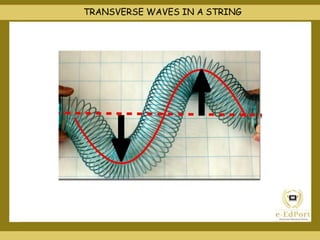
TRANSVERSE WAVES
 In a transverse wave motion, individual particles of the medium
execute simple harmonic motion about their mean position in a
direction perpendicular to the direction of propagation of wave
motion.
 A transverse wave travels through a medium in the form of
troughs and crests.
Trough
TRANSVERSE WAVES
CREST AND TROUGH
 A crest is a portion of the medium, which is raised temporarily
above the normal position of rest of the particles of the medium.
 A trough is a portion of the medium, which is depressed
temporarily below the normal position of rest of the particles of
the medium.
Crest
TRANSVERSE WAVES IN A STRING
C C CR R RR
LONGITUDINAL WAVES
 A longitudinal wave motion is that wave motion in which individual
particles of the medium execute simple harmonic motion about
their mean position along the same direction to the direction of
propagation of wave motion.
C RR
Compression (C) and Rarefaction (R) WAVES
 A longitudinal wave travels through a medium in the form of
compressions (C) and rarefactions (R).
Compression (C) and Rarefaction (R) WAVES
COMPRESSIONS
 Compression is the region in
which the particles come
closer because the distance
becomes less as compared to
normal distance.
 Thus, volume decreases and
density increases.
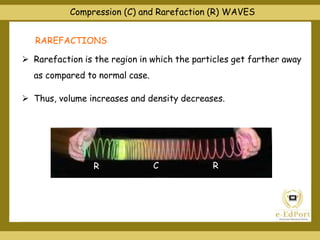
RAREFACTIONS
 Rarefaction is the region in which the particles get farther away
as compared to normal case.
 Thus, volume increases and density decreases.
C RR
Compression (C) and Rarefaction (R) WAVES
y = f (x,0)
 The functional form of f will be different for waves of
different shapes.
WAVE FUNCTION
 The functions which describe mathematically the motion
of a wave pulse are called wave functions.
 The displacement at different points along the travelling
wave pulse depends on
(i) Distance of the point from the origin
(ii) Time at which measurement is made
 At instant t = 0, let the displacement be represented by
 The displacement relation( at t  0) in a progressive
wave is given by:
y(x,t)  asin(kx  t  )
where, y(x,t)  Displacement
a Amplitude
k  Angular wavenumber
  Angular frequency
  Initialphaseangle
DISPLACEMENT RELATION IN A PROGRESSIVE WAVES
SOME IMPORTANT TERMS OF WAVE MOTION
Some terms which are important and connected with wave motion
are:
1. Amplitude
2. Wavelength
3. Angular Wave number
4. Frequency
5. Angular frequency
6. Time period
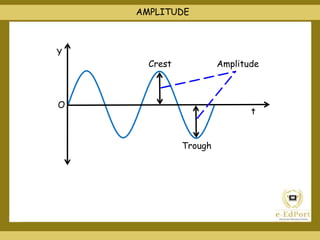
AMPLITUDE
 The amplitude of a wave is the magnitude of the maximum
displacement of the particles of a medium from their
equilibrium position, as the wave passes through the medium.
Amplitude
Y
t
O
Crest
Trough
AMPLITUDE
 The wavelength of a wave is equal to the distance travelled by a
wave during the time, any particle completes one vibration about
its mean position.
 It is represented by .
WAVELENGTH
Y
t
O
Crest
Trough
WAVELENGTH
WAVELENGTH OF TRANSVERSE WAVES
 In transverse wave motion, wavelength is the distance between
the centres of two consecutive crests or troughs.
 In longitudinal wave motion, wavelength is the distance between
the centres of two consecutive compressions or two rarefactions.
CompressionRarefaction
WAVELENGTH OF LONGITUDINAL WAVES

 S.I. unit of k is rad m-1.
ANGULAR WAVE NUMBER
 It is 2 times the number of waves that can be accommodated
per unit length.
 It is also called propagation constant.
 It is represented by k.
k =
2
 The number of complete cycles that pass a given point in one
second is called its frequency.
 It can also be defined as the number of complete wavelengths
traversed by the wave in one second.
 It is represented by .
 It is measured in hertz.
FREQUENCY
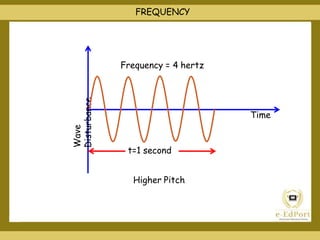
Time
Wave
Disturbance
Frequency = 4 hertz
t=1 second
Higher Pitch
FREQUENCY
t=1 second
Time
Wave
Disturbance
Frequency = 2 hertz
Lower Pitch
FREQUENCY
 = 2
ANGULAR FREQUENCY
 Angular frequency of the wave is 2 times the frequency
of the wave.
 It is represented by .
 It is measured in rad/s.
TIME PERIOD
 Time period of a wave is equal to the time taken by the wave
to travel a distance equal to one wavelength.
 It is represented by T. Its S.I. unit is second.
t
Y
O
TIME PERIOD
Time for completing one vibration =
1
sec.
Or,
T

T =
1
sec. or, T = 1

 =
1
RELATION BETWEEN TIME PERIOD AND FREQUENCY
 Now we will find relation between T and.
By definition,
Time for completing  vibrations = 1 sec.
The speed of wave is the product of frequency
and wavelength of the wave.
Thus,
v =  
SPEED OF A TRAVELLING WAVE
SPEED OF A TRANSVERSE WAVE ON STRETCHED STRING
 The speed of a transverse wave on stretched string depends
upon:
(i) Linear mass density of the string,
(ii) Tension T in the string
 The dimension of is [ML-1].
 The dimension of T is that of force that is [MLT-2].
-2
The ratio of
T
has the dimension
[MLT ]
= [L
2
T-2
]
μ [ML-1
]
So, if v depends only on T and μ the relation between
them must be v = C
So, v =
T
μ
It is observed that C = 1
T
μ
 It has been explained on the basis of Bulk Modulus B and
SPEED OF A LONGITUDINAL WAVE
density .
 The dimension of Bulk modulus is [ML-1T-2] and that of
density is [ML-3].
 On the basis of dimensional analysis, the expression for the
speed of Longitudinal Wave is
v = C
B
ρ
C is a dimensionless constant.
Thus, the speed of the longitudinal wave is
v =
B
ρ
(Since, C=1)
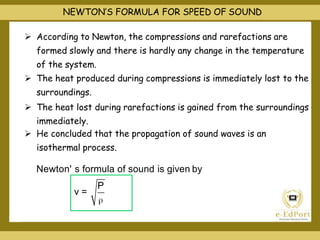
NEWTON’S FORMULA FOR SPEED OF SOUND
 According to Newton, the compressions and rarefactions are
formed slowly and there is hardly any change in the temperature
of the system.
 The heat produced during compressions is immediately lost to the
surroundings.
 The heat lost during rarefactions is gained from the surroundings
immediately.
 He concluded that the propagation of sound waves is an
isothermal process.
Newton' s formula of sound is given by
P
v =
ERROR IN NEWTON’S FORMULA
 The value calculated on the basis of Newton’s formula was less
than the experimental value by 15%.
Such a large error could not be taken as an experimental error.
LAPLACE’S CORRECTION
 According to Laplace, the compressions and rarefactions are
formed so rapidly that there is no exchange of heat between
the surroundings and the system.
 He concluded, when sound waves propagate through gas, the
change in pressure and volume of the gas is not isothermal,
but adiabatic. Thus, Boyle's law does not apply in this case.
 The value of speed of sound waves calculated is fairly close to
the experimental value at N.T.P.
v =
 Corrected formula for v
P

where,v  velocity ofsound
Ppressure,

CP
, and
CV
 densityof the medium.
LAPLACE’S CORRECTION
THE PRINCIPLE OF SUPERPOSITION OF WAVES
 The principle of superposition of
waves states that if two or more
waves travel past a point of the
medium, then, the resultant
displacement of the medium at
that point is given by the
algebraic sum of the individual
displacements due to the waves.
0o
90o 180o 270o 360o
SUPERPOSITION OF WAVES OF PHASE DIFFERENCE 0o
0o
90o 180o 270o 360o
SUPERPOSITION OF WAVES OF PHASE DIFFERENCE 180o
y(x,t) = y1(x,t) + y2(x,t)
MATHEMATICAL FORM OF THE SUPERPOSITION PRINCIPLE
 Let y1(x,t) and y2(x,t) be the displacements that any element of
the string would exhibit if each wave travels alone.
 The displacement y(x,t) of an element of the string when the
waves overlap is then, given by:
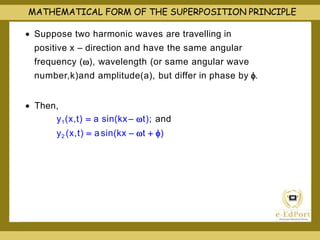
 Suppose two harmonic waves are travelling in
positive x  direction and have the same angular
frequency (), wavelength (or same angular wave
number,k)and amplitude(a), but differ in phase by .
 Then,
y1(x,t)  a sin(kx t); and
y2 (x,t)  a sin(kx  t  )
MATHEMATICAL FORM OF THE SUPERPOSITION PRINCIPLE
2 2
sin  + sin β = 2 sin
  + β 
cos
  - β
   
   
MATHEMATICAL FORM OF THE SUPERPOSITION PRINCIPLE
 According to the superposition principle,
the net resultant displacement is
y (x,t) = y1(x,t) + y2(x,t)
= a sin kx-t + a sin kx-t+
 Using the trignometrical relation
 
   
 This equation shows that the resultant wave is also a sinusoidal
wave travelling along positive x direction. The phase angle of
 
y (x,t) =  2a Cos
2  Sin  kx-t+
2 
2 2
resultant wave is

and itsamplitude is 2a cos
 .
MATHEMATICAL FORM OF THE SUPERPOSITION PRINCIPLE
We get,
MATHEMATICAL FORM OF THE SUPERPOSITION PRINCIPLE
SPECIAL CASES
Case I: If  = 0, i.e., the two waves are in phase,
then, equation of resultant wave is
y(x,t) = 2a sin kx-ωt
The amplitude of the resultant wave is 2a.
Wave 1
Wave 2
Resultant Wave
SUPERPOSITION OF WAVES OF PHASE DIFFERENCE 0o
So, the equation of resultant wave is
yx,t=0
Case II: If  = π, i.e., the two waves are out of
phase by 180 o
, the amplitude of resultant
wave reduces to zero.
SUPERPOSITION OF WAVES OF PHASE DIFFERENCE 0o
Wave 1
Wave 2
Resultant Wave
SUPERPOSITION OF WAVES OF PHASE DIFFERENCE 180o
REFLECTION OF WAVES
 When a pulse or a travelling wave encounters a rigid body, it
gets reflected.
 An echo is an example of reflection of sound waves from a
rigid body.
 The reflection can be observed from the following surfaces:
 Reflection of waves from a rigid boundary
 Reflection of waves from an open boundary
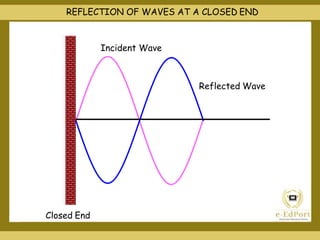
 Consider a pulse travelling on a string fixed at one end.
 If the support attaching the string to the wall is rigid, no wave
is transmitted to the wall.
 The reflected wave will be inverted.
REFLECTION OF WAVES AT A CLOSED END
PULSE REFLECTING FROM A FIXED END
Closed End
Incident Wave
Reflected Wave
REFLECTION OF WAVES AT A CLOSED END
Reason for the inversion of the pulse:
 When the pulse meets the fixed support, the string produces
an upward force on the support.
 By Newton’s third law, the support must then, exert an equal
and opposite (downward) reaction force on the string.
 This downward force causes the pulse to invert upon reflection,
i.e., a crest is reflected as a trough and vice versa.
y x,t = a sin (kx+ωt + π )
or
y x,t =- a sin kx+ωt
REFLECTION OF WAVES AT A CLOSED END
• The reflected wave is represented by:
REFLECTION OF WAVES AT AN OPEN END
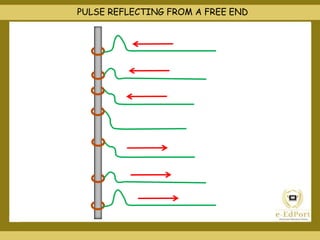
 Consider another case where the pulse arrives at the end of a
string that is free to move vertically on a smooth post.
 For this purpose, the end of the sting is attached to a ring of
negligible mass that is free to slide vertically.
 This time the reflected pulse is not inverted.
PULSE REFLECTING FROM A FREE END
Reason for the non-inversion of the reflected pulse:
 As the pulse reaches the post, it exerts a force on the free
end, causing the ring to accelerate upward.
 As the ring moves upwards, it pulls on the string stretching
the string and producing a reflected pulse of same sign and
amplitude as the incident pulse.
 Thus, a crest is reflected back as a crest, and a trough as a
trough.
 In other words, the reflection of a traveling wave, at an
open boundary takes place without any phase change.
 The incident and the reflected pulses reinforce each
other, creating the maximum displacement at the end of
the string.
 The reflected wave is represented by:
y x,t  a sin kx t
PULSE REFLECTING FROM A FREE END
STANDING WAVES
 Stationary or standing waves are formed in a medium when two
waves having equal speed and frequency and nearly equal amplitude,
moving in opposite directions along the same line, interfere in a
confined space.
 The resultant wave do not propagate in any direction.
STANDING WAVES
STANDING WAVES (NODES)
 In stationary waves, there are certain points of the medium,
which are permanently at rest, i.e., their amplitude is zero all
throughout. These points are called Nodes.
Node
Antinode
STANDING WAVES
STANDING WAVES (ANTINODES)
 In stationary waves, there are certain points of the medium,
which vibrate about their mean position with the largest
amplitude. These points are called Antinodes.
 Normal modes are set of frequencies given by
the following equations:
 n
v
,for n 1,2,3,4......
2L
where, v  Speedof the travelling waves
L  Length of the string fixed at both ends.
 The string fixed at both ends can have these values
of frequenciesonly.
NORMAL MODES FOR STING WITH FIXED ENDS
N N
1
1
1
(i) First normal mode of vibration:
Wavelength = 1, n = 1
 =
2L
=
2L
 L =
1
n 1 2
The frequency of vibration is given by:
v v
 = =
 2L
This n=1 mode of vibration is known as the fundamental mode or first
harmonic.
A
N=Node
A=Antinode
NORMAL MODES FOR STING WITH FIXED ENDS
n=1
n=2
n=3
n=4
n=5
L
NORMAL MODES FOR STING WITH FIXED ENDS
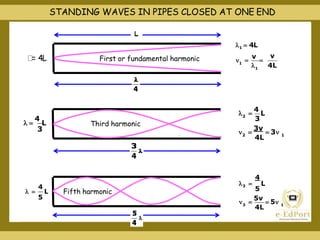
STANDING WAVES IN PIPES CLOSED AT ONE END
 A closed or stopped organ
pipe consists of a metal pipe
closed at one end and open at
the other end.
 Air is blown at the open end.
Thus, a longitudinal wave
travels towards the closed
end and is reflected back.
 This results in the formation of stationary waves in the pipe.
 The open end serves as the antinode as the air is free to vibrate
there.
1 1
2L
4L
 
n 
1
 2
 
 2 2L
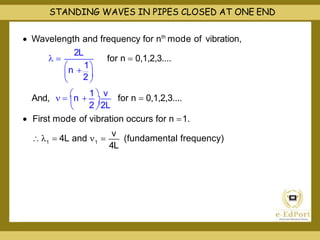
 Wavelength and frequency for nth
mode of vibration,
for n  0,1,2,3....
And,   n 
1 v
for n  0,1,2,3....
 First mode of vibration occurs for n 1.
 
   4L and  
v
(fundamental frequency)
STANDING WAVES IN PIPES CLOSED AT ONE END
First or fundamental harmonic
Third harmonic
Fifth harmonic
= 4L
3
 
4
L
4
5
  L
1
1
v
1  4L
 
v

 4L
2
2 1
3
4L
 
4
L
 
3v
 3
3 1
5
4L
4
3  L
 
5v
 5
STANDING WAVES IN PIPES CLOSED AT ONE END
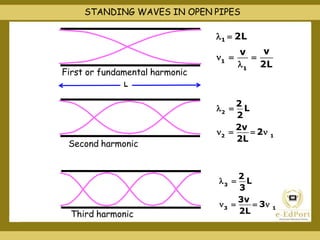
STANDING WAVES IN OPEN PIPES
 For an open pipe, both the ends are open.
 When air is blown from one side, it gets
reflected on encountering the free air
on the other side.
 Thus, stationary waves are formed.
 As air can vibrate on both ends, both of
them act as antinodes.
 As in the case of standing waves in a string fixed at
both ends, the allowed frequencies of standing waves
in an open pipe are given by:
n
n
and the corresponding wavelengths are
2L
n
 
nv
for n  1,2,3,........
2L
for n  1,2,3,........

STANDING WAVES IN OPEN PIPES
First or fundamental harmonic
Second harmonic
Third harmonic
1
1
v
1  2L
 
v

 2L
2
2 1
2
2L
 
2
L
 
2v
 2
3
3 1
3
2L
 
2
L
 
3v
 3
STANDING WAVES IN OPEN PIPES
First Wave
Second Wave
Formation of Beats
BEATS
 The phenomenon of alternate variation in the intensity of
sound with time at a particular position, when two sound waves
of nearly same frequencies and amplitudes superimpose on
each other is called Beats.
beat 1 2
BEATS
 When two waves of frequencies, n1 and n2, produce
beats, the beat frequency is given by:
 Whenever there is a relative
motion between a source of sound
and a listener, the apparent
frequency of sound heard by the
listener is different from the
actual frequency of sound emitted
by the source.
 This effect is called doppler
effect.
Same Frequency
Stationary
In Motion
Higher
Frequency
Lower
Frequenc
y
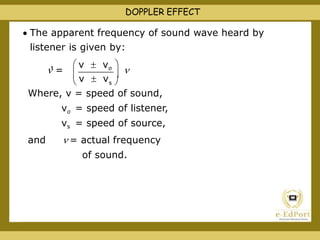
DOPPLER EFFECT
 s 

v  v

Where, v = speed of sound,
vo = speed of listener,
vs = speed of source,
and  = actual frequency
of sound.
DOPPLER EFFECT
 The apparent frequency of sound wave heard by
listener is given by:
' =
 v  vo 

DOPPLER EFFECT (MOVING SOURCE AND STATIONARY OBSERVER)
 When the source of sound moves towards a stationary observer,
the apparent frequency increases.
 When the source of sound moves away from the observer, the
apparent frequency decreases.
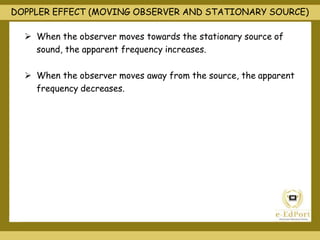
DOPPLER EFFECT (MOVING OBSERVER AND STATIONARY SOURCE)
 When the observer moves towards the stationary source of
sound, the apparent frequency increases.
 When the observer moves away from the source, the apparent
frequency decreases.
DOPPLER EFFECT (MOVING SOURCE AND MOVING OBSERVER)
 When both the source and the observer are moving, the apparent
frequency may increase or decrease depending upon the speeds of
the observer and the source.

Ch 15 waves

  • 1.
  • 2.
     INTRODUCTION  TRANSVERSEAND LONGITUDINAL WAVES  DISPLACEMENT RELATION IN A PROGRESSIVE WAVE  SPEED OF A TRAVELLING WAVE  THE PRINCIPLE OF SUPERPOSITION OF WAVES  REFLECTION OF WAVES  BEATS  DOPPLER EFFECT CONTENTS
  • 3.
    INTRODUCTION The transportation ofenergy from its source to the receiving end can be done in two ways:  By actually moving the matter carrying kinetic energy and delivering it to the other end.  By the vibration of the particles of a medium and thus, transferring energy from one particle to another.
  • 4.
    MECHANISM OF PROPAGATIONOF WAVES We may define wave motion as a kind of disturbance  Travelling through a material medium having properties of elasticity and inertia  Having repeated periodic motion of particles about their mean positions  Handed on from one particle to another without any net transport of the medium
  • 5.
    TYPES OF WAVES Weusually come across three types of waves. They are:  Mechanical Waves  Electromagnetic Waves  Matter waves
  • 6.
    Mechanical waves areof two types:  Transverse wave motion  Longitudinal wave motion TYPES OF MECHANICAL WAVE MOTION
  • 7.
    TRANSVERSE WAVES  Ina transverse wave motion, individual particles of the medium execute simple harmonic motion about their mean position in a direction perpendicular to the direction of propagation of wave motion.  A transverse wave travels through a medium in the form of troughs and crests.
  • 8.
    Trough TRANSVERSE WAVES CREST ANDTROUGH  A crest is a portion of the medium, which is raised temporarily above the normal position of rest of the particles of the medium.  A trough is a portion of the medium, which is depressed temporarily below the normal position of rest of the particles of the medium. Crest
  • 9.
  • 10.
    C C CRR RR LONGITUDINAL WAVES  A longitudinal wave motion is that wave motion in which individual particles of the medium execute simple harmonic motion about their mean position along the same direction to the direction of propagation of wave motion.
  • 11.
    C RR Compression (C)and Rarefaction (R) WAVES  A longitudinal wave travels through a medium in the form of compressions (C) and rarefactions (R).
  • 12.
    Compression (C) andRarefaction (R) WAVES COMPRESSIONS  Compression is the region in which the particles come closer because the distance becomes less as compared to normal distance.  Thus, volume decreases and density increases.
  • 13.
    RAREFACTIONS  Rarefaction isthe region in which the particles get farther away as compared to normal case.  Thus, volume increases and density decreases. C RR Compression (C) and Rarefaction (R) WAVES
  • 14.
    y = f(x,0)  The functional form of f will be different for waves of different shapes. WAVE FUNCTION  The functions which describe mathematically the motion of a wave pulse are called wave functions.  The displacement at different points along the travelling wave pulse depends on (i) Distance of the point from the origin (ii) Time at which measurement is made  At instant t = 0, let the displacement be represented by
  • 15.
     The displacementrelation( at t  0) in a progressive wave is given by: y(x,t)  asin(kx  t  ) where, y(x,t)  Displacement a Amplitude k  Angular wavenumber   Angular frequency   Initialphaseangle DISPLACEMENT RELATION IN A PROGRESSIVE WAVES
  • 16.
    SOME IMPORTANT TERMSOF WAVE MOTION Some terms which are important and connected with wave motion are: 1. Amplitude 2. Wavelength 3. Angular Wave number 4. Frequency 5. Angular frequency 6. Time period
  • 17.
    AMPLITUDE  The amplitudeof a wave is the magnitude of the maximum displacement of the particles of a medium from their equilibrium position, as the wave passes through the medium.
  • 18.
  • 19.
     The wavelengthof a wave is equal to the distance travelled by a wave during the time, any particle completes one vibration about its mean position.  It is represented by . WAVELENGTH
  • 20.
  • 21.
    WAVELENGTH OF TRANSVERSEWAVES  In transverse wave motion, wavelength is the distance between the centres of two consecutive crests or troughs.
  • 22.
     In longitudinalwave motion, wavelength is the distance between the centres of two consecutive compressions or two rarefactions. CompressionRarefaction WAVELENGTH OF LONGITUDINAL WAVES
  • 23.
      S.I. unitof k is rad m-1. ANGULAR WAVE NUMBER  It is 2 times the number of waves that can be accommodated per unit length.  It is also called propagation constant.  It is represented by k. k = 2
  • 24.
     The numberof complete cycles that pass a given point in one second is called its frequency.  It can also be defined as the number of complete wavelengths traversed by the wave in one second.  It is represented by .  It is measured in hertz. FREQUENCY
  • 25.
    Time Wave Disturbance Frequency = 4hertz t=1 second Higher Pitch FREQUENCY
  • 26.
    t=1 second Time Wave Disturbance Frequency =2 hertz Lower Pitch FREQUENCY
  • 27.
     = 2 ANGULARFREQUENCY  Angular frequency of the wave is 2 times the frequency of the wave.  It is represented by .  It is measured in rad/s.
  • 28.
    TIME PERIOD  Timeperiod of a wave is equal to the time taken by the wave to travel a distance equal to one wavelength.  It is represented by T. Its S.I. unit is second.
  • 29.
  • 30.
    Time for completingone vibration = 1 sec. Or, T  T = 1 sec. or, T = 1   = 1 RELATION BETWEEN TIME PERIOD AND FREQUENCY  Now we will find relation between T and. By definition, Time for completing  vibrations = 1 sec.
  • 31.
    The speed ofwave is the product of frequency and wavelength of the wave. Thus, v =   SPEED OF A TRAVELLING WAVE
  • 32.
    SPEED OF ATRANSVERSE WAVE ON STRETCHED STRING  The speed of a transverse wave on stretched string depends upon: (i) Linear mass density of the string, (ii) Tension T in the string  The dimension of is [ML-1].  The dimension of T is that of force that is [MLT-2]. -2 The ratio of T has the dimension [MLT ] = [L 2 T-2 ] μ [ML-1 ] So, if v depends only on T and μ the relation between them must be v = C So, v = T μ It is observed that C = 1 T μ
  • 33.
     It hasbeen explained on the basis of Bulk Modulus B and SPEED OF A LONGITUDINAL WAVE density .  The dimension of Bulk modulus is [ML-1T-2] and that of density is [ML-3].  On the basis of dimensional analysis, the expression for the speed of Longitudinal Wave is v = C B ρ C is a dimensionless constant. Thus, the speed of the longitudinal wave is v = B ρ (Since, C=1)
  • 34.
    NEWTON’S FORMULA FORSPEED OF SOUND  According to Newton, the compressions and rarefactions are formed slowly and there is hardly any change in the temperature of the system.  The heat produced during compressions is immediately lost to the surroundings.  The heat lost during rarefactions is gained from the surroundings immediately.  He concluded that the propagation of sound waves is an isothermal process. Newton' s formula of sound is given by P v =
  • 35.
    ERROR IN NEWTON’SFORMULA  The value calculated on the basis of Newton’s formula was less than the experimental value by 15%. Such a large error could not be taken as an experimental error.
  • 36.
    LAPLACE’S CORRECTION  Accordingto Laplace, the compressions and rarefactions are formed so rapidly that there is no exchange of heat between the surroundings and the system.  He concluded, when sound waves propagate through gas, the change in pressure and volume of the gas is not isothermal, but adiabatic. Thus, Boyle's law does not apply in this case.  The value of speed of sound waves calculated is fairly close to the experimental value at N.T.P.
  • 37.
    v =  Correctedformula for v P  where,v  velocity ofsound Ppressure,  CP , and CV  densityof the medium. LAPLACE’S CORRECTION
  • 38.
    THE PRINCIPLE OFSUPERPOSITION OF WAVES  The principle of superposition of waves states that if two or more waves travel past a point of the medium, then, the resultant displacement of the medium at that point is given by the algebraic sum of the individual displacements due to the waves.
  • 39.
    0o 90o 180o 270o360o SUPERPOSITION OF WAVES OF PHASE DIFFERENCE 0o
  • 40.
    0o 90o 180o 270o360o SUPERPOSITION OF WAVES OF PHASE DIFFERENCE 180o
  • 41.
    y(x,t) = y1(x,t)+ y2(x,t) MATHEMATICAL FORM OF THE SUPERPOSITION PRINCIPLE  Let y1(x,t) and y2(x,t) be the displacements that any element of the string would exhibit if each wave travels alone.  The displacement y(x,t) of an element of the string when the waves overlap is then, given by:
  • 42.
     Suppose twoharmonic waves are travelling in positive x  direction and have the same angular frequency (), wavelength (or same angular wave number,k)and amplitude(a), but differ in phase by .  Then, y1(x,t)  a sin(kx t); and y2 (x,t)  a sin(kx  t  ) MATHEMATICAL FORM OF THE SUPERPOSITION PRINCIPLE
  • 43.
    2 2 sin + sin β = 2 sin   + β  cos   - β         MATHEMATICAL FORM OF THE SUPERPOSITION PRINCIPLE  According to the superposition principle, the net resultant displacement is y (x,t) = y1(x,t) + y2(x,t) = a sin kx-t + a sin kx-t+  Using the trignometrical relation
  • 44.
          This equation shows that the resultant wave is also a sinusoidal wave travelling along positive x direction. The phase angle of   y (x,t) =  2a Cos 2  Sin  kx-t+ 2  2 2 resultant wave is  and itsamplitude is 2a cos  . MATHEMATICAL FORM OF THE SUPERPOSITION PRINCIPLE We get,
  • 45.
    MATHEMATICAL FORM OFTHE SUPERPOSITION PRINCIPLE SPECIAL CASES Case I: If  = 0, i.e., the two waves are in phase, then, equation of resultant wave is y(x,t) = 2a sin kx-ωt The amplitude of the resultant wave is 2a.
  • 46.
    Wave 1 Wave 2 ResultantWave SUPERPOSITION OF WAVES OF PHASE DIFFERENCE 0o
  • 47.
    So, the equationof resultant wave is yx,t=0 Case II: If  = π, i.e., the two waves are out of phase by 180 o , the amplitude of resultant wave reduces to zero. SUPERPOSITION OF WAVES OF PHASE DIFFERENCE 0o
  • 48.
    Wave 1 Wave 2 ResultantWave SUPERPOSITION OF WAVES OF PHASE DIFFERENCE 180o
  • 49.
    REFLECTION OF WAVES When a pulse or a travelling wave encounters a rigid body, it gets reflected.  An echo is an example of reflection of sound waves from a rigid body.  The reflection can be observed from the following surfaces:  Reflection of waves from a rigid boundary  Reflection of waves from an open boundary
  • 50.
     Consider apulse travelling on a string fixed at one end.  If the support attaching the string to the wall is rigid, no wave is transmitted to the wall.  The reflected wave will be inverted. REFLECTION OF WAVES AT A CLOSED END
  • 51.
  • 52.
    Closed End Incident Wave ReflectedWave REFLECTION OF WAVES AT A CLOSED END
  • 53.
    REFLECTION OF WAVESAT A CLOSED END Reason for the inversion of the pulse:  When the pulse meets the fixed support, the string produces an upward force on the support.  By Newton’s third law, the support must then, exert an equal and opposite (downward) reaction force on the string.  This downward force causes the pulse to invert upon reflection, i.e., a crest is reflected as a trough and vice versa.
  • 54.
    y x,t =a sin (kx+ωt + π ) or y x,t =- a sin kx+ωt REFLECTION OF WAVES AT A CLOSED END • The reflected wave is represented by:
  • 55.
    REFLECTION OF WAVESAT AN OPEN END  Consider another case where the pulse arrives at the end of a string that is free to move vertically on a smooth post.  For this purpose, the end of the sting is attached to a ring of negligible mass that is free to slide vertically.  This time the reflected pulse is not inverted.
  • 56.
  • 57.
    PULSE REFLECTING FROMA FREE END Reason for the non-inversion of the reflected pulse:  As the pulse reaches the post, it exerts a force on the free end, causing the ring to accelerate upward.  As the ring moves upwards, it pulls on the string stretching the string and producing a reflected pulse of same sign and amplitude as the incident pulse.  Thus, a crest is reflected back as a crest, and a trough as a trough.
  • 58.
     In otherwords, the reflection of a traveling wave, at an open boundary takes place without any phase change.  The incident and the reflected pulses reinforce each other, creating the maximum displacement at the end of the string.  The reflected wave is represented by: y x,t  a sin kx t PULSE REFLECTING FROM A FREE END
  • 59.
    STANDING WAVES  Stationaryor standing waves are formed in a medium when two waves having equal speed and frequency and nearly equal amplitude, moving in opposite directions along the same line, interfere in a confined space.  The resultant wave do not propagate in any direction.
  • 60.
    STANDING WAVES STANDING WAVES(NODES)  In stationary waves, there are certain points of the medium, which are permanently at rest, i.e., their amplitude is zero all throughout. These points are called Nodes. Node
  • 61.
    Antinode STANDING WAVES STANDING WAVES(ANTINODES)  In stationary waves, there are certain points of the medium, which vibrate about their mean position with the largest amplitude. These points are called Antinodes.
  • 62.
     Normal modesare set of frequencies given by the following equations:  n v ,for n 1,2,3,4...... 2L where, v  Speedof the travelling waves L  Length of the string fixed at both ends.  The string fixed at both ends can have these values of frequenciesonly. NORMAL MODES FOR STING WITH FIXED ENDS
  • 63.
    N N 1 1 1 (i) Firstnormal mode of vibration: Wavelength = 1, n = 1  = 2L = 2L  L = 1 n 1 2 The frequency of vibration is given by: v v  = =  2L This n=1 mode of vibration is known as the fundamental mode or first harmonic. A N=Node A=Antinode NORMAL MODES FOR STING WITH FIXED ENDS
  • 64.
    NORMAL MODES FORSTING WITH FIXED ENDS
  • 65.
  • 66.
    STANDING WAVES INPIPES CLOSED AT ONE END  A closed or stopped organ pipe consists of a metal pipe closed at one end and open at the other end.  Air is blown at the open end. Thus, a longitudinal wave travels towards the closed end and is reflected back.  This results in the formation of stationary waves in the pipe.  The open end serves as the antinode as the air is free to vibrate there.
  • 67.
    1 1 2L 4L   n 1  2    2 2L  Wavelength and frequency for nth mode of vibration, for n  0,1,2,3.... And,   n  1 v for n  0,1,2,3....  First mode of vibration occurs for n 1.      4L and   v (fundamental frequency) STANDING WAVES IN PIPES CLOSED AT ONE END
  • 68.
    First or fundamentalharmonic Third harmonic Fifth harmonic = 4L 3   4 L 4 5   L 1 1 v 1  4L   v   4L 2 2 1 3 4L   4 L   3v  3 3 1 5 4L 4 3  L   5v  5 STANDING WAVES IN PIPES CLOSED AT ONE END
  • 69.
    STANDING WAVES INOPEN PIPES  For an open pipe, both the ends are open.  When air is blown from one side, it gets reflected on encountering the free air on the other side.  Thus, stationary waves are formed.  As air can vibrate on both ends, both of them act as antinodes.
  • 70.
     As inthe case of standing waves in a string fixed at both ends, the allowed frequencies of standing waves in an open pipe are given by: n n and the corresponding wavelengths are 2L n   nv for n  1,2,3,........ 2L for n  1,2,3,........  STANDING WAVES IN OPEN PIPES
  • 71.
    First or fundamentalharmonic Second harmonic Third harmonic 1 1 v 1  2L   v   2L 2 2 1 2 2L   2 L   2v  2 3 3 1 3 2L   2 L   3v  3 STANDING WAVES IN OPEN PIPES
  • 72.
    First Wave Second Wave Formationof Beats BEATS  The phenomenon of alternate variation in the intensity of sound with time at a particular position, when two sound waves of nearly same frequencies and amplitudes superimpose on each other is called Beats.
  • 73.
    beat 1 2 BEATS When two waves of frequencies, n1 and n2, produce beats, the beat frequency is given by:
  • 74.
     Whenever thereis a relative motion between a source of sound and a listener, the apparent frequency of sound heard by the listener is different from the actual frequency of sound emitted by the source.  This effect is called doppler effect. Same Frequency Stationary In Motion Higher Frequency Lower Frequenc y DOPPLER EFFECT
  • 75.
     s   v v  Where, v = speed of sound, vo = speed of listener, vs = speed of source, and  = actual frequency of sound. DOPPLER EFFECT  The apparent frequency of sound wave heard by listener is given by: ' =  v  vo  
  • 76.
    DOPPLER EFFECT (MOVINGSOURCE AND STATIONARY OBSERVER)  When the source of sound moves towards a stationary observer, the apparent frequency increases.  When the source of sound moves away from the observer, the apparent frequency decreases.
  • 77.
    DOPPLER EFFECT (MOVINGOBSERVER AND STATIONARY SOURCE)  When the observer moves towards the stationary source of sound, the apparent frequency increases.  When the observer moves away from the source, the apparent frequency decreases.
  • 78.
    DOPPLER EFFECT (MOVINGSOURCE AND MOVING OBSERVER)  When both the source and the observer are moving, the apparent frequency may increase or decrease depending upon the speeds of the observer and the source.