Two-way Between-
Subjects ANOVA
Two-way ANOVA
 Two-way ANOVA is one type of Factorial
ANOVA.
 Factorial ANOVAs are designs with two or
more between-subjects independent variables
 If there are within-subjects IVs, then they are
often called Mixed ANOVAs
Two-way ANOVA
 Grouping factors (IVs)
 Example
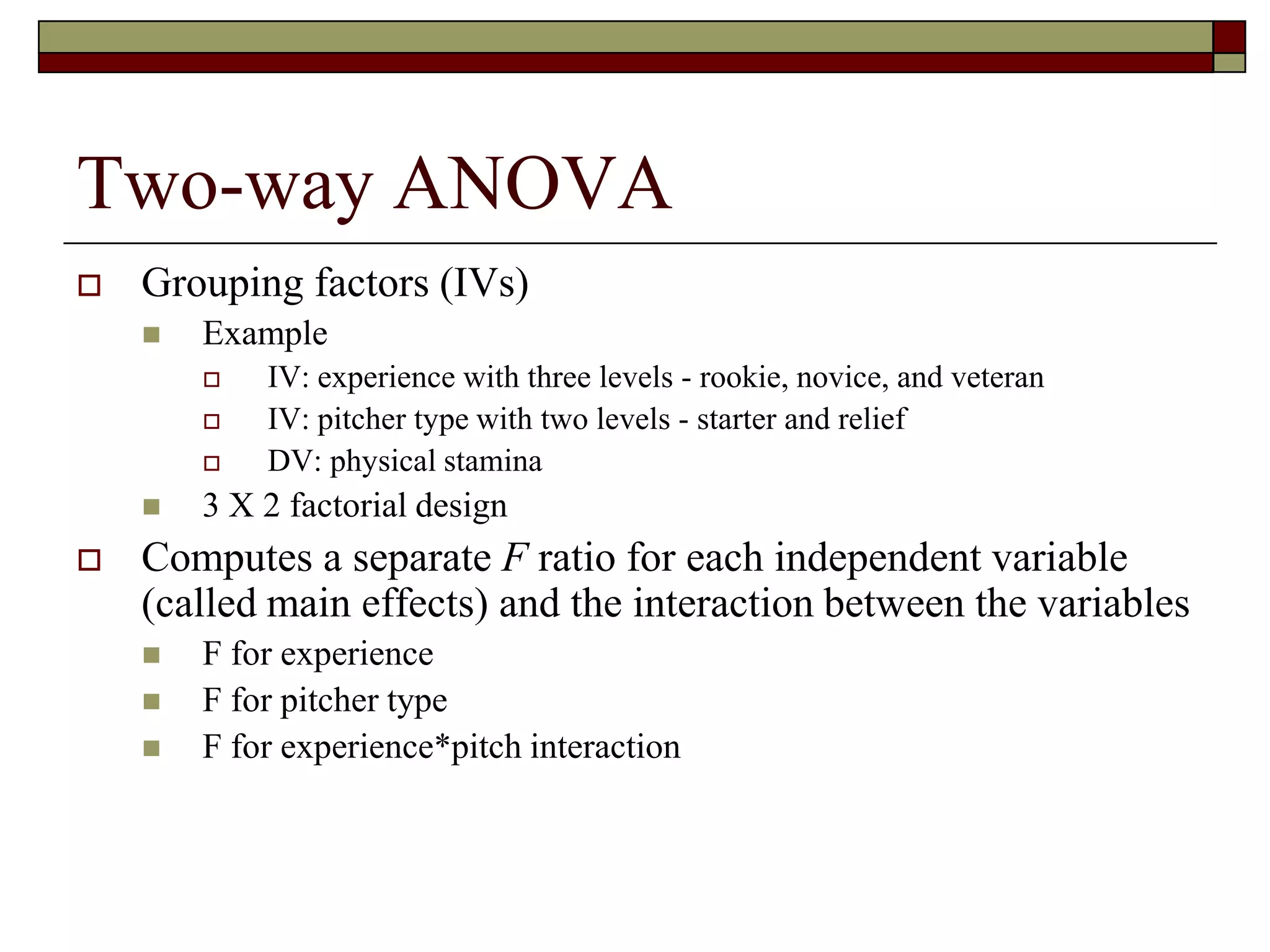
 IV: experience with three levels - rookie, novice, and veteran
 IV: pitcher type with two levels - starter and relief
 DV: physical stamina
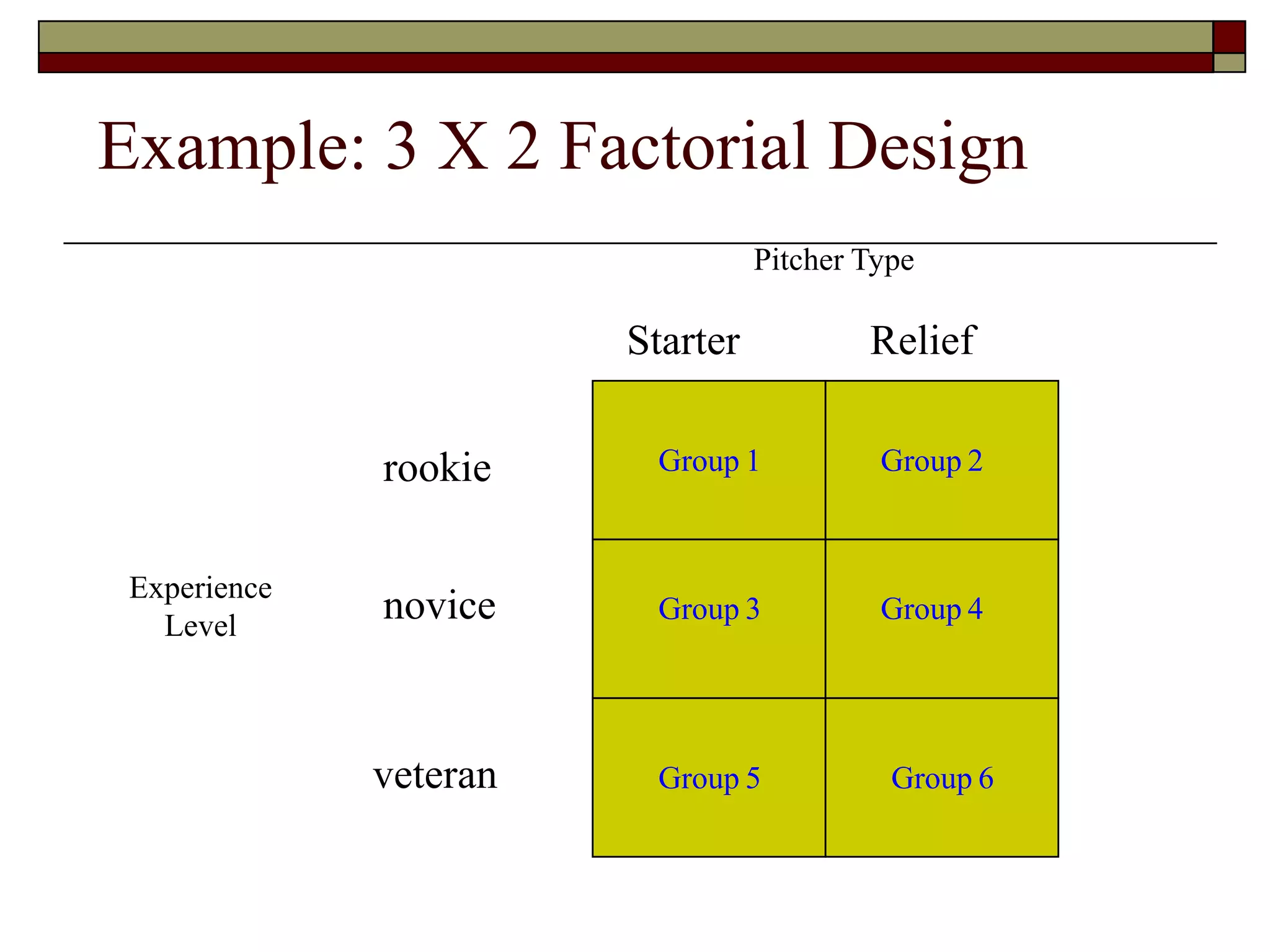
 3 X 2 factorial design
 Computes a separate F ratio for each independent variable
(called main effects) and the interaction between the variables
 F for experience
 F for pitcher type
 F for experience*pitch interaction
Example: 3 X 2 Factorial Design
Group 1 Group 2
Group 3 Group 4
Starter Relief
Group 5 Group 6
rookie
novice
veteran
Experience
Level
Pitcher Type
Practice
 A 3 X 3 design
 How many independent variables?
1. 1
2. 2
3. 3
4. 4
Practice
 A 3 X 3 design
 How many levels of the first independent
variable listed?
1. 1
2. 2
3. 3
4. 4
Practice
 A 3 X 3 design
 How many conditions?
1. 2
2. 3
3. 6
4. 9
Practice
 A researcher tests male and female doctors
for manual dexterity . She tests dexterity for
different tools: scalpel, scissors, scope, and
probe.
 How many independent variables?
1. 1
2. 2
3. 3
4. 4
Practice
 A researcher tests male and female doctors for
manual dexterity . She tests dexterity for different
tools: scalpel, scissors, scope, and probe.
 How many levels of the second independent variable
(tools)?
1. 1
2. 2
3. 3
4. 4
Practice
 A researcher tests male and female doctors
for manual dexterity . She tests dexterity for
different tools: scalpel, scissors, scope, and
probe.
 How many conditions?
1. 2
2. 4
3. 6
4. 8
Practice
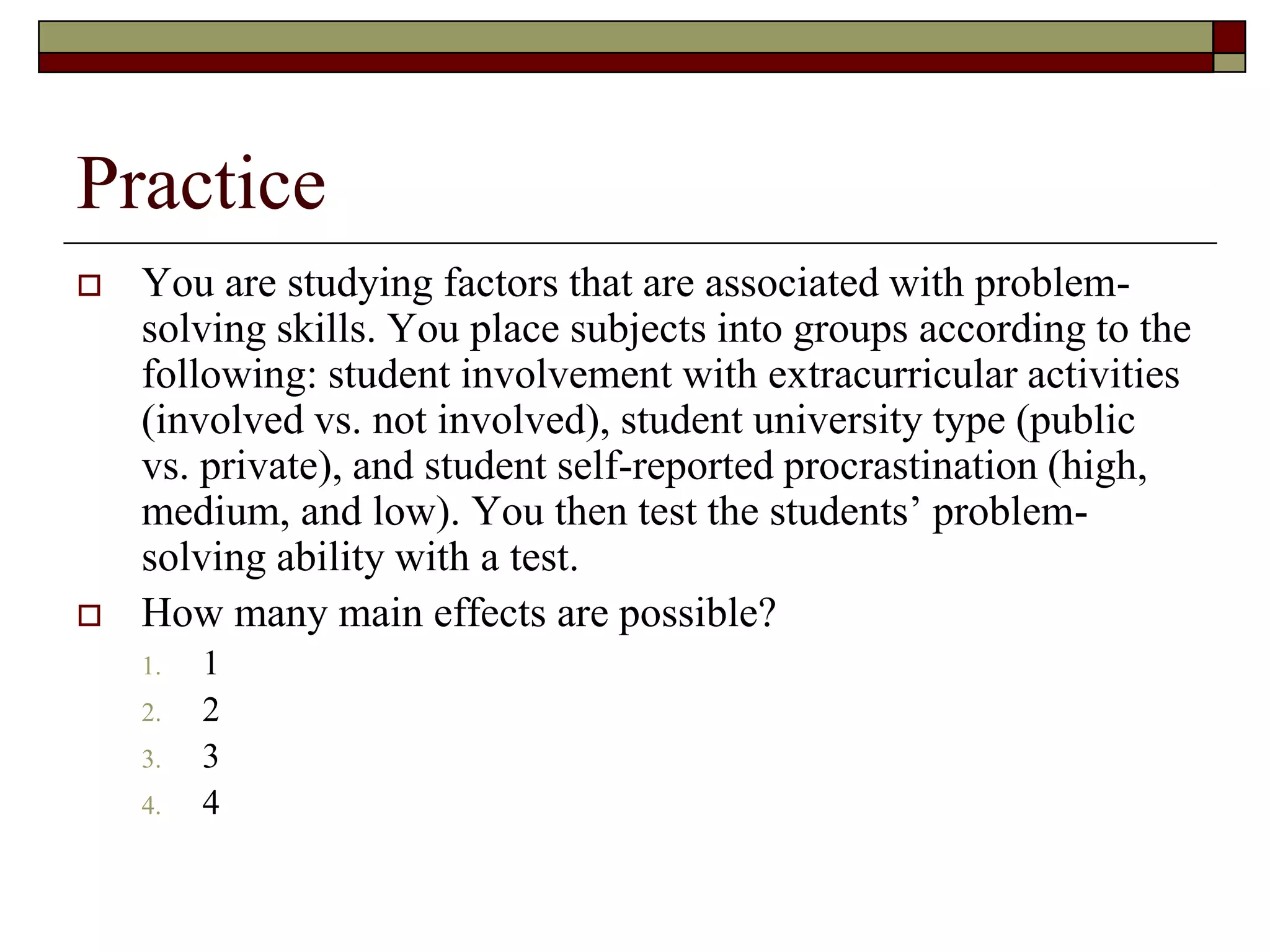
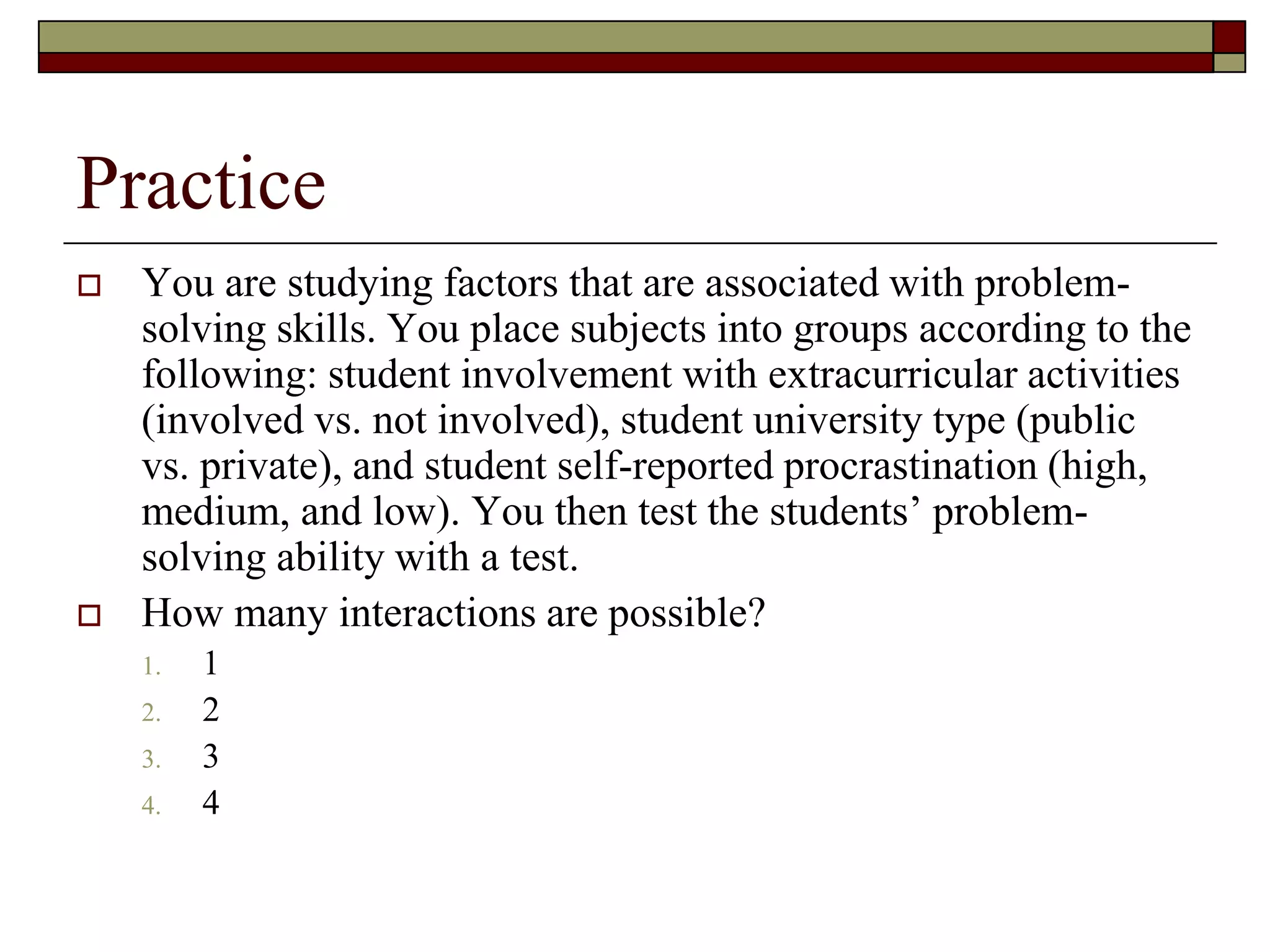
 You are studying factors that are associated with problem-
solving skills. You place subjects into groups according to the
following: student involvement with extracurricular activities
(involved vs. not involved), student university type (public
vs. private), and student self-reported procrastination (high,
medium, and low). You then test the students’ problem-
solving ability with a test.
 What is the design?
1. 1 X 2 X 2 X 3
2. 2 X 2 X 3
3. 3 X 2 X 6
4. 4 X 3
Practice
 You are studying factors that are associated with problem-
solving skills. You place subjects into groups according to the
following: student involvement with extracurricular activities
(involved vs. not involved), student university type (public
vs. private), and student self-reported procrastination (high,
medium, and low). You then test the students’ problem-
solving ability with a test.
 How many independent variables?
1. 1
2. 2
3. 3
4. 4
Practice
 You are studying factors that are associated with problem-
solving skills. You place subjects into groups according to the
following: student involvement with extracurricular activities
(involved vs. not involved), student university type (public
vs. private), and student self-reported procrastination (high,
medium, and low). You then test the students’ problem-
solving ability with a test.
 How many cells?
1. 3
2. 8
3. 12
4. 24
Two-way ANOVA
 Main Effects
 Think of them as one-way ANOVAs for each
independent variable.
 If you have 2 IVs, then you have two possible
main effects
 Example
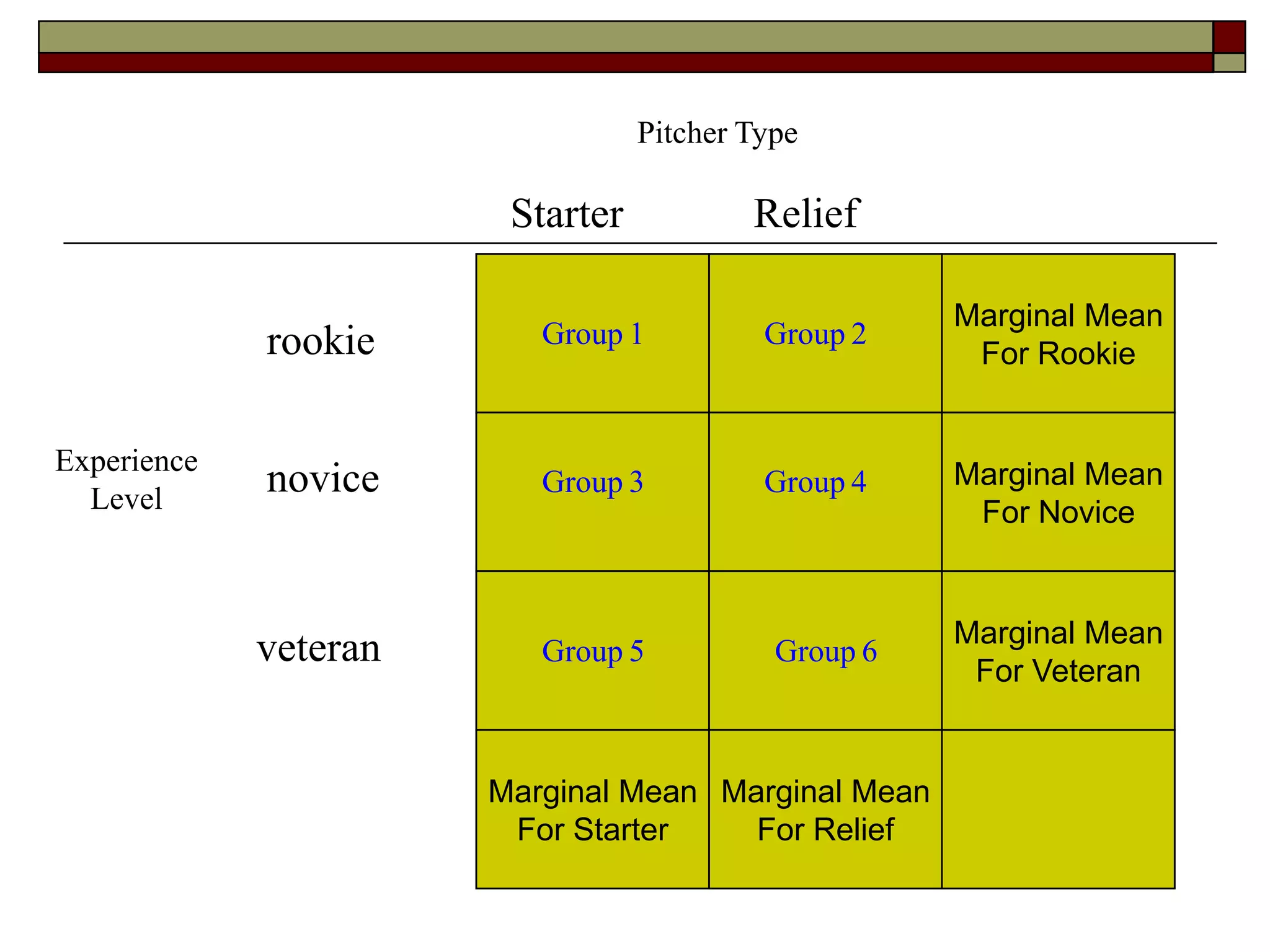
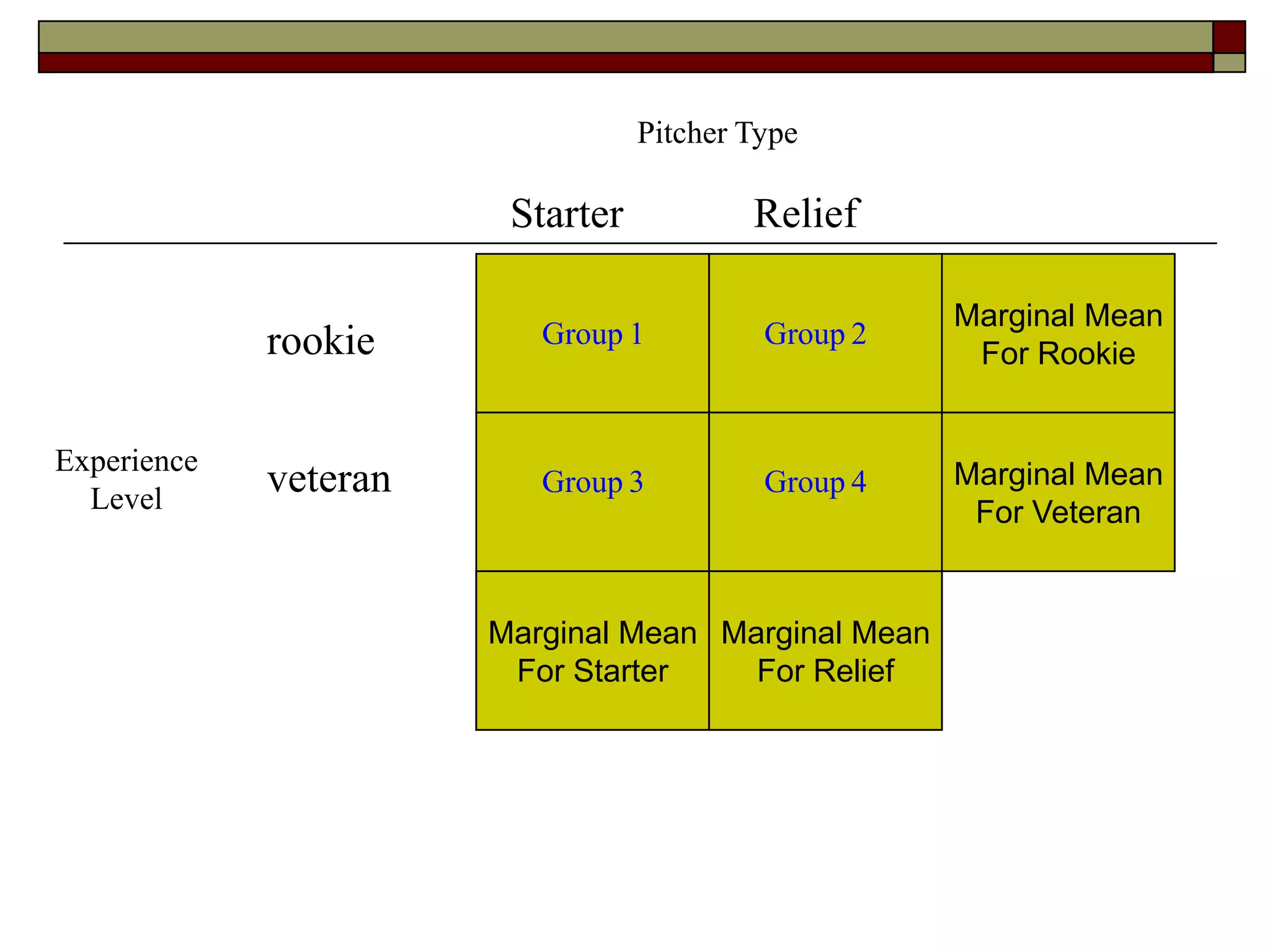
 A main effect for experience would look at the
three levels ignoring (collapsed across) pitcher type
 A main effect for pitcher type looks at starters vs.
relief pitchers regardless of (collapsed across)
experience
Group 1 Group 2
Group 3 Group 4
Starter Relief
Group 5 Group 6
rookie
novice
veteran
Experience
Level
Pitcher Type
Marginal Mean
For Rookie
Marginal Mean
For Novice
Marginal Mean
For Veteran
Marginal Mean
For Starter
Marginal Mean
For Relief
Two-way ANOVA
 Interaction
 For a two-way ANOVA there is one possible interaction
 Interactions occur if the effects of one IV are different
under different levels of the other IV
 Example
 Something about being an expert makes you behave differently if
you are a starter as opposed to being a relief pitcher.
 As the number of factors increases, the number of
possible interaction increases
Practice
 You are studying factors that are associated with problem-
solving skills. You place subjects into groups according to the
following: student involvement with extracurricular activities
(involved vs. not involved), student university type (public
vs. private), and student self-reported procrastination (high,
medium, and low). You then test the students’ problem-
solving ability with a test.
 How many main effects are possible?
1. 1
2. 2
3. 3
4. 4
Practice
 You are studying factors that are associated with problem-
solving skills. You place subjects into groups according to the
following: student involvement with extracurricular activities
(involved vs. not involved), student university type (public
vs. private), and student self-reported procrastination (high,
medium, and low). You then test the students’ problem-
solving ability with a test.
 How many interactions are possible?
1. 1
2. 2
3. 3
4. 4
Two-way ANOVA
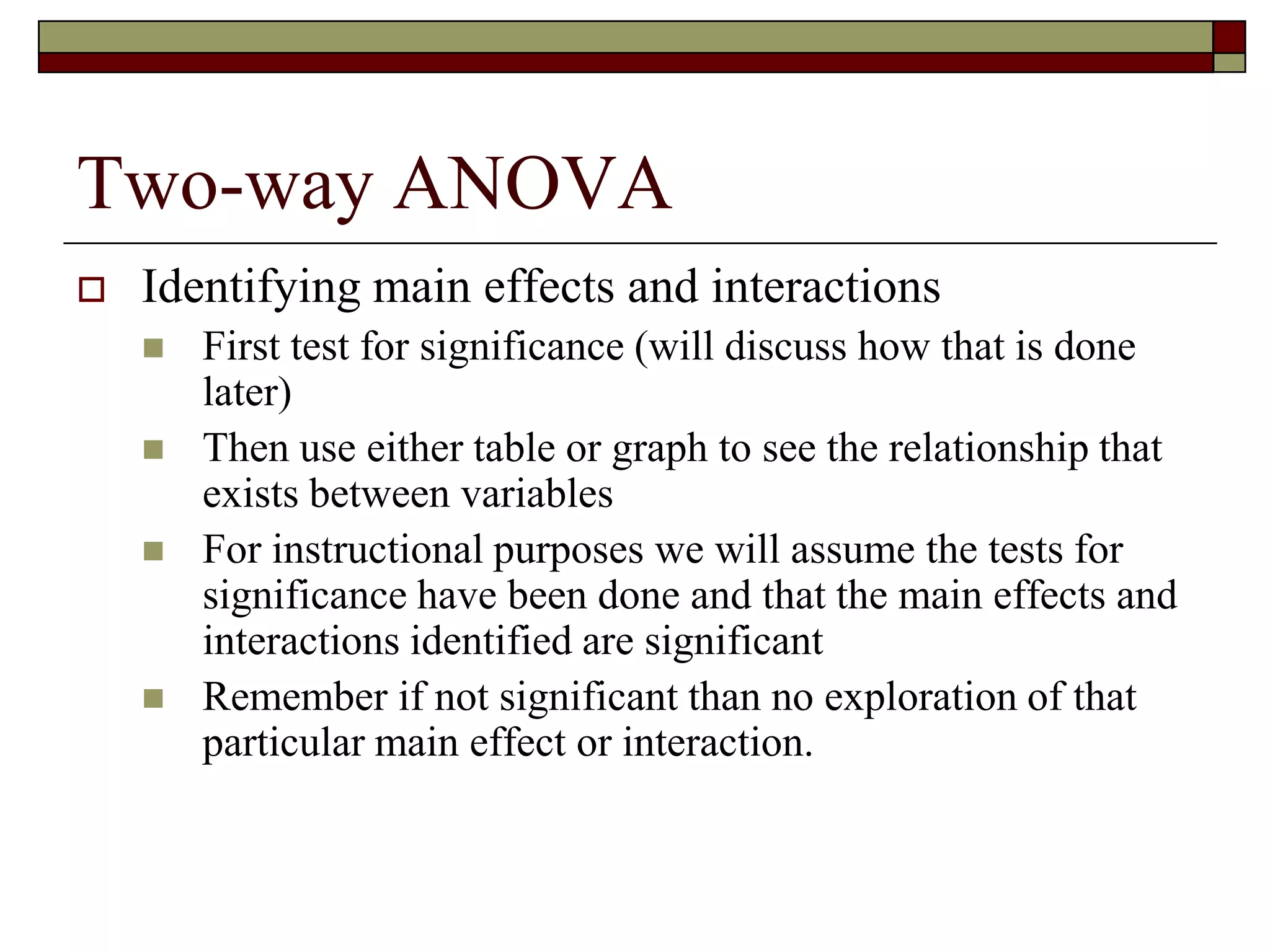
 Identifying main effects and interactions
 First test for significance (will discuss how that is done
later)
 Then use either table or graph to see the relationship that
exists between variables
 For instructional purposes we will assume the tests for
significance have been done and that the main effects and
interactions identified are significant
 Remember if not significant than no exploration of that
particular main effect or interaction.
Group 1 Group 2
Group 3 Group 4
Starter Relief
rookie
veteranExperience
Level
Pitcher Type
Marginal Mean
For Rookie
Marginal Mean
For Veteran
Marginal Mean
For Starter
Marginal Mean
For Relief
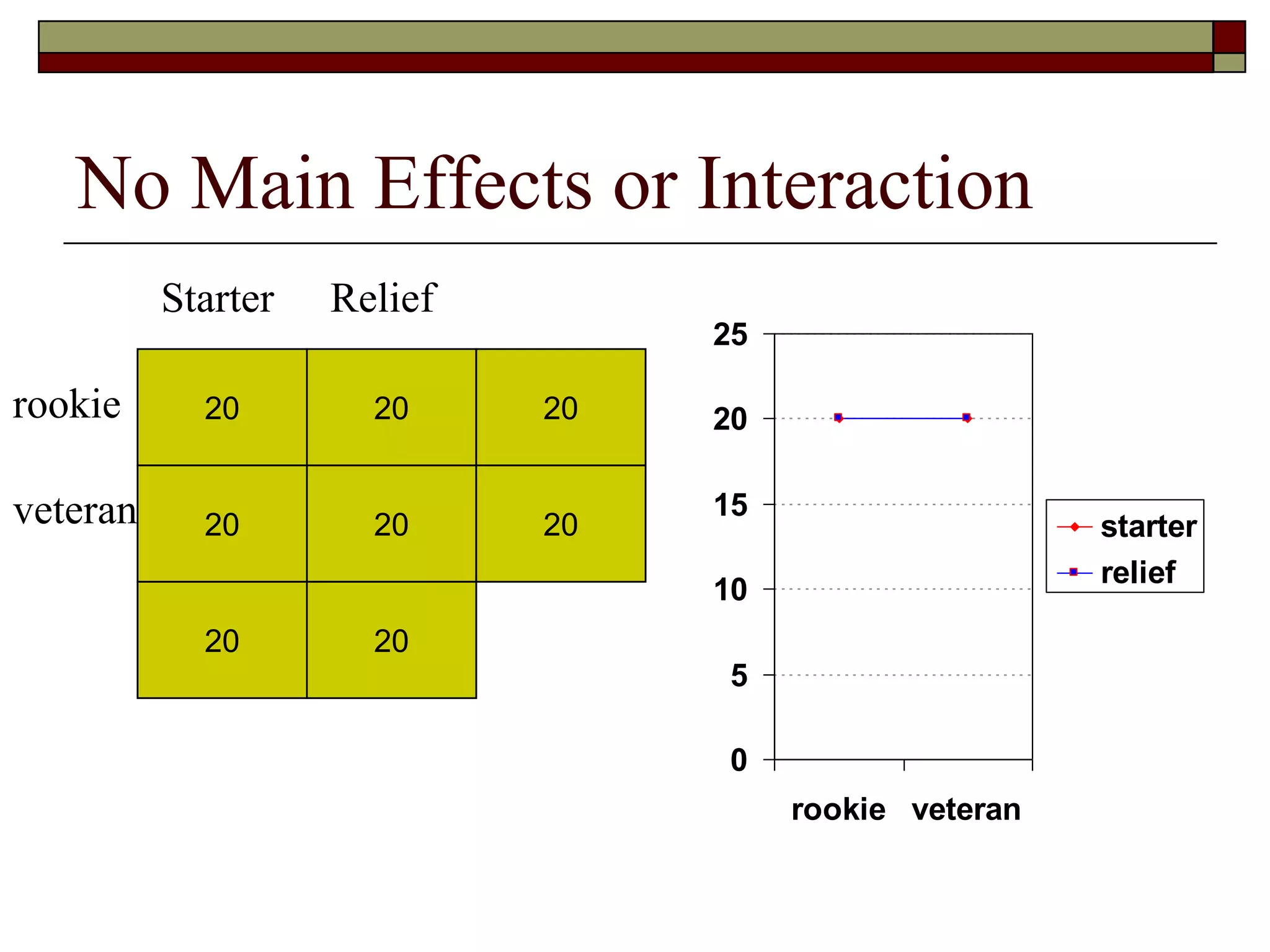
No Main Effects or Interaction
20 20
Starter Relief
rookie
veteran
20
20 20 20
20 20
0
5
10
15
20
25
rookie veteran
starter
relief
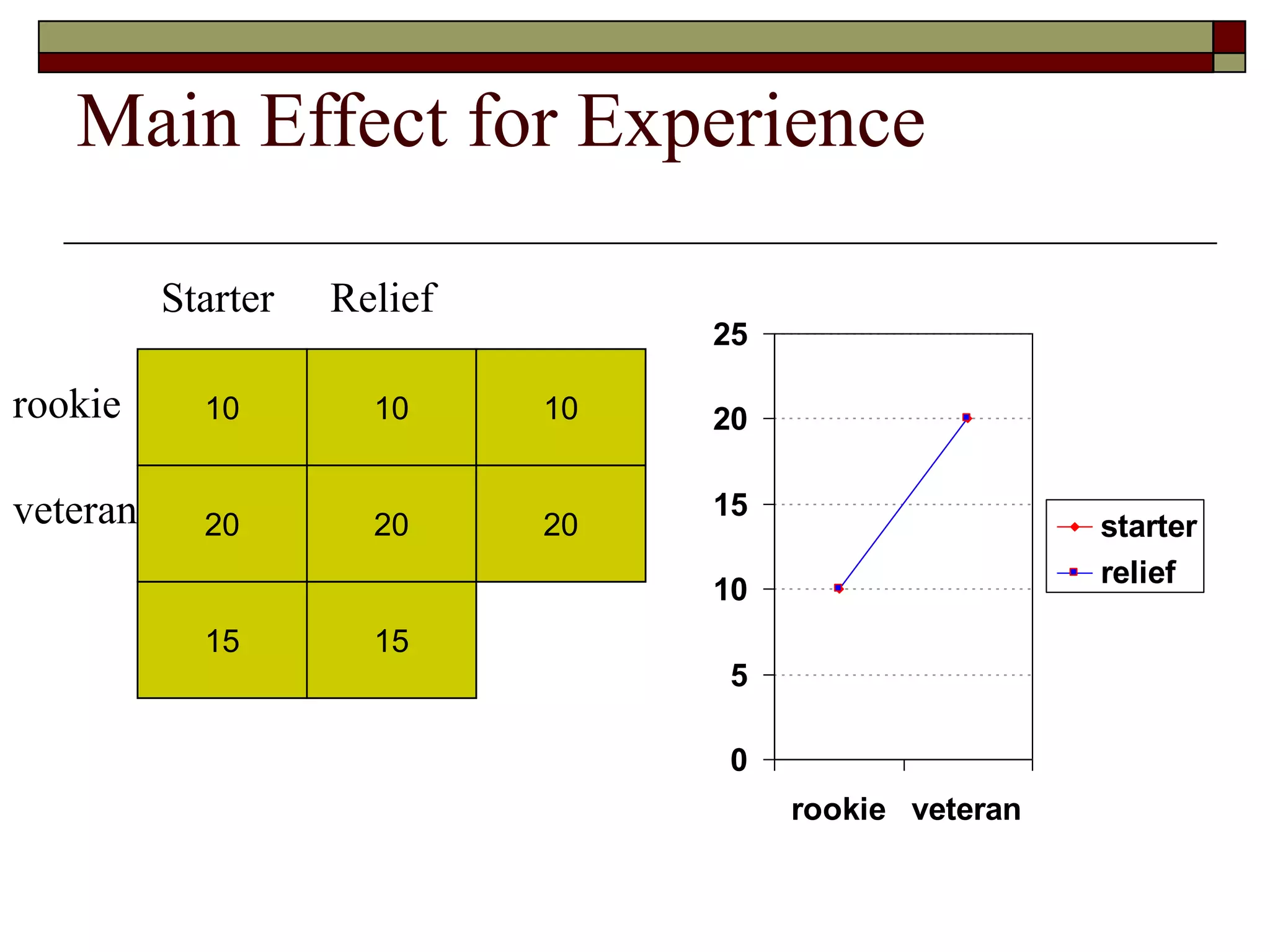
Main Effect for Experience
10 10
Starter Relief
rookie
veteran
10
20 20 20
15 15
0
5
10
15
20
25
rookie veteran
starter
relief
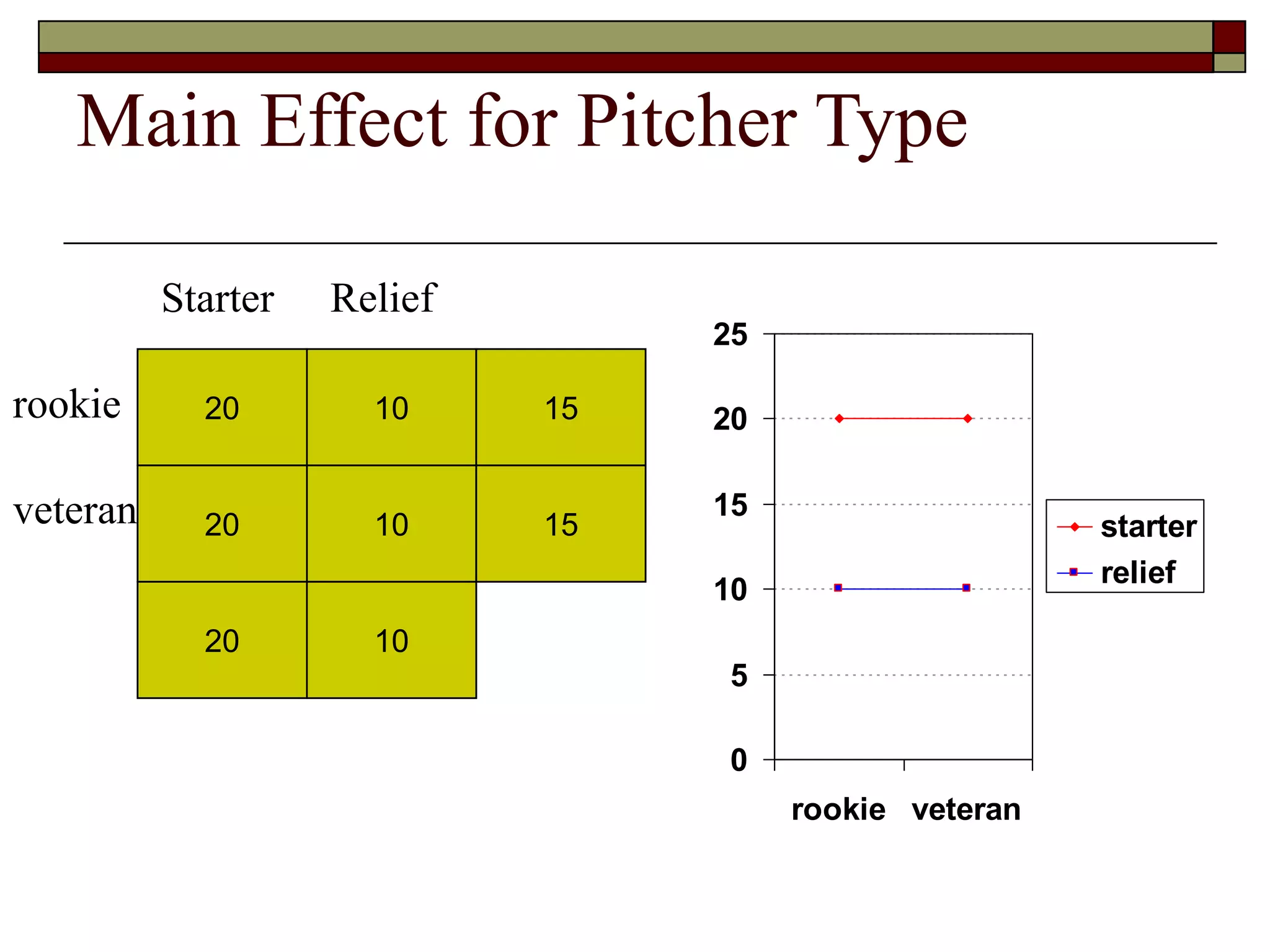
Main Effect for Pitcher Type
20 10
Starter Relief
rookie
veteran
15
20 10 15
20 10
0
5
10
15
20
25
rookie veteran
starter
relief
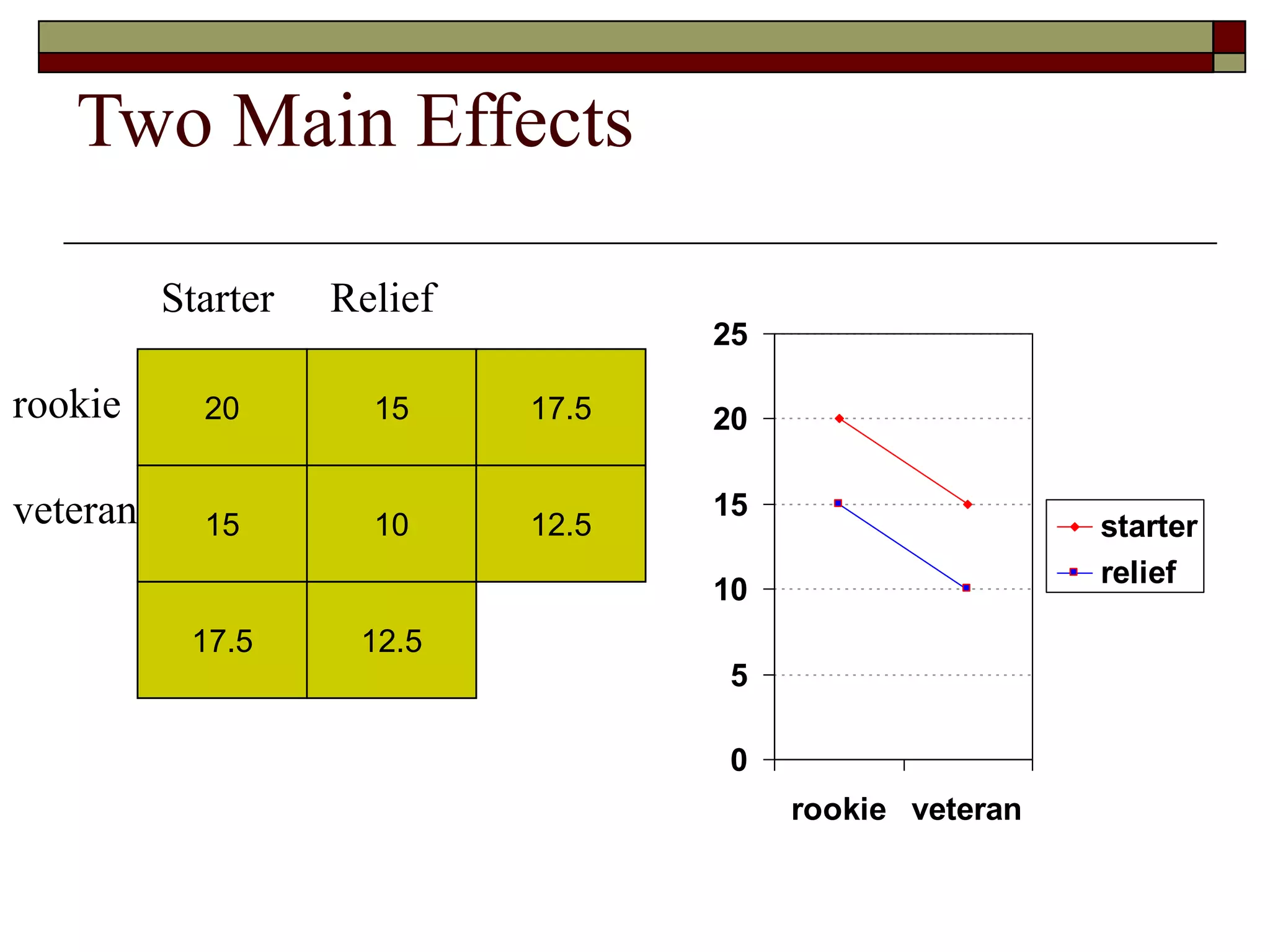
Two Main Effects
20 15
Starter Relief
rookie
veteran
17.5
15 10 12.5
17.5 12.5
0
5
10
15
20
25
rookie veteran
starter
relief
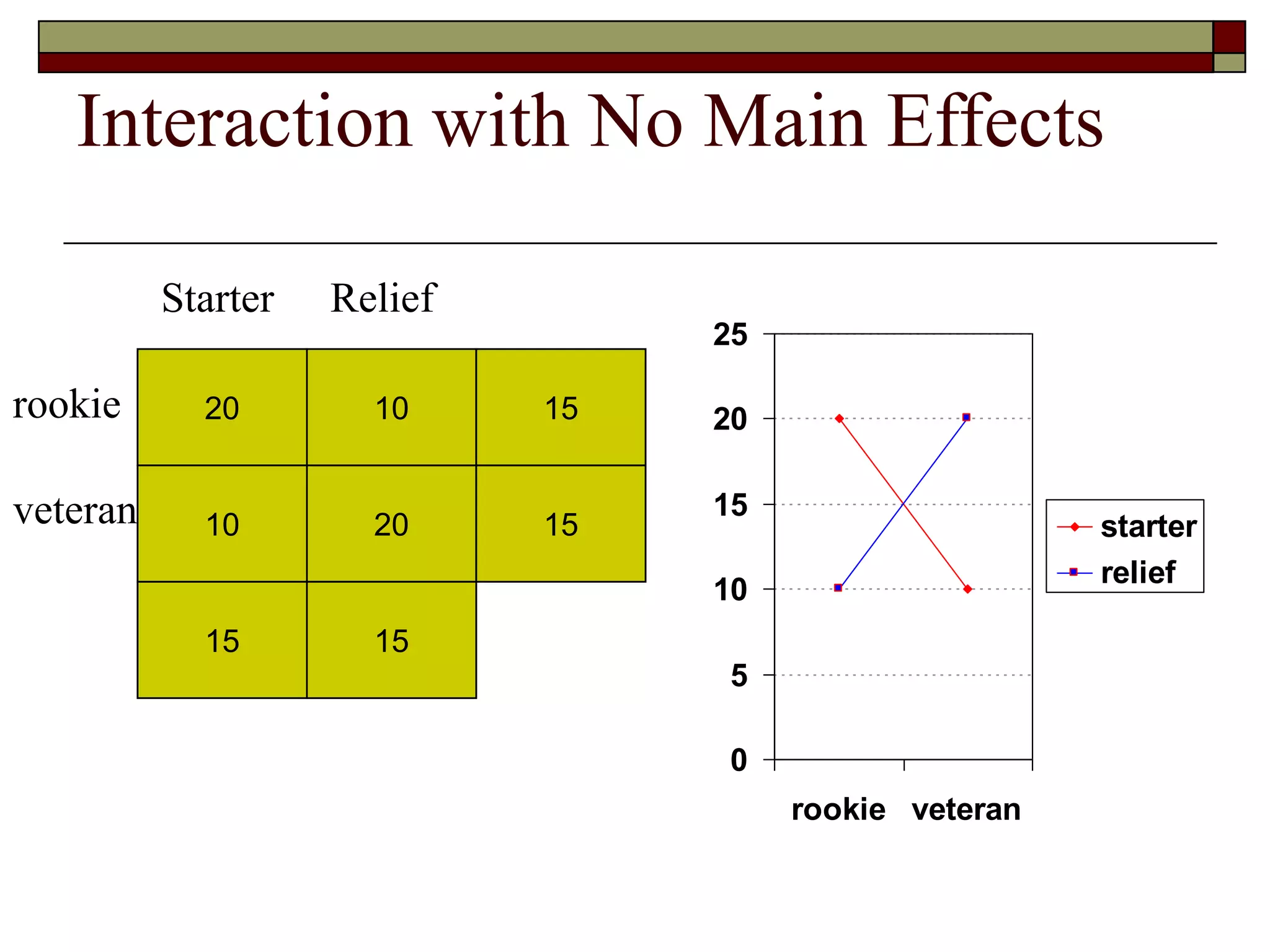
Interaction with No Main Effects
20 10
Starter Relief
rookie
veteran
15
10 20 15
15 15
0
5
10
15
20
25
rookie veteran
starter
relief
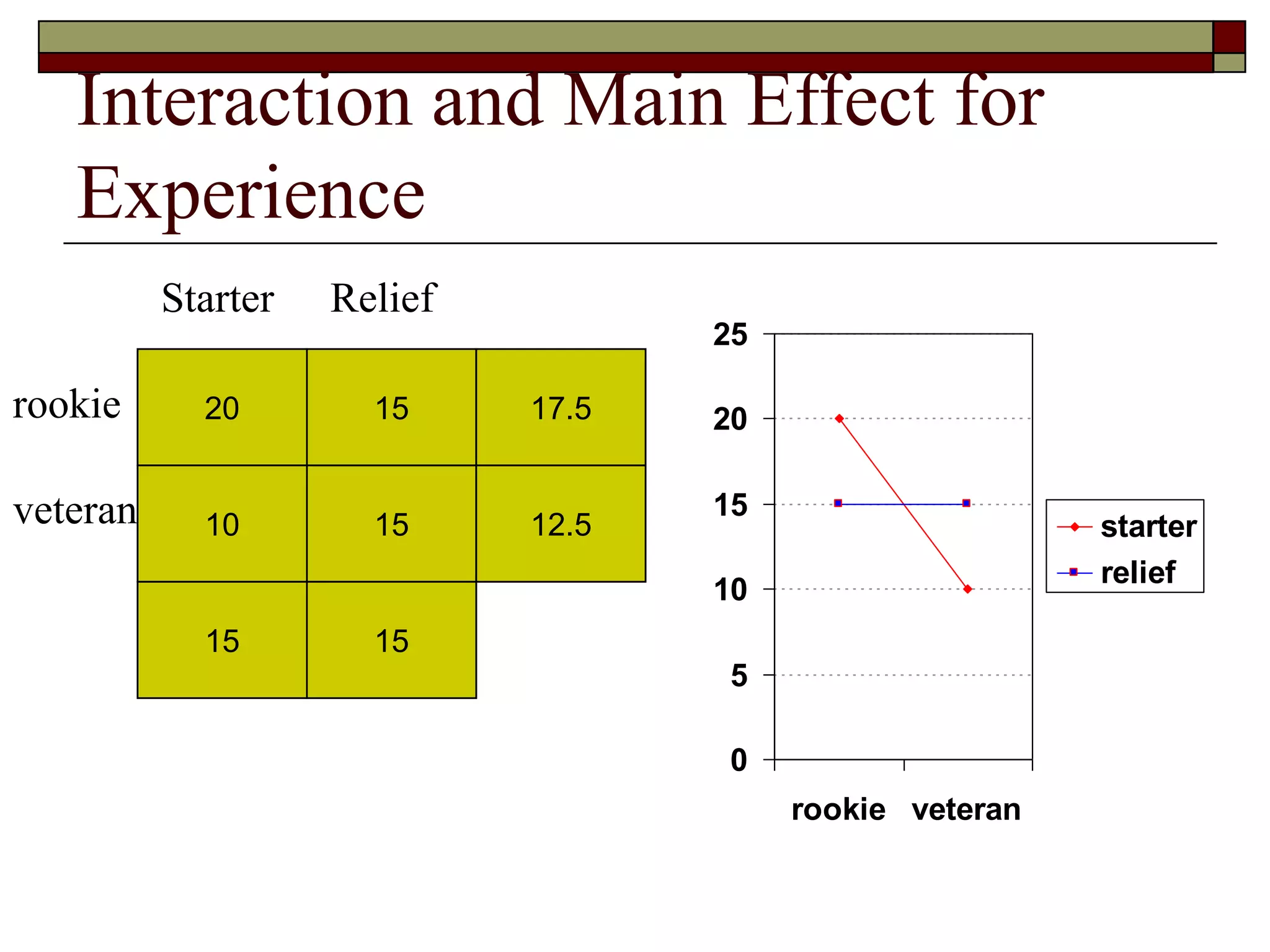
Interaction and Main Effect for
Experience
20 15
Starter Relief
rookie
veteran
17.5
10 15 12.5
15 15
0
5
10
15
20
25
rookie veteran
starter
relief
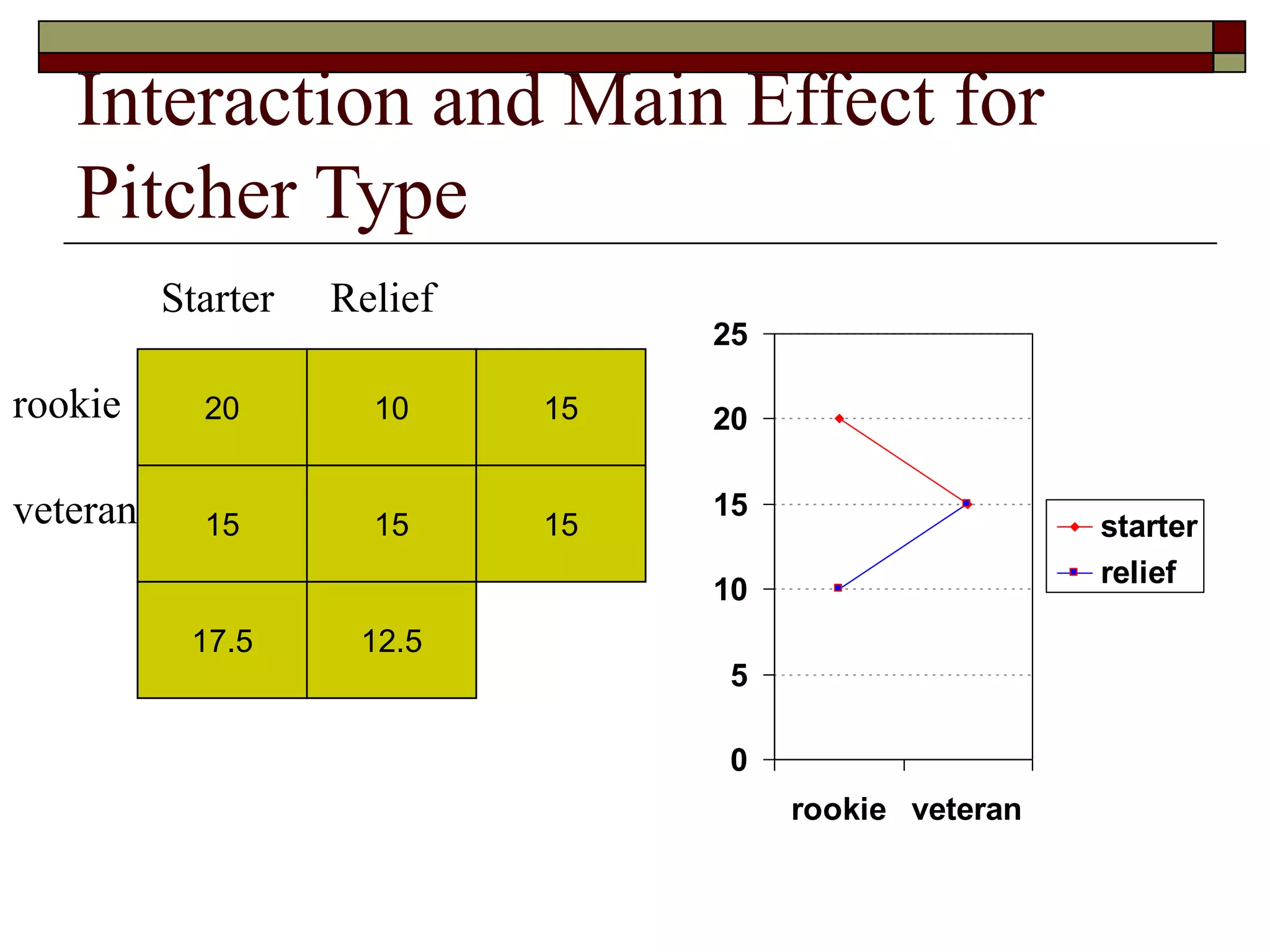
Interaction and Main Effect for
Pitcher Type
20 10
Starter Relief
rookie
veteran
15
15 15 15
17.5 12.5
0
5
10
15
20
25
rookie veteran
starter
relief
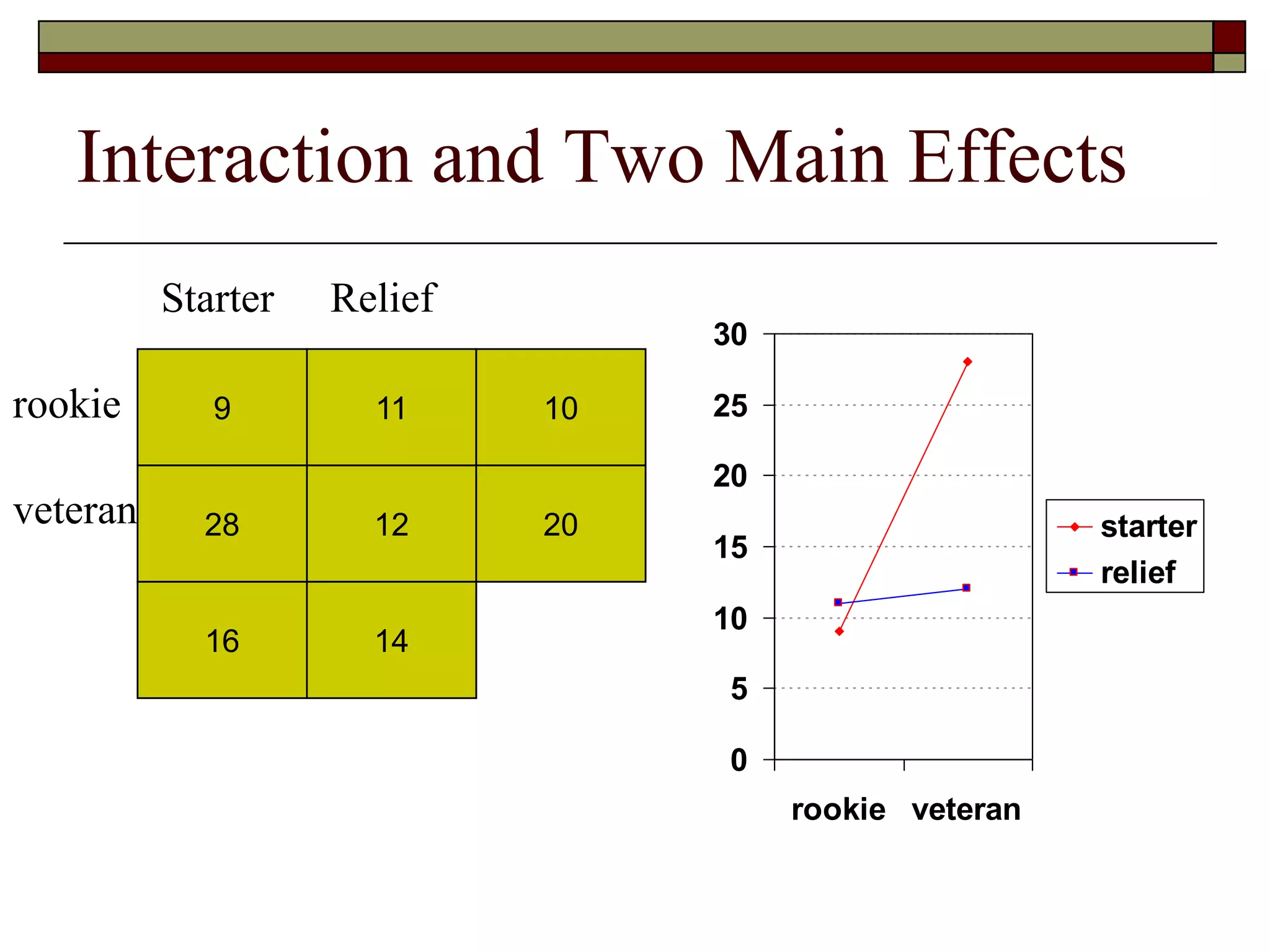
Interaction and Two Main Effects
9 11
Starter Relief
rookie
veteran
10
28 12 20
16 14
0
5
10
15
20
25
30
rookie veteran
starter
relief
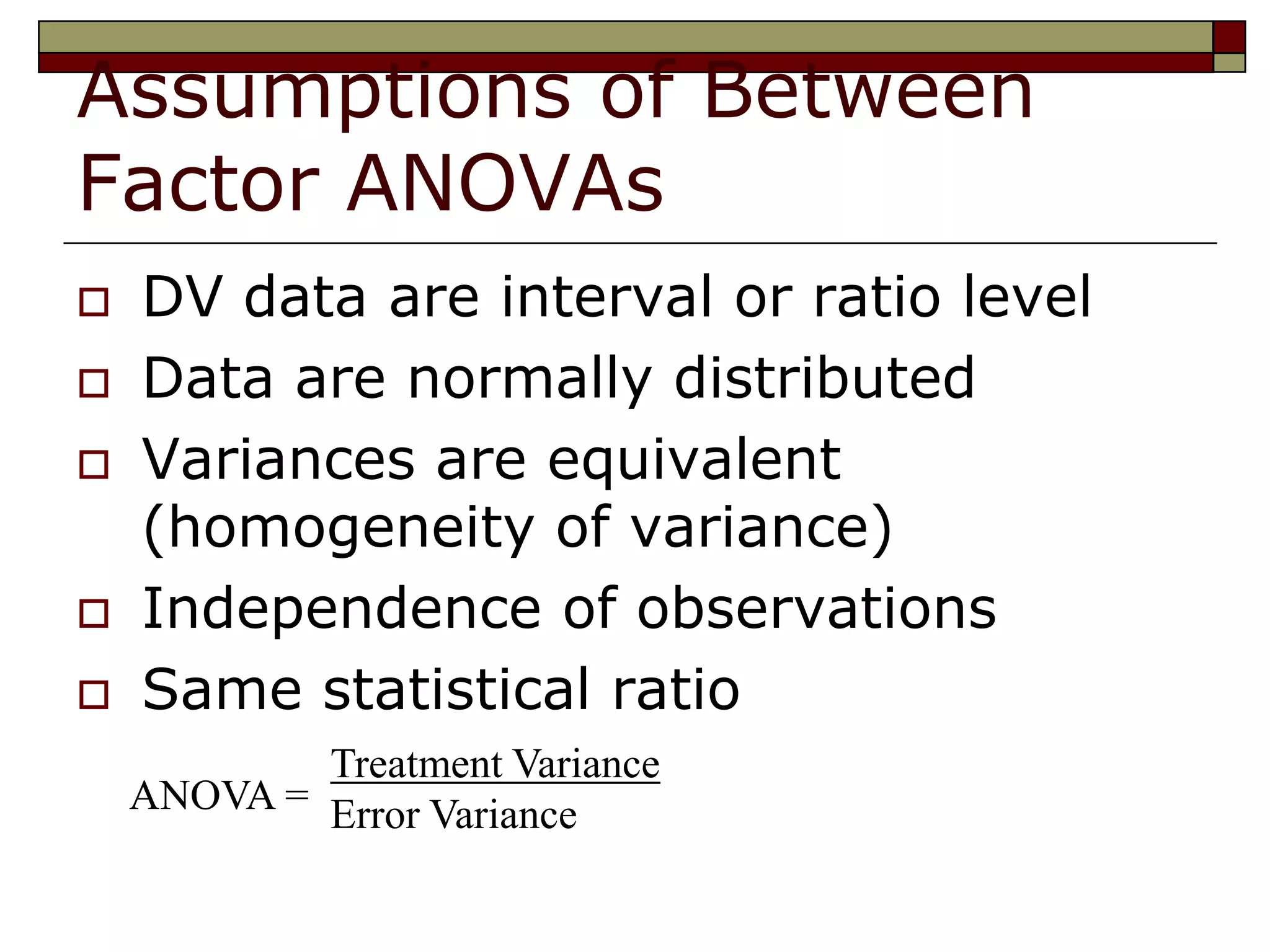
Assumptions of Between
Factor ANOVAs
 DV data are interval or ratio level
 Data are normally distributed
 Variances are equivalent
(homogeneity of variance)
 Independence of observations
 Same statistical ratio
ANOVA =
Treatment Variance
Error Variance
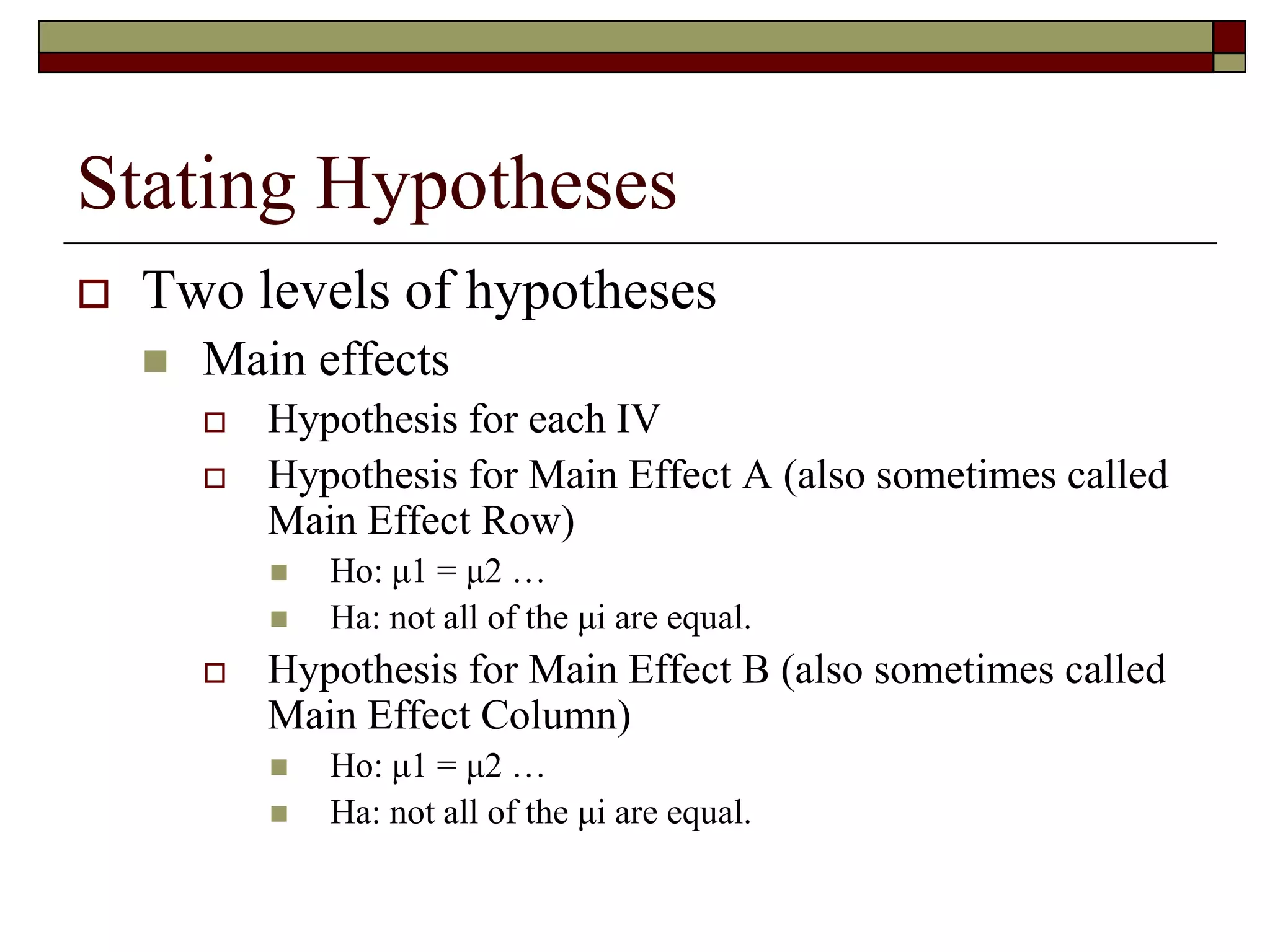
Stating Hypotheses
 Two levels of hypotheses
 Main effects
 Hypothesis for each IV
 Hypothesis for Main Effect A (also sometimes called
Main Effect Row)
 Ho: μ1 = μ2 …
 Ha: not all of the μi are equal.
 Hypothesis for Main Effect B (also sometimes called
Main Effect Column)
 Ho: μ1 = μ2 …
 Ha: not all of the μi are equal.
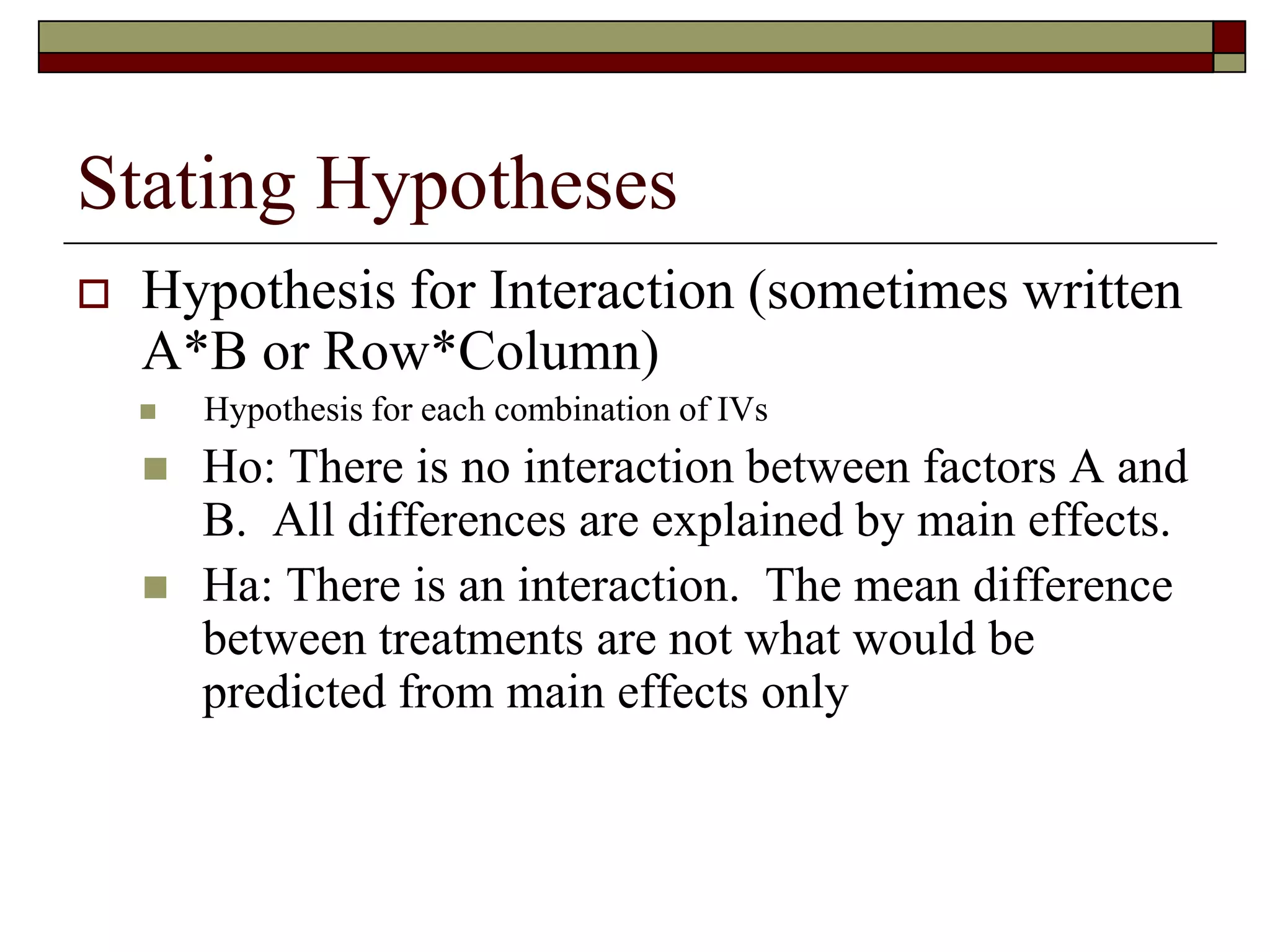
Stating Hypotheses
 Hypothesis for Interaction (sometimes written
A*B or Row*Column)
 Hypothesis for each combination of IVs
 Ho: There is no interaction between factors A and
B. All differences are explained by main effects.
 Ha: There is an interaction. The mean difference
between treatments are not what would be
predicted from main effects only
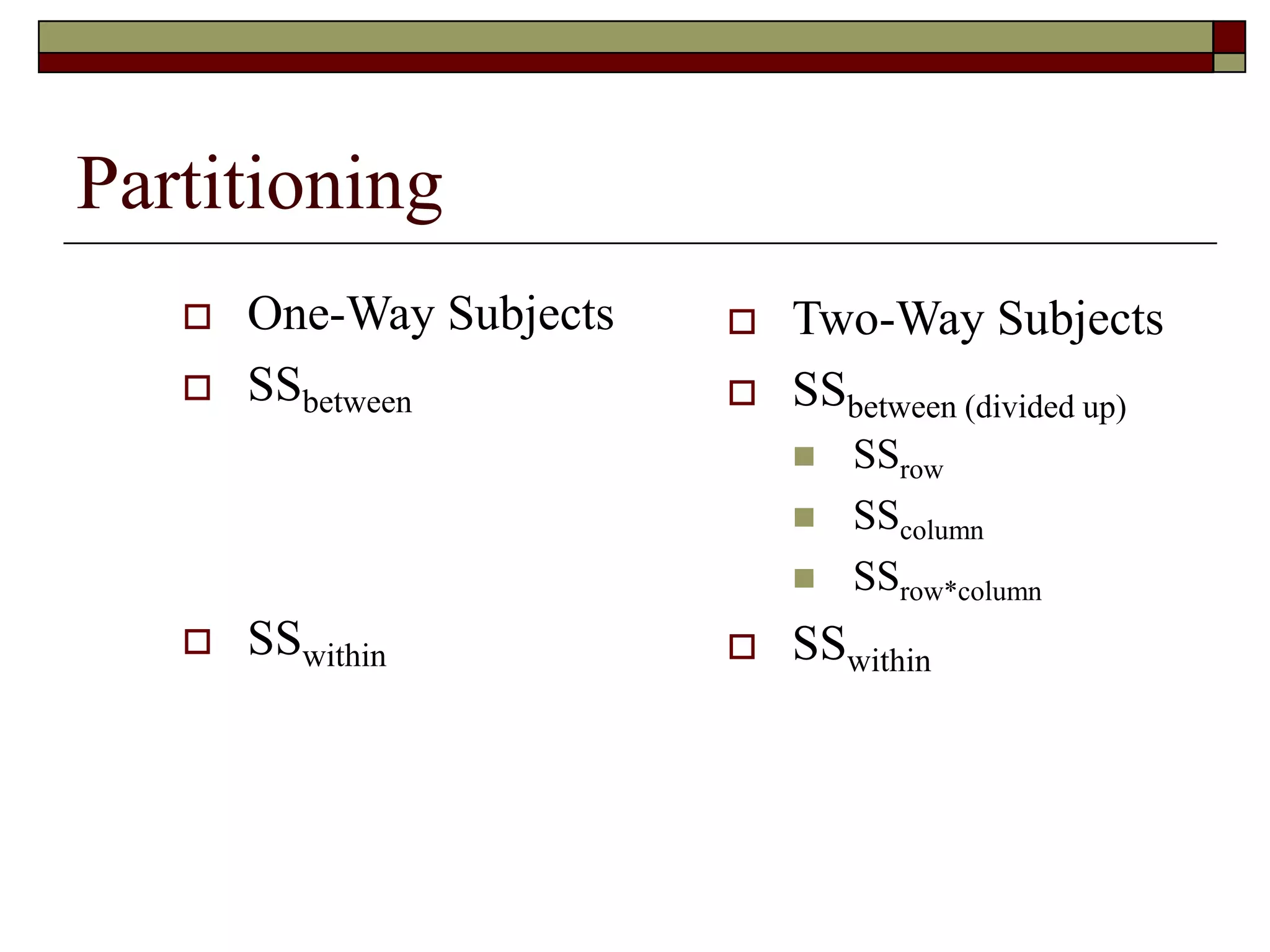
Partitioning
 One-Way Subjects
 SSbetween
 SSwithin
 Two-Way Subjects
 SSbetween (divided up)
 SSrow
 SScolumn
 SSrow*column
 SSwithin
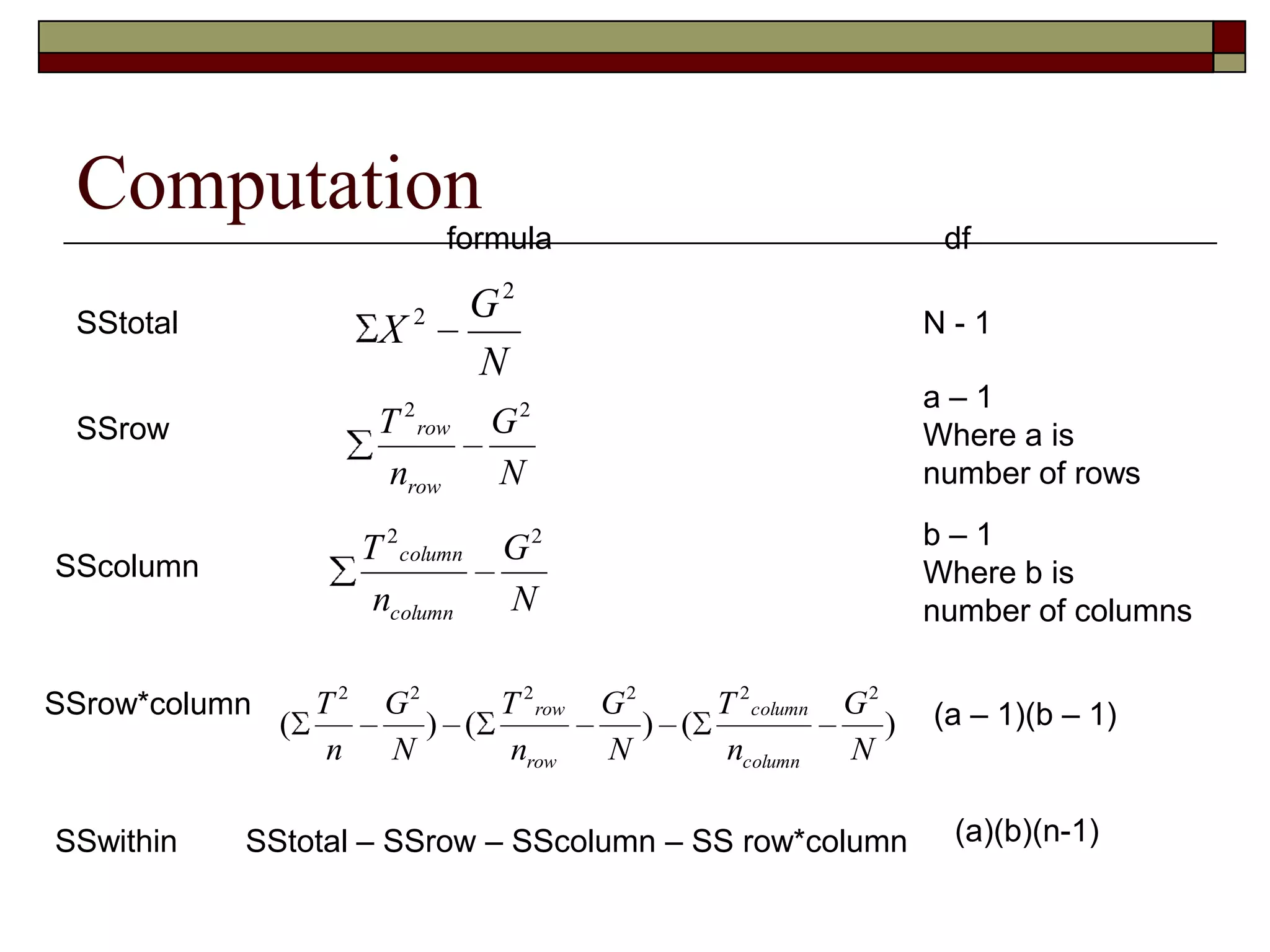
Computation
N
G
X
2
2
)()()(
222222
N
G
n
T
N
G
n
T
N
G
n
T
column
column
row
row
SStotal
formula df
N - 1
SSrow
SScolumn
SSrow*column
N
G
n
T
row
row
22
SSwithin SStotal – SSrow – SScolumn – SS row*column
a – 1
Where a is
number of rows
b – 1
Where b is
number of columns
(a – 1)(b – 1)
(a)(b)(n-1)
N
G
n
T
column
column
22
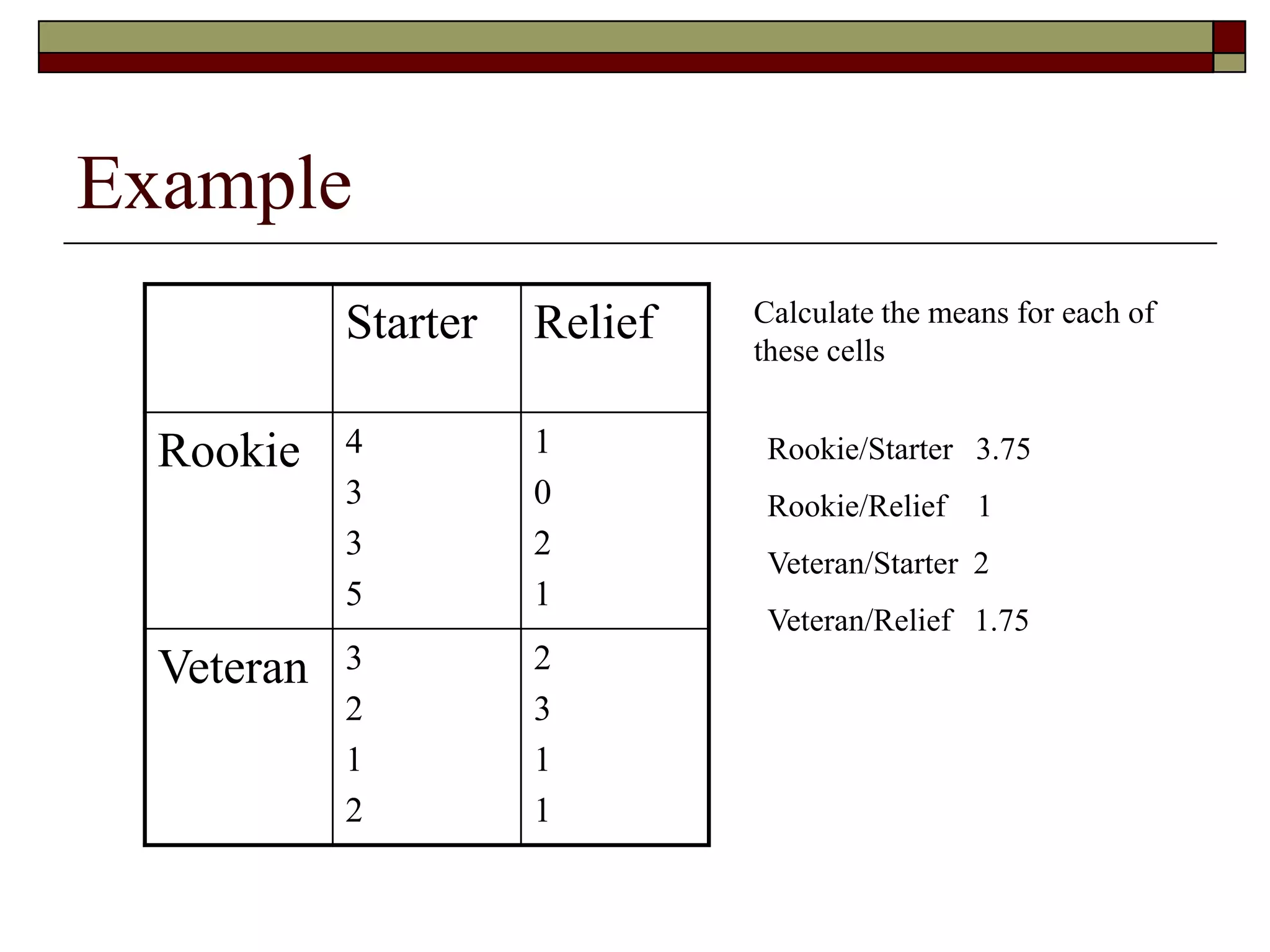
Example
Starter Relief
Rookie 4
3
3
5
1
0
2
1
Veteran 3
2
1
2
2
3
1
1
Calculate the means for each of
these cells
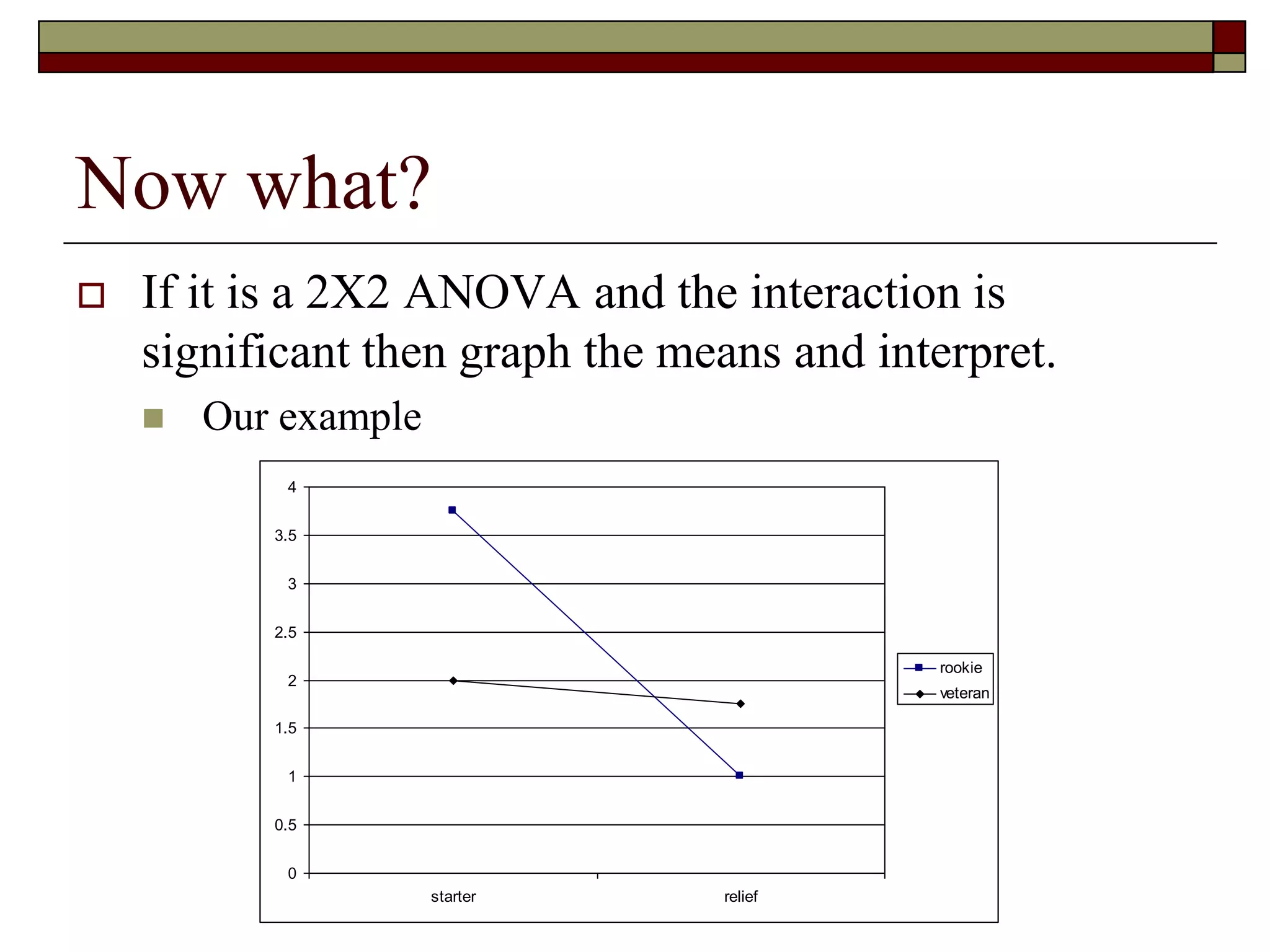
Rookie/Starter 3.75
Rookie/Relief 1
Veteran/Starter 2
Veteran/Relief 1.75
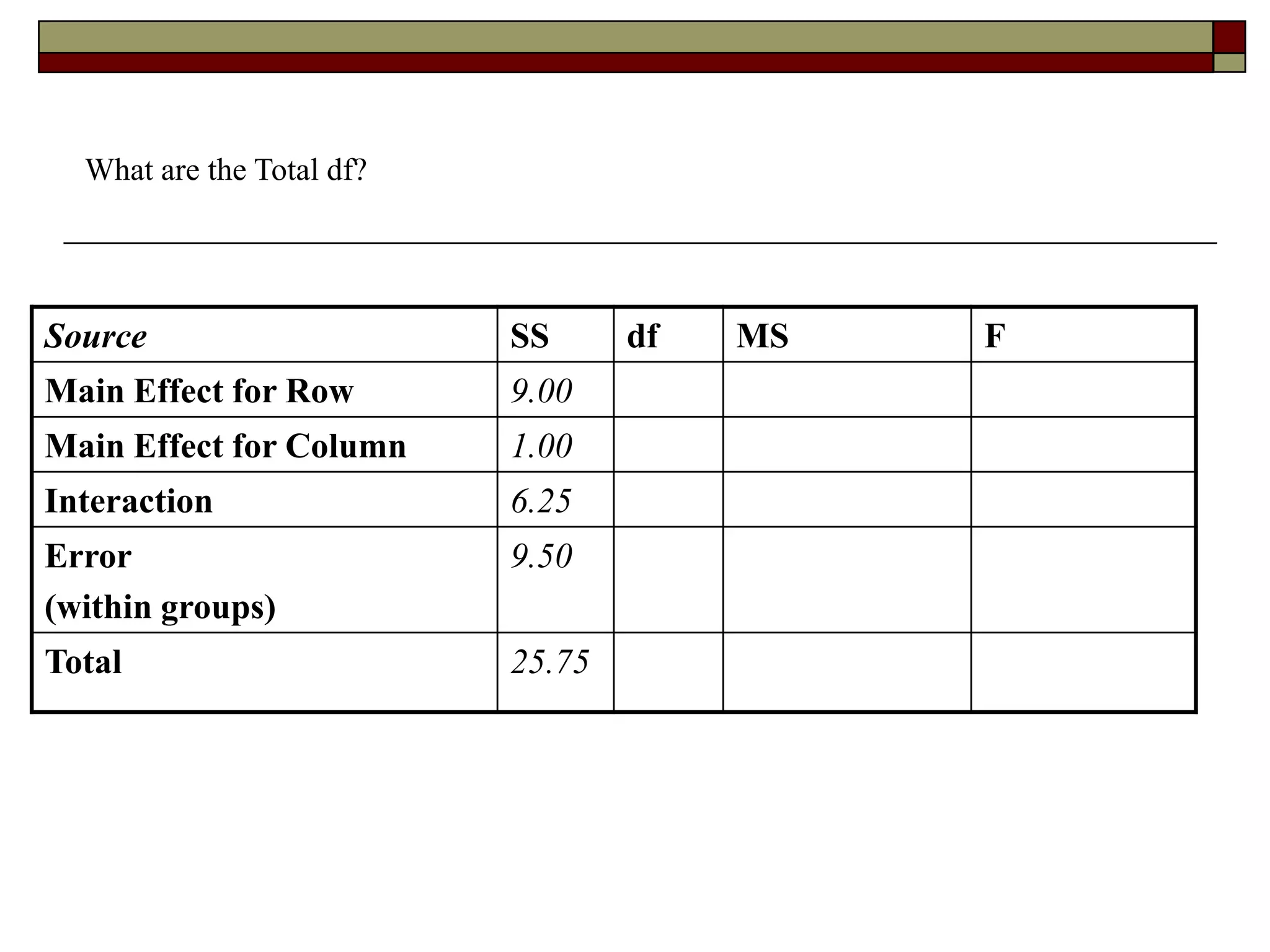
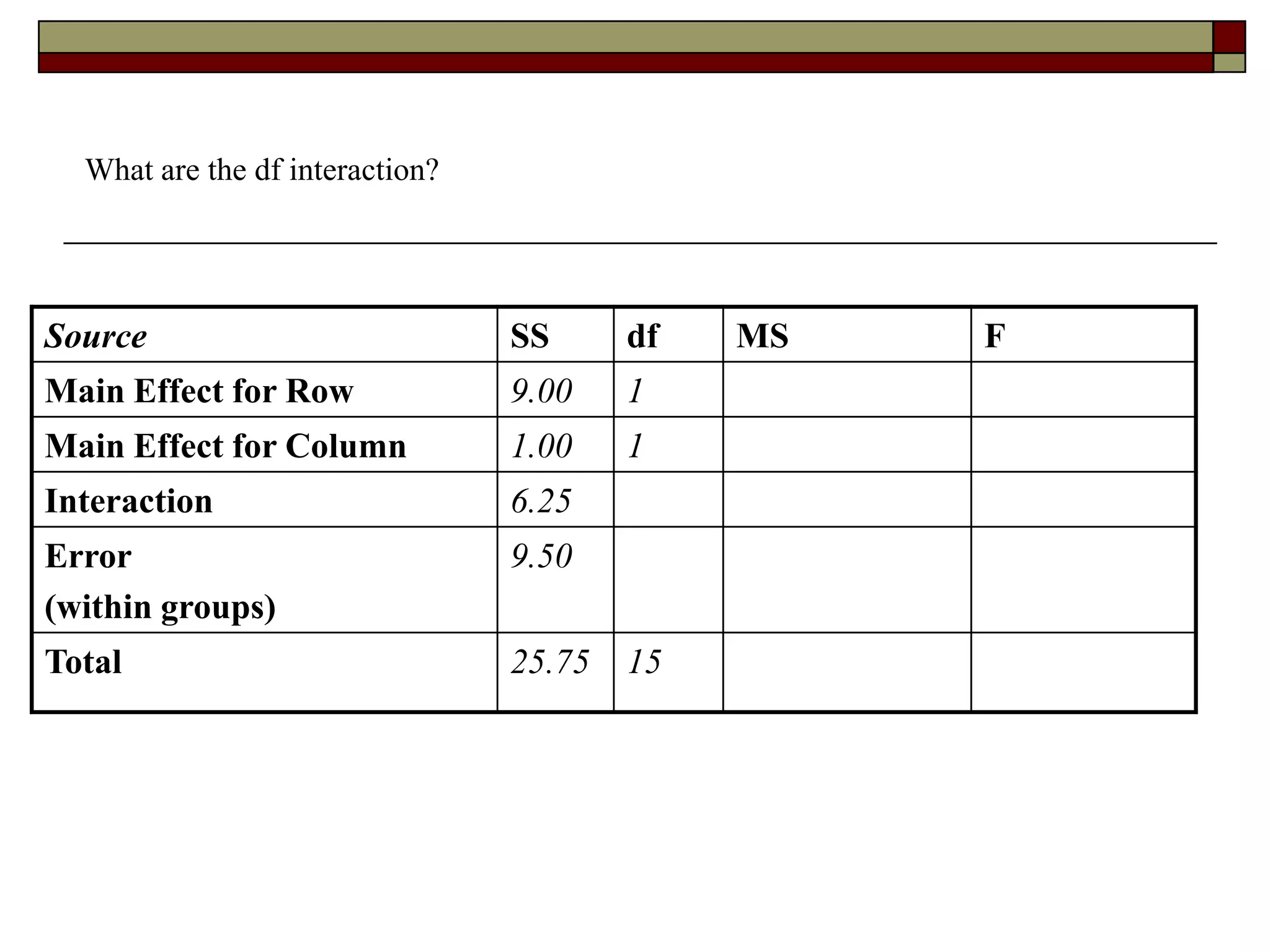
What are the Total df?
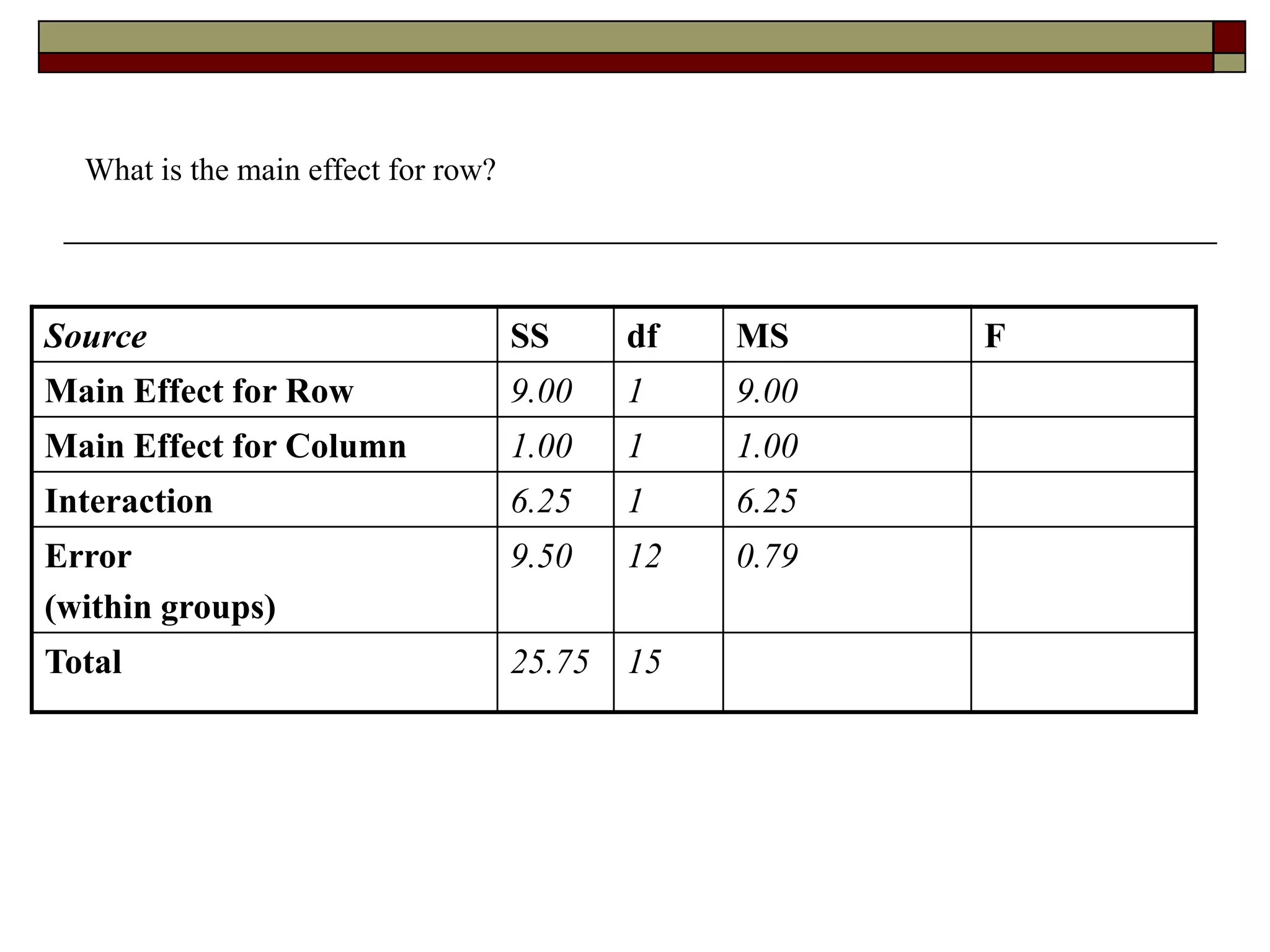
Source SS df MS F
Main Effect for Row 9.00
Main Effect for Column 1.00
Interaction 6.25
Error
(within groups)
9.50
Total 25.75
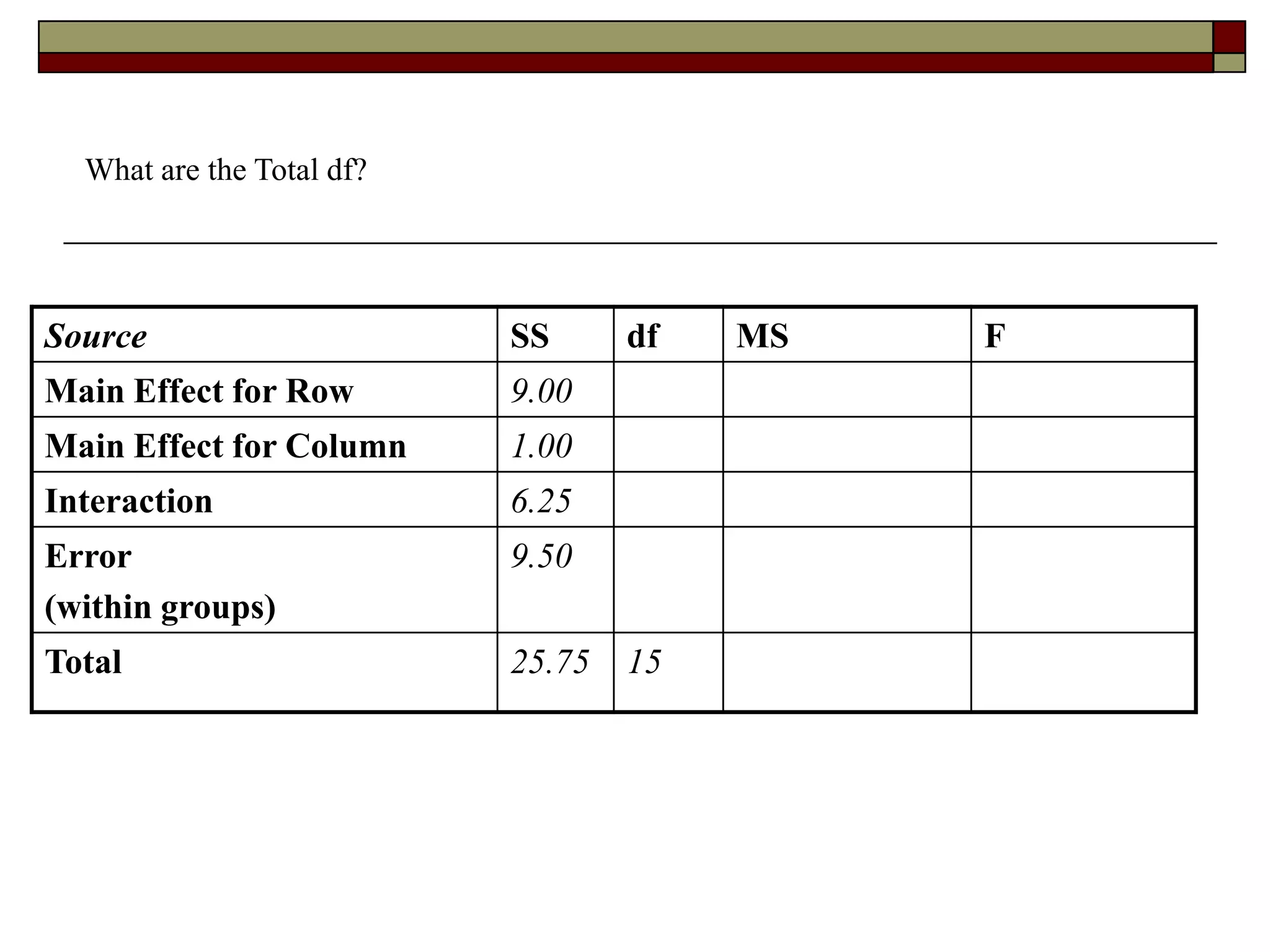
What are the Total df?
Source SS df MS F
Main Effect for Row 9.00
Main Effect for Column 1.00
Interaction 6.25
Error
(within groups)
9.50
Total 25.75 15
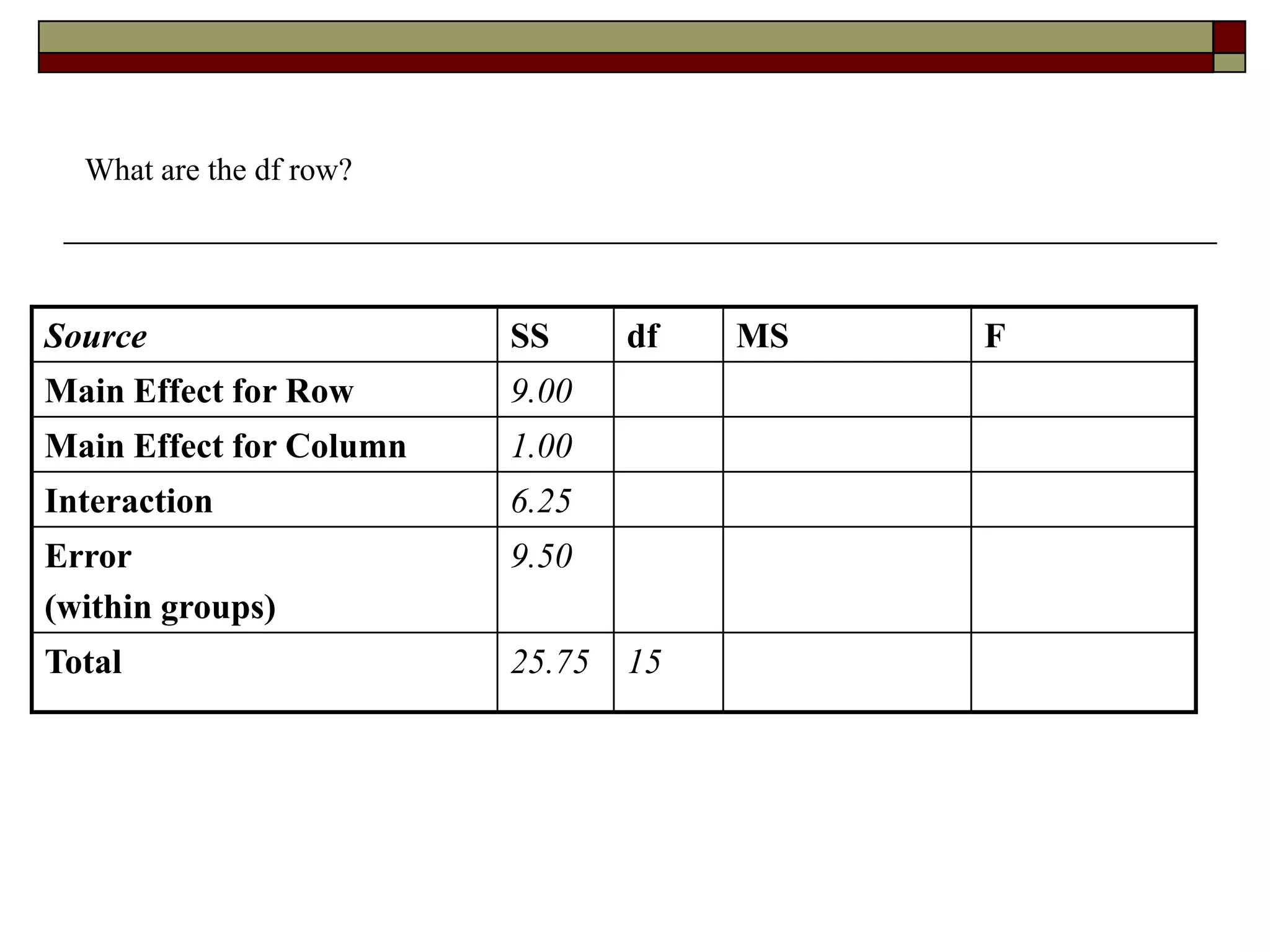
What are the df row?
Source SS df MS F
Main Effect for Row 9.00
Main Effect for Column 1.00
Interaction 6.25
Error
(within groups)
9.50
Total 25.75 15
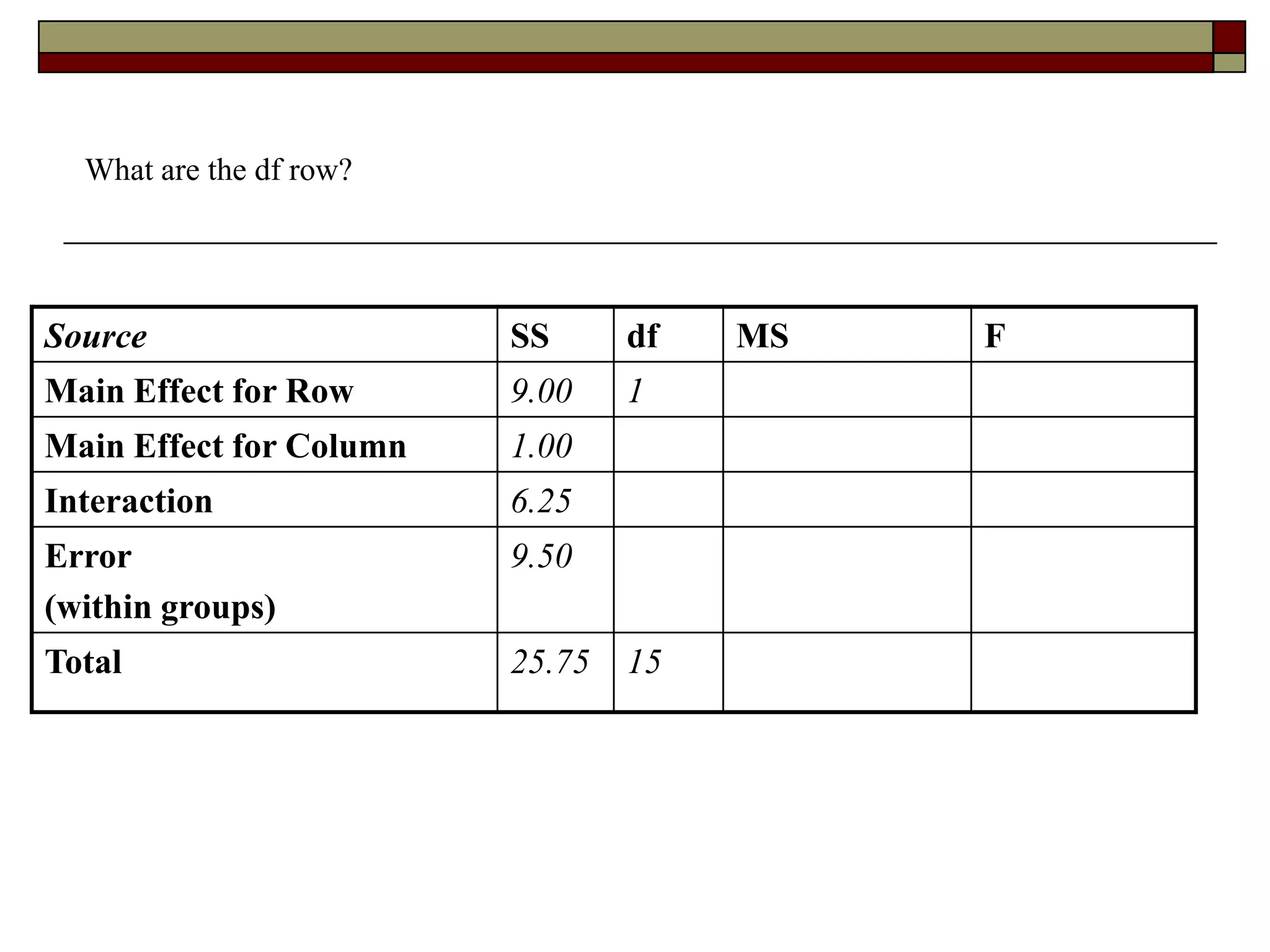
What are the df row?
Source SS df MS F
Main Effect for Row 9.00 1
Main Effect for Column 1.00
Interaction 6.25
Error
(within groups)
9.50
Total 25.75 15
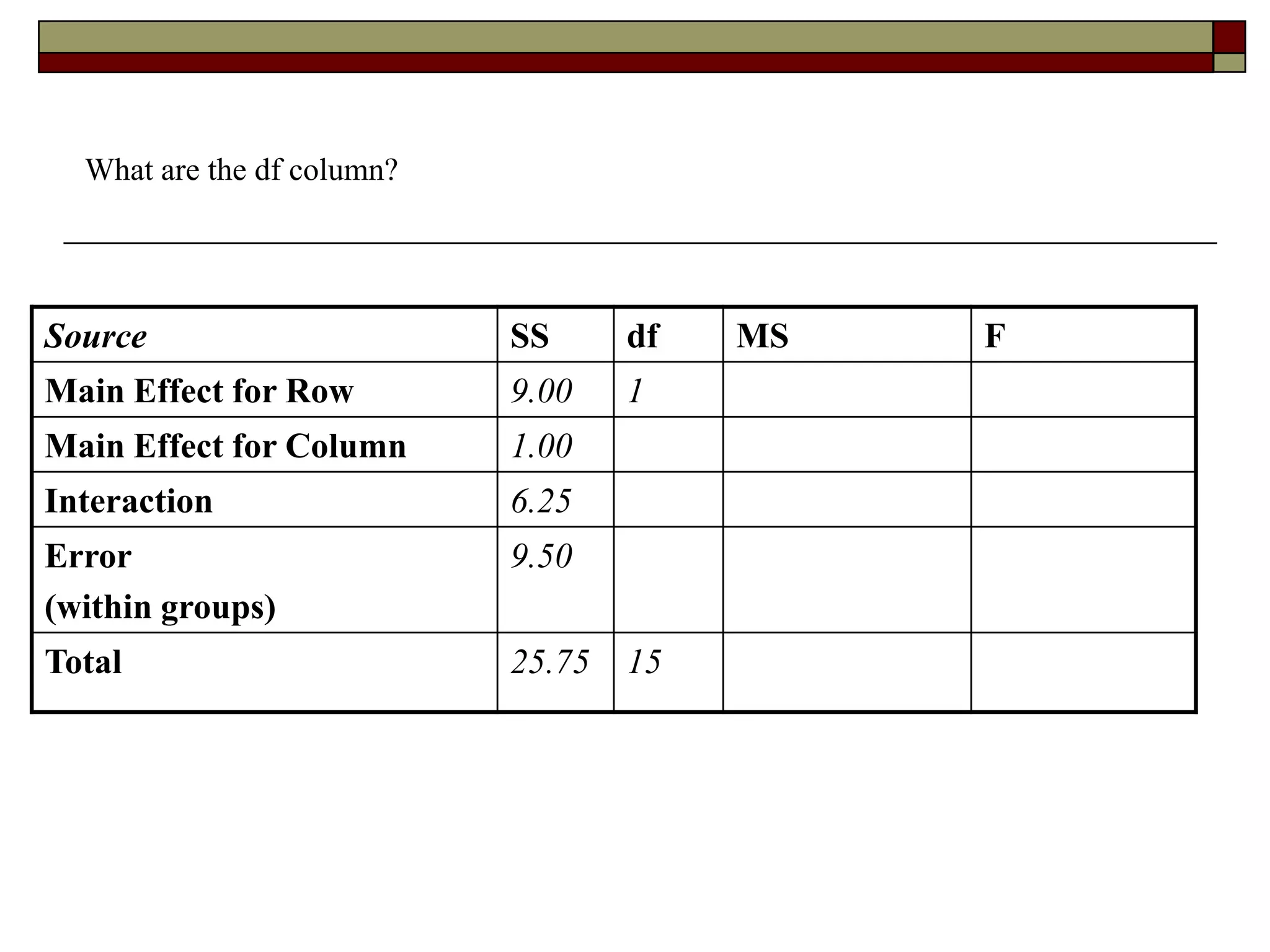
What are the df column?
Source SS df MS F
Main Effect for Row 9.00 1
Main Effect for Column 1.00
Interaction 6.25
Error
(within groups)
9.50
Total 25.75 15
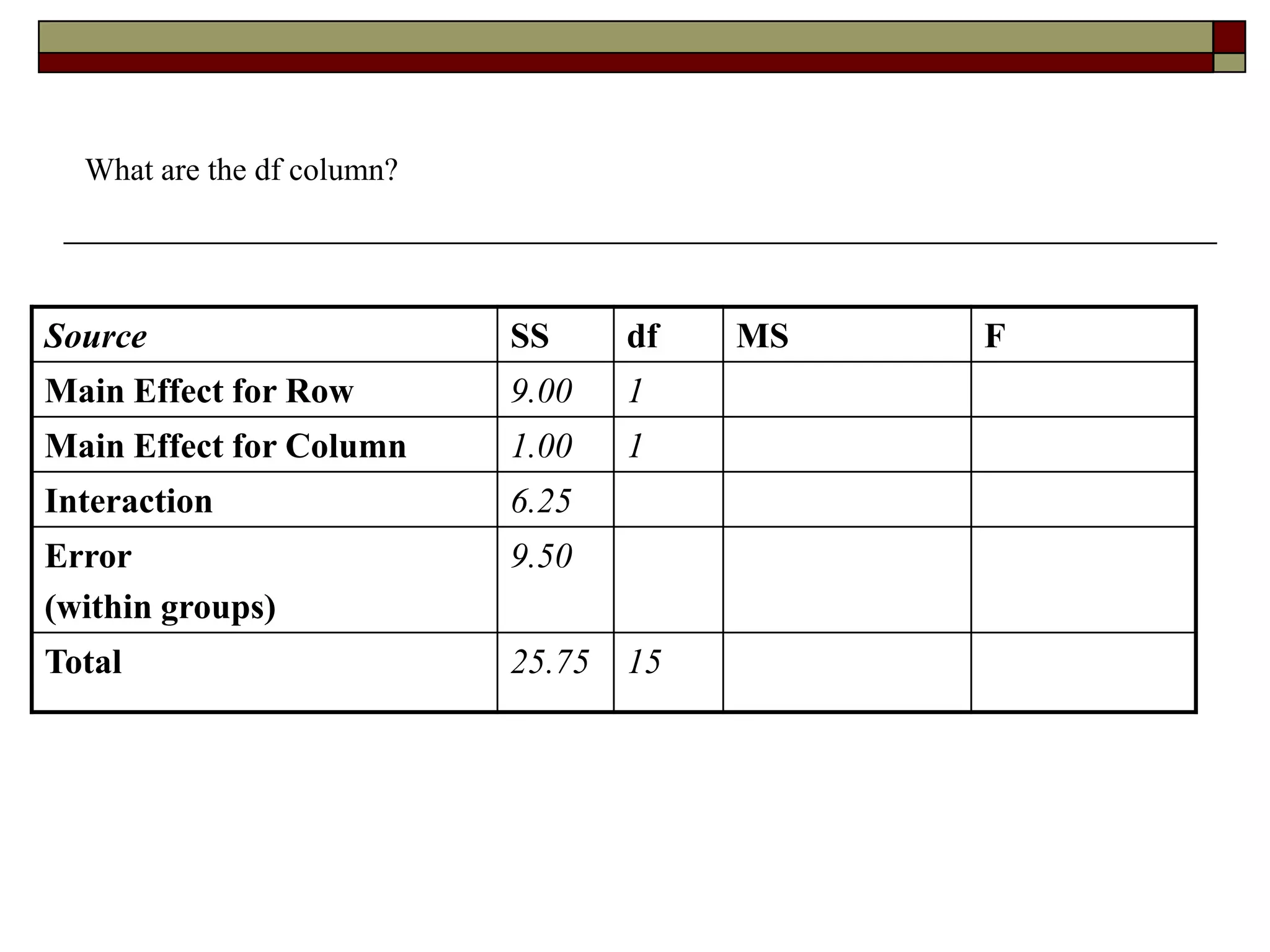
What are the df column?
Source SS df MS F
Main Effect for Row 9.00 1
Main Effect for Column 1.00 1
Interaction 6.25
Error
(within groups)
9.50
Total 25.75 15
What are the df interaction?
Source SS df MS F
Main Effect for Row 9.00 1
Main Effect for Column 1.00 1
Interaction 6.25
Error
(within groups)
9.50
Total 25.75 15
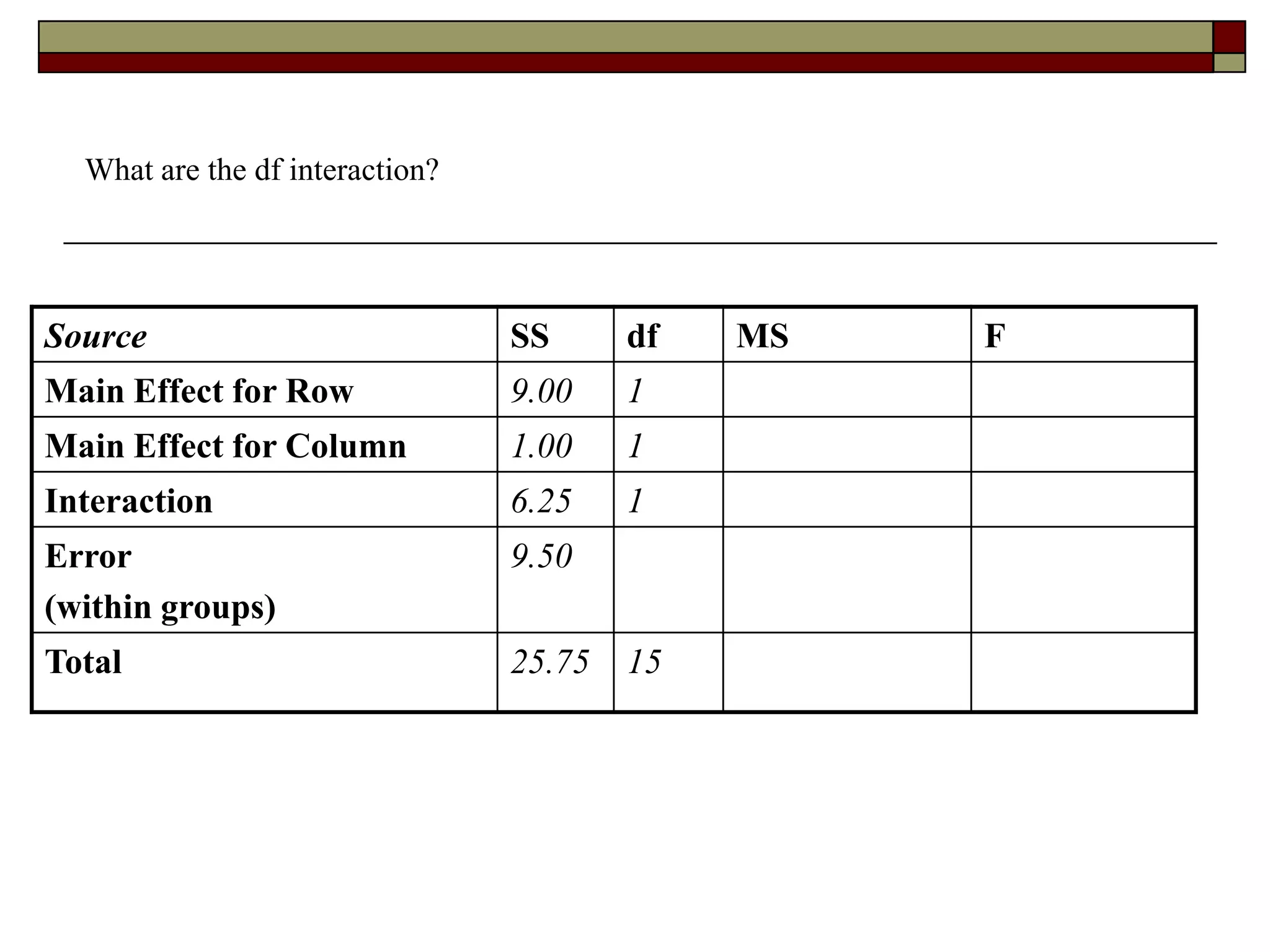
What are the df interaction?
Source SS df MS F
Main Effect for Row 9.00 1
Main Effect for Column 1.00 1
Interaction 6.25 1
Error
(within groups)
9.50
Total 25.75 15
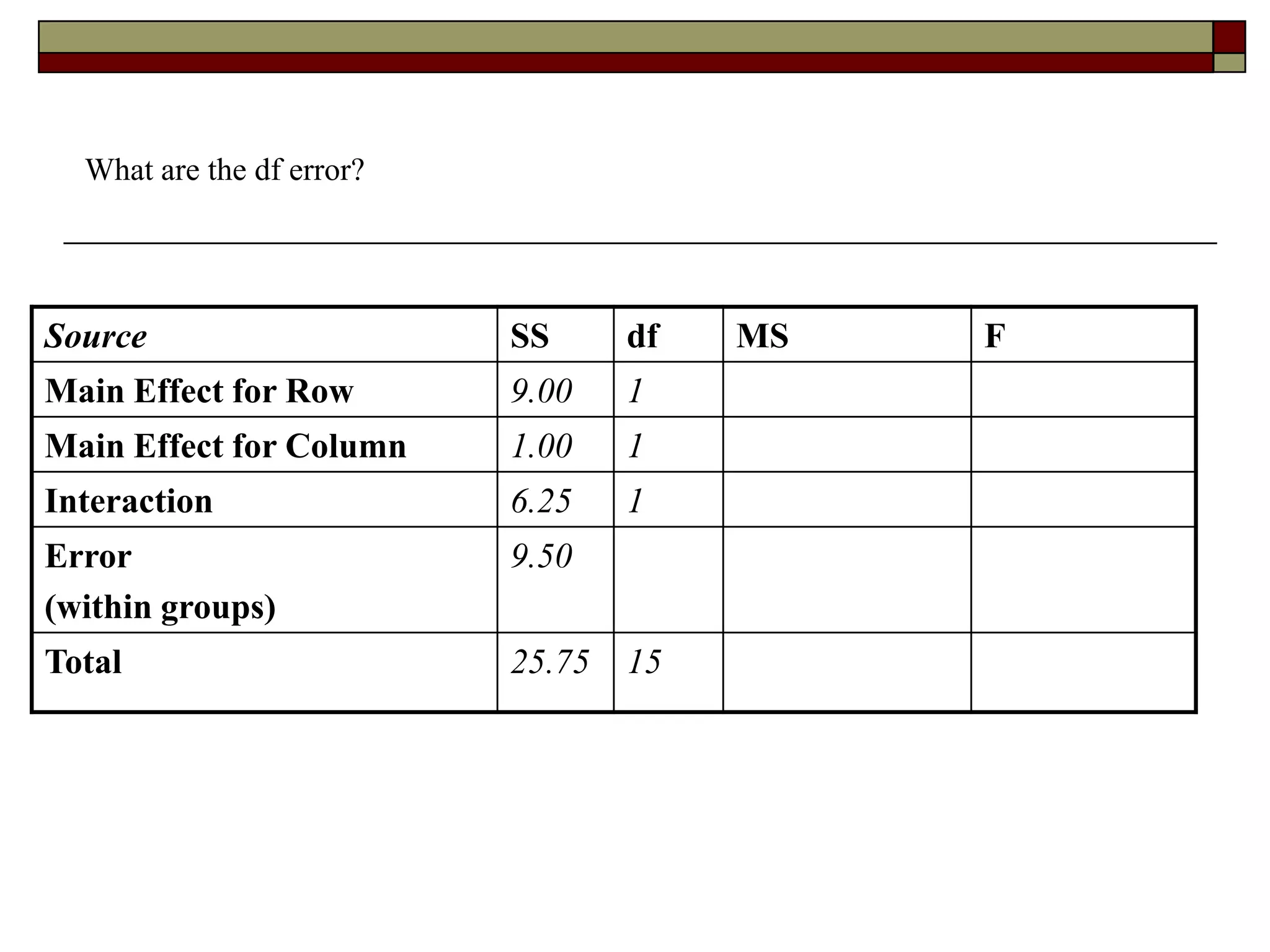
What are the df error?
Source SS df MS F
Main Effect for Row 9.00 1
Main Effect for Column 1.00 1
Interaction 6.25 1
Error
(within groups)
9.50
Total 25.75 15
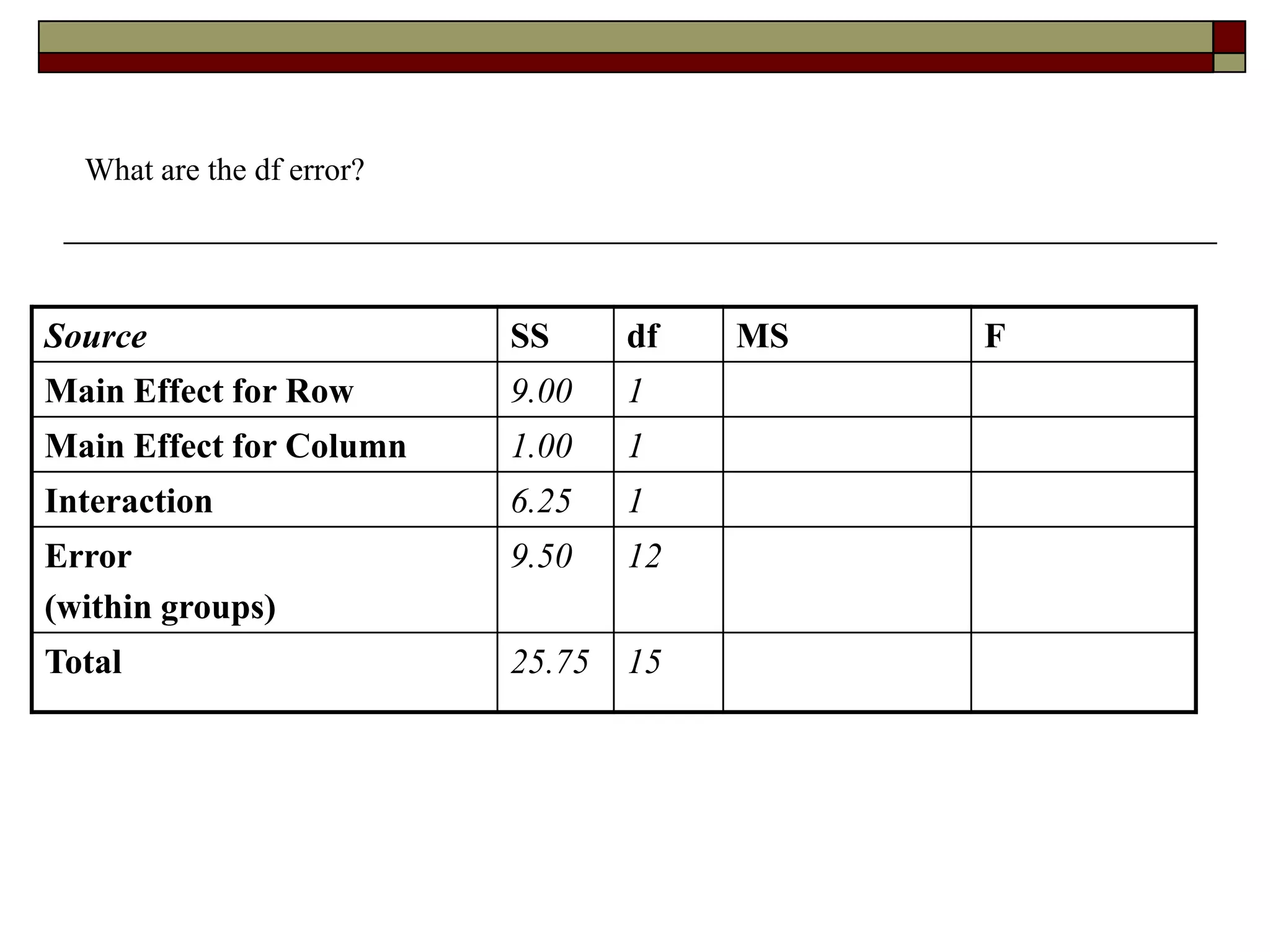
What are the df error?
Source SS df MS F
Main Effect for Row 9.00 1
Main Effect for Column 1.00 1
Interaction 6.25 1
Error
(within groups)
9.50 12
Total 25.75 15
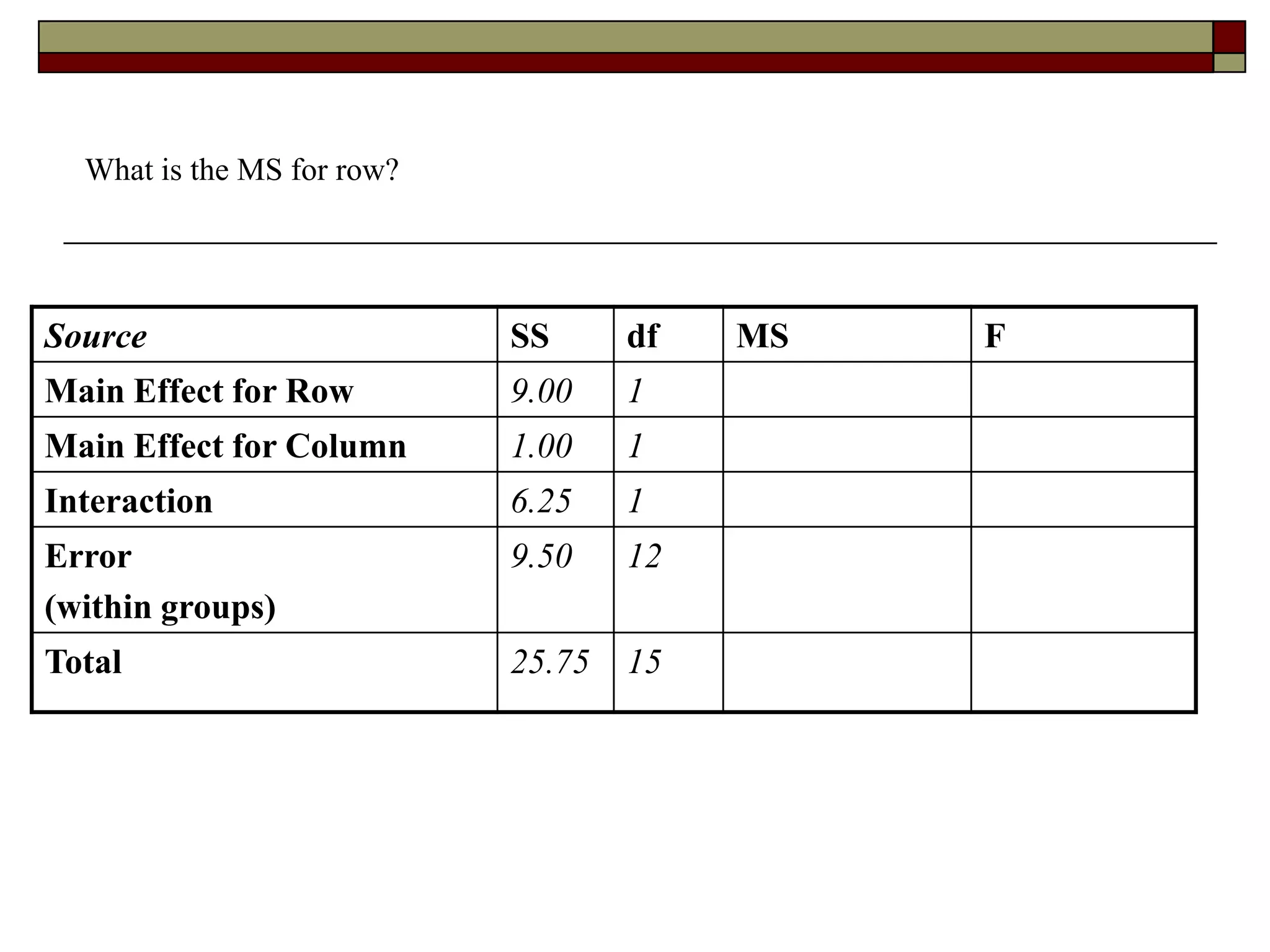
What is the MS for row?
Source SS df MS F
Main Effect for Row 9.00 1
Main Effect for Column 1.00 1
Interaction 6.25 1
Error
(within groups)
9.50 12
Total 25.75 15
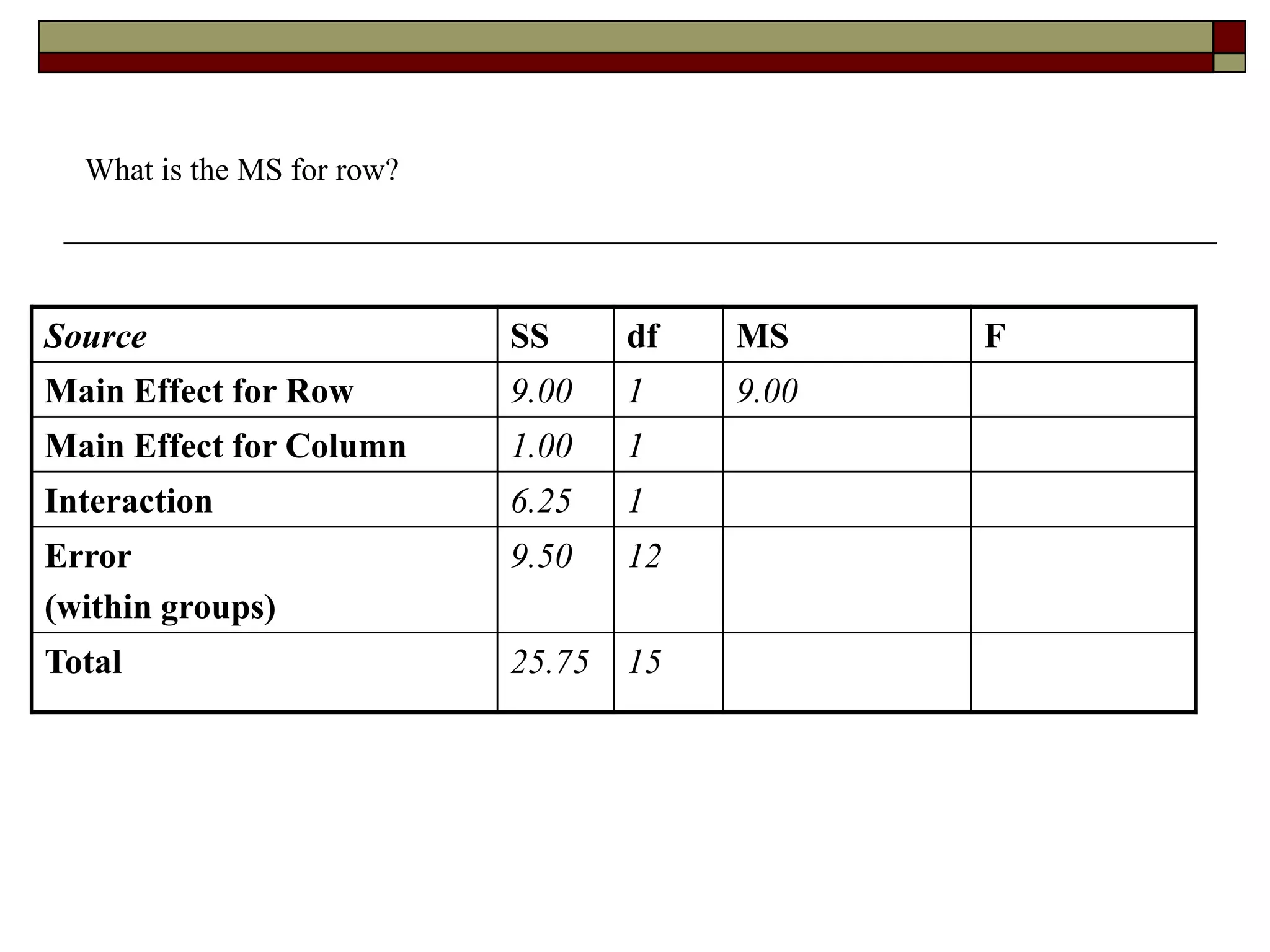
What is the MS for row?
Source SS df MS F
Main Effect for Row 9.00 1 9.00
Main Effect for Column 1.00 1
Interaction 6.25 1
Error
(within groups)
9.50 12
Total 25.75 15
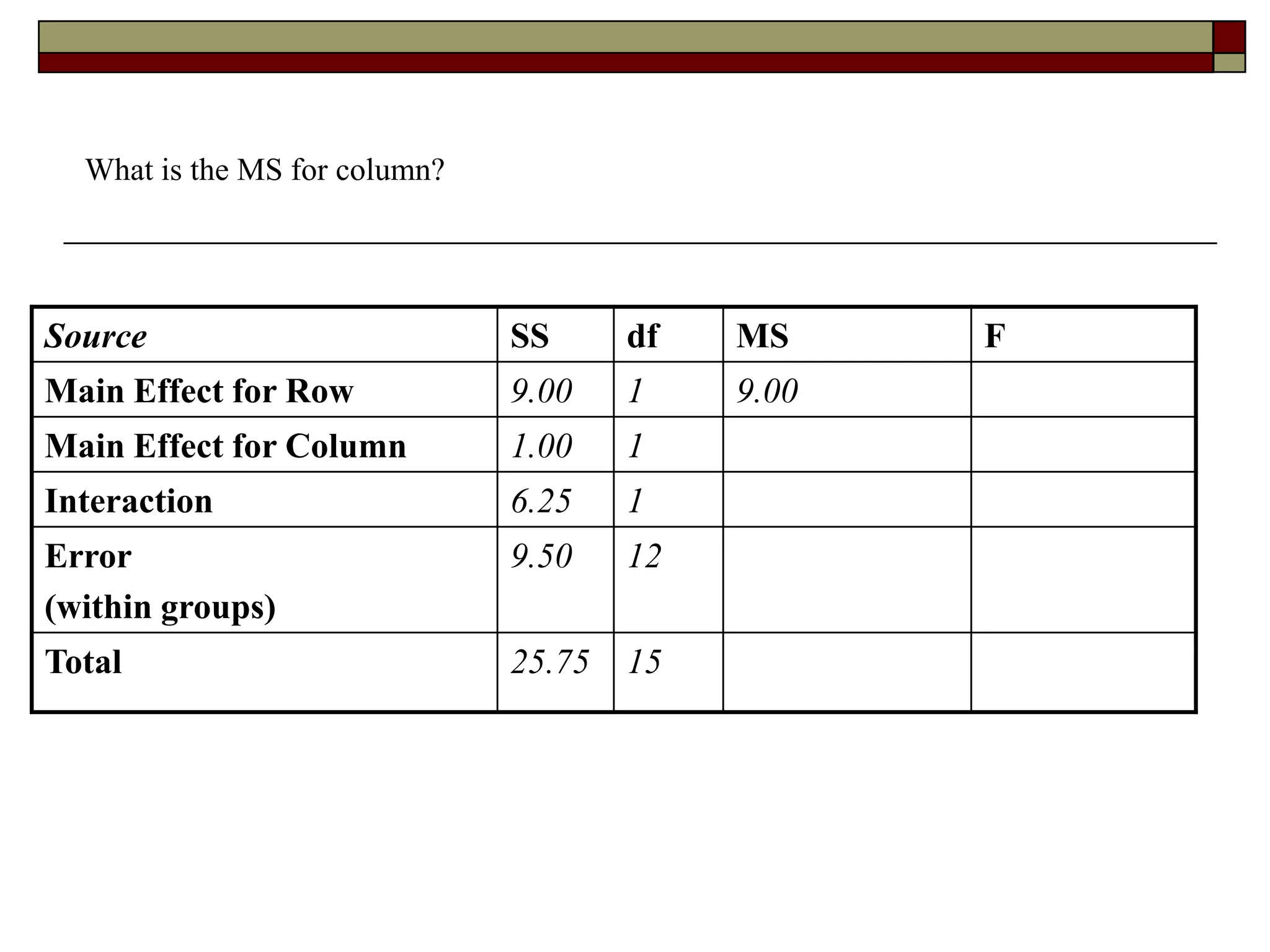
What is the MS for column?
Source SS df MS F
Main Effect for Row 9.00 1 9.00
Main Effect for Column 1.00 1
Interaction 6.25 1
Error
(within groups)
9.50 12
Total 25.75 15
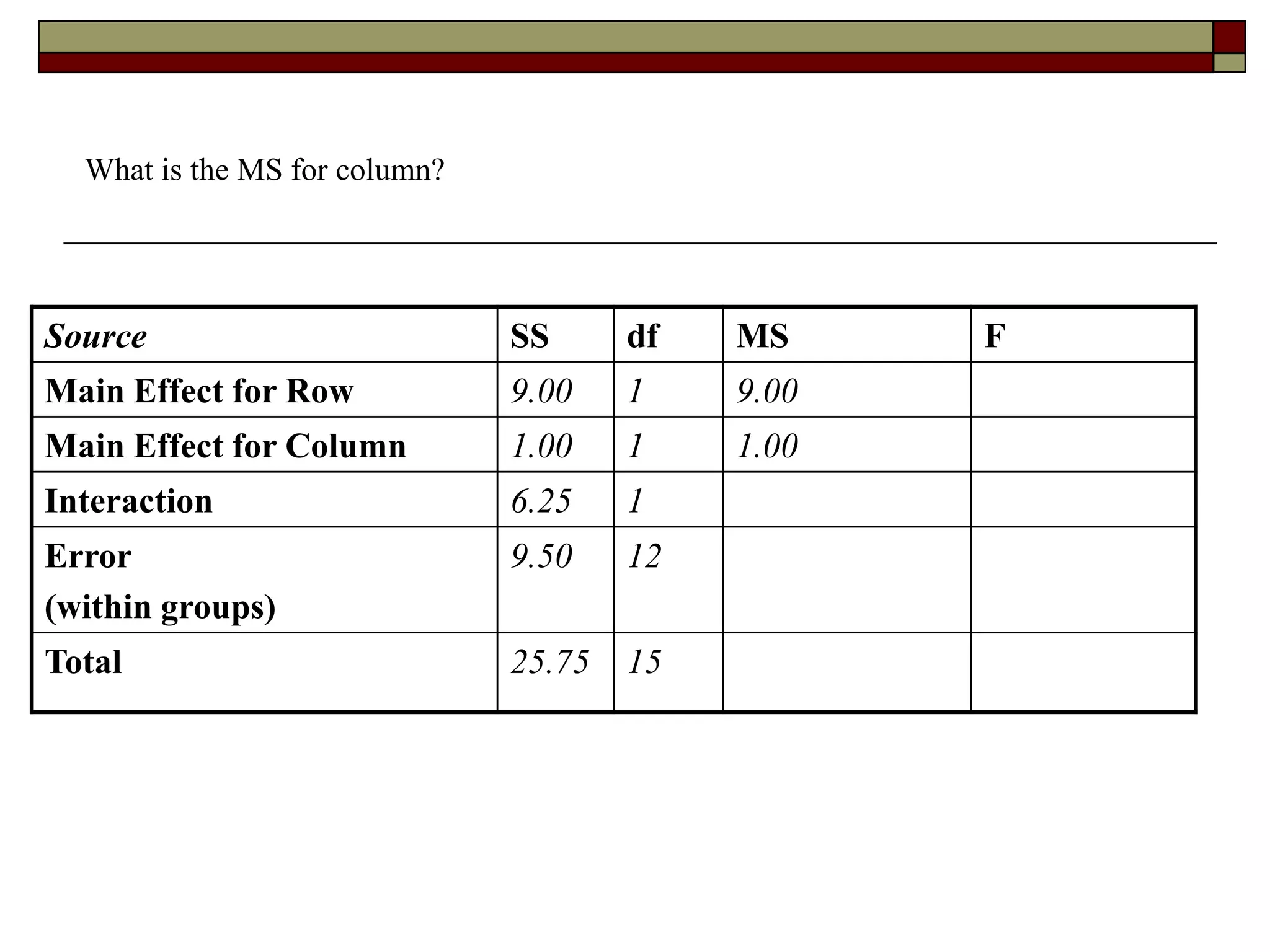
What is the MS for column?
Source SS df MS F
Main Effect for Row 9.00 1 9.00
Main Effect for Column 1.00 1 1.00
Interaction 6.25 1
Error
(within groups)
9.50 12
Total 25.75 15
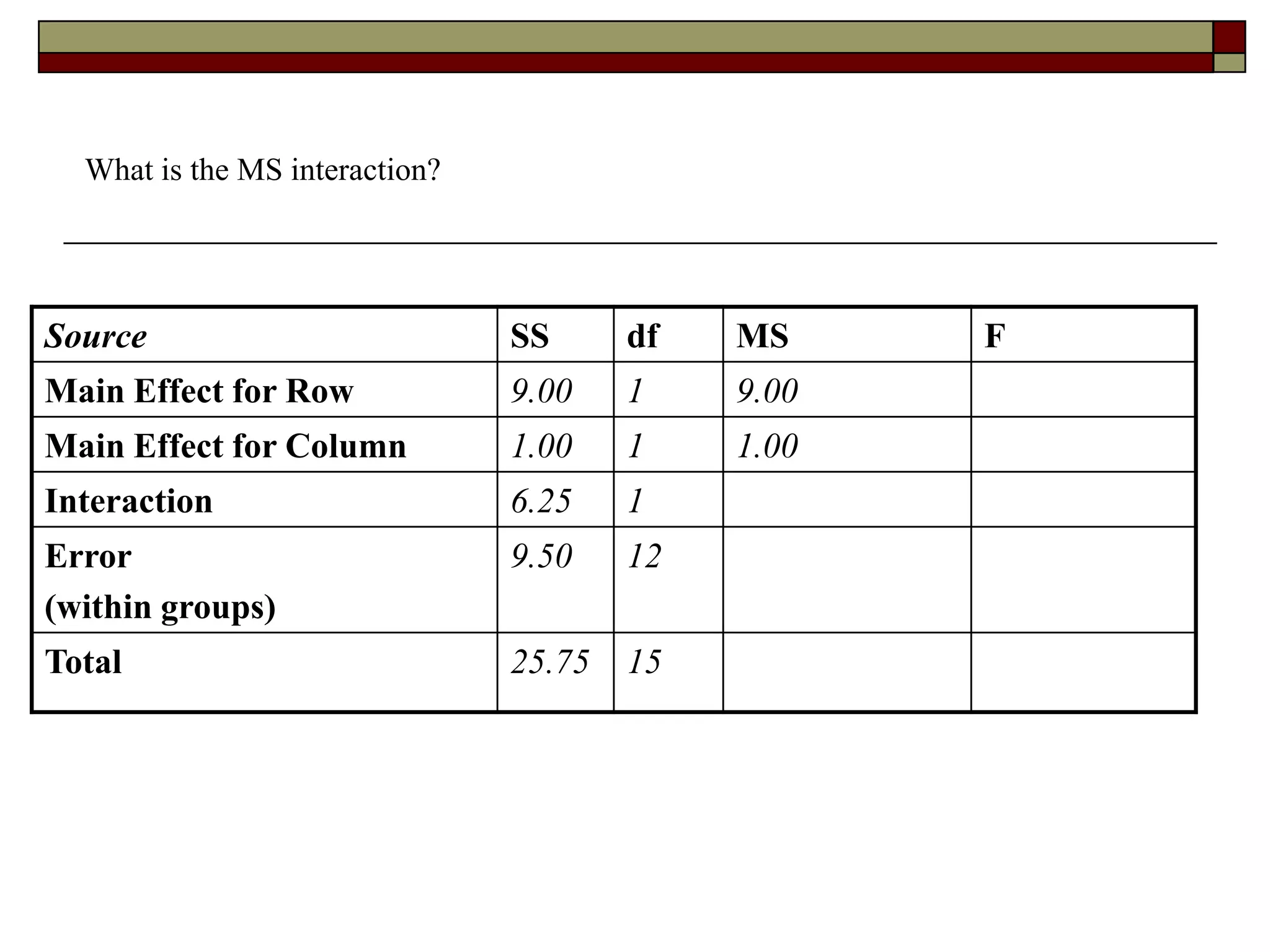
What is the MS interaction?
Source SS df MS F
Main Effect for Row 9.00 1 9.00
Main Effect for Column 1.00 1 1.00
Interaction 6.25 1
Error
(within groups)
9.50 12
Total 25.75 15
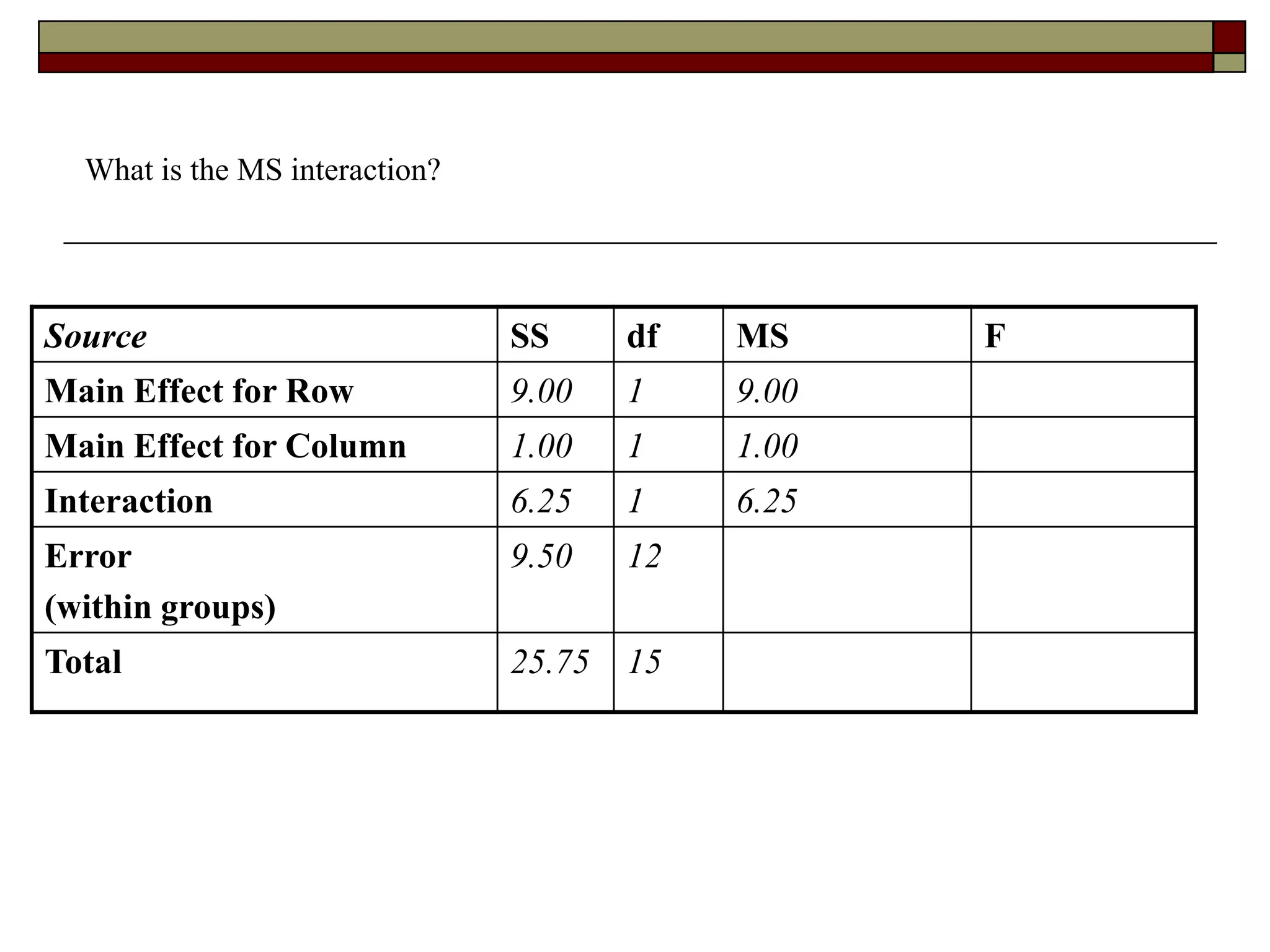
What is the MS interaction?
Source SS df MS F
Main Effect for Row 9.00 1 9.00
Main Effect for Column 1.00 1 1.00
Interaction 6.25 1 6.25
Error
(within groups)
9.50 12
Total 25.75 15
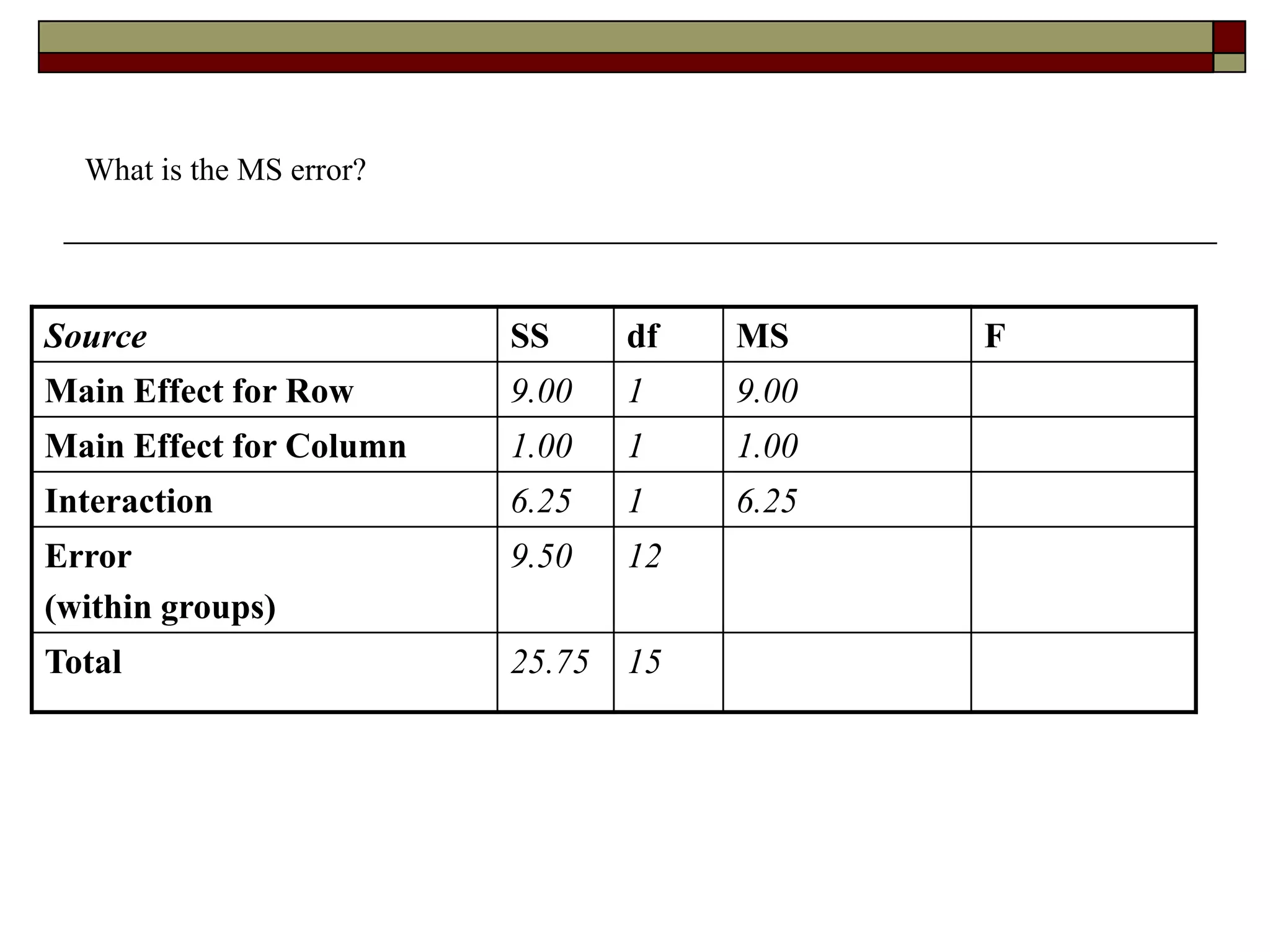
What is the MS error?
Source SS df MS F
Main Effect for Row 9.00 1 9.00
Main Effect for Column 1.00 1 1.00
Interaction 6.25 1 6.25
Error
(within groups)
9.50 12
Total 25.75 15
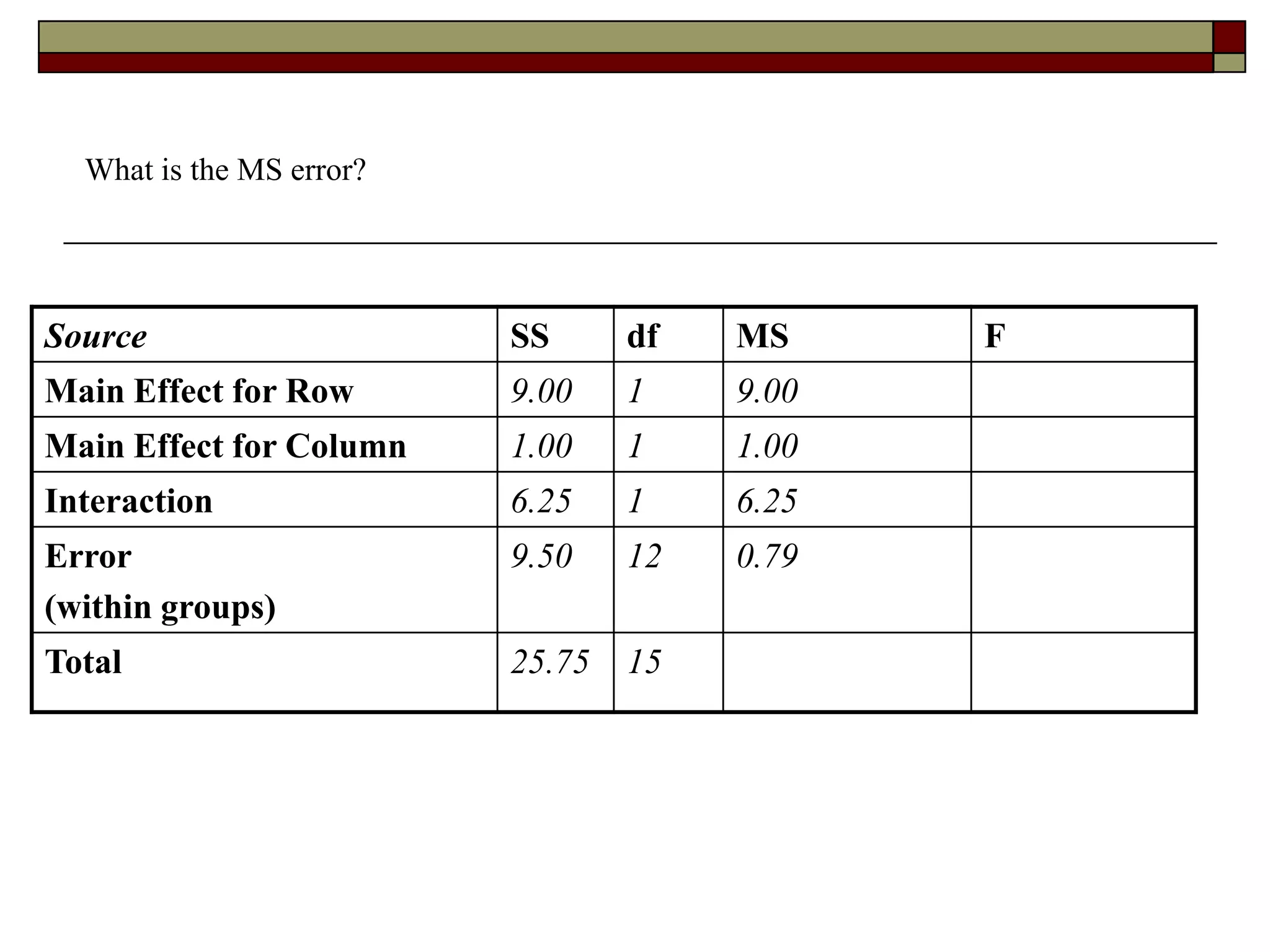
What is the MS error?
Source SS df MS F
Main Effect for Row 9.00 1 9.00
Main Effect for Column 1.00 1 1.00
Interaction 6.25 1 6.25
Error
(within groups)
9.50 12 0.79
Total 25.75 15
What is the main effect for row?
Source SS df MS F
Main Effect for Row 9.00 1 9.00
Main Effect for Column 1.00 1 1.00
Interaction 6.25 1 6.25
Error
(within groups)
9.50 12 0.79
Total 25.75 15
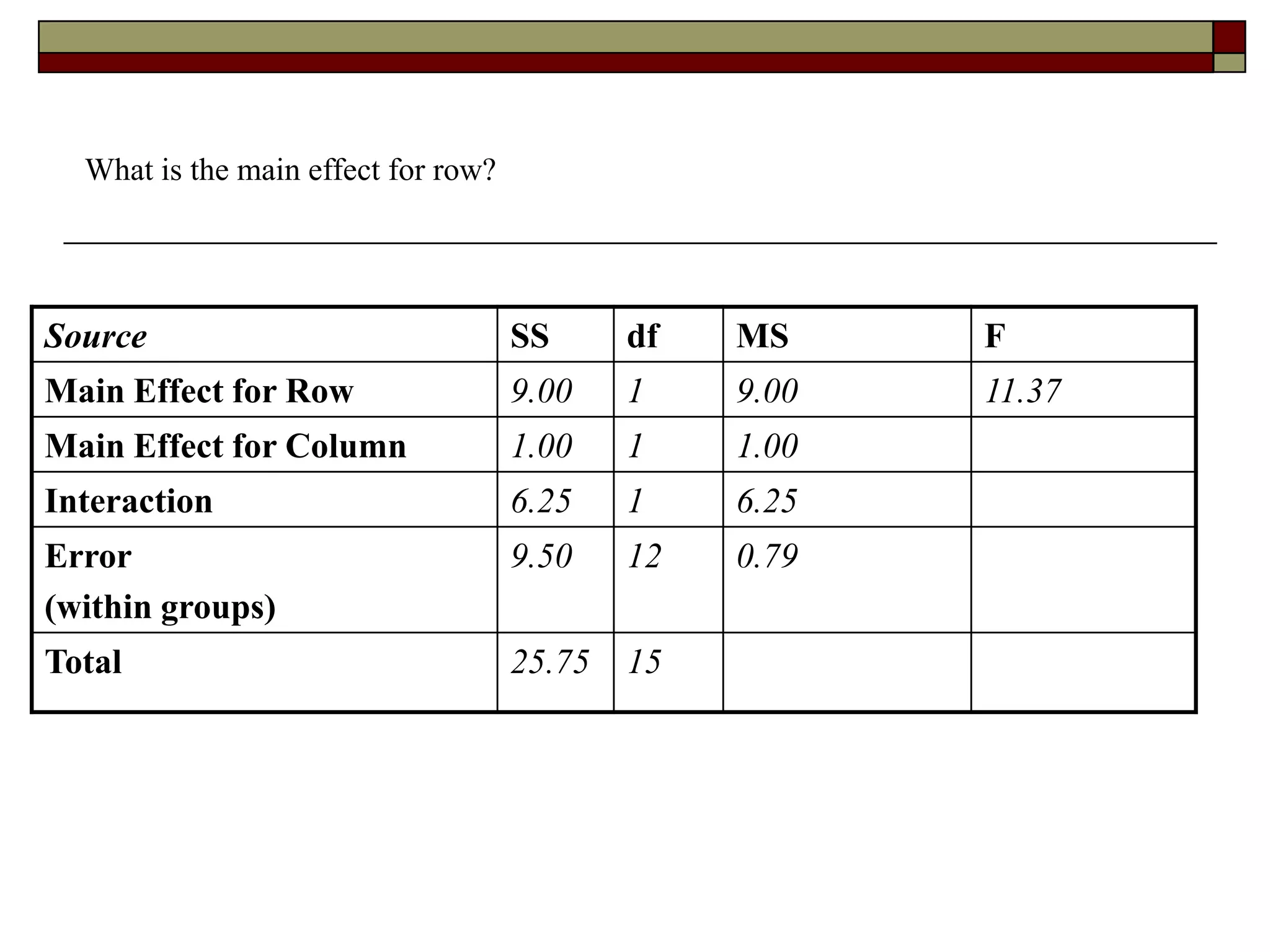
What is the main effect for row?
Source SS df MS F
Main Effect for Row 9.00 1 9.00 11.37
Main Effect for Column 1.00 1 1.00
Interaction 6.25 1 6.25
Error
(within groups)
9.50 12 0.79
Total 25.75 15
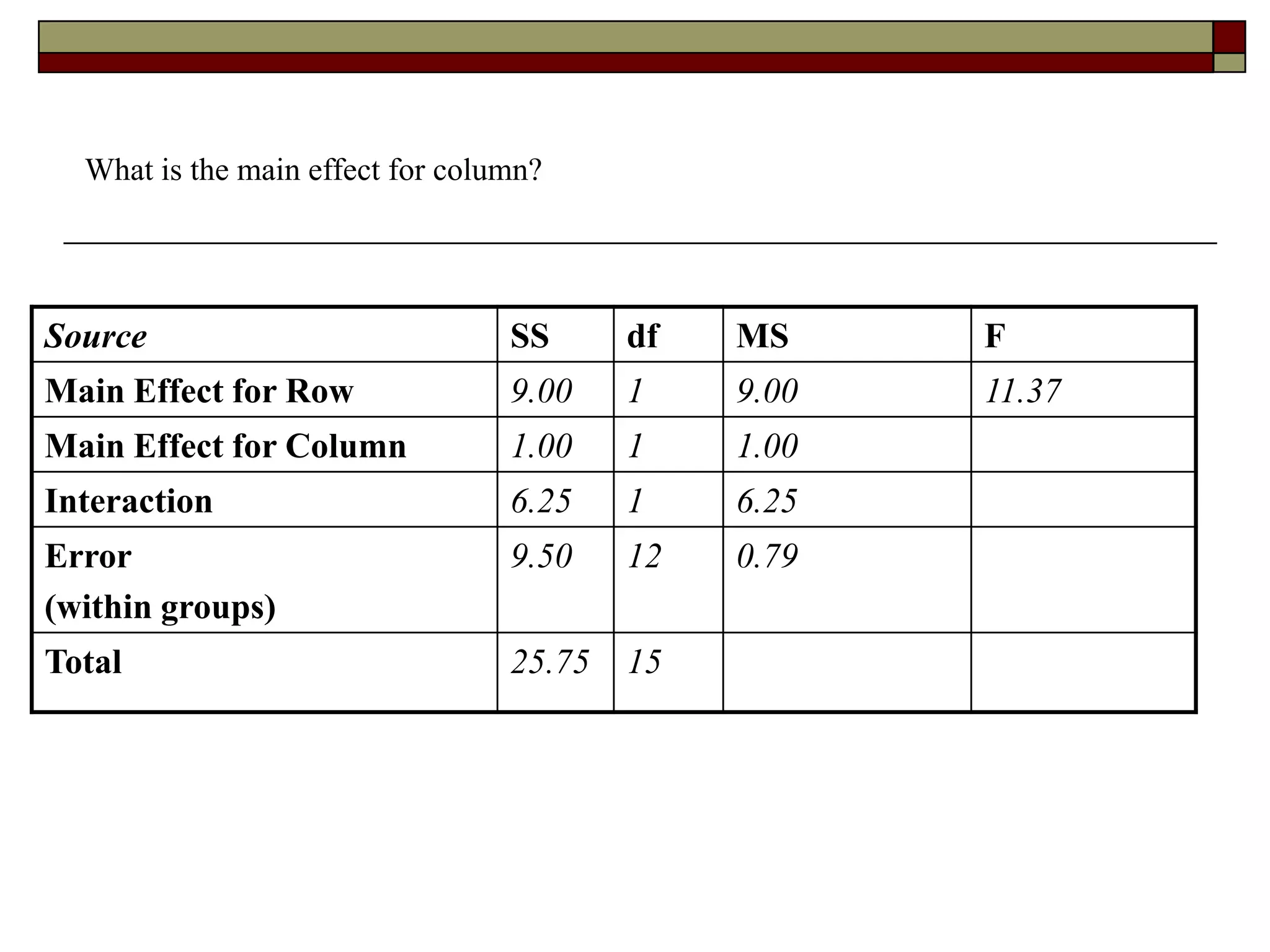
What is the main effect for column?
Source SS df MS F
Main Effect for Row 9.00 1 9.00 11.37
Main Effect for Column 1.00 1 1.00
Interaction 6.25 1 6.25
Error
(within groups)
9.50 12 0.79
Total 25.75 15
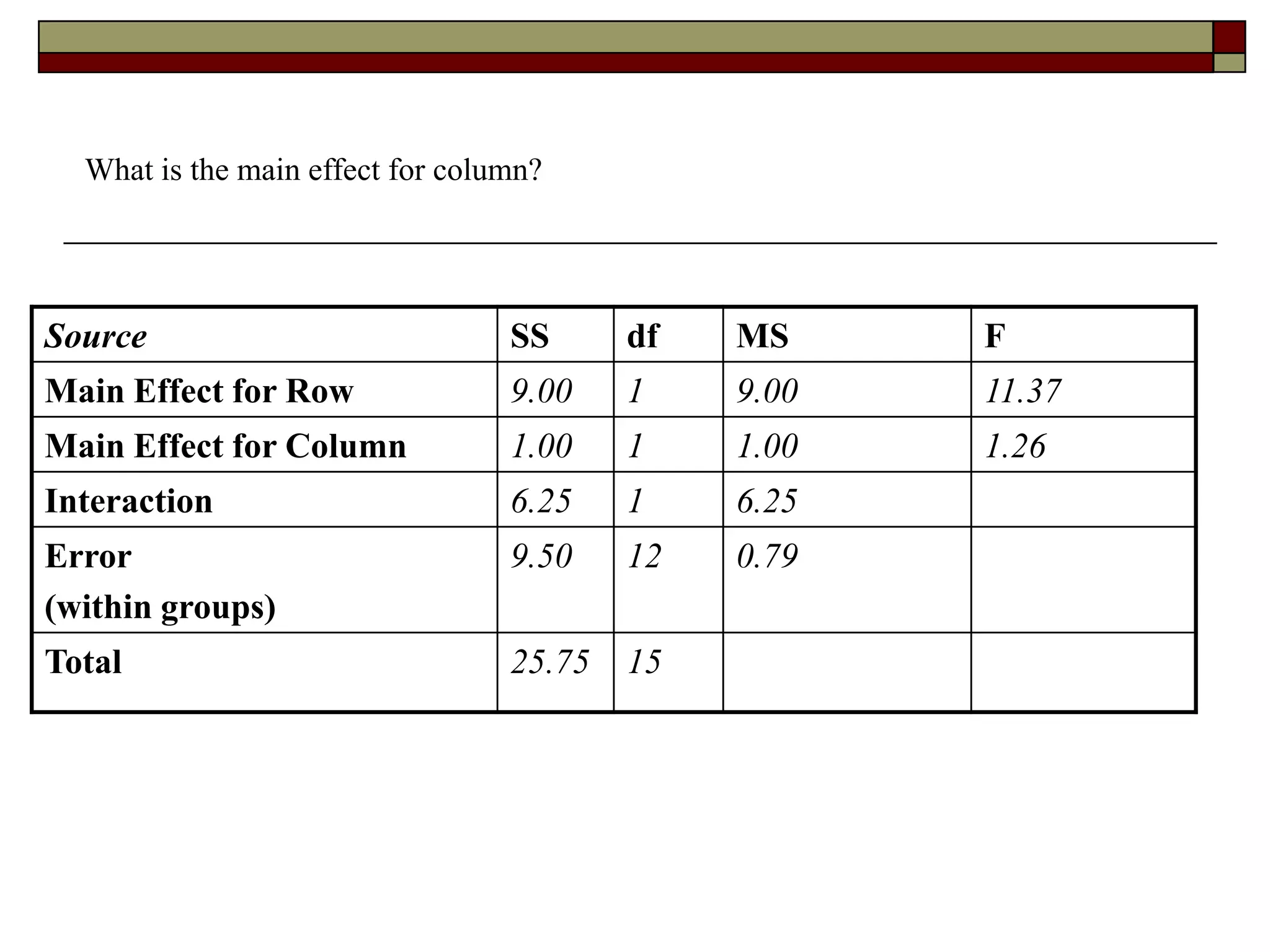
What is the main effect for column?
Source SS df MS F
Main Effect for Row 9.00 1 9.00 11.37
Main Effect for Column 1.00 1 1.00 1.26
Interaction 6.25 1 6.25
Error
(within groups)
9.50 12 0.79
Total 25.75 15
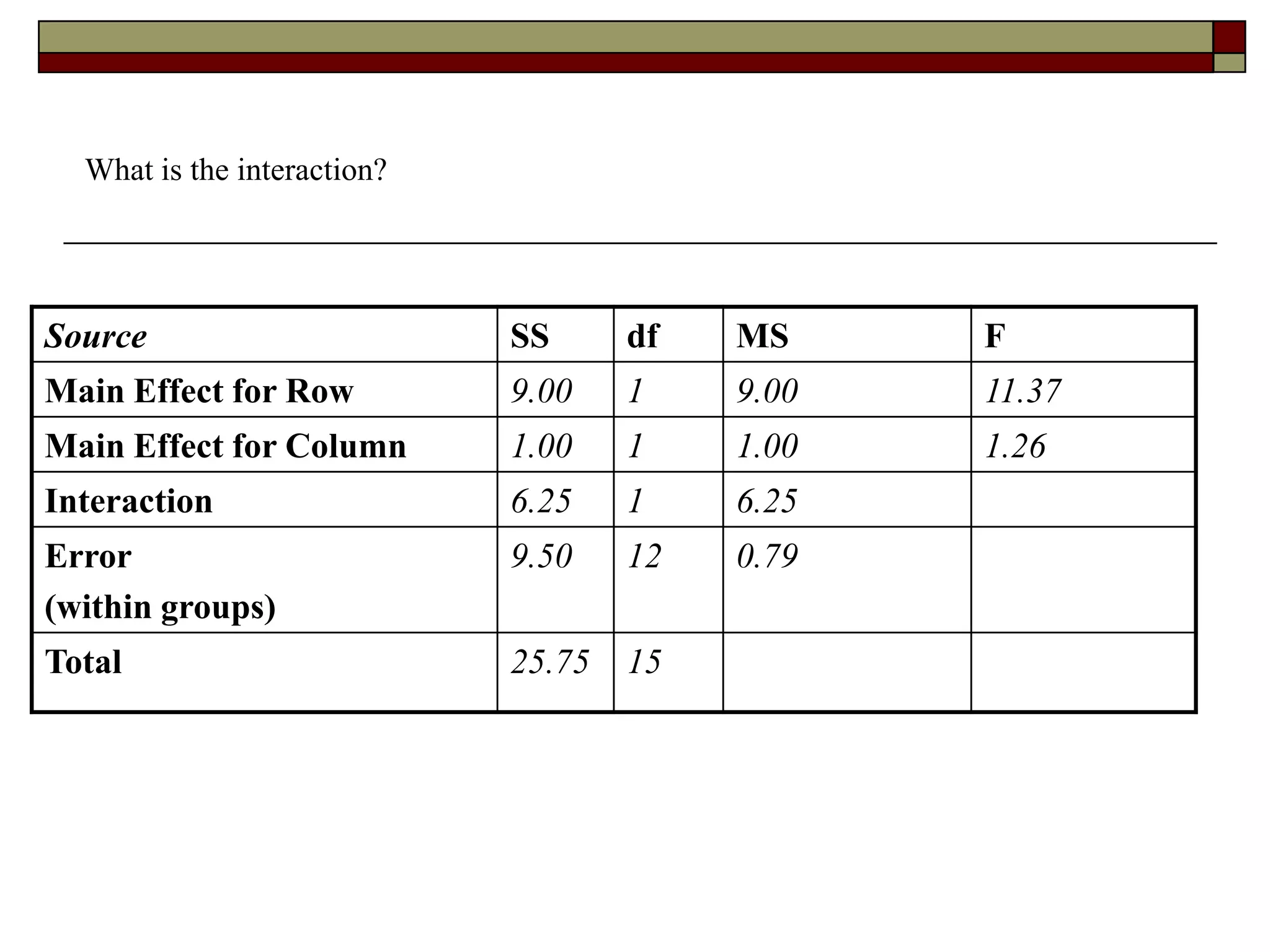
What is the interaction?
Source SS df MS F
Main Effect for Row 9.00 1 9.00 11.37
Main Effect for Column 1.00 1 1.00 1.26
Interaction 6.25 1 6.25
Error
(within groups)
9.50 12 0.79
Total 25.75 15
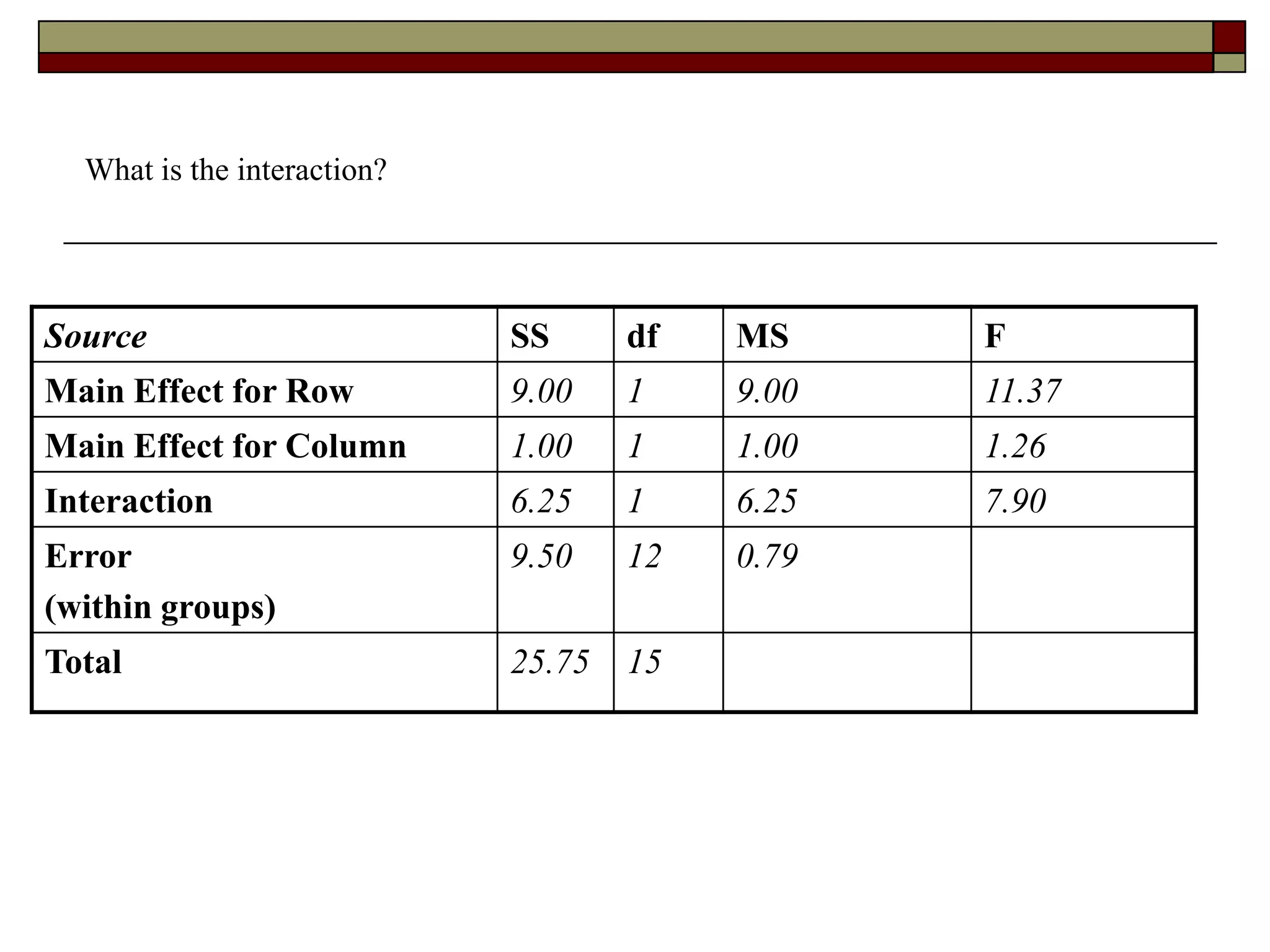
What is the interaction?
Source SS df MS F
Main Effect for Row 9.00 1 9.00 11.37
Main Effect for Column 1.00 1 1.00 1.26
Interaction 6.25 1 6.25 7.90
Error
(within groups)
9.50 12 0.79
Total 25.75 15
Example
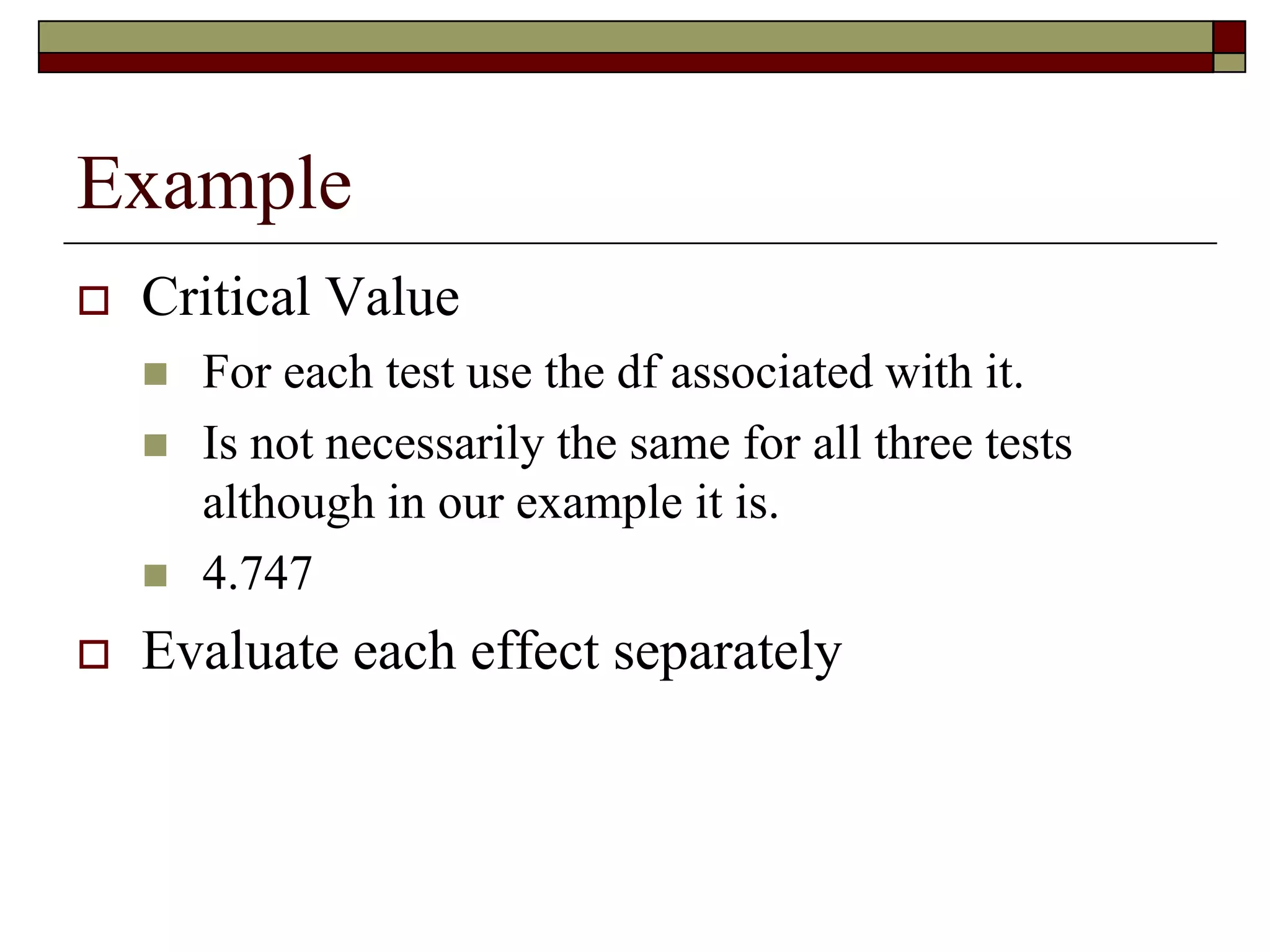
 Critical Value
 For each test use the df associated with it.
 Is not necessarily the same for all three tests
although in our example it is.
 4.747
 Evaluate each effect separately
 Is Main Effect row sig?
 Yes
 No
 Is Main Effect column sig?
 Yes
 No
 Is Interaction sig?
 Yes
 No
Now what?
 If you have no significant interaction, then
you can talk about what main effects are
significant in the same way that you evaluated
one-way ANOVAs.
 If the interaction is significant you must be
careful interpreting main effects. The main
effect could be present simply because of the
interaction. So concentrate on the interaction
interpretation.
Now what?
 If it is a 2X2 ANOVA and the interaction is
significant then graph the means and interpret.
 Our example
0
0.5
1
1.5
2
2.5
3
3.5
4
starter relief
rookie
veteran
Now what?
 If interaction is significant
 Plot interaction
 Interpret interaction
 Level of one IV is influenced by level of a
second IV
 If Main Effects are significant
 Conduct Post Hoc tests
 Report results
 Effect sizes
• Use omega squared to report effect size

Chapter 10 2 way

  • 1.
  • 2.
    Two-way ANOVA  Two-wayANOVA is one type of Factorial ANOVA.  Factorial ANOVAs are designs with two or more between-subjects independent variables  If there are within-subjects IVs, then they are often called Mixed ANOVAs
  • 3.
    Two-way ANOVA  Groupingfactors (IVs)  Example  IV: experience with three levels - rookie, novice, and veteran  IV: pitcher type with two levels - starter and relief  DV: physical stamina  3 X 2 factorial design  Computes a separate F ratio for each independent variable (called main effects) and the interaction between the variables  F for experience  F for pitcher type  F for experience*pitch interaction
  • 4.
    Example: 3 X2 Factorial Design Group 1 Group 2 Group 3 Group 4 Starter Relief Group 5 Group 6 rookie novice veteran Experience Level Pitcher Type
  • 5.
    Practice  A 3X 3 design  How many independent variables? 1. 1 2. 2 3. 3 4. 4
  • 6.
    Practice  A 3X 3 design  How many levels of the first independent variable listed? 1. 1 2. 2 3. 3 4. 4
  • 7.
    Practice  A 3X 3 design  How many conditions? 1. 2 2. 3 3. 6 4. 9
  • 8.
    Practice  A researchertests male and female doctors for manual dexterity . She tests dexterity for different tools: scalpel, scissors, scope, and probe.  How many independent variables? 1. 1 2. 2 3. 3 4. 4
  • 9.
    Practice  A researchertests male and female doctors for manual dexterity . She tests dexterity for different tools: scalpel, scissors, scope, and probe.  How many levels of the second independent variable (tools)? 1. 1 2. 2 3. 3 4. 4
  • 10.
    Practice  A researchertests male and female doctors for manual dexterity . She tests dexterity for different tools: scalpel, scissors, scope, and probe.  How many conditions? 1. 2 2. 4 3. 6 4. 8
  • 11.
    Practice  You arestudying factors that are associated with problem- solving skills. You place subjects into groups according to the following: student involvement with extracurricular activities (involved vs. not involved), student university type (public vs. private), and student self-reported procrastination (high, medium, and low). You then test the students’ problem- solving ability with a test.  What is the design? 1. 1 X 2 X 2 X 3 2. 2 X 2 X 3 3. 3 X 2 X 6 4. 4 X 3
  • 12.
    Practice  You arestudying factors that are associated with problem- solving skills. You place subjects into groups according to the following: student involvement with extracurricular activities (involved vs. not involved), student university type (public vs. private), and student self-reported procrastination (high, medium, and low). You then test the students’ problem- solving ability with a test.  How many independent variables? 1. 1 2. 2 3. 3 4. 4
  • 13.
    Practice  You arestudying factors that are associated with problem- solving skills. You place subjects into groups according to the following: student involvement with extracurricular activities (involved vs. not involved), student university type (public vs. private), and student self-reported procrastination (high, medium, and low). You then test the students’ problem- solving ability with a test.  How many cells? 1. 3 2. 8 3. 12 4. 24
  • 14.
    Two-way ANOVA  MainEffects  Think of them as one-way ANOVAs for each independent variable.  If you have 2 IVs, then you have two possible main effects  Example  A main effect for experience would look at the three levels ignoring (collapsed across) pitcher type  A main effect for pitcher type looks at starters vs. relief pitchers regardless of (collapsed across) experience
  • 15.
    Group 1 Group2 Group 3 Group 4 Starter Relief Group 5 Group 6 rookie novice veteran Experience Level Pitcher Type Marginal Mean For Rookie Marginal Mean For Novice Marginal Mean For Veteran Marginal Mean For Starter Marginal Mean For Relief
  • 16.
    Two-way ANOVA  Interaction For a two-way ANOVA there is one possible interaction  Interactions occur if the effects of one IV are different under different levels of the other IV  Example  Something about being an expert makes you behave differently if you are a starter as opposed to being a relief pitcher.  As the number of factors increases, the number of possible interaction increases
  • 17.
    Practice  You arestudying factors that are associated with problem- solving skills. You place subjects into groups according to the following: student involvement with extracurricular activities (involved vs. not involved), student university type (public vs. private), and student self-reported procrastination (high, medium, and low). You then test the students’ problem- solving ability with a test.  How many main effects are possible? 1. 1 2. 2 3. 3 4. 4
  • 18.
    Practice  You arestudying factors that are associated with problem- solving skills. You place subjects into groups according to the following: student involvement with extracurricular activities (involved vs. not involved), student university type (public vs. private), and student self-reported procrastination (high, medium, and low). You then test the students’ problem- solving ability with a test.  How many interactions are possible? 1. 1 2. 2 3. 3 4. 4
  • 19.
    Two-way ANOVA  Identifyingmain effects and interactions  First test for significance (will discuss how that is done later)  Then use either table or graph to see the relationship that exists between variables  For instructional purposes we will assume the tests for significance have been done and that the main effects and interactions identified are significant  Remember if not significant than no exploration of that particular main effect or interaction.
  • 20.
    Group 1 Group2 Group 3 Group 4 Starter Relief rookie veteranExperience Level Pitcher Type Marginal Mean For Rookie Marginal Mean For Veteran Marginal Mean For Starter Marginal Mean For Relief
  • 21.
    No Main Effectsor Interaction 20 20 Starter Relief rookie veteran 20 20 20 20 20 20 0 5 10 15 20 25 rookie veteran starter relief
  • 22.
    Main Effect forExperience 10 10 Starter Relief rookie veteran 10 20 20 20 15 15 0 5 10 15 20 25 rookie veteran starter relief
  • 23.
    Main Effect forPitcher Type 20 10 Starter Relief rookie veteran 15 20 10 15 20 10 0 5 10 15 20 25 rookie veteran starter relief
  • 24.
    Two Main Effects 2015 Starter Relief rookie veteran 17.5 15 10 12.5 17.5 12.5 0 5 10 15 20 25 rookie veteran starter relief
  • 25.
    Interaction with NoMain Effects 20 10 Starter Relief rookie veteran 15 10 20 15 15 15 0 5 10 15 20 25 rookie veteran starter relief
  • 26.
    Interaction and MainEffect for Experience 20 15 Starter Relief rookie veteran 17.5 10 15 12.5 15 15 0 5 10 15 20 25 rookie veteran starter relief
  • 27.
    Interaction and MainEffect for Pitcher Type 20 10 Starter Relief rookie veteran 15 15 15 15 17.5 12.5 0 5 10 15 20 25 rookie veteran starter relief
  • 28.
    Interaction and TwoMain Effects 9 11 Starter Relief rookie veteran 10 28 12 20 16 14 0 5 10 15 20 25 30 rookie veteran starter relief
  • 29.
    Assumptions of Between FactorANOVAs  DV data are interval or ratio level  Data are normally distributed  Variances are equivalent (homogeneity of variance)  Independence of observations  Same statistical ratio ANOVA = Treatment Variance Error Variance
  • 30.
    Stating Hypotheses  Twolevels of hypotheses  Main effects  Hypothesis for each IV  Hypothesis for Main Effect A (also sometimes called Main Effect Row)  Ho: μ1 = μ2 …  Ha: not all of the μi are equal.  Hypothesis for Main Effect B (also sometimes called Main Effect Column)  Ho: μ1 = μ2 …  Ha: not all of the μi are equal.
  • 31.
    Stating Hypotheses  Hypothesisfor Interaction (sometimes written A*B or Row*Column)  Hypothesis for each combination of IVs  Ho: There is no interaction between factors A and B. All differences are explained by main effects.  Ha: There is an interaction. The mean difference between treatments are not what would be predicted from main effects only
  • 32.
    Partitioning  One-Way Subjects SSbetween  SSwithin  Two-Way Subjects  SSbetween (divided up)  SSrow  SScolumn  SSrow*column  SSwithin
  • 33.
    Computation N G X 2 2 )()()( 222222 N G n T N G n T N G n T column column row row SStotal formula df N -1 SSrow SScolumn SSrow*column N G n T row row 22 SSwithin SStotal – SSrow – SScolumn – SS row*column a – 1 Where a is number of rows b – 1 Where b is number of columns (a – 1)(b – 1) (a)(b)(n-1) N G n T column column 22
  • 34.
    Example Starter Relief Rookie 4 3 3 5 1 0 2 1 Veteran3 2 1 2 2 3 1 1 Calculate the means for each of these cells Rookie/Starter 3.75 Rookie/Relief 1 Veteran/Starter 2 Veteran/Relief 1.75
  • 35.
    What are theTotal df? Source SS df MS F Main Effect for Row 9.00 Main Effect for Column 1.00 Interaction 6.25 Error (within groups) 9.50 Total 25.75
  • 36.
    What are theTotal df? Source SS df MS F Main Effect for Row 9.00 Main Effect for Column 1.00 Interaction 6.25 Error (within groups) 9.50 Total 25.75 15
  • 37.
    What are thedf row? Source SS df MS F Main Effect for Row 9.00 Main Effect for Column 1.00 Interaction 6.25 Error (within groups) 9.50 Total 25.75 15
  • 38.
    What are thedf row? Source SS df MS F Main Effect for Row 9.00 1 Main Effect for Column 1.00 Interaction 6.25 Error (within groups) 9.50 Total 25.75 15
  • 39.
    What are thedf column? Source SS df MS F Main Effect for Row 9.00 1 Main Effect for Column 1.00 Interaction 6.25 Error (within groups) 9.50 Total 25.75 15
  • 40.
    What are thedf column? Source SS df MS F Main Effect for Row 9.00 1 Main Effect for Column 1.00 1 Interaction 6.25 Error (within groups) 9.50 Total 25.75 15
  • 41.
    What are thedf interaction? Source SS df MS F Main Effect for Row 9.00 1 Main Effect for Column 1.00 1 Interaction 6.25 Error (within groups) 9.50 Total 25.75 15
  • 42.
    What are thedf interaction? Source SS df MS F Main Effect for Row 9.00 1 Main Effect for Column 1.00 1 Interaction 6.25 1 Error (within groups) 9.50 Total 25.75 15
  • 43.
    What are thedf error? Source SS df MS F Main Effect for Row 9.00 1 Main Effect for Column 1.00 1 Interaction 6.25 1 Error (within groups) 9.50 Total 25.75 15
  • 44.
    What are thedf error? Source SS df MS F Main Effect for Row 9.00 1 Main Effect for Column 1.00 1 Interaction 6.25 1 Error (within groups) 9.50 12 Total 25.75 15
  • 45.
    What is theMS for row? Source SS df MS F Main Effect for Row 9.00 1 Main Effect for Column 1.00 1 Interaction 6.25 1 Error (within groups) 9.50 12 Total 25.75 15
  • 46.
    What is theMS for row? Source SS df MS F Main Effect for Row 9.00 1 9.00 Main Effect for Column 1.00 1 Interaction 6.25 1 Error (within groups) 9.50 12 Total 25.75 15
  • 47.
    What is theMS for column? Source SS df MS F Main Effect for Row 9.00 1 9.00 Main Effect for Column 1.00 1 Interaction 6.25 1 Error (within groups) 9.50 12 Total 25.75 15
  • 48.
    What is theMS for column? Source SS df MS F Main Effect for Row 9.00 1 9.00 Main Effect for Column 1.00 1 1.00 Interaction 6.25 1 Error (within groups) 9.50 12 Total 25.75 15
  • 49.
    What is theMS interaction? Source SS df MS F Main Effect for Row 9.00 1 9.00 Main Effect for Column 1.00 1 1.00 Interaction 6.25 1 Error (within groups) 9.50 12 Total 25.75 15
  • 50.
    What is theMS interaction? Source SS df MS F Main Effect for Row 9.00 1 9.00 Main Effect for Column 1.00 1 1.00 Interaction 6.25 1 6.25 Error (within groups) 9.50 12 Total 25.75 15
  • 51.
    What is theMS error? Source SS df MS F Main Effect for Row 9.00 1 9.00 Main Effect for Column 1.00 1 1.00 Interaction 6.25 1 6.25 Error (within groups) 9.50 12 Total 25.75 15
  • 52.
    What is theMS error? Source SS df MS F Main Effect for Row 9.00 1 9.00 Main Effect for Column 1.00 1 1.00 Interaction 6.25 1 6.25 Error (within groups) 9.50 12 0.79 Total 25.75 15
  • 53.
    What is themain effect for row? Source SS df MS F Main Effect for Row 9.00 1 9.00 Main Effect for Column 1.00 1 1.00 Interaction 6.25 1 6.25 Error (within groups) 9.50 12 0.79 Total 25.75 15
  • 54.
    What is themain effect for row? Source SS df MS F Main Effect for Row 9.00 1 9.00 11.37 Main Effect for Column 1.00 1 1.00 Interaction 6.25 1 6.25 Error (within groups) 9.50 12 0.79 Total 25.75 15
  • 55.
    What is themain effect for column? Source SS df MS F Main Effect for Row 9.00 1 9.00 11.37 Main Effect for Column 1.00 1 1.00 Interaction 6.25 1 6.25 Error (within groups) 9.50 12 0.79 Total 25.75 15
  • 56.
    What is themain effect for column? Source SS df MS F Main Effect for Row 9.00 1 9.00 11.37 Main Effect for Column 1.00 1 1.00 1.26 Interaction 6.25 1 6.25 Error (within groups) 9.50 12 0.79 Total 25.75 15
  • 57.
    What is theinteraction? Source SS df MS F Main Effect for Row 9.00 1 9.00 11.37 Main Effect for Column 1.00 1 1.00 1.26 Interaction 6.25 1 6.25 Error (within groups) 9.50 12 0.79 Total 25.75 15
  • 58.
    What is theinteraction? Source SS df MS F Main Effect for Row 9.00 1 9.00 11.37 Main Effect for Column 1.00 1 1.00 1.26 Interaction 6.25 1 6.25 7.90 Error (within groups) 9.50 12 0.79 Total 25.75 15
  • 59.
    Example  Critical Value For each test use the df associated with it.  Is not necessarily the same for all three tests although in our example it is.  4.747  Evaluate each effect separately
  • 60.
     Is MainEffect row sig?  Yes  No
  • 61.
     Is MainEffect column sig?  Yes  No
  • 62.
     Is Interactionsig?  Yes  No
  • 63.
    Now what?  Ifyou have no significant interaction, then you can talk about what main effects are significant in the same way that you evaluated one-way ANOVAs.  If the interaction is significant you must be careful interpreting main effects. The main effect could be present simply because of the interaction. So concentrate on the interaction interpretation.
  • 64.
    Now what?  Ifit is a 2X2 ANOVA and the interaction is significant then graph the means and interpret.  Our example 0 0.5 1 1.5 2 2.5 3 3.5 4 starter relief rookie veteran
  • 65.
    Now what?  Ifinteraction is significant  Plot interaction  Interpret interaction  Level of one IV is influenced by level of a second IV  If Main Effects are significant  Conduct Post Hoc tests  Report results  Effect sizes • Use omega squared to report effect size