Blood Gas analysisDR. MANSOOR AQILASSOCIATE PROFESSOR,KING SAUD UNIVERSITY  HOSPITALSRIYADH.
Clinical case
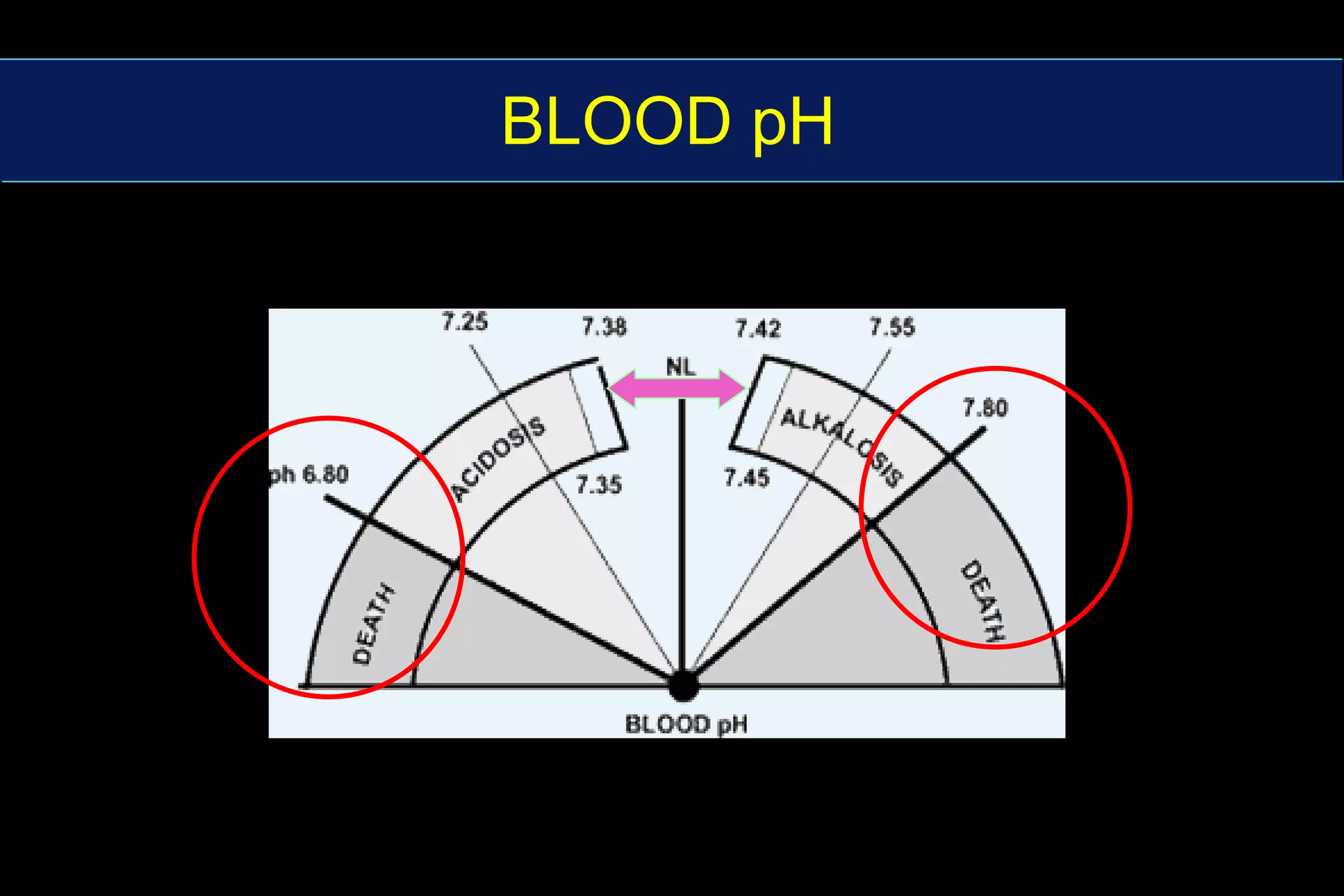
Maintained within narrow limitspH  7.36 to 7.44		pH  =  Alkalemia (Alkalosis) 		pH  =  Acidemia (Acidosis)BLOOD pH
NORMAL7.4ACIDOSISALKALOSIS7.87.0ACID(CO2)BASE
(HCO3)RESPIRATORY COMPONENTMETABOLIC COMPONENT
BLOOD pH
The challenge7.4 ACIDOSIS7.87.0Volatile ACID (CO2) & Fixed acidsDefense of normal alkalinity
Types of AcidsVolatile acidsEasily move from liquid to gas state within the bodyLung can removeH2CO3 + renal enzyme  H2O + CO2 (both of which are exhaled)Carbon dioxide is therefore considered an acid
Types of AcidsNonvolatile acids(Fixed acids)Cannot be changed to gas state within the bodyExamplesKeto acidsLactic acids
The challengeSources of acids:Volatile acidCO2 + H2O  H2CO3   H+ + HCO3Fixed acidsOrganic and inorganic sourceLactic acid, ketones, Sulfuric and phosphoric acid Kidney plays an important role handling fixed acids.
HYDROGEN ION SOURCESCO2 15000 mmol/dayCO2 + H2O          H2CO3           H+ + HCO3-Noncarbonic acids 70 mmol/dayDEFENCE AGAINST pH CHANGEAcute (minutes to hours)VentilationBuffering
DEFENCE AGAINST pH CHANGEAcute (minutes to hours)Long termRenal excretionHepatic metabolism
Chemical BuffersThe body uses pH buffers in the blood to guard against sudden changes in acidityA pH buffer works chemically to minimize changes in the pH of a solutionH+OH-H+BufferOH-OH-H+
BUFFERSIntracellular BuffersProteinsHaemoglobinPhosphateExtracellular BuffersProteinsBicarbonate
Biological systems and Buffering:The power of a buffer depends on:Concentration of the buffer.Whether the pK is close to the pH of the system.
Bicarbonate buffer systems:CO2 + H2O  H2CO3   H+ + HCO3-Maintains a ratio of 20 parts bicarbonate to 1 part carbonic acid
Bicarbonate Buffer SystemIf strong acid is added:HCl + NaHCO3 = H2CO3 + NaClHydrogen ions released combine with the bicarbonate ions and form carbonic acid (a weak acid)The pH of the solution decreases only slightly
BICARBONATE BUFFER SYSTEMH+H2CO3H+ + HCO3-Hydrogen ions generated  by metabolism or by ingestion react with bicarbonate base to form more carbonic acidH2CO3HCO3-20
BICARBONATE BUFFER SYSTEMH+Equilibrium shifts toward the formation of acidHydrogen ions that are lost (vomiting) causes carbonic acid to dissociate yielding replacement H+ and bicarbonateH2CO3HCO3-
Bicarbonate Buffer SystemIf strong base is added:NaOH + H2CO3 = NaHCO3 + H2OIt reacts with the carbonic acid to form sodium bicarbonate (a weak base)The pH of the solution rises only slightlyThis system is the only important ECF buffer
Bicarbonate buffer systems:CO2 + H2O  H2CO3   H+ + HCO3-pK = 6.1		 [HCO3-] = 24 mmol/L
Bicarbonate buffer systems:
Phosphate buffer systemsPhosphate buffer H2PO4- / HPO4pK = 6.8 and has a low concentration.Role as intracellular and urinary buffer.
Phosphate buffer systemsH2PO4- / HPO4-2
Protein buffers:A. Amino acid residues of proteins take up H+(pK=7.0) are most important NH2 NH3-B. Hemoglobin is important due to high concentrationand its increased buffering capacity when deoxygenated.
Relative Buffering power:
 Compensation
Renal buffering mechanisms Renal - kidney excretes H+ and replenishes [HCO3-] .But, this is  a slow process taking hours to days.
Renal buffering mechanisms
METABOLIC DISORDERS
RESPIRATORY ACIDOSIS7.47.87.0ACID(CO2)BASE
(HCO3)RESPIRATORY COMPONENTMETABOLIC COMPONENT
RESPIRATORY ACIDOSISH2O  + CO2  H2CO3   H+ + HCO3- Cause -  hypoventilationRetention of CO2 Drives equation rightwardIncreases both [H+]  and  [HCO3-]
RESPIRATORY ALKALOSIS7.47.87.0ACID(CO2)BASE
(HCO3)RESPIRATORY COMPONENTMETABOLIC COMPONENT
RESPIRATORY ALKALOSISH2O  + CO2  H2CO3   H+ + HCO3- 2. Respiratory Alkalosis cause - hyperventilationBlows off CO2 Drives equation leftward decreasing both [H+]  and  [HCO3-]
METABOLIC ACIDOSIS7.47.87.0ACID(CO2)BASE
(HCO3)RESPIRATORY COMPONENTMETABOLIC COMPONENT
Metabolic AcidosisDeficit in HCO3- and decreased pHCauses: 	Increased production of nonvolatile acids. 	Decreased H+ secretion in the kidney 	Increased HCO3- loss in kidney 	Increased Cl- reabsorption by the kidney.
Metabolic AcidosisBody response is increased ventilation to blow off excess CO2
METABOLIC ALKALOSIS7.47.87.0ACID(CO2)BASE
(HCO3)RESPIRATORY COMPONENTMETABOLIC COMPONENT
Metabolic AlkalosisPrimarily due to Increased HCO3- , increased pH CausesAdministration of excess HCO3-
 	Increased secretion of H+ by kidney and gut
 	Sudden volume contraction which leads to increased Na+retention.This 	leads to water and HCO3- to follow the Na+PARTIALLY COMPENSATED RESPIRATORY ACIDOSIS7.47.07.8ACID(CO2)BASE
(HCO3)RESPIRATORY COMPONENTMETABOLIC COMPONENT
PARTIALLY COMPENSATED RESPIRATORY ALKALOSIS7.47.87.0ACID(CO2)BASE
(HCO3)METABOLIC COMPONENTRESPIRATORY COMPONENT
7.47.07.8ACID(CO2)BASE
(HCO3)RESPIRATORY COMPONENTMETABOLIC COMPONENTPARTIALLY COMPENSATED METABOLIC ACIDOSIS
PARTIALLY COMPENSATED METABOLIC ALKALOSIS7.47.87.0ACID(CO2)BASE
(HCO3)RESPIRATORY COMPONENTMETABOLIC COMPONENT
MIXED ACIDOSIS7.47.87.0ACID(CO2)BASE
(HCO3)RESPIRATORY COMPONENTMETABOLIC COMPONENT
COMPENSATED STATE7.4ACIDOSISALKALOSIS7.87.0ACID(CO2)BASE
(HCO3)RESPIRATORY COMPONENTMETABOLIC COMPONENT
Acute ventilatory failure (acute respiratory acidosis)N
Chronic ventilatory failure(compensated respiratory acidosis)Normal
Acute alveolar hyperventilation(acute respiratory alkalosis)Normal
Chronic alveolar hyperventilation(compensated respiratory alkalosis)Normal
Acute metabolic acidosisNormal
Chronic metabolic acidosisNormal
Acute Metabolic AlkalosisNormal
Chronic metabolic alkalosis Normal Normal
Anion GapAG = [Na + ] - [Cl ‾ + HCO3‾ ]• AG represents unaccounted for anions (R ‾ )• Normal anion gap = 10
Anion GapCations are Na + & K +Major  Anions are Cl ‾ & HCO3 ‾
Anion gapUnmeasured AnionsvsUnmeasured CationsProteins, mostly albumin 15 mEq/L Calcium 5 mEq/L Organic acids 5 mEq/L Potassium 4.5 mEq/L Phosphates 2 mEq/L Magnesium 1.5 mEq/L Sulfates 1 mEq/L Totals: 23 mEq/L 11 mEq/L
 Rules For Analyzing The ABG’s• Look at the anion gap.
Differential diagnosis of metabolic acidosisElevated anion gapUremiaKetoacidosisLactic acidosisMethanol toxicityEthylene glycol toxicitySalicylateParaldehyde Normal anion gapRenal tubular acidosisDirrhoeaCarbonic anhydrase inhibitionUreteral diversionEarly renal failureHydronephrosisHCL administrationSaline administration
Diagnosis of acid base disturbance
Determining the predicted “Respiratory pH”Acute 10 mmHg increase in PCO2 results in pH decrease of approximately 0.05 unitsAcute 10 mmHg decrease in PCO2 results in pH increase of approximately 0.10 units
Determining the predicted “Respiratory pH”First determine the difference between the measured PaCO2 and 40 mmHg and move the decimal point two places left.60 - 40 = 20 X 1/2		0.1040 – 30 = 10                0.10
Determining the predicted “Respiratory pH”If the PaCO2 is greater than 40 subtract half of the difference from 7.40?  If this Pt has pH = 7.2 ?  If this Pt has pH = 7.3360 - 40  = 20 X ½ =10 = 0.10pH = 7.40 – 0.10 = 7.30
Determining the predicted “Respiratory pH”If the PaCO2 is less than 40 add the difference to 7.4040 - 30 = 10        0.10pH = 7.40 + 0.10 = 7.50
Determining the predicted “Respiratory pH”pH 		7.04PCO2  	 	7676 - 40 = 36 X ½ = 18           0.187.40 - 0.18 = 7.22
Determining the predicted “Respiratory pH”pH 		7.21PCO2 		   9090 - 40 = 50 X ½ = 25                  0.257.40 – 0.25 = 7.15
Determining the predicted “Respiratory pH”pH 		7.47PCO2		1840 – 18 = 22                        0.227.40 + 0.22 = 7.62
Determining the Metabolic componentRULE10 mmol/L variance from the normal buffer base represents  a pH change of approximately 0.15 units.
pH 		7.21PCO2 		   9090 - 40 = 50 X ½ = 0.257.40 – 0.25 = 7.15Determining the Metabolic component		7.21 -7.15 = 0.06 X 2/3 = 0.04 = 4 mmol/L base excess
pH 		7.04PCO2  	 	7676 - 40 = 36 X ½ = 0.187.40 - 0.18 =7.22Determining the Metabolic component		7.22 -7.04 = 0.18 X 2/3 =12 mmol/L base deficit

Blood Gas Analysis