ACIDOSIS & ALKALOSIS   ABG INTERPRETATION CRISBERT I. CUALTEROS, M.D.
Acidosis  – presence of a process which tends  to  lower pH by virtue of gain of H+ or loss of  HCO3 Alkalosis  – presence of a process which tends to  raise pH by virtue of loss of H+ or  addition of HCO3-
Respiratory  – processes which lead to acidosis or alkalosis  through a primary alteration in ventilation and resultant  excessive elimination or retention of CO2 Metabolic  – processes which lead to acidosis or alkalosis through  their effects on the kidneys and the consequent disruption of H+  and HCO3- control
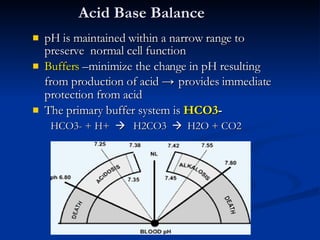
Acid Base Balance pH is maintained within a narrow range to preserve  normal cell function Buffers  –minimize the change in pH resulting from production of acid  ->  provides immediate protection from acid  The primary buffer system is  HCO3 -   HCO3- + H+     H2CO3     H2O + CO2
Simple acid-base disorder  – a single primary process of acidosis or  alkalosis Mixed acid-base disorder  – presence of more than one acid base  disorder simultaneously
Compensation  – the normal response of the respiratory system or  kidneys to change in pH induced by a primary acid-base disorder No overcompensation ( except occasionally primary resp. alkalosis) Kidneys slow, lungs fast Lack of compensation (or over) determines a second primary disorder The degree of appropriate compensation is predictable
Role of the kidney To  retain and regenerate HCO3-  thereby regenerating the buffer with the net   effect of eliminating the acid H+ secretion HCO3- reabsorption Role of the respiratory system   eliminate CO2
Characteristics of the simple acid-base disturbances    [HCO3-]    Pco2    Respiratory alkalosis    [HCO3-]    Pco2  Respiratory acidosis    Pco2    [HCO3-]    Metabolic alkalosis    Pco2    [HCO3-]  Metabolic acidosis Compensated response Primary Primary pH  Disorder
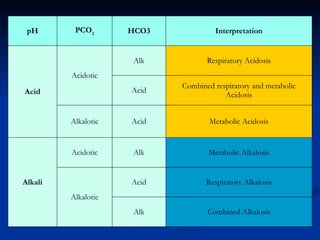
Combined Alkalosis Alk Respiratory Alkalosis Acid Alkalotic Metabolic Alkalosis Alk Acidotic Alkali Metabolic Acidosis Acid Alkalotic Combined respiratory and metabolic Acidosis Acid Respiratory Acidosis Alk Acidotic Acid Interpretation HCO3 PCO 2 pH
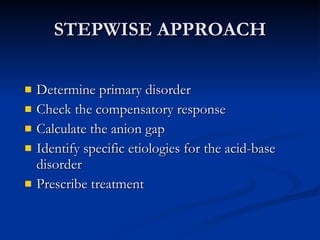
STEPWISE APPROACH Determine primary disorder Check the compensatory response Calculate the anion gap Identify specific etiologies for the acid-base disorder Prescribe treatment
 
DETERMINE  THE  PRIMARY DISORDER
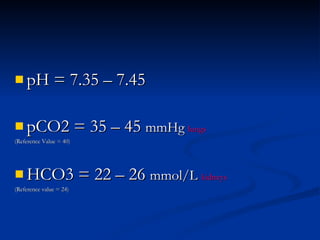
pH = 7.35 – 7.45 pCO2 = 35 – 45  mmHg  lungs (Reference Value = 40) HCO3 = 22 – 26  mmol/L  kidneys (Reference value = 24)
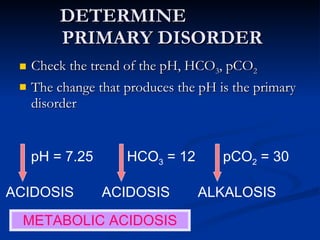
DETERMINE  PRIMARY DISORDER Check the trend of the pH, HCO 3 , pCO 2 The change that produces the pH is the primary disorder pH = 7.25 HCO 3  = 12 pCO 2  = 30 ACIDOSIS ACIDOSIS ALKALOSIS METABOLIC ACIDOSIS
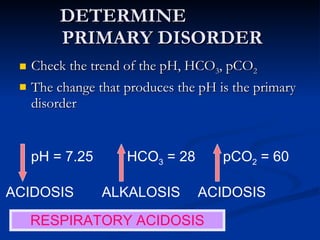
DETERMINE  PRIMARY DISORDER Check the trend of the pH, HCO 3 , pCO 2 The change that produces the pH is the primary disorder pH = 7.25 HCO 3  = 28 pCO 2  = 60 ACIDOSIS ALKALOSIS ACIDOSIS RESPIRATORY ACIDOSIS
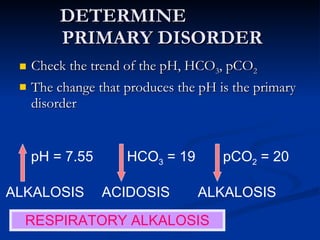
DETERMINE  PRIMARY DISORDER Check the trend of the pH, HCO 3 , pCO 2 The change that produces the pH is the primary disorder pH = 7.55 HCO 3  = 19 pCO 2  = 20 ALKALOSIS ACIDOSIS ALKALOSIS RESPIRATORY ALKALOSIS
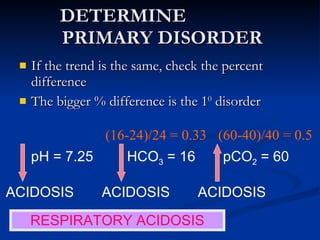
DETERMINE  PRIMARY DISORDER If the trend is the same, check the percent difference The bigger % difference is the 1 0  disorder pH = 7.25 HCO 3  = 16 pCO 2  = 60 ACIDOSIS ACIDOSIS ACIDOSIS RESPIRATORY ACIDOSIS (16-24)/24 = 0.33 (60-40)/40 = 0.5
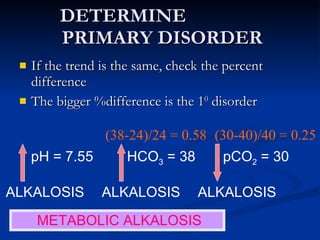
DETERMINE  PRIMARY DISORDER If the trend is the same, check the percent difference The bigger %difference is the 1 0  disorder pH = 7.55 HCO 3  = 38 pCO 2  = 30 ALKALOSIS ALKALOSIS ALKALOSIS METABOLIC ALKALOSIS (38-24)/24 = 0.58 (30-40)/40 = 0.25
CHECK THE COMPENSATORY RESPONSE
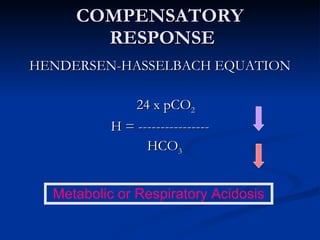
COMPENSATORY  RESPONSE HENDERSEN-HASSELBACH EQUATION   24 x pCO 2 H = ----------------   HCO 3 Metabolic or Respiratory Acidosis
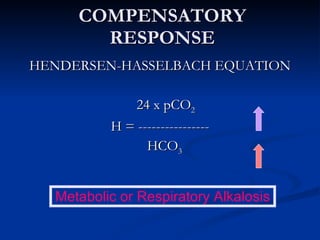
COMPENSATORY RESPONSE HENDERSEN-HASSELBACH EQUATION   24 x pCO 2 H = ----------------   HCO 3 Metabolic or Respiratory Alkalosis
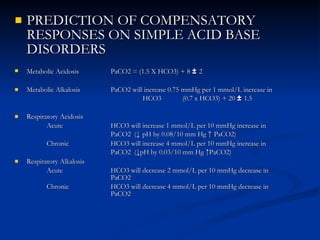
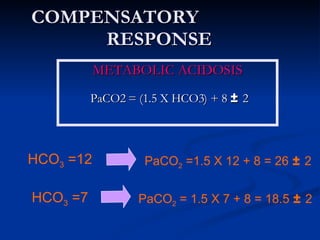
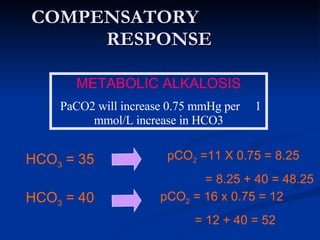
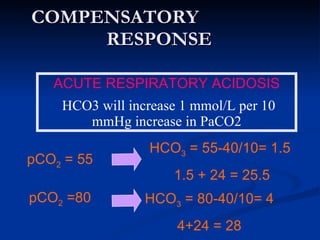
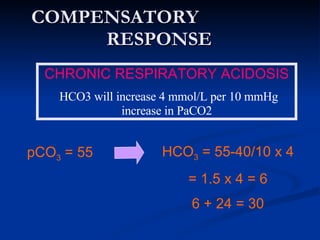
PREDICTION OF COMPENSATORY RESPONSES ON SIMPLE ACID BASE DISORDERS Metabolic Acidosis  PaCO2 = (1.5 X HCO3) + 8  ±  2 Metabolic Alkalosis PaCO2 will increase 0.75 mmHg per 1 mmol/L increase in  HCO3  (0.7 x HCO3) + 20  ±  1.5 Respiratory Acidosis  Acute  HCO3 will increase 1 mmol/L per 10 mmHg increase in  PaCO2  ( ↓  pH by 0.08/10 mm Hg  ↑  PaCO2) Chronic HCO3 will increase 4 mmol/L per 10 mmHg increase in  PaCO2  ( ↓ pH by 0.03/10 mm Hg  ↑ PaCO2) Respiratory Alkalosis Acute HCO3 will decrease 2 mmol/L per 10 mmHg decrease in  PaCO2 Chronic HCO3 will decrease 4 mmol/L per 10 mmHg decrease in  PaCO2
COMPENSATORY  RESPONSE METABOLIC ACIDOSIS PaCO2 = (1.5 X HCO3) + 8  ±  2 HCO 3  =12 PaCO 2  =1.5 X 12 + 8 = 26  ±  2 PaCO 2  = 1.5 X 7 + 8 = 18.5  ±  2 HCO 3  =7
COMPENSATORY  RESPONSE HCO 3  = 35 pCO 2  =11 X 0.75 = 8.25 = 8.25 + 40 = 48.25 pCO 2  = 16 x 0.75 = 12 = 12 + 40 = 52 HCO 3  = 40 METABOLIC ALKALOSIS PaCO2 will increase 0.75 mmHg per  1 mmol/L increase in HCO3
COMPENSATORY  RESPONSE pCO 2  = 55 HCO 3  = 55-40/10= 1.5 1.5 + 24 = 25.5 HCO 3  = 80-40/10= 4 4+24 = 28 pCO 2  =80 ACUTE RESPIRATORY ACIDOSIS HCO3 will increase 1 mmol/L per 10 mmHg increase in PaCO2
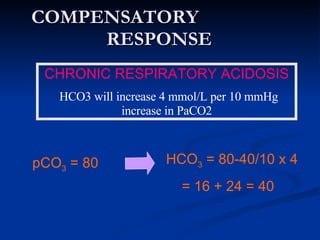
COMPENSATORY  RESPONSE pCO 3  = 55 HCO 3  = 55-40/10 x 4 = 1.5 x 4 = 6 6 + 24 = 30 CHRONIC RESPIRATORY ACIDOSIS HCO3 will increase 4 mmol/L per 10 mmHg increase in PaCO2
COMPENSATORY  RESPONSE HCO 3  = 80-40/10 x 4 = 16 + 24 = 40 pCO 3  = 80 CHRONIC RESPIRATORY ACIDOSIS HCO3 will increase 4 mmol/L per 10 mmHg increase in PaCO2
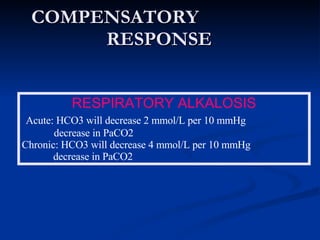
COMPENSATORY  RESPONSE RESPIRATORY ALKALOSIS Acute: HCO3 will decrease 2 mmol/L per 10 mmHg decrease in PaCO2 Chronic: HCO3 will decrease 4 mmol/L per 10 mmHg decrease in PaCO2
CALCULATE THE  ANION GAP
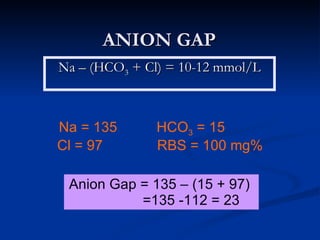
ANION GAP Na – (HCO 3  + Cl) = 10-12 mmol/L   Na = 135  HCO 3  = 15  Cl = 97   RBS = 100 mg% Anion Gap = 135 – (15 + 97)    =135 -112 = 23
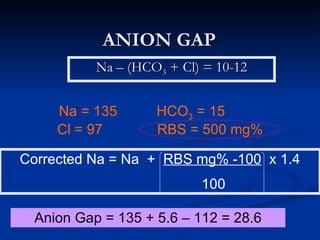
ANION GAP Na – (HCO 3  + Cl) = 10-12   Na = 135  HCO 3  = 15  Cl = 97   RBS = 500 mg% Corrected Na = Na  +  RBS mg% -100   x 1.4   100 Anion Gap = 135 + 5.6 – 112 = 28.6
CHECK THE DELTA / DELTA
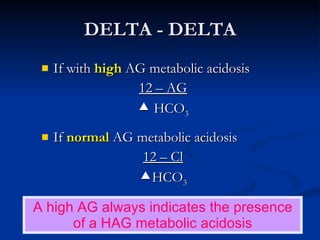
DELTA - DELTA If with  high   AG metabolic acidosis 12 – AG    HCO 3 If  normal   AG metabolic acidosis 12 – Cl  HCO 3 A high AG always indicates the presence of a HAG metabolic acidosis
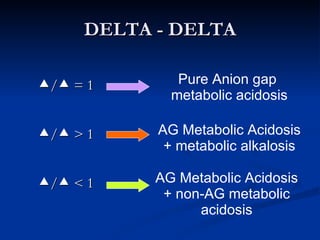
DELTA - DELTA  /   = 1   /   > 1  /   < 1 Pure Anion gap  metabolic acidosis AG Metabolic Acidosis + metabolic alkalosis AG Metabolic Acidosis + non-AG metabolic acidosis
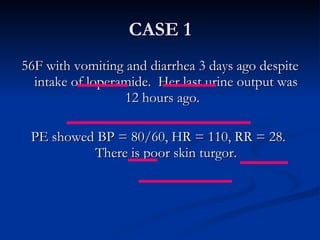
CASE 1 56F with vomiting and diarrhea 3 days ago despite intake of loperamide.  Her last urine output was 12 hours ago.  PE showed BP = 80/60, HR = 110, RR = 28.  There is poor skin turgor.
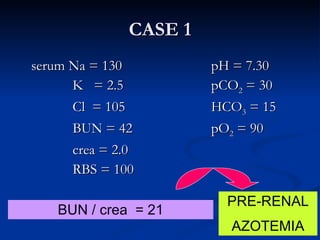
CASE 1 serum Na = 130  pH = 7.30   K  = 2.5 pCO 2  = 30   Cl  = 105 HCO 3  = 15   BUN = 42 pO 2  = 90   crea = 2.0   RBS = 100 BUN / crea  = 21 PRE-RENAL AZOTEMIA
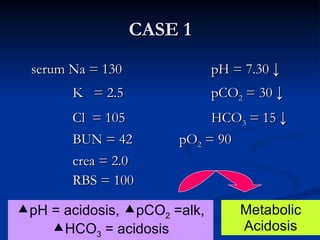
CASE 1 serum Na = 130  pH = 7.30  ↓   K  = 2.5 pCO 2  = 30  ↓   Cl  = 105 HCO 3  = 15  ↓   BUN = 42  pO 2  = 90   crea = 2.0   RBS = 100  pH = acidosis,   pCO 2  =alk,   HCO 3  = acidosis Metabolic Acidosis
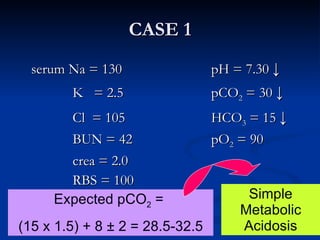
CASE 1 serum Na = 130  pH = 7.30  ↓   K  = 2.5 pCO 2  = 30  ↓   Cl  = 105 HCO 3  = 15  ↓   BUN = 42 pO 2  = 90   crea = 2.0   RBS = 100 Expected pCO 2  =  (15 x 1.5) + 8  ± 2  = 28.5-32.5 Simple Metabolic Acidosis
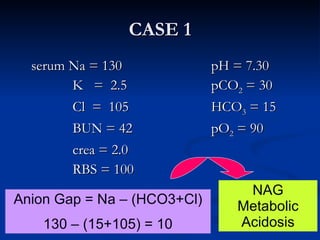
CASE 1 serum Na = 130  pH = 7.30   K  =  2.5 pCO 2  = 30   Cl  =  105 HCO 3  = 15   BUN = 42 pO 2  = 90   crea = 2.0   RBS = 100 Anion Gap = Na – (HCO3+Cl) 130 – (15+105) = 10 NAG Metabolic Acidosis
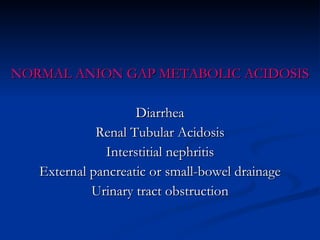
NORMAL ANION GAP METABOLIC ACIDOSIS Diarrhea Renal Tubular Acidosis Interstitial nephritis External pancreatic or small-bowel drainage Urinary tract obstruction
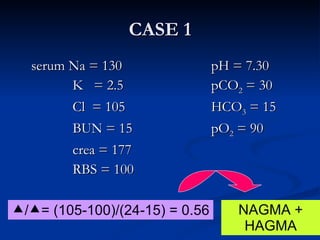
CASE 1 serum Na = 130  pH = 7.30   K  = 2.5 pCO 2  = 30   Cl  = 105 HCO 3  = 15   BUN = 15 pO 2  = 90   crea = 177   RBS = 100  /  = (105-100)/(24-15) = 0.56 NAGMA + HAGMA
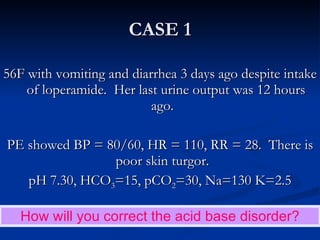
CASE 1 56F with vomiting and diarrhea 3 days ago despite intake of loperamide.  Her last urine output was 12 hours ago.  PE showed BP = 80/60, HR = 110, RR = 28.  There is poor skin turgor.  pH 7.30, HCO 3 =15, pCO 2 =30, Na=130 K=2.5 How will you correct the acid base disorder?
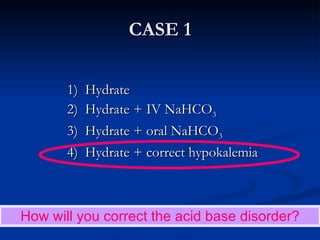
CASE 1 1)  Hydrate 2)  Hydrate + IV NaHCO 3 3)  Hydrate + oral NaHCO 3 4)  Hydrate + correct hypokalemia How will you correct the acid base disorder?
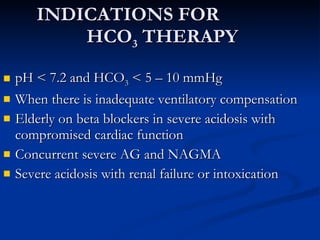
INDICATIONS FOR  HCO 3  THERAPY pH < 7.2 and HCO 3  < 5 – 10 mmHg When there is inadequate ventilatory compensation Elderly on beta blockers in severe acidosis with compromised cardiac function Concurrent severe AG and NAGMA Severe acidosis with renal failure or intoxication
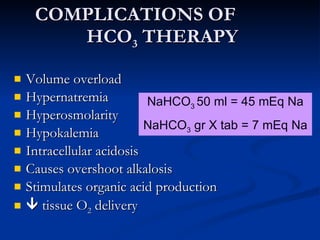
COMPLICATIONS OF  HCO 3  THERAPY Volume overload Hypernatremia Hyperosmolarity Hypokalemia Intracellular acidosis Causes overshoot alkalosis Stimulates organic acid production    tissue O 2  delivery NaHCO 3  50 ml = 45 mEq Na NaHCO 3  gr X tab = 7 mEq Na
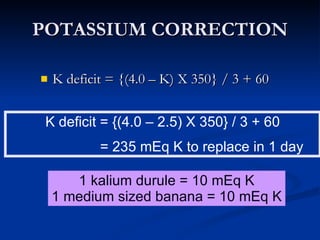
POTASSIUM CORRECTION K deficit =  { (4.0 – K) X 350 }  / 3 + 60 1 kalium durule = 10 mEq K 1 medium sized banana = 10 mEq K K deficit =  { (4.0 – 2.5) X 350 }  / 3 + 60   = 235 mEq K to replace in 1 day
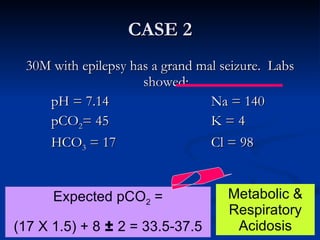
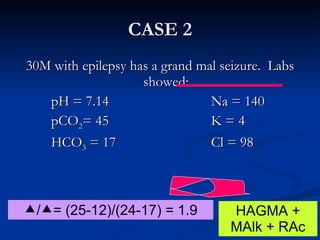
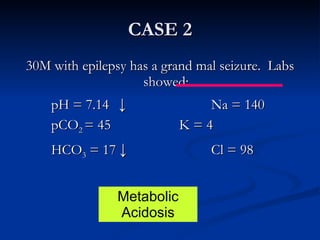
CASE 2 30M with epilepsy has a grand mal seizure.  Labs showed: pH = 7.14   ↓ Na = 140 pCO 2  = 45  K = 4 HCO 3  = 17  ↓ Cl = 98 Metabolic Acidosis
CASE 2 30M with epilepsy has a grand mal seizure.  Labs showed: pH = 7.14 Na = 140 pCO 2 = 45 K = 4 HCO 3  = 17 Cl = 98 Expected pCO 2  = (17 X 1.5) + 8  ±  2 = 33.5-37.5 Metabolic & Respiratory Acidosis
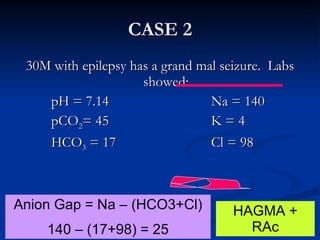
CASE 2 30M with epilepsy has a grand mal seizure.  Labs showed: pH = 7.14 Na = 140 pCO 2 = 45 K = 4 HCO 3  = 17 Cl = 98 Anion Gap = Na – (HCO3+Cl) 140 – (17+98) = 25 HAGMA + RAc
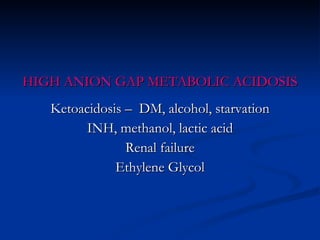
HIGH ANION GAP METABOLIC ACIDOSIS Ketoacidosis –  DM, alcohol, starvation INH, methanol, lactic acid Renal failure Ethylene Glycol
CASE 2 30M with epilepsy has a grand mal seizure.  Labs showed: pH = 7.14 Na = 140 pCO 2 = 45 K = 4 HCO 3  = 17 Cl = 98 HAGMA + MAlk + RAc  /  = (25-12)/(24-17) = 1.9
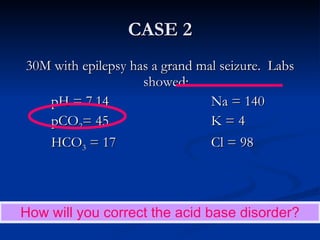
CASE 2 30M with epilepsy has a grand mal seizure.  Labs showed: pH = 7.14 Na = 140 pCO 2 = 45 K = 4 HCO 3  = 17 Cl = 98 How will you correct the acid base disorder?
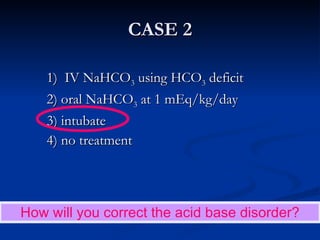
CASE 2 1)  IV NaHCO 3  using HCO 3  deficit 2) oral NaHCO 3  at 1 mEq/kg/day 3) intubate 4) no treatment How will you correct the acid base disorder?
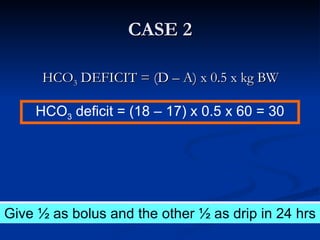
CASE 2 HCO 3  DEFICIT = (D – A) x 0.5 x kg BW How will you correct the acid base disorder? HCO 3  deficit = (18 – 17) x 0.5 x 60 = 30 Give ½ as bolus and the other ½ as drip in 24 hrs
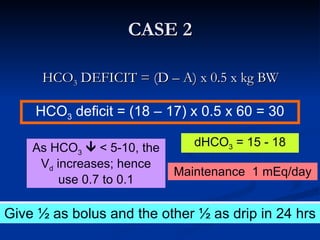
CASE 2 HCO 3  DEFICIT = (D – A) x 0.5 x kg BW How will you correct the acid base disorder? HCO 3  deficit = (18 – 17) x 0.5 x 60 = 30 As HCO 3     < 5-10, the V d  increases; hence use 0.7 to 0.1 dHCO 3  = 15 - 18 Maintenance  1 mEq/day Give ½ as bolus and the other ½ as drip in 24 hrs
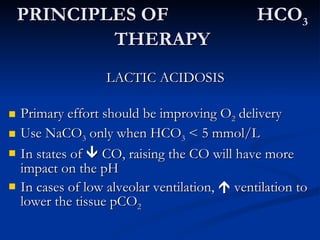
PRINCIPLES OF  HCO 3  THERAPY LACTIC ACIDOSIS Primary effort should be improving O 2  delivery Use NaCO 3  only when HCO 3  < 5 mmol/L In states of    CO, raising the CO will have more impact on the pH In cases of low alveolar ventilation,    ventilation to lower the tissue pCO 2
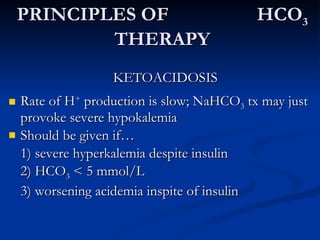
PRINCIPLES OF  HCO 3  THERAPY KETOACIDOSIS Rate of H +  production is slow; NaHCO 3  tx may just provoke severe hypokalemia Should be given if… 1) severe hyperkalemia despite insulin 2) HCO 3  < 5 mmol/L 3) worsening acidemia inspite of insulin
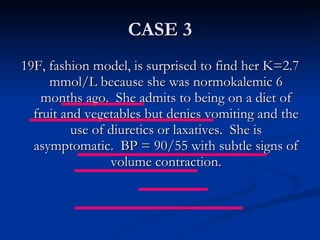
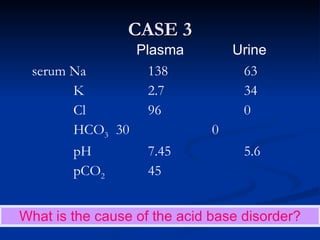
CASE 3 19F, fashion model, is surprised to find her K=2.7 mmol/L because she was normokalemic 6 months ago.  She admits to being on a diet of fruit and vegetables but denies vomiting and the use of diuretics or laxatives.  She is asymptomatic.  BP = 90/55 with subtle signs of volume contraction.
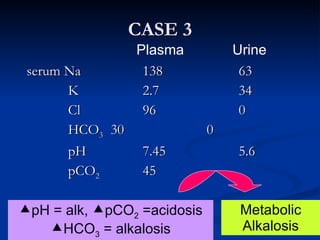
CASE 3 serum Na  138  63   K  2.7 34   Cl  96 0   HCO 3   30 0   pH  7.45 5.6   pCO 2   45   Metabolic Alkalosis Plasma Urine  pH = alk,   pCO 2  =acidosis   HCO 3  = alkalosis
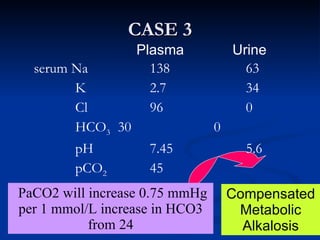
CASE 3 Expected PCO 2  =  6 x 0.75 = 4.5+40 = 44.5 CompensatedMetabolic Alkalosis serum Na  138  63   K  2.7 34   Cl  96 0   HCO 3   30 0   pH  7.45 5.6   pCO 2   45   Plasma Urine PaCO2 will increase 0.75 mmHg per 1 mmol/L increase in HCO3 from 24
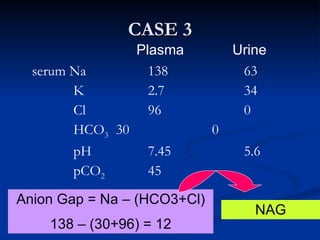
CASE 3 Anion Gap = Na – (HCO3+Cl) 138 – (30+96) = 12 NAG Plasma Urine serum Na  138  63   K  2.7 34   Cl  96 0   HCO 3   30 0   pH  7.45 5.6   pCO 2   45
CASE 3 Plasma Urine serum Na  138  63   K  2.7 34   Cl  96 0   HCO 3   30 0   pH  7.45 5.6   pCO 2   45   What is the cause of the acid base disorder?
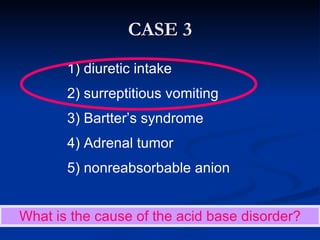
CASE 3 What is the cause of the acid base disorder? 1) diuretic intake 2) surreptitious vomiting 3) Bartter’s syndrome 4) Adrenal tumor 5) nonreabsorbable anion
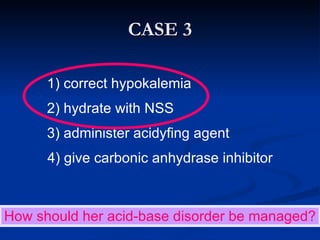
CASE 3 How should her acid-base disorder be managed?   1) correct hypokalemia   2) hydrate with NSS   3) administer acidyfing agent 4) give carbonic anhydrase inhibitor
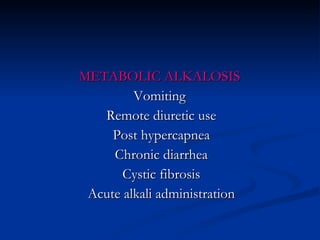
METABOLIC ALKALOSIS  Vomiting  Remote diuretic use Post hypercapnea Chronic diarrhea Cystic fibrosis Acute alkali administration
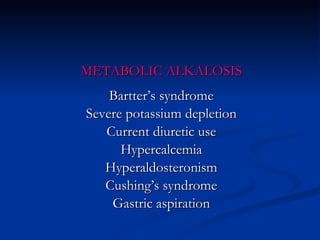
METABOLIC ALKALOSIS Bartter’s syndrome Severe potassium depletion Current diuretic use Hypercalcemia Hyperaldosteronism Cushing’s syndrome Gastric aspiration
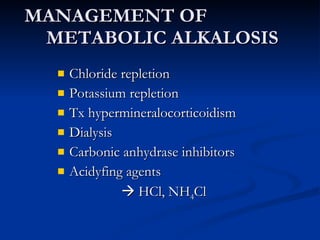
MANAGEMENT OF  METABOLIC ALKALOSIS Chloride repletion Potassium repletion Tx hypermineralocorticoidism Dialysis Carbonic anhydrase inhibitors Acidyfing agents     HCl, NH 4 Cl
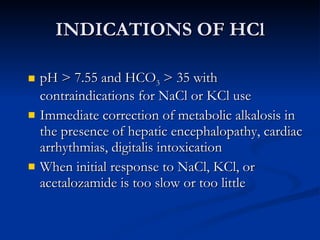
INDICATIONS OF HCl pH > 7.55 and HCO 3  > 35 with contraindications for NaCl or KCl use Immediate correction of metabolic alkalosis in the presence of hepatic encephalopathy, cardiac arrhythmias, digitalis intoxication When initial response to NaCl, KCl, or acetalozamide is too slow or too little
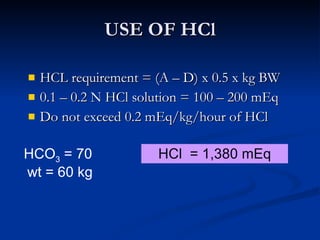
USE OF HCl HCL requirement = (A – D) x 0.5 x kg BW 0.1 – 0.2 N HCl solution = 100 – 200 mEq Do not exceed 0.2 mEq/kg/hour of HCl HCO 3  = 70  wt = 60 kg HCl  = 1,380 mEq
CASE 4 73M with long standing COPD (pCO 2  stable at 52-58 mmHg), cor pulmonale, and peripheral edema had been taking furosemide for 6 months.  Five days ago, he had anorexia, malaise, and productive cough.  He continued his medications until he developed nausea.  Later he was found disoriented and somnolent
CASE 4 PE: BP 110/70, HR 110, RR 24, T=40 respiratory distress prolonged expiratory phase postural drop in BP drowsy, disoriented scattered rhonchi and rales BLFs distant heart sounds trace pitting edema
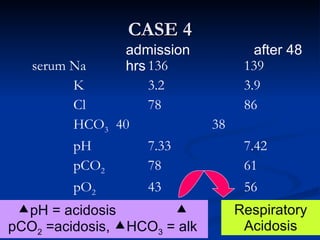
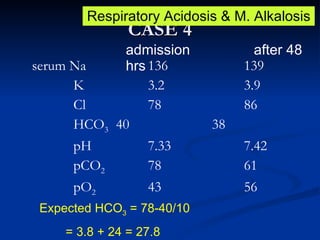
CASE 4 admission after 48 hrs  pH = acidosis   pCO 2  =acidosis,   HCO 3  = alk Respiratory Acidosis serum Na  136  139   K  3.2 3.9   Cl  78 86   HCO 3   40 38   pH  7.33 7.42   pCO 2   78 61   pO 2 43 56
 
CASE 4 serum Na  136  139   K  3.2 3.9   Cl  78 86   HCO 3   40 38   pH  7.33 7.42   pCO 2   78 61   pO 2 43 56   admission after 48 hrs Expected HCO 3  = 78-40/10 = 3.8 + 24 = 27.8  Respiratory Acidosis & M. Alkalosis
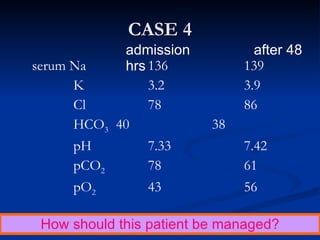
CASE 4 serum Na  136  139   K  3.2 3.9   Cl  78 86   HCO 3   40 38   pH  7.33 7.42   pCO 2   78 61   pO 2 43 56   How should this patient be managed? admission after 48 hrs
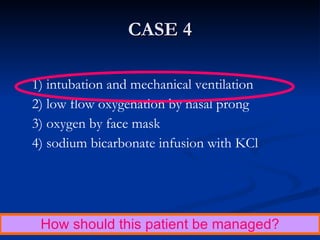
CASE 4 1) intubation and mechanical ventilation 2) low flow oxygenation by nasal prong 3) oxygen by face mask 4) sodium bicarbonate infusion with KCl How should this patient be managed?
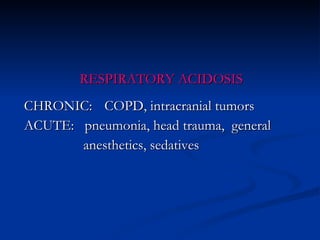
RESPIRATORY ACIDOSIS  CHRONIC: COPD, intracranial tumors  ACUTE:  pneumonia, head trauma,  general   anesthetics, sedatives
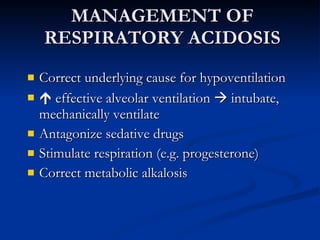
MANAGEMENT OF RESPIRATORY ACIDOSIS Correct underlying cause for hypoventilation    effective alveolar ventilation    intubate, mechanically ventilate Antagonize sedative drugs Stimulate respiration (e.g. progesterone) Correct metabolic alkalosis
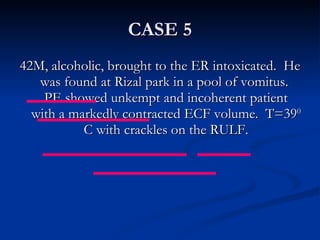
CASE 5 42M, alcoholic, brought to the ER intoxicated.  He was found at Rizal park in a pool of vomitus.  PE showed unkempt and incoherent patient with a markedly contracted ECF volume.  T=39 0  C with crackles on the RULF.
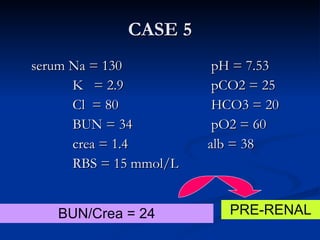
serum Na = 130  pH = 7.53   K  = 2.9 pCO2 = 25   Cl  = 80 HCO3 = 20   BUN = 34 pO2 = 60   crea = 1.4   alb = 38   RBS = 15 mmol/L CASE 5 PRE-RENAL BUN/Crea = 24
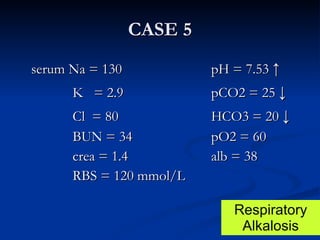
serum Na = 130  pH = 7.53  ↑   K  = 2.9 pCO2 = 25  ↓   Cl  = 80 HCO3 = 20  ↓   BUN = 34 pO2 = 60   crea = 1.4 alb = 38   RBS = 120 mmol/L CASE 5 Respiratory Alkalosis
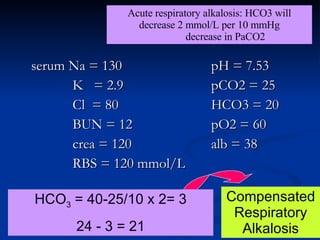
serum Na = 130  pH = 7.53   K  = 2.9 pCO2 = 25   Cl  = 80 HCO3 = 20   BUN = 12 pO2 = 60   crea = 120 alb = 38   RBS = 120 mmol/L CASE 5 Compensated Respiratory Alkalosis HCO 3  = 40-25/10 x 2= 3 24 - 3 = 21 Acute respiratory alkalosis: HCO3 will decrease 2 mmol/L per 10 mmHg decrease in PaCO2
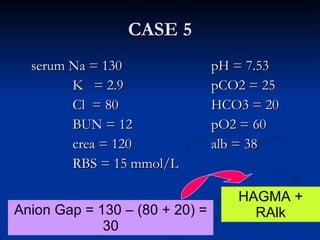
serum Na = 130  pH = 7.53   K  = 2.9 pCO2 = 25   Cl  = 80 HCO3 = 20   BUN = 12 pO2 = 60   crea = 120 alb = 38   RBS = 15 mmol/L CASE 5 HAGMA + RAlk Anion Gap = 130 – (80 + 20) = 30
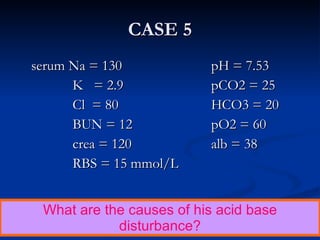
serum Na = 130  pH = 7.53   K  = 2.9 pCO2 = 25   Cl  = 80 HCO3 = 20   BUN = 12 pO2 = 60   crea = 120 alb = 38   RBS = 15 mmol/L CASE 5 What are the causes of his acid base disturbance?
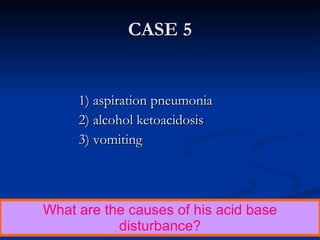
1) aspiration pneumonia 2) alcohol ketoacidosis 3) vomiting CASE 5 What are the causes of his acid base disturbance?
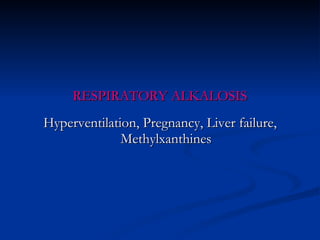
RESPIRATORY ALKALOSIS Hyperventilation, Pregnancy, Liver failure, Methylxanthines
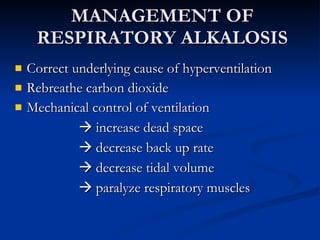
MANAGEMENT OF RESPIRATORY ALKALOSIS Correct underlying cause of hyperventilation Rebreathe carbon dioxide Mechanical control of ventilation    increase dead space    decrease back up rate    decrease tidal volume    paralyze respiratory muscles
QUESTIONS?
Thank You

ARTERIAL BLOOD GAS INTERPRETATION

  • 1.
    ACIDOSIS & ALKALOSIS ABG INTERPRETATION CRISBERT I. CUALTEROS, M.D.
  • 2.
    Acidosis –presence of a process which tends to lower pH by virtue of gain of H+ or loss of HCO3 Alkalosis – presence of a process which tends to raise pH by virtue of loss of H+ or addition of HCO3-
  • 3.
    Respiratory –processes which lead to acidosis or alkalosis through a primary alteration in ventilation and resultant excessive elimination or retention of CO2 Metabolic – processes which lead to acidosis or alkalosis through their effects on the kidneys and the consequent disruption of H+ and HCO3- control
  • 4.
    Acid Base BalancepH is maintained within a narrow range to preserve normal cell function Buffers –minimize the change in pH resulting from production of acid -> provides immediate protection from acid The primary buffer system is HCO3 - HCO3- + H+  H2CO3  H2O + CO2
  • 5.
    Simple acid-base disorder – a single primary process of acidosis or alkalosis Mixed acid-base disorder – presence of more than one acid base disorder simultaneously
  • 6.
    Compensation –the normal response of the respiratory system or kidneys to change in pH induced by a primary acid-base disorder No overcompensation ( except occasionally primary resp. alkalosis) Kidneys slow, lungs fast Lack of compensation (or over) determines a second primary disorder The degree of appropriate compensation is predictable
  • 7.
    Role of thekidney To retain and regenerate HCO3- thereby regenerating the buffer with the net effect of eliminating the acid H+ secretion HCO3- reabsorption Role of the respiratory system eliminate CO2
  • 8.
    Characteristics of thesimple acid-base disturbances  [HCO3-]  Pco2  Respiratory alkalosis  [HCO3-]  Pco2  Respiratory acidosis  Pco2  [HCO3-]  Metabolic alkalosis  Pco2  [HCO3-]  Metabolic acidosis Compensated response Primary Primary pH Disorder
  • 9.
    Combined Alkalosis AlkRespiratory Alkalosis Acid Alkalotic Metabolic Alkalosis Alk Acidotic Alkali Metabolic Acidosis Acid Alkalotic Combined respiratory and metabolic Acidosis Acid Respiratory Acidosis Alk Acidotic Acid Interpretation HCO3 PCO 2 pH
  • 10.
    STEPWISE APPROACH Determineprimary disorder Check the compensatory response Calculate the anion gap Identify specific etiologies for the acid-base disorder Prescribe treatment
  • 11.
  • 12.
    DETERMINE THE PRIMARY DISORDER
  • 13.
    pH = 7.35– 7.45 pCO2 = 35 – 45 mmHg lungs (Reference Value = 40) HCO3 = 22 – 26 mmol/L kidneys (Reference value = 24)
  • 14.
    DETERMINE PRIMARYDISORDER Check the trend of the pH, HCO 3 , pCO 2 The change that produces the pH is the primary disorder pH = 7.25 HCO 3 = 12 pCO 2 = 30 ACIDOSIS ACIDOSIS ALKALOSIS METABOLIC ACIDOSIS
  • 15.
    DETERMINE PRIMARYDISORDER Check the trend of the pH, HCO 3 , pCO 2 The change that produces the pH is the primary disorder pH = 7.25 HCO 3 = 28 pCO 2 = 60 ACIDOSIS ALKALOSIS ACIDOSIS RESPIRATORY ACIDOSIS
  • 16.
    DETERMINE PRIMARYDISORDER Check the trend of the pH, HCO 3 , pCO 2 The change that produces the pH is the primary disorder pH = 7.55 HCO 3 = 19 pCO 2 = 20 ALKALOSIS ACIDOSIS ALKALOSIS RESPIRATORY ALKALOSIS
  • 17.
    DETERMINE PRIMARYDISORDER If the trend is the same, check the percent difference The bigger % difference is the 1 0 disorder pH = 7.25 HCO 3 = 16 pCO 2 = 60 ACIDOSIS ACIDOSIS ACIDOSIS RESPIRATORY ACIDOSIS (16-24)/24 = 0.33 (60-40)/40 = 0.5
  • 18.
    DETERMINE PRIMARYDISORDER If the trend is the same, check the percent difference The bigger %difference is the 1 0 disorder pH = 7.55 HCO 3 = 38 pCO 2 = 30 ALKALOSIS ALKALOSIS ALKALOSIS METABOLIC ALKALOSIS (38-24)/24 = 0.58 (30-40)/40 = 0.25
  • 19.
  • 20.
    COMPENSATORY RESPONSEHENDERSEN-HASSELBACH EQUATION 24 x pCO 2 H = ---------------- HCO 3 Metabolic or Respiratory Acidosis
  • 21.
    COMPENSATORY RESPONSE HENDERSEN-HASSELBACHEQUATION 24 x pCO 2 H = ---------------- HCO 3 Metabolic or Respiratory Alkalosis
  • 22.
    PREDICTION OF COMPENSATORYRESPONSES ON SIMPLE ACID BASE DISORDERS Metabolic Acidosis PaCO2 = (1.5 X HCO3) + 8 ± 2 Metabolic Alkalosis PaCO2 will increase 0.75 mmHg per 1 mmol/L increase in HCO3 (0.7 x HCO3) + 20 ± 1.5 Respiratory Acidosis Acute HCO3 will increase 1 mmol/L per 10 mmHg increase in PaCO2 ( ↓ pH by 0.08/10 mm Hg ↑ PaCO2) Chronic HCO3 will increase 4 mmol/L per 10 mmHg increase in PaCO2 ( ↓ pH by 0.03/10 mm Hg ↑ PaCO2) Respiratory Alkalosis Acute HCO3 will decrease 2 mmol/L per 10 mmHg decrease in PaCO2 Chronic HCO3 will decrease 4 mmol/L per 10 mmHg decrease in PaCO2
  • 23.
    COMPENSATORY RESPONSEMETABOLIC ACIDOSIS PaCO2 = (1.5 X HCO3) + 8 ± 2 HCO 3 =12 PaCO 2 =1.5 X 12 + 8 = 26 ± 2 PaCO 2 = 1.5 X 7 + 8 = 18.5 ± 2 HCO 3 =7
  • 24.
    COMPENSATORY RESPONSEHCO 3 = 35 pCO 2 =11 X 0.75 = 8.25 = 8.25 + 40 = 48.25 pCO 2 = 16 x 0.75 = 12 = 12 + 40 = 52 HCO 3 = 40 METABOLIC ALKALOSIS PaCO2 will increase 0.75 mmHg per 1 mmol/L increase in HCO3
  • 25.
    COMPENSATORY RESPONSEpCO 2 = 55 HCO 3 = 55-40/10= 1.5 1.5 + 24 = 25.5 HCO 3 = 80-40/10= 4 4+24 = 28 pCO 2 =80 ACUTE RESPIRATORY ACIDOSIS HCO3 will increase 1 mmol/L per 10 mmHg increase in PaCO2
  • 26.
    COMPENSATORY RESPONSEpCO 3 = 55 HCO 3 = 55-40/10 x 4 = 1.5 x 4 = 6 6 + 24 = 30 CHRONIC RESPIRATORY ACIDOSIS HCO3 will increase 4 mmol/L per 10 mmHg increase in PaCO2
  • 27.
    COMPENSATORY RESPONSEHCO 3 = 80-40/10 x 4 = 16 + 24 = 40 pCO 3 = 80 CHRONIC RESPIRATORY ACIDOSIS HCO3 will increase 4 mmol/L per 10 mmHg increase in PaCO2
  • 28.
    COMPENSATORY RESPONSERESPIRATORY ALKALOSIS Acute: HCO3 will decrease 2 mmol/L per 10 mmHg decrease in PaCO2 Chronic: HCO3 will decrease 4 mmol/L per 10 mmHg decrease in PaCO2
  • 29.
    CALCULATE THE ANION GAP
  • 30.
    ANION GAP Na– (HCO 3 + Cl) = 10-12 mmol/L Na = 135 HCO 3 = 15 Cl = 97 RBS = 100 mg% Anion Gap = 135 – (15 + 97) =135 -112 = 23
  • 31.
    ANION GAP Na– (HCO 3 + Cl) = 10-12 Na = 135 HCO 3 = 15 Cl = 97 RBS = 500 mg% Corrected Na = Na + RBS mg% -100 x 1.4 100 Anion Gap = 135 + 5.6 – 112 = 28.6
  • 32.
  • 33.
    DELTA - DELTAIf with high AG metabolic acidosis 12 – AG  HCO 3 If normal AG metabolic acidosis 12 – Cl  HCO 3 A high AG always indicates the presence of a HAG metabolic acidosis
  • 34.
    DELTA - DELTA /  = 1  /  > 1  /  < 1 Pure Anion gap metabolic acidosis AG Metabolic Acidosis + metabolic alkalosis AG Metabolic Acidosis + non-AG metabolic acidosis
  • 35.
    CASE 1 56Fwith vomiting and diarrhea 3 days ago despite intake of loperamide. Her last urine output was 12 hours ago. PE showed BP = 80/60, HR = 110, RR = 28. There is poor skin turgor.
  • 36.
    CASE 1 serumNa = 130 pH = 7.30 K = 2.5 pCO 2 = 30 Cl = 105 HCO 3 = 15 BUN = 42 pO 2 = 90 crea = 2.0 RBS = 100 BUN / crea = 21 PRE-RENAL AZOTEMIA
  • 37.
    CASE 1 serumNa = 130 pH = 7.30 ↓ K = 2.5 pCO 2 = 30 ↓ Cl = 105 HCO 3 = 15 ↓ BUN = 42 pO 2 = 90 crea = 2.0 RBS = 100  pH = acidosis,  pCO 2 =alk,  HCO 3 = acidosis Metabolic Acidosis
  • 38.
    CASE 1 serumNa = 130 pH = 7.30 ↓ K = 2.5 pCO 2 = 30 ↓ Cl = 105 HCO 3 = 15 ↓ BUN = 42 pO 2 = 90 crea = 2.0 RBS = 100 Expected pCO 2 = (15 x 1.5) + 8 ± 2 = 28.5-32.5 Simple Metabolic Acidosis
  • 39.
    CASE 1 serumNa = 130 pH = 7.30 K = 2.5 pCO 2 = 30 Cl = 105 HCO 3 = 15 BUN = 42 pO 2 = 90 crea = 2.0 RBS = 100 Anion Gap = Na – (HCO3+Cl) 130 – (15+105) = 10 NAG Metabolic Acidosis
  • 40.
    NORMAL ANION GAPMETABOLIC ACIDOSIS Diarrhea Renal Tubular Acidosis Interstitial nephritis External pancreatic or small-bowel drainage Urinary tract obstruction
  • 41.
    CASE 1 serumNa = 130 pH = 7.30 K = 2.5 pCO 2 = 30 Cl = 105 HCO 3 = 15 BUN = 15 pO 2 = 90 crea = 177 RBS = 100  /  = (105-100)/(24-15) = 0.56 NAGMA + HAGMA
  • 42.
    CASE 1 56Fwith vomiting and diarrhea 3 days ago despite intake of loperamide. Her last urine output was 12 hours ago. PE showed BP = 80/60, HR = 110, RR = 28. There is poor skin turgor. pH 7.30, HCO 3 =15, pCO 2 =30, Na=130 K=2.5 How will you correct the acid base disorder?
  • 43.
    CASE 1 1) Hydrate 2) Hydrate + IV NaHCO 3 3) Hydrate + oral NaHCO 3 4) Hydrate + correct hypokalemia How will you correct the acid base disorder?
  • 44.
    INDICATIONS FOR HCO 3 THERAPY pH < 7.2 and HCO 3 < 5 – 10 mmHg When there is inadequate ventilatory compensation Elderly on beta blockers in severe acidosis with compromised cardiac function Concurrent severe AG and NAGMA Severe acidosis with renal failure or intoxication
  • 45.
    COMPLICATIONS OF HCO 3 THERAPY Volume overload Hypernatremia Hyperosmolarity Hypokalemia Intracellular acidosis Causes overshoot alkalosis Stimulates organic acid production  tissue O 2 delivery NaHCO 3 50 ml = 45 mEq Na NaHCO 3 gr X tab = 7 mEq Na
  • 46.
    POTASSIUM CORRECTION Kdeficit = { (4.0 – K) X 350 } / 3 + 60 1 kalium durule = 10 mEq K 1 medium sized banana = 10 mEq K K deficit = { (4.0 – 2.5) X 350 } / 3 + 60 = 235 mEq K to replace in 1 day
  • 47.
    CASE 2 30Mwith epilepsy has a grand mal seizure. Labs showed: pH = 7.14 ↓ Na = 140 pCO 2 = 45 K = 4 HCO 3 = 17 ↓ Cl = 98 Metabolic Acidosis
  • 48.
    CASE 2 30Mwith epilepsy has a grand mal seizure. Labs showed: pH = 7.14 Na = 140 pCO 2 = 45 K = 4 HCO 3 = 17 Cl = 98 Expected pCO 2 = (17 X 1.5) + 8 ± 2 = 33.5-37.5 Metabolic & Respiratory Acidosis
  • 49.
    CASE 2 30Mwith epilepsy has a grand mal seizure. Labs showed: pH = 7.14 Na = 140 pCO 2 = 45 K = 4 HCO 3 = 17 Cl = 98 Anion Gap = Na – (HCO3+Cl) 140 – (17+98) = 25 HAGMA + RAc
  • 50.
    HIGH ANION GAPMETABOLIC ACIDOSIS Ketoacidosis – DM, alcohol, starvation INH, methanol, lactic acid Renal failure Ethylene Glycol
  • 51.
    CASE 2 30Mwith epilepsy has a grand mal seizure. Labs showed: pH = 7.14 Na = 140 pCO 2 = 45 K = 4 HCO 3 = 17 Cl = 98 HAGMA + MAlk + RAc  /  = (25-12)/(24-17) = 1.9
  • 52.
    CASE 2 30Mwith epilepsy has a grand mal seizure. Labs showed: pH = 7.14 Na = 140 pCO 2 = 45 K = 4 HCO 3 = 17 Cl = 98 How will you correct the acid base disorder?
  • 53.
    CASE 2 1) IV NaHCO 3 using HCO 3 deficit 2) oral NaHCO 3 at 1 mEq/kg/day 3) intubate 4) no treatment How will you correct the acid base disorder?
  • 54.
    CASE 2 HCO3 DEFICIT = (D – A) x 0.5 x kg BW How will you correct the acid base disorder? HCO 3 deficit = (18 – 17) x 0.5 x 60 = 30 Give ½ as bolus and the other ½ as drip in 24 hrs
  • 55.
    CASE 2 HCO3 DEFICIT = (D – A) x 0.5 x kg BW How will you correct the acid base disorder? HCO 3 deficit = (18 – 17) x 0.5 x 60 = 30 As HCO 3  < 5-10, the V d increases; hence use 0.7 to 0.1 dHCO 3 = 15 - 18 Maintenance 1 mEq/day Give ½ as bolus and the other ½ as drip in 24 hrs
  • 56.
    PRINCIPLES OF HCO 3 THERAPY LACTIC ACIDOSIS Primary effort should be improving O 2 delivery Use NaCO 3 only when HCO 3 < 5 mmol/L In states of  CO, raising the CO will have more impact on the pH In cases of low alveolar ventilation,  ventilation to lower the tissue pCO 2
  • 57.
    PRINCIPLES OF HCO 3 THERAPY KETOACIDOSIS Rate of H + production is slow; NaHCO 3 tx may just provoke severe hypokalemia Should be given if… 1) severe hyperkalemia despite insulin 2) HCO 3 < 5 mmol/L 3) worsening acidemia inspite of insulin
  • 58.
    CASE 3 19F,fashion model, is surprised to find her K=2.7 mmol/L because she was normokalemic 6 months ago. She admits to being on a diet of fruit and vegetables but denies vomiting and the use of diuretics or laxatives. She is asymptomatic. BP = 90/55 with subtle signs of volume contraction.
  • 59.
    CASE 3 serumNa 138 63 K 2.7 34 Cl 96 0 HCO 3 30 0 pH 7.45 5.6 pCO 2 45 Metabolic Alkalosis Plasma Urine  pH = alk,  pCO 2 =acidosis  HCO 3 = alkalosis
  • 60.
    CASE 3 ExpectedPCO 2 = 6 x 0.75 = 4.5+40 = 44.5 CompensatedMetabolic Alkalosis serum Na 138 63 K 2.7 34 Cl 96 0 HCO 3 30 0 pH 7.45 5.6 pCO 2 45 Plasma Urine PaCO2 will increase 0.75 mmHg per 1 mmol/L increase in HCO3 from 24
  • 61.
    CASE 3 AnionGap = Na – (HCO3+Cl) 138 – (30+96) = 12 NAG Plasma Urine serum Na 138 63 K 2.7 34 Cl 96 0 HCO 3 30 0 pH 7.45 5.6 pCO 2 45
  • 62.
    CASE 3 PlasmaUrine serum Na 138 63 K 2.7 34 Cl 96 0 HCO 3 30 0 pH 7.45 5.6 pCO 2 45 What is the cause of the acid base disorder?
  • 63.
    CASE 3 Whatis the cause of the acid base disorder? 1) diuretic intake 2) surreptitious vomiting 3) Bartter’s syndrome 4) Adrenal tumor 5) nonreabsorbable anion
  • 64.
    CASE 3 Howshould her acid-base disorder be managed? 1) correct hypokalemia 2) hydrate with NSS 3) administer acidyfing agent 4) give carbonic anhydrase inhibitor
  • 65.
    METABOLIC ALKALOSIS Vomiting Remote diuretic use Post hypercapnea Chronic diarrhea Cystic fibrosis Acute alkali administration
  • 66.
    METABOLIC ALKALOSIS Bartter’ssyndrome Severe potassium depletion Current diuretic use Hypercalcemia Hyperaldosteronism Cushing’s syndrome Gastric aspiration
  • 67.
    MANAGEMENT OF METABOLIC ALKALOSIS Chloride repletion Potassium repletion Tx hypermineralocorticoidism Dialysis Carbonic anhydrase inhibitors Acidyfing agents  HCl, NH 4 Cl
  • 68.
    INDICATIONS OF HClpH > 7.55 and HCO 3 > 35 with contraindications for NaCl or KCl use Immediate correction of metabolic alkalosis in the presence of hepatic encephalopathy, cardiac arrhythmias, digitalis intoxication When initial response to NaCl, KCl, or acetalozamide is too slow or too little
  • 69.
    USE OF HClHCL requirement = (A – D) x 0.5 x kg BW 0.1 – 0.2 N HCl solution = 100 – 200 mEq Do not exceed 0.2 mEq/kg/hour of HCl HCO 3 = 70 wt = 60 kg HCl = 1,380 mEq
  • 70.
    CASE 4 73Mwith long standing COPD (pCO 2 stable at 52-58 mmHg), cor pulmonale, and peripheral edema had been taking furosemide for 6 months. Five days ago, he had anorexia, malaise, and productive cough. He continued his medications until he developed nausea. Later he was found disoriented and somnolent
  • 71.
    CASE 4 PE:BP 110/70, HR 110, RR 24, T=40 respiratory distress prolonged expiratory phase postural drop in BP drowsy, disoriented scattered rhonchi and rales BLFs distant heart sounds trace pitting edema
  • 72.
    CASE 4 admissionafter 48 hrs  pH = acidosis  pCO 2 =acidosis,  HCO 3 = alk Respiratory Acidosis serum Na 136 139 K 3.2 3.9 Cl 78 86 HCO 3 40 38 pH 7.33 7.42 pCO 2 78 61 pO 2 43 56
  • 73.
  • 74.
    CASE 4 serumNa 136 139 K 3.2 3.9 Cl 78 86 HCO 3 40 38 pH 7.33 7.42 pCO 2 78 61 pO 2 43 56 admission after 48 hrs Expected HCO 3 = 78-40/10 = 3.8 + 24 = 27.8 Respiratory Acidosis & M. Alkalosis
  • 75.
    CASE 4 serumNa 136 139 K 3.2 3.9 Cl 78 86 HCO 3 40 38 pH 7.33 7.42 pCO 2 78 61 pO 2 43 56 How should this patient be managed? admission after 48 hrs
  • 76.
    CASE 4 1)intubation and mechanical ventilation 2) low flow oxygenation by nasal prong 3) oxygen by face mask 4) sodium bicarbonate infusion with KCl How should this patient be managed?
  • 77.
    RESPIRATORY ACIDOSIS CHRONIC: COPD, intracranial tumors ACUTE: pneumonia, head trauma, general anesthetics, sedatives
  • 78.
    MANAGEMENT OF RESPIRATORYACIDOSIS Correct underlying cause for hypoventilation  effective alveolar ventilation  intubate, mechanically ventilate Antagonize sedative drugs Stimulate respiration (e.g. progesterone) Correct metabolic alkalosis
  • 79.
    CASE 5 42M,alcoholic, brought to the ER intoxicated. He was found at Rizal park in a pool of vomitus. PE showed unkempt and incoherent patient with a markedly contracted ECF volume. T=39 0 C with crackles on the RULF.
  • 80.
    serum Na =130 pH = 7.53 K = 2.9 pCO2 = 25 Cl = 80 HCO3 = 20 BUN = 34 pO2 = 60 crea = 1.4 alb = 38 RBS = 15 mmol/L CASE 5 PRE-RENAL BUN/Crea = 24
  • 81.
    serum Na =130 pH = 7.53 ↑ K = 2.9 pCO2 = 25 ↓ Cl = 80 HCO3 = 20 ↓ BUN = 34 pO2 = 60 crea = 1.4 alb = 38 RBS = 120 mmol/L CASE 5 Respiratory Alkalosis
  • 82.
    serum Na =130 pH = 7.53 K = 2.9 pCO2 = 25 Cl = 80 HCO3 = 20 BUN = 12 pO2 = 60 crea = 120 alb = 38 RBS = 120 mmol/L CASE 5 Compensated Respiratory Alkalosis HCO 3 = 40-25/10 x 2= 3 24 - 3 = 21 Acute respiratory alkalosis: HCO3 will decrease 2 mmol/L per 10 mmHg decrease in PaCO2
  • 83.
    serum Na =130 pH = 7.53 K = 2.9 pCO2 = 25 Cl = 80 HCO3 = 20 BUN = 12 pO2 = 60 crea = 120 alb = 38 RBS = 15 mmol/L CASE 5 HAGMA + RAlk Anion Gap = 130 – (80 + 20) = 30
  • 84.
    serum Na =130 pH = 7.53 K = 2.9 pCO2 = 25 Cl = 80 HCO3 = 20 BUN = 12 pO2 = 60 crea = 120 alb = 38 RBS = 15 mmol/L CASE 5 What are the causes of his acid base disturbance?
  • 85.
    1) aspiration pneumonia2) alcohol ketoacidosis 3) vomiting CASE 5 What are the causes of his acid base disturbance?
  • 86.
    RESPIRATORY ALKALOSIS Hyperventilation,Pregnancy, Liver failure, Methylxanthines
  • 87.
    MANAGEMENT OF RESPIRATORYALKALOSIS Correct underlying cause of hyperventilation Rebreathe carbon dioxide Mechanical control of ventilation  increase dead space  decrease back up rate  decrease tidal volume  paralyze respiratory muscles
  • 88.
  • 89.