Clinical Aspect of Interpretation of Blood Gas Analysis For medical students of PUMC Class 1999,  Sept. 15, 2003
What Does Arterial Blood Gas (ABG) Measure ?
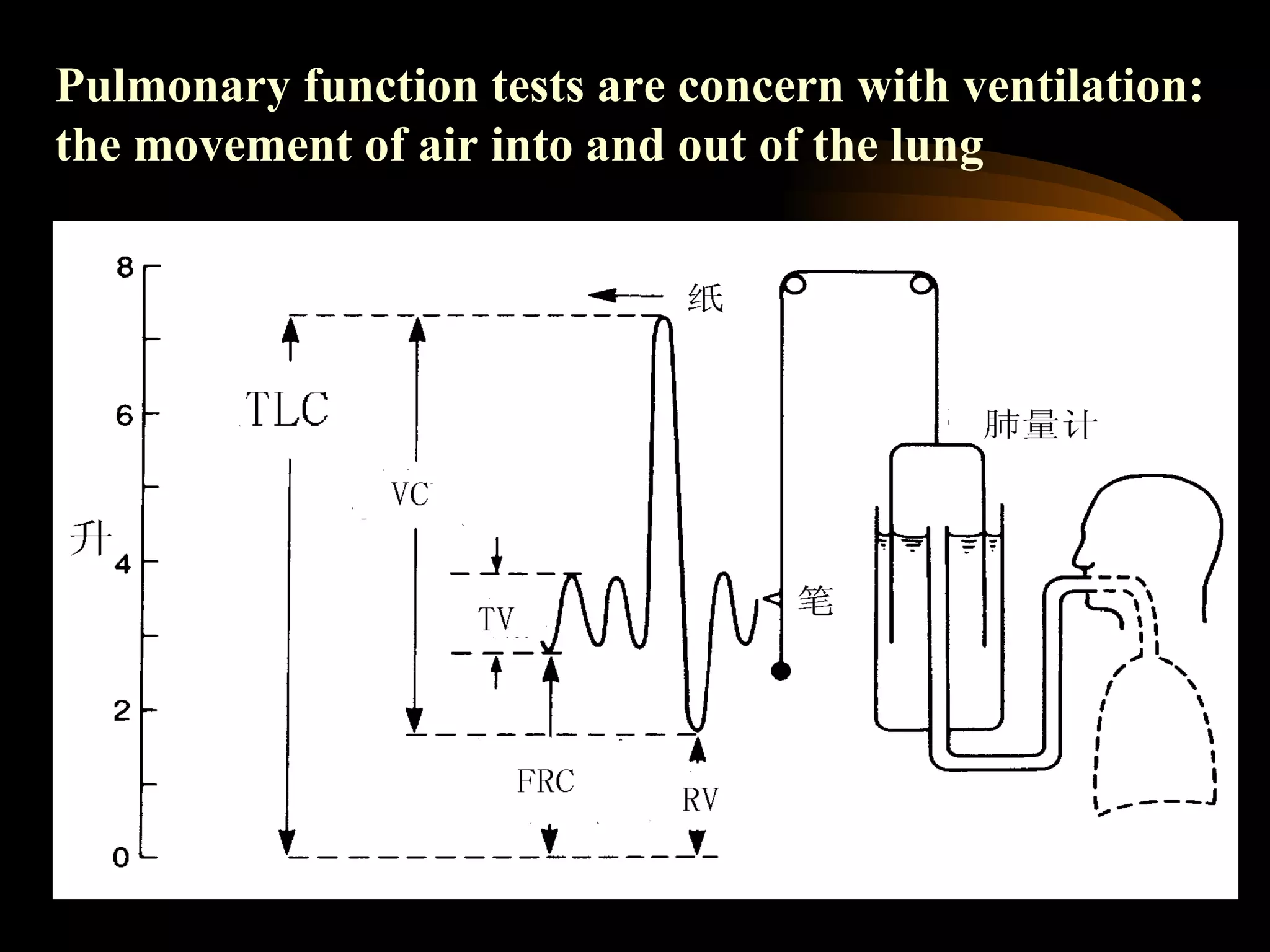
Pulmonary function tests are concern with ventilation: the movement of air into and out of the lung
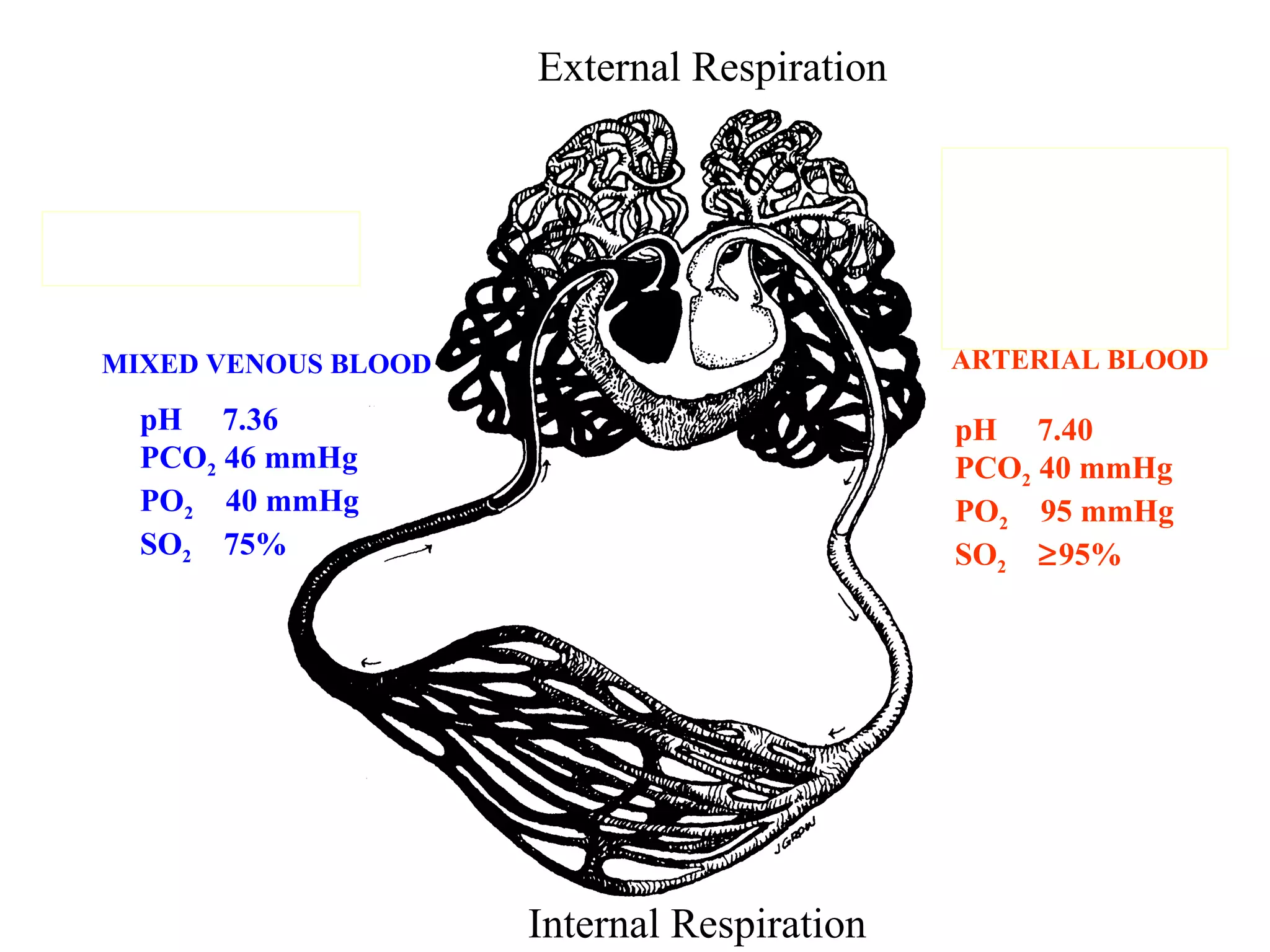
MIXED VENOUS BLOOD pH  7.36 PCO 2  46 mmHg PO 2   40 mmHg SO 2   75% pH  7.40 PCO 2  40 mmHg PO 2   95 mmHg SO 2    95% ARTERIAL BLOOD External Respiration Internal Respiration
What Information Does Arterial  Blood Gas provide? Arterial oxygenation Alveolar ventilation Respiratory/metabolic acid-base balance Carboxyhemoglobin levels
Alveolar Ventilation Equation Inverse relationship between V A  and P a CO 2
Arterial Blood Gas Analysis Indications Evaluate adequacy of lung function Ventilation, acid-base status Oxygenation Determine need for supplemental O 2  Monitor ventilatory support Document severity or progression of known pulmonary disease Diagnose the toxicity of CO
Henderson-Hasselbalch Equation The relationship between pH, P a CO 2  , HCO 3 -
Why the assessment of a single buffer system is adequate despite multiple buffer systems? Bicarbonate buffer system: of primary importance, open system in communication with external environment via kidneys Hemoglobin buffer: of second importance Phosphate buffer system Plasma protein buffer system All buffer systems are linked together through H +
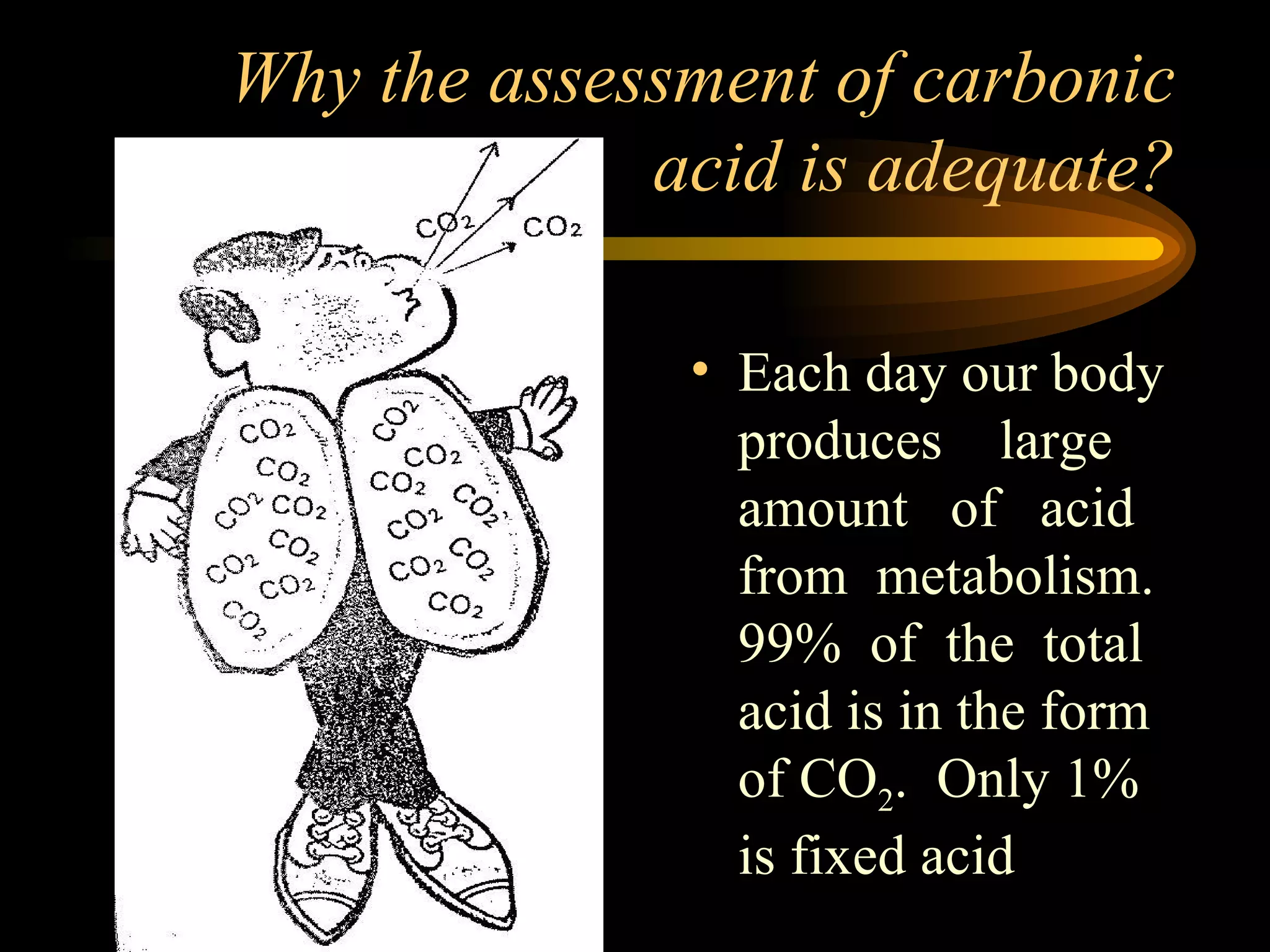
Why the assessment of carbonic  acid is adequate?  Each day our body produces  large amount  of  acid from  metabolism. 99%  of  the  total acid is in the form of CO 2 .  Only 1% is fixed acid
Henderson-Hasselbalch Equation The relationship between pH, P a CO 2  , HCO 3 -
Case 1: normal
Case 1: normal
Case 1: normal
Case 1: normal
Case 1: normal
Case 2 Uncompensated Respiratory Acidosis
Case2  Uncompensated Respiratory Acidosis
Case 2 Uncompensated Respiratory Acidosis
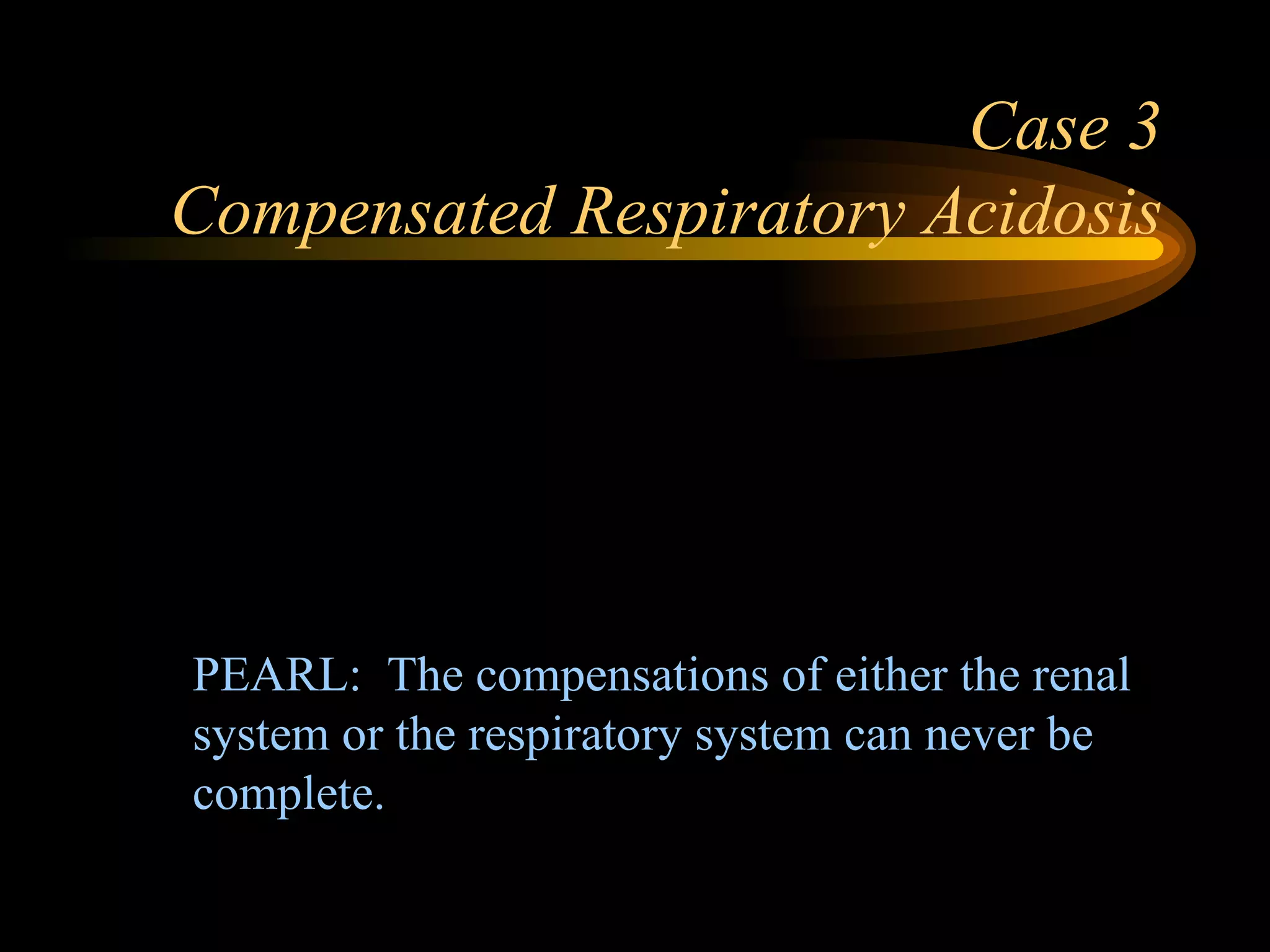
Case 3 Compensated Respiratory Acidosis
Case3  Compensated Respiratory Acidosis
Case 3 Compensated Respiratory Acidosis PEARL:  The compensations of either the renal system or the respiratory system can never be complete.
Clinically Relevant Parameters (1)  Through the years, opinions have changed  regarding  what  are  the most clinically relevant parameters.  Today, for a nearly complete description of the oxygenation, ventilation, and acid-base status,  pH,  PaCO 2 ,  PaO 2   and actual HCO 3 -  are generally sufficient.
Clinically Relevant Parameters (2) Indeed, the literature or text book contains literally several  parameters,  i.e. standard HCO 3 - ,  buffer  base (BB),  base  excess (BE)  from  in  vitro measures.  Because intro  and  in  vivo  changes in response to hypercapnia  are  different,  their actual clinical benefit is limited.  Burton GG, Hodgkin JE, Ward JJ. Respiratory care: A guide to clinical practice. 1997, 260-265.
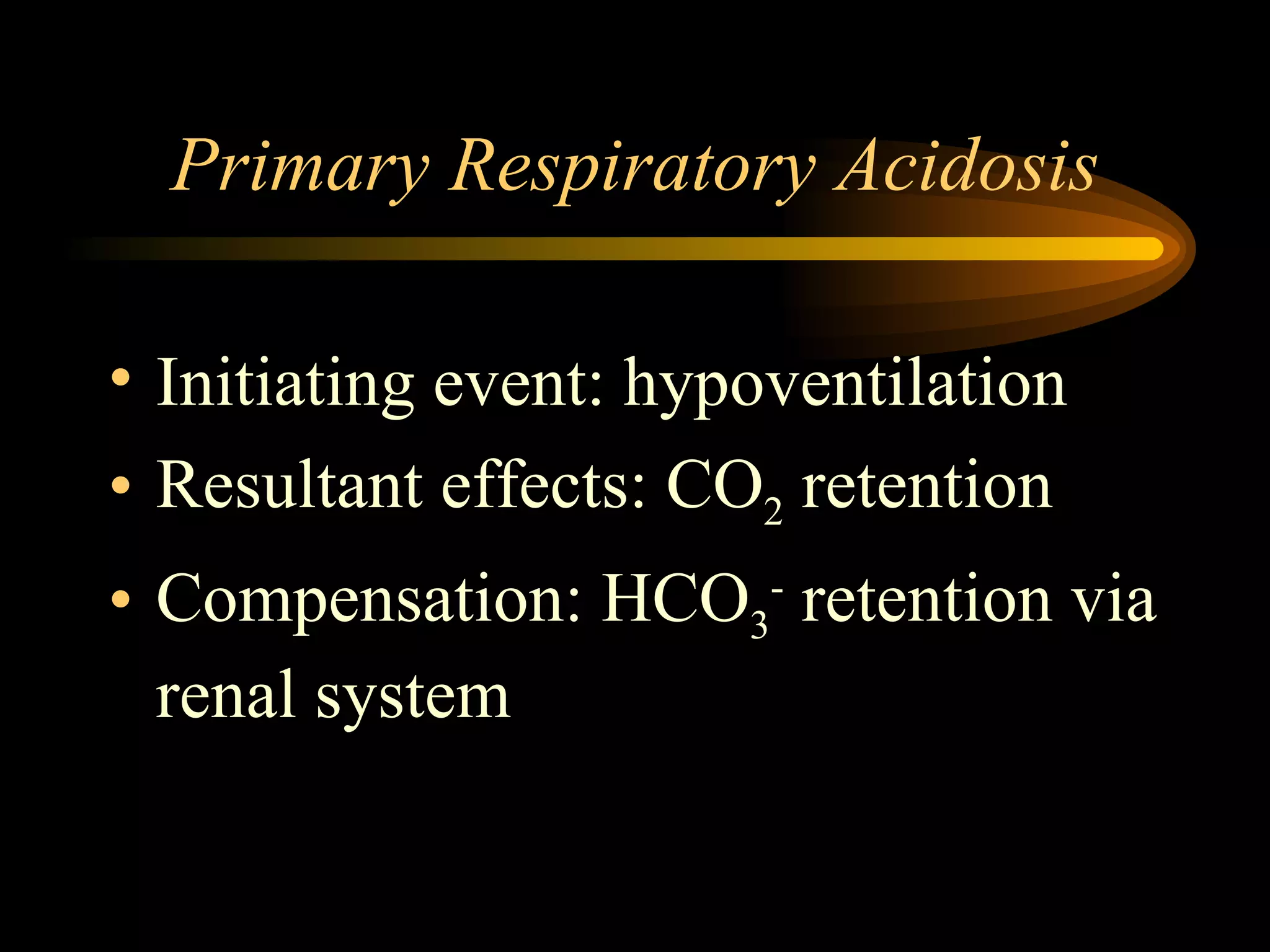
Primary Respiratory Acidosis Initiating event: hypoventilation  Resultant effects: CO 2  retention Compensation: HCO 3 -  retention via renal system
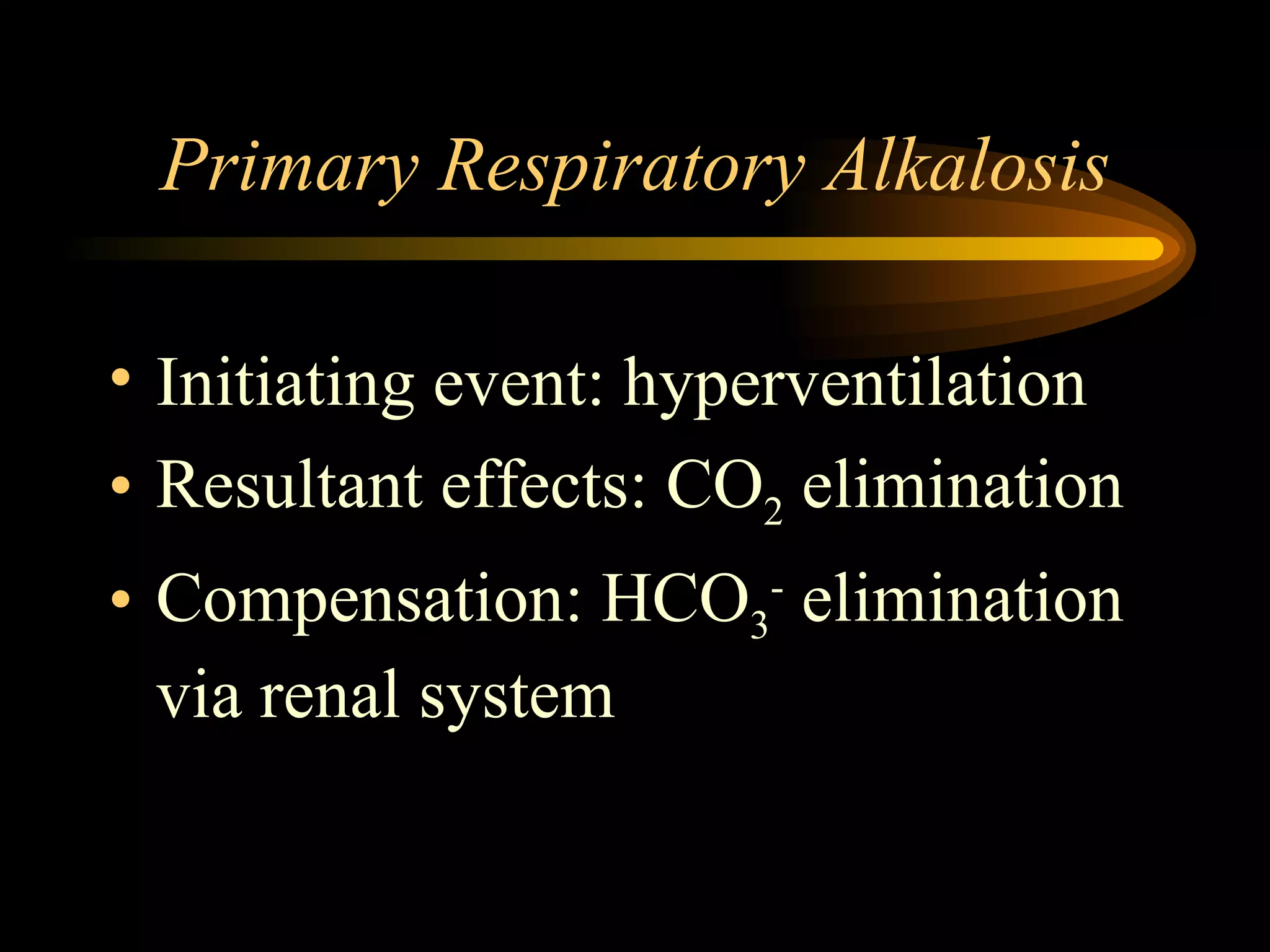
Primary Respiratory Alkalosis Initiating event: hyperventilation  Resultant effects: CO 2  elimination Compensation: HCO 3 -  elimination via renal system
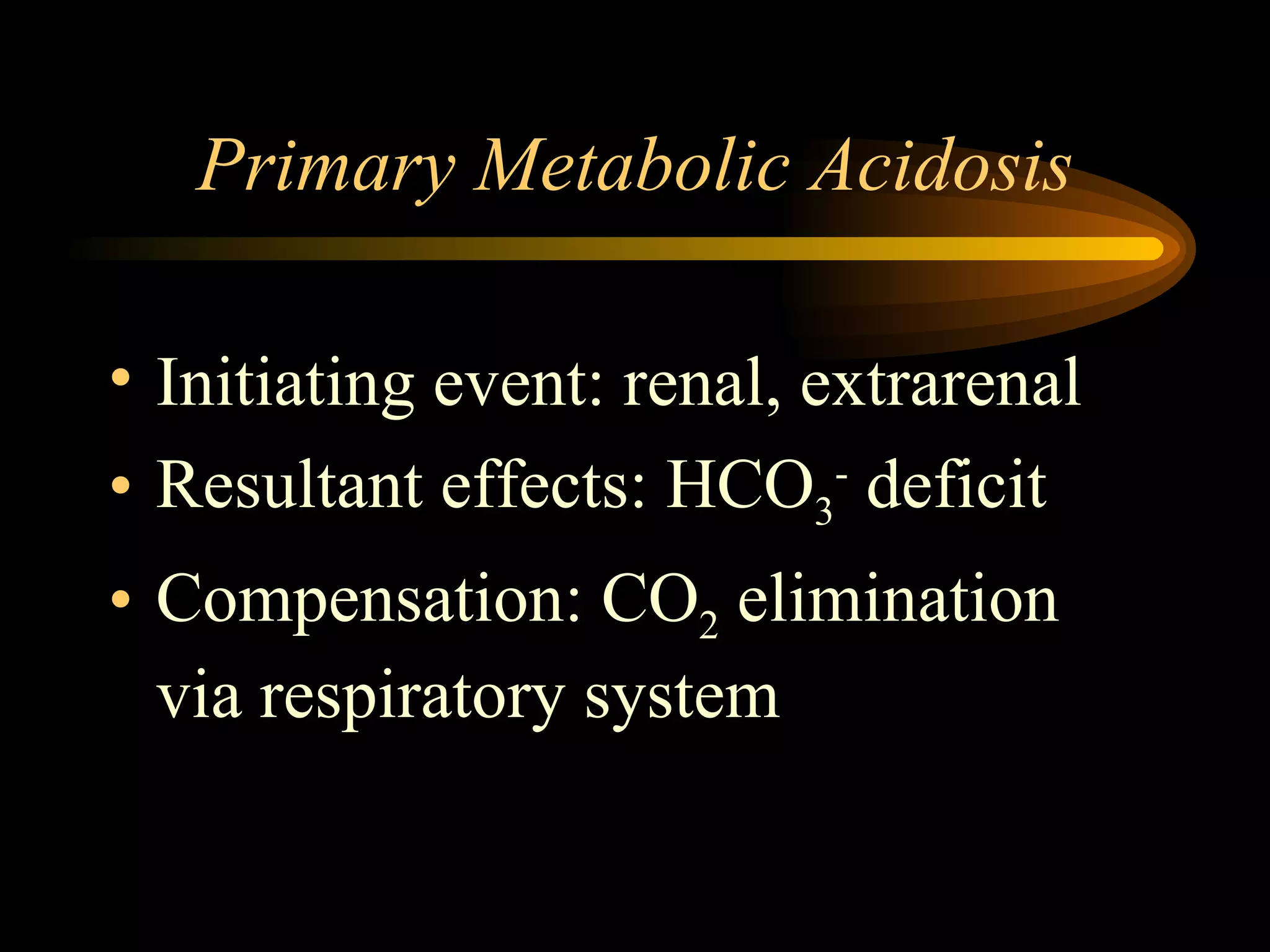
Primary Metabolic Acidosis Initiating event: renal, extrarenal  Resultant effects: HCO 3 -  deficit Compensation: CO 2  elimination via respiratory system
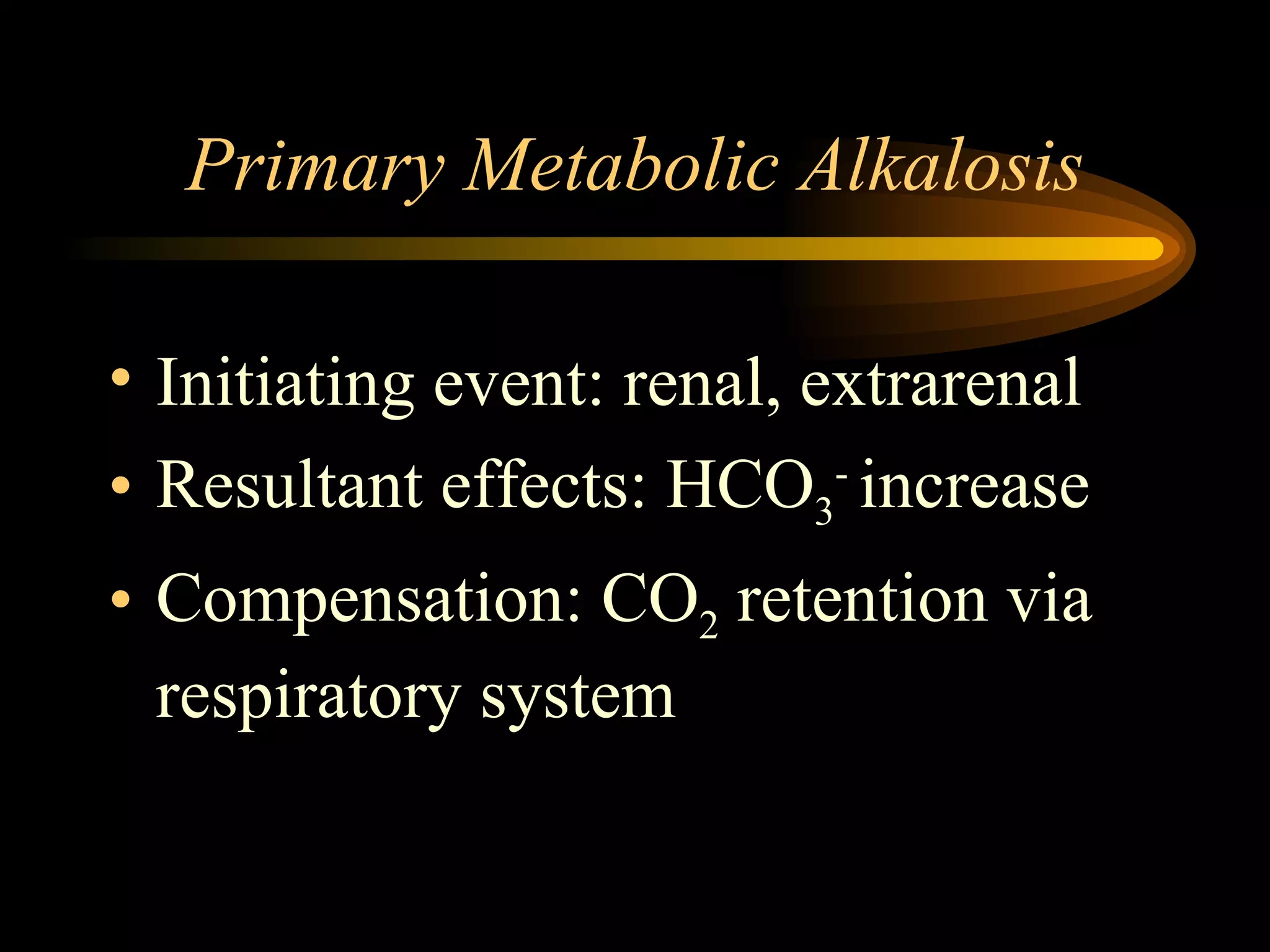
Primary Metabolic Alkalosis Initiating event: renal, extrarenal  Resultant effects: HCO 3 -  increase Compensation: CO 2  retention via respiratory system
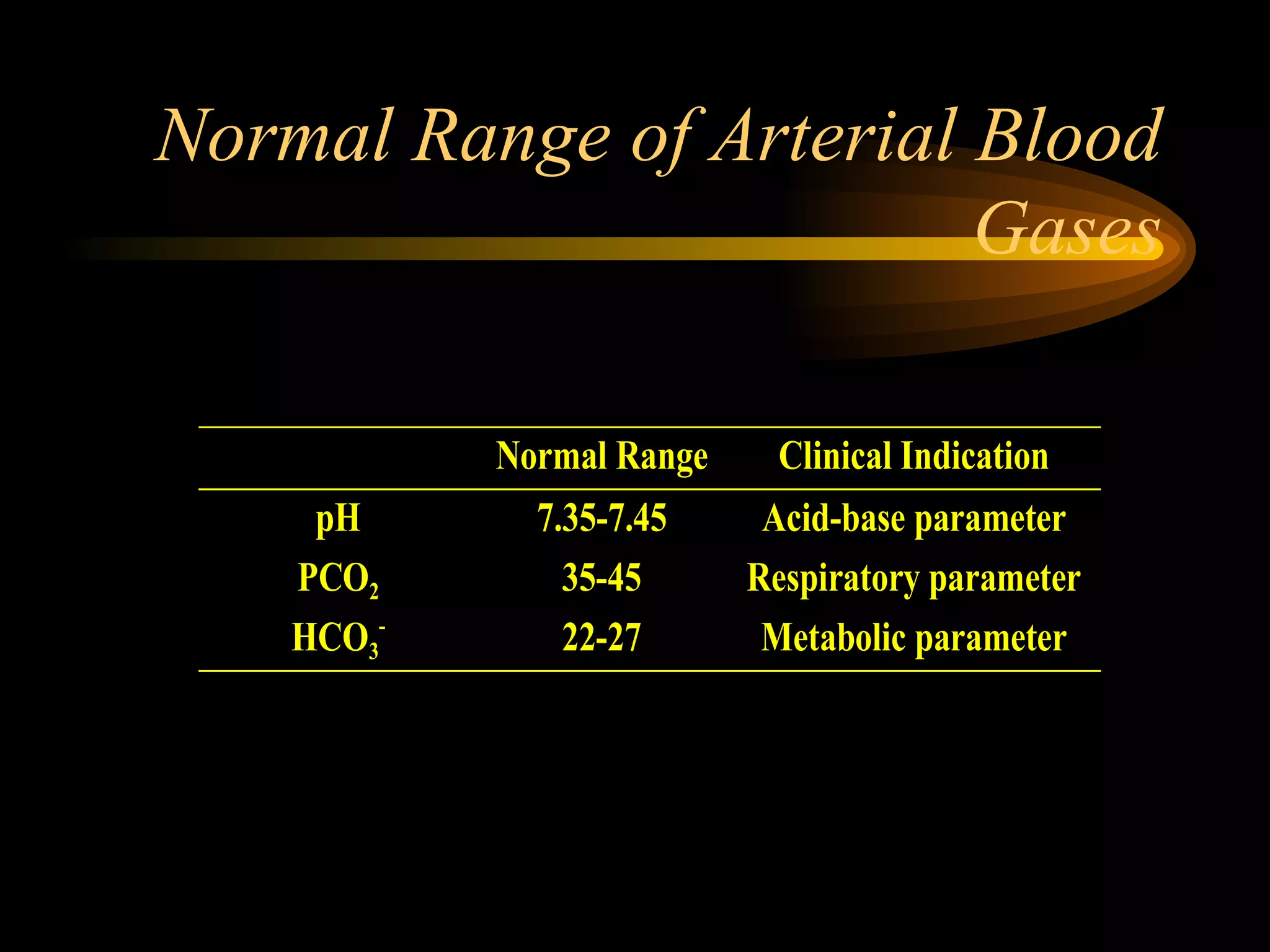
Normal Range of Arterial Blood Gases
Interpretation of Arterial Blood Gases
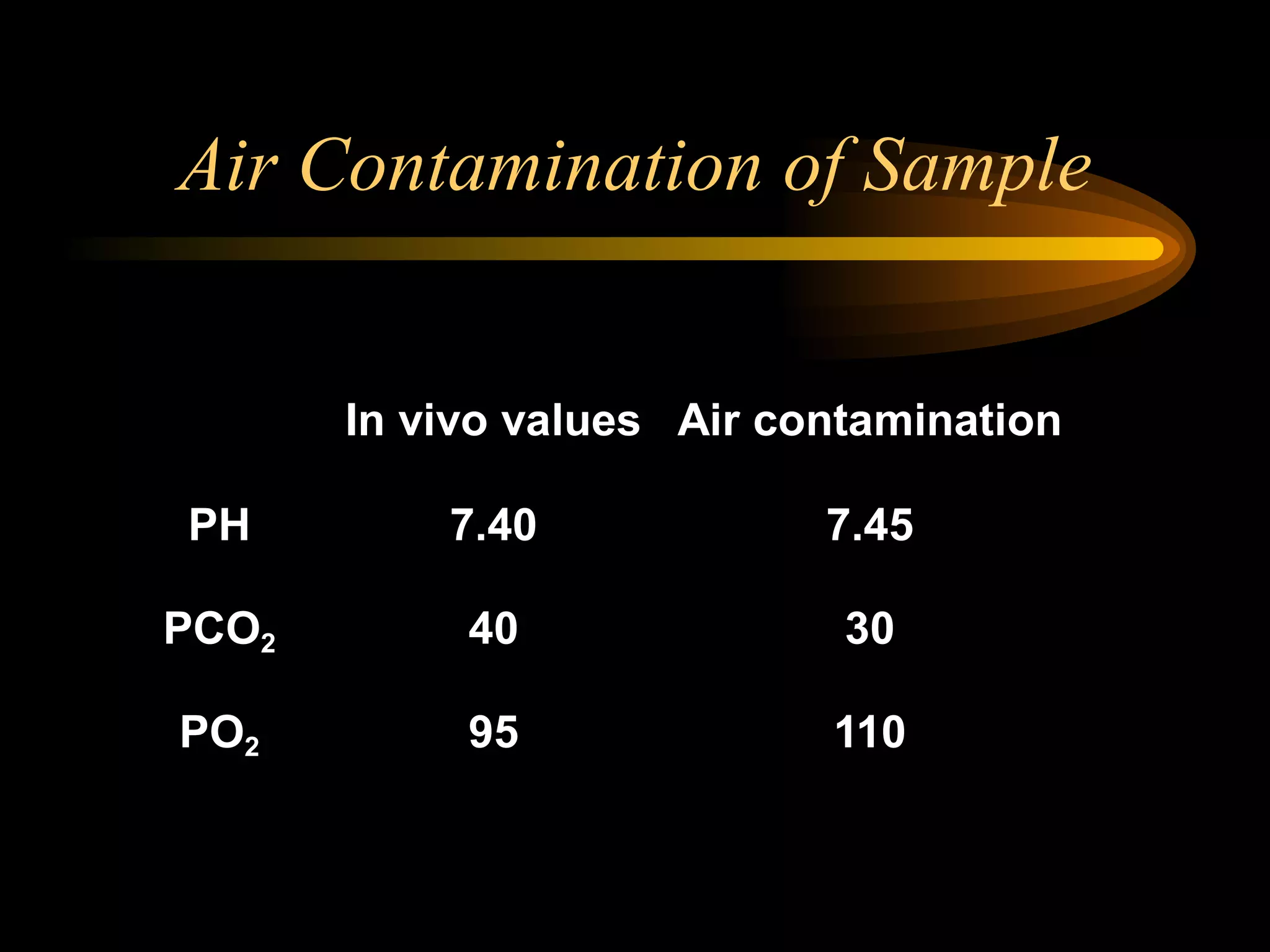
Interpretation Strategies Step 1   Was the blood gas specimen obtained acceptably? Free of air bubbles and clots? Analyzed  promptly and/or iced properly?
Air Contamination of Sample
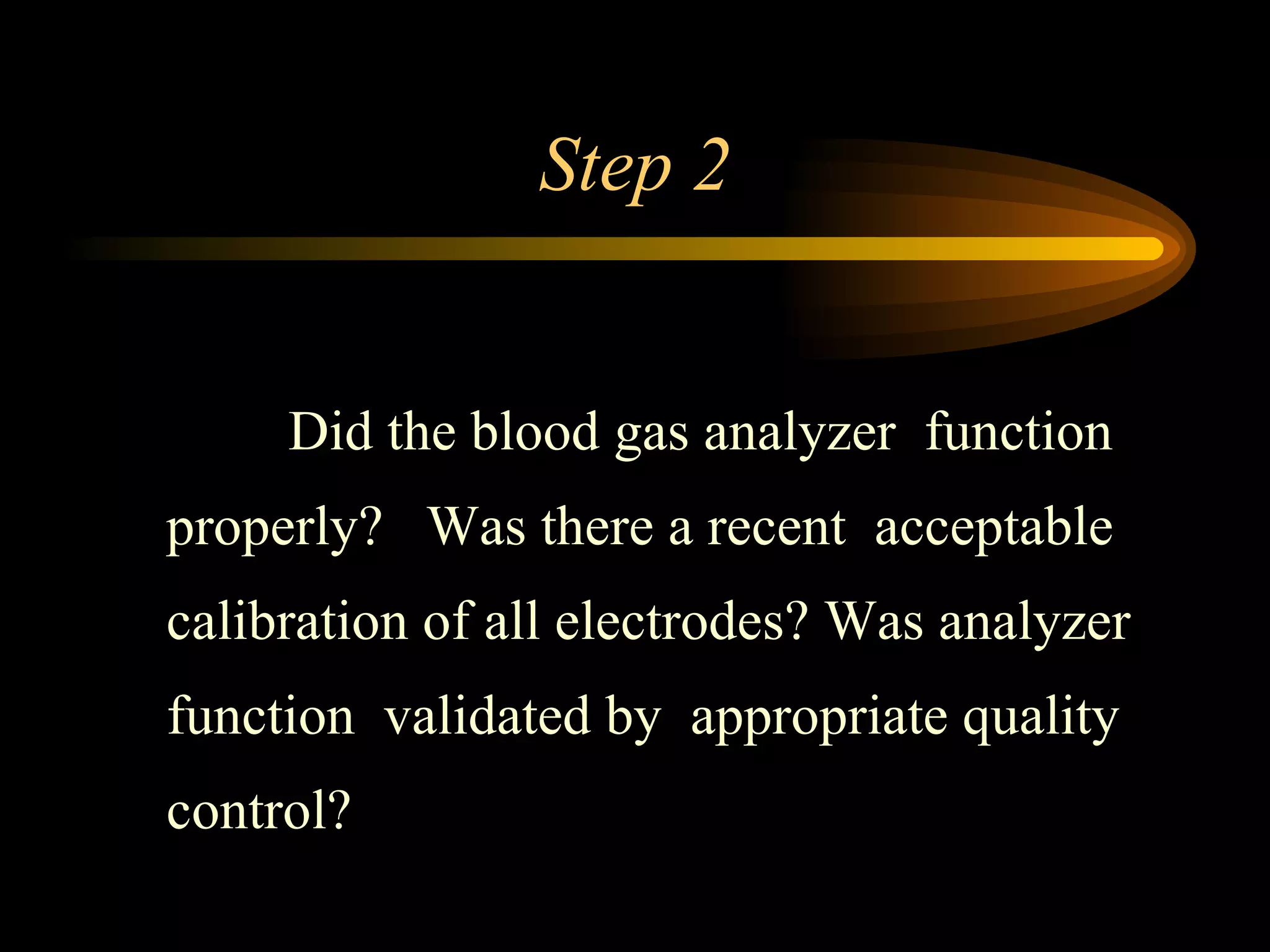
Step 2   Did the blood gas analyzer  function properly?  Was there a recent  acceptable calibration of all electrodes? Was analyzer function  validated by  appropriate quality control?
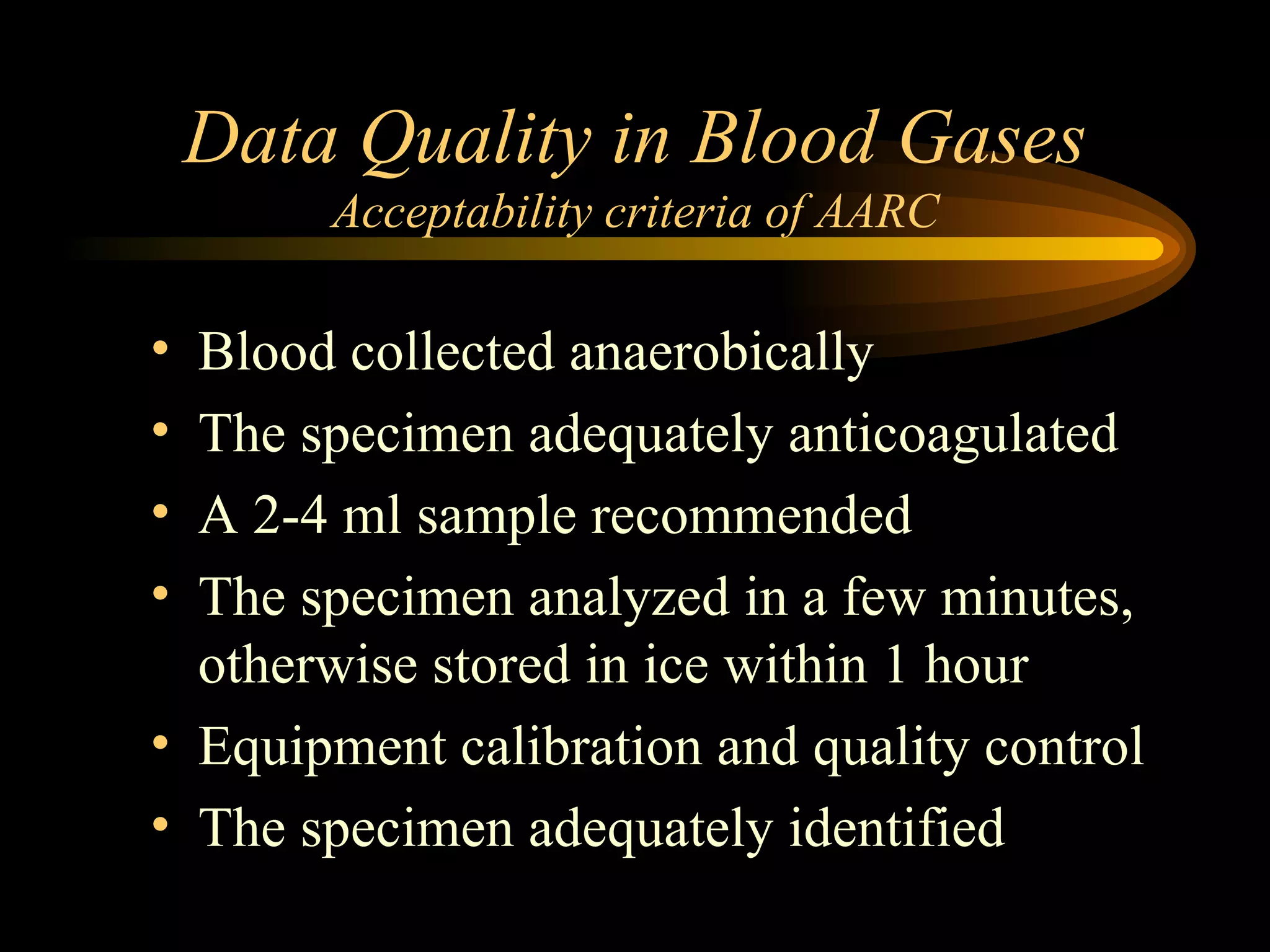
Data Quality in Blood Gases Acceptability criteria of AARC Blood collected anaerobically The specimen adequately anticoagulated A 2-4 ml sample recommended  The specimen analyzed in a few minutes, otherwise stored in ice within 1 hour Equipment calibration and quality control The specimen adequately identified
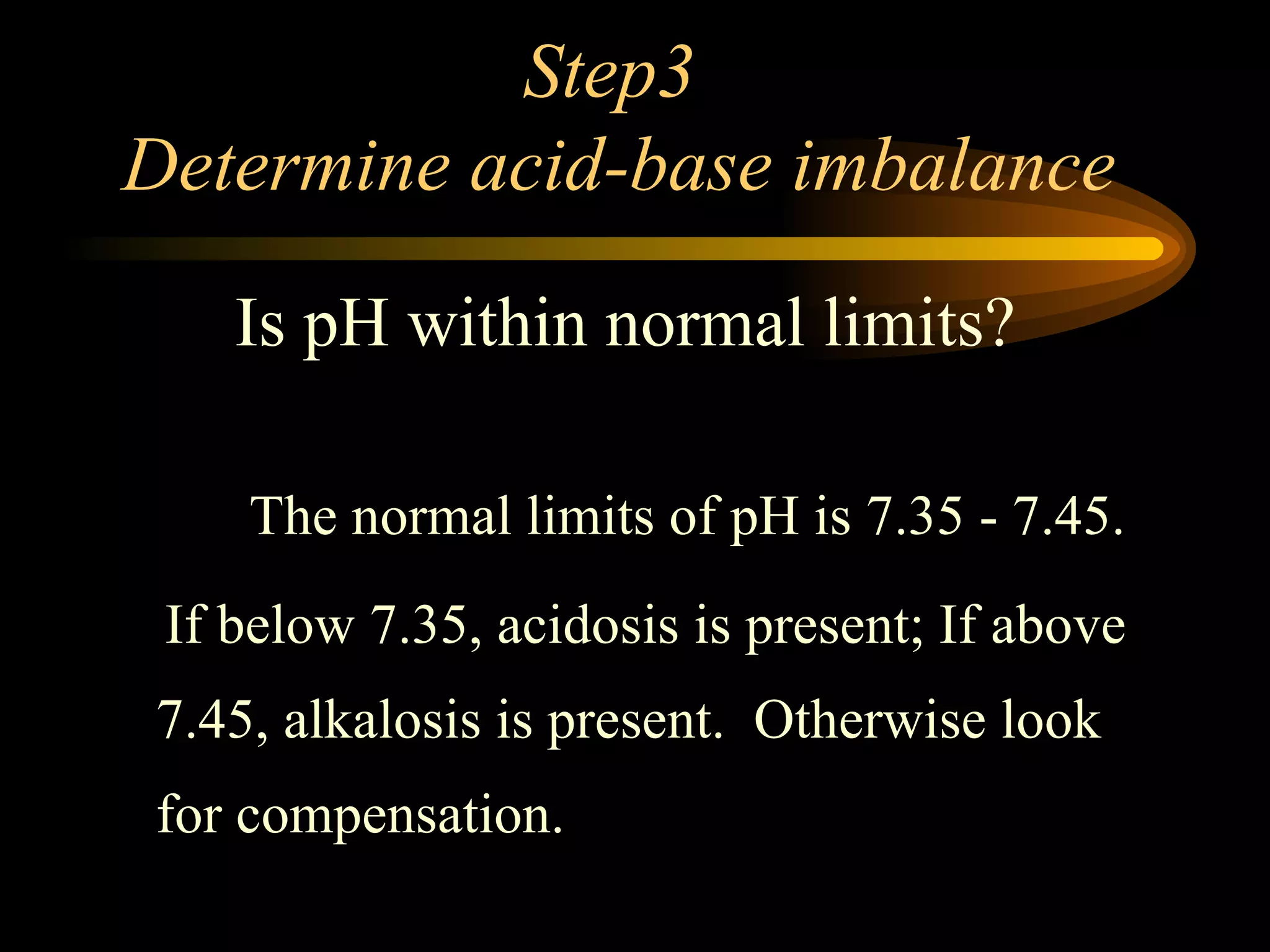
Step3  Determine acid-base imbalance   The normal limits of pH is 7.35 - 7.45.  If below 7.35, acidosis is present; If above 7.45, alkalosis is present.  Otherwise look for compensation.  Is pH within normal limits?
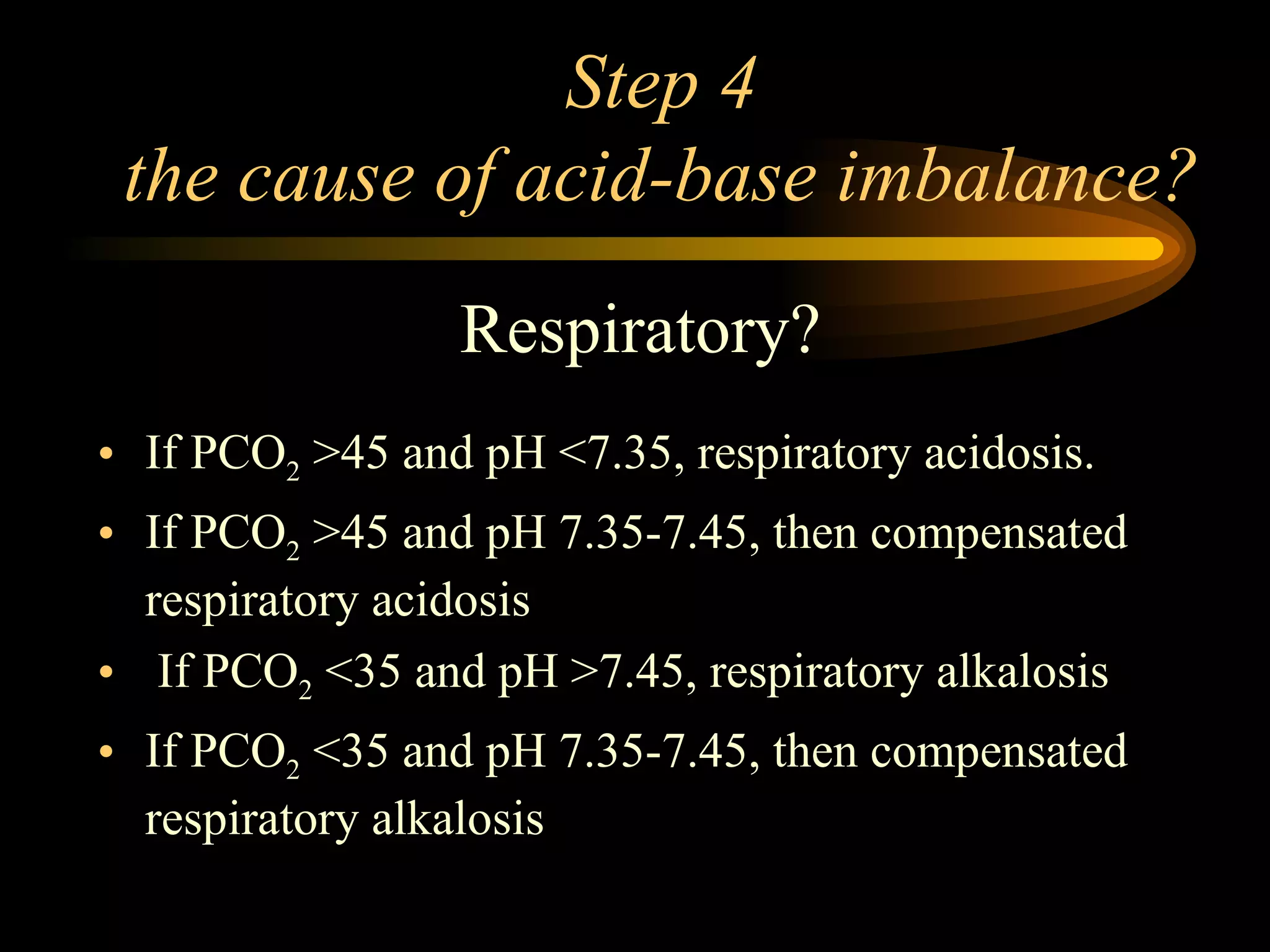
Step 4 the cause of acid-base imbalance?  Respiratory? If PCO 2  >45 and pH <7.35, respiratory acidosis.   If PCO 2  >45 and pH 7.35-7.45, then compensated respiratory acidosis If PCO 2  <35 and pH >7.45, respiratory alkalosis If PCO 2  <35 and pH 7.35-7.45, then compensated respiratory alkalosis
Step 4 the cause of acid-base imbalance? Metabolic? If HCO 3 -  <22 and pH <7.35, metabolic acidosis. If HCO 3 -  <22 and pH 7.35-7.45, then compensated metabolic acidosis If HCO 3 -  >27 and pH >7.45, metabolic alkalosis If HCO 3 -  >27 and pH 7.35-7.45, then compensated metabolic alkalosis
Step 5  Oxygenation? Is P a O 2  within normal  limits of  80 to 100 mm Hg?  If P a O 2  < 50 mm Hg,  severe hypoxemia is present.
The Hypoxemic State Hypoxemia is defined as PaO2 < 80 mm Hg while  breathing  room  air.  When  patients are  already  on  oxygen  it  is not necessary and may  be  dangerous  to  interrupt  the oxygen therapy to assess hypoxemia.
Step 6 Correlated with clinical picture? Are blood gas results consistent with patient's clinical status?
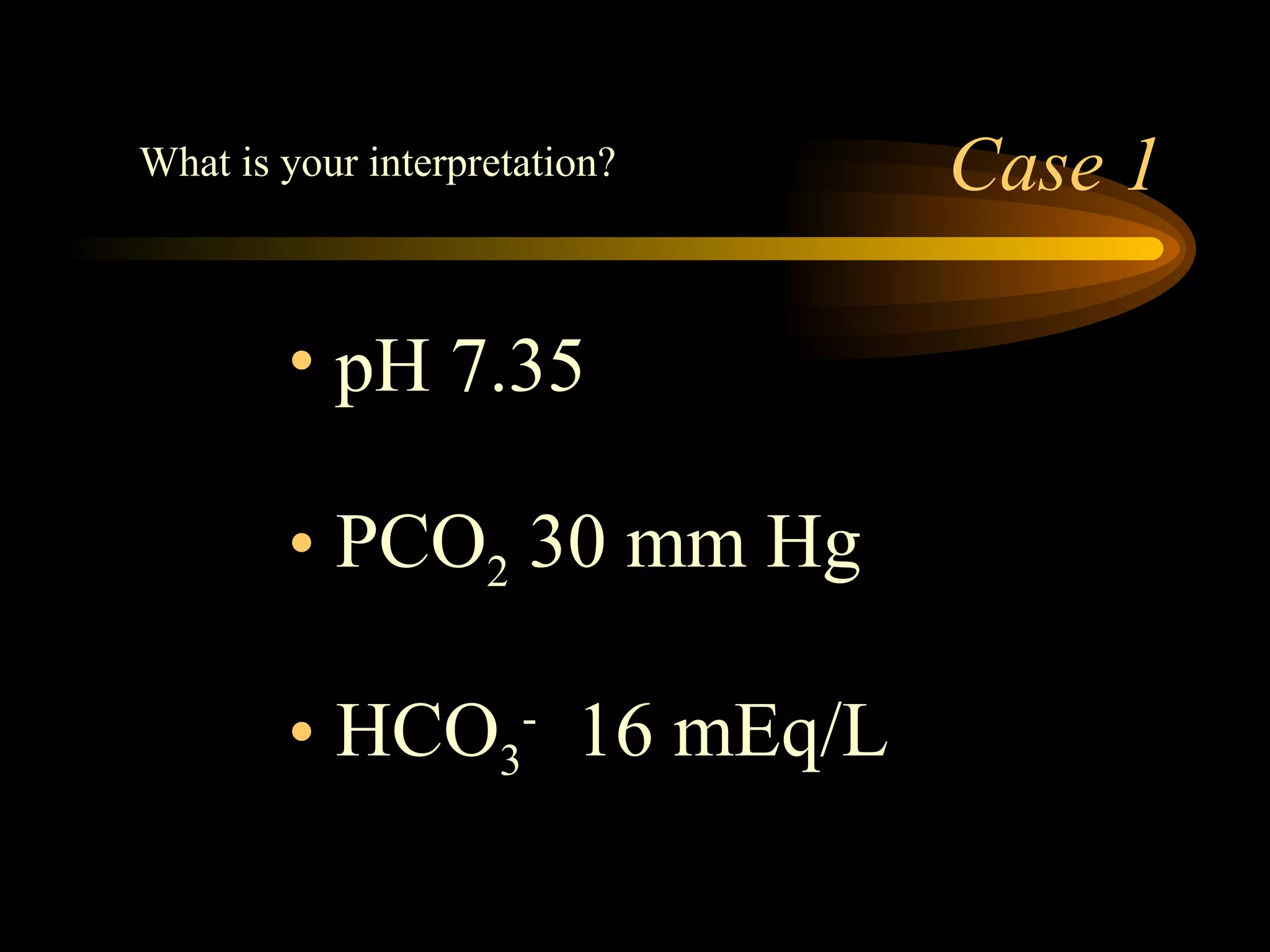
Case 1 pH 7.35 PCO 2  30 mm Hg HCO 3 -   16 mEq/L  What is your interpretation?
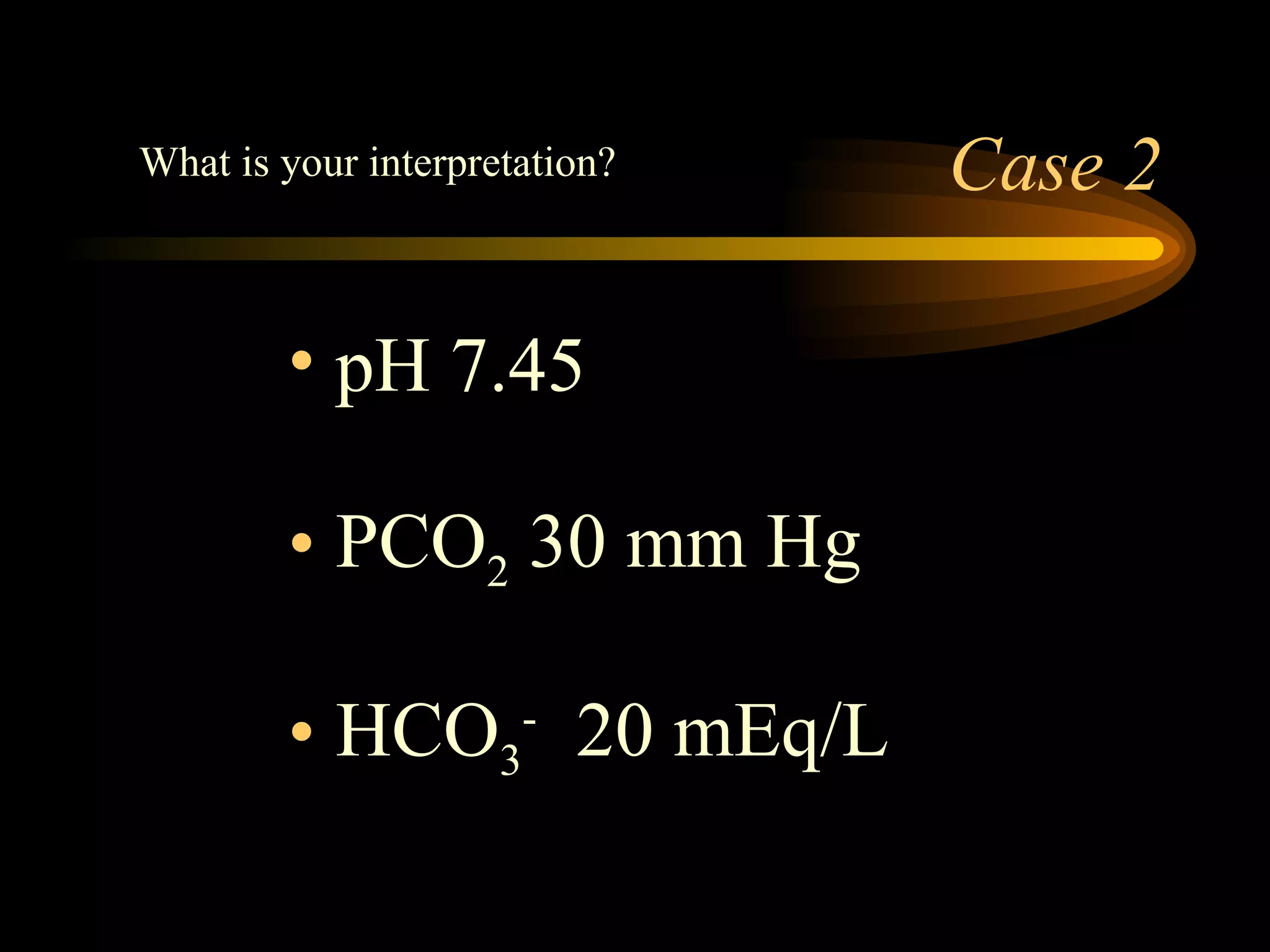
Case 2 pH 7.45 PCO 2  30 mm Hg HCO 3 -   20 mEq/L  What is your interpretation?
Case 3 pH 7.55 PCO 2  27 mm Hg HCO 3 -   23 mEq/L PO 2  104 mm Hg  Get the plastic bag out!!! What is your interpretation?
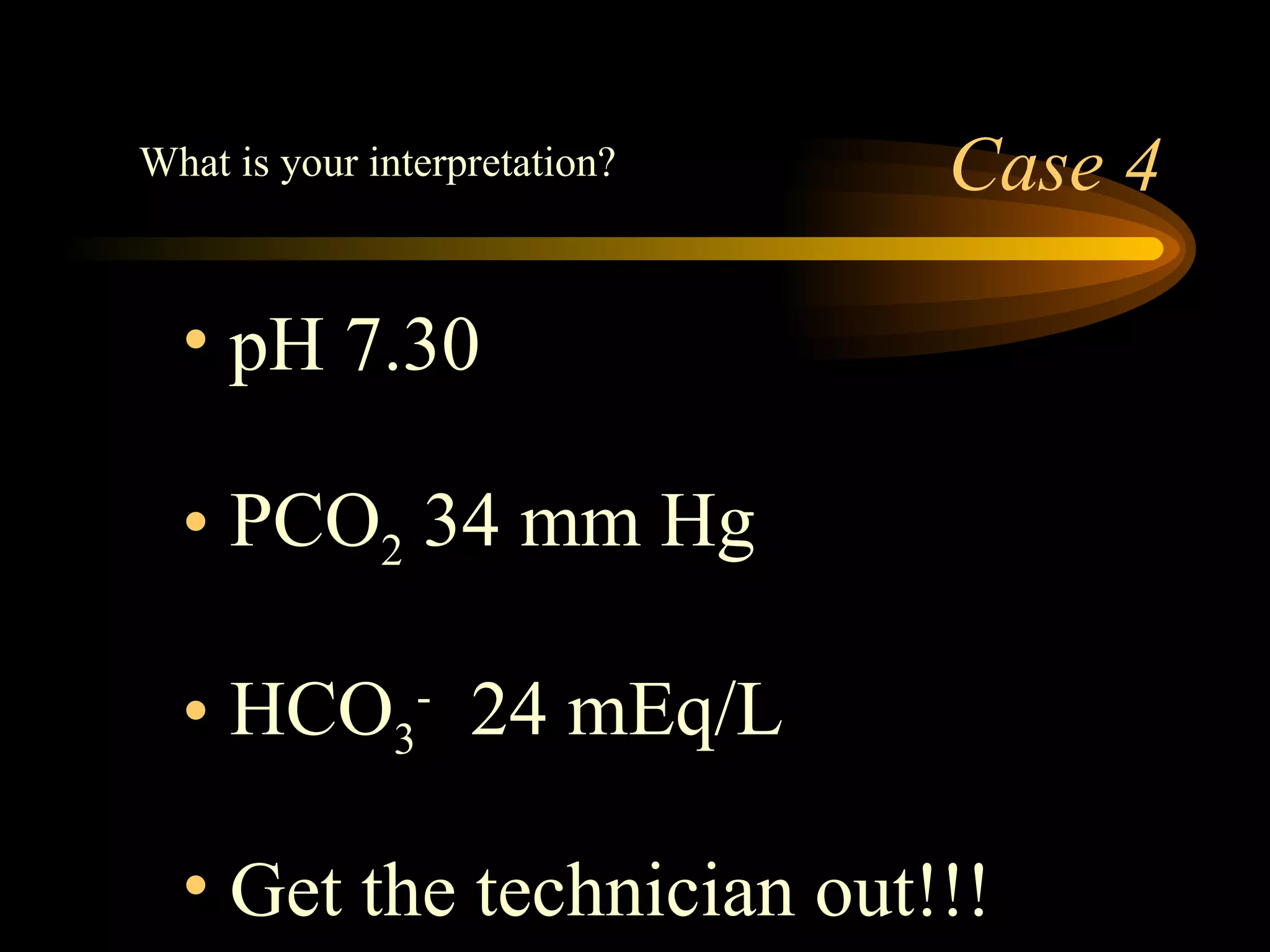
Case 4 pH 7.30 PCO 2  34 mm Hg HCO 3 -   24 mEq/L Get the technician out!!!  What is your interpretation?
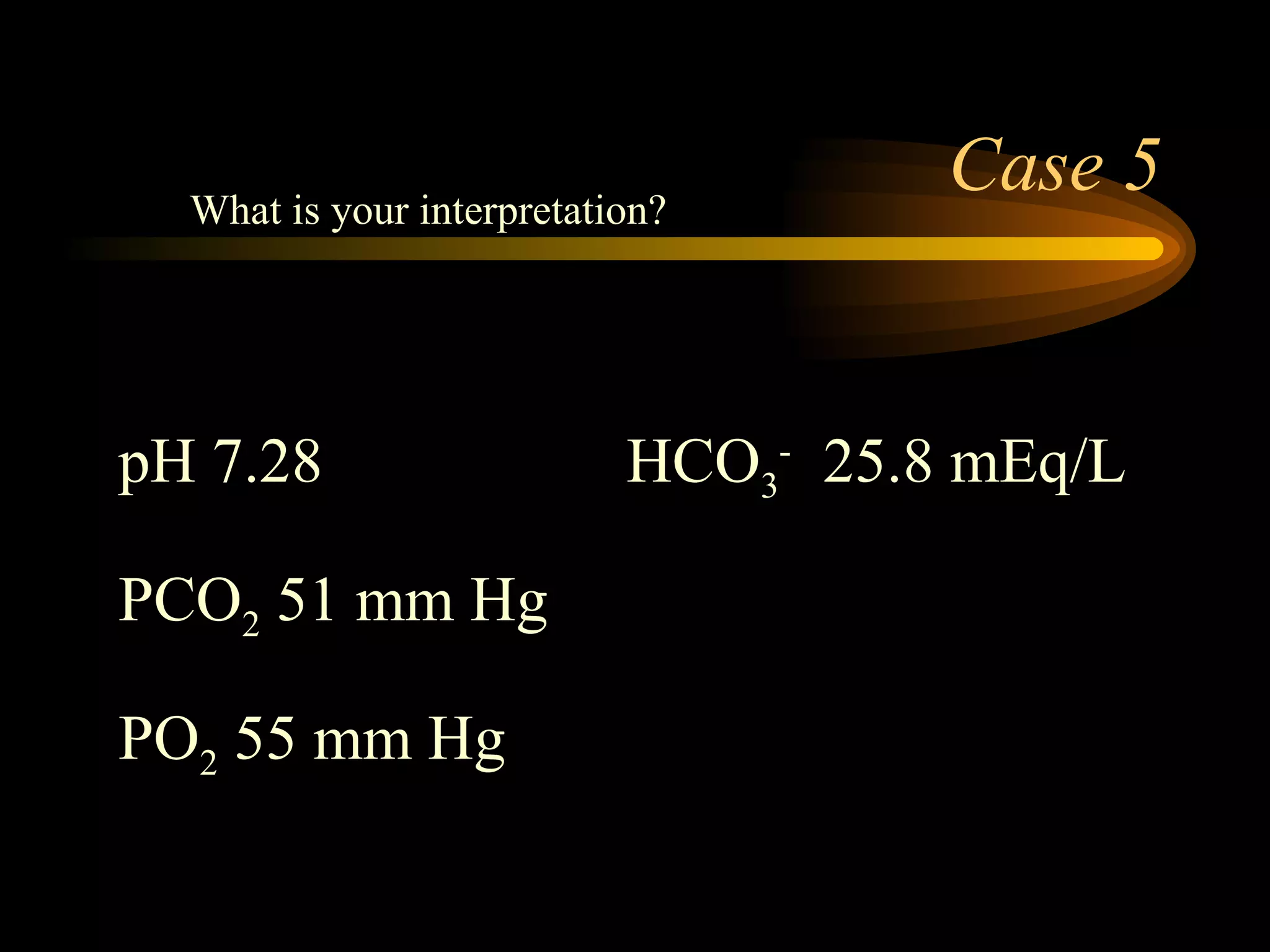
Case 5 A patient referred to PFT Lab. for  shortness of breath
Case 5 pH 7.28 HCO 3 -   25.8 mEq/L  PCO 2  51 mm Hg PO 2  55 mm Hg  What is your interpretation?
Case 6 A 17 y/o diabetic, entered Emergency with Kussmaul breathing
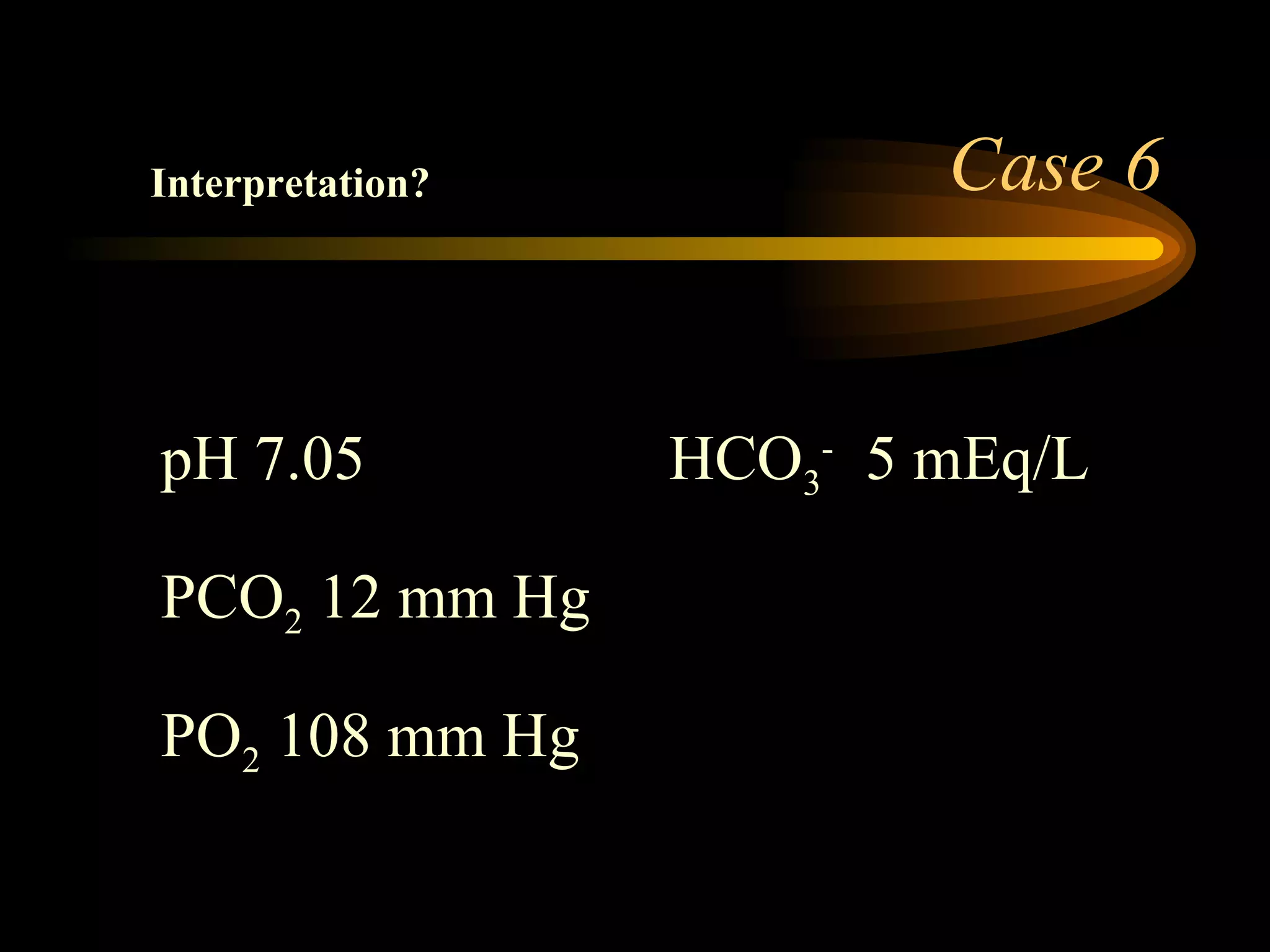
Case 6 Interpretation? pH 7.05 HCO 3 -   5 mEq/L  PCO 2  12 mm Hg PO 2  108 mm Hg
Case 7 34 y/o female, entered Emergency in coma, drug overdose suspected
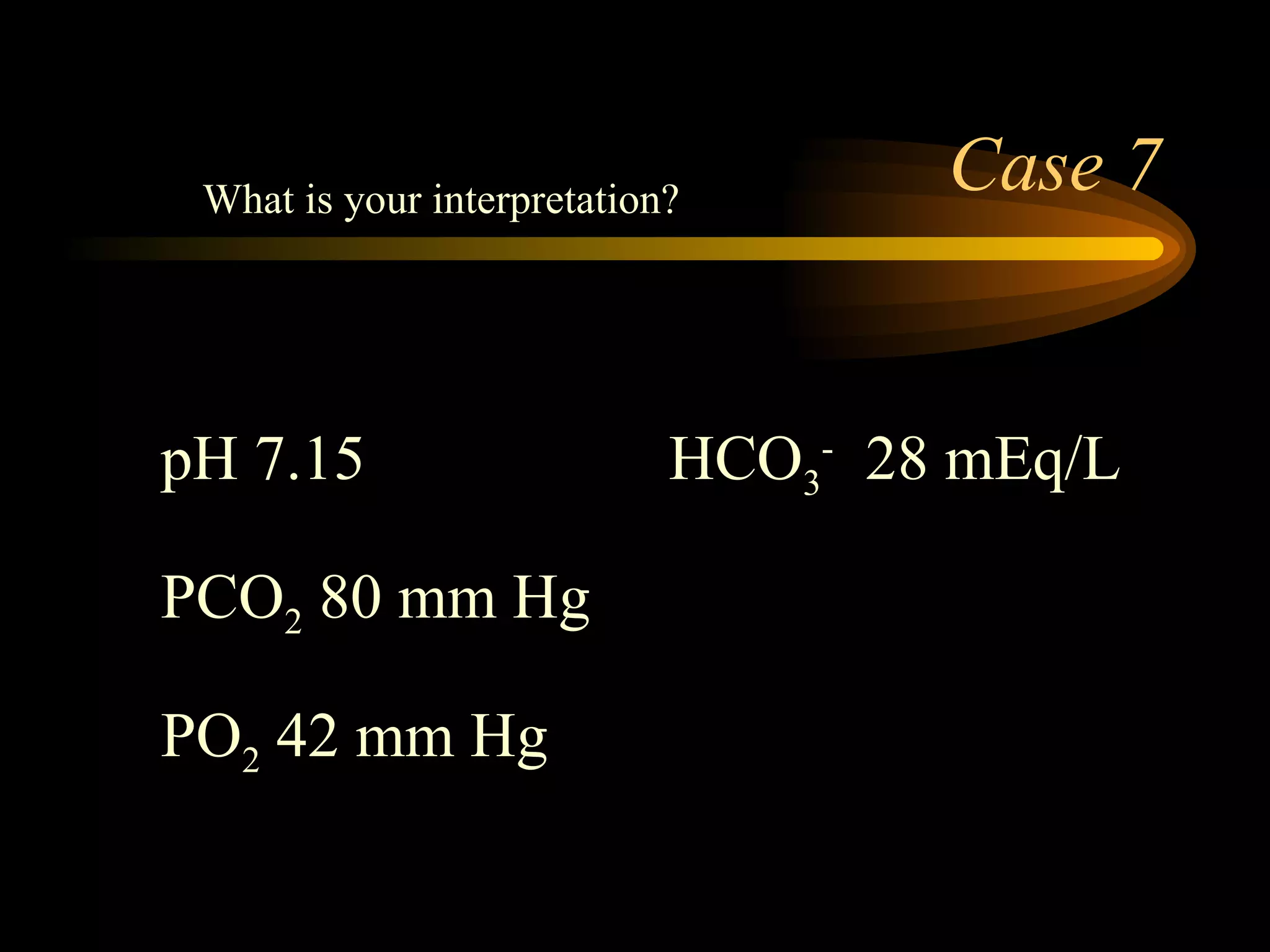
Case 7 pH 7.15 HCO 3 -   28 mEq/L  PCO 2  80 mm Hg PO 2  42 mm Hg  What is your interpretation?
Case 8 A 63 y/o male, admitted for  elective knee surgery
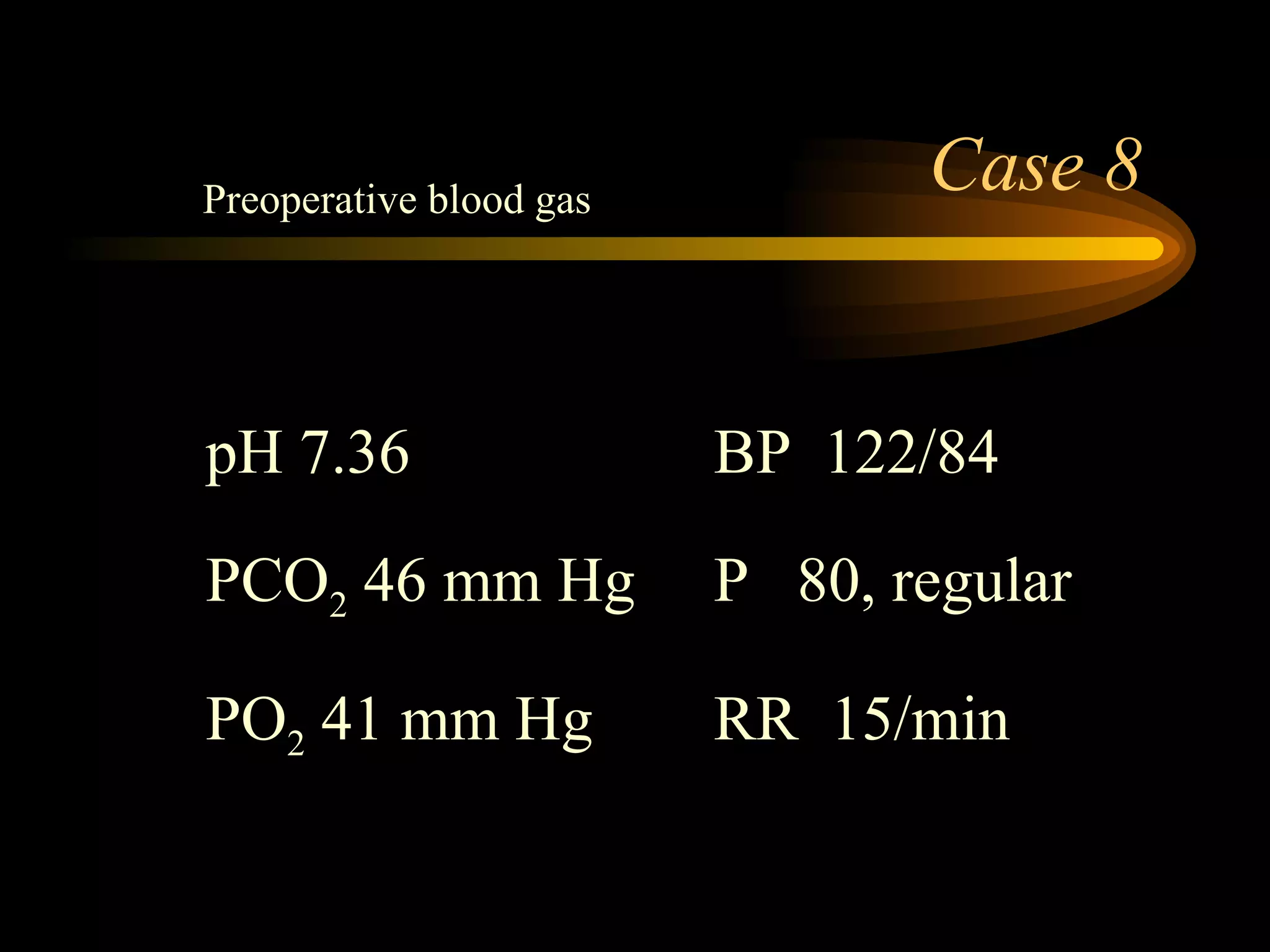
Case 8  pH 7.36 BP  122/84 PCO 2  46 mm Hg P  80, regular  PO 2  41 mm Hg  RR  15/min Preoperative blood gas
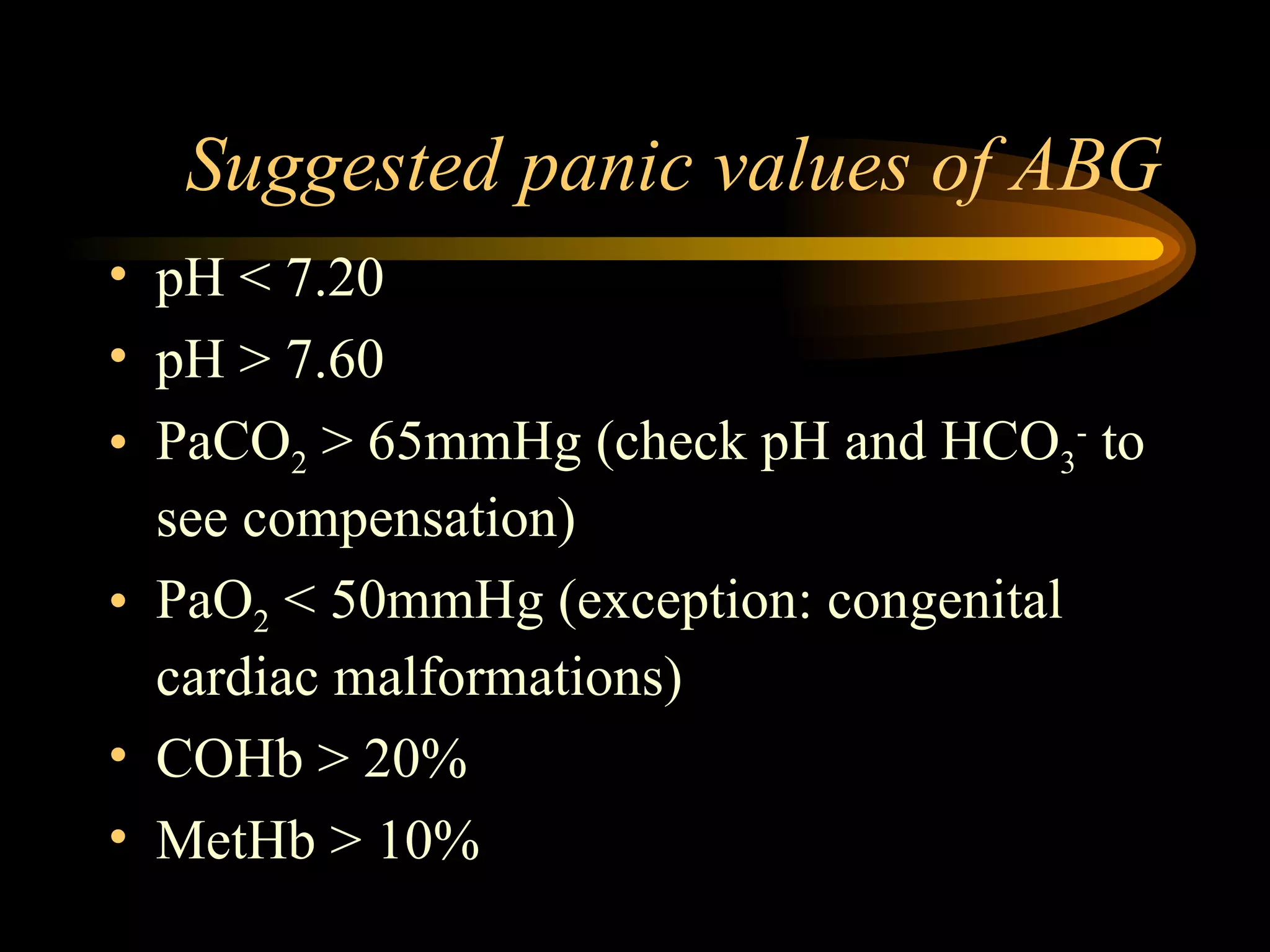
Suggested panic values of ABG pH < 7.20 pH > 7.60 PaCO 2  > 65mmHg (check pH and HCO 3 -  to see compensation) PaO 2  < 50mmHg (exception: congenital cardiac malformations) COHb > 20% MetHb > 10%
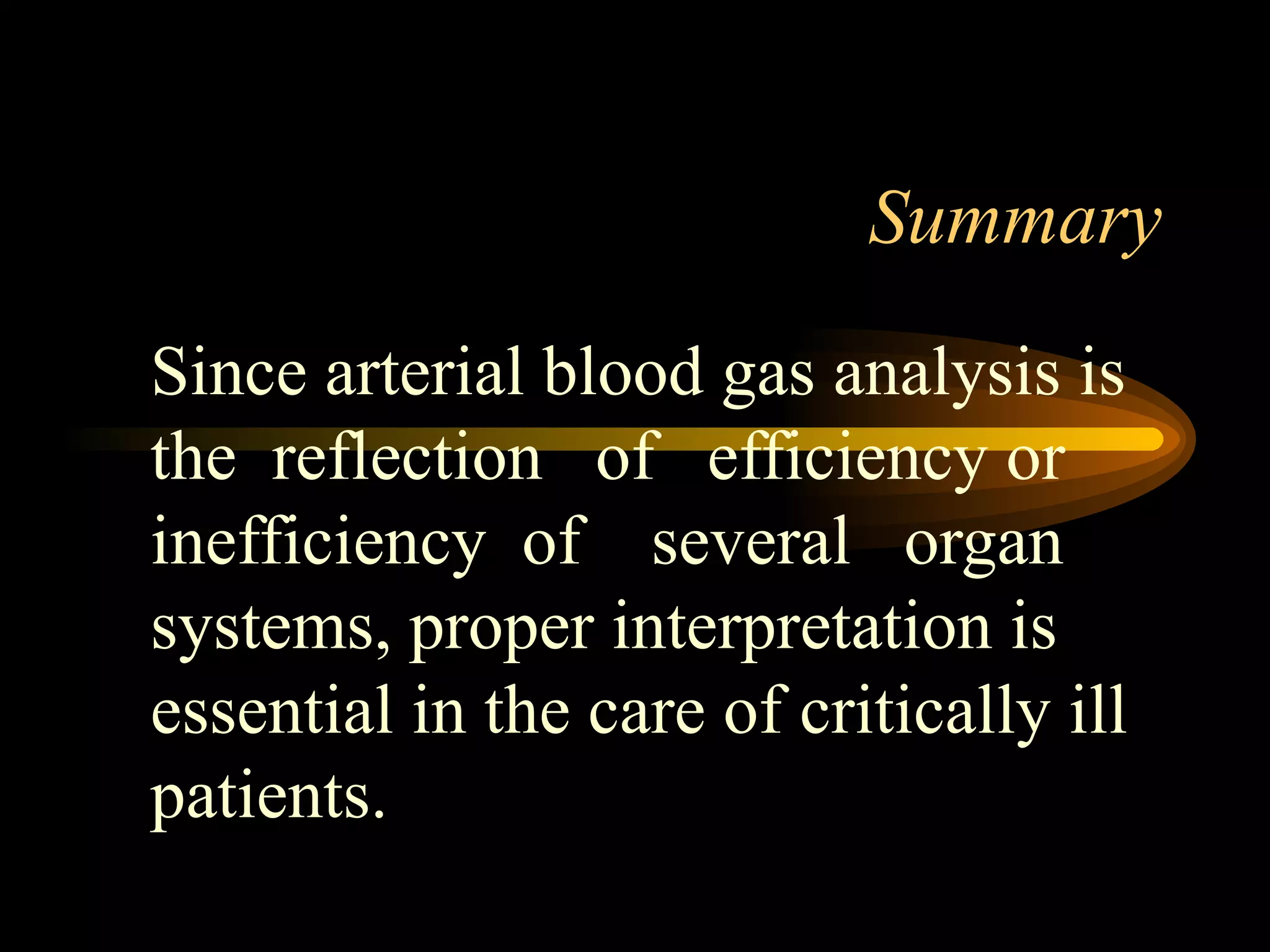
Summary Since arterial blood gas analysis is the  reflection  of  efficiency or inefficiency  of  several  organ systems, proper interpretation is essential in the care of critically ill patients.

01 Interpretation Of Blood Gas Analysis

  • 1.
    Clinical Aspect ofInterpretation of Blood Gas Analysis For medical students of PUMC Class 1999, Sept. 15, 2003
  • 2.
    What Does ArterialBlood Gas (ABG) Measure ?
  • 3.
    Pulmonary function testsare concern with ventilation: the movement of air into and out of the lung
  • 4.
    MIXED VENOUS BLOODpH 7.36 PCO 2 46 mmHg PO 2 40 mmHg SO 2 75% pH 7.40 PCO 2 40 mmHg PO 2 95 mmHg SO 2  95% ARTERIAL BLOOD External Respiration Internal Respiration
  • 5.
    What Information DoesArterial Blood Gas provide? Arterial oxygenation Alveolar ventilation Respiratory/metabolic acid-base balance Carboxyhemoglobin levels
  • 6.
    Alveolar Ventilation EquationInverse relationship between V A and P a CO 2
  • 7.
    Arterial Blood GasAnalysis Indications Evaluate adequacy of lung function Ventilation, acid-base status Oxygenation Determine need for supplemental O 2 Monitor ventilatory support Document severity or progression of known pulmonary disease Diagnose the toxicity of CO
  • 8.
    Henderson-Hasselbalch Equation Therelationship between pH, P a CO 2 , HCO 3 -
  • 9.
    Why the assessmentof a single buffer system is adequate despite multiple buffer systems? Bicarbonate buffer system: of primary importance, open system in communication with external environment via kidneys Hemoglobin buffer: of second importance Phosphate buffer system Plasma protein buffer system All buffer systems are linked together through H +
  • 10.
    Why the assessmentof carbonic acid is adequate? Each day our body produces large amount of acid from metabolism. 99% of the total acid is in the form of CO 2 . Only 1% is fixed acid
  • 11.
    Henderson-Hasselbalch Equation Therelationship between pH, P a CO 2 , HCO 3 -
  • 12.
  • 13.
  • 14.
  • 15.
  • 16.
  • 17.
    Case 2 UncompensatedRespiratory Acidosis
  • 18.
    Case 2 UncompensatedRespiratory Acidosis
  • 19.
    Case2 UncompensatedRespiratory Acidosis
  • 20.
    Case 2 UncompensatedRespiratory Acidosis
  • 21.
    Case 3 CompensatedRespiratory Acidosis
  • 22.
    Case3 CompensatedRespiratory Acidosis
  • 23.
    Case 3 CompensatedRespiratory Acidosis PEARL: The compensations of either the renal system or the respiratory system can never be complete.
  • 24.
    Clinically Relevant Parameters(1) Through the years, opinions have changed regarding what are the most clinically relevant parameters. Today, for a nearly complete description of the oxygenation, ventilation, and acid-base status, pH, PaCO 2 , PaO 2 and actual HCO 3 - are generally sufficient.
  • 25.
    Clinically Relevant Parameters(2) Indeed, the literature or text book contains literally several parameters, i.e. standard HCO 3 - , buffer base (BB), base excess (BE) from in vitro measures. Because intro and in vivo changes in response to hypercapnia are different, their actual clinical benefit is limited. Burton GG, Hodgkin JE, Ward JJ. Respiratory care: A guide to clinical practice. 1997, 260-265.
  • 26.
    Primary Respiratory AcidosisInitiating event: hypoventilation Resultant effects: CO 2 retention Compensation: HCO 3 - retention via renal system
  • 27.
    Primary Respiratory AlkalosisInitiating event: hyperventilation Resultant effects: CO 2 elimination Compensation: HCO 3 - elimination via renal system
  • 28.
    Primary Metabolic AcidosisInitiating event: renal, extrarenal Resultant effects: HCO 3 - deficit Compensation: CO 2 elimination via respiratory system
  • 29.
    Primary Metabolic AlkalosisInitiating event: renal, extrarenal Resultant effects: HCO 3 - increase Compensation: CO 2 retention via respiratory system
  • 30.
    Normal Range ofArterial Blood Gases
  • 31.
  • 32.
    Interpretation Strategies Step1 Was the blood gas specimen obtained acceptably? Free of air bubbles and clots? Analyzed promptly and/or iced properly?
  • 33.
  • 34.
    Step 2 Did the blood gas analyzer function properly? Was there a recent acceptable calibration of all electrodes? Was analyzer function validated by appropriate quality control?
  • 35.
    Data Quality inBlood Gases Acceptability criteria of AARC Blood collected anaerobically The specimen adequately anticoagulated A 2-4 ml sample recommended The specimen analyzed in a few minutes, otherwise stored in ice within 1 hour Equipment calibration and quality control The specimen adequately identified
  • 36.
    Step3 Determineacid-base imbalance The normal limits of pH is 7.35 - 7.45. If below 7.35, acidosis is present; If above 7.45, alkalosis is present. Otherwise look for compensation. Is pH within normal limits?
  • 37.
    Step 4 thecause of acid-base imbalance? Respiratory? If PCO 2 >45 and pH <7.35, respiratory acidosis. If PCO 2 >45 and pH 7.35-7.45, then compensated respiratory acidosis If PCO 2 <35 and pH >7.45, respiratory alkalosis If PCO 2 <35 and pH 7.35-7.45, then compensated respiratory alkalosis
  • 38.
    Step 4 thecause of acid-base imbalance? Metabolic? If HCO 3 - <22 and pH <7.35, metabolic acidosis. If HCO 3 - <22 and pH 7.35-7.45, then compensated metabolic acidosis If HCO 3 - >27 and pH >7.45, metabolic alkalosis If HCO 3 - >27 and pH 7.35-7.45, then compensated metabolic alkalosis
  • 39.
    Step 5 Oxygenation? Is P a O 2 within normal limits of 80 to 100 mm Hg? If P a O 2 < 50 mm Hg, severe hypoxemia is present.
  • 40.
    The Hypoxemic StateHypoxemia is defined as PaO2 < 80 mm Hg while breathing room air. When patients are already on oxygen it is not necessary and may be dangerous to interrupt the oxygen therapy to assess hypoxemia.
  • 41.
    Step 6 Correlatedwith clinical picture? Are blood gas results consistent with patient's clinical status?
  • 42.
    Case 1 pH7.35 PCO 2 30 mm Hg HCO 3 - 16 mEq/L What is your interpretation?
  • 43.
    Case 2 pH7.45 PCO 2 30 mm Hg HCO 3 - 20 mEq/L What is your interpretation?
  • 44.
    Case 3 pH7.55 PCO 2 27 mm Hg HCO 3 - 23 mEq/L PO 2 104 mm Hg Get the plastic bag out!!! What is your interpretation?
  • 45.
    Case 4 pH7.30 PCO 2 34 mm Hg HCO 3 - 24 mEq/L Get the technician out!!! What is your interpretation?
  • 46.
    Case 5 Apatient referred to PFT Lab. for shortness of breath
  • 47.
    Case 5 pH7.28 HCO 3 - 25.8 mEq/L PCO 2 51 mm Hg PO 2 55 mm Hg What is your interpretation?
  • 48.
    Case 6 A17 y/o diabetic, entered Emergency with Kussmaul breathing
  • 49.
    Case 6 Interpretation?pH 7.05 HCO 3 - 5 mEq/L PCO 2 12 mm Hg PO 2 108 mm Hg
  • 50.
    Case 7 34y/o female, entered Emergency in coma, drug overdose suspected
  • 51.
    Case 7 pH7.15 HCO 3 - 28 mEq/L PCO 2 80 mm Hg PO 2 42 mm Hg What is your interpretation?
  • 52.
    Case 8 A63 y/o male, admitted for elective knee surgery
  • 53.
    Case 8 pH 7.36 BP 122/84 PCO 2 46 mm Hg P 80, regular PO 2 41 mm Hg RR 15/min Preoperative blood gas
  • 54.
    Suggested panic valuesof ABG pH < 7.20 pH > 7.60 PaCO 2 > 65mmHg (check pH and HCO 3 - to see compensation) PaO 2 < 50mmHg (exception: congenital cardiac malformations) COHb > 20% MetHb > 10%
  • 55.
    Summary Since arterialblood gas analysis is the reflection of efficiency or inefficiency of several organ systems, proper interpretation is essential in the care of critically ill patients.