

Lactic Acidosis
Dr.M.Kotteswaran
1
INTRODUCTION
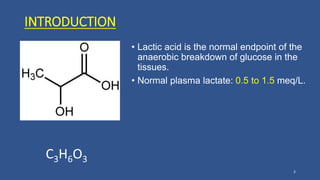
• Lactic acid is the normal endpoint of the
anaerobic breakdown of glucose in the
tissues.
• Normal plasma lactate: 0.5 to 1.5 meq/L.
C3H6O3
2
Lactic acidosis
Definition:
• Lactic acidosis is a pathological state diagnosed
when the serum concentration of lactate or lactic
acid is persistently 5mmol/L or greater and there is
significant acidemia and serum pH< 7.35.
• Associated with elevated anion gap.
3
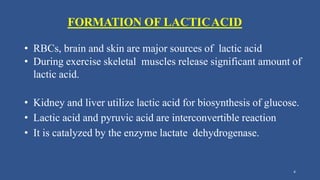
FORMATION OF LACTICACID
• RBCs, brain and skin are major sources of lactic acid
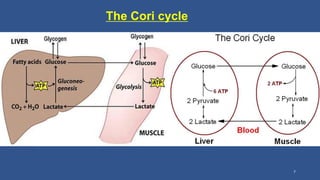
• During exercise skeletal muscles release significant amount of
lactic acid.
• Kidney and liver utilize lactic acid for biosynthesis of glucose.
• Lactic acid and pyruvic acid are interconvertible reaction
• It is catalyzed by the enzyme lactate dehydrogenase.
4
Pyruvate to lactate
The reduction of pyruvate by NADH⁺ to form lactate is
catalyzed by lactate dehydrogenase
The reaction takes place in the cells when the amount of oxygen is
less, as in muscle during intense activity.
5
• In the cells lacking
mitochondria and under
anaerobic conditions, the
NADH⁺ formed in the
oxidation of glyceraldehyde 3-
phosphate is consumed in the
hydrogenation of pyruvate.
• The regeneration of NAD + in
the hydrogenation of pyruvate
to lactate sustains the continued
operation of glycolysis under
anaerobic conditions.
6
The Cori cycle
7
PATHOPHYSIOLOGY
Lactic acidosis occurs whenever there is an imbalance between the
production and use of lactic acid.
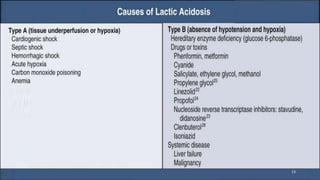
• Types and Causes of Lactic acidosis
• Type A(hypoxic)
• Type B(metabolic)
• d-Lactic acidosis: Generated from glucose and carbohydrate
by bowel bacteria in short bowel syndromes
8
Types and causes of lactic acidosis
Type A
• Due to hypoxia in tissues (most common)
• Hypoxia causes impaired oxidative phosphorylation and decreased
ATP synthesis
• To survive, the cells switch to anaerobic glycolysis for ATP
synthesis
• This produces lactate as a final product
9
• Type A - is due to inadequate supply of oxygen in tissues
E.g.
• Myocardial infarction
• Pulmonary embolism
• Uncontrolled hemorrhage
• Tissue hypoperfusion (shock, cardiac arrest, acute heart failure,
etc.)
• Anaerobic muscular exercise
10
Type B
• Due to disorders in carbohydrate metabolism
• It is speculated to be a primary defect in mitochondrial function
with impaired oxygen use.
• This leads to reduced stores of ATP and NAD⁺ with accumulation
of NADH⁺ and H⁺.
• In the presence of decreased liver perfusion or liver disease,
lactate removal from the blood is reduced, thereby aggravating
the lactic acidosis
11
Type B associated with disease
• Liver disease and Liver failure
• Neoplasia,
• Drug intoxication (ethanol, methanol, salicylate)
• Inborn error of metabolism.
12
13
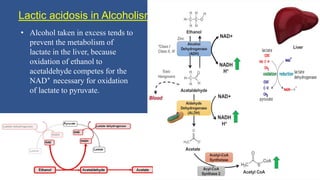
• Alcohol taken in excess tends to
prevent the metabolism of
lactate in the liver, because
oxidation of ethanol to
acetaldehyde competes for the
NAD⁺ necessary for oxidation
of lactate to pyruvate.
Lactic acidosis in Alcoholism
14
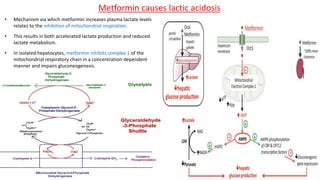
Metformin causes lactic acidosis
15
• Mechanism via which metformin increases plasma lactate levels
relates to the inhibition of mitochondrial respiration.
• This results in both accelerated lactate production and reduced
lactate metabolism.
• In isolated hepatocytes, metformin inhibits complex 1 of the
mitochondrial respiratory chain in a concentration-dependent
manner and impairs gluconeogenesis.
Lactic acidosis caused by vitamin Deficiency
• Deficiency of vitamin B1 (thiamine) is
a very rare cause of type B lactic
acidosis.
• Thiamine is an essential co-factor for
the enzyme pyruvate dehydrogenase
that allows oxidation of pyruvate to
acetyl CoA.
• In the absence of thiamine this
reaction cannot proceed and instead,
pyruvate is converted to lactate. The
resulting accumulation of lactate
causes lactic acidosis. 16
• An uncommon and often undiagnosed cause of lactic acidosis is
d-lactic acidosis.
• It was thought that d-lactate was not produced in human
metabolism, but normal individuals have a large capacity to
metabolize d-lactate.
• Moreover, absorption and accumulation of d-lactate from
abnormal intestinal bacteria may cause systemic acidosis.
• This occurs after jejunoileal bypass surgery and manifests as
altered mental status (from mild drowsiness to coma) with
increased blood concentrations of d-lactate.
d- Lactic acidosis:
17
Malignancy and Lactic acidosis:
• Warburg effect
• The Warburg effect is the phenomenon in which
cancer cells produce additional energy through
increased glycolysis followed by lactic acid
fermentation .
18
Illustration of lactate as a key player in cancer.
• A number of oncogenes and
tumor suppressor genes are
involved in the metabolic
switch from oxidative
phosphorylation (OXPHOS)
toward an altered glycolysis of
tumor cells, such as myc, NF-kB
this is reason for increased
lactic acidosis in malignancy.
• Key for Cancer cell is Lactate
• Increase immune escape –
decrease cytokines
• Increase ROS Scavenging –
increase radio-resistance
• Play important role in cancer
cell motility, migration,&
distant metastasis
• Increase angiogenesis in cancer
cell.
19
• Glucose 6-phosphatase deficiency
(type I G6PD)(von gierke disease)
• Fructose-1,6-biphosphatase
deficiency
• Pyruvate carboxylate deficiency
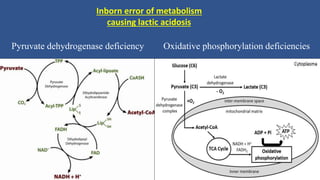
Inborn error of metabolism
causing lactic acidosis
20
Pyruvate dehydrogenase deficiency
Inborn error of metabolism
causing lactic acidosis
Oxidative phosphorylation deficiencies
21
SIGNS AND SYMPTOMS
• Shallow breathing
• Muscle pain that may later lead to cramping
• Loss of weight and loss of appetite
• Myalgia
• Weakness and fatigue
• Nausea, vomiting
• Abdominal pains
• Tachypnoea
• Tachycardia
22
Diagnosis
• Determination of Lactate in Whole Blood
• Principle
• Lactate is oxidized to pyruvate by lactate dehydrogenase in the
presence of NAD⁺. The NADH⁺ formed in this reaction is measured by
a spectrophotometer at 340 nm and serves as a measure of the
lactate concentration.
• Because of its high specificity and simplicity, the enzymatic
method is the method of choice for measuring lactate, although
other methods may also be used (e.g., gas chromatography,
photometry).
Methods for Measuring Lactate and Pyruvate in Body Fluids
23
• The Vitros Analyzer (Ortho-Clinical Diagnostics) uses an assay in
which lactic acid is oxidized to pyruvate by lactate oxidase.
• The H2O2 generated oxidizes a chromogen system, and absorbance
of the resulting dye complex, measured by a spectrophotometer at
540 nm, is directly proportional to the lactate concentration in the
specimen.
• Each mole of lactate oxidized produces 0.5 mole of dye complex.
24
Diagnosis done by measuring blood lactate levels
Hyperlactemia: 2 – 5 mmols/L
Severe lactic acidosis: > 5 mmols/L
• All commonly used laboratory assays for lactate use l-lactate
dehydrogenase, which does not detect d-lactate.
• d-Lactate can be measured by gas-liquid chromatography or, more
easily, by using a specific d-lactate dehydrogenase (Sigma) from
Lactobacillus leishmanni.
25
CSF lactate
• Lactate in CSF normally parallels blood concentrations in adults , but
not in children.
• CSF lactate values change independently of blood values.
• Increased CSF concentrations are noted in cerebrovascular accidents,
intracranial haemorrhage, bacterial meningitis, epilepsy, inborn errors
of the electron transport chain, and other CNS disorders.
• In aseptic (viral) meningitis, lactate concentrations in CSF are not
usually increased; hence, CSF lactate has been used to help
discriminate between viral and bacterial meningitis, but the clinical
utility has been questioned. In a few children with inherited metabolic
disease, increased.
26
• Correcting the underlying conditions
• Restoring adequate tissue oxygen
• Avoiding sodium bicarbonate
• Haemodialysis
Treatment
27
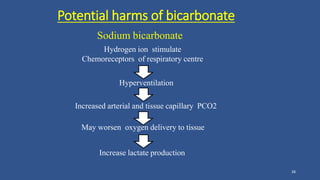
Potential harms of bicarbonate
Hydrogen ion stimulate
Chemoreceptors of respiratory centre
Hyperventilation
May worsen oxygen delivery to tissue
Increase lactate production
Increased arterial and tissue capillary PCO2
28
Sodium bicarbonate
• Dialysis may be a useful mode of therapy when
severe lactic acidosis exists in conjunction with
renal failure or congestive heart failure.
• Dialysis would allow bicarbonate infusion
without precipitating or worsening fluid
overload. Therefore, dialysis would correct
acidosis by restoring the buffer pool.
Haemodialysis
29
• Hemodialysis or continuous hemofiltration
used in conjunction with alkali infusion may
be tolerated in a patient with cardiovascular
instability.
• However, the overall benefit of such therapy
to a patient's outcome is not known.
Metformin-induced lactic acidosis has been
reported to improve after prolonged
hemodialysis.
Haemodialysis
30
31

Lactic acidosis

  • 1.
  • 2.
    INTRODUCTION • Lactic acidis the normal endpoint of the anaerobic breakdown of glucose in the tissues. • Normal plasma lactate: 0.5 to 1.5 meq/L. C3H6O3 2
  • 3.
    Lactic acidosis Definition: • Lacticacidosis is a pathological state diagnosed when the serum concentration of lactate or lactic acid is persistently 5mmol/L or greater and there is significant acidemia and serum pH< 7.35. • Associated with elevated anion gap. 3
  • 4.
    FORMATION OF LACTICACID •RBCs, brain and skin are major sources of lactic acid • During exercise skeletal muscles release significant amount of lactic acid. • Kidney and liver utilize lactic acid for biosynthesis of glucose. • Lactic acid and pyruvic acid are interconvertible reaction • It is catalyzed by the enzyme lactate dehydrogenase. 4
  • 5.
    Pyruvate to lactate Thereduction of pyruvate by NADH⁺ to form lactate is catalyzed by lactate dehydrogenase The reaction takes place in the cells when the amount of oxygen is less, as in muscle during intense activity. 5
  • 6.
    • In thecells lacking mitochondria and under anaerobic conditions, the NADH⁺ formed in the oxidation of glyceraldehyde 3- phosphate is consumed in the hydrogenation of pyruvate. • The regeneration of NAD + in the hydrogenation of pyruvate to lactate sustains the continued operation of glycolysis under anaerobic conditions. 6
  • 7.
  • 8.
    PATHOPHYSIOLOGY Lactic acidosis occurswhenever there is an imbalance between the production and use of lactic acid. • Types and Causes of Lactic acidosis • Type A(hypoxic) • Type B(metabolic) • d-Lactic acidosis: Generated from glucose and carbohydrate by bowel bacteria in short bowel syndromes 8
  • 9.
    Types and causesof lactic acidosis Type A • Due to hypoxia in tissues (most common) • Hypoxia causes impaired oxidative phosphorylation and decreased ATP synthesis • To survive, the cells switch to anaerobic glycolysis for ATP synthesis • This produces lactate as a final product 9
  • 10.
    • Type A- is due to inadequate supply of oxygen in tissues E.g. • Myocardial infarction • Pulmonary embolism • Uncontrolled hemorrhage • Tissue hypoperfusion (shock, cardiac arrest, acute heart failure, etc.) • Anaerobic muscular exercise 10
  • 11.
    Type B • Dueto disorders in carbohydrate metabolism • It is speculated to be a primary defect in mitochondrial function with impaired oxygen use. • This leads to reduced stores of ATP and NAD⁺ with accumulation of NADH⁺ and H⁺. • In the presence of decreased liver perfusion or liver disease, lactate removal from the blood is reduced, thereby aggravating the lactic acidosis 11
  • 12.
    Type B associatedwith disease • Liver disease and Liver failure • Neoplasia, • Drug intoxication (ethanol, methanol, salicylate) • Inborn error of metabolism. 12
  • 13.
  • 14.
    • Alcohol takenin excess tends to prevent the metabolism of lactate in the liver, because oxidation of ethanol to acetaldehyde competes for the NAD⁺ necessary for oxidation of lactate to pyruvate. Lactic acidosis in Alcoholism 14
  • 15.
    Metformin causes lacticacidosis 15 • Mechanism via which metformin increases plasma lactate levels relates to the inhibition of mitochondrial respiration. • This results in both accelerated lactate production and reduced lactate metabolism. • In isolated hepatocytes, metformin inhibits complex 1 of the mitochondrial respiratory chain in a concentration-dependent manner and impairs gluconeogenesis.
  • 16.
    Lactic acidosis causedby vitamin Deficiency • Deficiency of vitamin B1 (thiamine) is a very rare cause of type B lactic acidosis. • Thiamine is an essential co-factor for the enzyme pyruvate dehydrogenase that allows oxidation of pyruvate to acetyl CoA. • In the absence of thiamine this reaction cannot proceed and instead, pyruvate is converted to lactate. The resulting accumulation of lactate causes lactic acidosis. 16
  • 17.
    • An uncommonand often undiagnosed cause of lactic acidosis is d-lactic acidosis. • It was thought that d-lactate was not produced in human metabolism, but normal individuals have a large capacity to metabolize d-lactate. • Moreover, absorption and accumulation of d-lactate from abnormal intestinal bacteria may cause systemic acidosis. • This occurs after jejunoileal bypass surgery and manifests as altered mental status (from mild drowsiness to coma) with increased blood concentrations of d-lactate. d- Lactic acidosis: 17
  • 18.
    Malignancy and Lacticacidosis: • Warburg effect • The Warburg effect is the phenomenon in which cancer cells produce additional energy through increased glycolysis followed by lactic acid fermentation . 18
  • 19.
    Illustration of lactateas a key player in cancer. • A number of oncogenes and tumor suppressor genes are involved in the metabolic switch from oxidative phosphorylation (OXPHOS) toward an altered glycolysis of tumor cells, such as myc, NF-kB this is reason for increased lactic acidosis in malignancy. • Key for Cancer cell is Lactate • Increase immune escape – decrease cytokines • Increase ROS Scavenging – increase radio-resistance • Play important role in cancer cell motility, migration,& distant metastasis • Increase angiogenesis in cancer cell. 19
  • 20.
    • Glucose 6-phosphatasedeficiency (type I G6PD)(von gierke disease) • Fructose-1,6-biphosphatase deficiency • Pyruvate carboxylate deficiency Inborn error of metabolism causing lactic acidosis 20
  • 21.
    Pyruvate dehydrogenase deficiency Inbornerror of metabolism causing lactic acidosis Oxidative phosphorylation deficiencies 21
  • 22.
    SIGNS AND SYMPTOMS •Shallow breathing • Muscle pain that may later lead to cramping • Loss of weight and loss of appetite • Myalgia • Weakness and fatigue • Nausea, vomiting • Abdominal pains • Tachypnoea • Tachycardia 22
  • 23.
    Diagnosis • Determination ofLactate in Whole Blood • Principle • Lactate is oxidized to pyruvate by lactate dehydrogenase in the presence of NAD⁺. The NADH⁺ formed in this reaction is measured by a spectrophotometer at 340 nm and serves as a measure of the lactate concentration. • Because of its high specificity and simplicity, the enzymatic method is the method of choice for measuring lactate, although other methods may also be used (e.g., gas chromatography, photometry). Methods for Measuring Lactate and Pyruvate in Body Fluids 23
  • 24.
    • The VitrosAnalyzer (Ortho-Clinical Diagnostics) uses an assay in which lactic acid is oxidized to pyruvate by lactate oxidase. • The H2O2 generated oxidizes a chromogen system, and absorbance of the resulting dye complex, measured by a spectrophotometer at 540 nm, is directly proportional to the lactate concentration in the specimen. • Each mole of lactate oxidized produces 0.5 mole of dye complex. 24
  • 25.
    Diagnosis done bymeasuring blood lactate levels Hyperlactemia: 2 – 5 mmols/L Severe lactic acidosis: > 5 mmols/L • All commonly used laboratory assays for lactate use l-lactate dehydrogenase, which does not detect d-lactate. • d-Lactate can be measured by gas-liquid chromatography or, more easily, by using a specific d-lactate dehydrogenase (Sigma) from Lactobacillus leishmanni. 25
  • 26.
    CSF lactate • Lactatein CSF normally parallels blood concentrations in adults , but not in children. • CSF lactate values change independently of blood values. • Increased CSF concentrations are noted in cerebrovascular accidents, intracranial haemorrhage, bacterial meningitis, epilepsy, inborn errors of the electron transport chain, and other CNS disorders. • In aseptic (viral) meningitis, lactate concentrations in CSF are not usually increased; hence, CSF lactate has been used to help discriminate between viral and bacterial meningitis, but the clinical utility has been questioned. In a few children with inherited metabolic disease, increased. 26
  • 27.
    • Correcting theunderlying conditions • Restoring adequate tissue oxygen • Avoiding sodium bicarbonate • Haemodialysis Treatment 27
  • 28.
    Potential harms ofbicarbonate Hydrogen ion stimulate Chemoreceptors of respiratory centre Hyperventilation May worsen oxygen delivery to tissue Increase lactate production Increased arterial and tissue capillary PCO2 28 Sodium bicarbonate
  • 29.
    • Dialysis maybe a useful mode of therapy when severe lactic acidosis exists in conjunction with renal failure or congestive heart failure. • Dialysis would allow bicarbonate infusion without precipitating or worsening fluid overload. Therefore, dialysis would correct acidosis by restoring the buffer pool. Haemodialysis 29
  • 30.
    • Hemodialysis orcontinuous hemofiltration used in conjunction with alkali infusion may be tolerated in a patient with cardiovascular instability. • However, the overall benefit of such therapy to a patient's outcome is not known. Metformin-induced lactic acidosis has been reported to improve after prolonged hemodialysis. Haemodialysis 30
  • 31.

Editor's Notes

  • #6 Ph 9 to 9.6
  • #8 When oxygen level are low muscles undergo anaerobic metabolism in order to obtain ATP for muscle contraction so the muscles during anaerobic condition glucose is metobolised to pyruvate these pyruvated is hydrogenated (redused) to lactate by LDH . This reaction is important to regenerate +maintain NAD which is need for glycolysis to occur unitruptly, this latate produced in muscles is dead end so its taken up by liver where gluconeogenesis occur
  • #9 (Excessive tissue lactate production , Impaired hepatic metabolism of lactate)
  • #10 The amount of oxygen required to recover from oxygen deficiency is called oxygen debt
  • #13 Congenital lactic acidosis is due to deficiency of pyruvate dehydrogenase enzyme.
  • #21 Abnormal accumulation of g6p Increased the rate of glycolysis leading to an increased synthesis of pyruvate -lactate