Statistics for Managers
Using Microsoft® Excel
4th Edition
Chapter 8
Fundamentals of Hypothesis
Testing: One-Sample Tests
Statistics for Managers Using Microsoft Excel, 4e © 2004 Prentice-Hall, Inc.

Chap 8-1
Chapter Goals
After completing this chapter, you should be
able to:


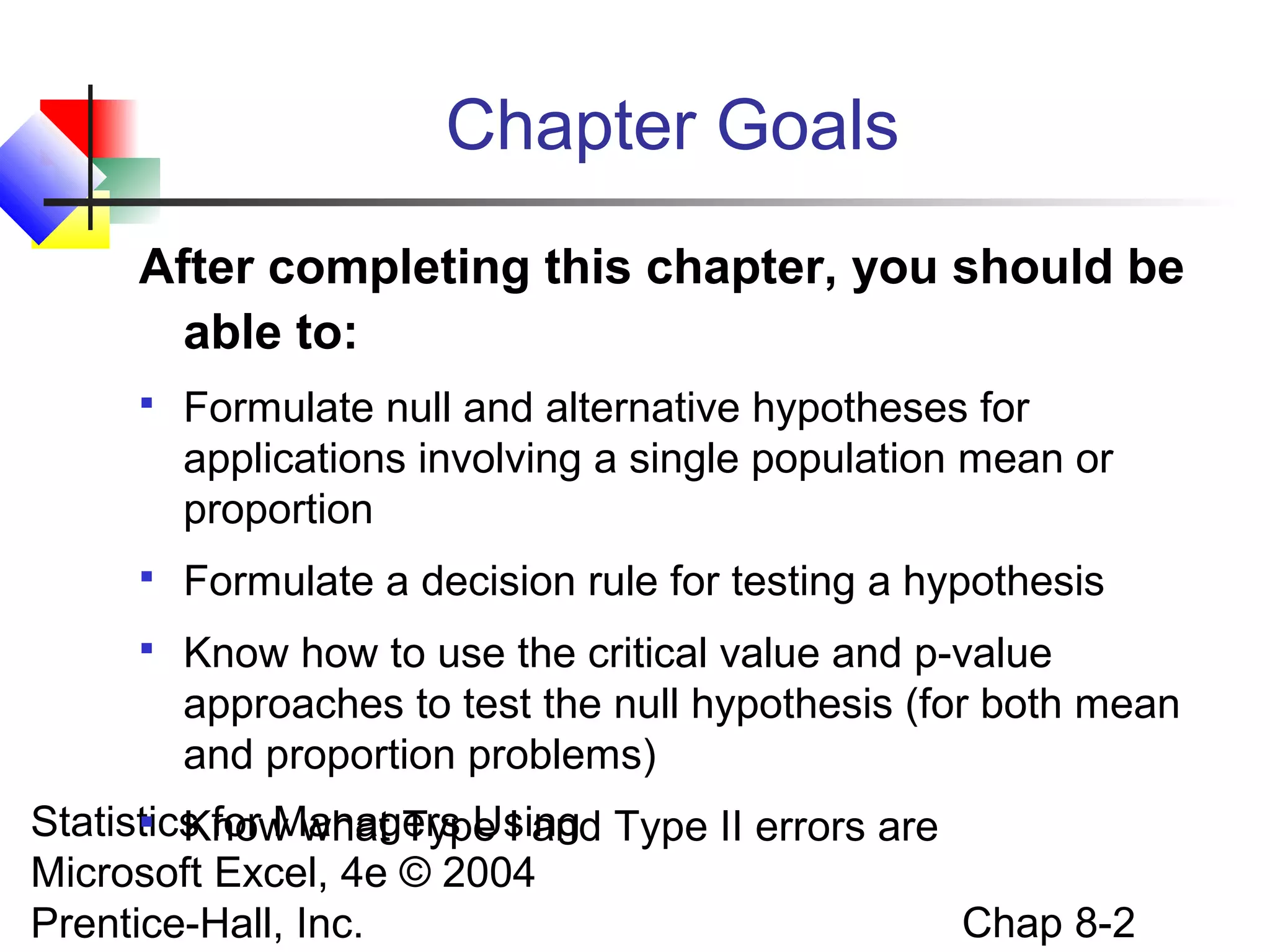
Formulate null and alternative hypotheses for
applications involving a single population mean or
proportion



Formulate a decision rule for testing a hypothesis



Know how to use the critical value and p-value
approaches to test the null hypothesis (for both mean
and proportion problems)

 Know what Type I and
Statistics for Managers Using Type II errors are
Microsoft Excel, 4e © 2004
Chap 8-2
Prentice-Hall, Inc.
What is a Hypothesis?


A hypothesis is a claim
(assumption) about a
population parameter:


population mean
Example: The mean monthly cell phone bill
of this city is μ = $42



population proportion

Example: The proportion of adults in this
Statistics for Managers Using
city with cell phones is p = .68
Microsoft Excel, 4e © 2004
Chap 8-3
Prentice-Hall, Inc.
The Null Hypothesis, H0


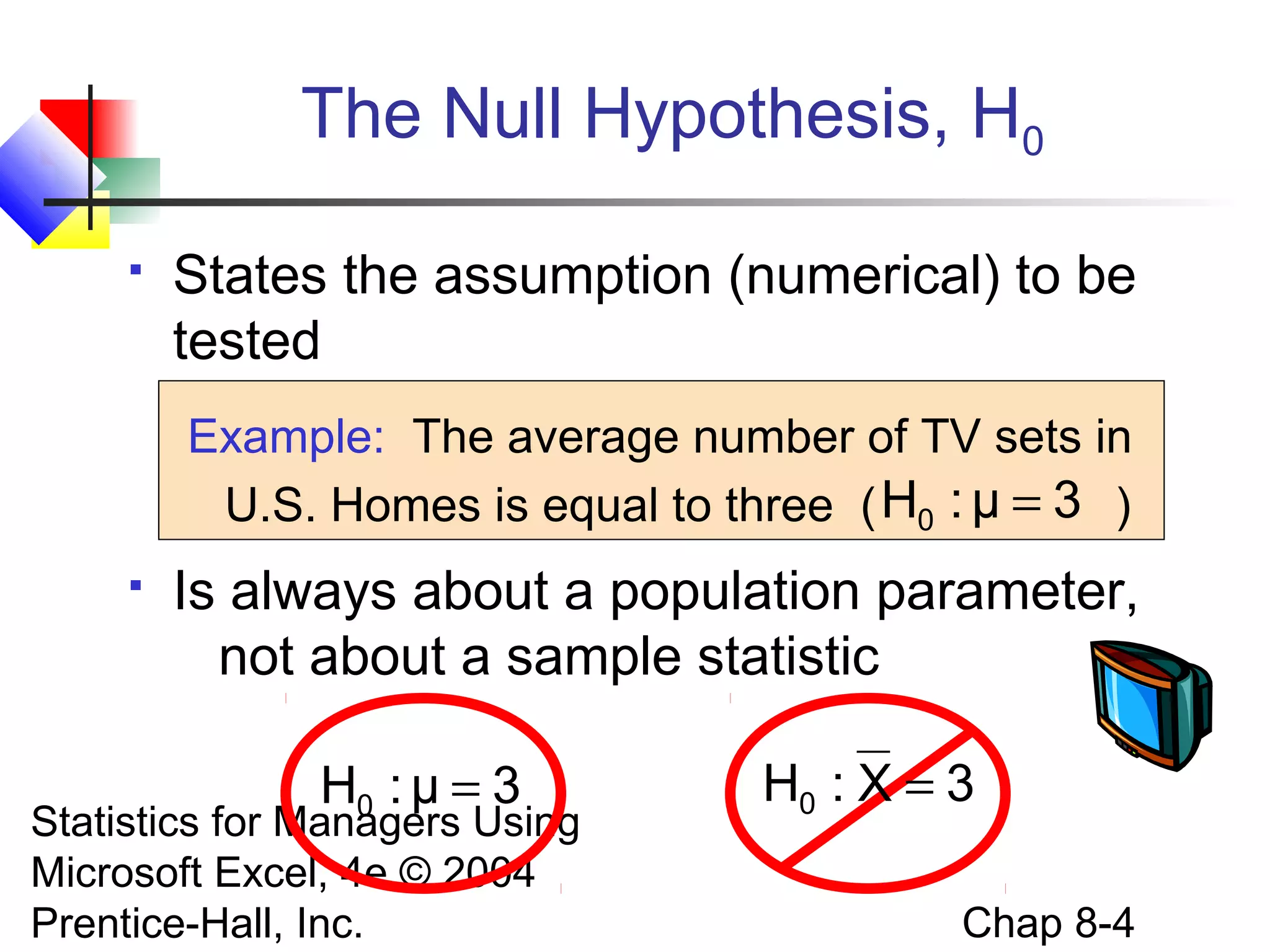
States the assumption (numerical) to be
tested
Example: The average number of TV sets in
U.S. Homes is equal to three ( H0 : μ = 3 )


Is always about a population parameter,
not about a sample statistic
H0 : μ = 3

Statistics for Managers Using
Microsoft Excel, 4e © 2004
Prentice-Hall, Inc.

H0 : X = 3
Chap 8-4
The Null Hypothesis, H0
(continued)






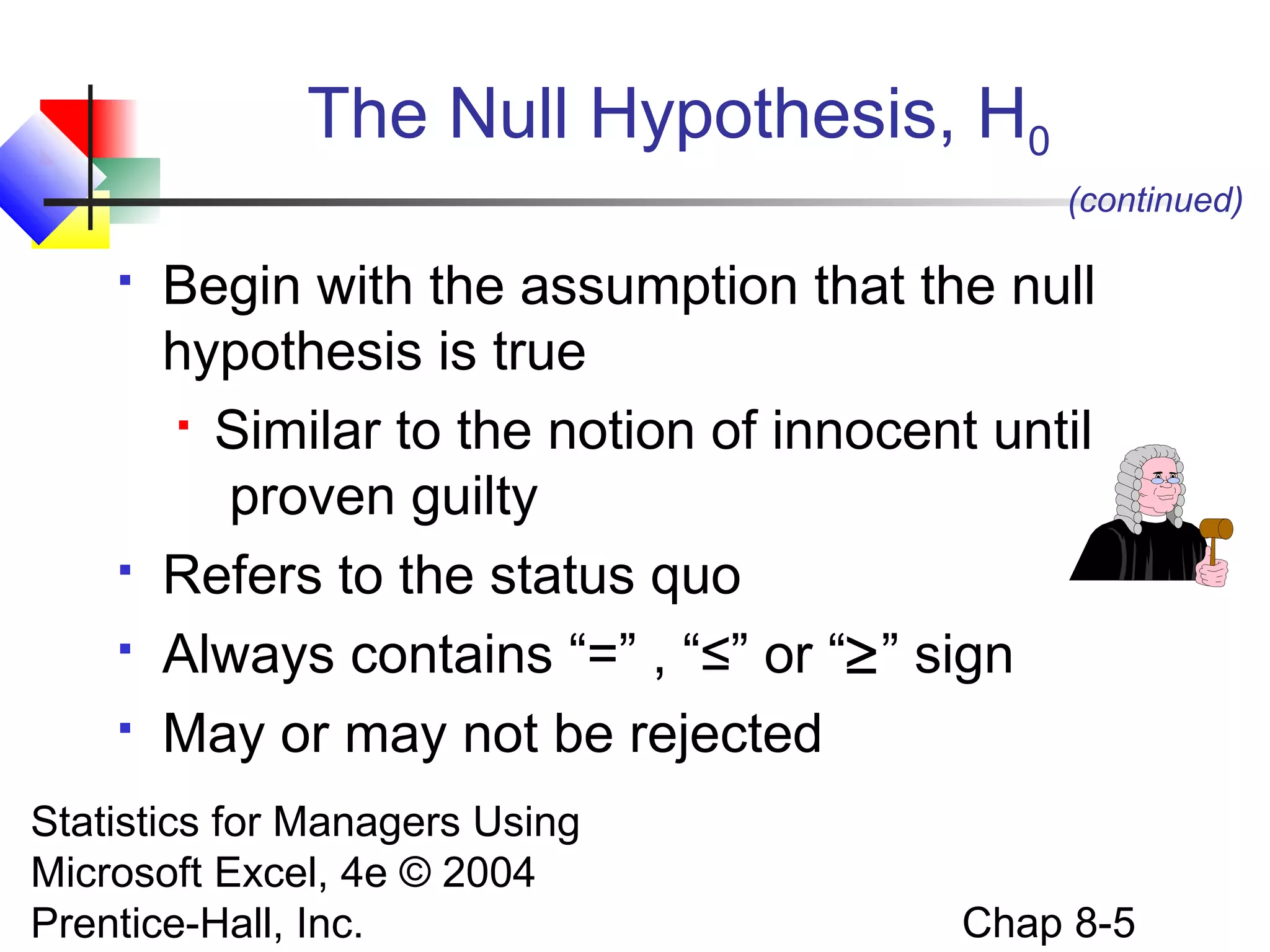
Begin with the assumption that the null
hypothesis is true
 Similar to the notion of innocent until
proven guilty
Refers to the status quo
Always contains “=” , “≤” or “≥” sign
May or may not be rejected

Statistics for Managers Using
Microsoft Excel, 4e © 2004
Prentice-Hall, Inc.

Chap 8-5
The Alternative Hypothesis, H1


Is the opposite of the null hypothesis


e.g., The average number of TV sets in U.S.
homes is not equal to 3 ( H1: μ ≠ 3 )


Challenges the status quo



Never contains the “=” , “≤” or “≥” sign
May or may not be proven
Is generally the hypothesis that the
researcher is trying to prove




Statistics for Managers Using
Microsoft Excel, 4e © 2004
Prentice-Hall, Inc.

Chap 8-6
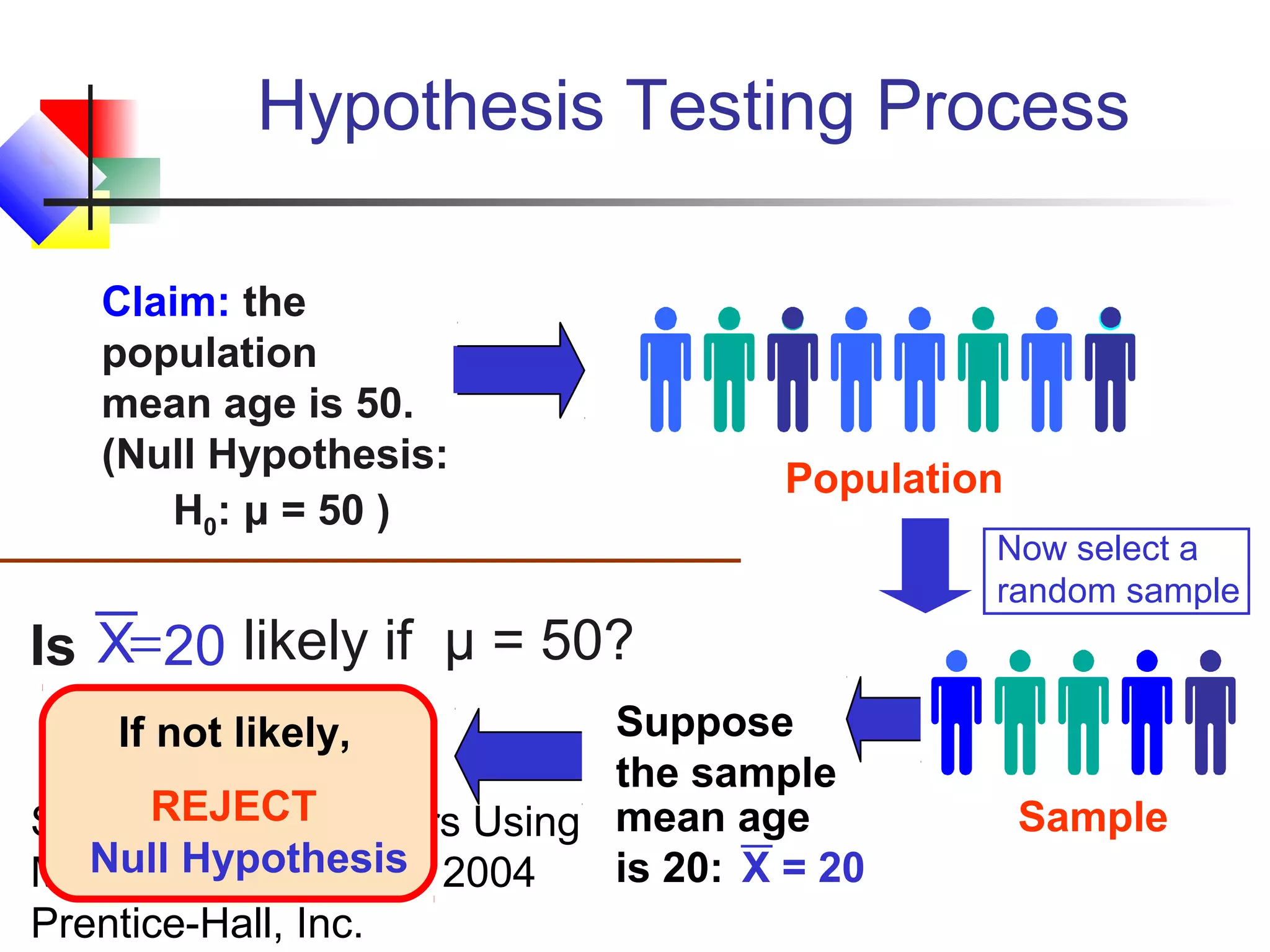
Hypothesis Testing Process
Claim: the
population
mean age is 50.
(Null Hypothesis:
H0: μ = 50 )

Population

Is X= 20 likely if μ = 50?
Suppose
the sample
REJECT
Statistics for Managers Using mean age
Null Hypothesis
is 20: X = 20
Microsoft Excel, 4e © 2004
Prentice-Hall, Inc.

Now select a
random sample

If not likely,

Sample
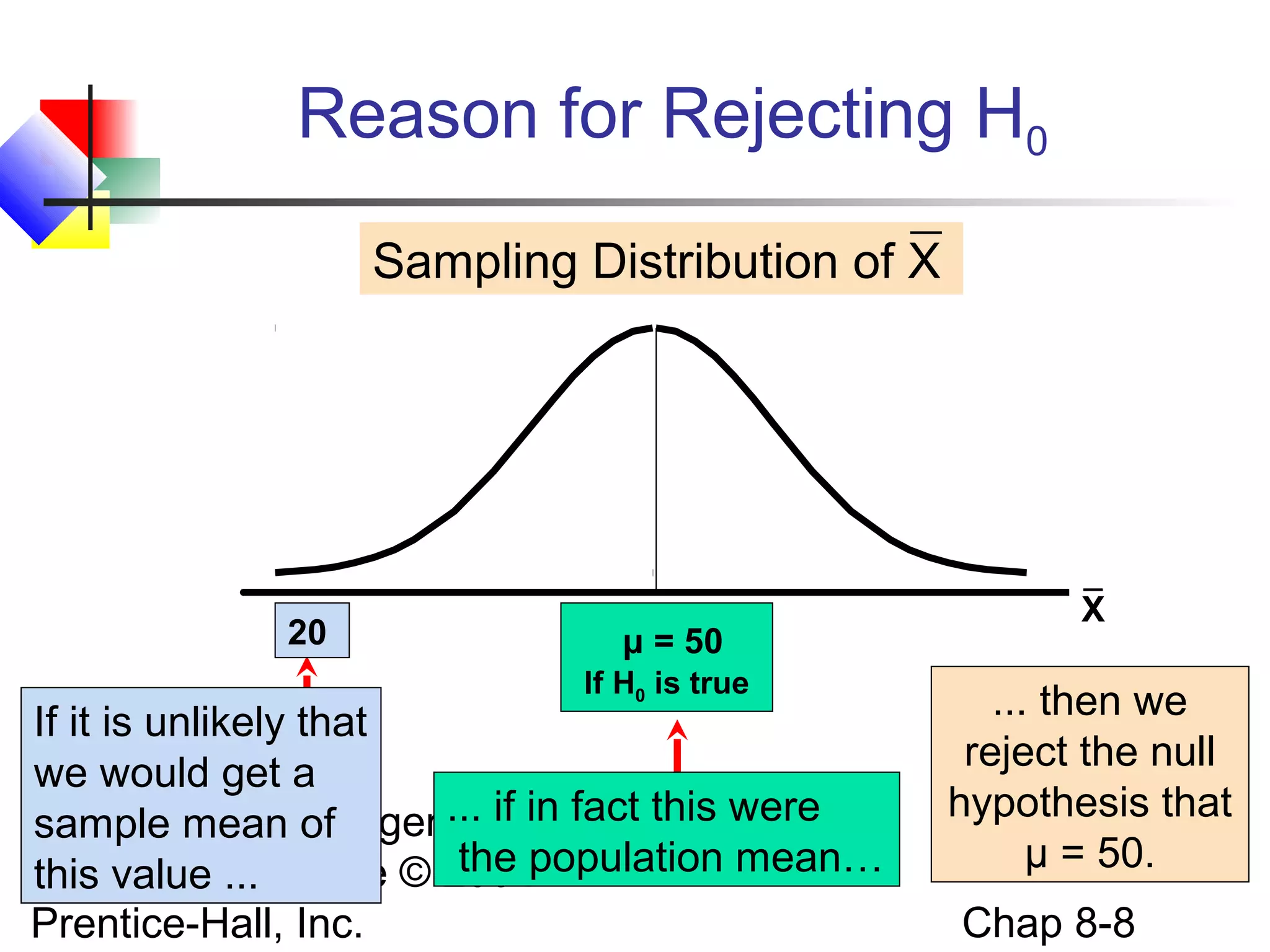
Reason for Rejecting H0
Sampling Distribution of X

20

μ = 50
If H0 is true

If it is unlikely that
we would get a
... if in fact this were
Statistics for Managers Using
sample mean of
the
Microsoft Excel, 4e © 2004population mean…
this value ...
Prentice-Hall, Inc.

X

... then we
reject the null
hypothesis that
μ = 50.
Chap 8-8
Level of Significance, α


Defines the unlikely values of the sample
statistic if the null hypothesis is true




Is designated by α , (level of significance)




Defines rejection region of the sampling
distribution
Typical values are .01, .05, or .10

Is selected by the researcher at the beginning

 Provides the critical
Statistics for Managers Using value(s) of the test
Microsoft Excel, 4e © 2004
Chap 8-9
Prentice-Hall, Inc.
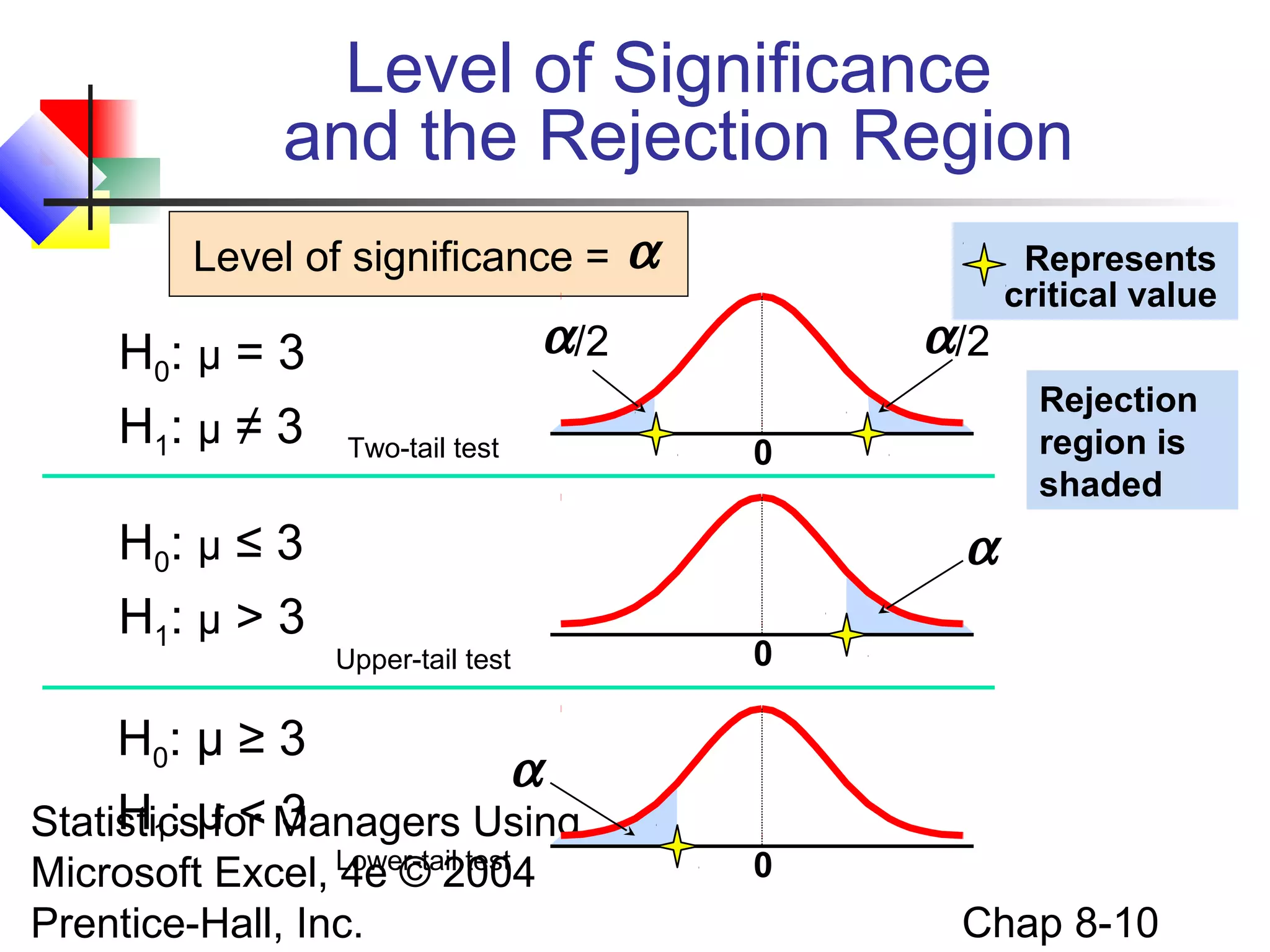
Level of Significance
and the Rejection Region
Level of significance =

H0: μ = 3
H1: μ ≠ 3
H0: μ ≤ 3
H1: μ > 3

α

α/2
Two-tail test

α/2

Represents
critical value
Rejection
region is
shaded

0

α
Upper-tail test

H0: μ ≥ 3
α
H1: for 3
Statisticsμ < Managers Using
Microsoft Excel, Lower-tail test
4e © 2004
Prentice-Hall, Inc.

0

0

Chap 8-10
Errors in Making Decisions


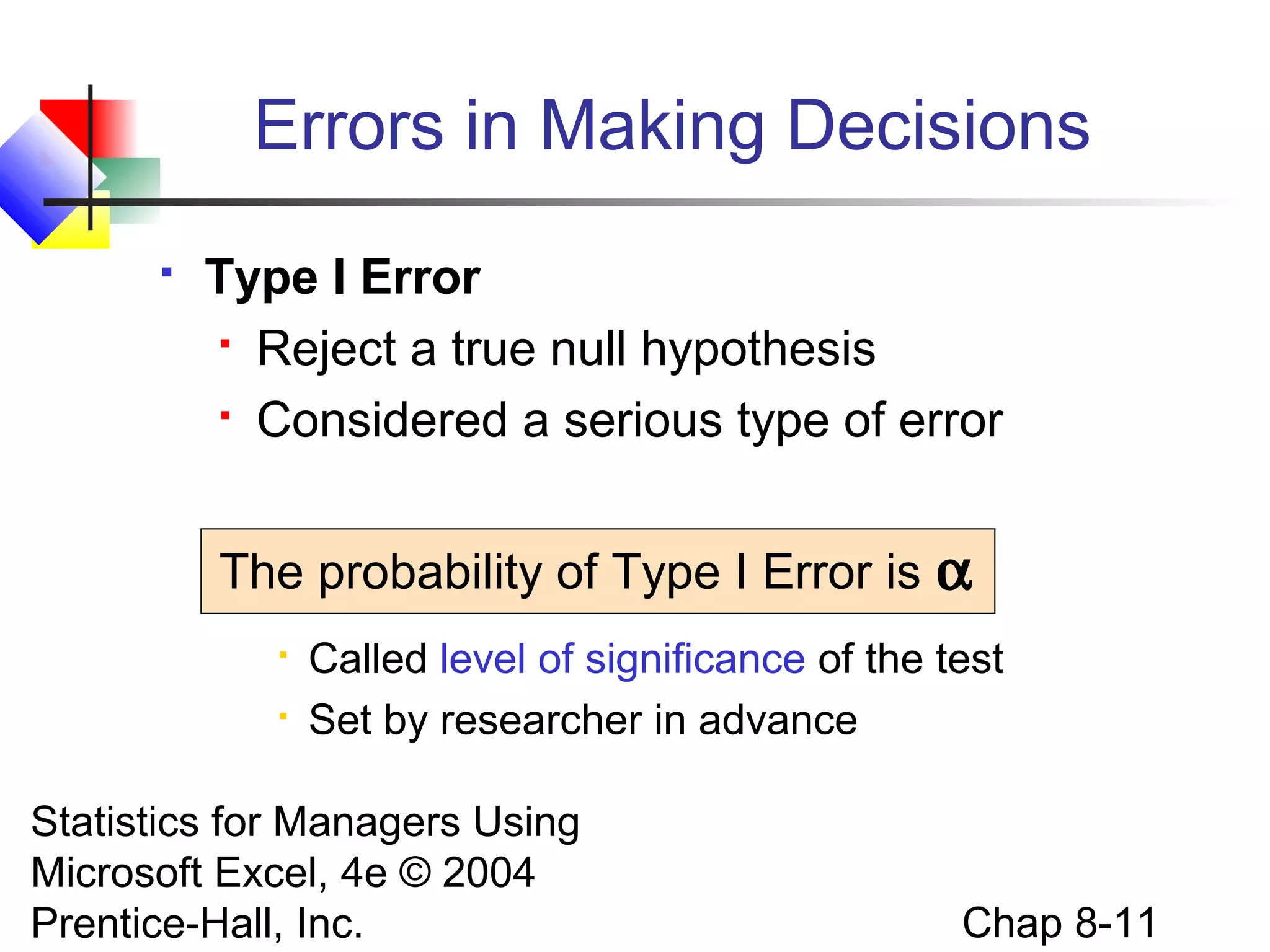
Type I Error
 Reject a true null hypothesis
 Considered a serious type of error
The probability of Type I Error is α



Called level of significance of the test
Set by researcher in advance

Statistics for Managers Using
Microsoft Excel, 4e © 2004
Prentice-Hall, Inc.

Chap 8-11
Errors in Making Decisions
(continued)


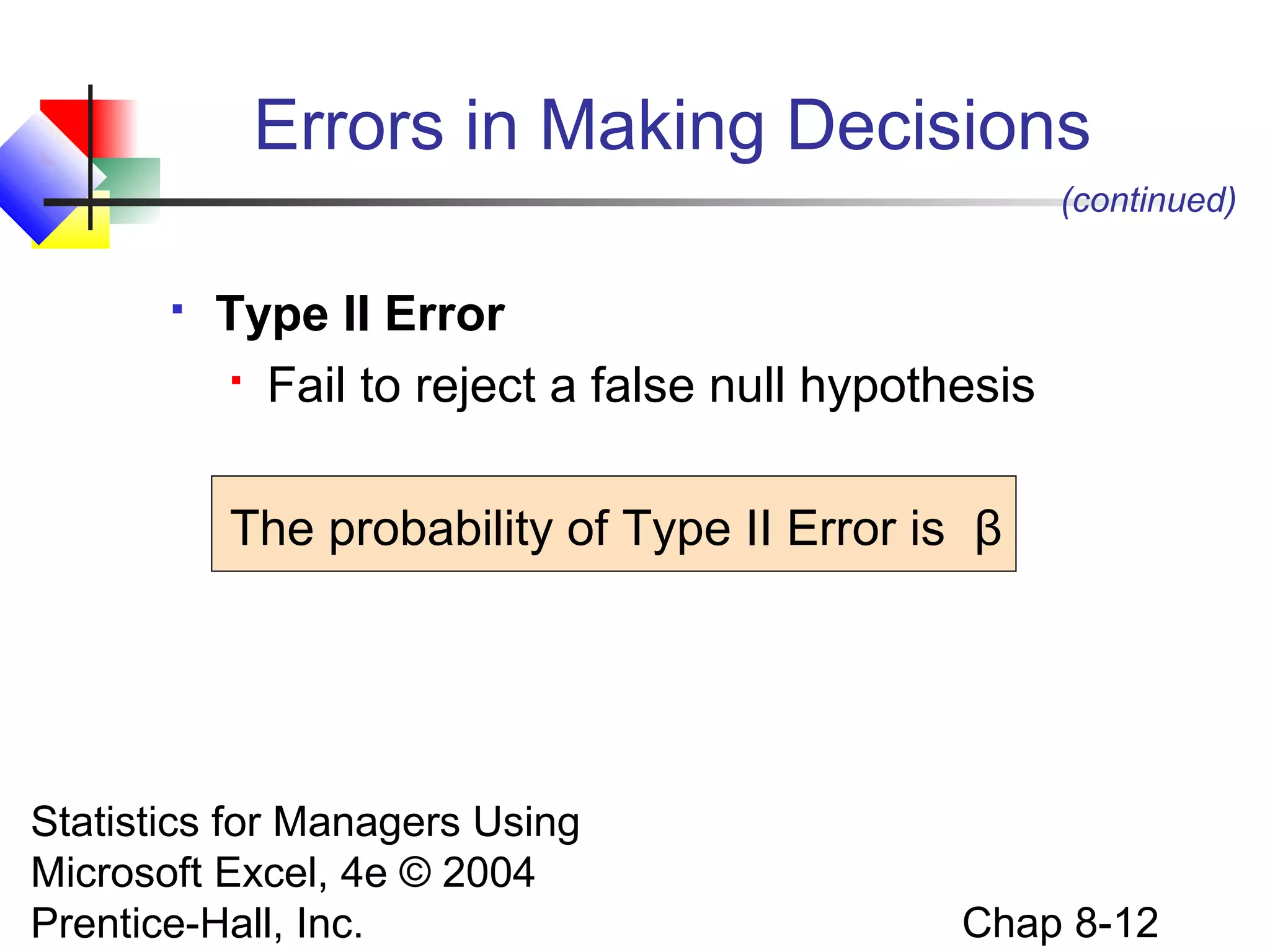
Type II Error
 Fail to reject a false null hypothesis
The probability of Type II Error is β

Statistics for Managers Using
Microsoft Excel, 4e © 2004
Prentice-Hall, Inc.

Chap 8-12
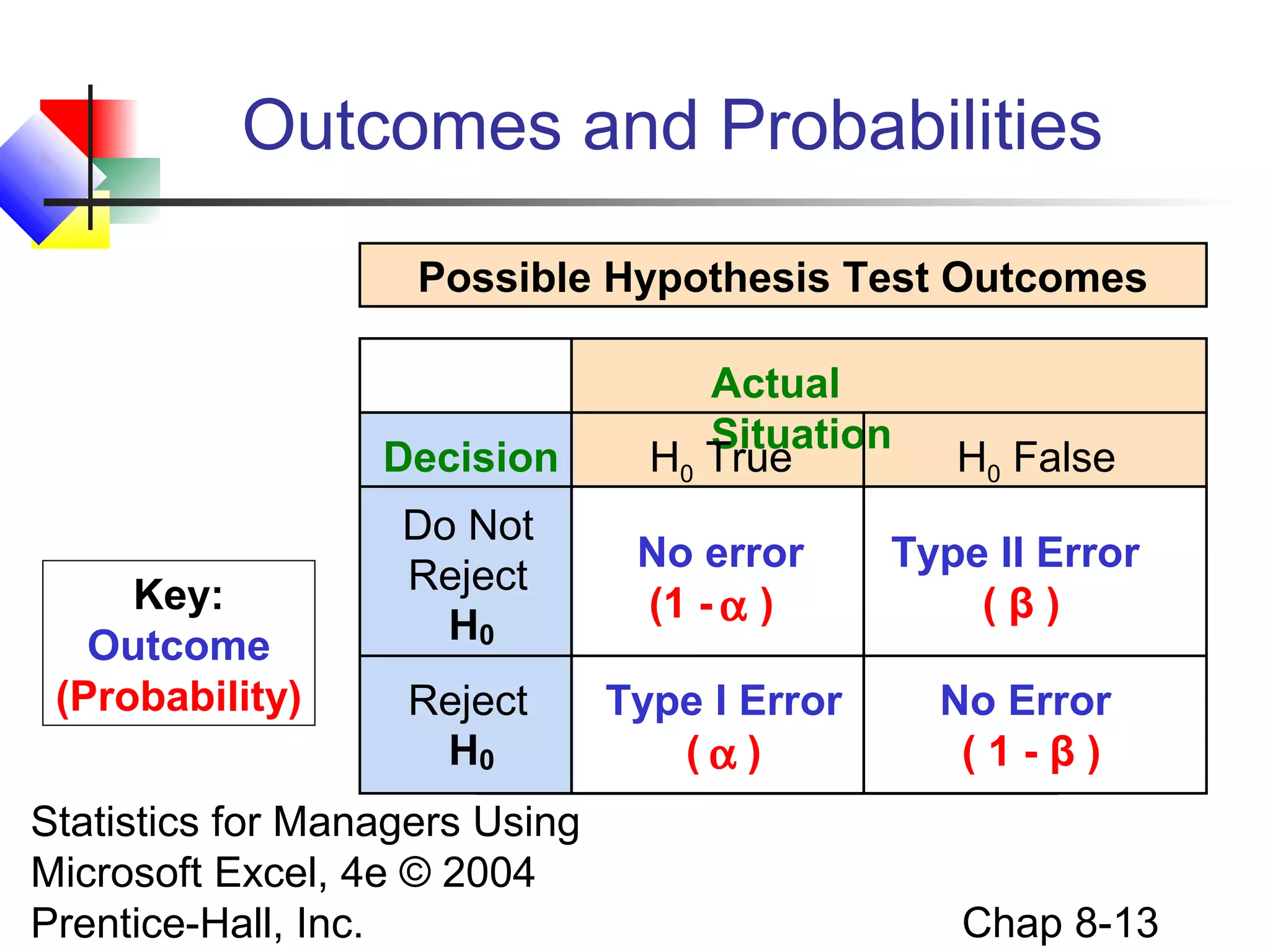
Outcomes and Probabilities
Possible Hypothesis Test Outcomes

Decision
Key:
Outcome
(Probability)

Actual
Situation
H0 True

H0 False

Do Not
Reject
H0

No error
(1 - α )

Type II Error
(β)

Reject
H0

Type I Error
(α)

No Error
(1-β)

Statistics for Managers Using
Microsoft Excel, 4e © 2004
Prentice-Hall, Inc.

Chap 8-13
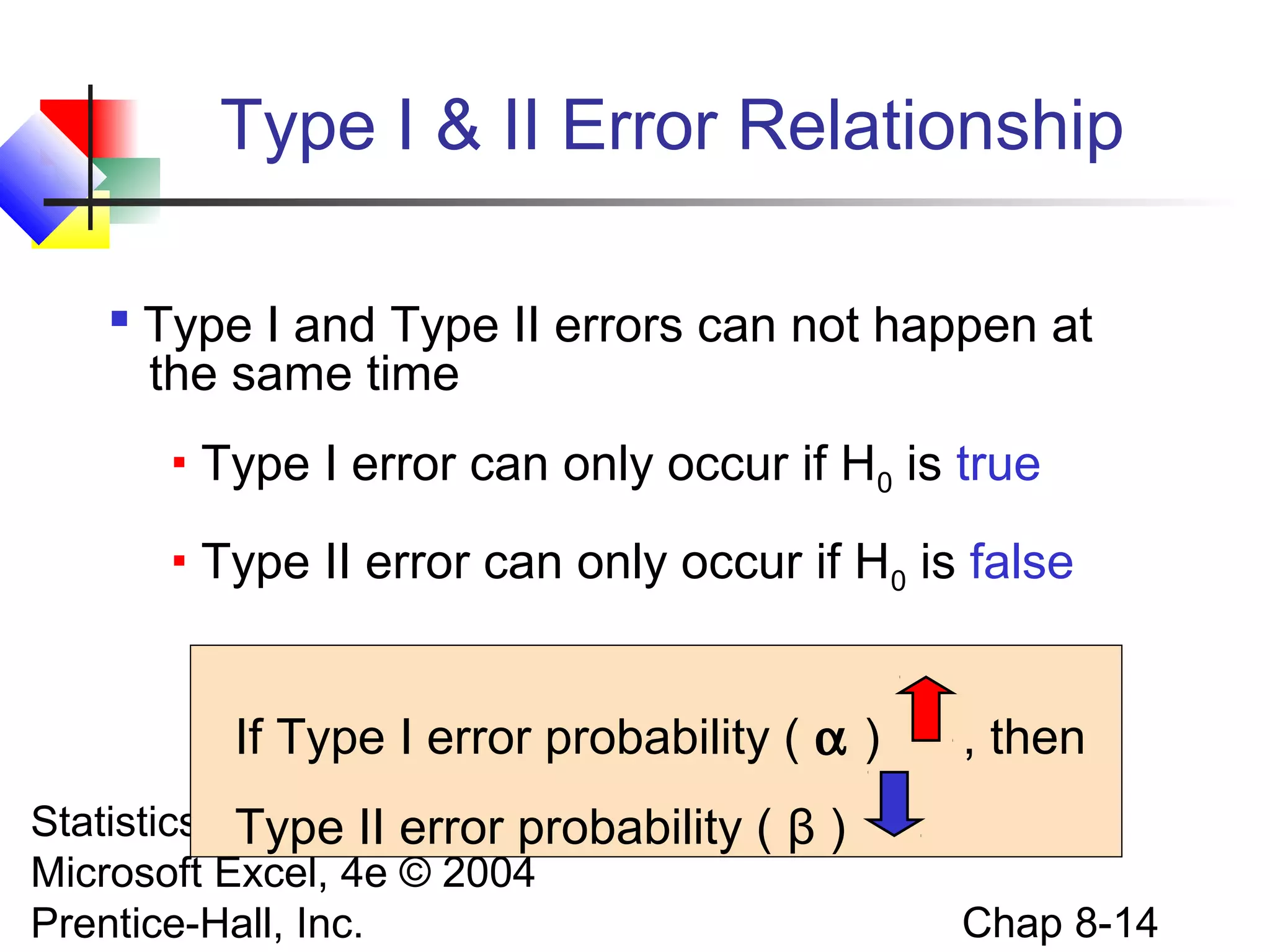
Type I & II Error Relationship
 Type I and Type II errors can not happen at
the same time


Type I error can only occur if H0 is true



Type II error can only occur if H0 is false
If Type I error probability ( α )

Statistics for Managers Using
Type II error probability ( β )
Microsoft Excel, 4e © 2004
Prentice-Hall, Inc.

, then

Chap 8-14
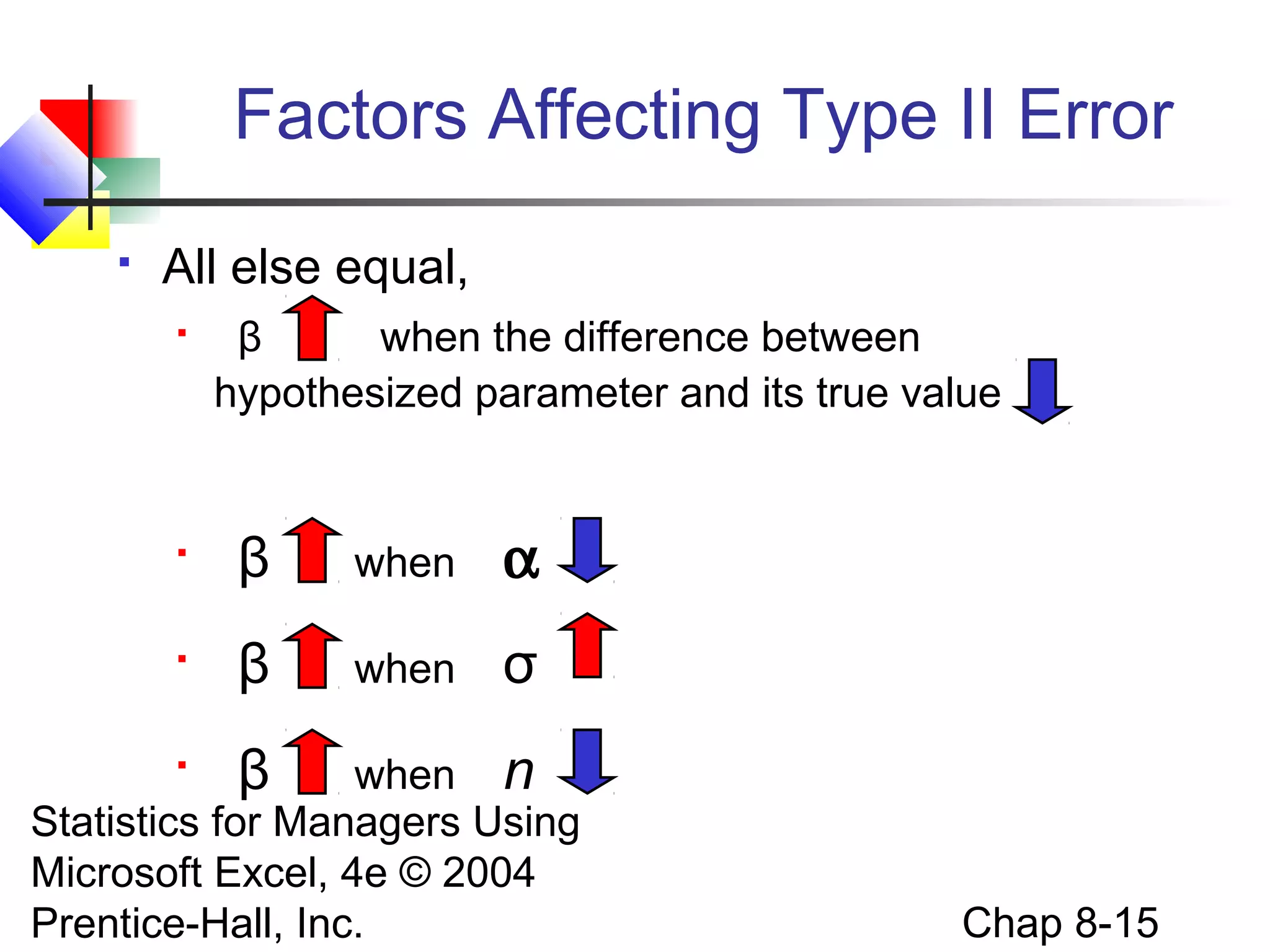
Factors Affecting Type II Error


All else equal,


β
when the difference between
hypothesized parameter and its true value



β

when

α



β

when

σ

when n
Statistics for Managers Using
Microsoft Excel, 4e © 2004
Prentice-Hall, Inc.


β

Chap 8-15
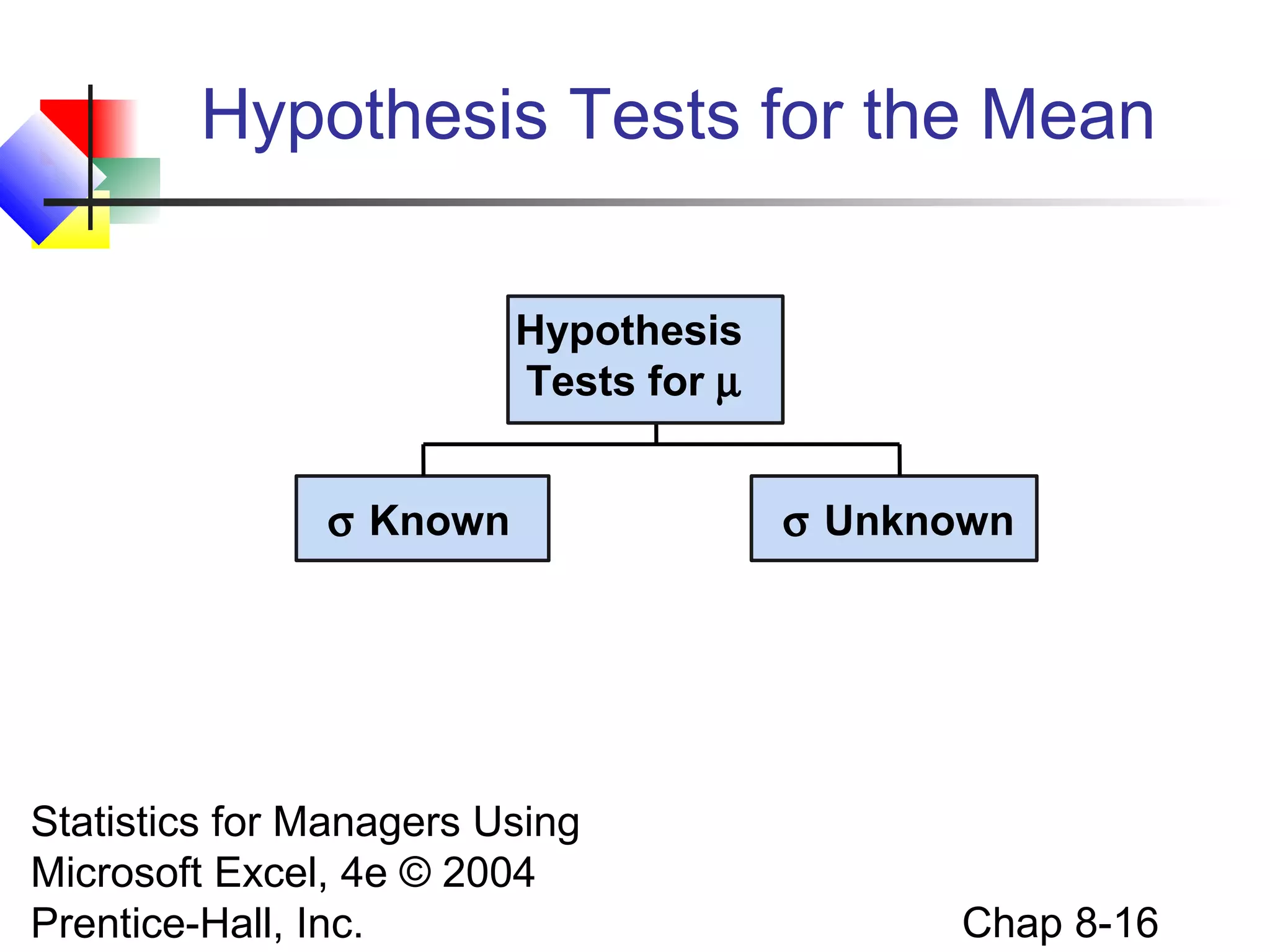
Hypothesis Tests for the Mean
Hypothesis
Tests for µ
σ Known

Statistics for Managers Using
Microsoft Excel, 4e © 2004
Prentice-Hall, Inc.

σ Unknown

Chap 8-16
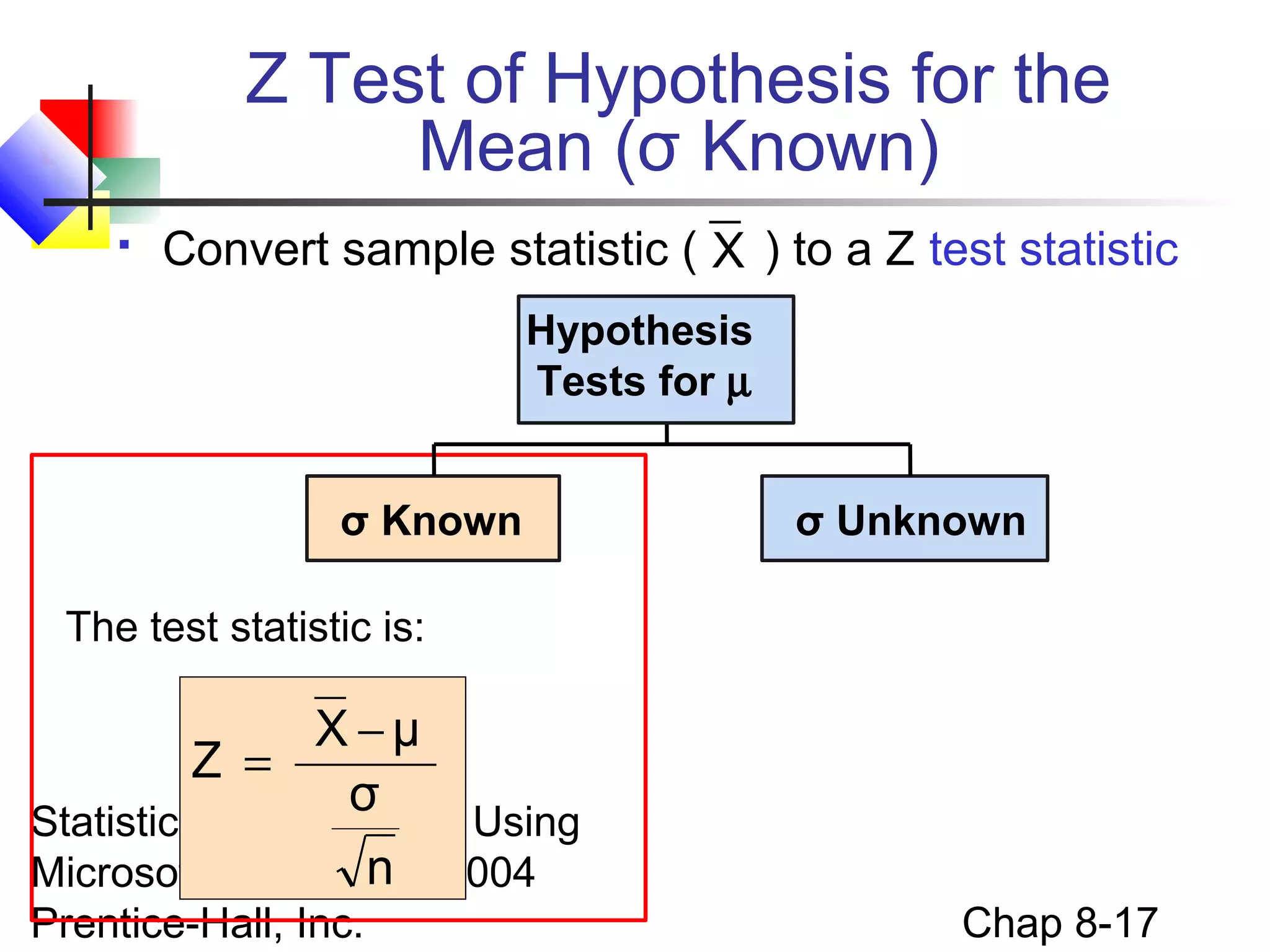
Z Test of Hypothesis for the
Mean (σ Known)


Convert sample statistic ( X ) to a Z test statistic
Hypothesis
Tests for µ
σ Known

σ Unknown

The test statistic is:

X −μ
Z =
σ
Statistics for Managers Using
n
Microsoft Excel, 4e © 2004
Prentice-Hall, Inc.

Chap 8-17
Critical Value
Approach to Testing


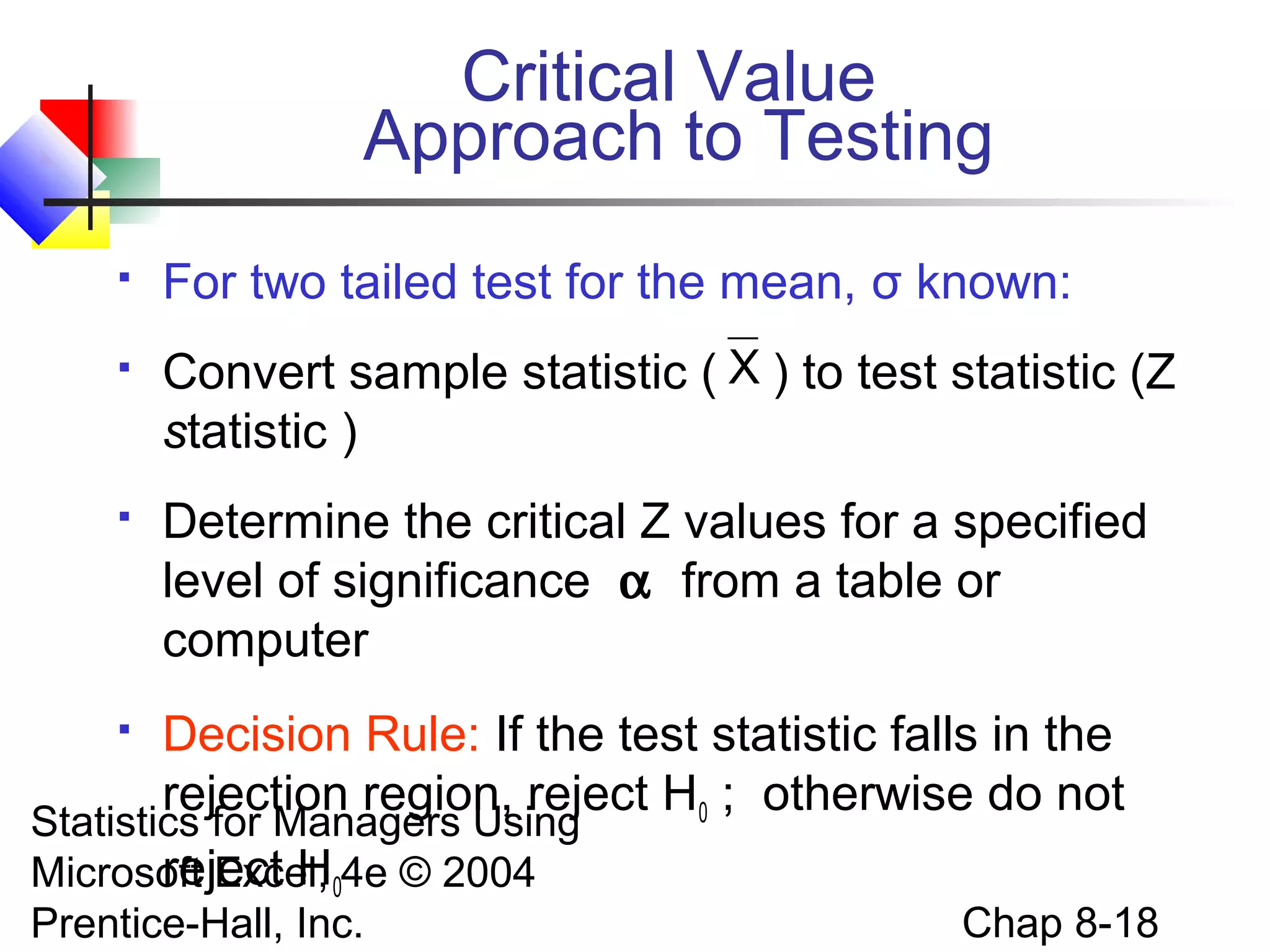
For two tailed test for the mean, σ known:



Convert sample statistic ( X ) to test statistic (Z
statistic )



Determine the critical Z values for a specified
level of significance α from a table or
computer



Decision Rule: If the test statistic falls in the
rejection region, reject H0 ; otherwise do not

Statistics for Managers Using
reject H
Microsoft Excel, 04e © 2004
Prentice-Hall, Inc.

Chap 8-18
Two-Tail Tests


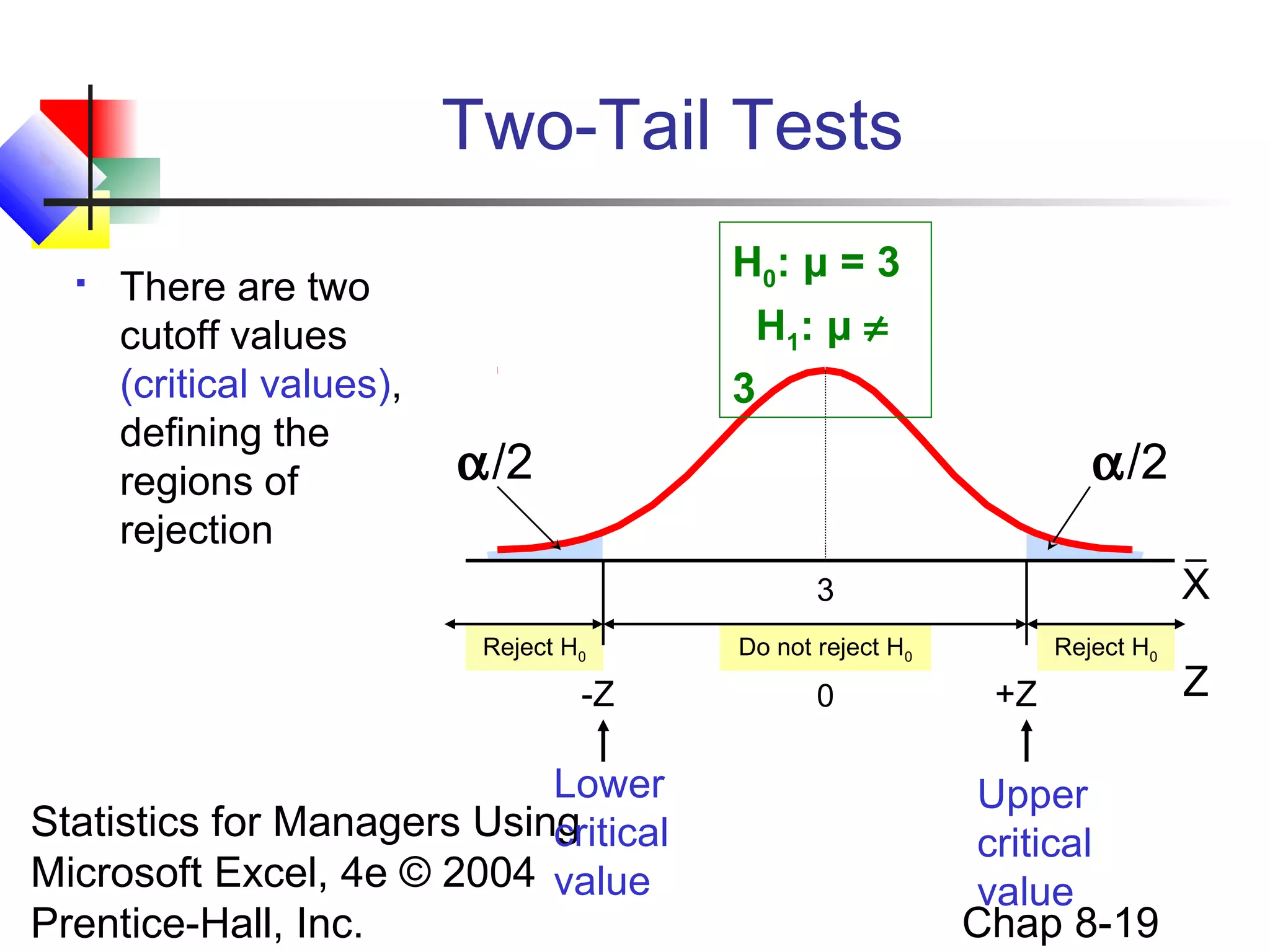
There are two
cutoff values
(critical values),
defining the
regions of
rejection

H0: μ = 3
H1 : μ ≠
3

α/2

α/2
X

3
Reject H0

-Z

Lower
Statistics for Managers Using
critical
Microsoft Excel, 4e © 2004 value
Prentice-Hall, Inc.

Do not reject H0

0

Reject H0

+Z

Upper
critical
value
Chap 8-19

Z
Review: 10 Steps in
Hypothesis Testing


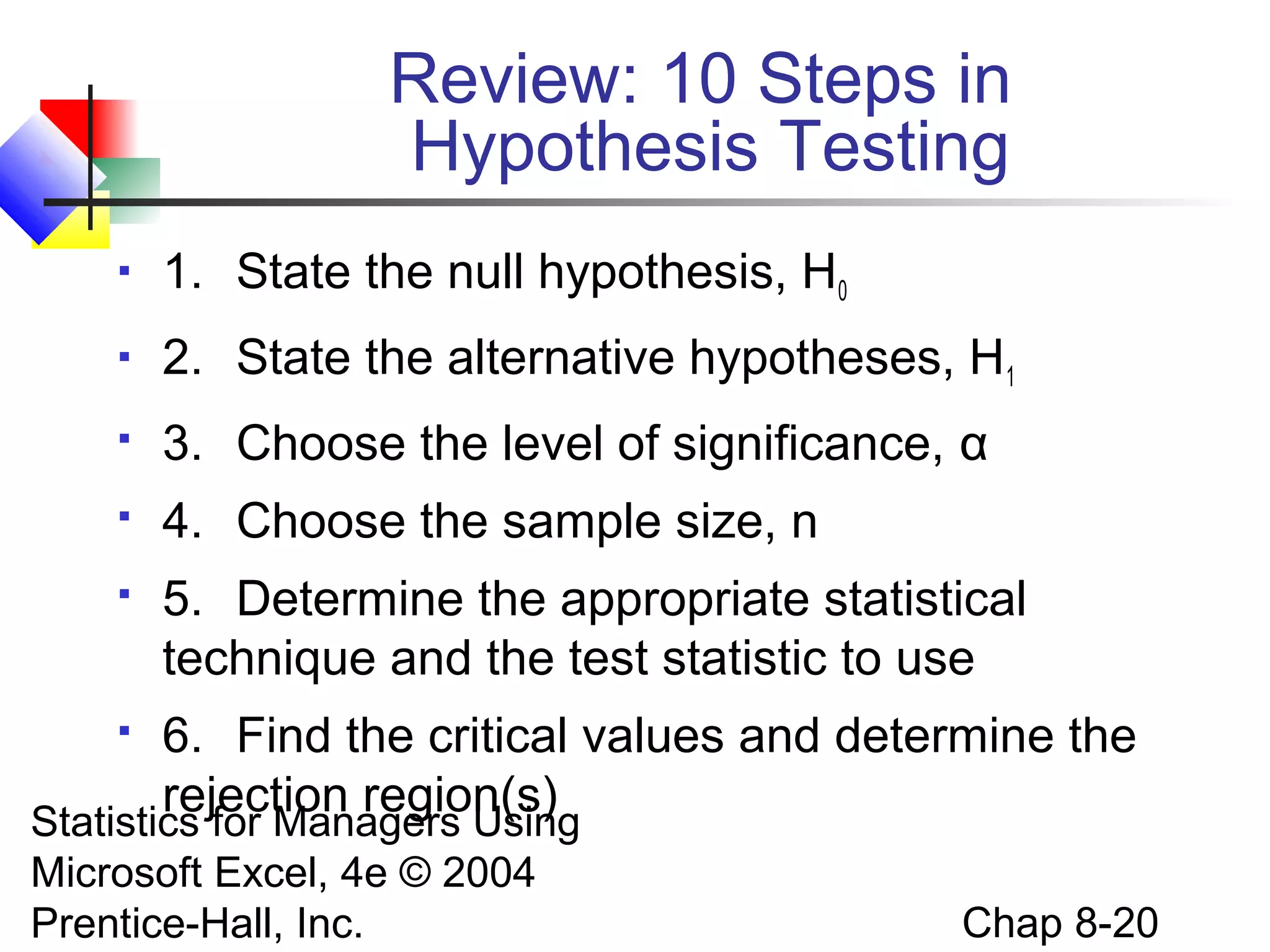
1. State the null hypothesis, H0



2. State the alternative hypotheses, H1



3. Choose the level of significance, α



4. Choose the sample size, n



5. Determine the appropriate statistical
technique and the test statistic to use

6. Find the critical values and determine the
rejection region(s)
Statistics for Managers Using


Microsoft Excel, 4e © 2004
Prentice-Hall, Inc.

Chap 8-20
Review: 10 Steps in
Hypothesis Testing


7. Collect data and compute the test statistic
from the sample result



8. Compare the test statistic to the critical
value to determine whether the test statistics
falls in the region of rejection



9. Make the statistical decision: Reject H0 if the
test statistic falls in the rejection region

10. Express the decision in the context of the
problem
Statistics for Managers Using


Microsoft Excel, 4e © 2004
Prentice-Hall, Inc.

Chap 8-21
Hypothesis Testing Example
Test the claim that the true mean # of
TV sets in US homes is equal to 3.
(Assume σ = 0.8)


1-2. State the appropriate null and alternative
hypotheses
 H: μ = 3
H1: μ ≠ 3 (This is a two tailed test)
0

Specify the desired level of significance
 Suppose that α = .05 is chosen for this test
 4.
Choose a sample size

StatisticsSuppose a sample of size n = 100 is selected
for Managers Using
Microsoft Excel, 4e © 2004
Chap 8-22
Prentice-Hall, Inc.


3.
Hypothesis Testing Example
(continued)






5.

Determine the appropriate technique
 σ is known so this is a Z test
6. Set up the critical values
 For α = .05 the critical Z values are ±1.96
7. Collect the data and compute the test statistic


Suppose the sample results are
n = 100, X = 2.84 (σ = 0.8 is assumed known)

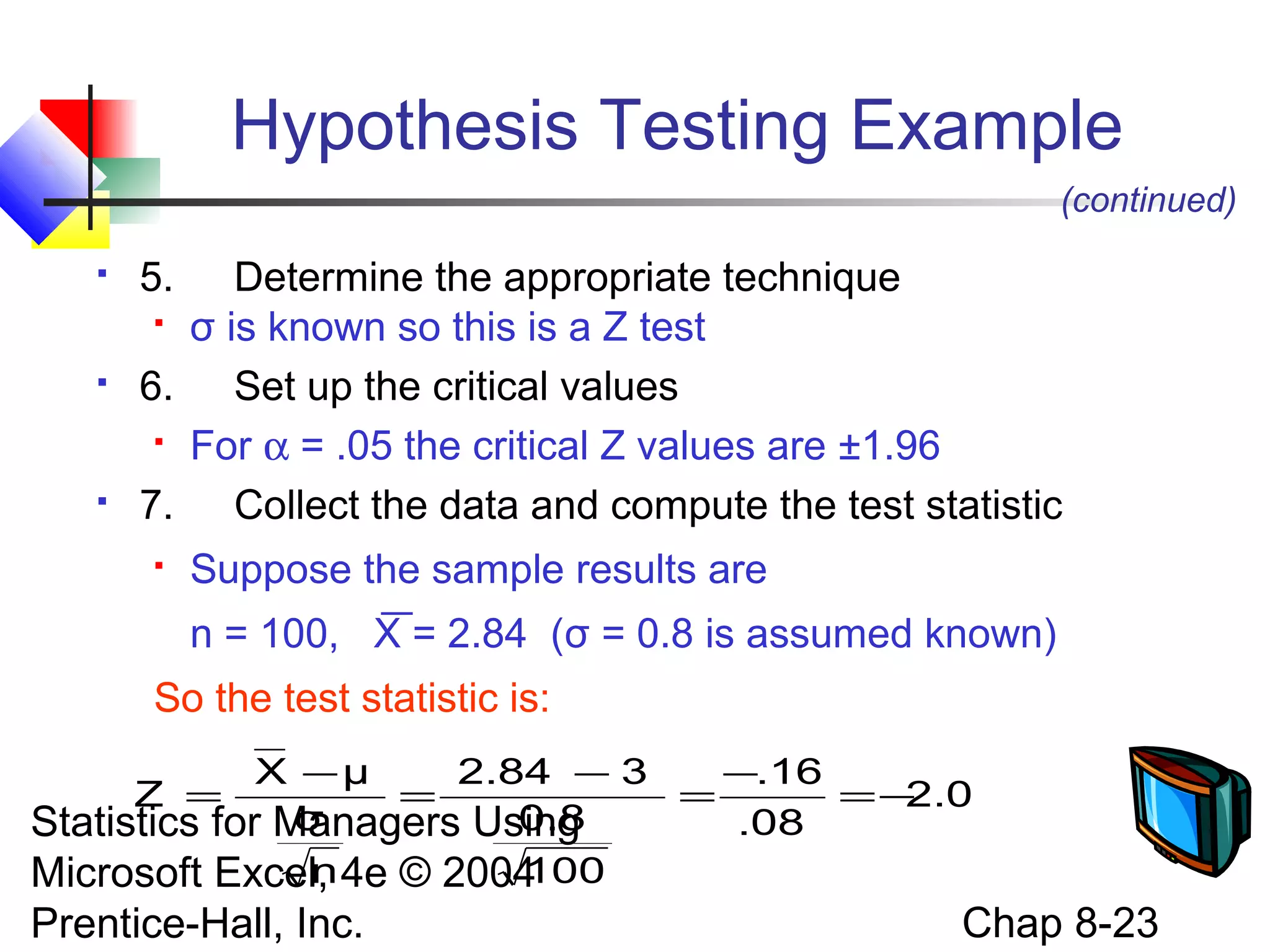
So the test statistic is:
X −μ
2.84 − 3
−.16
=
=
=−
2.0
σ
0.8
.08
Statistics for Managers Using
n
100
Microsoft Excel, 4e © 2004
Z =

Prentice-Hall, Inc.

Chap 8-23
Hypothesis Testing Example
(continued)


8. Is the test statistic in the rejection region?
α = .05/2

α = .05/2

Reject H
Do not reject H
Reject H
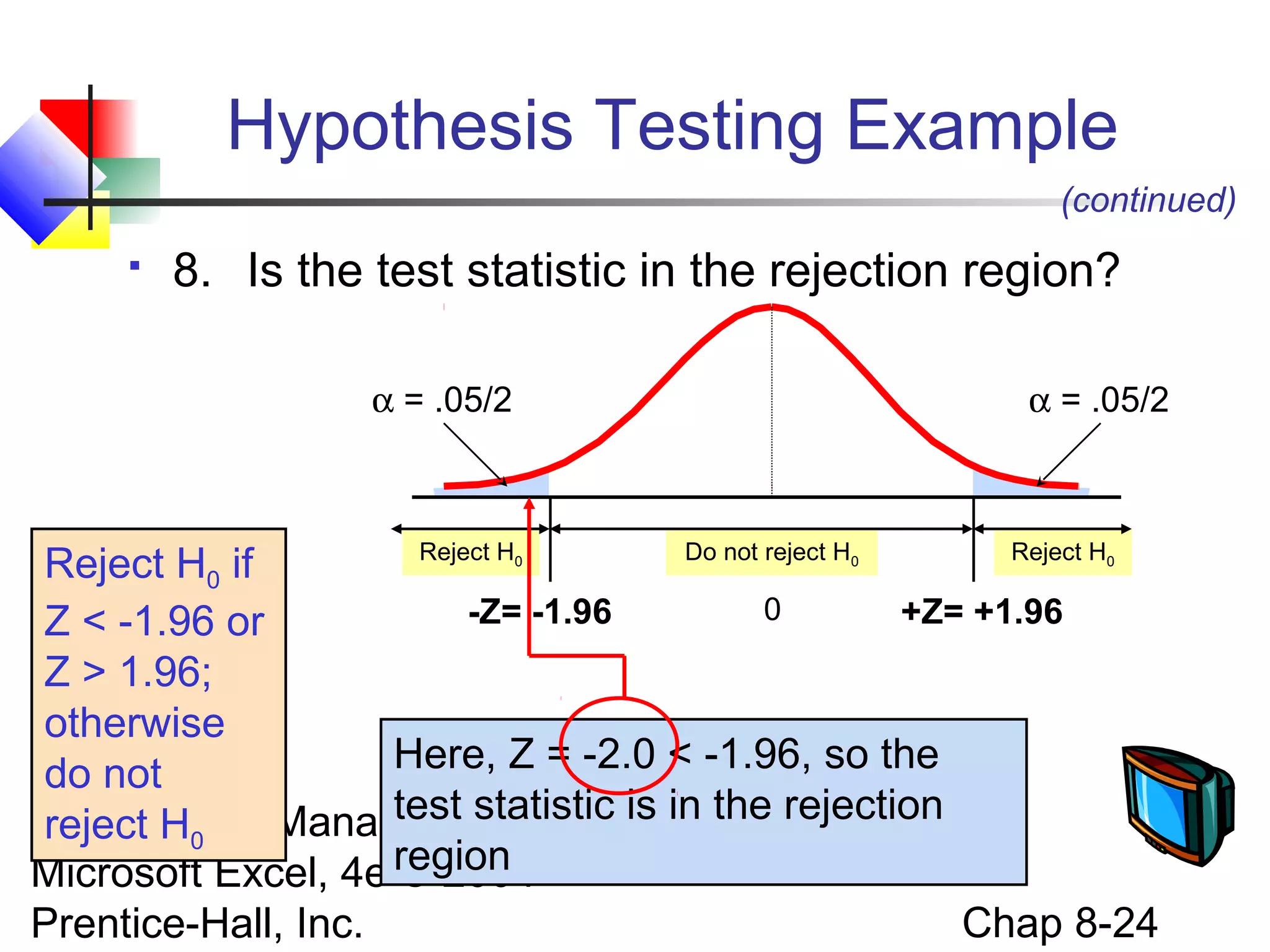
Reject H0 if
0
-Z= -1.96
+Z= +1.96
Z < -1.96 or
Z > 1.96;
otherwise
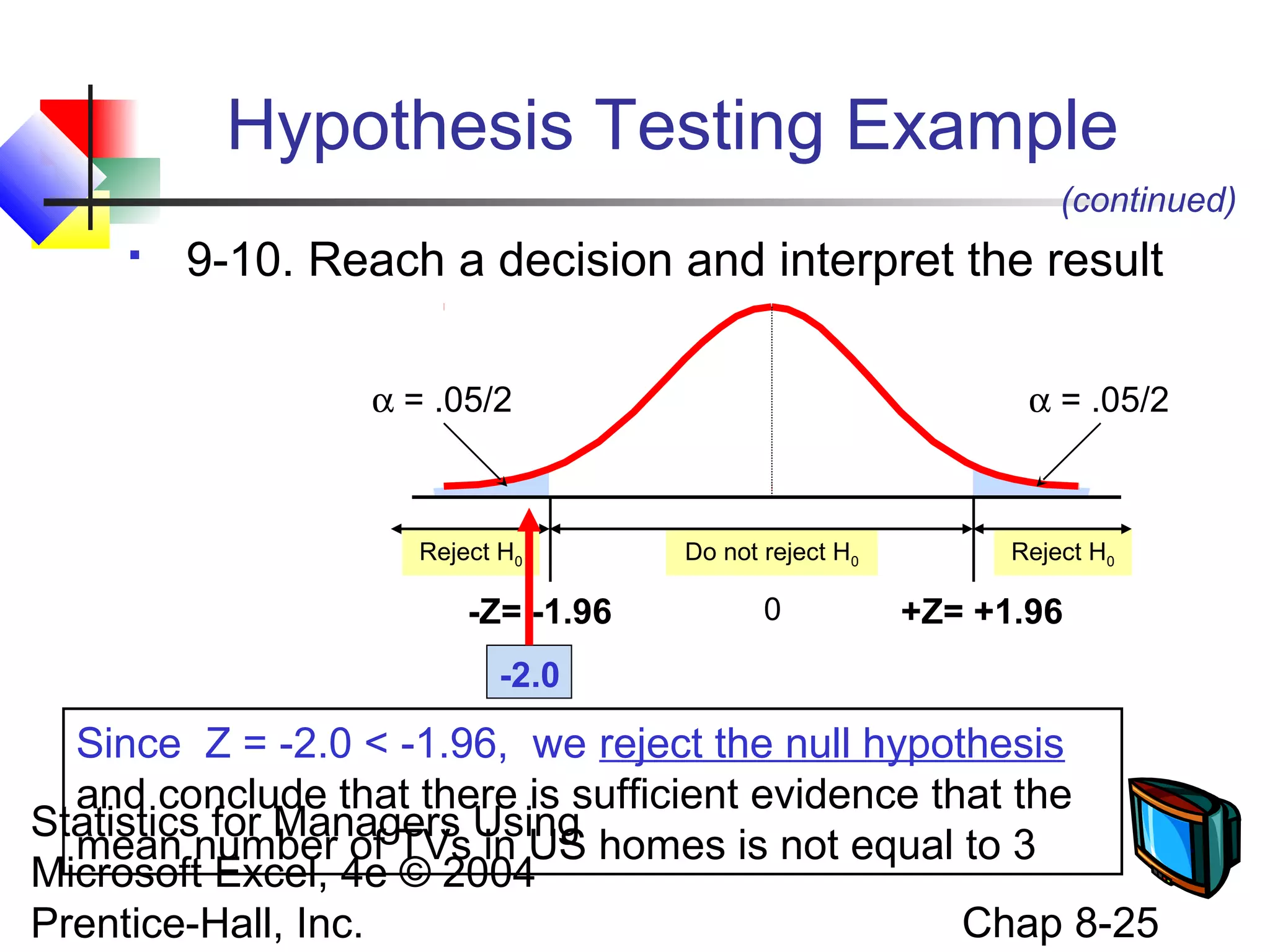
Here, Z = -2.0 < -1.96, so the
do not
test statistic
Statistics for Managers Using is in the rejection
reject H0
Microsoft Excel, 4e region
© 2004
Chap 8-24
Prentice-Hall, Inc.
0

0

0
Hypothesis Testing Example
(continued)


9-10. Reach a decision and interpret the result
α = .05/2

Reject H0

-Z= -1.96

α = .05/2

Do not reject H0

0

Reject H0

+Z= +1.96

-2.0

Since Z = -2.0 < -1.96, we reject the null hypothesis
and conclude that there is sufficient evidence that the
Statistics for Managers Using
mean number of TVs in US homes is not equal to 3
Microsoft Excel, 4e © 2004
Chap 8-25
Prentice-Hall, Inc.
p-Value Approach to Testing


p-value: Probability of obtaining a test
statistic more extreme ( ≤ or ≥ ) than
the observed sample value given H0 is
true


Also called observed level of significance

Smallest value of α for which H0 can be
Statistics for Managers Using
rejected


Microsoft Excel, 4e © 2004
Prentice-Hall, Inc.

Chap 8-26
p-Value Approach to Testing
(continued)


Convert Sample Statistic (e.g., X ) to Test
Statistic (e.g., Z statistic )



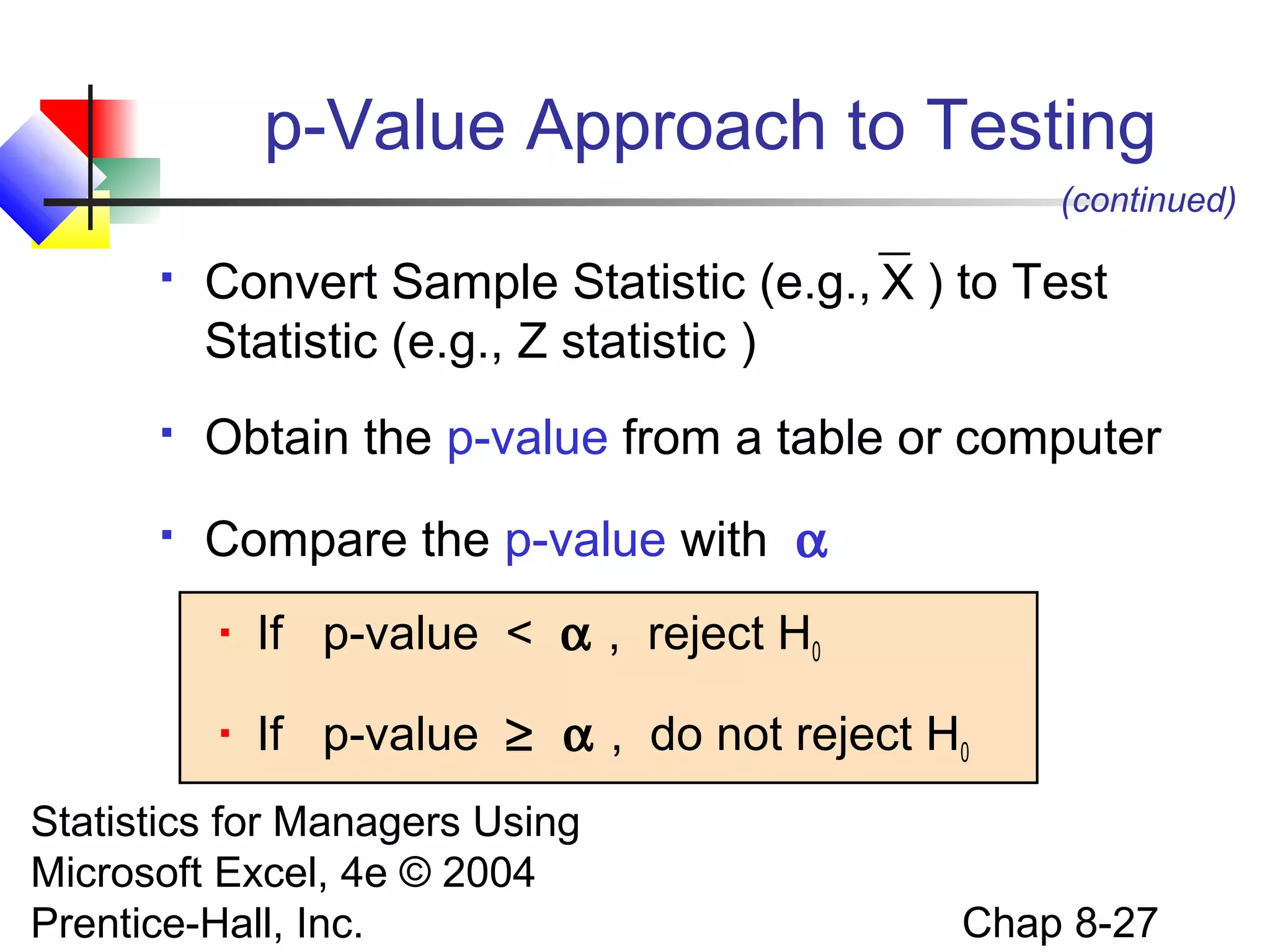
Obtain the p-value from a table or computer



Compare the p-value with α


If p-value < α , reject H0



If p-value ≥ α , do not reject H0

Statistics for Managers Using
Microsoft Excel, 4e © 2004
Prentice-Hall, Inc.

Chap 8-27
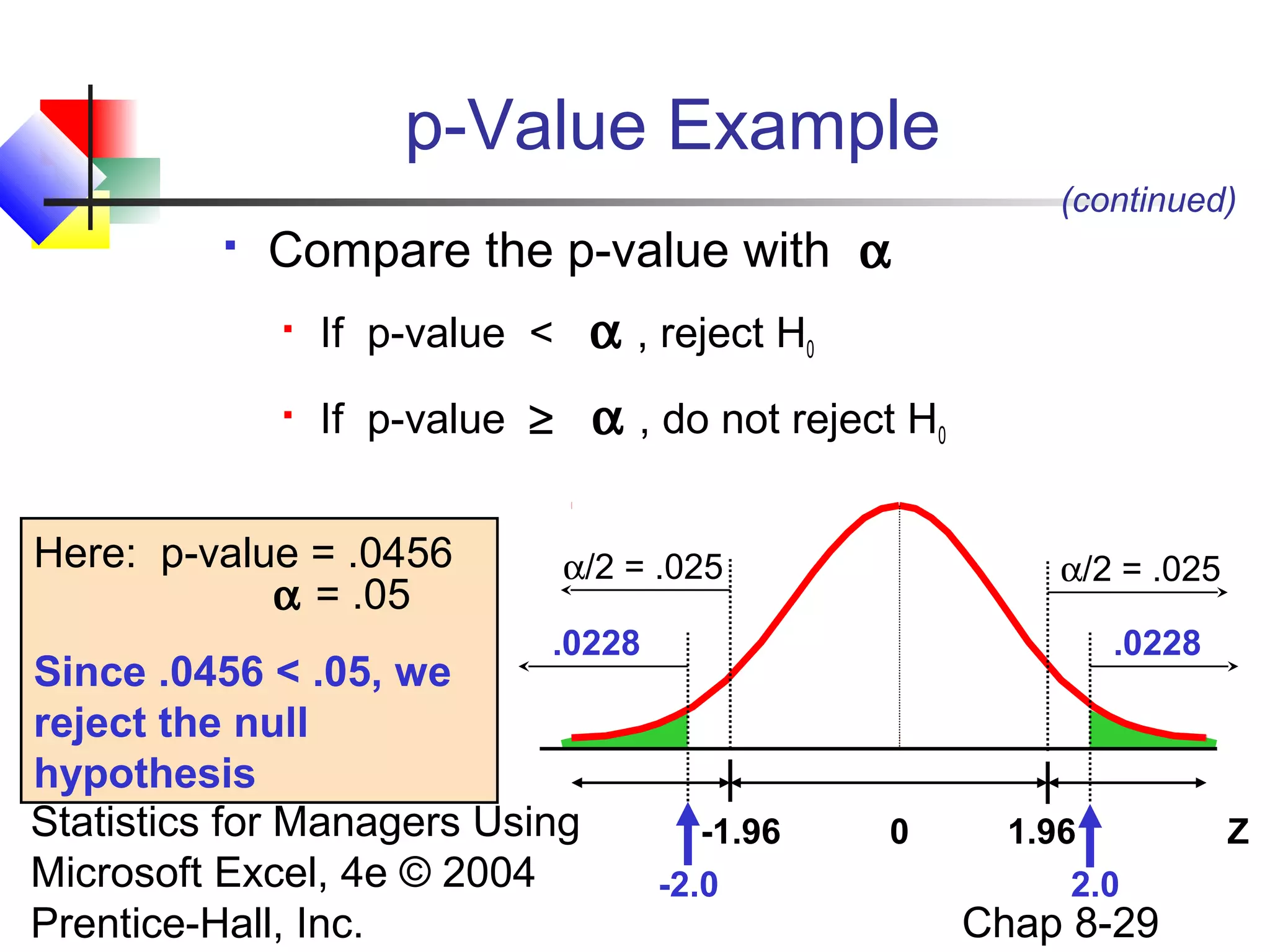
p-Value Example


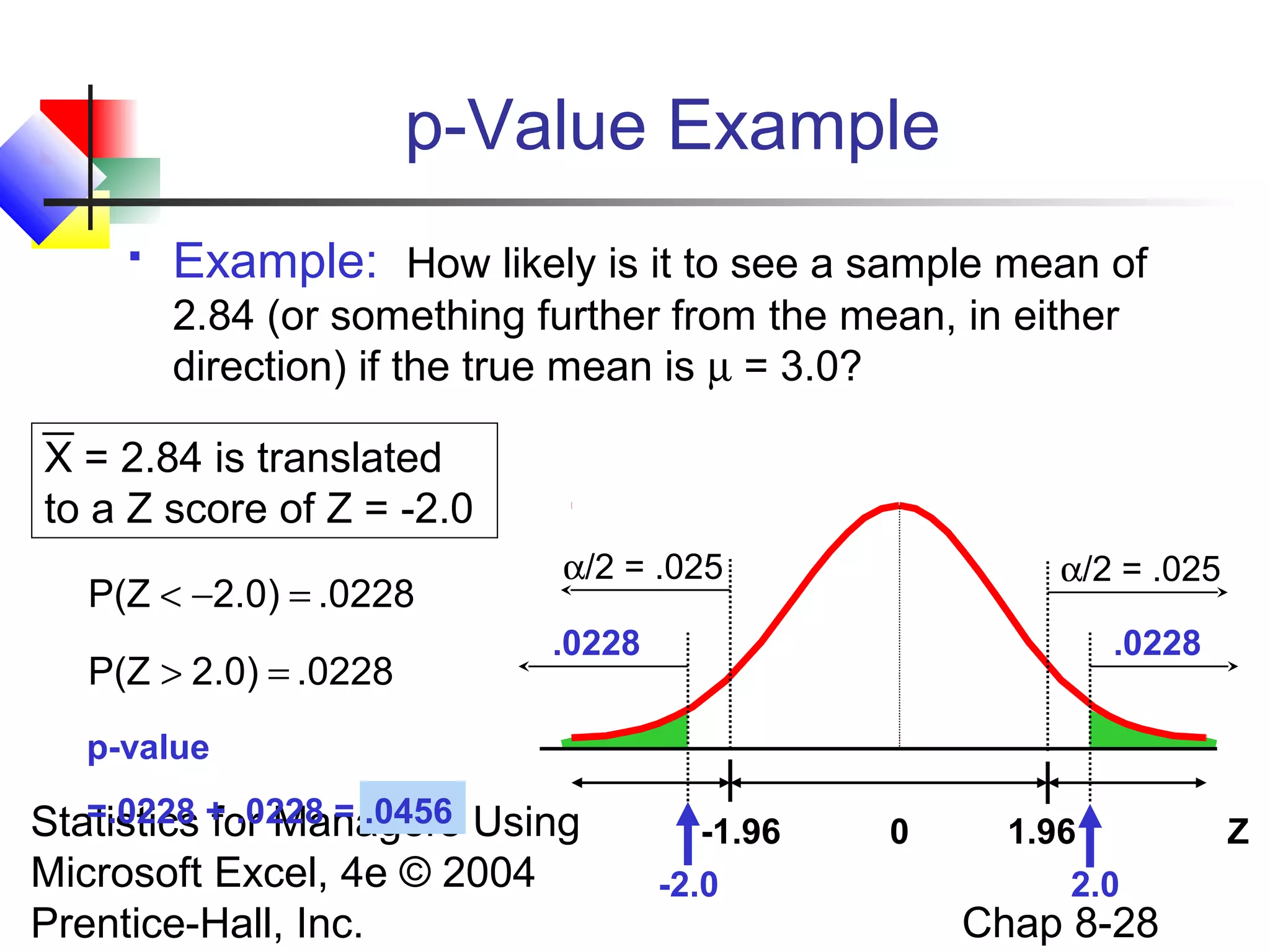
Example: How likely is it to see a sample mean of
2.84 (or something further from the mean, in either
direction) if the true mean is µ = 3.0?

X = 2.84 is translated
to a Z score of Z = -2.0
P(Z < −2.0) = .0228
P(Z > 2.0) = .0228

α/2 = .025

α/2 = .025

.0228

.0228

p-value
=.0228 for Managers
Statistics + .0228 = .0456 Using
Microsoft Excel, 4e © 2004
Prentice-Hall, Inc.

-1.96
-2.0

0

1.96
2.0

Chap 8-28

Z
p-Value Example


Compare the p-value with α


If p-value < α , reject H0



(continued)

If p-value ≥ α , do not reject H0

Here: p-value = .0456
α = .05

α/2 = .025

α/2 = .025

.0228

Since .0456 < .05, we
reject the null
hypothesis
Statistics for Managers Using
Microsoft Excel, 4e © 2004
Prentice-Hall, Inc.

.0228

-1.96
-2.0

0

1.96
2.0

Chap 8-29

Z
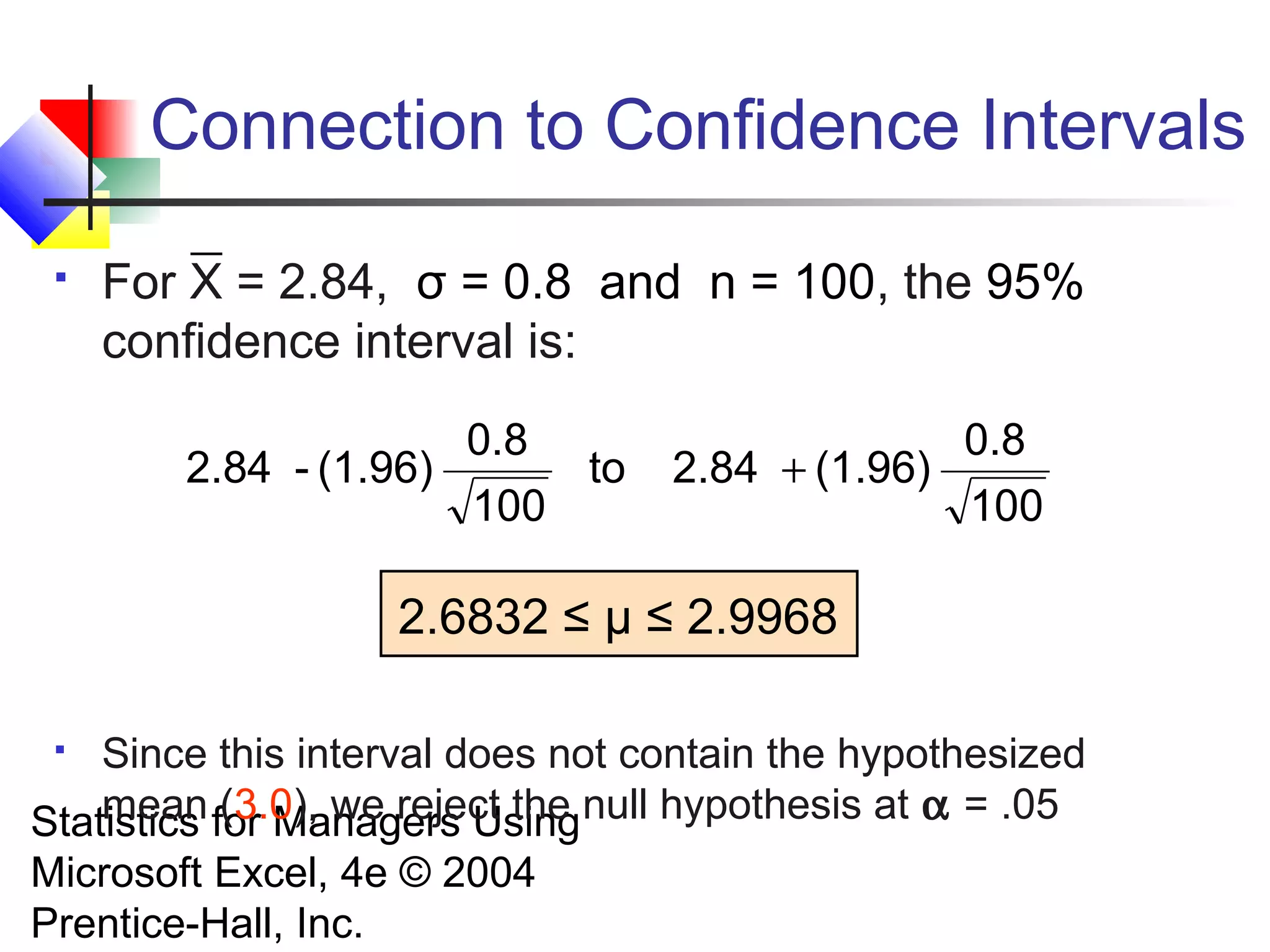
Connection to Confidence Intervals


For X = 2.84, σ = 0.8 and n = 100, the 95%
confidence interval is:
0.8
2.84 - (1.96)
to
100

0.8
2.84 + (1.96)
100

2.6832 ≤ μ ≤ 2.9968
Since this interval does not contain the hypothesized
mean (3.0), we reject the
Statistics for Managers Using null hypothesis at α = .05


Microsoft Excel, 4e © 2004
Prentice-Hall, Inc.
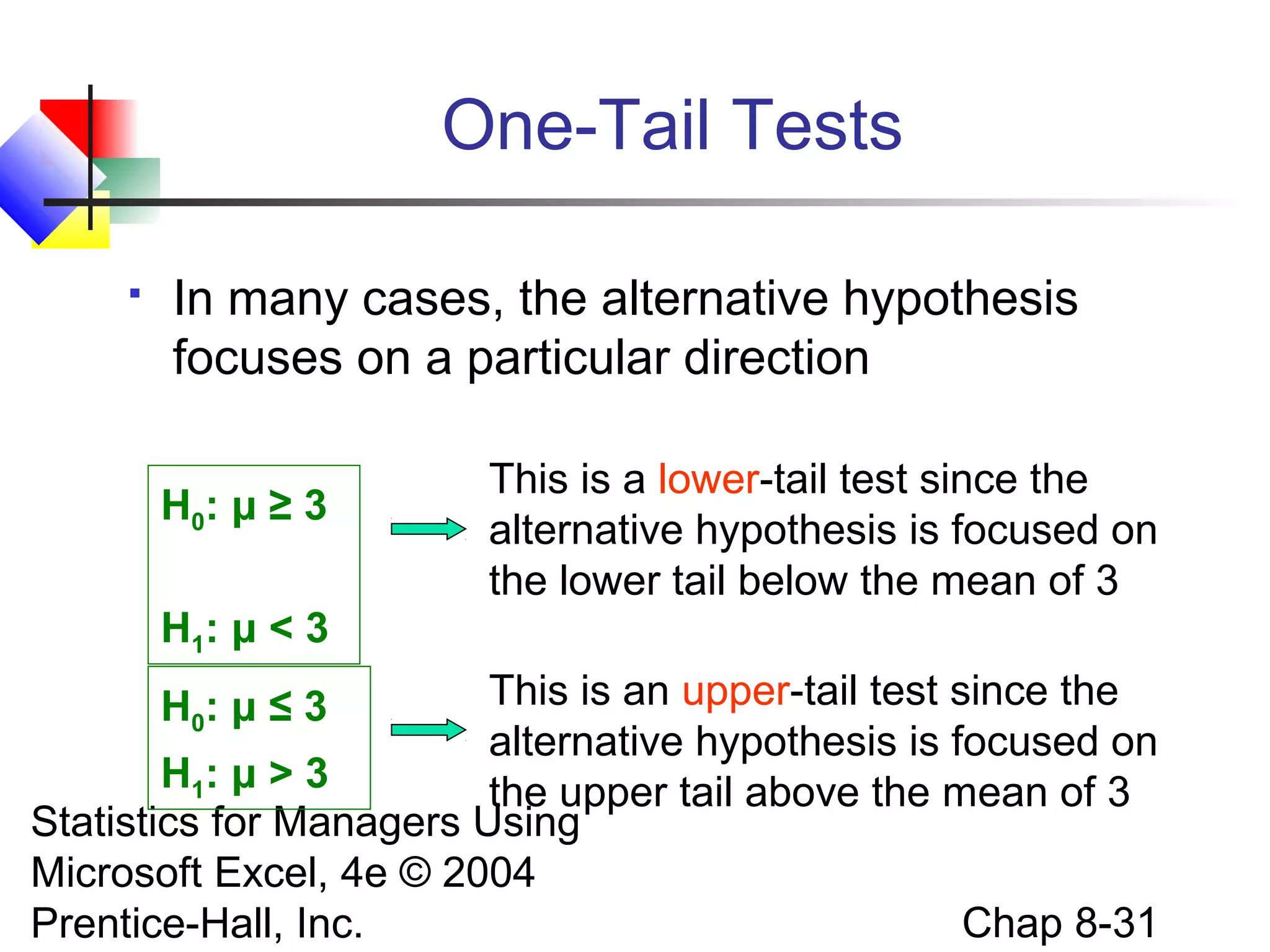
One-Tail Tests


In many cases, the alternative hypothesis
focuses on a particular direction
H0: μ ≥ 3

This is a lower-tail test since the
alternative hypothesis is focused on
the lower tail below the mean of 3

H1: μ < 3
This is an upper-tail test since the
alternative hypothesis is focused on
H1: μ > 3
the upper tail above the mean of 3
Statistics for Managers Using
Microsoft Excel, 4e © 2004
Chap 8-31
Prentice-Hall, Inc.
H0: μ ≤ 3
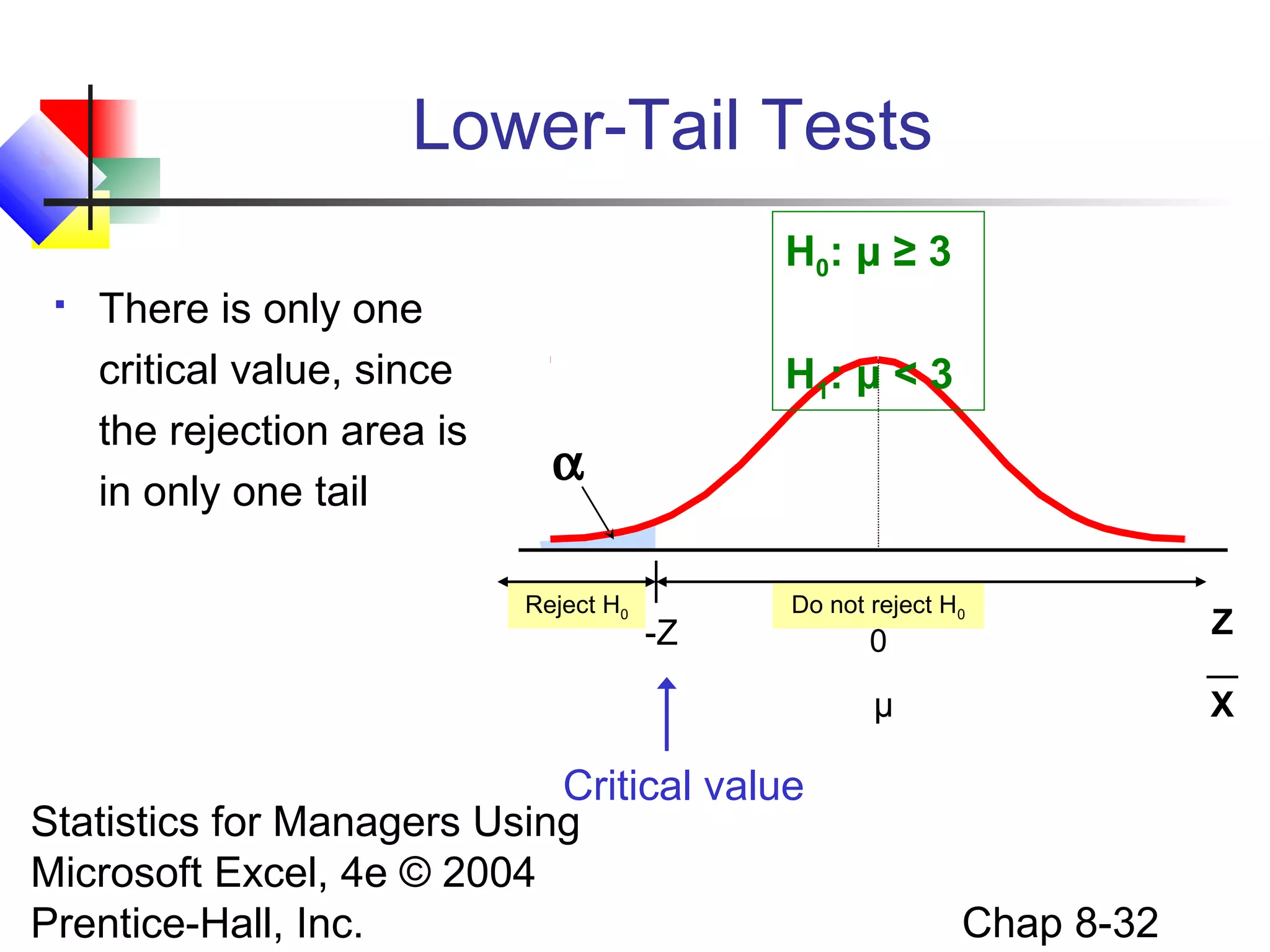
Lower-Tail Tests
H0: μ ≥ 3


There is only one
critical value, since
the rejection area is
in only one tail

H1: μ < 3

α
Reject H0

-Z

Do not reject H0

0

μ

Critical value
Statistics for Managers Using
Microsoft Excel, 4e © 2004
Prentice-Hall, Inc.

Z
X

Chap 8-32
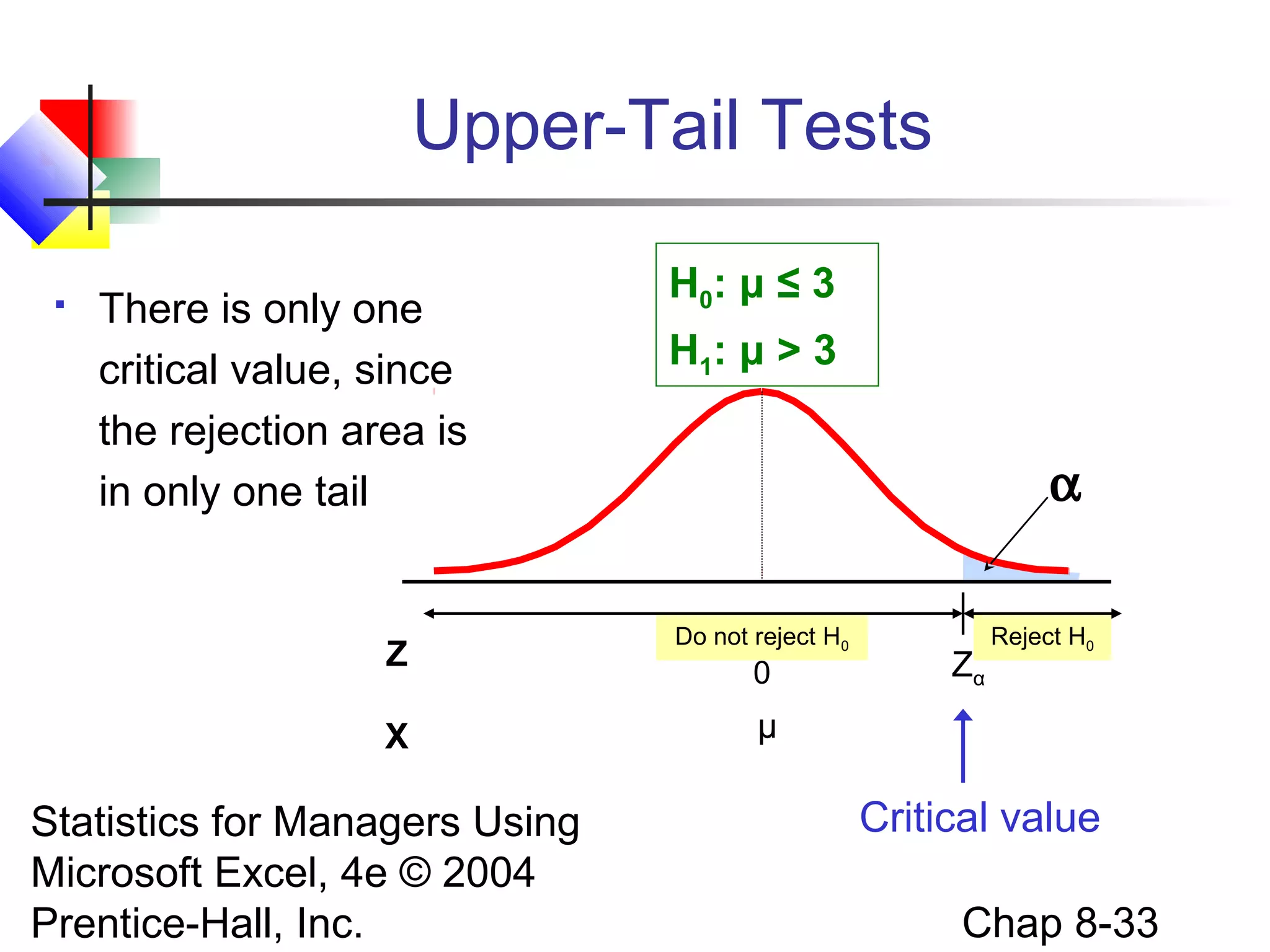
Upper-Tail Tests


There is only one
critical value, since
the rejection area is
in only one tail

H0: μ ≤ 3
H1: μ > 3

α

Z

Do not reject H0

X

μ

Statistics for Managers Using
Microsoft Excel, 4e © 2004
Prentice-Hall, Inc.

0

Zα

Reject H0

Critical value
Chap 8-33
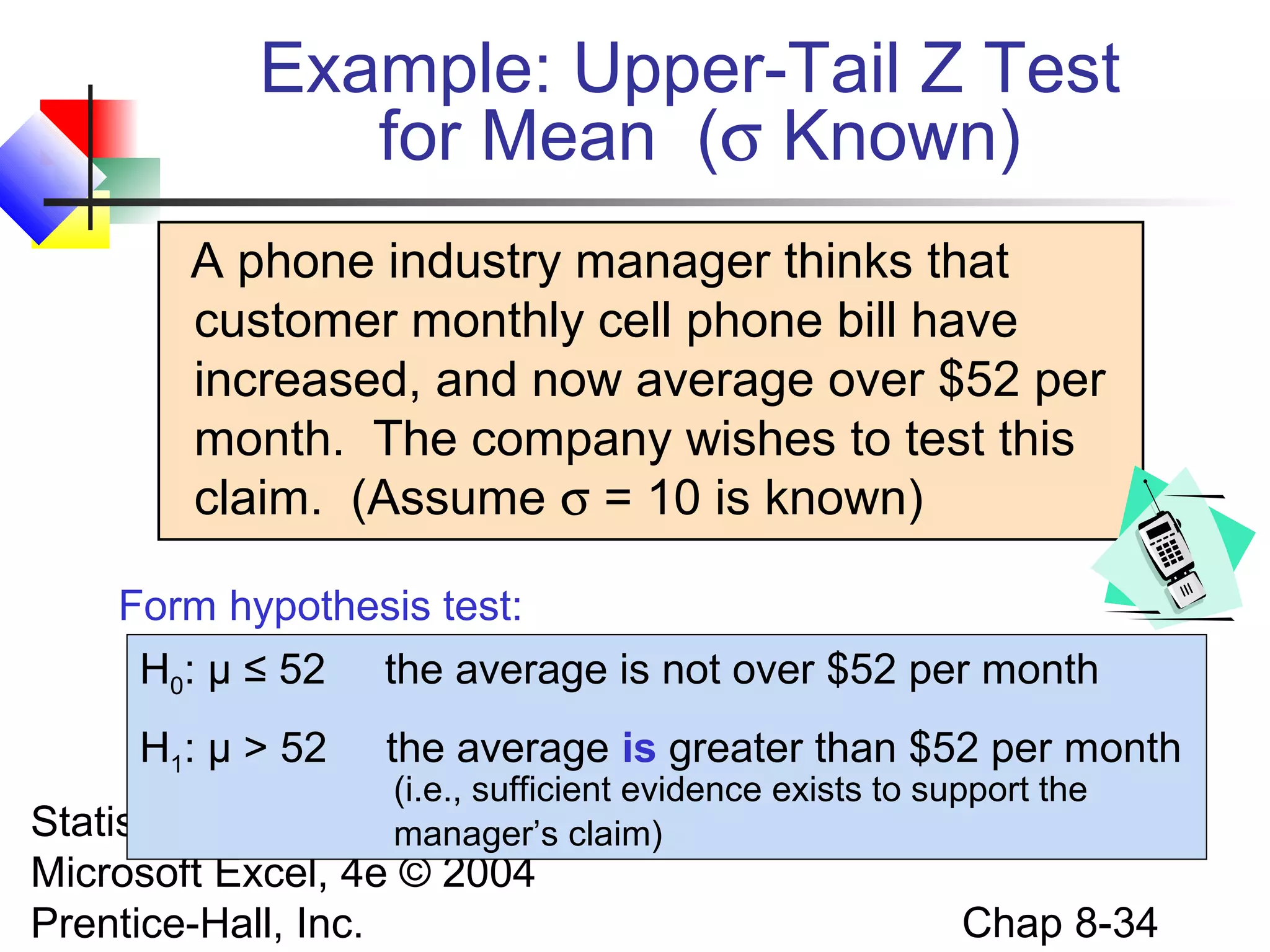
Example: Upper-Tail Z Test
for Mean (σ Known)
A phone industry manager thinks that
customer monthly cell phone bill have
increased, and now average over $52 per
month. The company wishes to test this
claim. (Assume σ = 10 is known)
Form hypothesis test:
H0: μ ≤ 52 the average is not over $52 per month
H1: μ > 52

the average is greater than $52 per month

(i.e., sufficient evidence exists to support the
Managers Using
manager’s claim)

Statistics for
Microsoft Excel, 4e © 2004
Prentice-Hall, Inc.

Chap 8-34
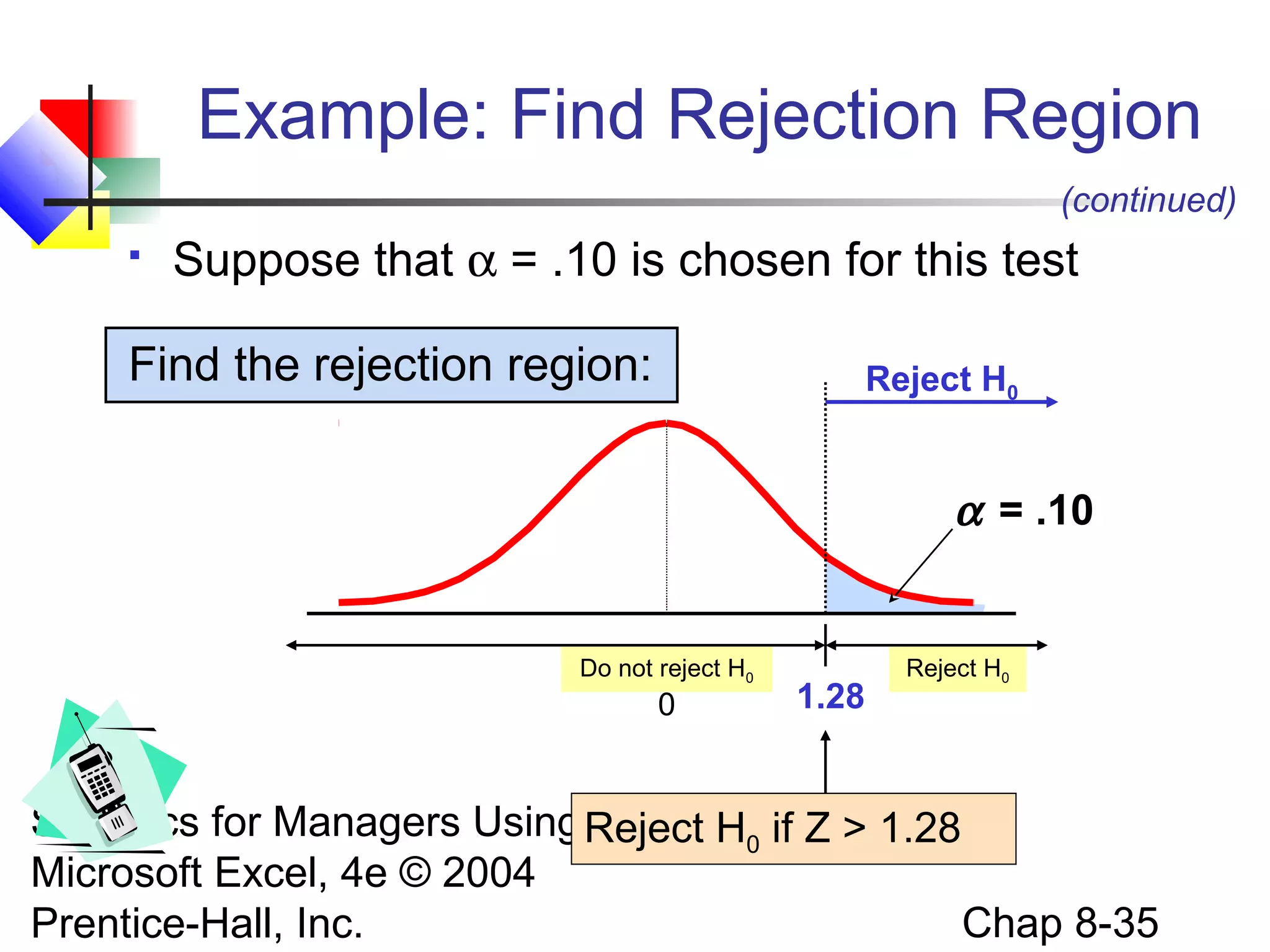
Example: Find Rejection Region
(continued)


Suppose that α = .10 is chosen for this test

Find the rejection region:

Reject H0

α = .10

Do not reject H0

0

1.28

Reject H0

Statistics for Managers Using Reject H0 if Z > 1.28
Microsoft Excel, 4e © 2004
Chap 8-35
Prentice-Hall, Inc.
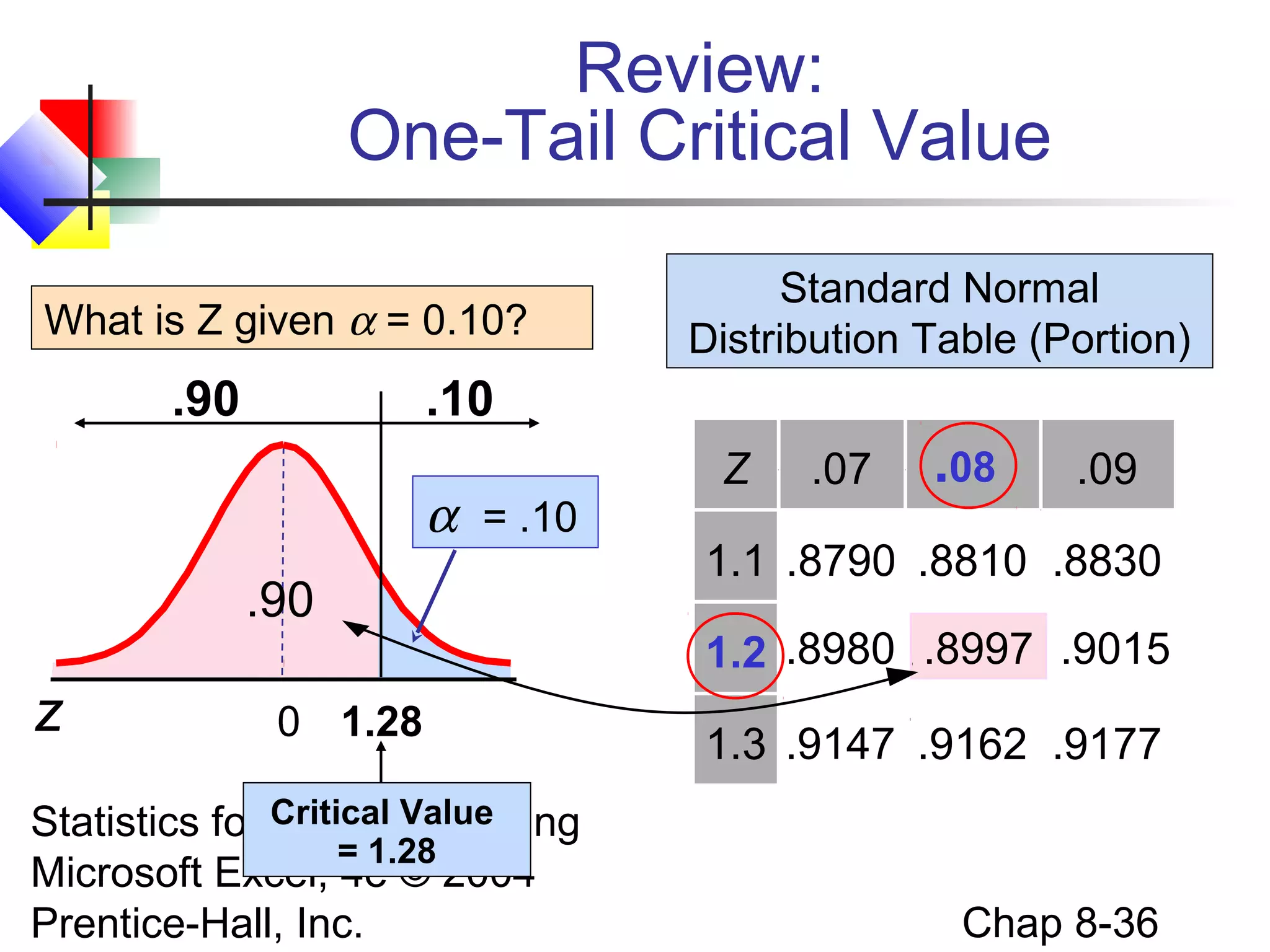
Review:
One-Tail Critical Value
What is Z given α = 0.10?

.90

.10

α = .10
.90

z

Standard Normal
Distribution Table (Portion)

0 1.28

Statistics for Critical Value
Managers Using
= 1.28
Microsoft Excel, 4e © 2004
Prentice-Hall, Inc.

Z

.07

.08

.09

1.1 .8790 .8810 .8830
1.2 .8980 .8997 .9015
1.3 .9147 .9162 .9177

Chap 8-36
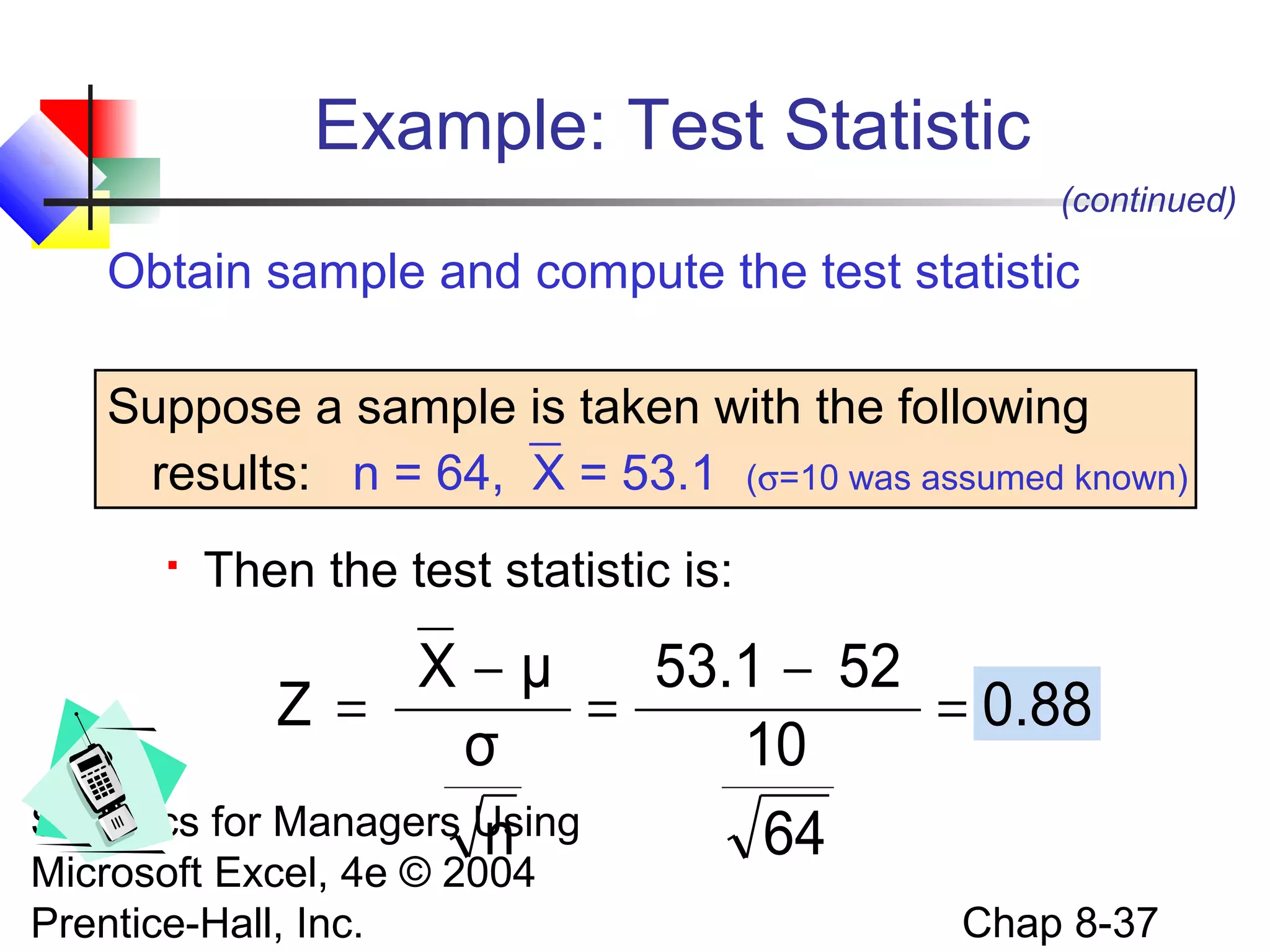
Example: Test Statistic
(continued)

Obtain sample and compute the test statistic
Suppose a sample is taken with the following
results: n = 64, X = 53.1 (σ=10 was assumed known)


Then the test statistic is:

X−μ
53.1 − 52
Z =
=
= 0.88
σ
10
Statistics for Managers Using
n
64
Microsoft Excel, 4e © 2004
Prentice-Hall, Inc.

Chap 8-37
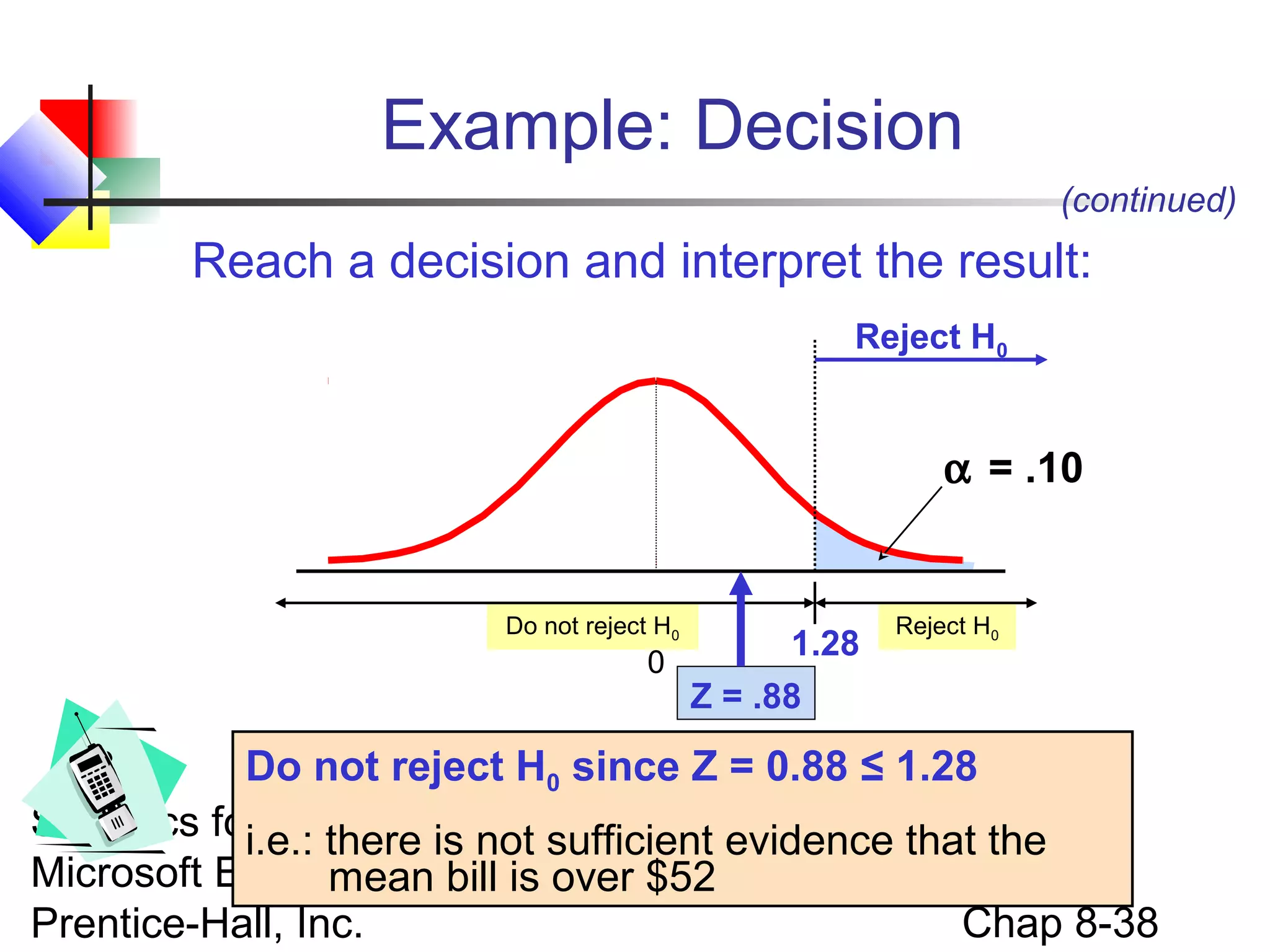
Example: Decision
(continued)

Reach a decision and interpret the result:
Reject H0

α = .10

Do not reject H0

1.28
0
Z = .88

Reject H0

Do not reject H0 since Z = 0.88 ≤ 1.28
Statistics for Managers Using
i.e.: there is not sufficient evidence that the
Microsoft Excel,mean 2004 over $52
4e © bill is
Chap 8-38
Prentice-Hall, Inc.
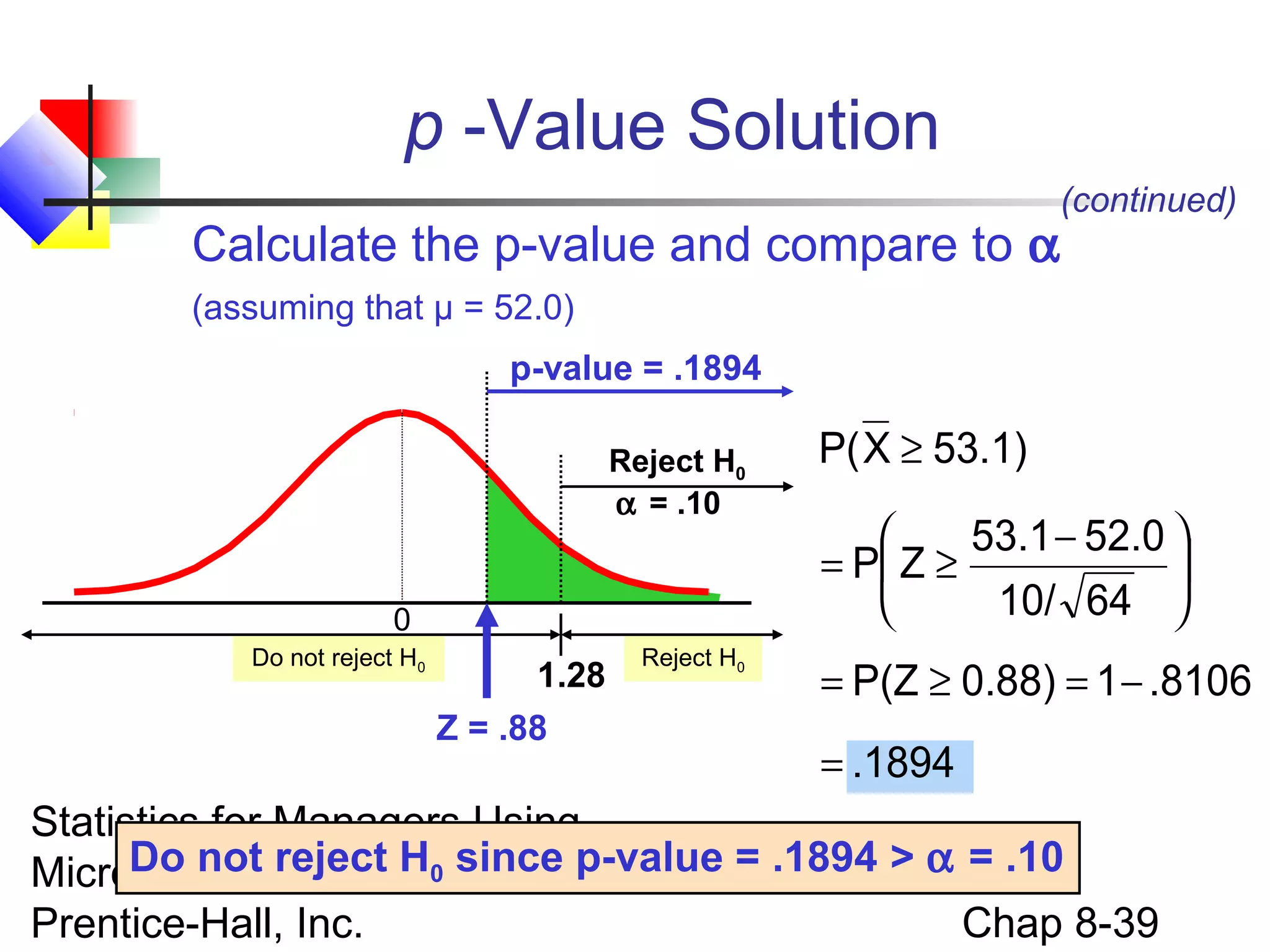
p -Value Solution
Calculate the p-value and compare to α

(continued)

(assuming that μ = 52.0)
p-value = .1894
Reject H0
α = .10
0
Do not reject H0

1.28
Z = .88

Reject H0

P( X ≥ 53.1)
53.1 − 52.0 

= P Z ≥

10/ 64 

= P(Z ≥ 0.88) = 1 − .8106
= .1894

Statistics for Managers Using
Do Excel, 4e © since
Microsoftnot reject H02004 p-value = .1894 > α = .10
Chap 8-39
Prentice-Hall, Inc.
Z Test of Hypothesis for the
Mean (σ Known)


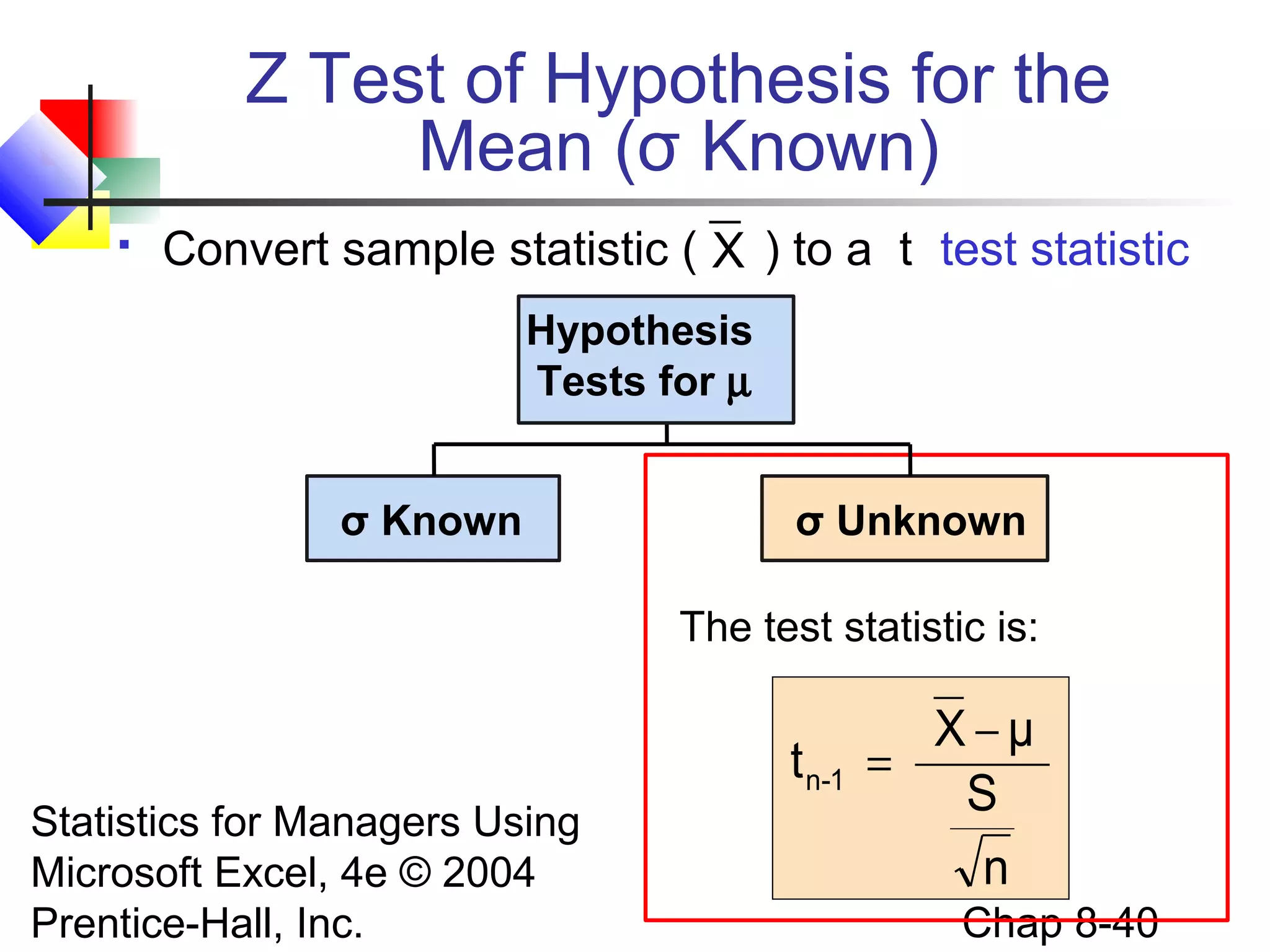
Convert sample statistic ( X ) to a t test statistic
Hypothesis
Tests for µ
σ Known

σ Unknown
The test statistic is:

t n-1
Statistics for Managers Using
Microsoft Excel, 4e © 2004
Prentice-Hall, Inc.

X−μ
=
S
n
Chap 8-40
Example: Two-Tail Test
(σ Unknown)
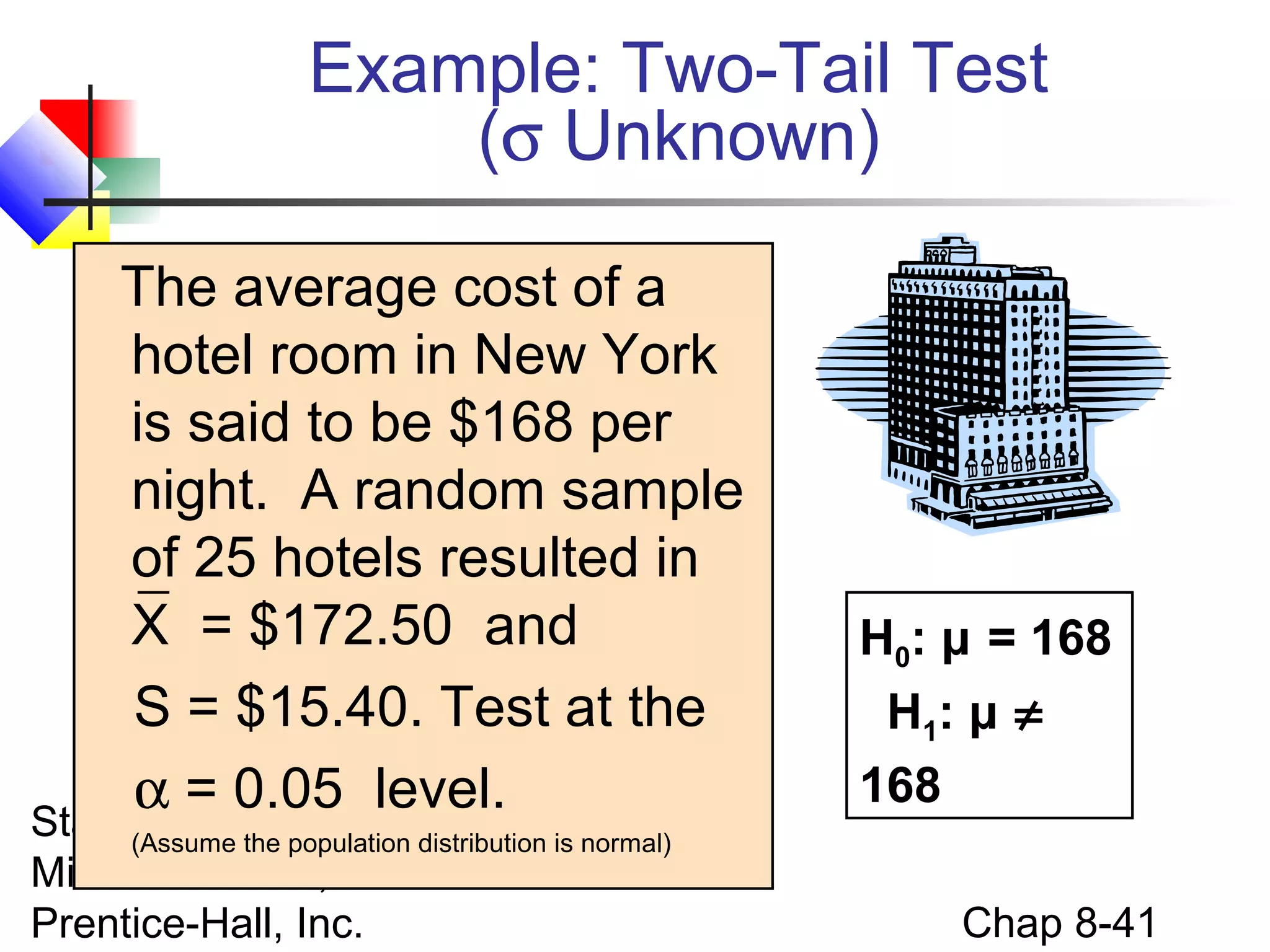
The average cost of a
hotel room in New York
is said to be $168 per
night. A random sample
of 25 hotels resulted in
X = $172.50 and
S = $15.40. Test at the
α = 0.05 level.

Statistics for Managers Usingnormal)
(Assume the population distribution is
Microsoft Excel, 4e © 2004
Prentice-Hall, Inc.

H0: μ = 168
H1: μ ≠
168
Chap 8-41
Example Solution:
Two-Tail Test







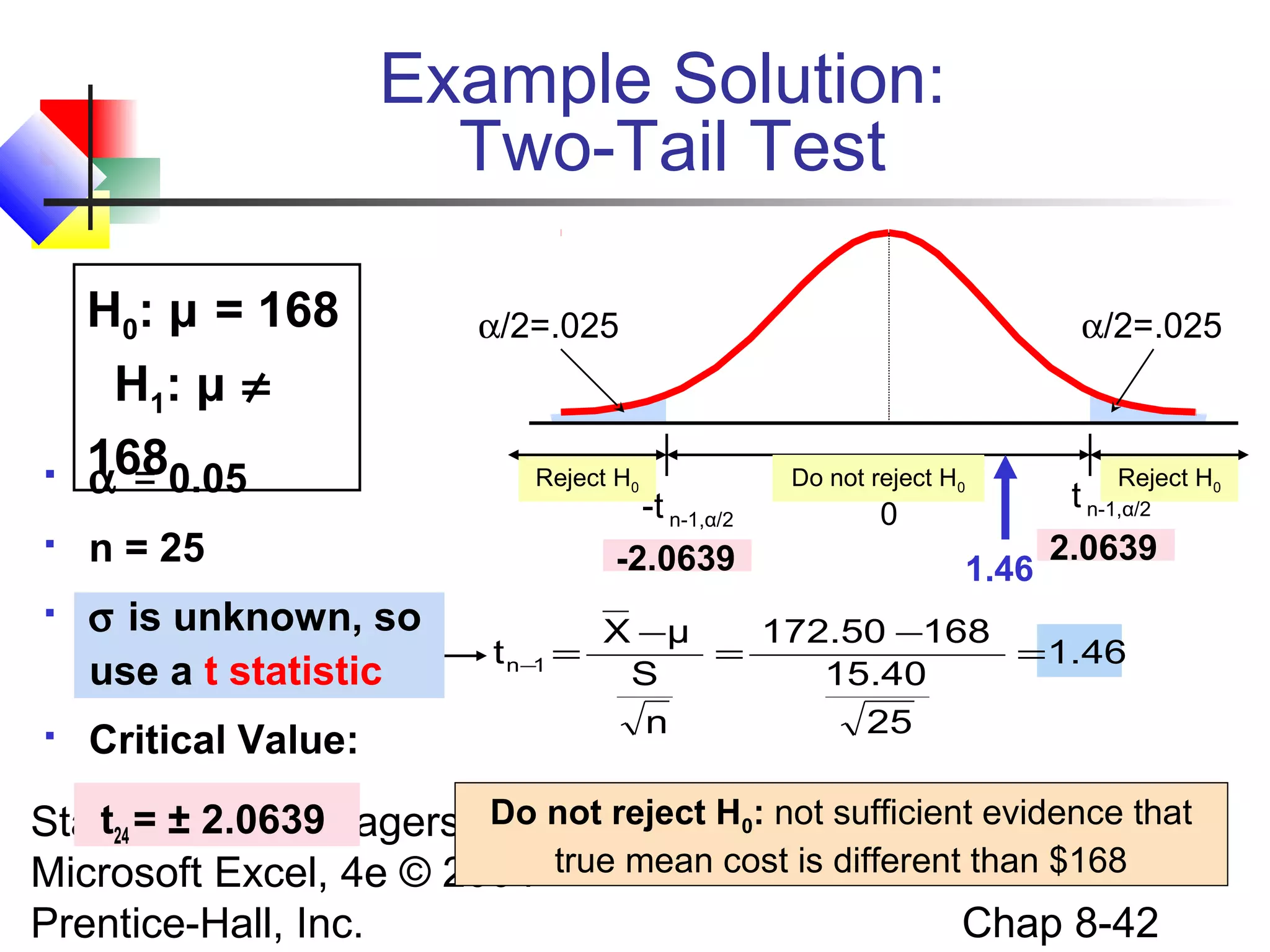
H0: μ = 168
H1: μ ≠
1680.05
α =

α/2=.025

Reject H0

-t n-1,α/2
-2.0639

n = 25
σ is unknown, so
use a t statistic
Critical Value:

t n−1 =

α/2=.025

Do not reject H0

0

1.46

Reject H0

t n-1,α/2
2.0639

X −μ
172.50 −168
=
= 1.46
S
15.40
n
25

Do not
t24 = ± for Managers Using reject H0: not sufficient evidence that
Statistics 2.0639
Microsoft Excel, 4e © 2004 true mean cost is different than $168
Chap 8-42
Prentice-Hall, Inc.
Connection to Confidence Intervals


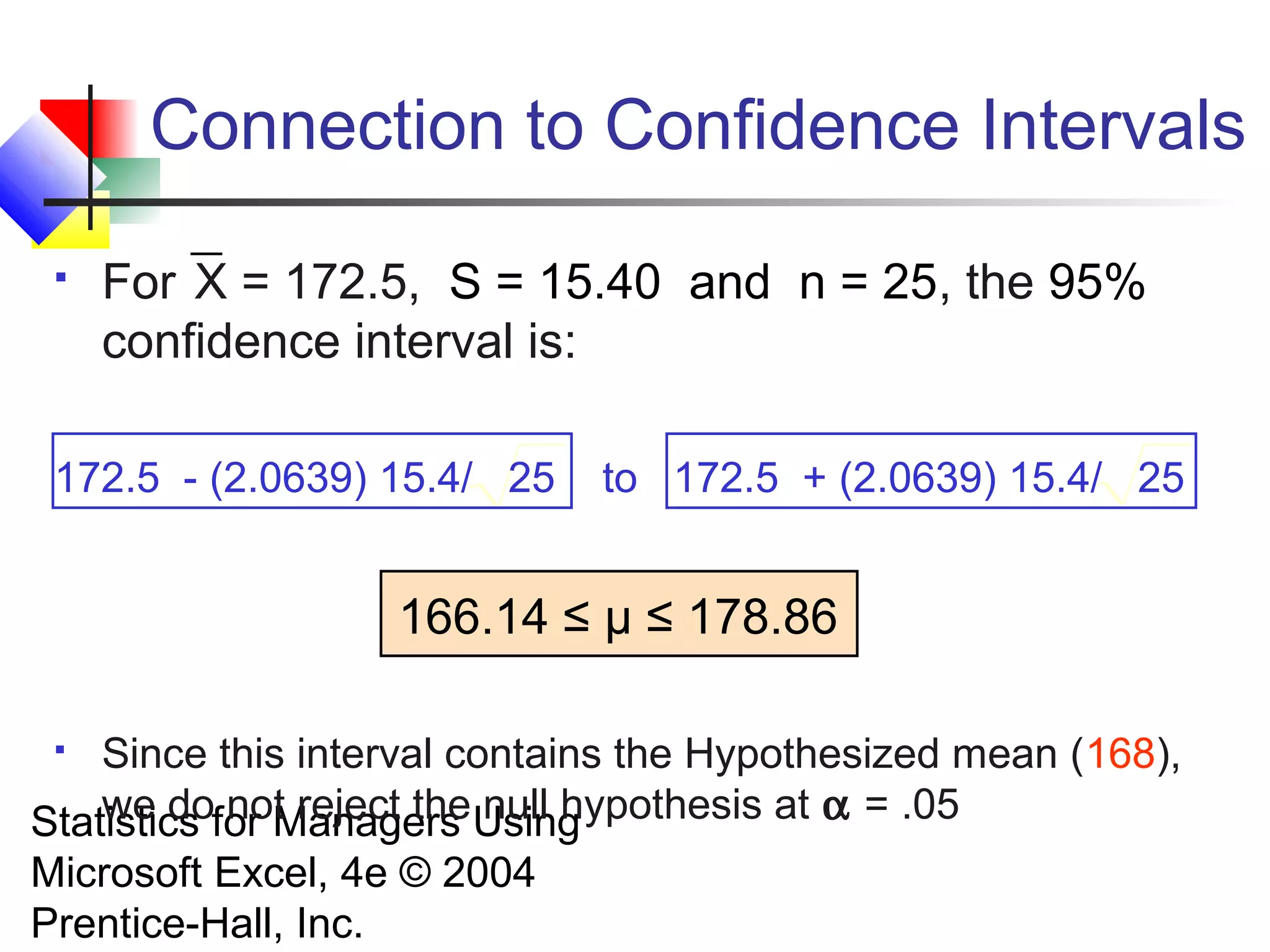
For X = 172.5, S = 15.40 and n = 25, the 95%
confidence interval is:

172.5 - (2.0639) 15.4/ 25

to 172.5 + (2.0639) 15.4/ 25

166.14 ≤ μ ≤ 178.86
Since this interval contains the Hypothesized mean (168),
we do not reject the null hypothesis at α = .05
Statistics for Managers Using


Microsoft Excel, 4e © 2004
Prentice-Hall, Inc.
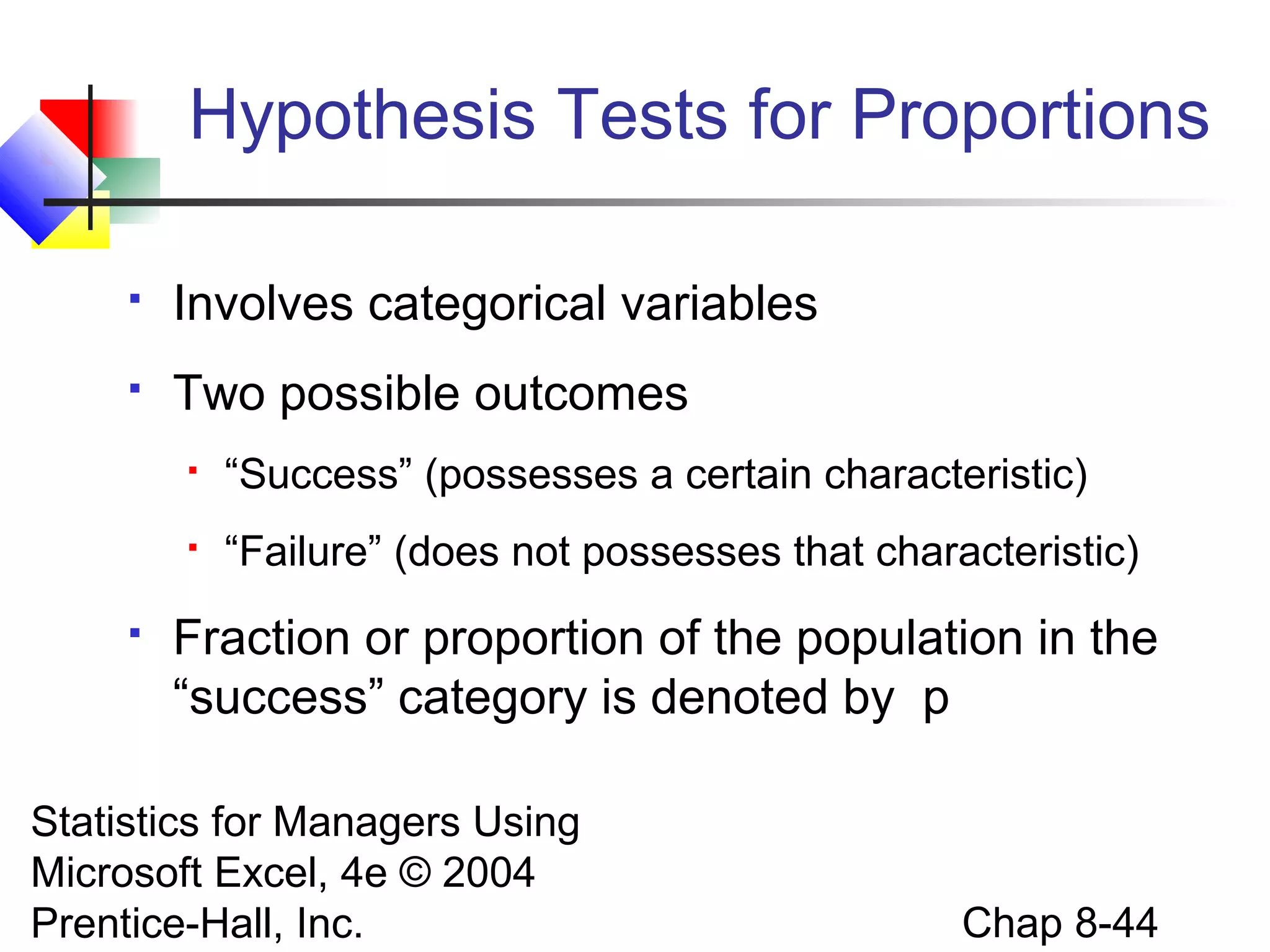
Hypothesis Tests for Proportions


Involves categorical variables



Two possible outcomes





“Success” (possesses a certain characteristic)
“Failure” (does not possesses that characteristic)

Fraction or proportion of the population in the
“success” category is denoted by p

Statistics for Managers Using
Microsoft Excel, 4e © 2004
Prentice-Hall, Inc.

Chap 8-44
Proportions
(continued)


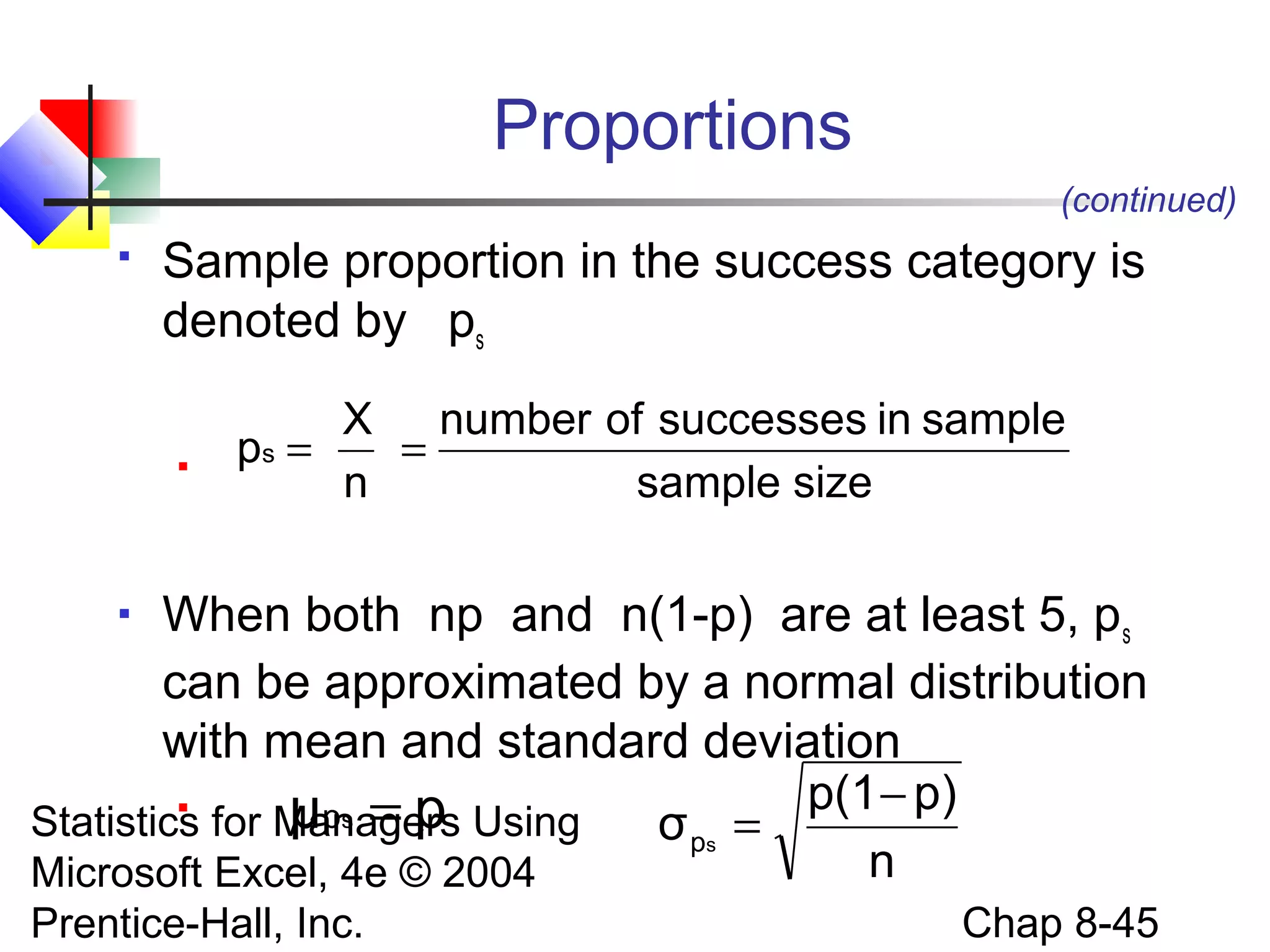
Sample proportion in the success category is
denoted by ps


X number of successes in sample
ps =
=
n
sample size

When both np and n(1-p) are at least 5, ps
can be approximated by a normal distribution
with mean and standard deviation

μps = p Using σ ps = p(1 − p)
Statistics for Managers
n
Microsoft Excel, 4e © 2004


Prentice-Hall, Inc.

Chap 8-45
Hypothesis Tests for Proportions


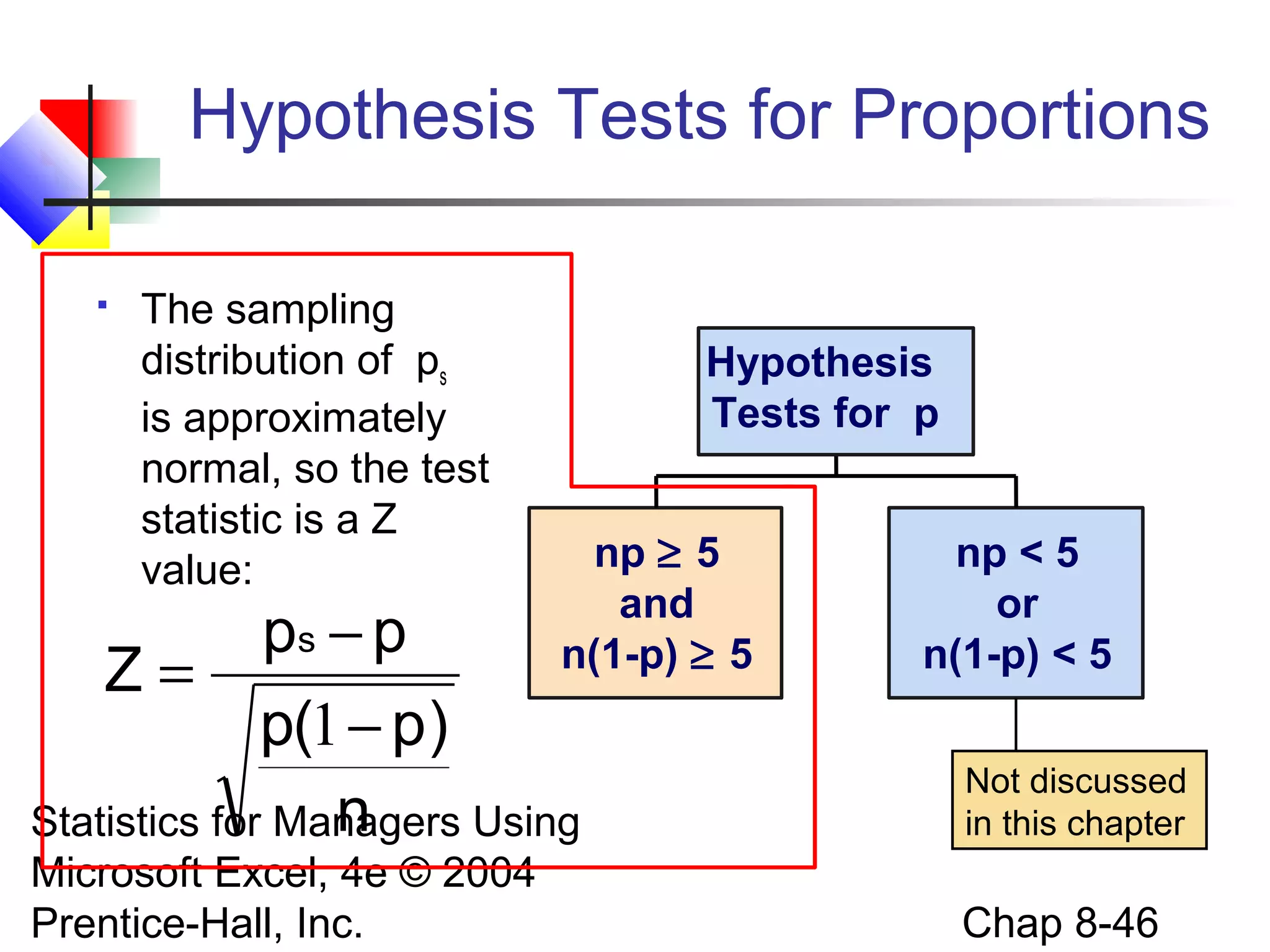
The sampling
distribution of ps
is approximately
normal, so the test
statistic is a Z
value:

Hypothesis
Tests for p
np ≥ 5
and
n(1-p) ≥ 5

ps − p
Z=
p(1 − p)
n
Statistics for Managers Using
Microsoft Excel, 4e © 2004
Prentice-Hall, Inc.

np < 5
or
n(1-p) < 5
Not discussed
in this chapter

Chap 8-46
Z Test for Proportion
in Terms of Number of Successes


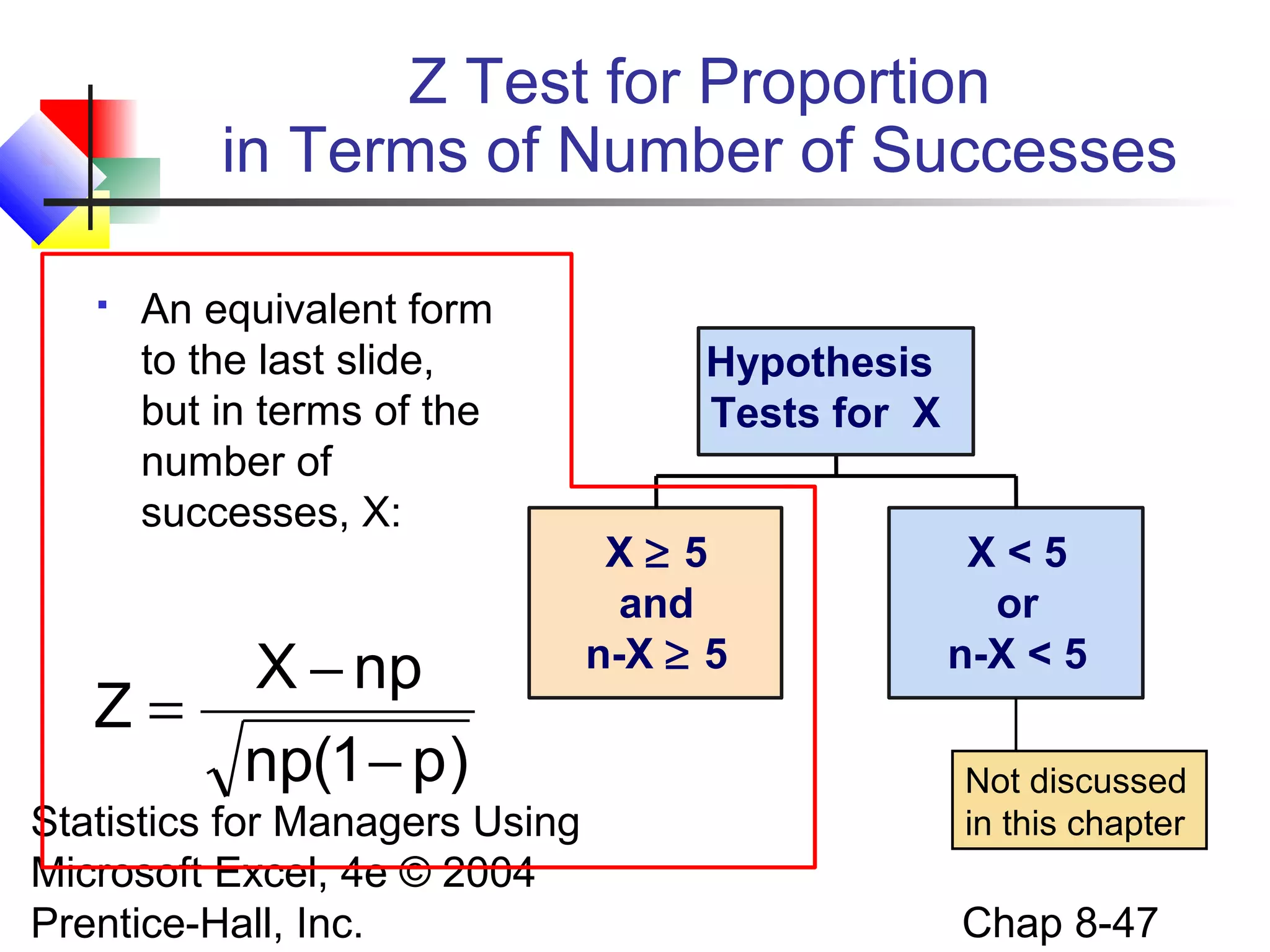
An equivalent form
to the last slide,
but in terms of the
number of
successes, X:

X − np
Z=
np(1 − p)

Statistics for Managers Using
Microsoft Excel, 4e © 2004
Prentice-Hall, Inc.

Hypothesis
Tests for X
X≥5
and
n-X ≥ 5

X<5
or
n-X < 5
Not discussed
in this chapter

Chap 8-47
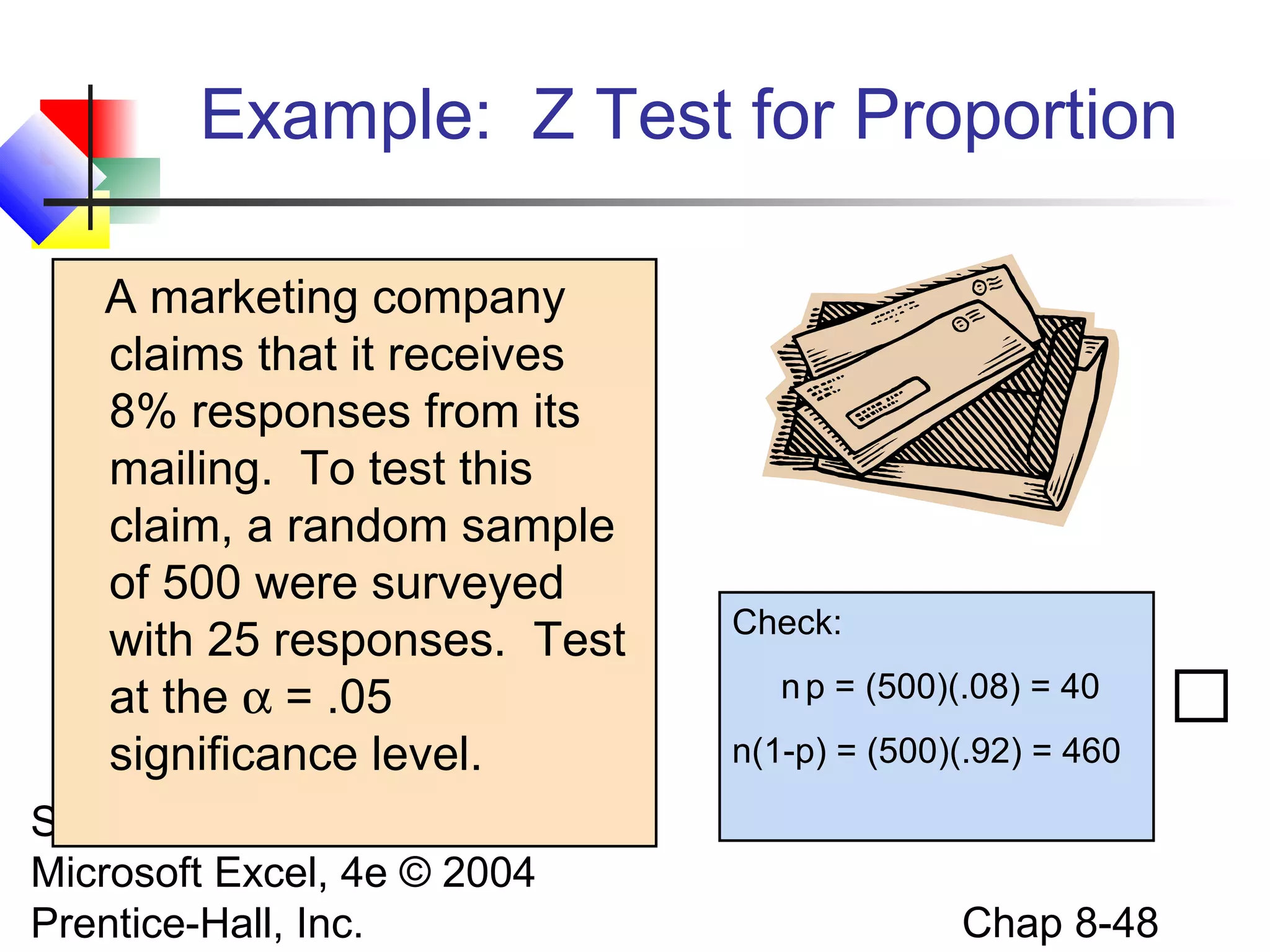
Example: Z Test for Proportion
A marketing company
claims that it receives
8% responses from its
mailing. To test this
claim, a random sample
of 500 were surveyed
with 25 responses. Test
at the α = .05
significance level.
Statistics for Managers Using
Microsoft Excel, 4e © 2004
Prentice-Hall, Inc.

Check:
n p = (500)(.08) = 40
n(1-p) = (500)(.92) = 460

Chap 8-48


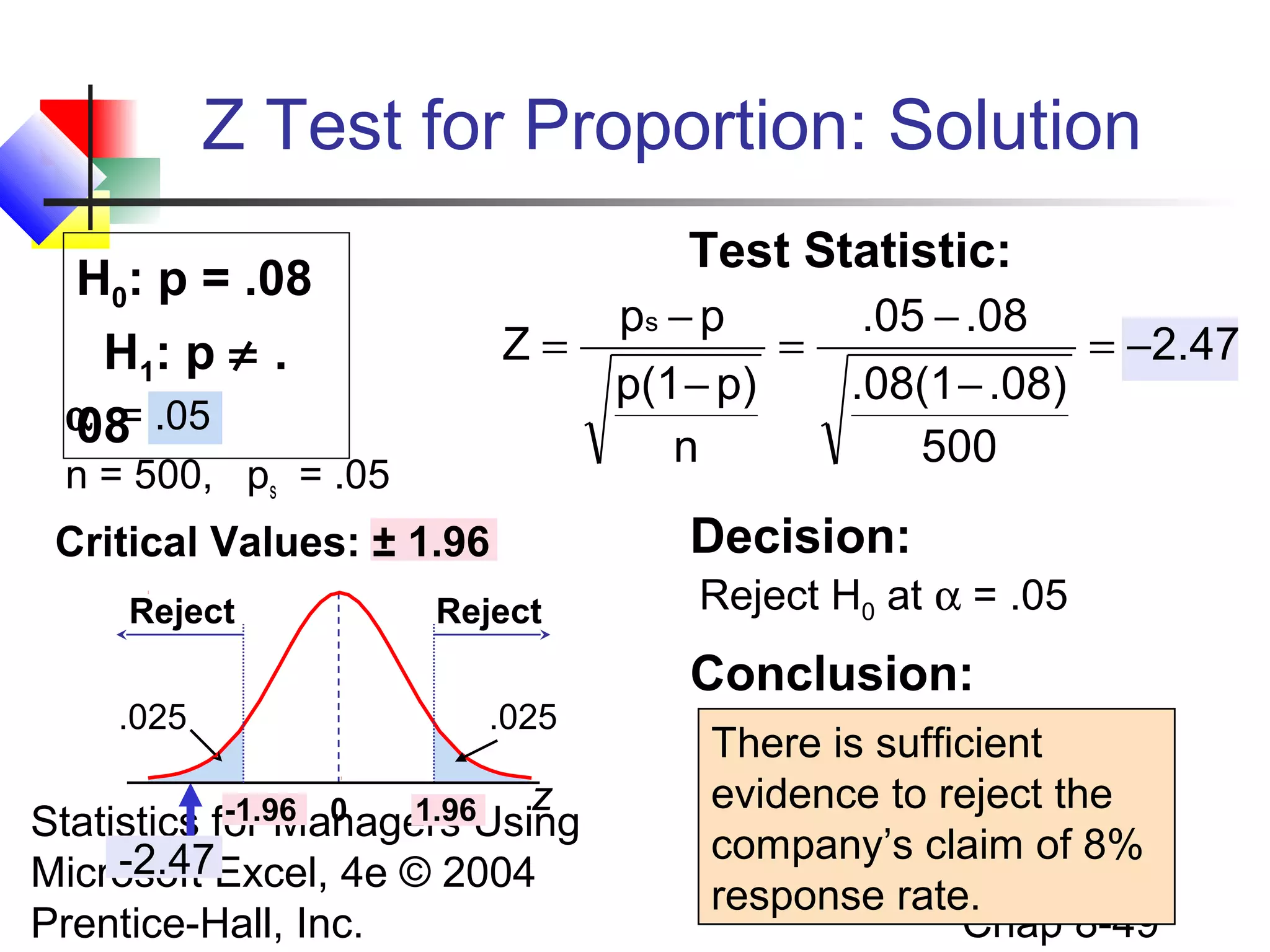
Z Test for Proportion: Solution
Test Statistic:

H0: p = .08
H1: p ≠ .
α = .05
08

Z=

n = 500, ps = .05

Critical Values: ± 1.96
Reject
.025

Reject
.025

z
-1.96 0
1.96Using
for Managers

Statistics
-2.47
Microsoft Excel, 4e © 2004
Prentice-Hall, Inc.

ps − p
=
p(1 − p)
n

.05 − .08
= −2.47
.08(1 − .08)
500

Decision:
Reject H0 at α = .05

Conclusion:
There is sufficient
evidence to reject the
company’s claim of 8%
response rate.
Chap 8-49
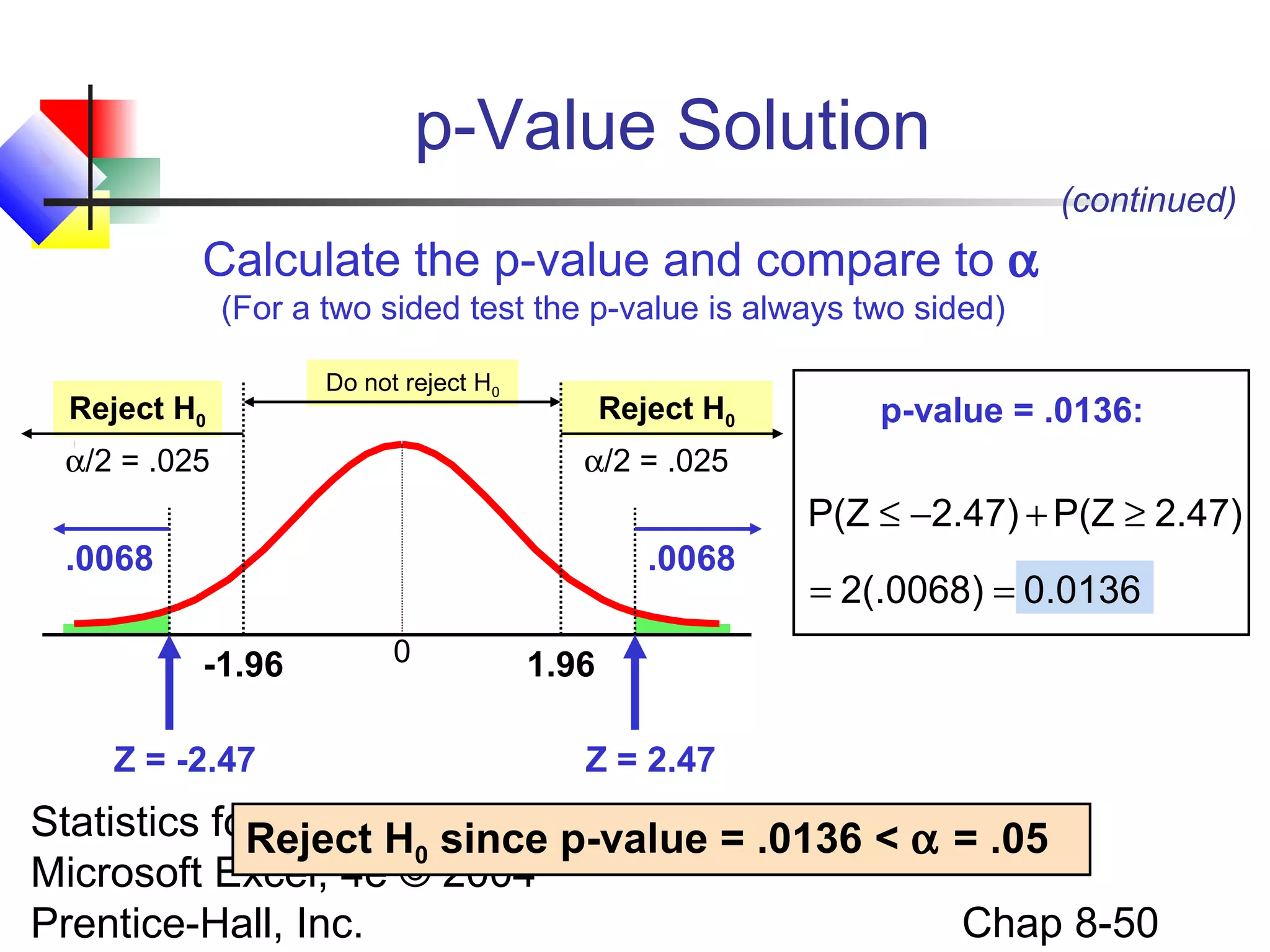
p-Value Solution
(continued)

Calculate the p-value and compare to α
(For a two sided test the p-value is always two sided)

Reject H0

Do not reject H0

α/2 = .025

Reject H0

p-value = .0136:

α/2 = .025

P(Z ≤ −2.47) + P(Z ≥ 2.47)
.0068

.0068
-1.96

Z = -2.47

0

= 2(.0068) = 0.0136

1.96
Z = 2.47

Statistics for Managers Using
Reject H0 since p-value = .0136 < α = .05
Microsoft Excel, 4e © 2004
Chap 8-50
Prentice-Hall, Inc.
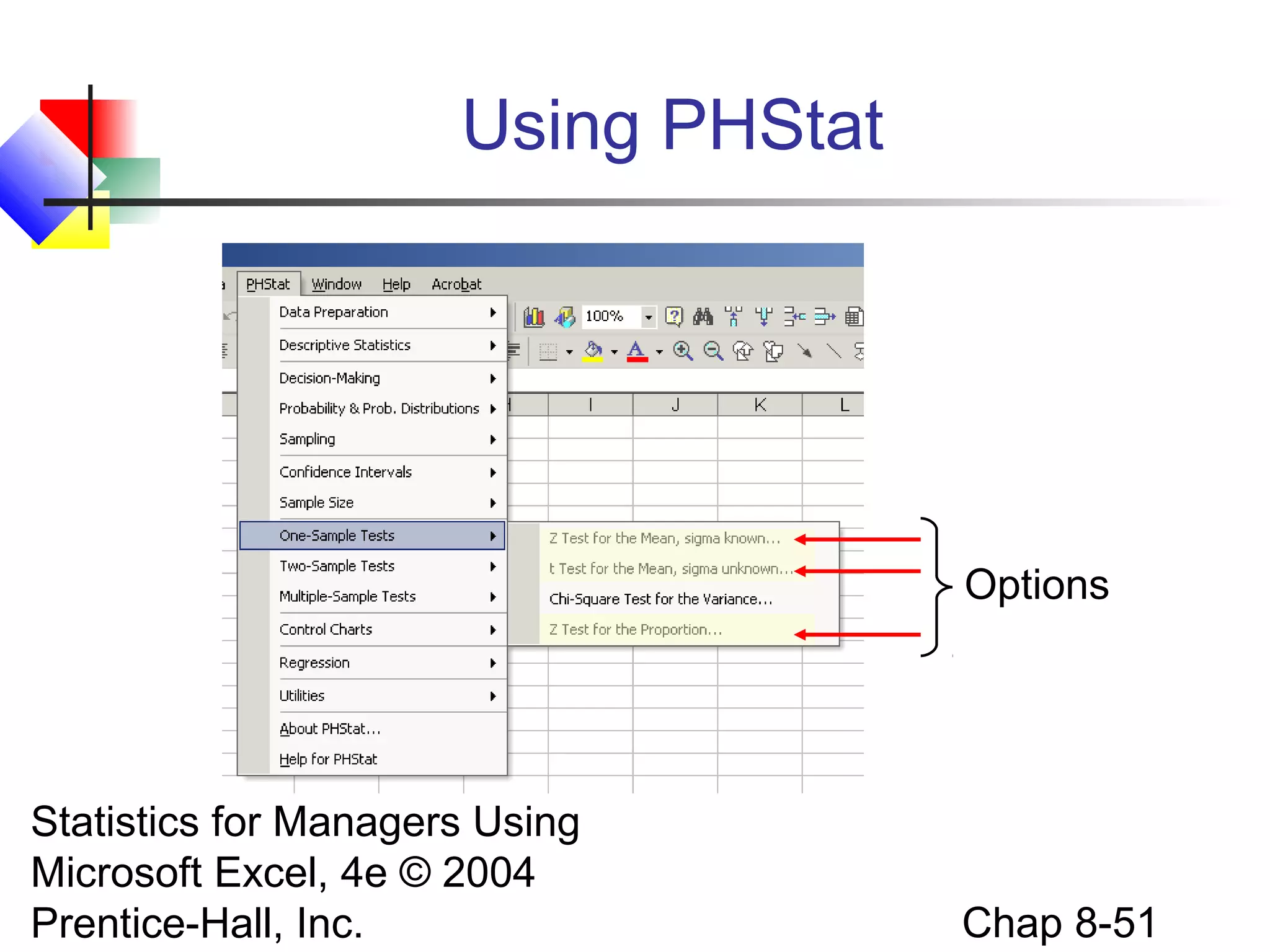
Using PHStat

Options

Statistics for Managers Using
Microsoft Excel, 4e © 2004
Prentice-Hall, Inc.

Chap 8-51
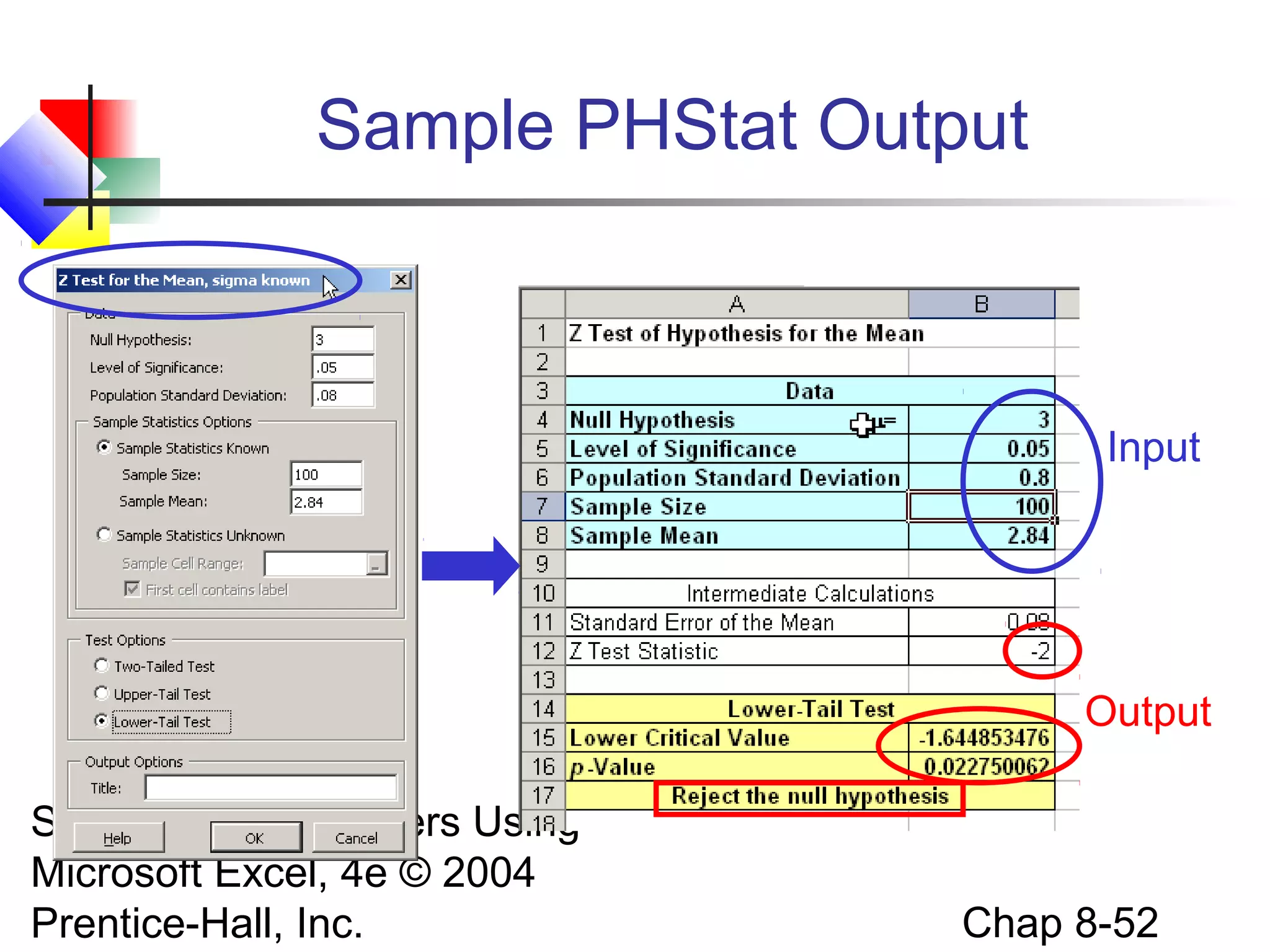
Sample PHStat Output

Input

Output
Statistics for Managers Using
Microsoft Excel, 4e © 2004
Prentice-Hall, Inc.

Chap 8-52
Potential Pitfalls and
Ethical Considerations


Use randomly collected data to reduce selection biases



Do not use human subjects without informed consent



Choose the level of significance, α, before data
collection



Do not employ “data snooping” to choose between onetail and two-tail test, or to determine the level of
significance



Do not practice “data cleansing” to hide observations
that do not support a stated hypothesis

Report all pertinent findings
Statistics for Managers Using
Microsoft Excel, 4e © 2004
Prentice-Hall, Inc.


Chap 8-53
Chapter Summary


Addressed hypothesis testing
methodology



Performed Z Test for the mean (σ known)



Discussed critical value and p–value
approaches to hypothesis testing



Performed one-tail and two-tail tests

Statistics for Managers Using
Microsoft Excel, 4e © 2004
Prentice-Hall, Inc.

Chap 8-54
Chapter Summary
(continued)


Performed t test for the mean (σ
unknown)



Performed Z test for the proportion



Discussed pitfalls and ethical issues

Statistics for Managers Using
Microsoft Excel, 4e © 2004
Prentice-Hall, Inc.

Chap 8-55

Chap08 fundamentals of hypothesis

  • 1.
    Statistics for Managers UsingMicrosoft® Excel 4th Edition Chapter 8 Fundamentals of Hypothesis Testing: One-Sample Tests Statistics for Managers Using Microsoft Excel, 4e © 2004 Prentice-Hall, Inc. Chap 8-1
  • 2.
    Chapter Goals After completingthis chapter, you should be able to:  Formulate null and alternative hypotheses for applications involving a single population mean or proportion  Formulate a decision rule for testing a hypothesis  Know how to use the critical value and p-value approaches to test the null hypothesis (for both mean and proportion problems)  Know what Type I and Statistics for Managers Using Type II errors are Microsoft Excel, 4e © 2004 Chap 8-2 Prentice-Hall, Inc.
  • 3.
    What is aHypothesis?  A hypothesis is a claim (assumption) about a population parameter:  population mean Example: The mean monthly cell phone bill of this city is μ = $42  population proportion Example: The proportion of adults in this Statistics for Managers Using city with cell phones is p = .68 Microsoft Excel, 4e © 2004 Chap 8-3 Prentice-Hall, Inc.
  • 4.
    The Null Hypothesis,H0  States the assumption (numerical) to be tested Example: The average number of TV sets in U.S. Homes is equal to three ( H0 : μ = 3 )  Is always about a population parameter, not about a sample statistic H0 : μ = 3 Statistics for Managers Using Microsoft Excel, 4e © 2004 Prentice-Hall, Inc. H0 : X = 3 Chap 8-4
  • 5.
    The Null Hypothesis,H0 (continued)     Begin with the assumption that the null hypothesis is true  Similar to the notion of innocent until proven guilty Refers to the status quo Always contains “=” , “≤” or “≥” sign May or may not be rejected Statistics for Managers Using Microsoft Excel, 4e © 2004 Prentice-Hall, Inc. Chap 8-5
  • 6.
    The Alternative Hypothesis,H1  Is the opposite of the null hypothesis  e.g., The average number of TV sets in U.S. homes is not equal to 3 ( H1: μ ≠ 3 )  Challenges the status quo  Never contains the “=” , “≤” or “≥” sign May or may not be proven Is generally the hypothesis that the researcher is trying to prove   Statistics for Managers Using Microsoft Excel, 4e © 2004 Prentice-Hall, Inc. Chap 8-6
  • 7.
    Hypothesis Testing Process Claim:the population mean age is 50. (Null Hypothesis: H0: μ = 50 ) Population Is X= 20 likely if μ = 50? Suppose the sample REJECT Statistics for Managers Using mean age Null Hypothesis is 20: X = 20 Microsoft Excel, 4e © 2004 Prentice-Hall, Inc. Now select a random sample If not likely, Sample
  • 8.
    Reason for RejectingH0 Sampling Distribution of X 20 μ = 50 If H0 is true If it is unlikely that we would get a ... if in fact this were Statistics for Managers Using sample mean of the Microsoft Excel, 4e © 2004population mean… this value ... Prentice-Hall, Inc. X ... then we reject the null hypothesis that μ = 50. Chap 8-8
  • 9.
    Level of Significance,α  Defines the unlikely values of the sample statistic if the null hypothesis is true   Is designated by α , (level of significance)   Defines rejection region of the sampling distribution Typical values are .01, .05, or .10 Is selected by the researcher at the beginning  Provides the critical Statistics for Managers Using value(s) of the test Microsoft Excel, 4e © 2004 Chap 8-9 Prentice-Hall, Inc.
  • 10.
    Level of Significance andthe Rejection Region Level of significance = H0: μ = 3 H1: μ ≠ 3 H0: μ ≤ 3 H1: μ > 3 α α/2 Two-tail test α/2 Represents critical value Rejection region is shaded 0 α Upper-tail test H0: μ ≥ 3 α H1: for 3 Statisticsμ < Managers Using Microsoft Excel, Lower-tail test 4e © 2004 Prentice-Hall, Inc. 0 0 Chap 8-10
  • 11.
    Errors in MakingDecisions  Type I Error  Reject a true null hypothesis  Considered a serious type of error The probability of Type I Error is α   Called level of significance of the test Set by researcher in advance Statistics for Managers Using Microsoft Excel, 4e © 2004 Prentice-Hall, Inc. Chap 8-11
  • 12.
    Errors in MakingDecisions (continued)  Type II Error  Fail to reject a false null hypothesis The probability of Type II Error is β Statistics for Managers Using Microsoft Excel, 4e © 2004 Prentice-Hall, Inc. Chap 8-12
  • 13.
    Outcomes and Probabilities PossibleHypothesis Test Outcomes Decision Key: Outcome (Probability) Actual Situation H0 True H0 False Do Not Reject H0 No error (1 - α ) Type II Error (β) Reject H0 Type I Error (α) No Error (1-β) Statistics for Managers Using Microsoft Excel, 4e © 2004 Prentice-Hall, Inc. Chap 8-13
  • 14.
    Type I &II Error Relationship  Type I and Type II errors can not happen at the same time  Type I error can only occur if H0 is true  Type II error can only occur if H0 is false If Type I error probability ( α ) Statistics for Managers Using Type II error probability ( β ) Microsoft Excel, 4e © 2004 Prentice-Hall, Inc. , then Chap 8-14
  • 15.
    Factors Affecting TypeII Error  All else equal,  β when the difference between hypothesized parameter and its true value  β when α  β when σ when n Statistics for Managers Using Microsoft Excel, 4e © 2004 Prentice-Hall, Inc.  β Chap 8-15
  • 16.
    Hypothesis Tests forthe Mean Hypothesis Tests for µ σ Known Statistics for Managers Using Microsoft Excel, 4e © 2004 Prentice-Hall, Inc. σ Unknown Chap 8-16
  • 17.
    Z Test ofHypothesis for the Mean (σ Known)  Convert sample statistic ( X ) to a Z test statistic Hypothesis Tests for µ σ Known σ Unknown The test statistic is: X −μ Z = σ Statistics for Managers Using n Microsoft Excel, 4e © 2004 Prentice-Hall, Inc. Chap 8-17
  • 18.
    Critical Value Approach toTesting  For two tailed test for the mean, σ known:  Convert sample statistic ( X ) to test statistic (Z statistic )  Determine the critical Z values for a specified level of significance α from a table or computer  Decision Rule: If the test statistic falls in the rejection region, reject H0 ; otherwise do not Statistics for Managers Using reject H Microsoft Excel, 04e © 2004 Prentice-Hall, Inc. Chap 8-18
  • 19.
    Two-Tail Tests  There aretwo cutoff values (critical values), defining the regions of rejection H0: μ = 3 H1 : μ ≠ 3 α/2 α/2 X 3 Reject H0 -Z Lower Statistics for Managers Using critical Microsoft Excel, 4e © 2004 value Prentice-Hall, Inc. Do not reject H0 0 Reject H0 +Z Upper critical value Chap 8-19 Z
  • 20.
    Review: 10 Stepsin Hypothesis Testing  1. State the null hypothesis, H0  2. State the alternative hypotheses, H1  3. Choose the level of significance, α  4. Choose the sample size, n  5. Determine the appropriate statistical technique and the test statistic to use 6. Find the critical values and determine the rejection region(s) Statistics for Managers Using  Microsoft Excel, 4e © 2004 Prentice-Hall, Inc. Chap 8-20
  • 21.
    Review: 10 Stepsin Hypothesis Testing  7. Collect data and compute the test statistic from the sample result  8. Compare the test statistic to the critical value to determine whether the test statistics falls in the region of rejection  9. Make the statistical decision: Reject H0 if the test statistic falls in the rejection region 10. Express the decision in the context of the problem Statistics for Managers Using  Microsoft Excel, 4e © 2004 Prentice-Hall, Inc. Chap 8-21
  • 22.
    Hypothesis Testing Example Testthe claim that the true mean # of TV sets in US homes is equal to 3. (Assume σ = 0.8)  1-2. State the appropriate null and alternative hypotheses  H: μ = 3 H1: μ ≠ 3 (This is a two tailed test) 0 Specify the desired level of significance  Suppose that α = .05 is chosen for this test  4. Choose a sample size  StatisticsSuppose a sample of size n = 100 is selected for Managers Using Microsoft Excel, 4e © 2004 Chap 8-22 Prentice-Hall, Inc.  3.
  • 23.
    Hypothesis Testing Example (continued)    5. Determinethe appropriate technique  σ is known so this is a Z test 6. Set up the critical values  For α = .05 the critical Z values are ±1.96 7. Collect the data and compute the test statistic  Suppose the sample results are n = 100, X = 2.84 (σ = 0.8 is assumed known) So the test statistic is: X −μ 2.84 − 3 −.16 = = =− 2.0 σ 0.8 .08 Statistics for Managers Using n 100 Microsoft Excel, 4e © 2004 Z = Prentice-Hall, Inc. Chap 8-23
  • 24.
    Hypothesis Testing Example (continued)  8.Is the test statistic in the rejection region? α = .05/2 α = .05/2 Reject H Do not reject H Reject H Reject H0 if 0 -Z= -1.96 +Z= +1.96 Z < -1.96 or Z > 1.96; otherwise Here, Z = -2.0 < -1.96, so the do not test statistic Statistics for Managers Using is in the rejection reject H0 Microsoft Excel, 4e region © 2004 Chap 8-24 Prentice-Hall, Inc. 0 0 0
  • 25.
    Hypothesis Testing Example (continued)  9-10.Reach a decision and interpret the result α = .05/2 Reject H0 -Z= -1.96 α = .05/2 Do not reject H0 0 Reject H0 +Z= +1.96 -2.0 Since Z = -2.0 < -1.96, we reject the null hypothesis and conclude that there is sufficient evidence that the Statistics for Managers Using mean number of TVs in US homes is not equal to 3 Microsoft Excel, 4e © 2004 Chap 8-25 Prentice-Hall, Inc.
  • 26.
    p-Value Approach toTesting  p-value: Probability of obtaining a test statistic more extreme ( ≤ or ≥ ) than the observed sample value given H0 is true  Also called observed level of significance Smallest value of α for which H0 can be Statistics for Managers Using rejected  Microsoft Excel, 4e © 2004 Prentice-Hall, Inc. Chap 8-26
  • 27.
    p-Value Approach toTesting (continued)  Convert Sample Statistic (e.g., X ) to Test Statistic (e.g., Z statistic )  Obtain the p-value from a table or computer  Compare the p-value with α  If p-value < α , reject H0  If p-value ≥ α , do not reject H0 Statistics for Managers Using Microsoft Excel, 4e © 2004 Prentice-Hall, Inc. Chap 8-27
  • 28.
    p-Value Example  Example: Howlikely is it to see a sample mean of 2.84 (or something further from the mean, in either direction) if the true mean is µ = 3.0? X = 2.84 is translated to a Z score of Z = -2.0 P(Z < −2.0) = .0228 P(Z > 2.0) = .0228 α/2 = .025 α/2 = .025 .0228 .0228 p-value =.0228 for Managers Statistics + .0228 = .0456 Using Microsoft Excel, 4e © 2004 Prentice-Hall, Inc. -1.96 -2.0 0 1.96 2.0 Chap 8-28 Z
  • 29.
    p-Value Example  Compare thep-value with α  If p-value < α , reject H0  (continued) If p-value ≥ α , do not reject H0 Here: p-value = .0456 α = .05 α/2 = .025 α/2 = .025 .0228 Since .0456 < .05, we reject the null hypothesis Statistics for Managers Using Microsoft Excel, 4e © 2004 Prentice-Hall, Inc. .0228 -1.96 -2.0 0 1.96 2.0 Chap 8-29 Z
  • 30.
    Connection to ConfidenceIntervals  For X = 2.84, σ = 0.8 and n = 100, the 95% confidence interval is: 0.8 2.84 - (1.96) to 100 0.8 2.84 + (1.96) 100 2.6832 ≤ μ ≤ 2.9968 Since this interval does not contain the hypothesized mean (3.0), we reject the Statistics for Managers Using null hypothesis at α = .05  Microsoft Excel, 4e © 2004 Prentice-Hall, Inc.
  • 31.
    One-Tail Tests  In manycases, the alternative hypothesis focuses on a particular direction H0: μ ≥ 3 This is a lower-tail test since the alternative hypothesis is focused on the lower tail below the mean of 3 H1: μ < 3 This is an upper-tail test since the alternative hypothesis is focused on H1: μ > 3 the upper tail above the mean of 3 Statistics for Managers Using Microsoft Excel, 4e © 2004 Chap 8-31 Prentice-Hall, Inc. H0: μ ≤ 3
  • 32.
    Lower-Tail Tests H0: μ≥ 3  There is only one critical value, since the rejection area is in only one tail H1: μ < 3 α Reject H0 -Z Do not reject H0 0 μ Critical value Statistics for Managers Using Microsoft Excel, 4e © 2004 Prentice-Hall, Inc. Z X Chap 8-32
  • 33.
    Upper-Tail Tests  There isonly one critical value, since the rejection area is in only one tail H0: μ ≤ 3 H1: μ > 3 α Z Do not reject H0 X μ Statistics for Managers Using Microsoft Excel, 4e © 2004 Prentice-Hall, Inc. 0 Zα Reject H0 Critical value Chap 8-33
  • 34.
    Example: Upper-Tail ZTest for Mean (σ Known) A phone industry manager thinks that customer monthly cell phone bill have increased, and now average over $52 per month. The company wishes to test this claim. (Assume σ = 10 is known) Form hypothesis test: H0: μ ≤ 52 the average is not over $52 per month H1: μ > 52 the average is greater than $52 per month (i.e., sufficient evidence exists to support the Managers Using manager’s claim) Statistics for Microsoft Excel, 4e © 2004 Prentice-Hall, Inc. Chap 8-34
  • 35.
    Example: Find RejectionRegion (continued)  Suppose that α = .10 is chosen for this test Find the rejection region: Reject H0 α = .10 Do not reject H0 0 1.28 Reject H0 Statistics for Managers Using Reject H0 if Z > 1.28 Microsoft Excel, 4e © 2004 Chap 8-35 Prentice-Hall, Inc.
  • 36.
    Review: One-Tail Critical Value Whatis Z given α = 0.10? .90 .10 α = .10 .90 z Standard Normal Distribution Table (Portion) 0 1.28 Statistics for Critical Value Managers Using = 1.28 Microsoft Excel, 4e © 2004 Prentice-Hall, Inc. Z .07 .08 .09 1.1 .8790 .8810 .8830 1.2 .8980 .8997 .9015 1.3 .9147 .9162 .9177 Chap 8-36
  • 37.
    Example: Test Statistic (continued) Obtainsample and compute the test statistic Suppose a sample is taken with the following results: n = 64, X = 53.1 (σ=10 was assumed known)  Then the test statistic is: X−μ 53.1 − 52 Z = = = 0.88 σ 10 Statistics for Managers Using n 64 Microsoft Excel, 4e © 2004 Prentice-Hall, Inc. Chap 8-37
  • 38.
    Example: Decision (continued) Reach adecision and interpret the result: Reject H0 α = .10 Do not reject H0 1.28 0 Z = .88 Reject H0 Do not reject H0 since Z = 0.88 ≤ 1.28 Statistics for Managers Using i.e.: there is not sufficient evidence that the Microsoft Excel,mean 2004 over $52 4e © bill is Chap 8-38 Prentice-Hall, Inc.
  • 39.
    p -Value Solution Calculatethe p-value and compare to α (continued) (assuming that μ = 52.0) p-value = .1894 Reject H0 α = .10 0 Do not reject H0 1.28 Z = .88 Reject H0 P( X ≥ 53.1) 53.1 − 52.0   = P Z ≥  10/ 64   = P(Z ≥ 0.88) = 1 − .8106 = .1894 Statistics for Managers Using Do Excel, 4e © since Microsoftnot reject H02004 p-value = .1894 > α = .10 Chap 8-39 Prentice-Hall, Inc.
  • 40.
    Z Test ofHypothesis for the Mean (σ Known)  Convert sample statistic ( X ) to a t test statistic Hypothesis Tests for µ σ Known σ Unknown The test statistic is: t n-1 Statistics for Managers Using Microsoft Excel, 4e © 2004 Prentice-Hall, Inc. X−μ = S n Chap 8-40
  • 41.
    Example: Two-Tail Test (σUnknown) The average cost of a hotel room in New York is said to be $168 per night. A random sample of 25 hotels resulted in X = $172.50 and S = $15.40. Test at the α = 0.05 level. Statistics for Managers Usingnormal) (Assume the population distribution is Microsoft Excel, 4e © 2004 Prentice-Hall, Inc. H0: μ = 168 H1: μ ≠ 168 Chap 8-41
  • 42.
    Example Solution: Two-Tail Test     H0:μ = 168 H1: μ ≠ 1680.05 α = α/2=.025 Reject H0 -t n-1,α/2 -2.0639 n = 25 σ is unknown, so use a t statistic Critical Value: t n−1 = α/2=.025 Do not reject H0 0 1.46 Reject H0 t n-1,α/2 2.0639 X −μ 172.50 −168 = = 1.46 S 15.40 n 25 Do not t24 = ± for Managers Using reject H0: not sufficient evidence that Statistics 2.0639 Microsoft Excel, 4e © 2004 true mean cost is different than $168 Chap 8-42 Prentice-Hall, Inc.
  • 43.
    Connection to ConfidenceIntervals  For X = 172.5, S = 15.40 and n = 25, the 95% confidence interval is: 172.5 - (2.0639) 15.4/ 25 to 172.5 + (2.0639) 15.4/ 25 166.14 ≤ μ ≤ 178.86 Since this interval contains the Hypothesized mean (168), we do not reject the null hypothesis at α = .05 Statistics for Managers Using  Microsoft Excel, 4e © 2004 Prentice-Hall, Inc.
  • 44.
    Hypothesis Tests forProportions  Involves categorical variables  Two possible outcomes    “Success” (possesses a certain characteristic) “Failure” (does not possesses that characteristic) Fraction or proportion of the population in the “success” category is denoted by p Statistics for Managers Using Microsoft Excel, 4e © 2004 Prentice-Hall, Inc. Chap 8-44
  • 45.
    Proportions (continued)  Sample proportion inthe success category is denoted by ps  X number of successes in sample ps = = n sample size When both np and n(1-p) are at least 5, ps can be approximated by a normal distribution with mean and standard deviation  μps = p Using σ ps = p(1 − p) Statistics for Managers n Microsoft Excel, 4e © 2004  Prentice-Hall, Inc. Chap 8-45
  • 46.
    Hypothesis Tests forProportions  The sampling distribution of ps is approximately normal, so the test statistic is a Z value: Hypothesis Tests for p np ≥ 5 and n(1-p) ≥ 5 ps − p Z= p(1 − p) n Statistics for Managers Using Microsoft Excel, 4e © 2004 Prentice-Hall, Inc. np < 5 or n(1-p) < 5 Not discussed in this chapter Chap 8-46
  • 47.
    Z Test forProportion in Terms of Number of Successes  An equivalent form to the last slide, but in terms of the number of successes, X: X − np Z= np(1 − p) Statistics for Managers Using Microsoft Excel, 4e © 2004 Prentice-Hall, Inc. Hypothesis Tests for X X≥5 and n-X ≥ 5 X<5 or n-X < 5 Not discussed in this chapter Chap 8-47
  • 48.
    Example: Z Testfor Proportion A marketing company claims that it receives 8% responses from its mailing. To test this claim, a random sample of 500 were surveyed with 25 responses. Test at the α = .05 significance level. Statistics for Managers Using Microsoft Excel, 4e © 2004 Prentice-Hall, Inc. Check: n p = (500)(.08) = 40 n(1-p) = (500)(.92) = 460 Chap 8-48 
  • 49.
    Z Test forProportion: Solution Test Statistic: H0: p = .08 H1: p ≠ . α = .05 08 Z= n = 500, ps = .05 Critical Values: ± 1.96 Reject .025 Reject .025 z -1.96 0 1.96Using for Managers Statistics -2.47 Microsoft Excel, 4e © 2004 Prentice-Hall, Inc. ps − p = p(1 − p) n .05 − .08 = −2.47 .08(1 − .08) 500 Decision: Reject H0 at α = .05 Conclusion: There is sufficient evidence to reject the company’s claim of 8% response rate. Chap 8-49
  • 50.
    p-Value Solution (continued) Calculate thep-value and compare to α (For a two sided test the p-value is always two sided) Reject H0 Do not reject H0 α/2 = .025 Reject H0 p-value = .0136: α/2 = .025 P(Z ≤ −2.47) + P(Z ≥ 2.47) .0068 .0068 -1.96 Z = -2.47 0 = 2(.0068) = 0.0136 1.96 Z = 2.47 Statistics for Managers Using Reject H0 since p-value = .0136 < α = .05 Microsoft Excel, 4e © 2004 Chap 8-50 Prentice-Hall, Inc.
  • 51.
    Using PHStat Options Statistics forManagers Using Microsoft Excel, 4e © 2004 Prentice-Hall, Inc. Chap 8-51
  • 52.
    Sample PHStat Output Input Output Statisticsfor Managers Using Microsoft Excel, 4e © 2004 Prentice-Hall, Inc. Chap 8-52
  • 53.
    Potential Pitfalls and EthicalConsiderations  Use randomly collected data to reduce selection biases  Do not use human subjects without informed consent  Choose the level of significance, α, before data collection  Do not employ “data snooping” to choose between onetail and two-tail test, or to determine the level of significance  Do not practice “data cleansing” to hide observations that do not support a stated hypothesis Report all pertinent findings Statistics for Managers Using Microsoft Excel, 4e © 2004 Prentice-Hall, Inc.  Chap 8-53
  • 54.
    Chapter Summary  Addressed hypothesistesting methodology  Performed Z Test for the mean (σ known)  Discussed critical value and p–value approaches to hypothesis testing  Performed one-tail and two-tail tests Statistics for Managers Using Microsoft Excel, 4e © 2004 Prentice-Hall, Inc. Chap 8-54
  • 55.
    Chapter Summary (continued)  Performed ttest for the mean (σ unknown)  Performed Z test for the proportion  Discussed pitfalls and ethical issues Statistics for Managers Using Microsoft Excel, 4e © 2004 Prentice-Hall, Inc. Chap 8-55