Statistics for Managers Using 
Microsoft Excel 
7th Edition 
Chapter 10 
Two-Sample Tests 
Statistics for Managers Using Microsoft Excel® 7e Copyright ©2014 Pearson Education, Inc. Chap 10-1
Chap 10-2 
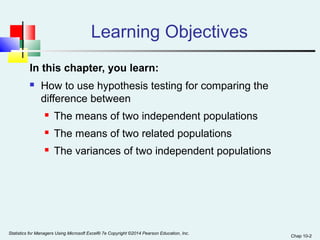
Learning Objectives 
In this chapter, you learn: 
 How to use hypothesis testing for comparing the 
difference between 
 The means of two independent populations 
 The means of two related populations 
 The variances of two independent populations 
Statistics for Managers Using Microsoft Excel® 7e Copyright ©2014 Pearson Education, Inc.
Chap 10-3 
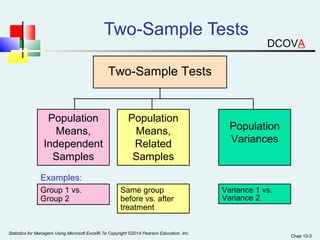
Two-Sample Tests 
Two-Sample Tests 
Population 
Means, 
Independent 
Samples 
Population 
Means, 
Related 
Samples 
Population 
Variances 
Group 1 vs. 
Group 2 
Same group 
before vs. after 
treatment 
Variance 1 vs. 
Variance 2 
Examples: 
Statistics for Managers Using Microsoft Excel® 7e Copyright ©2014 Pearson Education, Inc. 
DCOVA
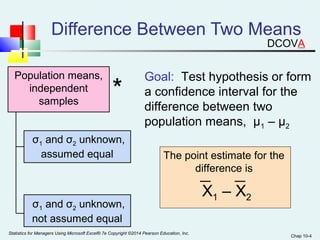
Difference Between Two Means 
Chap 10-4 
Population means, 
independent 
samples 
Goal: Test hypothesis or form 
a confidence interval for the 
difference between two 
population means, μ1 – μ2 
The point estimate for the 
difference is 
X1 – X2 
* 
σ1 and σ2 unknown, 
assumed equal 
σ1 and σ2 unknown, 
not assumed equal 
Statistics for Managers Using Microsoft Excel® 7e Copyright ©2014 Pearson Education, Inc. 
DCOVA
Chap 10-5 
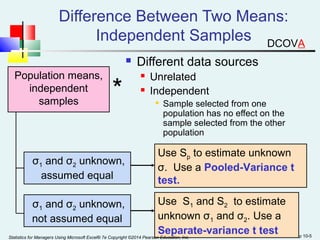
Difference Between Two Means: 
Independent Samples 
Population means, 
independent 
samples * 
 Different data sources 
 Unrelated 
 Independent 
 Sample selected from one 
population has no effect on the 
sample selected from the other 
population 
Use Sp to estimate unknown 
σ. Use a Pooled-Variance t 
test. 
σ1 and σ2 unknown, 
assumed equal 
σ1 and σ2 unknown, 
not assumed equal 
Use S1 and S2 to estimate 
unknown σ1 and σ2. Use a 
Separate-variance t test 
Statistics for Managers Using Microsoft Excel® 7e Copyright ©2014 Pearson Education, Inc. 
DCOVA
Chap 10-6 
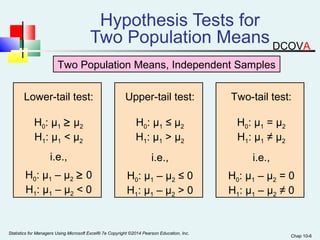
Hypothesis Tests for 
Two Population Means 
Two Population Means, Independent Samples 
Lower-tail test: 
H0: μ1 ³ μ2 
H1: μ1 < μ2 
i.e., 
H0: μ1 – μ2 ³ 0 
H1: μ1 – μ2 < 0 
Upper-tail test: 
H0: μ1 ≤ μ2 
H1: μ1 > μ2 
i.e., 
H0: μ1 – μ2 ≤ 0 
H1: μ1 – μ2 > 0 
Two-tail test: 
H0: μ1 = μ2 
H1: μ1 ≠ μ2 
i.e., 
H0: μ1 – μ2 = 0 
H1: μ1 – μ2 ≠ 0 
Statistics for Managers Using Microsoft Excel® 7e Copyright ©2014 Pearson Education, Inc. 
DCOVA
Chap 10-7 
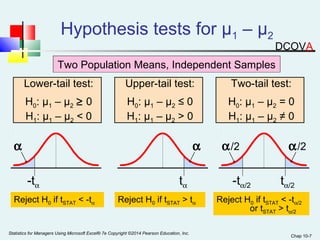
Hypothesis tests for μ1 – μ2 
Two Population Means, Independent Samples 
Lower-tail test: 
H0: μ1 – μ2 ³ 0 
H1: μ1 – μ2 < 0 
Upper-tail test: 
H0: μ1 – μ2 ≤ 0 
H1: μ1 – μ2 > 0 
Two-tail test: 
H0: μ1 – μ2 = 0 
H1: μ1 – μ2 ≠ 0 
a a a/2 a/2 
-ta -ta/2 ta ta/2 
Reject H0 if tSTAT < -ta Reject H0 if tSTAT > ta Reject H0 if tSTAT < -ta/2 
                          or tSTAT > ta/2 
Statistics for Managers Using Microsoft Excel® 7e Copyright ©2014 Pearson Education, Inc. 
DCOVA
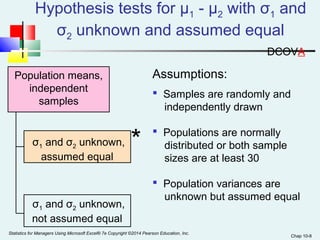
Hypothesis tests for μ1 - μ2 with σ1 and 
Chap 10-8 
σ2 unknown and assumed equal 
Population means, 
independent 
samples 
Assumptions: 
 Samples are randomly and 
independently drawn 
 Populations are normally 
distributed or both sample 
sizes are at least 30 
 Population variances are 
unknown but assumed equal 
σ * 1 and σ2 unknown, 
assumed equal 
σ1 and σ2 unknown, 
not assumed equal 
Statistics for Managers Using Microsoft Excel® 7e Copyright ©2014 Pearson Education, Inc. 
DCOVA
Hypothesis tests for μ1 - μ2 with σ1 
and σ2 unknown and assumed equal 
(continued) 
- - - 
X X μ μ 
1 2 1 2 
ö 
Chap 10-9 
Population means, 
independent 
samples 
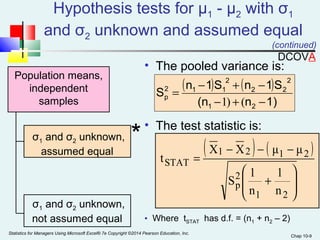
• The pooled variance is: 
( ) 2 
( ) 
(n n 1) 
S = n - 1S + n - 
1S 
2 1 1 
p - + - 
2 2 
1) ( 
1 2 
• The test statistic is: 
2 
æ 
1 
S 1 
• Where tSTAT has d.f. = (n1 + n2 – 2) 
σ * 1 and σ2 unknown, 
assumed equal 
σ1 and σ2 unknown, 
not assumed equal 
( ) ( ) 
÷ ÷ø 
ç çè 
+ 
= 
1 2 
2p 
STAT 
n 
n 
t 
Statistics for Managers Using Microsoft Excel® 7e Copyright ©2014 Pearson Education, Inc. 
DCOVA
Confidence interval for μ1 - μ2 with σ1 
and σ2 unknown and assumed equal 
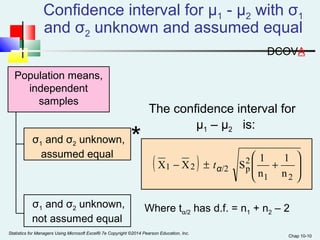
The confidence interval for 
1 
Chap 10-10 
Population means, 
independent 
samples 
÷ø 
( ) ÷ æ 
ö 
X X tα 
S 1 ç çè 
- ± + 
1 2 
2p 
1 2 /2 n 
n 
μ1 – μ2 is: 
Where tα/2 has d.f. = n1 + n2 – 2 
* 
σ1 and σ2 unknown, 
assumed equal 
σ1 and σ2 unknown, 
not assumed equal 
Statistics for Managers Using Microsoft Excel® 7e Copyright ©2014 Pearson Education, Inc. 
DCOVA
Pooled-Variance t Test Example 
Chap 10-11 
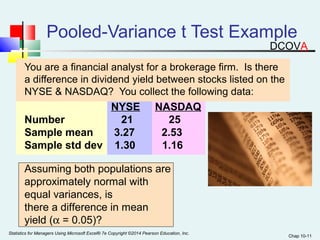
You are a financial analyst for a brokerage firm. Is there 
a difference in dividend yield between stocks listed on the 
NYSE & NASDAQ? You collect the following data: 
NYSE NASDAQ 
Number 21 25 
Sample mean 3.27 2.53 
Sample std dev 1.30 1.16 
Assuming both populations are 
approximately normal with 
equal variances, is 
there a difference in mean 
yield (a = 0.05)? 
Statistics for Managers Using Microsoft Excel® 7e Copyright ©2014 Pearson Education, Inc. 
DCOVA
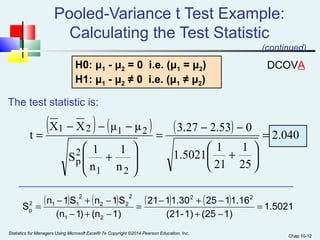
The test statistic is: 
( ) ( ) ( ) 2.040 
Chap 10-12 
Pooled-Variance t Test Example: 
Calculating the Test Statistic 
= - - 
3.27 2.53 0 
- - - 
1 2 1 2 = 
1 
1.5021 1 
X X μ μ 
1 
æ 
S 1 
ö çè 
ö 
( ) ( ) ( ) ( = 21 - 11.30 + 25 - 
11.16 
) 1.5021 
(21-1) (25 1) 
S = n - 1S + n - 
1S 
(n 1) (n 1) 
2 2 
1 2 
2 
2 2 
2 
2 1 1 
p = 
+ - 
- + - 
25 
21 
n 
n 
t 
1 2 
2p 
÷ø 
æ + 
÷ ÷ø 
ç çè 
+ 
= 
(continued) 
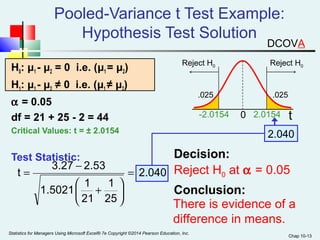
H0: μ1 - μ2 = 0 i.e. (μ1 = μ2) 
H1: μ1 - μ2 ≠ 0 i.e. (μ1 ≠ μ2) 
Statistics for Managers Using Microsoft Excel® 7e Copyright ©2014 Pearson Education, Inc. 
DCOVA
Reject H0 Reject H0 
-2.0154 0 2.0154 t 
Reject H0 at a = 0.05 
There is evidence of a 
difference in means. 
Chap 10-13 
Pooled-Variance t Test Example: 
Hypothesis Test Solution 
H0: μ1 - μ2 = 0 i.e. (μ1 = μ2) 
H1: μ1 - μ2 ≠ 0 i.e. (μ1 ≠ μ2) 
a = 0.05 
df = 21 + 25 - 2 = 44 
Critical Values: t = ± 2.0154 
Test Statistic: Decision: 
Conclusion: 
.025 
.025 
2.040 
2.040 
t 3.27 2.53 = 
1 
= - 
ö 25 
çè 
1.5021 1 
21 
÷ø 
æ + 
Statistics for Managers Using Microsoft Excel® 7e Copyright ©2014 Pearson Education, Inc. 
DCOVA
Chap 10-14 
Pooled-Variance t Test Example: 
Confidence Interval for μ1 - μ2 
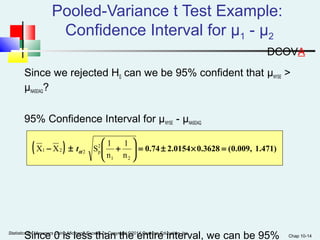
Since we rejected H0 can we be 95% confident that μNYSE > 
μNASDAQ? 
95% Confidence Interval for μNYSE - μNASDAQ 
( ) 1 
ö 
0.74 2.0154 0.3628 (0.009, 1.471) 
ç çè æ 
1 2 = ± ´ = ÷ ÷ø 
/2 n 
X X S 1 
- ± + a t 
n 
1 2 
2p 
Since 0 is less than the entire interval, we can be 95% 
Statistics for Managers Using Microsoft Excel® 7e Copyright ©2014 Pearson Education, Inc. 
DCOVA
Hypothesis tests for μ1 - μ2 with σ1 
and σ2 unknown, not assumed equal 
Chap 10-15 
Population means, 
independent 
samples 
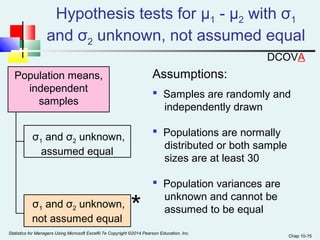
Assumptions: 
 Samples are randomly and 
independently drawn 
 Populations are normally 
distributed or both sample 
sizes are at least 30 
 Population variances are 
unknown and cannot be 
assumed * to be equal 
σ1 and σ2 unknown, 
assumed equal 
σ1 and σ2 unknown, 
not assumed equal 
Statistics for Managers Using Microsoft Excel® 7e Copyright ©2014 Pearson Education, Inc. 
DCOVA
Hypothesis tests for μ1 - μ2 with σ1 and 
σ2 unknown and not assumed equal 
t = X - X - μ - 
μ 
1 2 1 2 
Chap 10-16 
Population means, 
independent 
samples 
(continued) 
* 
σ1 and σ2 unknown, 
assumed equal 
σ1 and σ2 unknown, 
not assumed equal 
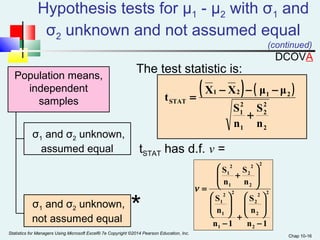
The test statistic is: 
( ) ( ) 
22 
2 
2 
1 
1 
STAT 
S 
n 
S 
n 
+ 
tSTAT has d.f. ν = 
2 
2 
S 
ö 
2 
2 
n 
S 
ö 
æ 
+ 
n 1 
æ 
S 
2 
1 
n 
S 
2 
1 
ö 
æ 
n 1 
n 
n 
2 
2 
2 
1 
2 
1 
2 
2 
1 
- 
÷ ÷ø 
ç çè 
- 
÷ ÷ø 
ç çè 
÷ ÷ø 
ç çè 
+ 
n = 
DCOVA 
Statistics for Managers Using Microsoft Excel® 7e Copyright ©2014 Pearson Education, Inc.
Separate-Variance t Test Example 
Chap 10-17 
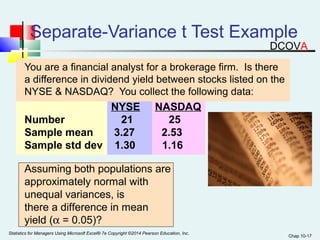
You are a financial analyst for a brokerage firm. Is there 
a difference in dividend yield between stocks listed on the 
NYSE & NASDAQ? You collect the following data: 
NYSE NASDAQ 
Number 21 25 
Sample mean 3.27 2.53 
Sample std dev 1.30 1.16 
Assuming both populations are 
approximately normal with 
unequal variances, is 
there a difference in mean 
yield (a = 0.05)? 
Statistics for Managers Using Microsoft Excel® 7e Copyright ©2014 Pearson Education, Inc. 
DCOVA
Separate-Variance t Test Example: 
Chap 10-18 
Calculating the Test Statistic 
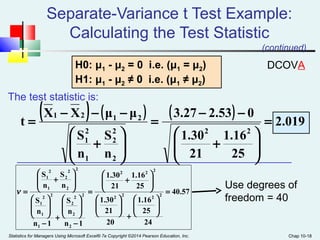
The test statistic is: 
( ) ( ) ( ) = 3.27 - 2.53 - 
0 
2.019 
= - - - 
1 2 1 2 = 
1.16 
25 
1.30 
21 
t X X μ μ 
S 
n 
S 
2 
1 
n 
2 2 
22 
2 
1 
ö 
÷ ÷ø 
æ 
ç çè 
+ 
ö 
÷ ÷ø 
æ 
ç çè 
+ 
(continued) 
H0: μ1 - μ2 = 0 i.e. (μ1 = μ2) 
H1: μ1 - μ2 ≠ 0 i.e. (μ1 ≠ μ2) 
2 2 2 
1.16 
ö 
1.16 
25 
1.30 
æ 
1.30 
21 
2 
2 
S 
ö 
2 
2 
n 
æ 
S 
2 
1 
n 
S 
S 
2 
1 
ö 
æ 
+ 
ö 
æ 
ö 
æ 
+ 
ö 
æ 
Statistics for Managers Using Microsoft Excel® 7e Copyright ©2014 Pearson Education, Inc. 
DCOVA 
40.57 
24 
20 
25 
21 
n 1 
n 1 
n 
n 
2 2 2 2 
2 
2 
2 
1 
2 
1 
2 
2 
1 
= 
÷ ÷ø 
ç çè 
÷ ÷ø 
ç çè 
÷ ÷ø 
ç çè 
+ 
= 
- 
÷ ÷ø 
ç çè 
- 
÷ ÷ø 
ç çè 
÷ ÷ø 
ç çè 
+ 
n = Use degrees of 
freedom = 40
Separate-Variance t Test Example: 
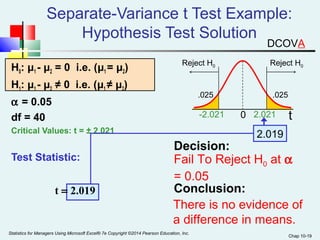
Reject H0 Reject H0 
-2.021 0 2.021 t 
Fail To Reject H0 at a 
= 0.05 
There is no evidence of 
a difference in means. 
Chap 10-19 
Hypothesis Test Solution 
H0: μ1 - μ2 = 0 i.e. (μ1 = μ2) 
H1: μ1 - μ2 ≠ 0 i.e. (μ1 ≠ μ2) 
a = 0.05 
df = 40 
Critical Values: t = ± 2.021 
Test Statistic: 
Decision: 
Conclusion: 
.025 
.025 
2.019 
t = 2.019 
Statistics for Managers Using Microsoft Excel® 7e Copyright ©2014 Pearson Education, Inc. 
DCOVA
Chap 10-20 
Related Populations 
The Paired Difference Test 
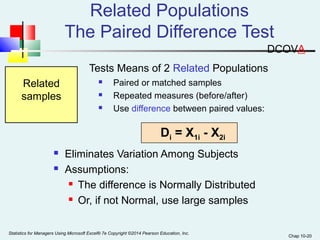
Tests Means of 2 Related Populations 
 Paired or matched samples 
 Repeated measures (before/after) 
 Use difference between paired values: 
 Eliminates Variation Among Subjects 
 Assumptions: 
 The difference is Normally Distributed 
 Or, if not Normal, use large samples 
Related 
samples 
Di = X1i - X2i 
Statistics for Managers Using Microsoft Excel® 7e Copyright ©2014 Pearson Education, Inc. 
DCOVA
(D D) 
Chap 10-21 
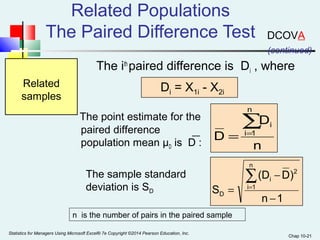
Related Populations 
The Paired Difference Test 
The ith paired difference is Di , where 
Related 
samples 
Di = X1i - X2i 
i å= 
= 
The point estimate for the 
paired difference 
population mean μD is D : n 
D 
D 
n 
i 1 
= 
n is the number of pairs in the paired sample 
- 
n 1 
S 
n 
å= 
i 1 
2 
i 
D - 
The sample standard 
deviation is SD 
(continued) 
Statistics for Managers Using Microsoft Excel® 7e Copyright ©2014 Pearson Education, Inc. 
DCOVA
Chap 10-22 
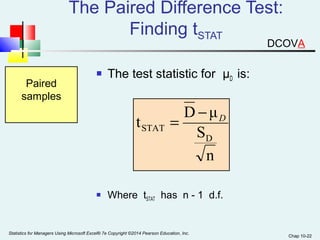
The Paired Difference Test: 
Finding tSTAT 
 The test statistic for μD is: 
Paired 
samples 
t D μ 
n 
S 
D 
STAT 
D = - 
 Where tSTAT has n - 1 d.f. 
Statistics for Managers Using Microsoft Excel® 7e Copyright ©2014 Pearson Education, Inc. 
DCOVA
Chap 10-23 
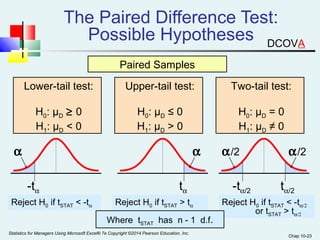
The Paired Difference Test: 
Possible Hypotheses 
Lower-tail test: 
H0: μD ³ 0 
H1: μD < 0 
Upper-tail test: 
H0: μD ≤ 0 
H1: μD > 0 
Two-tail test: 
H0: μD = 0 
H1: μD ≠ 0 
Paired Samples 
a a a/2 a/2 
-ta -ta/2 ta ta/2 
Reject H0 if tSTAT < -ta Reject H0 if tSTAT > ta Reject H0 if tSTAT < -ta/2 
                          or tSTAT > ta/2 
Where tSTAT has n - 1 d.f. 
Statistics for Managers Using Microsoft Excel® 7e Copyright ©2014 Pearson Education, Inc. 
DCOVA
Chap 10-24 
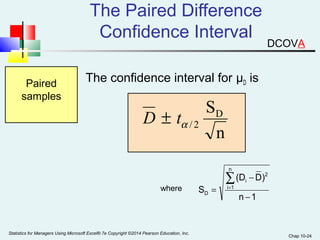
The Paired Difference 
Confidence Interval 
Paired The confidence interval for μD is 
samples 
(D - 
D) 
n 1 
S 
n 
å= 
i 1 
2 
i 
SD 
n 
= 
D - 
a / 2 D ± t 
where 
Statistics for Managers Using Microsoft Excel® 7e Copyright ©2014 Pearson Education, Inc. 
DCOVA
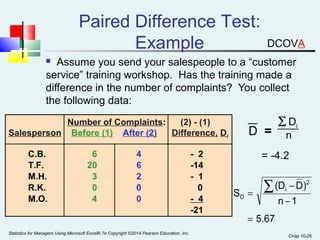
 Assume you send your salespeople to a “customer 
service” training workshop. Has the training made a 
difference in the number of complaints? You collect 
the following data: 
= -4.2 
(D - 
D) 
Chap 10-25 
Paired Difference Test: 
Example 
Number of Complaints: (2) - (1) 
Salesperson Before (1) After (2) Difference, Di 
C.B. 6 4 - 2 
T.F. 20 6 -14 
M.H. 3 2 - 1 
R.K. 0 0 0 
M.O. 4 0 - 4 
-21 
D = 
S Di 
n 
5.67 
n 1 
S 
2 
i 
D 
= 
- 
= å 
Statistics for Managers Using Microsoft Excel® 7e Copyright ©2014 Pearson Education, Inc. 
DCOVA
Chap 10-26 
Paired Difference Test: 
Solution 
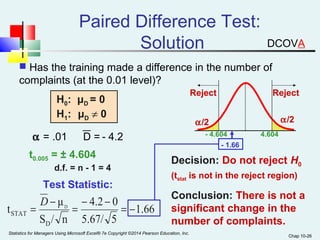
 Has the training made a difference in the number of 
complaints (at the 0.01 level)? 
H0: μD = 0 
H1:  μD ¹ 0 
D = - 4.2 
1.66 
t0.005 = ± 4.604 
d.f. = n - 1 = 4 
Test Statistic: 
4.2 0 
5.67/ 5 
t μ 
S / n 
D 
STAT 
= D - D = - - = - 
Reject 
a/2 
Reject 
a/2 
- 4.604 4.604 
- 1.66 
Decision: Do not reject H0 
(tstat is not in the reject region) 
Conclusion: There is not a 
significant change in the 
number of complaints. 
a = .01 
Statistics for Managers Using Microsoft Excel® 7e Copyright ©2014 Pearson Education, Inc. 
DCOVA
Chap 10-27 
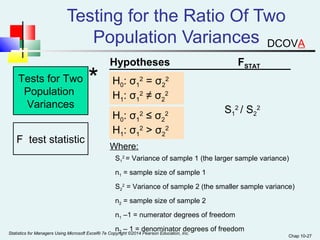
Testing for the Ratio Of Two 
Population Variances 
Tests for Two 
Population 
Variances 
F test statistic 
* Hypotheses FSTAT 
H: σ2 = σ2 
01 
2 
H1: σ1 
2 ≠ σ2 
2 
H0: σ1 
2 ≤ σ2 
2 
H1: σ1 
2 > σ2 
2 
S1 
2 / S2 
2 
Where: 
S2 = Variance of sample 1 (the larger sample variance) 
1 
n= sample size of sample 1 
1 S2 
2 = Variance of sample 2 (the smaller sample variance) 
n2 = sample size of sample 2 
n1 –1 = numerator degrees of freedom 
n2 – 1 = denominator degrees of freedom 
Statistics for Managers Using Microsoft Excel® 7e Copyright ©2014 Pearson Education, Inc. 
DCOVA
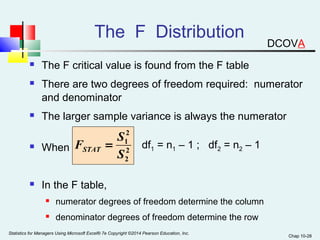
The F Distribution 
 The F critical value is found from the F table 
 There are two degrees of freedom required: numerator 
and denominator 
 The larger sample variance is always the numerator 
Chap 10-28 
 When 
F S STAT = 
 In the F table, 
2 
1 
S 
df1 = n1 – 1 ; df2 = n2 – 1 2 
2 
 numerator degrees of freedom determine the column 
 denominator degrees of freedom determine the row 
Statistics for Managers Using Microsoft Excel® 7e Copyright ©2014 Pearson Education, Inc. 
DCOVA
Chap 10-29 
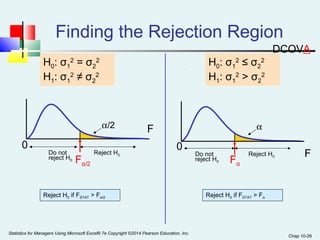
Finding the Rejection Region 
H: σ2 = σ2 
01 
2 
H1: σ1 
2 ≠ σ2 
2 
H0: σ1 
2 ≤ σ2 
2 
H1: σ1 
2 > σ2 
2 
a 
0 F 
Do not 
Reject Hreject H0 0 
Fα Reject H0 if FSTAT > Fα 
F 
0 
a/2 
Reject H0 Do not 
reject H0 Fα/2 
Reject H0 if FSTAT > Fα/2 
Statistics for Managers Using Microsoft Excel® 7e Copyright ©2014 Pearson Education, Inc. 
DCOVA
Chap 10-30 
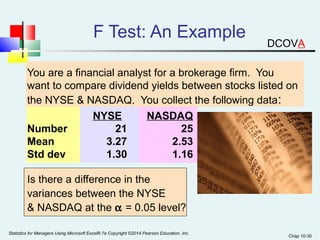
F Test: An Example 
You are a financial analyst for a brokerage firm. You 
want to compare dividend yields between stocks listed on 
the NYSE & NASDAQ. You collect the following data: 
NYSE NASDAQ 
Number 21 25 
Mean 3.27 2.53 
Std dev 1.30 1.16 
Is there a difference in the 
variances between the NYSE 
& NASDAQ at the a = 0.05 level? 
Statistics for Managers Using Microsoft Excel® 7e Copyright ©2014 Pearson Education, Inc. 
DCOVA
Chap 10-31 
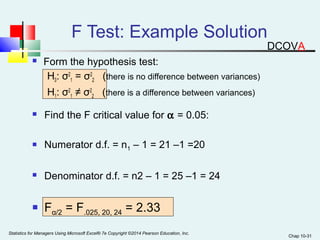
F Test: Example Solution 
 Form the hypothesis test: 
H0: σ2 
1 = σ2 
2 (there is no difference between variances) 
H1: σ2 
1 ≠ σ2 
2 (there is a difference between variances) 
 Find the F critical value for a = 0.05: 
 Numerator d.f. = n1 – 1 = 21 –1 =20 
 Denominator d.f. = n2 – 1 = 25 –1 = 24 
 Fα/2 = F.025, 20, 24 = 2.33 
Statistics for Managers Using Microsoft Excel® 7e Copyright ©2014 Pearson Education, Inc. 
DCOVA
Chap 10-32 
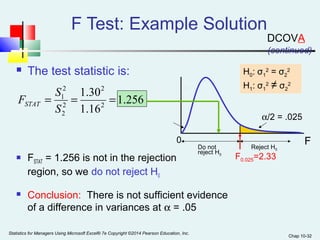
 The test statistic is: 
0 
1.256 
1.30 
= 1 = = 
S 
1.16 
2 
2 
2 
2 
2 
F S STAT 
H0: σ1 
2 = σ2 
a/2 = .025 
Reject H0 Do not 
reject H0 
F0.025=2.33 
2 
H1: σ1 
2 ≠ σ2 
2 
F Test: Example Solution 
 FSTAT = 1.256 is not in the rejection 
region, so we do not reject H0 
(continued) 
 Conclusion: There is not sufficient evidence 
of a difference in variances at a = .05 
F 
Statistics for Managers Using Microsoft Excel® 7e Copyright ©2014 Pearson Education, Inc. 
DCOVA
Chap 10-33 
Chapter Summary 
In this chapter we discussed 
 Comparing two independent samples 
 Performed pooled-variance t test for the difference in 
two means 
 Performed separate-variance t test for difference in two 
means 
 Formed confidence intervals for the difference between 
two means 
 Comparing two related samples (paired 
samples) 
 Performed paired t test for the mean difference 
 Formed confidence intervals for the mean difference 
Statistics for Managers Using Microsoft Excel® 7e Copyright ©2014 Pearson Education, Inc.
(continued) 
Chap 10-34 
Chapter Summary 
 Performing an F test for the ratio of two 
population variances 
Statistics for Managers Using Microsoft Excel® 7e Copyright ©2014 Pearson Education, Inc.

Two-sample Hypothesis Tests

  • 1.
    Statistics for ManagersUsing Microsoft Excel 7th Edition Chapter 10 Two-Sample Tests Statistics for Managers Using Microsoft Excel® 7e Copyright ©2014 Pearson Education, Inc. Chap 10-1
  • 2.
    Chap 10-2 LearningObjectives In this chapter, you learn:  How to use hypothesis testing for comparing the difference between  The means of two independent populations  The means of two related populations  The variances of two independent populations Statistics for Managers Using Microsoft Excel® 7e Copyright ©2014 Pearson Education, Inc.
  • 3.
    Chap 10-3 Two-SampleTests Two-Sample Tests Population Means, Independent Samples Population Means, Related Samples Population Variances Group 1 vs. Group 2 Same group before vs. after treatment Variance 1 vs. Variance 2 Examples: Statistics for Managers Using Microsoft Excel® 7e Copyright ©2014 Pearson Education, Inc. DCOVA
  • 4.
    Difference Between TwoMeans Chap 10-4 Population means, independent samples Goal: Test hypothesis or form a confidence interval for the difference between two population means, μ1 – μ2 The point estimate for the difference is X1 – X2 * σ1 and σ2 unknown, assumed equal σ1 and σ2 unknown, not assumed equal Statistics for Managers Using Microsoft Excel® 7e Copyright ©2014 Pearson Education, Inc. DCOVA
  • 5.
    Chap 10-5 DifferenceBetween Two Means: Independent Samples Population means, independent samples *  Different data sources  Unrelated  Independent  Sample selected from one population has no effect on the sample selected from the other population Use Sp to estimate unknown σ. Use a Pooled-Variance t test. σ1 and σ2 unknown, assumed equal σ1 and σ2 unknown, not assumed equal Use S1 and S2 to estimate unknown σ1 and σ2. Use a Separate-variance t test Statistics for Managers Using Microsoft Excel® 7e Copyright ©2014 Pearson Education, Inc. DCOVA
  • 6.
    Chap 10-6 HypothesisTests for Two Population Means Two Population Means, Independent Samples Lower-tail test: H0: μ1 ³ μ2 H1: μ1 < μ2 i.e., H0: μ1 – μ2 ³ 0 H1: μ1 – μ2 < 0 Upper-tail test: H0: μ1 ≤ μ2 H1: μ1 > μ2 i.e., H0: μ1 – μ2 ≤ 0 H1: μ1 – μ2 > 0 Two-tail test: H0: μ1 = μ2 H1: μ1 ≠ μ2 i.e., H0: μ1 – μ2 = 0 H1: μ1 – μ2 ≠ 0 Statistics for Managers Using Microsoft Excel® 7e Copyright ©2014 Pearson Education, Inc. DCOVA
  • 7.
    Chap 10-7 Hypothesistests for μ1 – μ2 Two Population Means, Independent Samples Lower-tail test: H0: μ1 – μ2 ³ 0 H1: μ1 – μ2 < 0 Upper-tail test: H0: μ1 – μ2 ≤ 0 H1: μ1 – μ2 > 0 Two-tail test: H0: μ1 – μ2 = 0 H1: μ1 – μ2 ≠ 0 a a a/2 a/2 -ta -ta/2 ta ta/2 Reject H0 if tSTAT < -ta Reject H0 if tSTAT > ta Reject H0 if tSTAT < -ta/2 or tSTAT > ta/2 Statistics for Managers Using Microsoft Excel® 7e Copyright ©2014 Pearson Education, Inc. DCOVA
  • 8.
    Hypothesis tests forμ1 - μ2 with σ1 and Chap 10-8 σ2 unknown and assumed equal Population means, independent samples Assumptions:  Samples are randomly and independently drawn  Populations are normally distributed or both sample sizes are at least 30  Population variances are unknown but assumed equal σ * 1 and σ2 unknown, assumed equal σ1 and σ2 unknown, not assumed equal Statistics for Managers Using Microsoft Excel® 7e Copyright ©2014 Pearson Education, Inc. DCOVA
  • 9.
    Hypothesis tests forμ1 - μ2 with σ1 and σ2 unknown and assumed equal (continued) - - - X X μ μ 1 2 1 2 ö Chap 10-9 Population means, independent samples • The pooled variance is: ( ) 2 ( ) (n n 1) S = n - 1S + n - 1S 2 1 1 p - + - 2 2 1) ( 1 2 • The test statistic is: 2 æ 1 S 1 • Where tSTAT has d.f. = (n1 + n2 – 2) σ * 1 and σ2 unknown, assumed equal σ1 and σ2 unknown, not assumed equal ( ) ( ) ÷ ÷ø ç çè + = 1 2 2p STAT n n t Statistics for Managers Using Microsoft Excel® 7e Copyright ©2014 Pearson Education, Inc. DCOVA
  • 10.
    Confidence interval forμ1 - μ2 with σ1 and σ2 unknown and assumed equal The confidence interval for 1 Chap 10-10 Population means, independent samples ÷ø ( ) ÷ æ ö X X tα S 1 ç çè - ± + 1 2 2p 1 2 /2 n n μ1 – μ2 is: Where tα/2 has d.f. = n1 + n2 – 2 * σ1 and σ2 unknown, assumed equal σ1 and σ2 unknown, not assumed equal Statistics for Managers Using Microsoft Excel® 7e Copyright ©2014 Pearson Education, Inc. DCOVA
  • 11.
    Pooled-Variance t TestExample Chap 10-11 You are a financial analyst for a brokerage firm. Is there a difference in dividend yield between stocks listed on the NYSE & NASDAQ? You collect the following data: NYSE NASDAQ Number 21 25 Sample mean 3.27 2.53 Sample std dev 1.30 1.16 Assuming both populations are approximately normal with equal variances, is there a difference in mean yield (a = 0.05)? Statistics for Managers Using Microsoft Excel® 7e Copyright ©2014 Pearson Education, Inc. DCOVA
  • 12.
    The test statisticis: ( ) ( ) ( ) 2.040 Chap 10-12 Pooled-Variance t Test Example: Calculating the Test Statistic = - - 3.27 2.53 0 - - - 1 2 1 2 = 1 1.5021 1 X X μ μ 1 æ S 1 ö çè ö ( ) ( ) ( ) ( = 21 - 11.30 + 25 - 11.16 ) 1.5021 (21-1) (25 1) S = n - 1S + n - 1S (n 1) (n 1) 2 2 1 2 2 2 2 2 2 1 1 p = + - - + - 25 21 n n t 1 2 2p ÷ø æ + ÷ ÷ø ç çè + = (continued) H0: μ1 - μ2 = 0 i.e. (μ1 = μ2) H1: μ1 - μ2 ≠ 0 i.e. (μ1 ≠ μ2) Statistics for Managers Using Microsoft Excel® 7e Copyright ©2014 Pearson Education, Inc. DCOVA
  • 13.
    Reject H0 RejectH0 -2.0154 0 2.0154 t Reject H0 at a = 0.05 There is evidence of a difference in means. Chap 10-13 Pooled-Variance t Test Example: Hypothesis Test Solution H0: μ1 - μ2 = 0 i.e. (μ1 = μ2) H1: μ1 - μ2 ≠ 0 i.e. (μ1 ≠ μ2) a = 0.05 df = 21 + 25 - 2 = 44 Critical Values: t = ± 2.0154 Test Statistic: Decision: Conclusion: .025 .025 2.040 2.040 t 3.27 2.53 = 1 = - ö 25 çè 1.5021 1 21 ÷ø æ + Statistics for Managers Using Microsoft Excel® 7e Copyright ©2014 Pearson Education, Inc. DCOVA
  • 14.
    Chap 10-14 Pooled-Variancet Test Example: Confidence Interval for μ1 - μ2 Since we rejected H0 can we be 95% confident that μNYSE > μNASDAQ? 95% Confidence Interval for μNYSE - μNASDAQ ( ) 1 ö 0.74 2.0154 0.3628 (0.009, 1.471) ç çè æ 1 2 = ± ´ = ÷ ÷ø /2 n X X S 1 - ± + a t n 1 2 2p Since 0 is less than the entire interval, we can be 95% Statistics for Managers Using Microsoft Excel® 7e Copyright ©2014 Pearson Education, Inc. DCOVA
  • 15.
    Hypothesis tests forμ1 - μ2 with σ1 and σ2 unknown, not assumed equal Chap 10-15 Population means, independent samples Assumptions:  Samples are randomly and independently drawn  Populations are normally distributed or both sample sizes are at least 30  Population variances are unknown and cannot be assumed * to be equal σ1 and σ2 unknown, assumed equal σ1 and σ2 unknown, not assumed equal Statistics for Managers Using Microsoft Excel® 7e Copyright ©2014 Pearson Education, Inc. DCOVA
  • 16.
    Hypothesis tests forμ1 - μ2 with σ1 and σ2 unknown and not assumed equal t = X - X - μ - μ 1 2 1 2 Chap 10-16 Population means, independent samples (continued) * σ1 and σ2 unknown, assumed equal σ1 and σ2 unknown, not assumed equal The test statistic is: ( ) ( ) 22 2 2 1 1 STAT S n S n + tSTAT has d.f. ν = 2 2 S ö 2 2 n S ö æ + n 1 æ S 2 1 n S 2 1 ö æ n 1 n n 2 2 2 1 2 1 2 2 1 - ÷ ÷ø ç çè - ÷ ÷ø ç çè ÷ ÷ø ç çè + n = DCOVA Statistics for Managers Using Microsoft Excel® 7e Copyright ©2014 Pearson Education, Inc.
  • 17.
    Separate-Variance t TestExample Chap 10-17 You are a financial analyst for a brokerage firm. Is there a difference in dividend yield between stocks listed on the NYSE & NASDAQ? You collect the following data: NYSE NASDAQ Number 21 25 Sample mean 3.27 2.53 Sample std dev 1.30 1.16 Assuming both populations are approximately normal with unequal variances, is there a difference in mean yield (a = 0.05)? Statistics for Managers Using Microsoft Excel® 7e Copyright ©2014 Pearson Education, Inc. DCOVA
  • 18.
    Separate-Variance t TestExample: Chap 10-18 Calculating the Test Statistic The test statistic is: ( ) ( ) ( ) = 3.27 - 2.53 - 0 2.019 = - - - 1 2 1 2 = 1.16 25 1.30 21 t X X μ μ S n S 2 1 n 2 2 22 2 1 ö ÷ ÷ø æ ç çè + ö ÷ ÷ø æ ç çè + (continued) H0: μ1 - μ2 = 0 i.e. (μ1 = μ2) H1: μ1 - μ2 ≠ 0 i.e. (μ1 ≠ μ2) 2 2 2 1.16 ö 1.16 25 1.30 æ 1.30 21 2 2 S ö 2 2 n æ S 2 1 n S S 2 1 ö æ + ö æ ö æ + ö æ Statistics for Managers Using Microsoft Excel® 7e Copyright ©2014 Pearson Education, Inc. DCOVA 40.57 24 20 25 21 n 1 n 1 n n 2 2 2 2 2 2 2 1 2 1 2 2 1 = ÷ ÷ø ç çè ÷ ÷ø ç çè ÷ ÷ø ç çè + = - ÷ ÷ø ç çè - ÷ ÷ø ç çè ÷ ÷ø ç çè + n = Use degrees of freedom = 40
  • 19.
    Separate-Variance t TestExample: Reject H0 Reject H0 -2.021 0 2.021 t Fail To Reject H0 at a = 0.05 There is no evidence of a difference in means. Chap 10-19 Hypothesis Test Solution H0: μ1 - μ2 = 0 i.e. (μ1 = μ2) H1: μ1 - μ2 ≠ 0 i.e. (μ1 ≠ μ2) a = 0.05 df = 40 Critical Values: t = ± 2.021 Test Statistic: Decision: Conclusion: .025 .025 2.019 t = 2.019 Statistics for Managers Using Microsoft Excel® 7e Copyright ©2014 Pearson Education, Inc. DCOVA
  • 20.
    Chap 10-20 RelatedPopulations The Paired Difference Test Tests Means of 2 Related Populations  Paired or matched samples  Repeated measures (before/after)  Use difference between paired values:  Eliminates Variation Among Subjects  Assumptions:  The difference is Normally Distributed  Or, if not Normal, use large samples Related samples Di = X1i - X2i Statistics for Managers Using Microsoft Excel® 7e Copyright ©2014 Pearson Education, Inc. DCOVA
  • 21.
    (D D) Chap10-21 Related Populations The Paired Difference Test The ith paired difference is Di , where Related samples Di = X1i - X2i i å= = The point estimate for the paired difference population mean μD is D : n D D n i 1 = n is the number of pairs in the paired sample - n 1 S n å= i 1 2 i D - The sample standard deviation is SD (continued) Statistics for Managers Using Microsoft Excel® 7e Copyright ©2014 Pearson Education, Inc. DCOVA
  • 22.
    Chap 10-22 ThePaired Difference Test: Finding tSTAT  The test statistic for μD is: Paired samples t D μ n S D STAT D = -  Where tSTAT has n - 1 d.f. Statistics for Managers Using Microsoft Excel® 7e Copyright ©2014 Pearson Education, Inc. DCOVA
  • 23.
    Chap 10-23 ThePaired Difference Test: Possible Hypotheses Lower-tail test: H0: μD ³ 0 H1: μD < 0 Upper-tail test: H0: μD ≤ 0 H1: μD > 0 Two-tail test: H0: μD = 0 H1: μD ≠ 0 Paired Samples a a a/2 a/2 -ta -ta/2 ta ta/2 Reject H0 if tSTAT < -ta Reject H0 if tSTAT > ta Reject H0 if tSTAT < -ta/2 or tSTAT > ta/2 Where tSTAT has n - 1 d.f. Statistics for Managers Using Microsoft Excel® 7e Copyright ©2014 Pearson Education, Inc. DCOVA
  • 24.
    Chap 10-24 ThePaired Difference Confidence Interval Paired The confidence interval for μD is samples (D - D) n 1 S n å= i 1 2 i SD n = D - a / 2 D ± t where Statistics for Managers Using Microsoft Excel® 7e Copyright ©2014 Pearson Education, Inc. DCOVA
  • 25.
     Assume yousend your salespeople to a “customer service” training workshop. Has the training made a difference in the number of complaints? You collect the following data: = -4.2 (D - D) Chap 10-25 Paired Difference Test: Example Number of Complaints: (2) - (1) Salesperson Before (1) After (2) Difference, Di C.B. 6 4 - 2 T.F. 20 6 -14 M.H. 3 2 - 1 R.K. 0 0 0 M.O. 4 0 - 4 -21 D = S Di n 5.67 n 1 S 2 i D = - = å Statistics for Managers Using Microsoft Excel® 7e Copyright ©2014 Pearson Education, Inc. DCOVA
  • 26.
    Chap 10-26 PairedDifference Test: Solution  Has the training made a difference in the number of complaints (at the 0.01 level)? H0: μD = 0 H1: μD ¹ 0 D = - 4.2 1.66 t0.005 = ± 4.604 d.f. = n - 1 = 4 Test Statistic: 4.2 0 5.67/ 5 t μ S / n D STAT = D - D = - - = - Reject a/2 Reject a/2 - 4.604 4.604 - 1.66 Decision: Do not reject H0 (tstat is not in the reject region) Conclusion: There is not a significant change in the number of complaints. a = .01 Statistics for Managers Using Microsoft Excel® 7e Copyright ©2014 Pearson Education, Inc. DCOVA
  • 27.
    Chap 10-27 Testingfor the Ratio Of Two Population Variances Tests for Two Population Variances F test statistic * Hypotheses FSTAT H: σ2 = σ2 01 2 H1: σ1 2 ≠ σ2 2 H0: σ1 2 ≤ σ2 2 H1: σ1 2 > σ2 2 S1 2 / S2 2 Where: S2 = Variance of sample 1 (the larger sample variance) 1 n= sample size of sample 1 1 S2 2 = Variance of sample 2 (the smaller sample variance) n2 = sample size of sample 2 n1 –1 = numerator degrees of freedom n2 – 1 = denominator degrees of freedom Statistics for Managers Using Microsoft Excel® 7e Copyright ©2014 Pearson Education, Inc. DCOVA
  • 28.
    The F Distribution  The F critical value is found from the F table  There are two degrees of freedom required: numerator and denominator  The larger sample variance is always the numerator Chap 10-28  When F S STAT =  In the F table, 2 1 S df1 = n1 – 1 ; df2 = n2 – 1 2 2  numerator degrees of freedom determine the column  denominator degrees of freedom determine the row Statistics for Managers Using Microsoft Excel® 7e Copyright ©2014 Pearson Education, Inc. DCOVA
  • 29.
    Chap 10-29 Findingthe Rejection Region H: σ2 = σ2 01 2 H1: σ1 2 ≠ σ2 2 H0: σ1 2 ≤ σ2 2 H1: σ1 2 > σ2 2 a 0 F Do not Reject Hreject H0 0 Fα Reject H0 if FSTAT > Fα F 0 a/2 Reject H0 Do not reject H0 Fα/2 Reject H0 if FSTAT > Fα/2 Statistics for Managers Using Microsoft Excel® 7e Copyright ©2014 Pearson Education, Inc. DCOVA
  • 30.
    Chap 10-30 FTest: An Example You are a financial analyst for a brokerage firm. You want to compare dividend yields between stocks listed on the NYSE & NASDAQ. You collect the following data: NYSE NASDAQ Number 21 25 Mean 3.27 2.53 Std dev 1.30 1.16 Is there a difference in the variances between the NYSE & NASDAQ at the a = 0.05 level? Statistics for Managers Using Microsoft Excel® 7e Copyright ©2014 Pearson Education, Inc. DCOVA
  • 31.
    Chap 10-31 FTest: Example Solution  Form the hypothesis test: H0: σ2 1 = σ2 2 (there is no difference between variances) H1: σ2 1 ≠ σ2 2 (there is a difference between variances)  Find the F critical value for a = 0.05:  Numerator d.f. = n1 – 1 = 21 –1 =20  Denominator d.f. = n2 – 1 = 25 –1 = 24  Fα/2 = F.025, 20, 24 = 2.33 Statistics for Managers Using Microsoft Excel® 7e Copyright ©2014 Pearson Education, Inc. DCOVA
  • 32.
    Chap 10-32 The test statistic is: 0 1.256 1.30 = 1 = = S 1.16 2 2 2 2 2 F S STAT H0: σ1 2 = σ2 a/2 = .025 Reject H0 Do not reject H0 F0.025=2.33 2 H1: σ1 2 ≠ σ2 2 F Test: Example Solution  FSTAT = 1.256 is not in the rejection region, so we do not reject H0 (continued)  Conclusion: There is not sufficient evidence of a difference in variances at a = .05 F Statistics for Managers Using Microsoft Excel® 7e Copyright ©2014 Pearson Education, Inc. DCOVA
  • 33.
    Chap 10-33 ChapterSummary In this chapter we discussed  Comparing two independent samples  Performed pooled-variance t test for the difference in two means  Performed separate-variance t test for difference in two means  Formed confidence intervals for the difference between two means  Comparing two related samples (paired samples)  Performed paired t test for the mean difference  Formed confidence intervals for the mean difference Statistics for Managers Using Microsoft Excel® 7e Copyright ©2014 Pearson Education, Inc.
  • 34.
    (continued) Chap 10-34 Chapter Summary  Performing an F test for the ratio of two population variances Statistics for Managers Using Microsoft Excel® 7e Copyright ©2014 Pearson Education, Inc.