Inverse FunctionsFinding the Inverse
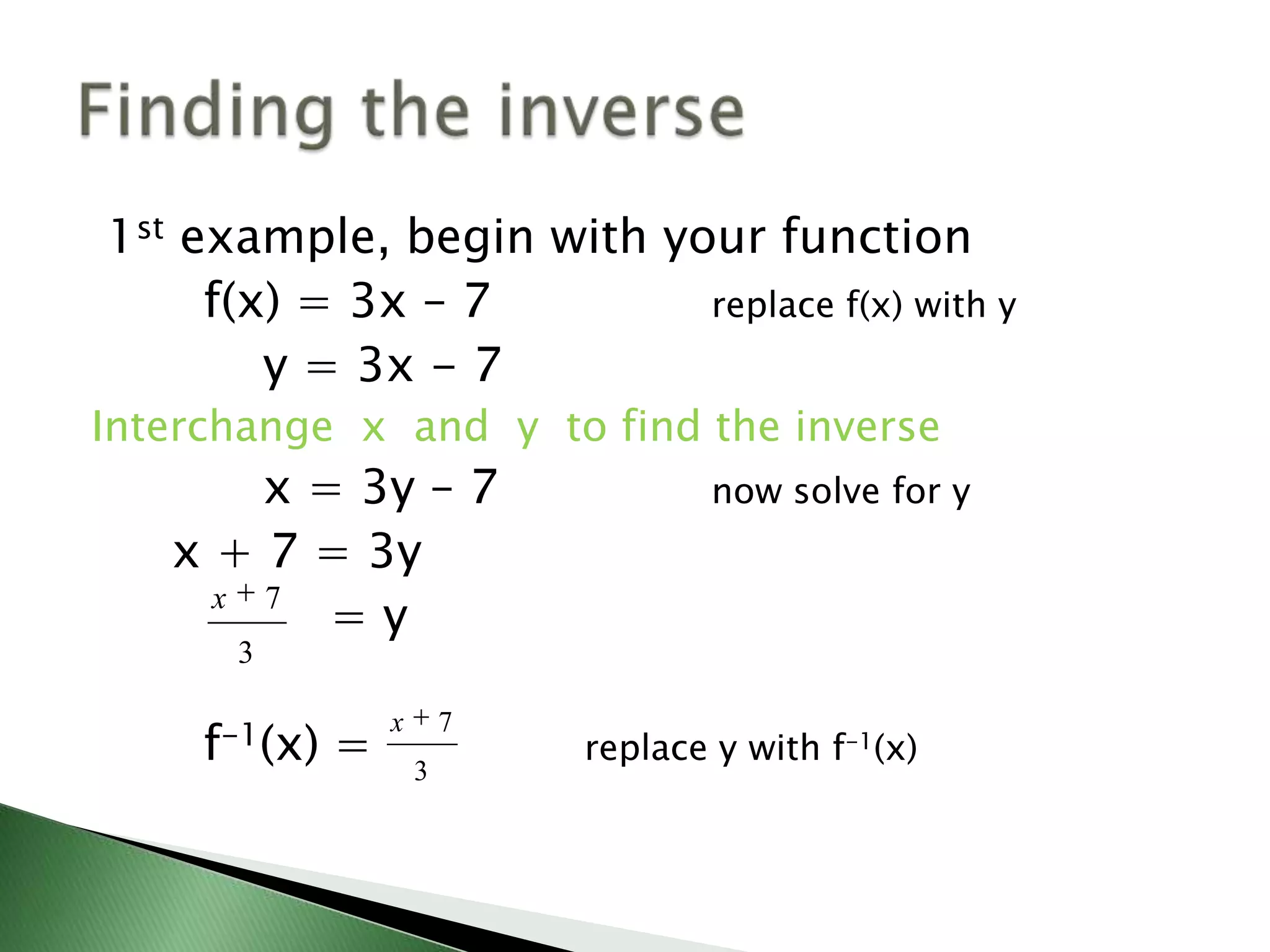
 1st example, begin with your function			f(x) = 3x – 7		replace f(x) with y		    y = 3x - 7Interchange  x  and  y  to find the inverse		    x = 3y – 7		now solve for y	   x + 7 = 3y			= y		f-1(x) = 		replace y with f-1(x)Finding the inverse
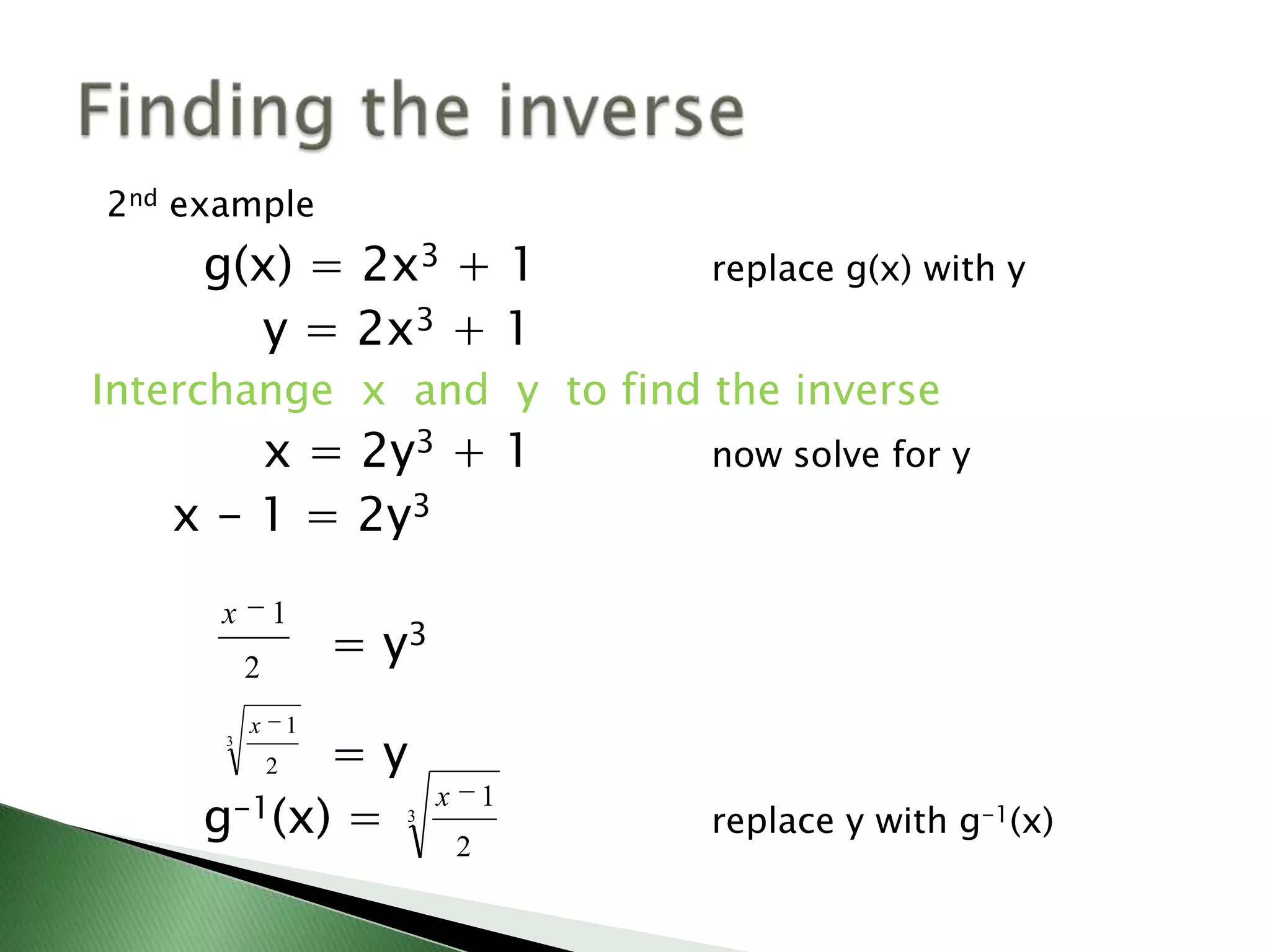
2nd example		g(x) = 2x3 + 1		replace g(x) with y		    y = 2x3 + 1Interchange  x  and  y  to find the inverse		    x = 2y3 + 1 		now solve for y	   x - 1 = 2y3			= y3= y 		g-1(x) = 			replace y with g-1(x)Finding the inverse
Recall, to verify you have found the inverse you check that composition of the function with the inverse, in both orders, equals xUsing specific ordered pairs can illustrate how the inverse works, but does not verify that it is the inverse.Verifying inverses
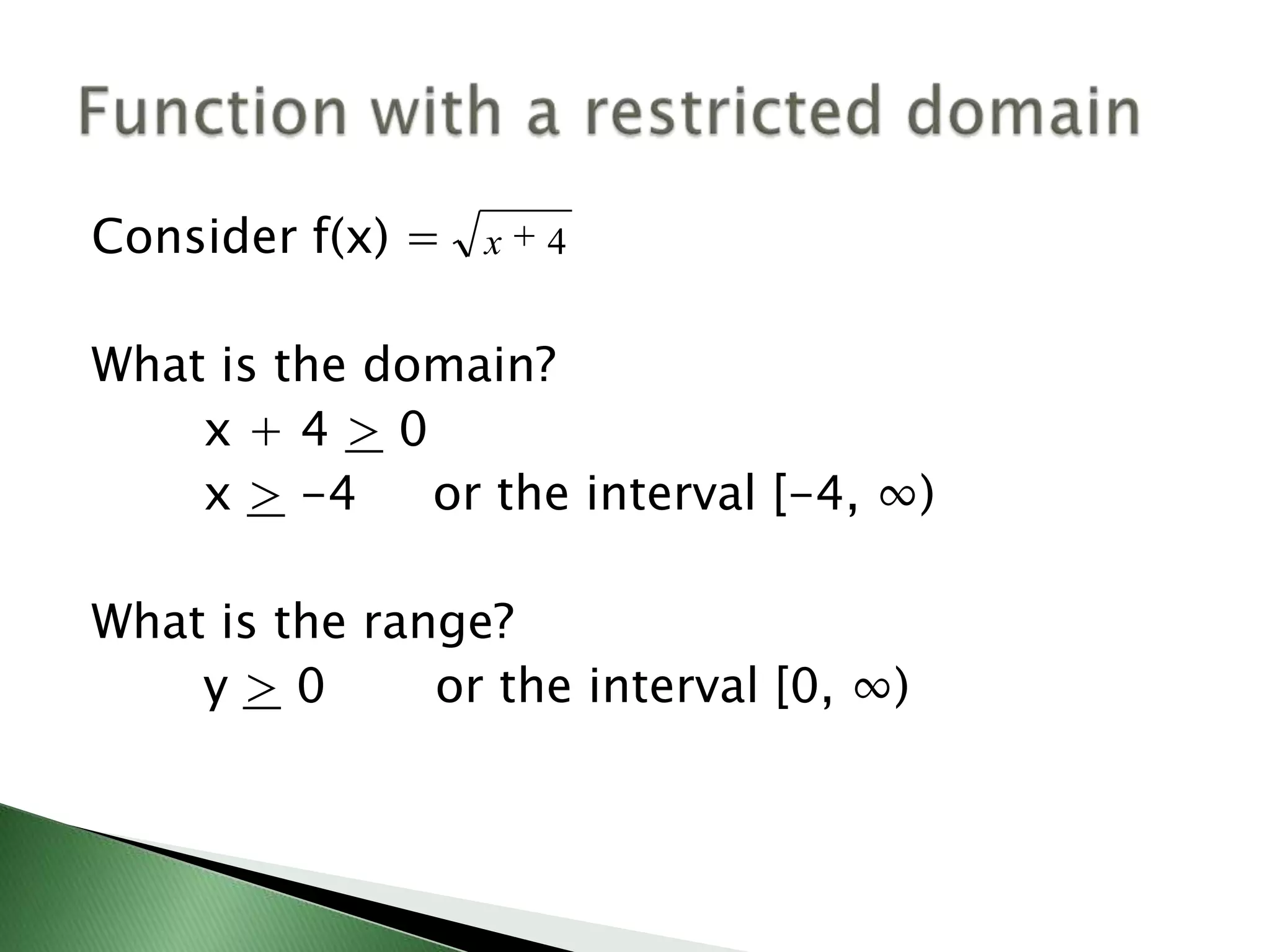
Consider f(x) =What is the domain?		x + 4 > 0		x > -4     or the interval [-4, ∞)What is the range?		y > 0	       or the interval [0, ∞)Function with a restricted domain
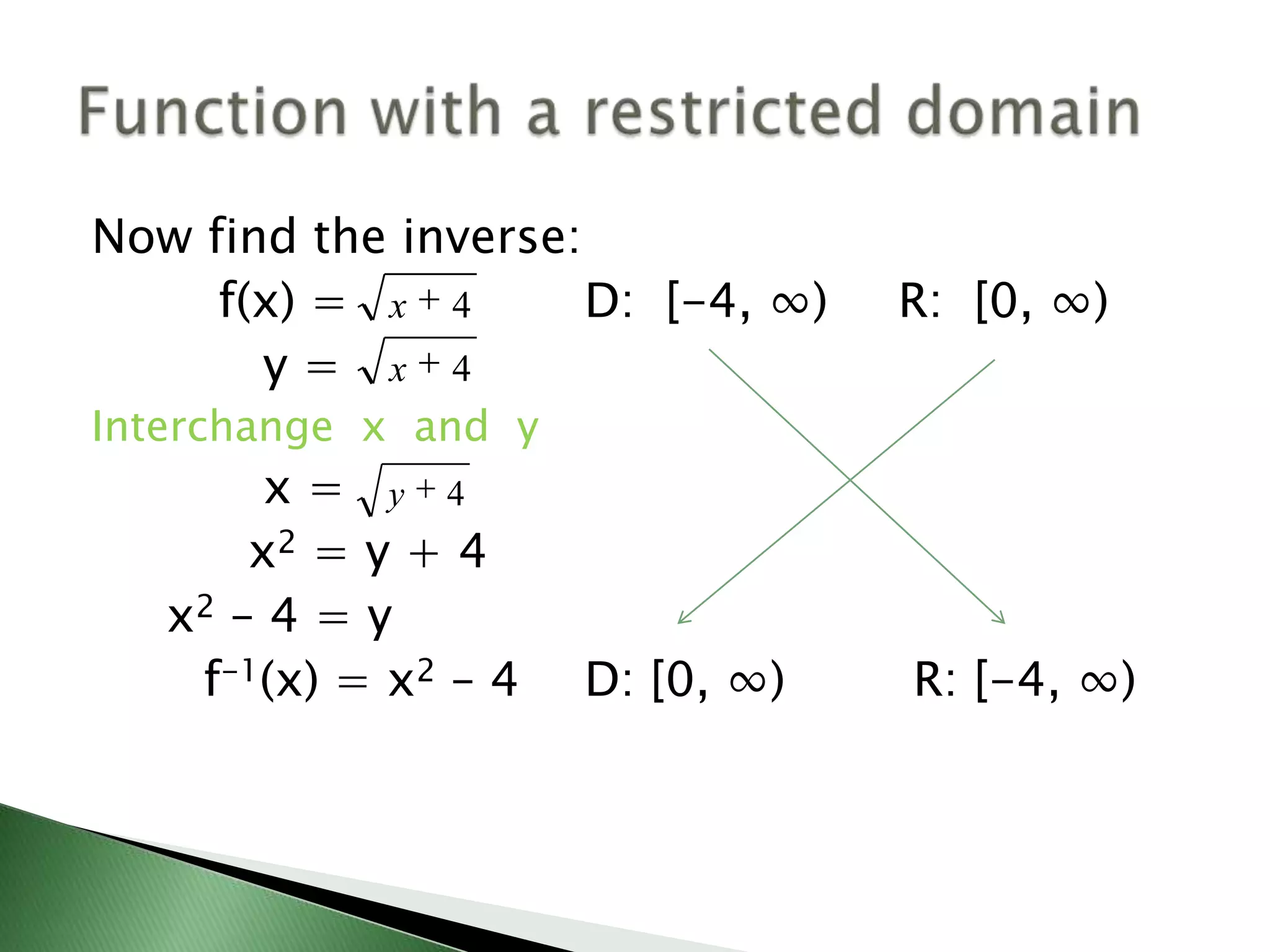
Now find the inverse:		 f(x) =		D:  [-4, ∞)	    R:  [0, ∞)		    y =Interchange  x  and  y		    x = 		   x2 = y + 4     x2 – 4 = y		f-1(x) = x2 – 4	D: [0, ∞)	     R: [-4, ∞)Function with a restricted domain
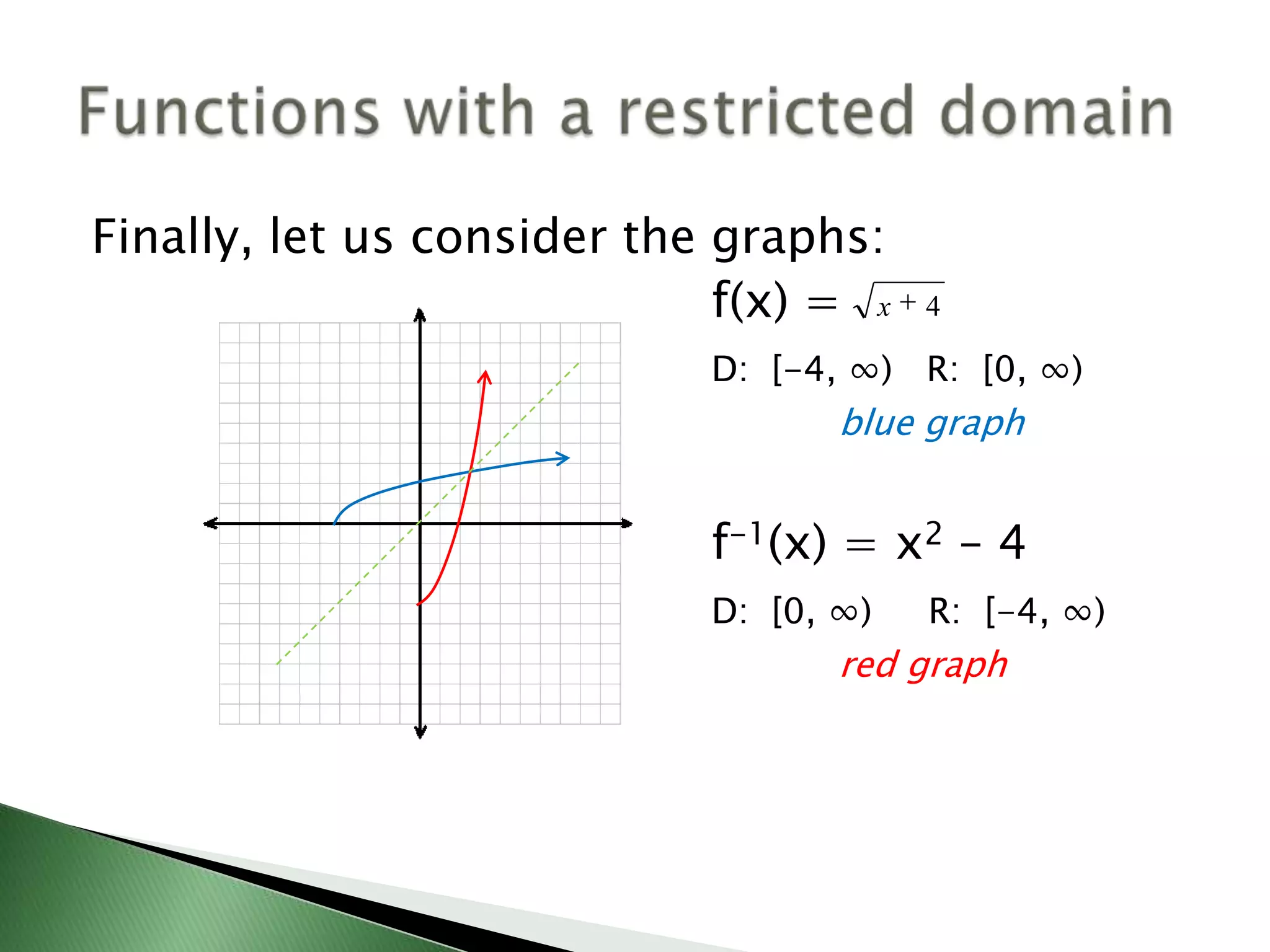
Finally, let us consider the graphs:						f(x) =D:  [-4, ∞)   R:  [0, ∞)							blue graph						f-1(x) = x2 – 4	D:  [0, ∞)     R:  [-4, ∞)							red graphFunctions with a restricted domain
2nd exampleConsider g(x) = 5 - x2 D:  [0, ∞)What is the range?			Make a very quick sketch of the graph				R: (-∞, 5]Function with a restricted domain
Now find the inverse:		 g(x) = 5 - x2 D:  [0, ∞)   R: (-∞, 5]		     y = 5 - x2Interchange  x  and  y		    x = 5 - y2		   x – 5 = -y2     	   5 – x = y2			= ybut do we want the + or – square root?		g-1(x) = 		 D: (-∞, 5]    R: [0, ∞) Function with a restricted domain
And, now the graphs:						 g(x) = 5 - x2						D:  [0, ∞)   R: (-∞, 5]							blue graph						g-1(x) = 	D: (-∞, 5]    R: [0, ∞) 							red graphFunctions with a restricted domain
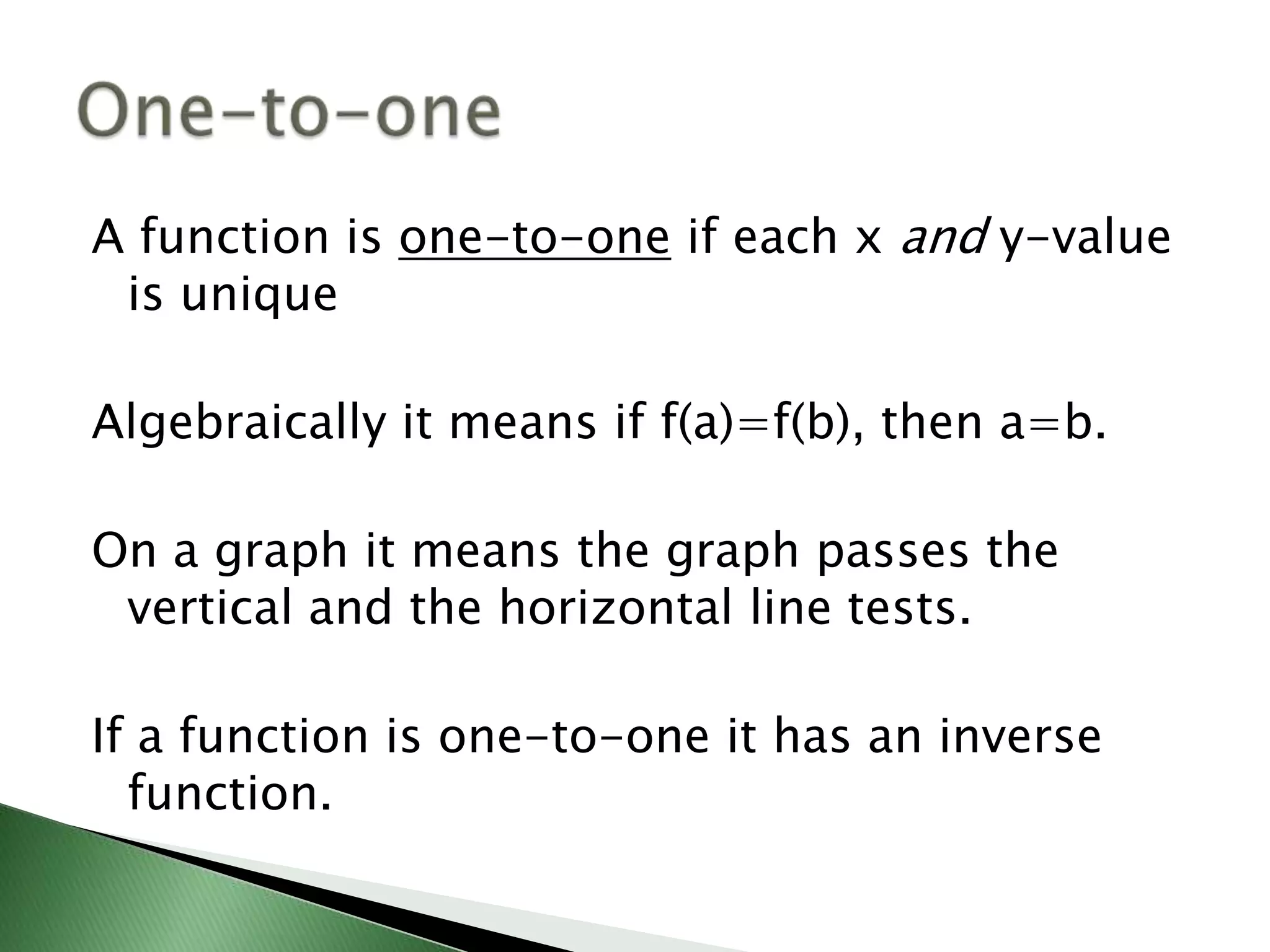
A function is one-to-one if each x and y-value is uniqueAlgebraically it means if f(a)=f(b), then a=b.On a graph it means the graph passes the vertical and the horizontal line tests.If a function is one-to-one it has an inverse function.One-to-one

Inverse Functions

  • 1.
  • 2.
    1st example,begin with your function f(x) = 3x – 7 replace f(x) with y y = 3x - 7Interchange x and y to find the inverse x = 3y – 7 now solve for y x + 7 = 3y = y f-1(x) = replace y with f-1(x)Finding the inverse
  • 3.
    2nd example g(x) =2x3 + 1 replace g(x) with y y = 2x3 + 1Interchange x and y to find the inverse x = 2y3 + 1 now solve for y x - 1 = 2y3 = y3= y g-1(x) = replace y with g-1(x)Finding the inverse
  • 4.
    Recall, to verifyyou have found the inverse you check that composition of the function with the inverse, in both orders, equals xUsing specific ordered pairs can illustrate how the inverse works, but does not verify that it is the inverse.Verifying inverses
  • 5.
    Consider f(x) =Whatis the domain? x + 4 > 0 x > -4 or the interval [-4, ∞)What is the range? y > 0 or the interval [0, ∞)Function with a restricted domain
  • 6.
    Now find theinverse: f(x) = D: [-4, ∞) R: [0, ∞) y =Interchange x and y x = x2 = y + 4 x2 – 4 = y f-1(x) = x2 – 4 D: [0, ∞) R: [-4, ∞)Function with a restricted domain
  • 7.
    Finally, let usconsider the graphs: f(x) =D: [-4, ∞) R: [0, ∞) blue graph f-1(x) = x2 – 4 D: [0, ∞) R: [-4, ∞) red graphFunctions with a restricted domain
  • 8.
    2nd exampleConsider g(x)= 5 - x2 D: [0, ∞)What is the range? Make a very quick sketch of the graph R: (-∞, 5]Function with a restricted domain
  • 9.
    Now find theinverse: g(x) = 5 - x2 D: [0, ∞) R: (-∞, 5] y = 5 - x2Interchange x and y x = 5 - y2 x – 5 = -y2 5 – x = y2 = ybut do we want the + or – square root? g-1(x) = D: (-∞, 5] R: [0, ∞) Function with a restricted domain
  • 10.
    And, now thegraphs: g(x) = 5 - x2 D: [0, ∞) R: (-∞, 5] blue graph g-1(x) = D: (-∞, 5] R: [0, ∞) red graphFunctions with a restricted domain
  • 11.
    A function isone-to-one if each x and y-value is uniqueAlgebraically it means if f(a)=f(b), then a=b.On a graph it means the graph passes the vertical and the horizontal line tests.If a function is one-to-one it has an inverse function.One-to-one