Inverse Functions
Inverse Functions
A function f(x) = y takes an input x and produces one output y.
Inverse Functions
A function f(x) = y takes an input x and produces one output y.
We like to do the reverse, that is, if we know the output y, what
was (were) the input x?
Inverse Functions
A function f(x) = y takes an input x and produces one output y.
We like to do the reverse, that is, if we know the output y, what
was (were) the input x?
This procedure of associating the output y to the input x may
or may not be a function.
Inverse Functions
A function f(x) = y takes an input x and produces one output y.
We like to do the reverse, that is, if we know the output y, what
was (were) the input x?
This procedure of associating the output y to the input x may
or may not be a function. If it is a function, it is called the
inverse function of f(x)
Inverse Functions
A function f(x) = y takes an input x and produces one output y.
We like to do the reverse, that is, if we know the output y, what
was (were) the input x?
This procedure of associating the output y to the input x may
or may not be a function. If it is a function, it is called the
inverse function of f(x) and it is denoted as f -1(y).
Inverse Functions
A function f(x) = y takes an input x and produces one output y.
We like to do the reverse, that is, if we know the output y, what
was (were) the input x?
This procedure of associating the output y to the input x may
or may not be a function. If it is a function, it is called the
inverse function of f(x) and it is denoted as f -1(y).
We say f(x) and f -1(y) are the inverse of each other.
Inverse Functions
A function f(x) = y takes an input x and produces one output y.
We like to do the reverse, that is, if we know the output y, what
was (were) the input x?
This procedure of associating the output y to the input x may
or may not be a function. If it is a function, it is called the
inverse function of f(x) and it is denoted as f -1(y).
We say f(x) and f -1(y) are the inverse of each other.
Example A. Let f(x) = x2 = y. Suppose y = 9, what is (are) the
input x that produces y = 9? Is this reverse procedure a
function?
Inverse Functions
A function f(x) = y takes an input x and produces one output y.
We like to do the reverse, that is, if we know the output y, what
was (were) the input x?
This procedure of associating the output y to the input x may
or may not be a function. If it is a function, it is called the
inverse function of f(x) and it is denoted as f -1(y).
We say f(x) and f -1(y) are the inverse of each other.
Example A. Let f(x) = x2 = y. Suppose y = 9, what is (are) the
input x that produces y = 9? Is this reverse procedure a
function?
Since f(x) = x2 = 9,
Inverse Functions
A function f(x) = y takes an input x and produces one output y.
We like to do the reverse, that is, if we know the output y, what
was (were) the input x?
This procedure of associating the output y to the input x may
or may not be a function. If it is a function, it is called the
inverse function of f(x) and it is denoted as f -1(y).
We say f(x) and f -1(y) are the inverse of each other.
Example A. Let f(x) = x2 = y. Suppose y = 9, what is (are) the
input x that produces y = 9? Is this reverse procedure a
function?
Since f(x) = x2 = 9,
so x = ±√9
x = – 3, x = 3.
Inverse Functions
A function f(x) = y takes an input x and produces one output y.
We like to do the reverse, that is, if we know the output y, what
was (were) the input x?
This procedure of associating the output y to the input x may
or may not be a function. If it is a function, it is called the
inverse function of f(x) and it is denoted as f -1(y).
We say f(x) and f -1(y) are the inverse of each other.
Example A. Let f(x) = x2 = y. Suppose y = 9, what is (are) the
input x that produces y = 9? Is this reverse procedure a
function?
Since f(x) = x2 = 9,
so x = ±√9
x = – 3, x = 3.
This reverse procedure takes y = 9 and associates to it two
different answers so it is not a function.
What condition is needed for a function to have an inverse?
Inverse Functions
The reverse of the function f(x) = x2 fails to be a function
because x2 produces the same output with two or more
different inputs
Inverse Functions
The reverse of the function f(x) = x2 fails to be a function
because x2 produces the same output with two or more
different inputs (e.g. f(3) = f(–3) = 9).
Inverse Functions
The reverse of the function f(x) = x2 fails to be a function
because x2 produces the same output with two or more
different inputs (e.g. f(3) = f(–3) = 9). This prevents us from
pinpointing exactly what x is even that we know the output is 9.
Inverse Functions
The reverse of the function f(x) = x2 fails to be a function
because x2 produces the same output with two or more
different inputs (e.g. f(3) = f(–3) = 9). This prevents us from
pinpointing exactly what x is even that we know the output is 9.
A function is one-to-one if different inputs produce different
outputs.
Inverse Functions
The reverse of the function f(x) = x2 fails to be a function
because x2 produces the same output with two or more
different inputs (e.g. f(3) = f(–3) = 9). This prevents us from
pinpointing exactly what x is even that we know the output is 9.
A function is one-to-one if different inputs produce different
outputs. That is, f(x) is said to be one-to-one if for every two
different inputs u and v then f(u)  f(v).
Inverse Functions
The reverse of the function f(x) = x2 fails to be a function
because x2 produces the same output with two or more
different inputs (e.g. f(3) = f(–3) = 9). This prevents us from
pinpointing exactly what x is even that we know the output is 9.
A function is one-to-one if different inputs produce different
outputs. That is, f(x) is said to be one-to-one if for every two
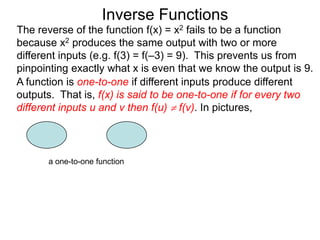
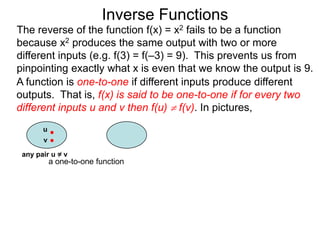
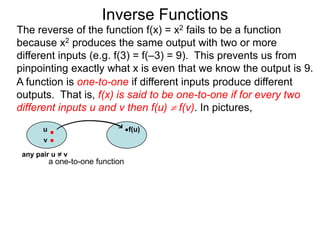
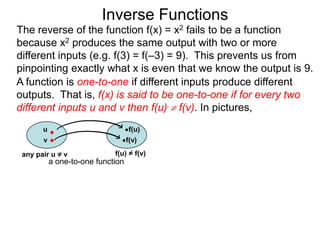
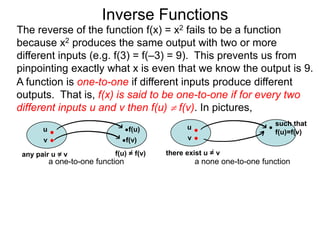
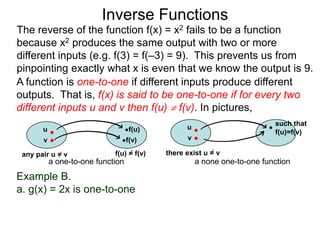
different inputs u and v then f(u)  f(v). In pictures,


      a one-to-one function
Inverse Functions
The reverse of the function f(x) = x2 fails to be a function
because x2 produces the same output with two or more
different inputs (e.g. f(3) = f(–3) = 9). This prevents us from
pinpointing exactly what x is even that we know the output is 9.
A function is one-to-one if different inputs produce different
outputs. That is, f(x) is said to be one-to-one if for every two
different inputs u and v then f(u)  f(v). In pictures,
       u
       v

 any pair u = v
           a one-to-one function
Inverse Functions
The reverse of the function f(x) = x2 fails to be a function
because x2 produces the same output with two or more
different inputs (e.g. f(3) = f(–3) = 9). This prevents us from
pinpointing exactly what x is even that we know the output is 9.
A function is one-to-one if different inputs produce different
outputs. That is, f(x) is said to be one-to-one if for every two
different inputs u and v then f(u)  f(v). In pictures,
       u                           f(u)
       v

 any pair u = v
           a one-to-one function
Inverse Functions
The reverse of the function f(x) = x2 fails to be a function
because x2 produces the same output with two or more
different inputs (e.g. f(3) = f(–3) = 9). This prevents us from
pinpointing exactly what x is even that we know the output is 9.
A function is one-to-one if different inputs produce different
outputs. That is, f(x) is said to be one-to-one if for every two
different inputs u and v then f(u)  f(v). In pictures,
       u                           f(u)
       v                           f(v)

 any pair u = v              f(u) = f(v)
           a one-to-one function
Inverse Functions
The reverse of the function f(x) = x2 fails to be a function
because x2 produces the same output with two or more
different inputs (e.g. f(3) = f(–3) = 9). This prevents us from
pinpointing exactly what x is even that we know the output is 9.
A function is one-to-one if different inputs produce different
outputs. That is, f(x) is said to be one-to-one if for every two
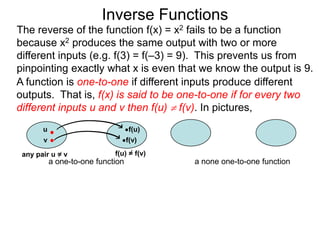
different inputs u and v then f(u)  f(v). In pictures,
       u                           f(u)
       v                           f(v)

 any pair u = v              f(u) = f(v)
           a one-to-one function           a none one-to-one function
Inverse Functions
The reverse of the function f(x) = x2 fails to be a function
because x2 produces the same output with two or more
different inputs (e.g. f(3) = f(–3) = 9). This prevents us from
pinpointing exactly what x is even that we know the output is 9.
A function is one-to-one if different inputs produce different
outputs. That is, f(x) is said to be one-to-one if for every two
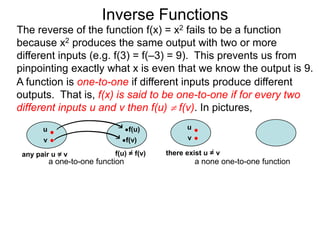
different inputs u and v then f(u)  f(v). In pictures,
       u                           f(u)          u
       v                           f(v)          v

 any pair u = v              f(u) = f(v)   there exist u = v
           a one-to-one function                     a none one-to-one function
Inverse Functions
The reverse of the function f(x) = x2 fails to be a function
because x2 produces the same output with two or more
different inputs (e.g. f(3) = f(–3) = 9). This prevents us from
pinpointing exactly what x is even that we know the output is 9.
A function is one-to-one if different inputs produce different
outputs. That is, f(x) is said to be one-to-one if for every two
different inputs u and v then f(u)  f(v). In pictures,
       u                           f(u)          u
       v                           f(v)          v

 any pair u = v              f(u) = f(v)   there exist u = v
           a one-to-one function                     a none one-to-one function
Inverse Functions
The reverse of the function f(x) = x2 fails to be a function
because x2 produces the same output with two or more
different inputs (e.g. f(3) = f(–3) = 9). This prevents us from
pinpointing exactly what x is even that we know the output is 9.
A function is one-to-one if different inputs produce different
outputs. That is, f(x) is said to be one-to-one if for every two
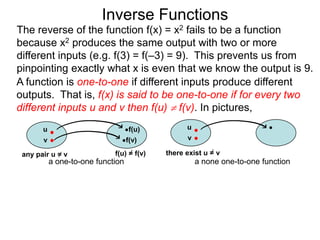
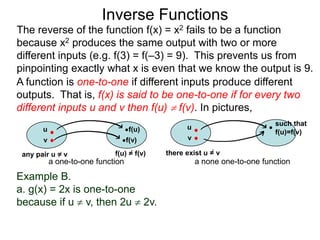
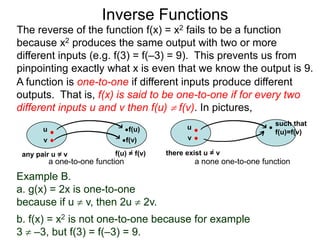
different inputs u and v then f(u)  f(v). In pictures,
                                                                          such that
       u                           f(u)          u
                                                                          f(u)=f(v)
       v                           f(v)          v

 any pair u = v              f(u) = f(v)   there exist u = v
           a one-to-one function                     a none one-to-one function
Inverse Functions
The reverse of the function f(x) = x2 fails to be a function
because x2 produces the same output with two or more
different inputs (e.g. f(3) = f(–3) = 9). This prevents us from
pinpointing exactly what x is even that we know the output is 9.
A function is one-to-one if different inputs produce different
outputs. That is, f(x) is said to be one-to-one if for every two
different inputs u and v then f(u)  f(v). In pictures,
                                                                          such that
       u                           f(u)          u
                                                                          f(u)=f(v)
       v                           f(v)          v

 any pair u = v              f(u) = f(v)   there exist u = v
           a one-to-one function                     a none one-to-one function
Example B.
a. g(x) = 2x is one-to-one
Inverse Functions
The reverse of the function f(x) = x2 fails to be a function
because x2 produces the same output with two or more
different inputs (e.g. f(3) = f(–3) = 9). This prevents us from
pinpointing exactly what x is even that we know the output is 9.
A function is one-to-one if different inputs produce different
outputs. That is, f(x) is said to be one-to-one if for every two
different inputs u and v then f(u)  f(v). In pictures,
                                                                          such that
       u                           f(u)          u
                                                                          f(u)=f(v)
       v                           f(v)          v

 any pair u = v              f(u) = f(v)   there exist u = v
           a one-to-one function                     a none one-to-one function
Example B.
a. g(x) = 2x is one-to-one
because if u  v, then 2u  2v.
Inverse Functions
The reverse of the function f(x) = x2 fails to be a function
because x2 produces the same output with two or more
different inputs (e.g. f(3) = f(–3) = 9). This prevents us from
pinpointing exactly what x is even that we know the output is 9.
A function is one-to-one if different inputs produce different
outputs. That is, f(x) is said to be one-to-one if for every two
different inputs u and v then f(u)  f(v). In pictures,
                                                                          such that
       u                           f(u)          u
                                                                          f(u)=f(v)
       v                           f(v)          v

 any pair u = v              f(u) = f(v)   there exist u = v
           a one-to-one function                     a none one-to-one function
Example B.
a. g(x) = 2x is one-to-one
because if u  v, then 2u  2v.
b. f(x) = x2 is not one-to-one because for example
3  –3, but f(3) = f(–3) = 9.
Inverse Functions
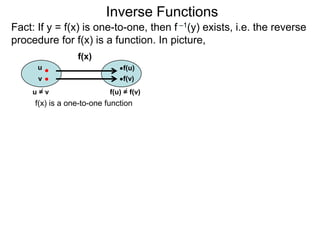
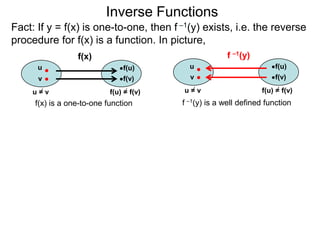
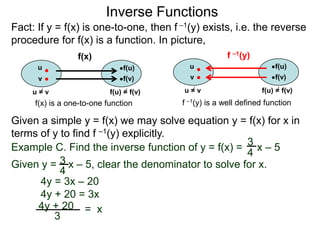
Fact: If y = f(x) is one-to-one, then f –1(y) exists, i.e. the reverse
procedure for f(x) is a function.
Inverse Functions
Fact: If y = f(x) is one-to-one, then f –1(y) exists, i.e. the reverse
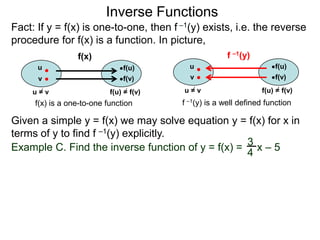
procedure for f(x) is a function. In picture,
                 f(x)
      u                        f(u)
      v                        f(v)
     u=v                   f(u) = f(v)
     f(x) is a one-to-one function
Inverse Functions
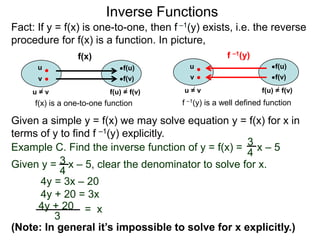
Fact: If y = f(x) is one-to-one, then f –1(y) exists, i.e. the reverse
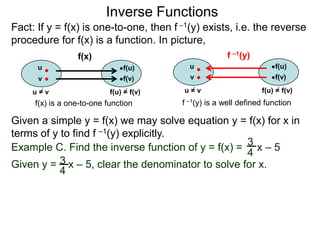
procedure for f(x) is a function. In picture,
                 f(x)                                  f –1(y)
      u                        f(u)        u                          f(u)
      v                        f(v)        v                          f(v)

     u=v                   f(u) = f(v)   u=v                     f(u) = f(v)
     f(x) is a one-to-one function       f –1(y) is a well defined function
Inverse Functions
Fact: If y = f(x) is one-to-one, then f –1(y) exists, i.e. the reverse
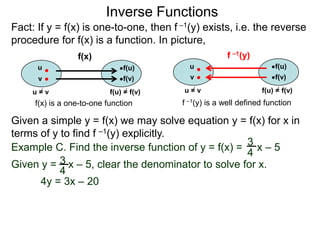
procedure for f(x) is a function. In picture,
                 f(x)                                  f –1(y)
      u                        f(u)        u                          f(u)
      v                        f(v)        v                          f(v)

     u=v                   f(u) = f(v)   u=v                     f(u) = f(v)
     f(x) is a one-to-one function       f –1(y) is a well defined function

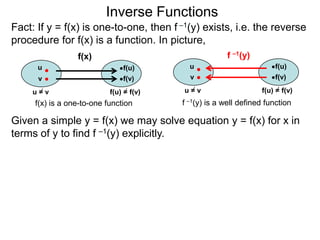
Given a simple y = f(x) we may solve equation y = f(x) for x in
terms of y to find f –1(y) explicitly.
Inverse Functions
Fact: If y = f(x) is one-to-one, then f –1(y) exists, i.e. the reverse
procedure for f(x) is a function. In picture,
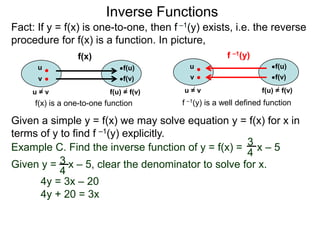
                 f(x)                                  f –1(y)
      u                        f(u)        u                          f(u)
      v                        f(v)        v                          f(v)

     u=v                   f(u) = f(v)   u=v                     f(u) = f(v)
     f(x) is a one-to-one function       f –1(y) is a well defined function

Given a simple y = f(x) we may solve equation y = f(x) for x in
terms of y to find f –1(y) explicitly.
Example C. Find the inverse function of y = f(x) = 3 x – 5
                                                   4
Inverse Functions
Fact: If y = f(x) is one-to-one, then f –1(y) exists, i.e. the reverse
procedure for f(x) is a function. In picture,
                 f(x)                                  f –1(y)
      u                        f(u)        u                          f(u)
      v                        f(v)        v                          f(v)

     u=v                   f(u) = f(v)   u=v                     f(u) = f(v)
     f(x) is a one-to-one function       f –1(y) is a well defined function

Given a simple y = f(x) we may solve equation y = f(x) for x in
terms of y to find f –1(y) explicitly.
Example C. Find the inverse function of y = f(x) = 3 x – 5
                                                   4
Given y = 3 x – 5, clear the denominator to solve for x.
           4
Inverse Functions
Fact: If y = f(x) is one-to-one, then f –1(y) exists, i.e. the reverse
procedure for f(x) is a function. In picture,
                 f(x)                                  f –1(y)
      u                        f(u)        u                          f(u)
      v                        f(v)        v                          f(v)

     u=v                   f(u) = f(v)   u=v                     f(u) = f(v)
     f(x) is a one-to-one function       f –1(y) is a well defined function

Given a simple y = f(x) we may solve equation y = f(x) for x in
terms of y to find f –1(y) explicitly.
Example C. Find the inverse function of y = f(x) = 3 x – 5
                                                   4
Given y = 3 x – 5, clear the denominator to solve for x.
           4
      4y = 3x – 20
Inverse Functions
Fact: If y = f(x) is one-to-one, then f –1(y) exists, i.e. the reverse
procedure for f(x) is a function. In picture,
                 f(x)                                  f –1(y)
      u                        f(u)        u                          f(u)
      v                        f(v)        v                          f(v)

     u=v                   f(u) = f(v)   u=v                     f(u) = f(v)
     f(x) is a one-to-one function       f –1(y) is a well defined function

Given a simple y = f(x) we may solve equation y = f(x) for x in
terms of y to find f –1(y) explicitly.
Example C. Find the inverse function of y = f(x) = 3 x – 5
                                                   4
Given y = 3 x – 5, clear the denominator to solve for x.
           4
      4y = 3x – 20
      4y + 20 = 3x
Inverse Functions
Fact: If y = f(x) is one-to-one, then f –1(y) exists, i.e. the reverse
procedure for f(x) is a function. In picture,
                 f(x)                                  f –1(y)
      u                        f(u)        u                          f(u)
      v                        f(v)        v                          f(v)

     u=v                   f(u) = f(v)   u=v                     f(u) = f(v)
     f(x) is a one-to-one function       f –1(y) is a well defined function

Given a simple y = f(x) we may solve equation y = f(x) for x in
terms of y to find f –1(y) explicitly.
Example C. Find the inverse function of y = f(x) = 3 x – 5
                                                   4
Given y = 3 x – 5, clear the denominator to solve for x.
           4
      4y = 3x – 20
      4y + 20 = 3x
     4y + 20 = x
         3
Inverse Functions
Fact: If y = f(x) is one-to-one, then f –1(y) exists, i.e. the reverse
procedure for f(x) is a function. In picture,
                 f(x)                                  f –1(y)
      u                        f(u)        u                          f(u)
      v                        f(v)        v                          f(v)

     u=v                   f(u) = f(v)   u=v                     f(u) = f(v)
     f(x) is a one-to-one function       f –1(y) is a well defined function

Given a simple y = f(x) we may solve equation y = f(x) for x in
terms of y to find f –1(y) explicitly.
Example C. Find the inverse function of y = f(x) = 3 x – 5
                                                   4
Given y = 3 x – 5, clear the denominator to solve for x.
           4
      4y = 3x – 20
      4y + 20 = 3x
     4y + 20 = x
         3
(Note: In general it’s impossible to solve for x explicitly.)
Inverse Functions
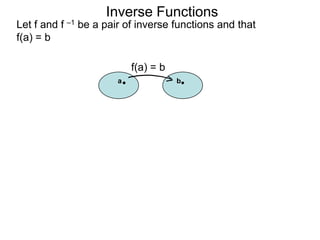
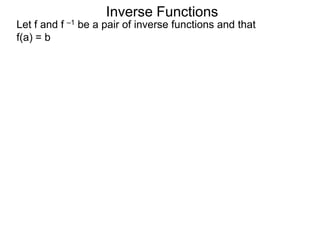
Let f and f –1 be a pair of inverse functions and that
f(a) = b
Inverse Functions
Let f and f –1 be a pair of inverse functions and that
f(a) = b

                          f(a) = b
                      a              b
Inverse Functions
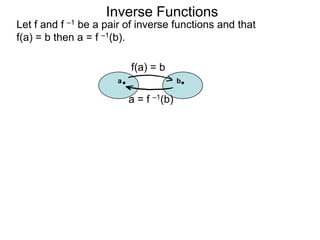
Let f and f –1 be a pair of inverse functions and that
f(a) = b then a = f –1(b).

                          f(a) = b
                      a                 b

                          a = f –1(b)
Inverse Functions
Let f and f –1 be a pair of inverse functions and that
f(a) = b then a = f –1(b).
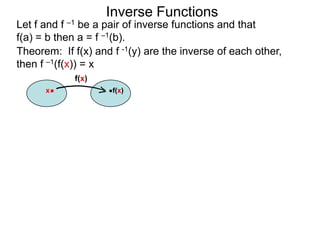
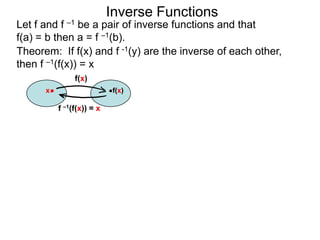
Theorem: If f(x) and f -1(y) are the inverse of each other,
then f –1(f(x)) = x
Inverse Functions
Let f and f –1 be a pair of inverse functions and that
f(a) = b then a = f –1(b).
Theorem: If f(x) and f -1(y) are the inverse of each other,
then f –1(f(x)) = x
            f(x)
      x              f(x)
Inverse Functions
Let f and f –1 be a pair of inverse functions and that
f(a) = b then a = f –1(b).
Theorem: If f(x) and f -1(y) are the inverse of each other,
then f –1(f(x)) = x
               f(x)
      x                    f(x)

          f –1(f(x)) = x
Inverse Functions
Let f and f –1 be a pair of inverse functions and that
f(a) = b then a = f –1(b).
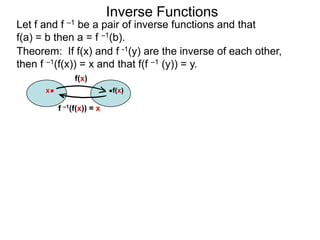
Theorem: If f(x) and f -1(y) are the inverse of each other,
then f –1(f(x)) = x and that f(f –1 (y)) = y.
               f(x)
      x                    f(x)

          f –1(f(x)) = x
Inverse Functions
Let f and f –1 be a pair of inverse functions and that
f(a) = b then a = f –1(b).
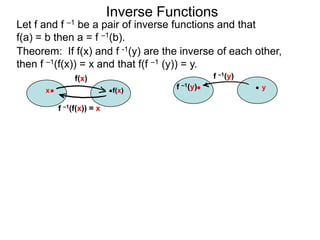
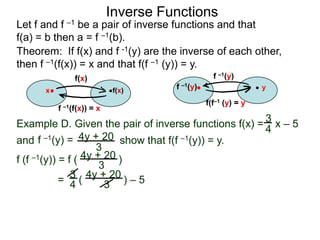
Theorem: If f(x) and f -1(y) are the inverse of each other,
then f –1(f(x)) = x and that f(f –1 (y)) = y.
               f(x)                            f –1(y)
      x                    f(x)      f –1(y)             y

          f –1(f(x)) = x
Inverse Functions
Let f and f –1 be a pair of inverse functions and that
f(a) = b then a = f –1(b).
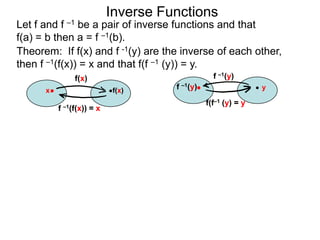
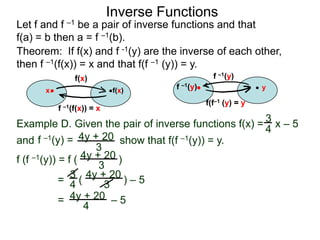
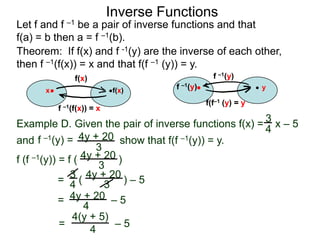
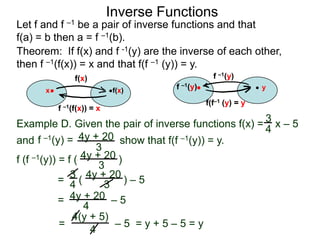
Theorem: If f(x) and f -1(y) are the inverse of each other,
then f –1(f(x)) = x and that f(f –1 (y)) = y.
               f(x)                              f –1(y)
      x                    f(x)      f –1(y)                   y

                                               f(f–1 (y) = y
          f –1(f(x)) = x
Inverse Functions
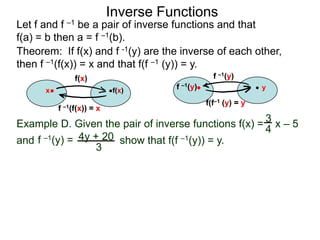
Let f and f –1 be a pair of inverse functions and that
f(a) = b then a = f –1(b).
Theorem: If f(x) and f -1(y) are the inverse of each other,
then f –1(f(x)) = x and that f(f –1 (y)) = y.
               f(x)                              f –1(y)
      x                    f(x)      f –1(y)                   y

                                               f(f–1 (y) = y
          f –1(f(x)) = x

Example D. Given the pair of inverse functions f(x) = 3 x – 5
                                                      4
and f –1(y) = 4y + 20 show that f(f –1(y)) = y.
                 3
Inverse Functions
Let f and f –1 be a pair of inverse functions and that
f(a) = b then a = f –1(b).
Theorem: If f(x) and f -1(y) are the inverse of each other,
then f –1(f(x)) = x and that f(f –1 (y)) = y.
               f(x)                              f –1(y)
      x                    f(x)      f –1(y)                   y

                                               f(f–1 (y) = y
          f –1(f(x)) = x

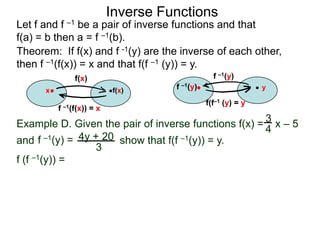
Example D. Given the pair of inverse functions f(x) = 3 x – 5
                                                      4
and f –1(y) = 4y + 20 show that f(f –1(y)) = y.
                 3
f (f –1(y)) =
Inverse Functions
Let f and f –1 be a pair of inverse functions and that
f(a) = b then a = f –1(b).
Theorem: If f(x) and f -1(y) are the inverse of each other,
then f –1(f(x)) = x and that f(f –1 (y)) = y.
               f(x)                              f –1(y)
      x                    f(x)      f –1(y)                   y

                                               f(f–1 (y) = y
          f –1(f(x)) = x

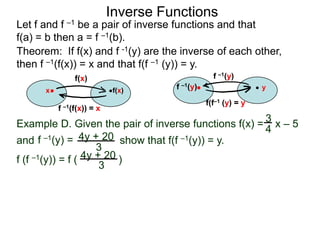
Example D. Given the pair of inverse functions f(x) = 3 x – 5
                                                      4
and f –1(y) = 4y + 20 show that f(f –1(y)) = y.
                     3
f (f –1(y)) = f ( 4y + 20 )
                      3
Inverse Functions
Let f and f –1 be a pair of inverse functions and that
f(a) = b then a = f –1(b).
Theorem: If f(x) and f -1(y) are the inverse of each other,
then f –1(f(x)) = x and that f(f –1 (y)) = y.
               f(x)                              f –1(y)
      x                    f(x)      f –1(y)                   y

                                               f(f–1 (y) = y
          f –1(f(x)) = x

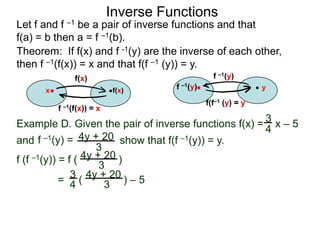
Example D. Given the pair of inverse functions f(x) = 3 x – 5
                                                      4
and f –1(y) = 4y + 20 show that f(f –1(y)) = y.
                     3
f (f –1(y)) = f ( 4y + 20 )
                      3
            = 3 ( 4y + 20 ) – 5
               4       3
Inverse Functions
Let f and f –1 be a pair of inverse functions and that
f(a) = b then a = f –1(b).
Theorem: If f(x) and f -1(y) are the inverse of each other,
then f –1(f(x)) = x and that f(f –1 (y)) = y.
               f(x)                              f –1(y)
      x                    f(x)      f –1(y)                   y

                                               f(f–1 (y) = y
          f –1(f(x)) = x

Example D. Given the pair of inverse functions f(x) = 3 x – 5
                                                      4
and f –1(y) = 4y + 20 show that f(f –1(y)) = y.
                     3
f (f –1(y)) = f ( 4y + 20 )
                      3
            = 3 ( 4y + 20 ) – 5
               4       3
Inverse Functions
Let f and f –1 be a pair of inverse functions and that
f(a) = b then a = f –1(b).
Theorem: If f(x) and f -1(y) are the inverse of each other,
then f –1(f(x)) = x and that f(f –1 (y)) = y.
               f(x)                              f –1(y)
      x                    f(x)      f –1(y)                   y

                                               f(f–1 (y) = y
          f –1(f(x)) = x

Example D. Given the pair of inverse functions f(x) = 3 x – 5
                                                      4
and f –1(y) = 4y + 20 show that f(f –1(y)) = y.
                     3
f (f –1(y)) = f ( 4y + 20 )
                      3
            = 3 ( 4y + 20 ) – 5
               4       3
            = 4y + 20 – 5
                  4
Inverse Functions
Let f and f –1 be a pair of inverse functions and that
f(a) = b then a = f –1(b).
Theorem: If f(x) and f -1(y) are the inverse of each other,
then f –1(f(x)) = x and that f(f –1 (y)) = y.
               f(x)                              f –1(y)
      x                    f(x)      f –1(y)                   y

                                               f(f–1 (y) = y
          f –1(f(x)) = x

Example D. Given the pair of inverse functions f(x) = 3 x – 5
                                                      4
and f –1(y) = 4y + 20 show that f(f –1(y)) = y.
                     3
f (f –1(y)) = f ( 4y + 20 )
                      3
            = 3 ( 4y + 20 ) – 5
               4       3
            = 4y + 20 – 5
                  4
               4(y + 5)
            =            –5
                    4
Inverse Functions
Let f and f –1 be a pair of inverse functions and that
f(a) = b then a = f –1(b).
Theorem: If f(x) and f -1(y) are the inverse of each other,
then f –1(f(x)) = x and that f(f –1 (y)) = y.
               f(x)                              f –1(y)
      x                    f(x)      f –1(y)                   y

                                               f(f–1 (y) = y
          f –1(f(x)) = x

Example D. Given the pair of inverse functions f(x) = 3 x – 5
                                                      4
and f –1(y) = 4y + 20 show that f(f –1(y)) = y.
                     3
f (f –1(y)) = f ( 4y + 20 )
                      3
            = 3 ( 4y + 20 ) – 5
               4       3
            = 4y + 20 – 5
                  4
               4(y + 5)
            =            –5 =y+5–5=y
                    4
Inverse Functions
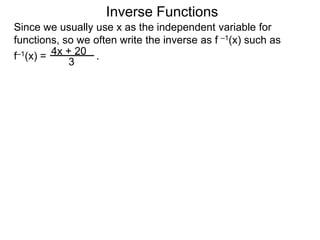
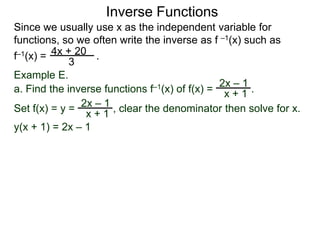
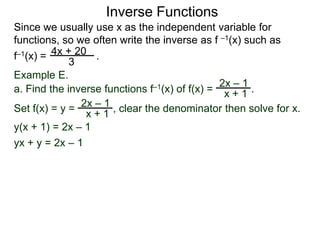
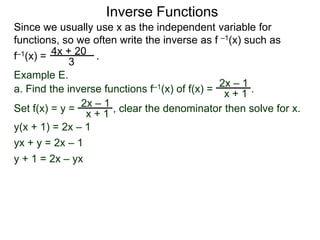
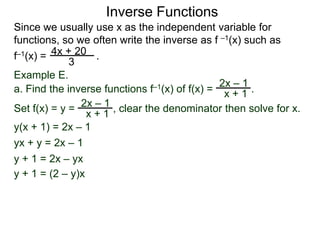
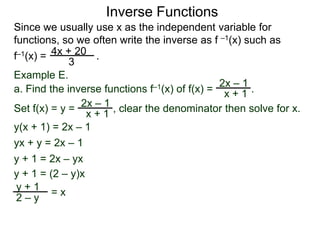
Since we usually use x as the independent variable for
functions, so we often write the inverse as f –1(x) such as
f–1(x) = 4x + 20 .
             3
Inverse Functions
Since we usually use x as the independent variable for
functions, so we often write the inverse as f –1(x) such as
f–1(x) = 4x + 20 .
             3
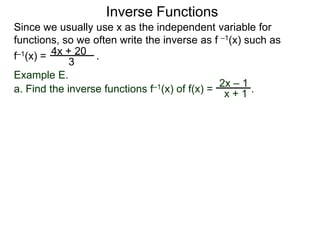
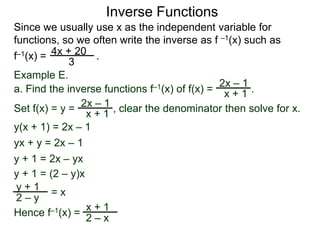
Example E.
                                               2x – 1
a. Find the inverse functions f–1(x) of f(x) = x + 1 .
Inverse Functions
Since we usually use x as the independent variable for
functions, so we often write the inverse as f –1(x) such as
f–1(x) = 4x + 20 .
             3
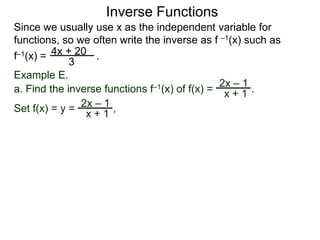
Example E.
                                               2x – 1
a. Find the inverse functions f–1(x) of f(x) = x + 1 .
                  –1
Set f(x) = y = 2x + 1 ,
                x
Inverse Functions
Since we usually use x as the independent variable for
functions, so we often write the inverse as f –1(x) such as
f–1(x) = 4x + 20 .
             3
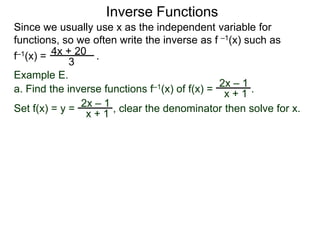
Example E.
                                               2x – 1
a. Find the inverse functions f–1(x) of f(x) = x + 1 .
                  –1
Set f(x) = y = 2x + 1 , clear the denominator then solve for x.
                x
Inverse Functions
Since we usually use x as the independent variable for
functions, so we often write the inverse as f –1(x) such as
f–1(x) = 4x + 20 .
             3
Example E.
                                               2x – 1
a. Find the inverse functions f–1(x) of f(x) = x + 1 .
                  –1
Set f(x) = y = 2x + 1 , clear the denominator then solve for x.
                x
y(x + 1) = 2x – 1
Inverse Functions
Since we usually use x as the independent variable for
functions, so we often write the inverse as f –1(x) such as
f–1(x) = 4x + 20 .
             3
Example E.
                                               2x – 1
a. Find the inverse functions f–1(x) of f(x) = x + 1 .
                  –1
Set f(x) = y = 2x + 1 , clear the denominator then solve for x.
                x
y(x + 1) = 2x – 1
yx + y = 2x – 1
Inverse Functions
Since we usually use x as the independent variable for
functions, so we often write the inverse as f –1(x) such as
f–1(x) = 4x + 20 .
             3
Example E.
                                               2x – 1
a. Find the inverse functions f–1(x) of f(x) = x + 1 .
                  –1
Set f(x) = y = 2x + 1 , clear the denominator then solve for x.
                x
y(x + 1) = 2x – 1
yx + y = 2x – 1
y + 1 = 2x – yx
Inverse Functions
Since we usually use x as the independent variable for
functions, so we often write the inverse as f –1(x) such as
f–1(x) = 4x + 20 .
             3
Example E.
                                               2x – 1
a. Find the inverse functions f–1(x) of f(x) = x + 1 .
                   –1
Set f(x) = y = 2x + 1 , clear the denominator then solve for x.
                 x
y(x + 1) = 2x – 1
yx + y = 2x – 1
y + 1 = 2x – yx
y + 1 = (2 – y)x
Inverse Functions
Since we usually use x as the independent variable for
functions, so we often write the inverse as f –1(x) such as
f–1(x) = 4x + 20 .
             3
Example E.
                                               2x – 1
a. Find the inverse functions f–1(x) of f(x) = x + 1 .
                   –1
Set f(x) = y = 2x + 1 , clear the denominator then solve for x.
                 x
y(x + 1) = 2x – 1
yx + y = 2x – 1
y + 1 = 2x – yx
y + 1 = (2 – y)x
 y+1 =x
 2–y
Inverse Functions
Since we usually use x as the independent variable for
functions, so we often write the inverse as f –1(x) such as
f–1(x) = 4x + 20 .
             3
Example E.
                                               2x – 1
a. Find the inverse functions f–1(x) of f(x) = x + 1 .
                   –1
Set f(x) = y = 2x + 1 , clear the denominator then solve for x.
                 x
y(x + 1) = 2x – 1
yx + y = 2x – 1
y + 1 = 2x – yx
y + 1 = (2 – y)x
 y+1 =x
 2–y
                 x+1
Hence f–1(x) =
                 2–x
Inverse Functions
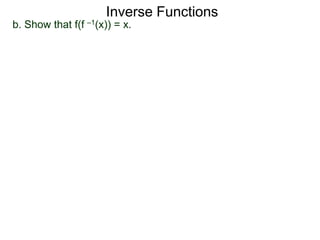
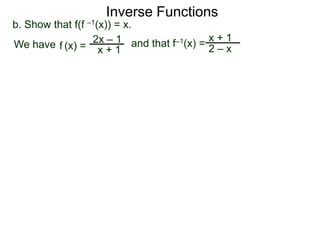
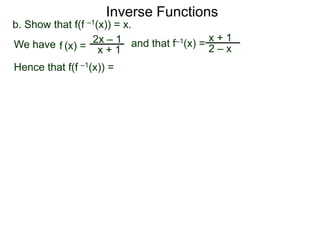
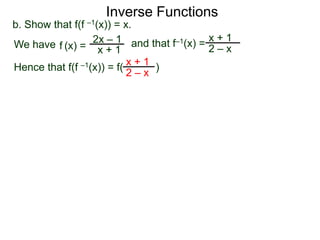
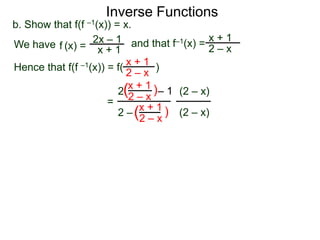
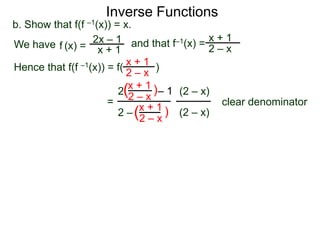
b. Show that f(f –1(x)) = x.
Inverse Functions
b. Show that f(f –1(x)) = x.
We have f (x) = 2x – 1 and that f–1(x) = 2 – x
                                         x+1
                    x+1
Inverse Functions
b. Show that f(f –1(x)) = x.
We have f (x) = 2x – 1 and that f–1(x) = 2 – x
                                         x+1
                    x+1
Hence that f(f –1(x)) =
Inverse Functions
b. Show that f(f –1(x)) = x.
We have f (x) = 2x – 1 and that f–1(x) = 2 – x
                                         x+1
                    x+1
Hence that f(f –1(x)) = f( x + 1 )
                           2–x
Inverse Functions
b. Show that f(f –1(x)) = x.
We have f (x) = 2x – 1 and that f–1(x) = 2 – x
                                             x+1
                    x+1
Hence that f(f –1(x)) = f( x + 1 )
                           2–x
                           x + 1)
                         2(2 – x – 1 (2 – x)
                      =
                         2 – (x + 1 ) (2 – x)
                              2–x
Inverse Functions
b. Show that f(f –1(x)) = x.
We have f (x) = 2x – 1 and that f–1(x) = 2 – x
                                             x+1
                    x+1
Hence that f(f –1(x)) = f( x + 1 )
                           2–x
                           x + 1)
                         2(2 – x – 1 (2 – x)
                      =
                              x + 1 ) (2 – x) clear denominator
                         2 –(
                              2–x
Inverse Functions
b. Show that f(f –1(x)) = x.
We have f (x) = 2x – 1 and that f–1(x) = 2 – x
                                              x+1
                    x+1
Hence that f(f –1(x)) = f( x + 1 )
                            2–x
                            x + 1)
                        [ 2(2 – x – 1 ] (2 – x)
                     = x+1                       clear denominator
                        [( 2 – x ) + 1 ] (2 – x)
Inverse Functions
b. Show that f(f –1(x)) = x.
We have f (x) = 2x – 1 and that f–1(x) = 2 – x
                                              x+1
                    x+1
Hence that f(f –1(x)) = f( x + 1 )
                            2–x
                            x + 1)
                        [ 2(2 – x – 1 ] (2 – x)
                     = x+1                       clear denominator
                        [( 2 – x ) + 1 ] (2 – x)
Inverse Functions
b. Show that f(f –1(x)) = x.
We have f (x) = 2x – 1 and that f–1(x) = 2 – x
                                              x+1
                    x+1
Hence that f(f –1(x)) = f( x + 1 )
                            2 – x (2 – x)
                            x + 1)
                        [ 2(2 – x – 1 ] (2 – x)
                     = x + 1 (2 – x)             clear denominator
                        [( 2 – x ) + 1 ] (2 – x)
Inverse Functions
b. Show that f(f –1(x)) = x.
We have f (x) = 2x – 1 and that f–1(x) = 2 – x
                                              x+1
                    x+1
Hence that f(f –1(x)) = f( x + 1 )
                            2 – x (2 – x)
                             x + 1)
                        [ 2(2 – x – 1 ] (2 – x)
                     = x + 1 (2 – x)             clear denominator
                        [( 2 – x ) + 1 ] (2 – x)
                           2(x + 1) – (2 – x)
                     =
                           (x + 1) + (2 – x)
Inverse Functions
b. Show that f(f –1(x)) = x.
We have f (x) = 2x – 1 and that f–1(x) = 2 – x
                                              x+1
                    x+1
Hence that f(f –1(x)) = f( x + 1 )
                            2 – x (2 – x)
                             x + 1)
                        [ 2(2 – x – 1 ] (2 – x)
                     = x + 1 (2 – x)             clear denominator
                        [( 2 – x ) + 1 ] (2 – x)
                           2(x + 1) – (2 – x)
                     =
                           (x + 1) + (2 – x)
                           2x + 2 – 2 + x
                     = x+1+2–x
Inverse Functions
b. Show that f(f –1(x)) = x.
We have f (x) = 2x – 1 and that f–1(x) = 2 – x
                                              x+1
                    x+1
Hence that f(f –1(x)) = f( x + 1 )
                            2 – x (2 – x)
                             x + 1)
                        [ 2(2 – x – 1 ] (2 – x)
                     = x + 1 (2 – x)             clear denominator
                        [( 2 – x ) + 1 ] (2 – x)
                           2(x + 1) – (2 – x)
                     =
                           (x + 1) + (2 – x)
                           2x + 2 – 2 + x
                     = x+1+2–x

                     = 3x = x
                          3
Inverse Functions
b. Show that f(f –1(x)) = x.
We have f (x) = 2x – 1 and that f–1(x) = 2 – x
                                              x+1
                    x+1
Hence that f(f –1(x)) = f( x + 1 )
                            2 – x (2 – x)
                             x + 1)
                        [ 2(2 – x – 1 ] (2 – x)
                     = x + 1 (2 – x)             clear denominator
                        [( 2 – x ) + 1 ] (2 – x)
                           2(x + 1) – (2 – x)
                     =
                           (x + 1) + (2 – x)
                           2x + 2 – 2 + x
                     = x+1+2–x

                     = 3x = x
                          3
Your turn: verify that f–1 (f (x)) = x.

53 inverse function (optional)

  • 1.
  • 2.
    Inverse Functions A functionf(x) = y takes an input x and produces one output y.
  • 3.
    Inverse Functions A functionf(x) = y takes an input x and produces one output y. We like to do the reverse, that is, if we know the output y, what was (were) the input x?
  • 4.
    Inverse Functions A functionf(x) = y takes an input x and produces one output y. We like to do the reverse, that is, if we know the output y, what was (were) the input x? This procedure of associating the output y to the input x may or may not be a function.
  • 5.
    Inverse Functions A functionf(x) = y takes an input x and produces one output y. We like to do the reverse, that is, if we know the output y, what was (were) the input x? This procedure of associating the output y to the input x may or may not be a function. If it is a function, it is called the inverse function of f(x)
  • 6.
    Inverse Functions A functionf(x) = y takes an input x and produces one output y. We like to do the reverse, that is, if we know the output y, what was (were) the input x? This procedure of associating the output y to the input x may or may not be a function. If it is a function, it is called the inverse function of f(x) and it is denoted as f -1(y).
  • 7.
    Inverse Functions A functionf(x) = y takes an input x and produces one output y. We like to do the reverse, that is, if we know the output y, what was (were) the input x? This procedure of associating the output y to the input x may or may not be a function. If it is a function, it is called the inverse function of f(x) and it is denoted as f -1(y). We say f(x) and f -1(y) are the inverse of each other.
  • 8.
    Inverse Functions A functionf(x) = y takes an input x and produces one output y. We like to do the reverse, that is, if we know the output y, what was (were) the input x? This procedure of associating the output y to the input x may or may not be a function. If it is a function, it is called the inverse function of f(x) and it is denoted as f -1(y). We say f(x) and f -1(y) are the inverse of each other. Example A. Let f(x) = x2 = y. Suppose y = 9, what is (are) the input x that produces y = 9? Is this reverse procedure a function?
  • 9.
    Inverse Functions A functionf(x) = y takes an input x and produces one output y. We like to do the reverse, that is, if we know the output y, what was (were) the input x? This procedure of associating the output y to the input x may or may not be a function. If it is a function, it is called the inverse function of f(x) and it is denoted as f -1(y). We say f(x) and f -1(y) are the inverse of each other. Example A. Let f(x) = x2 = y. Suppose y = 9, what is (are) the input x that produces y = 9? Is this reverse procedure a function? Since f(x) = x2 = 9,
  • 10.
    Inverse Functions A functionf(x) = y takes an input x and produces one output y. We like to do the reverse, that is, if we know the output y, what was (were) the input x? This procedure of associating the output y to the input x may or may not be a function. If it is a function, it is called the inverse function of f(x) and it is denoted as f -1(y). We say f(x) and f -1(y) are the inverse of each other. Example A. Let f(x) = x2 = y. Suppose y = 9, what is (are) the input x that produces y = 9? Is this reverse procedure a function? Since f(x) = x2 = 9, so x = ±√9 x = – 3, x = 3.
  • 11.
    Inverse Functions A functionf(x) = y takes an input x and produces one output y. We like to do the reverse, that is, if we know the output y, what was (were) the input x? This procedure of associating the output y to the input x may or may not be a function. If it is a function, it is called the inverse function of f(x) and it is denoted as f -1(y). We say f(x) and f -1(y) are the inverse of each other. Example A. Let f(x) = x2 = y. Suppose y = 9, what is (are) the input x that produces y = 9? Is this reverse procedure a function? Since f(x) = x2 = 9, so x = ±√9 x = – 3, x = 3. This reverse procedure takes y = 9 and associates to it two different answers so it is not a function. What condition is needed for a function to have an inverse?
  • 12.
    Inverse Functions The reverseof the function f(x) = x2 fails to be a function because x2 produces the same output with two or more different inputs
  • 13.
    Inverse Functions The reverseof the function f(x) = x2 fails to be a function because x2 produces the same output with two or more different inputs (e.g. f(3) = f(–3) = 9).
  • 14.
    Inverse Functions The reverseof the function f(x) = x2 fails to be a function because x2 produces the same output with two or more different inputs (e.g. f(3) = f(–3) = 9). This prevents us from pinpointing exactly what x is even that we know the output is 9.
  • 15.
    Inverse Functions The reverseof the function f(x) = x2 fails to be a function because x2 produces the same output with two or more different inputs (e.g. f(3) = f(–3) = 9). This prevents us from pinpointing exactly what x is even that we know the output is 9. A function is one-to-one if different inputs produce different outputs.
  • 16.
    Inverse Functions The reverseof the function f(x) = x2 fails to be a function because x2 produces the same output with two or more different inputs (e.g. f(3) = f(–3) = 9). This prevents us from pinpointing exactly what x is even that we know the output is 9. A function is one-to-one if different inputs produce different outputs. That is, f(x) is said to be one-to-one if for every two different inputs u and v then f(u)  f(v).
  • 17.
    Inverse Functions The reverseof the function f(x) = x2 fails to be a function because x2 produces the same output with two or more different inputs (e.g. f(3) = f(–3) = 9). This prevents us from pinpointing exactly what x is even that we know the output is 9. A function is one-to-one if different inputs produce different outputs. That is, f(x) is said to be one-to-one if for every two different inputs u and v then f(u)  f(v). In pictures, a one-to-one function
  • 18.
    Inverse Functions The reverseof the function f(x) = x2 fails to be a function because x2 produces the same output with two or more different inputs (e.g. f(3) = f(–3) = 9). This prevents us from pinpointing exactly what x is even that we know the output is 9. A function is one-to-one if different inputs produce different outputs. That is, f(x) is said to be one-to-one if for every two different inputs u and v then f(u)  f(v). In pictures, u v any pair u = v a one-to-one function
  • 19.
    Inverse Functions The reverseof the function f(x) = x2 fails to be a function because x2 produces the same output with two or more different inputs (e.g. f(3) = f(–3) = 9). This prevents us from pinpointing exactly what x is even that we know the output is 9. A function is one-to-one if different inputs produce different outputs. That is, f(x) is said to be one-to-one if for every two different inputs u and v then f(u)  f(v). In pictures, u f(u) v any pair u = v a one-to-one function
  • 20.
    Inverse Functions The reverseof the function f(x) = x2 fails to be a function because x2 produces the same output with two or more different inputs (e.g. f(3) = f(–3) = 9). This prevents us from pinpointing exactly what x is even that we know the output is 9. A function is one-to-one if different inputs produce different outputs. That is, f(x) is said to be one-to-one if for every two different inputs u and v then f(u)  f(v). In pictures, u f(u) v f(v) any pair u = v f(u) = f(v) a one-to-one function
  • 21.
    Inverse Functions The reverseof the function f(x) = x2 fails to be a function because x2 produces the same output with two or more different inputs (e.g. f(3) = f(–3) = 9). This prevents us from pinpointing exactly what x is even that we know the output is 9. A function is one-to-one if different inputs produce different outputs. That is, f(x) is said to be one-to-one if for every two different inputs u and v then f(u)  f(v). In pictures, u f(u) v f(v) any pair u = v f(u) = f(v) a one-to-one function a none one-to-one function
  • 22.
    Inverse Functions The reverseof the function f(x) = x2 fails to be a function because x2 produces the same output with two or more different inputs (e.g. f(3) = f(–3) = 9). This prevents us from pinpointing exactly what x is even that we know the output is 9. A function is one-to-one if different inputs produce different outputs. That is, f(x) is said to be one-to-one if for every two different inputs u and v then f(u)  f(v). In pictures, u f(u) u v f(v) v any pair u = v f(u) = f(v) there exist u = v a one-to-one function a none one-to-one function
  • 23.
    Inverse Functions The reverseof the function f(x) = x2 fails to be a function because x2 produces the same output with two or more different inputs (e.g. f(3) = f(–3) = 9). This prevents us from pinpointing exactly what x is even that we know the output is 9. A function is one-to-one if different inputs produce different outputs. That is, f(x) is said to be one-to-one if for every two different inputs u and v then f(u)  f(v). In pictures, u f(u) u v f(v) v any pair u = v f(u) = f(v) there exist u = v a one-to-one function a none one-to-one function
  • 24.
    Inverse Functions The reverseof the function f(x) = x2 fails to be a function because x2 produces the same output with two or more different inputs (e.g. f(3) = f(–3) = 9). This prevents us from pinpointing exactly what x is even that we know the output is 9. A function is one-to-one if different inputs produce different outputs. That is, f(x) is said to be one-to-one if for every two different inputs u and v then f(u)  f(v). In pictures, such that u f(u) u f(u)=f(v) v f(v) v any pair u = v f(u) = f(v) there exist u = v a one-to-one function a none one-to-one function
  • 25.
    Inverse Functions The reverseof the function f(x) = x2 fails to be a function because x2 produces the same output with two or more different inputs (e.g. f(3) = f(–3) = 9). This prevents us from pinpointing exactly what x is even that we know the output is 9. A function is one-to-one if different inputs produce different outputs. That is, f(x) is said to be one-to-one if for every two different inputs u and v then f(u)  f(v). In pictures, such that u f(u) u f(u)=f(v) v f(v) v any pair u = v f(u) = f(v) there exist u = v a one-to-one function a none one-to-one function Example B. a. g(x) = 2x is one-to-one
  • 26.
    Inverse Functions The reverseof the function f(x) = x2 fails to be a function because x2 produces the same output with two or more different inputs (e.g. f(3) = f(–3) = 9). This prevents us from pinpointing exactly what x is even that we know the output is 9. A function is one-to-one if different inputs produce different outputs. That is, f(x) is said to be one-to-one if for every two different inputs u and v then f(u)  f(v). In pictures, such that u f(u) u f(u)=f(v) v f(v) v any pair u = v f(u) = f(v) there exist u = v a one-to-one function a none one-to-one function Example B. a. g(x) = 2x is one-to-one because if u  v, then 2u  2v.
  • 27.
    Inverse Functions The reverseof the function f(x) = x2 fails to be a function because x2 produces the same output with two or more different inputs (e.g. f(3) = f(–3) = 9). This prevents us from pinpointing exactly what x is even that we know the output is 9. A function is one-to-one if different inputs produce different outputs. That is, f(x) is said to be one-to-one if for every two different inputs u and v then f(u)  f(v). In pictures, such that u f(u) u f(u)=f(v) v f(v) v any pair u = v f(u) = f(v) there exist u = v a one-to-one function a none one-to-one function Example B. a. g(x) = 2x is one-to-one because if u  v, then 2u  2v. b. f(x) = x2 is not one-to-one because for example 3  –3, but f(3) = f(–3) = 9.
  • 28.
    Inverse Functions Fact: Ify = f(x) is one-to-one, then f –1(y) exists, i.e. the reverse procedure for f(x) is a function.
  • 29.
    Inverse Functions Fact: Ify = f(x) is one-to-one, then f –1(y) exists, i.e. the reverse procedure for f(x) is a function. In picture, f(x) u f(u) v f(v) u=v f(u) = f(v) f(x) is a one-to-one function
  • 30.
    Inverse Functions Fact: Ify = f(x) is one-to-one, then f –1(y) exists, i.e. the reverse procedure for f(x) is a function. In picture, f(x) f –1(y) u f(u) u f(u) v f(v) v f(v) u=v f(u) = f(v) u=v f(u) = f(v) f(x) is a one-to-one function f –1(y) is a well defined function
  • 31.
    Inverse Functions Fact: Ify = f(x) is one-to-one, then f –1(y) exists, i.e. the reverse procedure for f(x) is a function. In picture, f(x) f –1(y) u f(u) u f(u) v f(v) v f(v) u=v f(u) = f(v) u=v f(u) = f(v) f(x) is a one-to-one function f –1(y) is a well defined function Given a simple y = f(x) we may solve equation y = f(x) for x in terms of y to find f –1(y) explicitly.
  • 32.
    Inverse Functions Fact: Ify = f(x) is one-to-one, then f –1(y) exists, i.e. the reverse procedure for f(x) is a function. In picture, f(x) f –1(y) u f(u) u f(u) v f(v) v f(v) u=v f(u) = f(v) u=v f(u) = f(v) f(x) is a one-to-one function f –1(y) is a well defined function Given a simple y = f(x) we may solve equation y = f(x) for x in terms of y to find f –1(y) explicitly. Example C. Find the inverse function of y = f(x) = 3 x – 5 4
  • 33.
    Inverse Functions Fact: Ify = f(x) is one-to-one, then f –1(y) exists, i.e. the reverse procedure for f(x) is a function. In picture, f(x) f –1(y) u f(u) u f(u) v f(v) v f(v) u=v f(u) = f(v) u=v f(u) = f(v) f(x) is a one-to-one function f –1(y) is a well defined function Given a simple y = f(x) we may solve equation y = f(x) for x in terms of y to find f –1(y) explicitly. Example C. Find the inverse function of y = f(x) = 3 x – 5 4 Given y = 3 x – 5, clear the denominator to solve for x. 4
  • 34.
    Inverse Functions Fact: Ify = f(x) is one-to-one, then f –1(y) exists, i.e. the reverse procedure for f(x) is a function. In picture, f(x) f –1(y) u f(u) u f(u) v f(v) v f(v) u=v f(u) = f(v) u=v f(u) = f(v) f(x) is a one-to-one function f –1(y) is a well defined function Given a simple y = f(x) we may solve equation y = f(x) for x in terms of y to find f –1(y) explicitly. Example C. Find the inverse function of y = f(x) = 3 x – 5 4 Given y = 3 x – 5, clear the denominator to solve for x. 4 4y = 3x – 20
  • 35.
    Inverse Functions Fact: Ify = f(x) is one-to-one, then f –1(y) exists, i.e. the reverse procedure for f(x) is a function. In picture, f(x) f –1(y) u f(u) u f(u) v f(v) v f(v) u=v f(u) = f(v) u=v f(u) = f(v) f(x) is a one-to-one function f –1(y) is a well defined function Given a simple y = f(x) we may solve equation y = f(x) for x in terms of y to find f –1(y) explicitly. Example C. Find the inverse function of y = f(x) = 3 x – 5 4 Given y = 3 x – 5, clear the denominator to solve for x. 4 4y = 3x – 20 4y + 20 = 3x
  • 36.
    Inverse Functions Fact: Ify = f(x) is one-to-one, then f –1(y) exists, i.e. the reverse procedure for f(x) is a function. In picture, f(x) f –1(y) u f(u) u f(u) v f(v) v f(v) u=v f(u) = f(v) u=v f(u) = f(v) f(x) is a one-to-one function f –1(y) is a well defined function Given a simple y = f(x) we may solve equation y = f(x) for x in terms of y to find f –1(y) explicitly. Example C. Find the inverse function of y = f(x) = 3 x – 5 4 Given y = 3 x – 5, clear the denominator to solve for x. 4 4y = 3x – 20 4y + 20 = 3x 4y + 20 = x 3
  • 37.
    Inverse Functions Fact: Ify = f(x) is one-to-one, then f –1(y) exists, i.e. the reverse procedure for f(x) is a function. In picture, f(x) f –1(y) u f(u) u f(u) v f(v) v f(v) u=v f(u) = f(v) u=v f(u) = f(v) f(x) is a one-to-one function f –1(y) is a well defined function Given a simple y = f(x) we may solve equation y = f(x) for x in terms of y to find f –1(y) explicitly. Example C. Find the inverse function of y = f(x) = 3 x – 5 4 Given y = 3 x – 5, clear the denominator to solve for x. 4 4y = 3x – 20 4y + 20 = 3x 4y + 20 = x 3 (Note: In general it’s impossible to solve for x explicitly.)
  • 38.
    Inverse Functions Let fand f –1 be a pair of inverse functions and that f(a) = b
  • 39.
    Inverse Functions Let fand f –1 be a pair of inverse functions and that f(a) = b f(a) = b a b
  • 40.
    Inverse Functions Let fand f –1 be a pair of inverse functions and that f(a) = b then a = f –1(b). f(a) = b a b a = f –1(b)
  • 41.
    Inverse Functions Let fand f –1 be a pair of inverse functions and that f(a) = b then a = f –1(b). Theorem: If f(x) and f -1(y) are the inverse of each other, then f –1(f(x)) = x
  • 42.
    Inverse Functions Let fand f –1 be a pair of inverse functions and that f(a) = b then a = f –1(b). Theorem: If f(x) and f -1(y) are the inverse of each other, then f –1(f(x)) = x f(x) x f(x)
  • 43.
    Inverse Functions Let fand f –1 be a pair of inverse functions and that f(a) = b then a = f –1(b). Theorem: If f(x) and f -1(y) are the inverse of each other, then f –1(f(x)) = x f(x) x f(x) f –1(f(x)) = x
  • 44.
    Inverse Functions Let fand f –1 be a pair of inverse functions and that f(a) = b then a = f –1(b). Theorem: If f(x) and f -1(y) are the inverse of each other, then f –1(f(x)) = x and that f(f –1 (y)) = y. f(x) x f(x) f –1(f(x)) = x
  • 45.
    Inverse Functions Let fand f –1 be a pair of inverse functions and that f(a) = b then a = f –1(b). Theorem: If f(x) and f -1(y) are the inverse of each other, then f –1(f(x)) = x and that f(f –1 (y)) = y. f(x) f –1(y) x f(x) f –1(y) y f –1(f(x)) = x
  • 46.
    Inverse Functions Let fand f –1 be a pair of inverse functions and that f(a) = b then a = f –1(b). Theorem: If f(x) and f -1(y) are the inverse of each other, then f –1(f(x)) = x and that f(f –1 (y)) = y. f(x) f –1(y) x f(x) f –1(y) y f(f–1 (y) = y f –1(f(x)) = x
  • 47.
    Inverse Functions Let fand f –1 be a pair of inverse functions and that f(a) = b then a = f –1(b). Theorem: If f(x) and f -1(y) are the inverse of each other, then f –1(f(x)) = x and that f(f –1 (y)) = y. f(x) f –1(y) x f(x) f –1(y) y f(f–1 (y) = y f –1(f(x)) = x Example D. Given the pair of inverse functions f(x) = 3 x – 5 4 and f –1(y) = 4y + 20 show that f(f –1(y)) = y. 3
  • 48.
    Inverse Functions Let fand f –1 be a pair of inverse functions and that f(a) = b then a = f –1(b). Theorem: If f(x) and f -1(y) are the inverse of each other, then f –1(f(x)) = x and that f(f –1 (y)) = y. f(x) f –1(y) x f(x) f –1(y) y f(f–1 (y) = y f –1(f(x)) = x Example D. Given the pair of inverse functions f(x) = 3 x – 5 4 and f –1(y) = 4y + 20 show that f(f –1(y)) = y. 3 f (f –1(y)) =
  • 49.
    Inverse Functions Let fand f –1 be a pair of inverse functions and that f(a) = b then a = f –1(b). Theorem: If f(x) and f -1(y) are the inverse of each other, then f –1(f(x)) = x and that f(f –1 (y)) = y. f(x) f –1(y) x f(x) f –1(y) y f(f–1 (y) = y f –1(f(x)) = x Example D. Given the pair of inverse functions f(x) = 3 x – 5 4 and f –1(y) = 4y + 20 show that f(f –1(y)) = y. 3 f (f –1(y)) = f ( 4y + 20 ) 3
  • 50.
    Inverse Functions Let fand f –1 be a pair of inverse functions and that f(a) = b then a = f –1(b). Theorem: If f(x) and f -1(y) are the inverse of each other, then f –1(f(x)) = x and that f(f –1 (y)) = y. f(x) f –1(y) x f(x) f –1(y) y f(f–1 (y) = y f –1(f(x)) = x Example D. Given the pair of inverse functions f(x) = 3 x – 5 4 and f –1(y) = 4y + 20 show that f(f –1(y)) = y. 3 f (f –1(y)) = f ( 4y + 20 ) 3 = 3 ( 4y + 20 ) – 5 4 3
  • 51.
    Inverse Functions Let fand f –1 be a pair of inverse functions and that f(a) = b then a = f –1(b). Theorem: If f(x) and f -1(y) are the inverse of each other, then f –1(f(x)) = x and that f(f –1 (y)) = y. f(x) f –1(y) x f(x) f –1(y) y f(f–1 (y) = y f –1(f(x)) = x Example D. Given the pair of inverse functions f(x) = 3 x – 5 4 and f –1(y) = 4y + 20 show that f(f –1(y)) = y. 3 f (f –1(y)) = f ( 4y + 20 ) 3 = 3 ( 4y + 20 ) – 5 4 3
  • 52.
    Inverse Functions Let fand f –1 be a pair of inverse functions and that f(a) = b then a = f –1(b). Theorem: If f(x) and f -1(y) are the inverse of each other, then f –1(f(x)) = x and that f(f –1 (y)) = y. f(x) f –1(y) x f(x) f –1(y) y f(f–1 (y) = y f –1(f(x)) = x Example D. Given the pair of inverse functions f(x) = 3 x – 5 4 and f –1(y) = 4y + 20 show that f(f –1(y)) = y. 3 f (f –1(y)) = f ( 4y + 20 ) 3 = 3 ( 4y + 20 ) – 5 4 3 = 4y + 20 – 5 4
  • 53.
    Inverse Functions Let fand f –1 be a pair of inverse functions and that f(a) = b then a = f –1(b). Theorem: If f(x) and f -1(y) are the inverse of each other, then f –1(f(x)) = x and that f(f –1 (y)) = y. f(x) f –1(y) x f(x) f –1(y) y f(f–1 (y) = y f –1(f(x)) = x Example D. Given the pair of inverse functions f(x) = 3 x – 5 4 and f –1(y) = 4y + 20 show that f(f –1(y)) = y. 3 f (f –1(y)) = f ( 4y + 20 ) 3 = 3 ( 4y + 20 ) – 5 4 3 = 4y + 20 – 5 4 4(y + 5) = –5 4
  • 54.
    Inverse Functions Let fand f –1 be a pair of inverse functions and that f(a) = b then a = f –1(b). Theorem: If f(x) and f -1(y) are the inverse of each other, then f –1(f(x)) = x and that f(f –1 (y)) = y. f(x) f –1(y) x f(x) f –1(y) y f(f–1 (y) = y f –1(f(x)) = x Example D. Given the pair of inverse functions f(x) = 3 x – 5 4 and f –1(y) = 4y + 20 show that f(f –1(y)) = y. 3 f (f –1(y)) = f ( 4y + 20 ) 3 = 3 ( 4y + 20 ) – 5 4 3 = 4y + 20 – 5 4 4(y + 5) = –5 =y+5–5=y 4
  • 55.
    Inverse Functions Since weusually use x as the independent variable for functions, so we often write the inverse as f –1(x) such as f–1(x) = 4x + 20 . 3
  • 56.
    Inverse Functions Since weusually use x as the independent variable for functions, so we often write the inverse as f –1(x) such as f–1(x) = 4x + 20 . 3 Example E. 2x – 1 a. Find the inverse functions f–1(x) of f(x) = x + 1 .
  • 57.
    Inverse Functions Since weusually use x as the independent variable for functions, so we often write the inverse as f –1(x) such as f–1(x) = 4x + 20 . 3 Example E. 2x – 1 a. Find the inverse functions f–1(x) of f(x) = x + 1 . –1 Set f(x) = y = 2x + 1 , x
  • 58.
    Inverse Functions Since weusually use x as the independent variable for functions, so we often write the inverse as f –1(x) such as f–1(x) = 4x + 20 . 3 Example E. 2x – 1 a. Find the inverse functions f–1(x) of f(x) = x + 1 . –1 Set f(x) = y = 2x + 1 , clear the denominator then solve for x. x
  • 59.
    Inverse Functions Since weusually use x as the independent variable for functions, so we often write the inverse as f –1(x) such as f–1(x) = 4x + 20 . 3 Example E. 2x – 1 a. Find the inverse functions f–1(x) of f(x) = x + 1 . –1 Set f(x) = y = 2x + 1 , clear the denominator then solve for x. x y(x + 1) = 2x – 1
  • 60.
    Inverse Functions Since weusually use x as the independent variable for functions, so we often write the inverse as f –1(x) such as f–1(x) = 4x + 20 . 3 Example E. 2x – 1 a. Find the inverse functions f–1(x) of f(x) = x + 1 . –1 Set f(x) = y = 2x + 1 , clear the denominator then solve for x. x y(x + 1) = 2x – 1 yx + y = 2x – 1
  • 61.
    Inverse Functions Since weusually use x as the independent variable for functions, so we often write the inverse as f –1(x) such as f–1(x) = 4x + 20 . 3 Example E. 2x – 1 a. Find the inverse functions f–1(x) of f(x) = x + 1 . –1 Set f(x) = y = 2x + 1 , clear the denominator then solve for x. x y(x + 1) = 2x – 1 yx + y = 2x – 1 y + 1 = 2x – yx
  • 62.
    Inverse Functions Since weusually use x as the independent variable for functions, so we often write the inverse as f –1(x) such as f–1(x) = 4x + 20 . 3 Example E. 2x – 1 a. Find the inverse functions f–1(x) of f(x) = x + 1 . –1 Set f(x) = y = 2x + 1 , clear the denominator then solve for x. x y(x + 1) = 2x – 1 yx + y = 2x – 1 y + 1 = 2x – yx y + 1 = (2 – y)x
  • 63.
    Inverse Functions Since weusually use x as the independent variable for functions, so we often write the inverse as f –1(x) such as f–1(x) = 4x + 20 . 3 Example E. 2x – 1 a. Find the inverse functions f–1(x) of f(x) = x + 1 . –1 Set f(x) = y = 2x + 1 , clear the denominator then solve for x. x y(x + 1) = 2x – 1 yx + y = 2x – 1 y + 1 = 2x – yx y + 1 = (2 – y)x y+1 =x 2–y
  • 64.
    Inverse Functions Since weusually use x as the independent variable for functions, so we often write the inverse as f –1(x) such as f–1(x) = 4x + 20 . 3 Example E. 2x – 1 a. Find the inverse functions f–1(x) of f(x) = x + 1 . –1 Set f(x) = y = 2x + 1 , clear the denominator then solve for x. x y(x + 1) = 2x – 1 yx + y = 2x – 1 y + 1 = 2x – yx y + 1 = (2 – y)x y+1 =x 2–y x+1 Hence f–1(x) = 2–x
  • 65.
    Inverse Functions b. Showthat f(f –1(x)) = x.
  • 66.
    Inverse Functions b. Showthat f(f –1(x)) = x. We have f (x) = 2x – 1 and that f–1(x) = 2 – x x+1 x+1
  • 67.
    Inverse Functions b. Showthat f(f –1(x)) = x. We have f (x) = 2x – 1 and that f–1(x) = 2 – x x+1 x+1 Hence that f(f –1(x)) =
  • 68.
    Inverse Functions b. Showthat f(f –1(x)) = x. We have f (x) = 2x – 1 and that f–1(x) = 2 – x x+1 x+1 Hence that f(f –1(x)) = f( x + 1 ) 2–x
  • 69.
    Inverse Functions b. Showthat f(f –1(x)) = x. We have f (x) = 2x – 1 and that f–1(x) = 2 – x x+1 x+1 Hence that f(f –1(x)) = f( x + 1 ) 2–x x + 1) 2(2 – x – 1 (2 – x) = 2 – (x + 1 ) (2 – x) 2–x
  • 70.
    Inverse Functions b. Showthat f(f –1(x)) = x. We have f (x) = 2x – 1 and that f–1(x) = 2 – x x+1 x+1 Hence that f(f –1(x)) = f( x + 1 ) 2–x x + 1) 2(2 – x – 1 (2 – x) = x + 1 ) (2 – x) clear denominator 2 –( 2–x
  • 71.
    Inverse Functions b. Showthat f(f –1(x)) = x. We have f (x) = 2x – 1 and that f–1(x) = 2 – x x+1 x+1 Hence that f(f –1(x)) = f( x + 1 ) 2–x x + 1) [ 2(2 – x – 1 ] (2 – x) = x+1 clear denominator [( 2 – x ) + 1 ] (2 – x)
  • 72.
    Inverse Functions b. Showthat f(f –1(x)) = x. We have f (x) = 2x – 1 and that f–1(x) = 2 – x x+1 x+1 Hence that f(f –1(x)) = f( x + 1 ) 2–x x + 1) [ 2(2 – x – 1 ] (2 – x) = x+1 clear denominator [( 2 – x ) + 1 ] (2 – x)
  • 73.
    Inverse Functions b. Showthat f(f –1(x)) = x. We have f (x) = 2x – 1 and that f–1(x) = 2 – x x+1 x+1 Hence that f(f –1(x)) = f( x + 1 ) 2 – x (2 – x) x + 1) [ 2(2 – x – 1 ] (2 – x) = x + 1 (2 – x) clear denominator [( 2 – x ) + 1 ] (2 – x)
  • 74.
    Inverse Functions b. Showthat f(f –1(x)) = x. We have f (x) = 2x – 1 and that f–1(x) = 2 – x x+1 x+1 Hence that f(f –1(x)) = f( x + 1 ) 2 – x (2 – x) x + 1) [ 2(2 – x – 1 ] (2 – x) = x + 1 (2 – x) clear denominator [( 2 – x ) + 1 ] (2 – x) 2(x + 1) – (2 – x) = (x + 1) + (2 – x)
  • 75.
    Inverse Functions b. Showthat f(f –1(x)) = x. We have f (x) = 2x – 1 and that f–1(x) = 2 – x x+1 x+1 Hence that f(f –1(x)) = f( x + 1 ) 2 – x (2 – x) x + 1) [ 2(2 – x – 1 ] (2 – x) = x + 1 (2 – x) clear denominator [( 2 – x ) + 1 ] (2 – x) 2(x + 1) – (2 – x) = (x + 1) + (2 – x) 2x + 2 – 2 + x = x+1+2–x
  • 76.
    Inverse Functions b. Showthat f(f –1(x)) = x. We have f (x) = 2x – 1 and that f–1(x) = 2 – x x+1 x+1 Hence that f(f –1(x)) = f( x + 1 ) 2 – x (2 – x) x + 1) [ 2(2 – x – 1 ] (2 – x) = x + 1 (2 – x) clear denominator [( 2 – x ) + 1 ] (2 – x) 2(x + 1) – (2 – x) = (x + 1) + (2 – x) 2x + 2 – 2 + x = x+1+2–x = 3x = x 3
  • 77.
    Inverse Functions b. Showthat f(f –1(x)) = x. We have f (x) = 2x – 1 and that f–1(x) = 2 – x x+1 x+1 Hence that f(f –1(x)) = f( x + 1 ) 2 – x (2 – x) x + 1) [ 2(2 – x – 1 ] (2 – x) = x + 1 (2 – x) clear denominator [( 2 – x ) + 1 ] (2 – x) 2(x + 1) – (2 – x) = (x + 1) + (2 – x) 2x + 2 – 2 + x = x+1+2–x = 3x = x 3 Your turn: verify that f–1 (f (x)) = x.