Inverse Functions
AP Calculus
Definition
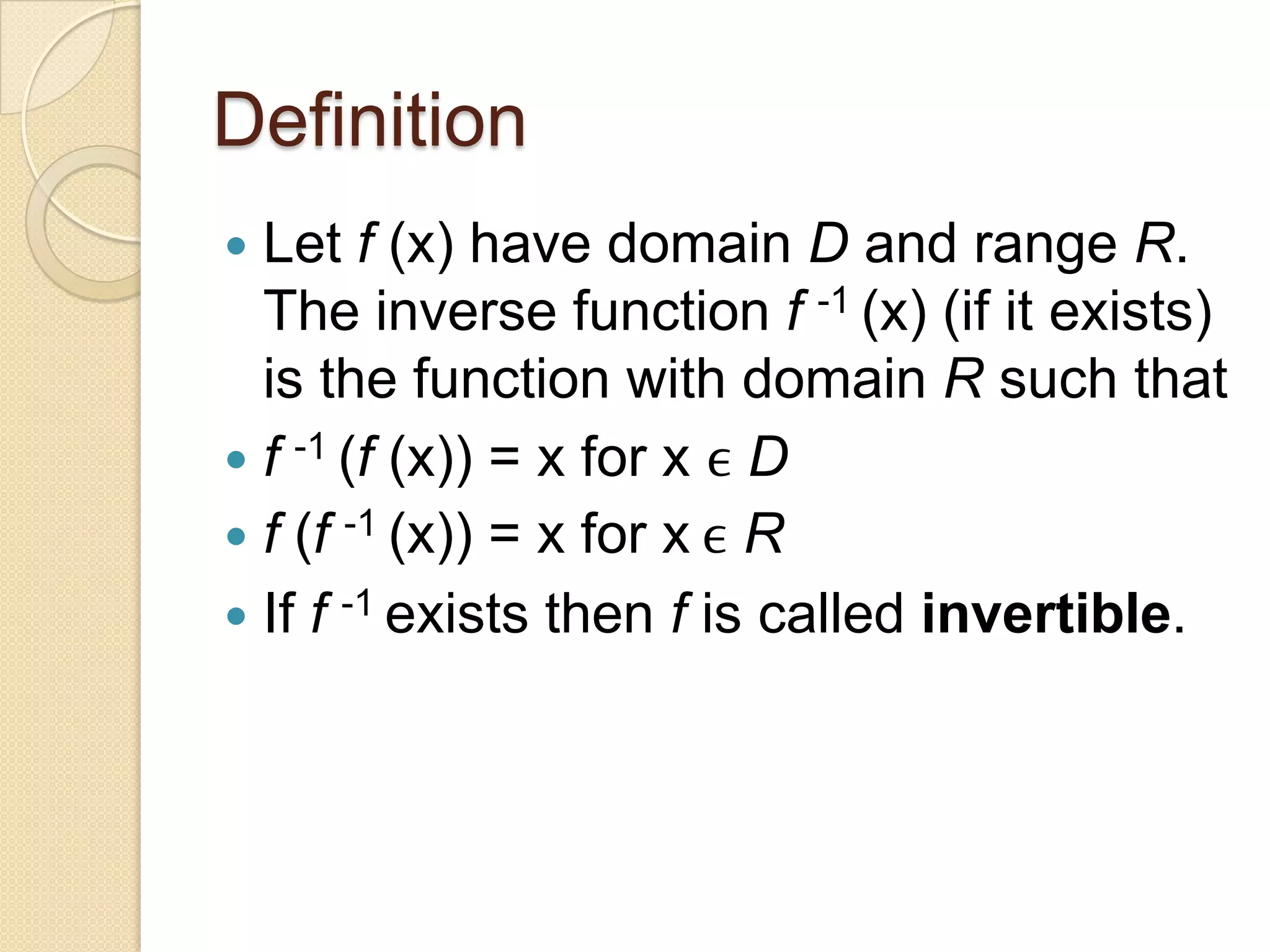
 Let f (x) have domain D and range R.
  The inverse function f -1 (x) (if it exists)
  is the function with domain R such that
 f -1 (f (x)) = x for x ϵ D
 f (f -1 (x)) = x for x ϵ R
 If f -1 exists then f is called invertible.
Example: Linear Function
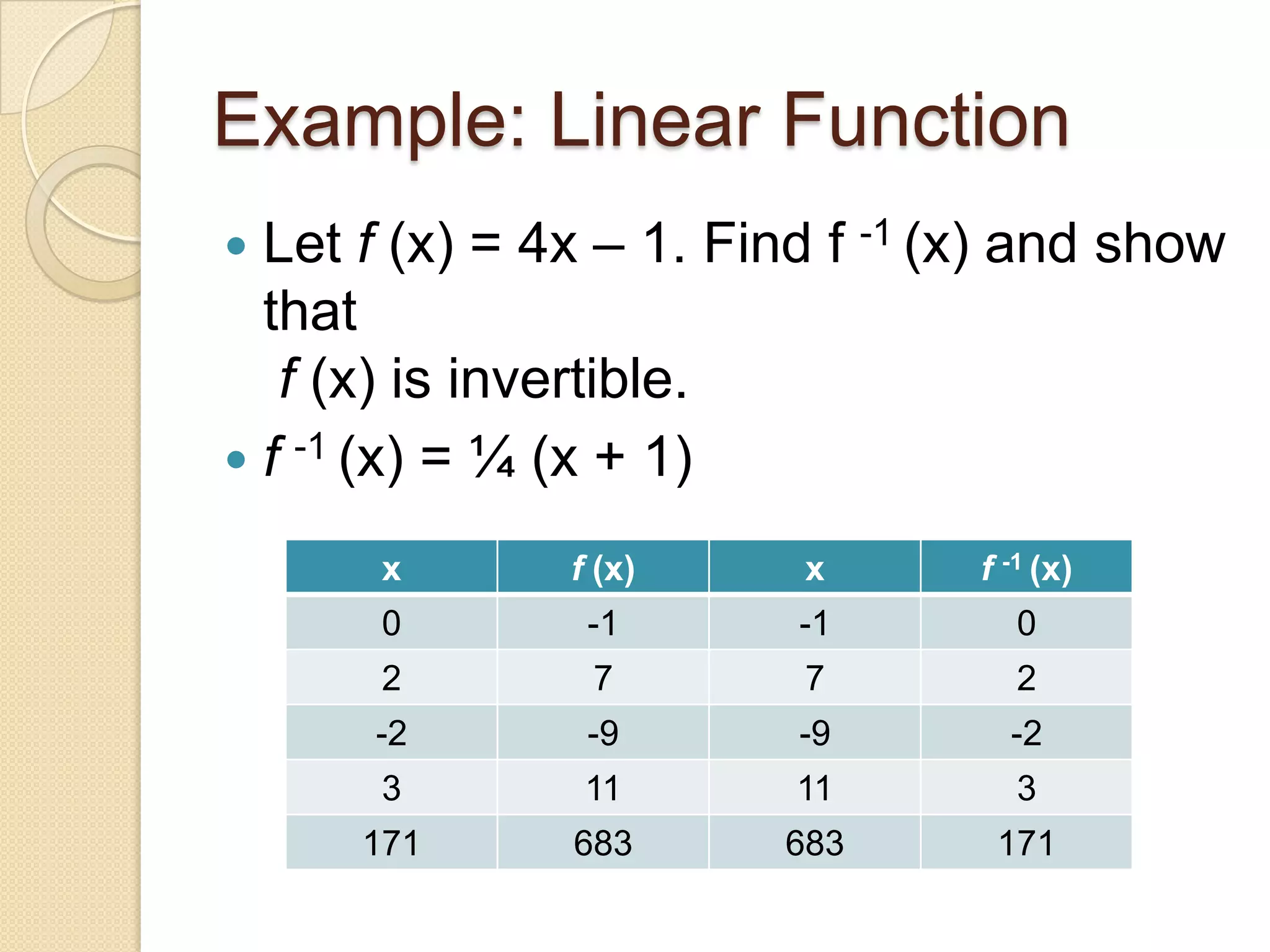
 Let f (x) = 4x – 1. Find f -1 (x) and show
  that
   f (x) is invertible.
 f -1 (x) = ¼ (x + 1)

       x       f (x)     x       f -1 (x)
       0        -1       -1         0
       2        7        7          2
      -2        -9       -9        -2
       3        11       11         3
      171      683      683       171
Example: Linear Function
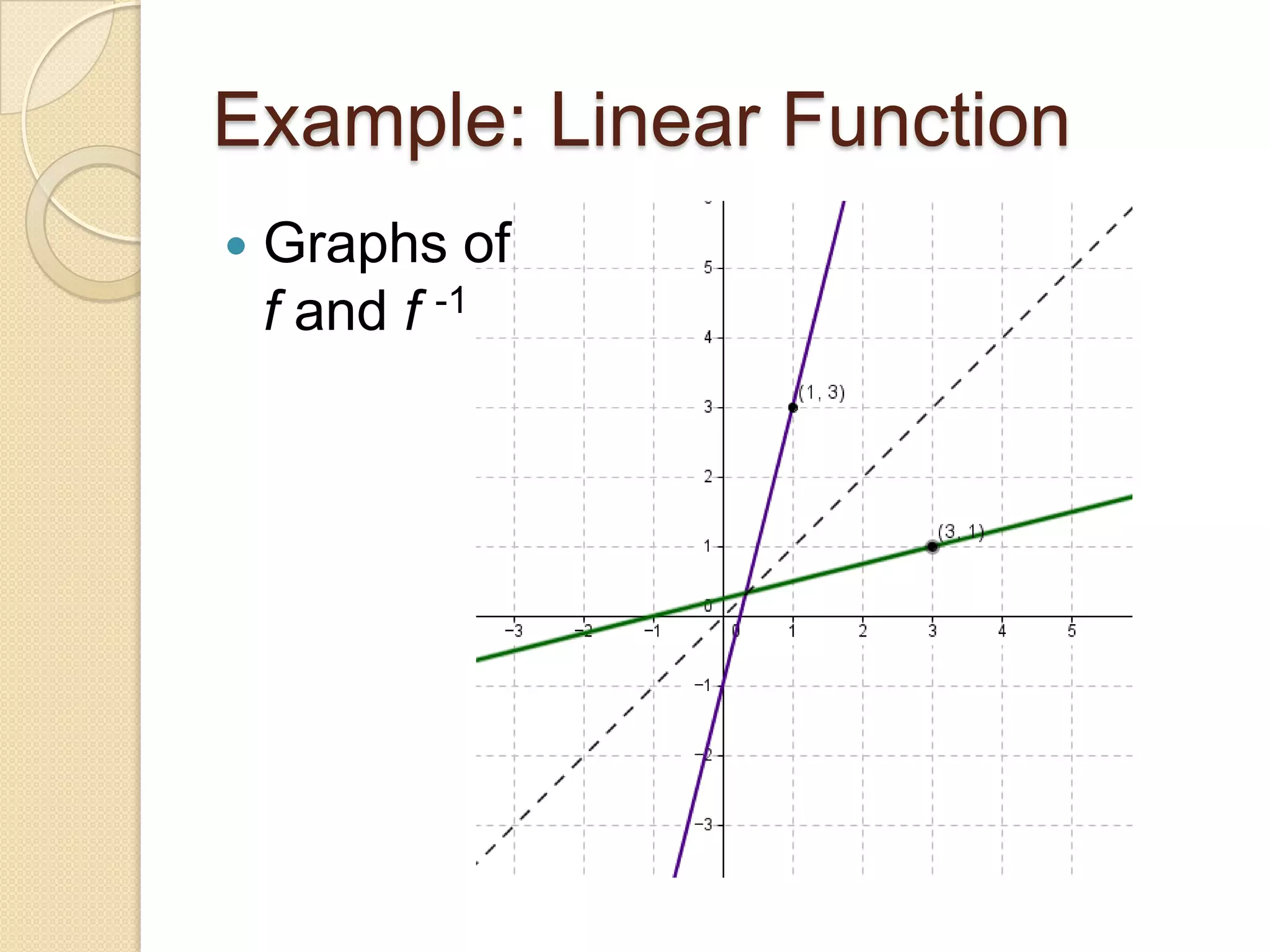
   Graphs of
    f and f -1
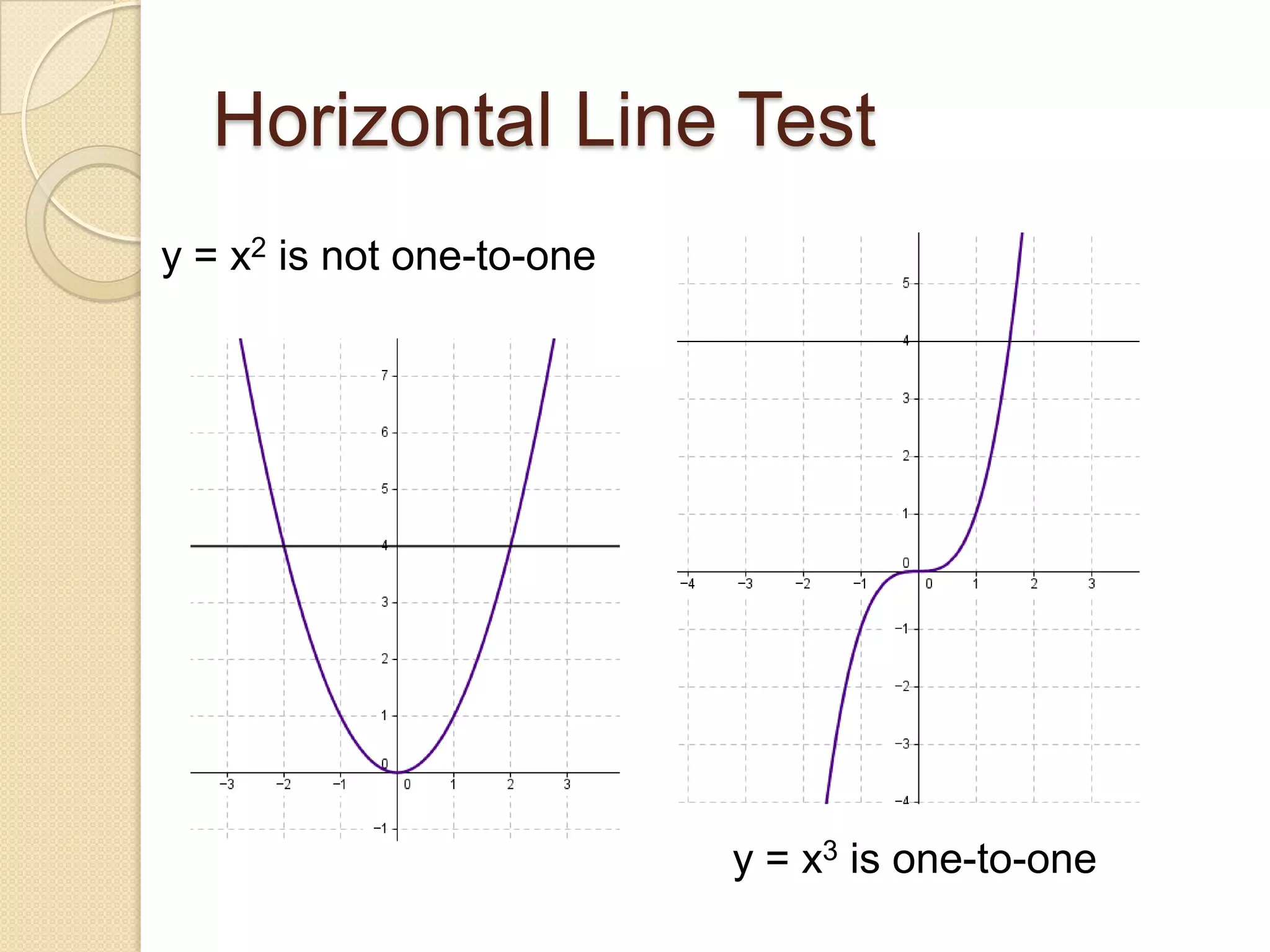
Horizontal Line Test
y = x2 is not one-to-one


                           y = x3 is one-to-one
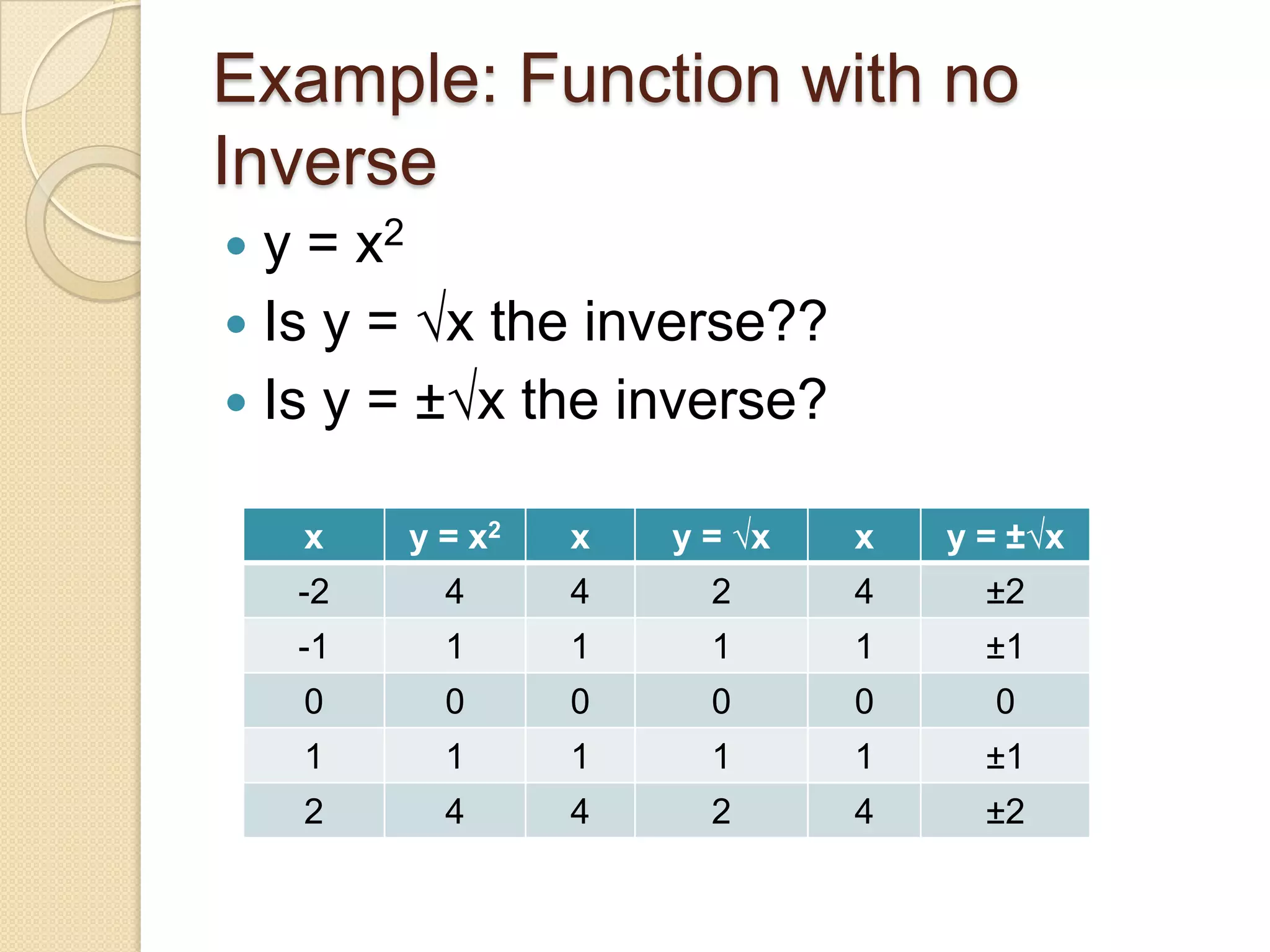
Example: Function with no
Inverse
 y = x2
 Is y = √x the inverse??
 Is y = ±√x the inverse?

    x    y = x2   x   y = √x   x   y = ±√x
    -2     4      4     2      4     ±2
    -1     1      1     1      1     ±1
    0      0      0     0      0     0
    1      1      1     1      1     ±1
    2      4      4     2      4     ±2
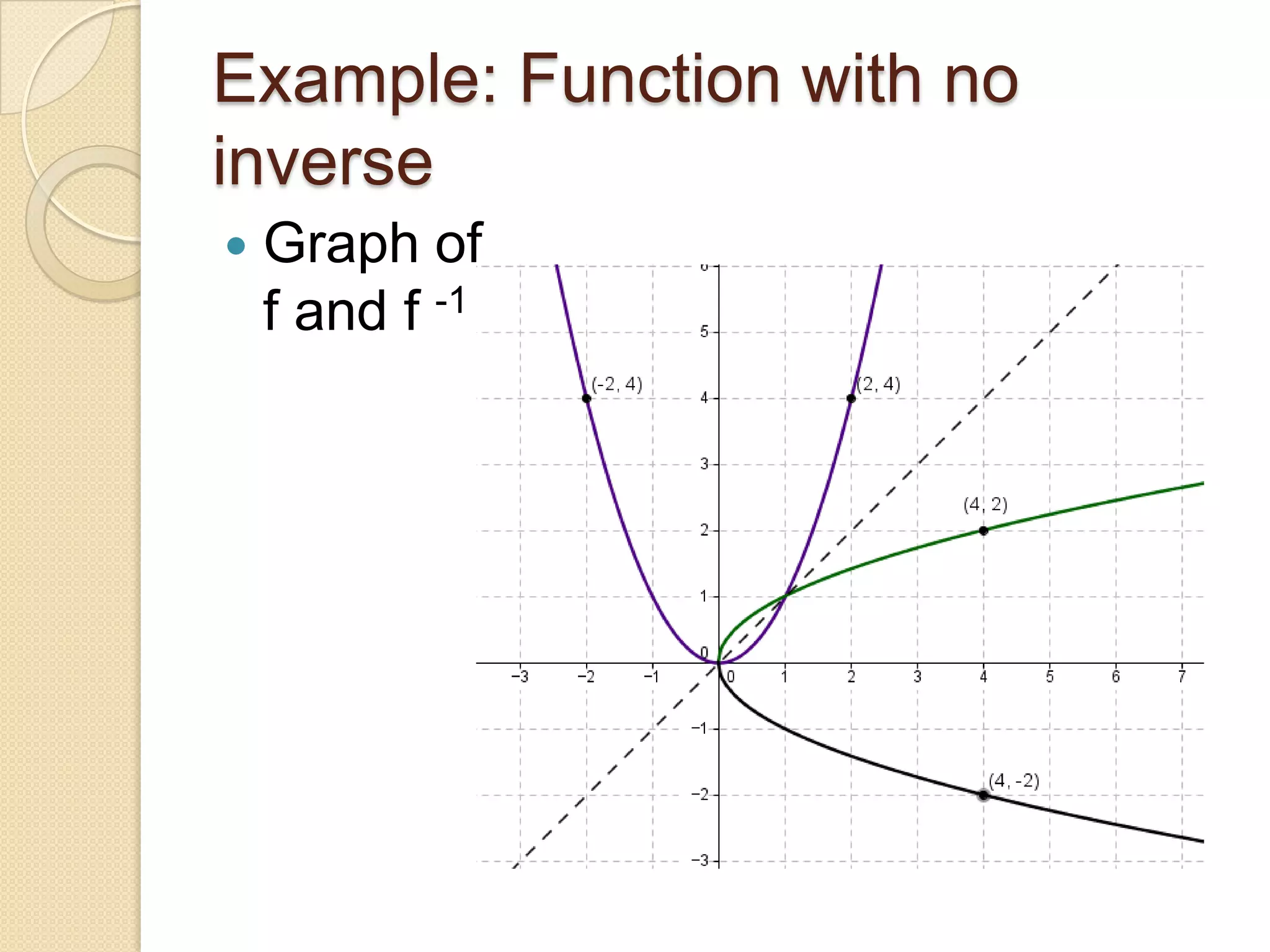
Example: Function with no
inverse
   Graph of
    f and f -1
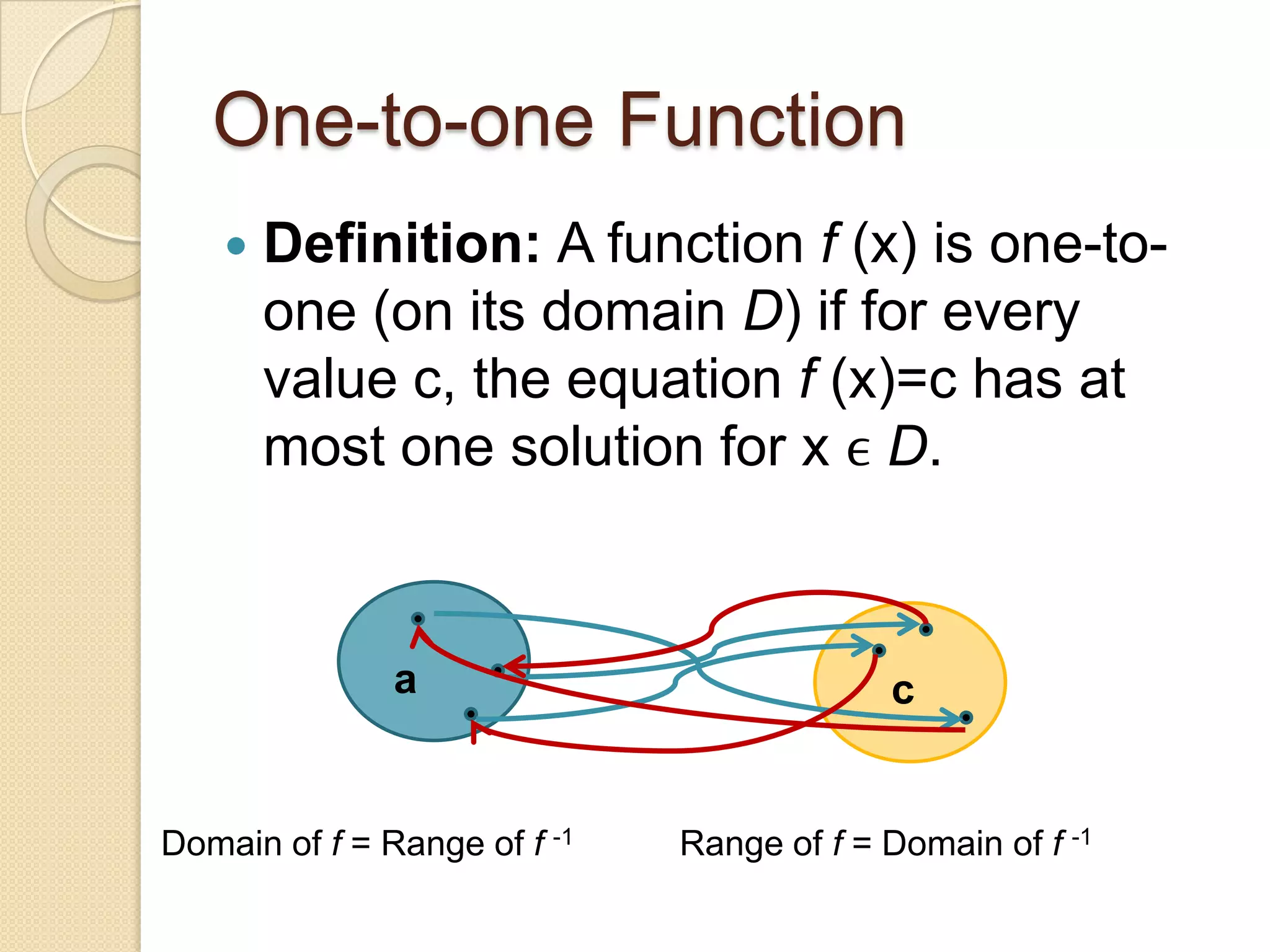
One-to-one Function
       Definition: A function f (x) is one-to-
        one (on its domain D) if for every
        value c, the equation f (x)=c has at
        most one solution for x ϵ D.


               a                           c


Domain of f = Range of f -1   Range of f = Domain of f -1
Theorem 1: Existence of
Inverses
 If f (x) is one-to-one on its domain D
  then f is invertible.
 Domain of f = range of f -1
 Range of f = domain of f -1
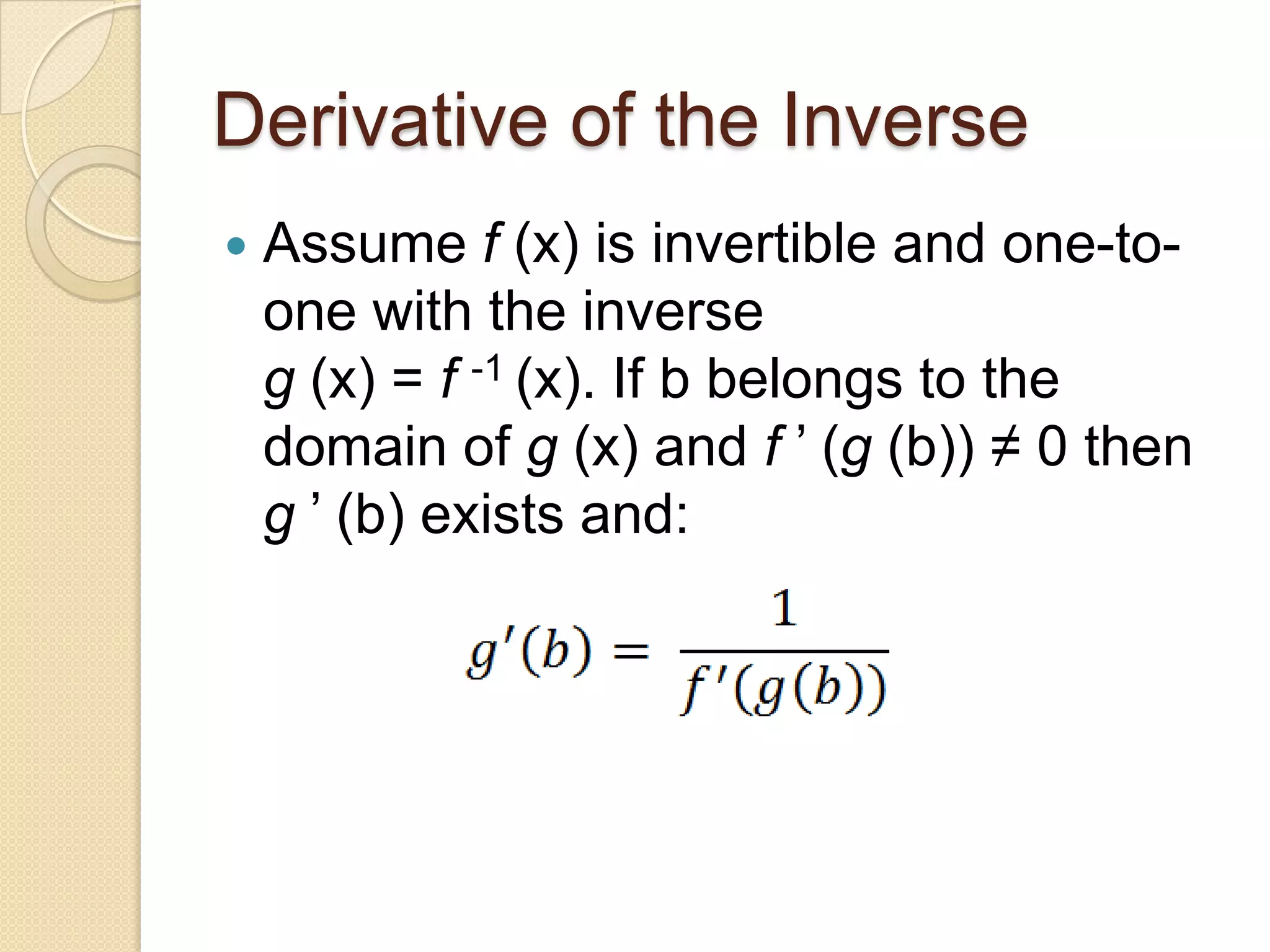
Derivative of the Inverse
   Assume f (x) is invertible and one-to-
    one with the inverse
    g (x) = f -1 (x). If b belongs to the
    domain of g (x) and f ’ (g (b)) ≠ 0 then
    g ’ (b) exists and:

Inverse functions

  • 1.
  • 2.
    Definition  Let f(x) have domain D and range R. The inverse function f -1 (x) (if it exists) is the function with domain R such that  f -1 (f (x)) = x for x ϵ D  f (f -1 (x)) = x for x ϵ R  If f -1 exists then f is called invertible.
  • 3.
    Example: Linear Function Let f (x) = 4x – 1. Find f -1 (x) and show that f (x) is invertible.  f -1 (x) = ¼ (x + 1) x f (x) x f -1 (x) 0 -1 -1 0 2 7 7 2 -2 -9 -9 -2 3 11 11 3 171 683 683 171
  • 4.
    Example: Linear Function  Graphs of f and f -1
  • 5.
    Horizontal Line Test y= x2 is not one-to-one y = x3 is one-to-one
  • 6.
    Example: Function withno Inverse  y = x2  Is y = √x the inverse??  Is y = ±√x the inverse? x y = x2 x y = √x x y = ±√x -2 4 4 2 4 ±2 -1 1 1 1 1 ±1 0 0 0 0 0 0 1 1 1 1 1 ±1 2 4 4 2 4 ±2
  • 7.
    Example: Function withno inverse  Graph of f and f -1
  • 8.
    One-to-one Function  Definition: A function f (x) is one-to- one (on its domain D) if for every value c, the equation f (x)=c has at most one solution for x ϵ D. a c Domain of f = Range of f -1 Range of f = Domain of f -1
  • 9.
    Theorem 1: Existenceof Inverses  If f (x) is one-to-one on its domain D then f is invertible.  Domain of f = range of f -1  Range of f = domain of f -1
  • 10.
    Derivative of theInverse  Assume f (x) is invertible and one-to- one with the inverse g (x) = f -1 (x). If b belongs to the domain of g (x) and f ’ (g (b)) ≠ 0 then g ’ (b) exists and: